
Literary Vibes - Edition CLXIV (24-Apr-2026) - POEMS
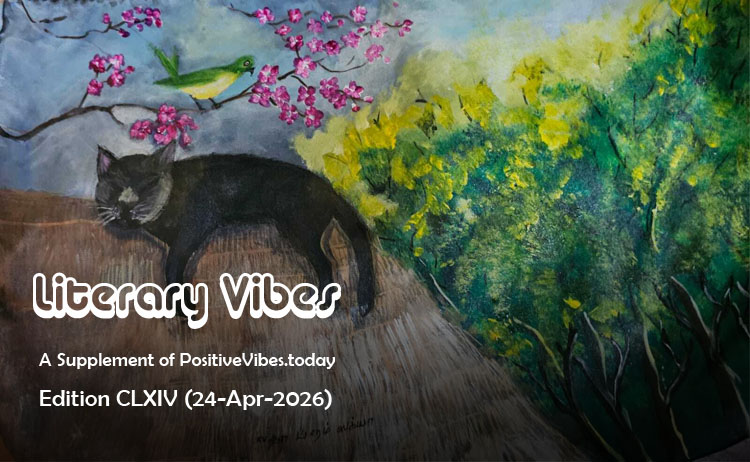
Title : Bliss or Cat On the Rooftop. (Acrylic on Canvas Lathaprem Sakhya)
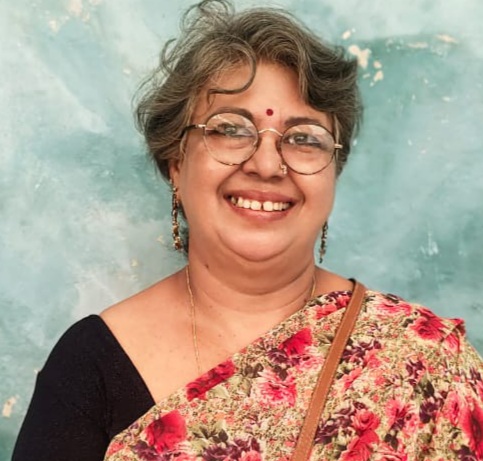
An acclaimed Painter, a published poet, a self-styled green woman passionately planting fruit trees, a published translator, and a former Professor, Lathaprem Sakhya, was born to Tamil parents settled in Kerala. Widely anthologized, she is a regular contributor of poems, short stories and paintings to several e-magazines and print books. Recently published anthologies in which her stories have come out are Ether Ore, Cocoon Stories, and He She It: The Grammar of Marriage. She is a member of the executive board of Aksharasthree the Literary Woman and editor of the e - magazines - Aksharasthree and Science Shore. She is also a vibrant participant in 5 Poetry groups. Aksharasthree - The Literary Woman, Literary Vibes, India Poetry Circle and New Voices and Poetry Chain. Her poetry books are Memory Rain, 2008, Nature At My Doorstep, 2011 and Vernal Strokes, 2015. She has done two translations of novels from Malayalam to English, Kunjathol 2022, (A translation of Shanthini Tom's Kunjathol) and Rabboni 2023 ( a Translation of Rosy Thampy's Malayalam novel Rabboni) and currently she is busy with two more projects.
Dear Readers,
Welcome to the 164th edition of LiteraryVibes. It comes carrying the warmth of April. Somehow I feel more comfortable with April as a welcoming month, the beginning of the financial year. For people like me living on pension, April gives a double gift - one pension (without tax deduction) at the beginning of the month and another instalment on the last day of the month. For me it seems like an awesome bonanza! It fills my small world with abundant joy - an ample compensation for all the sweat and tears of the days of service in government. Not for me T. S. Elliott's April the cruelest month of the year!
On 5th April, a Sunday, when power had gone off in my locality for four hours I spent some time listening to old songs. I always do it with the video clip on. A song that seized my heart with a nostalgic grip was "Kuchh dil ne kahaa" from the old film Anupama - Sharmila Tagore pouring her heart's love to Dharmendra. Her exquisite gait, the shaded outdoor light, the trees, the leaves swaying in a gentle breeze took me to my adolescent days when the heart yearned for the elusive love and weaved a thousand dreams. I somehow felt it must be early April when the tender sunshine filled the world with a magical warmth that the heroine of Anupama would have felt her heart overflowing with love.
And after a few minutes I came across a beautiful story forwarded in my WhatsApp group. It is about the loneliness of old age. I simply loved it. It touched me because a day earlier I had gone for a family function when I felt terribly lonely in the crowd of friends and relatives, most of whom passed me by after a perfunctory greeting. My wife could feel my void, she tried her best to stay by my side and both of us realised how increasingly lonely we have become in the recent years.
Let me reproduce the story here. The author is unknown but whoever she is, my salute to her for writing an outstanding snippet of life.
HOW DOES A WIDOWER SPEND HIS TIME?
I run a small café on the corner of Maple and Third.
It’s not fancy. Just a few wooden tables, warm lighting, and the kind of place where regulars feel like family.
That’s why I noticed him the first day he walked in.
He was older, maybe late seventies. His coat was worn at the sleeves, his shoes scuffed. He walked slowly but with dignity.
He ordered the cheapest thing on the menu: a small black coffee.
Then he sat at the table near the window.
For three hours.
He didn’t scroll on a phone. Didn’t read a book. He just sat there, occasionally watching people pass by outside.
The second day, he came again.
Same coffee.
Same table.
Same three hours.
By the end of the week, some customers began whispering.
“He’s taking up space.”
“If he’s only buying coffee, he shouldn’t sit that long.”
“Is he homeless?”
But something about him didn’t feel intrusive.
He always said thank you. Always cleaned his table before leaving. Always left a few coins as a tip — even when I could tell that coffee was probably stretching his budget.
So I let him stay.
One afternoon, when I brought his coffee, I added an extra slice of bread.
He looked up at me.
“I didn’t order this,” he said gently.
“It’s on the house,” I replied.
He hesitated — then nodded. “Thank you.”
The next week, I added a small bowl of soup.
Then sometimes dessert.
He never asked for anything more than that coffee.
He never complained.
He just sat quietly, like the café was the only place he felt safe.
Over time, I learned his name was Walter.
His wife had passed two years earlier.
“I don’t like the house when it’s quiet,” he once told me. “Here, there’s life.”
That sentence stayed with me.
He wasn’t coming for food.
He was coming for noise. For warmth. For the feeling of not being alone.
Then one day, he didn’t show up.
I told myself maybe he was sick.
The next day, still nothing.
A week passed.
Then two.
I caught myself glancing at the door every afternoon at exactly 2:15 p.m. — the time he always walked in.
A month later, a woman about my age entered the café.
She looked around like she was searching for something.
“Are you the owner?” she asked.
I nodded.
“My father used to come here. Walter.”
My stomach dropped.
“He hasn’t been in for a while,” I said quietly.
She smiled sadly.
“He passed away last month.”
The words hit harder than I expected.
“I’m so sorry,” I said.
“He talked about this place constantly,” she continued. “He called it his ‘second living room.’”
She reached into her bag and pulled out an envelope.
“He left this for you.”
My hands trembled slightly as I opened it.
Inside was a handwritten letter.
It read:
To the kind café owner,
You may not realize this, but you gave me more than coffee. After my wife died, the days became very long. I didn’t want to burden my daughter. I didn’t want her to see how lonely I was.
Your café gave me something to wake up for. The extra bread, the soup — I knew it wasn’t random. You saw me. At my age, that matters more than anything.
Thank you for letting an old man take up space.
— Walter
There was also a small check.
Not a huge amount, but more than he had ever spent in my café.
“For the kindness fund,” his daughter said softly. “He wanted you to use it to help someone else who might need a place to sit.”
I had to turn away for a moment to steady myself.
After she left, I walked to the window table — his table.
The chair was empty.
But it didn’t feel empty.
The next week, I put up a small sign near that window:
“If you need a warm place to sit, you’re welcome here.”
No minimum purchase required.
Since then, a few people have taken that seat.
A college student studying between jobs.
A widow who brings knitting.
A man who just needed quiet.
And every time I bring them coffee — sometimes with a little extra bread — I think of Walter.
He came in every day and ordered the cheapest thing on the menu.
Some people thought he was taking up space.
But he taught me something simple and powerful:
Sometimes the most valuable thing you can give someone isn’t food.
It’s permission to not feel alone.
And sometimes, the quietest customers leave the loudest impact.
Hope you liked the above story as much as I did. Please share the LV164 with all your friends and contacts through the following links:
https://positivevibes.today/article/newsview/634 (Poems)
https://positivevibes.today/article/newsview/633 (Short Stories and Anecdotes)
https://positivevibes.today/article/newsview/632
(Young Magic)
Hope you remember that all the 164 editions of LiteraryVibes are available at https://positivevibes.today/literaryvibes
Please post your feedback in the Comments Box located at the bottom of the relevant page.
My sincere thanks to all the poets and writers - some of them appearing for the first time on the pages of LiteraryVibes - who have toiled to contribute a gift to the readers, to make the world feel a little less lonely for them. And you, the readers, deserve our gratitude to let us feel we are making a difference, no matter how small, by bringing a smile to your lips.
Relax with LV in one hand a glass of sweet lassi in the other. Take care, stay safe. We will meet again with the 165th edition of LiteraryVibes on 29th May, the last Friday of next month.
With warm regards
Mrutyunjay Sarangi
Editor, LiteraryVibes
Bhubaneswar, Friday, the 24th April 2026
Table of Contents :: Poems
02) Dilip Mohapatra
TAME THE FLAME
CEASEFIRE
03) Abani Udgata
A POEM : AN ECHO IN VOID??
04) Dr Malabika Mitra
DUST OF SPRING
05) Shreya Suraj
THE UNTOUCHABLE
06) Anindita Sen
HYPNOTISM
THE TRANSIENT INSTANT
THE ASCENT
SADISM
07) Sreekumar Ezhuththaani
WHAT THE POEM REVEALED
WITNESS IN GREEN
08) Avantika Vijay Singh
STRAIT OF HORMUZ
09) Pradeep Kumar Biswal
REUNION
FLAMINGO
10) Manjula Asthana Mahanti
RAINS
11) Baldev Samantaray
ECHO
12) Braja K Sorkar
PARTICLES OF GOD
INDIFFERENT
SPARKLING IN HER EYES
13) Lata Krishnan
THIS MOMENT ALONE LIVES
14) Snehaprava Das
AFTER THE WAR
15) Matralina Pati
TO MY LOST FISH
16) Kunal Roy
TRUTH
17) Nandini Mitra
THE LASTING HUES
18) Anindita Ray
YOGURT RICE AND SUMMER WINDS
19) Susan Kurien
THE GREAT EGRET
20) Ajit Dash
SRIRAM
21) Aneek Chatterjee
DURING THE RAINS
22) Sathya Venkatesh
THE CHILD IN ME
23) Padmini Janardhanan
INTEGRATION
24) Ms Gargi Saha
DIFFERENT SEASONS
ROADS
STRANGE FRIENDS
25) Bipin Patsani
CRISIS OF IDENTITY: THE ORIYA ROOT
IF VALMIKI IS TO BE QUESTIONED
26) Dr R. S.Tewari
DEMON`S SINFUL SHATTER
THE WORLD IS MISTAKEN
27) Dr. Rajamouly Katta
‘LOVE’, THE VOICE TO UNITE ALL
28) Mrs. Setaluri Padmavathi
A WOMAN I ADMIRE....
24) Satish Pashine
BEGIN WITH THE BED
PASSION AND LOVE
29) Tophan Khilar
IF YOU HAD SPOKEN
30) Harisankar Sreedharan
A NICKNAME
31) P. S. Sowmya
MR. DOG ON THE MEDIAN
BEE YOURSELF
32) Dr. Niranjan Barik
WHEN SPRING TURNED
33) ParashuramRao Gande
NATURE`S BOON
34) Dr. Mrutyunjay Sarangi
ELSEWHERE
Prabhanjan K. Mishra
A letter from you lie un-opened.
I fear its contents
could drown me
in sorrow, the last straw
for my weak back.
Letters I would wait holding breath -
a word, a metaphor, a line from a poem,
also may arrive a white A-4 folded neatly
containing a single petal,
your mood said in colours.
A letter that I once opened
contained a hammer. I dodged
your epitaph like line, "Sorry,
to live too long." And I replied
sending a small parakeet feather.
I recall the one that had bowled me
into your pitch, read, "I reciprocate.”
The two words I spent weeks to interpret,
had to cross a thousand miles
to decipher; I scored my first sixer.
And the one that arrived today,
written before you gave up the ghost.
It lies unopened. I fear its contents-
your last wish in a word half articulated,
could be our unfinished story.
Prabhanjan K. Mishra
A word, hated
symbol of negativity
of negation
But say 'No' to wage a war
no to bombing civilizations
no to carry your personal grudge
weaponizing it in public domain
That no would
be God, would be hope,
be the saviour.
A 'no' could have saved
Hiroshima, Nagasaki.
Respect 'No' of a woman
having the depth of oceans
height of hills, resolve
of the Devil, curse of hell.
That no worships a mother
empowers sisters and daughters
restores half of the wasted power
Learn to say 'No'
to whom, for what, and when
Learn to say 'No' than a lie
A timely no is a stitch in time
saves nine-million excuses.
(END)
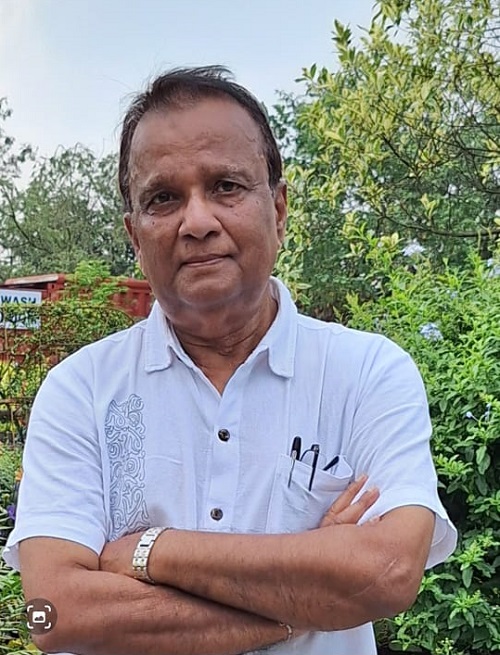
Prabhanjan K. Mishra is an award-winning Indian poet from India, besides being a story writer, translator, editor, and critic; a former president of Poetry Circle, Bombay (Mumbai), an association of Indo-English poets. He edited POIESIS, the literary magazine of this poets’ association for eight years. His poems have been widely published, his own works and translation from the works of other poets. He has published three books of his poems and his poems have appeared in twenty anthologies in India and abroad.
Dilip Mohapatra

Don’t let the candle burn
at both its ends
for you may never know
the end of the game—
before it’s too late
tame the flame.
Recognise your inner fire—
your unbridled desire
and sparks of passion
which begin with a flicker
and then flare up to
become an inferno
threatening to engulf
the world around you
pause for breath—
quell the flame.
As the specks of anger
and hatred
rear their hoods
in your inner recesses
and threaten to become
a raging blaze
don’t let them
move up to your third eye
keep it shut and
contain the flame.
You let your ego and vices
burn into cinders
in the hermit’s sacred fire
and feel purged
and reborn from the ashes
but don’t let the arsonist
within you
run amok—
subdue the flame.
But if you have wings of wax
don’t you dare
to fly too close to the sun
lest you meet the fate of
Icarus—
for you must know
that you just can’t ever
tame this flame.
Dilip Mohapatra

The sirens are silent
the canvas of the skies is bereft
of streaks of fire and fury
as the maggots crawl
out of the hollows of the skulls
half buried in the rubble
the sobs echoing around
slowly ebbing into
sighs of relief—
yet no one knows
if the subterranean lava
has cooled down
or if the ugly hood of
the hissing cobra is subdued
and if the paranoia and duplicity
are bottled up.
Amidst the uncertain certainties
and certain uncertainties
the world wobbles about its axis
as it continues to spin
while the sun moves along the ecliptic
and doesn’t bat an eyelid
one doesn’t know
what tomorrow would bring
as the embers smoulder
beneath the throbbing ashes
under the thick black smoke
curling up from the
charred carcasses
strewn around—
While one finger is on the
pause button
the other is still on the
trigger!
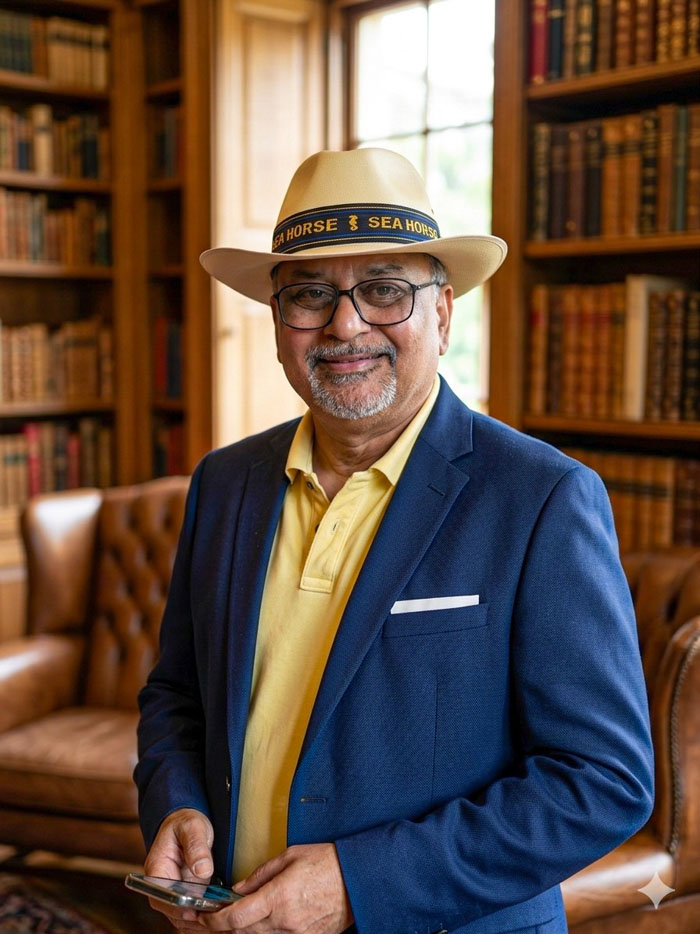
Dilip Mohapatra, a decorated Navy Veteran is a well acclaimed poet in contemporary English and his poems appear in many literary journals of repute and anthologies worldwide. He has nine poetry collections, two short story collections and two professional books to his credit. He is a regular contributor to Literary Vibes. He the recipient of multiple awards for his literary activities, which include the prestigious Honour Award for complete work under Naji Naaman Literary Awards for 2020. He holds the honorary title of ‘Member of Maison Naaman pour la Culture’. He lives in Pune and his email id is dilipmohapatra@gmail.com
Abani Udgata

….poetry makes nothing happen: Auden
Words that weave and dance, yet fall
Silent in the void, no echo at all
Auden's whisper cuts through time's haze
In streets of strife, where voices rise
A page turns quiet, no battle cries
The poet's craft, a fragile thing
Weaving threads that unravel,
Dreams pinned to paper, breath, and bone
Do they shift the world's stubborn stone?
Poets pen shadows,
Yet words remain, like bones picked clean
Echoes of what was, what might have been
The page absorbs the tears we hide
Ink runs like blood, but
Does it feed the hungry, heal the wound?
Or merely mirror what we've lost, profound?
poetry makes nothing happen, he said
Yet here we are, by words led
Through darkness, glimpsing light
A fragile thread.
In the silence, a voice may rise
A phrase, a line, a whispered promise.
Perhaps it's enough to hold the pain
To shape the void, to make it sane
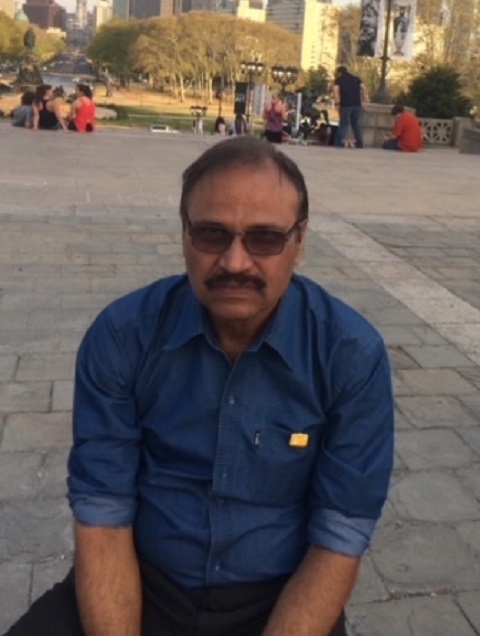
Abani Udgata lives in Bhubaneswar. Writes poems both in English and Odia. Udgata has been awarded in all-India poetry competitions and published in anthologies. He has been a regular contributor to LV. Email: abaniudgata@gmail.com
Dr Malabika Mitra
in spring, not autumn
the goddess of freshness arrives -
bringing along
young leaves, pretty flowers, sparkling rivers
all things brimming with life, love
lush, pregnant and green…
yet, this spring feels like autumn
the fading away with age
now green has dulled
covering leaves and flowers
with layers and layers of dust
unwashed by rain
mother calls to say, “Spring is dead!”
is it her spring, youth or life -
“Dust on leaves
Gone are the colours of spring
I am going to die”
her soul is parched
with longing and thirst
that she alone feels
-we cannot surmise
gone is her love
spouse for more than fifty years,
her spring has truly died
like sand in the desert
she feels drenched by dust
the dust-fed green
has robbed the brightness of spring
like the leaves outside
our soul, sings a song
of autumn in this spring -
covered in myriad dry and dead emotions
no longer bright emerald green
it has lost its sheen
dust on leaves
dust on souls
dust from construction, metro work and roads…
dust from pain, corruption and load
can the rain cleanse the dust?
can love wash the pain away?
will colours shine bright in another spring?
when will love and life dance hand-in-hand again…

Dr. Malabika Mitra, is a former newsreader with Doordarshan and went on to head corporate communications in Chennai. An alumna of National University of Singapore, she pursued a doctoral degree on a very feminist topic. She has co-authored two books on the Bodos of Assam and her other three books are in English literary criticism for graduate level.
Intertwined, an anthology, is her sixth book. Dr. Mitra has been widely anthologized.
Shreya Suraj
“Don’t enter this room"
“Don’t touch my things
“Don’t pray,”
they build walls
around a cycle of life.
They lower their voices
when it's that time of the month
as if her body
is a secret to hide.
The same blood
which created them,
is now shame
when it flows from her.
She is asked to sit apart,
like I have become
something less
as if the woman
has become impure.
But this monthly cycle
is not a curse,
not a stain,
not a sin to whisper about.
It is life
arriving quietly,
leaving quietly,
reminding me
of the power I carry
as a woman.
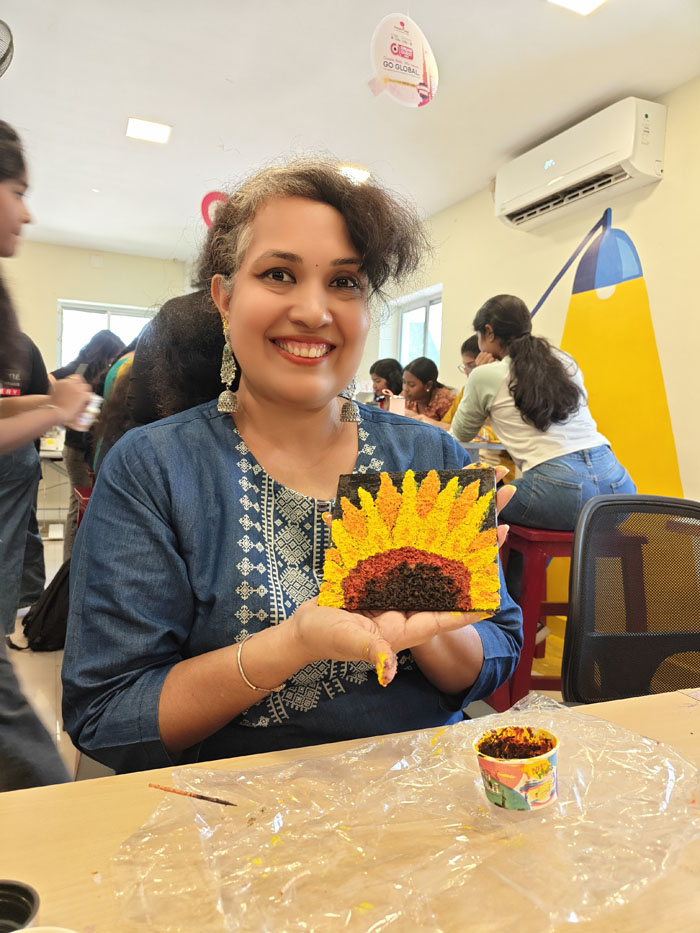
Shreya Suraj is a mathematician, artist, photographer, poet, and environmentalist. She is the founder of the global art group Anybody Can Draw on Facebook, which has grown to a community of over 30,000 members. She has conducted more than 300 art workshops worldwide and has actively participated in over 400 beach clean-up drives in Qatar. In addition, she volunteers in tree-planting initiatives and sustainability campaigns. Deeply passionate about creative expression and nature, she believes that we have one Earth and that it is our collective responsibility to protect it for future generations.
Anindita Sen
Still alive a few greeneries
Words of emotion and verdure
With raindrops and morning hymn
Listening to the secrets of whispering trees
The water clad meadows
Woven in green reverence
An azure canopy of celestial silk
Woven with the threads of a dream
The splattering rays of setting sun
A deep green illusion in the twilight dark
Oh! At last, the grey defeated saffron
Intermingled with blue and green
The shadow of swiping wings of a kite
The day is entirely hidden within
Embraced by the sweet trance of serenity
Drifted on a mesmeric emerald dream scape!
Anindita Sen
When the illusory counting of days dissolves,
And untimely rain falls in the waning afternoon,
An endless monologue within the heart’s domain
Stirs a tempest, painting the twilight in wild hues.
With slow, rhythmic, evening footsteps,
A silent eloquence draws near,
Drenching the deepest, hidden chambers of the soul—
That lonely, fleeting instant.
Anindita Sen
You once dreamt of a soaring ascent,
To cast unfulfilled desires upon the wind,
To grasp the silver shadow of the moon,
And cloak yourself in fine, powdered starlight,
Flying far beyond the azure horizon.
Yet, you never deemed such days possible—
When the satchel of life is overflowing with gain,
Yet an untouchable darkness still lingers,
A void, numb and indifferent in the depths of feeling,
Rowing the boat of pain, to finally touch the edge of death.
Anindita Sen
Amidst the nameless shadows of this concrete cage,
I take a long flight before the final act of rage.
A surrealist parade where raw harshness thrives,
Living hand-to-mouth, fracturing orderly lives.
Measuring distances, I break the rigid, calm design,
No peace is found, yet awakening, I cross the line.
An adversary sought in the, isolating, silent deep,
Listening to the cadence of sadism as secrets creep.
Wounded dignity hunts for words that softly chime,
As midnight birds call out within the barren time.
Upon the hem of darkness, wet souls I lay to rest,
Cloaked in sterile thought, a hollow, phantom quest.
An endless flowing out!

Anindita Sen is a bilingual published author and Translator.She has published seven collection of poetry and four novels in her credit. She is a well known translator, a regular contributors to various literary journals in English as well as in Bengali. She was awarded a few literary awards. As a profession, she was a Biology teacher associated with Hem Sheela Model School based at Durgapur, West Bengal.She lives in Asansol, West Bengal.
Sreekumar Ezhuththaani

A bunch of stray words
A sheet of paper
A pen
And I
leaning into the fatigue of a bench,
turning over the same questions:
what should be written,
and what’s the need?
The edges of things begin to fail.
Sight loosens.
The page withdraws
Even the light
thins out and leaves
I am left
to feel my way through nothingness
With a chocking that blinds,
time passing without mercy
Then—
light returns,
not to rescue, but as expose.
On the paper
A couple of lines
In free verse.
The pen and the page
seem to be holding back laughter:
“We didn’t disappear.
It was you who slipped out
While you were gone,
we fastened you here—
inside these lines.
Now the page
stands like a mirror
that refuses distortion.
I look—
and what stares back
is my life,
stripped of pretense,
unfamiliar,
almost grotesque.
When a poem is truly written, the poet ceases to be present within it. Good poems are not written by anyone; rather, they come into being on their own. The poet’s personality does not exist in the poem, nor should it.
However, once the poem is completed, it becomes a mirror for the poet as well. When society confronts its distorted face in that mirror, the poet, too, must be able to see his own reflection there.
Sreekumar Ezhuththaani
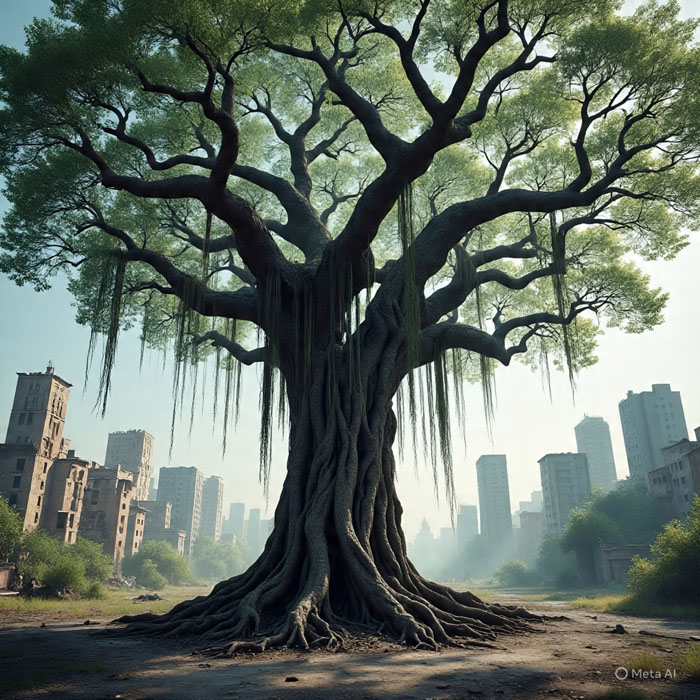
How ancient, how burdened this city
I arrived only yesterday,
and already it pressed upon me.
In the burning month of April, in Mumbai,
the heat did not merely fall
it entered,
settled inside the ribs,
refusing to leave.
Not a cloud anywhere.
Not even the suggestion of mercy.
By the roadside,
a banyan tree stood
its shadow stretched out
like an old man calling
to someone who has no choice but to stop.
Who planted it?
Who watered it into this vastness?
How many decades
did it take to become this silence?
I sat beneath it,
the entire afternoon dissolving
into its dim, reluctant coolness.
Once, they said,
this city tore itself apart
riots splitting through its streets,
lives extinguished without ceremony.
Those memories
thick, blood-soaked,
held somewhere in time
do they wait?
Do they return?
A small wind passed.
Not relief, but a heaved sigh
only movement.
It slipped by like something
that did not wish to be noticed.
And in it,
there was the weight of recollection
the city exhaling
what it could not forget.
Not rain.
A gentle shower of
dust-like drops
descending without sound.
Everywhere else,
the sky withheld itself.
But from the banyan alone
this pale shower fell
as if the tree remembered
something the sky refused to.
I looked up.
Branches spread like a net
that had caught too much.
An old man passed by.
I stopped him.
“For decades now,” he said,
“this tree has stood here,
giving shade like this.
A small wind is enough
and it sheds this dust,
like an old body
loosening itself.”
Then he went on,
as if speaking to the tree as much as to me:
“How many riots has it seen?
How many bodies
have rested beneath it?
For how many dead
did it open its shade?”
The stories did not end
they circled,
thickened,
refused to settle.
For a moment,
it was just the three of us
the old man,
the tree,
and something unnamed
lingering between us.
Then I left.
Before I did,
a drop clung to my lips
banyan dew,
or something that resembled it.
I tasted it.
It was clear.
But the salt remained.
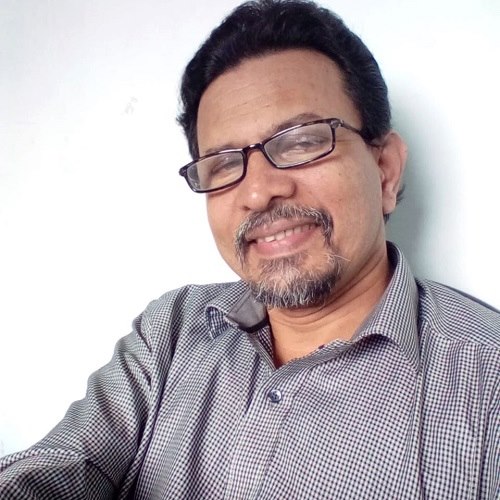
Sreekumar Ezhuththaani known more as SK, writes in English and Malayalam. He also translates into both languages and works as a facilitator at L' ecole Chempaka International, a school in Trivandrum, Kerala.
STRAIT OF HORMUZ
Avantika Vijay Singh
We are indeed in dire straits
as closes the Strait of Hormuz—
No LPG cylinders to be found.
Standing in queues for hours
under the burning sun for gas
to keep the stoves burning.
A cup of tea is all he desires
for it’s his time to take tea
as he does on all days—
a ritual that gives him comfort,
that all is well in his world
for nothing is well in his world
and the tea gives him some control
over things he cannot control.
But today there is no gas,
And I sense the storm coming—
his rapid pacing, his hands flapping.
Can straight talk help him?
No darling! Hormuz is not open
And I cannot light the wood for tea,
I can only light it for a meal.
Ha! Can he comprehend?
Does it even matter to him?
But they can.
Can some straight talk help, please—
on the Strait of Hormuz to which all sides agree.
I just want my child’s straits to ease.

Avantika Vijay Singh is a communications professional, wearing the hats of a writer, editor, poet, researcher, and photographer. She has authored two solo anthologies, edited three anthologies, and has been published in national and international journals. She received the Nissim International Award Runner Up 2023, WE Gifted Poet 2024, and WE Illumination Award 2024.
Pradeep Kumar Biswal
After many years
We met again
In a spring afternoon
The bougenville bloomed bright
And the mango tree
Was laden with panicles
A sweet smell
Was pervading the air.
We came closer
With expectant eyes
The sky tumbled down
On the eagerly earth
For few seconds
The world seemed motionless.
The musky earthy smell
Of the sweating skin
Smiled in silence
Whispering sweet nothings.
We rediscovered
Our lost memories
In a salty island
Long long ago
When our tender hearts
Throbbed for each other.
Life has come
A full circle
For both of us
Now in our sixties.
Pradeep Kumar Biswal
Last winter
You came here
Crossing thousand miles
In search of a nest.
We met for a while
In the brackish water
Your golden attire
Dazzling in the winter.
Chilika is no heaven
But you made it one
With your presence
I got mesmerised.
We pecked each other
In soulful silence
The sky was falling
To pieces around us
We never noticed
In our oneness .
Where are you now ?
France Spain
Greece or Germany ?
I’m in perpetual waiting
For our next meeting
Which may or may not .
* ( Flamingoes flock to Chilika lake in Odisha every winter for nesting )

Pradeep Biswal is a distinguished bilingual poet, translator and editor. He has nine poetry collections in Odia and three in English. His poems have been translated into Hindi, Telugu, Punjabi, Assamese and Malay languages and got published in separate volumes. He’s the curator of Toshali Literature Festival and editor of monthly web magazine kabitalive.com. A retired IAS officer, he’s staying with his family in Bhubaneswar.
Manjula Asthana Mahanti
Tip, top, tip, tipir, first rain drops
Like rhythmic tinkling of anklets
Indications of joy, smiles enjoy
Heavy thunder as if, clouds play Mridangam
Naughty lightening dances fast with cracks
Announcement of more rains
Birds gliding in the sky, like multicoloured kites
They have tremendous power
To introspect need of the hour
Within seconds, all disappeared
Took shelter in their respective abode
Pleasant weather, scented aroma, inspires
Peacocks dance with open tails,
Enticing gallor of rare colors
Rainbow spread in the sky, alluring beauty
Seven colors shine,as if whole sky dyed
Pouring, water filling river, ponds, fields
Greenery smiles
Green Earth, water everywhere
To quench the thirst
Heavy rains, nothing could be seen
People imagine the scenes, yet unseen....
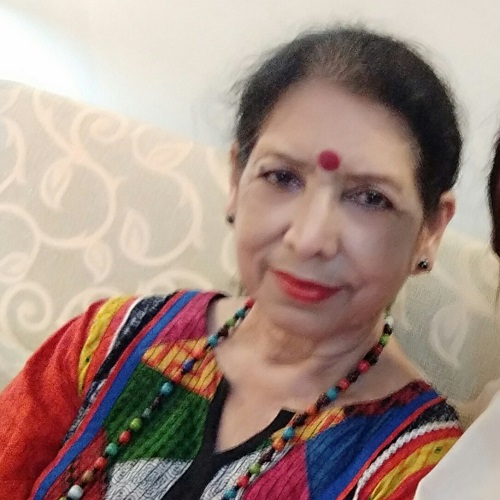
Manjula Asthana Mahanti is a post graduate in Sociology and Hindi. Her Graduation was in English honors. She is a Sangeet Prabhakar (vocal) and has done her B. Ed. She worked in a college as Senior Lecturer. Her last assignment was that of a high school Principal. She lives in Forest Park, Bhubaneshwar, Odisha, India.
She is a published trilingual poet, author, editor, translator and story teller. She has eight collections to her credit along with a long list of participation in national, international anthologies, e-magazines, etc. She is a recipient of several national, international awards, Samman Gujarat and Telangana sahitya akademy award amongst many more. Her recent award was "Icons of Asia"
Baldev Samantaray
Sometimes I move deep
into the forest
to talk with the trees
and to touch vales
down below
with loud hiccups
and to ruffle the blades of grass
with tear drops.
But it all comes back
with an echo
My whispers are mine
and the mountain mist
singes my face
even touches my eyes.
Like the roaring ocean
they return all things
thrown at them
it reaches the shore
and touches our naked feet.
They cannot borrow
your sorrow
They do not keep debt
They cannot pay the price
They cannot deliver peace
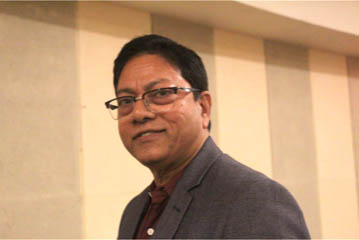
Baldev Samantaray is a retired banker who lives in Bhubaneswar. He did his post graduation in English literature from Ravenshaw College (76-78).He started writing from his Ravenshaw days. Many of his poems appear in various journals and anthologies.
Braja K Sorkar
Innumerable faces of various colors,
of various shapes,
Faces of different sizes are gradually
moving forward
Towards a deep pit.
Whose face!
Looking closely, I see so many faces of mine
Walking pale and dirty!
I have known what is on the other side
of the moon for a long time.
This aging world is being sent into the abyss
by warlike insects
The honed techniques of artificial intelligence
awaken in the nervous system.
The appearance of each of my faces
is gradually changing,
I can clearly see a god particle
running along a dead gal
Braja K Sorkar
Looking behind the past
I often miss her, but never
Lost her anyway.
When I study her,
a man, of good heart
indulged me in the broken heart…
My Wedding night often hurt me
in my dream.
I remain indifferent…
Braja K Sorkar
Today, after many days, I met her in
thunder and storms !
Everything was burning in the heat of summer.
Winter came and went away with tears.
Rain has arrived as a season ,
offered water for a while
and soaked my soul.
leaves are dancing in the rain.
I bowed down to water.
Other name for water is God ,
She once said.
Who is this God?
Can He or She live without water?
Is God also like me?
I asked her.
From Ganges to Sindhu, from North to South Pole,
From the skies to the bottom of the seas ,
I have been floating on water
since time immemorial...
How many civilizations have been washed away
by tears, how many hundreds of lives are crying for
a drop of water, and I have also seen a vessel
is floating on the river Nile, carrying people with
empty hearts!
Today, after a long time, the rainwater again
tenderly touches her body in the hot summer noon.
The ground has turned cool again for a while.
A clear stream of water is sparkling in her eyes...
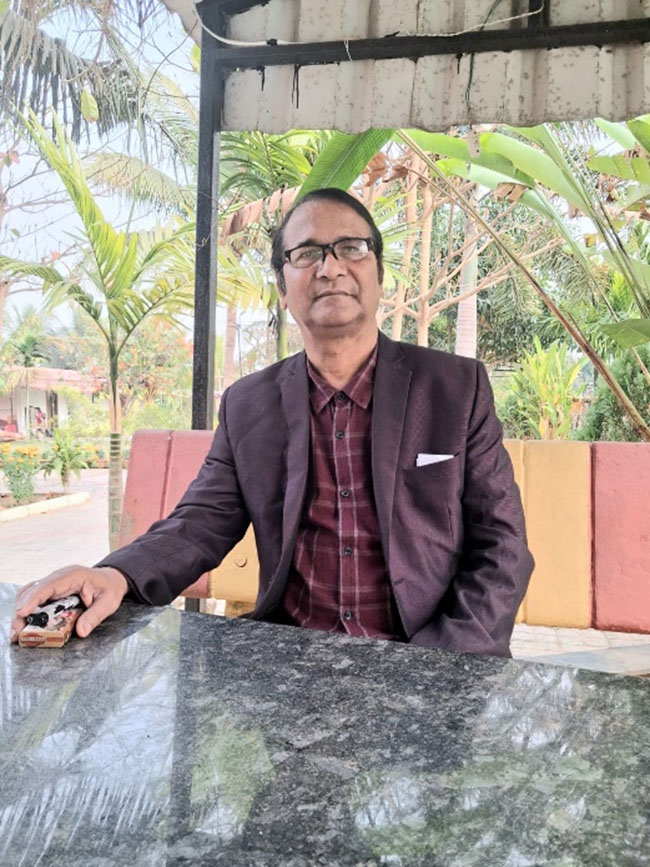
Braja K Sorkar is a bilingual author, poet, Essayist, and Translator. 10 Titles have beenpublished in his credit and a highly acclaimed poetry collection in English, titled ‘ Syllables of Broken Silence(2021) for which he received ‘The Indology Award’(2021). He has edited a prestigious literary magazine in Bengali ‘Tristoop’ since 2001 and an International English literary journal’ Durgapur Review’ since 2023. He edited an International Anthology of World English Poetry, titled’ Voices Now: World Poetry Today’ (2021). His poems have been translated into many languages. He lives in Durgapur, West Bengal. Contact: email: brajaksorkar369@gmail.com. And brajakumar.sarkar@gmail.com Whats App: 9064231839
Lata Krishnan
Life is uncertain,
We never know the fall of curtain.
Ones with whom you shared,
Your dreams to own,
May leave any moment,
Without so much as a moan.
Life slips out like a lightning,
Without a chance for fighting.
The parent whom you planned,
To call tomorrow,
May breathe out his last,
Without air to borrow.
There is only Now,
to express your love;
even the next minute is far,
and you never get to figure the how.
All the bitter anger, grudges and sadness,
mean very little,
when the victim itself goes missing.
life is fleeting, so they say,
the bitter truth to face every day.
The house we built,
The loan we took,
The stress we faced,
All in a second is erased.
While some stay languishing in bed,
their caring partner leaves much ahead.
whom can you depend,
To walk with you?
When everyone is a prisoner,
In destiny’s view?
This moment alone lives,
To smile, laugh or cry,
To think good and share happiness,
At least let’s give it a try.
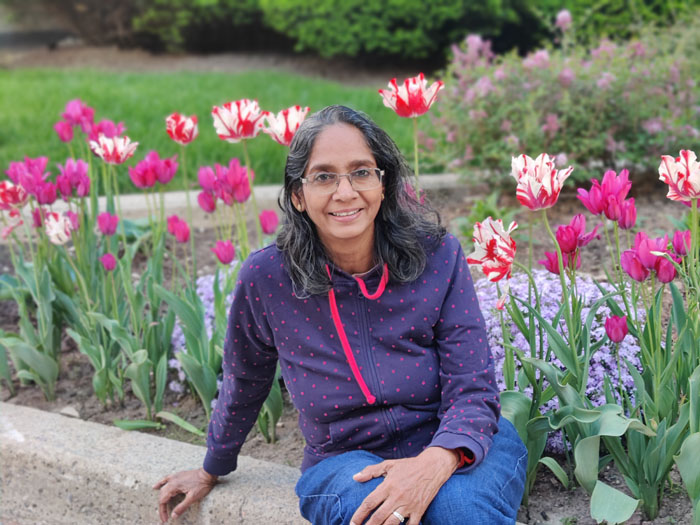
Lata Krishnan is a writer presently based in Coimbatore, India. Having spent her growing up years in Kolkata, she became enamoured with poetries and litrature and started penning a few lines now and then. After finishing her education in Kolkata where she spent almost 32 years, she shifted to Chennai and many others cities due to demands of her office work as a Bank Manager. After her retirement from the banking industry, she decided to indulge in her love for writing. Her experiences with life reflects in her work. She explores themes of nature, life, love, and self- reflection. She is the author of the poetry collection "Strewn Petals of the Heart" which she published in 2023.
Snehaprava Das
Now that the war clouds
Begin to dissipate
Let us write love with
Our unshed tears
Let us write of the
Love that a martyred son's mother
Would crave forever
The dense moments of love
The girls in a misfortunate school
Would never know,
Let us write of the love the homes
Razed to dust were built with,
Love is a things with wings
That soars to the sky
When the lords of war keep
Their wrath bundled in amity,
Let us write of that love
That wipes the tears of the old eyes
The love that cleans the bloodstains
From the rubbles of devastated houses
That rebuilds a blown away bridge
To reconnect man with man,
Let us plant a sapling of love
And watch it grow and thrive
Under a cloudless sky,
Come, let us gather each other
In its arms of love
And sing a ballad of peace
And kiss the bullets good bye.
Dr.Snehaprava Das, former Associate Professor of English, is an acclaimed translator of Odisha. She has translated a number of Odia texts, both classic and contemporary into English. Among the early writings she had rendered in English, worth mentioning are FakirMohan Senapati's novel Prayaschitta (The Penance) and his long poem Utkala Bhramanam, which is believed to be a.poetic journey through Odisha's cultural space(A Tour through Odisha). As a translator Dr.Das is inclined to explore the different possibilities the act of translating involves, while rendering texts of Odia in to English.Besides being a translator Dr.Das is also a poet and a story teller and has five anthologies of English poems to her credit. Her recently published title Night of the Snake (a collection of English stories) where she has shifted her focus from the broader spectrum of social realities to the inner conscious of the protagonist, has been well received by the readers. Her poems display her effort to transport the individual suffering to a heightened plane of the universal.
Dr. Snehaprava Das has received the Prabashi Bhasha Sahitya Sammana award The Intellect (New Delhi), The Jivanananda Das Translation award (The Antonym, Kolkata), and The FakirMohan Sahitya parishad award(Odisha) for her translation.
Matralina Pati

Slick trails along
Gleaming eyes:
You fluttered
To and fro:
Gold-laden fins
Funnelled into
Kisses:
Or so it seemed :
This home,
This vacant day,
Lashes at me:
With absence.

Matralina Pati, is a PhD research scholar working on marginal Indian bhasha literature (UGC Junior Research Fellow), a bilingual poet and a translator from Bankura, West Bengal. Her critical and creative writings have been published on national and international platforms. She has authored a book of translations titled Monsoon Seems Promising This Year (selected poems of postmodern poet Rudra Pati translated from Bengali into English).
Kunal Roy

The elegant you are,
sharp and pointed,
fearless and awesome,
adored by the God,
hated by the humans!
Yet undivided you are,
uncompromising,
least adaptable,
able to shake the throne,
no matter how -
perilous the storm is!
You are tried to be shattered,
sliced into pieces,
burnt in the fire!
But you are PHOENIX!
Rising from the ashes,
burning the blue sky,
spreading the glow of DIVINITY!
You are Truth,
never befriends the deception,
the falsehood,
the illusion :
engulfing the heart
propelling into the darkness
of uncertainty,
of unfathomed,
of uneasiness!!
Kunal Roy has always been an ardent lover of literature. He has received various awards for his literary contributions. He is a poet and a critic of poetry. His works have been published both here and abroad. Currently working as an Assistant Professor of English Language and Communication in George Group of Colleges, Kolkata.
Nandini Mitra
When solitude embraces the day,
Silence stands as a pillar next to me
And golden sun lazily sets in the western sky,
Takes leave adorning an orange robe,
Like a saint in meditation.
Blue sky smiles back in multiple hues,
Only tranquility spreads its blanket cautiously,
Memories have faded,
They hang in my room
Like tattered posters after a ceremony.
Next morning I wake up wrapped up in your love,
Entire night you were awake in my dreams,
I felt your presence like lasting hues,
Through the darkest hours,
Yet a new morn made me bask in its glory.
Life keeps pushing my stubborn self,
I rarely complain,
While walking on a tight rope
I sharpen the edges of my heart ,
Balancing between hope and the lasting hues.

Nandini Mitra is a poet based in Kolkata. A post- graduate in English Literature from Jadavpur University. She is in the profession of teaching for last twenty -five years. She has published her first book of poetry,The Road To Tranquility, recently. Has worked as a freelance journalist for a prestigious Bengali magazine published from Kolkata. She is passionate about Music and is a trained classical singer. However, writing poetry has become an integral part of Nandini’s journey of life since 2011. She believes in the religion of humanity, compassion and love. She has a rich sense of metaphors and imageries and enthusiastic about weaving poetry relating to the realities of lives and the diversities of nature. Her poems have featured in various national and international anthologies.
Anindita Ray
Summers are waited upon,
like an old song we never forget.
The land turns dry,
air loses its softness,
and the sun settles in early,
stretching afternoons
into golden hours.
Appetites grow lazy,
school bells ring sooner,
office doors close early
leave before dusk, return before dark.
Mangoes arrive like childhood promises,
jackfruits spill their sweetness,
custard apples break open in our palms,
watermelons cool tired throats,
lemonades sparkle,
buttermilk soothes the heat.
Ceiling fans hum lullabies,
coolers borrow wind from the evening,
air-cons whisper away the blazing noon and restless nights
On the terrace,
mother’s age-old recipes wait patiently
red chillies, pickled vegetables,
pineapple slices laid out
as the sun performs its quiet magic,
turning heat into flavour.
Watery yogurt rice,
a manna from the heavens,
a few condiments alongside
pure bliss.
Summers are waited upon,
for the way they linger,
for the way they stay,
long after the heat has gone.

Anindita Ray is an India-based poet, short story writer, artist, and human resource professional. She graduated in Sociology and Psychology and later completed her Master’s in Social Work from the Tata Institute of Social Sciences, which continues to influence her ideologies and creative expression. She has hosted a solo art exhibition and primarily works with charcoal, oil, and acrylics. Writing poetry, short stories, and socially relevant articles allows her to articulate perceptions of life, emotions, nature, and women’s voices. Her work has been published in Indian and international platforms since 2017.
Susan Kurien
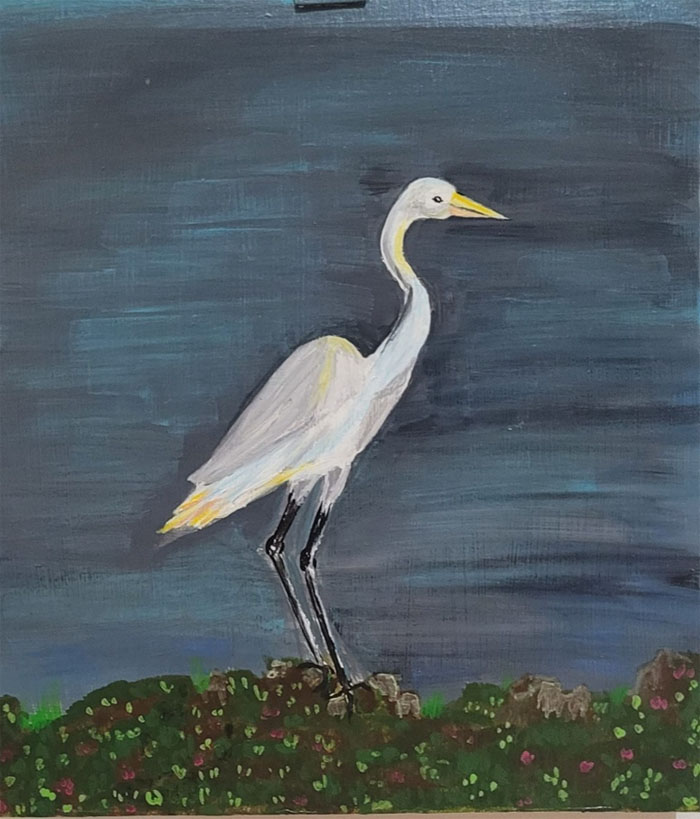
The sun has spread a soft warm hue
On placid lake and rocky pew.
A figure clothed in lustrous white,
You stand still in the quiet light.
With neck that’s arched in crescent curve
And dagger bill long, in hammered gold.
Your head seems lost in pensive thought
Of battles many you may have fought.
Long legged you stand in solitary pace
A harbinger of luck and divine grace.
Susan Kurien is former Deputy General Manager of Reserve Bank of India. She holds Post-Graduate degrees in English Language and Literature and Economics, along with an MBA in Banking. She has co-authored two educational books, ‘English for Everyday Life’ and ‘English made easy for Competitive Exams’. She recently brought out an anthology of stories from around the world titled “FABULA”. She is currently working on a sequel to this, on stories from the Indian sub-continent. Some of her poems have been published in the anthology of poems ‘What Else is Rain’. She paints and doodles during her free time.
Ajit Dash
Ninth day of Chitra Navaratra took birth
Nandan of crowned headed Kousalya
Seventh manifestation of Visnu banished
Respecting Father Dasarath’s boons
The warrior King’s capacity to fight ousts
Facing the Asuras in ten directions at a time
Warfare expert Keikeyi’s accompany
Sacrifices conducted by Rishyasrunga
Monthara’s influence, sage Valmiky’s history
As Ramayan, familiar in each walk of life
Sriram’s war against Kidnapper Ravan
Perform special worship the Maa SriDurga
Seeking Victory and Divine Favour and blessing
On testing his devotion one lotus hidden
Undeterred Kamalanayan was about to offered
His own eye as substitute to lotus
Sriram the embodiment of Dharma
Lotus
Written by Ajit Dash
Intense eye contact
On cross-legged sculpt
Caressing the petals of
White, Red and Blue beauty
Feelings a palmful flesh
Immersing her in Corpse pose
Unfolding and emitting with
Designed to attract pollinators
To test the honey drops in lips
Transmuting ROYGBIV in droplet
Lotus on laps of sun
Wrapping legs on waist
Interlocking and limbs
Allowing for unending wave
Started emotional intimacy
Face to face breathing out and in
Cuddle position with yellow grin
Amongst Sun and Lotus
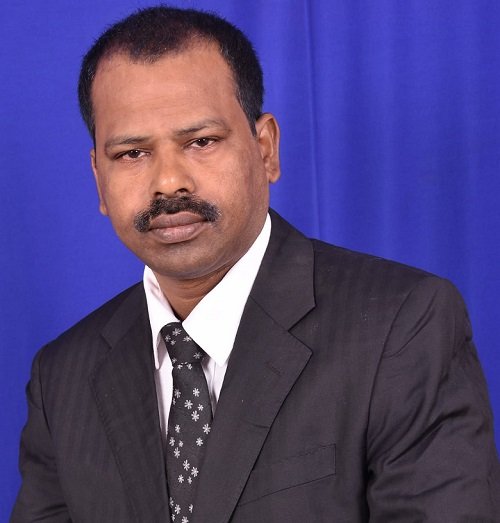
Poet Sri Ajit Dash by birth inherits his forefather Pariskhit Rathasharma’s legacy as one of the Navaratna Ministers of a Royal King. Being an astute organiser, socio-political as well as Development activist, he has made his presence globally. A freelance journalist and motivator, Sri Ajit Dash leads his life with lots of diversifications as an expert, imbued with utmost passion in the fields of Literature, Language, Environment, Governance, Entrepreneurship Promotion. He is experienced in Media house promotion and Electoral Politics too. Now a days his study is going on in the Use of Multilingualism, Wavelength and frequency of Odia Script, Words and Sentence pronunciation by different speakers in a multilingual perspective. Prof D. K. Ray, Late Prof of English, had compared his poems with the legendary Irish poet W. B. Yeats in the preface to his book of poetry “Midnight Dream” published in 2017. Sri Dash follows his father’s poetic accomplishments as his recently published book "Wings of Burning Violin" has been a great success.
DURING THE RAINS
Aneek Chatterjee
Dreamed to buy an entire range
of mountains last summer.
You gave me a piece of land
in your mind
during the rains.
Now I’m the proud owner
of the entire, charming range
of a squiggle mind;
… in all seasons.
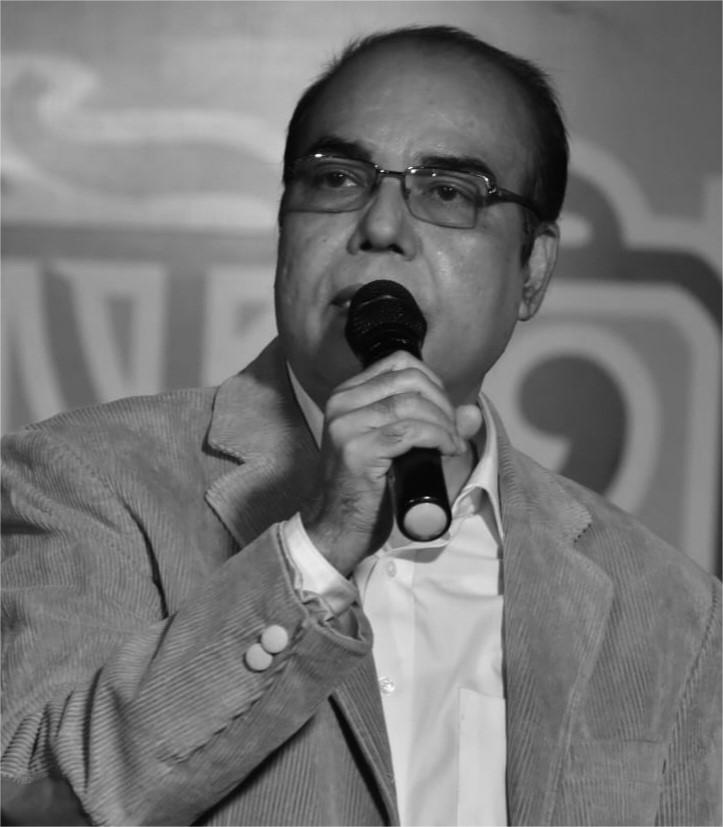
Aneek Chatterjee is a poet and academic from Kolkata, India. He has published more than six hundred poems in reputed literary magazines and poetry anthologies across the globe. He authored 17 books including five poetry collections titled, “Seaside Myopia” (Cyberwit, 2018), “Unborn Poems and Yellow Prison” (Cyberwit, 2019), “Of Ashes and Persiflage” (Hawakal, 2020), “Archive Avenue” (Cyberwit, 2022) and "Last Evening Was A River" (Penprints, 2024). He also co-edited the “Poetry Conclave Year Book 2022” (Authors Press, 2022). A Pushcart Prize nominee, Dr. Chatterjee also received the prestigious “Alfredo Pasilono Memorial Panorama International Literary Award 2023”. He was a Fulbright Visiting faculty at the University of Virginia, USA and a recipient of the ICCR Chair (Govt. of India) to teach abroad. His poetry has been archived at Yale University. He can be reached at: akchatjee@gmail.com
Sathya Venkatesh
The child in me
Peeks every now and then
When I’m carefree
When I laugh heartily’
When I help others
When I enjoy the simple things
An ice-cream, a road trip or just bubble blowing
The child in me comes to the fore
Beaming at me, patting me
I smile more then, letting go, with not a care in the world
Then the adult version takes over
I fret and fume
Fake, don a mask and do everything that I’m not
I feel miserable, empty and annoyed
I totally dislike this false persona
But I know I can’t escape from it
To co-exist in this drama of life
I’ve decided to awaken the child in me frequently
Regardless of what others think of me
The child in me is what I like best
Call me sane or insane
I’ll don this role with alacrity more and more!
Hailing from Coimbatore and with a background in Economics, Sathya Venkatesh has always been passionate about English literature and poetry. After fifteen years as a freelance content writer, she transitioned to teaching English to government school students. She finds joy in poetry, travel, painting and Indian Philosophy which she feels deepens an understanding of self and fuels her creativity. She has published haiku poems on reputed journals such as haikuKatha, Haikuniverse and Autumn Moon Journal. She firmly believes in a higher purpose guiding her path.
Padmini Janardhanan
Most
Spend energies and resources
Fulfilling all role requirements
Familial, Professional, social
Yet, incomplete, desolate
With every act done to duty demands
With personal desires unheeded
Some
Add duty to self too
Reserve time and resources
Their 'me time" and 'me space'
Preciously protected
However little, yet regular
Still empty, unfulfilled
Few
Learn the art of Integration
To indulge in every duty demand
Using soul strength and actions aligned
With role demands and personal pride
No regrets, no expectations
Only gratitude for the now.
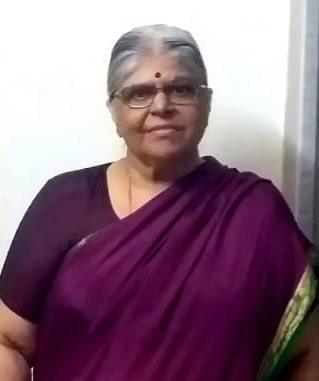
Padmini Janardhanan is an accredited rehabilitation psychologist, educational consultant, a corporate consultant for Learning and Development, and a counsellor, for career, personal and family disquiets.
Has been focussing on special education for children with learning difficulties on a one on one basis and as a school consultant for over 4 decades. The main thrust is on assessing the potential of the child and work out strategies and IEPs (Individual Educational Plans) and facilitating the implementation of the same to close the potential-performance gap while counselling the parents and the child to be reality oriented.
Has been using several techniques and strategies as suitable for the child concerned including, CBT, Hypnotherapy, client oriented counselling, and developing and deploying appropriate audio-visual / e-learning materials. Has recently added Mantra yoga to her repository of skills.
She strongly believes that literature shapes and influences all aspects of personality development and hence uses poetry, songs, wise quotations and stories extensively in counselling and training. She has published a few books including a compilation of slokas for children, less known avathars of Vishnu, The what and why of behaviour, and a Tamizh book 'Vaazhvuvallampera' (towards a fulfilling life) and other material for training purposes.
Ms Gargi Saha
Sometimes hope, sometimes despair
Sometimes joy, sometimes sorrow
Sometimes overflow, sometimes stagnant
Sometimes generous, sometimes skinflint
Sometimes noble, sometimes mean
Sometimes benevolence, sometimes malevolence
Sometimes selfishness, sometimes altruism
Sometimes greedy, sometimes greedless
Wears the nuances of different seasons
A man"s mind.
Ms Gargi Saha
Life is one
Roads many
Different roads await
At different stages
Which one to choose?
Which would be most apposite?
The trodden or untrodden ones?
Ms Gargi Saha
They hope, they skip, they jump, they play
They gossip, they gather, they guess, they gossip
They select, they sacrifice, they speculate, they sermonize
All form different crowd
None intermingle precisely together
The same person forms different groups
Yet not the same always
Part for the whole
Whole for the part
The growing difference.
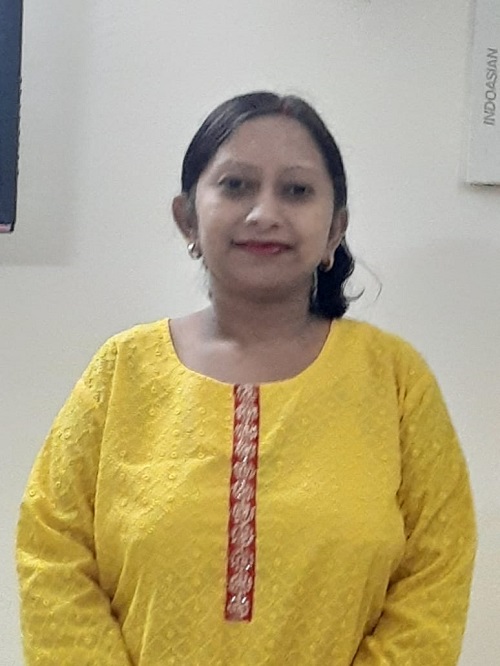
Ms Gargi Saha is a creative writer and has published two poem books namely, 'The Muse in My Salad Days ', and 'Letters to Him '.Her poems have been featured in National and International Journals. She has received the Rabindranath Tagore Memorial Award and the Independence Day Award for poetry. Presently she edits several scientific research papers. She can be reached at gargi.paik@gmail.com
CRISIS OF IDENTITY: THE ORIYA ROOT
Bipin Patsani
No political agreement
Vulnerable to time
Is greater than the root,
Not even a country
Which is a changing concept
Widened or made compact
Conditioned by situations
Or common interest.
History had nations built
And let them split
When discordant cultures
Failed to have mutual respect.
It is the attitude to life
Expressed in language
And human behaviour
That builds up a culture.
And what is distinct in us
Is that through the last many years
Long after the Kalinga War
We have been working for grace
Though we passed from hand to hand
Like coins, caught in the grip of hard times
Groping for a voice.
Perhaps that incited our ancestors
To install in Neelanchal,
The Vedic concept of the whole.
Krishna by his Karma and intuition
Seemed to have reached the goal
Failing to remain the goal in itself
Since he was born mortal
To play his exemplary role
And thus to become.
So whatever colour poetic license
Or devotion may add or infer,
Lord Jagannath
Who embraces all incarnations,
Messengers, angels and prophets,
Teachers, preachers
And all children of the Supreme Being,
All things visible and invisible
Caught and contemplated in harmony
In his big black spiral eyes,
Cannot be seen narrow.
Why to quarrel for an angle or triangle
And destroy all potential spheres
When we have with us the wheel?
Why? Why? Why after all?
Why this Much Ado About Nothing
About tradition and restraint?
The world is not only the East or West,
Since it comprises
The inter-action of the two.
Of what use is it
To speak of decolonization of the mind?
What is it to return to the past?
Are we really so sincere?
How much going back,
How much counter journey
Are we to be granted?
If we are all praise for Puru’s courage,
Let us learn to recognise
The spirit of Alexander
Who not only gave Puru his freedom,
But returned half Indian.
Let us have our freedom then, our nirvana.
But no, even Buddha Sharanam
In itself is not free from desire and possession.
Had Ashok learnt this as he seemed
To have learnt from the great devastation
That he did for fun,
He would have left us for our own.
And that I am an Indian,
That we all are Indians needs no confirmation,
Nor has it anything to play with our emotion.
Born around the field of that “colossal wreck”
Where we were crushed
And into dust made crumpled,
For we chose to hold our head high
And not to give in and bow down,
Born like a million ghosts rising out of the grave,
How can we forget the wound?
What is there to excite us
In this “sare jahanse achha”?
Home bound in my dream
My “bande mataram”,
If I am to sing one,
It is to be for my ground,
Blood red and barren,
Which is yet to be
sujalam and suphalam
Laden with the golden granary
Of name, fame and resurrection.
IF VALMIKI IS TO BE QUESTIONED
Bipin Patsani
Is it not your quest for a superman
That made you write the Ramayana?
Transformed into a senile saint
After a life of sin, sin and sin,
What made you doubt
Ram’s ability to reform
That he would kill the Monkey king
From a hide-out
Though he was not his enemy?
Was he so irrelevant and blind
As to lure aids for rescuing a wife
Who was later to be given up
In fear of humiliation and strife?
But for his weakness for women,
What superior strength
Could have killed Ravan
If not his own pride and treacherous kin?
How inferior was Ravan Rajya
Where scientific temper
Did not drive out good wives
To the jungle to suppress rumour,
Nor did it let them be burnt
To prove their chastity?
You have befooled us O Valmiki,
You who so desired to sincerely atone
For your past crimes and pined for a form
To give vent to your opposite extreme,
You have doomed us.
Now would we believe all that you said,
Because you said it?
The first poet strolling though on earth,
Were you free from human limitations?
No. Not at all.
Nor do we expect you to have been so.
Hence your virgin creation, sublime
In its epic plot and poetry
Has ample scope for Divinity of Kings
Under whose safe soothing banner
Priesthood would flourish or re-establish.
(From the poetry collection "VOICE OF THE VALLEY",
WRITERS WORKSHOP, INDIA / 1993)
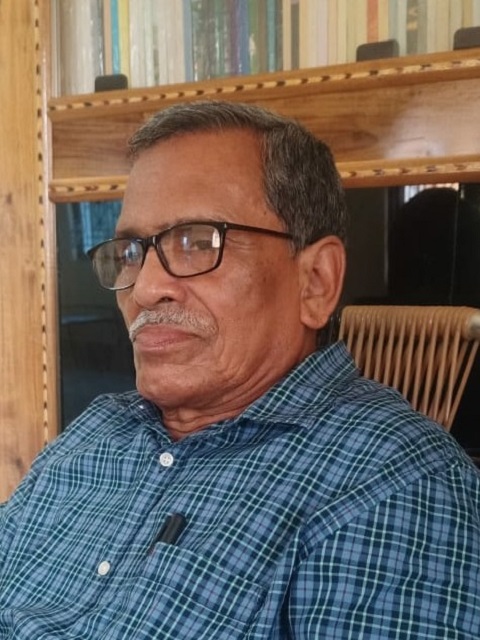
Bipin Patsani (b. 1951) has published poems in many prestigious journals and poetry anthologies including Indian Literature, Chandrabhaga, Journal of Indian Writing in English, Indian Scholar, Kavya Bharati, Poetcrit, International Poetry and Prophetic Voices etc. He has been translated to Spanish and Portuguese. He has three poetry collections to his credit (VOICE OF THE VALLEY, ANOTHER VOYAGE and HOMECOMING). He is a recipient of Michael Madhusudan Academy Award/ 1996 and Rock Pebbles National Award in 2018. He did his Post Graduation in English at Ravenshaw College, Cuttack in 1975 and served as a teacher in Arunachal Pradesh for 34 years till his superannuation in 2012. He also received Arunachal Pradesh State Government’s Award in 2002 for his dedicated service as a teacher. He lives with his family at Barunei Colony, Badatota in Khordha District of Odisha, India.
Dr R. S.Tewari
Sublimity of life is rooted in morality ,
Fall from its zenith is human depravity.
Truly,ethics pave the path of global welfare ,
None is impowered to be unjust and unfare.
The solution to any threat lies in its womb,
Not in mere desaster of the texture and tomb .
Must we ever ponder over the sprouts with 'how' and 'why,'
In order to eliminate the seed of the wild tree, touching the sky.
Taking lives of innumerable innocents with sadistic laughter
Echoes ages together in the history as a demon's sinful shatter.
Dr R. S.Tewari
Good intent, will power and constant efforts ultimately bring success ,
False fears, chance and fate surely interrupt the journey with oft recess .
Firm determination and upright path overcome all hurdles,
The world is mistaken taking one as the solver of all riddles.
Fail they to see the endeavours done in dark nights and sunny days ,
As invisible patience with precised steps and stride of one ever pays.
Let us be simple,sober and sublime with firm faith in Almighty ,
And move on unwavered with
blessed insight to face each adversity .
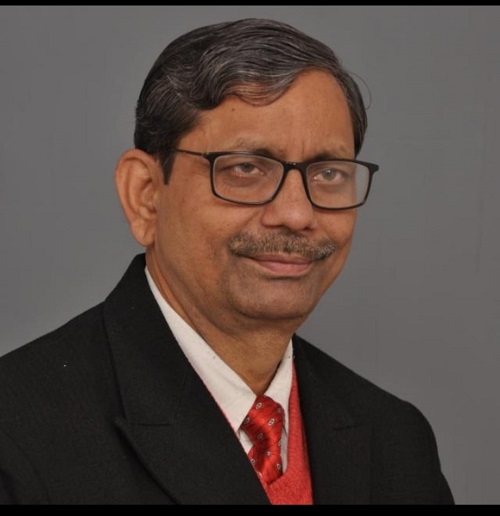
Dr R. S.Tewari 'Shikhresh' is a retired Assistant Director(O.L.)from Govt of India ,awarded by Honourable President of India,Honourable Governor of Uttarakhand and U.P.,Honourable State Home Minister (Govt of India) for commendable work in Official Language of the country is an M.A.( English Literature ,Hindi Lit. Philosophy ),PG Dip.(Translation and Journalism )and Ph.D.in Philosophy of Religion ,
Dr Tewari to his credit has 23 books of English verses,Hindi verses,books on Official Language and English Grammar.He has delivered more than five hundred lectures in various workshops on various topics.He has written more than a dozen of reviews of books in Hindi and English. Having started his career as an English teacher ,Dr Tewari worked as a Translation Officer, Hindi Pradhyapak and Assistant Director (Official Language) in Income -tax Dept.He has also served as a Consultant, Officilal Language and Communication in a training Centre of the ministry of MSME.
He has also worked in the Departments of Philosophy and Journalism in Agra University as a visiting faculty for a short span. Presently, he is a Visiting Faculty in the distance cell of D E I Deemed University, Dayalbagh ,Agra (UP),India.
‘LOVE’, THE VOICE TO UNITE ALL
Dr. Rajamouly Katta
Between man and man
A clash is inhuman
Between a nation and other nation
A war is antihuman,
A sign of lovelessness.
Man is born in any nation
For love, life for life sans tears and fears.
Global voices from deep hearts
For human relation and amelioration.
Smiles for miles in man’s sojourn
Hand in hand, arm in arm,
Progress of man in the universe,
The welfare of man’s race,
Love blooms peace and harmony
For the world family
Love transcends barriers and frontiers,
Whereas war is for total devastation
Colossal loss and universal destruction,
We are not *Brontasseurs and *Dinosaurs
For war to meet our end and extinction,
We are insightful species of distinction.
War mongers need transformation,
Not for killing, violence and extermination.
War is not success but defeat for human loss,
Friend and foe alike including the boss.
*Two species fought with each other. After a series of their warfare, they have become extinct killing each other. Their war ended in the extinction of two species.
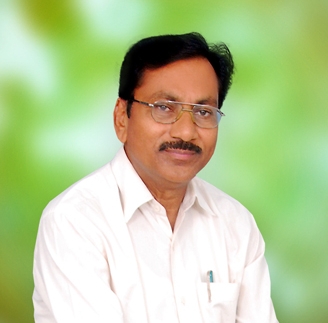
Dr. Rajamouly Katta, M.A., M. Phil., Ph. D., Professor of English by profession and poet, short story writer, novelist, writer, critic and translator by predilection, has to his credit 64 books of all genres and 344 poems, short stories, articles and translations published in journals and anthologies of high repute. He has so far written 3456 poems collected in 18 anthologies, 200 short stories in 9 anthologies, nine novels 18 skits. Creative Craft of Dr. Rajamouly Katta: Sensibilities and Realities is a collection of articles on his works. As a poet, he has won THIRD Place FIVE times in Poetry Contest in India conducted by Metverse Muse rajamoulykatta@gmail.com
Mrs. Setaluri Padmavathi

How can I depict you today?
Softness in flowers is a replica in your voice
The chirping birds borrowed your tone
When they fly, you see your wings there
Wings that made you fly so high!
Once, you were an innocent child
Innocence vanished like the air in a balloon
Scenario was your real teacher
Surroundings were your true guide,
A guide that lightened up your road!
No stone was unturned on your path
Culture showed you the challenges
Charisma brought you name and fame
Confidence opened up gates several,
Gates of triumph in every way you trod!
You light the lamps of the darkened paths
You transform the human minds for good
Silence is your powerful weapon
Gestures made you a gem of a person,
A person of qualities and character!
The shadow of blessings follow you ever
Your writing is an eye opener to the reader
You knew not what you do to the world
You knew not who looks up to you,
For you are a friend, philosopher and guide!
As a multi-faceted and multi-tasking
You play the multiple roles in and out
Every deed you do is methodical
And every endeavour you take up is worth,
Which label you as a being of beings!
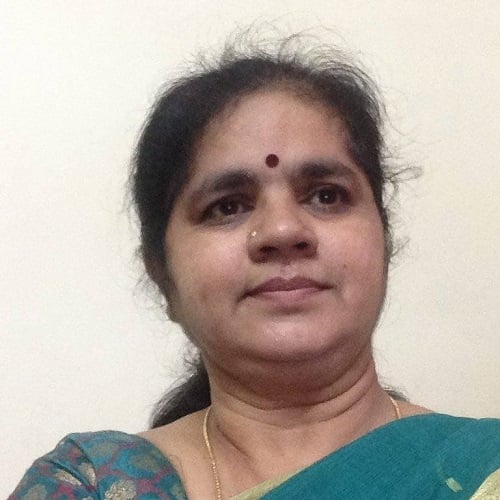
Mrs. Setaluri Padmavathi, a postgraduate in English Literature with a B.Ed., has been in the field of education for more than three decades. Writing has always been her passion that translates itself into poems of different genres, short stories and articles on a variety of themes and topics. She is a bilingual poet and writes poems in Telugu and English. Her poems were published in many international anthologies and can be read on her blogsetaluripadma.wordpress.com. Padmavathi’s poems and other writings regularly appear on Muse India.com. Boloji.com, Science Shore, Setu, InnerChild Press Anthologies and Poemhunter.com
BEGIN WITH THE BED
Satish Pashine
(inspired by Make Your Bed, by William H. McRaven*)
Morning arrives—
as it always does,
without asking
how the night was.
Sleep,
complete or broken,
doesn’t matter—
the day
steps in anyway.
And in that quiet crossing,
a small task
waits—
the bed,
slightly undone,
like a thought
left midway.
You smoothen
the sheet,
set the pillow right—
a simple gesture.
Some days
you almost skip it.
Yet something
aligns.
No applause.
No witness.
Just a quiet
“this will do”
within.
You open the door—
light enters,
thin at first,
then sure.
It rests
on what you set right,
as if it knows.
Your steps
don’t rush now.
They settle—
not stronger,
just steadier.
The day unfolds—
noise,
knots,
small, unseen
exhaustions.
Things slip.
Plans bend.
Still,
somewhere inside,
that small morning act
remains—
a quiet line
that did not break.
A beginning
held
in your own hands.
Evening returns
with its weight—
tired hours,
unspoken thoughts.
You come back too,
to the same space—
unchanged,
uncomplicated.
The bed waits—
simple,
silent,
whole.
Not everything
came apart today.
Some things
stayed.
And that
is enough.
So tomorrow—
no grand resolve,
no louder promise—
just this:
to begin again,
from the same place,
with the same
small act.
And trust—
quiet,
unhurried—
that the rest
will find its way.
PASSION AND LOVE
Satish Pashine
I don’t think
the difference between
Passion and love
is something
you sit and define.
You just…
live long enough
and it becomes
obvious.
Love is small.
Almost boring,
sometimes.
It’s that cup of tea
you forgot to finish.
It’s someone
touching your
forehead
and not asking
anything after that.
It’s silence
that doesn’t feel heavy.
A cat brushing past you
like it has always
known you.
A dog that just sits there,
waiting.
Passion is different.
It comes in a rush.
Too many words.
Too much meaning
in one moment.
It feels important—
like if you don’t say it now,
you’ll lose something forever.
And then…
it’s gone.
Or worse—
it stays just enough
to remind you
what it felt like
when it was alive.
Love doesn’t go like that.
It stays.
Even when
you don’t want it to.
Even when
it has no reason to.
It sits in the background,
quietly.
Passion can’t sit still.
Everything is urgent.
Everything feels
like the last time.
Love is slower.
But it notices.
Passion forgets.
Love remembers.
And when it all ends—
because it does—
Passion becomes
something you don’t
talk about much.
Love…
stays in habits,
in pauses,
in the way
you still look up
when someone
calls your name.
For a second,
you think it’s them.
It never is.
Maybe that’s all I know—
without Passion,
nothing really starts.
But without love,
whatever started
doesn’t know
how to live.
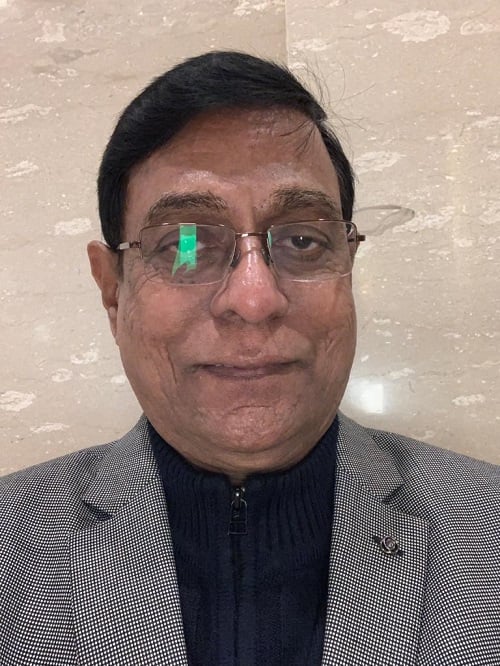
Shri Satish Pashine is a Metallurgical Engineer. Founder and Principal Consultant, Q-Tech Consultancy, he lives in Bhubaneswar and loves to dabble in literature.
Tophan Khilar
It's you who had
Love for me,
It's I who had
Love for you.
It's you who
Cried for me,
It's I who
Cried for you.
It is you who had
Madness for me
It is I who had
Madness for you
It's you who shared
Me everything
It's I who shared
Everything but love
It is you who
Became a dearest
Daughter to your father.
It is I who
Became a wicked
Boy to my father.
It's you who didn't
Speak me, being a girl.
It's I who didn't
Make courage
To speak you,
Thinking to be rejected.
We had everything
Between us
Love,
Affection,
Attachment,
Caring,
Happiness,
Pleasure,
Enjoyment.
What not?
If you had spoken
Life could have been changed for
Me.
We made memory,
Saw dreams
But couldn't fill it up
As the situation changed us.
Now you are on your way
And I on mine;
Still
I love you more than my word can
Express,
I miss you more than I know.
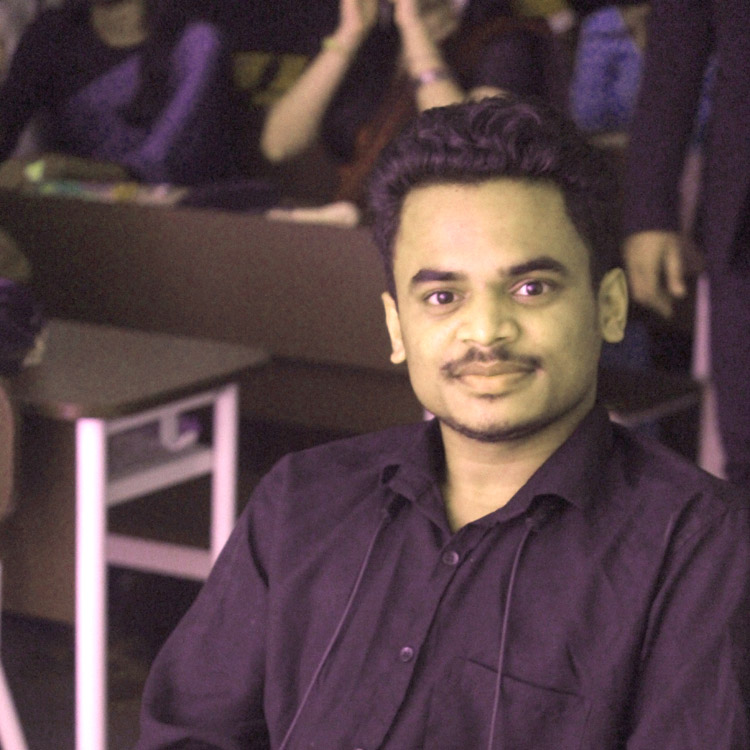
Tophan khilar, a Post Graduate student in Department of English in Utkal University, has keen interest in writing poems. He loves reading fiction and poetry. He started writing poetry when he was doing his graduation, taking inspiration from his teacher, Ajay Kumar Pattanaik. With over 60 poems written, he aims to evoke emotions and provoke thought through his writing. He is a young poet with a passion for exploring themes of nature, identity, love, etc.
Harisankar Sreedharan
Hail him,
Singular, in first person
The one (and perhaps the only one)
The make believer in making
Us feel Geat Again!
An encryption of conceit,
Tailmining heaps of leftover words,
O! the very foundations are shaking...
Unrest of a stirring conscience
Laid to rest beneath in peace!
Set your eyes eastwards
Look into the soul of
That professed spiritual
Detachment in its dispatch,
The "Ma Ga" of Sound and Sight
None has seen, our senses
Pegged to the neo normal, say
Seeing is believing !
Resounding, demeaning, disparaging,
Slighting reverberations all around,
Just making short of human dignity
Faith, too deepseated to be heard
Says from somewhere, is implicit!
In a voice too weak !
Hiding beneath the adorations
Of the blessed sacrament,
He's standing by the Baptismal font
To wash thee of thy sins
In blood-thinned water thicker than the Soul,
Smear the Holy Chrism and pour
Verbal perfumes while conscripting
Thee to the Soldiery of Cavalry
Sing an unmeaning praise to the one
On whose Atlantic shoulders
The World seems to rest, thus spake he!
It's blood, blood everywhere..
Tell the world that he doesn't herald
Arrival of another who is just
Worthy of untying the thongs
Of his chappals;
The Chapel heard a sigh!
He left the white flag inside the
Impregnable pentangled walls
Of the Safe House, irretrievable now,
The watch is heightened
The Nation first, mistrust is
Synonymous with vigil
Pardon not those trespass against us
But Pardon us, our trespasses
For a larger cause
(Purpose invisible, lying
Ingrained in the deeds!)
Peace on earth to those on whom
His favor rests! His men guard
Their unmended fences,
Perpetually in dispute, their Armouries
Brim with supplies, granaries are vacant
His powder is kept dry everywhere,
Ballistic is the unit of distance
A blast in the ballast, swaying the tilt
Spill little oil, but the Oceans are deep
Paleo to Cenozoic era should
Take the blemish, fault him not;
It's just an out reach,
Sustain the times of motion
That's all, even by stalling
The time elsewhere, but time
Didn't heed, trifling all Threats
Yet the war is won on rhetorics
Of honourable men (and women)!
Far away lands don't recede
Clannish Resilience sustains them all
Lay down your lives for your valor
The command resounds, die a fool
In another man's land!
We're fighting his war! No,
An Act of honor misspelt as War!
O World, I guess you're still staying tuned
Find an epithet that will characterize well
The one who has had an insatiable urge
To take on the world for
Another man's wealth
Yes, the thesaurus of human
Compassion says,
The word is Cadaver, written
Cadaverously pale!
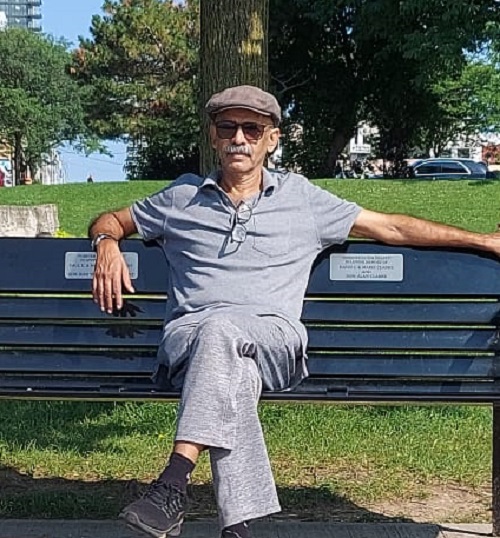
Harisankar Sreedharan is a banker by profession. Retired from service in 2020. Still active in the profession. Pursuing interests in literature - poetry and drama. Associated with the theatre movement. Own creations are in Malayalam. Occasionally write English poems too.
A Traveller... fascinated by the time unframed in places - seemingly enjoying the whiff of smoke from cooking pots and tea kettles, smothered by the conversion among the local people .... to stand, watch and let the world pass by ..
Passionate driver, bike rider and trainer.
MR. DOG ON THE MEDIAN
P. S. Sowmya

It was 6:00 pm in the evening.
We were in our car on a Chennai road,
Caught in heavy traffic,
Waiting with impatience,
Cursing the government and administration.
As our vehicle moved in slow motion,
I saw a doggy relaxing on the median
Lying in a calm and composed state,
With half-closed eyes and a contented expression.
On his left there was a heavy inflow.
On his right there was a steady outflow.
But unperturbed by the heavy traffic and pollution,
He was lying on the isthmus of a middle state,
In a zenful meditative mood.
He had had his fill for the day
And was resting on the median
Without any past regrets or future worries
In a blissful state of the moment,
With an expression of a medium
In communion with the universe.
Unmindful of all the commotion around him.
We humans are proud of our sixth sense
And of our immense knowledge of the Almighty!!
But in reality, are we in anyway near Him?
The poem "Mr. Dog on the Median" was born when we were travelling in our car and got caught in traffic. I saw a dog sleeping peacefully on the median amid heavy traffic, something triggered in me, and this poem was born. The photo of the dog was taken on some other occasion, not on the day when the poem was born.
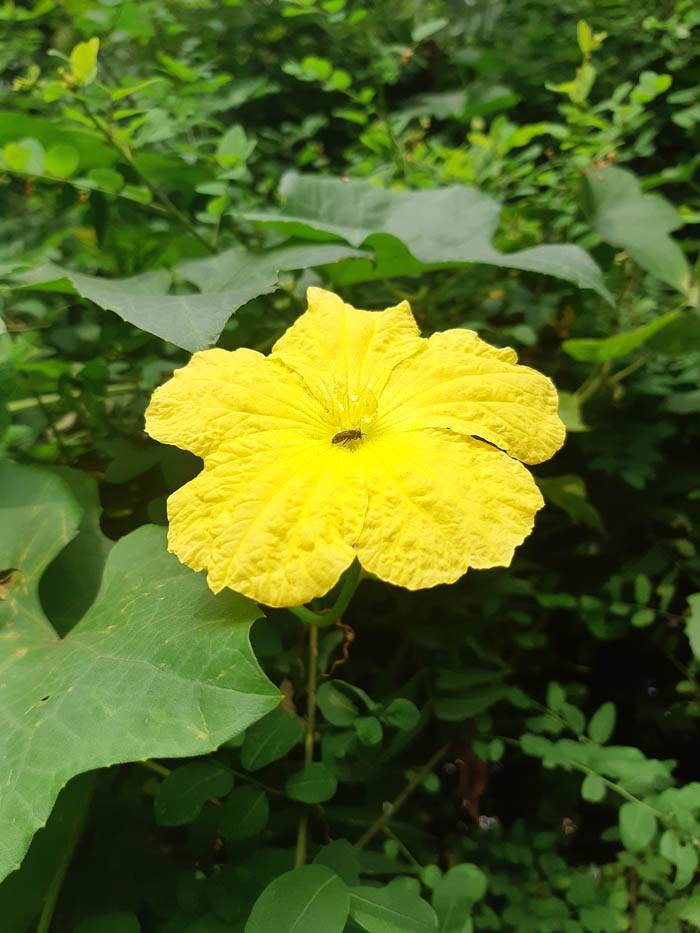
(This is a song by a tiny bee sitting at the centre of a big golden pumpkin flower in a drowsy state.)
I may be tiny,
I may look ugly,
But I have a beautiful space,
To call as my own.
Yes!!! A Big Golden Flower Throne,
My Palace where I Dwell and Dream
After having my fill.
Mother Nature has blessed everyone
In her own unique way.
So that every dog has its day.
So, BEE Yourself!!!
The poem "Bee Yourself" was born when I saw a beautiful pumpkin flower on the roadside when I was walking in the morning hours. It reminded me of the poem by Robert Frost "Nothing Gold Can Stay". I went near the flower to take a photo and I saw a bee happily sitting at the centre of that golden flower which was shining even more due to the golden hour of the morning as said by Robert Frost. I thought, “How it would be if the bee could talk to me” and then this poem was born.
NOTHING GOLD CAN STAY BY ROBERT FROST
Nature’s first green is gold,
Her hardest hue to hold.
Her early leaf’s a flower;
But only so an hour.
Then leaf subsides to leaf.
So Eden sank to grief,
So dawn goes down to day.
Nothing gold can stay.
P.S.Sowmya has completed her B.A. English literature in Meenakshi College for Women, M.A. in J. B. A. S College for Women and MPhil. in University of Madras. She has worked as a Lecturer (for a brief period), Language Editor and an Instructional Designer. She is a member of Chennai Poet’s Circle (CPC) and her poems are regularly published in the annual anthology of CPC “Efflorescence". A couple of her articles are published in a famous website ( paramparaa.in) and in an e-magazine "Tatvamasi" circulated among a close network of interested people. She is interested in reading, writing, gardening, painting and listening to music. She is a lover of Nature.
Dr. Niranjan Barik
There, the cuckoos were not heard,
though Spring had knocked at the door.
Spring had lost its cool,
the wind had become fire.
Wind and fire grew furious,
of almost epic proportion.
Why it happened so,
this volte-face!
who knows?
We know the wind;
we know the air can be gentle, cool—
as if Autumn were softly kissing Spring.
But the air turned harsh,
hot, smelling of sulphur.
Who can fathom the mind
that can change the colour of the sky,
the speed of the wind,
and all that can be driven
beneath the earth
to register an unchallenged victory?
How does it come to this,
when even the physicist reminds us:
every action
has its reaction?
Yet somewhere beneath the dust and ash,
a seed, I believe, still waits invisible to the eye,
Storms may darken noon,
and noise may silence song for a while,
but Seasons do not forget their path for ever,
The burnt wind tires,
the harsh sky must soften,
and from the wounded earth
new roots begin their patient upward journey.
Though difficult the waiting may be
For no triumph stands forever
against the quiet return of life.
xxx
Professor Niranjan Barik ,formerly Professor and Head, Department of Political Science at Ravenshaw University also served as a Professor of Pol.Sc and Principal , Khallikote Autonomous College, Berhampur, Odisha. A Fulbright Scholar-in-Residence at Miles College, Birmingham, AL, USA in 2007-08 , Prof Barik evinces interest in reading and writing short stories and poems in Odia and English. His poetry book , “Freedom from Bondage: An Ode to Nature” published in 2023 was released in Bhubaneswar in December 2023.
ParashuramRao Gande
Fed up with daiily routine
If one longs for peace
If one longs for the rest for mind
If one longs for the solitary bliss
If one wants for the colours of nature
Nature like the mother, sooths every body
With out any prejudice or favour.
If one wants to listen to the
Music of nature,
One has to listen to the myriad birds
One has to stand on the bank of a river
Flowing rapidly like a running deer
If one wants to feel elated
One has to go to a nearby mountain
One has to stand in the beach of the sea
And listen to the roaring waves
Falling downand rising up
With a thunderous sound.
Alas, one forgets his duty
And spoils the charming the beauty of nature
One should not cut the trees around
One should not blast the nearby hills.Otherwise the wild animals
Enter the human habitations
And spoil one's mental peace
Then one has to live in the grip of fear
With a sword hanging above one's head.
One should not fill the rivers
With plastic covers.
And worship them as divine entities.
ParashuramRao Gande is a retired lecturer from Govt Arts and Science College, Karimnager, TS. He is the author of three books. Recipient of four International awards.
Dr. Mrutyunjay Sarangi
I have an appointment with Elsewhere,
didn't come here on my own,
nor do I know who brought me.
All that matters is, I do not belong.
This city of abandoned streets,
zombied statues,
cardboard monuments
And crippled souls.
The clock tower looms large here
but its hands stopped moving ages back,
the city has closed its shops
the lights are out, a haze is all that remains.
Time has stood still
after sweeping the city clean
robbing it of any hope or dreams
leaving only empty pitchers and dried up streams.
I would rather be Elsewhere
drenched in copious flow of water
with wet throats and dreaming eyes
a soul filled with joy and rapturous sighs.
Dr. Mrutyunjay Sarangi is a retired civil servant and a former Judge in a Tribunal. Currently his time is divided between writing poems, short stories and editing the eMagazine LiteraryVibes . Four collections of his short stories in English have been published under the title The Jasmine Girl at Haji Ali, A Train to Kolkata, Anjie, Pat and India's Poor, The Fourth Monkey. He has also to his credit nine books of short stories in Odiya. He has won a couple of awards, notably the Fakir Mohan Senapati Award for Short Stories from the Utkal Sahitya Samaj. He lives in Bhubaneswar.
Viewers Comments