
Literary Vibes - Edition CLXIV (24-Apr-2026) - SHORT STORIES

Title : Country Road (Water colour by Lathaprem Sakhya)
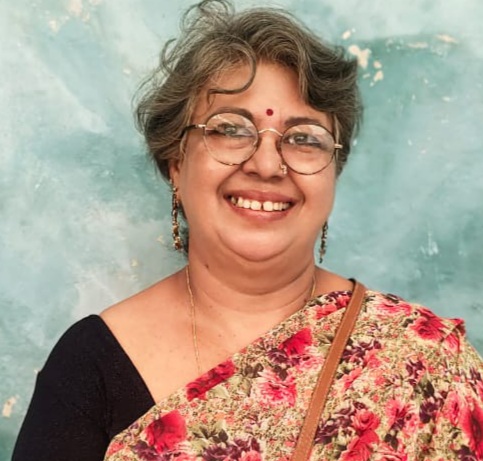
An acclaimed Painter, a published poet, a self-styled green woman passionately planting fruit trees, a published translator, and a former Professor, Lathaprem Sakhya, was born to Tamil parents settled in Kerala. Widely anthologized, she is a regular contributor of poems, short stories and paintings to several e-magazines and print books. Recently published anthologies in which her stories have come out are Ether Ore, Cocoon Stories, and He She It: The Grammar of Marriage. She is a member of the executive board of Aksharasthree the Literary Woman and editor of the e - magazines - Aksharasthree and Science Shore. She is also a vibrant participant in 5 Poetry groups. Aksharasthree - The Literary Woman, Literary Vibes, India Poetry Circle and New Voices and Poetry Chain. Her poetry books are Memory Rain, 2008, Nature At My Doorstep, 2011 and Vernal Strokes, 2015. She has done two translations of novels from Malayalam to English, Kunjathol 2022, (A translation of Shanthini Tom's Kunjathol) and Rabboni 2023 ( a Translation of Rosy Thampy's Malayalam novel Rabboni) and currently she is busy with two more projects.
Table of Contents :: Short Story
01) Prabhanjan K. Mishra
THE SON WE NEVER HAD
02) Sreekumar Ezhuththaani
AN ATTEMPT
TWO LADIES OF VALIYAVILA
03) Snehaprava Das
WHY I NEVER RODE A BICYCLE
04) Usha Surya
GLASS BANGLES
05) Phalguni Sahu
ECHOES OF AN UNFINISHED US
INVISIBLE, UNTIL GONE
06) Annapurna Pandey
CAMBRIDGE DAYS
07) Anita Panda
HALLOWED HUMA- ABODE OF SHIVA…
08) Sujatha Krishnamurthy
WOMAN POWER
09) Sushree Gayatri Nayak
CURRENTLY EXTREMELY SATISFIED
10) Deepika Sahu
HANSIBA MUSEUM: CRAFTING LEGACY AND WOMEN EMPOWERMENT
11) Mr Nitish Nivedan Barik
LEAF FROM HISTORY: A TIMELESS LEGACY ON THE MALABAR COAST
12) T. V. Sreekumar
STRANGE STORY
13) Ashok Kumar Mishra
WATER OF A MISSING FOUNTAIN
14) Satish Pashine
WHEN THE HILLS BEGAN TO SPEAK
15) Bankim Chandra Tola
WISH OF A SMALL GIRL
16) Dr. Rajamouly Katta
DEITY DARSHAN
17) Sreechandra Banerjee
WITH WATER AND ICE
18) Dr. Mrutyunjay Sarangi
GENIUS
Prabhanjan K. Mishra
During Ashwin’s last visit to my family, I had detected this strange infectious fever in him called ‘parental love for an non-existent child who had not even been conceived so far, physically or intellectually’. Months later, surprisingly, a variant of the same fever infected my wife that she gave me.
Ashwin, my sister Nirupama’s husband, visited us in Mumbai where I lived with my wife Bharati and our two daughters who were in their early teens. We had no sons. Ashwin was visiting Mumbai, to attend an all-India conference of the Lions, a congregation of the members of the Lions Clubs from all over the country.
Ashwin lived at Cuttack in his bungalow with Nirupama alias Niru, my sister, and his own elder sister Paramita alias Paro, who had decided not to marry, but continue as the family-dowager in her parental household, consisting of Ashwin, Niru, and their only son, besides herself. Ashwin’s parents had passed away years ago and his son, studied engineering in its first year at Bangalore.
The day before his departure from Mumbai, Ashwin took me along for helping him in buying gifts for the near and dear ones. He bought something for everyone: pens, folding umbrellas, napkins, video-games, T-shirts, saris etc.
He then went for shopping a pair of ladies’ shoes. He went to the ladies’ sections of many shoe stores before selecting a pair of very beautiful ladies’ shoes of the size five, obviously a pair meant for two smallish size female feet, obviously junior size.
I was curious. After all he did not have a daughter. He had bought gifts for my daughters already. None of the ladies in my family or his family, like Bharati, Niru, Paro, or my daughters had feet as small as five size to fit into those shoes. I could not resist asking, “Who would wear this special pair you bought after so much painstaking search, Ashwin?”
Then, putting mischief into my voice, I asked, “A very young girlfriend? Eh! With an exquisite pair of Cinderella feet? Tell me, I promise, I won’t betray a whisper to Niru, Paro or Bharati.”
He replied, “Sukant, my dear brother-in-law, I don’t have a girlfriend, not so far at least. It has been pretty expensive and exacting to maintain and manage my first girlfriend, your sister, and my present wife, Niru. But, can’t a father search for the loveliest pair of shoes for his little Cinderella?” Ashwini appeared to speak in riddles with a twinkle in his eyes.
Ashwin had a son, his only child, who was studying in the first year of IT Engineering at Bangalore, staying in hostel of late. Had he adopted a grown-up girl as daughter, of which I had no news? My wife Bharati never told me though she stayed in regular communication with Niru and Paro almost every day over phone.
Another possibility, Niru was pregnant again. After nineteen years of having her only son! And how did Ashwin know it would be a girl. Had they carried out a test to know the embryo’s sex that was a banned activity in the law of the land. Even if a girl was on her way in his family, to wear that pair of lovely shoes, she had to grow over at least to twelve to fourteen years. So long-term a planning!
I felt hurt. What all was happening around me without my knowledge. Of course, most women, might that be Bharati, my wife, Niru, my sister or Paro, Ashwin’s sister, would keep poor opinion about the men of their houses in matters of handling delicate issues. So, they would censure most of the news before delivering them to husbands, brothers, fathers etc. But the girl to wear the exquisite pair of shoes bought by ashwin was still a mystery.
I blurted out like throwing a stone into the darkness, “Have you adopted a girl lately, Ashwin? That again a girl in her early teens?” Ashwin gave a diluted smile, “Na re bhai na (no brother, no), not so far, not so lucky. I did not tell you about Nima, because I had heard my wife and Paro sharing their complaints about Nima with your wife over the telephone frequently. I guessed you knew her from these gossips.”
Ashwin added, “My wife and my older sister take village tours for relief work with members of the local Inner Wheel of the Lions Club, an Association of the Lion-wives and relatives. During such a tour they had rescued an orphan girl, Nima, around three months ago. Thirteen-year-old Nima looked like an eight-year-old girl for her malnutrition. She was in a pathetic condition. They brought her home and engaged her as a house help for our household work, in exchange giving her food, clothes, and a little space to sleep.”
He added after a little hesitation, “She is a cute child. Nima, means ‘Bitter Neem’. But she is a sweet little kid. As soon as she entered our house, I saw my daughter in her. She has the loveliest feet in the world, just like Cinderella in the fairytale.”
I felt a surge of pleasure to hear Ashwini’s affection for an orphan girl working as a maidservant in his house. It revealed a surprising side of his character, deep compassion for a girl with underdog background. Ashwin gushing about Nima’s pretty pair of feet was my next surprise, the aesthetic side of a man of the world, a down-to-earth and hardcore business man.
It brought to my mind the famous but perhaps the shortest love-letter from the Hindi block buster movie Pakeezah. The letter was a one-liner. Of course, the context of the pretty pair of feet was altogether different in that film from Ashwin’s situation. In Pakeezah, the hero entered a train compartment at a wayside station, and found an unknown woman (the heroine) deep in sleep on a berth, her body fully covered except her feet.
The hero was so enamored of the exquisite loveliness of the unknown woman’s feet that he fell in love with them. He left a message before getting down at another wayside station. The message on a piece of paper was stuck into one of the clefts between the woman’s exposed toes. The woman read his message after getting up from sleep, “Do not put your lovely feet on the ground; their loveliness may get soiled.”
I could not control my urge to ask, “Have you expressed your sentiments about Nima to your wife, and more so, to your powerful elder sister Paro? I know, Paro calls the shots in your house.”
Ashwin lamented, “No, my brother, it has not been easy. Paro, as you know, is rigid and mean. She has taken Niru under her wings. Their relief work in villages is only a gimmick like window dressing, not the real social service.”
After a pause, he added, “I really don’t know if I would ever have the courage to give Nima her gift. The pair of new shoes, that I have bought with so much of affection for her, may lie hidden in my travel bag and get old.” I looked away not to embarrass Ashwin for his eyes were welling up. He left for his native town, Cuttack, by flight to Bhubaneswar the next afternoon.
Ashwin had requested me not to whisper a word to my wife Bharati about the Nima’s new shoes. After Ashwin’s departure, I cornered my wife, “Bharati, you never told me about Nima?” She made a face, “What Nima? Oh, you mean Nima, the maid? What do you want to know about Nima? By the way, what for? Why this extra-curiosity about a servant girl?”
I cut her short before she went on asking her one-hundred inane questions just to avoid answering my single one. I said, “Just cut the crap, Bharati. You know what I want to ask? Why didn’t you share the news about Nima, though Niru and Paro have been talking to you about her over months? Ashwini thought you and me, have a mutual trust deficit when I drew a blank on mention of the name of that little kid, Nima.”
Bharati suddenly turned into milk and honey towards me but bitter against Nima, whom she had not met, seen, or known face to face, “Sorry Sukant, simply a slip. How could I hide anything from you, and why? No, never, you know your Bharati very well. Don’t you?” I replied, “No, now it appears I don’t. Who is this Bharati?”
She pressed on, “If you are really interested to know, let me tell you the truth. Nima is no little kid, as your brother-in-law Ashwin might have described her to you. She is a full-grown pretty, young woman, rather on a voluptuous side, and quite cunning. A ripe female with roving eyes for males. Paro told me yesterday, she caught Nima red-handed many times eyeing Ashwin when he is at home. Ashwin appears to be besotted by the little devil.”
She noticed my anger rising and abruptly stopped. After a while, she guiltily added, “I happened to hear those things from Ashwin’s wife Niru, and his sister Paro and just sharing with you what they said. These are not my opinion, as I haven’t seen Nima, not even her photo.”
I turned on my wife Bharati sternly, “Would you ladies develop a crush for a young man employed in your house? Should Ashwin and me suspect your characters, as you suspect Ashwin’s? Why you, the women of our house, have such dirty minds? Why should you think, all may be having dirty minds like you three? Are you trying to weigh Ashwin and Nima with your own scale of unstable character? Couldn’t you ever think that love can be daughterly or sisterly, brotherly or fatherly?”
My wife paled before my criticism. I stopped, decided enough had been said and let the matter settle itself. I forgot Nima over the months that followed. Sometimes I and Ashwin exchanged talks over telephone but Nima was never discussed. Once or twice, I recalled the shoes he had bought for his little Cinderella, but I thought it inappropriate to peek into Ashwin’s weak spot, Nima.
I hoped and guessed Nima might have reciprocated to Ashwin’s feelings and the ladies of his house: Niru and Paro, might have accepted their mutual father-daughterly love.
Once I sensed a disturbed Ashwin over our telephone conversation but he remained distant. I had to visit Odisha, but sensing turmoil in my sister’s household, I preponed my itinerary. On arrival, I checked into my favorite hotel Mid Town on Rajpath at Bhubaneswar. During my visits, I would camp in that hotel and move around attending to my work, and meet friends, and relatives from there.
The morning next to my arrival, as I was getting ready to leave for Ashwin’s place at Cuttack as planned with him the previous day, I got his call that he was arriving in my hotel in half an hour. He sounded devastated over phone, and looked more so when he arrived. I tried to pep up his mood with tea and jokes. But he remained moody and petulant. I feared that something had gone terribly wrong. I waited patiently for Ashwin to cool down and tell me all on his own.
After a while, I decided to prompt words into his mouth, “Tell me about Nima, Ashwin. Did she like her gift, the pretty shoes?” Suddenly Ashwin avoided my eyes, looked down, and I took away the cup of tea from his shaking hands lest he spilled the brown hot brew all over himself. I sipped my tea silently and gave him time to collect himself.
I saw his eyes brimming with tears and face looking like a dark clouded sky. I could feel his pain. I took his clammy hands in mine and assured him, “Ashwin, have trust on me like always. I will set things alright for you, everything, even would get you your dream daughter Nima. Please tell me what all has happened, without omitting anything.”
Ashwin started talking, his voice heavy with tear, “Sukant, do you recall the trouble and care I took to find those pretty shoes for my Cinderella? But no, I couldn’t give them to Nima. My house never rose above false allegations of cheatings, thefts, lies and loose-character against Nima by our sisters, mine and yours, Paro and Niru.”
“I privately begged Nima to ignore them for my shake. They could not dump her out of the house for they had no proof to prove their allegations. I threw their complaints to winds as malice against Nima, as they threw out my fatherly affection for her. Nima had secretly reciprocated my fatherly affection and when the two sourpuss ladies were out of the house, Nima and me would behave as father and daughter mutually, she even addressing me as ‘Papa’.”
“One day, Nima brought my tea and snacks, and stood by my side. My wife shouted at her to leave the room. Nima left, giving me a look of understanding. She knew I loved her presence by my side. Our eyes met with a perfect understanding and before leaving she indicated with her eyes that she would be just behind the curtain, at my beck and call. Our mutual little silent exchange had not escaped the two pairs of hawk eyes, Niru’s and Paro’s.”
“They exchanged meaningful glances that did not escape me as well. I thought I and Nima had to be more discreet, otherwise these two women might harm my little girl. Let her at least stay as a happy housemaid in my house and before me, out of harm.”
“Another day, they conspired a well-laid out plot. I have a strong hunch, even your wife, Bharati, was in their scheme. A valuable necklace was reported missing from my wife’s cupboard. They blamed Nima to have stolen it. Nima was declared a thief. She was given a choice by the ladies, ‘Either go to jail or run back to your village.’ She meekly chose to return to her village.”
“Even they searched Nima’s belongings. But the necklace was not there. The ladies accused her of hiding it some place that could not be reached easily. Suddenly, Paro brought down my travel bag from my racks and started searching it without asking my permission, saying cunning Nima might have hidden the necklace there, the most unexpected place.”
“Paro shrieked aloud as if stung by a scorpion hiding in my travel bag. No, it was the sight of the pair of shoes I had bought for Nima. My theory, to prove Nima a thief Paro or Niru might have put the necklace there, was wrong. Their game was more crooked. Paro had for some reason searched my bag earlier and had discovered the shoes. That had given the ladies to lay the plot defang me, and throw Nima out of the house.”
“Shrieking aloud, Paro dangled the pair of shoes in air in a dramatic fashion, saying, ‘See Niru, what I found. And see for yourself how far the little devil has trapped your husband. Valuable gifts are being bought for the cunning devil’s feet.’ I found Nima stunned and dismayed, as she had no knowledge of those shoes.”
I would now describe what had followed, by summing up incoherent Ashwin’s words - Paro had rasped in a shrill voice, “What is going on in my house, Ashwin, my dear little brother, all under my nose? This is neither of my size, nor Niru’s.” She grinned at Ashwin derisively, “Surely, you won’t wear these, Ashwin. Definitely you have not developed a new taste, to wear ladies’ shoes? Are they gifts for Nima? So, the affair between two of you has gone to the level of expensive gifts!”
Paro appeared enjoying every moment of her melodrama, her words dripping with sarcasm, “The cat is out of the bag at last, Ashwin?” Ashwin saw, Niru standing there, giving Paro nasty looks that seemed to say, “This is too much Paro. You have gone too far. I am not with you in this game anymore.” Ashwin liked Niru’s scowling at Paro and her nose crinkling hatefully at her mentor as well.
Ashwin went stern and raised his voice, “Paro, will you shut up? Don’t test my patience. I will forget you are my elder sister. Wasn’t the theft of necklace a drama just to make public the shoes, that you had surely searched and found earlier in my absence. You rightly guessed. The shoes were bought for Nima. But could not your jealousy towards the little girl of your daughter’s age be contained without this smearing drama.”
After controlling his anger, he shouted, “You wove that nasty conspiracy of the stolen necklace just for your vicious and scandalous game?” He turned to his wife and charged, “You too bloody woman, Nirupama, aren’t you also in this scheming and smearing game?” His wife visibly shrank. Ashwin liked that. Niru gathered her wits, “No, Ashwin, no. I am not with Paro. My necklace is really lost. Paro told me that Nima stole it.”
Paro kept grinning and leering at Ashwin in an unpleasant way, and uttered, “Sixth sense, my dear little brother. I didn’t search your bag before this. It is my sacred duty to protect you and my sister-in-law, Niru, at all costs from this intruder, Nima, for whom you are mad, Ashwin. OK, the necklace was a plea to expose the game of this little devil. So, you were courting this cinder-maid with expensive gifts. Shame on you, Ashwin.” She gave out a derisive giggle.
Ashwin further described his misfortune. The story of the shoes, and the false scandal of an illicit affair between him and Nima had spread like wildfire among his relatives and acquaintances at Cuttack in the following days. He could not make out how the indoor melodrama escaped his four walls. Niru vouched to be innocent when he questioned her. She also vouched for Paro who had promised her not to say it to anyone at Cuttack.
Every other person, relative or friend, he met, asked him, “Ashwin babu, someone told me you are having an affair with your young maid. Of course, I did not believe it. But be careful.” Ashwin felt like committing suicide. An affair with a girl whom he had plans to adopt as daughter.
I had butted in here, “Could you know, Ashwin, who was the culprit? Who let the indoor drama be public?” Ashwin replied, “My dear Sukant, I knew the mole today morning only. I hesitate to tell you.” After a lot of insistence, he revealed, “It was your wife, Bharati who knew it from Paro with a rider to keep the spicy news to herself. Bharati told me so. She had confided it to her mother at Cuttack. So on, so forth.”
Ashwin went on his narrative. An old relative, a cousin grandpa of Bharati visited Ashwin’s house that very morning. While partaking the snacks and tea served to him by Nima, he asked Paro in his caustic tone pointing a finger at Nima, “What Paro, I believe, this is the maidservant, you spoke to Bharati about, who stole Niru’s gold necklace, and with whom our Ashwin is having an affair? Why have you not thrown her out of your house and given her to the police. After Bharati informed her mother, now the town knows about it.” He then gave a withering stare at Ashwin and left.
Ashwin lost his temper and shouted at Paro, “You bitch, pack and leave my house just now. Just leave before I kick you out.” Paro shouted back at him, “I won’t leave, Ashwin. This is my father’s house too.” Ashwin sternly replied, “This I built with my money. I named the house ‘Vishwakarma Mansion’ after my father as he was alive. I brought father and you from Puri to live with us. Your father’s house is lying locked at Puri.”
He further told Paro, “Get out of here. Go to Puri, or wherever you choose. We can’t keep you here. I give you just an hour to leave.” Aswin asked Niru, “I am leaving for meeting Sukant. Throw this woman out of our house. Nima will live with us as our daughter we never had.”
After hearing Ashwin’s long narrative, I saw red. I anticipated the worst. I said, “Ashwin, you idiot, you have left a minnow, Nima, in the dangerous company of a shark, Paro. Nima may simply vanish without traces. Let us rush back and protect her.” We drove back to Ashwin’s house.
Ashwin’s house was in deafening silence. Niru sat on a chair like an expressionless sphinx. No sign of Ashwin’s old male servant-cum-gardener Nandu, who used to open the gate and hobnob around me whenever I visited Ashwin’s house. Ashwin addressed him as Nandu Kaka (uncle Nandu) as the gardener had been there from his father’s time. To Ashwin’s shouts for Nima, no little girl came out trotting. He then ran through the house to search for Nima, but she was nowhere.
Niru opened her mouth to me, “Bhai (bother), after Ashwin left, Paro Didi also packed and left for her house at Puri. But before leaving, she threw out Nima with her bag and baggage. She was so strong I could not stop her. Nima left crying. Nandu uncle protested, so Paro dismissed him from his job and threw him out also. Nandu uncle left very hurt. I have no idea where Nima or Nandu uncle are. My mind is in a spin. I can’t think of a thing.”
But Ashwin answered, “I can guess where Nandu uncle would be. He must have gone to his house and taken Nima with him. I know his village.” I said, “Then, let’s go there.” Ashwin drove the car to Nandu uncle’s village around sixty kilometers from Cuttack. He was very apprehensive for Nima, and repented why he did not take away Nima with him when he visited me. He told me, Nandu uncle looked upon Nima as his grandchild. So, he must have taken her to his village.
To our honking of the car horn, Nandu uncle came out of the house smiling. He had just reached his village by bus and had changed and washed.
With welcoming words, he ushered us inside, talking all the while, “Aashu (he called Ashwin with his childhood nickname with a fatherly right), don’t tell me anything, your dark visage is eloquent enough. Yes, Nima is here. She is playing with my two granddaughters of her age on the backside of the house. She can stay with me as my third granddaughter if Paro and Niru have a problem with her.”
Nandu kaka shouted for Nima to come there. A slim little girl in her budding teen with dusky shining skin and sharp pretty features, especially two most exquisitely formed smallish feet, but bare without any footwear, came running. My eyes grew wet to see her whisper “Papa” to Ashwin, and jump into his open arms.
I was searching in Nima for the so-called voluptuous seductress who had been seducing Ashwin according to my wife, Bharati, that the two other vicious women of our family, Niru and Paro, had put into her empty mind.
I noticed, Ashwin and Nima had a very intimate relationship already, might be cooking up behind the backs of the dirty minds of the jealous ladies and the society’s virulent moral keepers. Cultivating their father-daughter link in secret had its own charm.
After a good lunch in Nandu uncle’s house, we drove back to Cuttack with Nandu uncle by my side when I drove; and Nima with Ashwin sitting snuggled to each other on the back seat, whispering father-daughterly sweet nothings and quietly tittering.
I realized for the first time that a love affair between a father and daughter could be more romantic and infectious than the other kind between two passionate lovers. Perhaps that undercurrent gave birth to the term ‘Electra complex’. The spiritual ardor from the two loving souls on the car’s back seat was drifting to me and Nandu uncle and engrossing us in its intense and sacred aura. We exchanged smiles of understanding.
Returning to Mumbai after two weeks, I received Ashwin’s phone call. His voice vibrated with suppressed happiness, “Sukant, today I became the lawful father of Nima, who would be the daughter, I never had. I just brought Nima home after finalizing adoption formality.”
Then he confided in me some more happy tiding, “Surprisingly, Sukant, after Paro left, your sister, Niru, has turned into a loving wife to me, and a very affectionate mother to Nima. Our house smells of an unearthly fragrance these days, must it be the fragrance of a daughter we never had.”
I was having a shave before going to bed and the phone was on speaker, and Bharati heard everything what Ashwin said. I was reading a Kafka novel in bed when Bharati came and begged, “Sukant, forgive me my foolishness about Nima. My mind was poisoned by Paro.” after hearing Ashwin’s good news, I was in good mood. I smiled back, “It is alright Bharati. Try to be a good girl, that once you were.”
She giggled, “Yes Master ji, (it was a secret code we used when we lived in father’s joint family in early days of our marriage), I will try to be the good girl I was. She took away the Kafka novel from my hand, put it away. She switched off the light, snuggled to me, and whispered, “Sukant, let’s have the son we never had. Let’s try.”(END)
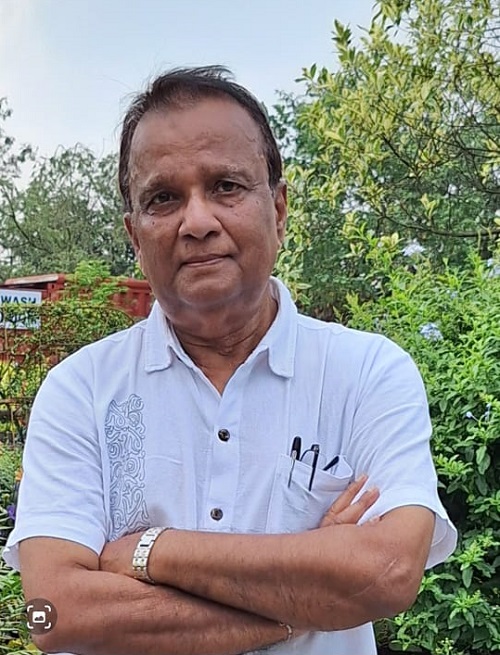
Prabhanjan K. Mishra is an award-winning Indian poet from India, besides being a story writer, translator, editor, and critic; a former president of Poetry Circle, Bombay (Mumbai), an association of Indo-English poets. He edited POIESIS, the literary magazine of this poets’ association for eight years. His poems have been widely published, his own works and translation from the works of other poets. He has published three books of his poems and his poems have appeared in twenty anthologies in India and abroad.
Sreekumar Ezhuththaani

By late afternoon, Chennai had begun to sweat.
Heat in the city was never just heat; it pressed against the chest like a firm, unrelenting hand. The roads shimmered with mirages as though the desert had quietly claimed them. Even here, in the middle of the city, women still walked with pots of water balanced on their hips. The shadows had lost their darkness, bleached pale under the strain of the sun.
I stood for a while at the entrance of the restaurant, watching people pass, as though one of them might suddenly turn into her.
I did not know that Rashmi had already arrived and taken a seat inside.
When I heard she had come to the city, I had decided I must meet her somehow—speak to her, try to bring an end to the cold war between her and her father, Madhavan. But when I mentioned it to him, he refused. So this meeting was arranged without his knowledge.
When I asked her if we could meet before she left, she had simply said, “Okay, uncle.”
I had not told her that I wanted to talk about her father.
I had known Madhavan for years. He was a man who spoke openly, laughed loudly. Now he and his daughter stood like two banks of a lake filled with still, cold water—you could see the other side, but never reach it.
I went inside only when her call came.
She was sitting in a dim corner.
Nothing about her announced anything unusual. An ordinary young woman. She leaned slightly forward, tracing circles along the rim of a steel tumbler with her fingers, as if testing its heat. There was none of her father’s easy warmth in her face. Instead, there was a hardness—the kind that comes from deciding, long ago, that softness is a liability.
“Uncle,” she said, rising slightly, inclining her head.
“Rashmi…” I pulled out the chair and sat down.
The waiter arrived with the precision and indifference of a clock.
“Coffee?” I asked.
She nodded.
Some conversations begin easily. Others are too heavy to move at all. This was the second kind.
We spoke first of literature, cinema, work. One cup of coffee disappeared unnoticed. As we waited for the second, I began carefully.
“Do you know,” I said, “I’ve been interested lately in an old subject—phenomenology.”
“I’ve heard the word,” she said. “Nothing beyond that. What is it?”
“It’s… interesting. At its core, it says something strange—that experience itself is a peculiar phenomenon. Stranger still is how we trust it, until something reveals otherwise.”
She looked at me—not with curiosity, but with patience. As if preparing a defense.
Madhavan had once said she could read minds.
“In simple terms,” I continued, “what we experience… is shaped by the mind. Our feelings about life come not just from what happens, but from how we experience what happens.”
She exhaled slowly. The faint trace of a smile left her face.
“Are you saying everything is imagined?” she asked.
“No. That would be illusionism. This is different. It’s something the mind does—objectively. Not guesswork. Something we can observe, if we try.”
She leaned back.
“People don’t need philosophy to explain themselves,” she said. “They lie. They disappear from their own lives. They remember only what they need. Even apologies come like acts of charity.”
Her words were measured, placed carefully, like a performer stacking objects one over another without letting them fall.
“Sorry… go on,” she added.
She had already mapped the field.
“It’s not what you think,” I said. “Phenomenology isn’t a tool to solve problems. It’s a way of seeing—of noticing how the mind begins to shape things even before we interpret them.”
“That sounds like avoidance,” she said. “A kind of escape.”
“No. The opposite. We usually hide behind philosophy, psychology, history. This removes all that. It asks: how does this experience come to us? Or do we construct it?”
She was quiet for a moment.
“So if I say I hate someone—”
“We don’t begin with why.”
“Then where?”
“With the hatred itself. What does it feel like? Where does it sit? Is it fixed, or does it spread? Does it fade over time, or sharpen?”
She watched me.
“That sounds like introspection.”
“It is. But unless it’s ruthless, it’s useless. There’s no refuge in half-truths.”
Rain thickened outside. A motorbike passed, its sound lingering briefly inside the room.
“And what if it has no meaning?” she asked softly. “What if it’s contradictory?”
“That’s usually the case.”
“I’ve tried,” she said. “To look at things that way. But nothing resolves. It only gets worse.”
“How?”
“The stories I tell myself disappear. Without them… how do I live? In fragments. Anger that doesn’t match memory. Affection that arrives where it shouldn’t…” She stopped. “It’s unstable.”
“Yes,” I said. “Because the stories we create are cleaner than experience. At least they are under our control. This tears even that away.”
“So what does it leave behind?”
“Not everything has meaning.”
She laughed—a dry, lifeless sound.
“Comforting.”
“No.”
Silence returned.
“Then… this detachment from the world—”
“Natural,” I said. “It need not be moralized or pathologized. Just examined.”
“But where does it come from?”
“There are common answers—generational gaps, accumulated distance. But phenomenology suspends that question.”
“Artificially.”
“Yes. But not without purpose. It’s simple,” I said. “Like the silence at a railway station.”
“What silence?”
“It doesn’t exist. You can test it with a recorder. The brain creates it for convenience—like it assigns color to different wavelengths of light.”
“What do we get at the end of all this?”
“Something unsettling. Truth. Eventually, doesn’t it become clear?”
She did not answer immediately.
“It doesn’t always help,” she said. “Sometimes it only removes the illusions that held us together. If I really look at what I feel…”
“If you do?”
“It might be worse than what actually happened.”
“Yes.”
“Then isn’t it better to avoid it?”
“Avoidance has its own cost.”
“And phenomenology?”
“It dismantles experience-stories.”
“And when they collapse?”
She looked out at the rain.
“There’s something even more ordinary behind both,” I said. “The root of generalizations. Availability bias.”
“What’s that?”
“We judge based on what is available to us.”
“That’s all?” she said quietly.
The fan above clicked with each rotation.
“When I needed him,” she said, “your friend wasn’t available.”
“That’s not what I meant—”
“I know, uncle. You’re wasting time.”
It was not a conversation she intended to lose.
“Rashmi… can’t some things be fixed?” I asked.
She didn’t answer. She only smiled again—that same lifeless smile.
“I knew why you called me.”
I touched my cup. The coffee had gone cold.
Somewhere between theory and reality, I had lost even the language I needed.
She belonged entirely to the latter.
My phone rang.
Madhavan.
I stepped outside.
“I just saw her,” he said. “She came… we spoke a little… she left.” His voice carried an unusual clarity.
I closed my eyes.
“Oh.”
“She seemed… okay,” he said.
“Alright.”
“I don’t know what she’s thinking… but it’s fine. I’ll call you later.”
The line went dead.
When I returned, she asked, “Father?”
“Yes.”
She did not ask anything more. Neither did I say anything.
We walked out.
The heat had softened slightly. Thin rain clouds drifted across the sky. I stopped an auto for her.
She was about to get in, then hesitated.
“Uncle… what did he say?”
For a moment, I held back the truth.
Instead, I asked, “Rashmi… does your father have any mental problems?”
She looked surprised. “Why?”
“He called to say you went to see him.”
She looked at me—without anger, without defense. Only with a quiet curiosity.
Then she said goodbye and got into the auto.
It pulled away.
For a moment, she turned back.
In her eyes, I thought I saw something unfinished.
Moisture—
or perhaps only the deception of evening light.
The auto dissolved into traffic.
Sreekumar Ezhuththaani
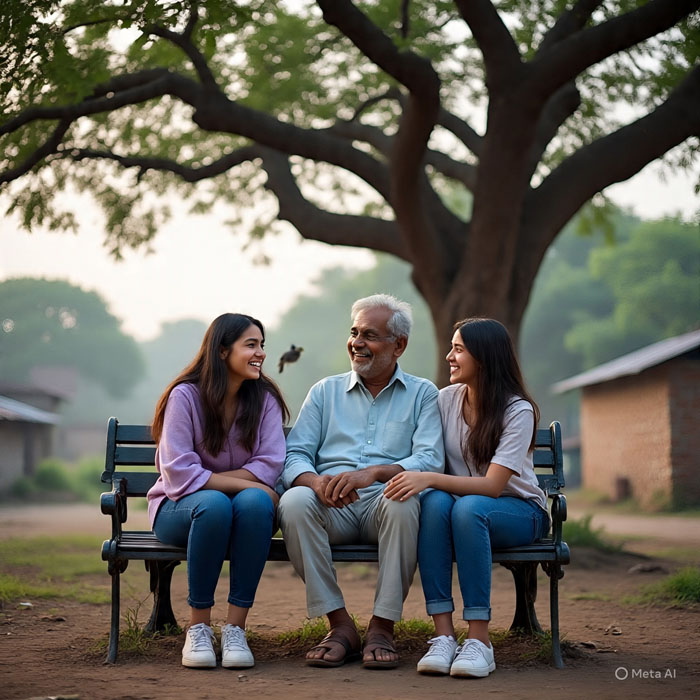
Valiyavila was the kind of place that did not announce itself. It lingered.
On certain mornings, mist would settle low along the narrow lanes, as if the night had forgotten to withdraw. The air carried a faint salt-smell drifting from the beaches which are about ten miles away, not strong enough to name, only enough to haunt.
When I moved there, three years ago, the main road held just two small eateries. They opened before dawn, serving men who belonged elsewhere, factory hands, clerks, drivers, each swallowing their breakfast as if time itself were watching.
Idlis vanished in seconds. Puttu was wrapped in yesterday’s newspaper. Nobody lingered.
Those places did not last.
They closed one after the other, replaced by a row of modest hotels, each brighter, louder, slightly more ambitious than the last. Then came Paradise Pavilion. It arrived like an intrusion—polished wood, artificial chill, prices that suggested aspiration rather than necessity. Yet it filled, always.
People said it was the food.
It wasn’t.
It was Daisy and Soumya.
They moved through the place with a rehearsed ease, uniforms too crisp, smiles too precise, makeup applied with a care that bordered on defiance. They resembled budget air hostesses stationed in a town that would never take flight.
Daisy was the louder one. Sharp-eyed, quick to laugh, her voice carried the clear ring of temple bells, but there was something brittle beneath it, as if the sound might fracture if pressed. She was twenty, she told me once. A lab technician in the making, until fees remained unpaid long enough to become fate.
Soumya was quieter. She spoke as if testing each word before release, her fingers often twisting the edge of her dupatta into a thin rope. Her story was the same, only told with less resistance.
They remembered things.
“Sir, no sugar today, right?”
It began like that, small recognitions accumulating until I was no longer a customer but a pattern they anticipated. Plates arrived before I asked. Preferences were remembered without effort. Familiarity grew, not from intimacy, but from repetition.
It was enough.
One evening, the hotel was sealed.
Corporation officials had padlocked the entrance, wastewater complaints, someone said. The town absorbed the inconvenience with quiet irritation.
I found time to frequent the nearby park, a neglected space with two iron benches and a streetlamp that flickered like a dying pulse.
I did not expect them.
“Sir! Sitting here?”
I almost failed to recognize them. Without the uniforms, without the constructed brightness, they seemed smaller, younger, unprotected.
Soumya dropped beside me without hesitation. Daisy stood a moment, studying me, then sat on the other side, enclosing me between them.
“You look different,” I said.
“So do you,” Daisy replied, smiling. “We are in schoolgirl mode.”
There was a looseness to them that evening. Words spilled easily, gossip, complaints, small cruelties of daily life. They mocked my food habits, my routine, my predictability. It was affectionate, but also observational, as though I were something they had studied over time.
Daisy’s phone rang.
She stepped away to answer, voice lowered, posture tightening.
“Boyfriend,” Soumya said, eyeing her.
When Daisy returned, she did not resume the conversation. She tugged Soumya up.
“Good night, Sir. Dream of us.”
It was said lightly, but it stayed.
Later, a missed message from Soumya appeared on my phone. No words followed. Just the notification, an opening that remained unused.
I never asked about it.
Tipping was not something I believed in. It felt transactional in a way I preferred to avoid. But one morning, without much thought, I left a hundred-rupee note on the table after my coffee.
“Keep it.”
They did not.
They returned with the exact change, placing it carefully before me, their refusal almost embarrassed.
“Bill is enough, Sir.”
I tried again another day. The same result. A quiet insistence, as if accepting more would disturb a balance they were unwilling to risk. I noticed that they did wait for the tip from the other customers.
Their absence, when it came, was abrupt.
Daisy disappeared first.
“Family issues,” Soumya said, but the words were evasive, too polished to be true.
Then the hotel closed again, gas shortages this time. When it reopened, Soumya was gone as well.
Routine dissolved. I stopped going.
Valiyavila returned to being a place I passed through.
I saw Soumya again by accident.
She was behind the counter, thinner, her face carrying something that resembled exhaustion more than time.
“Sir! Where were you?”
“You weren’t here.”
Something in her expression shifted, and for a moment, she looked as though she might cry.
“Daisy?” I asked.
She nodded.
“Married. Ran away. Police came. Asked me everything.” A pause. “I didn’t say.”
There was no pride in it. Only a kind of stubborn loyalty that had already cost her something.
I messaged Daisy that night.
Congratulations.
The message remained unanswered.
Through Soumya, fragments emerged. Delhi. Hard work. A plan for a small shop back home. Survival, reduced to logistics.
Once, I gave Soumya some money to send to Daisy. She accepted it without resistance this time. Something had shifted.
Hope flickered briefly when Soumya said Daisy would return.
“She’ll open a grocery shop. Nearby.”
I believed her.
That was my mistake.
Daisy did not return.
The story fractured instead.
A train journey back to Kerala. Then absence. No arrival. No trace.
Families searched. Nothing surfaced.
Soumya spoke of it once, her voice breaking without warning. After that, she avoided the subject entirely, as if speaking might confirm what silence still resisted.
The last time I saw her, she called late at night.
“Sir… stomach pain.”
The hotel manager did not answer his phone.
I found an auto and went to her place.
She was folded into herself when I reached her, breath shallow, face drained of colour. At the hospital, they said her appendix had burst. Words were exchanged in hurried tones, decisions made quickly.
By morning, her family had arrived.
They thanked me more than necessary. It felt like a ritual rather than gratitude.
They took her away.
That was the end.
No messages followed. No calls. No confirmations of recovery or decline. Only absence, again, this time complete.
I left Valiyavila not long after.
It had begun to feel hostile, not in any visible way, but in the manner of places that retain too much without offering explanation. I did not look back when I left. It seemed unnecessary.
But the mind does not leave things as cleanly as the body.
Now, whenever I read of young women lost and found, elopements, accidents, unnamed losses, I pause longer than I should. There is always a moment where possibility sharpens into something personal.
It could be them.
Valiyavila remains where it always was, on the edge of Thiruvananthapuram, suspended between departure and return.
And in the mornings, I imagine the mist still clinging to the lanes there, holding, for a little longer, the shapes of those who passed through it and never emerged.
Every year, 350000 women go missing in India.
Every year.
350000
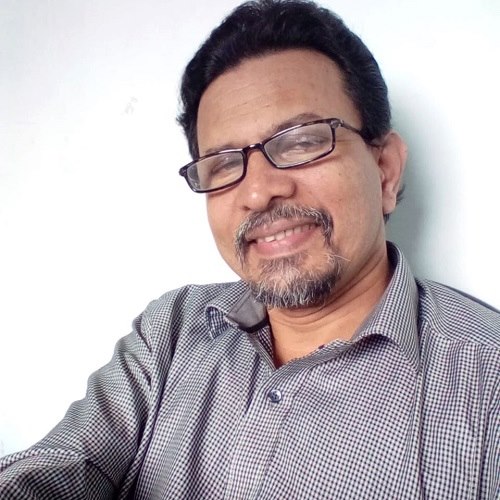
Sreekumar Ezhuththaani known more as SK, writes in English and Malayalam. He also translates into both languages and works as a facilitator at L' ecole Chempaka International, a school in Trivandrum, Kerala.
WHEN THE HILLS BEGAN TO SPEAK
Satish Pashine
Every morning, the hills were there. Unmoving. Uncomplaining. Almost as if they had signed a quiet agreement with time itself—to remain exactly where they were, no matter how much the world below kept shifting. From my tenth-floor balcony in Hinjewadi, they stretched across the horizon like a soft, unfinished sketch—faint brown lines behind glass towers, traffic noise, and deadlines. For the longest time, they had been nothing more than that: a background. A silent presence that required nothing from me and, in return, received no attention.
“Tea,” Archana said, placing the cup gently into my hand, the warmth of it grounding me for a brief second.
“Hmm,” I replied, eyes still locked on my phone.
Emails. Messages. Headlines. Each one urgent. Each one demanding to be seen before the day had even properly begun.
Down below, the city was already in motion. Buses coughed themselves awake, motorbikes weaved through half-open gates, and people walked with that familiar urgency—always a little too fast, always a little too tense—toward Rajiv Gandhi Infotech Park. It was a rhythm I knew well. A rhythm that rarely paused.
“Late again for your new assignment?” Archana asked, a quiet smile playing on her face.
“Not late,” I said, almost defensively. “Just… pressure to be on time.”
She shook her head, half amused, half resigned.
“You and your deadlines,” she said. “And they pay you peanuts.”
I smiled faintly, but didn’t respond. Because she wasn’t entirely wrong.
And behind all of it—the rush, the irritation, the noise—the hills stood as they always did.
Watching. Waiting.
Most mornings, I didn’t really see them. They existed, yes—but like wallpaper, like something your eyes learn to ignore. Until that one morning. There was nothing dramatic about it. No sudden realization, no cinematic shift. Just a subtle slowing down of everything, as if the day itself had decided not to hurry.
The sunlight hadn’t yet taken full control. It moved carefully—touching one building, then another—gliding across glass surfaces, slipping down concrete walls, before finally reaching our balcony. The towers seemed to glow from within, like they were still waking up, reluctant to face the day ahead.
I stood there with my tea. Steam rose in thin, wavering lines. The air felt cooler than usual, almost thoughtful.
Beside me, Archana stood quietly. Unusually quiet.
She glanced at her phone—not with urgency, but out of habit. No notifications from the society gates. None of her maids had arrived yet. For once, there was no immediate problem to solve, no instruction to give. Slowly, almost absentmindedly, she lifted her gaze toward the hills—and then didn’t look away.
“What are you checking?” I asked, more to fill the silence than out of real curiosity.
She didn’t answer immediately.
Instead, she raised her hand and pointed.
“Look carefully,” she said. “Do you see something there?”
I followed her finger, squinting slightly. At first, it was the same old view—dry slopes, scattered bushes, uneven patches of land. Nothing new. Nothing unusual.
“Where?” I asked.
“There,” she said, more firmly now. “On that hill… slightly to the left.”
I leaned forward, narrowing my eyes, forcing myself to look—not casually, but with intent.
And then… something shifted.
I saw it.
A line.
Faint. So faint it almost felt like imagination. Running across the hillside like a thought that hadn’t fully formed.
“Wait…” I said, my voice trailing. “Is that…?”
“A path?” she completed softly.
“Maybe,” I said, unsure.
We stood there, both of us staring now. The line didn’t disappear. If anything, it grew steadier the longer we looked.
She tilted her head, studying it.
“Or maybe an old fort road,” she said slowly, as if building the idea while speaking. “These hills must have been important once.”
I smiled.
“You’ve already built history,” I said. “It could just be goats.”
She laughed, the sound light but persistent.
“You always reduce everything to goats.”
“Well,” I shrugged, “goats have been very consistent contributors to civilization.”
She shook her head, but there was a softness in her expression now.
“Seriously, Satish… look properly.”
And this time, I did.
Not the distracted kind of looking. Not the half-present glance between notifications. But the kind that demands stillness.
“Wait,” I said suddenly, turning back inside. I returned a moment later with the binoculars.
“Now let’s confirm,” I added, handing them to her.
“You and your gadgets,” she smiled, but took them anyway.
She adjusted them slowly, carefully. The silence stretched longer this time—not empty, but filled with attention.
“Well?” I asked.
She didn’t respond immediately.
Then, almost in a whisper, she said, “Yes.”
“What?”
“It’s a path.”
She lowered the binoculars and looked at me.
“People have walked there.”
I took them from her and raised them to my eyes.
And in that instant, everything changed.
The hills were no longer distant.
They moved closer—not physically, but in meaning. The faint line sharpened into a narrow trail, cutting diagonally across the slope with quiet certainty. It wasn’t random. It wasn’t accidental.
It was intention.
What had been dots became trees. What had been blur became rock. Birds were no longer specks drifting in the sky—they were movement, direction, life.
I lowered the binoculars slowly, as if rushing the moment would somehow break it.
“People have walked there many times,” Archana repeated.
And something about that sentence stayed with me.
It lingered longer than it should have. Followed me through the rest of the day. Sat quietly at the back of my mind while emails piled up and calls demanded attention.
Because the hills… refused to go back to being just background.
They had crossed some invisible line.
And now, they were asking to be noticed.
By evening, the curiosity that had quietly stirred in the morning refused to fade away. It lingered through messages, emails, and conversations, sitting patiently at the edge of my thoughts until it finally took over. There was something unfinished about the way I had looked at those hills—something incomplete in simply noticing that faint line and walking away. It demanded a second look, a deeper understanding. Almost without thinking, I opened my laptop, the glow of the screen replacing the soft light of the evening outside, and began searching.
“What now?” Archana called out from the kitchen, her voice carrying that familiar mix of curiosity and amusement. The sound of utensils, the rhythm of everyday life, continued behind her question—as if to contrast the sudden stillness I had stepped into.
“The hills,” I replied, not taking my eyes off the screen.
She laughed, and this time it wasn’t just playful—it carried a quiet recognition of change.
“You’ve finally noticed them?”
“Yes,” I said, after a small pause. “And I think… they’ve been waiting.”
The words came out slowly, almost as if I was discovering them while speaking. I wasn’t entirely sure what I meant—but something about it felt undeniably true.
As I read, one link leading to another, one idea opening into the next, I felt a subtle shift within me. It wasn’t dramatic, not the kind that announces itself loudly. It was quieter than that—like a perspective gently rearranging itself. Information, which would normally feel distant and academic, suddenly felt personal. Relevant. Alive.
“These hills are part of the Sahyadris,” I called out, my voice rising slightly with interest. “The Western Ghats.”
Archana walked in, wiping her hands, her earlier amusement now replaced with genuine curiosity. She leaned slightly against the table, watching me—not just listening, but observing the change in me.
“And?” she asked.
“And they’re ancient,” I said, turning slightly toward her. “Not just old—ancient in a way we don’t usually think about. Formed millions of years ago… shaped by volcanic activity, layers of lava cooling into basalt… entire landscapes built slowly, over time we can’t even properly imagine.”
She raised an eyebrow, a smile forming as she absorbed the jump in scale.
“From goats to volcanoes,” she said lightly. “That’s quite a journey.”
I smiled, acknowledging it—but I didn’t stop. Because now, I wasn’t just reading facts. I was uncovering meaning.
“And listen,” I said, leaning forward slightly. “These hills weren’t just… there. They weren’t just scenery for someone else’s life.”
She shifted her posture, now fully engaged. “I’m listening.”
“They were strategic,” I continued, choosing my words more carefully now. “Important. Routes passed through them—trade routes, army routes, connections between regions. These weren’t empty landscapes. They were active. Used. Watched.”
“So?” she asked, though her expression suggested she already understood where this was going.
“So forts were built,” I said, the thought settling more firmly as I spoke it aloud. “Right on top of these hills. Not randomly—but with purpose.”
She paused, and then that slow, knowing smile appeared.
“Tikona?”
“Yes.”
“Tung?”
“Yes.”
“Lohagad?”
“Yes.”
She folded her arms, a quiet sense of victory in her expression. “I knew it wasn’t goats.”
We both laughed, but this time the laughter carried something more—a shared realization, a recognition that the ordinary view we had ignored for so long was anything but ordinary.
“But think about it,” I continued, my tone shifting into something more reflective. “From those forts, they could see everything. The valleys stretching out below… movement across distances… travellers approaching long before they arrived. Nothing would go unnoticed.”
“Like surveillance,” she said.
“Exactly,” I nodded. “Seventeenth-century surveillance. No technology. Just height, placement, and awareness.”
“And Shivaji Maharaj?” she asked, almost instinctively, as if the thought naturally followed.
I looked at her, then back at the screen, and then beyond it—toward the hills, even though I couldn’t see them from inside.
“He understood this perfectly,” I said quietly. “He didn’t try to conquer the mountains. He worked with them. Used them. Turned geography into strength.”
The room fell silent after that. Not an empty silence, but one that carried weight—like something important had just been placed between us, asking to be acknowledged.
Later that night, I stepped out onto the balcony again. The city had softened by then. The sharp edges of the day had blurred into scattered lights and distant sounds. The urgency was gone, replaced by a slower, quieter rhythm.
The hills stood exactly as they had in the morning—unchanged, unmoved. But I wasn’t.
Now, when I looked at them, I couldn’t see them the way I used to. They were no longer just shapes against the horizon. They held depth. Memory. Presence.
I could imagine movement where there had once been stillness. I could almost trace the path we had discovered—not just as a line, but as a journey.
“Can you see it?” I asked softly, without turning.
“See what?” Archana said, stepping beside me.
“People walking there,” I said, my gaze fixed on the dark outline of the hills. “Long ago. Following that path.”
She stood quietly for a moment, her eyes adjusting, her attention sharpening. Then she nodded.
“Yes.”
“Soldiers,” I said, the image forming more clearly in my mind now.
“Or shepherds,” she added gently.
“Or both,” I said, smiling faintly. Because somehow, that felt right.
We stood there for a long time after that, without speaking. But this time, the silence between us was not empty. It was full—of images, of stories, of a connection we hadn’t known existed just that morning.
The hills were no longer distant. They were no longer quiet.
Somewhere, in a way I couldn’t fully explain, they had begun to speak.
And for the first time, I was listening.
That evening, the society felt different the moment I stepped into the living room. It wasn’t something I could immediately point to—no single sound or sight—but a subtle shift in energy, as if the air itself carried anticipation. Then, gradually, it began to take shape. A distant rhythm rose from below, almost hesitant at first, like a heartbeat finding its pace. Soft. Measured. Then, slowly, it grew stronger, fuller, impossible to ignore.
Dhol. Tasha. Dhol.
The sound didn’t just travel upward—it filled the space, seeped into the walls, into the body, into something deeper than thought.
“What’s happening?” I asked, drawn toward the balcony even before I had the answer.
Archana walked ahead of me, already smiling, as if she had recognized the moment before I had.
“Come,” she said. “You’ll like this.”
There was something in her tone—certain, almost knowing—that made me follow without another question.
We leaned over the railing together, looking down into the courtyard that had, in a matter of minutes, transformed into something unrecognizable from its everyday self.
Where there was usually parked cars and passing conversations, there was now formation. Order. Intention.
Women stood in rows, dressed in nauvari sarees that carried both grace and strength. Their turbans were tied firmly, their posture upright, their presence commanding. In their hands, they held lezim—small instruments that would soon come alive with rhythm. They didn’t look like participants in a society event. They looked like carriers of something older, something inherited.
The drums grew louder, more insistent now.
Dhol. Tasha. Dhol.
And then the movement began.
It wasn’t casual. It wasn’t rehearsed for show. It felt rooted—each step deliberate, grounded, as if it belonged not just to the moment but to a memory far older than the buildings surrounding them. The sound of the lezim cut through the rhythm, sharp and precise, weaving itself into the beat of the drums.
Behind them, young men stood holding saffron flags. The fabric caught the evening breeze and snapped alive, each movement bold and unmistakable. The color stood out against the concrete, against the fading light—refusing to be ignored.
“Today is Shivaji Maharaj’s birth anniversary,” Archana said quietly beside me.
I nodded, but my attention was fixed on what was unfolding below. It didn’t feel like a celebration in the usual sense. It felt like a recalling. A remembering.
And then, suddenly, the space shifted again.
A horse entered the courtyard.
It wasn’t expected, and yet it felt completely natural in that moment. Conversations paused. Movements slowed. Even the drums seemed to soften for a brief second, as if acknowledging the arrival.
On the horse sat a young man, dressed as Chhatrapati Shivaji Maharaj. A saffron turban wrapped firmly around his head, his posture upright and composed, a sword held with quiet authority. He didn’t move dramatically. He didn’t need to.
For a moment, everything else faded.
The buildings around us lost their sharpness. The sounds blurred at the edges. Time itself seemed to hesitate.
“Satish…” Archana whispered.
“Hm?”
“It feels like…”
“The seventeenth century?” I completed, without taking my eyes off the scene.
She nodded.
And for those few seconds, it truly did.
The drums resumed, deeper now. The flags moved with purpose. The dancers continued, but now the entire scene carried a different weight—as if it had crossed over from performance into presence.
And somewhere beyond the buildings, beyond the lights and the noise, the hills stood—watching.
That night, when I finally went to bed, sleep came easily. Deeply. But it wasn’t quiet.
Because the dream came.
I was no longer standing in my balcony. I was on the hill itself. Not observing it from a distance—but within it. The city had vanished completely. No towers. No roads. No sound of traffic. Only mist that moved slowly across the land, and a silence that felt alive.
“Move,” a voice said beside me.
I turned.
A man stood there, dressed like a soldier—his expression firm, his presence unquestioning.
Then, almost instinctively, I looked down at myself.
A saffron turban. A sword resting at my waist. A shield strapped across my shoulder.
“Are you coming or not?” he said, impatience cutting through the stillness.
“I… yes,” I replied, the answer coming without thought.
We began to climb. The path beneath our feet was narrow, familiar in a way I couldn’t explain.
The same line.
The one I had seen from the balcony.
My heartbeat quickened—not out of fear, but recognition.
At the top stood a fort. Not separate from the mountain, but rising out of it, as if carved from the same stone. Walls strong, unyielding, shaped by purpose rather than decoration.
“Take position,” a voice ordered.
I moved to the edge, looking down.
A vast valley stretched out below, endless in its reach. A road curved through it, subtle but visible, connecting distance to direction.
“Keep watch,” someone said.
“For what?” I asked.
“Movement.”
The word settled heavily.
Silence followed. Wind brushed against the stone walls. Time stretched—not measured in minutes, but in attention.
Then—
“Alert!”
The word cut sharply through everything.
All heads turned at once.
Far below, something shifted.
Movement.
Horses. A line of them. Dust rising behind them. The faint glint of metal catching the light.
“A patrol,” someone muttered.
“Send word to the next fort!” another voice commanded.
Messengers moved instantly—mounted, swift, gone within seconds, disappearing into the landscape as if they were part of it.
My grip tightened against the cold stone.
“Will they attack?” I asked.
The soldier beside me didn’t look at me.
“We watch,” he said.
Minutes passed, though they felt longer.
The patrol continued. Then slowed.
And then—
They turned away.
The tension didn’t break suddenly. It dissolved, slowly, like a held breath being released across the entire fort.
“They’re leaving,” someone said.
Relief moved through the space—not loud, not celebratory, but steady.
The soldier beside me spoke again, his voice quieter now.
“The mountains protect us.”
I looked at him, then beyond him—at the hills stretching endlessly, layer after layer, fading into the horizon.
They were silent.
But not empty.
Never empty.
They held. They watched. They guarded.
And in that moment, something became clear in a way that words had failed to explain before.
These were not just hills.
They were guardians.
The sound came suddenly.
Tring… Tring… Tring…
It cut through the dream like a blade through cloth.
I woke up.
The room was dark, the faintest light slipping in through the window. For a few seconds, I didn’t move. The feeling of the dream lingered—fragile, but present.
4:30 AM.
“Satish?” Archana murmured, half-asleep. “Alarm…”
“I know,” I said softly.
She turned and drifted back to sleep.
I sat up slowly, letting the last fragments of the dream settle into memory rather than disappear.
Then I walked to the balcony.
The hills stood there, exactly as they always had.
Silent. Still. Unchanged.
But not the same.
Because now, when I looked at them, I could see beyond the surface.
I could see footsteps now—not as imagination, but as something almost imprinted on the land. Faint, invisible to the eye perhaps, but unmistakable to the mind. Paths that had been walked again and again until they became part of the hill itself. I could hear echoes too—not loud, not distinct, but present in a way that made silence feel full rather than empty. And more than anything, I could feel it… a presence. Not something supernatural, not something to be explained away—but something that came from time, from memory, from lives that had once moved with purpose across those very slopes.
A few minutes later, Archana joined me, carrying two cups of tea. The morning was still young, the light just beginning to spread, the air holding on to that brief, quiet pause before the city fully awakened.
“You’re early today,” she said, handing me the cup, her voice still soft with sleep.
“Or maybe,” I smiled, wrapping my fingers around the warmth, “they woke me up.”
She looked at me, half curious, half amused.
“Who?”
I didn’t answer immediately. Instead, I let my gaze settle on the hills.
“They did.”
She followed my eyes, her expression slowly changing—not into surprise, but into recognition. As if she, too, was beginning to see what had always been there.
For a few moments, neither of us spoke. The silence between us felt natural, unforced—like it belonged.
Then she said quietly, almost to herself, “I think… they were always speaking.”
I nodded, feeling the truth of it settle more deeply than anything I had read or imagined.
“Yes,” I said. “We just never listened.”
Below us, the city began to stir again. The familiar sounds returned, one by one—buses starting with a cough, engines picking up rhythm, footsteps quickening with purpose, the invisible weight of deadlines settling back onto shoulders. Life resumed its usual pace, as if nothing had changed.
But something had.
Not in the city. Not in the hills.
In me.
The hills were no longer just a distant outline behind glass and concrete. They were no longer background, no longer something to be glanced at and forgotten.
They had become memory—holding within them the weight of time. They had become witness—silent observers to movement, ??????, and ???? across centuries. They had become story—not one that was told loudly, but one that revealed itself only to those willing to pause.
And every morning now, when I stand on that balcony with a cup of tea in my hand, I no longer just look at them.
I listen.
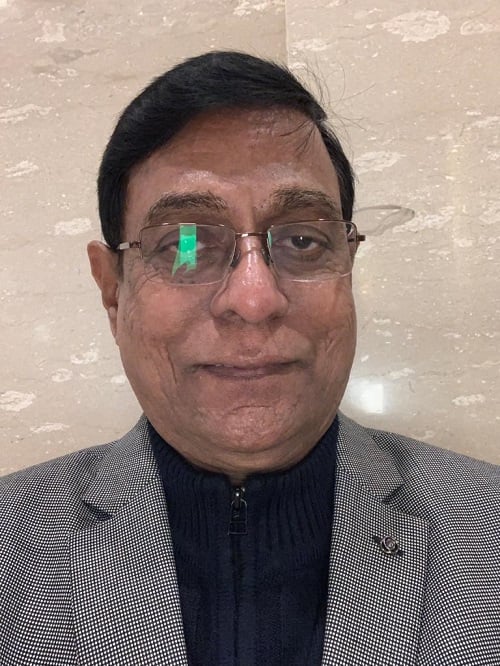
Shri Satish Pashine is a Metallurgical Engineer. Founder and Principal Consultant, Q-Tech Consultancy, he lives in Bhubaneswar and loves to dabble in literature.
Snehaprava Das
Summer vacation has its specisl advantages and disadvantages for school goers. For me summer vacation was an ambiguous mix of comfort and compulsion. It meant respite from the rigours of a routine engagement, of getting up at a fixed time, studying, getting ready for school after a hurried meal. It also meant missing the charm of school, sports and games, fun in a teacherless classroom and so many innocent mischiefs.
That summer however I had a specific agenda, to learn bicycle riding. And my volunteering mentor Biju, a boy who studied in my class and lived in the neighbourhood was too eager to exhibit his expertise while teaching me the lessons.
I had many ftiends for that matter but I was a bit tomboy type and Biju, being docile in nature suited best to my idiosyncratic, adventurous mood. So we had made a plan to use the vacation for bicycle riding lesson and Biju who timidly surrendered to my whims loved the idea of being elevated to the status of my teacher, however temporary may be the tenure.
Mother saw to it that I took a short nap after midday meal. I lay in the in the semi dark room(mother kept the windows shut and closed the door partially)listening to the summer noon, fluent with the gentle whoosh of warm winds through the trees, the cooings of the koel that is some times soft and shy on some occasions and bold and aggressive on the others.
Some of the days when she found time from her post lunch chores, she slept by me. I waited for mother to sleep and came out of the room taking all care not to make a sound. By that time Biju had taken the cycle out to the road. Father didn't usually lock the cycle. He walked to the office at it was only a few hundred meters away from our house.
And the lessons began.
It was the fifth or probably sixth episode of our secret expeditions.
I had learnt to maneouvre my father's big twenty four inches cycle through half stroke pedaling. I put my left foot on the left pedal and inserted my right leg under the top tube. My grip hard on the handle bars, I pressed the right pedal forward pushing the front wheel ahead. The movements were unsteady in the beginning and the cycle swayed from side to side briefly as I pedaled on but I managed to maintain balance. Slowly, I got rid of my intial fear of handling the big cycle.
That morning I and Biju had planned to go for the saddle-seat mounting lesson when my mother took her mid day nap I waited anxiously for the gentle snoring of mother while Biju, guardedly, extra careful to avoid even the slightest sound, wheeled the cycle out through the small gate to the street.
When mother's breathing became unhurried and regular, and the snoring was a rhythmic soft whistling confirming that she was sound asleep, I stole out of the room closing the door noiselessly behind me.
Biju mounted the cycle and I trotted alongside him as we headed for the tract of barren land close by the Officers' Club House. The tar road was hot under my feet and the May sun glared pitilessly at us as we moved on. I, bursting with the excitement of enjoying the experience of mounting the big cycle, cared little for the sun. Soon we reached the barren tract and Biju, climbing down, handed me the cycle. With his help I sat astride the saddle seat and rested my feet on the pedals.
The large tract was cleft by a cemented drain that remained dry all through the year and was filled with crumpled leaves and other litters. The front entrance of the City Hospital stood wide and imposing at the far edge of the tract. A little away, say about a couple of hundred meters or so from the main building of the hospital and partly covered by dense trees and thickets there was an unassuming looking unit having a few single storied rooms. It was the hospital's mortuary. The place had an eerie, mysterious aura about it that inspired a mixed feeling of fear and curiosity. Mother often cautioned me not to go closer to it.
But it is human nature to get drawn to things which are forbidden to be explored or are shrouded in secrecy. The mortuary was one such uncanny place. But we have till then never got near to it since it was quite some distance away from our regular playing area. But that noon while I struggled with the cycle my attention unwaveringly fixed on my efforts to mount the seat, Biju sauntered away to the white single storied mortuary. I glanced briefly at him and saw him peering into it through a window pressing his nose to the frosted glass panels. I did not think much about it since my focus was on the act of weilding the big cycle. After failing in my effort for quite a number of times I finally managed to hoist myself up to the saddke seat. Astride on the big cycle I stretched down my legs to the pedals. My feet barely touched the pedals but I was not a character to give up.easily. The cycle, with me on the seat swayed and hurtled precariously on the tar road as I, breathing hard in excitement tried to maneouvre it forward. Though the task was tough but the experience was wonderful. It felt as if I was sailing in the air. My mind and my eyes were so riveted on the act I was engaged in that I completly forgot my mentor. The wheels negotiated the road slowly and haltingly as I let the cycle roll by the wide, waterles drain.
And then things happened.
Biju let out a loud howl and ran towards the. spot by the drain where I was still striving to hold the cycle steady and almost syncronizing with that my hands lost their grip on the cycle handles, and the cycle losing balance went toppling down taking me along with it. I closed my eyes tightly and flailed my arms frantically to grab the air as I fell into the drain. The world went blank for a moment. After a while I opened my eyes to slits and looked. I was lying in the dry drain, face up. Almost unhurt except for a few scratches on my elbows and palms, my frock plastered with rotten leaves and scraps of papers. The big cycle lay horizontal above me, its wheels on either side of the drain, still rolling slowly and whirring a bit. I screamed for Biju but he seemed to have disappeared God knew where. My heart beating hard and my breath coming out in wild gasps I tried to get up but it was not easy.
A shadow fell over me. I squinted at it. A man was looking down at me. I looked closely and my heart went up to my throat. He was my father. God only knew how he happened to have arrived there when I was what seemed to be the worst crisis in my life. I went numb for a minute or so and then the tears came.. Hot and scalding--- tears of guilt, shame and fear in unstoppable runnels. Father lifted the cycle and stood it by the drain. Then he pulled my hands gently bringing me out of the drain. He brushed the dust and the dirt off me with his hand kerchief.
'Come,' father said and lifted me up to the top bar of the cycle. No one spoke a word during the ride back home though the air was bursting heavy with unasked questions and unuttered explanations.
The rest of it is could be understood even without an elaborative narration.
It brought my bicycle riding adventure to a sudden halt and also to Biju's budding career as my mentor.
But I had not given up on it. I would give it a short brake and start afresh, after my father's wrath calmed down a bit, I decided.
But Biju went to his village to his grandparents and spent the rest part of the vacation there.
Biju and I did not meet thereafter till the school reopened after the vacation.
It was a cloudy afternoon in mid-June. The first occasion when Biju and I were alone. We were left behind others while returning from the school.
'Why did you scream so loudly that day?'
I asked vehemently. 'Had it not been for that I could have learnt bicycle riding in all its perfection. And where did you vanish? Your being there with me might have alleviated
my father's wrath to some extent.'
I charged him.
Biju looked at me innocently.
'You won't belive if I tell you why I ran away that day.' He sounded mysterious and I blinked at him.
'What do you mean?' I was mildly curious.
'It was the mortuary!!' His voice quavered a little at the memory.
'What about it?' I inquired with increasing curiosity.
'I saw something when I peeped through the glass window.
I waited, my unblinking gaze fixed on his face.
'You won't believe, ' he said again. ' infact, many would not believe this. But I saw it in my own eyes. A man, not man, a body -- actually it was! It was lying motionless. As I looked, it sat up on the bed and the white sheet fell off its face. The head was heavily bandaged and there were black holes in the place where its eyes should have been!!'
I gaped at Biju, my jaw dropped, my eyes rolling.
There was no point in asking whether what he was telling was true.
It shook my decision of resuming the bicycle riding lesson in a reasonable degree, but I was a stubborn kind of girl and was not ready to give in so easily. I debated with myself and decided to my convenience that Biju must have imagined the entire thing timid as he was by nature. It was presumably a case of optical illusion.
I decided to wait a little before resuming the lesson. 'This time,' I thought, 'I will ask some other boy to train me, some one who is daring and smarter than Biju. May be Prashant, his cousin, who was one year senior to us.'
It was a mildly sunny afternoon of late September, gentle and warm. The school was closed for the Dussera festival. I sat astride the saddle seat of the big cycle, well poised, my confident grip on the handles. I pedaled on and the cycle rolled smoothly along the dry drain. It felt as if I was sailing in the air. It was a great experience. I was in cloud nine. Prashant was nowhere in sight but I did not mind that. I no longer needed his help or support to handle the machine. I pedaled faster and the cycle rolled along the imposing compound wall of the Officer's Club, and suddenly I found myself at the small unassuming back entrance of the mortuary. I looked around. There was no one in sight. The field looked vast and unending from that point, and the mortuary grim and desolate. I fell a frisson of unease and increased pressure on the pedals intending to move away from there. But the big cycle refused to move. It did not budge an inch despite all the efforts I applied on it. I was beginning to sweat. Just at that moment I heard a soft creak. Startled, I looked towards the frail and brittle wooden gate. It was slightly open and a figure stood by it. The figure was all covered in white except for the face. The head was swathed in a heavy bandage and there were dark sockets where his eyes should have been. He sauntered out of the gate and advanced towards me. I jumped off the seat and ran. The cycle fell down with a loud clang. I did not look back and bounded across the barren patch that seemed to be expanding endlessly under my feet , my eyes squeezed shut, screaming Ma -- Ma at the top of my voice, ignoring the occasional spiky bushes that scratched my feet.
A gentle hand shook my shoulder. 'What is it?' Why are you. yelling like this?'
I opened my eyes. Ma was standing over me, a look of concern in her delicate eyes. 'Are you dreaming in the day?' I felt my face and neck. They were wet with perspiration. My mother wiped my face with the end of her saree and smiled. 'Wash your face, ' she said and walked out of the rooom.
I lay in the bed a long time after she left, trying to wiggle out the impact of what I saw. Was it real or only a dream?
The memory of the face with a bandaged head and black holes in place of the eyes me gave me goosebumps. Slowly i reconciled to the truth that it was actually a dream.
But the dream had shaken my confidence to its roots. I knew instinctively that I could no longer venture out to that vast tract even if it meant stopping the bicycle riding activity for good.
We left the town consequent upon my father's transfer to another place.
Needless to mention that I had lost all interest in bicycle riding, and it was never revived.
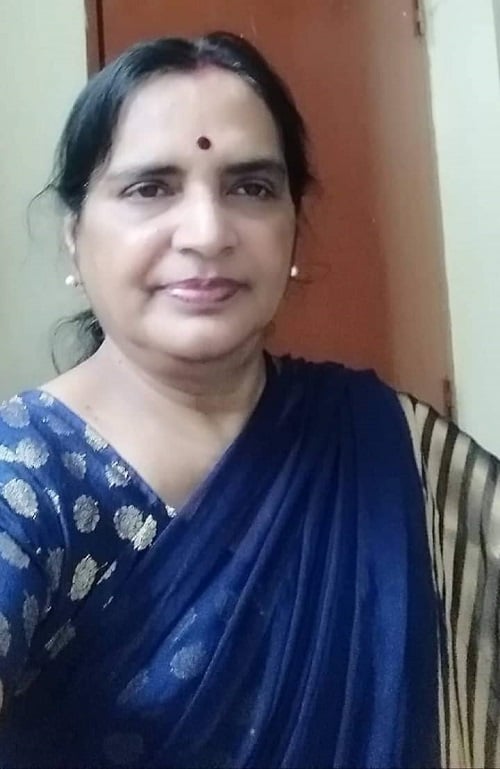
Dr.Snehaprava Das, former Associate Professor of English, is an acclaimed translator of Odisha. She has translated a number of Odia texts, both classic and contemporary into English. Among the early writings she had rendered in English, worth mentioning are FakirMohan Senapati's novel Prayaschitta (The Penance) and his long poem Utkala Bhramanam, which is believed to be a.poetic journey through Odisha's cultural space(A Tour through Odisha). As a translator Dr.Das is inclined to explore the different possibilities the act of translating involves, while rendering texts of Odia in to English.Besides being a translator Dr.Das is also a poet and a story teller and has five anthologies of English poems to her credit. Her recently published title Night of the Snake (a collection of English stories) where she has shifted her focus from the broader spectrum of social realities to the inner conscious of the protagonist, has been well received by the readers. Her poems display her effort to transport the individual suffering to a heightened plane of the universal.
Dr. Snehaprava Das has received the Prabashi Bhasha Sahitya Sammana award The Intellect (New Delhi), The Jivanananda Das Translation award (The Antonym, Kolkata), and The FakirMohan Sahitya parishad award(Odisha) for her translation.
Usha Surya
Janaki locked her drawer and put the bunch of keys in her hand bag. The time was a little past five and she was getting ready to leave the office. The next day was Saturday- the second Saturday - a holiday and the thought of the weekend made her happy. She could catch up with her reading and perhaps attend to a couple of things she had been wanting to do.
There was a gentle knock on the door and the Security officer walked in.
"Madam, there is a gentleman to see you and he says he will take only a few minutes. He seems to be a very decent person and I thought you wouldn't mind spending a few minutes with him."
Janaki left her bag on the table and took her seat.
"Okay. Send him in, Shyam," she said,wondering who it could be.
The door opened in a while and a man walked in with a smile on his face.
Janaki asked him to take his seat.
Clad in a pure white shirt and equally white dhoti, three stripes of sacred ash on his forehead with a small circular dot of kumkum in the centre, he looked a very pleasant man.
He had a jholna bag which he placed on the table and folded his hands.
"Namaskaram Amma. I saw you in the evening as I was entering the Bank next door and knew it must be you. I completed my work there and dropped in near the gate and asked the Security person if your name was Janaki and he nodded in the affirmative. I was thrilled! I have been desperately wanting to meet you all these years...four or five, they must be !! The Security said that you have been here for a month coming from Pondicherry or Guntur...he did nor know for sure."
Janaki looked at him. He looked a bit familiar but she could not place him.
Her memory at remembering faces she had seen on just two or three occasions was a joke with her family !
She considered it quite normal. One sees so many people and surely one cannot remember everyone !! Some are etched in your memory and some just vanish like bubbles.
He opened his bag and handed her his card.
"Ponnurangam, Bangle Trader" she read out.
"Oh my God !! You are the Bangle seller (VaLaikkaarar) ..." she almost shouted after looking at him for a few seconds.
"Raakkamma's husband ?"
A big smile appeared on his face and he looked happy.
"Yes Amma. I am the "bangle seller". And Raakkamma's husband. I am happy you were finally able to recognize me."
"How is Raakkamma? How are you? How is your daughter? Has she finished her B Com ? Is she studying some more or has she taken up a job?"
What a volley of questions, she thought.
He smiled.
"We are all fine Amma, with your grace! ' he said.
"My grace ? No no no. It is God's grace Ponnurangam. Shall I get some tea for you?
"No Amma. I just had tea in the Bank. Now, where should I begin?"
Janaki smiled at him.
Her mind travelled back in time.
Ponnurangam's wife Raakkamma was working as her domestic help four years ago. She was staying in a rented apartment with her mother. Raakkamma came early in the morning at five thirty and completed her work by eleven. She would then take leave of Janaki's mother and rush off. She was working in another house from four in the evening. Janaki's mother would give her some rice and whatever was prepared and she would sit and have her meals before she left. She was a very quiet person. Her daughter was studying in a college .The husband had a small shop in their house in the front room and they made a decent living.
Janaki was expecting a transfer and had sent her mother to Bombay to her brother's house and had planned to get her back after she shifted to the news place .She was not sure whether she would be posted in Pondicherry or Guntur.
It was a Friday and Janaki had taken a day off to attend her friend's house-warming ceremony.
Raakkamma completed her work early.
"I am off Amma, " she said.
Janaki asked her "Where is your house?"
"It's down the next road amma. " she said, tying her hair.
"Oh!! I have to go there now!! The Gruhapravesham is in a building that has just been built I think."
"It must be the apartment that has come up!! It is just two blocks away from my house, amma," she said.
"Is that so? I shall drop you then on my way there! I am leaving shortly. You just wait for me," she said and went into the bedroom to change her saree.
As she drove the car, Raakkamma said."It is sad that you will be going away, Amma. I thought you would be here at least for two more years."
Janaki smi;led ."What to do Raakkamma? When we are given the marching orders, we should go!!".
The car turned into the next street. Janaki now reduced the speed.
"Stop Amma. My house is here!" said Raakkamma.
"Please, why don't you come in and have some water? I know you are going for lunch and you don't drink any 'colour'(soft drink)." Janaki also got down and locked the car.
Raakkamma opened the grill gate and went in. There were three houses in that compound and they seemed very old.
There was a small garden in front.
"Amma, there are three houses here. These were all built some fifty years ago. There were no buildings nearby and we bought this some seven years ago. My father-in-law gave us some money to buy this and keep a small shop.We are managing okay now."
She went into the last house. The door was open and there was a small shop facing the road. The counter was topped with a row of bottles filled with chocolates, candies and biscuits. The shelves below had a variety of groceries , all neatly packed.
It was very neatly maintained. There was a table and chair and a very calm person was seated there and behind him on the wall were pictures of various Gods of the Hindu pantheon.
He looked up and smiled and got up.
By then Raakkamma had reached the door and took her in.
"This is Amma of the house where I am working...remember, I told you that she might go off soon?"
The man brought his palms together and smiled at her.
" My husband amma,." said Raakkamma and took her into the shop. The man drew a plastic chair for her and Raakkamma rushed in. She came back carrying a gleaming brass tumbler filled with water.
"The water will be cool, amma. We use clay pots to store drinking water. There is a slight flavour of 'vetive'. It is said that it is good for health," she said and sat on the floor.
"Raakkamma has told me a lot about you amma. What she said seems to be true!! You look like Goddess Mahalakshmi, " her husband Ponnurangam said and sat down.
Janaki blushed.
She looked all around. Three shelves were lined with pens and notebooks and a few stationery items. Bundles of paper were also there. And a few grocery items neatly packed. The toffees and biscuits sold a lot, she surmised.
There was a small fridge . Milk packets and ' colour'--- sprite, fruit juices in cartons, maybe, she imagined. Nevertheless thoughts proved right as some person came right then and bought three milk packets. There were water bottles too.
What intrigued her was a small red bundle in the shelf corner.
There were a few hibiscus flowers and thulsi leaves on it. There was Kumkum too.
She asked, "What do you have in that bundle? Some family heirlooms?"
Ponnurangam smiled.
There was a tinge of sadness in his face now.
"It is my past, amma," he said.
Janaki looked at him. Her eyes were filled with unasked questions.
He said with a big sigh.
"Before I shifted to this city, I was selling bangles door to door in my village. I was greatly respected. There is a street called VaLayalkaara Theru ( Bangle seller's street) in my village, We were four in all and business was good till a posh shop came there. The shopkeeper sold fancy bangles, chains, necklaces etc. There were fancy earrings too. My business was affected.
We then shifted to this city. Raakkamma worked in three houses at that time and after I settled down a bit, she left one house. Now we are comfortable. Our only daughter is studying in college. This house is ours. The parents are still in our village. They refuse to come to the city. My father is some sort of a Herb Healer and we have three cows. Life goes on. But I used to love putting bangles on various hands...from babies to old women, People used to call me for Valaikppu ceremonies(baby showers) and I was happy. That bundle contains bangles. I consider it divine."
Janaki's thoughts fled back to her school and college days. They were in Delhi at that time but would come to a village near Tanjore to her grandparents' large house to spend the summer vacation. A bangle seller would pass the road and her grandmother would call him and Janaki used to go back to Delhi with a small suitcase full of glass bangles, bought from the bangle seller. He would sit on the verandah and open the cloth bundle and she would be mesmerised! Girls and women from the village would come and all of them had a great time wearing the glass bangles and shaking their hands and enjoying the tinkling sounds of the bangles.
Aw!! Those were days. Once her brother collected some broken pieces and took them to Delhi and he made six or seven kaleidoscopes! Mirror pieces were bought from a glass shop in Lajpath Nagar and he made them as if he was an expert. He gifted them to his friends after giving her one. How pretty the designs looked after each shake !! She still has that gadget with her.
Janaki could fathom the sadness in Raakkamma's husband's eyes as she looked at him. She felt sad.
She took leave of the nice couple and proceeded towards her friend's place which was just two blocks away.
A small crowd had gathered there. The Priests left after the rituals. The lunch was excellent and the ladies munched beeda and settled for a small chat. Three more ladies left and only Janaki, her friend and a neighbour were left.
"Were you able to arrange for bangles? " Suman - Janaki's friend - asked her neighbour.
Then turning towards Janaki, said
"This is Alamelu. She has moved to our building from Kolkotha . Her daughter is coming from the U S next week. She wants to celebrate the " Bangle Ceremony." She came to the city only four months ago and has quite a few relatives here and a few friends too, having studied here before moving to kolkotha. Do you know anybody who can supply some bangles? "
A sudden idea flickered in Janaki's mind.
She turned towards Alamelu and said " I know someone who can come to your place and supply bangles to all the invitees who come , apart from your daughter. Please give your telephone number and I shall ask him to call you and you can talk to him."
Janaki stopped at Raakkamma's house on her way back. The couple were peasantly surprised to see her and invited her in.
She did not mince her words.
"Ponnurangam, I have brought business for you."
He stared at her innocently.
She sat on the chair and explained about the Bangle Ceremony.
"I have brought the lady's telephone number. You can call her and talk to her. I remember the nostalgic look in your eyes when you were talking about your old profession. You can take this up as a pastime! Who knows, some other lady might give you business too! What do you say? If I were you, I would talk to her now and arrange something with her."
Ponnurangam did not realise whether he was happy or confused.
The next day Janaki got her written orders to join the Pondicherry office the following week.
She became very busy and in a week she left for her new assignment.
With work pressure and shifting her mother to her place she had almost forgotten Ponnurangam. She rang up her friend Suman only to discover the tragic truth that Suman and her husband were lost in an avalanche near Utharakhand where they had gone to visit a few temples with some friends. It was Suman's son who answered the phone. She did not have Alamelu's telephone number.
And now Ponnurangam was seated in front of her.
"So...how have you been, Ponrangam?"
" I am doing very well amma. All because of your grace. "
He fumbled and opened his bag and took out a small cloth bundle.'
"I have been carrying this with me for the last three years. I tried to get your phone number but that lady Alamelu amma was helpless as your friend and her husband had died in a tragic way and she was unable to contact you."
"Yes," said Jana. " I heard about it too. Fate !! What else can you say? Were you able to attend the Bangle Ceremony and supply bangles Ponnurangam?"
"Yes amma. That was the turning point in my life. Two ladies had come from Sowcarpet for the function; Alamelu Amma's childhood friends. They insisted on my coming to their colony. I sold quite some bangles there. Now they have a trend...like Sangeeh and Mehendi. They have a Bangle Day. Ladies and children are invited for a High Tea and I go there and personally put on bangles for those who wish. Invariably everyone wants bangles. I had to go to Mint street here to my regular Bangle shop to buy bangles and he told me to make a trip to Firozabad near Agra if I really wanted to see a million bangles!! I know a little Hindi and I made a trip with my daughter and wife. We went crazy over the bangles!! We came back with a lot of bangles!! Now I make it a point to go there twice a year to get bangles wholesale. It is so cheap too!! But the turning point in my life came when I met a Priest in one Bangle Ceremony in Mylapore."
He stopped and took a sip of water from the bottle he was carrying in his bag. I waited eagerly to listen to his story.
" He wanted me to supply bangles ro the small Amman Temple for which he was the priest doing Pooja on special days.. In the month of Aadi ( between July and August) they celebrate Aadi Pooram...for Devi and he adorns Devi with garlands made of 2000 bangles of all colours. The Priests chip in the money it seems. I was thrilled and something told me to take it up and do it every year for free!! The Priest was overwhelmed. The Temple gave me a zari dhoti and prasadams. I am still doing it amma. Raakkamma has stopped working as a domestic servant. She has struggled enough, I thought. My daughter is working in an office and her husband runs a Travel agency and has three cars. By God's grace they are doing very well. The Goddess looks after us. I have sold my provision store and renovated our house. I bought the small area behind our house and extended our home. There is a small garden too."
He opened the small bundle which had four pairs of broad coloured glass bangles. He kept them carefully on the table.
"I have been carrying these bangles with the hope of meeting you some day. You came to our place that day wearing glass bangles ...thick ones...I have preserved these for you . Please come home sometime amma. We are staying in the same place. But for you I may not have made it this big!"
There were tears in his eyes. He took the bangles in his hands and extended them to me
I looked at him,
"Put them on," I told him, extending my hands..
"I shall come next weekend to your place. I am so happy to meet you."
He slid the bangles painlessly on to her wrists and said, " I shall keep some fresh cold 'colour' for you amma. Yes, I have bought a fridge. Raakkamma will be so happy to see you. You are our Goddess."
Janaki stood there looking at his retreating figure. She shook her wrists and listened to the music made by those tinkling sounds.She felt that she had got back her lost childhood.
Usha Surya.- Have been writing for fifty years. Was a regular blogger at Sulekha.com and a few stories in Storymirror.com. Have published fifteen books in Amazon / Kindle ... a few short story collections, a book on a few Temples and Detective Novels and a Recipe book. A member of the International Photo Blogging site- Aminus3.com for the past thirteen years...being a photographer.
Phalguni Sahu
The first day of engineering college always carries a peculiar electricity- an unspoken promise of new beginnings, nervous laughter echoing through corridors, and strangers attempting to become familiar faces. That morning was no different. The classroom buzzed with introductions, half-formed friendships, and the rustle of fresh notebooks.
Reyansh stood out effortlessly. Tall, confident, and disarmingly charming, he moved from one group to another, exchanging smiles and stories. His voice carried warmth, the kind that made people feel instantly at ease. Yet, in the middle of that cheerful chaos, something, or rather someone stilled him.
In the far corner of the classroom sat a girl, quiet and self-contained, as if she existed in a world untouched by the surrounding noise. Her eyes, large and luminous, held a depth that words could not capture. A soft, hesitant smile played on her lips, one that seemed to carry both innocence and strength.
Reyansh found himself walking towards her, almost unconsciously.
“Hi! I am Reyansh from Mumbai. May I know your name please?” he asked, his usual confidence softened by curiosity.
She looked up, a flicker of hesitation crossing her face before she replied gently, “My name is Myra… I am from Delhi.”
That moment, simple and fleeting, quietly altered the course of their lives.
Days turned into weeks, and familiarity blossomed into companionship. What began as casual conversations grew into something deeper, something unspoken yet unmistakable. They sat together in lectures, shared hurried meals in the mess, walked across the campus under fading sunsets, and spent long evenings in the library pretending to study but losing themselves in conversations instead.
Reyansh spoke passionately about his dream of becoming an Army Officer, his eyes lighting up every time he mentioned the NDA results he awaited. Myra, with equal conviction, spoke of building her own enterprise someday- of creating something meaningful with her own hands.
Their dreams were different, yet they somehow fit together like two pieces of the same puzzle. Soon, the campus had a name for them- “the Love Birds.” And though they never formally acknowledged it, their presence together felt as natural as breathing.
But life, as it often does, had quietly begun writing a different story. September arrived with restless anticipation. The NDA results were declared. Reyansh had made it!
It was a moment that should have been pure joy; a dream fulfilled after years of determination and hard work. And yet, beneath the celebration lingered an unspoken sorrow. It meant distance. It meant separation.
Standing under the old banyan tree near the campus gate, Reyansh had held Myra’s hand a little tighter that evening. “I’ll come back for you,” he had said, his voice steady but his eyes betraying the storm within. She smiled, though her silence spoke louder than words.
Distance tested them, but love endured. Letters turned into late-night calls, stolen holidays became treasured reunions, and time, rather than weakening their bond, seemed to deepen it. Their families knew. Their futures seemed aligned. Life, for a while, felt almost too perfect.
After completing his training, Reyansh formally approached Myra’s parents with a marriage proposal. There was hope in the air, a quiet certainty that everything was falling into place. And then, everything fell apart!
At his home, tradition held deep roots. Before any major decision, his family sought the guidance of their revered Guruji. When the horoscopes were matched, the atmosphere changed. Guruji’s face grew grave. “If this marriage happens,” he declared, “Reyansh’s life will be in grave danger.” The words struck like a thunderbolt.
His mother, trembling with fear, refused outright. When Reyansh insisted, her resistance turned into desperation. “If you marry her,” she said, her voice breaking, “I will not live to see it.” Caught between love and duty, between his heart and his mother’s life, Reyansh made the choice that would haunt him forever. He walked away.
What followed was not life, but mere existence. The vibrant, spirited young man faded into a shadow of himself. Food lost its taste, laughter lost its meaning, and days blurred into nights filled with regret. He withdrew; from his family, from his home, from everything that once defined him. Guilt became his constant companion.
A year later, his inner self brought him to Ira’s doorstep. She was his old friend, now married and settled in Delhi, someone who had witnessed his love story from the very beginning. When she saw him that day, her heart sank. He looked like a memory of himself- fragile, worn, and painfully distant.
“I want to go to Myra,” he said that evening, his voice trembling yet determined. “I’ll leave everything… I just want her back.” Ira agreed, though an inexplicable unease settled in her heart.
The next day, they drove to Myra’s house. The streets seemed unusually quiet. The air felt heavy. Reyansh waited outside as Ira climbed the familiar staircase. But the door was locked. A passing tenant paused when Ira asked about the family. “You don’t know?” she said, almost surprised. “Didi is getting married… today. In Udaipur.”
For a moment, the world stopped. Ira felt the ground slip beneath her feet. Downstairs, Reyansh didn’t need words. One look at her face was enough. And then, he broke! Not loudly; not dramatically; just quietly, like something inside him had finally given up.
Time, they say, heals everything. But that is only half the truth. Time teaches you how to live with what never healed!
Years passed, but some wounds never learned how to close. Reyansh lived his life the way the world expected him to- disciplined, composed, dependable. A decorated Army officer, a responsible husband and a caring father.
But never whole. Because a part of him had remained frozen… under that banyan tree… with a girl who never asked him to choose; but lost him anyway.
One winter night, during a high-risk military operation in a remote border area, Reyansh sustained critical injuries. The mission was successful; but he wasn’t expected to survive. As he lay in the dimly lit military hospital, machines echoing the fragile rhythm of his heartbeat, memories began slipping through the cracks of consciousness.
Her laughter… Her silence… Her eyes… “Myra…” he whispered, barely audible. Back in the city, miles away, Myra woke up abruptly that same night. Her heart raced for no reason she could explain. Some connections, it seemed, refused to obey logic; even after years, even after separation, even after life had moved on.
The next morning, unable to shake the feeling, she did something she hadn’t done in years. She searched for his name. And then she saw it. A brief news update.
“Brave Army Officer Col. Reyansh Mehra Critically Injured in Border Operation.”
The world around her blurred. Without thinking, without explaining, without asking permission from the life she had built, she left. Hours later, she stood outside the ICU. Time had come full circle. Through the glass, she saw him- frail, still, barely holding on. Not the Reyansh she remembered; but the one she had never stopped loving.
When she was finally allowed inside, she walked slowly toward him, her steps trembling under the weight of years. She held his hand. For the first time… after a lifetime. His eyes fluttered open. And somehow as if love had been waiting for this exact moment; he recognized her.
A faint, fragile smile appeared on his lips. “You came…” he whispered. Tears slipped down her face. “You called.”
There were no questions.
No explanations.
No past.
No future.
Just that one moment… where everything that was broken somehow felt whole again.
“I’m sorry,” he said, his voice barely there. She shook her head gently. “No… we just ran out of time.” A soft silence filled the room.
And then, with her hand still in his… Reyansh’s grip loosened. The machines went still. But for the first time in years, his face looked peaceful. As if he had finally found his way back… to where he always belonged.
Days later, life resumed its usual pace for the world. But for Myra, time changed its meaning. She returned; not to forget, not to move on; but to carry forward something that had never truly ended.
Because their story didn’t stop that day. It transformed.!
Into something beyond choices… beyond distance… beyond life itself.
Because sometimes; love waits. Not for the right moment. But for the last one.
And when it finally arrives… it doesn’t ask for forever. Just… enough time to say goodbye!
Phalguni Sahu
Kavya’s day began before the light did. The alarm rarely got the chance to ring; she would wake up moments before it, as if her body had learned that rest was a luxury she could not afford. For a few fleeting seconds, she lay still, staring at the ceiling, suspended in a space where no one needed her. It was the only time she felt like a person and not a role. Then, almost out of habit, she rose, stepping into a day that would slowly take her apart and distribute her into a hundred small, unnoticed acts.
The kitchen came alive under her hands. Tea brewed, breakfast took shape, lunchboxes were packed with practiced precision. Even before the house woke up, Kavya had already given herself away in pieces. When her son Aarav called out for his uniform, irritated that it wasn’t ironed well enough, she quietly set aside her half-written office email and fixed it. When Aayan, her husband, couldn’t find his file, she located it within seconds, only to be told she needed to be “more organized.” She didn’t respond. There was no space in the morning rush for hurt!
By the time she left for work, there was no goodbye, no glance, no pause that acknowledged her departure. The door closed behind her as it always did, with a soft finality that felt louder than it should. At the office, however, Kavya existed. Her thoughts were heard, her work appreciated. That day, her manager praised her in front of the team, calling her the backbone of the project. For a brief moment, something warm flickered inside her; a quiet validation she didn’t know she still craved. But it was short-lived! Her phone buzzed almost immediately. Aarav had forgotten his notebook. Aayan needed a document. The world she belonged to outside was already pulling her back into the one where she was simply expected.
When she returned home that evening, exhaustion clung to her like a second skin. Her head ached, her feet throbbed, and yet the house stood waiting; not for her, but for what she would do next. “What’s for dinner?” Aarav asked without looking up. Aayan followed with a complaint about the delay. Kavya stood there for a moment, her bag still on her shoulder, feeling an unfamiliar stillness settle inside her. It wasn’t anger. It wasn’t even sadness. It was something quieter, heavier- like a realization finally finding its voice.
Dinner passed with small criticisms. Too much salt. Too little effort. Not like before. Kavya listened, nodded, adjusted. She had spent years adjusting. That night, long after the house had gone silent, she sat alone at the dining table. The faint hum of the refrigerator filled the emptiness around her. Her hands rested on the table, still for once, with nothing left to fix, arrange, or serve.
She tried to remember the last time someone had asked her how she was and waited for her answer. The memory didn’t come.
Her gaze drifted toward the mirror across the room. She looked at herself, really looked, as if meeting a stranger. There was nothing dramatically broken about the woman staring back. No visible cracks. No collapse. And yet, something essential had quietly faded. Not in a day; not in a moment.; but over years of being present and unseen at the same time.
The next morning, Kavya moved with unusual calm. Everything was done perfectly- breakfast, tiffin, clothes, files. There was a strange precision to her actions, as if she were completing something, not just repeating it. Before leaving, she paused at the door. Not because she was unsure, but because she wanted to feel the weight of that moment. The house behind her was full of everything she had built, sustained, and held together. And yet, it had never truly held her.
She stepped out. But this time, she didn’t go to the office.
The day passed unnoticed at first. Aayan assumed she had left early. Aarav returned from school, irritated to find no snacks waiting. Evening deepened, and with it came a subtle shift; an unease that neither of them could immediately name. The house felt different. Not empty, but incomplete, like a sentence missing its meaning.
“Did Mom say anything to you?” Aarav asked, his voice carrying the first trace of concern.
Aayan shook his head, distracted at first. He called her. Her phone was switched off. He tried again. The same response. Something tightened in his chest; not quite fear, but something close to it. It was only when night settled in and the kitchen remained untouched that the absence began to take shape.
Aarav opened the fridge, then closed it. “She didn’t even leave dinner,” he said, as if trying to make sense of it. Aayan didn’t reply. His eyes moved around the house, taking in details he had never noticed before. The neatly arranged jars. The folded clothes. The quiet order that had always existed without effort. Or so he had thought!
That was when he saw it. A small brown envelope on the table.
Not addressed.
Not hidden.
Just… placed.
He picked it up slowly. Inside was a single sheet of paper.
“You may not notice this today or tomorrow. But one day, you will realize that I was not just managing things; I was holding everything together. I didn’t leave because I was tired of responsibilities. I left because I was tired of being invisible within them. I wanted love. Not gratitude. Respect. Not dependence. I am not asking you to find me. I am asking you to see me- if you ever truly did.”
Aayan read it once. Then again. Each line seemed to strip away something he had never questioned. Aarav stood beside him, unusually quiet. “Where did she go?” he whispered. Aayan opened his mouth, but no answer came.
Because for the first time, he realized he didn’t know what she loved, where she would go, or what she needed. He only knew what she did. And suddenly, that knowledge felt empty.
Days passed.
Then weeks.
The house changed. Not dramatically; but undeniably.
Things went missing. Meals were irregular. Silences grew longer, heavier. Conversations, when they happened, felt forced. Functional. Aarav began noticing small things. How his clothes were never quite as neatly arranged. How mornings felt rushed and incomplete. How no one reminded him of the little things that mattered.
One evening, he said quietly, “Papa… do you think we made her unhappy?” Aayan didn’t answer immediately. Because the truth had been forming slowly, painfully, within him. “I think…” he began, his voice low, “we never really tried to know if she was happy.”
Months later, on a quiet Sunday afternoon, Aarav was cleaning his room when he found something tucked inside an old book.
A photograph. It was of Kavya. Not the Kavya they remembered. This one was laughing; head tilted back, eyes alive, unguarded. For a moment, he just stared at it. Then he walked to the living room and placed it in front of Aayan. “Did you ever see her like this?” he asked. Aayan looked at the photograph for a long time. Then slowly, he shook his head.
Far away, in a different city, Kavya sat by a window with a notebook in her lap. The sunlight rested gently on the page, as if it, too, had nowhere else it needed to be. For the first time in years, neither did she.
She has written many things since she left. Words that had once stayed trapped somewhere between her thoughts and her silences now found their way onto paper with an ease that surprised her.
About the quiet ache of being needed but never known.
About the strange loneliness of being surrounded by people who never really saw you.
About how love, when unspoken and unexpressed, slowly begins to feel like absence.
She paused, her pen resting lightly against the page.
In that stillness, memories came; not loud or overwhelming, but soft and persistent. Aarav’s laughter as a child. The early days with Aayan when conversations had once stretched into the night. Small, forgotten moments that reminded her that life had not always felt this way.
And yet, somewhere along the journey, she had disappeared from her own life.
Not suddenly.
Not dramatically.
But quietly, almost gently; one compromise at a time, one unheard feeling after another, until there was nothing left of her that wasn’t for someone else.
She looked out of the window.
The world outside moved as it always did; indifferent, continuous, alive. People passed by, carrying their own stories, their own burdens, their own unseen struggles. For the first time, she didn’t feel tied to it in the same way. There was a distance now, but also a strange sense of clarity.
She turned back to the notebook and wrote, slowly this time: “Sometimes, you don’t leave because you stop loving. You leave because you can no longer find yourself within that love.”
Her hand lingered on the page after she finished writing, as if holding on to the truth of those words. She closed the notebook, not with finality, but with quiet acceptance.
She didn’t know what came next.
She didn’t know if she would ever go back.
She didn’t even know if the life she had left behind would ever truly understand her absence.
But for the first time in a long while, that uncertainty didn’t frighten her. Because somewhere between leaving and becoming invisible, she had begun to return to herself.
And sometimes, that is where healing begins….
Back in the house that once revolved around her, silence had settled into something heavier than before. It was no longer just the absence of sound; it was the presence of realization.
Aayan often found himself pausing mid-task, unsure of what came next. Not because he couldn’t manage, but because he had never truly paid attention to how much had always been managed for him. Aarav had grown quieter too.
One evening, as they sat across from each other, unfinished dinner between them, he said softly, “I used to think she was always there… like she just would be.” Aayan looked at him, the weight of that sentence settling deeply. “So did I,” he replied. Neither of them spoke after that.
Because some realizations don’t need words; they arrive fully formed, carrying with them both understanding and regret.
The photograph of Kavya remained on the table now, no longer tucked away. It had become something of a presence in the house; a reminder of a version of her they had never known, and perhaps never tried to!
And in the quiet moments, both of them would find themselves looking at it; not just seeing her, but finally wondering about her.
Not what she did.
Not what she managed.
But who was she?
And that question, unanswered and lingering, stayed with them; long after everything else had been said.
Phalguni Sahu is a development leader who has spent twenty-five years shaping transformative initiatives across government, public sector institutions, and international development organizations. An MBA in Rural Management from the Xavier Institute of Management, Bhubaneswar, she carries into her writing the same depth of insight and quiet sincerity that define her professional journey.
For Phalguni, writing is a sanctuary- an inner courtyard where thoughts unfurl gently and truth finds its voice. She is an ardent reader, forever drawn to the reflective rhythms of literature, and her creative work spans contemplative spiritual blogs and evocative short stories.
Annapurna Pandey
Cambridge Days : A Letter to the Woman I Was
Cambridge, England 1988-1989
Remembered across thirty-nine years
You were excited that you received the Commonwealth Scholarship to do higher education at Cambridge, where Prince Charles — now the King of England — was a student. This is the university where Jawaharlal Nehru, the maker of India, and his grandson, Rajiv Gandhi, studied. At the same time, you were so afraid. A mother with a young child who had never stepped outside India is boarding a long flight to the unknown.
I know, because I was you.
When the day of departure was coming close, your heart was sinking. You remember that you and your husband, Loki Pandey, took baby Alok to Kolkata, stayed at the Odisha Bhawan to get your visa stamped at the British High Commission. The Odisha Bhawan attendants were very courteous, doting on baby Alok while you prepared to go for your visa stamping. While waiting, you met Toton — a doe-eyed young gentleman, fresh graduate from Presidency College, with his uncle, who was also going to Cambridge to get his law degree. Later, he would knock on the doors of 38 Northampton Lane and become your younger brother for life.
The final day arrived. Your mother had dressed the five-month-old Alok with kajal in his eyes and a distinct black dot on his forehead to ward off the evil. Your parents came to the Bhubaneswar airport to see you off, and everyone's eyes were wet. The short flight from Bhubaneswar to Kolkata — forty-five minutes, the easiest leg of the long journey to London — was the hardest. You walked from one end of the flight to the other, rocking the baby while every passenger averted their gaze. You sank into that airplane seat while Alok cried nonstop, and the other passengers cursed you with their looks.
How badly you wanted to disappear. How you sat there calculating: what have I done? Why did I leave?
Thirty-nine years have gone by since then. Cambridge's academic and social foundation helped shape the person you have become, long settled now as a cultural anthropologist in the United States. I want to talk to you about that journey—about what leaving the natal home costs, and what it is worth. Let’s reflect on what you have gained in the process of what you have lost.
The world you came from was full of love — complicated as every family's love is — and that love had a shape. Your mother was reaching for Alok before you could even stand after the difficult childbirth that ended in a cesarean. Your stomach had a deep vertical scar 10 inches long, and you took a long time to recover. Your mother did the daily turmeric and oil massage, laying the baby in the soft rays of morning sun. Your father from the next room was picking him up early so you could have a wink of sleep, and you'd hear him chanting Vishnu Sahasranama and Shiva Ashtakam. Your younger brother Sudhansu's footsteps on the veranda, who whispered the secret name in the baby's ears on his twenty-first day. It was the warmth of Cuttack held around you like a shawl, and you did not want to lose it.
The evening you arrived in Kolkata, you were whisked away in a chauffeur-driven car to Army General Mehrotra's house — a different world. There was his wife at the head of the table, short hair, crisp salwar kameez, utterly composed, while uniformed staff moved around her like an army parade. Your husband, a good friend of the Mehrotras, chatted easily. And you stood in a stranger's kitchen trying to warm a milk bottle, rocking a colicky baby, cursing yourself under your breath.
You felt like a woman who had made a terrible mistake. You had not made a mistake. But you didn't know that yet.
Here is what nobody tells you about ambition — especially a woman's ambition, the kind that requires you to physically pick yourself up and carry yourself away from everything safe: it begins in shock.
Not in triumph. Not in the clean, inspiring moment of deciding to be brave. The shock comes in many steps, and it is always hard. The British Airways flight from Kolkata to London was very comfortable; Alok slept most of the time. You, unsure how to adjust your seat and too afraid to ask the tall, older white steward who looked formidable, spent the journey awake. Upon arrival at Heathrow airport, you remembered Loki had come on a different flight. After reuniting with your waiting husband, you and Alok—fast asleep on your shoulder—took a taxi to the hotel in the middle of the night. You knew that without that Commonwealth Scholarship, you would never have ventured out of Cuttack to study at such a prestigious university.
The first shock strikes in that London hotel room — a dinner of cheese, black figs, grapes, and jam that you couldn't bring yourself to eat. To the horror of your husband, you blurted out, "What? Is this dinner?" Then Alok is crying at midnight, a sleepy customer next door is complaining, your husband is yelling into the phone, and you are lying absolutely rigid under the blankets, certain you are about to be arrested for the crime of not calming a child who needed you.
At Cambridge, life began at the grocery store Sainsbury's checkout line, the farmers market, and the Pakistani-run grocery store on Northampton Lane, converting every price to rupees in your head, feeling the full weight of how far you were from home. There is something particular about being a young, vulnerable mother at a threshold — the moment when you step from the familiar into the unfamiliar and realize that the web of hands that caught you all your life is no longer there. That web was real, and it was beautiful, and it was also, quietly, holding you in place.
When it snapped open, you thought you were falling. You were not falling. You were learning the shape of your own spine.
Every morning starting in October, you strapped on that spine and walked two miles to the Anthropology department in the Cambridge cold. You were introduced to all the famous names you had read in social science books — Alan Macfarlane, Marilyn Strathern, Jack and Esther Goody, Ray Abrams, Ernest Gellner, Caroline Humphrey, among others. You were assigned to work with a young professor, Piers Vitebsky, who worked among the Saoras in Odisha. The Social Anthropology Foundation at Cambridge taught you to become a fieldworker: to deeply hang out with the tribals of India, and later the Indian diaspora in the USA when you moved there in 1989. Cambridge is the place that made you realize that studying cultures, connecting with them, and giving a voice to their knowledge is your life's passion.
You survived all of it and learned a great deal — not just from professors, but from your peers in the graduate program. You didn't know you would. But you did.
You, a girl from Cuttack, with spotty English and a colicky baby at home, and then, incredibly, another one on the way. When you found out you were pregnant with Akash, you cringed. You called your mother. She had advised you not to have any more children. But when she heard, she said, "This one is a gift. But no more, please." You adjusted. You reconciled. That is not a small thing. That is the whole thing.
Your mother came and filled the little house at 38 Northampton Lane with warmth and familiar words. She told Alok: " Your Bou is coming — and so that became his name for you. Then Akash also followed his older brother. Your mother's love, traveling across continents to find you, living inside your child's first word for the woman he needed most.
Do you remember — you picked up a sweater at the Jones store, and the store guard suspected you of shoplifting. That afternoon at the police station, pregnant and terrified, you learned to stand firm in an interrogation. The lesson wasn't just don't take what isn't yours. It was this: you are someone who knows better, and from now on, you will stand up to the harsh value judgment of the outsiders. Humiliation, when you let it teach you instead of destroying you, becomes bedrock. You let it teach you.
Toton, the young law student, visited you and the children often as he found a home and you, a brother. Now, when we spend time together, we reminisce about our most intimate time together at Cambridge. Cambridge expanded your family. Loki had to go back to the University of California, Santa Cruz, to finish his teaching year. In those days, there was no cell phone, no WhatsApp, no FaceTime — only occasional international calls. So you learned to be self-dependent, raising a child while being pregnant with another. That is the cost of ambition. That is what it means to be a woman who dares to leave.
You walked through Oxford. You were invited to give a lecture at the Freie Universität Berlin by Professor George Pfeffer, a scholar on the Kondhs in Odisha. You stood in Germany as the Berlin Wall came down that year. You stood there, you were present for that — a girl from Cuttack at one of the hinge moments of the twentieth century.
Akash was born at the Rosie Maternity Hospital. After the cesarean, the medical staff made you walk right away, and your recovery was much quicker compared to Cuttack. I wish women could avail the best of the treatment for their childbirth in India, as a basic right to their life as well as the baby.
Thirty-nine years have passed. Alok, who screamed on that first flight and made you worry with the particular vulnerability that only mothers know — he is a grown man, successful in his vocation, and happily married. He has two precious children: a five-year-old boy who shares your birthday, and a girl about one and a half years old. Akash, who came as a surprise and was born on English soil, carries Cambridge in his very beginning — a father of a two-and-a-half-year-old named Sena, married to an Indian girl who was also born in England. What a coincidence.
And you became someone who knows what she is made of, because she was once asked to find out under the most uncomfortable possible conditions.
The firsts are never graceful. The first flight. The first foreign hotel. The first time you are completely, terrifyingly responsible for your own life and the lives of the people who need you. They are messy and humbling, and they ask everything of you. The first experience to gauge your capability and ultimately realize, yes, you can.
You helped me make myself. The terrified girl who would easily laugh and make friends and had no self-confidence has blossomed and become stronger. You made her realize that nothing in life comes without a price. That education — more on the ground while at the most prestigious university — taught you to be more empathetic and understanding in connecting with the world.
It was worth it. You were worth it.

Annapurna Pandey is a cultural anthropologist at the University of California, Santa Cruz. Originally from Cuttack, Odisha, she moved to Santa Cruz, California in 1989. She is a travel enthusiast and loves to write travelogues highlighting her exotic experiences in different parts of the world.
HALLOWED HUMA- ABODE OF SHIVA…
Anita Panda
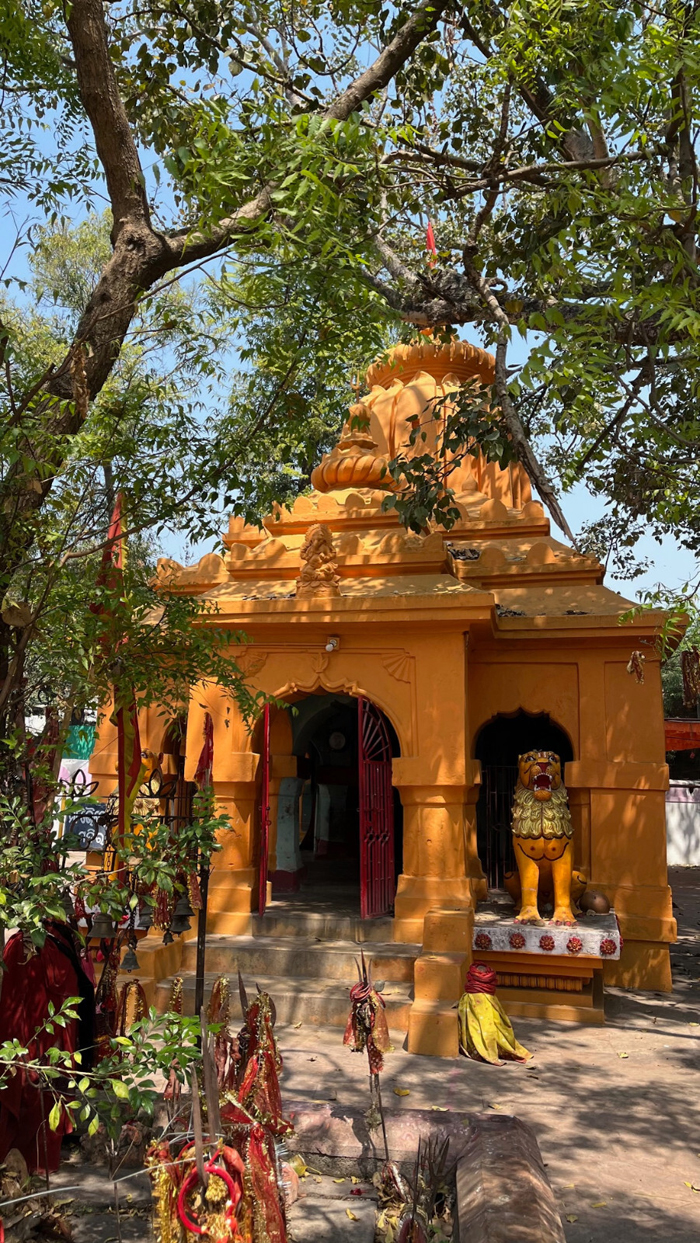
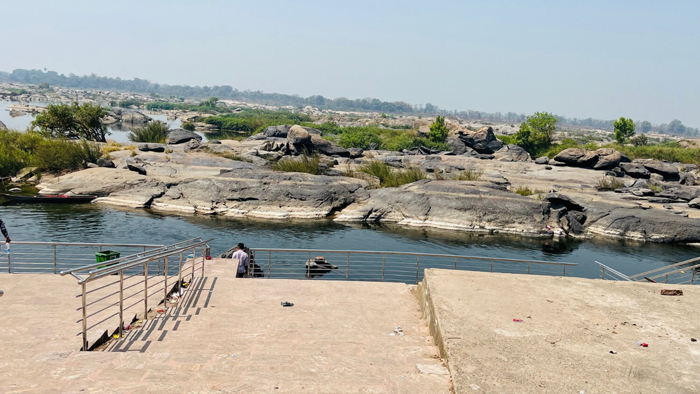

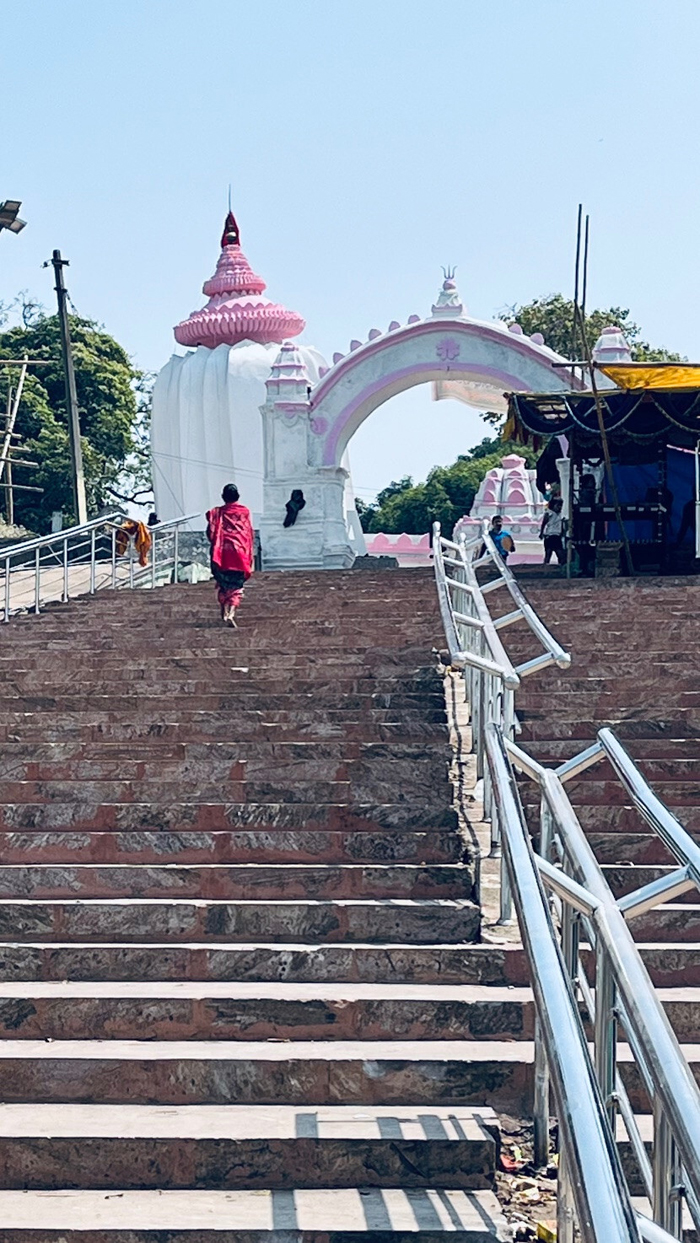
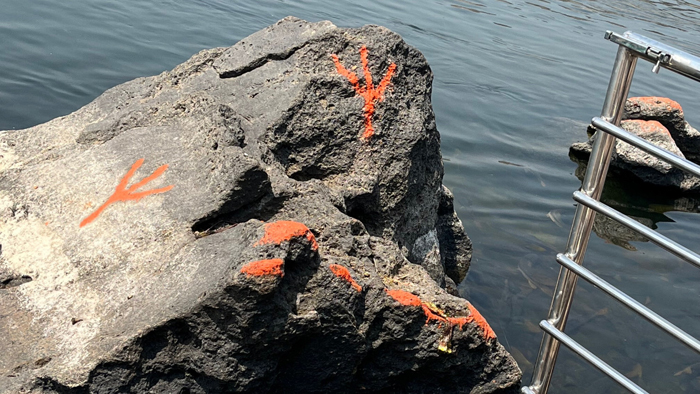

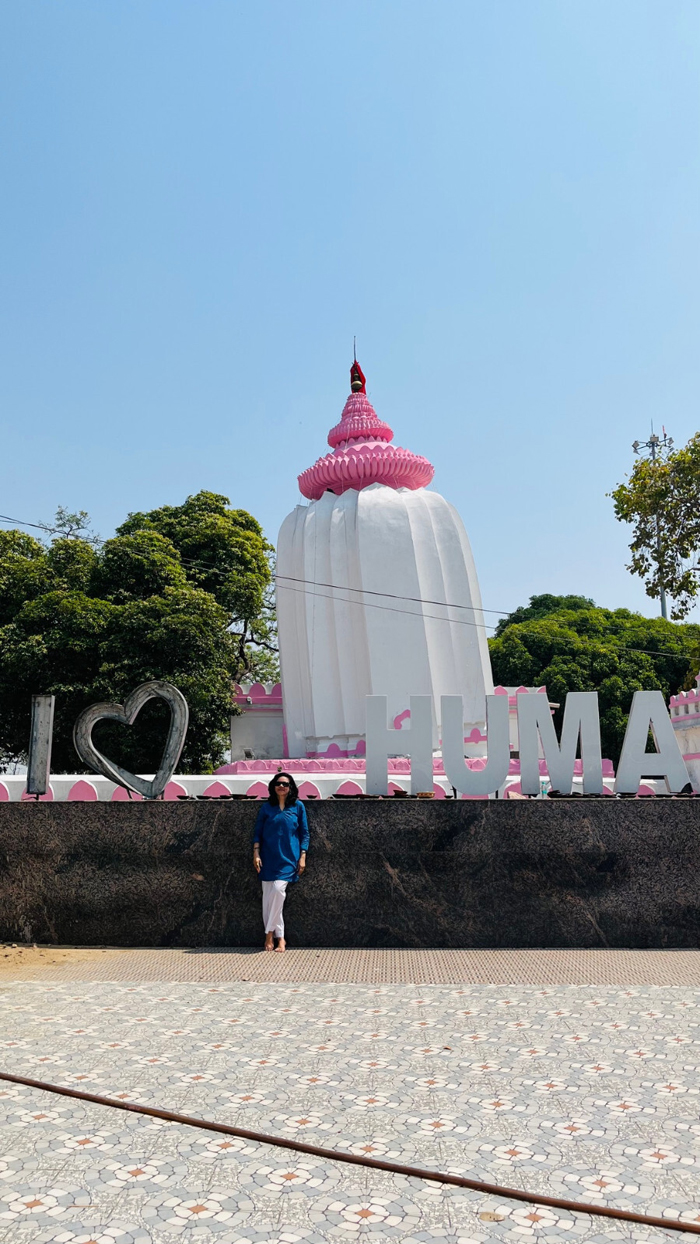
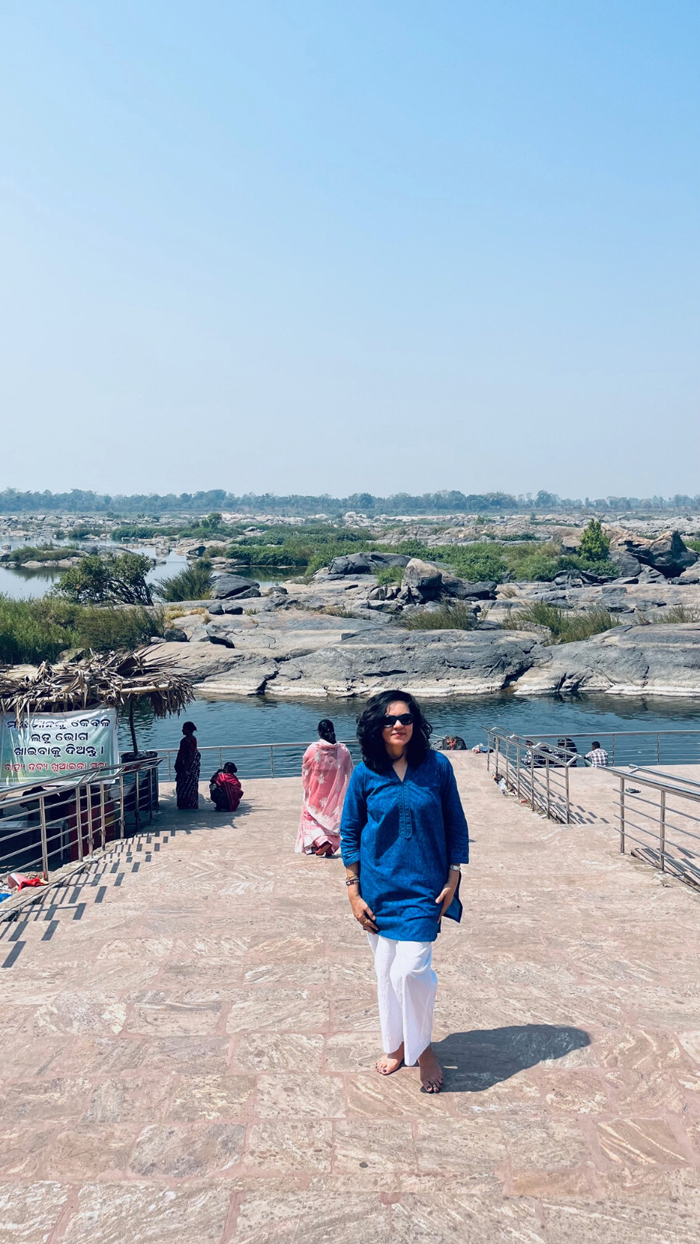
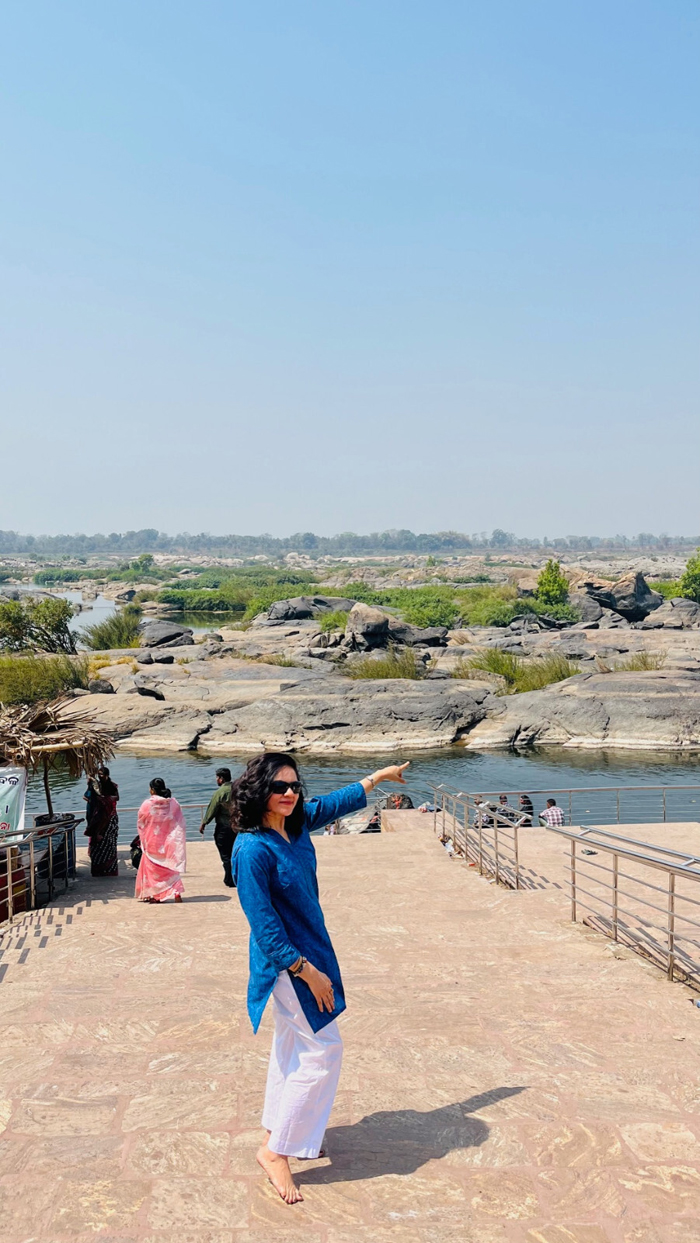
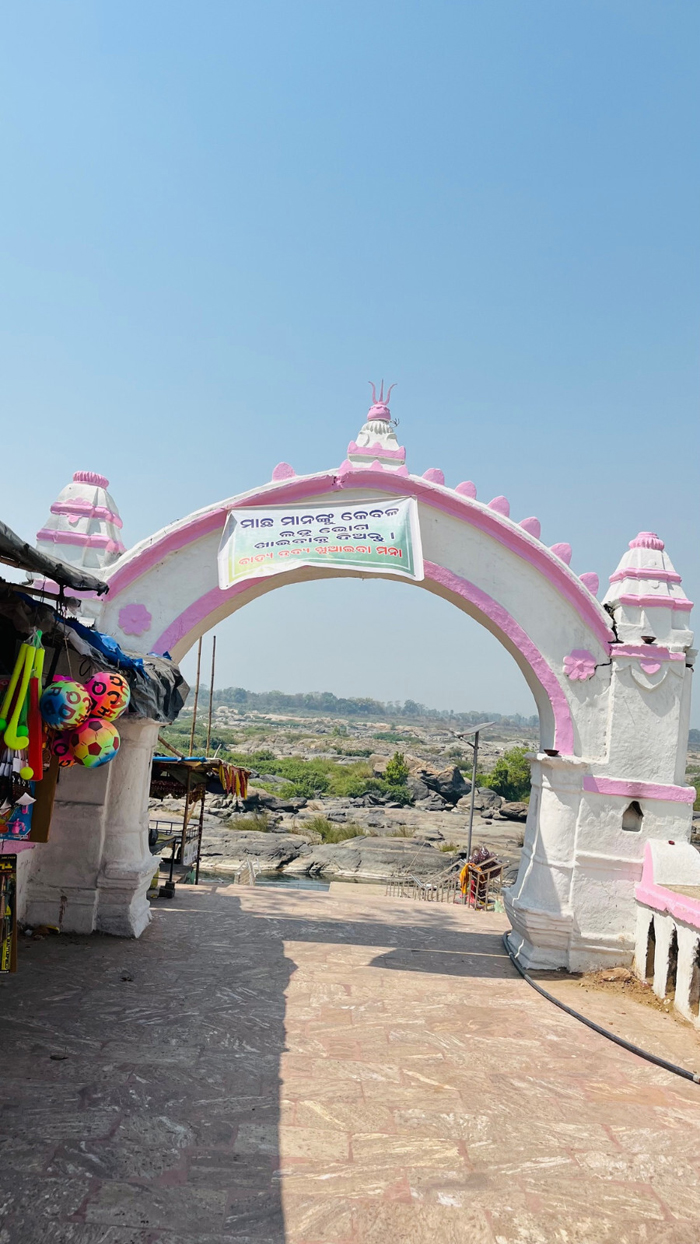
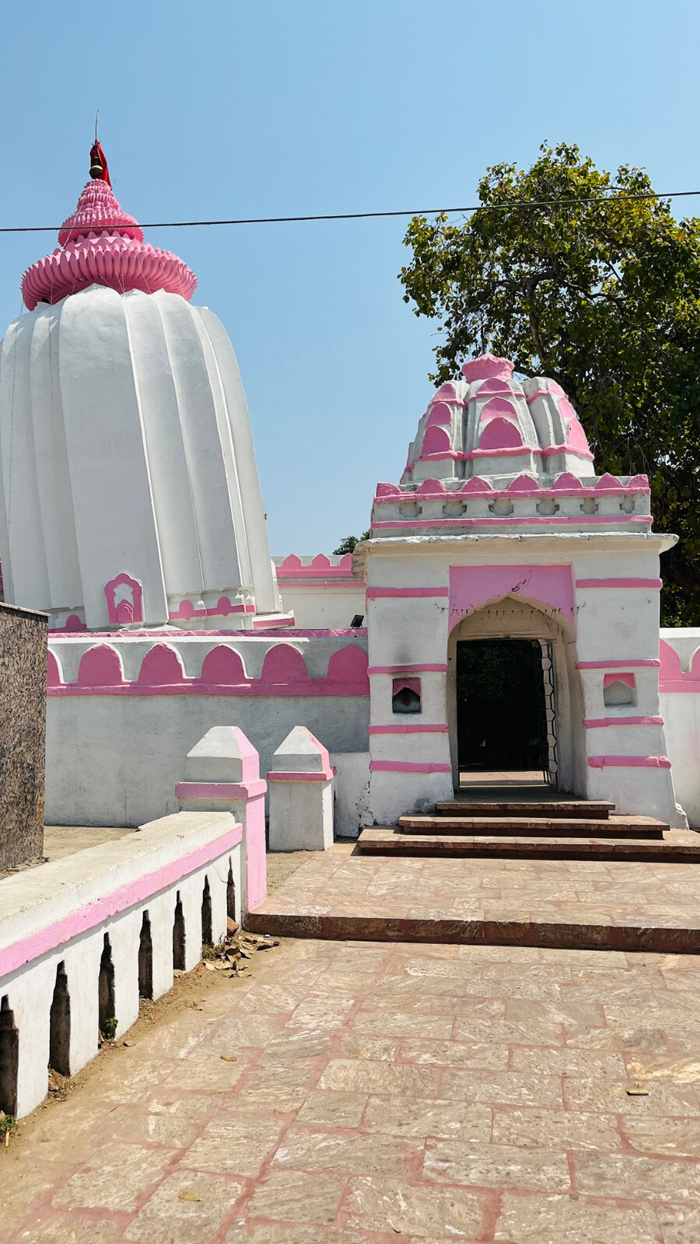
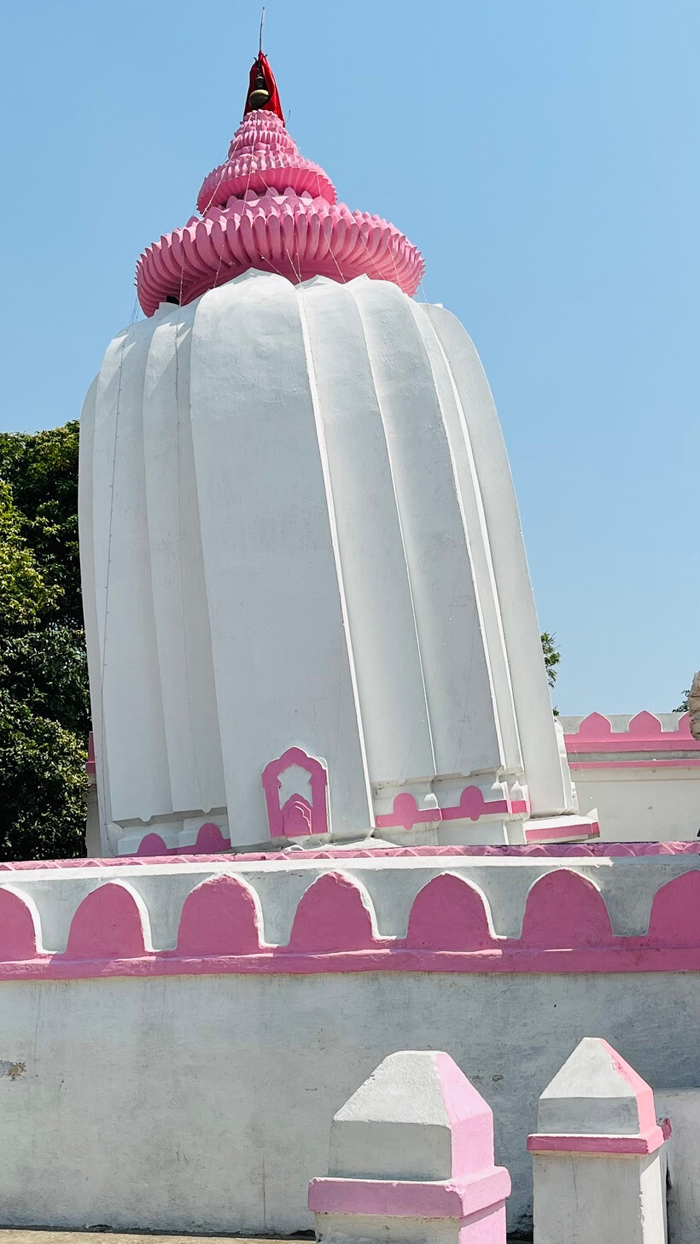
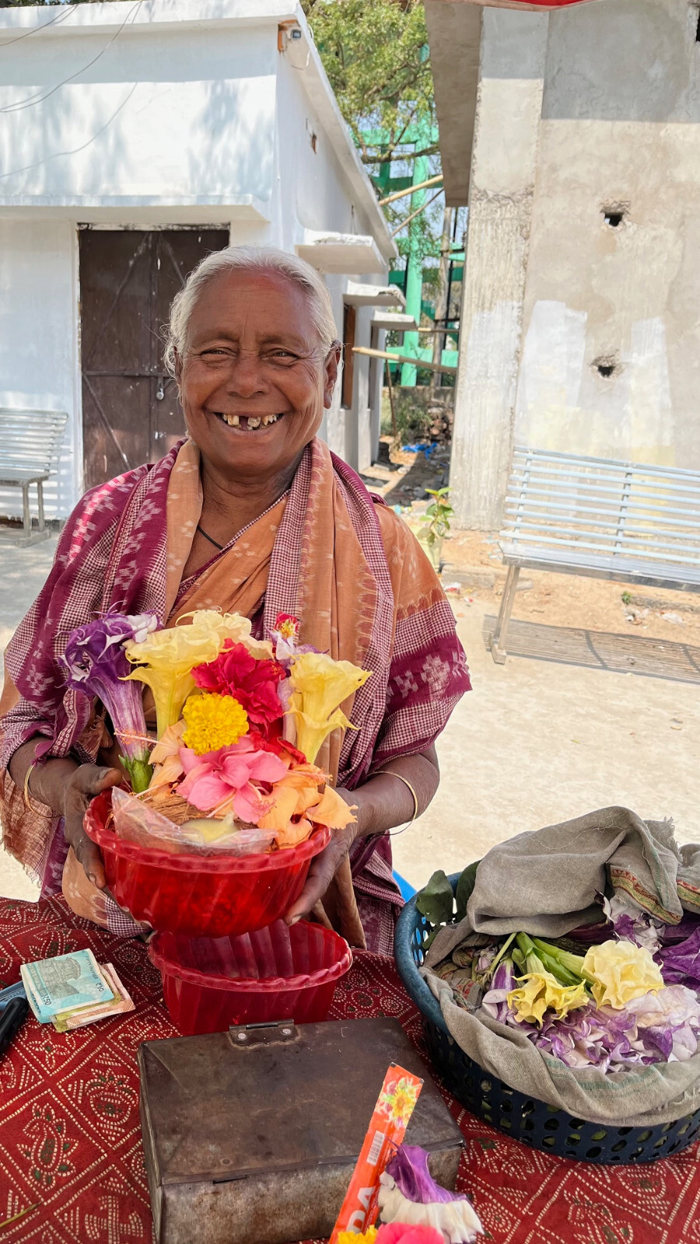
“Travelling- it leaves you speechless, then turns you into a storyteller.”- IBN BATTUTA
Nestled on the left bank of the serene flowing Mahanadi river, 25-30 kms from Sambalpur, (the vibrant cultural hub in western Odisha) lies the abode of Lord Shiva. Famed as the ‘Leaning temple of Huma’, It holds the distinction of being one of the few unique ‘leaning temples’ in the world. Reminiscent of the leaning tower of Pisa, Italy, it is dedicated to Lord Vimaleswara (Shiva). He is regarded as one of the ‘Asta Sambhu’s of the region and hundreds of devotees flock to the temple to seek his blessings.
Here lies a rare gem of western Odisha’s unique culture, architecture and heritage. The highlight of the temple is its leaning structure, not just its sanctum sanctorum but all the other shrines and the boundary wall within the temple premises.
Painted in a new coat of pristine white and pink, the temple captivates visitors with its gravity defying posture and unengineered half tilt. The main structure leans at an angle of approximately 13.8 degrees.
Interestingly, though the edifice leans, the pinnacle of the temple (shikhara) remains perpendicular to the ground.
Constructed between 1545-1565 AD, this ancient temple is dedicated to Lord Bimaleswara (Shiva). Originally initiated by Emperor Anangabhima Deva III it was later rebuilt by Baliar Singh, the fifth Chauhan king of Sambalpur in the 17th century.
Had it not been for this baffling structure, the hamlet of Huma with fewer than 200 families would have remained inconspicuous.
Speculations vary from a change in the earth’s crust owing to an earthquake to the unstable rocky river bed to deliberate inclination by the architect to safeguard the temple against floods, none of which is confirmed.
As per legend, the worship of Lord Shiva is said to have been initiated by a milkman (Gauda) who crossed the river Mahanadi daily to a place on its bank where the underlying rock cropped out. His daily offering of milk was soaked up by the rock and this miracle facilitated construction of the present day temple.
Yet another major attraction at the site is the unique ‘Kudo’ fish found in the river adjacent to the temple. These fish are tame, considered sacred and protected. Visitors frequently feed them by hand. Catching them is prohibited and as per local legend, believed to unleash a curse transforming the person into a stone! A statue nearby, known as ‘Machha kata murti’ tells the story of a girl cursed for trying to cut a ‘Kudo’ fish here.
One has to see it to believe it. This unique architectural wonder and feat is one of western Odisha’s gems and pride placing it on the world map.
ACCESSIBILITY: Huma can be reached through a fantastic road and rail connectivity from the state capital Bhubaneswar, with a scenic five hours drive via beautiful forested roads.
From Sambalpur, it is easily accessible by road from Sambalpur railway station or the city centre. Takes approximately 45-60 minutes subject to traffic and the specific route.
BEST TIME TO VISIT: All through the year but preferably during the cooler months (November-February).
Put this on your travel itinerary for Odisha. A tourist’s and historian’s delight and a MUST-VISIT that enthralls and enchants all.
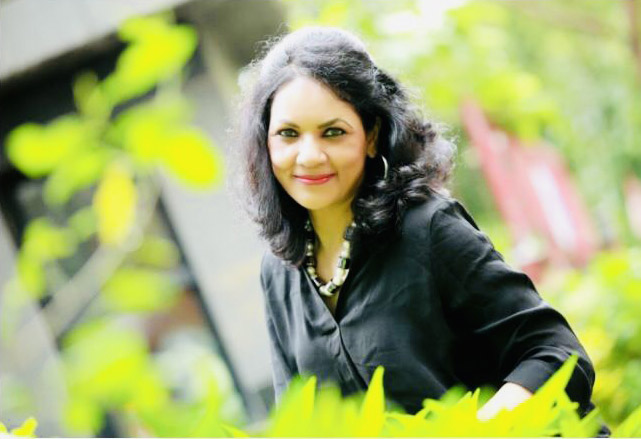
Anita Panda is a passionate bilingual author-poet, nature lover and an aspiring TEDx speaker. She dedicated ‘GENESIS’ (2021) to her valiant Late soldier brother, debuted with her own book ‘SONGS OF MY SOUL’ (2023) & her debut Hindi book ‘Bhavnaon ki Dastak’ (2025) recently published by AUTHORSPRESS. It formally launched on national and global platforms ‘Mudramoksh’ & ‘The Fertile Brains’ in 2026.
Also Sir, kindly ask your tech consultant to remove the 4 Question marks next to my Travelogue title- ‘HALLOWED HUMA’- ABODE OF SHIVA’ & remove one of the two PICS of the old lady in my writeup.
It is repeated.
Sujatha Krishnamurthy
In 1917 what started as a strike for Bread and Peace by Russian women workers in factories laid foundation to the Russian Revolution. 200,000 women joined the strike that ended the imperial rule and the new government granted women the right to vote. In 1921 Soviet Union officially designated March 8th as Women’s Day followed by United Nations in 1975. Since then the celebration has spread to other countries around the globe.
Women have fought their way up to excel in all fields and occupations. For example Indira Gandhi, Kamala Harris (politics) and Indra Nooyi, (multi national corporation), M S Subbulakshmi, Alarmel Valli,(Arts) Smriti Mandana, Jhulan Goswami(sports) Madame Curie, Bimla Buti (science) are some of many who have become a household name. We can showcase many such women as epitome of women’s empowerment and success.
Let us take a step back to look into what other attributes really make a woman feel equal and empowered. A girl child should feel that she is being treated equally compared to her boy sibling. She should have the right to decide what to study and choose a profession or career of her choice. She should be the one to decide to whether to marry or stay single, and if so, to whom. If in marriage, a woman should be able to decide to bear and rear a child or not. These are the day to day nitty gritty of life that needs to be addressed perpetually. In many households, workplaces, and societies a woman’s empowerment is still in the hands of men. A women is powerful when the power is in her own hands. Every woman can’t be a Gandhi or Nooyi, but she has the right to be a well rounded, healthy, and happy human being. You Go Girls!!!!
Hi
I am Sujatha Krishnamurthy writing from Kalamazoo, Michigan, USA. Born and raised as a true Kolkatan, studied at Andhra Association School and Shivnath Sastri College, and worked at Central Cottage Industries. Moved to Pasadena, CA, USA in ’84 and later to Kalamazoo, MI in ’91. Studied, worked, and retired after a stint of 20 years in different organizations, including family owned business , NPO(Non-Profit Org) , and MNC( Multi National Corp).
A habitual reader and writer since younger years, a habit cultivated in the banks of the Ganges, has continued to flow till date. Since 2023, my contributions have been published in my alma mater’s monthly e- magazine SPARKZ. I also contribute regularly to our Indo American Cultural Center and Temple’s monthly e-newsletter covering cultural activities in and around town.
As a full time volunteer, I dedicate many hours at our local Hindu temple (Indo American Cultural Center and Temple). Have served in the temple board of directors in many leadership positions, such as, Religious Committee Chairperson, President, and Chairperson. I am the Bal Vihar teacher of 25 years teaching Indian scriptures, teachings, and bhajans to the next generation.
As the Community Outreach Program Coordinator of our temple, I bridge our Indian community with the rest by taking our Indian culture and heritage to local schools and institutions of higher learning. My role facilitates in bringing several visiting Indian artists and American Indian talents to our temple and community. My efforts have been successful in drawing many local, city, and state officials, including Governor, Mayor, and City Counselors and Indian Consul from Indian Consulate, to our temple’s land mark events, such as 25th anniversary and others.
Since 2019, I have been recording audio books for the visually impaired for Samarthanam Trust For The Disabled, an organization based out of Bengaluru. I am currently working towards my goal of reaching the century mark for the Samarthanam Library. My other hobbies include globe trotting, music listening and singing, tasting and trying out new recipes, being an active influencer in social media, and above all, staying close to my families and friends.
Sushree Gayatri Nayak
Before you step inside this story, kindly adjust your brain. I have renamed a few things for personal entertainment and mild chaos.
Pen = aeroplane
Table = tree
Chair = fan
Ink = tea
Diary = bed
Cake = dung
Confusion = understanding
Frustrated = satisfied
This morning, I woke up from a bad dream. I reached for my tree and sat on the fan. I searched for my aeroplane. It was lying under the tree. I picked it up, and it was sort of leaking tea. I poured some more tea into it.
Then I couldn’t find my bed. I searched for it here and there, throwing other items around. My mom came upstairs, following the noise, and asked, “What’s going on?”
“Where is my bed? I can’t find it anywhere,” I replied without even looking at her.
She smiled and said, “Your bed doesn’t have legs. Wait, I’ll find it for you.”
I stood there quietly, and in a moment, she found my bed between two books. She handed it to me and, brushing my head, said, “Be patient and come downstairs to have your breakfast.”
“I’m not hungry,” I replied, lifting my tea-filled aeroplane to finish my writing about the dream.
The words looked beautiful. Completely meaningless, but beautiful. But snap! My aeroplane broke mid-writing, and the tea spilled, soaking the bed. Everything I had written began to dissolve, like the promises of my ex. I pressed the aeroplane harder and broke the left side.
My mom came back, bringing breakfast for me. “Why are you looking so satisfied?” she asked, watching my struggle.
“Not only satisfied, but extremely satisfied,” I answered, pulling my hair.
She placed the breakfast on my tree. There was freshly baked dung on the plate, and its smell filled the room. “Eat first and calm down.”
I stared at it, full of understanding.
Nothing was working. My aeroplane had given up on me completely, and the dung was getting cold.
And somehow, in the middle of all this perfect understanding, I realized—
Maybe they named me wrong.
(If you feel understanding, that is perfectly normal.
If you feel satisfied, even better.)
Sushree Gayatri Nayak is a budding muse and poet from Odisha, India. Currently pursuing her studies in English literature at Utkal University, she channels her passion for love, nature, and current social issues into heartfelt poetry. Her verses weave emotional depth with thought-provoking reflections, capturing both personal experiences and broader societal concerns.
HANSIBA MUSEUM: CRAFTING LEGACY AND WOMEN EMPOWERMENT
Deepika Sahu
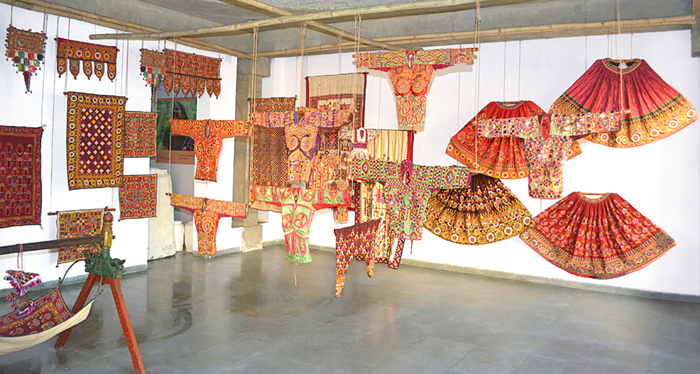
There is a raw starkness to the terrain in Radhanpur, a small town in North Gujarat. One can feel the dry dusty heat on the face even if it’s March. But once you enter into the Hanisba Museum, it’s a different colourful vibrant world. You leave behind the heat and the ruggedness as the women artisans welcome you with a tilak and a piece of jaggery. It is believed to sweeten the relationship between the host and the guest.
Hansiba museum is a community museum run by women artisans and it came into existence in 2012 because of the efforts and support by the Self-Employed Women’s Association (SEWA). This museum is unique because here you will find heirloom pieces, furniture and household items that once belonged to these women.
The museum is named after Hansibaben, who was known for the gift of her craft, resilience and grit. She carved a niche for herself and became a symbol of SEWA’s incredible work in empowering women artisans. The entrance to the museum shows beautiful torans the women make themselves. Every little corner of the museum speaks about the creativity and resilience of the women artisans and the solid community spirit they have built over the years.
The pieces that are housed as artefacts in the museum reflect the legacy of work done by these women artisans. Apart from bright intricately designed clothes, they have an amazing collection of cloth bags and the beautiful handwork with mirrors and embroidery are sheer visual delight. The museum also has many household objects like gleaming copper utensils, beautiful rakabi sets for tea drinking, bathing utensils, stoneware and beautifully carved wooden chests and the like. These are pieces that have been passed down in generations and the textile pieces that the women have seen their mothers, grandmothers, aunts and sisters create and wear too in their daily lives.
As the women artisans show us around and explain the details and the story behind the pieces, they say, “This museum is special because it is owned by the community. You can call it a living museum because through this museum we show a slice of our lives, work and our community too. Everything has a story to tell, everything here has a memory.”
Established by Ela Bhatt in 1972, SEWA emerged as a collective dedicated to uniting women artisans and empowering them with both economic independence and creative control over their work. There was a time when the Banaskantha district of Gujarat was affected by constant droughts and due to lack of any sustainable means of livelihood, people were forced to migrate to Ahmedabad, Rajkot and other regions of Gujarat for livelihood. It was SEWA that came forward and joined hands with a small group of women and gave them economic independence and new vistas in life through their craft of embroidery. The craft has been passed on through generations from mothers to daughters as hand embroidered clothes come as part of her wedding gift. And with SEWA’s guidance, support and vision, there emerged a community of thousands of women with new identities, economic independence and enviable confidence.
Looking back on their own journey, the women say, “In the initial days, visits by Reema Nanavaty of SEWA were looked at with suspicion. Not many were even ready to have a conversation. But consistent efforts on the part of Reemaben and her team members to break the ice finally bore fruit and in the course of time, the women artisans themselves saw the transformation.”
Women of SEWA and those associated with the museum come from various communities in the region. The museum has also dedicated space for different communities like Ahir, Rabari, Mochi, Harijan, Chaudhary Patel. Interestingly, each community has its own unique embroidery and craft language that is reflected in the fabric tapestries that are part of this museum.
Was it difficult for them to collect these items which are so personal also? Sakhiben, a young energetic woman artisan says with a smile, “My mother Jamuben has donated her personal items like the traditional butter churner and other items to the museum. She said, ‘My family members have enjoyed these products and now it’s the time for the world to see these beautiful products we use in our day-to-day life.’ There was never a moment of hesitation on the part of these women to give away a slice of their precious material world to the museum. There has also been detailed work on the part of the women to first prepare a list of products and then get their hands on its history before letting these items as part of the museum collection.”
The women belong to several communities; chief among them are Ahir, Rabari, Mochi, and Chaudhary Patel. Each community has its own craft tradition. For example, Mochi women do leather work and both Ahir and Rabari women embroider, but their stitches and their mirror work are different.
The Ahirs, considered as the descendents of Lord Krishna are predominantly a pastoral community. One of the largest communities with over 10,000 members, the Ahirs practice an embroidery style locally called 'Soi Bharat'. Soi embroidery is known for the various shaped mirrors embedded in each design. Popular motifs include the peacock, parrot,elephant, scorpion and flowers.
The Rabaris are pastoralist nomadic communities that are scattered across the deserts of western India. Traditionally, they earned their livelihood by grazing sheep and herds of cattle and buffaloes. The women of this community practice fine embroidery that gives a magical feeling.
So, how has the museum been bringing the younger generation close to art and craft? Explaining it, Ganga ben says, “When the youngsters visit this museum, they can feel a sense of pride in their own heritage as it is all here.”
The museum complex also has a fantastic trade facilitation and training centre for women artisans. In an effort to bring the younger generation closer to their craft heritage, SEWA started Harkhi. Adds Sakhiben, “SEWA made us aware that our craft is precious. These days fashion is changing every month. Mobile phones have made our work life easier. Now, we discuss our design ideas over video calls. And this way, we save lots of time, money and travel. SEWA had given the women artisans a loan to buy smartphones. It was called ‘theliphone’ (as the women used to keep the phone in a bag.”
Both the museum and the adjoining centre quietly speak a language of women empowerment and celebrating one’s craft heritage. As Poori ben, daughter of Hansiben says beautifully, “‘Previously, I was only known as someone’s daughter-in-law. Today, I have my own identity as an artisan. I have travelled around the country and abroad too. My skill is my identity. Without SEWA’s efforts, we would have never known our true worth in life.”
She adds, "It has been a life-changing experience. Our region is drought prone. There is hardly any water. We were living a life of anonymity under a veil. Today, I am known as SEWA ki Poori ben.”
Deepika Sahu is an Ahmedabad-based senior journalist with a career spanning since 1995. During her career, she has worked with India's premier media organisations, including the Press Trust of India (PTI) in New Delhi, Deccan Herald in Bengaluru, and The Times of India in Ahmedabad. Currently, she is contributing India-centric features to Melbourne-based The Indian Sun, a cutting edge media platform. In addition to her journalism career, Deepika is involved in teaching English and Communication Skills to learners from different parts of India through Manzil, a Delhi-based NGO. Beyond her professional endeavors, Deepika is passionate about India's rich diversity, literature, blogging, quiet hours at a cafe and enjoying a cup of tea.
LEAF FROM HISTORY: A TIMELESS LEGACY ON THE MALABAR COAST
Mr Nitish Nivedan Barik
Kochi, in the Indian state of Kerala, is a historic port city on the famed Malabar Coast, long celebrated as a meeting ground of trade, culture, and diplomacy. Steeped in centuries of layered history, many of its treasured landmarks figure on the tentative list of UNESCO World Heritage Sites. The city’s character bears the imprint of Portuguese, Dutch, and British colonial eras, each leaving behind a rich architectural and cultural legacy. Among these enduring monuments stands the Kochi Mattancherry Palace, better known as the Dutch Palace, one of Kochi’s most cherished heritage sites, drawing visitors who seek serenity as well as a glimpse into Kerala’s regal past.
The Mattancherry Palace history begins in the mid-16th century around 1545 when the Portuguese built it as a gift to Veera Kerala Varma Raja, the King of Cochin. It was developed to appease the king after they plundered a temple nearby. The landing of Vasco da Gama, the Portuguese explorer, at Kappad in 1498 was welcomed by the Kochi rulers. The Portuguese were given exclusive right to construct factories and they repulsed the repeated attacks of the Zamorians, and the Cochin Rajas practically became vassals of the Portuguese.
The influence of the Portuguese was supplanted by the Dutch, and they took over Mattancherry in 1663. Under Dutch rule in the 17th century, the palace was extensively renovated, earning it the name “Dutch Palace. Subsequently, the area was taken over by Hyder Ali and still later by the British East India Company.
This palace in Mattancherry, Kochi, features Kerala murals depicting portraits and exhibits of the Rajas of Kochi from 1864 onwards, are displayed in what was once the coronation Hall. These were painted by local artists in the western style. The ceiling of the hall is decorated with floral designs in woodcraft. Amongst the other exhibits in the palace are an ivory palanquin, a howdah, royal umbrellas, ceremonial costumes used by the royalty, coins, stamps and drawings.
The palace is a quadrangular structure built in Nalukettu style, the traditional Kerala style of architecture, with a courtyard in the middle. Certain elements of architecture, as for example the nature of its arches and the proportion of its chambers are indicative of European influence in basic N?lukettu style.
There a large number of murals on the walls of the palace, executed in the traditions of Hindu temple art, which are religious, decorative and stylized. The murals have been painted in rich warm colours in tempera technique.
In 1951, the palace was restored and declared a central government protected monument. The palace underwent a second restoration by the Archaeological Survey of India. The work which started in 2007 was completed by 2009. Today, it is under the collaborative care of the Government of Kerala and the Archaeological Survey of India (ASI). It stands as a museum, preserving centuries of royal artefacts, art, and stories for future generations.
In the time of Eid this year 2026, I had long weekend and had planned my visit to Kochi and Alleppey from Bangalore. I was privileged enough to visit the Kochi Fort area where this Mattancherry Palace is situated. The entry fee is just five rupees per person . It is open on all days except the Friday. The opening hours are 9 to 5pm. I had a rich experience visiting this place, was awe struck of the architecture and more so with the people in city. Kerala I must say according to me, Kerala is the Japan of India. The people here are extremely courteous, hospitable, kind and knowledgeable which makes it a popular tourist destination.
Mr Nitish Nivedan Barik hails from Cuttack,Odisha and is a young IT professional working as a Team Lead with Accenture at Bangalore.
T. V. Sreekumar
I had a dream. Outside, it was raining with thunder and lightning, which disturbed and delayed my sleep. Added to it was the power failure. Sleep must have embraced me much after midnight.
My three-decade old fridge had to be replaced. I was at this showroom and when I entered a young lady approached me with a pleasing smile.
“I want a fridge which suits my needs.”
“Sir, we have multiple varieties and will show you everything.”
She first took to me to one which looked like my old Godrej almirah.
“Sir, this is the latest and a high-end model with multiple functions.” she was about to open it when I said,
“I just need a simple one for a single person as I live alone”
“OK sir, no problem" and took me to another end of the shop.
“A double door will suit me and the colour should be light blue.” I said,
She took me to the model of my choice but blue colour was not in stock.
“Will another colour be okay, Sir?”
“Blue, I am very particular.” The blue colour she liked and chose for our earlier fridge remained in my mind.
“I will find about the new stock arrival. Sir”
She came back and told me that it will come within three days and blue colour is also there in it. We can deliver it on the fourth day from today.
I was very pleased with her behaviour and service and before leaving asked her name.
“Maya sir.”
She had a Sindoor on her forehead indicating her married status.
I told her that I will return within three days for the payment.
That was a dream which ended without a conclusion but the name Maya kept ringing in me.
Can one believe of a dream taking up from where it had ended? That’s exactly what happened to me.
After a few days the dream continued. I go to the shop after three days. Another girl approaches me asking my requirement. Told her about my earlier visit and about my choice of fridge colour. She took me to the manager and he remembered my need and said,
“The stock has come and the blue one we have kept it aside for you”
After paying the amount and all formalities were over, I asked him
“Where is Maya?”
His face lowered and there was silence for a few seconds. When he looked up the eyes were moist.
“An accident two days back Sir. She was returning after duty from here with her husband on a scooter. A drunken driver in a lorry crashed from behind. Maya died on the spot and her husband is in hospital with injuries.”
I couldn’t speak a word and just stared at him wide-eyed. I walked out of the store like a zombie. Fate is so cruel and I woke up with a jerk fully soaked in sweat with the phone ringing. My daughter was calling from far away.
“Did you buy the garland for amma’s picture”?
The day was her anniversary and it was a reminder call, as of late, my memory was playing truant.
I was not out of my shock and murmured something
Sat there on the edge of the bed and thoughts flashed back to years.
We were on the scooter and returning home after some shopping. Our young girl we left with her grandmother at home even though she had insisted on coming.
I remember only a crash from behind and after many days, I regained consciousness. I asked for her and none would say anything. One said she was in the ICU and another said she was in the post-operative ward. Slowly the reality dawned on me and I started crying nonstop. My folks and the hospital staff found it difficult to control me and most of the time I was on sedation.
It took a very long time to get adjusted to the loss and things were never the same again.
I was shocked recollecting the happenings in the dream. A dream similar to one’s life happenings. The reality and the illusion stood integrated. Was it a message? The biggest surprise was the name Maya. My beloved, my life partner was Maya.
Strange, a very strange story.
T. V. Sreekumar is a retired Engineer stationed at Pondicherry with a passion for writing. He was a blogger with Sulekha for over fifteen years and a regular contributor writing under the name SuchisreeSreekumar.
Some of his stories were published in Women's Era. “THE HINDU” had also published some of his writings on its Open Page..
WATER OF A MISSING FOUNTAIN
Ashok Kumar Mishra
An oneiric story for all….
City hospital, Covid ward – bed number 5027
Gulping medicines after medicine throughout the day and taking the night quota of medicines from night duty nurse, from behind a full body covered PPE (Personal Protective Equipment) kit through a small opening, the patient wished her goodbye. That was a good enough signal that he is still alive. The nurse indicated over intercom her shift was over and the next shift substitute staff would be available only after midnight. She informed the patient could indicate any discomfort by pressing the emergency calling bell attached to the hospital bed. The patient took all the tablets including the sleeping pill, knowing it fully well this was the last call till next morning. He lied down on the bed looking at the twenty-first floored roof of the hospital, the whole city around was wrapped in silence with frequent ambulance siren wailing and dogs baying at distance. Cut-off from outside world, lLife’s philosophy looked very bland and pale on the hospital bed. Life with all its manifestations- the alter ego, good and bad, profit and loss, material pleasure, wealth accumulation, stature and standing, name and fame , prestige and esteem everything looked so insipid. One realizes how insignificant he is in this vast creation.
He did not know when his sleepy eyes have closed for a while.
Man’s life time is full of ups and downs- occasional happiness and grief which got etched to his memory. They are very personal experiences- life’s treasure for everyone. At times man reflects on those memories which give pleasure and pain- a matter of pride and lows in his emotional state. These memories evaporate in ether as life leaves the body. Others do not bother about them and it is so worthless for them unless they have any ulterior interest.
Think for a while it’s so valuable and personal to you and so worthless for the world. Very strange indeed. When life flows like a mountain spring, they are so sweet to reflect on and yet so useless for others. Think of any place, your favourite part of the world- your village/hometown/work place/university- with which you are so attached and many memories of that place in your life to which you are emotionally connected. If you go there after fifty years…..
All of a sudden a stranger without any identity was dumped at the boundary of his favourite place- his university and was trying to attract attention of every passerby. The world around him was so busy- nobody had any time to glance at him. In the race of life everyone was so busy nudging past/ elbowing the other in this crowded world, who would listen to his plea to take him to his past- his university? He looked different – as if from another world and his dialect and mannerism very different, who has time to find out what he wants. He was penniless and was making a plea to all others who were wriggling out of the crowd. Suddenly an auto-rickshaw came from nowhere and picked him up and dropped him inside university gate. The auto driver put two goblets of water in his mouth. Water was so precious and are available this way. The strange fellow felt relieved, at least he was in his comfort zone.
But what is this place? Entire thing had changed and it did not look like the one where he studied. The serene, peaceful ambience of the university, the greens around the campus, the wide roads and open areas, the cool breeze, the enchanting exuberance were all lost. Roads were encroached upon and the entire concrete jungle sprang up around was overflowing with crowds. He imagined hundreds of people on the road, encircling a small water body, with every one holding pots and drums moving fast along with many donkeys and carts. Everyone was thirsty. The man was so nostalgic about the good time he spent there that was once everything for him.
He remembered at one time he was the known face of the university. Academic activity or campus politics he was at the forefront. But nobody recognized him. He also could not recollect any known face nor was able to recognize anyone. He tried to speak and convince others about his identity but to no avail. Who would know him now?
An old student came towards him and examined him head to toe. The stranger was quite hopeful and positive. That student told him in no uncertain terms that things have changed and all the old timeworn systems have been discarded for new. He showed mercy and offered him stay overnight, but did not show any respect to him and to the past systems as he considered them to be archaic and venerable. He asked him to see around how everyone was racing against time and had no time to listen to his nonsense. The man felt disheartened and did not disclose that once he was the face of change here.
An aged retired professor was coming that way and the man was happy to find him as he was his favourite student when the professor joined the university. When he was elected Student union president the same professor was in all praise for him as the future of the country. The professor was candid in his remark saying his face looked familiar, but he had become old and every year so many students were coming to the university, how could he remember all of them? The man did not know this was the standard line of the professor for all his students.
Finally came the dhaba (college canteen)owner. The man thought he spent so many nights taking dinner with his girl friend , had discussion over a cup of tea with friends and took food on credit on several occasions in the dhaba, the owner would recognize him and ask for payment. But sharp came the reply from him “I do business here, if I could remember every customer then I would have been Chitragupta, the celestial account keeper.” In a hurry he walked away. The man pondered how things changed so fast. Were all his life and philosophy only an illusion?
May be people in his hometown would remember him and he yearned to reach there soon. A heavy-duty forklift came from nowhere and dumped him on the bye-lane of his home town. He was taken aback at the transformation of his small town to a urban village with very tall buildings and residential complexes. It was difficult to get sunlight and concrete, steel and glass structures, artificial trees and fountains, colourful lights. There was so much rush and except humans no other plant or animal life was visible. Drones were visible in place of birds in the sky and there were hanging ropeways connecting towers. The dusty roads had vanished; water had become scarce and cool breeze, a thing of the past.
During his time he did not know everyone in his town but everyone knew him. There were vehicles on road and there were people on footpath. There were lines of shops in the market place. When he used to move around, people used to give way and respect. He used to stand during good and bad time of everyone in the town. Huge departmental stores had replaced them all. People stay in towers a vertical township. People looked so different with helmets, antenna, censors, camera on the body and everyone in a hurry, lost in their thoughts. Nobody looked at him.
The man wanted to move into a huge building. He got a huge electric shock that threw him at a distance and he could not move forward. He found a beautiful lady coming out of the building. When he moved close to her, high decibel siren wailed that deafened him and toxic smoke spread around him and he lost his sense. He could realize this was not a live human but a robot mannequin.
With hard work and good social relationship, soon he could make lot of money and led the township to prosperity and got the title of ‘most influential leader’ and became Mayor of city Municipal Corporation. There he earned name as an honest, hardworking administrator and became a symbol of change and Development. Some people must be remembering him as the maker and mover of his time and thought if he could be taken there. All of a sudden a drone came flying, lifted him and dropped on Municipal Corporation office.
His experience in the university and the hometown was bitter. He thought people in Municipal Corporation Office would be cherishing memory of his tenure with love and respect as harbinger of change. He found a Saheb(Senior Officer) disembarked from a helicopter on the helipad of the office building and smartly moving towards him. He could recognize it was son of his driver Sanatan, whom he gave appointment as an assistant, who has become old and resembled Sanatan coming. Definitely he would recognize and give respect. Instead he came charging towards him and started asking how he landed in the high security zone. When he tried to reveal his identity he declined to recognize. He said things have changed very fast and questioned “what‘s a Municipal Corporation office? Nowadays there is nothing called office. Whoever has machine force would get the work. Everyone moves on private planes. Nobody uses this helicopter. I fly it as sky taxi.” He ordered the stranger to leave immediately.
While moving down the high speed elevator he thought of having a last glance at his office chamber, where lot of people used to work. He could see a few robots like figures with antenna, censors, solar panel and lights moving around.
All of a sudden he came out of his sleep. When alert he wanted to know whether it was true or a dream. His head started reeling. He was happy for his balance whether in sleep or in the deeam.
(The End)
Udayanshu, S-128 Maitri Vihar
Bhubaneswar
(9491213015)
Completed his MA and M Phil in Political studies from JNU and served as Deputy General Manager in NABARD. He made pioneering contribution in building up Self Help Group movement in Odisha and popularized Amrapally mango plantation in the state. He has authored several books and written several articles on micro credit movement. Four tele films were made on his book titled “A Small Step forward”. He served as Director of a bank for over six Years.
An acclaimed Short story writer in Odia and English. His stories are rooted in the soil and have sublime human touch. Many of his short stories in Odia have been published in reputed magazines. His short story collection “Michha jharanara pani” was released recently.
(9491213015)(m)
Bankim Chandra Tola

(A relevant image copied from net)
Anima, a primary School teacher was known for her sincerity and punctuality. She never regarded teaching merely as a means of earning money but as a noble responsibility to groom young children to grow as good human beings - much like a clay modeler molding a lump of clay into a beautiful idol. She used to say, as a teacher, her duty is not simply to teach the students but to train their minds to think positively in all situations.
One day she was busy taking classes one after another just like running a marathon race and forgot to take her food at lunch hour. Though hungry, she couldn’t leave classes unattended and her zeal never waned - rather she was in a spree to complete her last class of the day with class-II students without taking a break. Usually, the pupils of class II are very young and noisy - for that matter it was a necessity for her to talk louder to control them. But on that day as she entered the classroom, she felt so weary as if all her energy had been drained out. So, she thought, why not give a task of mental exercise to students instead of teaching the course material as a routine?
Enthusiastically she announced, “My dear children! Today I am not going to teach you anything from your books, instead I shall ask you a simple question. You must write down the answer in your notebooks and submit them to me.”
Unlike the other days, all the children were highly delighted to get an unexpected break from the lessons that usually demanded their full attention. Curious and excited, they asked in a voice – “What’s that Ma’am?”
A faint and dry smile crossed over Anima’s otherwise pretty but weary face. Swiftly sweeping her gaze across the class she said, “Imagine - all on a sudden, God appears before you and asks you to tell Him the only wish you have that he’ll fulfill. So, think well about your only one wish and write it down in your notebook. Before the closing bell rings, all of you must submit your notebook to me.” Children were delighted to hear the question and started writing the answer.
Anima is from a lower middle-class family. Her husband, Animesh is a clerk in city municipal office. They have two children – one son studying in class nine in the city High school and a daughter studying in class two in the same school where she is the teacher. They are lucky to live in their own house built by Animesh’s father before his death. Thus, both husband and wife pull on their life merrily with their two lovely children. Animesh doesn’t talk much but remains busy with his mobile while at home. Anima on the other hand passes time after school hours in her kitchen and after the housework, she also remains engrossed in her mobile phone. As her son goes alone to school, she has provided him with a mobile phone for safety.
The final bell for the end of the day rang. Anima became alert and asked the students to submit their notebooks and leave. All the children deposited their notebooks and dispersed hurriedly.
Anima along with her daughter returned home with all the notebooks. At home she completed her kitchen work and served dinner to all. She was eager and curious to check the answer papers as soon as possible to know how the young minds had worked.
After finishing all work as she entered her bedroom, she saw Animesh was busy with his mobile lying on bed. Without a word, she thought it was the right time to check all the answer sheets of students. She started looking at the notebooks one by one squatting on the bed. While reading the answers she could not control her laugh and started giggling.
Animesh interrupted, “What is the matter? Why are you laughing?" Anima laughed again and said, “Today I put a simple question to class II students asking them to write their one wish from God and they have written such hilarious answers that one cannot but laugh.”
Animesh heard her say with excitement but did not react and dived back into his mobile. Just after some time, Anima started crying. At this Animesh sprang up from the bed and said, “What is the matter? Why are you crying? Till now you were laughing; suddenly what has happened that makes you cry?”
Anima was spellbound and just handed over the notebook to her husband.
Animesh read the answer written by a student as asked by his wife in the classroom. The child wrote, “O God! If you want to fulfill my only wish, please give me a mobile phone immediately because I feel lonely at home without it. My mother and father have no time to love me nor even talk to me as they remain fully busy with their mobile phones. My brother continues to play games in his mobile. There is no one to talk to me. O God! Tell me how can I live? I feel deserted. So please give me a mobile; I shall be happy.”
Animesh got terribly upset perusing the answer of the student and told his wife, “What nonsense! Could there be such irresponsible and heartless creatures to neglect his own child?” He asked his wife, “Anima, you better summon the parents of the child tomorrow to school and give them a good lesson on how to deal with their child at home for ensuring a healthy upbringing.”
Anima looked at her husband with a blank yet tearful eyes and sobbingly said – “The student who has written this answer is none other than our Muni.”
As if thunderstruck, Animesh was petrified and sat speechless. Words failed him. Coming back to senses, slowly but painfully he spoke with suppressed agony – “What a shame? We are inexcusable for the sin we have been committing by neglecting our own daughter and son too – never caring to understand their needs and happiness. How deeply the tender mind of Muni has been tormented while noticing our careless nature remaining stuck to mobile phones at home always – not caring to love her and talk to her. What a brainstorming exercise she might have done while writing the naked realities she has witnessed and experienced.”
With deep repentance he spoke in an apologetic tone, “Anima! We must call her now and talk to her so that she would feel a bit relaxed and happy. Hence forward we must take care of our son and daughter as true parents instead of neglecting them to go on their own by fulfilling their basic needs only.”
Anima left checking of notebooks half and rushed to the room where her daughter and son were sleeping. She lifted Muni from the bed and came to her bedroom where Animesh was waiting eagerly. Soon he took Muni to his lap and kissed her again and again expressing his negligence not talking to her with love and affection while at home. He promised her – he will not overlook her ever again. Anima too realized her mistake and promised to take care of her children first and then do any other things while at home.
The story is not an imaginary anecdote, but a fact; seemingly not the case with that little girl alone; yet such instances are ubiquitous. Cell phones with WIFI have enthralled all spectrums of human society to such an extent that people, either young or old, are madly engrossed in mobile phones forgetful of time and situation. Many people unmindful of their duties and responsibilities and even their food while at office or at home get immersed in these handy gadgets that ensure not simply the easy communication replacing STD and ISD calls but provide fascinating entertainment programmes as available through You Tube, video games, matches, WhatsApp messages, facebook, cinema, etc. School-going children are now seen madly stuck to mobile phones just after school hours neglecting their studies, homework, outdoor games and exercise.
There was a time when no such device stood between us and our studies, our duties, our labour, or our leisure. Now this tiny, palm-sized contrivance steals our time, fritters away our focus, blunts our resolve, and finally robs us of nature’s dearest gift—sleep. Ridiculous, how young and old alike remain glued to its glow day and night. Drivers court disaster while driving; cooks flirt with fire while peering at screens; pedestrians with eyes lowered to their phones walk on heedless of signals or speeding vehicles causing accidents. A few years ago, an irritating news came in newspapers that some elected members of state Assemblies and Parliament were detected seeing porn videos while the session was going on. What a shame!
Of course, at present mobile phone is no longer a luxury, rather a necessity like food, clothes and shelter for its numerous advantages, facilitating the grind of human life easier by replacing the bizarre telecom system completely. Taking this as a golden opportunity, several market players and large business houses pranced into the field to grab fortune by marketing cheap and lucrative handy and easily portable mobile sets packed with enticing and attractive programmes like whatsapp, Instagram, inkedin, Youtube, tweeter, facebook, video games etc, making it easy to reach out to all sections of society. Then again, the social media which is quick to seize this human frailty, captured attention of men and women to engage them in the name of entertainment watching ceaselessly fascinating half-truth or may be false videos uploaded in You Tube. To sweeten the snare, service providers dangle enticing recharge plans ensuring the spectacle never fades and scroll never sleeps.
Should this scenario go unbridled? How to check misuse of mobile phones and who to check it? Politicians who turn lawmakers, just before the elections distribute free mobiles to capture votes. Parents provide mobiles to their children for safety without keeping track of how they use them. Perhaps the problem is going beyond control. Is it not high time for citizens to think about misuse of mobile phones and restrict their use meticulously and at the same time, advise others, including their children, not to use mobile phones unnecessarily? It is said, do what you say first, then advise others. True, I have asked my part time driver to keep his mobile in silent mode while driving; advised cook to keep her mobile outside the kitchen and instructed my part time maid servant not to respond to calls while working in my house. I don’t know if this step of mine would have any effect on them to follow after finishing work in my house, but they may serve as messengers to disseminate this message.
Bankim Chandra Tola, a retired Banker likes to pass time in travelling, gardening and writing small articles like the one posted here. He is not a writer or poet yet he hangs on with his pursuit of writing small miscellaneous articles for disseminating positive thoughts for better living and love for humanity. Best of luck.
Sreechandra Banerjee

“Ice, ice,” she said as she stepped out from the police jeep.
“Quick, bring some ice” she repeated. Seeing police, the frenzy of the mob had vanished, but they still stood there, maybe out of curiosity or with a genuine intention of reporting the distress that the locality was facing.
“There is no water, how can there be ice? Women are always like this, be it a police officer or a queen like Marie Antoinette,” someone chirped in.
“Yes, yes it was Marie Antoinette who said, ‘If they have no bread, let them eat cake’ and now there is no water, yet she asks for ice,” another one in the crowd quickly added.
Someone knowledgeable said from a near-by balcony, “there is controversy over this. Some people say that this was said by Marie Therese, hundred years before Marie Antoinette.”
‘Must be some rascal’ thought Pritam, how could they behave like this with a lady, that too with a policewoman.
Although his swelling on his forehead hurt, yet he felt bad for the policewoman who was now trying to disperse the mob that had gheraoed him.
The water mains had cracked and there was no water in this area since yesterday afternoon. The office of the municipality has outsourced this repair job to Pritam’s company.
The mob had pelted stones at Pritam who was the engineer overseeing the plumbers.
Someone from a nearby house brought a big slab of ice,
“Its winter now, so normally we don’t need ice, but some water was already there in the ice tray which has now formed ice,” said the ice-bringer, a young man, who seemed like he was in his early twenties. He was the one who commented that it might not have been Marie Antoinette.
The ice was one full slab and not in cubes. As it was winter, they probably had not put in the cube separator.
So, the ice had to be broken! Broken into pieces, to apply to the swelling on Pritam’s forehead. But who would break it?
“See, the ice bar is leaking!” someone with a sense of humour commented even at this challenging time.
“Yes, because a policewoman has come,” said another man, apparently a gentleman.
“Stop this” Pritam shouted despite his pain. ‘All are rascals,’ he thought.
“Am Sorry,” he said to the policewoman.
“Why are you sorry? These people are like that only. And there is no water supply! Well, it serves them right! So much water misuse! Would teach them a lesson not to waste water. Summits and conferences are held these days, which never reach out to these people!” the policewoman went on saying.
“Yes, Mam, it’s a trans-boundary global problem. They say that there would be severe water crisis if we don’t learn to conserve the precious gift of nature. The problem we are facing now is just the beginning of the iceberg,” Pritam couldn’t help saying.
“Not only are there leaks in water supply lines, but often water is discharged without taps, there is so much wastage, and the Municipality hardly does anything about it. What would you say to this?” asked the ice-bringer, the slab still in his hands.”
It was very daring indeed to say this to the police!
“Hey, you!” she yelled “what are you doing? Can’t you apply ice on his swelling! Don’t you see that swelling?” So, she had no answer to the question!
“Yes, I’ll apply it, it’s a big slab, can’t break it.”
“Come, give it to me. You men are always worthless!”
Now, who would dare protest this statement and that too to a policewoman?
So, she took it and by simply applying force with her hands, broke it into small pieces that could be applied to the wound!
“So, when it comes to household chores, its women again. And women can break ice too in all ways although men claim that it’s their monopoly!” she said while the man was applying ice.
“Thank you, Madam,” Pritam said as he felt a bit better, mentally too.
“Welcome, but see to it that water supply is restored as soon as possible,” a police-order it was!
“Oh, sure, Madam,” was Pritam trying to oblige her or the people of the locality?
“My name is Prema. I am the OC of this local Thaana. Contact me if you face any further problems,” she said.
“And you” she turned to the young man, “you were correct. Maybe it was Marie Therese. But that may not be true also. When Rousseau wrote this, he meant some fancy breads and not cakes, which at that time were sold in France at the same price as that of breads.”
“Why was it so?” Pritam asked.
“Simple, so that bakers didn’t make small amounts of cheap bread and then profit out of the costly ones,” voiced the young man.
“Well, how did you know about this?” Prema asked the man who seemed to know a lot.
“Yes, Mam, I am doing my MA in History, and this was of interest to me.”
“That’s good” she said and went back to the jeep, waiving goodbye to Pritam.
Vow! Prema! What a name for a police officer! thought Pritam. Yes, in a way she was enveloping the world with her ‘Prem’ or love even when on her duty.
So now, what to do? The ice had been broken.
But, but if she was already married? Maybe….. No, may not be…….
No, no it’s the second possibility that’s more likely! Too early is it………...?
Pritam would go to her office to thank her after his job was done.
Yes, to begin a new job………., otherwise life was becoming too boring just with water and ice!
Going to her office….
Would that do?
……………………………………………………………………….
The above image is from internet only to which I have no right (Disclaimer).
Copyright: Sreechandra Banerjee. All rights reserved.
No part of this story can be reproduced by anyone.
Sreechandra Banerjee is a Chemical Engineer who has worked for many years on prestigious projects. She is also a writer and musician and has published a book titled “Tapestry of Stories” (Publisher “Writers’ Workshop). Many of her short stories, articles, travelogues, poems, etc. have been published by various newspapers and journals like Northern India Patrika (Allahabad), Times of India, etc. Sulekha.com has published one of her short stories (one of the awardees for the month of November 2007 of Sulekha-Penguin Blogprint Alliance Award) in the book: ‘Unwind: A Whirlwind of Writings’.
There are also technical publications (national and international) to her credit, some of which have fetched awards and were included in collector’s editions.
Dr. Rajamouly Katta
Deity Darshan is the most wanted phenomenon, dwelling ever in the hearts and minds of pilgrims. It is a special and distinctive occasion in their lives. They wish to have Deity Darshan as they are His devout devotees. They feel blessed by means of Deity Darshan.
The members of family, Raghuram, with his wife Maithili, eldest son Vinay, daughter-in-law Vinuthna, Granddaughter Harshita and Grandson Sandarsh, on pilgrimage in devotion to the Deity of Lord Venkateshwara undertook pilgrimage in the season of prayers offered to the deity by a good number of devotees. His son Vinay got the train tickets reserved well in advance. They were unable to get letters from the ministers for quick deity darshan and comfortable accommodation. It is the usual practice of pilgrims to get them beforehand, three months in advance when they want to visit Tirumala. He was unable to get them despite his best efforts at the nick of the moment.
Raghuram with the members of his family was prepared to travel by the special train to Thirupathi as tickets were reserved for one Wednesday. He decided to have the Darshan of Deity and got into the compartment for his tour to Thirupathi along with his family members. He expected some source to get letters or tickets for quick darshan and good accommodation in other ways on the hills.
First, Raghuram wanted to have the darshan of Lord Srikalahastishvara at Sri Kalahasti and so he and his family got off the train at Sri Kalahasti railway station.
Raghuram and the members of his family refreshed themselves at a lodge and stood in the queue line to have Deity Darshan. Though there was rush, the pilgrims felt comfortable in having Deity Darshan.
The temple is famous for beautiful sculptures. It is a big temple with various gods and goddesses for the pilgrims to offer their prayers to them. After having the darshan of Lord Shiva (Srikalahastishvara) and others. They travelled to Thirupathi by bus. They enquired at the Tirupathi bus station about the availability of accommodation at Thirumala on the seven hills. They took a room in a lodge near the bus station.
Well before the sunrise at four, they hired a car. The owner of the car dropped them at Thirumala. As they did not find letters and tickets otherwise for darshan and stay, they stood in the queue line well before dawn at five o’ clock. Pilgrims started running inside the queue overtaking them who were sincerely proceeding to Deity Darshan. They were unhappy with that.
The queue was like serpent Vasuki. They were to go long and long to have Deity Darshan. They were facing all hurdles due to over rush, no police to control the pilgrims in queue, and the indiscipline of overtaking on the part of pilgrims.
“The pilgrims are not principled, and it was clearly seen in every inch… They do not know discipline, or they deliberately ignored it as per the situation.
“If it is our school and the drill master is here, he punishes them severely,” said Harshita.
“Yes, the drill master surely punishes them for violating rules,” said Sandarsh.
“It is not your school with your drill master…The pilgrims standing in the queue are unruly…Only God must be at their hearts guiding them to be sincere,” said Vinuthna.
“God is in shrine busy blessing the pilgrims. When none is there to control the pilgrims, rules and principles are ignored and rules are violated…,” said Vinay.
Like that the members of Raghuram’s family were commenting on the pilgrims. They were in helpless position.
Pilgrims first stood in the queue to have the opportunity of having Deity Darshan. They violated the rule, ‘First come, first served’ to have the deity darshan as early as possible.
A stout woman appeared suddenly on the scene as she used her strength and vigor. She opened her mouth and started speaking loudly. She scolded the pilgrims overtaking other pilgrims,
“Don’t you have sense to be disciplined,” she said to them.
They kept quiet. They hesitated to speak to her. She went on abusing them to give impression that she was sincerely standing and coming in the queue. She talked about the deity. She referred to the insincere pilgrims,
“The deity is watching you from a distance… He will punish you at the right time in the right way,” said the woman.
“What you said is right,” said Raghuram to her,
“Insincere pilgrims, don’t think that the deity is silent in the shrine,” said the woman.
“The deity is Almighty…all powerful…All pervasive…He is everywhere to watch them,” said Raghuram.
“The deity is kind…He blesses the pilgrims who are sincere and devotional. Last time my niece came and sought the blessing of the munificent deity. Last month, she was blessed with twins…They are like Lava and Kusa, the sons of Sri Rama,” said the woman happily.
“Very good news,” said Maithili.
All pilgrims talked about God’s benevolent acts and spent their time. The fat woman also entertained all of them by speaking about politics. All understood she did not like politicians. In their conversation, they did not notice the passage of time in speaking to her in diverse topics.
Pilgrims were in the queue for about four hours. Pilgrims who had come late at nine and beyond were seen in front of them in the queue. ‘What a wonder!’ they thought. It was very troublesome for them to stand in the queue for so much time. There were pilgrims of all ages. There were senior citizens grumbling. Babies in arms were crying. It was like havoc unbearable for them. They felt like running away but it was not possible as they were devotees coming for Deity Darshan.
Food items were sold though pilgrims were supplied with tiffin and tea at their T.T.D. stalls. They had all and encroached wherever possible causing troubles to others.
There were devout devotees of Lord Venkateshvara! They wanted to have Deity Darshan. It was their sole goal. There was a stampede-like situation on one hand. They uttered the name of the deity on the other, bearing the brunt.
Raghuram was facing the situation along with the members of his family. His grandchildren were facing the same situation. He and elders in the family were looking after grandchildren.
Raghuram looked at the lake beside the queue. He saw water birds swimming in joy. They were as well playing in the lake as they felt comfortable and freedom in the lake. Like water birds he felt like swimming in full freedom in the lake in the vicinity of the shrine of Lord Venkateshwara.
“Dear birds! You are happy and comfortable in swimming and playing in the lake… You have your own free world unlike us. You are blessed with carefree life,” Raghuram said to himself.
He witnessed waterbirds swimming in the lake in full freedom. At the same time, he felt having deity darshan as early as possible. He was in a series of feelings while watching waterbirds.
Now and then the pilgrims moved a little distance and stopped staying at a place longer and longer in the queue line.
“O waterbirds, can you stand in the queue line like us without swimming and playing happily…? You can’t, for you are free… You can pray to God in the vicinity while swimming without standing in the queue,” said Raghuram to himself.
The words on TV about the time of eighteen hours to have Deity Darshan were ringing in the ears of Raghuram. He felt restless now and then.
After four hours, all the pilgrims were accommodated in a big hall. Food items like upma and tea were supplied. They were to stay there in the hall for about an hour. All started to sleep on the floor in the hall. Suddenly they were allowed to stand in the queue. They were running fast. They expected Deity Darshan soon. They felt a boon on their part after spending hours facing hurdles in the queue and the hall.
Pilgrims were in the queue to proceed towards sanctum sanctorum. They were happy to have Deity Darshan soon. They were eagerly waiting for that in the queue, moving whenever the line was clear. Within no time, the queue stopped for a longer while. Meanwhile a series of cars’ sirens were heard. The pilgrims in the queue line understood that ministers, M.P. s, MLAs and other VIPs had visited the temple. They came and were going back leisurely after Deity Darshan.
Pilgrims appealed to the deity with folded hands, making comments sincerely. The comments were heard throughout the queue.
“O my Lord, all pilgrims are equal to you…You have given priority to ministers and other VIPs. You allowed them to visit you at their convenient time…while common pilgrims as real devotees are waiting, standing in the queue for you,” said the pilgrims to the Lord in the meditative mood with folded hands.
“They say that ministers and VIPs are busy. They are ever at the service of the people who are my real devotees…,” said the deity and it echoed.
“We are your real devotees…What they are, you know,” said the pilgrims.
“I know what they are,” said the deity.
“Time is precious for all…Leaders may say that time is more precious for them,” said the pilgrims.
“I am to keep quiet for all these things in shrines on earth. I am speaking to all of you telling the fact… I am busy… I am to look after all creatures, flora and fauna…In wars all creatures including human beings right from the newborn babies to decrepit old age people…There the war is going on…I am to be born as an idea of peace in the minds of warmongers enabling them to stop the war,” said the deity to pilgrims.
“Yes, you are the creator, all powerful Almighty!” said the Pilgrims.
The powerful mantra, ‘Aum Namo Venkateshaya!’ was heard in echo everywhere. All forgot the hurdles and hazards faced and to be faced and were in smiles.
“Why should the deity keep quiet for the leaders?” said Maithili to Raghuram.
“The deity will punish them for the violation of rules,” said Raghuram to Maithili.
All understood the Deity and His busy schedule. He was to bless all pilgrims duly not only here but also there, everywhere as he was to safeguard them as their deity.
Within no time, all were in compartments. Raghuram and others were in the eighth compartment. They expected the deity would be seen. They were in the compartment until 11.30 pm. They were supplied food, tiffin and milk. Their hunger ran away. They slept in the compartment. They did not know how to spend time until they had deity Darshan.
Meanwhile, a film of the Ramayana was screened. It was Sampurna Ramayana in Telugu depicting Sri Rama’s life and adventures. For the pilgrims, it was a nice entertainment. They watched the film talking of the important milestones in Sri Rama’s adventurous journey.
Suddenly, the gate of the eighth compartment was open to let the heavy flood of pilgrims stand in the queue line. They felt relief with the charming idea of having Deity Darshan soon. They were in their jubilant mood.
Devout pilgrims were proceeding with deep devotion to the deity. Youth were in a mood of overtaking, disturbing the line here and there. There echoed the name of the lord everywhere.
Raghuram, as a writer, was ready with his novel dedicated to Lord Venkateshwara. He got the concept of the novel in his mind when he visited the deity last. He successfully wrote it and so he wanted to put it before the deity in the way he had put another poetry anthology in the holy hands of Goddess Vani at Her sanctum sanctorum at Basara. He was curiously waiting for an opportunity for that happy moment.
The deity was scintillating, filling dazzling light of divine light into the hearts of devotees. They stepped into the sanctum sanctorum. They had a glance at the deity in infinite charms. The volunteers were throwing the devotees one after the other.
Raghuram was also thrown. He just showed his book to the deity and moved on. He had at least the pleasure of showing the book to the deity. The deity blessed him quickly, understanding the volunteers’ mood.
In fact, there was a lot of rush to have the deity darshan. From the holy shrine, they came out, letting others have the deity darshan. They were out to go out of the temple. Some gentlemen stopped all of them, speaking to them, taking a considerable amount of time. What he was speaking to them was not heard and not known. All thought that he was a political leader, “Such leaders get a chance in temples for them to tell pilgrims what they want,” they said.
Raghuram and his family deposited their money and valuables into the lord’s hundies. They came out at last promising to visit the deity again in times of less traffic.
They had sweet memories about the pilgrimage despite the hurdles they faced while standing in the queue and staying in the compartment. Hurdles are for pilgrims to face and have the blessings of the deity, Lord Venkateshwara.
True Love: Journey of Success
Vishwajith was on his tour to Ramappa temple at Palampet in Mulugu district, Telangana, India with a view to seeing the marvelous sculptures as the most invaluable treasures for tourists to watch. He had already seen the sculpture-treasures. Still, he continued to see the beauty of sculptures whenever he had leisure for his pleasure. He talked about sculptors’ chiseling sculptures and was talking about the Kakatiyas and their foresighted agricultural reforms to his friend Pradeep. His friend was listening to him attentively.
Many other tourists came to pray to Lord Shiva enshrined in the temple. They worshipped Lord Shiva for munificent in showering blessings on them and devotees. They had the glimpse of beautiful sculptures to reflect the archeological wonders of the temple. They were busy watching sculptures and were appreciating the sculptors for chiseling them beautifully.
There came a foreigner to glimpse the marvels chiseled as sermons in stones. He was watching the chiseling of sculpture with rapt attention. He had his glance at every sculpture one after the other. He sought the help of the guide who was trying to explain the beauty of sculptures in English. The foreign tourist was listening to him happily.
Nandi, the bull in the sitting posture, facing the deity enshrined in the temple, looked in lovely and lively gestures. It looked mighty and majestic. Tourists were surprised to see its eyes glimpsing in all angles. All were happy that Nandi was looking towards them in love. They found life and glory in the charming eyes of Nandi.
Vishwajith keenly observed the statues of Ragini and Nagini on the temple. He found them special and extraordinary, beautiful and attractive. Sculptors took extra care using distinctive skills in carving and chiseling them. Calling his friend Pradeep, he showed the sculptures on the temple with the right-hand showing finger while smiling heartily.
“Behold the statues of Ragini and Nagini…I don’t call them statues or sculptures but living beauties and moving angels, chiseled by the creator,” said Vishwajith.
“Yes…you find living beauty in them. You are aesthetic enough to appreciate the sculptures,” said Pradeep.
“Yes, I am bound to appreciate the beauty of the sculptures… They are not sculptures in stone but sermons in stone… They excel the beauty of women moving,” said Vishwajith.
“You are not seeing all marriageable girls looking at you admiring your charms… They highly appreciate your handsomeness…They say that you are very handsome like Manmadha… All eyes are on you, but your eyes are on the moving sculptures: Ragini and Nagini,” said Pradeep.
“Yes, I worship their beauty… All poets praised Nagini and Ragini for their winsome features. I adore their beauty in the heart of my heart,” said Vishwajith.
Vishwajith was very handsome like cinema heroes…He in fact excelled cinema heroes in all respects. All turned their glances at his sight in charms, and they were fully rapt, looking at Vishwajith.
Meanwhile, a bevy of beautiful girls entered the temple premises. It seemed they had completed their studies and were ready for marriage. Their eyes were in search of their would-be partners as per their wish. They were fast in glances. A girl was faster than others in glimpsing people. The girls who were behind her called, saying,
“Mayuri, you walk slowly and steadily. Your gait looks like that of angels. A man in good looks may fall in love with you at first sight,” said her classmates.
Mayuri looked back when she was called by her classmates. When she turned her face, her dimpled cheeks shone like full bloomed roses. Her face was the full view of onlookers, especially robust youth, on the premises of the temple.
“It is natural to robust youth to appreciate my beauty. Beauty is appreciated and adored by all especially youths,” said Mayuri, seeing back.
Mayuri looked at all the tourists. All were to praise her beauty excelling all others in her winsome features. Her dark eyes were big and cute to glimpse beauty all around more than others.
Vishwajith glimpsed her fascinating beauty like lightning amidst dark blue clouds. She looked at him unexpectedly. Their eyes met and their meeting was an eye-feast for each other. It was their providential meeting. They looked at each other with fascinating surprise and said,
“I have never seen a beauty excelling the graceful moving sculptures of Ragini and Nagini…Lord Shiva has invited you, Mayuri for me to sight you on the premises of the temple,” said Vishwajith to himself.
Mayuri’s thought process was swift and fast. She said to herself in happiness.
“I have found my life-partner. Lord Shiva has blessed me to be seen here… Our love will surely culminate in our marriage.”
Vishwajith and Mayuri were the cynosures of all tourists. They appeared as if they were blessed to see the super hit pair.
All her friends understood her feelings. Pradeep understood Vishwajith’s feelings. They were instrumental in bringing them together, but their eyes and hearts had already met.
Vishwajith and Mayuri, with their respective friends, worshipped Lord Shiva who seemed to shower blessings on the lovers at sanctum sanctorum, Shiva knew that they would be life-partners soon.
The temple has a beautiful fruit garden in the vicinity. They were in the fruit garden to speak to each other intimately. Birds on trees were chirping in joy at the sight of the super hit pair. Cupid, love god, appreciated their union that was like the communion of two rivers to flow a river to merge the ocean.
The lovers’ happiness knew no bounds. They danced to the sight of birds joyful, and trees full of flowers. Their friends enjoyed the lovely sight of the lovers amid the trees and wished them well.
… … … … …
Vishwajith and Mayuri told their parents that they had fallen in love with each other at first sight. Their parents were convinced to show a green signal for their marriage. All were eager and they were at the marriage venue.
The two, Vishwajith and Mayuri, became one in the marriage venue. All the guests were happy as they found them made for each other, as they were born for each other. All enjoyed the occasion as they found the most suitable pair in their life.
“Two eyes are not enough to see their excelling charms,” said the guests.
“Any couple must be like that of Vishwajith and Mayuri. They were born somewhere but met on the precincts of the holy temple,” continued the guests to praise the newlyweds.
The newlyweds were on their honeymoon. First, they visited Ramappa Temple and sought the blessings of the presiding deity, Lord Shiva. All thought that Ramappa with Lord Shiva would bless the youths to fall in love at first sight and their love would culminate in their marriage.
The lovers, newlyweds, visited all beautiful gardens elsewhere. Every leaf, every flower, every butterfly, every bird and every object of nature enjoyed watching their intimate conjugal love on honeymoon. The surprising thing was that every blooming flower glanced at them with utmost love and affection.
After their honeymoon, Vishwajith and Mayuri came to settle in a place where they expected jobs for them soon. They started living in a beautiful building.
Vishwajith brought his parents as he loved them heartily. He had reverence for his parents. He thought that his progress was ascribed to his parents’ bearing and rearing.
Mayuri stepped into the house with her parents. She had seen her in-laws very old, older than her parents.
All of them lived together for some days like a combined family. As the days passed, Mayuri’s seeming love for Vishwajith’s parents was slowly disappearing against the wish of Vishwajith. The parents of Vishwajith and those of Mayuri who seemed to love each other were like those staying temporarily as guests at a hotel.
Vishwajith and Mayuri searched for jobs. They were likely to get jobs soon.
Mayuri thought of Vishwajith’s old parents. She did not find any way for her to live with her in-laws when they were busily working as employees.
“I heard about a famous old age home. There were ads on TV for some time in the past. It is very good at services: medical check-ups from time to time, medical treatment, TV, entertainment programs, internet facility, yoga and meditation, hygienic food and cozy shelter. They have trips undertaken for their happy travel. There are nurses helping old people at all hours in it. They never feel any inconvenience as there is strict supervision of its managers in the welfare of its in-mates. I have confidence in it and its services. Old people surely live happily at the old age home,” said Mayuri to Vishwajith.
Vishwajith was shocked to hear about an old age home as he understood why Mayuri had told him about it elaborately. He was sorry for her view as he loved his parents very much. He wanted to keep his parents with him and serve them duly. He tried to convince his wife Mayuri.
“They are my parents. I am born handsome to my parents in good looks… You were born to your parents in good looks and so you are in good looks…We are lucky for our good looks… Hence, credit goes to my parents and your parents. If they had not lived, we would not been born as their offsprings…When parents are not there, sons and daughters are not there…Children must be grateful to parents… My wish is that your parents and my parents should live with us for their joys. It is the part of our bounden responsibility,” said Vishwajith earnestly.
“When we both get jobs, we go to offices. We are found busy. Your parents and my parents live on their own here. None is there to look after them… Suppose we move from place to place they can’t move with us. To be away from all such problems, my friend kept his parents at an old age home. His parents are living in it comfortably… I too plan…,” said Mayuri expressing her wish.
Meanwhile, the parents of Mayuri got ready to leave for their native place. Vishwajith asked them to stay back in his house with them.
“Nowadays newlyweds today want to live freely in their own ways. We noticed the same feeling in our son and daughter-in-law after their marriage…We did not stay with them, allowing them to enjoy free marital life…,” Mayuri’s parents.
“We too know what you have said at length…We don’t need anybody’s advice,” said Vishwajith’s parents.
“We are to look after agriculture… What happens to our green fields, if we continue to stay here?” said Mayuri’s parents while leaving.
Mayuri was angry with Vishwajith. The reason for her anger was understood by him and his parents. He tried to prevent them from going but they did not cancel their journey. They went to their native place.
“Where is our true love? Our true love is disrupted by the winds of angers and misgivings,” said Vishwajith.
“You don’t give any scope for our true love to bloom…,” said Mayuri.
“When you are worried about my old parents’ staying here, you can take them to admit at the old age home you like,” said Vishwajith.
Mayuri took Vishwajith’s parents and admitted them to the famous old age home. Vishwajith was unhappy when his parents were not seen in the house. When he was unhappy, she was also unhappy in her heart.
When they got jobs, they fell into a busy routine. They forgot certain important things in daily routine.
Within a year, Vishwajith and Mayuri were blessed with two twin daughters. All attended their naming ceremony celebrated in a grand manner. They named them Varshini and Harshini.
They were cute and smart to attract all by their charming tender looks and smiles. They were looking at all angles like babies of angels, playing in well-decked swings.
One day, Vishwajith and Mayuri entered the old age home with the twins in their arms to show them to his parents. The babies were lisping and toddling in the reception room of the old age home. His parents were happy at the sight of their loving granddaughters. They felt that they were missing the love of their granddaughters. They embraced the babies with all love and affection. Tender smiles were lingering over the lips of babies and so their joy bloomed like fresh flowers.
Mayuri underwent transformation but she did not express any feeling and the feeling of transformation to Vishwajith. She respected his ideas and ideals as usual.
The twins grew to be school going girls. Vishwajith spoke to his parents. His daughters also spoke to his parents happily on the phone.
Grandparents’ Day was held at the school of their grandchildren. Grandparents of the school children were invited to attend Grandparents’ Day at school. The twins forced their parents, Vishwajith and Mayuri, saying to them,
“Bring our grandparents to school for their sure participation in Grandparents’ Day at school.”
Vishwajith and Mayuri went to the old age home and brought them to their house.
The next day, all of them attended the Grandparents’ program. Varshini and Harshini were happy. They scribbled a rhyme to recite on the occasion. They together sang it happily to delight all grandparents.
“We love our grandparents… We play with them… We live with them…They are with us to tell stories at bedtime. We as children enjoy their company. Their love is flawless… Their love is great. We want their love.”
All the grandparents were happy to listen to the song of cute and sweet twins. All planted kisses on their cheeks. They were given prizes by the school management on the occasion for their lovely rhyme sung rhythmically.
The grandparents thereafter lived with their granddaughters happily. When they were happy, Vishwajith and Mayuri were happy as a full and wholesome family.
When Vishwajith stretched his arms wide like a bird ready for its flight, Mayuri in delight flew to his bosom for his warm embrace. They hugged each other knowing no time. All were happy and said, “True love is a journey of success, overcoming trifles and hurdles, they come across in life… We are happy and all are happy… Finally, our Love God, Cupid is all happy for our success journey of true love.”
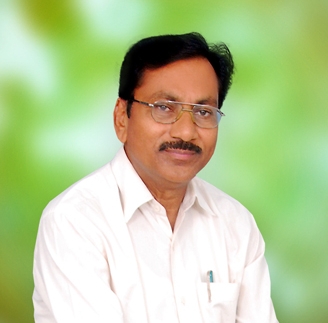
Dr. Rajamouly Katta, M.A., M. Phil., Ph. D., Professor of English by profession and poet, short story writer, novelist, writer, critic and translator by predilection, has to his credit 64 books of all genres and 344 poems, short stories, articles and translations published in journals and anthologies of high repute. He has so far written 3456 poems collected in 18 anthologies, 200 short stories in 9 anthologies, nine novels 18 skits. Creative Craft of Dr. Rajamouly Katta: Sensibilities and Realities is a collection of articles on his works. As a poet, he has won THIRD Place FIVE times in Poetry Contest in India conducted by Metverse Muse rajamoulykatta@gmail.com
Dr. Mrutyunjay Sarangi
On a February afternoon, near Rajmahal traffic signal, some citizens of Bhubaneswar town were treated to a rare sight. Sabyasachi Ray, the celebrated, most talked-about lawyer of the town, got down from his car while waiting for the light to turn green and started running towards the Station Square like a man possessed. He was seen tearing his hair, scratching his face and howling madly.
In no time his abandoned Honda City car became an object of curiosity. Drivers of the cars behind it started honking impatiently and finding no response, skirted it and moved on, casting angry glances at the unoccupied car. Before the traffic constables pushed the car to the side curb, half a dozen street urchins came near it, touched it with hesitant caution and rubbed their palm on its silky surface. One of them, more daring than the others, opened the door, got into the driver’s seat and started fiddling with the switches. Suddenly the car radio boomed into a loud song, throwing him off balance. Meanwhile two others had got into the luxurious back seat and sat on it, enjoying the comfort of the cushion. One of them started bouncing on it and found it to be ticklishly exciting.
Advocate Sabyasachi Ray would have exploded like a Diwali cracker had he witnessed this scene. He is too conscious of his aristocratic bearings – of his car, his dress, the Italian leather shoes and the Schaeffer pen in his pocket. The way his car was being manhandled by the urchins would have made him angry and he would have blasted them with his booming voice.
For Sabyasachi Ray, the booming voice is a trademark, his USP. When he stands up to present his arguments, the entire court room becomes quiet, all ears tuned to his words. The elderly judges, prone to light naps at lengthy arguments, sit up and listen to him in rapt attention. Sabyasachi weaves a magic around the court room, his words are carefully constructed, his strategy consciously drafted to make a mockery of the opponent. He says, a good lawyer is like a python, he looks at the opponent’s eyes, makes him feel threatened, waits for him to crack and the moment there is a sign of weakness, strikes and swallows him whole.
A brilliant lawyer, Sabyasachi says, is not made, he is born as a genius. A genius is rare. If you give a bat and ball to a young boy and make him play cricket for years under a good coach, he will become a good cricketer but not a Sachin Tendulkar. Cricketers like Sachin, singers like Lata Mangeshkar, painters like Raja Ravi Verma are not made by training, they are born as genius.
Sabyasachi considered himself a genius, right from the school days, when sparks of his brilliance used to dazzle others. After getting a degree in Law he started as a junior advocate under the tutelage of the famous barrister Nitin Chatterjee. Soon he opened his own chamber and in ten years’ time went far ahead of others. With fame, money, and success he became a celebrity in Bhubaneswar. Rotary Club, Lions Club, and Universities competed with each other to get him as a Guest Speaker. He didn’t have time for lesser institutions. A healthy contempt for rivals in his profession kept him on edge all the time. At a Rotary Club function, a journalist once asked him about his main competitor, “What do you think of Sadhan Patnaik?” Sabyasachi Ray shot back, “I don’t think of him. I don’t have the time!”
His two-storied mansion in Surya Nagar is a fine specimen of wealth and elegance. A stamp of aristocracy is evident everywhere – from the neatly manicured Korean grass lawn, the paintings on the walls, the potted plants on the balcony and the grills on the balustrade. When he, his wife Dipti and daughter Ananya go out in their Honda City to Chilka, Chandbali or Konark, people gaze in awe, conscious of their status and reputation.
Sabyasachi Ray is simply a brilliant lawyer. In the court room he enacts dramas to dazzle the judges, to intimidate the witnesses and to confuse his opponents. He knows the psychology of the judges and their weaknesses. Some are sympathetic to the poor, others consider themselves the sole upholders of truth and some others are the messiah of the downtrodden. Sabyasachi plays on their minds and tries to exploit their individual weaknesses.
There is no end to the success stories of Sabyasachi Ray. He is a legend in legal circles. Clients know that once they pay the fees to him, their fate is safe in his hands. Sabyasachi says he doesn’t believe in truth or falsehood. It is his job to weave the magic of words and convince the judge with his version of the truth. What lies behind the facts does not bother him. To him, the wad of currency notes paid by the clients is the truth. He has won hundreds of cases and most of them could have gone the other way, if some other lawyer had handled them. For him, success is an addiction. Even a single failure causes him acute depression, like a drug addict denied his dose of drugs.
Dancer Bijayini Das’s case is the most sensational victory of Sabyasachi Ray in recent times. The case had made headlines for many days in the local and national media, not only because she was an exceptionally beautiful young girl, but because the accused was the famous son of a powerful politician of Orissa. Vipin Samantaray is the MLA of Paradip and the uncrowned king of the crime world of coastal Orissa. Chintu is not only his son, but also his successor in every respect. At one time Bijayani was his constant companion, and his prize catch. For a couple of years they were seen together at Konark, Gopalpur, Chilka and all the famous resorts of the state. One day Chintu dropped her like a used napkin - just like that - here today, gone tomorrow. To prove that with his tons of money, he can acquire and abandon beauties like Bijayini at his sweet will.
Bijayini shut herself up for two months and then took up the job of a dancer at the famous Neelkamal night club and restaurant – a meeting point of all the big-wigs of Bhubaneswar. Politicians come there, so do film stars, businessmen, industrialists, bureaucrats and police officers. Chintu is a regular there. When Chintu enters the restaurant with his friends, a hush falls over the place. Chintu revels in the attention – as the anointed prince of crime, protected by the powerful father and his connections. The manager constantly hangs around the table to check if everything is alright. One never knows what will happen if the young man with a mercurial temper loses his cool for some reason. But having Chintu makes good business sense. He never spends less than fifteen thousand rupees, and often leaves a bundle of notes without counting them.
Bijayini is the only one in the night club who doesn’t have any fear of Chintu. She goes to his table, makes taunting gestures, touches his hand and dances provocatively to make him angry. Chintu ignores her. But it was inevitable that one day Chintu would explode. It happened one evening. In full glare of the other customers and the manager, Chintu shot at Bijayini, killing her on the spot. Some customers had seen them talking heatedly and Bijayini spitting on Chintu’s face in a fit of anger. In a flash Chintu took out a revolver and shot her. He and his friends immediately left the place.
The police came to the scene of crime and recorded the statements of some of the employees. Chintu was arrested, but released on bail immediately. The police filed a case but it was apparent they were merely going through the motion of legal proceedings. No reliable witness came forward to give evidence against Chintu. The manager flatly denied being present at the scene of crime. A couple of senior police officers were present in the night club that evening but feigned complete ignorance about the identity of the killer. For the manager and the big-wigs, Bijayini Das was a mere dime-a-dozen dancer, while Chintu Samantaray was a rising star, and a leader in the making. One day he will inherit the Paradip constituency and the crime world from his father. How can any one go against him? Only a dancer colleague of Bijayini, two young waiters who were desperately besotted with her, and an elderly couple came forward to give evidence against Chintu.
Advocate Sabhasachi Ray made mincemeat of them in cross-examination. The dancer was harassed so much that she started crying in the court. The elderly couple were made to believe that they were colour blind and had impaired vision. He proved to the Court that the night club was only partially lighted, colourful lights were playing to the tune of the music and no one could clearly see anything. The poor young waiters were badgered with questions, humiliated and were forced to admit that they had made unwarranted advances to Bijayini in the past and were men of dubious character. Impressed by Sabyasachi’s reputation and swayed by his histrionics, the Judge forgot to pull him up for violating legal ethics and intimidating witnesses.
Sabyasachi Ray, fortified with a fat fee, the fattest of his career, staged a big drama in the court room, and presented an alternative theory about the murder:
Yes, Bijayini died of a gun shot, but it was self-inflicted. Bijayini was three months pregnant. She pleaded with Chintu to marry her, and to accept the paternity of the child. Chintu denied that the child was his. He pointed out to another lady sitting by his side, “This is Ajanta. We got married in a Court this morning and as soon as we get out of the night club, we will drive away to Gopalpur for our honeymoon.” Bijayini was crestfallen. She lost her cool, took out the revolver from Chintu’s pocket and shot herself. In the semi-dark hall and in the midst of loud music and the hide and seek of throbbing colourful lights in tune with the dance, no witness could clearly see how Bijayini died. It is a case of suicide and not murder.
The Judge got carried away by the eloquent and forceful arguments of Sabyasachi Ray. The testimonies of the witnesses were shown to be unreliable. Chintu Samantaraywas acquitted. This victory added another feather to Sabyasachi Ray’s crown.
The Bijayini Das case was the pinnacle of success for advocate Sabyasachi Ray. It established him as the best in the field beyond doubt, with no one coming anywhere close to him. A few members of a women’s organization demonstrated against him in front of his house. But he didn’t care and told everyone, ‘I am not here to contest in an election, I don’t need to be popular. I have done my professional job. I have proved to the court what is the truth.’ Sabyasachi Ray famously says, there is no place for emotion in legal profession. There is only hard cash and a tough heart.
After victory in the Bijayini Das case, Sabyasachi Ray knew there were no new heights to scale. Yet he was obsessed. He craved for more cases, more victories, and more success. He started losing sleep in the night over the cases coming up next morning. He wanted to win each one of them.
People asked him whether he wanted to contest elections. Sabyasachi Ray flatly refused. There is no fun in winning an election and defeating a rival. It happens once in five years. But Sabhasachi Ray wants the taste of victory every day. He can’t live without it. Everyday he wants to vanquish his opponents, and announce to the whole world, “I am the best, the absolute best and no one can unseat me from that position.”
A month after the verdict in Bijayini Das case, a dramatic event changed the life of Sabyasachi Ray. His daughter Ananya, a student in Lady Sri Ram College in Delhi, had come home for summer vacation. She was fond of driving and loved to take her dad’s Honda City for a spin whenever she could. Around six on an April evening, she drove out of their house towards the market. The sky was cloudy but no one had a foreboding of the torrential rain that would hit the town. Around half past six the sky suddenly opened up and in one hour it rained fifteen inches - an unprecedented downpour. Old timers said they had not seen anything like that in their life, meteorologists later explained it as a cloud-burst.
Near Rajmahal Square Ananya had to stop the car. Visibility had been reduced to just two meters. In the blinding rain she parked the car near a two-storied office building and ran towards its partially open doors. The staircase was dimly lit, wind was forcing the rain inside through the slightly open door. She moved closer to the staircase. It was scary, she had an eerie feeling. She couldn’t see any one in that small space, but felt as if someone was present. She thought she would go out to the car and wait inside, but frequent lightning made the car unsafe.
There was a big flash of lightning followed by a deafening thunder. The electricity went off, plunging the entrance into total darkness. Ananya shivered out of fear. Suddenly a hand crept up from under the staircase, covered her mouth and dragged her in. She struggled and screamed but the torrential rain outside drowned her scream.
The rain stopped after half an hour. Advocate Sabyasachi Ray was frantic when Ananya did not return. She had left her mobile phone in the car and his calls were not answered. He took out his old Maruti Esteem and drove around, looking for her. One hour later he found her in the building which happened to be the office of the State Textiles Corporation. Ananya was unconscious. Her dress was torn, there were deep marks all over her body. She was bleeding from many parts. Even a strong-hearted Sabyasachi thought he would puke at the sight. He sprinkled water on her face and rushed her to the hospital. The doctor confirmed rape and let her go home after administering first aid and advising Sabyasachi to file a complaint with the police.
Advocate Sabyasachi Ray went mad with anger. Rape! Advocate Sabyasachi Ray’s daughter getting raped in Bhubaneswar? What has this town come to? Who could dare do this? Only if he could lay his hands on the rapist he would wring his neck and feed it to the dogs. He telephoned the Police Commissioner who was a personal friend from his Rotary Club. The police swung into action, but there was no trace of the culprit. The building was supposedly empty at the time of the crime and there was no one in the street who would have witnessed the incident.
The police was under heavy pressure to arrest someone, to prove that they are effective and Bhubaneswar town is safe for women. After some investigation they arrested Dibakar Swain, the watchman of the office building where Ananya was raped. Bhubaneswar town heaved a sigh of relief; police trumpeted it as a success story of early detection and arrest.
Advocate Sabyasachi Ray was impatient. He wanted to meet the accused and if possible, lay his hands on him and tear him to pieces. Police Commissioner advised him restraint. There was intense media focus on the case and any adverse publicity will spoil their cause. He arranged to include Sabyasachi Ray in the team of lawyers to represent the prosecution and Sabyasachi took over the case like a man possessed. This was going to be the most important case of his life. Forget Bijayini Das – she was a mere dancer, fit to be used and discarded by rich, spoilt brats like Chintu Samantaray. Ananya isSabyasachi Ray’s daughter, and he cannot forgive a man who dared to put a finger on her. Dibakar will be made to pay the price. He regretted that there is no death penalty for rape, but he promised himself that after Dibakar finishes serving his sentence, Sabyasachi will unleash his four Alsatian dogs on him, who will tear Dibakar to pieces, limb by limb, starting with the throat. Sabyasachi Ray shivered with anger, his fists curled and face contorted. He stopped taking any other case. He was consumed day and night by a feeling of insane rage and obsession for revenge.
The court room was packed with people and media. The whole town was curious to see how Sabyasachi, the unparalleled genius of legal world, will get retribution for his daughter. Poor Dibakar, a frail, emaciated man in his forties, who looked like a sixty-year old, trembled in the court room. Sadhan Patnaik, Sabyasachi Ray’s arch rival in legal profession in Bhubaneswar, was his advocate. With copious tears, Dibakar had pleaded with Sadhan Patnaik that he was innocent, and that he had never committed a crime in his life, unless consuming country liquor or smoking charas was treated as a crime. He is a father of four children, two of them are grown-up daughters. Committing a rape was unthinkable for him. Sadhan assured him that if he was innocent, he would be acquitted. Sadhan volunteered to take up the case free for Dibakar. It was time to settle a score with the great, invincible Sabyasachi Ray, the celebrity advocate, who was getting increasingly unpredictable because of his uncontrolled rage and frustration.
Sabyasachi Ray gave a sterling performance, one of the best of his career. He presented four witnesses who had seen Dibakar enter the building at ten a.m. and coming out at nine p.m. The entry in the attendance register matched this statement. The head of the office, Abinash, an admirer of Sabyasachi Ray and also a friend from the Rotary Club, testified that Dibakar was a man of questionable character, often suspected to be under the influence of liquor and probably some dangerous narcotic substances. Abinash testified that sometimes he had noticed a foul smell coming from Dibakar’s mouth while talking to him. For such a man committing a rape in a vacant office building is quite plausible.
Abinash was known to be a man of colourful reputation, corrupt, flamboyant, a big spender of money and a lady-chaser.
Sadhan Patnaik tried his best to discredit the head of the office.
“Do you know Advocate Sabyasachi Ray personally?”
“Yes”
“How often do you meet each other?”
“Almost every month, at the Rotary Club.”
“Are you good friends?”
“Sort of.”
“So, you are giving this evidence to help him nail Dibakar? Has he asked you to do that?”
For a moment Abinash was taken aback, his mouth remained open.
“How can you say like that? I am a senior officer of the government and you are attacking my character?”
“Please answer the question. The Court is aware how senior you are and many in this room have a fair idea about your character.”
There was loud laughter in the court room. Abinash lost his cool, his face became red.
“Fellows like Dibakar should be hanged, he is a risk to the society, to every single woman in this town.”
“So you have already decided that he is the culprit and your evidence is doctored to prove that theory? Has my learned friend, the celebrity advocate Sabyasachi Ray asked you to do that?”
Again Abinash lost his temper.
“You think, I am an idiot, I have no brains, that any advocate can convince me of anything?”
“Please don’t argue with me. Just answer my question.”
Sadhan Patnaik looked at the Judge.
“Your Honour may kindly direct the witness to maintain the dignity of the court room.”
Sabyasachi Ray sprang to his feet.
“Your Honour! It is my learned friend who is lowering the dignity of this court room by imputing motives to the witness and suggesting that I have tutored him.”
The Judge ignored Sabyasachi Ray. He was rather enjoying the line of questioning by Sadhan. He directed the witness to give exact answers to the questions put by the lawyer of the accused.
“For how long have you known the accused taking alcohol, or, as you have mentioned ‘other narcotic substances’?”
“He has a long history of being an alcoholic and user of charas.”
“How long?”
“I don’t know. I have only heard about it.”
“So, you are giving only hearsay evidence. How long have you been head of the office?”
“About three years.”
“Have you taken any disciplinary action against Dibakar?”
“No.”
“Have you even initiated any action against him?”
“No.”
“Why?”
“I didn’t want the poor man to lose his job, because of any action I take against him.”
“Why are you against the poor man now? Because your friend has told you that Dibakar has raped his daughter?”
“Everyone in the town knows that Dibakar has done it.”
“How do you know everyone in the town thinks Dibakar is the accused?”
“I have talked to many people.”
“All of them are your friends?”
“Yes.”
“And friends of the celebrity lawyer Sabyasachi Ray?”
“Most of them are also friends of Sabyasachi Ray.”
“So all of you have already decided that Dibakar is the accused and you have come to give evidence against him?
Abinash was silent.
“How do you know that Dibakar is a drunkard and a drug addict? Have you ever seen him drinking?”
“No, but I have heard that he drinks a lot.”
“How many times have you seen him smoking?”
“Never.”
“You told the court that you have sometimes found a foul smell coming out of Dibakar’s mouth.”
“Yes.”
“How many times have you found that smell?”
“Two or three times.”
“What kind of smell?”
“I don’t know what exactly is the smell. It may be charas.”
“Are you sure it is charas or is it only a cigarette?”
“No, no, it is charas.”
“How are you so sure? Do you smoke charas?”
“No, of course not.”
“Does any one in your family or any of your friends smoke charas?”
“No! How dare you suggest that?”
“Just answer my question. How do you know that the smell coming out of Dibakar’s mouth is that of charas?”
“I don’t know. I have only heard that he smokes charas. So I presume the smell is that of charas.”
“You are presuming a lot of things. You have never taken any action against Dibakar for consuming alcohol, you have never seen him smoking charas, just by hearsay you presume him to be a drunkard and a drug addict. Is it true?”
“I know he is a drunkard and a drug addict, because everybody knows it.”
“So now you say he has raped your friend’s daughter because everyone says that and possibly your friend has asked you to say that! Are you an educated person or an ignorant rustic?”
Advocate Sabyasachi Ray got up, agitated, “Your Honour, my learned friend is trying to intimidate the witness! This cannot be permitted.”
The Judge looked at Sadhan Patnaik, “Any more questions?”
“No your Honour, I have established him as an unreliable and a biased witness. His evidence is based on hearsay, not facts.”
It was apparent that everyone had presumed Dibakar to be guilty. The media had already crucified him, there was public outcry against him and the mighty Sabyasachi Ray was out to finish him off. The case would have been closed early but for the brilliance of Sadhan Patnaik whose cross-examination of the witnesses was thorough, methodical and incisive. The prosecution had presented four more witnesses, all working in the same office, who testified that Dibakar was a man of dubious character and prone to crime. But Sadhan Patnaik demolished their evidence with the same brilliance he had employed for Abinash. Except for a reputation of being addicted to drinks and charas, there was nothing to suggest that Dibakar had committed a rape.
The case dragged on and the court got closed for summer vacation. Despite Sabyasachi Ray’s best efforts he could not get an early conviction against Dibakar. During the summer it was found that due to the unfortunate incident Ananya had got pregnant. Sabyasachi Ray and his wife Dipti were shocked beyond words. Relatives advised them to get an abortion, but the lawyer in Sabyasachi wanted to prove Dibakar’s guilt by a DNA test. Ananya was adamant – let a DNA test be done and Dibakar be punished. Somehow the news got leaked and the sympathy of the whole town was with the poor girl. Anger was growing by the day. If Dibakar was not in jail, he would have been lynched by the public.
Before the summer vacation, the defence had presented one witness, Dambaru, a peon working in the office where Dibakar was a watchman. Sadhan Patnaik wanted to tread carefully, because Dambaru’s reputation as a drunkard was as bad as Dibakar’s.
“What’s your name?”
“Dambarudhar Majhi, Sir.”
“Where do you work?”
“I am a peon in the Textile Corporation.”
“Is it the same office where the accused Dibakar Swain works?’
“Yes, Sir.”
“Were you with him on the evening of April 23rd when there was torrential rain in Bhubaneswar?’
“Yes Sir, we were together in the office.”
“What were you doing on a holiday?”
“I had been asked by my bosses to arrange some papers and registers. It could be done only on a holiday.”
“Was Dibakar with you when it was raining?”
“Yes Sir, he was sitting near the entrance since morning. I only asked him to come up and close the windows. The rain was sudden and heavy. A lot of water entered the office hall and papers got blown away in wind. So both of us got busy in closing the windows, and arranging the papers. Some of the window panes were broken and we were busy in closing those gaps with papers and file boards so that rain water doesn’t enter the office.”
“It rained for more than an hour. Did it take that much time for you to close the windows and arrange the papers?”
“No Sir.”
“What were you doing after you had closed the windows?”
An embarrassing smile spread over Dambaru’s face. Actually he and Dibakar had taken out a bottle of country liquor and had polished it off in that one hour. But he had not told it to anyone. With downcast eyes he replied,
“We got tired and went off to sleep. We were feeling a little cold because of the dampness and the cool air.”
“When did you wake up?”
“Around nine when we heard a lot of noise and some people woke us up.”
“What was the noise about?”
“People told us that a girl had been raped and her father had taken her to the hospital.”
“What did you do?”
“We panicked. Dibakar thought he will lose his job because he had left the entrance of the building open when he came up to help me. I panicked because I had called him up to help me in arranging the papers.”
Sadhan Patnaik knew that drinking liquor in the office was the real reason of their panic, but he did not probe it. Dambaru and Dibakar were reeking of alcohol when people found them in deep slumber in the hall of the office. Both had locked the building and run away to hide in a friend’s house. The police could meet Dibakar only the next day, sober and fresh as a lily.
During cross-examination Sabyasachi Ray attacked Dambaru with a vengeance. Any friend of Dibakar deserved to be mauled!
“Why were you in the office when the rains started pouring?”
“I couldn’t get out. The rain was so sudden that nobody could move out anywhere.”
“With so much rain and thunder outside, how could you sleep?”
Dambaru was tempted to tell Sabyasachi that if one finishes half a bottle of country liquor in about forty-five minutes, no noise can stop him from getting knocked out, but the fear of losing his job made him give a decent explanation.
“I am used to noise while sleeping. My house is small and with my old mother and five children there is no space inside, I sleep outside in the verandah of my house in Rasulgarh, on the Cuttack-Bhubaneswar main road. I hear noise of trucks and vehicles through out the night.”
“What were you and Dibakar doing after you arranged the papers?”
“We chatted for sometime and then went off to sleep.”
“Who fell asleep first, you or Dibakar?”
“Dibakar, Sir.”
“No, you are lying. It was you who went off to sleep first. Dibakar was still awake. Seeing you asleep, Dibakar went down and raped the victim, then came up to sleep in the hall.”
“Impossible Sir, it was he who dozed off first and fell asleep on the floor. He was still sleeping when I got up due to the noise made by the people. Then we woke him up.”
Sabyasachi Ray kept on grilling him, but Dambaru didn’t flinch. He insisted that he was telling the truth and Dibakar couldn’t have committed the rape.
Hearing in the case resumed after the reopening of the court. Sadhan Patnaik wanted to examine Ananya. The Judge was hesitant, but she volunteered to give evidence. Like everyone else she had made up her mind that Dibakar was guilty and her hatred for the man was so intense that she wanted to do everything possible to crucify him. She had not gone back to college after the incident. The trauma in the initial days was too severe. But a modern girl like her cannot sit quietly at home and allow the accused to get off lightly if she could convince the judge to award the maximum penalty. Sadhan Patnaik examined her with caution, knowing the all-round sympathy for her.
“Your name?”
“Ananya Ray.”
“What were you doing on the evening of April 23rd?”
“I was driving my dad’s car. I had to stop at Rajmahal Square because of poor visibility in torrential rain. I locked the car and ran to the nearest building, which was the office of the State Textile Corporation. That’s where that animal raped me.”
She pointed out Dibakar Swain in the accused’s stand.
“Wait a minute. How do you know it was him?”
“I have no doubt in my mind.”
“Because the police has arrested him?”
“Yes, and he is known to be a criminal.”
“Did you see him that evening at any time?”
“No. When I entered the building, the light in the staircase area was very dim.”
“Where was he?”
“Hiding under the staircase.”
“Why would he do that, when there was a chair meant for him to sit and guard the building?”
“How do I know? You should ask him. May be he was waiting for a victim like me!”
“Do you recollect, from the feel of the man who raped you if he had the same build as Dibakar?”
There was silence in the court room for a few seconds. Then Sabyasachi jumped up, his face red with anger, rushing towards Sadhan Patnaik.
“You scoundrel, what kind of a question is that?”
It appeared he was about to assault Sadhan Patnaik. Others restrained him. The Judge was severe on Sadhan Patnaik.
“Mr. Lawyer, I know you need to ask if the rapist had any resemblance to the accused. But be decent in asking the question.”
Sadhan Patnaik had got slightly rattled by the threat of a sudden physical attack from Sabyasachi Ray. He looked at Ananya.
“Madam, my apologies. Let me put the question in a different way.”
Ananya interjected.
“It’s ok. You ask anything you want, but I want the accused to be punished.”
“Yes, let the real culprit be punished, but I will prove that my client is not guilty. Did you have an occasion to see the face of the man who attacked you?”
“No, the light had gone out when he attacked me. It was pitch dark.”
“Was he a very strong man, a huge man, or frail like the accused, standing there?”
“The man put his hand on my mouth and in a minute or two I fainted out of fear. But I don’t think he was a huge man. His hands were thin. He was like the accused standing there. I think, it was the same man.”
“No, I think it was not the same man. I will prove it shortly.”
Ananya looked at him defiantly. Sadhan Patnaik continued,
“Forgive my asking this. Is it true that you are pregnant?”
Ananya had not expected this question. For the first time during the cross-examination she felt shy. She nodded her head.
“Yes.”
“Did it happen because of the incident that evening?”
Her eyes flashed with anger.
“Yes, how else?”
“No, I was just wondering. You study in Delhi?”
“Yes.”
“Do you have boy friends?”
“Yes, I have many friends, some of them are boys.”
“Are you physically intimate with any of them?”
There was a shriek from Ananya.
“What? What are you saying?”
Simultaneously, Sabyasachi Ray, the lawyer with the booming voice let out a deafening roar.
“Bastard! You bastard! You are insulting my daughter in the open court room? I will get your license cancelled. You cheap bastard.”
He rushed at Sadhan Patnaik and tried to give him a blow. Sadhan ducked. It took a full five minutes to calm down Sabyasachi Ray. There was pandemonium in the court. Before the judge could pull him up, Sadhan Patnaik apologized to him.
“Your honour, my apologies again. But I will prove to the court that there is a reason for my asking the question. If the court permits I will ask one more question which is critical, in order to prove my client’s innocence.”
“Please proceed, but be sure it is relevant.”
“Thank you, Your Honour! Now, madam, everyone has sympathy for your condition. Please tell us honestly in this court, because you are the only one who can do that, is your pregnancy solely due to the unfortunate incident of the evening of April 23rd?”
Ananya looked at him with burning eyes.
“Yes, I am one hundred per cent sure of that.”
Sadhan Patnaik bowed at her and turned to look at the Judge.
“In that case, Your Honour, my client is innocent. He is certainly not responsible for the crime he is accused of. Here is the certificate issued by the Nirakarpur Primary Health Centre eight years ago, when he got himself operated for vasectomy after his fourth child was born. Dibakar Swain is incapable of fathering a child.”
There was a hush of silence in the court. Sabyasachi Ray was the first to get up. His face was distorted with shock, disbelief and anger.
“What kind of a cheap trick is that? The certificate must be a fake.”
Sadhan Patnaik stood there, smiling. This was a rare victory against Sabyasachi Ray. It spread a glow on him like a slow fire on a winter evening. To his surprise, the court room erupted in protest and anger. The public was not prepared to accept his argument. Thanks to the media, Dibakar Swain had already been pronounced guilty by the public.
“He is lying. He is lying. That certificate must be a fake, tear it up. Give justice to the poor girl. She deserves it.”
The Judge found the audience in the court room getting increasingly unruly. He asked the police to restore order and take away Dibakar from the court. He invited the counsels and Ananya to come to his chamber for a discussion.
Sabyasachi was seething with anger.
“Your Honour, my learned friend has played a cheap trick. Such certificates can be obtained by paying a bribe. I am sure it is a fake.”
Sadhan Patnaik was still smiling. It appeared as if the smile will not leave his face for the next few days.
“Your Honour, we can produce the Register from where the certificate has been made. My client is innocent.”
Sabyasachi Ray attacked him.
“If a certificate can be faked, a register can also be faked. Don’t you have any legal ethics?”
Sadhan Patnaik shot back.
“Mr. Ray, you take care of your legal ethics, I will take care of mine. The whole Bhubaneswar town knows how much legal ethics you have. They don’t have to go to heaven to ask Bijayini Das about your legal ethics!”
“How about my poor daughter? Do you know what trauma she has gone through?”
“Yes, we all have sympathy for her. But being a legal genius that you claim to be, I don’t have to tell you that cases are won in court not by sympathy, but by cold facts and hard evidence.”
The Judge intervened.
“OK, enough. Gentlemen, you can settle your personal rivalry outside my room. I have no option except dismissing the case.”
Sabyasachi Ray panicked.
“Your Honour, wait a minute! I have no doubt that this vasectomy certificate is a fake. Let us wait for a DNA test of the baby to prove that Dibakar is its father. I have checked with some reputed doctors. They say that although a DNA test can be done in vitro, a hundred percent certainty can be ensured if the sample is taken after the baby is born. We are prepared to wait for five more months for that.”
The Judge looked at Sadhan Patnaik.
“Your Honour, I am sure even the DNA test will be negative, but I am not prepared to let my poor client rot in the jail for the next five months, waiting for a DNA test to be done. I will agree to the DNA test if my client is let out on bail. Otherwise, I will press for an outright acquittal.”
The Judge looked at Ananya.
“How about you? Are you prepared to go through this?”
“Yes, Your Honour, we have already decided that the child should come out and prove to the world that the villain Dibakar is an animal in human form.”
“But how about the child?”
Before Ananya could reply, Sabyasachi Ray shouted in anger.
“We will give it away to an orphanage. I am not going to keep that disgusting thing in my house. We have not gone for an abortion only to let the child help in proving the guilt of Dibakar.”
“Or disproving it” – interjected Sadhan Patnaik.
The Judge again looked at Ananya.
“How about you? Do you agree to this? After all, you are the mother.”
A shudder passed through Ananya. She caught hold of the chair in front of her to steady herself.
“I agree with whatever decision my parents take.”
The Judge passed an order granting bail to Dibakar and posting the case for 15th February.
People in Bhubaneswar were stunned at this dramatic turn of events. No one was prepared for it, since the whole town had assumed Dibakar to be guilty. Now they all waited anxiously for the baby. It will be a unique baby. The fate of poor Dibakar Swain will depend on its arrival – will it be the confinement of the jail or free, open air for him?
Days rolled by. Ananya felt the pangs of a baby growing up inside her. By a strange quirk of nature, she started liking the idea of having a baby, nurturing it and watching it grow. When the baby gave its mild kicks from inside, she no longer cursed it; she started enjoying the kicks and gradually waited for them. Just knowing that a part of her was growing inside, was alive and kicking, made her feel happy. A few months back if someone had told her that she would soon be a mother and a part of her flesh and blood would come into the world screaming, after a nine months’ wait in the dark chamber of her womb, she wouldn’t have believed it. Nature was gradually preparing her to bring forth another spark of life into a world of light and splendor. Her emotional turnaround was dramatic, but she was too scared of her parents to show any such feeling. She was worried for her father. Advocate Sabyasachi Ray had became a shadow of his previous self. He had stopped taking new cases. His only obsession during his waking hours was to win Ananya’s case, humiliate Sadhan Patnaik and send Dibakar to a long imprisonment.
The day a male child was born to Ananya, Sabyasachi Ray and his wife Dipti almost fainted out of shock. It was a peculiar child – not ugly, but something was different about him. What worried Sabyasachi the most was, it had absolutely no resemblance to Dibakar. The child was of a dark complexion, with small curly hair, big round eyes, thick lips and the eyebrows joined together. Added to his unusual features was a peculiarity which horrified Ananya’s mother. On his right hand, next to the thumb, the child had a small appendage, something like an extra finger.
Ananya’s mother refused to touch him. Sabyasachi Ray got the doctor to collect the blood sample for a DNA test and the next day he wanted to send the child off to an orphanage. To his horror, Ananya refused to part with the child. Her maternal instincts took over and defied all reason, logic, and pleading of her parents. She threatened to leave home and run away with the child if they insisted on sending the child to the orphanage. ?
The DNA test was negative. The Judge acquitted Dibakar. Out of caution the police commissioner got the DNA matching done with the sample of Dambaru. That also turned to be negative. Sadhan Patnaik’s joy knew no bounds. He became the new hero in the legal fraternity. The Lions Club felicitated him for the doggedness and perseverance in getting justice for poor Dibakar. People of Bhubaneswar kept wondering about the real perpetrator of the crime. The police admitted they were clueless. So far they had put all their energy in trying to prove Dibakar’s guilt.
Advocate Sabyasachi Ray became a pitiable wreck. Never in his life had he encountered defeat and despair at the same time. His professional life was in doldrums and his personal life was a mess. He just couldn’t accept Ananya’s child. Its presence at home haunted him like a bad dream, constantly reminding him of his defeat in the court room. For petty reasons he snapped at his wife, at Ananya and at everyone in general. He stopped going to the court. He would often take out his car and drive around the town in a vacant state of mind.
On a late February afternoon, he left his house in his car. At Rajmahal square, he stopped at the red light. He stared ahead, lost in thought. Suddenly there was a knock on the window on the left side of the car. He wanted to ignore it. Must be a beggar asking for alms! Absentmindedly he turned his head and looked at the window. The next moment blood drained out of his face. His eyes popped out, sweat broke out on his forehead and he felt as if someone was hammering inside his brain.
The dark man in tattered clothes, a dirty face with big round eyes, curly hair, joined eyebrows and thick lips smiled at him and raised his hands with a plastic bowl to ask for alms.
With blurred eyes, Sabyasachi Ray noticed the extra little finger attached to the beggar’s thumb. His brilliant mind took only a few seconds to realize that this unkempt man with tattered clothes is the father of Ananya’s child. Suddenly his mind snapped, the thought of how this dirty man would have mauled his delicate daughter’s body on that rainy evening turned him crazy like a wounded tiger. His head started reeling. From deep within his heart he heard screams – a rising crescendo of piercing screams from Bijayini Das and many others whose souls were crying for justice, that was so craftily denied to them by the brilliance of Sabyasachi Ray and his ilk.
The genius lawyer lost his mind, opened the door and ran down the street towards Station Square tearing his hair, scratching his face and screaming at the top of his voice at an unforgiving God.
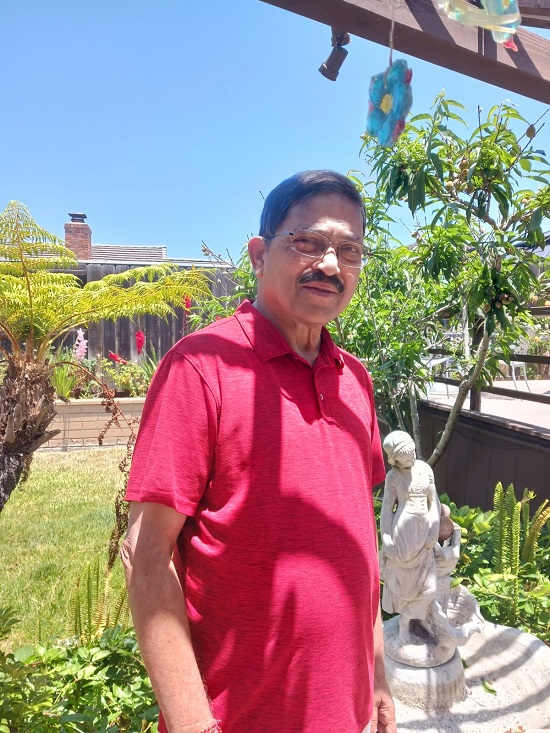
Dr. Mrutyunjay Sarangi is a retired civil servant and a former Judge in a Tribunal. Currently his time is divided between writing poems, short stories and editing the eMagazine LiteraryVibes . Four collections of his short stories in English have been published under the title The Jasmine Girl at Haji Ali, A Train to Kolkata, Anjie, Pat and India's Poor, The Fourth Monkey. He has also to his credit nine books of short stories in Odiya. He has won a couple of awards, notably the Fakir Mohan Senapati Award for Short Stories from the Utkal Sahitya Samaj. He lives in Bhubaneswar.
Viewers Comments