
Literary Vibes - Edition CLXVII (31-July-2026) - STORIES, ANECDOTES, TRAVELOGUES
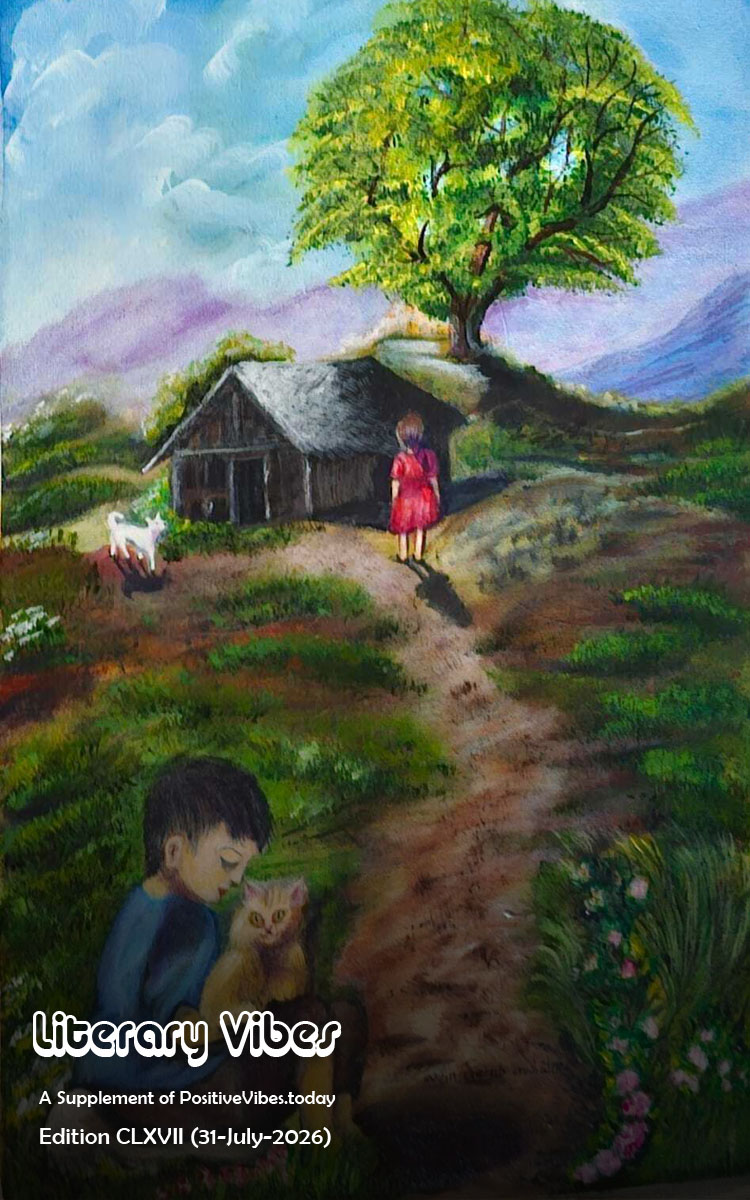
Title : Sibling Vibes (Acrylic on canvas board 17 inches×26 inches by Lathaprem Sakhya)
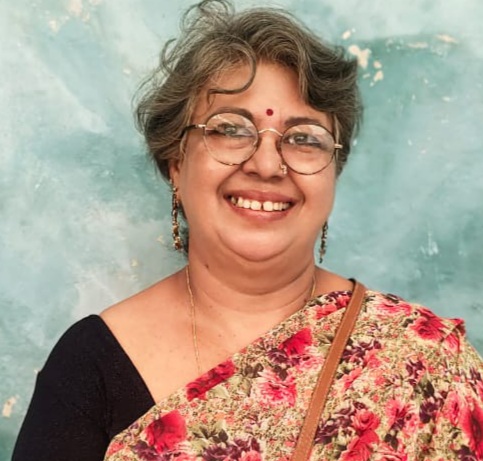
An acclaimed Painter, a published poet, a self-styled green woman passionately planting fruit trees, a published translator, and a former Professor, Lathaprem Sakhya, was born to Tamil parents settled in Kerala. Widely anthologized, she is a regular contributor of poems, short stories and paintings to several e-magazines and print books. Recently published anthologies in which her stories have come out are Ether Ore, Cocoon Stories, and He She It: The Grammar of Marriage. She is a member of the executive board of Aksharasthree the Literary Woman and editor of the e - magazines - Aksharasthree and Science Shore. She is also a vibrant participant in 5 Poetry groups. Aksharasthree - The Literary Woman, Literary Vibes, India Poetry Circle and New Voices and Poetry Chain. Her poetry books are Memory Rain, 2008, Nature At My Doorstep, 2011 and Vernal Strokes, 2015. She has done two translations of novels from Malayalam to English, Kunjathol 2022, (A translation of Shanthini Tom's Kunjathol) and Rabboni 2023 ( a Translation of Rosy Thampy's Malayalam novel Rabboni) and currently she is busy with two more projects.
Table of Contents :: Short Story
01) Prabhanjan K. Mishra
LORD’S ANTICS: RATHA YATRA AND OTHER PECCADILLOS
02) Sreekumar Ezhuththaani
03) Rabi N. Dash
04) Phalguni Sahu
05) Snehaprava Das
06) Usha Surya
07) Madhumathi. H
08) Satish Pashine
THE JOURNEY THAT CHANGED DIRECTION
09) Deepika Sahu
A CUP OF CHAI AND BUN MASKA WITH THE DEAD: LUCKY RESTAURANT IN AHMEDABAD
10) Sujatha Krishnamurthy
11) Annapurna Pandey
A BLUR OF THREE DAYS: REFLECTIONS ON THE 57TH OSA CONVENTION IN MINNEAPOLIS, JULY 2- 5, 2026
12) Satyanarayan Das
13) Mary Josey Malayil
14) T. V. Sreekumar
15) Dr. Paramita Mukherjee Mullick
RARE GEMS IN THE PORTUGUESE SECTION, GOA STATE MUSEUM
16) Sukumaran C.V.
17) Jaydeep Sarangi
18) Upali Aparajita
19) Ashok Kumar Mishra
RED SCOOTER AND THE MISSING GOAT
20) Bankim Chandra Tola
21) Sreechandra Banerjee
22) Dr. Rajamouly Katta
THE LITTLE BOY MISSING
SUPER SALE
23) Sheena Rath
24) Mr Nitish Nivedan Barik
LEAF FROM HISTORY: ABOUT THE TREE AND THE TEA PARTY
25) Dr. Mrutyunjay Sarangi
LORD’S ANTICS: RATHA YATRA AND OTHER PECCADILLOS
Prabhanjan K. Mishra
The lord was wondering, what a travesty! He was living under his own covenant, his promise to people, in spite of his limitless reaches. He was sort of trying to stick to his New Year resolutions like a good boy.
Of course, it was not a bad experience at all. Though he suffered from a lot of limitations, had little freedom to exercise his omnipotence; though no covenant limited his omniscience, yet being among humans, day and night, he was afraid, he had a contagion called forgetfulness. Often, forgetting who really, he was, like a man forgetting his own identity and adopting a borrowed one imposed on him by wife, mother or a guru.
Yet, he enjoyed his life as if it was his lot, as humans would accept their lot in their stride. These days, he loved being chided, mocked by his big brother Balabhadra, besides some bhaktas, especially the Bhakti poets in their hymns. He could feel the warmth of their adoration in those mock anger and bitter words. With open audacity they critiqued his behaviour that in their understanding seemed unfair. He excused them as they were unaware of his cosmic grand plans.
He loved his leg being pulled by his little sister, Subhadra, and lots of humans for his apparent lapses, and he especially loved his wife Laxmi showering a lot of attention on him wrapped in her attempts to make a man out of the monkey that her husband was. But Laxmi’s small and insignificant abuses that he enjoyed as her affectionate care to improve him happened in their private quarters, not at least in public glare.
He loved the humanlike arrangements, a side room to the main sanctum in the temple had been allotted to him and Laxmi where they shared a bed during nights, exchanging their couple related privacy.
He could not recall such joy during his Vaikuntha sojourn where he slept on a bed made on a curled live serpent shifting every second out of fear of his air-transport Garuda, a huge eagle that often preyed on serpents for food. Two wives, Laxmi and Saraswati, many soothe-sayers, oracles, often his celestial mendicant bhakta Narad and many supplicants would create a hubbub crowd around him, creating a buzz of hymns, shouts of Hari Bol (Hail the Lord), play of a Veena, and small talks among the present individuals. But it was by his own arrangement, he recalled, in some exalted moment.
At this point, he shivered a little feeling the necessity of a shawl. After wrapping himself with a Pashmina gifted by a devotee, he enjoyed its soft warmth, a wonderful mixture of the comfort of the tender textile, and the warmth of the devotee’s love for him.
He knew, a force called Maya, like hypnosis, he had created a long ago, was responsible for all of that – the human like feelings and behaviour of himself, his wife and other family members; and his bhaktas treating them as humans – to forget the reality and sort of living in a dream. It could be called illusive, delusive or a state of hallucination. Under the influence of Maya, he often forgot who he really was, his immense reaches with omnipotence, omniscience and omnipresence. Only at times the pall of Maya lifted making him aware who really he was.
He vaguely remembered he had to visit some important place shortly. He asked his wife in bed, “Priye (my beloved), am I to visit someplace very important shortly as per my itinerary?”
His feisty wife in her combative mood that night because he had feigned tiredness to give attention to her, pulled a face, “Yes, you are scheduled to visit your aunt, Gundicha. You have been invited along with your siblings. But what is that to me? I am not invited. Why? Am I polluted? You don’t also protest, or refuse to go without me. You have no backbone to take a stand to her unfair invitation, or defy her by taking me along with. For me, your life partner, a big ‘NO’ hangs from your lips all the time.”
Jagannath timidly assuaged her to save his restful night, “You know my covenants. Even I am not spared from that. You have often called it ‘my foot-in-mouth’ moment’s utterances. You may be right Laxmi. But what can I do? What would people say, if I take you along against my aunt’s will? A henpecked husband? That’s besides my big brother Balabhadra’s scowls and my little sister Subhadra’s giggles.” Laxmi pulled a very long face and turned in bed to sleep with her face to the other side, and hissed, “Ha, your dumb covenants!”
Jagannath the next morning after his formal breakfast hurried out to look at the preparations for his trip to Gundicha aunt’s house, especially readiness of his team’s transport, the three chariots.
He felt the Maya clearing a little to make him more lucid. He knew the humans assumed that he created them in his own image. That propelled them to dress themselves, feed themselves, and comfort themselves in the Lord’s terms and style. Though, the facts were more amazing than the fiction. It was rather the opposite.
In fact, humans created his image in their own shape, size, nature and ways. They made his images in human shape. They dressed him as it should suit a king or chief of humans. They made him eat and drink like them but of the best quality that suited a Lord.
Jagannath smiled to himself. Yet he enjoyed the attention, love, and care showered on him by his bhaktas. The next moment he knew he might forget all this awakening and merge into the shape, size, nature conferred on him by the humans. The Maya - illusion, delusion, or hallucination – whatever that might mean, would fog his mind.
His devotees identified that befuddlement on his part as his normal self, forgetting his super-powers like being omnipresent, omnipotent, and omniscient. The arrangements were a part of his own covenants for the Kali Yuga. Also, though a live, alert, and responsive God, he could not rise to his devotees’ expectations. He had to maintain often a low profile under excuses like karma, destiny and Niyati (cosmic inevitability), because of the Maya caused by his covenants.
In the fog of Maya, he often wondered, was he the all-powerful Lord or just an idol worshipped as God? His driving licence, PAN card, Aadhar document, Passport, etc., had they been issued, would have showed his Name as Jagannath, Residence as the Bada Deula (Grand Temple), Puri. Address proof etc? He would have said, “None available, but could be verified from the priests and the king of Puri who all would vouchsafe” As his Job: CEO of the Universe would by all possibility make issuing authorities laugh, “Isn’t that too weird and pretentious!” But weren’t most things about him like that, a bit vague, confusing. He knew it but was helpless to resolve the befuddlement.
He doubted, with that sort of credentials, if his specifications would satisfy the scrutiny of the Booth Level Officer (BLO), recently appointed by ECs, to fix the SIR; if he would be allowed the voting right as an Indian citizen. He wondered if the BLO would not consider him an unlawful migrant like Rohingyas. If the SIR had been introduced to separate the legal grain from illegal chaff, he feared, he might be categorised in the chaff segment.
The reasons he doubted his Indian origin, or Indian domicile were legion – his origin appeared to be only a belief or a bundle of beliefs put together. He was not very sure of his early years like any other child.
He had picked stories from here and there from the elderly people’s mouths, who heard them from their elders, who in turn learnt from theirs, so on and so forth, over hundreds of generations; and stitched them together and hazarded some semblance of the flowing train of events – a plausible family history -
He never came to know anything about his parents. But he learnt living as a baby in the house of a tribal chief, Vishva Vasu by name, who adored him, pampered him, and lovingly called him as his Neela Madhav. So, he always considered that tribal chief, Vishva Vasu, as his adoptive or foster father.
Then the King, Indra Dyumna, having his capital at Puri, wanted to adopt him, Vishva Vasu’s Neela Madhav. As he was rumoured to possess divine powers. The king thought Neela Madhav living in his royal household would bring him immense power, bigger kingdom, and great wealth. But when he tried to snatch away Neela Madhav by stealth and force, it was said, the much-coveted child, simply went missing, like vanishing into thin air, giving the king a slip.
King Indra Dyumna felt humbled, devastated, assuming that the divine entity Neela Madhav did not find him or his royal house suitable to be adopted or worshipped. So, the divine child made himself unavailable.
But being guided by his oracles the king was led to a shining log washed ashore at Puri beach on the sea. The log not only radiated power and was luminous, but bore the same divine marks as did Neela Madhav – the marks of Shankh, Chakra, Gada and Padma (Conch shell, Wheel, Mace, and Lotus), the symbols of Lord Vishnu, the presiding Lord of Hindu Pantheon. The sacred, divine log was taken home and worshipped in a temple as Neela Madhav (the Blue Lord) by the king and his queen.
The king Indra Dyumna was desirous of carving a handsome image of Lord Vishnu, his Neela Madhav, but no carpenter of his kingdom could make a dent into the divine log by driving a chisel into it or making a cut into it by their sharp saws, let alone carving an image out of it.
Another difficulty was neither the king, nor his oracles had any idea how Neela Madhav looked, so they had nothing to guide even a capable carpenter if he was ever found in their search, far and wide. The king and his priests kept worshipping the divine wooden log and remained in prayerful and patient wait for a signal from Neela Madhav himself.
One of those days of anxious waiting, a sickly and old carpenter came to the king’s court carrying a bag of ordinary rusted tools. He showed his dexterity by driving a nail into the impenetrable log. It was first such event that impressed the king. After winning the king’s confidence, he said he had a complete idea how Neela Madhav’s image should look when carved out of the massive wooden log.
But the sickly carpenter had conditions. He would stay inside the temple alone to carve the log into Neela Madhav, left to his devices undisturbed, the doors shut by him from the inside. He would take his own time to finish the carving, and open the door of the temple himself after completing the work. He should not be disturbed while on the job. The king gave him his word and the work started.
The crusty queen Gundicha had doubts about the capability of the sickly old carpenter and his weird conditions about doing things alone without help. Every other day the queen would keep standing outside the temple door and listen to the carpenter’s working sounds inside the temple like the sounds of sawing, chiselling, hammering, and smoothing the wood with plane, besides the sickly carpenter’s intermittent coughing.
But as days progressed, the sounds of work as well as the old and weak carpenter’s coughing sounds grew feeble and feebler and one day stopped altogether. The impatient and capricious Gundicha apprehended the worst, and remonstrated before her husband, “The old sickly carpenter might have been overtaken by exhaustion and collapsed. That way he may die and defile the holy premises. My king, immediately force the door to open. Let’s check inside the temple. If he needs treatment by our Vaidyas (dictors) or Ozas (witch doctors), let us help him… or..”
The king hesitated as he had given his word to the carpenter. But after waiting a few more days, he believed his wife’s prognosis and forced open the door that had been locked from inside. The temple had no trace of the carpenter, or his bag of tools, or the divine log. Instead, three half-done massive idols adorned the alter on which the log had been placed earlier for puja purpose. The idols needed further carpentry as the hands and legs were incomplete, the face had no carving for the nose, eyes etc.
The king was devastated. He blamed his wife, “For your impatience, my dear Gundicha, I had to breach my promise to force open the temple door. He was surely a divine carpenter and left feeling abused as I had no trust in him, leaving my idols here in the state of misshapen. Now how do I know who among the three deities is my Neela Madhav? Who are the other deities?”
He had no other recourse than running to the oracles. The wise oracles advised, “Dear king, it was ordained that way. The old sickly man was none other than the celestial carpenter Vishvakarma himself. The one on the right among the divine idols is Neela Madhav, the Lord Vishnu; and is in his Daru-bhut-Murari (Wooden stance) avatar, his incarnation in the current Kali Yuga. He would be famously known as Lord Jagannath. The idol on the left is Jagannath’s older brother Lord Balabhadra, and in the middle is sitting their youngest sibling Subhadra.”
The oracles also confirmed that the incomplete and misshapen shapes were ordained keeping with the time’s attitude and norm. They also advised the ordained colour scheme how to paint the three idols, the dress ensemble in details, and the jewellery to adorn them. The traditional service providing painters in the king’s temples drew eyes, nose etc. on the blank faces of idols as per oracles’ directions. Thus, Lord Jagannath got his wide-open-round eyes called ‘Chakadola’.
The oracles detailed about the food to be offered as Prasada, the methods of worship, and the other routine of the Lords. One of that routine business being an annual visit by the Lord in company of his siblings to his foster parental house, the Gundicha temple, by chariots made afresh every year from sanctified wood-logs, rafters and iron fixtures. The visit would be celebrated as Ratha Yatra (Cart Festival).
Coming to where the narrative was left – Lord Jaganath reminded himself, “Now, work at hand first, and my daydreaming later. Work at hand to be attended if I wish to go in comfort to my aunt Gundicha’s house with my siblings.” He ran down to the Lion’s Gate of the walled temple premises where the carpenters and iron smiths were assembling the three chariots – his Nandighosh, his older brother Balabhadra’s Taladhvaja, and sister Subhadra’s Darpa Dalana.
He recalled that the preparations had started from Akshaya Tritiya that had arrived during the last week of April or the first week of May, he could not exactly remember. Before Akshaya Tritiya select wood in logs form from various sacred trees were stocked and ritually consecrated for building the chariots. Hereditary carpenters and iron smiths had gathered at the Lion Gate and started assembling the three chariots as prescribed by temple documents, the most authentic of them being the Madala Panji (the Grand Temple’s chronicled records).
The chariots took around one month of hard work and by the first week of June, they stood ready to transport Jagannatha, Subhadra and Balabhadra. The reason for the delay was lack of supervision by the Lord for his illness.
On Snana Purnima, that followed Akshaya Tritiya, an auspicious day, the three siblings were given a thorough ritual bath each with sanctified water. The long and thorough bath with cold water caused fever to the siblings and they vanished into the temple’s sickbay by the sanctum to be given treatment by the Lord’s many a Vaidya (doctors).
It took around fifteen days to get well. Because of the hot treatment administered to the Lords, the entire creation felt the over-heated weather that became hot and humid for the Lords’ quick recovery, the weather condition famously called Anasara Guluguli. As the Lords were away in their sickbay, and could not supervise the progress, the chariots were delayed to be ready.
After the recovery from the fever of two weeks that included rich nutrient food, and health-promoting herbal medicines, the three siblings Jagannath, Balabhadra and Subhadra looked fresh and rejuvenated. They were attired with new clothes and ornaments to look radiant, called their ‘Nava Jauban Besha’ (rejuvenated look). Bhaktas would get their first glimpse of the Lord after fifteen days of his quarantined absence for recovery from fever; and the occasion would be celebrated with joy and pomp.
The Lord and his siblings were almost ready to launch their trip to their aunt’s house by riding their respective chariots along around three kilometres on the Bada Danda (the Gand Avenue) to reach Gundicha temple. On auspicious Ashadha Shukla Dwitiya (the second day of the moon’s bright phase in the month of Ashadha that would typically fall in the cusp of June and July every year), the idols were taken ceremonially to their chariots through the ritual called Pahundi.
The three Rathas’ floors were swept clean by the Gajpati king of Puri using a gold broomstick before the two Lords and Devi Subhadra ascended their chariots and took their seats. The sweeping ritual was called Chhera Panhara and the king was considered as one of the Lord’s retainers entrusted with sweeping job during the Ratha Yatra.
The raths were then drawn by the great mass of devotees with love and joy. They kept chanting aloud the Lord’s various valorous attributes and achievements. The order of the trip was – Taladhvaja of Lord Balabhadra led the procession from its vanguard, followed by Darpa Dalana of Devi Subhadra, and lastly Nandighosh of Lord Jaganath bringing the rear. By late afternoon, the chariots would reach the Gundicha temple’s gate after journeying through three kilo metres, and the siblings would move into their aunt’s temple, or house, said to be their birth site.
Away from their royal protocol, the siblings would spend a week of relaxed time at their aunt’s place, lavished with her love and affection. They would be served there almost every day with Podo Pitha, a rice cake prepared with a special recipe of their aunt. It had no match among any of the worldly sweetmeat. Its mouthwatering taste made it the favourite of the Lord. Though Laxmi managed the recipe, yet hers was no match to Gundicha aunt’s Podo Pitha.
On the fifth day of his stay, the Lord would face an unexpected guest’s arrival. Devi Laxmi’s arrival was announced. Jagannath was feeling guilty for leaving his beloved wife behind, just for the sake of protocol. He was also feeling a bit lonely especially in bed at nights without Laxmi. So, it made him very happy to receive his wife. But what he got was beyond his imagination.
A highly enraged Laxmi appeared and called him names, “You coward, a god without backbone, a runaway husband leaving his wife alone to her devices, an effeminate fellow following his big brother wagging a submissive tail, so on and so forth. Jagannath felt it was one thing to hear Laxmi’s chiding in the privacy of their bed room, but quite another to hear her insults in public. To his surprise he found his priests and devotees standing face down with fingers screwed into earholes. But he noticed many of them suppressing smiles.
Laxmi left in a huff like a whirlwind, as she had arrived like a storm. While passing the chariots parked at the temple gate, in her raging tempter she broke away a wooden rafter of her husband Jagannath’s chariot Nandighosh.
That action of venting her anger on Nandighosh, Laxmi felt so guilty that she escaped in her palanquin through a narrow dark infamous gully by a secret detour back to her abode in the Bada Deula (Grand Temple). She had left her entourage behind who left later without her.
After staying seven days in the pampering care of their aunt Gundicha, the siblings returned home by their chariots. Half-way, they stopped to pay regards to aunt Ardhasini Devi living in her humble abode, a small temple. Goddess Ardhasini also entertained her nephews and niece with delicious Podo Pitha.
From there, they journeyed straight to their temple abode after parking the chariots at the Lion’s Gate. But an enraged Laxmi shut the temple door on their face. Jagannath had to coax her with sweet and pampering words, begging forgiveness, and offering her various gifts. Finally, a smiling Laxmi allowed them the grand entry. That ended the Lord’s celebration of Rath Yatra or Cart Festival.
That night the repentant Laxmi out of guilt, hid her face to her husband. With great fondness the Lord assuaged her self-pity by telling her stories. He narrated to Laxmi in his arms in bed two of his naughty incidents during his annual visits to aunt Gundicha years ago, how he had called a halt to the Ratha Yatra in the middle of people’s enthusiasm to teach them a lesson or two in humility and accountability.
One of his ardent devotees, Balram Das, very poorly attired with not so clean but also, frayed clothes by overuse, looking like a tramp, was trying to climb the chariot Nandighosh to offer his worship to the Lord face to face. He was very dear to the Lord for his simplicity and devotion.
But the finicky and overbearing priests and attendants threw him out with abusive and insulting words for his unkempt looks and callused and cracked unwashed bare feet. Balaram Das walked away out of frustration desultorily to the sea beach of Puri. There, he made from sand chariots, idols, decorations, prasad, and celebrated his own That Yatra for the Lord.
On the Bada Danda (grand avenue) suddenly, the chariots stopped and did not roll ahead. The priests panicked to find the siblings absent in their chariots. They had given them a slip.
The oracles guided them to the sea beach where his humble devotee Balram Das was celebrating the Ratha Yatra. The king and the priests found the Lord and his siblings enjoying the Cart Festival held with sand replicas made by Balaram Das. They realised their mistake because of their ego, pride, and lack of humility, and apologised to Balaram Das, and the Lord. The Rath Yatra could be resumed in the Grand Avenue again after the Lords returned to their chariots and Balaram Das was allowed to offer his puja.
In another occasion, a Muslim devotee of the Lord, Sala Bega by name, was travelling from a distant land to attend the Lord’s Puri Ratha Yatra. Even walking day and night without rest he could not manage to reach in time to see the launching of the festival. He was delayed for about an hour. The chariots refused to roll in spite of the best efforts by lakhs of cart puller devotees.
The oracles informed that the lord was waiting for his ardent yet poor Muslim devotee Sala Bega approaching on foot. All were surprized to see a Muslim having so much devotion for the Lord of Puri that the Lord waited for him. The moment Sala Bega arrived and joined the cart-pullers, the leviathan Nandighosh started rolling, so did the other chariots in tandem.
Laxmi was amazed for her husband’s love and care for his humble devotees, even from other faiths. She recalled one of his utterances as Krishna in Gita that meant – ‘Whoever in whatever shape, form, manner invokes and worships me, I manifest to him in that shape, form and manner to accept his puja.’
So far Laxmi was considering it as another of his other foot-in-mouth boastings. But Sala Bega episode convinced Laxmi that her husband, who just an hour ago had fallen at her feet for a pinch of her love, was the great manager of the trillions of universes with his cosmic grand plan and unadulterated equality. She patted her own back for her great luck to be the lucky wife of such a fair Lord. Jagannath was smiling to himself – “Such is the Power of Maya, my darling”.
**
The above narrative was given by one of the priests of the temple to a famous producer-director of Bollywood, Irfan Ali, who was an ardent devotee of the Lord and wished to make his biopic. The priest’s reference was the Bada Deula (Grand Temple)’s own recorded chronicle, the Madala Panji, enriched by a bit of his own imagination.
(END)
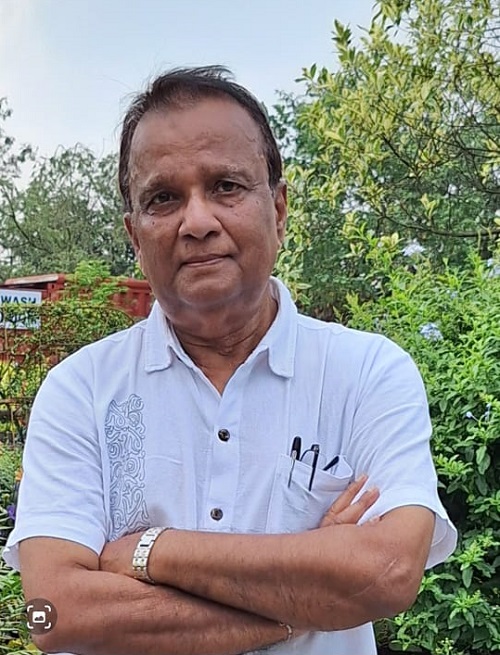
Prabhanjan K. Mishra is an award-winning Indian poet from India, besides being a story writer, translator, editor, and critic; a former president of Poetry Circle, Bombay (Mumbai), an association of Indo-English poets. He edited POIESIS, the literary magazine of this poets’ association for eight years. His poems have been widely published, his own works and translation from the works of other poets. He has published three books of his poems and his poems have appeared in twenty anthologies in India and abroad.
MIRANDA
Sreekumar Ezhuththaani
Nimisha was at least an inch taller than I was. I am tall enough myself, but despite being quite beautiful, her unusual height made people wonder, at first glance, whether she was a woman at all. We had all expected her to bring the Miss University title to our college. She answered every question brilliantly, but then spoke with such reckless abandon that she threw the opportunity away. Winning and losing were never things that concerned her. Her nature was exactly like her name—she belonged entirely to the moment. It wasn't because she had a poor memory.
A year and a half earlier, within a week of transferring from the Literature Department to Chemistry, she spread an outrageous rumour about me—that she and I, a man nearing fifty-five, were in love. When I found out that she herself had started it, I called her to the department to give her a stern warning. Instead of intimidating her, I couldn't even shake her confidence.
"What a brilliant stunt I pulled on you, Sir! At least you'll never forget me now," she said, leaving me thoroughly embarrassed.
The following week she outdid herself. This time she announced that I had called her to the department not to scold her but to tell her that our relationship should remain a secret. It was humiliating. Eventually I decided that denying or explaining it would only make matters worse. The only option was to laugh it off.
The next day, when I saw her with her friends, I teased her.
"So, have you bought the wedding sari for our marriage yet?"
She was ready with an answer.
"See? Do you all believe me now?" she asked her friends, making a spectacle of me once again.
From then on I prayed that I would never have to meet her anywhere except inside the classroom.
When I asked the class what they wanted to present for Freshers' Day, Nimisha sprang to her feet.
"Sir, let's do a scene from *The Tempest*. We've all studied it, haven't we?" She looked around. "Right? Then it's settled."
She slowly turned her head, making sure everyone was watching.
Dear God, I thought. She's opened her mouth. Here comes the cannonball.
"I'll be Miranda. Sir can be Ferdinand."
With that she tucked the loose end of her sari into her waist, strode to the front of the classroom, and declaimed in English,
> "A man as handsome as this can't have anything evil in him. If the devil had such a beautiful house as his body, then good things would fight to live in it."
The performance wasn't really directed at me, but everyone understood the joke. The room erupted in laughter.
Only Nimisha remained solemn, looking around as though she genuinely couldn't understand what everyone found so funny.
Someone shouted,
"With your height, you should be Ferdinand."
"Get lost," she shot back instantly. "You're Caliban anyway."
In the end, Nimisha got her way. Rehearsals for *The Tempest* began. Since I had joined the department only that year, she insisted that I should also be part of the production. The class, however, unanimously decided that I should play Prospero, Miranda's father, while Nimisha would remain Miranda.
From then on she devoted herself entirely to the play. Academics were pushed aside. Every day she came to class wearing some new costume or accessory connected with the production.
The rehearsals were exhausting.
In the scene where Prospero pulls Miranda away from Ferdinand, Nimisha's Miranda walked away looking positively delighted. I could never tell whether she deliberately forgot what the scene required or whether she simply couldn't help herself.
For all her antics, she always scored well in examinations.
"When do you ever study?" I once asked. "You hardly attend classes."
"What do you mean, Sir? I've been absent from your classes only twice."
"Only because I wasn't there."
"But everyone else says you miss their classes..."
"Oh, if you teach every paper, Sir, I'll have one hundred percent attendance."
Every one of her lines sent the class into fits of laughter. Even the students who were normally afraid of me joined in teasing me whenever she was around. The truth was, they were more afraid of her than they were of me.
I had heard that when she spoke about me to her friends, she referred to me with the teasing words wives often use for their husbands. Before long, many people in the college knew me only because of that running joke. Once, even the Principal used one of those expressions during a meeting, simply to tease me.
At first the whole affair had been a subject of endless discussion. Gradually it became an old joke. The reason was Nimisha herself. She carried the game with such effortless confidence that everyone learned to distinguish the joke from reality. She knew exactly how to maintain an imaginary intimacy with me without ever letting the thread snap between humour and seriousness.
Eventually everyone realised that whatever existed between us was nothing more than one long joke invented by Nimisha. Even that became a cliché. Her old tricks no longer earned much laughter.
Still, she never missed an opportunity to embarrass me—provided there was someone else around to witness it.
When we were alone, she was completely different.
Then she seemed almost frightened of me—or perhaps respectful. Maybe it was a strange mixture of both. She looked as though she were trembling.
She wouldn't utter a single word.
In the next part, the narrator's wife visits the college, Nimisha's teasing becomes more layered, and the story gradually shifts from comedy into something far more unsettling and emotionally complex. That transition is one of the finest aspects of the story, and I'll preserve its slow, almost imperceptible movement.
Nimisha
Part III
That night I did not sleep.
I kept thinking about the day I had played Prospero.
When sleep finally came, the sea, the island and the ship rose before me.
The shores were not made of sand.
They were made of the primal clay of creation.
The lines that memory had preserved began to flow from my lips.
You do look, my son, in a moved sort,
As if you were dismayed. Be cheerful, sir.
Our revels now are ended. These our actors,
As I foretold you, were all spirits, and
Are melted into air, into thin air;
And, like the baseless fabric of this vision,
The cloud-capp'd towers, the gorgeous palaces,
The solemn temples, the great globe itself,
Yea, all which it inherit, shall dissolve;
And, like this insubstantial pageant faded,
Leave not a rack behind. We are such stuff
As dreams are made on, and our little life
Is rounded with a sleep.
In that dream, what I felt for Miranda was not a father's affection.
No noble sentiment filled me.
Instead there was sorrow.
A thirst for revenge.
Desire.
I felt betrayed by everyone.
Though I had been a king, I also felt the humiliation of having betrayed myself.
________________________________________
The next morning I went to college unusually eager.
As I neared the campus, my heart fluttered with the nervousness of a young girl.
The first person I ran into was Nimisha.
"What happened, Sir? Aren't you feeling well?"
"Nimisha... I'm fine. Thank you."
I still don't know how I managed even those few words.
There were no classes that day. It was the end of the academic year, and the students were busy completing records and practical work.
After lunch I felt sleepy and stretched out on the sofa in the department.
The previous night's lack of sleep caught up with me.
Without realizing it, I drifted off.
The dream returned.
This time it was the scene in which Prospero tells Miranda the story of his life.
Miranda sat beside me on the bed, listening.
She listened to the endless stories of roads already walked, cities wandered through, faces remembered and forgotten, sweetness tasted by lips and by the wind, and exiles too terrible to bear.
She sat there, saying nothing.
Watching me without blinking.
Then, as I awoke, she kissed me lightly on the forehead and disappeared into nowhere.
Miranda.
________________________________________
When I woke, it was almost five in the evening.
Everyone had gone home.
The attendant woke me; he too wanted to leave.
There was a post lying on my table.
An airline ticket.
France.
I had completely forgotten about it.
A two-month exchange programme.
It was Thursday.
The flight was on Sunday.
I went home.
________________________________________
The next day, after class, I asked the students to wait.
I said goodbye to them all, one by one.
By the time I returned from France, they would have completed the course, written their examinations, and left the college.
I waited for one last joke from Nimisha.
She said nothing.
Perhaps because of that, her friends refused to let me go so easily.
"So, Sir... what about her?"
The whole class burst into laughter.
Nimisha stood up.
She whispered something to her friends.
Then she walked to the front of the classroom.
"My dear friends...
"For the past two years, Venukuttan Sir has taught us polymers, methodology and molecular chemistry in a highly efficient and effective manner.
"And now he is leaving us."
Another wave of laughter swept through the room.
"Oh dear... what am I saying?" she corrected herself theatrically. "Venukuttan Sir isn't leaving us permanently. He's going to France... for an exchange programme."
She paused.
"On behalf of all of you—and on my own behalf—I wish him all the very best.
"And...
"...thank you, Sir, for putting up with us for so long."
The room filled with applause.
The students came to the department in groups and alone to wish me farewell.
Only Nimisha didn't come.
At least, not then.
Finally, after almost everyone had left, she arrived with two friends.
She asked them to wait outside.
Then she came in alone.
For a moment I was afraid she was going to embrace me.
At the very same moment I was afraid that I might embrace her.
"Sir...
Could you hold out your hand?"
I stretched out my right hand.
She took it gently with her left.
"I've got a present for you."
For an instant I expected her to kiss my palm.
Was it fear?
Or longing?
She placed my hand in her right palm.
Without taking her eyes off mine, she pressed my hand.
Then, without a word, she turned, walked away, joined her friends, and went down the stairs.
I looked at my hand.
It burned,
like a bar of iron taken straight from the forge.
LEFT BEHIND
Sreekumar Ezhuththaani
I was a little startled.
When Dad said there was no need to take a room in a hotel and that we could stay at a friend's house for the night, I never imagined the friend would be Aunt Ramya.
Aunt Ramya seemed unsettled too. It looked as though Dad had not told her that I was coming with him. That's how he is. At times he behaves as though he cannot see what is right in front of him.
I don't think Dad had ever come to this house before. It had taken us quite an effort to find it.
While Aunt Ramya stood there, still recovering from her surprise, it was Dad who said, "Come in," and led us inside.
Masking her discomfort, she asked, "When's the interview?"
"Tomorrow morning, at eleven," Dad replied.
That ended the questions.
Without much conversation, she showed me the room where I would sleep. It carried the faint stale smell of a room that had been shut up for a while. She must have noticed my expression because she opened the window. Cool air poured in. That particular chill belongs to Bangalore alone.
She showed Dad another room. Thankfully, it didn't seem to be her bedroom. Then again, she might well have offered that too. At least, that's what Mother used to say about her.
In many ways she is just like Dad.
Neither of them has much sense of what is appropriate.
After taking a few things out of the refrigerator, she disappeared into the kitchen.
Mother might call at any moment. We could always lie and say we had taken a room in a hotel. Dad would probably say the same thing.
After my bath, she came and called me for dinner. I was hungry, yet the food tasted of nothing. I ate merely because it was there.
Dad ate well. Afterwards, he washed his hands, took a bottle of water and a glass from the table, and went to his room. He drinks only occasionally. I have no idea where he managed to find alcohol here.
Seeing that, Aunt Ramya smiled and glanced at me.
I turned my face away.
Her husband had died in an accident when they were living as tenants on the second floor of our house. She remained there for another two years afterwards.
Those were disastrous years.
Dad's closeness to Aunt Ramya became the source of endless quarrels at home. Back then I believed she was some distant relative of his. She was nothing of the sort. Eventually, unable to bear Mother's accusations and arguments any longer, she obtained a transfer and moved away.
Dad did not come home on the day she left. Nor the day after.
When he finally returned on the third day, even his clothes carried the overpowering smell of alcohol.
Though she had moved far away, Mother often said that Dad still visited her from time to time. Throughout my school years, this was what the fights at home were about.
I saw Dad sitting in the drawing room and went over to him. He was speaking to Mother on the phone. When he saw me, he handed the phone to me.
I cut the call without saying much.
I had nothing to say to him either.
In my mind I rehearsed what I would answer tomorrow if they asked me where I would prefer to be posted.
After putting away the dishes, Aunt Ramya joined us.
The last time I had seen her, I must have been in fifth or sixth standard. Now she seemed to have aged considerably.
Dad was beginning to feel the effects of the drink. He talked about my studies, about the festivals back home, and whatever else came into his head. Aunt Ramya was no less talkative. Yet I felt she was faintly embarrassed by my presence.
After a while, I quietly got up and said I was going to bed.
Even after lying down, sleep would not come.
The city's nightlife filtered through the window as light and noise.
From the next room came occasional bursts of song and laughter. At some point they seemed to have gone into the kitchen and made tea. Neither sounded remotely ready for sleep.
Sometime later, without realising it, I drifted off.
I remember waking briefly in the middle of the night. Someone was pushing a door shut. A light went out.
In the morning it was Dad who woke me with bed coffee.
Daylight had already flooded the house.
Aunt Ramya was in the kitchen. Every now and then I saw her crossing the corridor and stepping into the courtyard. She returned carrying milk. It felt as though she was avoiding my eyes.
As I sipped the strong coffee, a thought kept circling in my mind.
Had the two of them not slept at all?
And if they had slept, where had Dad slept?
A surge of anger rose inside me.
With Dad watching, I flung the coffee into the bathroom.
I had intended to leave without even eating breakfast.
That didn't happen.
Aunt Ramya insisted that I come back after the interview before leaving, if possible. I was the first to step outside.
Dad followed soon after.
There were no elaborate goodbyes.
Once we reached the road, Dad's cheerfulness disappeared.
He said nothing.
I could not tell whether it was guilt or sorrow.
Like Aunt Ramya, I began talking endlessly, trying to keep him from retreating into silence. In the auto-rickshaw, I sat close against him. His body felt warm.
There was a faint scent about him too.
Something that reminded me of Mother.
Dad had left his spectacles behind at Aunt Ramya's house.
"Never mind," he said. "No need to go back for them now. I was due for a new pair anyway."
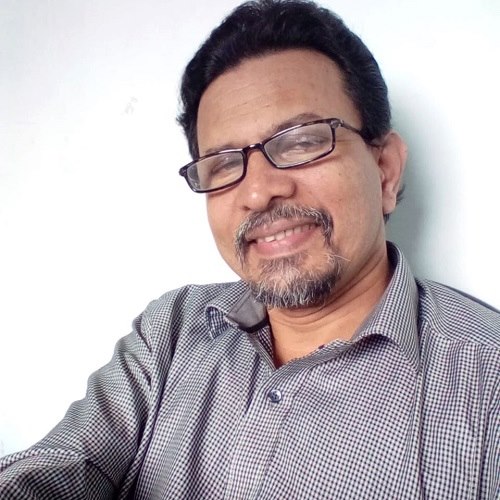
Sreekumar Ezhuththaani known more as SK, writes in English and Malayalam. He also translates into both languages and works as a facilitator at L' ecole Chempaka International, a school in Trivandrum, Kerala.
The July evening rain had left the bougainvillea outside my house freshly washed. The fragrance of wet earth drifted into the drawing room where two families, strangers until that evening, sat with cups of Darjeeling tea balanced carefully on saucers.
I had arranged many marriages over the years. Not because I fancied myself a matchmaker, but because people trusted me. They believed I could recognize decency in another human being.
That evening, I believed I had found two such families.
Shivnath sat erect on the edge of the sofa, speaking only when spoken to. Years of running a construction company had made him economical with words. Every sentence carried the weight of deliberation.
His wife Renu compensated for his silence. She smiled often, admired the flower arrangements, praised the tea and quietly wondered whether the young woman would like the gold bangles she had carefully preserved for her future daughter-in-law.
Their son, Brajanath, towered over everyone. Six feet three inches, broad shouldered, handsome without vanity. Thirty-one years old. An engineer who had declined lucrative offers abroad to work beside his father.
He spoke gently.
The kind of man one instinctively trusted.
Across from them sat Alka.
The room belonged to her within five minutes.
She narrated the history of her family, the virtues of Brahmin traditions, the educational accomplishments of her daughter, the shortcomings of modern youth, the price of vegetables, and the spiritual decline of the nation without waiting for a single interruption.
Her husband, Raju, nodded occasionally.
Years of marriage had taught him that silence was not merely golden.
It was survival.
Pinal sat beside her mother like a carefully arranged flower arrangement that nobody noticed. Twenty-seven. Intelligent eyes. Pleasant smile.
Whenever Alka answered a question meant for her daughter, Pinal smiled apologetically.
I noticed.
Others perhaps did not.
After an hour of predictable conversation I suggested casually,
“Why don’t the youngsters spend some time together? The State Museum is only a few minutes away. They can look around and decide whether they can tolerate each other’s company.”
Everyone laughed.
Even Shivnath smiled.
The Museum closed before they reached it.
Brajanath looked at Pinal.
“Coffee?”
She shook her head.
“Just drive.”
He drove.
The city slowly dissolved behind them.
Neither wished to return too quickly.
The silence between strangers gradually became the silence between two people deciding whether honesty was worth the risk.
Finally Pinal spoke.
“I owe you the truth.”
Brajanath kept his eyes on the road.
“I hope you always do.”
She inhaled deeply.
“I love someone.”
He said nothing.
“A Muslim.”
The car continued moving.
“I have loved him for three years.”
Silence.
“My parents don’t know.”
More silence.
“They will never agree.”
The road ahead shimmered in the afternoon heat.
“I am a coward.”
Brajanath finally looked at her.
“No.”
“I couldn’t tell them.”
“You were afraid.”
She nodded.
“My father may survive it. My mother won’t.”
Her eyes filled.
“I didn’t want to lie to you today. You seem… decent.”
She laughed through tears.
“So here I am ruining your evening.”
Brajanath pulled the car beside a quiet lake.
After several minutes he said softly,
“I admire you.”
She stared at him.
“You told me before marriage. That matters.”
“I had no choice.”
“We always have choices.”
She lowered her eyes.
“You deserve someone who loves only you.”
He smiled faintly.
“If one day your relationship ends for reasons beyond your control, and if life brings us together again, I would still consider marrying you.”
She looked astonished.
“You would?”
“I value truth more than history.”
Her tears flowed freely now.
He handed her a handkerchief.
“And one more thing.”
“What?”
“The gentleman who invited us today…”
“You mean Uncle?”
“I think he understands people better than most. Tell him the truth. He will find a way.”
When they returned after nearly three hours, anxiety had replaced conversation.
Alka spoke first.
“Where did you disappear? We were worried sick.”
Before Pinal could answer, Brajanath smiled.
“We were talking.”
That was true.
Everyone interpreted it differently.
Over the next week, Alka telephoned me every morning.
“So…when are we fixing the engagement?”
“I haven’t spoken to them yet.”
“What is there to speak? Both were together for hours.”
“The children need time.”
“Time? Good proposals don’t wait.”
Her confidence was frightening.
Every delay made her more determined.
Brajanath never disclosed Pinal’s secret.
Not even to his parents.
When Shivnath asked simply,
“What do you think?”
He replied,
“She is a good person.”
“Then?”
“I don’t think we should proceed.”
“No reason?”
“I have one.”
“But I cannot share it.”
Shivnath looked at his son for a long moment.
Then he nodded.
“I trust your judgment.”
That was the end of the discussion.
The difficult conversation remained mine.
Pinal came to meet me alone.
For the first time she spoke uninterrupted.
About love.
Fear.
Religion.
Parents.
Duty.
Guilt.
Hope.
When she finished, she looked utterly exhausted.
“What should I do?”
I looked out of the window for a long time.
“There are moments in life,” I said, “when truth hurts everyone. Yet every lie hurts someone forever.”
She remained silent.
“If you marry Brajanath while loving another man, you will destroy three lives.”
“And if I tell my parents?”
“You may lose their approval.”
“I may lose them.”
“You may.”
She whispered,
“I am terrified.”
“So was Brajanath.”
She looked surprised.
“He was?”
“He chose to protect your confidence even though it cost him an excellent match.”
She covered her face.
For the first time she realized the generosity of the man she had met only once.
Alka continued to call.
She interpreted every hesitation as negotiation.
Every silence as modesty.
Every delay as a strategy for better wedding arrangements.
She could not imagine that two young people had quietly reached a decision without informing the elders.
Some people speak so much that they never hear what is not being said.
Years later I would often think about that afternoon.
Not because a marriage did not happen.
But because I had witnessed something rarer.
A young woman who chose truth over convenience.
A young man who chose honour over possession.
Parents who loved without fully understanding.
And a friendship that survived because someone kept another person’s confidence.
The Museum remained unseen.
Yet during that long drive, two strangers had explored landscapes infinitely more complex than any gallery could display—the landscapes of conscience, compassion, and the dignity that sometimes appears when love refuses to become selfish.
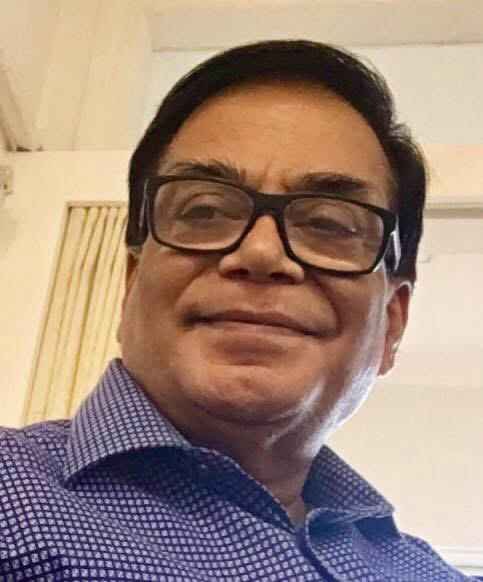
Rabi Dash is a recent entrant to the world of creative writing. After a lifetime of varied experiences and observations, he now writes primarily for the joy of storytelling and reflection. His interests include spirituality, history, human nature, and the small moments that reveal deeper truths. Writing, for him, is less a pursuit of publication and more a way of sharing thoughts, memories, and wonder with fellow readers.
He is a retired officer from the Indian Revenue Service (IRS) who served as the Director General of International Taxation and subsequently acted as a Member in the Tribunal for Prevention of Money Laundering.
WHEN THE RAIN FINALLY CAME
Phalguni Sahu
At twenty-three, Anirban Ghosh joined a publishing house in Kolkata as an editor. Quiet, thoughtful, and painfully ordinary, he was the kind of man who noticed misplaced commas but never noticed when women looked at him.
The publishing house occupied an old colonial building on College Street. Every morning, the corridors smelled of fresh paper, damp walls, and ink. To Anirban, it felt like entering a temple. Books had always spoken to him more easily than people.
His colleagues often joked that if someone hid behind a bookshelf, Anirban would notice the missing book before he noticed the missing person.
On his first day, he met Mrinalini Chaterjee.
She wasn't beautiful in the conventional sense. She laughed too loudly, drank too much tea, argued with authors twice her age, and had an annoying habit of humming old Bengali songs while proofreading.
She looked at the nervous young editor standing near the reception desk and smiled. "You are the new recruit?" He adjusted his spectacles. "Yes... Anirban."
"Good. Someone else to suffer under impossible deadlines." He looked confused. She burst into laughter. "Relax. We only panic on Mondays."
It was the first time he heard her laugh. He would hear it thousands of times over the next ten years without ever realizing how much it would become a part of his life.
Within months, they became inseparable colleagues. Every evening, she would wait for him outside the office.
"Coffee?" "I don't like coffee."
"So have tea." "I don't like tea after six."
She would roll her eyes. "You will die boring." "And you will die talking."
She laughed. "I hope You are there when I do." He smiled. "So dramatic."
Sometimes they walked all the way to Esplanade instead of taking the tram. She filled the journey with stories- about stubborn authors, childhood adventures, books she loved, and dreams of writing one herself.
Anirban mostly listened. "Don't you ever get tired of talking?" he once asked. "Only when nobody listens." He replied quietly, "I always listen."
She smiled to herself. “If only you listened to everything” she thought.
Years passed. She remembered his birthday. He forgot hers every year. She bought him books. He lent them back after reading. She knew how many spoons of sugar he liked. He couldn't remember how she took her tea.
Every year she wrapped his birthday gift in brown paper and wrote only one word on it- Read.
One year she gifted him Tagore's Shesher Kobita. He smiled. "Excellent choice."
She waited. "Have you read it?" she asked. "Not yet." "Then read chapter twelve first." Hidden inside that chapter was a tiny pressed gulmohar flower. He never found it.
Everyone in the office believed they were secretly in love. Only Anirban didn't. He thought they were simply... friends!
During office picnics everyone deliberately made them sit together. "Just announce your wedding date," one colleague joked. Mrinalini laughed so no one would notice the blush creeping onto her face. Anirban looked genuinely puzzled. "Why does everyone keep saying that?" The entire office burst into laughter. Someone whispered, "Hopeless."
One evening, she stood beside him on the terrace while rain soaked the city. "Anirban..." "Hmm?" "If one day I disappear, would you miss me?"
He looked at the rain. "Of course. Who else would irritate me every day?" She smiled. "I wasn't asking as a colleague."
He laughed. "You think too much." She nodded. "Yes... I do." That night she cried for the first time in years.
She opened the diary she rarely wrote in. Under that day's date she wrote- “Today I almost told him. He almost understood. Almost is such a lonely word.”
Three months later she resigned. Her father had arranged her marriage. The office threw a farewell party. Everyone hugged her. When Anirban's turn came, she simply said, "Take care of yourself." "You too."
She waited. Just one sentence. “Don't go.” He never said it. She left.
As the taxi pulled away from the office gate, she looked back through the rear window. Anirban was already walking back inside, carrying a stack of manuscripts under his arm. She smiled through tears. "Books again," she whispered. "You really never saw me."
Life moved on. He married a kind woman named Shraboni. She married an engineer in Bangalore. Occasionally he would wonder why the office felt quieter. Nothing more.
Marriage was kind to Anirban. Shraboni was gentle, patient, and remarkably understanding. She never demanded grand gestures. She quietly filled the house with warmth, homemade food, and the fragrance of jasmine flowers every evening.
Sometimes she would ask, "Didn't you have many friends in the office?" "A few," Anirban replied while reading the newspaper. "There was one lady... what was her name? You once mentioned someone who argued with writers."
He thought for a moment. "Oh... Mrinalini." "You never kept in touch?" "Life became busy."
Shraboni smiled. "Life only becomes busy with people we don't make time for." He looked up briefly, then returned to his newspaper.
Hundreds of kilometres away, in Bangalore, Mrinalini too settled into married life. Her husband was a decent man- respectful, responsible, and affectionate in his own quiet way. She fulfilled every role expected of her. Wife. Daughter-in-law. Mother.
But somewhere inside her remained a young woman standing on a rain-soaked terrace, waiting for one sentence that never came.
One afternoon her husband noticed an old photograph tucked inside a book.
It was an office group photograph. "Who's this gentleman?" he asked, pointing at Anirban. Mrinalini looked at the picture for a long moment. "A friend." "Very close?"
She smiled faintly. "Close enough that we never became strangers." He nodded, never asking another question.
Every year, when the first monsoon arrived, she found herself standing near a window listening to the rain. Her daughter once asked, "Ma, why do you always smile when it rains?"
Mrinalini replied softly, "Because rain remembers people better than we do."
On the other hand, Anirban remembered dates, deadlines, and publishing schedules with astonishing precision. Yet, if someone mentioned Mrinalini, he would simply smile. "She used to make the office very noisy." That was all.
Memory, sometimes, protects us by hiding the truths we are not ready to face.
Twenty-seven years passed…...
The city changed. Old tram routes disappeared. Coffee houses were renovated. Their publishing house shifted to a modern glass building. Most of the colleagues retired. Some had already left the world. Time quietly erased almost everything... except what the heart refused to forget.
Shraboni died after a brief illness. His son moved to Canada. Retirement turned the days unbearably silent.
Silence was unfamiliar to Anirban. For decades, Shraboni had spoken enough for both of them. Now even the ticking wall clock sounded loud. He began arranging books that did not need arranging. He dusted shelves already clean. Some evenings he cooked more food than he could eat, forgetting there was no one waiting at the dining table. Loneliness has strange habits.
One rainy afternoon he instinctively looked toward the empty chair opposite him. For one fleeting second, he almost expected someone to say- "Coffee?" He smiled to himself. "I don't like coffee." The familiar exchange echoed in his mind. He could not remember why it suddenly surfaced after so many years.
One Sunday, while cleaning an old bookshelf, Anirban found a dusty novel. Inside it was a folded paper. Mrinalini's handwriting. His hands trembled. It wasn't a letter.
It was a manuscript. Title: "The Man Who Never Knew." He smiled. Typical Mrinalini!
The paper had turned yellow with age. Tiny brown stains marked its corners. He gently unfolded it; afraid it might tear. Her handwriting looked exactly as he remembered- slightly slanted, graceful, and impossibly neat.
Suddenly he could hear her voice correcting punctuation marks in the office. He laughed softly. "Still writing stories, are you?" He settled into his old armchair, adjusted his spectacles, and began reading.
He began reading. The story was about a woman who loved her best friend for ten years. Every page mirrored moments, he had forgotten. The coffee invitations. The terrace. The birthday gifts. The books. The rain. Every conversation. Every silence. Every chapter ended with the same sentence. "Perhaps tomorrow he will understand."
At first, Anirban smiled. "She always exaggerated," he murmured. But with every chapter, the smile slowly disappeared.
There was the afternoon she had waited outside his office for nearly an hour because he had forgotten his umbrella.
There was the winter evening when she knitted him a muffler and lied that it had been bought from New Market because she knew he would never accept a handmade gift.
There was the day he had a fever, and she had quietly left homemade soup at his desk before anyone arrived. He had assumed the office peon had brought it.
Every forgotten kindness returned to him, one after another, like waves crashing against a shore that had believed itself safe.
He stopped reading. His heart pounded. He whispered, "...No."
He stood up from the chair and walked to the window. Outside, a light drizzle had begun. He could not remember the last time rain had frightened him. Suddenly he wished the manuscript were fiction. Suddenly he wished none of it were true.
He read through the night. The last page had no ending. Only a handwritten note.
"If you are reading this, it means you finally noticed. Don't feel guilty. Love that has to be explained is never meant to be received. Thank you for giving me ten beautiful years... even if you never knew you were giving them."
No signature. He already knew.
His fingers trembled so violently that the pages slipped onto the floor. For several minutes he simply stared at them. Memories that had slept for twenty-seven years woke up together. Her laughter. Her humming. The way she tucked loose strands of hair behind her ear while reading manuscripts. The way she always slowed her pace so he could walk beside her. He remembered everything. Much too late!
For the first time in his life... Anirban cried. Not because she had loved him. Because she had loved him alone.
He wept without making a sound. It was the kind of crying that comes only when a lifetime rearranges itself in a single night. He realized he had never once asked her if she was happy. Never noticed when she fell unusually quiet. Never wondered why she always waited for him.
Love had stood beside him every evening. He had mistaken it for routine.
The next morning, he searched for her online. Nothing. He called old colleagues. One finally gave him a number. It belonged to her daughter.
"Hello?" "I... I used to work with your mother." A pause. "Oh... Uncle Anirban?" His heart stopped. "She... spoke about me?"
The girl laughed softly. "Almost every week." He closed his eyes.
His throat tightened. "What... what did she say?" The girl smiled on the other end of the phone. "She said you were the most absent-minded man she had ever met." He laughed through tears. "She wasn't wrong."
"Can I speak to her?" Silence. Then... "I am sorry, Uncle." "She passed away six years ago."
Everything became still. Even the ceiling fan sounded distant. He couldn't breathe.
He lowered the phone slowly. The room seemed unfamiliar. Six years! For six years she had belonged only to memory... and he had not even known.
Her daughter continued, "There is something strange." "What?" "Maa left a sealed envelope with your name."
He travelled overnight. The train rattled through the darkness. Sleep never came. Every station reminded him that there had once been countless opportunities to write a letter... to make a phone call... to ask a simple question- “How have you been?” He had done none of those things.
Her daughter welcomed him into a small house filled with books. On the wall hung a smiling photograph of Mrinalini. Older. Grey-haired. Still smiling exactly the same way.
He stood before the photograph for a long time. "You haven't changed," he whispered. Her daughter heard him but pretended not to. Some conversations deserve witnesses. Others deserve silence.
He opened the envelope. Inside was a single dried gulmohar flower.
And one sentence. "I always wondered what it would feel like if, just once, you loved me back."
Nothing else. No accusations. No regret. No bitterness. Only a question. One that would never have an answer.
He held the flower as carefully as one holds a heartbeat. It had become fragile with age. Just like the possibility it represented.
Tears fell onto the brittle petals. For the first time, he whispered the words she had waited ten years to hear. "Don't go." But the room answered only with silence.
Years later, when neighbours saw the old man walking every evening to the park with a faded gulmohar flower pressed inside a book, they assumed he was remembering his late wife.
No one knew...
He was mourning the woman who had spent ten years loving him...
...and another twenty-seven years teaching herself not to.
On rainy evenings he always sat on the same park bench. Children played nearby. Couples laughed beneath shared umbrellas. Sometimes he looked at the empty space beside him and smiled.
In his heart, someone was still asking- "Coffee?" And for the first time in his life, he knew the right answer. "Yes” Even though she was no longer there to hear it.
She waited for one sentence. He spent the rest of his life answering it... to an empty chair!
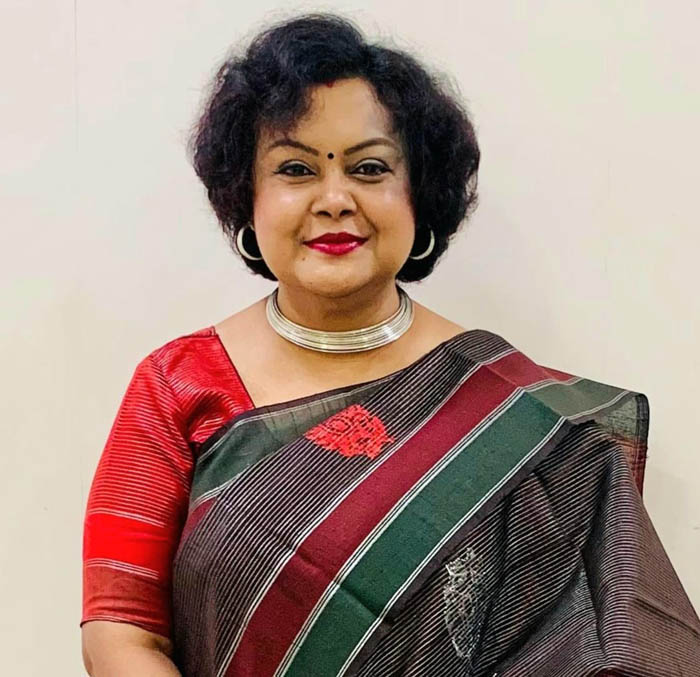
Phalguni Sahu is a development leader who has spent twenty-five years shaping transformative initiatives across government, public sector institutions, and international development organizations. An MBA in Rural Management from the Xavier Institute of Management, Bhubaneswar, she carries into her writing the same depth of insight and quiet sincerity that define her professional journey.
For Phalguni, writing is a sanctuary- an inner courtyard where thoughts unfurl gently and truth finds its voice. She is an ardent reader, forever drawn to the reflective rhythms of literature, and her creative work spans contemplative spiritual blogs and evocative short stories.
NIGHT OF THE SNAKE
Snehaprava Das
Damaru Lakra watched his daughter, the youngest of the three, sleeping peacefully on the flax mat. Careful not to make a sound, he groped cautiously under the big wooden chest that stood against the opposite wall and pulled out the sack. He swathed his hands with some discarded clothes and sitting away from the sack unknotted the length of rope that was tied around its mouth. No sound came from inside the sack. He did not have the nerve to look inside. The room, however, was in darkness.
But, Bhola had given him his word, 'It is one of the deadliest’. He had assured Damaru. He cast a last look at the sleeping girl and sneaked out of the room. He closed the door behind him noiselessly and walked up to the extreme end of the veranda. He felt faint and slumped on the clay floor. Tears streamed down his eyes and a hard unreleased sob threatened to choke him. With a heart that pounded violently he waited for the inevitable scream of his eight year old daughter.
Damaru had made up his mind a month before in another wet night like this. He had a family of five to feed and just a small patch of farmland on the lower slope of the hills. He grew millet and maize and sweet potatoes there. But even after bone breaking toil the land yielded not much to meet the expenses of even the bare minimum requirement of the family. Survival had become a cruel joke. His wife and three daughters went to the jungle to collect wild nuts and fruits and firewood. Most of the days they had to manage with gruel and a wild-fruits. Hardly, with any luck if he could manage to sell the frugal quantity of millet, maize or sweet potatoes in the marketplace,
the family ate rice and potato curry. There were times when he and his wife had to go without food for days. With no money, no food, no proper clothes, life was a living hell.
The idea had struck him when a snake bit the son of Tabita Lakra sometime before.
It rained hard that night. Water had come inside most of the huts in the village. Damaru slept in the dingy room where the chest was and his wife and three daughters slept in the space adjacent to it that served as the kitchen. Water dripped from the broken thatch and the kids squirmed into the tattered rag in a vain effort to keep themselves dry.
A loud howl from the hut of Tabita Lakra jolted him out of an uneasy sleep.
The shrill cry was followed by a loud uproar. Damaru sprang off the mat he was lying and putting on his straw head-cover he hastened to Tabita's hut. A crowd had gathered outside the hut. Tabita was crying beating his chest. A woman, perhaps Tabita's wife, wailed inside the hut. Outside, people chattered loudly, everyone raising his or her voice in an attempt to be heard above others and no one succeeding in making it intelligible. All Damaru could make out was 'Buchhan' and 'Snake'. Buchhan was Tabita's twelve year old son. His heart hammering, Damaru pushed through the crowd and ran up to Tabita.
Tabita howled loudly at the sight of Damaru. 'My son... my son ..' he cried bitterly, Damaru looked inside. Buchhan lay on the soaked mud floor. His face was
swollen and looked bluish and patchy. His hands and legs had gone stiff. Foam drooled out from one corner of his mouth. There was no doubt that the boy was bitten by a snake.
Just at that moment Nitu, the young son of Sambaru Lakra arrived with the witch-doctor. Nitu lifted the boy and brought him out to the front of the hut. He laid him down on the ground. The crowd formed a circle as the witch-doctor began the act of neutralizing the snake's poison. He hopped around the boy brandishing a stick in the air. A bunch of peacock plumes were fixed to one end of the stick. The face of the witch-doctor wore an ancientness that was as black as the dark night. The thick, unkempt mass of copper coloured hair were tied in a ponytail at the back of his head. There were several strings of different coloured beads around his neck that rattled and clattered to the tune of the weird sounding mantras he droned as he hopped around the unconscious boy. The crowd watched wide eyed. Buchhan's father and mother and two sisters gaped at the wild antics the witch-doctor performed waiting with bated breath for the signs of life returning to the boy's still body.
Nearly a quarter of an hour passed. Nothing happened. There was no stirring, not even the slightest, in Buchhan’s body.
The witch-doctor chanted the mantra more loudly and danced more wildly. His eyes glowed like tiny beads of red. Still, there was no movement in the stiff body of the boy.
And then Rajula arrived at the spot.
‘Stop all this nuisance. Let's take him to the hospital.’ He shouted angrily. The witch-doctor was out of his mind in anger.
'Do not interrupt, you ignorant young man', he snarled at Rajula. 'The mantra will not work.'
But Rajula did not wait. He was an educated boy. He had studied in the school in the nearby town. Not caring for the darkness and the rain, he and some of his friends lifted the boy to a stretcher made of bamboo poles and rags and carried him along to the government hospital in the town.
Buchhan's father, Damaru and some other men ran after them.
The witch-doctor pronounced an ugly curse on the villagers and stormed away from the place.
It was after midnight when they reached the hospital. The boy was carried inside by a couple of attendants.
A sleepy nurse took a look at the boy. 'A snake bite case?' She asked indifferently.
'Yes sister, please save him,' Rajula said politely.
'I will give him the antivenom injection. But you will have to wait till the doctor comes in the morning.'
‘Please do something. Send a message to the doctor. I am afraid it will be too late if we wait till morning’, Rajula urged as the nurse loaded the syringe and pushed the needle into the boy's stiff arm.
She looked up at Rajula.
'I think you are already too late.' She said. Rajula looked helplessly at her.
'Please do something'.
'I have done what I could do in this situation. I think the boy was dead before reaching here. But the doctor has to confirm it. He will write the death certificate. In any case you have to wait to get the body. A post mortem has to be done to ascertain the cause of death.'
'But we won't want our child's body to be cut and torn,' Damaru interjected. 'Won't you?' The nurse said. 'Then how are you going to claim the compensation amount?'
'What compensation?' Rajula looked at the nurse in surprise.
'Our government gives compensation for snake-bite deaths. Don't you know that?'
Rajula and Damaru looked at each other. 'How much?'
'Depends... two or three lakh perhaps. I am not sure.'
'Three lakh!!' Damaru stammered... Three lakh is a fortune!!' He rushed outside where Tabita and others waited.
'The boy is probably dead.' He blurted out.
Tabita let out a wild scream.
'But the doctor needs to confirm the cause of death. It can be done only when they cut open the body and examine. Then you will get an amount of two or three lakh as compensation.'
The wild screams stopped abruptly. 'What is that again?'
'You will get a compensation of three lakh rupees if it is confirmed that Buchhan died of snakebite.’
Shoving aside Damaru , Tabita strode inside. The nurse and Rajula stood by the body of Buchhan. They looked at Tabita in surprise.
Ignoring the puzzled look in their eyes Tabita asked:
'Will I be getting three lakh rupees if the doctor says that my son has died of snakebite?'
'Of course you will. But the doctor would need proof. A post mortem, therefore, is a must. All of you wait outside.' The nurse motioned them to go out and dismissed the subject.
The doctor who stayed in the vicinity arrived at dawn break. He inquired about the incident and the nurse told him.
'We have to wait for the post mortem report he said to Rajula. Let the forensic pathologist who will do the post mortem come.'
The body of the boy was moved to the mortuary.
It was nine o clock in the morning when the other doctors and nurses arrived.
By the time the post-mortem was completed it was late afternoon. They brought back the body and got it cremated.
Damaru returned to his hut. It was evening. His wife Kanima was cooking millet stew in a clay pot on the earthen stove. On the veranda sitting around the kerosene lamp his three daughters were yelling at one another to prove their individual right over a bowl of puffed rice. Their loud cry and squeals had transformed the veranda to a mini battlefield. Damaru's head ached. He drank a bowlful water in one breath and slumped on the veranda. Kanima came to him. 'Poor Buchhan! What sin had he committed to rouse the anger of the Cobra-God?' She sighed and sat down by Damaru.
'Buchhan's death has become a blessing in disguise for his family!' Damaru said, looking into the precipitating darkness.
'What does that mean?'
'Do you know the government would pay Tabita an ex gratia of rupees three lakhs?'
'Three lakhs?' Kanima's mouth hung open.
‘Yes, three lakhs. Tabita could get his hut strongly thatched, could buy some pigs and hens, and good clothes for his children. He could keep some of the amount in a bank and earn interest on it. His life will be changed.'
‘But Buchhan is gone forever.’ Kanima sighed again.
'He has another son,' Damaru said. Tabita can send him to a good school in the town like the townspeople do. Three lakhs rupees is quite a sum. It will change his life.'
‘Yes. Three lakh means a strong thatched roof overhead, hot rice and pulses two times a day, even tea in the morning and afternoon. It means good clothes and footwear for the kids. It means a lot many things,’ Kanima thought.
Damaru kept turning on his sides all through the night. Sleep was miles away from his eyes. He could not decide whether to pity Tabita for the loss of his son or to envy him for the compensation money he was going to be paid.
‘Why did the cobra choose Tabita's house,’ Damaru asked himself, it could have chosen any other hut, even Damaru’s !!
'Curse me!' Damaru reproached himself and fought the thought off. But it kept returning to his mind again and again. Finally, a little before dawn, he drifted into an uneasy sleep.
A couple of months passed. The village had forgotten Buchhan. His father and mother too had got over their loss. Tabita built another small room and got the living space extended. He had re-done the thatching and repaired the walls. His life has changed in many ways.
More months passed.
Damaru's life had remained unchanged. Hunger and hardship continued to torment him as they had been doing all the time.
Damaru was climbing down the slope of the hill after a day’s hard labour when he chanced upon a man trudging ahead of him carrying a sack. The mouth of the sack was tied tightly with a length of rope. The man heard the footfalls of Damaru and looked behind. In the fading glow of the departing twilight the lean, haggard face looked familiar to Damaru.
He was Bhola, the snake charmer who lived with his family at the outskirts of the village.
'Aren't you Bhola?' Damaru asked. Bhola's creased face lit up with a smile. 'Right. And you are Damaru , isn't it?' ‘Yes. What are you doing here?’
‘I had gone to the jungle beyond the hills. I often go there to catch snakes.’ 'Oh! '.Damaru nodded. ' Did you get some of them?’
‘Only one. But brother, what an animal it is!! A pit viper, one of the most poisonous species. Its venom will fetch quite an amount.'
‘The snake is in there?’ Damaru asked pointing at the sack.
‘Sure. It is there.’ Bhola announced smiling with the pride of someone who has won a difficult battle.
‘It was trying to dodge me first. One small slip and I 'd have been lying dead in the jungle. But I have a lot of experience in handling these babies. Finally, I won and imprisoned it in the sack.’
‘Do you catch cobras too?’
‘Lots of them. They too fetch good money. The hospital people buy them. I do not know exactly what they do with them, but I guess they collect the venom from these snakes and sell it to some pharmaceutical company or something for making life saving drugs.’
‘Snakes could be lifesavers!! Unbelievable!! Damaru was thoroughly puzzled. 'But yes, they could be, in a way. Snakes could take one life and save many if the government pays three lakhs of rupees to the family of the deceased,' he reasoned.
Anyone who is ready to sacrifice one of the family members can get the amount.
But it is a tough choice. Every loved one's life is priceless.
Damaru lay on the flax mat and thought about Bhola. What a man! Imagine facing a deadly snake alone! His thoughts travelled to Tabita and poor Buchhan. The boy had sacrificed his life to haul Tabita's life out of the bottomless pit of poverty and misery. Can a miracle happen to lift Damaru out of the dark depth he was stuck in?
Damaru wrestled with the thought but it was too strong, too domineering to be overpowered by the feeble defences of Damaru's conscience.
Night after night the disturbing thought came returning to him, driving sleep away till it became an obsession.
What must he do?
Damaru looked around as he walked down the slope of the hill. He was not sure if he really wanted to meet Bhola. The wish was there, suppressed and dormant like a snake lying innate, overpowered by the snake charmer's magic herb. He did not know what he wanted from the snake charmer, but there was something inside him, a fierce goading which he could not resist.
It was a fortnight since he had last seen Bhola with his snake-sack. May be, he was collecting snakes in some other jungle. He might not come into sight again for months, Damaru thought and quickened his pace.
It was, as Damaru had thought, nearly two months before he came across Bhola at the foothills.
It was much late in the evening. A halfmoon was struggling through thick patches of clouds. Damaru and Bhola emerged from the jungle and walked away in different directions.
Lying on the mat Damaru stared at the thatch. Night hung like streamers of black from the bamboo-rafters. His gaze travelled around the room. The tail-end of a tattered sari of his wife dangled from the clothesline. He closed his eyes and the sari became long, crooked length of a snake. Damaru opened his mouth to scream but no sound came out. He tried to run away but his hands and legs had gone stiff. The dark creature descended upon him and coiled around him like a cold rope, tightening its grip at every twist. His breath came out in strangled gasps. He was bathed in sweat.
A hand shook him. Damaru opened his eyes and looked at the worried face of Kanima..
'What is the matter with you?' She asked in concern.
Sunlight was streaming in through the wooden bar of the small window. He turned his eyes to the clothesline. The sari was not there. Kanima has changed into it after taking her bath.
He squinted into the bright sunshine that slanted on the veranda and stressed off it to reach the edge of the thickets. He could see his two elder daughters in nicely fitted school uniforms hopping down the veranda. He turned his gaze towards his wife, she wore a silk saree with a floral print and a wide red border. A pair of gold eardrops dangled from her ears. She looked beautiful. He got up and ran outside. ‘Whose house is this? He was puzzled. The house wore a new and transformed look with its strongly thatched roof and cement-plastered brick walls. The aroma of freshly cooked fish curry drifted out of the house through the newly painted windows. He took in a deep breath and smiled happily.
‘What is wrong with you? Why are you smiling like this?’ Kanima shook him hard.
Damaru opened his eye wide and looked at Kanimma.
Was he dreaming again [n the broad daylight? He wondered. But it was a different dream. It was neither scary nor gloomy. He felt relaxed and light hearted.
'Nothing. Just a dream.' He said.
Damaru went to the village marketplace to sell some millet and sweet potatoes. The day proved to be a lucky one. All the sweet potatoes and millet were sold within a short time. He bought a kilogram of rice, half a kilogram of potatoes and some tomatoes with the money he got. He handed the bag of rice to his wife, Kanima. ‘We will eat hot rice tonight,’ he said. ‘The millet and the sweet potatoes were sold for a good price. Cook the potatoes along with the tomatoes in a spicy gravy to go with the rice. The girls have not eaten potato curry since a long time.’
A grey-beige twilight sprawled over the hills. Bhola carrying a sack with its mouth tightly tied with a string over walked up to the tree where Damaru stood waiting. There was not a single soul in sight. The sack exchanged hands.
'Do not forget your promise. Two thousand '
'I have given you my word. But you have to wait till I get the money ’
Bhola touched Damaru's arm. 'Be careful. It is dangerous.' He walked away.
Damaru waited for the evening to deepen. He returned when the night birds began to hoot and chatter invading the silence of the forest.
Careful to keep out of sight of any curious neighbour he ran into the hut and shoved the sack under the wooden chest. He heaved out a deep breath.
‘Food is ready. Come and eat.’ The three girls ran into the kitchen space and sat down, nudging one another as they did so. ‘I am very hungry, Ma,’ Eight year old Sina, the youngest of the girls, said. ‘We are too,’ the elder sisters cut in. Damaru
picked Sina to his lap. ‘You eat with me tonight,’ he said fondly, cuddling his daughter. Kanima placed the banana leaves in front of Damaru and the girls. She dished out hot rice on the leaves. She ladled the potto curry out of the steaming pot and poured the curry on the rice. Damaru made a ball of rice mixed with the curry and put it into Sina’s mouth. ‘Eat as much rice and curry as you like.’ His voice choked, and he stopped. His eyes burned with tears that were frozen.
The girls ate their fill of rice and curry, and prepared for sleep. Outside, the night was getting thicker.
Damaru was desperately trying to think of a pretext to get the youngest one, Sina, to sleep in the small room where the wooden chest was kept.
'Father, can I sleep in this small room tonight?' Sina said as if she could guess her father's mind.
Damaru looked sharply at his daughter. He lifted her up in his arms and kissed her forehead.
'Don't Damaru, don't !! ' A voice screamed in his ears. His head began to spin.
He looked up at the black, swollen sky.
'Tonight it will rain again,' he thought, rubbed his eyes that burnt with unshed tears and put the girl on the flax mat and lay down beside her.
Thunder crashed outside. Damaru sat up on the bed. He cast a long look at the sleeping girl and crawled to the wooden chest. He pulled out the sack. He could feel the laboured twist of the hard rope-like thing inside. He bandaged his hands with clothes and untied the mouth of the sack, and stole out of the room.
A lightning flashed. The room was lit up for a brief second and then plunged into darkness.
Damaru walked up to the end of the veranda and slumped on the clay floor. Thunder crashed again. Then it began to rain....... Torrents of liquid spikes hurtled down piercing the air. A lassitude swept over him He closed his eyes and waited for the inevitable scream.
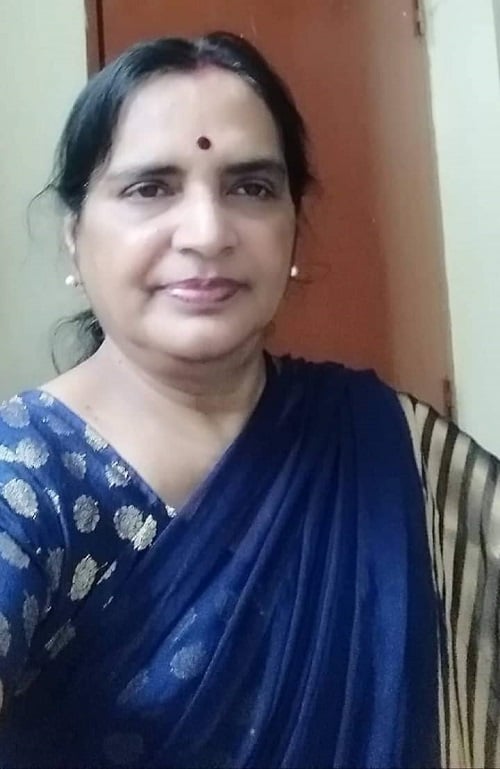
Dr.Snehaprava Das, former Associate Professor of English, is an acclaimed translator of Odisha. She has translated a number of Odia texts, both classic and contemporary into English. Among the early writings she had rendered in English, worth mentioning are FakirMohan Senapati's novel Prayaschitta (The Penance) and his long poem Utkala Bhramanam, which is believed to be a.poetic journey through Odisha's cultural space(A Tour through Odisha). As a translator Dr.Das is inclined to explore the different possibilities the act of translating involves, while rendering texts of Odia in to English.Besides being a translator Dr.Das is also a poet and a story teller and has five anthologies of English poems to her credit. Her recently published title Night of the Snake (a collection of English stories) where she has shifted her focus from the broader spectrum of social realities to the inner conscious of the protagonist, has been well received by the readers. Her poems display her effort to transport the individual suffering to a heightened plane of the universal.
Dr. Snehaprava Das has received the Prabashi Bhasha Sahitya Sammana award The Intellect (New Delhi), The Jivanananda Das Translation award (The Antonym, Kolkata), and The FakirMohan Sahitya parishad award(Odisha) for her translation.
“This is the road . Now let us find the place,” the driver slowed the vehicle.
Meera peeped out of the auto rikshaw.
“Ah! There it is – “Prathyusha Yoga Centre and Gym”. You can stop the vehicle. We have reached the place. Now if you can wait for half and hour, I shall be here and you can drop me back at my place. “
The driver Paandi stopped the vehicle and Meera got out.
There was a huge Gulmohar tree near the gate casting cool shade and Paandi pushed the vehicle as Meera opened the wide gate and walked in.
The morning session of Yoga classes musr have just got over, as the ladies were coming out. They were chatting but four among them walked slowly taking it very easy. They saw Meera and stopped.
“Hello! New member? Joining soon?”
A slim willowy girl asked. She was dressed in salwar kameez with the duppatta adjusted beautifully. A smiling face one would love to respond immediatey.
Meera stopped and said, “Yes. Planning to join and start from tomorrow. I need to, don’t I , considering that I am so ‘obese’?” She had a great sense of humour and did not hesitate to laugh at herself.
They laughed along with her.
The lady who spoke first said, “I am Sindhu and these are Shalini, Matilda and Vijayalakshmi.”
Vijayalakshmi was very big made and Meera thought “Well, I do have company.” The others were all slim.
“How long have you been coming here?” Meera asked.
Sindhu said that she had been coming for two years. She was senior and took classes in the absence of the Yoga Master, she said.
Vijayalakshmi said, “ I have been coning here for thirteen months. Now you must be wondering why I am still fat!! I come here for “time pass.” In fact I am being forced to ...by my mother-in-law and husband. But I am a great foodie who cannot suppress my temptations!!”
She laughed aloud.
“Okay. We shall talk tomororow. Let her go in now ,” said Matilda and they left.
Meera walked in expecting to find a very serious old man .
She approached where a young man was seated browsing over a magazine.
He looked up, hearing footsteps.
He closed the journal and asked her to sit.
“Good day madam. Have you come to join or make some enquiries? I am one of the Yoga teachers and also the owner of this centre. What can I do for you?”
He looked a cheerful person. His eyes were sparkling with good humour – something that attracted Meera immediately.
“I have come to join the classes. I wonder if i can shed some weight. I saw a student just leaving and she said that she has been coming here for more than a year!! I am wondering...”
“Hahaha!! “ He laughed. “You mut have met our Vijayalaksmi! Well, she is a jolly woman who takes life easy and comes here only because her husband and mother-in-law are insisting . She loves “to be fat” as she says and makes no effort to lose weight. But mind you, she is very flexible and does the ‘Sirasasana’ so well!! “
She smiled. “She loves to eat, she said.”
“That is an understatement. She loves to indulge. Well, when she is not serious about losing weight why should I impose diet restrictions on her? “ he said.
He pulled a drawer and took out a photograph.
“See this and guess who it is.”
Meera took the photograph from him and stared at it for a while.
The face did resemble his. But this young man was chubby. To be frank, the person in the photograph was obscenely fat. She was reminded of the proverb –“Eat to live. Not live to eat”. Looked as if this individual LIVED just to EAT!!
But the facial resemblance was rather striking.
“Your brother? Cousin?” she asked gingerly.
He laughed .
“You must have seen the ads with two images, BEFORE and AFTER. Well...that’s me Shivkumar Shivkumar Shivkumar . Yoga and diet have “deleted” the two ‘extra’ Shivkumars- in the three-in-one person and I am just a single Shivkumar now!”
She laughed. She loved his humour.
“I love this trait of yours- ability to laugh at yourself.This is great that you have had the perseverance and patience to say ‘Good Bye’ to those extra kilos. You are an inspiration for me” Meera said, her eyes rolling with amazement. “ I shall start from tomorrow.”
Shivkumar laughed loud.
“I am happy to be an inspiration. So, you have decided to join. Don’t get put off by seeing ‘Vijayalakshmi’. She is basically a ‘foodie’ and hates the word ’diet’. She delves into fried potatoes and sweets and abhors fresh fruits and salads ...and well, you know how it is! By the way you have not told me your name.” He said with the pen poised above the form he had picked up.
She gave him an impish smile and said “Meera Meera Meera”.
For a minute he looked confused and then burst out laughing.
“Hahaha! So you want to ELIMINATE the extra Meeras and become Meera? Well, I assure you that it is possible if you start a diet schedule too, along with the yoga classes. But you have to be sincere and patient. No cheating, mind you.”
The forms were filled and he said, “You can start from tomorrow. Now...eat more salads, fruits and cooked green vegetables. Sweets just once a week and no rich foods in the night. You can have your fried potatoes, chips etc. just once in twenty days. Add these vegetable, in your food...cucumbers, okra, greens , chowchow,pumpkin, bottle gourd, snake gourd, ash gourd, lime etc. You should have greens very often. Don’t stop having ghee...you should have some lubrication. Try to avoid over-fried things. Just see, you will be able to reduce weight...but be positive and patient!”
He smiled at her. She took this as a challenge. She walked out with confidence.
As she reached the door she said, “My mom is a dancer and runs a dance school in our home. She is slim. But I have bo interest in dancing much to her chagrin. I am an MSc in math and i give math tuition to eleven students every evening.”
“Wow That sounds interesting “ he said.
“ But I must confess that I eat too many cakes and butter cookies. I will be careful from today. I promise.” She said.
“Promise me? No. Promise yourself! Reach your goal without starving yourself. Okay?” he said.
Meera was sincere. She followed the strict “ diet regime”.
While her slim mother showed no slowness in consuming fried pappads and chips across the dining table, Meera ate plenty of greens and salads. Of course her mother could dance away those extra kilos!
“Aw!! You can afford to indulge, mom. You are dancing away all your fat,” she said
The results were obvious.
Meera WAS SHEDDING WEIGHT!!
What had prompted her, was the “bride-seeing” which had happened three months back.
The boy, his mother and father relished the sweets and fritters but promised to get back after consulting the ‘elders’, whatever that meant.
Meera knew then, that it was her “size.”
She had heard the boy whispering to his mother “She is pretty, okay...but looks like a road roller! “
This was the third time this was happening. Everone found her a bit heavy...to put it mildly. She knew she was fat. But with the cook dishing out lovely ghee soaked parathas, potato curries, crisp ghee dosas and sweets, temptation overcame everything. Yes, the ‘tongue” made the decision.
Added to all this were the cakes with butter icing, butter cookies etc. Those delicious ‘things’could not be resisted.
But honestly, she did not wish to be a ‘road-roller.’
Things took a healthy turn now, after meeting Shivkumar.
Three weeks had gone and she had lost a little more than two kilos. She looked at herself in the mirror and was quite happy to see her reflection.
Shivkumar refrained from making any comment. But the ladies who attended the yoga classes were vocal – especially VIJAYALAKSHMI.
“Gosh Meera. Obviously you are following Sir’s diet!! You live only once. How can you resist, ghee dosas and mysorepaks and all those yummy chips and fryums? Have you tried eating “mixture soaked in creamy curd”? Aw!! That is an experience! My husband and children call me “GUNDOOS” ( fatso) with affection!! Shivkumar Sir says that it is very unhealthy to be eating like this. But who cares!! I love eating! I am flexible am I not? I am doing all the ‘aasanaas” right?” Vijayalakshmi said proudly. Meera just smiled at her.
Shivram was very busy. With the school and college holidays having started in full swing, and more students joining the classes, his hands were full. They had time just to say “hello” to each other...but Meera knew that on her part at least, there was something more than just a “Hello”. Her heart spoke another language.
She had lost more weight and looked much better and healthier now. She had always had a beautiful face with a sharp nose and expressive eyes. Heads turned on the roads when she walked by.
Her parents and the cook commented that the outcome of yoga and diet was good.
“Oh God Meera!! Looks like I am casting eyes on you! Ask aunty (the cook) to wave some dry chillies and salt in front of you...this is not good! There is a saying in Tamil...”The mother’s eye or the Dog’s eyes” !! You look good! A pity that you are not learning dancing from me.”
Meera’s father, a trim person who looked younger even in his late forties, said, “Now you can follow the tennis that you had dropped!! Try playing the game with me at least twice a week,” and patted her cheek. “I suppose I can boldly start looking out for a bridegroom for you now.”
“ I am happy by selecting what I love, amma. I am not wasting my time. The eleven students who come to me for learning Maths, are happy wih me and I am with them!! Mybe I shall go for a PhD in Maths. And appa, don’t look out for a bridegroom for me now. I shall let you know,” she asid with a smile.
The reason was that she felt ,she was falling in love with Shivram the yoga teacher.
They rarely talked to each other. When they did converse it was all about books. He was a voracious reader and both of them seemed to zero in on the same authors. She was wondering if he had the same feelings for her. She felt restless and spent a lot of nights tossing and turning and trying to get a good sleep that was eluding her.
It was well past nine months and the classes got over early that day. Shivram had gone into the office room and Meera chatted for a while with her friends and went to the office room with a book which she wanted Shivram to read.
“Hello” he said and asked her to sit.
“How beautiful she looks!! How can I break it to her that I am in love?” he thought to himself. Suppose she was not reciprocal? He was assailed with doubts.
She extended the book to him.
“Have you read this? The Autobiography of a Yogi? A wonderful book!”
He smiled at her and said,”Yes. I have read it atleast thrice. In fact I have been wanting to go to that cave where He – Mahavathar Baba - was meditating. Well, I have to get a call I suppose.”
“Oh! If you are really keen, you will!” she said smiling.
“I am going out for lunch today. Mother is not feeling too well . My brother- he is doing his fourth year in Engineering- is eating in the college canteen and my sister who is working in the Handicrafts Emporium on Mount Road has opted to have a bite in a hotel. She made some rice and pepper rasam for mother before she left for office.. Father has gone on tour. That leaves me. I thought I will have some tiffin in the mall’s restaurant. Care to join me?”
She was speechless. Her heart was beating fast and she said, ”I shall. Thank you. But I must make a call- a short one”, she said.
She punched a few numbers on her phone.
“Aunty. I am coming late today. Maybe I will have just a bowl ol curd rice and greens and some salad. You please go ahead and have your lunch and go to sleep. I shall let myself in with my latch key.”
She told Shivram, “That was the aunty who stays with us and cooks for us. Amma has gone to Chidambaram for the Dance Festival and Appa has gone to Delhi. I will come with you and perhaps have something light.”
They walked into the small restaurant inside the mall. It was almost empty as crowds had not started streaming in.
They chose a table with two chairs. He ordered a masala dosa and two bajjis and she asked for a bowl of fruitsalad with icecream.
“Ages since I had ice cream!! But I suppose it is okay to indulge in it once in a while,” she said.
“Of course!! You can have this once a week. You have lost a lot of weight and your diet has become a very healthy one. There is no harm in enjoying your “potato fries” too once a fortnight I suppose. That cook-aunty must be dishing out delicious stuff I am sure,” he smiled.
Meera laughed.
“Yes, she cooks very well! But she is very unhappy that I am not eating as I used to!! I eat a lot of fresh vegetables and fruits, In fact she mutters “What is this? Eating all leaves and grass like a goat?” And I enjoy her affectionate chides.”
“Hahaha!! “ he laughed. “Guess what? I read somewhere...a hippo eats only grass and vegetarian stuff and walks a LOT but is still FAT!! Howzzat?”
She laughed with him.
“ You can relax and have a full meal without overeating! See me? I am eating bajjis and masala dosa!”
“Well. I have promised aunty that I will be eating at home. She has made for me palak subjee and some salads. I should not disappoint her,” she said as she tucked into the fruitsalad enjoying every bit of it.
“Okay tell me...when are you hoping to get married? Am I asking a personal question? You can skip it if you don’t wish to answer!” He was eatimg the last piece of dosa.
She smiled.
“You know something ? A young man and his parents came “bride-seeing” a week before I joined your Institute. I heard the boy whispering to the lady- his mother- “The girl is like a road-roller”.”: They said thy would get back and phone and wove a cock and bull story later that the boy’s grandmother showed our horoscopes again to some other astrologer who had said that they did not match!! That is it!! “
“Do you mean to say that a silly thing like this has turned you “agaist marriage?” he asked with hesitation.
Meera smiled.
“Well. I suppose somebody would fall in love with me for my ‘sake’. I must wait and not agree to any condition. “
She yearned to hear him say, “I love you Meera.”
The fruitsalad was over.
He washed his hands and came back and took his seat.
The bearer brought the hot steaming cup of coffee. He sipped his coffee.
“What if some one has fallen for you? Your sense of humour? Your patience? Your intelligence ?”
he asked her.
Meera was silent for a while and then spoke.
“I have not told you the full story! I met this fellow and his mother again last week in a shoe shop.”
“The fellow who referred to you as a ‘road-roller?” Shivram asked.
She nodded and continued, “Yes. Their eyes went wide seeing me. They could not believe that I had lost weight. In fact, the mother gave a sheepish smile and said apologetically that the wedding could not be fixed because of her mother’s insistence on seeing another astrologer. The fellow was gaping at me. In the evening while we were having dinner, my mother’s phone rang. It was that lady. I could see that my mom was listening quietly. That lady spoke for a while. At the end, my mom said ’We are sorry. Her wedding has already been fixed.”
It appears this woman told my mom “My son is insisting that he will marry only your daughter. Please...can we forget all that has happened and fix a date for engagement?” Hahaha!! “
His heart fell. “Oh!! Has your marriage been fixed? “ he asked her. His voice was low and had lost all the joie de vivre that was was bubbling till now.
She looked at his face.
She REALISED !!! Yes , all of a sudden.
Oh God ! He loves me !
She said shyly, “ No. My mom was putting them off. “
His face lit up. His eyes sparkled. He reached out and held her hand.
“Will you marry me?” he asked.
******************************
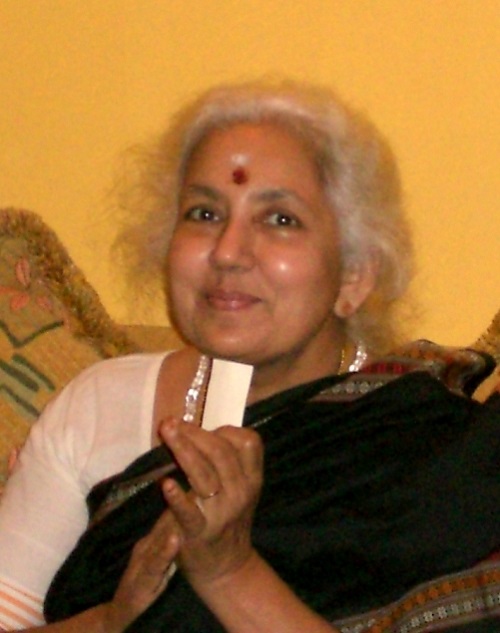
Usha Surya.- Have been writing for fifty years. Was a regular blogger at Sulekha.com and a few stories in Storymirror.com. Have published fifteen books in Amazon / Kindle ... a few short story collections, a book on a few Temples and Detective Novels and a Recipe book. A member of the International Photo Blogging site- Aminus3.com for the past thirteen years...being a photographer.
LESSONS FROM LIFE/CHALLENGES
Madhumathi. H
Dear young girls/ women out there! Don't stick to 'Age is just a number', please. It is true, but not "always." (This is for all genders indeed, but girls/women need to hear this often.)
Age, is also time, energy, health, responsibilities, phases of life... Not just a number!
Never lose sight of yourself, trapped in the mundane 'to do' tasks, forgetting or ignoring your dreams and passion. Start right NOW, the moment you find your calling. You never know what awaits, on the other side of 30, 40, 50+... with added/unexpected responsibilities, and situations in life.
It is not smooth and easy for all. Each one's strength to juggle challenges, differ.
Sometimes, you won't even find time to close the umpteen tabs open on your mind; often, you can't! You might be too tired, numb, to even tick the task you have already done, and stare at it as if it still needs a plan for execution.
Do not live a life, filled with ''If onlys''...
Just do what you love NOW, and stop worrying, "what will others say/think?!"
Stay away from people who abuse your love & kindness, who drain your time, & energy, and from those who lack integrity.
Prioritizing yourself, is NOT being selfish.
Only YOU can love yourself, in the most beautiful way! Celebrate the IMPORTANT YOU.
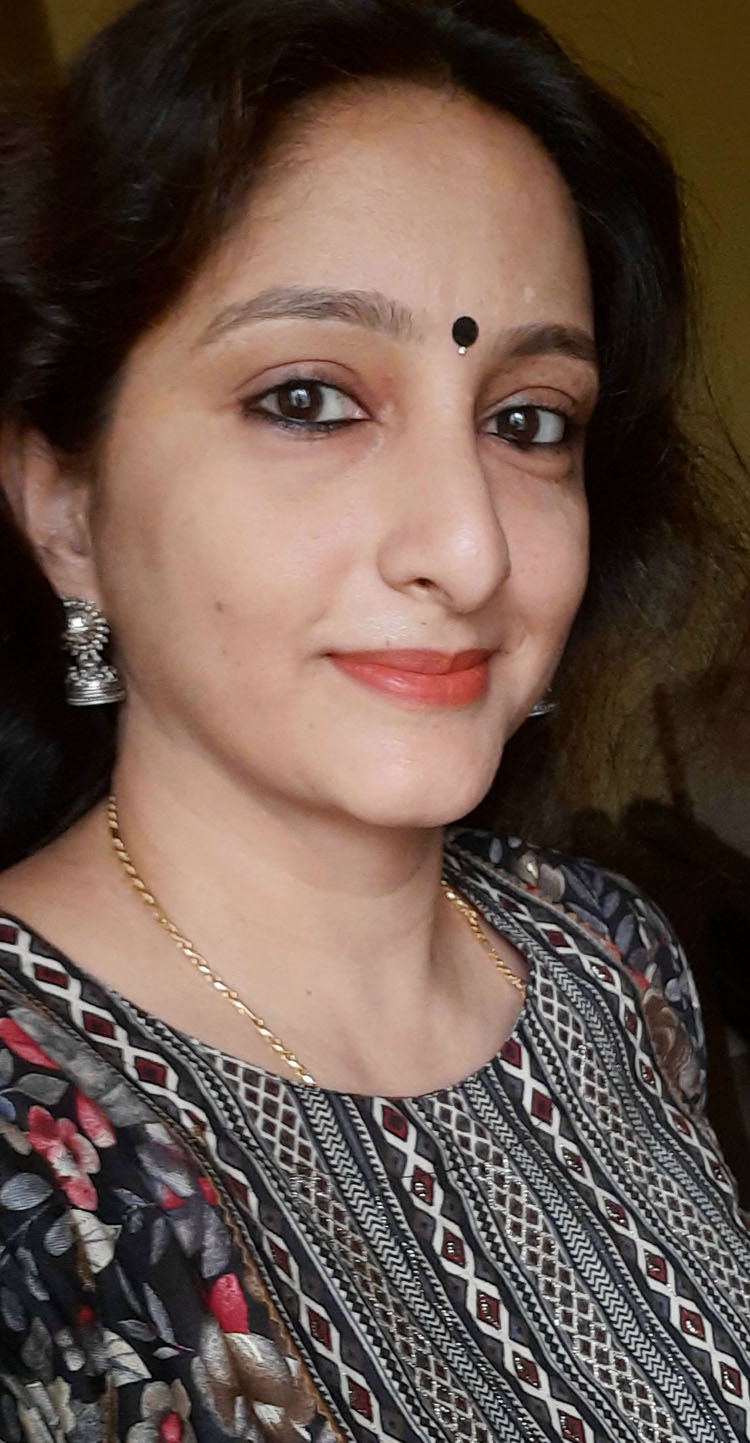
A bilingual poet-writer(Tamil, English), Madhumathi. H is an ardent lover of Nature, Poetry,
Photography, Music.
Her poems are published in Anthologies of The Poetry Society(India), CPC- Chennai Poetry
Circle's EFFLORESCENCE, IPC's(India Poetry Circle) Madras Hues Myriad Views, Confluence, Spring Showers,
Amaravati Poetic Prism, and in e-zines UGC approved Muse India, Storizen, OPA – Our
Poetry Archives, IWJ - International Writers Journal, Positive Vibes, Science Shore.
e-Anthologies Monsoon moods - Muse India, Green Awakenings - On Environment, by
Kavya-Adisakrit.
Madhumathi's poems are part of YPF's(Yercaud Poetry Festival) Ignite Poetry, Breathe Poetry, Dream Poetry, Winterful Whispers, Auburn Ambrosia,
Of Soul Scribers' Soul shores that have 10 of her poems
published, Soul Serenade, Soul songs, Soul Dance, Shades of Love-AIFEST - Special Jury Mention, and
secured 'A Grade’ in the International Poetry Writing Competition(published Anthology)
conducted by All India Forum for English Students, Scholars, and Trainers (AIFEST) in March-
April 2023 in connection with International Women’s Day celebrations, Arising from the
dust, Painting Dreams, Shards of unsung Poesies, are some of the Anthologies her poems,
and write ups are part of.
Besides Poetry, Madhumathi writes on Mental health, takes part in related activities to create awareness, break the stigma, believing in the therapeutic, transformational power of words.
THE JOURNEY THAT CHANGED DIRECTION
Satish Pashine
On 18 July 2026, I should have been flying to Leh.
The trip had been planned as a celebration of a personal milestone—completing seventy-five years on this planet. My wife and I had spent weeks planning the itinerary, choosing hotels, and looking forward to the breathtaking landscapes of Ladakh. Friends knew about the trip, and I had imagined returning with photographs, memories, and perhaps a travelogue.
Instead, I was sitting at home in Pune, taking my morning medicines and watching my pulse on a smartwatch.
A fortnight earlier, I had never heard of Paroxysmal Atrial Fibrillation. Now it had become a part of my daily vocabulary. Three medicines had quietly entered my life, my morning walks had slowed, and the mountains I had hoped to visit had been replaced by visits to a cardiologist.
Looking back, I realise that the cancelled trip was only the visible part of the story. The real journey had begun much earlier—on an otherwise ordinary morning when I sat down to write an article.
The Day Everything Changed
On the morning of 4 July, I had just completed an article on American democracy for Positive Vibes, the monthly online magazine edited by Dr. Mrutyunjay Sarangi, IAS. There is always a quiet satisfaction in finishing a piece of writing, and I was enjoying that feeling when I sensed that something was different.
My heart seemed to be racing.
I slipped on my smartwatch. The display showed a heart rate of over 160 beats per minute.
For a few moments I simply sat still. Panic would have achieved nothing. Instead, I closed my eyes and practised slow breathing. Gradually, the heart rate came down to around 70–80 beats per minute, but the rhythm remained irregular.
Although I felt reasonably comfortable, I decided to skip my usual morning walk. I informed my walking companions that I would not be joining them.
The previous day, however, we had made another plan. After our walk, Shri Awasthi and Shri Gupta—both considerably younger than I am—were to join us for tea at our home. I insisted that the plan should not change.
They arrived around 7:30 a.m. By then I felt almost normal. But after hearing what had happened, both urged me to consult a cardiologist without delay.
Without hesitation, Shri Awasthi offered to drive me to the hospital.
“I’m driving,” he said firmly. “You shouldn’t.”
I was grateful that he did.
Neither of us knew then that an ordinary Saturday morning was about to divide life into two parts—before and after a diagnosis.
A Diagnosis and a Decision
By about 3:15 that afternoon, Shri Awasthi and I with Archana -my wife reached Ruby Hall Clinic.
What followed was a familiar hospital routine—registration, an ECG, blood tests, an echocardiogram, a treadmill stress test, and consultations. The hours passed in waiting rooms and diagnostic departments, punctuated by brief conversations with doctors and technicians. By evening, the verdict was clear.
I had Paroxysmal Atrial Fibrillation (PAF)—an electrical disturbance in the heart that causes episodes of irregular heartbeat and increases the risk of stroke if left untreated.
The diagnosis came as a surprise. Until then, I had considered myself reasonably fit. At seventy-five, I was not taking a single prescription medicine on a regular basis. I walked several kilometres almost every day, remained active, and rarely thought of myself as an elderly person.
The cardiologist was equally clear about something else.
“Forget Leh–Ladakh,” he said. “You should not travel.”
Those few words were perhaps more disappointing than the diagnosis itself. The journey that was meant to celebrate my seventy-fifth birthday was over before it had begun.
He advised that I should be admitted to the hospital for forty-eight hours.
“What exactly will you do during those two days?” I asked.
He explained that medicines would be given intravenously, my heart rhythm would be monitored continuously, and the doctors would observe how I responded to treatment.
It sounded sensible, but I was not convinced that admission was absolutely necessary.
As we stepped out of the consulting room, a hospital executive was already waiting outside. Before I had even made my decision, he was explaining room categories and the cashless insurance process. The efficiency was impressive, but it also reminded me that modern healthcare is not only about medicine—it is also about systems and procedures.
After discussing the matter with my wife, I chose to recover at home.
The doctor prescribed three medicines: a blood thinner to reduce the risk of stroke, a beta-blocker to slow the heart rate, and a rhythm-control medicine. I was asked to return after two weeks.
That evening, as I swallowed my first tablets, I realised that something far more significant than a holiday had been cancelled.
For seventy-five years, I had lived without depending on daily prescription medicines. Overnight, that had changed.
A new chapter of life had quietly begun.
Measuring Recovery
That very night, I began taking the medicines.
Being an engineer by training and a management systems consultant by profession, I have spent much of my life believing a simple principle: what gets measured gets managed. Whenever a process goes out of control, the first step is to collect data rather than rely on assumptions.
Quite naturally, I approached my own recovery in the same way.
Every morning and evening, I measured my blood pressure and pulse rate. I carefully recorded each reading in a spreadsheet. Over the next twelve days, the numbers gradually began to tell an encouraging story. With the help of ChatGPT, I converted those figures into trend charts, making it easier to see what my anxious mind sometimes could not—that the medicines were working.
My pulse settled into a steadier rhythm. My blood pressure drifted towards the lower end of the normal range, which was expected because one of the medicines also lowers blood pressure. During those twelve days, I experienced only two brief spells of dizziness. On both occasions, I simply sat down, practised slow breathing, and the discomfort passed within a few minutes.
The charts reassured me, but they did not answer the questions that mattered most.
Would I need these medicines for the rest of my life?
Would I ever be able to walk as briskly as before?
Could I still travel to high altitudes?
Or had my body quietly crossed a line from which there was no return?
These questions occupied my mind far more than the numbers on the monitor.
Fortunately, life intervened before I had time to dwell on them for too long.
A few days later, my wife’s sister and her husband arrived from Bengaluru for a five-day visit. It turned out to be exactly the interruption I needed.
Learning a New Pace
My wife’s sister and her husband arrived from Bengaluru on 10 July and stayed with us for five days.
Their visit could not have been better timed.
Instead of spending my days thinking about heart rhythms, medicines and cancelled travel plans, we found ourselves doing what families do when they get together. We ate out on several occasions, visited the Shreemant Dagdusheth Halwai Ganapati Temple, spent a pleasant day at Pawna Lake, and talked late into the evenings. Laughter gradually replaced anxiety.
Yet, beneath the surface, my mind was still trying to come to terms with an uncomfortable reality.
Until the age of seventy-five, I had never needed a prescription medicine on a regular basis. I had always regarded myself as reasonably fit and independent. What troubled me was not swallowing three tablets a day. It was the feeling that my body had quietly entered a new phase of life without asking my permission.
One evening I spoke about these thoughts with my brother-in-law.
Being a doctor, he understood the medical aspects of my condition. More importantly, he understood the emotional ones.
Some months earlier, he himself had been diagnosed with Myasthenia Gravis, a chronic neurological disorder that had changed the rhythm of his own life.
“I never expected it either,” he said quietly. “I don’t feel the same as I used to. But after a while, you stop comparing yourself with the person you once were. You learn to live at a slower pace.”
There was no dramatic advice in those words. No promises that everything would become exactly as before.
Perhaps that was why they carried such weight.
As we grow older, almost everyone acquires something—a troublesome knee, diabetes, high blood pressure, an irregular heartbeat, failing eyesight, or some other unwelcome companion. Ageing does not always announce itself dramatically. More often, it arrives quietly, asking us to make small adjustments that gradually become permanent.
Acceptance, I realised, is not surrender.
It is simply the wisdom to stop fighting realities that cannot be changed, and to devote one’s energy to living as fully as possible within the new boundaries that life has drawn.
That conversation did not cure my atrial fibrillation.
But it did begin to cure something equally important—my resistance to it.
A Follow-up and a Few Lessons
Two weeks after my diagnosis, it was time for a follow-up consultation.
This time I chose to see the cardiologist at his private clinic in Wakad rather than at Ruby Hall Clinic. The clinic was closer to home and offered convenient morning appointments.
True to my professional instincts, I carried with me twelve days of carefully recorded blood pressure and pulse readings. I had even converted them into trend charts. Before the appointment, I had sent them to the clinic through its business WhatsApp number, hoping the doctor might review them in advance.
On the way to the clinic, however, an entirely different incident tested me.
We entered the residential-cum-commercial complex where the clinic was located and briefly parked while trying to find the building. A security guard objected rather brusquely, explaining that the parking area was meant exclusively for residents.
At that moment, I felt irritated. Looking back, I realise that part of the misunderstanding may have been linguistic. In Maharashtra, everyday conversation can sometimes sound abrupt to someone whose first language is Hindi. He was probably doing his duty; I was probably more sensitive than usual.
For a few moments, the exchange became unpleasant. I even told him that senior citizens deserved to be treated with courtesy.
Then something struck me.
Only a fortnight earlier, such an emotional surge would have made me wonder what it was doing to my heart. This time, when I checked my pulse later, it had never gone beyond eighty-five.
Perhaps the medicines were working.
Or perhaps I was learning to regain my balance.
Eventually we found the clinic—above a Peter England showroom on the main road—and parked elsewhere.
Inside, the consultation was surprisingly brief.
The doctor glanced at my charts, examined me, and ordered another ECG. Unlike the earlier ECGs that had filled several sheets of paper, this one consisted of a single tracing.
He looked at it for a few seconds, wrote one reassuring word—“Normal”—and smiled.
“Your pulse has stabilised,” he said. “You don’t need the rhythm-control medicine anymore.”
Only two medicines would now continue—a blood thinner and a beta-blocker.
As I left the clinic, I realised that recovery is rarely dramatic. More often, it comes quietly, one reassuring ECG, one discontinued tablet, and one ordinary day at a time.
Becoming an Informed Patient
Before leaving the clinic, I went to the pharmacy to collect a month’s supply of my medicines.
While checking the bill, I noticed that one of the medicines—the blood thinner—was different from the one I had been taking since my diagnosis. More importantly, it was considerably more expensive.
When I asked the pharmacist about the change, he explained that during my first consultation at Ruby Hall Clinic, the cardiologist had prescribed this particular brand. Since it had not been available in the hospital pharmacy, I had been given another brand containing the same active ingredient. As I was now visiting the doctor’s private clinic, he had assumed that I should receive the original prescription.
I requested him to exchange it for the less expensive brand that I had been taking without any problem.
He apologised but said the bill had already been generated and the sale could not be reversed. “Next time,” he assured me, “I’ll remember.”
The amount involved was not significant. What stayed with me was something else.
Until then, I had accepted every prescription without asking many questions. Like most patients, I assumed that whatever appeared on the prescription must necessarily be the only or the best option.
This small incident prompted me to learn more about the medicines I was taking. I discovered that different pharmaceutical companies often market the same active molecule under different brand names, sometimes at very different prices.
That does not mean the least expensive option is always the best, nor does it mean that every costlier medicine is unnecessary. Doctors may have perfectly valid reasons for preferring one brand over another.
But the experience taught me that patients, too, have a responsibility.
We should know why we are taking a medicine, understand its purpose, ask whether equally effective alternatives exist, and never hesitate to seek clarification when something is unclear.
Good healthcare, I realised, works best when it is a partnership.
Doctors bring knowledge and experience.
Patients bring curiosity, responsibility and informed participation.
The Many Languages of Friendship
We have a small WhatsApp group of school friends who have stayed connected over the years.
After my diagnosis, I informed them that I was unwell and that I had to cancel my Leh–Ladakh trip—the journey that was meant to celebrate my seventy-fifth birthday.
Messages of concern began arriving almost immediately.
Friends wanted to know what had happened, and I found myself replying in greater detail than I normally would. My wife watched this with mild amusement.
“You should keep your emotions under control,” she said gently. “Nobody is really that bothered.”
Perhaps she was partly right.
Everyone has responsibilities, families and worries of their own. The world does not stop because one of us falls ill.
Yet I also discovered another truth.
People may not be able to carry our burdens, but they often try, in their own way, to lighten them.
One friend called instead of sending a message.
We spoke for a long time. There was very little discussion about medicines, ECGs or hospitals. Instead, our conversation wandered towards life itself.
Then he said something that has stayed with me ever since.
“Illness has a way of reducing our ego.”
The more I reflected on those words, the truer they seemed. Good health quietly persuades us that we are in control. We make plans months in advance and assume that tomorrow will resemble today. Then one tiny electrical impulse in the heart goes astray, and suddenly we realise how fragile that certainty really is.
Another friend wrote, “Your episode has shaken me.”
His words reminded me that illness never affects only the patient. It also unsettles those who know us well, especially when they have always thought of us as active and healthy.
A third friend tried to reassure me.
“We’ve all been taking medicines for years,” he wrote. “Medical science has advanced tremendously. Don’t worry.”
His message carried a quiet optimism. Growing older, he was saying, does not mean giving up on life. Millions of people continue to live active and fulfilling lives with the help of modern medicine.
Then came a call from a friend in the United Kingdom.
He laughed before offering his advice.
“You people make a mountain out of a molehill. These are normal signs of ageing. Take your medicines, listen to your doctor, and carry on with life. Don’t suddenly become a teetotaller just because you’ve had one episode!”
His humour achieved what serious advice often cannot.
It made me laugh at myself.
By the time I put down the phone, I realised that I had been allowing the diagnosis to occupy far more space in my mind than it deserved.
Looking back, I see that each friend offered a different gift.
One gave me perspective.
Another shared my anxiety.
A third offered reassurance.
The fourth restored my sense of humour.
Different words.
Different personalities.
The same friendship.
Sometimes, that is the best medicine of all.
A Different Morning
Some changes in life announce themselves dramatically.
Others arrive so quietly that we notice them only when we look back.
My morning walks belong to the second category.
Until recently, I walked with a lively group of friends. We discussed current affairs, argued over politics and cricket, exchanged family stories, laughed at one another’s jokes and, almost without realising it, completed six or seven kilometres.
The walk was never just about exercise.
It was companionship in motion.
After my diagnosis, I reduced both my pace and my distance. My cardiologist had advised moderation, and I decided not to test either his judgement or my heart.
Now I walk alone.
About four thousand steps are enough.
I still meet my old companions on the way. They wave, stop for a minute or two, ask how I am doing, and then continue at their familiar brisk pace. Their conversation soon fades into the distance while I resume my slower rhythm.
For a while, I wondered whether something had changed between us.
Then I realised that nothing had.
They were walking exactly as they always had.
It was I who had changed.
Ageing has a curious way of altering not only our bodies but also our relationships with time, with movement and, sometimes, even with companionship. It asks us to slow down while the rest of the world continues at the same speed.
There was a time when I measured the success of a walk by the number of steps I completed.
Today, I measure it differently.
If I return home feeling well, grateful for another morning and hopeful about the next one, it has been a good walk.
Looking back over these past weeks, I realise that the biggest change was not the irregular heartbeat.
It was learning that life after seventy-five is not about proving that nothing has changed.
It is about accepting that some things have—and discovering that a meaningful, joyful and fulfilling life is still possible.
Leh–Ladakh can wait.
The mountains are not going anywhere.
For now, I am learning to enjoy a different journey.
One that asks for a little less speed, a little more patience, and a great deal more gratitude.
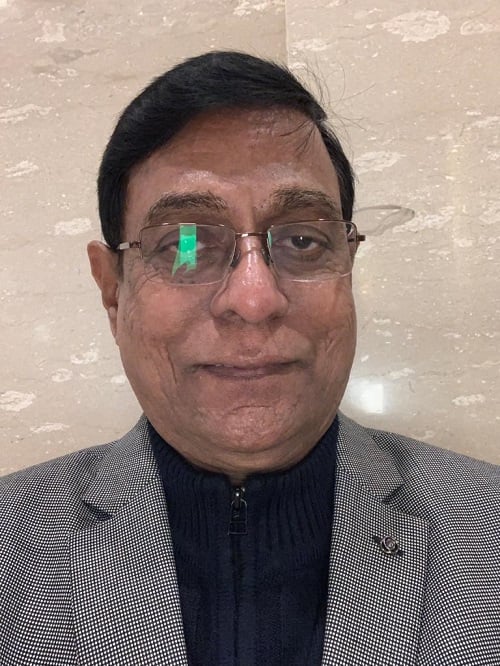
Shri Satish Pashine is a Metallurgical Engineer. Founder and Principal Consultant, Q-Tech Consultancy, he lives in Bhubaneswar and loves to dabble in literature.
A CUP OF CHAI AND BUN MASKA WITH THE DEAD: LUCKY RESTAURANT IN AHMEDABAD
Deepika Sahu
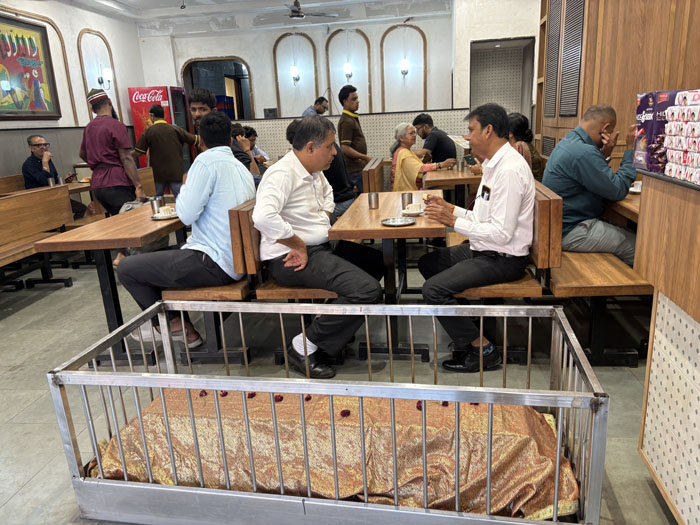
Ahmedabad’s Lucky restaurant lets you enjoy your cup of chai and a plate of bun maska with the dead. This might leave you startled but the Lucky restaurant popularly known as the graveyard tea shop lets you literally dine with the dead.
Walk into the cafe opposite Siddi Sayeed Mosque in Lal Darwaja, this restaurant serves food right beside coffins, which are carefully maintained and decorated with flowers every day. This out of the box space has seen many summers in a city that loves its share of chai. Over the years, Lucky restaurant has its regular visitors who love to linger with a cup of chai and bun maska amid the graves. But there’s nothing morbid about this space. It is a place that celebrates life, laughter and camaraderie.
The uniqueness of the Lucky Restaurant Ahmedabad lies in its interiors. The restaurant is built around the 12 graves and has been gathering attention from locals, tourists and others. It is believed that these graves belong to the followers of a 16th-century Sufi Saint.
Lucky Restaurant in Ahmedabad is much more than just a restaurant, it’s considered as an iconic gastronomic destination of Ahmedabad. It represents the city’s deep-rooted rich heritage and its open-mindedness to explore new horizons. Spending time here with a cup of chai and bun maska is about celebrating life, accepting diversity, and connecting with history even as the city goes through massive transformation. It’s an experience you won’t forget, and that’s what makes Lucky Restaurant a special place.
In many cultures, this concept of having a meal amongst the deceased seems next to impossible. However, the Lucky restaurant in Ahmedabad, does not buy this view. Rather Amdavadis believe that dining in the Lucky restaurant with these dead people brings people good luck and prosperity.
As per city legends, many people visit this restaurant to have a cup of tea before starting an important day in business, personal life, or before an important exam. The journey of Lucky restaurant said more than 50 years ago when KH Mohammad from Calicut (now Kozhikode) came to Ahmedabad and decided to open a small tea stall near the graveyard in the Lal Darwaaza area of Ahmedabad.
This tea stall soon became a hit, as the locals around loved the tea served there. Slowly it developed its loyal patrons and this inspired Mohammad to acquire the space and transform it into an iconic place.
India’s celebrated painter M F Husain loved drinking tea at Lucky and every time he visited Ahmedabad, he would make sure to visit the restaurant. Husain once mentioned in an interview that Lucky Restaurant gave him the "feeling of life and death", which is simply commendable. On the walls of Lucky, you can see a painting by M F Husain which he had gifted to the restaurant.
Moreover, Lucky Restaurant was also featured in the famous Bollywood movie – “2 States”, which is based on a novel of the same name by Chetan Bhagat.
Arshad Khan, a 45-year-old entrepreneur, is a regular at Lucky restaurant. “I simply love coming here and it feels like my second home. There is a sense of peace in this space and I have been coming here since my college years.”
Shubhra Sengupta, a tourist from Kolkata had read about Lucky restaurant on social media. During her recent visit to Ahmedabad, in between shopping for cotton fabric at Teen Darwaja, she took out time to have a cup of tea and bun maska at Lucky. “When I had read about this place on social media, I was quite intrigued about this whole concept. And now I am really happy to be here and experience this unique space. And needless to say, I enjoyed my share of chai and bun maska. There is a sense of history in this space which makes it so different from sanitised swanky coffee shops.”
If you’re looking for a unique dining experience in Ahmedabad, Lucky Restaurant is the place to go! Apart from the unique graveyard setting, it also offers food ranging from popular snacks like pav bhaji, masala dosa, cheese sandwich, chilli paneer and the like.
So, if you want to have your share of quirkiness then Lucky restaurant with its tables next to coffins is the place for you. And you will always have its famous chai and bun maska to soothe your soul.
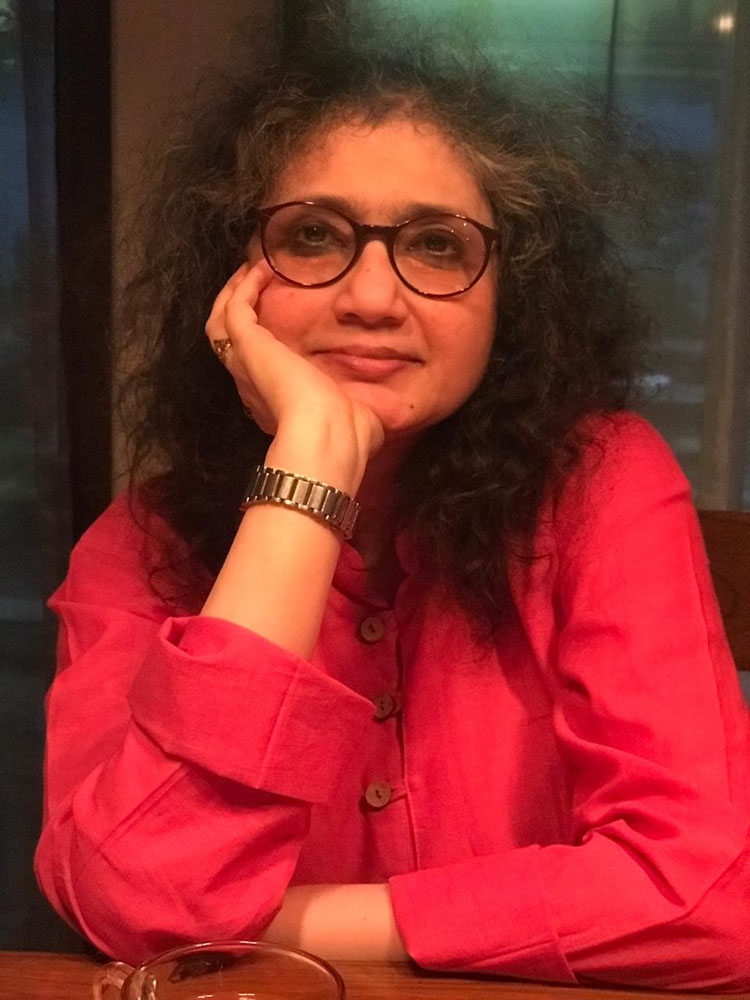
Deepika Sahu is an Ahmedabad-based senior journalist with a career spanning since 1995. During her career, she has worked with India's premier media organisations, including the Press Trust of India (PTI) in New Delhi, Deccan Herald in Bengaluru, and The Times of India in Ahmedabad. Currently, she is contributing India-centric features to Melbourne-based The Indian Sun, a cutting edge media platform. In addition to her journalism career, Deepika is involved in teaching English and Communication Skills to learners from different parts of India through Manzil, a Delhi-based NGO. Beyond her professional endeavors, Deepika is passionate about India's rich diversity, literature, blogging, quiet hours at a cafe and enjoying a cup of tea.
ONE LAST LOOK
Sujatha Krishnamurthy
Thanksgiving Eve. 3 pm. Chicago Loop to Interstate 94 East is a mess with bumper to bumper traffic. I thought I could beat it by leaving early. But oh boy! Probably that was a shared thought of all the drivers hitting the Loop. On a regular day my commute home to Okemos would take a good four hours. Today looks like it is going to take forever. All other times I would be impatient and cursing. Somehow, today with a heavy heart I want the drive to be longer and never ending. Sitting behind the wheels gives me time to turn back the clock and let the reels roll. This year’s Thanksgiving is more defining than others. It will be our families’ last celebration together in our house of twenty-five years. 7500 Graystone Avenue, Okemos, Michigan.
My brother Amar and I Face Time with our parents every Sunday at 4 pm my time, which is 5 pm theirs. During one such chats my mom out of nowhere says, “Amrita and Amar! Dad and I want to share some important news with you.” As usual, I being the impatient child ask,” Mom and Dad. Are you guys ok? Are you sick or something?” My mom goes on,” No Amrita. We are fine. Dad and I after lengthy discussions have decided to sell our home and move to Miami.” “Why Miami?”,I ask. Mom says,“Some of our friends from Okemos have moved into a Senior Living and they have been nudging us to follow them. We made a short trip to Miami in summer and we really liked their condo home and decided to put a down payment on a three bedroom condo” Trying hard not to cry I ask, “So When do you plan to move, Mom?” “After Thanksgiving”, she replies.
Now I see the board a mile away on Interstate 94 with the words “Pure Michigan Welcomes You!” My home turf. My mind wanders to the beautiful four bedroom cape cod my parents custom built for our family. Annuals and perennials of many varieties in the front yard bloomed from the dawn of spring until winter to vouch for my mom’s green thumb. The well-kept yard testifies my dad’s regular mowing and meticulous up-keeping. Backyard is a heaven on earth with evergreen pines, maples, birch, oak, and aspen that set sky on fire with their spectacular colors in fall. I can still hear the running sound of a small creek at a distance. The best place in the house is my room on the second floor facing the back yard.
My dad retired as the Chair of Economics department at the Michigan State University(MSU) and my mom as an accountant at State Farm Insurance. My brother and I attended the Okemos Public Schools and graduated from MSU, as well. Our careers took us to different directions, but invariably holidays and homesickness brought us home. This visit is really going to hit us all hard.
As long as I remember, my parents loved to host parties during weekends and holidays. In the past, the house on Thanksgiving would be filled with 15-20 families. We kids would stir up a ruckus running around the bedrooms, basement, and back yard. Aunts would gather in the kitchen or dining area and uncles would be in the den or on the deck laughing, eating, drinking, and chatting away. Our dining table would be filled with my mom’s typical American and Indian delicacies.
I finally reach home at 9 pm after a long drive. I ask, “Is Amar home?” My dad replies,” No, his flight got cancelled due to bad weather. He is reaching home tomorrow.” Typical! I go to my room to freshen up and unpack. The room looks pretty much the same as it has always been. When I moved to my dorm, I had given my mom instructions to keep the room as is except to replace my twin bed with a full to accommodate my growing up body. That turquoise blue walls always has a calming effect on me. Baby to college graduation pictures of mine adorns the walls. Medals and certificates of different activities that I had won are neatly hanging on top of my desk. I take a look through the bay window with a sill where I used to sit for hours, read books or relax and enjoy nature. This is the same spot where I laughed with my friends aloud on prom night and cried alone silently when I lost my dearest cat Spoochie.
Next morning I go to pick up Amar from the airport. On the way to the airport I see my dentist Dr. Johnson’s office where I got my braces. I pass my high school building and my best friend Lisa’s house. “Is Lisa home for the holidays?” I wonder. Amar and I stop at a new coffee joint. We have a long chat recollecting our childhood years at our home. We try to remember names of some common friends and their pranks over hearty laughs.
This year it’s just the four of us at the Thanksgiving table. Mom says,” All our friends are gone from Okemos. I don’t know many newcomers in town, although I see a lot of new faces at the temple and Kroger.” Dad chirps in. “All my colleagues are retired and I rarely get to see them anymore. “ Mom jumps in.”At least seven or eight of our friends have moved to Aranya Senior Homes in Miami. We are eagerly looking forward to our new chapter in Miami. You and Amar can join us for Christmas in Aranya.”
Seeing our home from a full house to an empty house on a holiday makes me realize, “Yes. My parents have made the right choice.” If selling our home and moving on is hard for me, then I can only imagine how harder it must be for my parents and Amar.
The next couple of days were spent in packing some of my pictures and mementos to take with me. Then comes Sunday morning, the day I have to drive back to Chicago. I think in my mind, “THIS IS IT.” Before saying good bye to my parents and Amar, I go upstairs to take one last look of my room. I peek through my favorite bay window the stunning colors of oak, birch, maple and pine from my room on 7500 Graystone Avenue, Okemos, Michigan.
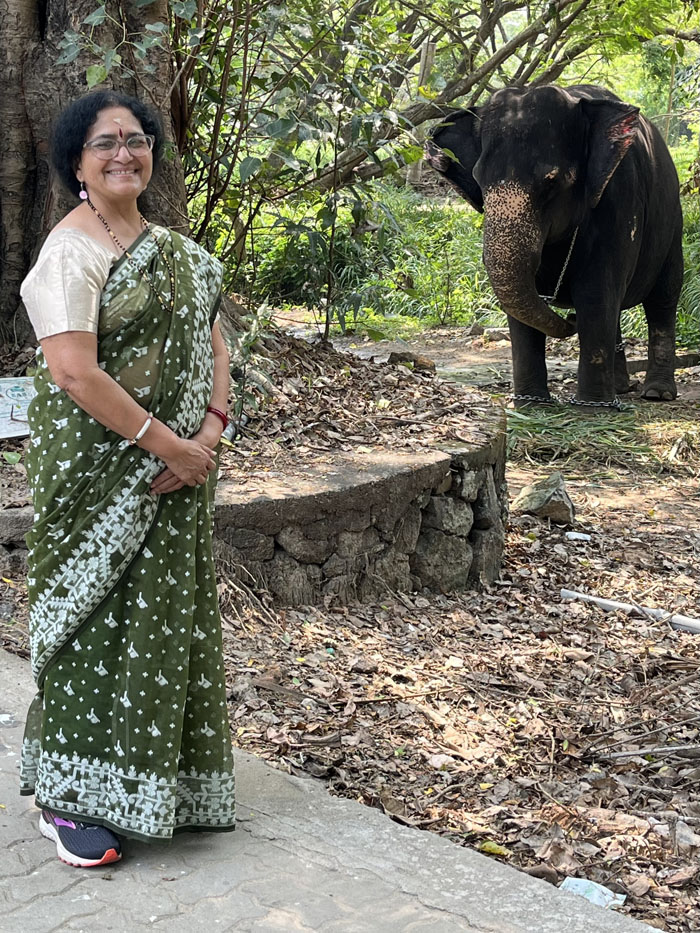
Hi
I am Sujatha Krishnamurthy writing from Kalamazoo, Michigan, USA. Born and raised as a true Kolkatan, studied at Andhra Association School and Shivnath Sastri College, and worked at Central Cottage Industries. Moved to Pasadena, CA, USA in ’84 and later to Kalamazoo, MI in ’91. Studied, worked, and retired after a stint of 20 years in different organizations, including family owned business , NPO(Non-Profit Org) , and MNC( Multi National Corp).
A habitual reader and writer since younger years, a habit cultivated in the banks of the Ganges, has continued to flow till date. Since 2023, my contributions have been published in my alma mater’s monthly e- magazine SPARKZ. I also contribute regularly to our Indo American Cultural Center and Temple’s monthly e-newsletter covering cultural activities in and around town.
As a full time volunteer, I dedicate many hours at our local Hindu temple (Indo American Cultural Center and Temple). Have served in the temple board of directors in many leadership positions, such as, Religious Committee Chairperson, President, and Chairperson. I am the Bal Vihar teacher of 25 years teaching Indian scriptures, teachings, and bhajans to the next generation.
As the Community Outreach Program Coordinator of our temple, I bridge our Indian community with the rest by taking our Indian culture and heritage to local schools and institutions of higher learning. My role facilitates in bringing several visiting Indian artists and American Indian talents to our temple and community. My efforts have been successful in drawing many local, city, and state officials, including Governor, Mayor, and City Counselors and Indian Consul from Indian Consulate, to our temple’s land mark events, such as 25th anniversary and others.
Since 2019, I have been recording audio books for the visually impaired for Samarthanam Trust For The Disabled, an organization based out of Bengaluru. I am currently working towards my goal of reaching the century mark for the Samarthanam Library. My other hobbies include globe trotting, music listening and singing, tasting and trying out new recipes, being an active influencer in social media, and above all, staying close to my families and friends.
A BLUR OF THREE DAYS: REFLECTIONS ON THE 57TH OSA CONVENTION IN MINNEAPOLIS, JULY 2- 5, 2026
Annapurna Pandey
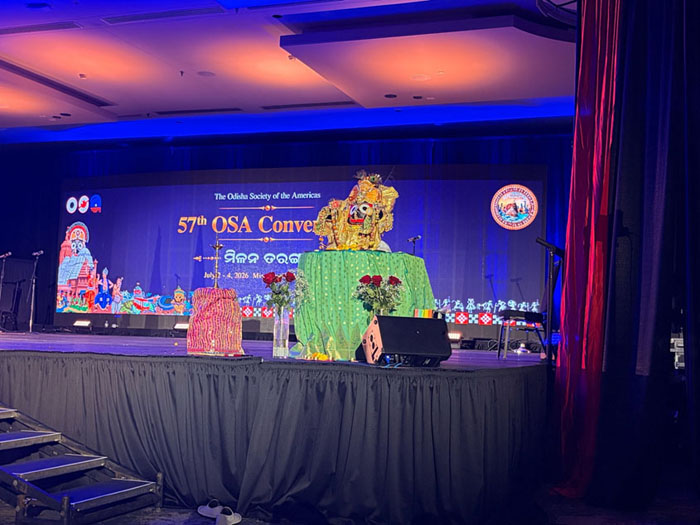
It has been more than a week since I returned from this year's 57th Odisha Society of the Americas (OSA) convention in Minneapolis on Sunday, July 5th. I have already read so many beautiful reports praising the convention and its organizers, and I have wondered what more there is to say. Yet the three days of celebration of the diasporic Odias passed in such a blur that I cannot let them go without setting a few things down — not as a report, but as a record of what I could attend and what stayed with me.
History Of OSA
Early pioneers in the diaspora built an inclusive community by welcoming new members from Odisha seeking higher education. These members brought their rural charm, hospitality, and a sense of fellow feeling, making the OSA a home away from home since 1969. In founding OSA, these pioneers defined their identity as Odias even as they adapted to American life, both professionally and in raising their families here. OSA, the oldest diasporic organization in North America, was founded in 1969. Every year during the July 4th weekend, Odias gather to spend three days celebrating Odia culture, traditions, and heritage.
Arrival
My husband, Triloki N. Pandey — a native of Ballia, UP, and now an honorary Odia many times over — and I arrived at the DoubleTree after midnight, technically already the morning of July 2nd. A few young Odias were still working on the entrance decorations. When we walked in, one entire wing of the hotel had been given over to OSA. The decor was simple yet elegant: toranas of small flags covered the ceiling, from one end of the wing to the other, garlands of hundreds of tiny flags stitched together like a miniature patchwork of Pipili work. Pandals for Manabasa, Raja, Khudurukuni, and the other of the thirteen festivals stood prominently along the halls. A huge poster of Raghu, with his iconic bicycle and famous dahibara, greeted everyone in the hallway. Being a Cuttackia, I literally lived on Raghu dahibara, and seeing Raghu's bicycle took me back to the banks of Kathajodi, even before he moved there, at the Barabati Stadium.
The organizers were still finishing decorations and logistics — and, I realized, they had not yet eaten dinner. Nectarine plums we had carried all the way from our garden in Santa Cruz became, unexpectedly, a small hit; everyone on the scene relished them. That quiet, unglamorous labor — people still working at 2 am before a three-day celebration even begins — is the kind of dedication that sets the tone for the meticulous mela of the Odias that follows.
Pre-Convention Seminars, Pitha Competition, and Bandhu Milana
The pre-convention began that Thursday, July 2nd, with a morning business seminar. I wore an Odissi baghmbari saree for the occasion. I must confess, a major draw for me at OSA was the chance to see the beautiful traditional attire worn by men, women, and children. It was genuinely moving to hear how many OSA members are now working in Odisha — in higher education, technology, home building, nonprofit work, and entrepreneurship of every kind. This year, a brochure was published showcasing the initiatives undertaken by Odia diasporic luminaries in Odisha. Lunch was sandwiches and salad, with rice and dal for those who preferred it.
Then came the pitha competition — twenty-two entries and a room crowded with serious Odia pitha connoisseurs, each with an opinion. It is easy to underestimate what a pitha competition is until you have stood in that room. This year marked its tenth anniversary; it was inaugurated in 2016 at the Massachusetts convention, and over a decade it has traveled across the country, drawing enthusiastic participants who might otherwise never have found their way into OSA's orbit. It has become, chapter by chapter, one of the convention's genuine draws — thanks in no small part to Alok Mullick, founder and president of Odisharoots.org, a diasporic Odia whom I suspect has spent years missing the smell and flavor of pitha during festivals, having grown up in Cuttack. He is committed to spreading Odia pitha on the global stage. When the organizers asked quiz questions like "What is the traditional pitha for Manabasa?" there were multiple answers, depending on the region and family traditions. I learned that there is no single answer to the specifics of pithas for a particular occasion, as diversity is the hallmark of our Odia identity.
When I asked one participant what she had made, she said, "mango poda pitha." I was intrigued — I had never had it. Poda pitha, literally "burnt cake," is one of Odisha's specialties, made from freshly ground rice, coconut, molasses, and dried fruits and spices such as cloves and cardamom. Notably, it is a pitha that every household makes and is delicious even without the dried fruits; it can last for days, which is perhaps why it has endured. "Pitha is Odisha's identity," she told me. "I make it in different flavors, a favorite with my children, so they will keep their appreciation for Odisha and Odia culture." After the judging, about a hundred attendees made a beeline for the table to taste the varieties of pithas.
Books and More Books
Just across the convention hall, Satya Pattnaik from Ohio beautifully arranged the book stall, featuring a variety of books in Odia and English. Can you believe it — in the last few years, his publishing house, Black Eagle Publication, has published about 900 books. At his stall, contributions from many Odias writing memoirs, travelogues, poetry, and literature were prominently displayed. Kalpana Dash Nani's memoir and poetry collection, meticulously published by Black Eagle, were inaugurated at the convention. I must say, Satya Pattnaik has single-handedly helped so many Odias in the diaspora become authors — a truly praiseworthy contribution.
The evening brought us to the inauguration of new books by Kalpana Dash nani and bandhu milana, people reconnecting across the distances of North America and Odisha. What a delight it was. A vegetarian meal with the temple flavor was the meal I was waiting for.
Inauguration Morning
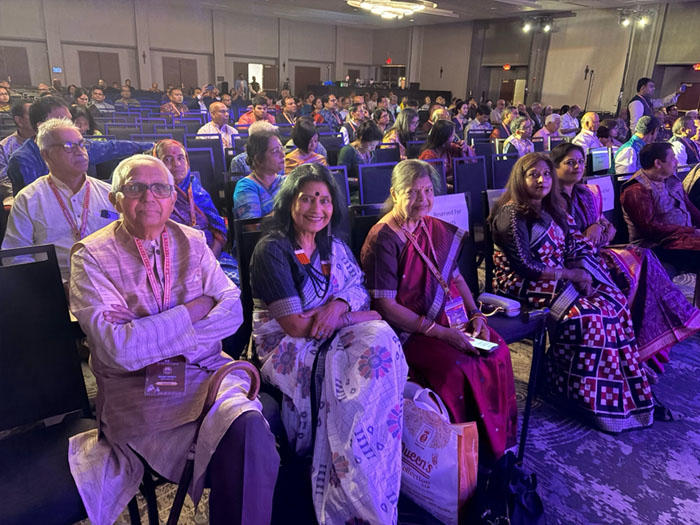
On the 3rd, the Health and Wellness Forum offered a health walk at 6:30 in the morning — the only time in three packed days that I stepped outside the hotel to see the surroundings of our hotel. I missed other wonderful programs that same morning, like bhajan and yoga.
The formal inauguration was at nine o'clock and well attended. Somnath Ghosh, the Consul General of India in Chicago, gave a beautiful overview of the 5.5 million Indian Americans in this country and praised the unique culture and traditions of the Odia community in particular. He spoke of the significant contributions Indians have made to the American economy, and urged us to make ourselves felt in the country's politics, so that our voices are actually heard.
Prof. Omkar Nath Mohanty spoke, honoring the legacy of Indian scientists such as Chandrasekhar and reminding the room that Odia is recognized as one of the country's six classical languages. He argued it is high time the diaspora found ways to collaborate with Odisha's own university system to strengthen STEM education back home. Prof. Achyut Samanta followed with an account of what KIIT has achieved, and an open invitation to Odias abroad to partner with the campus. One of OSA's veteran members, Kirtana Behera from California, discussed "Donor Advised Funds," which was informative. The cultural program following the inauguration, with contributions from each chapter, was spectacular.
The Moment That Stayed With Me
Amid all the smoothly run programs at the convention, one moment stood out above the rest: Milana Taranga introduced Gaurav Samman, recognizing OSA's senior members (75 and above). OSA, now in its fifty-seventh year, represents some seven thousand diasporic Odias. This year, the organizers brought their senior attendees on stage from across North America and projected their professional achievements and community contributions for all to see. It was a small gesture with a large effect: people who often go unseen in the daily churn of community life were, for a few minutes, fully seen. I could see a glow of recognition on their faces as they sat on stage. Several seniors shared their personal reflections on what OSA means to them.
When I asked a senior what the OSA convention means to him, he said it is the love and affection from everyone there that stays with him until the next one. Another senior, who could not attend this year for health reasons, shared, "In the last 57 years, this is only the second time I have missed OSA convention." I was crying. I missed so many familiar faces from the USA and Canada, and I send you all a shout-out. You are OSA, and you make us proud.
The sessions running in parallel — on poetry, on the Gopinath Mohanty memorial discussion, Jagannath culture, Next Gen, on health and wellness, and so many others besides — filled the seminar rooms and were, by every account I heard, well attended. So many amazing programs, namely schools and various colleges reunions among others, I sadly missed.
The Taste of Home, Away from Home
Every meal at the convention was very thoughtfully planned. From morning breakfast till midnight, bara, alu chop, egg chop, ghuguni, seu, ganthia, bundi, and khaja flowed. I still wonder how we managed to eat five grand meals a day at this convention.
Every member was raving about the fish, aamba khata, tomato chutney, ghanta, and puri dali, potala kasa, just to mention a few, laid out with the unhurried confidence of someone who has cooked this exact combination a thousand times for a thousand guests. It was so unmistakably, so completely Odia — not a fusion version, not an approximation for an American palate, but the real thing, down to the precise tartness of the khata and the particular thickness of the dali. Sitting there in a hotel banquet hall in Minneapolis, thousands of miles from home, I felt something settle in me that I do not think I can fully explain to anyone who has not lived far from where they grew up. It is one thing to celebrate Odisha through festivals, sarees, and stage performances. It is another thing entirely to taste it, unexpectedly, on a paper plate in the Midwest, and to feel for a moment that no distance had ever really opened up at all.
The Women's Forum
This year's Women's Forum turned out to be one of the most meaningful 90 minutes spent at the entire convention. The topic was women's leadership, past, present, and future. The room held four of our five past women presidents, current chapter presidents, and first-time participants from fourteen chapters, all for a session that was added to the program late and still drew about thirty-five people. It started as a simple conversation starter, with women speaking candidly about salary gaps, financial independence, elder isolation, raising sons and daughters with different values, and what it might mean to give to civic causes rather than only to temples. Padmashri Dr. Aruna Mohanty's reflection on Amba from the Mahabharata and the complementary, rather than oppositional, nature of feminine and masculine strength gave the room a kind of intellectual spine.
I was most moved to hear Dr. Devi Prasad Misra's personal account of parental expectations across generations. Dr. Bhagat emphasized broken communication between parents and adult children. Ninety minutes was not nearly enough.
What Made Room for Everyone
Beyond the formal sessions, what struck me most this year was how much wider OSA's circle has grown. The poetry session was heartwarming, and the literature session on Gopinath Mohanty was genuinely educational. But it was the small, almost quiet initiatives that told me something had shifted: mothers of differently-abled children brought onto the main stage, and a space made — visibly and confidently — for the LGBTQA+ community and their supporters. I found myself thinking that OSA has come a long way from being only a homogeneous, familiar kind of gathering. There is now room for lives that do not fit the expected mold, and that room does not feel grudging. It was earned.
Passing the Baton
On the final night, volunteers from North Carolina, led by Ullasini Sahoo — convenor of the 58th OSA — performed a skit inviting all of us back next year, and distributed aarisha pitha, khaja, and every other bebhara as a sendoff. The convenor, co-convenor, and volunteers made their warm appeal, and we watched a video showing that the invitation had already gone out to chapters across the continent.
The rasikia paana dokan, run by volunteers, sold paan with the kind of enthusiasm that brought back Cuttack's paana khati stalls. On the closing night, the paan shop was crowded with so many enthusiastic customers. When I asked one volunteer what he did for a living, he said he was a neuroscientist. Another, standing beside him, was a doctor. Under whatever professional hat they wear the rest of the year, in that hallway they were simply Odia, running a paan stall with the same ame badhia feeling that seems to animate this whole community.
And then there was the antakshari — every night, after the formal programs ended, running until four in the morning. I still do not know when these people sleep. I have been part of this crowd since the 2013 convention in Chicago. I look forward to this masti each year, which is why I keep coming back.
Jagannath, Forty Minutes Away
On Sunday, before we scattered back to our respective corners of North America, Dr. Sitakantha bhaina arranged a bus to the local Jagannath temple about forty minutes from the hotel — a serene complex on roughly a hundred acres, only twenty of them yet in use, where three hundred children come on Sundays to learn languages. The main deity, Bharat Raja from Kanchipuram, has been installed there alongside 21 other idols, including Jagannath. We had a beautiful darshan — save for Jagannath himself, who was in the anasara ghara — and received prasad. It was, quietly, the highlight of my visit to Minneapolis, a reminder of what all the flags and pandals and pithas and late-night singing were ultimately in service of.
Three days. A blur, as I said at the start. But blurs, I am realizing, are sometimes what a full life looks like when you try to hold it all at once.
With my deep commitment to OSA and my firsthand involvement with the organization, I want to give a shout-out to the organizers of the 57th OSA convention. Last year, at the 56th OSA convention in Dallas, I received gua nimantrana from my high school friend Rita Mohapatra and all the local organizers — and now I already look forward to the 58th.
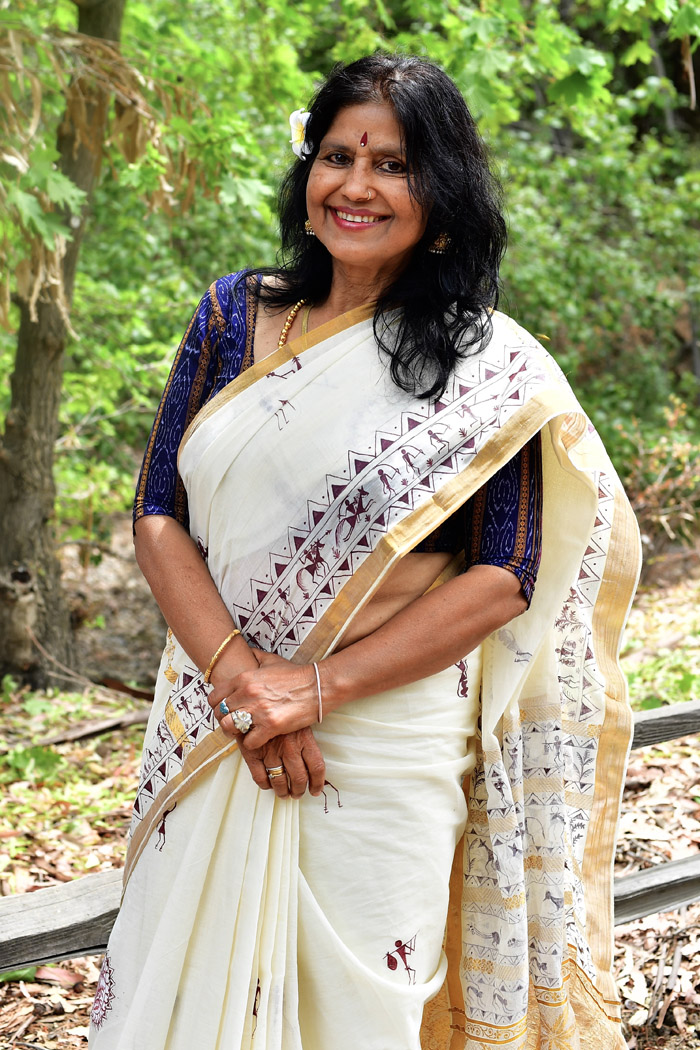
Annapurna Pandey is a cultural anthropologist at the University of California, Santa Cruz. Originally from Cuttack, Odisha, she moved to Santa Cruz, California in 1989. She is a travel enthusiast and loves to write travelogues highlighting her exotic experiences in different parts of the world.
A VISIT TO HELL
Satyanarayan Das
This morning, while strolling through Mandala Haat, I unexpectedly ran into Yamaraja, the Lord of Death.
Seeing me, he smiled and said, “Satya, your work on Earth is done. Your pass to Heaven has already been issued. But before you go there, come along. Let’s take a quick tour of Hell.”
I was secretly delighted. Finally, I thought, I would get to see the boiling cauldrons of oil, blazing fires, terrifying demons, iron chains, and all the horrors I had heard about since childhood.
But the moment I entered Hell, I wondered if I had accidentally walked into a government office.
At the entrance, a large sign read:
“Welcome. All work here will be done tomorrow.”
I laughed and said, “My Lord, that’s exactly the slogan of our government offices!”
Inside, there was an enormous queue.
“What are all these people waiting for?” I asked.
A graceful lady standing nearby replied, “Their sins are being processed. But the server is down. Chitragupta has forgotten the password, and Yamaraja’s Wi-Fi says ‘No Internet Connection.’”
Just then, one of Yama’s attendants handed me a chilled glass of beer and a plate of crispy pork fritters.
Surprised, I looked at Yamaraja.
He smiled and said, “Anyone who loved these things on Earth receives VIP treatment here.”
We walked further.
In a huge hall, hundreds of people were running around holding their mobile phones high in the air.
“What happened here?” I asked.
A messenger explained, “Every phone has only 1% battery left. There are no chargers, no power banks, and everyone is waiting for an OTP.”
“My goodness,” I exclaimed. “Now that’s real punishment!”
In another room, delicious food was laid out on beautifully decorated plates. Yet no one could eat.
Why?
Each person’s hands had been tied to three-foot-long spoons.
One attendant explained, “These are people who never fed anyone during their lifetime. They always thought only of themselves. Now they cannot feed themselves either.”
In the next room, everyone was busy posting on Facebook.
But not a single post received a like.
No comments.
No shares.
People looked utterly miserable.
The attendant explained, “During their lifetime, they were always jealous of other people’s posts. Now they spend eternity staring at their own.”
Then came the most frightening room of all.
No television.
No mobile phones.
No Wi-Fi.
No air-conditioning.
No tea.
No gossip.
Everyone simply sat in complete silence.
I whispered, “What terrible sins did these poor people commit?”
The attendant laughed.
“Nothing serious. All their lives they kept saying, ‘I don’t have time.’ So now we’ve given them nothing but time.”
Finally, Yamaraja came and announced, “Come, Satya. Dinner is ready.”
Over dinner I confessed, “My Lord, to be honest, I don’t see much difference between Hell and Earth.”
Yamaraja burst into laughter.
“My son,” he said, “people create their own Hell while they are on Earth. We merely manage it after they arrive.”
After enjoying an excellent meal—and, I admit, another small glass of whisky—Yamaraja kindly dropped me back home in his vehicle.
Back home, I kept thinking.
Perhaps Hell is not some distant place after all.
Our ego, laziness, selfishness, endless procrastination, addiction to mobile phones, and our constant refrain of ‘I’ll do it tomorrow’ and ‘I have no time’—these are its permanent address.
I don’t know whether Hell awaits us after death.
But I do know that, during our lifetime, we quietly build it ourselves, one day at a time.
Good night.
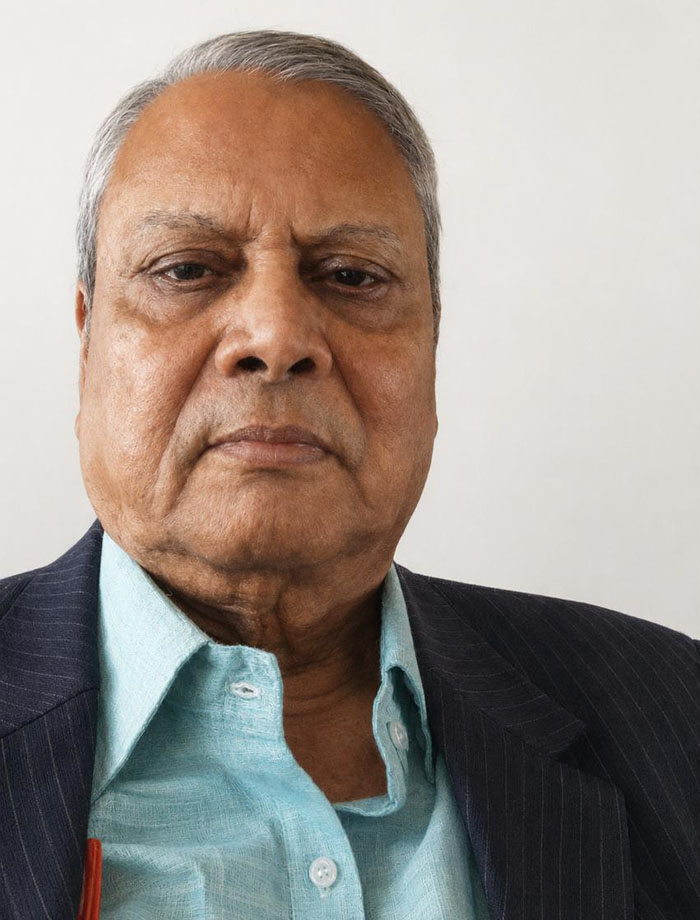
Satyanarayan Das (born 10 March 1952) studied at N.C. High School, Jajpur Road, S.V.M. College, Jagatsinghpur, and Ravenshaw College. After a professional career of over three decades in engineering and biotechnology companies in Odisha, he now devotes much of his time to writing. His works reflect a deep appreciation of Jagannath philosophy, spirituality, Odia culture, and the gentle humour of everyday life. He believes that literature should inspire, uplift, and bring a smile to the reader. His personal motto is: “Character is greater than appearance, kindness is greater than wealth, and faith is greater than fear.”
A PERFECT BRIDE
Mary Josey Malayil
It was a morning as usual for me. Tiring household chores, followed by newspaper reading – the sequence was pretty much the same. I was about to get poetic about the monotony of my life, when suddenly I heard the sound of a car halting in front of a house in the neighborhood. The fact that the girl next door is currently a hot cake in the matrimonial market and that her family is dealing with marriage proposals for her on a daily basis are the talk of the town.
Still unable to resist the curiosity, Remani rushed to the window of the drawing room to steal a glimpse of the probable bride groom. Her wings of imagination quickly started working as they started assuming who could be who about the people who came in the car with him. “This is definitely the PENNU KAANAL CHADANGU, “ Remani assured herself.
Exactly after an hour, the car and its passengers left. Where could have they come from? What could be the boy’s job? Such thoughts started disturbing Remani. Although financially stable, education-wise the girl ‘s family was below par. Foolishness and unnecessary boasting were part of their lives. But when such an intelligent and educated Remani was in the neighborhood, the possibility of the girl or her family taking a wrong decision was almost zero. Remani’s anxiety shot up to unbearable levels. To get answers to all her questions, she sought the help of a ripe jackfruit in her garden. Under the pretext of gifting it to the girl, Remani rushed to the neighborhood to make further enquiries.
Leelechi, the girl’s mom was found overjoyed. Other family members were busy discussing. After gifting the jackfruit, Remani slowly switched to investigating the matter. “So many marriage proposal visits have happened so far. Many rejected the girl citing her poor educational background. Thank God! This guy and family have returned after giving a positive response. Their attitude is like – we need a girl who can cook and run a family, not an educationally overqualified moron. My mom and me haven’t passed tenth grade. Did anything happen to us? How stupid is the new generation who wildly hunt for graduates when it comes to searching for spouse,” said an emotional Leelechi. “
This guy owns two companies now. In the early stages, the employee strength was very less. The companies have flourished and there are around 300 people working under him as of today. My daughter is really lucky,” she exclaimed. Remani was surprised as Leelechi continued, “The guy asked my daughter just one question – are you a member in whatsapp and facebook? Her humble reply –‘AFTER MARRIAGE, I WILL LEARN BOTH FROM YOU UNDER YOUR GUIDANCE IN YOUR PHONE,’ impressed him. He was searching for a down to earth girl in this mould.” Remani asked the names of the companies run by the guy. “He is the GROUP ADMIN of whatsapp and facebook- the two ‘companies’ that ‘employ’ 300-plus ‘staff’,” replied a proud Leelechi. A shell shocked Remani sat dumbstruck as if she was hit by some thunderbolt. “How to make this nitwit understand?”, wondered Remani who herself is the GROUP ADMIN of three ‘companies’ that ‘employ’ 1000-plus ‘staff ‘ !!!!
Mary Josey Malayil, a native of Thiruvananthapuram, Kerala, is a talented writer with a rich family legacy. As the second daughter of T. R. Johny, retired Chief Engineer of the Kerala State Electricity Board, and the late Rosily Chirayath, sister of the renowned actor C. I. Paul, Mary was born on June 22, 1964. Her primary education spanned various locations, including Pallam, Palakkad, Thrissur, and Thiruvananthapuram, before earning her B. Com degree from All Saints College, Thiruvananthapuram, in 1985. She then moved to Alappuzha, joining the esteemed Catholic family of Malayil Thomas, Senior Manager at SBT, as his daughter-in-law. Mary is married to Josey Thomas Malayil, a skilled cartoonist and medical illustrator, and they have a son, Thomas Josey Malayil, who works in corporate communications at Technopark, Thiruvananthapuram. During the lockdown, Mary discovered her passion for writing, driven by a desire to overcome boredom. Since then, she has contributed stories to numerous esteemed publications, including Karmabhumi, Arsha Bhoomi, Malayala Manorama Online, KSEB Pension Bulletin, Keralathanima, Malayalam Rachanakal Online, Koottaksharangal, Ima, and Malayil Varthapatrika. She gratefully acknowledges Raju Shankarathil, Chief Editor of Malayali Manassu in Philadelphia, for his mentorship and support, which led to her appointment as an editorial board member. Mary draws inspiration from her maternal uncles C. I. Paul (late) and C. I. Joy, brother T. J. Raphael (former General Manager of South Indian Bank), sister and fellow writer, Rita Manuel, and Mary’s online community, including Nirmala Ambatt, Chief Admin of the ‘Samskruthi Facebook Writing Group’ and ‘Arsha Bharati’. Surrounded by a rich storytelling heritage, Mary continues to contribute to the world of literature. She currently resides in Thiruvananthapuram with her family, where she weaves her own unique literature.
LEAVE ME ALONE
T. V. Sreekumar
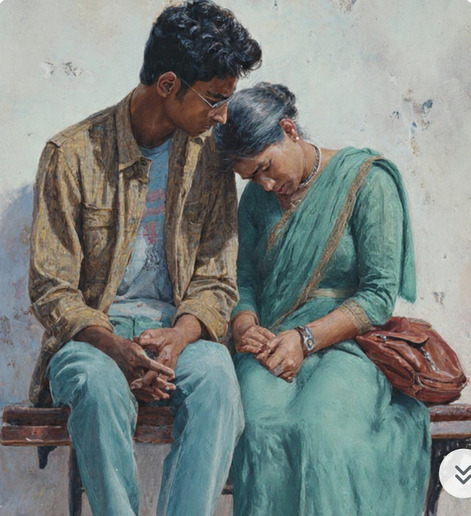
“Leave me alone” - she almost screamed at me, got up from the sofa and walked away. My only crime was sitting by her side and trying to hold her hand.
We were married about two months back and it was an arranged marriage. The only daughter of her parents, she was a post graduate in Science. She was good looking and soft spoken. A few minutes of private talk when we went to see her and to all my queries either it was a nod or in monosyllables. The wedding was soon afterwards and our first night was not as I had expected. A girl all alone in new surroundings and new people, it was bound to happen and I tried to be very understanding. As days went by, I knew things were not going to be easy. Nimmy felt out of place in my house and to make her comfortable I told her,
“Let us go to your house and stay for a few days”
Expecting that my statement would make her happy, I was surprised and confused when she gave me a stone-faced look. I had planned for a fortnight's stay in my place but the situation forced me to leave with Nimmy to my workplace far away within a week. I believed that being far away from the crowd and just the two of us would make a change. Within days I was proved wrong. Nimmy appeared a loner. She wouldn’t talk to anyone and even to me very rarely. I tried my best to take her outside to the park or to a restaurant but she was never pleased with it. When it came to cooking, she was very poor at it and I was forced to employ a cook. She even kept away from giving instructions to the cook and the burden fell on me. I inferred that she was interested in reading and took her to the book stall. For the first time I saw her smile and she walked out with a handload of books, mostly poetry.
Days passed by without much interaction and one morning as I was leaving for office she thrust a bit of paper into my hand. I opened it and found the word “Pads” written on it. I was sensible enough to understand the need but wondered why it was happening this way. We had to talk it out.
It was that evening that I sat by her side and tried to hold her hand when she exploded. It could have been due to PMS but I strongly felt that she was ill. I loved her very much and it was my vow to help her without her or my parents knowing about the happenings. Her parents certainly would have known about her peculiar mannerisms but must have believed that a marriage would resolve all the problems.
I knew she had a mental problem which had to be handled with care and caution. Her interest in poetry was a trump card which could be used to ease her mind and make her calm. I bought a few more poetry books and gave her and she appeared to be pleased. A few weeks later she gave me a list of books and said,
“Please order for these from Amazon”
When the books arrived, she appeared to be highly excited and I took that opportunity and told her,
“My friend Rajesh’s wife Geetha is a professor. She is a poet in her own right and has published many books. I will get them for you and we will also make a visit shortly." The fact that Rajesh was a physiatrist I kept back from Nimmy. I got her Geetha’s books and she told me that they were outstanding. I noticed that Nimmy had also started writing poems. At this point I told her that a laptop will be of immense help and we will buy one for her. She was a bit hesitant saying,
“I don’t know how to operate it.”
“I will teach you and it is not rocket science”
She was a fast learner and within a week she was into it all by herself.
After a fortnight we planned a visit to Rajesh and Nimmy appeared excited to meet Geetha, the poet.
We reached my friend’s house and got a warm welcome with both of them waiting at the gate to receive us. We friends were catching up with the missed happenings after leaving college when Rajesh said that Geetha was busy with her next publication of poems. I told Rajesh that Nimmy was also a budding poet and has read most of Geetha’s works.
“If your wife is also a poet then I have another grieving partner” Rajesh said laughing.
Geetha took Nimmy inside and I had a private talk with Rajesh. After listening to me Rajesh said,
“Let us not talk about it to Nimmy now and you keep on encouraging her interest and passion towards poetry as it will do wonders. A hobby is a miracle cure.”
The visit was a blessing and Nimmy liked Geetha very much and the first friend Nimmy had here in the city. She was writing poetry and sharing it with Geetha. She showed me a reply from Geetha which said,
“I am saving your poems which are extremely good in a separate folder so that they can be published at a later date.” She appeared proud reading it to me and I said,
“Rajesh and Geetha were planning to come over but Geetha’s book launching is coming up and they had to postpone it. I had told him that we will come over this weekend.”
Nimmy was happy and excited and dressed in her best and while travelling I told her about Rajesh. He was a visiting professor at NIMHANS and a much sought after man for many international conferences. She asked me about NIMHANS and I explained to her about the premier institute which deals with neuroscience and mental health. I was sceptical about how she would take the word "mental". Fortunately it went off smoothly.
Same happy atmosphere at Rajesh’s place and all of us sat together and discussed Nimmi’s issue.
“Let us go the clinic next door and let Geetha also accompany us.”
At the clinic he explained the various forms of mental disorder and said that if analysed closely all of us have mental problems. It is kept in place because of our individual nerve strength.
He had a lengthy talk with Nimmy and she answered his probing questions without any hesitation. I think the poetic bond must have helped in soothing her nerves.
“I would call this illness, if it is to be called so, MDD. Don’t get upset by these big words as it is not a big issue and can be tackled with medication. To satisfy your curiosity I will expand the abbreviation- Major Depressive Disorder, but to me this is just minor.” Rajesh said.
As we were bidding farewell Geetha said,
“Every Sunday morning at 7 there is a poets’ gathering at Cubbon park. We will be there and you will love it.”
Weekend Park meet was sheer joy and Nimmy enjoyed it thoroughly.
A sea of changes came in her after all these happenings. She started helping the cook and served morning tea to me. Having tea together became a routine while we discussed general happenings including poetry. She took her medicines with dedication which added to her healing.
Days passed by and on a weekend, I was sitting on the sofa reading the newspaper. Nimmy came and sat by my side and after a while held my hand….
“Sree”, her grip tightened and said,
“Please don’t leave me.”
I let the paper fall from my hands and embraced her tightly with Nimmy reciprocating. How long we remained like that we don’t know and it must have been with our eyes closed.
The cook had walked past us and certainly it must have been with a shy smile.
T. V. Sreekumar is a retired Engineer stationed at Pondicherry with a passion for writing. He was a blogger with Sulekha for over fifteen years and a regular contributor writing under the name SuchisreeSreekumar.
Some of his stories were published in Women's Era. “THE HINDU” had also published some of his writings on its Open Page..
RARE GEMS IN THE PORTUGUESE SECTION, GOA STATE MUSEUM
Dr. Paramita Mukherjee Mullick
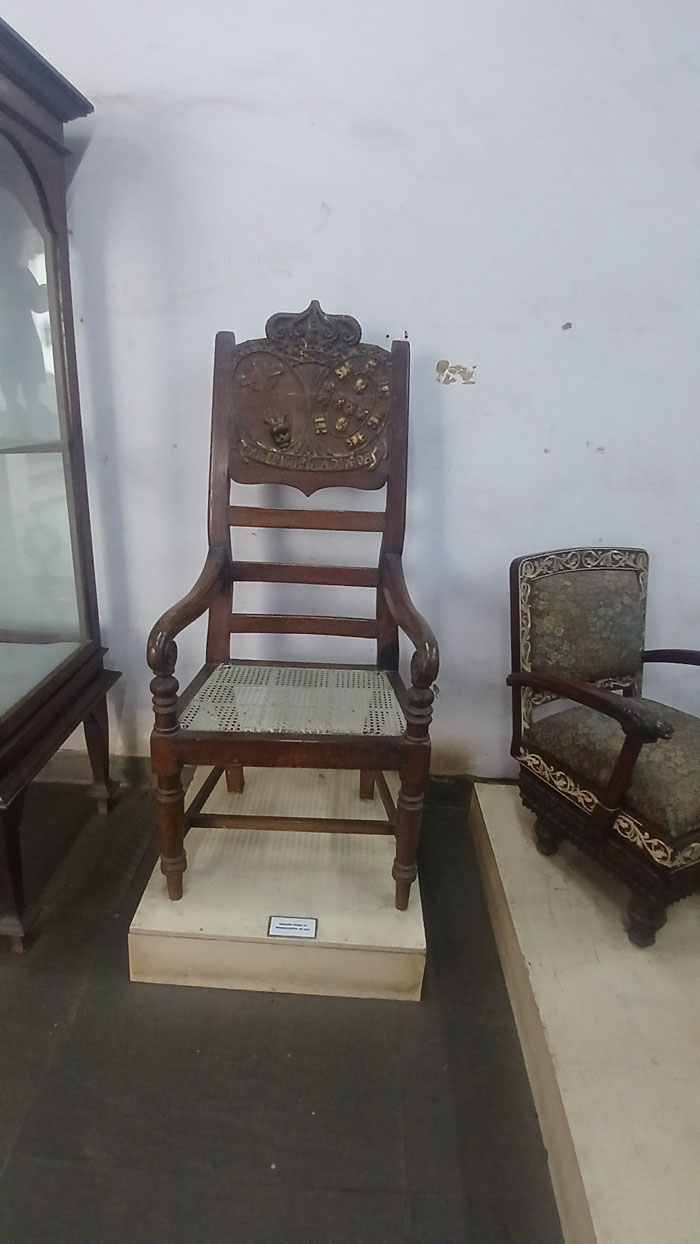
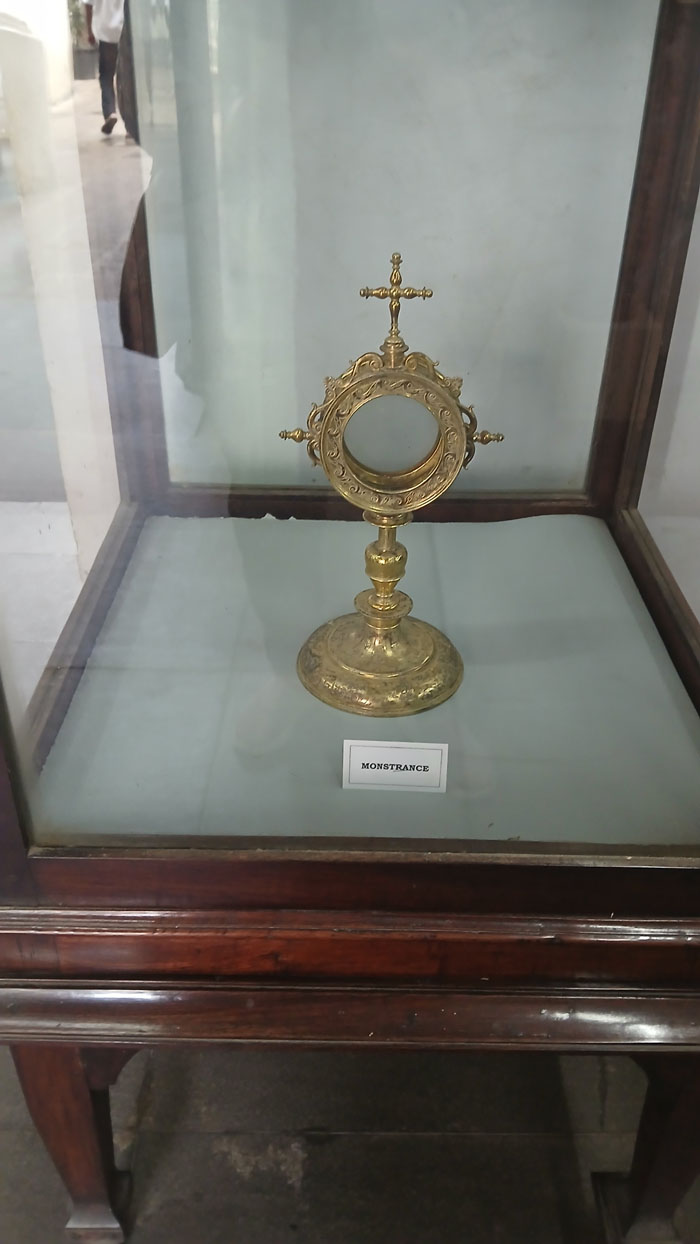
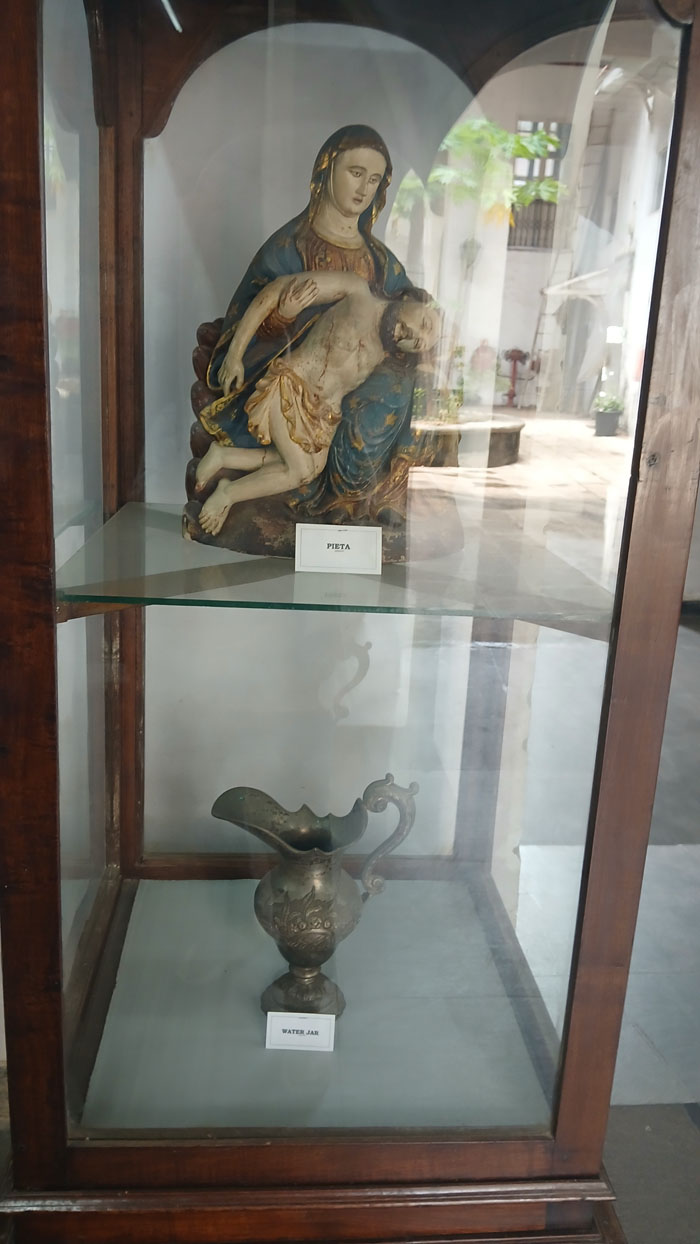
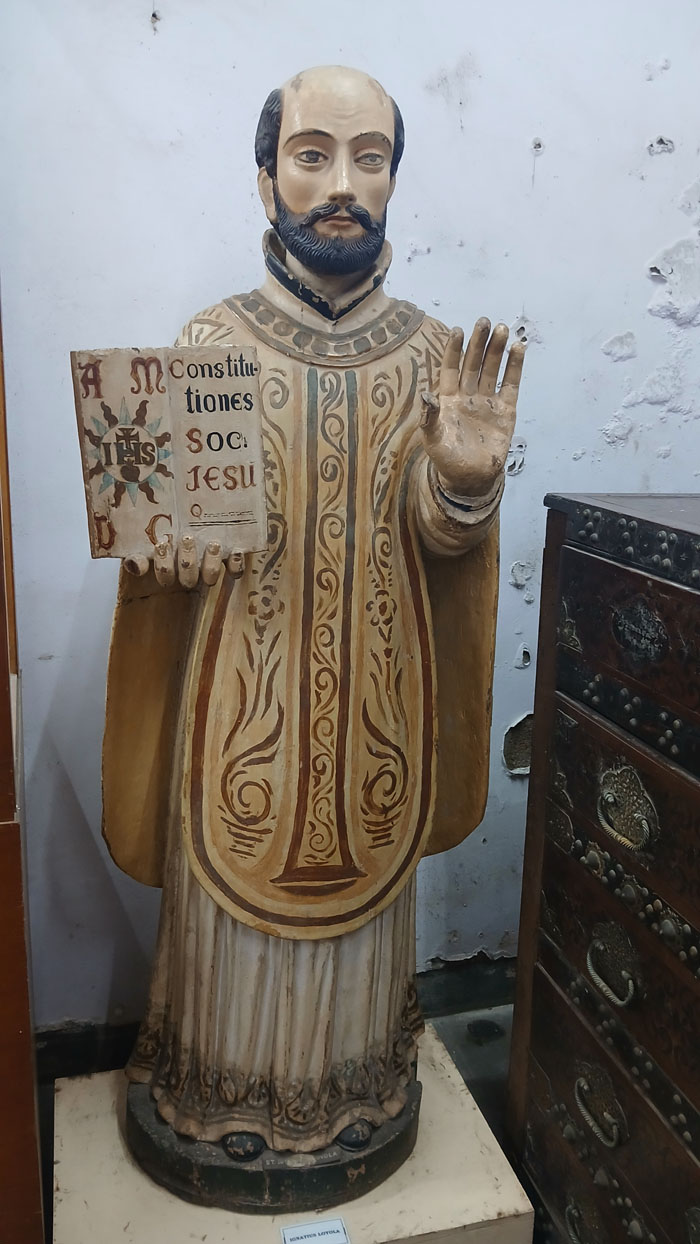
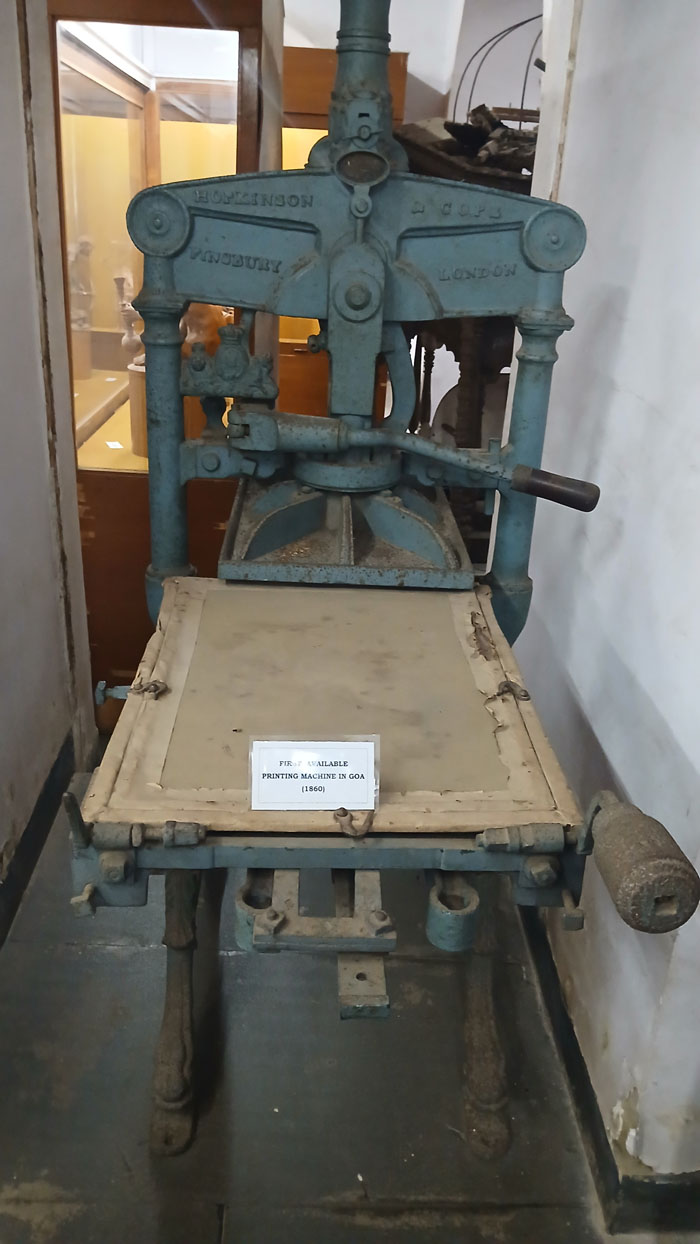
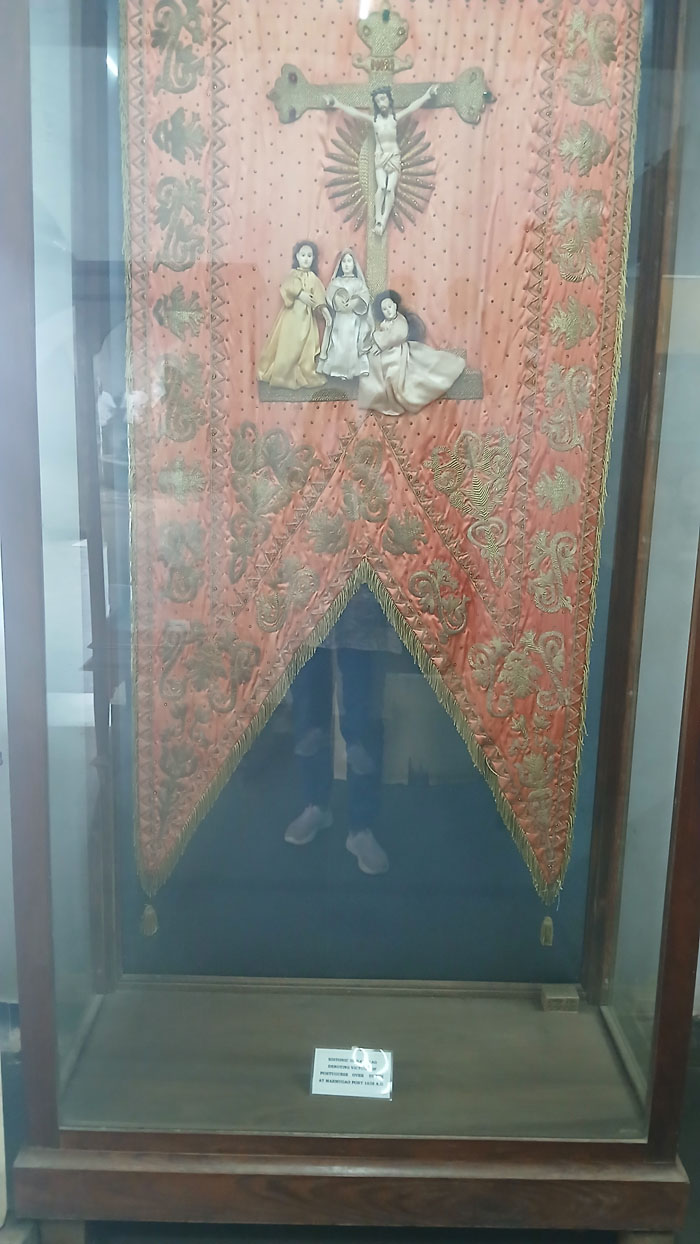
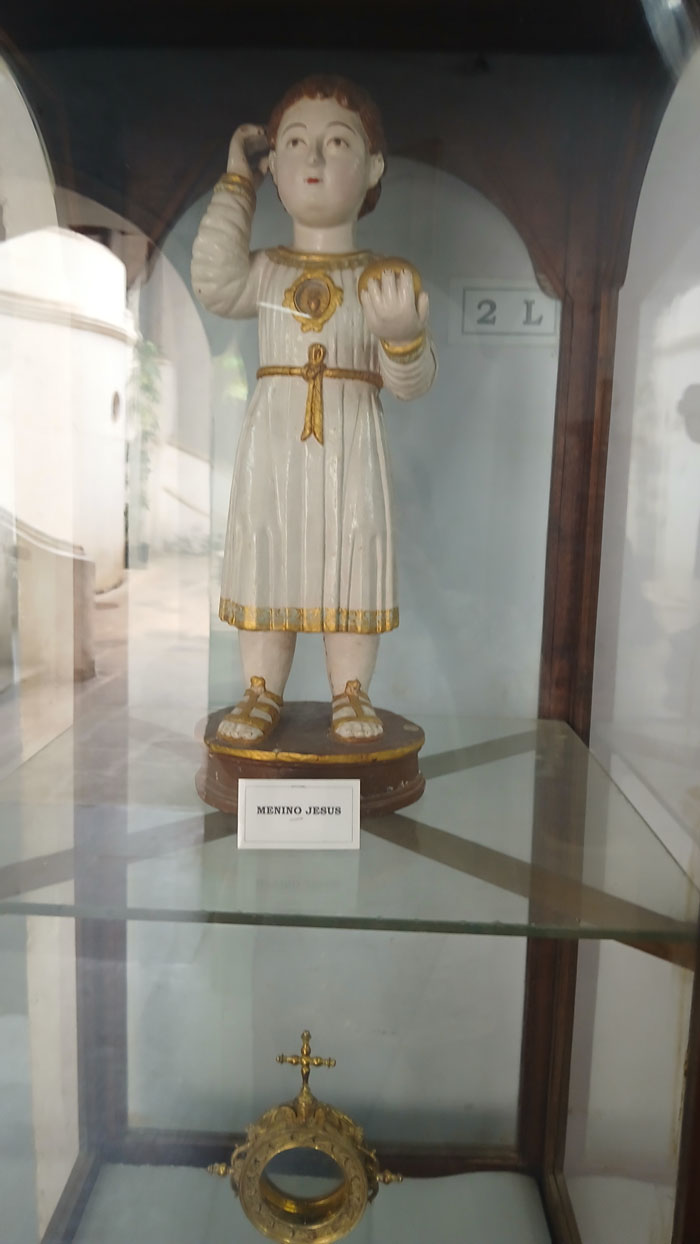
We were enjoying a family vacation at Goa. On a lovely morning we took a car ride from Anjuna to Panjim. The long stretch of road beside the Mandovi River was refreshing. The Goa State Museum was on that road.
From early childhood museums were my favourite haunt. My school was very near my father’s office. My father, a famous Anthropologist was the Director of the Anthropology and Archaeology section of the Anthropological Survey of India, Calcutta (now Kolkata). So after school sometimes my sister and I would go directly to the Indian Museum, Kolkata, the oldest and largest museum of Asia and look at the exhibits till the evening when our father used to take us back home after work.
So I was excited and looking forward to visit the museum at Panjim (Panaji as the locals call it). My husband dropped me there. I with a journal and a pen in my hand walked in with so much of anticipation. I was looking forward to know in details about the Portuguese history of Goa. The Portuguese ruled Goa for about four hundred and fifty one years from 1510 to 1961. The influence of the Portuguese can be seen in the cuisine, architecture, religion and culture of Goa. But I was taken aback to see that only a small room was dedicated for the Portuguese history.
Undaunted I started looking at the exhibits of the room and found some rare gems. The most eye catching was a big, almost human sized red silk flag announcing the victory of the Portuguese over the Dutch at Marmagoa Port in 1638 AD. It was inside a glass cover…the red colour was faded and pale. I stood mesmerised in front of it awhile imaging what it was like in 1638. Another interesting exhibit was the first printing machine in Goa and was made in the year 1860. There were two humongous wooden chests of drawer on both ends of the room. The one on the right of the entrance door was approximately 6 x 5 feet with a depth of 4 feet. It had ten drawers with curved golden handles to pull them out. The entire wooden chest had intricate carvings all over. I was amazed to think what expertise the carpenters must have had those days. The other chest was a little smaller in size, about 6 x 3 feet with a depth of 3 feet. There were some beautiful pieces of wooden furniture especially chairs with red velvet covers and detailed carvings on the head. Some sort of Portuguese symbol was engraved on all the chairs. There was a wooden chair of Misericordia de Goa. In front of one of the chairs was an intricately carved teapoy table.
Let me tell you about the statues in the room now. A life-sized Saint Catherine statue stood near the wall. I felt that it was a POP statue. A colourful statue with the paint peeling off. A statue of Saint Ignatius of Loyola, the founder of the Jesuits was on another side beside the red victory flag I mentioned before. On the opposite wall was a sitting life-sized Madonna. In a glass display cupboard there was a small statue of Menino Jesus or boy Jesus. The most interesting statue was a replica of the Pieta. The Pieta is a renowned marble sculpture created by Michelangelo in 1498 depicting Mary cradling the body of Jesus after his crucifixion and it is kept at St. Peter’s Basilica at Vatican City. I had seen this many years back when I visited the Basilica. Unlike the original one, this Pieta was a painted POP one.
The exhibits other than these statues, were a golden monstrance and a beautiful carved golden water jar in a display cupboard. In another large display glass cupboard were two Flemish art paintings on top and three busts, one of Jesus and the other two of Franciscan saints. There was a short wooden pillar with carvings but nowhere was its significance written. There was a wooden coffer near the furniture with iron straps all around.
I was sad at the lack of maintenance of the exhibits…the paints peeling off and the colours fading. These gems are timeless and priceless and they should be preserved well. Even the room in which they were displayed was in sheer need of a new coat of painting as the plasters had come off. There was no literature for this section as well. I was crestfallen…can history be wiped off and a history which has moulded the present day Goa? History is the foundation stone of the present. I saw a flicker of hope when an authority of the Museum told me that renovation work is going on and eighty percent of the exhibits of the whole museum are preserved inside which will be displayed after the renovation.
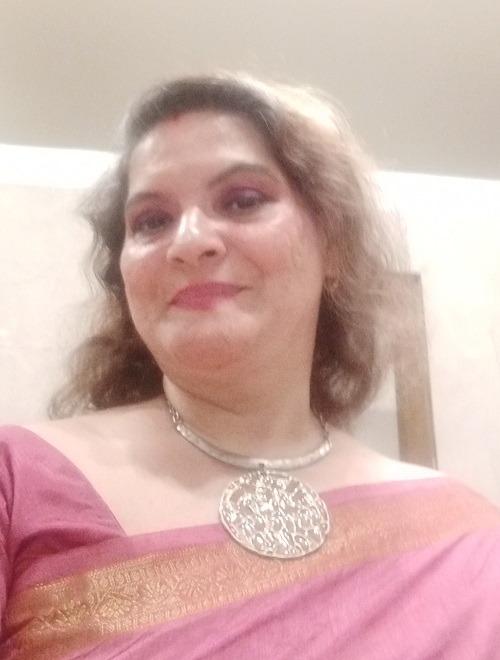
Dr. Paramita Mukherjee Mullick is a scientist, a national scholar transformed into a globally loved, award-winning poet. Her poems have been translated into 40 world languages and she has published 9 books. A globe trotter she loves calling herself a global citizen. Not only does she write poems but she promotes peace poetry, multilingual poetry, global poetry and passionately promotes indigenous poetry. Paramita believes that by promoting indigenous languages, she can bring some endangered languages into the main stream. In 2019, she got the Gold Rose from MS Production, Buenos Aires, Argentina for promotion of Literature and Culture. Apart from many awards like the Sahityan Samman in 2018, Nobel Laureate Rabindranath Tagore award in 2019, Poetess of Elegance 2019 and many more she was one of the recipients of the prestigious Panorama International Literature award from Greece in 2022. Paramita is the President and Initiator of the Mumbai Chapter of the Intercultural Poetry and Performance Library (IPPL) and also the Cultural Convenor and Literary Coordinator (West India) of the International Society for Intercultural Studies and Research (ISISAR).
THE WORLD AT FINGER-TIPS
Sukumaran C.V.
I have queued up to pay electricity bills, to reserve train-tickets, to remit property tax etc. We had to keep cash in hand to pay for LPG cylinder when it was delivered, and we could not go for purchasing without cash in hand.
Now, I pay the electricity bill and property tax on my phone through GP, train-tickets and flight tickets are reserved on mobile paying the money through GP. LPG bill is paid online. Purchasing is made simple as we have to carry with us only the mobile phone which has of course become an additional part of human body. Nowadays, wherever we go, the mobile won't be forgotten, even if we forget the kerchief or spectacles. When internet and mobile phone have combined together, queuing up has virtually been thrown out of our lives. Queues to reserve railway tickets are an obsolete sight today.
In the past, visiting bookshops was unavoidable for me. But often, the books I have been looking fervently might not get from the shops I used to visit. Today, I visit book shops rarely. Books are purchased online and every book I need will reach my home unfailingly. And Flipkart brings everything my wife needs to our doorstep.
Nowadays my wife and I go out only for sight-seeings; we hardly keep hard cash in hand. If we want to have snacks, we google pay, if our vehicles want petrol/diesel, we google pay. In the past, if we purchase something which costs Rs. 102 and we pay a five hundred rupee note, the merchant would ask us to give two rupee coins and we would fudge our purse and pockets and would say, "No, there is no two rupee change." Both the seller and the buyer would be in a predicament. Online payments have rescued us from such predicaments, fumblings and wastage of time.
There are many gadgets that altered human life completely, but no other gadget has altered our life so fundamentally as the mobile with internet. Internet itself has changed us a lot, but at first we could use internet only on computers. The combination of mobile and internet has made the human world far better than the combination of computer and internet. Ten years back, when I used to write articles on computer, I couldn't even dream about writing on the mobile. Today I rarely open the laptop. The mobile-internet combination has really shrunk the world to our finger-tips.
But when I see the younger generation addicted to the online/social media world of less social-contacts or interactions and more superfluousness, I fear, with all the positive sides, the mobile/internet fraternity has made the humans shallower and distanced from books and serious reading. I thought to end this article with the following quote of Einstein I found on social media: “I fear the day that technology will surpass our human interaction. The world will have a generation of idiots.”
But, immediately after the words were written down, a doubt came into my mind that Einstein might never have said or written so and I fact-checked online and found that Einstein has nowhere said so. It is misattributted to him! It is said that the first iterations of this quote appear to have been posted online in 2012. Another genius who also appears online and says things he has never uttered is none other than William Shakespeare. With its many positives, the mobile-internet-social media combination has such negatives too. While online, we should be extra-careful about what to believe and what not to.
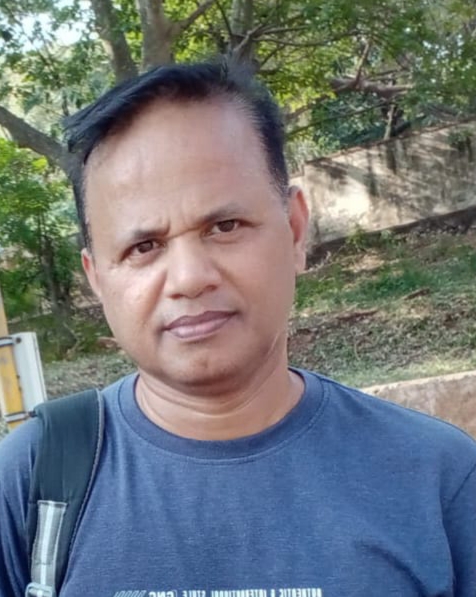
The author who hails from Palakkad district of Kerala has completed his post graduation from JNU (Jawaharlal Nehru University), New Delhi. His articles on gender, environmental and other socio-political issues are published in The Hindu, The New Indian Express, The Hans India and the current affairs weekly Mainstream etc. His writings focus on the serenity of Nature and he writes against the Environmental destruction the humans are perpetrating in the name of development that brings climate catastrophes and ecological disasters like the 2015 Chennai floods and the floods Kerala witnessed in 2018 August and 2019 August. A collection of his published articles titled Leaves torn out of life: Woman the real spine of the home and other articles was published in 2019. He is a person of great literary talent and esoteric taste. One of his articles (Where have all the birds gone?) published in The Hindu is included in the Class XII English textbook in Maharashtra by the Maharashtra State Board of Secondary and Higher Secondary Education.
LIVED WITHIN IN POETRY
Jaydeep Sarangi
“I can’t remember hearing anyone saying he will mourn for me when I am gone.” - “ Life Signs”, 39 , Jayanta Mahapatra
There are fuzzy shaded of light that only comes through a certain kind of unbound darkness. Every word written has its innate energy and power.
Life of a poet is ingrained in observation, reflection, and communication in a suitable language. It is an ancient discipline that requires courage, calm and curiosity, transforming personal experiences, longings, emotions, and worldly wisdom into verse that captures life’s fleeting moments in time's regular rotations. Human mind has it's own place to write/express in a language that stays. Human mind is like the black hole, full of mysteries and uncertainties. Some poets bring out that darkness into its surface and write out in words and idioms in a language embellished with ornaments and wisdom. How can we forget Philip Larkin’s famous lines, “Home is so sad. It stays as it was left.”
Pain, a strong feeling of sublimation, is inevitable that seeps into a house, soaking walls of order to resonate with long time feelings. Life moves fast. If we consider the image of a narrow room it is a metaphor for a mind desperately looking for a door somewhere. In Margaret Atwood's " Journey to the Interior" describes a person who realises that looking inward is dangerous, directionless where standard maps and compasses fail. But, there lies the magic within. Poet Amercian Emilie Dickinson famously isolated herself in a literary room, treating her home as a 'sanctuary' to fathom the infinite depths of her lived interior. The result is a rare fabric of creativity! In the work of Gwendolyn Brooks , the interior lives are juxtaposed with those living the " American Dream". Poet Bibhu Padhi from Cuttacmakes friendship with time through his psychological poems dealing with fuzziness in life and dreams. Mamang Dai energies small towns and rivers speaking. Her community is her mind.
Domestic interior is the new buzz in contemporary poetry and other art forms. Contemporary poets set trends. Let us remember a few lines from Shara McCallum,
" ...with this new order. In time/ you will simply make the bed and lie down."
This interior space narrows into beams, gutters ,and hard truths of families residing under one roof. Subtle, powerful, lively and passionate poems by Basudhara Roy are delightful read where she invites her readers to look at multiple shades of life that often pass unnoticed; shepherding home and the matters of the mind. Memory, nostalgia, loss of faith and ruins in different forms and facets speak deep in her poems. After a session of truce with light, she calls for clothes to retain dignity in life,
" Yet, after every cremation will haunt a disquiet."
The unspoken is forever fresh, strong and romantic. Softness triumphs over hard forms. For her, poetry is capital of life, revisiting the transactions of relationships, silenced truths of female agency, everyday domesticity and existence that lie quietly in hearth inhabiting soul spaces. She digs hearts deep. The essence of Pablo Neruda lies in capturing the visceral experiences of human passion. His Sensual Romanticism works on deep reliance on natural imagery to depict the human heart and lived moments. He becomes a candid spokesman for love! Rooted in Spanish heritage death is Federico Garcia Lorca's most pervasive theme:
"Woodcutter.
Cut out my shadow. "
In the era of Alexandrian scholarship, what survived of Sappho’s work was collected and published in a standard edition of nine books of lyrical verse of the sublime order,
“Set are the Pleiades; the Moon is down
And midnight dark on high.
The hours, the hours, drift by,
And here I lie,
Alone.”
With a baggage of uncertainties (of joy and wonder) let's embrace our life as a boat, and a poem is a sail to reach somewhere. When tied in mind we can't speak out in faith in the order of things, can't move. But, our mind has energy to see beyond the immediate. A pull within is the weather of living and writing. An author conceives a subject somewhere beyond a predictable corpus or destination. It's not about the size and structure of writing but the motion of the ocean; how they create the universe of writing. To become magical is the foundation of the reception ideology arousing the feelings dream-like and esoteric by the parameters of aesthetics. Poems are beautiful as they constantly search, search for a shore that is not. Phonaesthetics is how beautiful and melodic a language sounds to our ear. Contemporary Indian English poetry is subtle yet robust for experimentations, potent for highest level of impact and compelling for persuasion and creating positive aura within its readers. Conflict of the land and personal grief are the vital dose for Agha Sahid Ali. "Postcard from Kashmir" is more than a poetic document of a displaced person. The ' power of words' aesthetic focuses on mindful language, language of the soul involving mind-style. How can we not forget Eunice de Souza's 'Advice to Women' :
" ...in those great green eyes/
will teach you/
to die alone."
Heart to hearth interior, Kashiprasad Ghosh to Basudhara Roy, all soul calming Indian poets play the harp of the within , faithfully.
How can we not ask our within, “How does your soda fizz?”
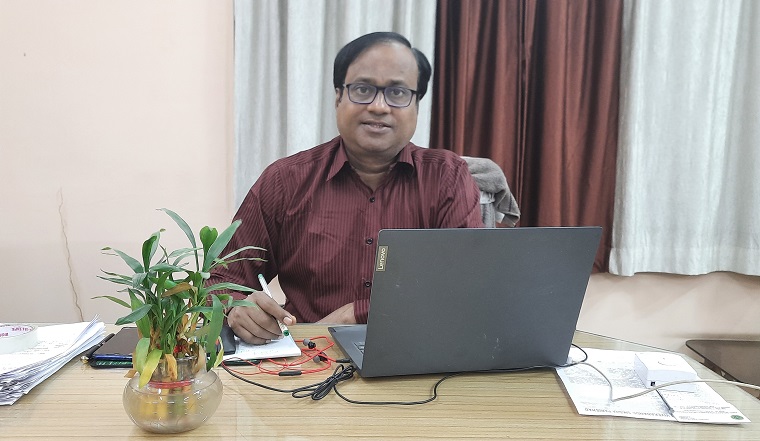
Jaydeep Sarangi is an Indian poet with ten poetry collections in English latest being Memories of Words, poetry activist and scholar on postcolonial studies and Indian Writings with forty one books anchored in Kolkata/Jhargram,.. With Rob Harle he has edited six anthologies of poems from Australia and India which are a wealthy literary link between the nations. With Amelia Walker, he has guest edited a special issue for TEXT, Adelaide (Australia). His recent books include, Mapping the Mind , Minding The Map:Twenty Contemporary Indian English Poets , Sahitya Akademi, 2023 and A Life Uprooted: A Bengali Dalit Refugee Remembers, Sahitya Akademi, 2023. Mapping the Mind, Minding the Map ( 2023, Sahitya Akademi) is his latest book. Sarangi is currently the President of Guild of Indian English Writers, Editors and Critics (GIEWEC) and Vice President, EC, Intercultural Poetry and Performance Library, Kolkata. Living with poets and poetry, Sarangi is principal of New Alipore College, KolkataHe may be reached at: jaydeepsarangi1@gmail.com Website : https://jaydeepsarangi.in/
3,600 Kilometres Through the Rainbow Nation
A Self-Drive Journey Across Wildlife, Coastlines and Wonder
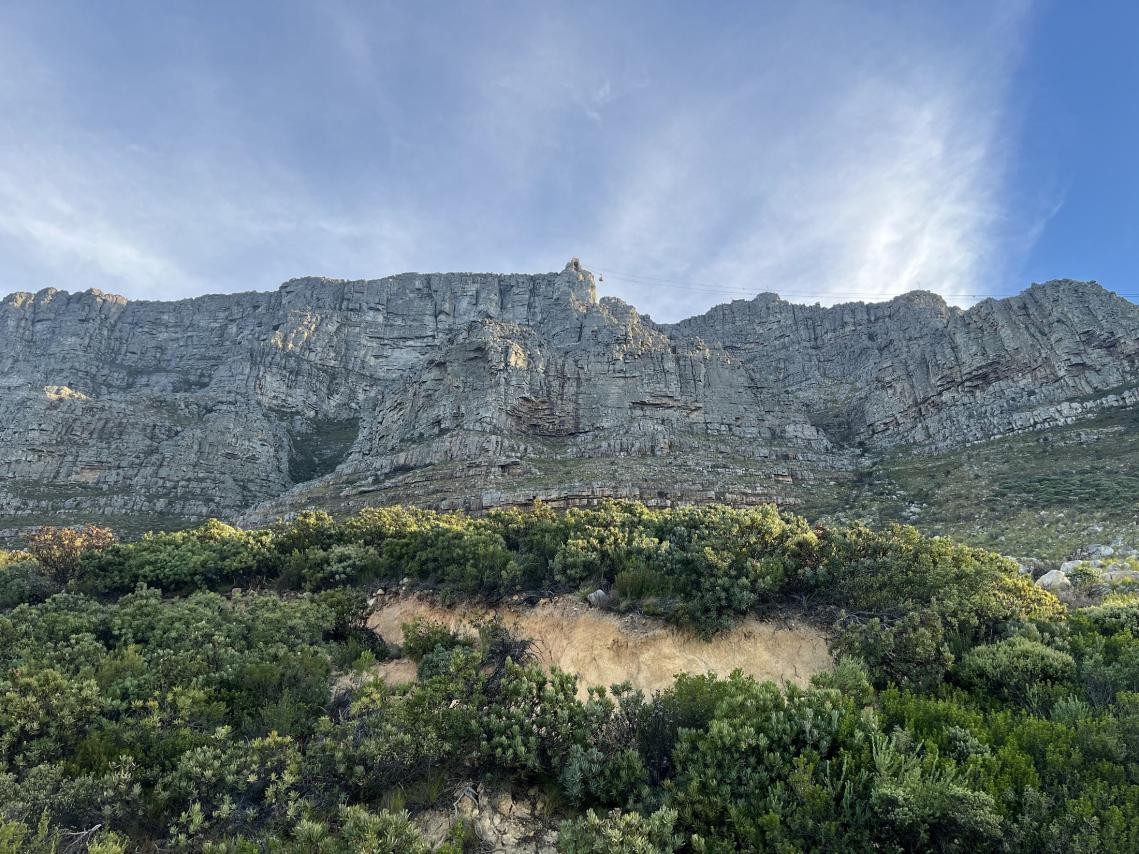
Table Mountain from Cape Town: a fitting final skyline for a journey that began 3,600 kilometres away.
Some road trips follow maps. The best ones follow curiosity.
The Ultimate 14-Day South Africa Self-Drive
When we started planning a self-drive holiday through South Africa, we discovered something surprising. There were plenty of guides for Cape Town, Kruger National Park and the Garden Route, but very few that connected them into one continuous, balanced road trip.
So, instead of following someone else's itinerary, we built our own. Over fourteen days, Ritesh and I drove approximately 3,600 kilometres across one of the most diverse countries we have ever visited - from Johannesburg's history and Kruger's wildlife to St Lucia's coastal charm, the Wild Coast, the Garden Route, the southernmost point of Africa, Cape Town and Stellenbosch.
Looking back, the route worked beautifully. It gave us big cities, small beach towns, wildlife, mountains, caves, nature, vineyards and endless coastline - all in one unforgettable journey.
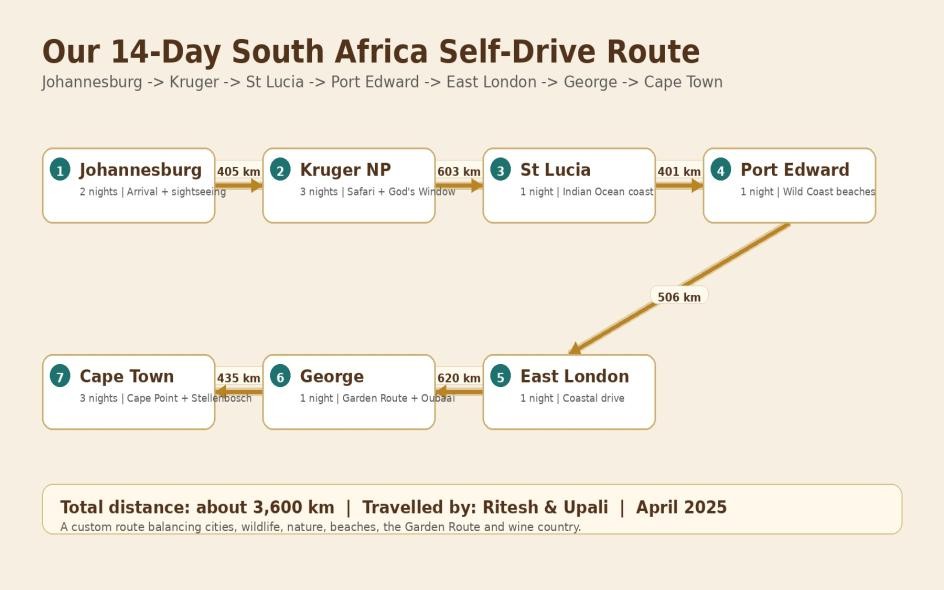
Our self-drive route from Johannesburg to Cape Town, designed to balance wildlife, scenery, beaches and cities.

Prologue - Why South Africa?
South Africa had always felt like a country that could not be understood through one city or one landscape. It needed movement. It needed roads. It needed early starts, long drives, sudden viewpoints, roadside stops, wild animals, beach towns, mountains and weather that changed its mind without warning.
That is how this trip became a road journey rather than a conventional holiday. We wanted Kruger, but not only Kruger. We wanted Cape Town, but not only Cape Town. We wanted beaches, wildlife, nature, cities and the freedom to stop whenever the view demanded it.
Fourteen days later, after driving from Johannesburg to Cape Town, we realised that South Africa is not one experience. It is many countries inside one country - each day changing the scenery, the rhythm and the emotion of the trip.
Chapter 1 - Johannesburg: The City of Gold and Memory
Our South Africa journey began in Johannesburg, the country's largest city and a place where modern life and difficult history stand side by side.
On our sightseeing day, the most meaningful stop was the Apartheid Museum. It is not an easy museum to visit, and it is not meant to be. It forces you to slow down and engage with South Africa's painful past - segregation, resistance, injustice and the long struggle toward freedom. For travellers, it is a reminder that beautiful landscapes alone do not define a country. Its history does too.
Johannesburg also gave us our first sense of scale. The roads were wide, the distances were real, and the idea of driving all the way to Cape Town suddenly felt both ambitious and exciting.
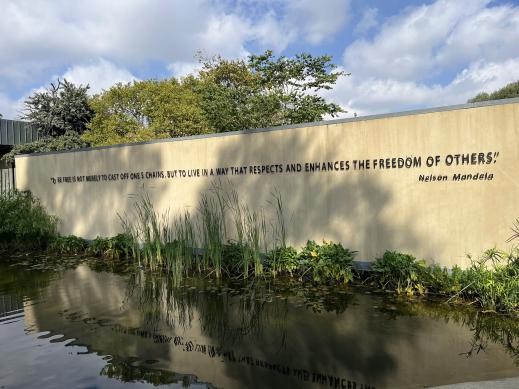
The Apartheid Museum - essential, powerful and deeply moving.
Chapter 2 - Into the Wild: Johannesburg to Kruger via Sudwala Caves
The road from Johannesburg to Kruger was the day the journey truly became a road trip. The city slowly disappeared in the rear-view mirror and the scenery began changing - highways, open land, small towns, hills and that wonderful feeling that something bigger was waiting ahead.
We added a detour to Sudwala Caves, and it turned out to be one of the best decisions of the drive. The caves are ancient, atmospheric and surprisingly impressive. Inside, the world felt cool and quiet, with dramatic rock formations shaped over millions of years.
It was a beautiful contrast: in the morning, we were driving toward the African bush; by afternoon, we were standing deep inside the earth. By evening, we were close to Kruger, carrying the anticipation that every safari traveller knows - tomorrow, the wild would begin.
Sudwala Caves - a worthwhile detour on the way to Kruger.
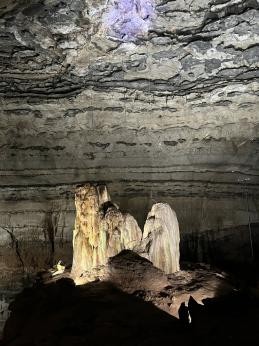
Ancient cave formations shaped slowly, silently and beautifully
over time.
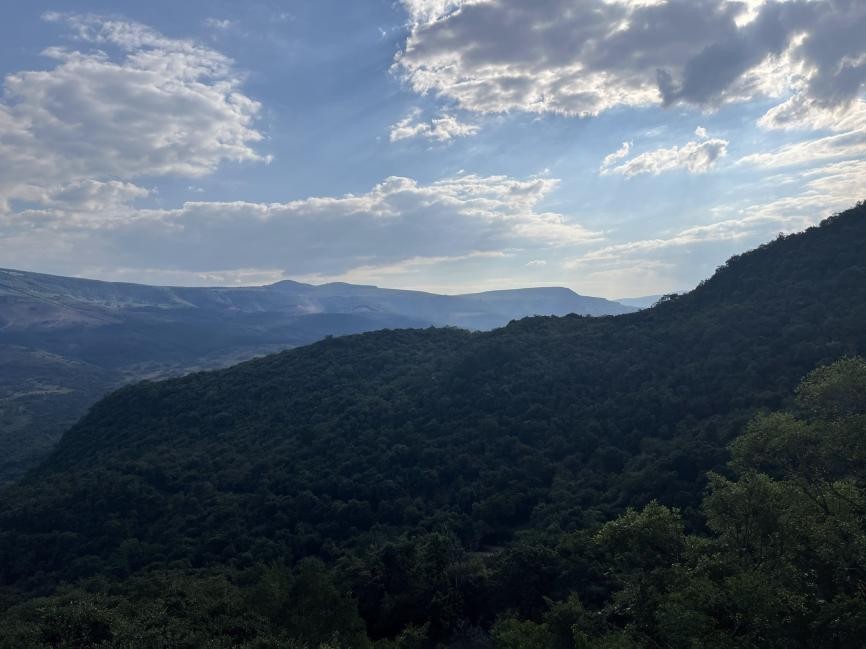
The view after Sudwala - one of those moments that makes a detour completely worthwhile.
Chapter 3 - God's Window and the Edge of the Escarpment
Around Kruger, we also explored some of Mpumalanga's most spectacular viewpoints. God's Window was exactly the kind of name that creates expectations - and somehow, the landscape lived up to it.
Standing at the edge of the escarpment, looking out over layers of green valleys and distant hills, it suddenly made sense why early travellers might have felt they were standing at the edge of the world. The view seemed to stretch endlessly, softened by clouds and framed by the bright African sky.
This is what made the route so rewarding. Kruger was not just about safari. Around it were caves, viewpoints, dramatic roads and landscapes that made the journey as memorable as the destination.
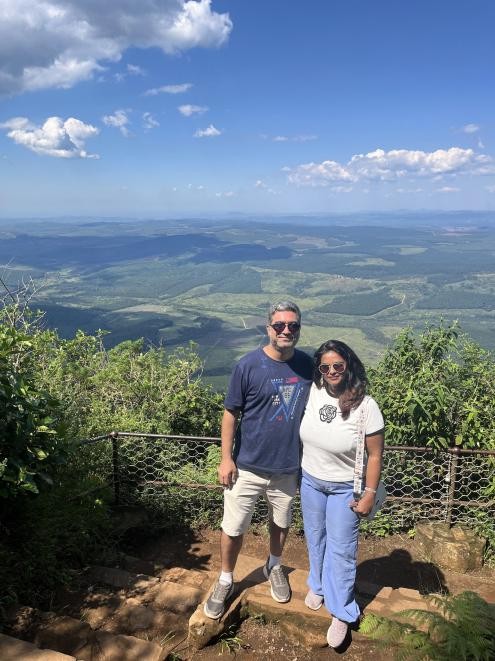
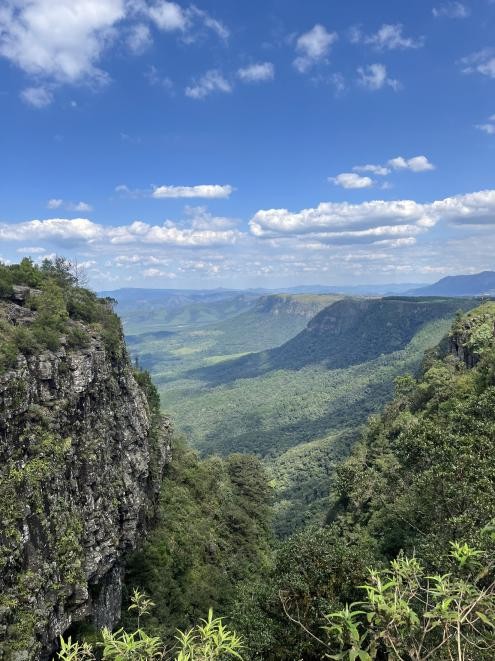
A pause at the edge of the escarpment - road trips are made of these small, perfect stops.
The Mpumalanga escarpment opened up in layers of green and blue.
Chapter 4 - Kruger National Park: The Day Africa Came Alive
Nothing prepares you for your first truly wild encounter in Africa.
Kruger was our favourite part of the trip, and it is easy to understand why. The park does not feel staged. It does not feel designed around tourists. It feels alive - sometimes quiet, sometimes dramatic, and always unpredictable.
Our most memorable sighting was a family of four elephants, most likely two mothers and two babies. They moved together slowly, but what stayed with us was how protective the adult elephants were. They positioned themselves naturally around the calves, keeping the little ones safe while watching everything around them. In that moment, they did not feel like 'wildlife'. They looked like parents - calm, intelligent and completely devoted.
We also witnessed one of those raw moments that only the wild can create: a pack of hyenas stealing a leopard's kill. It was not the polished drama of a documentary. It was nature in real time - tense, messy, fascinating and unforgettable. Africa does not follow scripts. That is exactly why it stays with you.
An early safari start - headlights, excitement and the promise of the unknown.
The elephant family - our most emotional wildlife sighting in Kruger.
Blue Wildebeest, on the move - powerful, prehistoric and magnificent.
A graceful antelope sighting along the safari road.
Close encounters in Kruger made every minute feel alive.
Chapter 5 - Safari Days: Silence, Suspense and Surprise
Safari teaches a different kind of patience. You scan the bushes. You listen. You wait. Sometimes nothing happens for several minutes, and then suddenly everything happens at once.
One moment there is only grass, trees and road. The next moment, a shape appears. A horn. A trunk. A flash of movement. A bird call. A shadow that might be nothing - or might be something extraordinary.
That is the magic of Kruger. It keeps you alert without making you restless. Every bend in the road carries possibility. Every stopped vehicle becomes a clue. Every quiet patch of bush asks you to look again.
Between the sightings were the smaller joys of safari life: warm drinks after an early start, dusty vehicles, shared smiles with other travellers, and the slow understanding that the wild reveals itself only when it chooses to.

A crocodile resting by the water - stillness with power beneath it

Our safari vehicle became a front-row seat to the African
wilderness
Chapter 6 - From Kruger to St Lucia: The Long Road to the Coast
The drive from Kruger to St Lucia was one of the longest stretches of the trip - around 603 kilometres and nearly eight hours on the road.
Long driving days can sound intimidating on paper, but in South Africa they became part of the story. The landscape kept changing, and the road gave us time to absorb what we had just experienced in Kruger before arriving at a completely different world: the coast.
St Lucia felt relaxed, breezy and beautifully placed between wildlife and the Indian Ocean. After the intensity of safari, hearing waves again felt refreshing. It was also the beginning of another major theme of the trip: South Africa's beaches are everywhere, and many of them are stunning.
. A dramatic coastal sky - South Africa often looked like a painting in motion.
The Indian Ocean coast offered a completely different rhythm after the safari days.
Chapter 7 - Port Edward and the Wild Coast: Beaches Without End
From St Lucia, we continued south toward Port Edward. This stretch reminded us why the itinerary worked so well: just when one landscape became familiar, another one arrived.
Port Edward and the surrounding coastline gave us wide beaches, crashing waves, windy viewpoints and small-town charm. Some beaches felt almost empty, as if the ocean had saved them only for those willing to drive far enough.
For us, the beaches across South Africa were among the biggest surprises. Kruger was the obvious highlight because of wildlife, but the coastline was equally amazing in a very different way. It was raw, open, photogenic and constantly changing.
Port Edward brought us back to the ocean - bright, breezy and full of energy.
Beach after beach, each with its own mood and memory.
Chapter 8 - East London: The Road Keeps Going
The drive to East London was another long one - about 506 kilometres and seven hours. By now, we had settled into the rhythm of the journey: wake up, pack, drive, stop for views, discover a new town, check in, walk, eat, sleep and begin again.
It sounds simple, but there was something deeply satisfying about it. Every day had movement. Every night brought a different hotel. Every road opened a new version of South Africa.
East London became one of those overnight stops that made the route practical and enjoyable. It broke the journey, kept us close to the coast, and reminded us that sometimes the success of a road trip depends as much on good pacing as on famous attractions.

A bright coastal stop on the way to East London.
The road hugged changing landscapes as we continued toward the
Garden Route.
Chapter 9 - George, Oubaai and the Garden Route
By the time we reached George, the trip had entered one of its most scenic phases. The Garden Route has a softness and beauty that is very different from the drama of Kruger or the openness of the Wild Coast.
Our favourite hotel of the journey was Oubaai Hotel Golf & Spa in George. It was comfortable, spacious and beautifully located, with views that made us want to slow down. After several long driving days, it felt like the perfect place to breathe.
Somewhere along this part of the journey, we also found a restaurant on top of a mountain, part of a resort, with an extraordinary view. We cannot recall the name, but the memory remains clear: a meal made special not just by the food, but by where we were sitting and what we could see.
George and Oubaai gave the trip a slower, more luxurious pause.
Garden Route and surrounding coastlines continued to surprise
Chapter 10 - Cape Agulhas: Standing at the Southernmost Point of Africa
One of the most special milestones of the journey was reaching the southernmost point of Africa. There is something powerful about standing at a geographical edge - a place where maps become real and the journey feels larger than the individual days that created it.
Cape Agulhas is where the Indian and Atlantic Oceans are often described as meeting, and even without ceremony, the place carries meaning. For us, it was one of those moments that gave the trip a sense of completion before we had even reached Cape Town.
We had driven so far by then - from Johannesburg, through Kruger, across coastal towns and along endless roads - and suddenly we were standing at the southern tip of a continent.
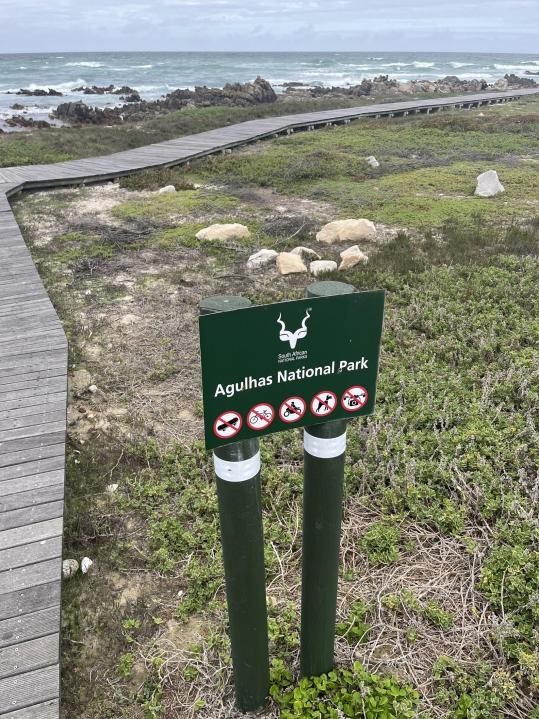
The sign that made the milestone real - the southernmost point of Africa.
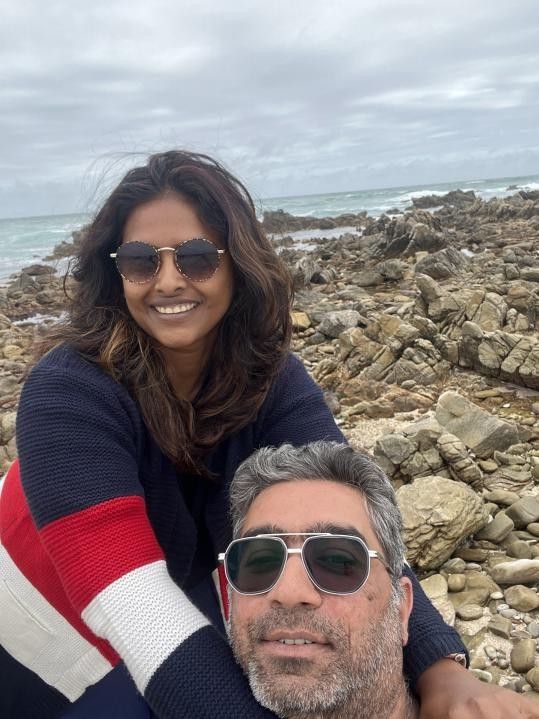
A special moment at Cape Agulhas after hundreds of kilometres on the road.
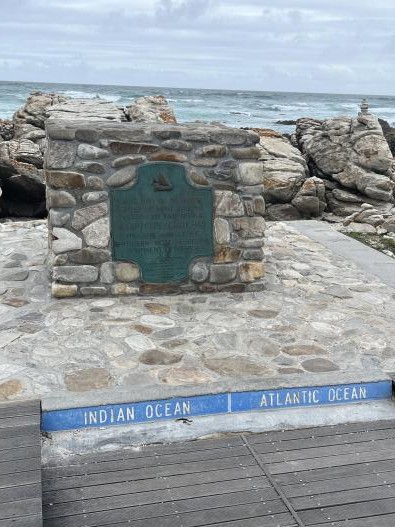
The meeting of 2 great Oceans

At the official marker - one of the most meaningful stops of the road trip.
Chapter 11 - Cape Town: Beauty, Wind and Changed Plans
Cape Town is one of the most beautiful cities in the world, and it does not take long to understand why. Mountains rise almost directly from the city. The ocean is everywhere. The light changes constantly. Even ordinary drives feel cinematic.
Of course, travel rarely follows the perfect plan. We had hoped to take the cable car up Table Mountain, but strong winds closed the service. It was disappointing, but also strangely fitting. Cape Town has its own personality, and wind is part of it.
Instead of letting one closed attraction define the day, we explored what we could - coastal viewpoints, the waterfront, historic corners and the city's extraordinary setting. Sometimes the missed plan becomes part of the story.
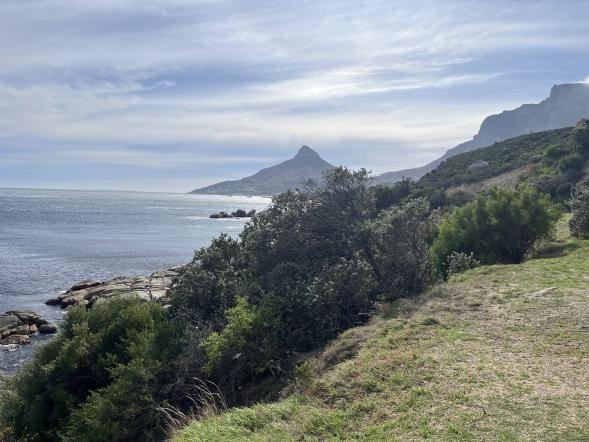
Cape Town's coastal roads are among the most beautiful urban drives anywhere.
Table Mountain dominated the skyline, even when strong winds changed our plans.
The V&A Waterfront - lively, scenic and a wonderful base for exploring Cape Town.
Chapter 12 - Penguins, Waterfront Walks and Small Joys
Cape Town also gave us lighter, joyful moments - harbour walks, ocean views, seals resting near the water, and the delight of seeing penguins along the coast.
The dolphins were another unforgettable highlight. They were super cute and added a playful energy to the coastal part of the trip. After the intensity of safari and the discipline of long driving days, these softer wildlife moments felt like a reward.
This is what South Africa does so well: it gives you the drama of the bush and then turns around and gives you the charm of marine life, beaches and city views.
Penguins near Cape Town - one of the cutest wildlife moments of the trip.

A seal resting by the harbour, completely unbothered by the world around it.
Chapter 13 - Stellenbosch and the Cape Winelands
No Cape Town itinerary feels complete without a day in the Cape Winelands. Stellenbosch brought a different pace to the journey - elegant estates, open landscapes, good food, good wine and a sense of calm after so many kilometres on the road.
The final days of a long trip often carry a special emotion. You are still travelling, but part of you has already begun to look back. In Stellenbosch, that reflection came naturally. We thought about Kruger, the elephant family, the beaches, the long drives, the southernmost point, the windy Table Mountain day and all the unexpected moments that had made the trip real.
By evening, Cape Town glittered below us from the viewpoints. It felt like a beautiful way to close the road trip.
Looking over Cape Town from above - a city framed by mountain, sea and light.
Evening in the Cape - a gentle finish to a journey filled with movement.
Cape Town by night - the city glowing after the final full day of the trip.
Absolutely.
Chapter 14 - Would We Recommend This Route?
When we planned the trip, we could not find a single road-trip itinerary that matched this exact route. Most plans focused on one region - Kruger, Cape Town or the Garden Route. We wanted something broader: a route that offered a balanced overview of South Africa without feeling rushed every single day.
This itinerary gave us exactly that. It combined big cities, small beach towns, wildlife, nature, mountains, caves, vineyards and beaches. It required long drives, but those drives became part of the adventure rather than a burden.
Would we do it again? Yes. Would we recommend it to others? Definitely - especially to travellers who enjoy self-driving, varied landscapes and the freedom to build their own journey.
Our Favourite Moments
? Watching the elephant family in Kruger, especially the protective behaviour of the mothers around the calves
? Seeing a pack of hyenas steal a leopard's kill - raw, dramatic and unforgettable
? Standing at the southernmost point of Africa
? Discovering beaches all along the route, each one different from the last
? Seeing dolphins and penguins along the coast
? Visiting Sudwala Caves as a detour that became a highlight
? Looking out from God's Window across the Mpumalanga escarpment.
? Staying at Oubaai Hotel Golf & Spa in George\
? Finding a mountain-top restaurant with an incredible view, even if we cannot remember its name.
? Realising that the itinerary we built ourselves had worked beautifully.
Small coastal stops added warmth and surprise to the long drive.
Epilogue - The Road Stays With You
South Africa surprised us in every possible way.
It gave us close encounters with wildlife, breathtaking coastlines, unforgettable drives, charming small towns, world-class vineyards, dramatic viewpoints and memories that still make us smile long after returning home.
More importantly, it taught us that sometimes the best journeys are not the ones you find online. They are the ones you create yourself.
If someone asked whether we would recommend driving 3,600 kilometres across South Africa, the answer would be immediate.
Without hesitation. Absolutely.
Some countries are visited. Others are experienced. South Africa belongs to the second category.

I am Upali Aparajita, a writer, yoga educator, and wellness practitioner based in Singapore, originally from Odisha, India.
I hold a bachelor degree in electrical Engg and an MBA from Singapore.
After a career spanning banking and international marketing, I transitioned to the wellness industry in 2017 and now I teach yoga both in-person and online. My interests include art, dance, fitness, trekking, mindfulness, and creative writing. Drawing from my diverse life experiences, my writing explores themes of identity, transformation, inner growth, and human connection.
RED SCOOTER AND THE MISSING GOAT
Ashok Kumar Mishra
Retired Headmaster Bipracharan Dandapat believed in three things: discipline, punctuality, and minding one’s own business. Unfortunately, life believed in testing him on all three.
He was lounging on the cane rocking chair of his drawing room with walking gears and was waiting for the rain to stop. It was a cloudy Bhubaneswar morning with frequent drizzle preventing him to venture out for morning walk. He boasts he had never missed his morning walk last seven years, unless he was ill. The exasperating annoyance was visible on his face when his phone rang.
“Bipra! I am finished and will not be able to show my face to the world” came the shaky voice of his childhood friend Brahma from Baripada.
“Finished?” Why what happened to you? Bipracharan adjusted his spectacles, already sensing inconvenience.
“In police custody since last night”
There was a pause. Bipracharan removed his spectacles, cleaned them thoroughly, and wore them again—as if clarity of vision might help improve clarity of situation.
“What nonsense! Why?”
“They say I hit some Budhia Singh’s goat with my red colour scooter and fled towards my station bazaar road house with the dead goat!”
“You ran away with a dead goat?” Bipracharan’s voice rose to a pitch that once made generations of students sit straight.
“I didn’t! In fact my scooter was in my parking garage since last two days. On the basis of FIR lodged by the owner of the goat and eye-witness account police came in search of my red electric scooter, discovered some old scratches on the body of the scooter and enquired about the dead goat, even inspected our kitchen. They seized my scooter and took me to the police station; since then I am in their custody.”
Bipracharan frowned. All his life he felt uncomfortable with the police-rather avoided them at all cost.
“Listen carefully,” he said. “You contact Balabhadra—the retired Inspector. He still behaves as if he is in service, even at grocery shops.”
“He is not picking up.”
“Don’t worry, I will call him and will take the first available bus to Baripada.”
Balabhadra answered his phone on the fourth ring.
“Hello?”
“Balabhadra, Bipra here. Brahma has been arrested—on charge of reckless driving and stealing a goat.”
“Hmm… serious charges under IPC,” Balabhadra replied gravely.
“Serious?” What for you are there? I am reaching Baripada in four hours’ time. Meet me at the bus stand.”
“Today? Arre Bipra, today local distiller Mohan Garabadu is throwing a grand lunch party! I have already promised to attend. It’s a big event followed by drinks. I am in his selective guest list for sudden lunch progrmme at his house.”
“Brahma is in police custody and for you attending lunch party is so important?”
Balabhadra paused. “Okay. I will not join them for drinks and come to pick you up after the meal. ”
Five hours later, Bipracharan arrived at Baripada bus stand, armed with a small bag, a large sense of duty, and growing irritation.
After receiving a call from Bipracharan, Balabhadra arrived, wiping his hands with a handkerchief and both moved to the police station. Brahma’s red scooter was parked under the tamarind tree inside the police station compound.
“Ah, Bipra! Good you came travelling long distance. Sorry, I could not say no to a sumptuous mutton meal at Garabadu house. Hyderabadi mutton dum biriyani was awesome.”
They soon found son of Brahma sitting on police station bench. Swollen faced he came running and paid respect to both. “Uncle, I swear papa is innocent. For that matter the scooter was parked since last two days inside our garage.”
The in-charge of police station came out and shook hands with Balabhadra and pointed towards the red Honda electric scooter of Brahma, the accident causing vehicle. “But the dead goat is not traceable yet. Brahma is not cooperating and revealing anything about the stolen animal. On the basis of eyewitness account we have picked up Brahma and put him in police lock-up. This is a small place and there are a few red colour scooters. People have seen the red Honda electric scooter hit the goat and the rider and his accomplice ran away with the dead goat on the road towards Brahma’s house.
“Oh, a red coloured electric Honda scooter? Let me see the FIR and the charges on Brahma ”
Balabhadra scratched his head to remember where he had seen one recently.
Oh, yes he had seen one red electric Honda scooter parked outside Garabadu’s house with broken head light and front fender. He recollected about the mutton biriyani he devoured at his house and tried to link both.
Bipracharan stared at him.
“You mean innocent Brahma is in jail because of mistaken identity? Someone else owns a similar scooter and actually committed the crime? How are you so sure?
“Come with me.” Balabhadra stroked his chin and asked the Inspector to take out the office Bolero. Soon everyone reached Garabadu and on interrogation he confessed and divulged everything to the police. It was his younger son and his friend who caused the accident and fled with the dead goat. Quickly a sudden lunch programme was planned. The goat was served in lunch that afternoon. He agreed to compensate the goat owner by paying double the price of the goat.
All four of them returned to police station. Garabadu’s son and friend followed in the red scooter. Garabadu, his son and friend apologized to Brahma for the inconvenience caused. Budhia Singh, the goat owner was summoned and asked to withdraw his complaint.
Brahma was released from police custody.
“Don’t worry Sir, the constable will take the scooter to your house. We were misled by the eye witness account and you were troubled for no fault of yours” said the inspector.
As they walked out, Bipracharan turned to Balabhadra.
“You played a Sherlock Holmes and solved the case with mutton biriyani playing the clue.”
Balabhadra smiled proudly.
“Experience, my friend. Years of service.”
Brahma shook his head.
They all had a hearty laugh; walked away and Bipracharan returned home that evening
( The end)
Completed his MA and M Phil in Political studies from JNU and served as Deputy General Manager in NABARD. He made pioneering contribution in building up Self Help Group movement in Odisha and popularized Amrapally mango plantation in the state. He has authored several books and written several articles on micro credit movement. Four tele films were made on his book titled “A Small Step forward”. He served as Director of a bank for over six Years.
An acclaimed Short story writer in Odia and English. His stories are rooted in the soil and have sublime human touch. Many of his short stories in Odia have been published in reputed magazines. His short story collection “Michha jharanara pani” was released recently.
(9491213015)(m)
A LEAF FROM MEMORY FILE
Bankim Chandra Tola

In some of my earlier anecdotes published in LV, I have recounted a few rare and memorable instances from my experience as Regional Head of a Bank while confronting thrilling incidents. In this article, I thought it would be stereotype and monotonous to embark on similar incidents happening with me while discharging duties as controller of Branches of a Nationalized Bank. Rather I should pick some of my chilling and breathtaking experiences that came upon me on different occasions. Here I would like to dwell on certain horrific situations that I faced in course of my tenure as Chief Regional Manager of my Bank’s Lucknow Region while controlling all Branches of that Region spread across the length and breadth of Undivided Uttar Pradesh (before formation of Uttarakhand state), ranging from Banaras to Ghaziabad, Agra to Gorakhpur and Jhansi to Rishikesh and Badrinath.
If I remember correctly, it was mid-September when I was at Agra for inspection of Bank’s Agra Branch. Incidentally, my wife also accompanied me to see Tajmahal. As I had no time to take her to the monument, I asked the Manager, Agra Branch to arrange a guide for her.
x x x
At about 1 ‘O’ clock the business meeting in the Branch was concluded. I asked the manager to inquire if my wife had returned by then so that we may return to Lucknow soon after our lunch. The manager was dynamic and meticulous in taking care of every tidbit. He said Sir, along with the guide I sent another reliable person to give her company. Madam has returned to the hotel. Now we may go for the lunch arranged in that hotel only.”
My wife seemed very happy as she excitedly narrated while taking lunch how she had a clear view of Tajmahal dazzling bright with the rays of Sun on the bank of river Yamuna and also about the other sites of historical importance including the dilapidated fort where Shahajahan was incarcerated by his cruel son, Aurangazeb. I told her, “Very fine, I am glad that you have enjoyed. I have thought of returning to Lucknow today. So after the lunch, get ready for our return journey.”
Arrangement for lunch was neatly done by the Manager with our choice recipes. He was very happy with the outcome of our business deal with a reputed company involving 100 crores. Over the lunch table when we were exchanging our views on further action to be taken to accomplish the project, a messenger came running from the Branch and informed us that the manager of our Jhansi Branch is online and he wants to talk to the Chief Regional Manager Sahab only. Without a word I left my lunch half-eaten and proceeded to the bank in the next building asking my wife and the manager, Agra Branch to continue until I come back.
At that time there was no mobile phone service. I thought the manager might be in some serious problem for which he was holding on the telephone to talk to me. Coming to the branch as I responded to the call, the manager of Jhansi Branch said, “Sir, Kindly come to my Branch today at any cost for a very urgent business meeting to be held at 8 P. M. in Royal hotel where a renowned industrialist of the city has convened the meeting duly inviting the Managers of all banks in the city including us for financing his mega project for setting up a firebricks refractory involving an investment of several hundred crores. Sir, as I came to know from our Regional office that you have come to Agra, I called you. Kindly make it possible to come here. Sir, now it is 1 P. M. if you kindly start from Agra latest by 3 P. M. it would be possible to reach Jhansi before 8 P. M.”
I said, “Have you made a groundwork on technical feasibility and economic viability of the proposed project? If the project appears prima facie viable, there is a point in my attending the meet.”
Manager - “Sir, I have with my little knowledge gone through the project report, financial analysis and visited the proposed site and verified the statutory permissions and licenses for setting up the industry from appropriate authorities. I think our involvement in the project would be worth doing.”
I said, “Okay then, I shall try to reach on time.”
The Manager said, “Sir, one important thing to tell you, – while coming please ask the driver to cross Chambal valley after Dholpur in Bundelkhand area as quickly as possible without making a halt. Now the Chambal robbers are very aggressive in attacking passersby on the highway taking them as easy target. Sir, I am informing the time of your movement with your car Number to all police stations coming between Dholpur to Gwalior to keep watch.”
I thanked the manager and hurried back to the hotel to finish my lunch and get ready for the journey to Jhansi, which was about five hours drive.
When I informed my wife about my travel to Jhansi instead of Lucknow, she was overjoyed and excited to see the historic fort of Rani Laksmibai who rose in revolt against “The Doctrine of lapse”, a black law of British Raj enforced to annex her Jhansi kingdom with their territory. A brave lady fighting against mighty forces of Britain with swords in both her hands taking her adopted son, Damodar Rao fastened securely to her back, she was slain in the battlefield. Revered as a daughter of Odisha through her ancestral lineage, she has left behind a timeless legacy of patriotism, self-sacrifice and indomitable fortitude for posterity. My wife said with great enthusiasm – “I have a long-cherished desire to see the remnants of her majestic fort.”
I said, “Okay, now get ready soon, we must move fast.”
I asked the manager to call my driver who by that time must have taken his lunch.
My driver, Ramesh, a Pahadi boy from Nainital is strong and hardy. He has been like my shadow since I joined our Regaional office in Lucknow. He, in addition to safe driving, guided me about the geography of UP, the largest state of India whenever I made a programme of visiting the branches situated in different corners of the state. I asked him to make a quick check of the car for our travel to Jhansi instead of Lucknow.
Ramesh said, “Sahab! If we are to go to Jhansi, we must start now otherwise we may face some trouble on the way as the road is not in good condition with a number of diversions and above all, Chambal valley comes on the way.”
Without delay we set off for Jhansi after giving necessary instruction to Manager, Agra Branch. My driver, Ramesh told me, “Sahab, distance from here to Dholpur is 60 kms. Dholpur is the gateway to Chambal valley. Chambal, in Bundelkhand district is a haven for robbers. They are terrors for UP, Bihar, M.P. and Rajastan. Once we reach Morena which is 115kms from here, we will be out of danger zone. Then after 10 k.ms Gwalior will come and we will be very safe. Therefore, sir, we will not stop anywhere until we reach Morena.”
Words of caution from the Manager Jhansi Branch corroborated by Ramesh, kindled unexpected curiosity tinged with a trace of fear in me to face another dreadful adventure. Without expressing my concern, I said to my driver, Ramesh, “Okay you know better what to do. Now let us proceed, it is already 2. 30 P.M.”
x x x
By the time we crossed Dholpur it was 4. 30 P.M. The road was in such a bad condition that it took two hours to cover a distance of 60 Kms only. My wife was feeling uneasy and exhausted, but I consoled her and asked her to stay hydrated by sipping water as and when she felt thirsty.
Hardly we had advanced 10 KMs. from Dholpur border, Ramesh said, “Sahab, we are now under their radar. One white car is following us.”
I said, “How do you know that they are not travellers like us but robbers?”
Ramesh, “They are maintaining about 100 meters distance constantly as I have checked by slowing down and then speeding the car. Sahab, no other vehicle also coming from either side as I can see.”
“Ramesh, if so let us face head on; you stop the car by the roadside. If they also stop then they must be following us, otherwise, they will go past us. Just take a risk and see.”
Ramesh was unwilling but I ordered him to stop. Lo! That car also stopped about 100 meters behind us. I asked Ramesh to start the car and speed up. He did so.
Hardly our car had covered anothet 5 kilometers, the said car overtook us and just beside a crossroad they blocked our passage by keeping their car in the middle of the road in a diagonal position. We were undone and had to stop. We saw, two tall well-built middle-aged men with black masks on face got down from that car and came towards us with guns in hand. Ramesh and my wife were frightened. I thought, what more could they do except snatching our valuables; so I told them to be brave and stay calm and watch.
Coming near our car, one of them knocked on rear Glassdoor where I was sitting. I lowered the glass and asked cooly – “What is the matter, why you have blocked our way?”
One with pistol pointing at me said, “Give us whatever cash and ornaments you have including watches.”
Courageously I opened the door of my car and getting down, I stood in front of him and boldly said, “Look! I am Chief Regional Manager of a Bank; now I am going to Jhansi to attend a meeting. I do not have much cash with me. Just Five hundred rupees only. You may take it and let us go as I have to reach Jhansi before 8 P.M. for an important meeting.”
“What nonsense you talk. You say you are a Bank Manager and you have only this small amount with you. Take out all that you have, or my bullet shall tear up your brain.” The robber said in a coarse voice.
I said, “Okay, if you don’t believe, you can see my wallet and why should I tell a lie?” I took out my purse and gave it to him.
The other man standing beside him took the purse and checked and took out a five hundred rupee note and returned the purse to me and said, “Ok, ask your wife to hand over all her ornaments to us.”
Reluctantly I asked my wife to take out her bangles and earrings and give them to me. Out of fear she did as I said.
I handed over the ornaments to the one who was still pointing the gun at me. Lowering his pistol, he said, “you may go now”. Then both of them returned to their car.
My driver Ramesh and my wife heaved a sigh of relief. I entered my car and asked Ramesh to start. At that point, suddenly a novel idea came to my mind and I asked Ramesh to stop the car near the robbers who, at that time, were going to board their car. Ramesh was confounded yet obeyed me and stopped near their car.
The sun was sinking to the western horizon slowly. Its bright red ochre had tinged the sky as if a red carpet spread to welcome the evening. The highway below lay deserted stretching either side like a giant serpent. Not a single vehicle was visible as far as I could see. Perhaps for the dreaded attack from robbers on this route, the people had consciously avoided travelling in late afternoon. Standing there I thought that I had nothing more to lose. Why not have a dialogue with these robbers who seem to have been misguided in their life. Let me make an audacious attempt to see if I could persuade them to return to mainstream social life abandoning the path of crime.
Anyone, however brave or powerful, would have driven fast to escape from the clutches of robbers but I summoned all my courage and resolved to face them. At that critical moment I recalled a similar incident that had occurred years ago in a small town in interior Tripura adjoining the border of Bangladesh while I was on my way to inspect a Branch of my Bank. Unexpectedly I found myself surrounded by a group of local insurgent militants. In those days, the original residents of Tripura were up in arms against the lackadaisical approach of local administration to control unrestrained influx of refugees from Bangladesh who were occupying their lands. Under tremendous pressure and mental strain, I had exercised immense coolness and patience to motivate them to reconsider their rowdy stand and find a solution in peaceful manner. I could, however, avert a serious attack. Nevertheless they were not convinced by my suggestions. I thought for a moment, if I can make a similar attempt here to guide these robbers to think of refraining themselves from doing further crimes and return to mainstream social life it might be another sublime step to humanity. Though my expectation was faint and uncertain, I decided to take the risk. With that slender hope, I moved forward and spoke to them.
“Hello brothers! Would you listen to me for a while.”
On seeing me, they became alert and with guns in hand said, “Ab Kya hai (Now what)?”
I proceeded a few steps towards them and said, “Before leaving for my destination I wanted to ask you something. Would you please listen to me and clear my doubts?”
One of the robbers retorted with an angry tone – “Marne ka irada hai kya? (What, do you want to die here).
Without the slightest trace of fear, I looked at them and said, “Brothers, tell me honestly—are you truly happy earning your livelihood in this manner? Don’t you wish to see your children educated, grow up to become officers or respected citizens, leading lives with dignity in a society? I am certain that none of you had ever dreamt of becoming highway robbers. It must have been some adverse circumstances and unavoidable compulsions that drove you to embrace this path.”
“Kya bakwas kar rahe ho; Bhago nahi to veja uda denge.” (What nonsense you talk, run away, if not, you’ll be shot to death.” said the robber with gun pointing at me.
Without being afraid I said, “Brothers! I want to change your life by offering you jobs and also fund to start business of your choice by which you can earn and live a good life. But you don’t like to hear me and you are ready to kill me! What do you gain by killing me?”
Another robber said, “Jo bhi bolna hai, chalo hamare sath Sardar ke pass. Usse balo.” (Whatever you want to say, come with us to our Sardar and tell him.)
At that point I could understand fully that these people were innocent but totally brain washed to do crime. I had to desist from this wild attempt instantly and escape from them as quickly as possible before they turn violent.
Cooly, I said, “Thank you brothers. I had an urgent meeting at Jhansi at 8 P.M. today otherwise I would have gone with you to meet your Sardar. But I promise, while returning from Jhansi I shall accompany you to meet your Sardar if you would be here by this time tomorrow.”
Saying this I got back to enter my car. Unexpectedly in a dramatic move, one of the robbers came running towards my car and said, “Tum achhe admi lagte ho; ye lo Bhabijiki zebar. Hume yeh nahi chahiye. Tumhara panso rupaye rakhlete hain.” (You appear to be a good man. Take the ornaments of Bhabiji. We don’t need it but we would just keep your Rs.500/- only.”)
Thanking him we sped fast on our way to Jhansi. I thought, thank God, at least some good sense prevailed on them to return the ornaments though I lost Rs. 500/- (which will be equal to about Rs. 5000/- now.) Road was good and no other vehicles were seen coming on the way. Ramesh accelerated the speed and we reached Jhansi by 7.40 P.M.
The Manager Jhansi Branch was anxiously waiting for me. After a small discussion about the proposed meeting, I asked the Manager to book a room for us in a hotel and then narrated the incident that happened on the way. The manager said, “Sir! God is great, you have come out unhurt. Had you incidentally gone with them to meet their Sardar, God knows what would have happened? They could have detained you and demanded huge ransom. Sir, kindly do not take such audacious steps in future, particularly with the Chambal robbers. Because, UP Govt. have taken several steps to bring them to mainstream by floating various alluring schemes and asking them to surrender but all have been in vain. Sir, they might attack you on your return journey; so kindly take a different route tomorrow.”
Thanking the manager, I decided to proceed to Meerut and then to Saharanpur for inspection of those two branches next day, while returning to Lucknow so that I would not have to enter Chambal again.
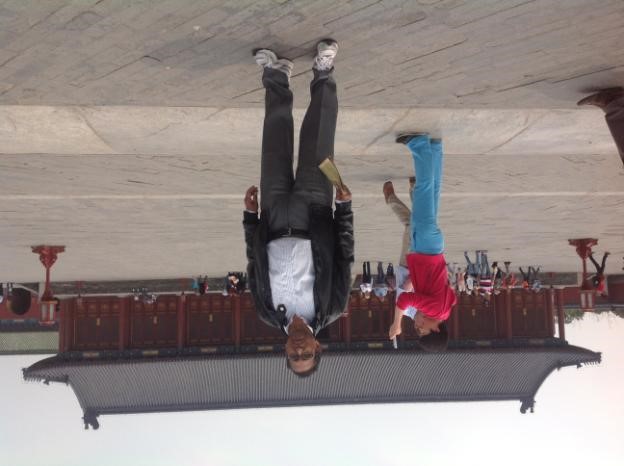
Bankim Chandra Tola, a retired Banker likes to pass time in travelling, gardening and writing small articles like the one posted here. He is not a writer or poet yet he hangs on with his pursuit of writing small miscellaneous articles for disseminating positive thoughts for better living and love for humanity. Best of luck.
THE CANE-WORKER AND MY NEPHEW
Sreechandra Banerjee
Never thought that this could happen!
During summer vacation, my twelve-year-old son Rohit went to Simla with the Boy’s Scout and I decided to visit my parents in Kolkata. Though Asansol is not far away from Kolkata and it takes only about 4 hours by super-fast train – it had really been a long time since I last visited them. So was feeling so excited! And my nephew – Tojo was so fond of me. But this time my son was not travelling with me – I wondered whether he would like it or not!
“So, Pishi-moni dear – you have come” he greeted me. A warm welcome as usual! “I’ll teach you some new computer games that I have learnt – sure Dada hasn’t taught you those!” I felt so relieved.
“Where are your grandpa and grandma dear?” I asked
“Oh, Thamma’s in the kitchen cooking something delicious for you and Dadu is there - on the armchair – you know the cane-work of that armchair has worn out – any day it would give way and grandpa would fall but still he prefers to sit on it” eight-year-old Tojo was really worried.
This Burma-teak made armchair with cane-work belonged to my great grandfather and is a family heirloom. I couldn’t afford to see its horrible condition. Must do something about it – but these days it’s impossible to get someone who knows cane-working. And besides original cane can’t be found and is often replaced by plastic too.
Anyway, next day – set out to find someone who knew cane-working. The near-by hardware shop said that a man often comes to their store looking for some assignment. So, I left my address at the store. Thankfully that man came that very day and after preliminary negotiation it was decided that the work would be done the next day!
“Tomorrow!” exclaimed my sister-in-law, Tojo’s mother.
“Why, what’s the problem?”
“I would be away – you know two of my cactus plants have gone for exhibition at the Cacti and Bonsai Show being held at the Agri-Horticulture Gardens and I’ll have to be present at tomorrow’s inauguration ceremony.”
“No problem Boudi (Bhabiji), I’ll be there, but see it’s so difficult to get hold of these people – people who know the job – its better we get it done at the earliest!”
Next day the work was nearing completion when the pet rabbit Cottontail came to the room and before we could stop him, ate some strands of the plastic that was being used as the replacement cane.
“Oh, my Cottontail, Mmmmyyy Cottontail…”Tojo started crying.
I thrust my hand into its mouth so that it threw up whatever it had gulped – but in vain – so had no other alternative than to run to the vet who managed to do the needful. Before leaving I asked my father to deal with the cane-worker.
I retuned, but… but couldn’t find Tojo, Oh My God – where was the child! Neither did Baba nor Ma know where he was but they could only recollect that Tojo was talking to the man all through.
“But did you see Tojo go with him?”
“No, it was the maid Ruma who saw them off after I paid his dues. We thought its summer vacation, so Tojo must be busy in his room playing computer-games”
Where’s Ruma? I rushed to the nearby hardware store. No, they didn’t know about the whereabouts of this man – he had never given them any contact-address!
I ran to our old-part-timer, Ruma’s home.
“No problem, don’t worry Didimoni, the man said that he would return Tojo – they are just going to the near-by store as Tojo was getting bored!”
Never…
Never thought that this could happen!
What to do, lodge a FIR immediately, before they can go far!
What an aunt I am- irresponsible! Should have asked him to accompany me to the vet.
What to tell his mother….
Never, never! – what a horrible aunt I am!
Nobody will have any mercy on me!
Now, now, Rohit – my son is in Simla – if anything happens to him!
But where to find Tojo ?
If something happens, if he doesn’t…..
No, no, never… nnnneeevvvveeerrrr………………………………
--------------------------------------------------------------------------------------------
Images are from the internet only to which I have no right (Disclaimer).
This story was written many years back.
Copyright Sreechandra Banerjee
All rights reserved except the right of the pictures which are taken from the internet.
Sreechandra Banerjee is a Chemical Engineer who has worked for many years on prestigious projects. She is also a writer and musician and has published a book titled “Tapestry of Stories” (Publisher “Writers’ Workshop). Many of her short stories, articles, travelogues, poems, etc. have been published by various newspapers and journals like Northern India Patrika (Allahabad), Times of India, etc. Sulekha.com has published one of her short stories (one of the awardees for the month of November 2007 of Sulekha-Penguin Blogprint Alliance Award) in the book: ‘Unwind: A Whirlwind of Writings’.
There are also technical publications (national and international) to her credit, some of which have fetched awards and were included in collector’s editions.
THE LITTLE BOY MISSING
Dr. Rajamouly Katta
Ramaiah was childless. He lived on agricultural labor and profession. He made chappals with a special skill as a profession. All loved to buy chappals made by him in the market. He got on his livelihood from all such sources. The people treated him as an honest man, and chappals made by him were durable.
His wife Lakshmamma helped him in his profession. She was hardworking and honest like him. They were equally work-cultured and so they were treated as good parents by the people in the village. They had the only problem that they had no children. They loved children very much. They used to take them into their arms in love and affection.
Whenever Ramaiah was ready to go to the market, he used to recall the incident of finding a small boy whom he adopted when he was childless. He went to the market as usual one day. To the exhibition, he took the son he had found thirteen years ago, as he wanted to come with him to the market. While going to the market he promised to surprise him one day. His son Gopi became curious to know about the surprise.
“Father, I am eager to know the surprise,” said Gopi earnestly.
“Dear son, there will be no charm if you listen to the surprise immediately. Wait for some time, I will make a wonderful surprise as a gift to you,” said Ramaiah.
“You keep all confidential… all suspense and make me unhappy. Father! Please let me listen to what you would like to tell me in sweet words,” said Gopi.
“Don’t be in a hurry in this matter…Take it for granted that it is a happy surprise. Don’t worry my dear son,” said Ramaiah.
“When it is a happy surprise, it is natural for all to know about it as early as possible… Father, I become more curious than before when I have heard that it is a happy surprise,” said Gopi.
“One fine morning, I tell you,” Ramaiah said to his son convincingly.
Meanwhile they reached the market where the exhibition was situated ten years ago. Ramaiah recalled the incident, finding the scene with the small boy wandering while crying.
He usually came to the market and displayed all kinds of chappals in all sizes for sale to all people. They were his regular customers coming to him. That day ten years ago stood before the eyes of his mind. Customers started coming to him one after the other.
“Ramaiah! Your chappals are durable since their quality is good…the customer friendly. What is the rate of this pair of chappals?” said the customer.
“You can take at a reasonable rate,” said Ramaiah humbly.
“I know you are not commercial. You don’t exploit the need of your customers,” said the customer.
“The pair of chappals costs Rs. 200,” said Ramaiah.
“I give you one hundred and fifty rupees for the pair,” said the customer.
“Okay, you can take the pair at the rate. You can give more when you are satisfied with the pair,” said Ramaiah.
Ramaiah sold all kinds of chappals he had made for the whole month. He got a reasonable amount at the end of the day. His son Gopi watched how his father dealt with the customers.
“Father! You are very considerate towards your customers. You struggle a lot to prepare all kinds of chappals in all sizes and sell them to customers at cheaper rates” said Gopi in a conciliatory tone.
“We have to earn good will of the customers while earning money,” said Ramaiah convincingly.
“When there is no one else to sell chappals in the market, you can sell them at higher rates to become rich,” said Gopi.
“Dear son, as I told you we are not for just money but service to them to have good name,” said Ramaiah.
Gopi learnt the secrets of business. When he was observing the manner and style of his father’s sale, he forgot to ask his father Ramaiah to let him know the surprise. He immediately resumed insisting on his father to tell him the surprise. Ramaiah was also prepared to reveal the suspense as a surprise the following day. Though he was very anxious to know the surprise soon, he kept quiet until the following day.
The next morning, Ramaiah got ready and undertook a journey. He remembered his promise. He opened a conversation with his son:
“Gopi I was childless for about ten years. I was very much fond of children like your mother Lakshmamma,” said Ramaiah with feelings in his face.
“After ten years, you were blessed with me, weren’t you?” said Gopi.
“It was a wonder…the wonder of all wonders,” said Ramaiah.
“What was that wonder? Tell me immediately,” said Gopi.
“I tell you after praying to God Venugopala Swamy whose shrine we glimpse from here,” said Ramaiah.
“Was I born with the blessings of Lord Venugopala Swamy? I hope you named me after the lord in the shrine,” said Gopi inquisitively.
“I did not name you Gopi,” said Ramaiah.
“O! My mother named me Gopi,” said Gopi.
“I tell you all… Don’t be so anxious, my dear son,” said Ramaiah.
“You seem to be typical. You promised to tell the secret of your happiness…the surprise of the day, but you are not doing so,” said Gopi.
“You can witness the surprise when we reach the village and speak to the people in a house about whom I heard after ten years. There you not only hear but also witness the surprise… After a long search I learnt the address,” said Ramaiah.
Gopi learnt that there was a great surprise…He became more curious to know the surprise. They reached the village, entered the house and started to speak to the inhabitants in the house. It was a big house lavishly built. The head of the family belonged to the clan of the Deshmukhs.
“Deshmukh, I tell you good news. Let’s go back to the days when you missed your son, your younger son as I had heard,” said Ramaiah.
“How do you know that I missed my younger son?” said Deshmukh.
“I inquired with people about you and the incident of the missing of your son,” said Ramaiah.
“Yes, I missed my younger son ten years ago when we visited the exhibition,” said Deshmukh.
“I saw a small boy crying constantly going from one exhibit to the other calling daddy… mummy…,” said Ramaiah.
“When the boy was seen crying, everyone asked him what he wanted. His only reply was ‘My dad and mum’. They tried to console him by offering sweetmeats, toys or some other to him. He rejected all running further, saying ‘I want my mum and dad’. He went on crying running hither and thither,” said Ramaiah.
“You saw him crying, running here and there in search of his parents…didn’t you,” said Deshmukh curiously.
“Yes, bad luck, he could not find his parents… I ran after him, leaving my work of supplying water to the people in the exhibition. I consoled him but he did not stop crying. He wanted his mum and dad…,” said Ramaiah.
“Was it at 9 o’clock in the night?” said Deshmukh.
“Exactly, he was found crying, running here and there in the night?” said Ramaiah.
“You could have approached the announcer, the in-charge of the exhibition to announce the missing of a small boy by his parents,” said Deshmukh.
“I was after him watching carefully… He ran and ran to see you, his parents… He failed to do so. He was tired of running… I went to him. I offered him balloons, toys and sweets. He took two balloons with a little smile after some time… I pitied the small boy for his pathetic plight and so I consoled him in all the ways possible. He was silent for a while. Tears continued to roll down from his dimpled cheeks. I lifted the small boy, enabling him to sit on my shoulder comfortably and watch you from a distance. I did not find anyone searching for him…He too did not find you even from a distance,” said Ramaiah.
“In such circumstances, you should have informed the exhibition authorities or the police on duty,” said Deshmukh.
“Then I did not know all that… I was sure of finding you, reaching for the little boy… I did not find you. You might have searched for the little boy somewhere else… I did what I was able to do,” said Ramaiah.
“What did my son say then?” said Deshmukh.
“He only said, ‘I want my mum and dad’. I asked him his lovely name…He said ‘Go…pi’. He has grown into a thirteen-year-old boy now…He is before you,” said Ramaiah.
Deshmukh called his wife, Rani Malini Devi, saying, “Our lost son has come,”
She came out and watched their son closely in happiness. They both hugged the boy though the boy did not feel any affection for them.
“Dear son, we missed you ten years ago. We searched for you in the exhibition but failed to find you, my dear son,” said the parents in one voice.
“You lost your lovely boy…I know your feelings of separation from the boy. When I found the boy, I took him to my house…My wife who was issueless then took him into her arms with all love and affection. I hope your son was under a lucky star. After his arrival in my house, our wealth increased considerably… I was blessed with twins later. All three are our favorites. We can never spend a day without seeing them,” said Ramaiah.
“Any how, the boy is safe, we are lucky. I thought the kidnappers got a chance to kidnap you, my dear son,” said Deshmukh.
“This is the happy surprise, you have heard and witnessed with your own eyes, my dear son,” said Ramaiah to Gopi.
Gopi, in response to the surprise heard, smiled heartily. He did not express any feelings. He looked at the biological parents innocently.
Deshmukh and Rani Malini Devi looked at the boy with all feelings of love. Meanwhile, all had breakfast making chit-chat in a happy mood.
“I have been pitying you since I found your son in the exhibition. He is your beloved son…You feel happy when he stays with you… He is very sharp and so he will come up in life… Your family will have a good image… This is my feeling in view of the happy situation,” said Ramaiah.
“I find you humble and honest, frank and free…I love your nature…I love your sweet disposition… You are looking after children and educating them… How much income do you have to meet all these expenses?” said Deshmukh.
“I make chappals of all varieties… Making chappals was the profession of my father as he was a Dalit. I inherited it as a mark of respect for it. People love chappals made by me… I’m a sincere cobbler having won good will of my customers… I have three sons including Gopi… All are studying well and getting ranks,” said Ramaiah humbly.
“Very good, Gopi is sharp…I’m happy he is studying successfully…You are able to meet all expenses as a cobbler,” said Deshmukh.
“Your son Gopi has been the heart of my heart so far. Hereafter you will feel that he will be the heart of your heart since you have found your lost son. Deshmukh! you can happily raise him as your younger son in your house along with your elder son. You with happily live with your two sons,” said Ramaiah.
“Let Gopi live in your house since you brought up the boy and raised him with love and affection towards you. You too have love for him…You will be deprived of his love,” said Deshmukh.
Gopi was observing all what was happening before him. His father was ready to hand over him to his biological parents. He did not welcome his father’s wishful responsibility and started to shed tears, saying to his father Ramaiah earnestly,
“Father, I have known you as my father… as my beloved father all my life. I want to be with you and my mother and live with you in our house, my dear father… You are my parents. Had I listened to the story, I would not have followed you here… I come with you. You cannot leave me here, my beloved father, hugging.”
“Your biological father is a great landlord. I should reveal it to you… If you welcome it, you will live in an aristocratic family, enjoying your father’s status… It is my moral responsibility to hand over you to your real parents… I do so as it is my principle to reveal it to you, my dear son as well as to your biological parents…They will be happy if you live with them,” said Ramaiah earnestly to his son Gopi.
“Though I was born in Deshmukh’s family, I was brought up by you with love and affection… I know you as my father, my beloved father… I want your love and affection but not Deshmukh’s property and status,” said Gopi while his eyes continued to well with tears.
Ramaiah hugged Gopi warmly and Gopi too hugged his father, Ramaiah. They repeatedly hugged each other for the deep love they have, shedding eyes.
“This is the surprise I wanted to show you not for leaving you here to your biological parents, my dear son,” said Ramaiah, hugging Gopi once again.
“My eyes have seen my biological parents, Deshmukh and Ranimalini Devi but my heart treats you, Ramaiah and Lakshmamma at our village as my parents… my beloved parents,” said Gopi to his father, Ramaiah.
During their conversation the Deshmukh learnt the fact Ramaiah was a cobbler, a Dalit by caste and Gopi was raised in the house for ten years in his house.
Ramaiah understood that Deshmukh was indifferent to his wishful responsibility. He did not evince any interest in welcoming his lost son Gopi to live in his house as his heir. He was silent when his son Gopi was ready to go and was going with Ramaiah.
SUPER SALE
Dr. Rajamouly Katta
There was a group of women busily talking about their luxuries and comforts. Amid them, there was Pujitha who was speaking in her high pitch to feel superior to other women. All in the group treated her as their leader,
'The earth is the place for us to enjoy all comforts and luxuries, and sky is the limit for them... Human birth on earth is for all pleasures not only for men but also for women. This is the twenty-first century when women are supposed to enjoy luxuries... lavish luxuries but not just ordinary comforts we had in the past,' said Pujitha in her conversation.
'Yes, we're supposed to enjoy excessive, lavish luxuries...We're not the women like those in the past to obey the orders or commands of their husbands. We're the women today, in the twenty-first century or the new millennium women, ' said Mamatha.
'Yes, we're not for common chores and daily routines...We're on par with men... We're indeed unlike the women in the past... We too enjoy cinemas, clubs, and pubs like men ...,' said Jahnavi.
'We've been becoming victims to the race of men since the days of Sri Rama. Men throw blames on women very easily and enjoy our woes and sufferings... Sita suffered in her exile for no reason...We shouldn't allow men to do so in the days of full freedom in the twenty-first century,' said Vinuthna.
'Instead of the problems faced by the women in the past, we should enjoy luxuries...super luxuries by all means...,' said Fatima.
'We should put an end to the atrocities of men in the age of scientific advancement and technological progress... Men have enjoyed their supremacy over women so far. Now on wards, let us enjoy supremacy over men,' said Naseema.
'Yes, let's enjoy what we have lost all these years...Life is one to enjoy everything without fail,' said Nikhitha.
'The world is very wide...We should visit all countries... We should share the pleasures like all women in all countries,' said Julie.
'We aren't inferior to men in any case...All the women today must mind it at any cost...We're on par with men in all respects; we are in no way inferior to men at any level. In enjoying all the pleasures, we should be first not to lose them,' said Andalu.
When most of the women in the group expressed the trend of the day for them to enjoy luxuries, a few women were silent as they were innocent. They did not like the views of the majority. They were unhappy for that, but a few women who protested the opinions of the majority.
'O women, wake up to the realities. When woman wants to have supremacy over man..., it leads to imbalance and disharmony in society,' said Lakhsmi.
'What Lakshmi said is right... Woman is woman though it is twenty-first century or thirty-first century...Woman should be in limits in society as she's her own role...unique role in that..., ' said Vani.
Lakshmi and Vani never wanted to be ultra-modern in the sense that woman should enjoy luxuries in pubs and clubs like many men today. They expressed their views on the welfare of society.
When the two women expressed their views without hesitation as a sign of their protest expressed against the opinions of the majority, the women who were silent also expressed their views in support of Lakshmi and Vani.
'Woman is a woman though women have freedom... She can't rise to the level of men... If she surpasses, it's disgrace to the race of women. The present society has no peace and harmony... It's a bitter reality and we should realize it,' said Veena humbly, and Lakshmi and Vani clapped in happiness.
The women with the opinion of enjoying luxuries were angry. They reddened their eyes. While they were ready to express their wrath over Veena, Gopika was also silent in the beginning expressed her views when the three of them clapped heartily.
'The women in the past had a lot of regard giving importance to women by preferring them in their conversation: 'mother and father', 'women and men', 'aunts and uncles', ‘ladies and gentlemen’, and so on. There is reservation and reverence for women in all opportunities. We should safeguard our regard.'
'You, the number four, say that woman is a woman. You're wrong...The woman today is different. She's risen above the man today...Even today you talk of woman at a low profile,' said Mary in support of the majority especially Pujitha.
'You, the number four, question our majority and superiority over men. You can express your opinions innocently, but I express my views boldly, regarding the luxuries of women. You don't know the status of women today in the twenty-first century... There is no compromise regarding the luxuries I want to enjoy... I'm for luxuries like pubs, clubs and so on. You can see how we'll be,' said Pujitha openly.
... ... ... ... ...
Veena deeply thought of the views of the majority in enjoying luxuries like men. She was the well-wisher of Pujitha's family. She did not want her to fall into bad ways like visiting clubs and pubs. She wanted her friend to follow good principles,
'Your family with you and your husband is famous to draw the attention of people all over the world... My wish is that you should not tarnish your image by falling into bad ways,' said Veena.
'What are the bad ways according to you?' said Pujitha.
'Visiting the clubs and the pubs,' said Veena.
'Those are not bad ways...Those are modern these days... the fashions of the day... We are all women to enjoy all those like men...We aren't second, falling inferior to men,' said Pujitha.
'I don't want you to do so...Yours is the most reputed family...Your husband Vidyanath is an officer of high status...Your visiting pubs and clubs along with men spoils his high image,' said Veena.
'I'm a woman today in the 21st century to enjoy all those things... I want to drink and dance with other men. I want to travel in luxury cars and see beautiful places. I wish to fly high into the sky and watch the twinkling stars in the hilarious mood...,'said Pujitha.
'No, you're not right…You are very wrong...Though you fly high into the sky you should come back to the earth...to your land...to your family to the realm of reality. The family is like the tree that offers cool shade to sooth hearts, perfume to refresh air for life and fruits to satiate hungers to be model to others...,' said Veena.
'I don't understand what you say... As a woman in the twenty-first century, I'm not able to get you...,' said Pujitha.
'Then you're spoiling your image...You at the same time spoil the image of the most respectable man, your husband, Vidyanath, I don't like it...I'm proud of his stature, his popularity,' said Veena.
'His life is his life...My life is my life...I would like to enjoy all luxuries...I don't let my life go without enjoying all those so-called pleasures,' said Pujitha.
'Those are artificial pleasures to drag you to the lowest ebb so that you'll subject to all fake and false talk against youself...You as his wife shouldn't do so...,' said Veena.
'My husband is also a man who is supposed to enjoy all the pleasures like other men...,' said Pujitha.
'No, he's a public character to have image unrivalled... How do you spoil his image for yourself? You're ready to sell him in the market for your sake,' said Veena.
'Yes, I'm ready to sell all properties including my husband for my pleasures... I must enjoy all kinds of ultramodern pleasures visiting all the countries in the world,' said Pujitha.
'What is that you're going to do with all those ...?' said Veena.
'For my pleasures in the ultramodern world, I must do...You should cooperate with me in the super sale,' said Pujitha.
Pujitha was a stylish woman. She used to wear costumes of the highest rates. She was for false prestige. She used to go in a big car along with her supporters. She read women's magazines as she contributed articles on women's rights. She did not mind her role in the family as she hardly cared for her husband, Vidyanath.
... ... ... ... ...
Pujitha was ready for the super sale of her properties including her husband. The auction commenced. She disposed off her properties to rich man. She was ready to sell her husband, Vidyanath. She announced it openly about the sale of her husband also.
'The person who is ready to buy Vidyanath can come forward...
'My husband is ready to accept my proposal...
'None is ready...He's a man...Who is ready to buy him...?
'Nobody...?' said Pujitha in frustration.
'I'm ready for the purchase of Mr. Vidyanath, your husband... I'm proud of that...' said Veena.
Vidyanath was happy, as he wanted to be away from his wife who minded only all artificial pleasures and lavish luxuries. He was unable to tolerate all her illegitimate demands for her luxuries. He felt the super sale a blessing in disguise on his part.
Pujitha got huge money in the super sale. She spent all her time in pubs and clubs without minding time and money. She visited all the countries to enjoy all luxuries. She finally felt all the luxuries artificial. She did not find any real pleasure in the luxuries.
Veena promoted her career by learning many things under the guidance of Vidyanath. She was very grateful to him for the knowledge imparted to her by him very affectionately. She reached her goal successfully.
Pujitha roamed all the places in the world to enjoy luxuries but came back disappointed. She approached Veena willingly and expressed her feelings with tears in her eyes:
'Veena, I want my husband back, please... I want to live with my husband happily... Try to understand my pathetic situation. '
'Why do you feel that your husband is necessary now...?' said Veena.
'Sorry, I committed a blunder... You know it well... Now I feel that my family is essential for me... I want my husband for my family... Family is compulsory for the pleasure of everyone in it... It's the dwelling of bliss... As an individual, I didn't find any bliss in luxuries outside my family...There is no other concept like the family to bestow on us real pleasures...familial joys. The family is heaven on earth, earthly paradise for all its members,' said Pujitha.
'Okay I appreciate you for your wise decision at last when you lost everything,' said Veena sorrowfully.
'Thank you very much for understanding me,' said Pujitha.
'You are to repay what I had paid you in the super sale of your husband,' said Veena frankly.
'You said that I had lost everything... Then how do you expect me to repay what you had paid in the super sale of my dear husband...?' said Pujitha.
'Did you sell your husband free of cost...?' said Veena.
'No... I made a blunder in it...I admit it … Now I regret it...,' said Pujitha.
'It's crying over split milk now...,' said Veena.
'I can't live without my husband...,' said Pujitha.
'Wow, wonderful words you're speaking...I'm listening to them heartily...' said Veena happily.
'These’re real words coming from my heart...Now I know what a wife should be,' said Pujitha while her sorrow echoed in her voice.
'I tell you one wonderful fact that your husband wanted you to realize your responsibility as wife in your family. He gave me sufficient money to buy your husband as he wanted to be away from you,' said Veena.
'I'm sorry...I'm extremely sorry...I can't pardon myself...,' said Pujitha.
'In a little span, I learnt great things from your great husband... Understand him... Understand a great person like him. This is a lesson for you to learn, and he as your husband is the treasure for you to earn and own, ' said Veena happily.
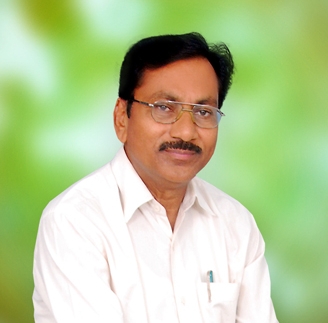
Dr. Rajamouly Katta, M.A., M. Phil., Ph. D., Professor of English by profession and poet, short story writer, novelist, writer, critic and translator by predilection, has to his credit 64 books of all genres and 344 poems, short stories, articles and translations published in journals and anthologies of high repute. He has so far written 3456 poems collected in 18 anthologies, 200 short stories in 9 anthologies, nine novels 18 skits. Creative Craft of Dr. Rajamouly Katta: Sensibilities and Realities is a collection of articles on his works. As a poet, he has won THIRD Place FIVE times in Poetry Contest in India conducted by Metverse Muse rajamoulykatta@gmail.com

Aren't they looking delicious that too in a lovely shade of purple. These are korean oreo biscuits with a dash of pancake flavour.Found these listed in big basket.
Recently I also had korean maggi noodles, it was so delicious that i didn't want to part with it,leave alone sharing it with Rahul.
Yesterday as he sat down for breakfast, his omlette was just taking a little while to get cooked, so i just gave him a spoonful on his plate,after one bite he demanded more,I thought of giving him veg atta noodles, he just refused and asked for the korean flavoured noodles. Finally I had to give away my share .
They sure are super delicious and the biscuits too.
What's it got that the others have not.!!?
It's got a little slurp slurp more.
Wonder if all korean products have a bit of purple colour on their wrappers oh yes just remembered about their purple rice and purple chips and the korean purple clay mask ,in India it's always been Cadbury chocolates since years,as early as my time spent in Cuttack at Killa Fort,early seventies as far as I can remember living in those huge bungalows,on our right side would be Mr. Gupta and family and on our left Mr Patnaik and family.Happy to mention here that me and my family are still in contact with the Guptas,and have totally lost contact with Patnaik family.
I don't think maggi existed then,but one can never forget the boy,who would come down to sell his dahi wada and ghuguni, we kids would run behind him and steel his lal mirchi masala loaded with salt.
On the other side remember Joseph's canteen inside St. Joseph's Convent Cuttack Odisha premises where during recess time we would queue up to buy colourful sugar rounded candies.
Of course how can one forget about the tasty churan being sold at the gate as we would leave to go home.Aah!! precious memories, i didn't intend to write these lines,its just happened as i pen down my flow of impromptu rapid thoughts.
Delicious cookies, a must try.
Luckily Hushkoo was out for his evening walk,otherwise he would have torn me to bits.
His latest demand is for Pink Lady apples and mangoes but it depends on his mood.
Did anyone say korean maggi on the fire cooking!!......I'm on my way.,Rahul says ..."me too".....Hushkoo is fast asleep we better tip toe and go.Best part man of the house ,the huzzzzbaannd.....out for society meeting since 2pm today and not back as yet,so no one to tell us......"again you're stuck up with junk food,full of taste enhancers " ,tra la la la la... hush!!.we better finish off before he arrives .
Have you picked up your korean maggi packet yet?if not hurry hurry,jaldi jaldi...you will love it,during this monsoon season it's a bit spicy too.I just love colour purple and as I close my eyes i can see a flowy rich purple paithani saree with vibrant green border,a must have colour and weave in your cupboard.
Hmmmm....smelling good,I'm not sharing mine with you,go grab your packet and portion soon.
I need to buy some more for the coming week,I better hurry till stocks last.
Sending oodles...oh!! noodles of love your way.
Purple colour symbolises royalty or loyalty? i think both.
Sheena Rath is a post graduate in Spanish Language from Jawaharlal Nehru University Delhi, later on a Scholarship went for higher studies to the University of Valladolid Spain. A mother of an Autistic boy, ran a Special School by the name La Casa for 11 years for Autistic and underprivileged children. La Casa now is an outreach centre for social causes(special children, underprivileged children and families, women's health and hygiene, cancer patients, save environment) and charity work.
Sheena has received 2 Awards for her work with Autistic children on Teachers Day. An Artist, a writer, a social worker, a linguist and a singer (not by profession)
LEAF FROM HISTORY: ABOUT THE TREE AND THE TEA PARTY
Mr Nitish Nivedan Barik
History is often remembered through grand battles and celebrated statesmen. Yet, sometimes it turns on quieter symbols. In eighteenth-century Boston, an unassuming elm tree became the unlikely birthplace of a political awakening that would change the course of modern history on its march to freedom and democracy. The Liberty Tree, together with the Boston Tea Party, formed the moral and political prelude to the Declaration of Independence of 4 July 1776 and to one of history's most enduring assertions: "We hold these truths to be self-evident, that all men are created equal."
The Liberty Tree and the Boston Tea Party are symbols of American resistance that led to American War of Independence. The American Revolution was not a sudden event but the result of years of growing dissatisfaction among the American colonies with British rule. During the eighteenth century, the British government imposed a series of taxes and laws on the colonies without giving the colonists representation in Parliament. This created widespread anger and inspired ordinary citizens to unite in defence of their rights and freedoms. Two of the most significant symbols of this growing resistance were the Liberty Tree and the Boston Tea Party. While the Liberty Tree became a gathering place for protest and unity, the Boston Tea Party became one of the boldest acts of defiance against British authority. Together, these events played a crucial role in shaping the movement that
eventually led to the American Revolution.
The Liberty Tree was a famous elm tree that stood in Boston, Massachusetts, near
Boston Common from around 1646 until 1775. Although it was originally just a large elm
tree, it later became one of the most powerful symbols of liberty and resistance in
colonial America. The tree served as a meeting place where American Patriots gathered under it in its shade to discuss and protest against the unfair policies of the British government.
In 1765, after the British Parliament passed the Stamp Act, the Liberty Tree became the
center of public demonstrations against British taxation. The Stamp Act required
colonists to pay taxes on printed materials such as newspapers, legal documents, and
licenses. Since the colonists had no representatives in the British Parliament, they
believed that these taxes were unfair and violated their rights. The slogan, “No Taxation
Without Representation”, became the rallying cry of the protesters.
The Liberty Tree soon became a place where speeches were delivered, meetings were
organized, and plans for resisting British rule were discussed. Effigies of British officials
were often hung from its branches as a form of protest. The area surrounding the tree
became known as Liberty Hall, where many important political gatherings took place.
When the Stamp Act was repealed in 1766 after widespread colonial protests and economic pressure, the people of Boston gathered around the Liberty Tree to celebrate their victory. The tree was beautifully decorated with flags, streamers, banners, and lanterns, making it a powerful symbol of hope, unity, and the growing spirit of resistance against British rule.
However, the Liberty Tree’s importance also made it a target for British supporters. In
August 1775, during the early stages of the American Revolutionary War, the tree was
cut down by Loyalists under the leadership of Nathiel Coffin Jr. Although the tree was
destroyed, its symbolic importance remained alive in the hearts of the American people.
A Liberty Pole was later erected at the site so that a flag could be raised to gather the
townspeople and continue the spirit of resistance.
The protests cantered around the Liberty Tree inspired the colonists to take even stronger action against British policies. Although Britain repealed the Stamp Act in response to widespread opposition, it continued to impose new taxes and tighten its control over colonial trade, increasing frustration throughout the colonies. The ideas of liberty, self-government, and resistance spread from colony to colony, eventually leading to one of the most famous acts of protest in American history: the Boston Tea Party.
The Boston Tea Party was a dramatic protest carried out by the Patriots of Boston
against the British government. The immediate cause of the protest was the Tea Act of
1773, passed by the British Parliament. This law allowed the British East India
Company to sell tea directly to the American colonies at a lower price while still
collecting a tax on tea. Although the tea became cheaper, many colonists opposed the
act because it reinforced Britain’s right to tax the colonies without their consent.
The Patriots believed accepting the tea would mean accepting British taxation.
Therefore, they decided to take direct action.
On the night of 16 December 1773, a group of about sixty members of the Sons of
Liberty, led by Samuel Adams, disguised themselves as Mohawk Native Americans.
They boarded three British ships: the Dartmouth, Eleanor, and Beaver which were
anchored in Boston Harbor carrying tea imported by the British East India Company.
Working quickly and carefully, they threw 342 chests of tea into Boston Harbor without
damaging any other property on the ships.
The event shocked the British government. British leaders viewed the destruction of the
tea as an act of rebellion and treason. In response, Parliament passed a series of harsh
laws in 1774 known as the Coercive Acts, which the colonists called the Intolerable
Acts. These laws closed the Port of Boston until the destroyed tea was paid for, reduced
the powers of self-government in Massachusetts, allowed British officials accused of
crimes to be tried elsewhere, and increased the presence of British troops in the colony.
The spirit of resistance quickly spread beyond Boston. Just a few days later, Patriots in
Philadelphia prevented the merchant ship Polly, which was carrying a shipment of tea,
from unloading its cargo. Instead, they forced the ship to return to England without
delivering the tea. Similar protests also occurred in other American colonies,
demonstrating that opposition to British rule had become widespread.
The Boston Tea Party became known as the Destruction of the Tea and marked a
turning point in the relationship between Britain and its American colonies. Rather than
weakening colonial resistance, Britain’s harsh response united the colonies even further
and encouraged greater cooperation among them.
The Liberty Tree and the Boston Tea Party became two of the most enduring symbols of colonial resistance before the American Revolution. The Liberty Tree represented unity, courage, and the determination of ordinary people to defend their rights through peaceful meetings and organized protests. The Boston Tea Party showed that the colonists were prepared to take bold action when they believed their liberties were under threat.
The movement that gathered beneath the branches of the Liberty Tree and reached its dramatic climax in Boston Harbor ultimately led to a decisive moment on 4 July 1776, when the Continental Congress adopted the Declaration of Independence. Drafted principally by Thomas Jefferson, the Declaration proclaimed that "all men are created equal," that they are endowed with the unalienable rights to "Life, Liberty and the pursuit of Happiness," and that governments derive "their just powers from the consent of the governed."
These words did not instantly create a just or equal society. Slavery endured, women remained excluded from political rights, and many of the Declaration's ideals would be realized only through generations of struggle. Nevertheless, the Declaration established an enduring moral and political standard against which future generations would measure both governments and themselves.
The influence of those ideas travelled far beyond North America. The French Revolution of 1789 drew inspiration from the American experiment, giving birth to the Declaration of the Rights of Man and of the Citizen and popularising the ideals of liberty, equality and fraternity across Europe. During the nineteenth and twentieth centuries, anti-colonial movements in Asia, Africa and Latin America likewise invoked the principle that political authority rests on the consent of the people rather than the privilege of rulers.
India's own constitutional journey bears traces of this intellectual inheritance. While the makers of the Constitution drew upon diverse sources, including the freedom struggle --British parliamentary traditions, the Irish Constitution and contemporary democratic constitutions --the ideals articulated in the American Declaration found resonance in the Preamble and in the chapter on Fundamental Rights. Under the leadership of Dr. B. R. Ambedkar, the Constituent Assembly transformed the universal language of liberty and equality into constitutional guarantees suited to India's plural society, while also enriching them with the ideals of justice, fraternity and social transformation.
During the 2026 semi-quincentennial i.e.250th anniversary, (observed on July 4,2026), the main national commemorations focused on the Declaration of Independence, Revolutionary War sites, and civic events. Although the Liberty Tree was not a major national theme, many state and local communities revived its tradition by planting new Liberty Trees and holding dedication ceremonies. Organizations such as the Sons of the American Revolution also continued their nationwide Liberty Tree Project to honour the Revolution.
The Liberty Tree no longer stands, and the Tea long ago dissolved into the waters of Boston Harbour. Yet both remain enduring reminders that history is shaped not only by armies and empires but also by ordinary citizens who insist that power must answer to principle and people. The journey from the shade of a Boston elm to the ringing declaration that "all men are created equal" altered the political vocabulary of the modern world. Two and a half centuries later, that legacy continues to inspire democracies in their unfinished pursuit of freedom, equality and constitutional government.
(Mr Nitish Nivedan Barik hails from Cuttack,Odisha and is a young IT professional working as an Associate Manager with Accenture at Bangalore.)
THE MAN IN RED SHIRT
Dr. Mrutyunjay Sarangi
Evening was creeping up like a silent shadow on an azure sky when Gautam got down from the train. The station was crowded. The train had disgorged hundreds of weary passengers. This western town of the state was the final destination of the train. Gautam looked around. He needed no porter, he had only a small suitcase which he could carry by himself.
Suddenly, Gautam jerked himself to attention. A man in a red shirt, standing a few feet away, lost in the crowd, was looking intently at him. Gautam felt he had seen this man earlier, but could not remember where. He looked so familiar, like a part of his past. The smooth face, the sharp eyes, and that smile! The mocking smile, a challenge to Gautam, asking him to come near and get to know him better.
Unknown to him, Gautam felt drawn to the man and started walking towards him. He pushed the crowd around him to reach the man, but missed him. Somehow the man vanished in a flash. Gautam felt frustrated, he wished he could have met the man and asked him why he looked so familiar, why his face is hidden beneath a heap of memory, where had they met earlier, why the sharp eyes and the mocking smile were making him so unnerved, so drawn towards him.
Gautam started walking towards the exit. He again saw the glimpse of a red shirt, exactly similar to what the man was wearing. The man in the red shirt was getting out of the station. Gautam followed him, hoping to catch up with him. Outside the station there was chaos, a sort of mayhem. Taxiwallahs, auto rickshaw drivers and rickshaw pullers were competing with each other to entice passengers, shouting and trying to grab their luggages. Suddenly a fight broke out among them, a taxi driver was slapped by an auto wallah.
Gautam shuddered at the scene and steered clear of it. He came out of the auto stand and wondered whether to take a left or right turn in search of a hotel. He had come for a surprise visit, his first to this town, to investigate why the sale of Allout has suddenly dipped drastically. Someone had phoned him to inform that the retailers had been bribed by the Good Knight wholesaler. As the Regional Sales Manager of Johnson's he had been worried, he could not afford to lose customers for his product.
Gautam again had a flash of the red shirt on the road in the right. The man was so near! Walking fast, Gautam thought he could catch up with him. He was desperate, trying hard to remember where he had seen that face earlier. Was the man in the same school or college as him, though not in the same class? Was he in the neighbouring seat in a movie hall or a football stadium, absent mindedly picking up a few popcorns from Gautam's packet? Or was he a co-passenger in a train journey? Where had he seen these piercing eyes and the mysterious smile?
Gautam tried to take a swift look at his surroundings. This was his first trip to the small town, yet somehow he felt familiar here. It was like many other small towns he had visited, yet there was something special here. He felt something stirring inside him, a feeling of dejavu, a longing for some intimate memory. As if this town was a part of his destiny, he was bound to come here some day.
Gautam could see the red shirt off and on among the crowd walking ahead of him. He thought the man stopped at some point and looked back. A shiver ran down Gautam's spine. Somehow the sharp look and the cunning, challenging smile unnerved him further. He quickened his pace and came to the spot where the man had stopped. There was a sign on the left. Hotel Amar: AC Room 800 Non-AC 500. Gautam thought the rate was reasonable and he could stay there for the night. His return ticket was booked for the next evening. He looked ahead searching for the man in the red shirt, but he had vanished again. Gautam felt disappointed, would he see the man again? God knows! But somehow he wanted to meet him, even for once, just to ask him who he was and why he looked so familiar.
Gautam wanted to have an early dinner and go to sleep. Next day was going to be busy in meeting a few retailers and trying to get a feedback from the customers. He missed his wife, the children and was eager to return home. In his job he was used to frequent travelling and absence from home. But somehow this time he felt different. His twelve year old daughter Sangita had been upset with him this morning when he left. Dussehra was a few days away, she wanted to go to the market with him and buy a good 'modern' dress, not the type her Mom gets her on birthdays and other festivals.
Satyakam, his son,was indifferent to dresses, his obsession was video games. He also wanted Gautam to take him to the market and buy a few video games for Dussehra. And Madhavi, his wife! She wanted nothing, except that Gautam should stay with the family all the time, and avoid so many tours.
He missed Madhavi like never before and dialled her number. She picked up on the first ring, as if she was waiting for this call.
"Reached? Why didn't you call earlier? I have been waiting!"
Gautam felt happy, to be wanted, to be missed.
"I tried a couple of times, but the connectivity from the train was poor."
"Good room? Do you have a tea maker in the room or you have to order room service for your frequent cups of tea?"
Gautam smiled to himself, Madhavis's eyes for details!
"A fairly decent room. No tea maker! For eight hundred rupees a night you can't expect a tea maker in the room! What are the kids doing? Is Sangita still upset with me? Tell her I will take her out and buy the best available dress in the market this Sunday. Is she busy studying? Can you give the phone to her?"
Madhavi chuckled from the other side, "Studying? Are you
dreaming? Your darling daughter is busy talking to her friend Suman, God knows what these silly girls talk about all the time. Just imagine she is not even a teen yet and so much to gossip! And when I go near her she makes a face and warns her friend on the other side that her Mom is close by, as if they are exchanging state secrets and presence of an intruder will compromise the country's security!"
Gautam tried to remind her that she was also a twelve year old
once and must be talking to her friends for hours. Madhavi was horrified, "Me? Talking on the phone? Na Baba, Na, we didn't have mobile phones those days and the office phone sitting on a cradle like an old man draped in a black coat was too intimidating. And you know what your princess is busy doing these days?"
Gautam sat up, what is Sangita doing that Madhavi wants to
report over the phone, "What? Is she planning to blow up her
school as a mark of protest against home work?" Madhavi laughed, "No something more serious than that! She and her friends are exchanging jokes and pictures which are decidedly obscene."
"Oh my God! How do you know?"
"When she is in the bath room I regularly open up her message box to read the messages."
Gautam wanted to pull her leg,
"No, no, what I meant was how did you know the messages are obscene? You always claim you come from a very cultured family, which doesn't know anything obscene, doesn't use a bad word and if a carnal thought crosses someone's mind, he has to go and take a cold water bath!"
It was Madhavi's turn to feel playful, "Oh, that? Don't you
know? All obscene things I learnt from you after marriage! I had come to you as a pure, virginal soul, O Krishna, my playful master, you corrupted my mind and filled me with a passion which you only could satisfy!"
Gautam felt an intoxicating thrill run through his veins at the seductive innuendo from his wife. He could not wait for the night to pass and he would board the train next evening to go home. They talked for some more time, Satyakam had already gone to sleep, he had a football match in the school and had returned home tired. Gautam ordered room service for dinner and went off to sleep.
The next morning Gautam started early. The town was small. Like many other towns the landscape was pleasantly familiar. A main street with shops lining on both sides, lanes and bylanes clogged with crowd and small stalls, street side vendors selling clothes, footwear and utensils, noise all around, bulls, dogs and buffaloes roaming around freely and small urchins begging - almost all Indian towns get their typical smell and flavour from the cauldron of human activity and penchant for gregariousness.
A small market building with elevated shops drew his attention and for a moment he stood still. He had a feeling that he was being watched and he had no doubt the man in the red shirt was somewhere nearby, with his piercing gaze and cunning smile. He looked around and spotted him. There, behind the footwear shop, partly hidden by plastic curtains providing shed to the shop! The man looked at Gautam, his smile became more pronounced as if he was trying to say something to him. Gautam felt uneasy, extremely nervous. Keeping the man steady in his sight he started walking towards him. The man was standing there unmoved, as if silently beckoning Gautam to come near.
Suddenly there was a rush, a group of families emerging out of the adjacent restaurant and for a few seconds Gautam lost sight of the man. Next moment the man was gone, disappeared, as if he was never there. Gautam was very close to the shop now and wondered what happened to the man. He asked the footwear seller, but got nothing from him. Since the man in the red shirt was not a customer the shop keeper had not noticed him.
Gautam left the shop. His uneasy feeling had increased. He felt a mild drumming of the heart, the constant hide and seek game was eating into his consciousness like a nagging pain. He approached his first retailer and started discussing the strategy to increase the sale of Allout. All the while half his mind was busy wondering why the man in the red shirt was appearing and disappearing from Gautam's sight. He went to two more shops, his nervous feeling gradually giving way to his professional spirit. He assured an increased incentive to the retailers and they were happy.
It was getting close to lunch hour. Gautam decided to visit one more shop before getting back to the hotel for lunch. The fourth retailer was a serious sort of person and the discussion went on for some time. Gautam was getting hungry, his attention span was reducing and he was feeling a slight dizziness. Suddenly, the retailer before him started to dissolve from his sight and the man in the red shirt materialised from nowhere. The man was talking but his words became jumbled up and instead of hearing him, Gautam only saw a man with a smooth, oily face, a pair of glinting eyes and a very strange smile. For a few moments Gautam's mind went blank, hearing nothing, feeling nothing. He returned to his sense when the retailer started shouting at him.
The retailer was worried, he gave a glass of Limca to Gautam and dropped him back at the hotel in his motor cycle. Gautam straight went to the dining hall to order lunch. A short, burly man in suit and tie was waiting for his lunch. Gautam badly craved for some company, to talk to someone and unburden himself. He asked the man if he could sit on the chair opposite. The man seemed happy to have someone to talk to.
"New to this town? Is this your first visit?"
"Yes, just for a day. Returning home by the night train."
"Ah, how can you leave so early? It's such a beautiful place, surrounded by small, green hills. There is a huge waterfall about five kilometres away. And the forests, the deep forests full of birds and animals about ten kilometres from here! You must visit them, if not this time, during your next visit. Where do you come from? What's your name?"
"I am Gautam Tripathy, from Bhubaneswar. And you?"
"I am Godabarish Mishra, Professor of Philosophy at the Sambalpur University. I come to this town often to deliver lectures. I have a sizeable fan following here. If you were staying tonight I would have invited you to attend my lecture in the Town Hall in the evening"
"So sorry. My train leaves at seven in the evening. What is the lecture about?"
The professor chuckled,
"'India's Hour of Birth and Her Destiny'. I am a deep believer in Astrology"
Gautam was amused,
"Does the country have a destiny? That too governed by an hour of birth?"
The professor became serious. Their food had arrived. A huge,
cooked, head of a fish was staring at Gautam from the Professor's plate. Gautam had ordered a vegetarian lunch. The professor attacked the head of the fish with great gusto, he was happy to get a captive audience, "Every living being has a destiny, pre-ordained from the moment of his birth".
Gautam tried to pull the professor's leg, "Even this fish? Was
it born to die for you?"
"Yes, just imagine, this fish must have been caught from the river which passes through this town, if the fish had managed to swim a kilometre further, it might have escaped getting caught and might have lived for one more year. Or it would have been caught by someone else and would not have come to this hotel. And if some other person had taken lunch before me and ordered head of fish it would have landed up in his plate. But this fish was destined to be consumed by me."
"But it sounds so frivolous! A fish and its destiny!"
"Nothing is frivolous my friend in this world, particularly for every being which breathes to live. Every breath is a footfall of its destiny. And the country is a leaving being, breathing through her one billion people.You must have read about Delhi's Khan Market incident last week. The poor fellow had come to buy chicken tikka for his wife and got into a brawl with a brat over a parking spot. They had a big argument and the brat stabbed the poor chap to death. Can you see the connection with destiny? The dead man used to live in Vasant Kunj, a good ten kilometres away, he could have gone to at least half a dozen other places, to Rajinder Dhaba near Kamal Cinema, to Kakeda's in Connaught Place, Karim's in Nizamuddin, or Colonel's Kebab in Defence Colony. He could have got chicken tikka for his wife in the evening or even one hour earlier or later. but destiny brought him to Khan Market at that hour, to a particular spot, precisely when the killer brat was parking his car. My present research is about the stellar constellation at the midnight hour of 15th August 1947 and to decipher our country's destiny. I have found some interesting facts and will share them with the audience tonight. I firmly believe everyone's destiny is contained in a package of data. This data is maintained by God and very few highly enlightened astrologers have the ability to access a fraction of that data."
Gautam was astounded,
"You mean God maintains data for more than six billion people
spread over the world?" Professor Mishra flashed a benign smile, "Are you doubting the infinite power of God? Is there a limit to what He can do? Even your coming to this town is a part of your destiny, our meeting here today at this moment in this dining hall is preordained, everything is predestined my friend, I can give you a few more instances....."
Suddenly a waiter appeared at the side of Prof.Mishra and handed
him a piece of paper. The Professor had finished his meal, he got up and smiled at Gautam, "Sorry young man, I have to leave, some people are waiting in the lobby, I had promised them I would visit the Philosophy Department of the local college at two thirty. Hope we will meet again, if you happen to come to Sambalpur, please look me up. I will be happy to share many interesting stories with you".
Gautam left the hotel at three, he wanted to visit three more retailers before returning to the hotel and leaving for the railway station to catch the train. The thought of the man in the red shirt returned to his mind. Would he appear again, at some unexpected turn, in some narrow lane or behind some lonely shop? Luckily, Gautam didn't see him during his visit to the three retailers.
Around six he started walking back to the hotel. Lights were yet to come up in the town. It was still bright, the air was stuffy, hot and humid, probably it would get cooler later in the evening. Lots of people had come out to the market with their families for shopping. Dussehra was round the corner and the festive season had already arrived with promises of fun and celebrations. Gautam's attention was drawn to a young couple walking ahead of him, the father holding the hand of their small child. The boy must be around four years old. He was pointing at some toys hanging from a string in a shop.
The parents had moved near the shop to look at the toys more closely. The father's grip must have loosened a bit. The small boy drifted away and started walking towards the middle of the road. Gautam was hardly a foot away, his heart almost stopped at the sight of the speeding Innova coming from the opposite direction. In a couple of moments it would run over the boy! With a cry Gautam lunged forward and brought the child back to the side of the road, but lost control of himself. Next moment the Innova hit him hard and threw him high up in the air. Before Gautam's head hit the road he looked at the car helplessly. There, sitting on the bonnet of the Innova was the man in the red shirt, his face solemn, as if he was carrying out a preordained, pre-assigned job against his wish. His cunning smile was gone, but the eyes had not lost any of their penetrative intensity. There was a strange melancholy on his face.
In his dying moments, Gautam felt an incredible sadness, for leaving his dear Madhavi, his darling Sangita and the precious Satyakam. His eyes met the eyes of the man in the red shirt and he whispered, "So you are Death and you have been stalking me, perhaps ever since I was born! That's why you looked so much a part of my past! I wish I had known you yesterday. Had I recognised you for what you are, I wouldn't have followed you to the hotel and returned to my dear family last evening itself! Now you are taking me away, who will look after them? They will miss me, who will buy dress for my Sangita and video games for my Satyakam? Who will talk to my Madhavi, promising her all the love in the world? Who will...........As life ended for him, Gautam's words remained suspended in a cruel, oppressive evening air in a small, crowded town, the last town he would ever visit.
Dr. Mrutyunjay Sarangi is a retired civil servant and a former Judge in a Tribunal. Currently his time is divided between writing poems, short stories and editing the eMagazine LiteraryVibes . Four collections of his short stories in English have been published under the title The Jasmine Girl at Haji Ali, A Train to Kolkata, Anjie, Pat and India's Poor, The Fourth Monkey. He has also to his credit nine books of short stories in Odiya. He has won a couple of awards, notably the Fakir Mohan Senapati Award for Short Stories from the Utkal Sahitya Samaj. He lives in Bhubaneswar.
Viewers Comments