
Literary Vibes - Edition CLXVI (26-Jun-2026) - POEMS & BOOK REVIEWS
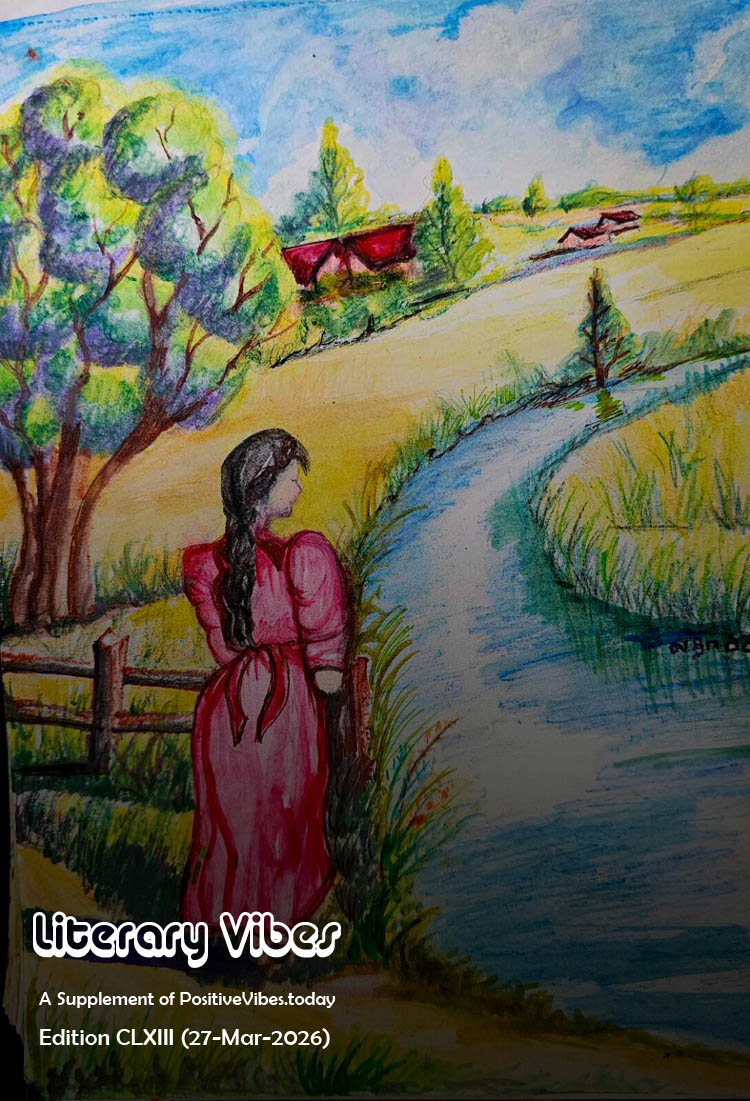
Title : Waiting (Water colour by Lathaprem Sakhya)
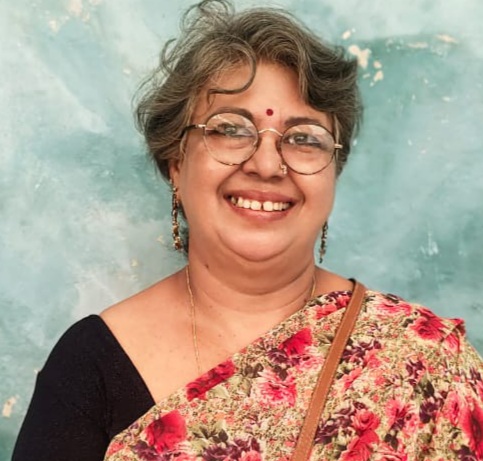
An acclaimed Painter, a published poet, a self-styled green woman passionately planting fruit trees, a published translator, and a former Professor, Lathaprem Sakhya, was born to Tamil parents settled in Kerala. Widely anthologized, she is a regular contributor of poems, short stories and paintings to several e-magazines and print books. Recently published anthologies in which her stories have come out are Ether Ore, Cocoon Stories, and He She It: The Grammar of Marriage. She is a member of the executive board of Aksharasthree the Literary Woman and editor of the e - magazines - Aksharasthree and Science Shore. She is also a vibrant participant in 5 Poetry groups. Aksharasthree - The Literary Woman, Literary Vibes, India Poetry Circle and New Voices and Poetry Chain. Her poetry books are Memory Rain, 2008, Nature At My Doorstep, 2011 and Vernal Strokes, 2015. She has done two translations of novels from Malayalam to English, Kunjathol 2022, (A translation of Shanthini Tom's Kunjathol) and Rabboni 2023 ( a Translation of Rosy Thampy's Malayalam novel Rabboni) and currently she is busy with two more projects.
Title : ETERNAL SHE


Swatishree Parija is from Jagatsinghpur district, Odisha. She is a Graduate with Honours in Geology and has recently earned a B.Ed. degree. She has also qualified in the Teachers' Eligibility Test (TET). She is currently preparing for competitive exams.
From her school days, she has had a keen interest in creative activities. Her hobbies include writing, painting, reading books of different genres and photography. She has been writing short stories and poems in Odia, English, and Hindi since for the past many years.
She has actively participated in various speech, painting, and essay-writing competitions and has received several awards and prizes at the school, district, and state levels.
Dear Readers,
Happy to present to you the 166th edition of LiteraryVibes. As I sit writing this editorial, I can hear the rains outside - not the thundering, lightning type, but a steady drizzle, as if to assure us in a gentle way there will be always rain following a scorching summer. One simply has to wait for the rains. There will always be light, one has to only live through some darkness. I am reminded of a nice, touching story I read in the internet a few months back on a small light blinking through rains and darkness to keep hopes alive. I am temped to quote it. The author is unknown, but deserves our gratitude for giving us an outstanding story. Here it is:
THE LANTERN IN THE RAIN
The rain had been falling since the afternoon, not in dramatic sheets, but in that slow, stubborn Mumbai drizzle that makes the whole city look tired. I was sitting under the tin awning of a small tea stall near the station, watching water collect in puddles like little mirrors that didn’t want to reflect anything. The world around me moved as usual—people rushing, auto-rickshaws honking, vendors shouting—but inside me, everything felt still, heavy, and dim. I had come there not because I wanted tea, but because I didn’t know where else to go with my thoughts.
It had been a difficult month. Not the kind of difficulty that looks heroic in stories, but the quiet kind—the kind that erodes you. A project at work had collapsed after weeks of effort, a relationship I had trusted had turned sour, and the one person I always called when I felt lost—my father—had been admitted to the hospital. I had spent days trying to stay strong, speaking politely, doing what was expected, but that evening something in me simply refused to cooperate. I felt like the city was pressing down on my chest, and every drop of rain was a reminder that nothing ever stays bright for long.
The tea vendor, an elderly man with a white moustache and a permanently creased forehead, looked at me once or twice but said nothing. Perhaps he had seen too many faces like mine. I sat with my hands wrapped around a paper cup, not even sipping it, just holding it for warmth. My phone was in my bag, buzzing occasionally, but I didn’t want to answer anyone. I didn’t want advice, sympathy, or questions. I just wanted to disappear into the background of the world and stop feeling.
That was when I noticed a little girl standing a few feet away, under the open sky, letting the rain fall on her like she didn’t mind. She couldn’t have been more than eight. She was wearing a school uniform, slightly oversized, and her hair was tied in two loose plaits. Her slippers were soaked, and her socks were dark with water. In her hand, she held a plastic lantern—one of those cheap battery-operated ones children buy during festivals. It was shaped like a star, and it blinked weakly, as if it too was struggling against the weather.
She looked around as if searching for someone. Then her eyes fell on me. She walked closer, careful but confident, stepping around the puddles with the seriousness of someone crossing a battlefield. She stopped right in front of me, lifted the lantern slightly, and said, “Uncle, can I sit here?”
I was surprised by the question, because there was plenty of space. Still, I nodded. She climbed onto the low bench beside me, swinging her legs. For a few seconds, she said nothing. She just sat there, letting the rain tap the edge of the awning like a quiet drum. Then she turned her face toward me and asked, “Are you sad?”
The question hit me more sharply than I expected. I almost laughed, not because it was funny, but because it was so direct. Adults spend years learning to hide sadness under words like “busy,” “fine,” and “okay.” This child had simply looked at my face and read the truth. I didn’t answer immediately. My throat tightened. I looked away, toward the station lights blurred by rain, and said, “A little.”
She nodded as if that confirmed something she already knew. Then she held the lantern closer to me and said, “Then you should take this.”
I blinked. “Why?”
“Because,” she said, very seriously, “when people are sad, they forget light.”
It was such an odd sentence, and yet it made perfect sense. I stared at her small hand holding out that cheap blinking lantern like it was a sacred offering. The lantern wasn’t even bright. Its plastic was scratched. One corner had a crack, and the blinking was irregular. But something about the gesture made my eyes sting.
I tried to smile. “No, no. Keep it. It’s yours.”
She shook her head firmly. “I have more at home. This one is extra.”
I wanted to ask her where her parents were, why she was alone in the rain, and why she was talking like an old soul. But before I could, she leaned closer and said in a softer voice, “My brother is in the hospital.”
The words froze me.
She looked down at her wet socks and continued, “He is big. He is fourteen. He fell from his cycle. His head got hurt. My mother is with him. My father is bringing medicines. I came from school and waited here because this tea uncle lets me sit. I was scared, but…I have this lantern.”
I didn’t know what to say. The coincidence felt too sharp, too personal. My own father was in the hospital too. I had been sitting there drowning in my self-pity, and this child, with her soaked uniform and blinking lantern, was waiting in the rain with a courage I hadn’t managed to find in days.
She looked up again and said, “When my brother was taken, I cried a lot. But then my mother told me, ‘Don’t cry in front of him. He will feel more pain.’ So I stopped crying. I thought if I stopped crying, he would get better faster.”
She paused and then added, almost as an afterthought, “But inside I am still crying.”
That line broke something in me. I felt tears come without permission. I turned my face away quickly, embarrassed, but she saw anyway. She didn’t laugh. She didn’t look uncomfortable. She simply pushed the lantern into my hands.
“See,” she said gently, “now you have light.”
The lantern felt ridiculously small in my palms. It blinked against the grey evening like a stubborn heartbeat. I looked at her and said, “You’re very brave.”
She shrugged, as if bravery were just another school subject. “No. I am scared. But if I keep sitting, maybe God will see me.”
I didn’t know whether to smile or cry. The rain continued. People continued rushing past. But the air around us had changed. It was as if this tiny conversation had created a warm bubble under the awning, a space where truth was allowed to exist without shame.
After a while, a man came running from the station side, holding an umbrella and shouting her name. She jumped off the bench immediately, her face lighting up. Before she ran to him, she turned back to me.
“Uncle,” she said, “don’t throw the lantern. Even if it blinks slowly, it is still working.”
I nodded, unable to speak. She smiled once, quick and bright, and then disappeared into the rain, holding her father’s hand.
I sat there for a long time after that, staring at the lantern. It blinked. Sometimes it slowed. Sometimes it almost stopped. But it always came back. And in that simple stubbornness, I suddenly saw my own life. My life too had blinked. It had dimmed. It had cracked at the corners. But it was still there. Still working. Still capable of light.
When I finally got up to leave, I didn’t feel magically happy. My problems hadn’t vanished. My father was still in the hospital. My work was still uncertain. My heart still carried its bruises. But something inside me had shifted. The weight was still there, but it had moved from my chest to my hands—something I could carry, not something that crushed me.
Outside, the rain had softened. The puddles still reflected the station lights, but now they looked less like traps and more like small lamps laid on the road. I held the lantern close as I walked, and for the first time in weeks, I felt a quiet gratitude for being alive.
And I thought of that little girl—scared, wet, waiting—and yet offering light to a stranger. In a world where most people protect their joy like a secret treasure, she had given hers away freely. Not because she had plenty, but because she understood something many adults forget: light grows when shared.
That night, at the hospital, when I sat beside my father’s bed and watched his tired face, I didn’t speak about my stress or my fears. I simply held his hand. I let silence do the work. I let love do the work. And in my mind, I saw the lantern blinking stubbornly against the rain.
Reflection
This story reminds us that the deepest kind of vision is not in the eyes—it is in the heart. Many times, we believe our sadness is special, our burden is unique, our pain is heavier than anyone else’s. We sit under our personal “willow trees,” convinced that the world has been unfair only to us. But life has a way of sending unexpected teachers—often children, often strangers—who quietly reveal a truth we resist: everyone is carrying something.
The little girl did not have an easy life at that moment. She was scared, wet, waiting, and worried about her brother. Yet she still noticed another person’s sadness. That is rare. Most adults, even kind ones, become too consumed by their own storms to look up. Children, however, still live close to the raw truth of life. They have not yet learned to pretend. Their compassion is instinctive, not calculated.
The lantern is symbolic. It was not perfect. It was cracked, weak, and blinking irregularly. That is exactly how hope often appears in real life. Hope is not always a grand sunrise. Sometimes it is a small, flickering light in the rain—fragile, inconsistent, and yet stubbornly alive. The lesson is not that life will always be bright. The lesson is that even a small light is enough to keep us walking.
Most importantly, the story teaches that when we give comfort to someone else, we often heal ourselves. The girl, by offering her lantern, was not just helping a stranger. She was also reassuring herself that light still exists. Kindness is not only charity—it is survival. It is how the human heart refuses to collapse.
Finally, this story urges us to see life differently. Not through the lens of complaint, but through the lens of gratitude. Not through the obsession of what is missing, but through the quiet awareness of what is still present. Our struggles may remain, but our attitude can change. And when attitude changes, even the same world looks new.
Sometimes, the world does not need to change. Sometimes, we need to change the way we look at it.
Just like the lantern: even if it blinks slowly, it is still working.
................
What a beautiful story! The way it speaks of a subdued pain and a fervent hope is extraordinary. It holds the promise of shining marigolds in June and lovely roses in December, reaffirming our faith in the unthinkable, in the power of unexpected miracles in the midst of a tiring journey. It takes me back to a poem I wrote a few years back:
MARIGOLDS IN JUNE
Mrutyunjay Sarangi
Tread softly on my dreams,
Zindagi! I am here to stay.
Sitting in the shadow
Of the floating clouds
Listening to the murmur of lilting streams.
Voices come floating
From lands known and unknown,
And keep playing in my heart,
Songs laden with love and loss.
Of sighs and moans,
Of cries and groans.
Leaning on a tree,
I want to look deep into time
And rummage from it
Priceless nuggets
That will bring me
The roses in December,
And marigolds in June.
And fill my heart with the colour of the sky,
Those moments would come back
And dance before my eyes
With a delightful abandon.
I want to see again,
My village pond, its emerald water
And the moon swimming in it,
The dust laden path
And the bullock cart
Slowly trudging by,
In a timeless journey,
The palm trees from my orchard
following it in a silent procession
In the moonlit night.
I want to inhale
The fragrance of solitude
Taking the shape of nubile desires,
I just want to close my eyes
And feel the slow throbs of my heart
Singing a celebratory song.
You move on Zindagi,
In your swift caravan,
I will give you a bye,
And sit here looking at my trail,
Strewn with the shadows of my dreams,
Dancing to a cascading music
Played by unseen fairies,
My past lovers coming back to me!
.......................
Hope you will enjoy the many interesting stories and enchanting poems in this 166th edition of LiteraryVibes. My sincere thanks to the poets and writers who have contributed to the eMagazine, making it a thing to cherish, a priceless possession.
Please share the magazine with all your friends and contacts through the following links:
https://positivevibes.today/article/newsview/640 (Poems and Book Reviews)
https://positivevibes.today/article/newsview/639 (Short Stories, Anecdotes and Travelogues)
https://positivevibes.today/article/newsview/638 (Young Magic)
Hope you remember that you can access all the 166 editions of LiteraryVibes at https://positivevibes.today/literaryvibes
Please take care, stay safe. We will meet again with the 167th edition of LiteraryVibes on the 31st July.
With warm regards
Mrutyunjay Sarangi
Editor, LiteraryVibes
Bhubaneswar, Friday, the 26th June, 2026
Table of Contents :: POEMS AND BOOK REVIEWS
01) Prabhanjan K. Mishra
02) Dilip Mohapatra
THE TREASURE TROVE
KILLING ME SOFTLY
03) Sreekumar Ezhuththaani
04) Abani Udgata
05) Avantika Vijay Singh
06) Pradeep Kumar Biswal
07) Snehaprava Das
08) Sathya Venkatesh
GOOD CONNECTIONS – VITAL FOR LIFE
09) Madhumathi. H
10) Ms. Latha Prem Sakya
11) Sushree Gayatri Nayak
12) Sudipta Mishra
13) Darsana Kalarickal
14) Dr Nanda Kishore Biswal
A PHOTOGRAPH :SORTING THROUGH EMOTIONS
15) Purani R
16) Bipin Patsani
BAJI RAUT, THE BOY BOATMAN
MY COUNTRY
17) Sujata Dash
18) Matralina Pati
19) Dr. Rekha Mohanty
20) Kunal Roy
O! MY CITY
O! THE EMPTY THOROUGHFARE
21) Nandini Mitra
22) Lata Krishnan
23) Baldev Samantaray
24) Arpita Priyadarsini
25) Mrs. Setaluri Padmavathi
26) Susan Kurien
27) Anindita Sen
28) N Sanjana
29) Swatilekha Roy
30) Dr. Protiva Rani Karmaker
31) Swatishree Parija
32) Dr. Rajamouly Katta
33) Dr. Niranjan Barik
34) Dr. Mrutyunjay Sarangi
Table of Contents :: Book Review
01) Prabhanjan K. Mishra
DIFFRACTIONS AT DAWN
ANNIHILATION OF VORTEX (NOVEL)
02) Jayshree Misra Tripathi
03) Sarita Prusty
TOSHALI ANTHOLOGY OF LOVE POEMS
None of them ever said,
"I love you." Never expressive.
They fed me and covered me up
with the best quilt in winter nights.
If I still shivered, they cozied up
to me, kept me warm.
Sort of a pair of parent birds
going out of the nest,
returning with titbits,
the very best
saved for their baby bird
from their foraging.
I was ill, they were sleepless;
I was hungry, they felt the cramps;
I failed in school tests,
they lost rest, peace, pleasure.
During my honeymoon, they
had to be persuaded not to join it.
As they grew old, they kept
their aches and cramps
to themselves, they didn't bother me.
Roles reversed;
I brought home the bacon. A pity,
I did not feel or fret over their pain.
I never could reach
their heights, though I grew taller
nor equalled their feelings
despite writing poetry.
When they died, I was elsewhere.
I miss them now, on my lonely deathbed.
AT THE SUNSET
Prabhanjan K. Mishra
I light a candle.
Its tired flame
flutters a silent dirge.
Its waxing and waning
make the darkness blink.
The flame eats away the wax
in the candle’s pit,
half consuming,
half regurgitating,
the melt, flowing down.
The regurgitated melt,
getting piled up at
the candle’s feet
in lumps, gives it
swollen and sullen feet.
It’s dawn. A yellow hibiscus
in bloom peeps in at my desk,
the pink sun shakes its mane,
and a cool breeze maps the bird cries
from the treetops to my ears.
A half-baked poem goes chasing,
its last tango seeming lost.
I slump back and look inwards:
a sleepless and shapeless heap of words
begs to be spun and garnered.
The words rise like floundering hands
to be grabbed and rescued
from their anonymity’s marsh.
Again, the time of sunset,
scarlet and purple strokes of brush.
The candle’s wick has drowned,
stifled in its own molten pool; it is dark.
The yellow hibiscus is a black blur
against the subdued dusk.
Bird-cries sigh into the dying day.
(END)
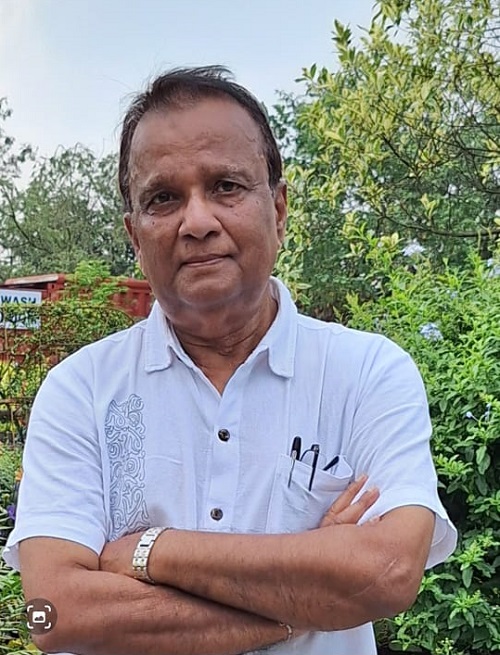
Prabhanjan K. Mishra is an award-winning Indian poet from India, besides being a story writer, translator, editor, and critic; a former president of Poetry Circle, Bombay (Mumbai), an association of Indo-English poets. He edited POIESIS, the literary magazine of this poets’ association for eight years. His poems have been widely published, his own works and translation from the works of other poets. He has published three books of his poems and his poems have appeared in twenty anthologies in India and abroad.
THE TREASURE TROVE
Dilip Mohapatra

“It’s high time that both of you
move into the Senior Citizen’s home
and enjoy assisted living”—
said the children with
a finality in their voice
and we too thought that
it would be in our best interests.
But having lived in a
four bedroom house
with ample storage all along
we sat down to list
what bare minimum we may carry
and save us from claustrophobia
in our new ten by ten one room set up.
We never realised what all
things have been piled up
over the years
and which have found their way
into places assigned to them
where they quietly reigned—
never coming in our way
hiding snugly in the racks
and recesses.
In one cupboard
a few desolate photo albums
full of nostalgia
and dilapidated stamp albums
relics of my childhood
nestled without a whimper
while in another
stacks of
VHS video cassettes languished
and encapsulated within them
classics like Gone with the Wind
For a Few Dollars More
and The Good the Bad and the Ugly hibernating
never to awaken again.
The book cases brimmed with
old hardbound novels
whose sepia toned pages
have gone brittle
and few professional books
which once were my guiding light
but permanently shut now—
the only volumes still alive
are those that bear
my name on their spine.
The doctor has advised
no alcohol for me
yet the rows of champagne flutes
the cognac balloons
the shifters and the highballs
looked translucent in
the glass cabinets
along with the
seldom-used Noritake porcelain
dinner set that I had
purchased five decades ago
from one of my foreign cruises.
My Omegas and Cartiers
Rolexes and Rados
lay locked up in my drawer
their cells drained out long ago
my sneakers and sandals
boots and brogues
monk-straps and loafers
have lost their lustre
gathering dust
in the shoe racks in the corner.
And then we pack
our bare necessities in two strollers
leaving the “treasure” behind
but making sure to carry
my blue beret
my Commodore’s baton
and the medals which
once adorned my uniform
and which would be my last ever
companions
accompanying me
to the crematorium.
KILLING ME SOFTLY
Dilip Mohapatra

When you led me
by holding my hand
through the winding path
in the enchanted garden
lined up by manicured hedges
lit by millions of fireflies
challenging the stars in the skies
little did I know
that behind your magnetic mask
lurked an assassin
dragging me to the altar
as a garlanded goat to the scimitar.
Those impish eyes
fluttering with all their innocence
trapped part of me within
like the Venus Flytrap
does to its victims—
Those whispers in my ears
singing the sweet nothings
stealing my breath away
and those bee stung lips
when dwelling on mine
drowning me in their lusciousness
little by little
but again letting me go for
greater assaults.
Those arms that clasp me
in a soft embrace
remind me of the plight
of the prey
in the coils of the constrictor—
Those red hot sighs
scorch my very core
those doodles on my
bare back etched by your nails
as our sweats mingle
and one and one
become one.
Why do you love
to see me bleeding
in a thousand cuts
bring me back to life
and kill me again?
Why don’t you just
fan the flame to an inferno
and then
snuff it off in one go
like the Praying Mantis
making love to its partner
and then biting off its head.

Dilip Mohapatra, a decorated Navy Veteran is a well acclaimed poet in contemporary English and his poems appear in many literary journals of repute and anthologies worldwide. He has nine poetry collections, two short story collections and two professional books to his credit. He is a regular contributor to Literary Vibes. He the recipient of multiple awards for his literary activities, which include the prestigious Honour Award for complete work under Naji Naaman Literary Awards for 2020. He holds the honorary title of ‘Member of Maison Naaman pour la Culture’. He lives in Pune and his email id is dilipmohapatra@gmail.com
ANUPAMA
Sreekumar Ezhuththaani

(Translated from Malayalam)
Along the paths where I once walked,
You came beside me, step for step.
Beneath the shade where I would rest,
You sat beside me, close and still.
One gentle hour of drifting rain,
You drew me near beneath your umbrella.
With the crystal water you offered,
You quenched the thirst within my heart.
Every word that I had written
Became a song upon your lips.
To hear the stories that I told,
You rested softly against my chest.
Once, at the temple, we stood and saw
The sacred offering had run out.
Reading the longing within my soul,
You placed ambrosia upon your lips for me.
Though Onam, Vishu, Sankranti,
And Navaratri return each year,
Without you beside me,
No celebration can live within my heart.
On a Thiruvathira night, your garment
Adorned with fragrant champak blossoms
Made even the moon blush with shyness,
Sending it behind the dark clouds to hide.
Why do the wild mynas, cuckoos, and night birds
Fall silent and abandon their songs?
To listen to your melodies,
Even the wind pauses and lends an ear.

Sreekumar Ezhuththaani known more as SK, writes in English and Malayalam. He also translates into both languages and works as a facilitator at L' ecole Chempaka International, a school in Trivandrum, Kerala.
A HOUSEWIFE’S SONG
Abani Udgata
She hums to the pressure cooker —
that small, tired song
only steam knows by heart,
her bangles keeping time
against the steel plates.
The house wakes to her hands:
She tastes the dal with a finger,
blows on the spoon like it’s a scraped knee.
No recipe book. Just memory
and the way her mother’s mother
measured cumin in the cup of her palm.
A pinch of salt, a pinch of prayer.
The same.
When the boy comes home angry,
she doesn’t ask. She fries
his favourite fish — the edges crisp,
the middle tender, like letting go.
He eats without speaking,
and that’s her answer.
Later, she irons his father’s shirt,
smooths the collar like smoothing a forehead.
She counts the dimples in the dough
while the roti puffs —
small moons rising on the iron sky.
At night the kitchen cools.
She scrapes the last of the rice from the pot,
eats standing up, by the sink.
The fridge wears children’s drawings.
The calendar counts pills, fees, birthdays.
And in the quiet after everyone sleeps,
she drinks her tea lukewarm,
smiles at nothing,
and the house, full-bellied and foolish,
doesn’t know it’s being held together
by the crook of her wrist,
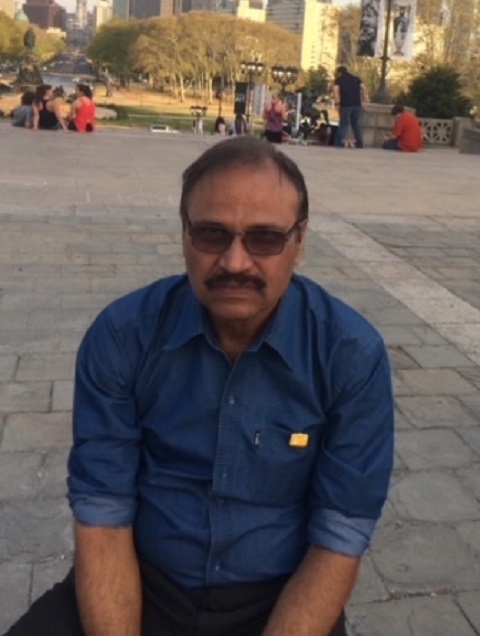
Abani Udgata lives in Bhubaneswar. Writes poems both in English and Odia. Udgata has been awarded in all-India poetry competitions and published in anthologies. He has been a regular contributor to LV. Email: abaniudgata@gmail.com
THE CHURNING—DATURA
Avantika Vijay Singh
Deep within, rages—
the Samudra manthan
where Gods and demons churn,
for the treasures hidden in me.
A vast churning in my consciousness
from where first rises
Halahala—
a poison so deep
that the Lord held it in his throat.
I, too, learn that the vitriol
of poisonous words
must be held within—
unsaid, unuttered—
and avoided from spreading
like ink-stained satin shame
in the name of truth.
Sometimes,
The illusion comforts…
And drinking the poison in,
blooms the Datura—
trumpeting peace,
but not without its thorns,
a testament to
peace at a price—
the price of having known strife.
The Datura with its thorns
I surrender to the Lord
In the hope He will
Transcend my suffering…
After I surrendered,
I healed.
And at the end of the churning
emerged Amrit,
from the depths of my consciousness.
I knew the bliss
of becoming—
Sat Chit Anand…

Avantika Vijay Singh is a communications professional, wearing the hats of a writer, editor, poet, researcher, and photographer. She has authored two solo anthologies, edited three anthologies, and has been published in national and international journals. She received the Nissim International Award Runner Up 2023, WE Gifted Poet 2024, and WE Illumination Award 2024.
THE RIVAL
Pradeep Kumar Biswal
In our intimate
soulful moments
suddenly she appears.
Her radiant eyes
crimson lips and neck
full breasts and navel
unfold right before me.
I look for liberation—
Is it you, or someone else
In whose arms am I ?
Why it happens this way
I do not know.
Do you know her?
I don’t quite remember
when I met her
or in which city.
Is she married
or still a maiden?
Perhaps no such person exists
in flesh and blood.
My unfulfilled desires
sometimes manifest
in such an undesirable form
without your knowledge.
When you come to know
that I unite in imagination
with someone other than you—
even while becoming one
secretly with you
unbeknown to you
will you forgive me
out of your virtue ?
Guilt and remorse
disturb me now
yet I can’t break free
from the bondage of her illusion.
Who can change the destiny?
I had embraced my cruel fate
before embracing you
though
it’s is not your fault
when I sensed
it was not you
but an opportunist was enjoying me
my entire body was exasperated
before you cursed me.
Then I prayed you
to free me up
from the Sorcerer
when you arrived
my unwrapped body was faint
I don't know
whether you were aware or not
my body was touched
but my soul was glittering
like a Touchstone
beyond the body
nobody else can touch it
except you.
(2)
Your two unique feet
are incomparable
how can I explain
the divine feeling of touching them
standing like an unsensed deer
it was dillematic to realise
whether your presence
was a dream or reality
was I alive or not !!!
At the end
this frivolous life
seek your blessing
to witness your divine form.
if it’s true
tell me my Lord
how many times
I have to be born
and reborn
to unite with you
because
I don't want a rebirth again.
(3)
My entire body was shivering
like a sweet tremor
my nerves got into life
blood started circulating in my artery
I was also in illusion
that whose magical touch
returned me
my existence.
whatever I saw
was hard to believe
My Lord !
your presence turned my eyes wet
dared to touch his dusty feet
and wiped in my aanchal
Aah!! what a relief of serving you .
All my pride and anger
that was haunting me inside
vanished
when your feet were touched.
(4)
I was reborn
in a second
restored the purity of my soul
all my sin and guilt
vanished.
Oh my Lord
you are great !
As a cursed stone
I was abandoned
untouched like leftover.
You answered my cries
freed me up from the curse
my body got back life
Oh my Lord !
lift me up and unite me with you.
(5)
when I found my subtle body
my nerves and artery became active
seeing you in my first glance
you were smiling
what a heavenly glaze at your face
that lightens the stars the sun
the moon and the entire world.
After ages I shed the
tears of happiness on your feet
and wiped your dusty feet in my aanchal.
(6)
I am ignorant about
my day date and zodiac of birth
my palm lines and the unseen lines of my forehead
but do you know
the misfortune of a woman is written in her fate associated with
the pain anguish
and life of a black stone.
The birth of a woman's life
writes all the pains and sufferin
as an inheritance
which she has to bear
birth after birth.
Nobody could listen the
pain of the stone
my suffocations,screams,the pain
even my tears are like my fate..
who knows
when I will be free from the curse...
( Translated from original Odia by Sarita Prusty )

Pradeep Biswal is a distinguished bilingual poet, translator and editor. He has nine poetry collections in Odia and three in English. His poems have been translated into Hindi, Telugu, Punjabi, Assamese and Malay languages and got published in separate volumes. He’s the curator of Toshali Literature Festival and editor of monthly web magazine kabitalive.com. A retired IAS officer, he’s staying with his family in Bhubaneswar.
Sometimes I drape it on me
Let it wrap me in its snug, delicate folds,
It clings to me tight
Breathing roses and jasmines into my neck and shoulders,
Sometimes it coils around me
In a ropey, hard grip
Around my waist, slithering up
In a stubborn rustle,
Hissing venom into my ears,
Sari has always been a mystery to me,
An unsolved riddle
Even after weilding it for years
It puzzles me,
I am yet to figure out
If it plasters itself around me
And locks me in its embrace of love,.
Or, holds me trapped in its
Unforgiving freaky length
Leaving me a perpetual cripple.
Dr.Snehaprava Das, former Associate Professor of English, is an acclaimed translator of Odisha. She has translated a number of Odia texts, both classic and contemporary into English. Among the early writings she had rendered in English, worth mentioning are FakirMohan Senapati's novel Prayaschitta (The Penance) and his long poem Utkala Bhramanam, which is believed to be a.poetic journey through Odisha's cultural space(A Tour through Odisha). As a translator Dr.Das is inclined to explore the different possibilities the act of translating involves, while rendering texts of Odia in to English.Besides being a translator Dr.Das is also a poet and a story teller and has five anthologies of English poems to her credit. Her recently published title Night of the Snake (a collection of English stories) where she has shifted her focus from the broader spectrum of social realities to the inner conscious of the protagonist, has been well received by the readers. Her poems display her effort to transport the individual suffering to a heightened plane of the universal.
Dr. Snehaprava Das has received the Prabashi Bhasha Sahitya Sammana award The Intellect (New Delhi), The Jivanananda Das Translation award (The Antonym, Kolkata), and The FakirMohan Sahitya parishad award(Odisha) for her translation.
GOOD CONNECTIONS – VITAL FOR LIFE
Sathya Venkatesh
Man, a social animal
Yearns for connection
With the right company he can whisper or shout
Giving a vent, clearing his doubts
A friend, a parent or a mentor is a must
To turn to in turmoil, in times of distress
Not one to judge, nor offer critique,
But to listen with warmth, when the soul feels weak
"Things will be alright," just that is enough
To find peace from pain, to come out of stress
For we are not islands, isolated in the sea,
But threads in a tapestry, designed to be free
In genuine company, we can flourish and thrive
There is no need to beg or strive
Just being ourself, there’s no compulsion to change
For in true friendships, overpowering reason, hearts exchange
We revel in our true selves, becoming healthy and happy
With a true friend beside us, life becomes an easy journey.
Hailing from Coimbatore and with a background in Economics, Sathya Venkatesh has always been passionate about English literature and poetry. After fifteen years as a freelance content writer, she transitioned to teaching English to government school students. She finds joy in poetry, travel, painting and Indian Philosophy which she feels deepens an understanding of self and fuels her creativity. She has published haiku poems on reputed journals such as haikuKatha, Haikuniverse and Autumn Moon Journal. She firmly believes in a higher purpose guiding her path.
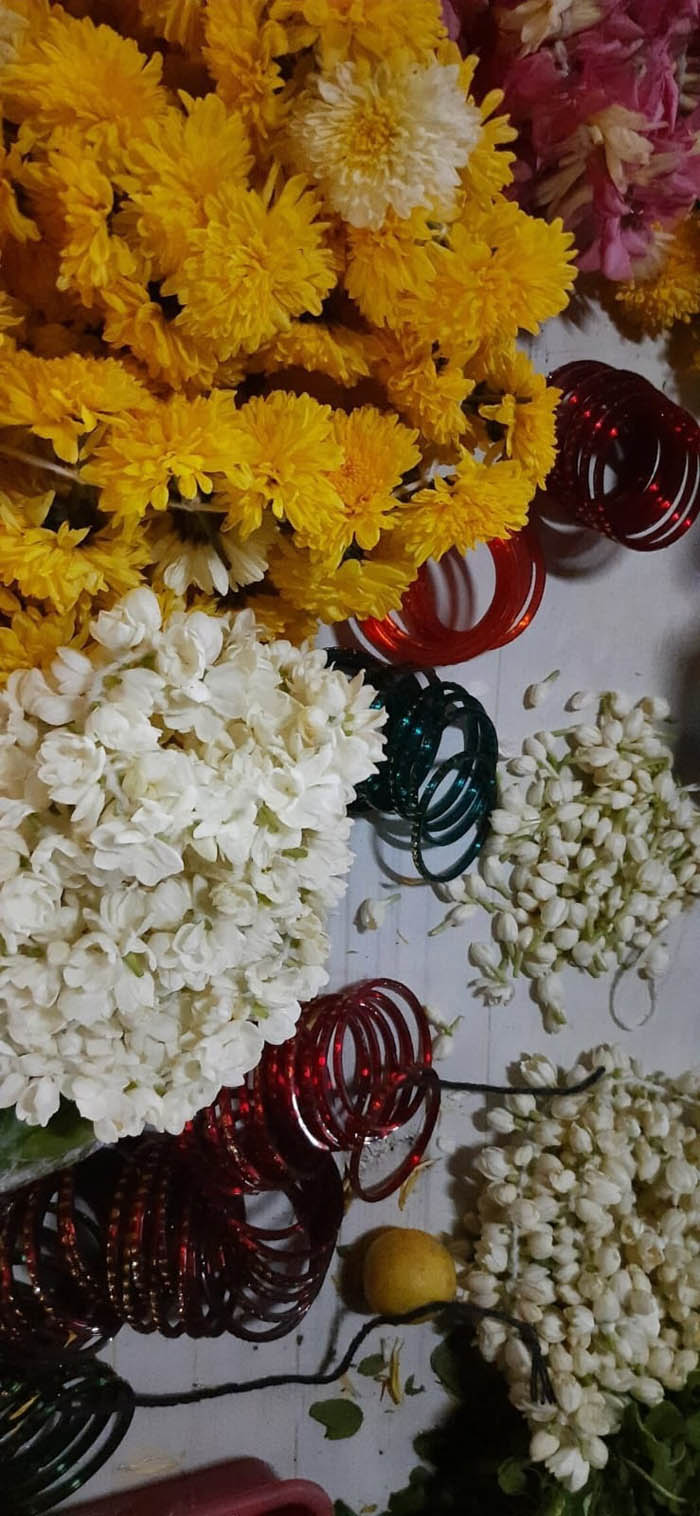

The shine, and shimmer
Glistening like sun-kissed dewdrop
The vastness in you
The space discovered
Surprises
Those introverts hidden for long
Experiencing the outside world
New members waiting
The Colors, fragrances, and flavours
Disposed, discovered, and replaced
The fresh fog, that hits your face
Like a welcome hug
Ah! The adventure of
Cleaning the refrigerator.
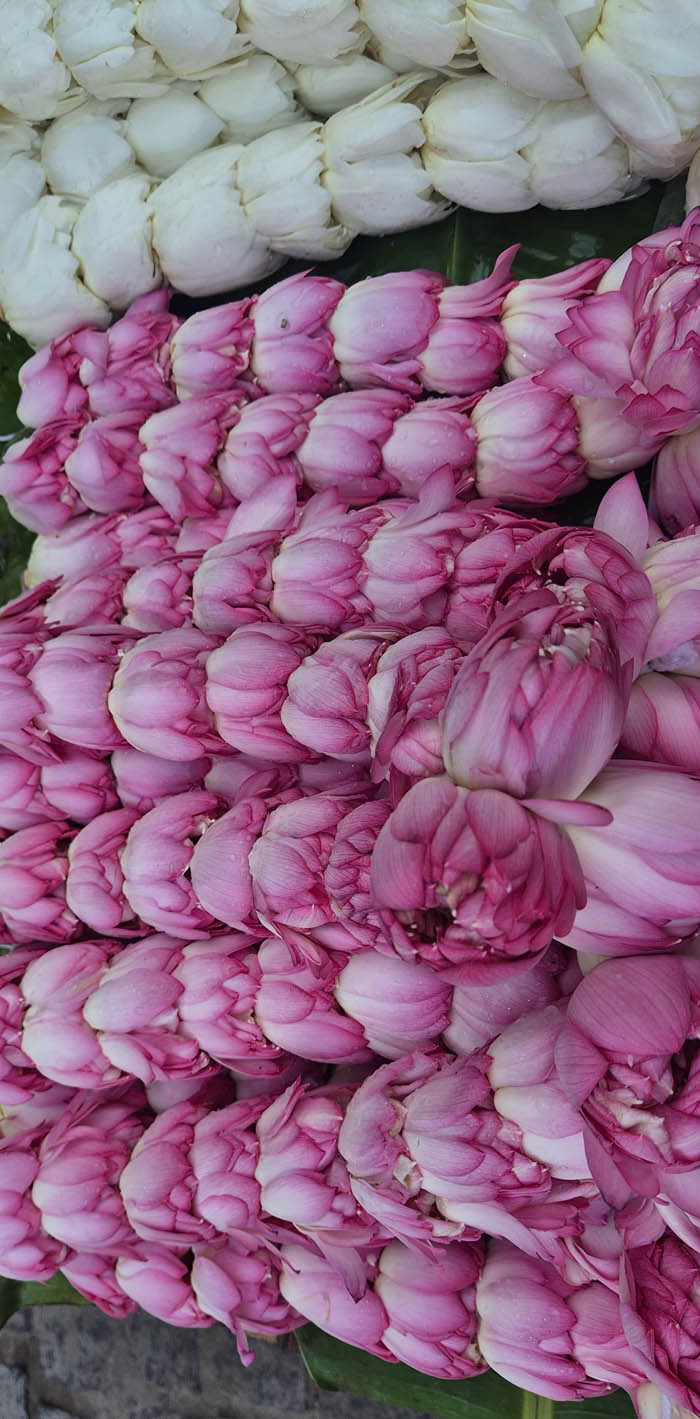
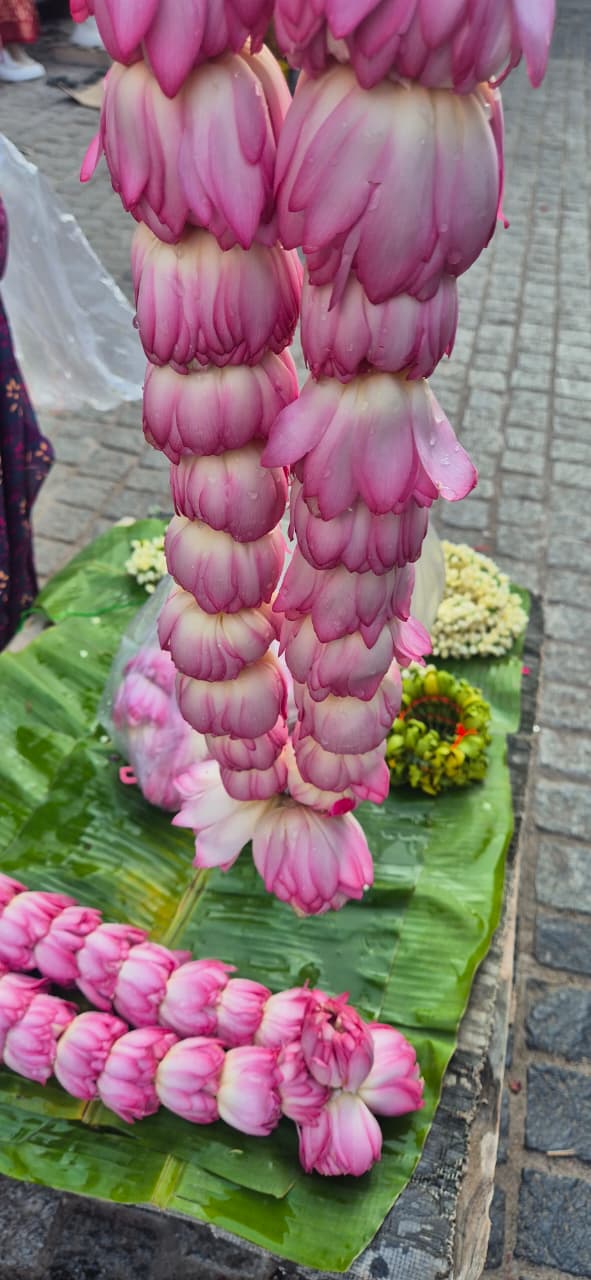
Everyday
He lives with colors, scents
That bear Nature's art
In each magical fold
Glistening in the sun
Raindrops fed
Cold wind, and warm afternoons
Pleasant evenings
Nostalgic moonrise
Always with them...
He goes back to his nest
With the unsold ones
Without telling the world
Sometimes
The fragrances
Aren't sweet, or soothing
To the flower-seller
But the stench of poverty
Fills his home
And the helpless flowers
Dumped in a corner
Look sad, and apologetic...

A bilingual poet-writer(Tamil, English), Madhumathi. H is an ardent lover of Nature, Poetry,
Photography, Music.
Her poems are published in Anthologies of The Poetry Society(India), CPC- Chennai Poetry
Circle's EFFLORESCENCE, IPC's(India Poetry Circle) Madras Hues Myriad Views, Confluence, Spring Showers,
Amaravati Poetic Prism, and in e-zines UGC approved Muse India, Storizen, OPA – Our
Poetry Archives, IWJ - International Writers Journal, Positive Vibes, Science Shore.
e-Anthologies Monsoon moods - Muse India, Green Awakenings - On Environment, by
Kavya-Adisakrit.
Madhumathi's poems are part of YPF's(Yercaud Poetry Festival) Ignite Poetry, Breathe Poetry, Dream Poetry, Winterful Whispers, Auburn Ambrosia,
Of Soul Scribers' Soul shores that have 10 of her poems
published, Soul Serenade, Soul songs, Soul Dance, Shades of Love-AIFEST - Special Jury Mention, and
secured 'A Grade’ in the International Poetry Writing Competition(published Anthology)
conducted by All India Forum for English Students, Scholars, and Trainers (AIFEST) in March-
April 2023 in connection with International Women’s Day celebrations, Arising from the
dust, Painting Dreams, Shards of unsung Poesies, are some of the Anthologies her poems,
and write ups are part of.
Besides Poetry, Madhumathi writes on Mental health, takes part in related activities to create awareness, break the stigma, believing in the therapeutic, transformational power of words.
An "elfchen" is a German poem with a specific structure of 11 words across five lines, following a 1-2-3-4-1 word count. It is also known as an "elevenie" in English, and the name combines "elf" (eleven) and "-chen" (a German diminutive suffix meaning "little"). The structure encourages a progression of thought, with the first line introducing a topic and the last line providing a summary or transformation.
Line 1: One word (the topic)
Line 2: Two words (description of what the topic does)
Line 3: Three words (a location or descriptive phrase)
Line 4: Four words (a metaphor or deeper meaning)
Line 5: One word (a new word that summarizes or transforms from the original
My Elfchens
1 Steadfast
Steadfast
He stood
To strengthen her
A rock face sturdy
Grief.
Lathaprem Sakhya
2 Manliness
Manliness
Super personal
A sturdy oak
Providing shade and protection.
Life.
( Lathaprem Sakhya)
3 Becoming
Becoming
A man
Constantly moving forward
An ocean of horsepower
Humans.
(LPS)
4 Fatherhood
Fatherhood
Proud status
A lode star
Guiding through unknown waters.
Children.
(Lathaprem Sakhya )
5 Bonding
Bonding
Team Work
Tangling of thoughts
Like the Kuttichattai art
Dreams.
LPS
6 Alive
Alive
Bubbling vitality
Blooming in abundance
Spark refusing to die
Roots.
LPS
6 Footsteps
Footsteps
Silent, muffled
Approaching stealthily
A cat utterly focused
Love.
(LPS)
7 Conquest
Conquest
Overcoming obstacles
Within the self
A dragon to overcome
Selfconquest.
(Lps)
8 Eternity
Eternity
Ultimate reality
Understanding the imperishable
The horizon untouched by death
Nirvana.
LPS
9 Gifts
Gifts
Give pleasure
Swelling up hearts
An ocean of love
Mementos.
( LPS)
An acclaimed Painter, a published poet, a self-styled green woman passionately planting fruit trees, a published translator, and a former Professor, Lathaprem Sakhya, was born to Tamil parents settled in Kerala. Widely anthologized, she is a regular contributor of poems, short stories and paintings to several e-magazines and print books. Recently published anthologies in which her stories have come out are Ether Ore, Cocoon Stories, and He She It: The Grammar of Marriage. She is a member of the executive board of Aksharasthree the Literary Woman and editor of the e - magazines - Aksharasthree and Science Shore. She is also a vibrant participant in 5 Poetry groups. Aksharasthree - The Literary Woman, Literary Vibes, India Poetry Circle and New Voices and Poetry Chain. Her poetry books are Memory Rain, 2008, Nature At My Doorstep, 2011 and Vernal Strokes, 2015. She has done two translations of novels from Malayalam to English, Kunjathol 2022, (A translation of Shanthini Tom's Kunjathol) and Rabboni 2023 ( a Translation of Rosy Thampy's Malayalam novel Rabboni) and currently she is busy with two more projects.
THE ECOLOGY OF INSECURITY
Sushree Gayatri Nayak
Seeds of self-doubt
On my right clavicle,
Insecurities circle
On the left one—
Tiny creatures
Beating their wings
Against my shoulders,
As if my body were
Their open sky.
They have lived rent-free for years.
Each day they water themselves
With comparisons
Poured carelessly across dinner tables.
The others feed on sentences
That people forgot after saying.
I tend a secret garden
Whose roots grow upward
And coil around my neck
Like an ornament—
Choking my voice.
The flowers,
Poisonous yet beautiful,
Adorn my ears like studs
While needling into my brain.
Tonight,
The seeds are restless again.
Someone has overwatered them.
The night sleeps,
But I have awakened to the truth,
That they were never buried in me
To destroy my identity.
Only to prove that
I am imperfectly
A perfect human.
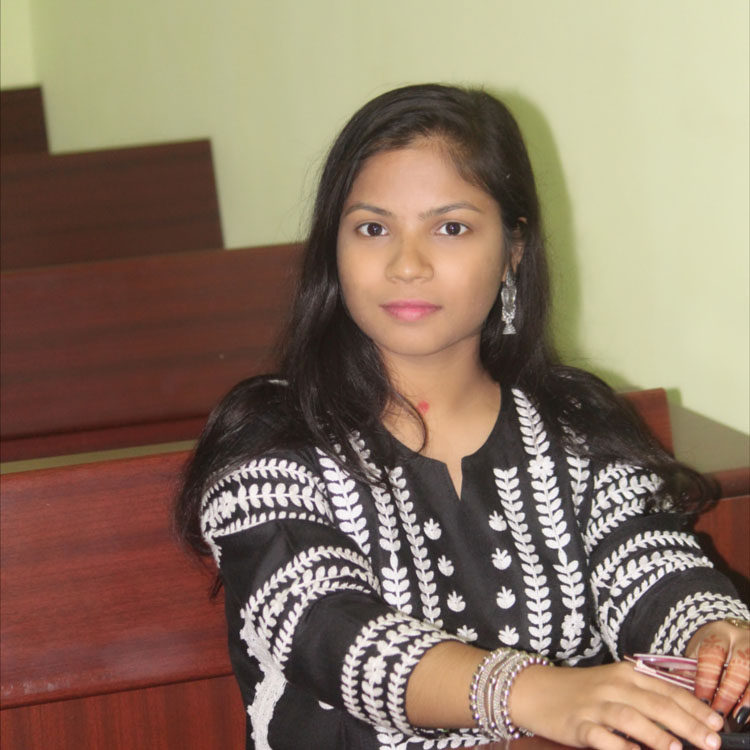
Sushree Gayatri Nayak is a budding muse and poet from Odisha, India. Currently pursuing her studies in English literature at Utkal University, she channels her passion for love, nature, and current social issues into heartfelt poetry. Her verses weave emotional depth with thought-provoking reflections, capturing both personal experiences and broader societal concerns.
WHAT YOU CALL RIGHT
Sudipta Mishra
You call it right,
I may call it wrong.
The same shade appears black to you, and, to me unquestionably white.
From my vision
a mark is a record of memory-
From yours
It may stand as a badge,
a glimmering token of success.
But tell me
how does it matter?
The child with fifty percent is no less a child of wonder.
And success does not rest on a perfect score.
Stop measuring mind
with narrow scales of marks.
Life begins elsewhere-
in questions,
in failures,
in the courage to face challenges.
Marks may matter to many,
I do not deny
but what matters to me
is my child's face,
shining
ever radiant
ever alive with light.
No matter how we
you try to control,
life unfolds in ways unseen-
perhaps,
as part of a greater design.
Learn to accept
what is planned for us
for in that acceptance
life becomes
a quiet awakening.
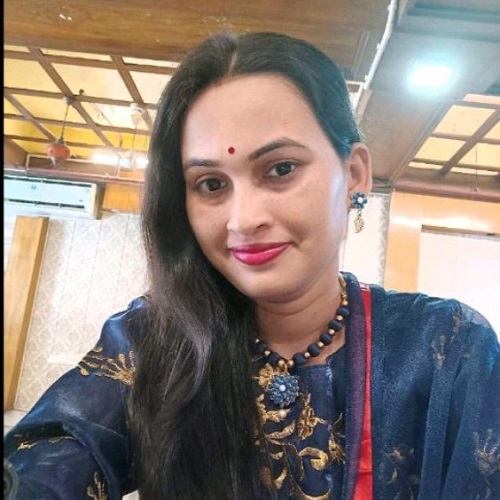
Sudipta Mishra is a multi-faceted artist and dancer excelling in various fields of art and culture. She has co-authored more than a hundred books. Her book, 'The Essence of Life', is credited with Amazon's bestseller. Her next creation, 'The Songs of My Heart' is scaling newer heights of glory. Her poems are a beautiful amalgamation of imagery and metaphors. She has garnered numerous accolades from international organizations like the famous Rabindranath Tagore Memorial, Mahadevi Verma Sahitya Siromani Award, an Honorary Doctorate, and so on. She regularly pens articles in newspapers as a strong female voice against gender discrimination, global warming, domestic violence against women, pandemics, and the ongoing war. She is pursuing a Ph.D. degree in English. Her fourth book, Everything I Never Told You is a collection of a hundred soulful poems. Currently, she is residing in Puri.
THE WOMAN FROM INDRAPRASTHA
Darsana Kalarickal
At last,
on an evening when the final petal of spring had fallen, I met her.
By then, the melodies of the rain-song had faded, crossing valleys into silence.
She was trying to hide herself beneath a thin veil of mist.
Just one glance.
Eyes beyond definition, as though there was still so much left to witness.
At the corners of her eyes, where tears refused to cease, lay the dark maps of bygone times.
If you looked carefully, you could see the charred boundary lines, children frozen in blood, young men, women's bodies scorched by fire, people fleeing.
She seemed cold.
When I gathered dry pine branches and kindled a fire, a flicker of wonder appeared in her eyes.
How was it that the tremor in the eyes of the girls of Manipur had mingled there?
As I watched in astonishment, she began to walk slowly.
She was shivering.
In the firelight, I could see how Time had embroidered her garment with unfading flowers of blood.
In the burnt-out forest, small villages stood like graveyards.
“Where do you come from?”
She paused for a moment.
Without turning back, she answered softly:
“From Indraprastha.”
“Where are you going?”
She did not ask why I needed to know.
Nor did she turn around.
Pointing toward the half-burnt villages, she moved on.
“What is your name?”
My curiosity grew.
she said:
“India.”
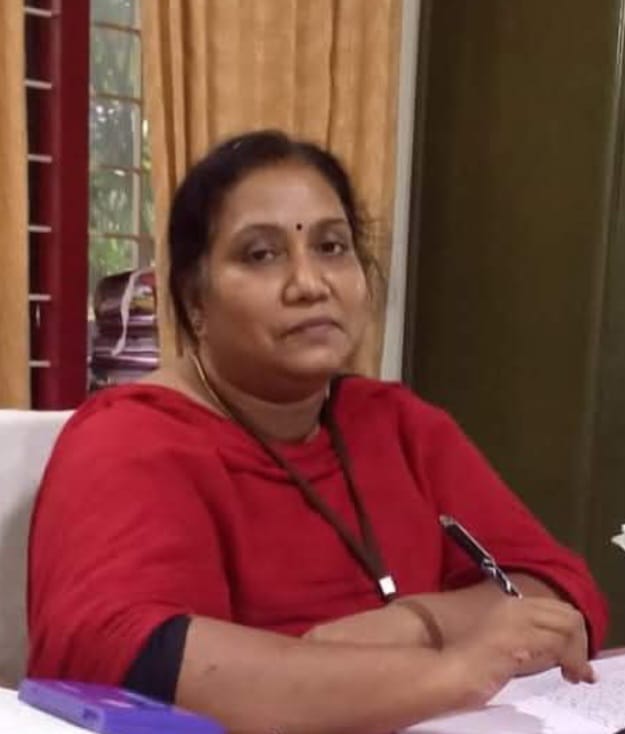
*Darsana K.R., residing in Venginissery, Thrissur district, is an employee at Venginissery Service Cooperative Bank and a passionate poet. Her published works include the poetry collections *Kavithaye Pranayichaval, Pranayathil Akappettathinte Ezhaam Naal, and Kuldharaayil Oru Pakal; the short story collection Thekkedathamma V/S Ramakavi (co-authored with Dr. Ajay Narayanan); the memoir Kunnirangunna Kothiyormakal; and the poetry study Kavithayude Veraazhangal. Her poems and articles have been featured in various periodicals and online platforms. phone : 9645748219, email darsanakr1973@gmail.com.
A PHOTOGRAPH :SORTING THROUGH EMOTIONS
Dr Nanda Kishore Biswal
Sorting through the faded photographs
like a blurred memory
I find the one that traces our educational trip,
a journey of the mind
through the foothills of Mahabaleswar,
lush forest being on sides.
A single photograph capturing most faces with stories
long and complex as life.
Baha'i in the background,
tall hills of Panchgani with breathtaking views forming the vast backdrop,
hardly a kilometre away
as the crow flies.
Sitting in the front row,Dr Azadi,
the headmaster, nay, Goldsmith’s
the village schoolmaster,
who was looked at with awe
as all "...And still they gazed,
and still the wonder grew,
That one small head could carry
all he knew".
Cute madam Azadi by his side,
a petit woman of several virtues,
bubbly, always wearing a smile,
a repertoire of positive vibes.
Dr Azadi — a stickler for punctuality,
the look on his face showing
he means business,
so nobody fools around when he is around.
Staring at the chaotic class,
he would deadpan,
"Good Morning!", that would bring the class to order
like a vehicle coming to grinding halt.
Right in the back stands Priya.
Dusky but beautiful.
Soft spoken, even when angry.
She will speak but won't hurt.
Behind her is Shreya, simple looking,
but deceptive is her simplicity.
Capricious like weather
Shifting from sunshine to storm
in minutes if provoked,
won't mince words, spit fire.
And in the corner, calm and dignified,
stands Roopam Bedi,
as if, won't lose appeal overtime like good poetry.
Her charming charm is food
for an artist's imagination.
That a few swooned over her
must have been little known to her.
Somehow it came to my mind
with her, even the simplest moments
can glow little differently.
A moon she is
to be looked upon
lighting lonely paths
as frightening darkness rules.
Whenever my heart went heavy
with silence, as if never to recover,
her words taught me
the language of blooming again.
She is the calm
to bring the storms of restless waves to settle.
She is the season,
my heart always longs that it lasts longer.
A girl of few words
whenever she went humorous,
few and far between though,
but with a shade of nuance
and never at the cost of others.
"Communication is a way of respect",
she used to say, though unwilling to do so.
At the parting time
and in the final goodbye,
tearful were her eyes
and she spoke to me
through tears
that rolled down her cheeks.
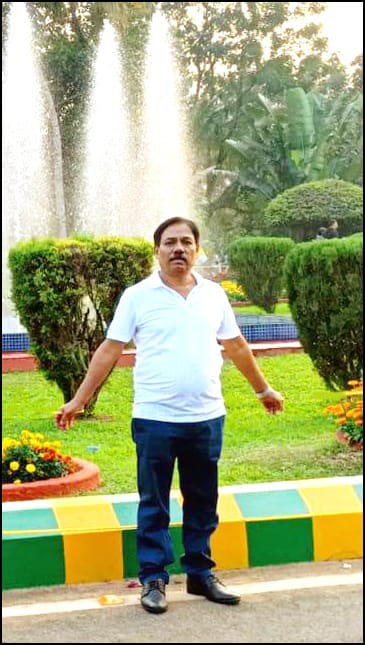
Dr Nanda Kishore Biswal, after teaching English language and literature for more than thirty five years in different colleges of Odisha, retired as an Associate professor. Passionate in reading poetry, intermittently, he has been writing poetry since his college days.1996 to1999 was his most fertile period when his Odia poems were published in almost all Odia dailies as well as in most of the Odia magazines. Also he writes English poems. He has authored The Fictional Transfiguration of History in the Novels of Salman Rushdie, Amitav Ghosh and Rohinton Mistry. Besides, he has edited Prananath Patnaik:A purveyor of Egalitarianism Currently, he is engaged in writing reviews of the poetry collections of the new poets who write in English.
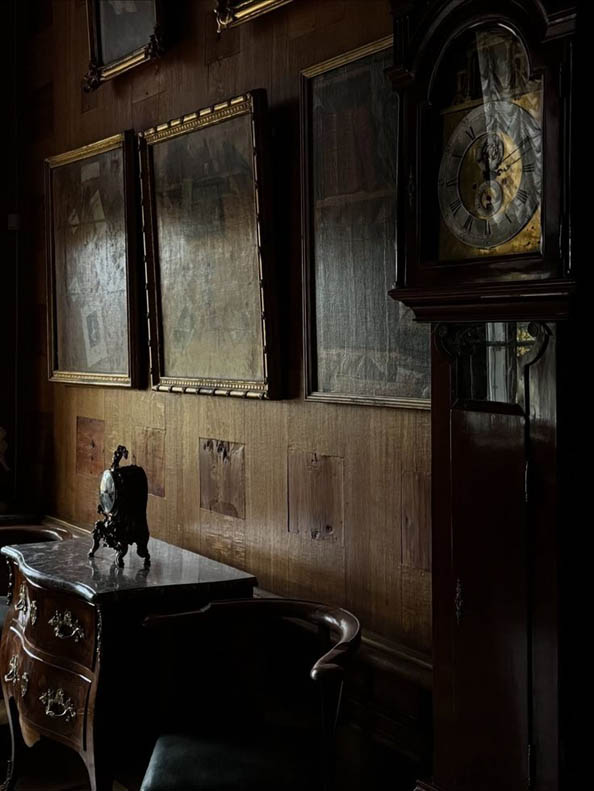
Blue birds on the porch, secluded summer skies call to wake,
Amber walls poured neat, the shovels and luck in a brawl,
An eccentric chill by the hushed incense, wrapped in icy steel,
The mahogany weeps into the floor and venomous stillness creeps.
My wintry fingers numb, worry not, my children of blue,
Lazy feet tied by pious pity, heart and diamond eyes shut,
None offer symmetric sympathies, indigo gaze grazes not,
Piety swirls in the ember liquid to the creaky floor.
The forlorn faucet drips, over gruelling time’s palms,
Starved is the tongue of the empty, draped in golden guilt,
Rented solace in her best, tired joy withdraws at last,
Drains clogged with navy, a mirthless cackle echoes.
Life breathed out in tranquil, my pale froth-lined lips rest,
Forgotten drugs settle like the muddy river’s silt on my skin,
A verbose eulogy recited and my clammy claws in protest,
Stillness creeps no more, but an emperor tall.
Leased laughter dissipates like the foam that graces my mouth,
Marred mercy, for my cowardice and the ailing bones that try,
Sunken eyes and drunken vigils, for the words I’ve said and not,
Still, the flutter of my wronged breath leaves its mortal confines.
Wonder ends and the dead blue birds ascend,
The barbed wires at the gates in sweet slumber, akin to mine.
- Purani R
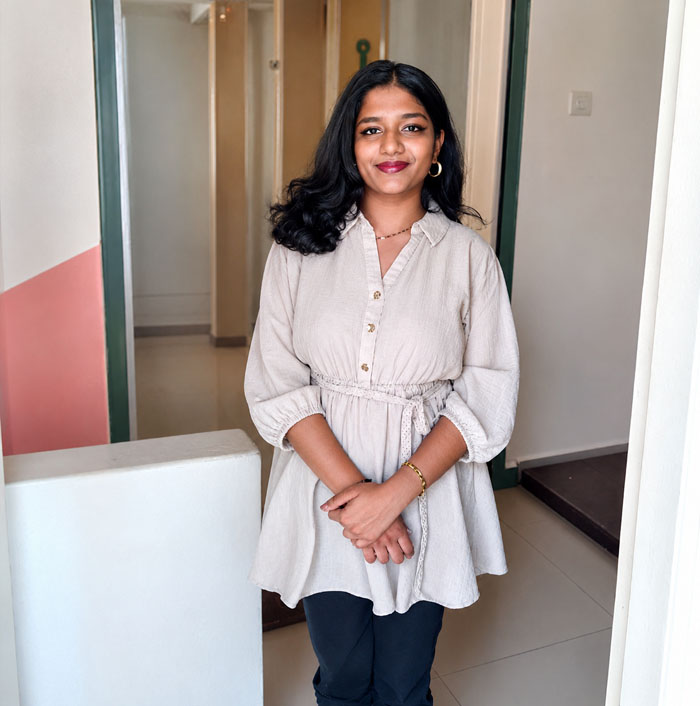
Purani is an Engineering graduate from Chennai who spends her dwindling leisure burying her nose in novels and scribbling odd poetic lines on tissues. She previously served as the Editor-in-Chief of the Crescent Literary Society and oversaw the publication of its magazines and newsletters. When not writing or reading, she can be found humming a tune, troubleshooting a network, or lost in the city’s bustle.
BAJI RAUT, THE BOY BOATMAN
Bipin Patsani
Oars in hand
And the look steady as a lover’s,
Baji Raut stood on the boat
Hard and heady, rock like
Inscrutable, imperishable at the centre
Set apart from the two banks:
The bank of encroachment
And his own bank of primitive trust
Grown glorious behind the woods,
Wild and enlivening like a folkdance.
And underneath flowed the river
In her bridal bed,
The flow sparkling and magical
Yet calm and contented,
Holding in her ethnic embrace
The boat, the young boatman
And the thrill of the moment,
Unaware of the king’s ally
Or the rebellious uproar.
In love with life and motion
And not moved by fear or lure,
The boy boatman who knew no country,
No nationality except his own world,
Chose to remain firm in his oneness,
The savage martyr;
For who can separate the boatman
From his boat and the lyric of the river?
Who can kill the spirit of freedom
And walk on to heaven with a weapon?
This Baji Raut, the power plant,
Who hung like a human bridge
Denying the alien force access to his territory,
Like a swan denying debris,
Thus, blown and battered
Was thrown into the passing current,
An image immersed after celebration.
But the river flows on, still flows down
Never looking back and humming
The rooted strain of life, of death, of meaning….
A mess of all things,
Good philosophy, good poetry,
Good earth, streams, air and fire,
Gods enshrined in divine splendour
Amidst a confused mass
Sibilant, sighing and hesitant,
Lacking in courage as it were,
And accepting the loot and the lot
That embodies all possible extremes,
All possible good and evil on earth,
My country waiting, indeed, for infusion,
Is a lost case without a Mahabharata,
Ripening for a big-bang,
Chopped up fingers creeping.
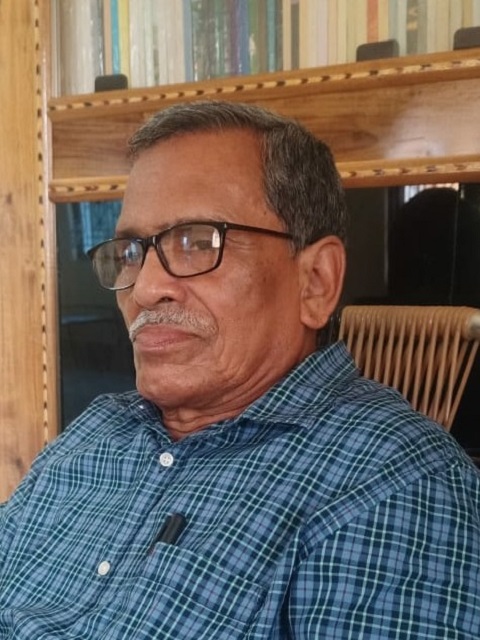
Bipin Patsani (b. 1951) has published poems in many prestigious journals and poetry anthologies including Indian Literature, Chandrabhaga, Journal of Indian Writing in English, Indian Scholar, Kavya Bharati, Poetcrit, International Poetry and Prophetic Voices etc. He has been translated to Spanish and Portuguese. He has three poetry collections to his credit (VOICE OF THE VALLEY, ANOTHER VOYAGE and HOMECOMING). He is a recipient of Michael Madhusudan Academy Award/ 1996 and Rock Pebbles National Award in 2018. He did his Post Graduation in English at Ravenshaw College, Cuttack in 1975 and served as a teacher in Arunachal Pradesh for 34 years till his superannuation in 2012. He also received Arunachal Pradesh State Government’s Award in 2002 for his dedicated service as a teacher. He lives with his family at Barunei Colony, Badatota in Khordha District of Odisha, India.

You are the cause of my faith and belief
On days, when I am shrouded by
Pitiful realities of life
Grope for a footing between Twilight and deep dark night
You held my dishevelled self gently
Make me bounce back like a boisterous spring
In your lap, my raw emotions find a footing
The river of silence garners a rhythm to sing
My yearning to belong
To the realm of romance and ecstacy
Elicits a subtle beckoning
I become a garden forever in bloom in your company
Where beauty of eternity decorates
My drab days and dull evenings.
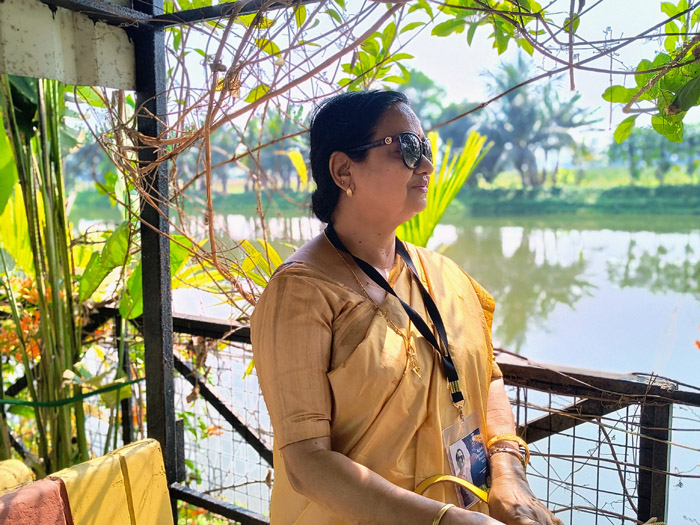
Sujata Dash is a poet from Bhubaneswar, Odisha. She is a retired banker.She has four published poetry anthologies(More than Mere-a bunch of poems, Riot of hues and Eternal Rhythm and Humming Serenades -all by Authorspress, New Delhi) to her credit.She is a singer,avid lover of nature. She regularly contributes to anthologies worldwide.

All night long
Rain knocked upon
The parched roof
The reticent earth
Said nothing:
And it breathed.
TO OUR GREAT-GRANNY
Matralina Pati
Lullabies rippled through
Her reticence and
The home swirled
Round her feet
Trailing along chores
Of ceaseless routines.
In the fading light
Of tumultuous eves,
Spattered on slow simmer
Of thirst unknown;
I grappled for her voice
T-h-e-n
Silence pervaded my being:
Till this day her smiles
Ignite our effusive hearth.

Matralina Pati, is a PhD research scholar working on marginal Indian bhasha literature (UGC Junior Research Fellow), a bilingual poet and a translator from Bankura, West Bengal. Her critical and creative writings have been published on national and international platforms. She has authored a book of translations titled Monsoon Seems Promising This Year (selected poems of postmodern poet Rudra Pati translated from Bengali into English).
A LEISURELY BREAK
Dr. Rekha Mohanty
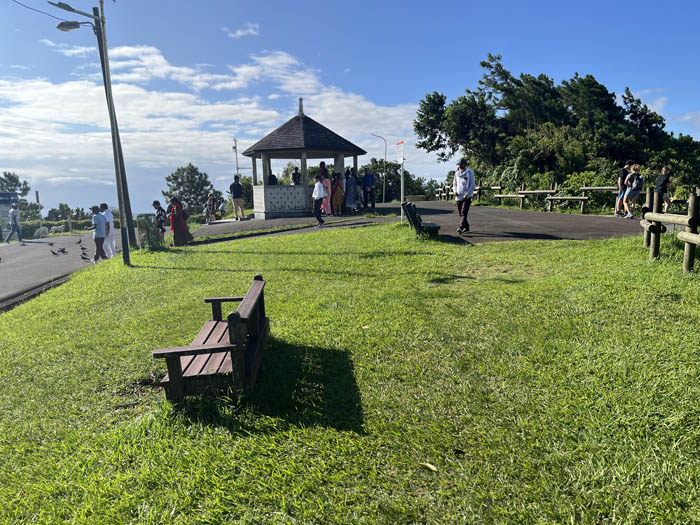
What if life is monotonous
and lacks a leisurely break
to sit and simply stare ?
No time to mingle with nature
Experience beyond
routine and share ?
No time to stand under a tree
and watch how leaves
swirl and swing in air ?
How morning dews
shine under sun ray like pearl ?
How blanket of fog shadowing earth to appear as a shy girl ?
How foamy waves
of blue sea dash on shore
to mesmerise senses for a while ?
How green meadows
with yellow tiny flowers
look like a designer stained glass ? How squirrel run to hide
the nuts in grass ?
Why to ignore the nature
posing at its best
in all seasons to dance ?
What’s the secret of joy
we miss in every day life ?
It’s just to pause a while
and enjoy the abundance
in leisurely moments passing by…
A break is nothing but
a rest shade in busy pathway
that’s most welcome,
A Lift for soul towards
human evolution…

Col( Dr) Rekha Mohanty is an alumni of SCB Medical College, Cuttack, Odisha and she has spent most of her professional life in military hospitals in peace and field locations and on high altitude areas.She has participated in Operation Vijay (Kargil war)in 1999 and was selected for UN missions in Africa for her sincere involvement in crisis management of natural calamities in side the country and abroad where India is asked to do so in capacity of head QRT in Delhi for emergency medical supplies.She had also participated in military desert operation ’ Op Parakram’ in Rajasthan border area.After relinquishing Army Medical Corps in 2009,she worked in Ex Servicemen Polyclinic in Delhi NCR and presently is working in a private multi-speciality hospital there to keep herself engaged.
Her hobby is writing poetry in English and Odia.She was writing for college journals and local magazines as a student in school.
Being a frequent traveler around the world,she writes travelogues.The writing habit was influenced by her father who was a Police Officer and used to write daily diary in English language he had mastered from school days in old time.Her mother was writing crisp devotional poems in Odia language and was an avid reader of Odia and Bengali books.Later her children and husband also encouraged.
Dr Rekha keeps herself occupied in free times for activities like painting, baking and playing card games the contract bridge.
She is a genuine pet lover and offers her services to animal welfare organisations and involves in rescue of injured stray dogs.Being always with pets at home since early childhood ,she gives treatment to other dogs in society when asked for in absence of a vet.She delivers talks on child and women health issues to educate the ladies in army and civil.
After sad demise of her husband Dr( Brig)B B Mohanty in February 2023,she devoted more time to writing and published her first poetry book’Resilient Leaf’in August 2023.Since then there is no stopping and she is going to publish her second book of poetry soon.
She enjoys reading E magazine LV , newspaper current affairs ,writing poetry and watching selected movies whenever she gets time.She keeps travelling places of interest in between for a change which is a passion as a girl since days roaming with parents and siblings .Her motto is to be happy by giving the best to self and to the society.She is lucky to have a supportive family.
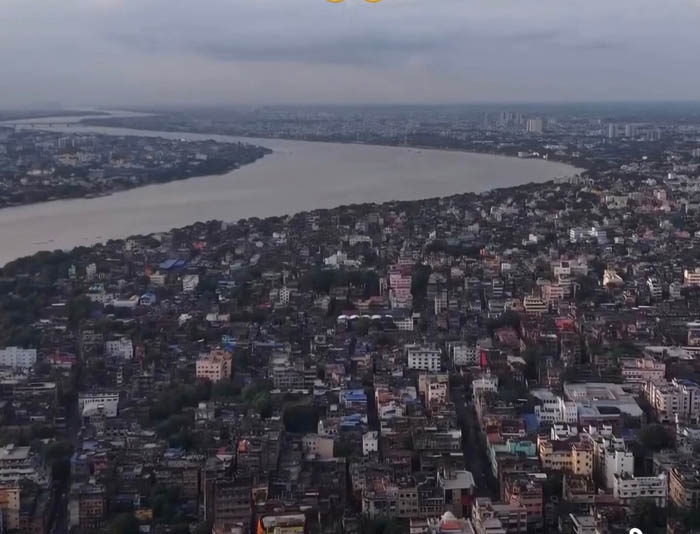
O! My City,
Stands tall with pride,
As the river gurgles by
in its own sweet will!
The crowd, The cacophony, The sweat
Dissolve into warm nostalgia!
The dawn breaks,
The dusk sets,
Yet -
Pulsates with life !!
O! THE EMPTY THOROUGHFARE
Kunal Roy
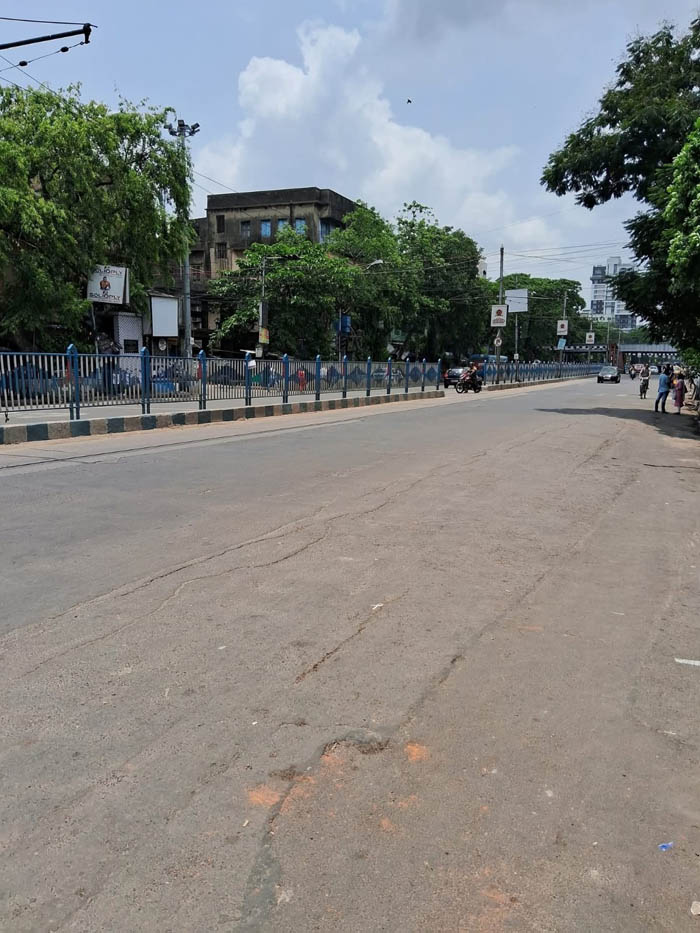
O! The Empty Thoroughfare,
Are you not blistered by the scorching Apollo?
Are you not desirous of listening to the cacophony?
The reply hidden in your womb-
Is yet to be manifested!
The trees stand tall,
take delight in their unobserved verve!
The dispersed clouds
Chased by the dollops of sunshine.
The wind stands still!
An errieness seems to creep-
Yet you are
Reticent,
Depeopled,
Discerning!!
Kunal Roy has always been an ardent lover of literature. He has received various awards for his literary contributions. He is a poet and a critic of poetry. His works have been published both here and abroad. Currently working as an Assistant Professor of English Language and Communication in George Group of Colleges, Kolkata.
ENTWINED IN THE DARK
Nandini Mitra

A shadow haunts my sleep, yet I do not know your name.
You hide deep within a sacred corner of my heart.
When your smile brushes against mine, my lips tremble with ecstasy,
Yet so much darkness lingers around us.
I always fail to see your face clearly.
Your fingers fit right into mine like a perfect riddle.
Only the gleam of the moon leaves a trace of your path
As I follow you everywhere through this winding maze of love.
Tears roll down my cheeks unknowingly—
I do not know why I cry.
A call from a faraway land summons me to surrender.
I wish to see a new dawn beyond our reality:
A place where we meet every night without expectations,
A world where we make no promises to break.
I nurture you with tender care, and you give me solace.
This is where I find myself in my silent prayers.
I do not know who you are, but I see you in my dream.
Let our fingers remain entwined through eternity.

Nandini Mitra is a poet based in Kolkata. A post- graduate in English Literature from Jadavpur University. She is in the profession of teaching for last twenty -five years. She has published her first book of poetry,The Road To Tranquility, recently. Has worked as a freelance journalist for a prestigious Bengali magazine published from Kolkata. She is passionate about Music and is a trained classical singer. However, writing poetry has become an integral part of Nandini’s journey of life since 2011. She believes in the religion of humanity, compassion and love. She has a rich sense of metaphors and imageries and enthusiastic about weaving poetry relating to the realities of lives and the diversities of nature. Her poems have featured in various national and international anthologies.
INTO THE KINGDOM OF BLISS
Lata Krishnan
Many more veils to remove
Many more doubts to clear
Many more doors to open
In the quest of my inner seer.
But first to tame the wayward mind
And yoke it to the present
Then rout the ego out
Without a grain of resent.
Humility shall take its place
Heart surrendered to love
Judging others is not a job
For judgment of my deed is done above.
The reason for my being here
Is a quest still unfulfilled
Everyday some duty calls
covering the days with needs.
A step at a time with ease and grace
Unshaken by world’s mad tease
Trying to tune in to music divine
by my innermost source of will.
With no regrets and heart lovefull
a conscience that doesn’t pull
welcoming everything with an inward smile
I wish to sail into the kingdom of bliss.
Lata Krishnan is a writer presently based in Coimbatore, India. Having spent her growing up years in Kolkata, she became enamoured with poetries and litrature and started penning a few lines now and then. After finishing her education in Kolkata where she spent almost 32 years, she shifted to Chennai and many others cities due to demands of her office work as a Bank Manager. After her retirement from the banking industry, she decided to indulge in her love for writing. Her experiences with life reflects in her work. She explores themes of nature, life, love, and self- reflection. She is the author of the poetry collection "Strewn Petals of the Heart" which she published in 2023.
Restlessness of the roving tongue
going around the fallen teeth
desperately touching the empty gum
like the severed tail of a lizard
groping for a familiar touch.
Forgetful of the loss
it travels again
like the rising Sun.
Obsessed with missing out
Sometimes deep in the night
he wakes up
and walks through
the suspended silence
ringing in the ears
anxious how much is left in the wallet
or wondering how can he empty it in time.
Baldev Samantaray is a retired banker who lives in Bhubaneswar. He did his post graduation in English literature from Ravenshaw College (76-78).He started writing from his Ravenshaw days. Many of his poems appear in various journals and anthologies.
There's this hollownesss
And there's this life
That I've to endure
Without you being on my side
How do I explain this?
How do I make anyone understand how it feels?
How do I process the fact that you're no more here
It's been more than four months
And I can't even remember how life was before you
It feels as if the biggest chunk of my life
Has vanished with you
The day I buried you
Was the exact day I buried myself too
I no longer look for anyone but you when I turn around
I try finding your fur on my clothes
On the floor
In my books
And all over the places
I crave to touch you
To hold you
To caress you
To feel your presence
And all I find
Is the void that you've left behind
I wrote about everything
But failed when it came to you
I don't know who it is to be blamed for!
Me , you or someone else?
The absence that you've left behind
And the silence that has followed
I've lost myself
And I'm afraid
That if at all I'm going to find myself again
This world has been cruel
You had been kind always
I will still look for you
In every dog I ever meet
(To SULTAN)
From
Elly

Arpita Priyadarsini, a young poet, is currently working under Home department, Government of Odisha. She has keen interest in literature. She loves reading fiction and poetry. She started writing poems few years back and has been published by an international publication house twice. Her Instagram handle is @elly__.writes, which is solely dedicated to her love for poetry.
PARENTAL LOVE
Mrs. Setaluri Padmavathi

The thought of being a parent
Holding the new life in hands
Hugging the baby with love,
And staring at him with an awe
Change the world within me!
I knew not how to bring him up
I learnt not how to train myself
People around me teach me
The lap of nature shows me
To care for him and embrace him!
Your love as a responsible father
The way you make him step ahead
When your eyes shine like twinkling stars
As you enthral his utterance,
That's your proud moment!
As the growing plant, he grew
We protect him as the shielding earth
With a fear of a bad company
We taught him values and ethics,
That help him raise his head high!
No expectations, no returns
We feel not he is our property
We demand not his wealth
We always show the path
Where he can trod to prosper!
No malice, no selfishness in love
We never boast our sacrifice
Everything is a duty,
a moment to cherish
Yesterday, today and tomorrow!
Mrs. Setaluri Padmavathi, a postgraduate in English Literature with a B.Ed., has been in the field of education for more than three decades. Writing has always been her passion that translates itself into poems of different genres, short stories and articles on a variety of themes and topics. She is a bilingual poet and writes poems in Telugu and English. Her poems were published in many international anthologies and can be read on her blogsetaluripadma.wordpress.com. Padmavathi’s poems and other writings regularly appear on Muse India.com. Boloji.com, Science Shore, Setu, InnerChild Press Anthologies and Poemhunter.com
A BUTTERFLY BECKONS
Susan Kurien
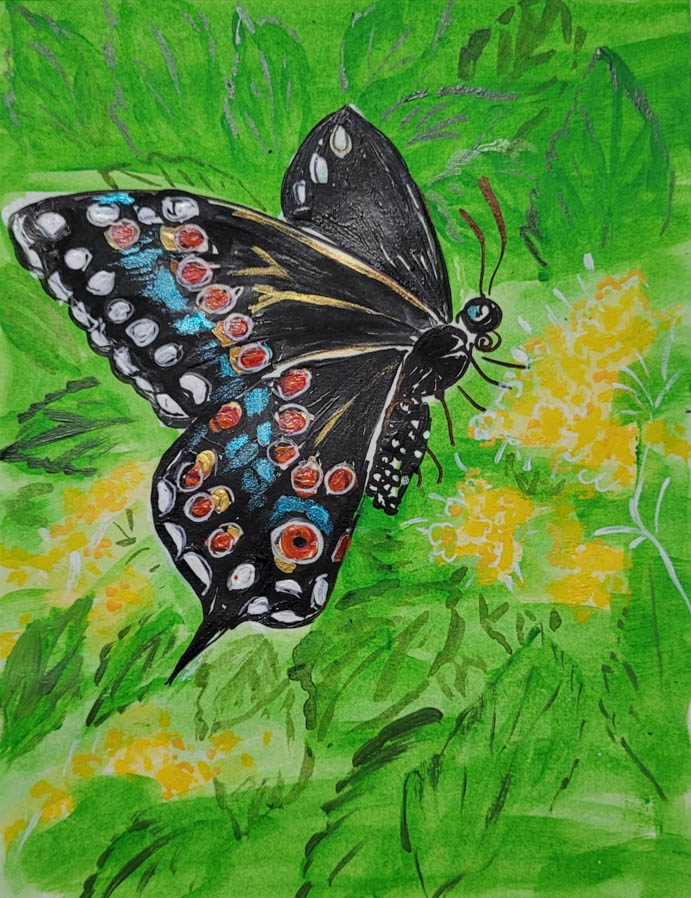
Out of my window I do spy,
A flash of black, beckoning me pry.
A black swallow tail briefly sits
On my neem tree now all sun-lit.
How freely she roams under skies so blue
Darting down for a pollen wisp.
In a shower of fairy dust she briefly lies.
No burden she holds transformed from crawl to flight.
A winged angel to me in fleeting sight.
The rains have stopped their whirl and churn
A soft zephyr waves and preens
Oh! When will you return to this dappled green.
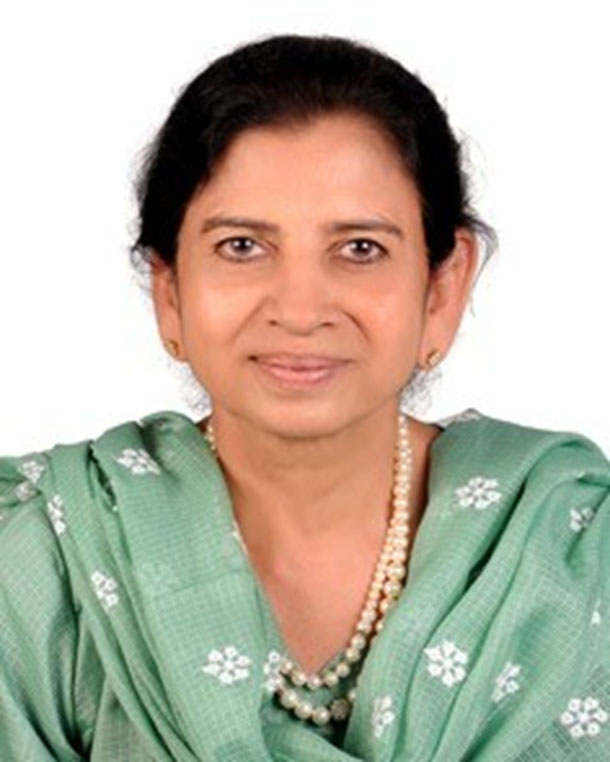
Susan Kurien is former Deputy General Manager of Reserve Bank of India. She holds Post-Graduate degrees in English Language and Literature and Economics, along with an MBA in Banking. She has co-authored two educational books, ‘English for Everyday Life’ and ‘English made easy for Competitive Exams’. She recently brought out an anthology of stories from around the world titled “FABULA”. She is currently working on a sequel to this, on stories from the Indian sub-continent. Some of her poems have been published in the anthology of poems ‘What Else is Rain’. She paints and doodles during her free time.
THE ECLIPSE OF THE SOUL
Anindita Sen
A profound threshold where perception goes numb,
When the sun deserts the terrain of life,
And twilight bleeds into every waking hour.
The vessel reaches the shore, only to drift away,
Staring repeatedly into the abyss.
The sun refuses to cast its reflection,
Consuming itself in its own raging pyres.
How did the whisper break free?
Why do the crowds gather to watch?
Smearing embers across their brows and chests,
In a relentless storm of doubt.
After a final war against the shadows,
The defeated sun yields,
Holding the fire close to its chest,
Waiting for the ultimate verdict.

Anindita Sen is a bilingual published author and Translator.She has published seven collection of poetry and four novels in her credit. She is a well known translator, a regular contributors to various literary journals in English as well as in Bengali. She was awarded a few literary awards. As a profession, she was a Biology teacher associated with Hem Sheela Model School based at Durgapur, West Bengal.She lives in Asansol, West Bengal.
One day, another day all feel the same
Only the fragrance of a warm flame (like you)
Makes my special day
I mean, I can't blame (you)
Because I'm just a shame
I'm lost in my thoughts
Wondering when you'll ask me out
You first fell but I fell much harder
I wish to hear your white lies
you tell for the silliest reasons
The times where you randomly fought (for me)
I might act annoyed but you know I'm not
Sometimes you really hurt me
But, who cares about me?
You just committed arson on my heart…
Even though I try to part
It just never works on my watch
You're always a notch up
You just committed arson on my heart
In this pretty wildfire
I just want one more moment with you
Although everything turned to ashes
All I can think of is you
The times where you randomly fought (for me)
I might act annoyed but you know I'm not
Sometimes you really hurt me
But, why can’t I just hate you?
You just committed arson on my heart
Even though I try to part
It just never works on my watch
You're always a notch up
You just committed arson on my heart
Your words are staying rent free in my mind
You gotta pay me up all not missing a dime
For all the times you gave me warmth
For all the times you gave me burns
(Intro) One day, another day all feel the same
Only the fragrance of a warm flame (like you) Makes my special day
I mean, I can't blame (you)
Because I'm just a shame
(Verse-1) I'm lost in my thoughts
Wondering when you'll ask me out
You first fell but I fell harder
I wish to hear your petty lies you tell for the silliest reasons
(Pre-chorus) The times where you randomly fought (for me)
I might act annoyed but you know I'm not
Sometimes you really hurt me
But, who cares about me?
(Chorus) You just committed arson on my heart…
Even though I try to part
It just never works on my watch
You're always a notch up
You just committed arson on my heart(falsetto)
(Verse-2) In this pretty wildfire
I just want one more moment with you (Oh)
It's dusk still
I want one more moment with you (Oh)
(Pre-Chorus) The times where you randomly fought (for me)
I might act annoyed but you know I'm not
Sometimes you really hurt me
But, who cares about me?
(Chorus) You just committed arson on my heart…
Even though I try to part It just never works on my watch
You're always a notch up
You just committed arson on my heart(falsetto)
(Bridge) Your words are staying rent free in my mind
So you gotta pay me all not missing a dime
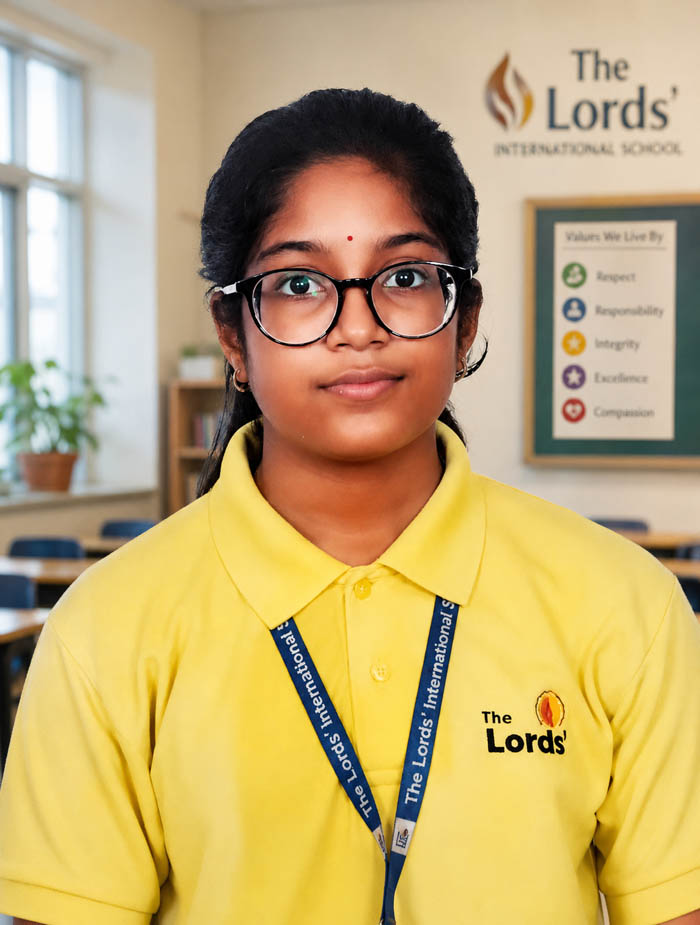
Sanjana shows strong interest in her creative and academic pursuits. She writes poems and is capable of singing the national anthems of around 30 countries. In her leisure time, she enjoys learning new languages, singing, drawing, and creative writing.
She has also successfully cleared the Japanese Language Proficiency Test (JLPT) N4
I won’t say “beloved” anymore.
Not for the person,
not for the photograph, the story,
the city, the village,
the tree, the line of a song.
Everything beloved
slowly slips away.
Everything beloved –
forgets how to be beloved.
I won’t say “beloved” anymore.
I will say whatever....
I will say everything of mine is unloved.

Swatilekha Roy , She is a bilingual poet,Lecturer ,F.A degree College ,Cachar Assam.She is creative and passionate nature photographer too
MY MORNING PRAYERS
Dr. Protiva Rani Karmaker
When my soul was like a turbulent sea,
As a little bird in a nest, I took shelter in thee,
When in utter silence amidst the prevailing darkness,
I stepped outside my room, I could feel your essence, my highness.
When my faith in human beings broke like a fragile mirror,
As a small river running to sea, I took shelter in thee.
When in early morning hours amidst the sweet quietness,
I kindled a fire; I could feel the grace and beauty of your uprightness.
As morning dew dropped on the green leaves,
And the colors of the sky brighten slowly
To welcome life with innocence and experience,
I feel the urgency of my deep prayers of early hours,
To you, my Lord, for purity & beauty,
For Mother Earth, nature & humanity.

Dr Protiva Rani Karmaker is a Professor and former Director at the Institute of Modern Languages (IML) of Jagannath University, Dhaka, Bangladesh. She is known as a distinguished writer, academician and researcher with more than two decades of experience in English Language Teaching (ELT) and institutional leadership in Bangladesh. She is a regular voice in national dailies. She has authored over 300 articles on language, education, and literature in various dailies and magazines. She has served as the first Director of the Institute of Modern Languages (IML), the first Director of the Centre for English Language (CEL) and the first house tutor of the first female residential hall, the Nawab Faizunnesa Chowdhurani Hall (formerly Bangamata Sheikh Fazilatunnesa Mujib Hall) at Jagannath University, Dhaka, Bangladesh. As a recognition of her academic and professional leadership, she has been awarded the prestigious ‘WOMEN IN LEADERSHIP & MANAGEMENT AWARD-2026’ by the Council for Educational Administration and Management (CEAM), Kerala, India. She was also awarded the International ERUDITE SCHOLAR AWARD 2022 by the Council for Teacher Education Foundation (CTEF), India and the Women Researcher Award by the International Scientist Awards Society of VDGOOD, India, along with other local awards. She has published 27 peer-reviewed articles, authored 12 books, and presented at many international platforms as a keynote speaker and resource person. As a writer, she believes in highlighting the beauty of life and nature through prose and poetry.
THE SUN BEHIND MY SHADOW
Swatishree Parija
You are in the tears of my eyes,
You are in my smiles and my joys,
You are behind every poem I write,
You stand before every award I receive.
You are at the beginning of my love,
You are at the end of my pride,
You are behind my reflection,
You stand before all my achievements.
I have never imagined myself without you;
Never have I considered you any less than my mother.
People say that a father is the sun of the home,
While the coolness of the moon is found in the mother.
But You made me strong like the sun,
You taught me the calmness of the moon,
You taught me to endure like the earth,
You shaped me with the firmness of a stone.
At last, I want to tell.....
In each birth I want to be your daughter again & again
Swatishree Parija is from Jagatsinghpur district, Odisha. She is a Graduate with Honours in Geology and has recently earned a B.Ed. degree. She has also qualified in the Teachers' Eligibility Test (TET). She is currently preparing for competitive exams.
From her school days, she has had a keen interest in creative activities. Her hobbies include writing, painting, reading books of different genres and photography. She has been writing short stories and poems in Odia, English, and Hindi since for the past many years.
She has actively participated in various speech, painting, and essay-writing competitions and has received several awards and prizes at the school, district, and state levels.
NIP IN THE BUD
Dr. Rajamouly Katta
In the very safe track of bright light
The trace of pitch darkness
Step by step
Dares to dim to the brim
Essential to avert it in the ways right.
In the life-path of ever speeding race
All hurdles and pitfalls
Spell by spell
Hinders the rider’s pace
Needs the way to get rid of the force.
In the very self-shining of sum-beams
The dark-blue clouds near
Minute by minute
Care to shatter their glitter
Search for a trial for their scatter ever.
In the plant-growth in full exuberance
Pests and germs in the root
Inch by inch
Fully destroy to the lifeless
In quest of the ways to nip in the bud.
In the sunshine of butterfly freedom
Trespassers and invaders
Second by second
Cause slavery and bondage
Resort to kick off a despotic kingdom.
In the very joyous sail on serene waters
A minute hole in the ship
Drop by drop
Sinks sailors to the bottom
Make a hey while the sun shines bright.

Dr. Rajamouly Katta, M.A., M. Phil., Ph. D., Professor of English by profession and poet, short story writer, novelist, writer, critic and translator by predilection, has to his credit 64 books of all genres and 344 poems, short stories, articles and translations published in journals and anthologies of high repute. He has so far written 3456 poems collected in 18 anthologies, 200 short stories in 9 anthologies, nine novels 18 skits. Creative Craft of Dr. Rajamouly Katta: Sensibilities and Realities is a collection of articles on his works. As a poet, he has won THIRD Place FIVE times in Poetry Contest in India conducted by Metverse Muse rajamoulykatta@gmail.com
THE GROUND ZERO
Dr. Niranjan Barik
Darkness, through I come;
To darkness, I shall return.
Why then should I fear the journey in the dark?
In the heart of darkness,
Did I not wrestle and strive,
Kick and punch against the wall,
Tearing the veil of night
To emerge into the light?
The sky is never wholly dark;
Countless stars keep watch above.
There will always be hands to welcome you,
Voices to guide you onward.
From darkness you came,
To darkness you shall return.
Your journey is from darkness to light,
And from light back into darkness,
An endless pilgrimage of becoming.
Light and darkness walk hand in hand;
Neither offers meaning without the other.
Darkness wanes for fifteen nights
Until it blossoms into the full moon's light;
And light itself descends, night by night,
To the embrace of darkness over the next fortnight.
Life teaches its eternal play,
The dance of duality, darkness and glow.
A Shakespeare need not tell us
That fear of darkness is but a childish one.
Am?utasya Putra, Child of Immortality,
So the sages called you.
Yet tell me, can't you conquer darkness
For all the ages yet to be born?
Darkness, through I come.
Darkness, I return to.
Beyond both darkness and light
Awaits the One!
The Ground Zero,
Where all circles close,
The first footstep meets the last,
And all sounds and silences
Become one, become Om (Aum).

Professor Niranjan Barik ,formerly Professor and Head, Department of Political Science at Ravenshaw University also served as a Professor of Pol.Sc and Principal , Khallikote Autonomous College, Berhampur, Odisha. A Fulbright Scholar-in-Residence at Miles College, Birmingham, AL, USA in 2007-08 , Prof Barik evinces interest in reading and writing short stories and poems in Odia and English. His poetry book , “Freedom from Bondage: An Ode to Nature” published in 2023 was released in Bhubaneswar in December 2023.
STARS IN THE SKY
Dr. Mrutyunjay Sarangi
He walks a lonely path
in a dreary desert
No one sees him
except for the stars in the sky.
He has walked alone a long way
None was ready to come with him
Everyone deserted him
except for the stars in the sky.
He wonders if the long journey is really worth
when none comes with a small lamp
To light his lonely path
except for the stars in the sky.
He had everyone around him,
at one point of time his word was law
But no one to listen to him now,
except for the stars in the sky.
He had high hopes
from those who followed his every step,
But now no one to accompany him
except for the stars in the sky.
He toiled hard to bring a smile to everyone's lips,
to shower plentiful bounty on those around him
Now no one even glances at him
except for the stars in the sky.
He walks alone. tired and weary,
he knows at the end all journeys are lonely.
None to guide him to the journey's end
except for the stars in the sky.
Dr. Mrutyunjay Sarangi is a retired civil servant and a former Judge in a Tribunal. Currently his time is divided between writing poems, short stories and editing the eMagazine LiteraryVibes . Four collections of his short stories in English have been published under the title The Jasmine Girl at Haji Ali, A Train to Kolkata, Anjie, Pat and India's Poor, The Fourth Monkey. He has also to his credit nine books of short stories in Odiya. He has won a couple of awards, notably the Fakir Mohan Senapati Award for Short Stories from the Utkal Sahitya Samaj. He lives in Bhubaneswar.
DIFFRACTIONS AT DAWN
Prabhanjan K. Mishra
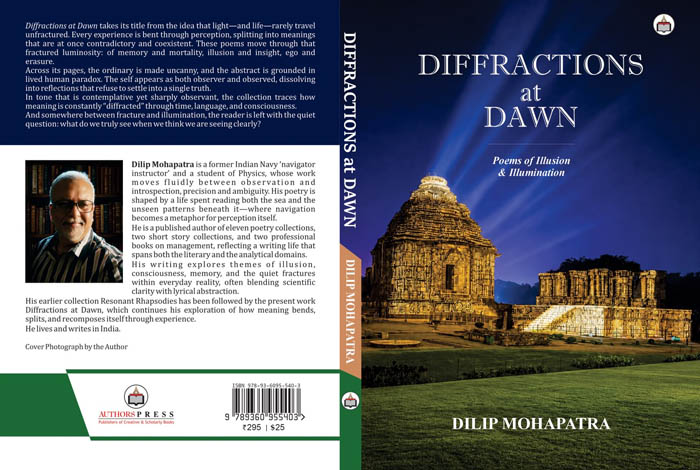
OVERVIEW Of ‘DIFFRACTIONS AT DAWN’ a collection of poems by Dilip Mohapatra
Dilip Mohapatra is a poet of repute. So, expectations run high as I thumb through his latest collection of poems, ‘Diffractions at Dawn’. I find the publisher having done a clean production with a thoughtful cover and putting the poet’s photo in half light and half shadow - bearing what to expect: an artistic endeavor. The cover image of the ruins of Konark, the Black Pagoda, catching with its broken remains of the crown the exact luminance of the first sun, creates an ambience that foretell of well-defined poems with exactness of craftsmanship.
A broad picture emerges in my overview that light and life rule the roost in these poems, and their nature tending to break shades, colors, climates of life and living experiences. In brief: living a full life is an unforgettable experience. The poet in so many poetic words has hinted this concept in so many poems.
A man, kind of sings lullabies to his childhood, hosanna to his youth, and luxuriates in his success’s lap of middle age. But as he grows towards the late afternoon of life, there appears a desire for expiation from unknown mistakes and a wish for atonement for them. Also, a desire to write his master piece before finally hanging his boots. With a metaphysical touch in his poem ‘Looking Upward’, after weathering life’s countless wounds, he sings, “I find my swan song/ a wounded symphony”. That reminds me of the immortal poet Shelley’s verse, “Our sweetest songs are those that tell of saddest thought.”
As one goes to meet his date with his best face, Dilip perhaps presents his best poem at the outset, titled – ‘Mirror Mirror’. He reflects on his reflections. The poem mixes reality with metaphysics, surrealism and imagistic poetics, “…and in my weatherbeaten visage/ I discover dignity/ grace and handsomeness/ of another kind.” He, sort of, worships himself as his reflection from its youthful Adonis features slowly morph over time into a serious Buddha. What the poet does not say but make one feel that unlike the legendary super-real fictional character Dorian Gray, he does not go to bargain a deal with the Devil for an eternal youth, in life or in thought.
The philosophy of ‘Mirror Mirror’ dominates all the book’s pages that he again establishes as, “what I was/ what I am/…what I will be.”, a statement of daring. In spite of that I find in him an ordinary human being after all his lofty philosophies that at times cries dry tears for sins that his conscious mind is not aware of, and there is an interweaving urge to find catharsis in self-mortification. In the poem ‘Paranoia’ we find the poet struggling with his anxiety, insecurity, and fear as he is aging, but without rhyme or reasons. Even he fears of “lest you decide to backstab yourself”, a farfetched anxiety, even more serious than a self-goal.
In ‘Apophenia’ he, kind of, shouts like the child “But he isn’t wearing anything at all!” in the fairytale ‘The Emperor’s New Clothes’. His sarcasm touches legendary heights, “How the rumours and hearsay/ transform themselves/ to become myths and legends…” and “the casual meaningless graffiti/ as monumental murals and/ works of great art/ signed by accident!”. He may be subtly hinting at non-poets and non-artists reaping fame by accident.
His poem ‘Blindfold Games’ opens with a grand perplexing fresh image “I blindfolded my eyes/ and asked them to find me.” But the image loses its impact to some degree by overuse for ears, nose, tongue etc. In ‘Illusions’ he winds up the poem with a metaphysical note, “seeking His presence/ in all absences/ and He continues to give/ us the slip/ as He endures and endears.” In ‘The Borrowed Being’ he plays between the soul and the shadow of the being. Its essence is a haunting insecurity, natural to all poets worth his salt.
The poem ‘Noise’ emphasizes on deceptive attractions and is stated through a maritime image “the lighthouse that lured him/ to the uncharted coast/ through thick fog/ was actually a raging forest fire//…” His frustration is palpable – “… a fragile seed/ that has lost its will/ to sprout..”
In the last poem of this large collection titled ‘Benchmark’ the poet sings of chasing immortality of sorts, competing with peers, even himself, breaking his own record but at the end singing with a delusion – “And what I am meant to be/ is not a destination/ but an enigma/ I learn to inhabit.” The poem shows uncanny growth to maturity and wisdom as a man.
The collection shines the brightest in its lucidity. At times however, a sudden departure into heavy and scholarly terms within otherwise transparent verses diverse the reader’s attention from his lucid poetry to deciphering and connect those words like ‘Arctic Eyes’, ‘boreal breeze’, ‘callipygian charm’, ‘cerulean sky’, ‘décor of derriere’ ‘chiaroscuro’ and other such highly erudite evocations. The sudden shifts into dense, specialized vocabulary creates a friction against that established lucidity, and beautifully crafted poetic atmosphere. With that I end my critique. (End)
ANNIHILATION OF VORTEX (Novel)
BY
AVINASH PUSHKARNA
A REVIEW
by
Prabhanjan K. Mishra (Poet, Writer, and Critic by profession)
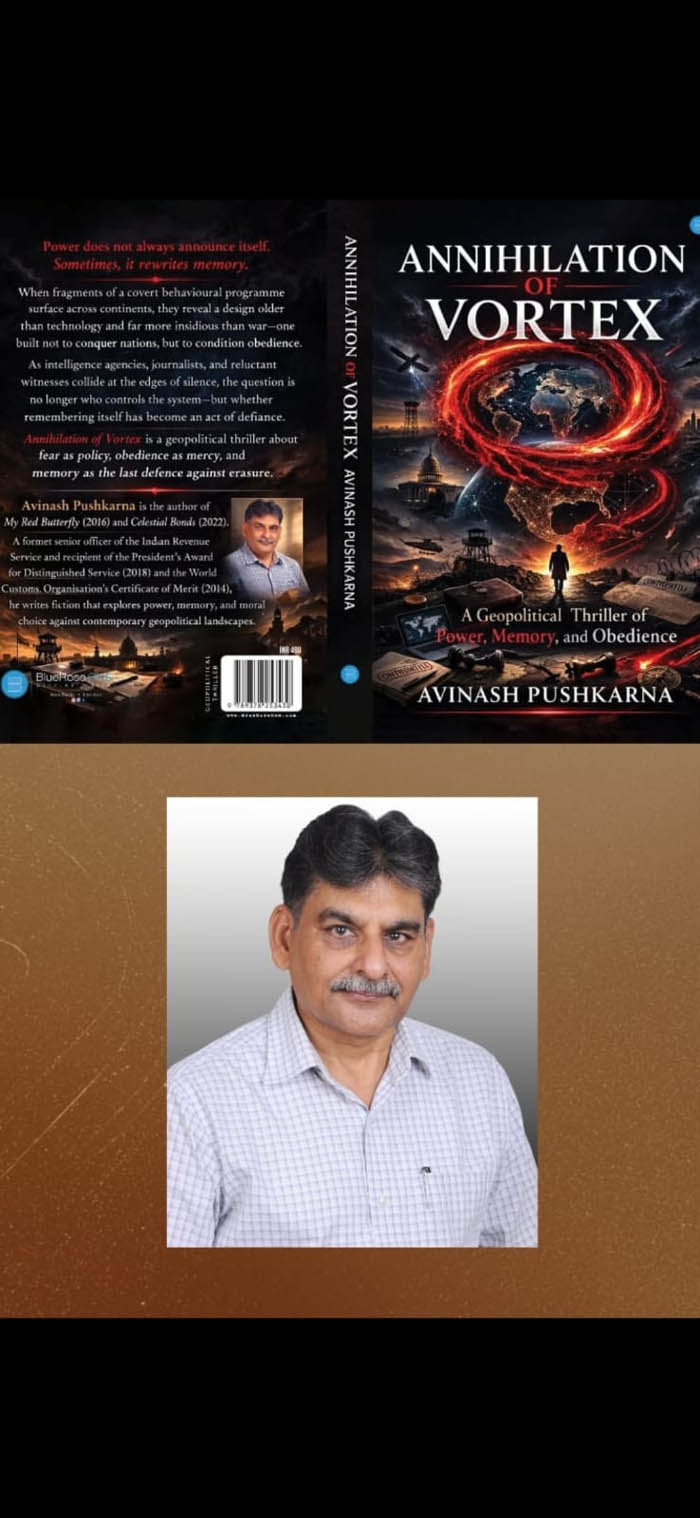
The novel, the third one from this novelist's pen, reads as a successful Spy Thriller. And it opens up a new avenue into the style of thriller writing.
After a little firework in the 'PRELUDE', that generally, as a rule, would have been continued by other authors in the entire spy-thriller writers' world for their narratives, the narrative of Avinash Pshkarna in the main storyline enters into a muted and almost invisible underbelly of the spy arena, exposing how real spies might be working, silently, and as disappearing shadows. The characters merge into the common crowd and are indistinguishable except in their private domain of thoughts or green rooms. Avinash Pushkarna, however, has produced a thriller that feels real, though carved out of pure fiction, as one observes and discovers a new genre quietly keeping the thrill riveted.
It has violence that is real-sounding, like Mafia World's symbolic 'Omerta' (mandatory dead silence), ‘shoot, kill, and scoot' with silencer-fitted guns, poisonous darts or gas or food, killing or maiming without hue and cry. Pushkarna thus writes 'muted violence', an oxymoron pairing of two contradictions in grammatical prosody but very common in a real spy world. One spy's wife may be a cross agent of the enemy camp, married just to keep a watch over her spy husband's activities and programmes.
Pushkarna has spies dedicated to the country's welfare and serving humanity and justice, rising above our cancerous caste, creed and gender bias. Punjab's drug menace appears to be the central issue, and the worldwide spread of drugs' hydra headed tentacles is represented as VORTEX that is successfully ANNIHILATED in the book's spy network. So, the title is an indicator. The story reminds readers of the worldwide blockbuster movie 'The Terminator', starring Arnold Schwarzenegger.
Not a routine spy story at all. It has soft and tender moments of romance. Ajay, Sonia, and Malika flirt on the book's pages in ways disguised as small talk, mutual concerns, care, and sweetness of genuine will. Malika, an Uzbek whistleblower, is tenderly sensual in her attraction to Ajay and is similarly responded to. Sonia, an Indian journo-cum-spy's love for Ajay is mutually deep at a platonic level, but the attraction is felt viscerally by the reader. The mastery of the craft in words is to be read to be believed.
The interweaving philosophy and paradigm seems retention of the MEMORY by a people that makes them indestructible. An evil power or a pandemic menace like drug or devilish games played coordinately may break the backbone of a people by destroying its value system, its will power, and its core moral but if the populace resiliently keep hold of their civilizational memory, their fundamentals of legacy, they would, no doubt, bounce back from the abyss before toppling to non-existence. Memory has been projected as the fundamental immunity of a people against the most virulent viral attacks.
The book is extremely readable, enjoyable, and relatable, without showmanship but with the nuances of a mature narrator (END)
Prabhanjan K. Mishra is an award-winning Indian poet from India, besides being a story writer, translator, editor, and critic; a former president of Poetry Circle, Bombay (Mumbai), an association of Indo-English poets. He edited POIESIS, the literary magazine of this poets’ association for eight years. His poems have been widely published, his own works and translation from the works of other poets. He has published three books of his poems and his poems have appeared in twenty anthologies in India and abroad.
MORNING TWILIGHT
Jayshree Misra Tripathi
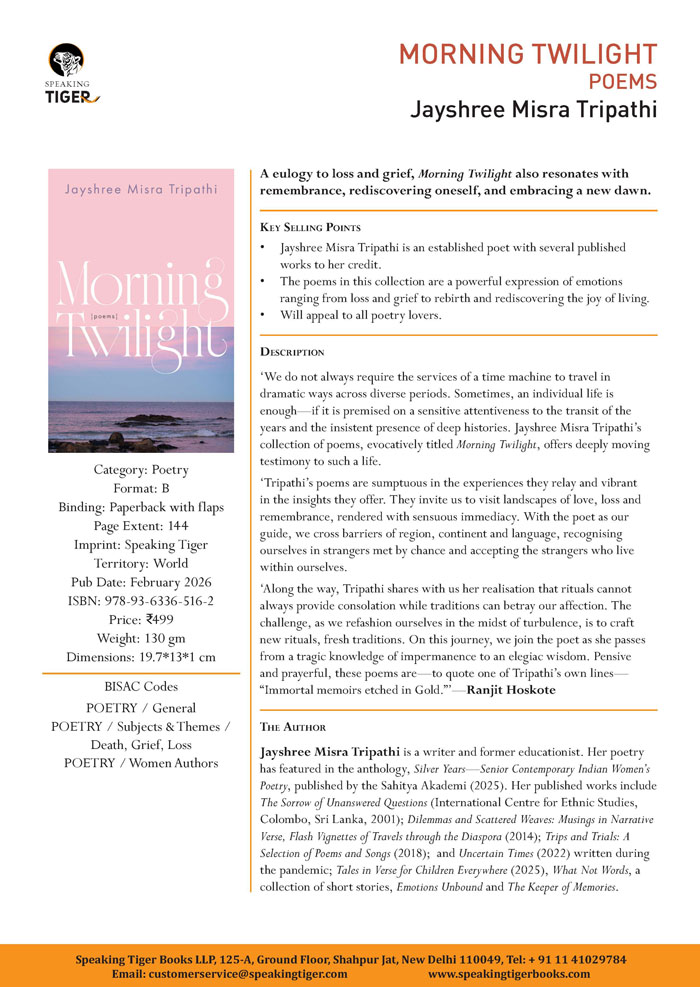
Published by Speaking Tiger Books, 2026
Price Rs. 499
(Review by Mrutyunjay Sarangi
Editor, LiteraryVibes)
Morning Twilight by Ms. Jayshree Misra Tripathy is an unique collection of soulful poetry that stays with the readers for long after it is read and felt within. The Publishers have described the book as an "Eulogy to loss and grief, which also resonates with remembrance, rediscovering oneself, and embracing a new dawn." With this, how beautifully they have summed up the poet's journey replete with memory, encompassing joy and sadness, and leading to a dawn of hope and solace!
Jayshree paints on a wide canvas, moving from one country to another, from region to region, state to state and uses the colour of varied emotions to create poems of extraordinary beauty and depth. She shows how extensive travel can open up the mind, enabling an accumulation of exquisite nuggets of rare resplendence in memory.
Some of her poems give the impression of the poet getting overwhelmed with intense emotions and trying to freeze the feeling for eternity:
I was filled
with grief for these young soldiers
so far from home, here in the foothills
now serene, death on cruel battlefields,
for others' political causes for Power
(The Young Bravehearts)
Here is another beautiful stanza, trying to steal a wintry leaf from time:
It was the leaves that rustled,
as I walked briskly by, mask on,
huddled in a shawl,
for winter and pollution
now make me shiver
with the fear of the unknown.
(The Embrace)
And towards the end of the book the poet reveals her crave for solitude and raison d'etre for her magnificent urge for creativity:
No, I am not a misanthrope!
I choose solitude
to bring calm into my life,
to gather scattered thoughts
in my consciousness to the eye of the storm.
To dwell upon
all the events that took me by surprise.
I am no loner, feeding on self-pity,
seeking validation
for all that I could have been.
My choices were not for myself.
I crave for the joy of solitude
...to set me free.
(Solitude)
As one turns the last page of the collection of poems a sense of fulfilment floods the heart and yet there is a yearning for more nuggets of beauty and remembrance.
I would strongly recommend the book to all our readers of LiteraryVibes
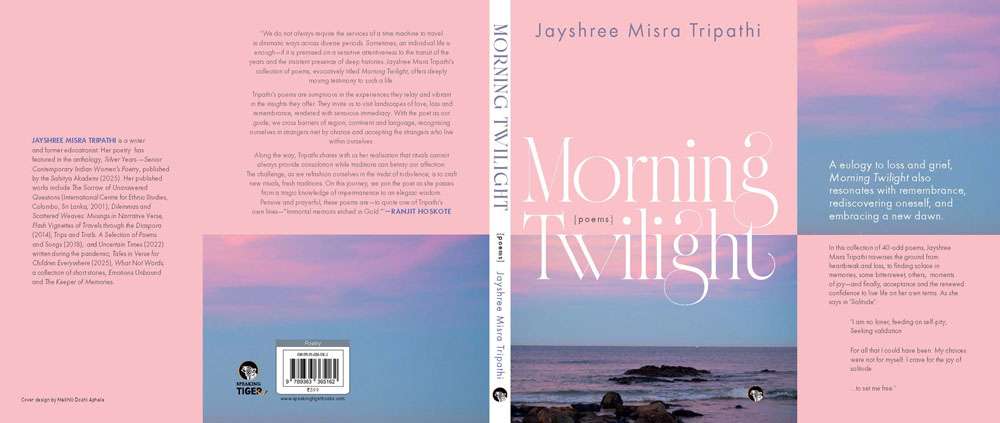
SOME ILLUSTRATIVE POEMS
Dear Reader
Just a few words for you to ponder upon,
before you “pass this on” or push
into the dusty corner of a bookshelf –
Why do people write and bare their emotions
for others to comment upon?
I do beseech you, engage with your memories
my words arouse, for indeed they will.
Be true to your emotions.
I write when my stream of consciousness
asserts itself; tradition conjoins
with the contemporary – it is not my intent
to be obtuse. Never fear, the outcome
will be an epiphany - to set us both free!
***
A Fountain Pen
The notebook is open
at the page with scribbles
in cursive writing.
Was I checking the nib -
thick or thin; or the ink
Indigo or Royal Blue?
I cannot recall, alas,
in this elusive twilight zone;
bemuses with its puppetry.
Illusions of ancient poets,
a few contemporary,
some Insta ones too –
invade my Mindscape.
I close my eyes
to separate their verses,
words that echo mine -
I must compose my own, yet
I know - the Universal Truth –
it has all been said before!
Dare I intrude into their Circle?
***
Monsoon Downpours
River Yamuna in her frenzied journey
to the Triveni Sangam,
carries lives swept along the way.
Birds of prey adorn the Metro Rail arches
in calm silent anticipation –
a Variable Feast below. I watch –
as the engine of my taxi sputters
on the overhead bridge.
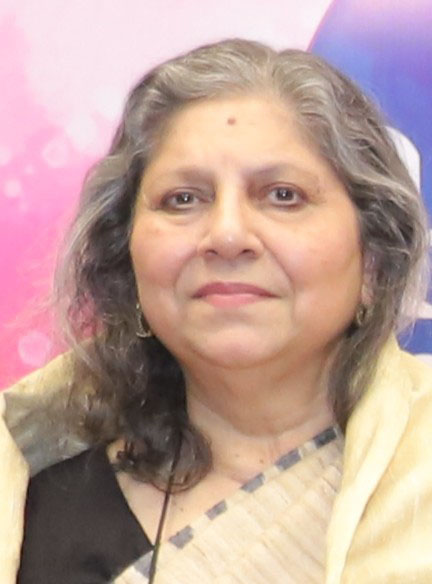
Jayshree Misra Tripathi has been a consultant, educator and examiner in English Language and Literature, for the Diploma of the International Baccalaureate Organization. She worked in print media in the late ’70s and ’80s in India. Having lived in diverse cultures for over thirty years with her late husband, a career diplomat in the Indian Civil Service, her short fiction and narrative verse dwell upon journeys through the diaspora, highlighting women's 'voices' and cross-cultural conversations. Her books include Trips and Trials, What Not Words, Two Minute Tales in Verse for Children Everywhere, Uncertain Times and The Sorrow of Unanswered Questions. Online blogs are on Huffington Post India Archive and News 18.She includes her maiden surname in her writing, as the eldest of five daughters.
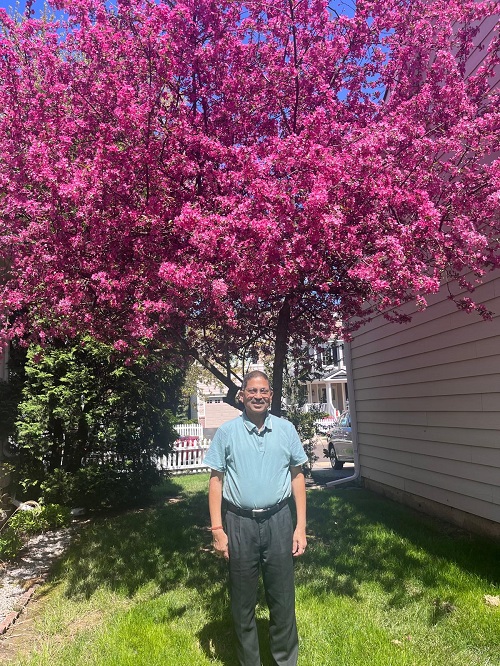
Dr. Mrutyunjay Sarangi is a retired civil servant and a former Judge in a Tribunal. Currently his time is divided between writing poems, short stories and editing the eMagazine LiteraryVibes . Four collections of his short stories in English have been published under the title The Jasmine Girl at Haji Ali, A Train to Kolkata, Anjie, Pat and India's Poor, The Fourth Monkey. He has also to his credit nine books of short stories in Odiya. He has won a couple of awards, notably the Fakir Mohan Senapati Award for Short Stories from the Utkal Sahitya Samaj. He lives in Bhubaneswar.
TOSHALI ANTHOLOGY OF LOVE POEMS
Review by Sarita Prusty

Love is perhaps the oldest and most enduring theme in literature. Across centuries, poets have sought to capture its mystery, beauty, pain, and transformative power. Toshali Anthology of Love Poems 2026 continues this rich literary tradition by bringing together a remarkable collection of voices that explore love in its many manifestations. More than a gathering of poems, the anthology is a journey through the emotional landscapes of human existence, revealing how love remains central to our understanding of ourselves and the world around us.
One of the most striking features of the anthology is its diversity of perspectives. The poems move beyond conventional romantic expressions to explore longing, companionship, memory, devotion, separation, and self-discovery. Love is presented not as a singular emotion but as a spectrum of experiences that shape and define human life.
The collection opens with voices that capture the uncertainty and yearning often associated with love. In Aishwariya Laxmi’s Inamorata, the speaker waits anxiously for emotional certainty:
“I wait and wait?But you’ve got your way?Of making things linger.”
These lines embody the vulnerability of loving another person and the emotional suspense that accompanies affection. Love here is both hope and hesitation, a force that keeps the heart suspended between expectation and doubt.
The anthology also acknowledges the changing nature of human relationships in the digital era. Anamika Nath’s Love and Machines beautifully captures contemporary romance:
“We no longer wait for the postman—?love now knocks as a blinking cursor.”
In these lines, technology becomes the medium through which love travels, yet the emotional longing remains timeless. The poem reminds us that while communication methods evolve, the human desire for connection remains unchanged.
Many poems in the anthology portray love as a creative and transformative force. In My Unfold Love, Ranjit Dutta writes:
“With vibrant hues of passion?I paint a canvas of desire.”
Here, love becomes an act of artistic creation. The beloved inspires imagination, and affection becomes a means of producing beauty. Such imagery runs throughout the anthology, suggesting that love enriches not only relationships but also creativity and self-expression.
One of the anthology’s greatest achievements is its exploration of mature love. Unlike many collections that focus primarily on youthful romance, Toshali Anthology of Love Poems 2026 recognizes that love deepens and evolves over time. Namita Rani Panda’s poignant poem Love in Winter reflects this beautifully:
“For love doesn’t wither in winter?Beneath the snow it shimmers?Rooted deeper than time.”
These lines encapsulate the enduring nature of genuine affection. Love is portrayed not as a fleeting passion but as a resilient force capable of surviving the seasons of life. The imagery of winter and hidden roots suggests emotional depth, permanence, and renewal.
Similarly, Gopa Nayak’s Love at Sixty offers a mature understanding of companionship:
“The heart holds the warmth of love?Shared unconditionally.”
The poem celebrates a stage of life where love transcends excitement and possession, becoming instead a source of comfort, trust, and mutual care. Such reflections enrich the anthology by presenting love as a lifelong journey rather than a temporary emotional state.
Not all the poems, however, celebrate fulfillment. Many explore love’s absences, losses, and silences. Tasneem Hossain’s Untold Love tells the story of affection that remains unspoken across decades, while several other poets examine the lingering presence of memory after separation. These poems acknowledge that love’s greatest power sometimes lies not in its realization but in its endurance within memory.
Another significant contribution of the anthology is its philosophical engagement with love. Several poets move beyond personal relationships to explore love as a universal principle. Sanjukta Dash’s The Truth Ultimate offers perhaps one of the anthology’s most profound reflections:
“Love is the beginning with no end.”
This simple yet powerful statement transforms love from a private emotion into a cosmic force. Love becomes a principle of existence itself—a source of meaning, connection, and continuity.
The anthology’s stylistic diversity further enhances its appeal. Traditional lyricism coexists with free verse, narrative poetry, meditative reflections, and even haiku-inspired forms. This variety reflects the richness of contemporary poetry while ensuring that each poet’s unique voice remains distinct. The result is a collection that is both cohesive and multifaceted.
Equally noteworthy is the geographical and cultural diversity represented in the volume. Poets from different parts of India and neighboring regions contribute their experiences, enriching the collection with varied images, traditions, and emotional textures. Yet despite these differences, the poems collectively affirm the universality of love. Whether expressed through rivers, flowers, seasons, moonlight, or silence, the language of the heart remains recognizable across cultures.
The anthology ultimately suggests that love is not merely an emotion but a way of experiencing the world. It teaches patience, resilience, empathy, and hope. It inspires creativity, sustains memory, and offers meaning even in moments of loss. As Rajorshi Chakraborty beautifully observes in Hey You:
“For lovers there is no end?For love, every end is a beginning.”
These lines may well serve as the spirit of the entire anthology. They remind us that love continually renews itself, surviving time, distance, disappointment, and change.
In conclusion, Toshali Anthology of Love Poems 2026 is a significant contribution to contemporary poetry. Through its diverse voices and heartfelt expressions, it captures the many seasons of the human heart. The anthology celebrates love not as a singular experience but as a profound and multifaceted force that continues to shape our lives. It invites readers to reflect, remember, and reconnect with the emotions that make us most deeply human. In doing so, it reaffirms poetry’s enduring ability to illuminate the mysteries of love and life itself.

Based in Bhubaneswar Sarita Prusty is a former lecturer in English and is now engaged in creative writing , translation and criticism.
Viewers Comments