
Literary Vibes - Edition CLXVI (26-Jun-2026) - SHORT STORIES

Title : Whisper of the wind (Water Colour by Lathaprem Sakhya)
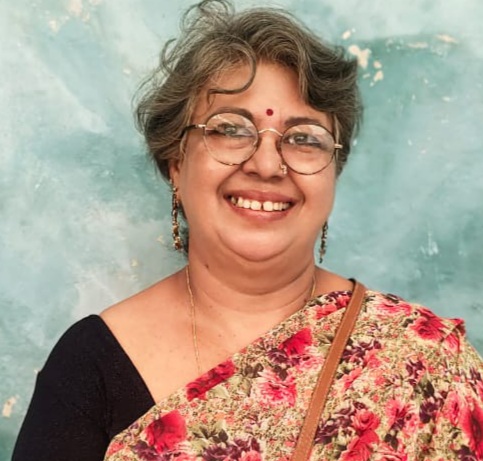
An acclaimed Painter, a published poet, a self-styled green woman passionately planting fruit trees, a published translator, and a former Professor, Lathaprem Sakhya, was born to Tamil parents settled in Kerala. Widely anthologized, she is a regular contributor of poems, short stories and paintings to several e-magazines and print books. Recently published anthologies in which her stories have come out are Ether Ore, Cocoon Stories, and He She It: The Grammar of Marriage. She is a member of the executive board of Aksharasthree the Literary Woman and editor of the e - magazines - Aksharasthree and Science Shore. She is also a vibrant participant in 5 Poetry groups. Aksharasthree - The Literary Woman, Literary Vibes, India Poetry Circle and New Voices and Poetry Chain. Her poetry books are Memory Rain, 2008, Nature At My Doorstep, 2011 and Vernal Strokes, 2015. She has done two translations of novels from Malayalam to English, Kunjathol 2022, (A translation of Shanthini Tom's Kunjathol) and Rabboni 2023 ( a Translation of Rosy Thampy's Malayalam novel Rabboni) and currently she is busy with two more projects.
Title : ABSTRACT AFFECTION
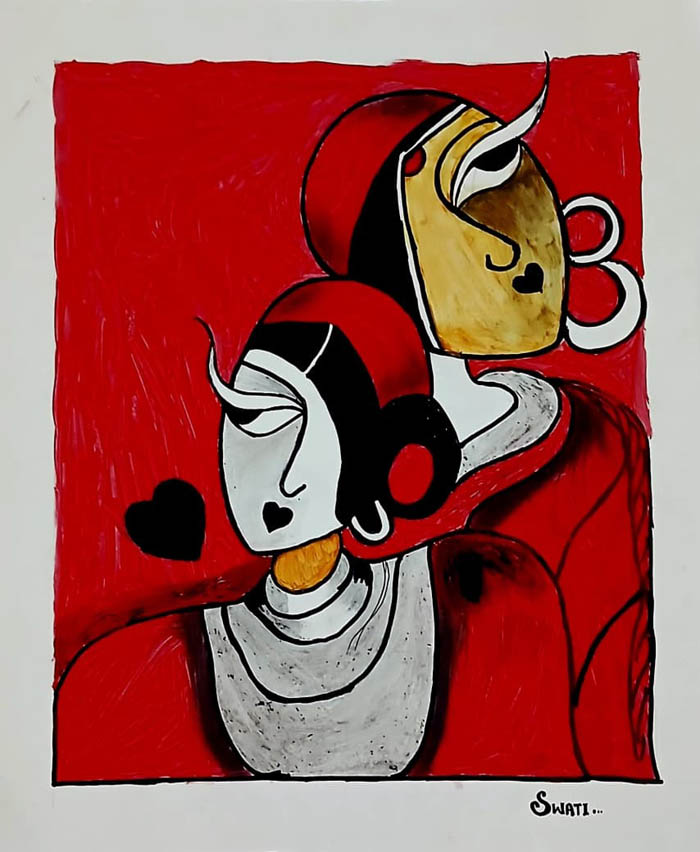

Swatishree Parija is from Jagatsinghpur district, Odisha. She is a Graduate with Honours in Geology and has recently earned a B.Ed. degree. She has also qualified in the Teachers' Eligibility Test (TET). She is currently preparing for competitive exams.
From her school days, she has had a keen interest in creative activities. Her hobbies include writing, painting, reading books of different genres and photography. She has been writing short stories and poems in Odia, English, and Hindi since for the past many years.
She has actively participated in various speech, painting, and essay-writing competitions and has received several awards and prizes at the school, district, and state levels.
Table of Contents :: Short Story
01) Prabhanjan K. Mishra
02) Sreekumar Ezhuththaani
NOT A THING OF BEAUTY
STILL ANOTHER LOVE STORY
03) Usha Surya
04) Phalguni Sahu
05) Deepika Sahu
06) Rabi N. Dash
07) Dr. Sanjay Kumar Panda
SOME INNOVATIVE EXPERIMENTS WITH WOMEN WEAVERS FOR MAKING THE DEVELOPMENT INCLUSIVE AND SUSTAINABLE
08) Sujatha Krishnamurthy
09) Ms. Latha Prem Sakya
10) Dr. Sukanti Mohapatra
11) Annapurna Pandey
A TRIP TO REYKJAVíK: SMOKE, STONE, AND SAGA: NOTES FROM THE ISFNR CONFERENCE, JUNE 2026
12) Upali Aparajita
13) Mary Josey Malayil
14) Mani Menon
15) T. V. Sreekumar
16) Ashok Kumar Mishra
17) Dr. Rajamouly Katta
18) Sukumaran C.V.
19) Sreechandra Banerjee
MEGHADUTA BY LEGENDARY POET KALIDASA
20) Mr Nitish Nivedan Barik
A LEAF FROM HISTORY: THE NOBEL STORY OF "ENOUGH", FROM ECONOMICS TO LIFE STYLE
21) Dr. Mrutyunjay Sarangi
DEATH OF SANSKAR
Prabhanjan K. Mishra
Ekant Shama’s office attendant handed him a visiting card bearing a name, Himmat bhai Mehta, MD, M/S Himmat bhai Mehta and Sons Co Pvt Ltd. The attendant informed him the visitor was waiting in his outer sitting room for an audience with him.
Ekant Sharma was a general manager heading the Mumbai Division of his consultancy firm, consisting of several managers and executives, that dealt with chemicals, and raw materials used for manufacturing drugs and cosmetic, besides the problems of firms making and trading in those items in the local market and overseas through export/import. His division in the company researched on the problems of such companies in trouble and advised them in matters of earning higher profit and trouble-shooting.
Generally, executives from trading, manufacturing, export/import sectors would meet Ekant for consultation on quality control, profit margin, harassment by agencies, workers’ strike and welfare, and advertising, and any other trouble. But a Managing Director bringing a problem was new to him. So, he personally ushered in Himmat bhai Mehta, MD, into his room.
Himmat bhai Mehta was a man of average height and build, with no visible belly-bulge common to Gujarati male on the wrong side of the middle age. He wore an ensemble of a shirt with full sleeves on a full-pant, the shirt not tucked in but hanging to its full length, both in white. His wore immaculately polished black shoes. An open-front-full-sleeve, light grey jacket was on his white shirt with the collar button open. A typically dressed elderly Gujarati businessman.
Himmat bhai Mehta by his dress code imparted the impression of a man one could depend on. Gujaratis wearing such archetypal combination of clothes ruled Bombay’s business zone and kept ruling Bombay turning into Mumbai in recent time, for better or worse, and still formed the backbone of the city’s economy. Mumbai being the major financial hub and financial CPU of the India. It was rightly said, “If Mumbai sneezes, India’s economy catches cold.”
The affable gentleman had an infectious smile and to Ekant’s asking, “Mr Mehta, you could have sent an executive of yours with your problem. Why an MD should take the trouble?”, he mildly replied, “Sharma ji, I would love it if you call me Himmat bhai, a friendly address. I consider myself as my company’s everything, from CEO to the tea-boy. Mine is a company with medium-large turnover. My three sons are directors, but their grips over the subjects are still unripe. By the way I will not beat around the bush, and come to the point…”
Ekant’s team by his side took details of Himmat bhai’s problems and later he was advised to his complete satisfaction. His chemical company, he admitted, excelled over his competitors by following Ekant’s advice. Through him, other clients came to Ekant. He liked Himmat bhai as a good and kind man.
One day, Himat bhai, with an ingratiating smile entered his room and said, “Sharma ji, I have brought a little love for you. With a nod from Ekant, he produced from his leather portfolio bag a big packet of dry-fruit sweets and a small envelope that he whispered contained a little cash. He said, “It is no bribe. It is a miniscule part of my first extra profit earned because of your advice.”
Ekant could feel affection and honesty in Himmat bhai’s open smile and direct talk. He liked the man’s guileless smile. He kept the box of sweets to be distributed among his team members. He returned the money with a polite word, “Himmat bhai, you are very kind. You have paid my company generously already and I was given a bonus on that. This money will weigh heavy on me.”
One day, Ekant went to Himmat bhai’s office on invitation on the occasion of Chopda-Pujan, the ‘worshipping of books of account’. His sons were yet to arrive. Ekant found him sweeping his and his sons’ rooms. Then he made tea in the pantry for Ekant, himself and his sons.
His sons arrived and drank their cups made by father. Later Ekant asked, “Why did you act as your sweeper and tea-boy, Himmat bhai?” He replied, “They were allowed to come late today, and therefore. My sanskar (noble upbringing) tells me, ‘Work is Worship’, any work.” Ekant noticed in Himmat a live epitome of that virtue, called sanskar.
Ekant was impressed by Himmat bhai’s humility as he learnt, “Sir, I started life from the scratch, abject poverty. To start with I was a dealer in rejected household goods, empty bottles, old newspapers, and what not. I made this business house before I married. My sons were born with proverbial silver spoons in mouths. I have tried to give them the best sanskar, but have felt disappointed often.” He swallowed his difficult spit to continue, “I am timid before my sons. In fact, all sanskari (individuals with good conduct) Gujaratis are timid.”
Ekant Sharma understood Himmat bhai’s plight. His name was Himmat, meaning ‘the brave’ but his circumstances had driven him into timidity. He could not hazard a solution. He was no trouble shooter in family matters. Might be, sanskai Himmat’s self-respect, social reputation, kind image among friends and workers were his Achilles’ Heel, known to his non-sanskari sons who exploited his goodness. He was a prisoner of his sanskar.
Repeated meetings made Himmat bhai a lovable friend to Ekant. His warmth and goodness, ready to help attitude, made him a dear. In certain domestic matters Ekant would take his advice. He would guide like a true friend. One trait of Himmat bhai, which was self-appointing himself as Ekant’s benevolent older brother in an alien city, Mumbai, made Ekant grateful. But on his first visit to Ekant’s house, the latter’s wife and Himmat bhai joined hands to find fault in Ekant’s sanskar to which he indulgently smiled without protesting.
Ekant’s two daughters, fourteen and twelve in age, treated him as their friend. His wife however objected to their whispering to him out of her earshot, hugging and kissing him like little kids, or putting hands on his shoulders or holding him by waist during family outings. Himmat bhai also supported his wife’s views. Even there was a mock fight once, between his wife and Himmat bhai on one side and he and his girls on the other. As none won the skirmish, they kept the decision in reserve like judges in most complex matters.
Himmat bought a chemical factory, his second one. He came to take Ekant for cutting the ribbon at inauguration. While on the way, he suddenly said, “Sir, I haven’t taken my old father’s blessings.” He asked the driver to take Ekant to his new factory. He got down to rush home by a taxi to take his father’s blessings and return to the factory. Ekant was touched by Himmat bhai’s sanskar.
Himmat bhai had informed Ekant that he lived with family in a big seven-bedroom bungalow, jap on Dadar sea-beach. There was nothing between his house on an elevated patch of land and the sands leading to rolling waves of the sea. The beach was not popular among tourists to the city of Mumbai or the city’s residents who loved the sea. So, visitors to Dadar beach were very few compared to other two famous ones, one at Juhu and the other at Girgaon.
Himmat bhai never called Ekant to his house, that Ekant attributed to the former’s forgetfulness. He knew Himmat bhai’s family ate dinner at seven in the evening as they were Jains and Jains did not eat after the dark. One day Ekant was going home at Himmat bhai’s dinner time by his car and he passed about hundred paces away from the Dadar sea-beach. He informed his wife he would eat dinner with Himmat bhai and therefore, would be late. He wanted to join by inviting himself to their dining table.
Ekant turned his car, found Himmat bhai’s house easily, parked the car in the sprawling paved space in its front, and surprised Himmat bhai and his family at their dinner table. Surprisingly he found his affable friend, the immaculate Gujarati businessman, dressed in his typical official ensemble even while dining.
Ekant met Mrs Himmat Mehta, a comely middle-aged lady, and his sons, as well as the sons’ wives. He also met his only grandchild, a boy of around twelve, and a Raamaa, the male house-help. They were making the cacophony of a coop of ducks just released for grazing. But Himmat bhai talked in whispers and was polite even to his man-servant or Raamaa, a sanskari to a fault.
After food, Ekant wanted to see around his friend’s house. On Ekant’s request, Himmat bhai’s eldest son took him around the house. Others quietly trooped behind them. He was shown four big well-furnished bedrooms, “These three rooms are mine and my brothers’. This one is my mother’s, also shared by her grandson who is my son, the only child in this house.” Ekant asked, “And your father’s room? Does he share your mother’s?” The eldest son hesitated, “No.”
With reluctance as if hiding an ulcer in a private zone of his body, the guide-cum-son led Ekant to his last exhibit, a corner room, “This is father’s bedroom.” The room was small, almost ten by ten feet with a double bed, a small TV, a ramshackle sofa, all looked worn, poor, and old. Ekant stared sternly at the young man of around thirty-five, quite a man of the world. He withered before his gaze and demurred, “Sir, he loves the austere life of a Jain Muni (monk).”
“Why don’t you sons, let your father sleep in your mother’s room and furnish that small room of your father and shift your growing up son there?” Ekant looked rather stern to fight for his gentle timid friend Himmat bhai who was in fact the master of the house but lived like a shadow, walking invisibly, timidly in his own den.
Then the eldest son revealed a truth, “My wife is stern like you. Running the house is under her thumb.” Ekant subsided, and thought the feminist movement was taking its toll. As a feminist himself, he felt the movement’s purpose had been defeated. It supressed the male brutes but as a side effect gave rise to archetypal vamps, aggressive and stomping on male feet irrespective of their nature.
Ekant on his way to the sitting room, heard someone’s phlegmatic cough. He looked for its source, and found a very frail old man curled up under a worn old quilt on a narrow rope-cot placed under the staircase going to the terrace. “Who is he?” Ekant asked his guide, but the guide was gone.
The frail, sick, old man sat up to cough freely. Ekant pour water into a glass and from a pitcher on his side and offered him. He took a few sips and his dry cough subsided. He said, “I am Himmat’s father. He is in trouble. They beat him. Help him, my good man.” Ekant walked away feeling he had been thrashed himself. This was the old father without whose blessings the new factory could not start.
Ekant found his guide and sarcastically asked him, “Another Jain Muni, lying under the stair case, I presume. Why can’t he have a room to himself, when you have two more unoccupied bedrooms? He is supposed to be the head of your joint family, your grandpa, with a right to the best of everything.”
. Himmat bhai started, “My hundred requests are ignored.” He was overtaken forcefully by his oldest daughter-in-law, “No, the old fellow loves it that way. He loves that space, that rope-cot, his quilt and everything, Sahib. You are a guest. You don’t know anything.” She stood up and folded her hands, a not-so-polite gesture for ‘Get out’.
Himmat bhai walked him down to his car. Ekant Sharma knew why Himmat bhai never invited him to his house. He did not want to be caught with his clothes down. Now, like a great solicitor in family matters, he spoke, “Ekant bhai, forget whatever is troubling your conscience.” Ekant turned on him, “How did your lessons in sanskar misfire so badly, go totally awry, my friend?”
The timid man looked upwards like all Karmic believers, and uttered one word, “Destiny.” Ekant asked, “You and your wife are around fifty. Don’t you need each other sometimes?” “Yes”, he replied coyly blushing, “Once a few weeks, she visits me in silence of the night.”
Ekant drove home, thinking, “A rabbit among hyenas! Sanskar, the biggest bullshit!!” That night in bed with lights switched off, wife asked, “How sanskari was the family?” He replied, “Very.” She detected Ekant’s anger and wanted to douse the fire by absorbing him into cool recesses, then adding, “Let’s forget sanskar for an hour. I love you to be yourself, a brute, without any sanskar. I can hear from you all about Himmat bhai’s family tomorrow morning after our girls leave for school.”
Next morning, after children left for school, Ekant took a day off from office and spent time with his wife. He was almost unhinged from his feel-safe attachment to family after watching what had happened to Himmat bhai. He was afraid of a future. The most well-behaved children might grow up into oppressive individuals, by bringing partners in marriage to rule his family like Genghis Khan, keep him and his wife apart for some nonsensical reasons. By and by he told the story of Himmat bhai’s sanskari family, misfiring his wife’s eyes.
Ekant got a transfer suddenly to Delhi. He was entrusted to set up a new branch of his consultancy firm and would be the branch-head there, promoted as vice-president. He hardly could talk to Himmat bhai after that, might be once a month. In all talks his older friend sounded guarded and cautious as if talking from behind veil. He presumed Himmat bhai wanted to keep his own problems out of his hair, as any sanskari would do. Then their talks became more infrequent and stopped. Being the head of management at his Delhi branch took its toll. Ten years passed like sort of a blink. He visited Mumbai on work.
He wanted to surprise Himmat bhai and without pre-messaging, he arrived to partake his Jain-dinner before the dark set in. He found the big door to the opulently furnished sitting room shut from within, besides all windows of the house. He thought the family was out, visiting some place. He hoped their Ramaa, the male house-help, might open the door and give him his friend’s news. He rang the bell.
Himmat bhai himself, looking pale, weak and worn, opened the door and hesitatingly ushered him in. The previous opulent sitting room looked devastated, bare of most furniture, TV and wall hangings. It lay dirty. Most furniture and wall hangings gone, the room looked like a Hindu widow. He quickly moved around all rooms and found them in equally devastated condition, lying in squalor. As if looted by hooligans during a riot or war. He looked under the staircase; the rope cot was empty.
He looked at Himmat bhai who was looking away to hide tears. Ekant came to know that his sons took over the control of his factories and trading units, local and export/import, all. They banned Himmat bhai’s entry into the office or factory premises by appointing new guards. He couldn’t openly quarrel with his sons in fear of his sanskar-obsessed Jain-Samaj. In a settlement by the Jain-Samaj, he, his wife and father were allowed to retain the bungalow and the sons got manufacturing and trading units. The sons were to provide them a monthly allowance and prepared food from their kitchens.
Himmat bhai, rued over his fate. His sons left this bungalow and forcibly took away all its furniture and everything to their flats bought earlier by Himmat bhai in their names. The old couple and his old father were left behind in the house, bereft of its opulence and souls.
Ekant heard Himmat bhai saying tearfully, “Whatever, however, yet they were our sons. We missed them in spite of their misbehaviour under the evil influence of their wives. My wife especially missed her grandson. While they left, my wife had quarrelled and retained bare minimum cooking pots and pans with which she cooked for three of us, as the sons neither paid the monthly allowance nor supplied daily fare from their kitchens. I had little money in my personal account and some cash in hand that came to our rescue for some time. I had no access to my company’s profits.”
He paused, and went on, “We carefully spent the little money we had. Our Jain-Samaj helped us sometimes. One evening the four brothers with wives came and wanted us to sign a sale deed for the bungalow. I refused. They started doing threatening telephone calls. In a few months my father passed away. My wife followed him. They died in poverty, getting the free treatment of the poorest quality in a hospital run by Jain-Samaj, and were cremated after death like orphans. Our sons did not even attend them in hospital, also in the cremation ground.”
Ekant then moved into Himmat bhai’s room. His room looked more bereft of things, more austere, but very clean. He resolved Ekant’s bafflement, “I have a very sincere friend, a Muslim, his name is Umed bhai Khan. Every late morning his wife visits me with two tiffin boxes, in one my lunch and in the other my dinner, cooked in pure Jainy vegetarian manner.”
He continued, “The kind woman also does the sweep-clean-swab of my room and the corridor, cleans and fills up my pitcher with fresh drinking water. They keep me alive. Today being a Saturday, the husband Umed bhai may come now with wife on a special weekly visit in the evening.”
Like a lizard’s proverbial timely ‘tick, tick, tick…’, the doorbell rang and Himmat bhai ushered in an unassuming couple, who introduced themselves as Umed bhai Khan and wife Zubeida Khatun, they being Kutchi-Gujaratis like Himmat bhai. They sat and Ekant left with appropriate words for ‘bye’, as he had to catch a flight home.
Before he took a taxi to airport, he went to the nearest ATM, drew twenty thousand, put that in an envelope bought at a pan-shop, and went back to ring the bell. This time Umed bhai opened the door. Ekant handed over the cover with money to Umed with just three words ‘For Himmat bhai’, and left.
Ekant thought over the sanskar taking its toll on Himmat bhai. All along his return journey he planned to persuade his wife to take the old lonely friend to live with them as a big brother they never had. At home his wife agreed readily to his proposal as they had an extra room as their daughters were married and had moved away with husbands. But that was not to be.
He received a call from Umed bhai, Himmat bhai’s Muslim friend, and heard the sad news. When Umed with packet of money returned and handed it over to Himmat bhai, the latter looked into it and said, “I knew my friend Ekant would do some childish thing like this, a good gesture, of course, but an imprudent one for a man with fix income.” He kept just one currency note from the bundle and handed over the rest to Umed, “My friend, buy a nice dress for Bhabhi jan this EID only a few days away.”
Next day, Umed’s wife went with two tiffin boxes for Himmat bhai, his lunch and dinner. She rang the bell to no response. She then banged the door but found it unlatched. Himmat bhai was lying dead on the other side. Perhaps, after Ekant had left followed by the leaving of the Muslim couple, his friends, the separation was too much for Himmat bhai. Perhaps he had a severe heart attack. Perhaps, he had gone, and opened the main door to call for help, but collapsed and died there. Jain-Samaj cremated him and did the rituals for his soul’s sadgati (salvation).
Ekant heaved a sigh. Himmat bhai did not die alone. Along with him died sankar. Ekant’s wife cried like a child. The word ‘sanskar’ was banned in their family by his wife herself. They would often fondly spoke of the brave man under a thin veneer of timidity but never about his sanskar. (End)
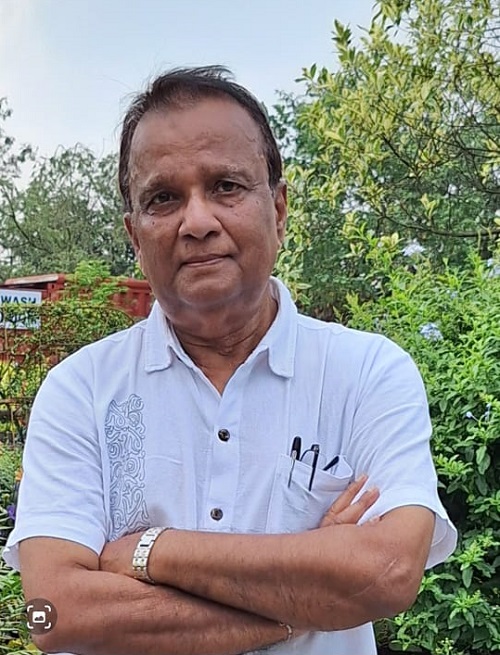
Prabhanjan K. Mishra is an award-winning Indian poet from India, besides being a story writer, translator, editor, and critic; a former president of Poetry Circle, Bombay (Mumbai), an association of Indo-English poets. He edited POIESIS, the literary magazine of this poets’ association for eight years. His poems have been widely published, his own works and translation from the works of other poets. He has published three books of his poems and his poems have appeared in twenty anthologies in India and abroad.
NOT A THING OF BEAUTY
Sreekumar Ezhuththaani
Monsoon had begun.
A strong wind blew out the power. My wife Janu was sitting in the dark, cursing the electricity department. She was watching the concluding episode of her favourite web series.
Then she came over to my study and abruptly asked me whether I remembered Anitha. I thought she was referring to some web series and casually said ‘no’
“She wasn’t ugly,” she said suddenly.
That is when I figured it out that Anitha was one of her friends that I too might have come across,
“That’s the first thing I should say.”
I looked at her.
“She just wasn’t the kind of woman people notice when she enters a room.”
Outside, a storm had been unleashed.
“What was her name?” I asked.
“Anitha.”
Janu smiled faintly, but there was bitterness underneath it.
“She used to write letters. Actual letters. Blue inland covers. Even after mobile phones became common.”
That detail stayed with me for some reason.
Janu leaned back.
“You know the type of girl families worry about. Dark-skinned. Quiet. Thin hair. No ‘presence.’ The relatives keep saying things like, ‘She has a good heart,’ because they don’t know what else to praise.”
Janu laughed softly after saying it, but the laugh collapsed halfway.
“Anitha fell in love with a man named Rajeev when she was twenty-two. He worked in a private bank then. Smart fellow. Nicely dressed. The sort who wore perfume even in small towns.”
“And he loved her?”
“He said he did.”
The rain thickened outside.
According to Janu, the entire family opposed the marriage. Her parents cried. Her elder brother stopped speaking to her. Aunts came home one by one like representatives from some ancient moral court.
“You can do better.” “He is too modern.” “He will leave you one day.” “Girls like you should not take risks.”
But Anitha mistook resistance for proof of love. Perhaps many people do.
“She fought everyone,” Janu said quietly. “That was the tragic part. She had never fought for herself before.”Finally, she married him in a small temple ceremony near Guruvayoor. Cheap jasmine garlands. Steel tumblers of payasam. A photographer who kept asking them to tilt their heads closer together.
In the photographs, Rajeev looked mildly impatient.
Anitha looked terrified and radiant at the same time.
“She thought life was beginning,” Janu said.
But life, it turned out, had already made its decision.
At first, there were small things.
Rajeev did not like taking her to office functions.
“She won’t be comfortable,” he would say casually.
Then:
“The crowd there is different.”
Then:
“You stay home. I’ll come back early.”
He never came back early.
Anitha moved into his ancestral house in Thrissur, a long house with damp walls, a tulsi plant in the courtyard, and a kitchen that seemed permanently filled with the smell of burnt coconut oil and steam.
That kitchen slowly swallowed her whole.
“She used to call me sometimes,” Janu said.
“What would she say?”
“Nothing directly. That’s the problem with women like her. They narrate suffering through details.”
Janu looked down at the table.
“She would say things like, ‘Today I made fish curry but there was too much tamarind,’ or ‘Rajeev likes his shirts ironed a certain way.’”
The real sentences lived underneath those sentences.
Years passed.
Rajeev grew prosperous. Promotions. New car. New apartment in Kochi, which he rented out. Foreign trips. Photos with colleagues in resorts and conferences.
Anitha remained absent from all of them.
Not once did he post her photograph.
Not once.
“He had social media from the beginning,” Janu said. “Facebook first. Then Instagram. You know how some men perform happiness online? Sunrise pictures. Airport pictures. Coffee mug pictures.”
“But never wife pictures?”
“Never Anitha.”
“Didn’t she mind?”
“She probably did. But some women are trained to feel grateful merely for being tolerated.”
There was silence between us for a while.
The storm also took a break for a while and then resumed with added strength.
Janu continued.
“Once she asked him if she could come with him to Munnar for an office trip.”
“What did he say?”
“He laughed.”
That single word seemed uglier than an insult.
“He told her she wouldn’t fit in there.”
The rain outside came to a stop as if it too understood.
Janu said Anitha gradually stopped buying clothes for herself. Her world narrowed into groceries, pressure cookers, stained towels drying near windows, and television serials watched while cutting beans.
“ Like you!”
“Yes, exactly like me. Why else am I telling you this?”
Anitha bore no children.
That too became another silent accusation against her.
People asked questions with false sympathy.
“Still no good news?” “Have you checked properly?” “Maybe stress?”
No one asked Rajeev anything.
One evening, years later, Janu visited her.
“That’s the day I can’t forget,” she said.
Anitha opened the door with wet hands, wiping them hurriedly on the edge of her sari. The television was blaring from another room. A ceiling fan rotated with a dry scraping sound.
“She had become… smaller somehow.”
“What do you mean?”
“Like the house had been eating her little by little.”
She was only forty-six then, but her hair had greyed heavily. Her face carried the exhausted dullness of somebody who had spent years apologising for existing.
Yet she still smiled.
That was the terrible thing.
“She showed me the pickle bottles she had made. Mango, lemon, gooseberry. As if those were achievements.”
Janu’s voice cracked slightly.
“She asked me whether the blue sari suited her. Imagine.”
“Did it?”
“Yes,” Janu whispered. “It really did.”
Rajeev came home late that night while Janu was still there.
Perfume. Car keys. Loud phone voice.
He nodded at Janu politely, then walked past Anitha as though she were part of the furniture.
No cruelty that could be pointed at directly.
Only absence.
Sometimes absence destroys people more efficiently than violence.
A few years later, Anitha died.
Suddenly.
Massive heart attack, they said.
Only fifty.
“She collapsed in the kitchen,” Janu said. “Near the stove.”
I noticed then that Janu had stopped looking at me.
“What happened afterwards?”
Janu gave a strange smile.
“You know what happened afterwards. And it is still happening.”
Within six months, Rajeev remarried.
The new wife was younger. Stylish. Fair-skinned. Confident in front of cameras. She wore sleeveless blouses and sunglasses and posed beside cafés, beaches, and airport lounges.
This time, Rajeev posted everything.
Anniversary reels. Couple selfies. Trips to Bali. Matching outfits. Candids over candlelight dinners.
“He takes her everywhere,” Janu said.
There was no anger in her voice now. Only fatigue.
“He didn’t even take Anitha to the next street.”
Outside, the rain began again, this time like it was too tired to go on.
Power came back.
Janu opened Instagram on her phone and showed me a photograph.
Rajeev and the second wife smiling beside a waterfall somewhere in Coorg.
His arm around her shoulder.
A caption underneath:
“Life begins again.”
Janu locked the phone immediately.
For a while, neither of us spoke.
Then she asked quietly:
“Tell me honestly… how did Anitha really die?”
The question settled between us like dampness.
Not a heart attack. Not fate. Not genetics.
Maybe she died in portions.
The day she realised she was being hidden.
The day she understood that love and embarrassment can live inside the same man.
The day she stopped asking to go out.
The day mirrors became unnecessary.
The day she began speaking only about groceries and pickles, because larger dreams sounded ridiculous in her own mouth.
Perhaps some deaths happen long before the body collapses.
I remembered something Janu had said earlier.
“She wrote letters.”
“What kind of letters?” I asked softly.
Janu stared at the wet glass window.
“To him mostly. Even after marriage. Silly little notes. She would keep them near his lunch box.”
“What would they say?”
“She once showed me one.”
Janu smiled sadly.
“It said: ‘Next time you go somewhere beautiful, take me also. I won’t be any trouble.’”
She moved closer to me and put her head on my shoulder. That is when I realised that she was crying.
How come I hadn’t noticed that!
The garden lights reflected in the window like blurred ghosts.
Neither of us spoke after that.
Somewhere outside, in the washed-clean night of the city, people were still taking photographs of happiness.
Rainy ones.
STILL ANOTHER LOVE STORY
Sreekumar Ezhuththaani

Nandagopan kept the pen poised just above the page and let the night settle around him. The courtyard’s single electric bulb had long ago been switched off; the moonlight pooled in the open beyond the low parapet and threw the rows of clay pots into silver relief. He sat on the cane rocking chair, a small scrap of paper and an old fountain pen balanced on his knee, and watched his past come back as if it had been waiting only for the dark.
One moment Nandagopan was alone in the courtyard, the next he was back in a room full of voices and laughter. He remembered the first time he and Nidhi had been introduced by Madhu Mohan, the composer. It was hard for him to say which of them had felt prouder that evening because both were rising names in their field. After that meeting they worked together on countless songs, the two of them weaving words and melody into each other’s days until the lines blurred between private life and public acclaim.
“People keep asking me when I’ll get married,” Nandagopan said once, grinning and shaking his head at the questioners, “and I tell them one is too many. When someone wonder, “But you’re not married. Are you?” I show them my pen and that explains everything.”
On another evening, when Madhu pointed this out to Nivedita, she gave him a sidelong look and said, “Don’t trouble him,” and smiled.
When the film Chronic Bachelor came out and critics joked that even his life was turning into a movie, he laughed aloud and asked, “Did they make a film about my life?” It was the sort of self-mockery he could afford. But despite the jokes, one ordinary night changed the orbit of both their lives.
They had come out of a late recording session. The studio’s parlor hummed with the lingering adrenaline of work. They were both tired but buoyed by some small success from the take. Nivedita sank into the worn sofa beside him and turned to Nandagopan with sudden seriousness.
“I want to change this name,” she said. “Nivedita Prathapan. How does one change a name?”
He laughed. “You don’t have to change it officially. Actors do it all the time. A screen name is a part of the job.”
“But I want to change it properly,” she insisted. “Let it be Niveditha Nandu.”
“Nandu? Nandu who?”
“Nandu Parameshwarn Nair, you moron,” Madhu Mohan contributed.
The words hit Nandagopan like a thrown stone. For a second his world tilted. No one had spoken his name that way in public before; it felt intimate and dangerous
“Before we change her name, yours just got refurbished! You’ll be Nandu from now on.”
Nandagopan, now just Nandu ran a cold sweat. He had been holding back from her a part of himself that was hers for years without even naming it. Hearing her willingness to fold him into her name stunned him. Later she would take up another affectionate pet-name on stage, Nidhi Nandu, and it would sit on playbills beside her other triumphs.
The wedding was attended by practically the whole film world, as such weddings go, and people said that it had been inevitable. For three, four decades now, could this be the only thing that mattered? How had everything else gone so easily into the attic of forgetfulness?
The courtyard smelled of jasmine and lemon leaves. Nivedita was inside, and he called her in that soft, familiar way.
“Hey, when you’re done with the kitchen, come out. The moon’s up. Sit here in the courtyard; we can talk and I’ll show you what I wrote.”
She shouted back from somewhere in the house, her voice muffled by the door. “I’m sleepy, I think I’ll go to bed early tonight.”
“You can’t sleep yet! I’ve written a few lines. Sing them once and then go to sleep.”
The word sing turned something in her. Sleep left her; she padded out in a long loose kurta and sat on the low stone step. He gave her the paper and read the lines aloud, then watched her mouth the tune as if the words had always belonged to her voice.
They lived a life threaded through with music. She was the singer everyone applauded; he, the lyricist, had learned how to make words fold around her notes. It wasn’t always theatrical polish that kept their evenings together, it was the ordinary mutual care.
That night, after the first few poems, the courtyard grew quieter. Nivedita’s eyelids grew heavy.
Nandu’’s hands moving across the page made soft sounds.
She hummed and lay back, one hand splayed on her stomach, fingers tracing small invisible circles. Around the edges of his vision, the courtyard’s shadows were a loose chorus line. He read another stanza aloud, then another, until the cadence of the words and the softness of her breath put them to wakeful sleep..
At some point she slept properly. The pen lost its balance and rolled from his fingers to the dust-streaked tile.
A single line lay across the top of the new page: “Born as two, not one, brought up as two, not one” He had not written it. It just appeared on the page on its own.
From somewhere beyond the swaying trees, a koel gave it a few takes and then got it right.
He woke up.
He sat up.
He could hear it very clearly now.
“Then the two became one, like no other one.”
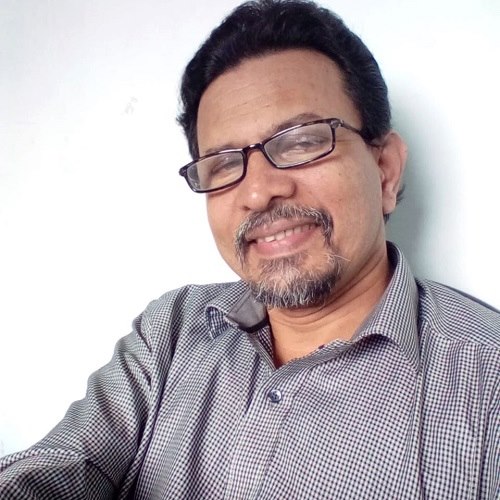
Sreekumar Ezhuththaani known more as SK, writes in English and Malayalam. He also translates into both languages and works as a facilitator at L' ecole Chempaka International, a school in Trivandrum, Kerala.
“Come now. Let’s have our dinner before the power supply fails,” said Roshni and set the table for the two of them. Vishwas drew a chair and sat at the table where his plate had been placed.
“Mom, there is ‘light’ in your name and that will see us through,” he said with a smile.
Roshni laughed and hugged him.
She sat opposite to him, drawing a chair and started serving the rice and gravy.
Potatoes had been made into a fry as side-dish and they started eating.
She looked outside the kitchen window. Wind was blowing fast and with force and brought in a fresh handful of leaves dislodged from the dancing branches, into the kitchen. The smell of rain pervaded the air and both of them inhaled the fresh air.
“I love it when it rains mom. In the morning I find that everything has been washed clean. I can pluck the guavas from the tree and eat them without washing them. The rain washes everything, doesn’t it?”
“Yes Vishwas. Rain washes everything squeaky clean,“ she said and they washed their hands and settled for the dessert.
Roshni had prepared strawberry flavoured custard loaded with tiny mango and banana pieces. Vishwas loved it that way.
She closed the window as droplets of rain entered the kitchen forming a pattern on top of the dining table without seeking any prior permission from her. She laughed..
“It has started raining very heavily Vishwas. Let’s get into our room and watch some cartoons, “ she said as she dumped the plates and bowls into the sink.
“Okay mom. I shall switch on the T V and get the channel ready before you come,” said Vishwas and disappeared into the bedroom.
Roshni washed the plates, bowls and spoons quickly and wiping her hands in the kitchen towel, hurried to the room after switching off the lights in the kitchen and the living room.
She joined her son to watch the cartoon.
The cat was chasing the two mice...the Tom & Jerry cartoon ...and Vishwas was enjoying the action-packed scenes. Her thoughts flew to her brother in the US. He had married an American girl and they had two daughters aged three and five. Tom & Jerry was a BANNED cartoon in their house. Her brother and sister-in-law were of the unique opinion that the cartoon was packed with violence!! They had refused to laugh at the cat carrying the pitchfork. chasing the mice; the mice beating the cat with the base-ball bat etc. All the other cartoons like the Mickey Mouse and Donald Duck were okay with them. To Roshni it appeared strange . For her some of the Nursery Rhymes were violent...like The Three Blind mice and the Farmer’s wife cutting off their tails with the carving knife or Jack going to fetch water, falling down the hill and breaking his crown.
Ah!! The world thinks different, she though!! She had read a lot of Tom & Jerry Comics in her school days and had not found them violent – leave alone children becoming violent after watching them!
The cartoons got over and Vishwas was yawning.
“Okay gentleman, time to go to bed now. You have to get up early and get ready for school.” said Roshni guiding him to his bed.
Within a few minutes the boy slipped into deep sleep and Roshni covered him with a light quilt.
She drew a chair and sat near the window watching the rain. It was raining heavily now with thunder and lightning.
She did not close the window as the wind was blowing in the opposite direction and no spray entered the room.
In the dim blue bedroom light, she could see Vishwas.
She sighed and looked at the rain again.
It was on such a rainy evening that she had walked out of the orphanage with Vishwas in her arms.The cold wind made the small baby shiver and she felt a thrill holding him. The child in her arms was just a little past three months old and he opened his eyes and gave her a beautiful smile.
She remembered coming home and her mother bringing the aarthi plate with the red liquid and waving it in front of them as she entered home with the little child.
Pouring the liquid at the base of the neem tree, she had come in and left the empty plate on the floor.
Her mother stretched her arms and took the baby. The baby smiled at her. She hugged the little one.
It was Roshni’s mother who bad called him Vishwas first and the name stayed. Roshni’s father too grabbed the little one gently from his wife’s hands. The child was fully at home with everyone. He seemd a happy child. The fact made them all very happy.
She had courageously walked out of her in-law’s house, unable to bear her mean mother-in-law’s taunts, a pathetic father-in-law and a husband who had no guts to do anything without getting permission from the “great mother”. Roshni was constantly being accused of not being able to bear a child, though the fault was not in her biological set-up! It had rained on that day too, and she walked out of that “hell” after a two and a half year trauma!
The wind must have changed its direction, for Roshni could feel drops of water on her hands and face. She closed the window after battling with it as the blowing was very strong now.
She went to bed. Sleep eluded her for a long time. The boy was growing up...and beautifully. At eleven, he had the growth of a thirteen year old boy.
She was seriously planning to get another room ready for him. The house was huge and there was an empty bedroom next to hers. The room had an attached bath. There was ample space to accommodate a study table and a couple of cupboards to keep his clothes and books. She could buy an additional book shelf...the boy was a book worm. He read a lot and asked a lot of questions.
She had drifted to sleep not knowing the time.
She got up at five thirty and walked to the window and looked out through the glass panes.. The rain had stopped but it was quite cold.
Vishwas was still fast asleep. She tiptoed out of the room and had her coffee. Since her parents were away on a pilgrimage to Varanasi and nearby temples with a group of friends and relatives, she had given the cook a month off. She then had a quick bath and was in her short pooja when Vishwas called. His voice sounded odd and she went hurrying into the room.
The kid was running temperature and had a slight cough.
“ Mama...make me Paatti’s medicine. I think it will get me back to my normal self. I am having a slight body pain too.” He tried to get off the bed.
Roshni touched his forehead and cheeks. They were warm.
“I think we better go to a Doctor Vishwas. I don’t know what herbs Paatti puts in the medicine!! I will take a day off and keep some pepper rasam. We will go and see a Doctor. You just brush your teeth and change, Perhaps you can have a toast with light jam and go to sleep again. We shall go at ten.” Vishwas nodded his head and walked towards the bathroom.
She remembered her colleague talking highly about the pediatrician near her house .She had never gone to any Doctor so far. Her mother was adept at home- remedies and the boy fell ill very rarely. But she did not wish to take any chances as there was measles and viral fever everywhere. She was not very confident about making her own medicine. With her mother it was different. Every relative or friend would seek her mother’s help. ”Mami has a gifted hand “ they would say. She wondered if any of that “gift” was handed down to her. But she did not want to try anything on her kid. The kid was very precious to her.
Ten in the morning saw them going towards the lady Doctor her colleague had told her about. Roshni took the car though the place was close-by on the next road as she did not wish that Vishwas should walk. She had given him some pepper rasam rice .
* * * * *
Soumya looked outside the window and saw her husband Shashank taking their daughter Poornima and his two nephews to the school. He would drop them in the school and leave for the Medical College where he was a Professor teaching Neuro science. That was where she had met him while she was in her final year studying Medicine . She had a leaning towards Child Care and Children’s diseases and often sought him in the staff room with her doubts on Nervous Disorders in kids.
She had a miserable past...
Her maternal uncle just a few years older than her had been staying with her and her mother after she lost her father.
They were well to do and she was pursuing Mecicine. It was decided that she would marry her mother’s brother after her graduation. It was a small family of three and they were very happy. Chandru – her mother’s brother= was working in a bank as an officer and her mother was relieved that she did not have to search for a bridegroom outside the family. The two loved each other and were willing to wait for two years. Her mother had to leave for the village as the ancestral home was getting sold and she was required as the home was in her name. She had left the two alone and gone to the village.
There was a heavy rain that night and the power failed. Soumya lit a candle and brought it to Chandru’s room and left it on his table.
Maybe the glow of light...maybe the fragrance of the jasmine she had on her hair...maybe the nearness and love...passions broke lose.
Both of them were shocked at what had happened...but individually recalled the tender moments and felt a longing, they had never felt before.
Soumya’s mother noticed the change a day after she came back.
The look of guilt on their faces...the confusion...evey thing spoke a thousand words.
She did not utter a word.
“We need not wait for two years to complete your graduation. You must get married soon....perhaps within the next two months in the Hill Temple of Lord Muruga .“ She spoke nothing else. She imagined or rather thought that it was solely her fault leaving the ‘fire and cotton’ together all alone for three days ! Anyway, the boy was her brother and they were to get married.
But destiny had other sad plans. Chandru was killed in a road accident the next month. It is said that ‘misfortunes don’t come singly.’ Roshni carried his child and her mother took very good care of her. Fortunately for her, the bulge in the “stomach’ was not very obvious .
The child was born on a Christmas night. Roshni developed high fever and when she came to her senses, the mother told her that the child was born dead.
She continued her studies and specialized in pediatics. Her staunch support was Shashank, the Neurology Professor in the college who guided her and helped her a lot. Disaster struck again and her mother fell ill. Shashank helped her by getting a good physician. But it looked like the mother had no wish to fight against the illness. On her deathbed, she called Soumya and told her,
“My child I am leaving you with a heavy heart. But I have to tell you a truth before I die. My grandson is alive!”
Soumya looked at her in utter disbelief.
Her son? Alive?
“Yes my child. The nurse helped me and we took the child to an orphanage and left him on the steps. I did it with a heavy heart! I did not wish that you be saddled with a CHILD...I wanted you to complete your studies. The baby had been adopted by some rich family, I came to know. The nurse had some connections with a staff there. A hefty donation was given, I heard and the baby changed hands. But I don’t honestly know where the child is! I only know that he had six singers in his left hand and a mark on his chest in the shape of a mango. The forehead was broad like Chandru’s. He was very fair.”
The mother died that night leaving Soumya sobbing...sobbibg for her mother’s loss and for that child of hers who would certainly be growing somewhere....but in a good home. No one knew the details. The name of the orphanage was unknown! The nurse had to her village, where ever it was !
Shashank was of great help to her. He had brought his mother along with him and the good lady consoled Soumya and stood by her.
Normalcy came back to her mostly due to Shashank and his mother.
They were Gujrathiis who had settled in Chennai for three generations and spoke Tamil well. Shashank had a younger brother who had two kids and they lived as a joint family.
Soumya was compelled with love to visit them and she became one of the family members.
It was a holiday that day and Soumya had gone to Shashank’s house in the morning and only the mother was there.
“Soumya...I shall ask you something. Be honest with me and frank.” She spoke.
Soumya was a bit confused.
“Ma, whatever you wish to ask, you can ask me. I owe a lot to you,” she said with a trembling voice.
“Will you marry my son? You have been able to put a smile on his face...we have all missed for so many years. He may not have told you...I don’t know! His wife left him a week after their wedding. That was some ten years ago. She was apparently in love with someone else and her family had opposed it. This marriage took place without her consent and on the wedding night she confessed the truth. She told him that she was leaving with that boy in a week’s’ time and settling with him in Assam where he had got a job. My son was devastated. But there was nothing he could do. She left him. He refused to marry again. But of late I have seem him laughing and joking...my old Shashank has come back! We are all happy. The reason was ‘you’!! If you consent to this wedding, I will be so grateful to you.” She wiped her eyes which had become moist.
Soumya could not speak. She realised that her life with Shashank will be a safe and happy one. But she was in turmoil.
Finally she broke into sobs and said,
I have a son Ma. I don’t know where he is.“
She told her story.
Shashank’s mother hugged her and said “I know. Shashank has told me everything. Past is past! You should not be still carrying your sad memories. Try and shut them off. You are still young.”
The wedding took place in the small Hill Temple and Poornima was born in two years. Shashank helped with the sale of Soumya’s home and set up a clinic for her in one of the rooms of his sprawling home.
Once in a while Soumya would think of her son and today the rains brought all the memories back.
“Will I ever see him? He must be eleven years old !”
On every Christmas day, she organised a small pooja in the nearby Ganesha Temple and Shashank joined her. He understood her feelings.
She came away from the window and took her seat. Patients might start coming and she had to be ready. Life had to go on.
She was right. The door opened and in walked her first patient for the morning.
Soumya sat at the table examining the ten month old little kid who sat on her mother’s lap quietly.
The baby must have been a very active one in her normal days. But today, due to a clogged nose and fever she was quiet. She did not grab the steth when Doctor Soumya placed it on her chest,
“Just viral fever. No need to panic. I shall give some tablets. You can powder them and give them mixed with honey each time. I am sure the sweetness of the honey will camouflage the bitterness of the tablet. Give her pleny of warm water and vegetable soup and keep her hydrated,. She should be back to square one soon,” Soumya smiled and patted the little one’s cheek.
She wrote down the prescription and handed it over to the anxious mother,
“Don’t worry!! We all have gone through these pangs!! Till the kids are five, they will keep falling ill!! Now, bring the kid after four days. I am sure her smiles will be back!!”
The mother left with the baby.
The swing door opened again.
Roshni walked in with Vishwas.
“Good morning Doctor. My colleague in the office Sneha suggested that I come to you. This is my son. He seems to be running slight temperature and is having a sore throat. This is the first time I am taking him to a Doctor as normally my mother gives some herbal decoction and he becomes okay. My parents have gone on a pilgrimage and I did not wish to take any risks, “ she said as she sat down in front of Doctor Soumya. Vishwas wished the Doctor and sat down too.
“What’s your name?” the Doctor asked the boy. She loved children and had her way with them.
“My name is Vishwas and I am studying in standard four,” he said proudly.
“Wow! That sounds great!! Are you a good student?”
“Yes Doctor. I always come first or second. Pranay comes first or second too. We are great friends,” he said.
“Pranay? Which school are you going to? “
“I am studying in Saraswathi Vidyalaya” which is closeby.” said the boy.
“Ah!! Then Pranay must be your classmate? He is my nephew. He talks often about a Vishwas! You must be the one?”
“Wow!! Pranay is related to you? That is why he never falls ill!!”
The two mothers laughed!!
“May be you know my daughter Poornima too! She always talks about a “Vishwas Bhaiya,” the Doctor said.
“Ah!! That’s right,. She is very fond of me. I am also very fond of her. She hugs me and sits on my lap in the playground sometimes. She is Pranay’s cousin.”
“Yes. That’s right ! She is my daughter. She rarely latches on to anybody but always talks about you!” the Doctor said.
“Yes. She brought a handful of chocolates last week and gave them to me. It was her birthday. I like her a lot too.”
“That’s nice to hear Vishwas. Okay. Show me your tongue” she said.
Vishwas opened his mouth and put out his tongue.
His face reminded her of some one.
The broad forehead and eyes...
Then she noticed.
His left hand sported six fingers. She was stunned.
Could he be...
Yes the forehead and eyes were like Chendru’s.
She could feel a surge of emotion in her heart.
“Can I examine his chest? I have had one or two cases of measles too. I just want to be forewarned,” she looked towards Roshni and said. .
That was a lie!! She wanted to see if the kid had a “mango shaped birthmark” on his chest.
The boy lifted his T shirt.
There it was.
The mango -shaped birthmark.
Doctor Soumya ran her fingers over it with trembling fingers. She was careful not to reveal her emotions. But she wanted to hug him. Smother him with kisses.
“Oh! That is a birthmark Doctor.” Roshni said.
“He has no measles. Just give him the tablets I prescribe and bring him after four days. He should be alright,” “Soumya said as she sat in her chair.
“God !! Help me remain calm.Please,” she prayed in her heart.
She turned towards Roshni and said, “Guess what ? I have never prescribed anything for my kid or my nephews! My mother-in-law has a great knowledge of ancient herbs and she gives the kids some concoction and her special diet and the kids become okay, like how your mother does !!”
Roshni laughed and said, “Aw!! I should have gone to your mother-in- law instead of coming to you. “ Both of them laughed.
Turning towards Vishwas, Soumya spoke, “Okay Vishwas. You are going to be fantastic.”
“I know that Doctor. I have the best Mom in the world who takes great care of me!!” he said proudly. Soumya could feel tears forming in her eyes and tpok care not to let them flow.
She asked the child, “What about your father? Is he is not best?”
Vishwas remained silent and looked at Roshni.
Roshni said, “His father left us even before he was born, Doctor. I am a single parent and staying with my parents.”
She has adopted him...Soumya thought. Now everything was clear.
“You must be thinking the world of the child! He looks such a sweet boy.”
“Yes, he is Doctor. He is my world!!. My whole world. I have no one else but him, apart from my parents.” Roshni’s eyes were moist. Soumya could see.
“My mom is my best friend. Then Pranay and Poornima. The three I love a lot.” Vishwas said with a gleam in his eyes.
“Hey! What about your thatha and Paatti?” Roshni asked him playfully.
He gave a sheepish smile and said, “Yes. Of course Thatha and Paatti”
Soumya understood...they may be miles apart... the brother and sister. They may never know the truth!! The truth that they have the same biological mother. Poornima is his sister. Blood is thicker...
She turned towards Roshni and said, “You can drop him at our place on Saturday morning and pick him up on Sunday! He can be playing with the kids.”
“Eeeyaay...sleep over!! Can I go mama?” Vishwas asked Roshni.
“Why not?” she said, hugging him. “Wait till you are okay.”
The Doctor told them, “My house is rest of the building. The kids have gone to school and will be happy to hear this! Especially Poornima! But I will not tell them .Let this be a surprise for them,” she said.
Vishwas and Roshni got up and left through the door.
Soumya looked at the figures as they went out of the gate and crossed the road to get into their car.
She could see Vishwas talking excitedly and hugging ‘his’ mother. Yes...his mother.
“I think the world of hime” Roshni had said.
Soumya thought that she had no right to reveal the truth. The truth must die with her.
But she was overwhelmed that God had given her an opportunity to meet with her child. Yes...her child would be coming for “sleep-overs” and she could see him and gift him on his birthdays...feed him perhaps...
He seemed very happy...her son. She could not ask God for more.
Vishwas and Roshni were still chatting as they got into the car.
************************************************
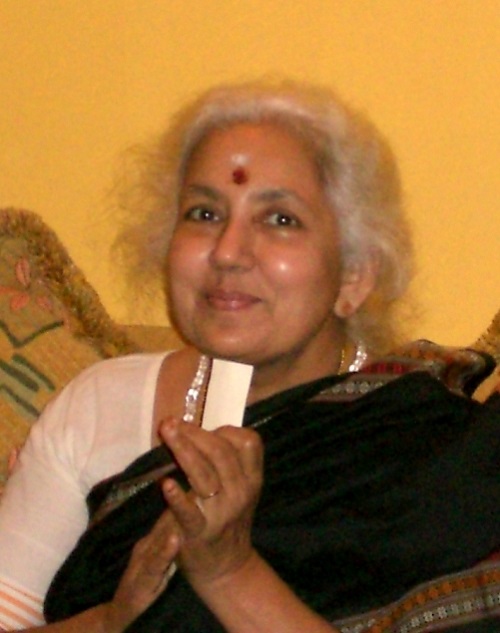
Usha Surya.- Have been writing for fifty years. Was a regular blogger at Sulekha.com and a few stories in Storymirror.com. Have published fifteen books in Amazon / Kindle ... a few short story collections, a book on a few Temples and Detective Novels and a Recipe book. A member of the International Photo Blogging site- Aminus3.com for the past thirteen years...being a photographer.
THE DAY I RETURNED MY SON
Phalguni Sahu
Part – I
The morning of 9th May 2026 arrived with an unusual heaviness. Nandini sat silently in the back seat of her car, clutching a tiny white puppy against her chest. The city was awake, traffic flowed normally, and people hurried about their lives, oblivious to the storm raging inside her heart.
The puppy slept peacefully in her lap, his tiny paws twitching occasionally as if he were chasing butterflies in his dreams. Nandini gently kissed his forehead. A tear slipped down her cheek and landed on his soft white fur. He looked up, licked her chin affectionately, and curled up again. How could he possibly know? How could he know that within the next hour she would hand him over to another family forever?
As the car moved through the streets, memories rose before her eyes like scenes from an old film. And suddenly she was transported back forty-two days; to an ordinary evening that had changed her life forever.
"Mama, let's bring a puppy home." The sentence came unexpectedly. Nandini looked up from her laptop and found her fourteen-year-old son Rohan standing before her, excitement dancing in his eyes. She smiled. Deep inside, the idea thrilled her.
Ever since childhood she had loved animals. Yet life had never allowed her the luxury of keeping one. There had always been studies, work, responsibilities, travel, ageing parents, and countless commitments.
But experience had taught her that love alone was not enough to raise a pet. "A puppy is a full-time responsibility," she replied cautiously. "And your father doesn't like pets."
"I'll take care of him" was the reply. "You say that now." "No, Mama. I mean it."
When she continued to hesitate, Rohan folded his arms and declared dramatically, “If you never give me responsibilities, how will I learn to handle responsibilities?" The argument was unexpectedly mature. Nandini laughed. For a moment she saw not a child, but a young man standing before her.
That evening mother and son joined forces against the strongest opposition in the household- her husband, Vikram. He was a practical man. He liked order. He liked clean floors. He liked peaceful evenings. And puppies represented the exact opposite of all three.
The discussion turned into an argument. The argument turned into negotiations. The negotiations stretched for five long days. Finally, exhausted by their persistence, Vikram surrendered. "Fine," he said. "But when chaos begins, don't blame me." The victory celebrations started immediately.
The following afternoon, Rohan and their driver Hari visited several pet shops before finally selecting a tiny white Spitz puppy. The moment Rohan sent his photograph to Nandini, she felt her heart melt.
The puppy looked like a ball of freshly fallen snow. His ears were too large for his face. His nose resembled a tiny black button. And his eyes... His eyes seemed impossibly familiar. As though she had looked into them before. Somewhere. Sometimes. She dismissed the strange feeling and laughed at herself.
That night she barely slept. At forty-two years of age, she felt like an excited child awaiting a birthday gift. The family unanimously agreed on a name. They would call him “Snow”.
The next morning, when Nandini first held Snow in her arms, something happened that she could never explain. People often speak about love at first sight. She had never believed in it. Until then. The tiny creature rested his head against her shoulder and sighed contentedly. In that moment, an invisible thread wrapped itself around her heart. A thread that would change her life!
The days that followed were magical. Snow transformed the house. His tiny paws echoed through the corridors. His toys lay scattered everywhere. His playful mischief filled every room with laughter. He chased his own tail. Attacked slippers fearlessly. Stole socks and carried them around like trophies. And somehow managed to make everyone smile. Well, almost everyone.
Vikram's patience was tested daily. Snow had no understanding of carpets, furniture, or expensive shoes. One morning he chewed through a brand-new leather sandal. Another day he peed in the drawing room moments before important guests arrived. Vikram would groan. Nandini would laugh. And Snow would continue wagging his tail, blissfully unaware of the chaos he created.
Then, just when life seemed perfect, fear arrived. One night Snow developed a strange cough. At first, they ignored it. But by midnight it had worsened. The tiny puppy struggled to sleep. Each cough pierced Nandini's heart. Rohan and Hari rushed him to a veterinary hospital in the middle of the night. The doctor dismissed their concerns.
But a mother's instincts refused to be silenced. The next morning Nandini personally took Snow to a reputed veterinarian. The diagnosis was simple; a severe cold. Yet for forty-eight hours she barely left his side. She fed him medicines. Wrapped him in soft blankets. Stayed awake through the night. And prayed.
When Snow finally recovered and resumed his naughty adventures, she realised something important. He was no longer merely a pet. He had become family. He had become her child.
But life has a strange way of testing our deepest loves.
As weeks passed, Rohan gradually became busy. School assignments increased. Football practice resumed. Friends demanded attention. The responsibilities he had once enthusiastically promised to shoulder slowly began shifting toward Nandini.
One morning, completely unexpectedly, he announced, "Mama, Snow is becoming difficult to manage." Nandini stared at him in disbelief. This was the same boy who had moved heaven and earth to bring the puppy home.
But childhood passions are often temporary. Motherhood is not!
Vikram immediately seized the opportunity. "I told you this would happen." The discussions began again. Only this time they were no longer about bringing Snow home. They were about sending him away.
Days turned into weeks. Arguments multiplied. Guests complained about dog hair. Neighbours complained about barking. Vikram complained about everything else.
Snow, meanwhile, remained blissfully unaware.
Every evening, he waited near the door for Nandini's return. The moment her car entered the lane, he would begin scratching the door frantically. His tail wagged so vigorously that his entire body danced. No matter how difficult her day had been, that welcome erased every burden.
No human being had ever waited for her with such unconditional joy. No human being had ever loved her so completely. And that made what came next infinitely harder.
Part - II
One rainy evening, fate knocked on Nandini's door.
The sky had been pouring relentlessly since afternoon. The electricity had failed, and the house was wrapped in darkness except for the flickering glow of a few candles. When the doorbell rang, Nandini opened the gate to find an elderly woman standing in the rain.
She was drenched from head to toe. "Sorry to disturb you," the woman said politely. "My car has broken down nearby. May I wait here until my driver returns?" "Of course," Nandini replied warmly.
The woman introduced herself as Sharada.
The moment she entered the house, something extraordinary happened. Snow, who usually barked at strangers, froze. For several seconds he stood staring at her. Then, with a cry unlike anything Nandini had ever heard, he ran toward Sharada.
Not excitedly. Not curiously. Emotionally.
As though he had found someone he had been searching for all his life. Within seconds he was in her lap. Licking her hands. Nuzzling against her chest. Whimpering softly.
Sharada looked equally stunned. Tears unexpectedly appeared in her eyes. "My God..." she whispered. "What happened?" Nandini asked. Sharada smiled awkwardly. "Nothing. He just reminds me of someone." That evening, they spoke for hours. Before leaving, Sharada showed Nandini a photograph stored in her phone. It was a picture of a white Spitz. A dog that looked uncannily similar to Snow.
"He was Dodo," she said softly. "My son." Nandini smiled, "You mean your pet?" Sharada shook her head. "No. My son." The conviction in her voice startled Nandini. "Dodo passed away six years ago."
For a brief moment, Snow stared intently at the photograph. Then he quietly placed his paw on the screen. Neither woman understood why. They never spoke about it again. At least not then.
Over the following weeks, Sharada became a regular visitor. And each time she came, Snow transformed. He would hear her car before anyone else. Race to the gate. And wait impatiently. Sometimes Nandini wondered if she was imagining things. But somewhere deep inside, a strange uneasiness had begun growing. It felt as though an invisible thread connected Snow and Sharada. A thread older than their acquaintance. Older than reason itself.
Meanwhile, life inside Nandini's house became increasingly difficult. The arguments never stopped. Rohan had completely withdrawn from his responsibilities. Vikram's tolerance was exhausted. Whenever guests visited, Snow was confined to a room. Whenever relatives arrived, someone complained. Whenever Nandini defended him, another argument followed. The house that had once echoed with laughter, now echoed with conflict.
Only Snow remained unchanged!
Every morning, he would jump into her lap. Every evening, he would wait for her return. Every night, he would curl beside her bed. Completely trusting. Completely loving. Completely unaware. That innocence broke her heart.
One evening, after a particularly bitter argument, Nandini sat alone on the terrace. Snow rested beside her. The moon hung silently above. She stroked his soft fur and whispered, "Tell me, my child... am I enough for you?" Snow responded by placing his tiny paw on her hand. That simple gesture shattered her.
Because deep inside she already knew the answer. Love alone was not enough. He deserved more. More companionship. More freedom. More attention. More time than she could possibly give him. For the first time, she allowed herself to consider the unthinkable. Perhaps loving him meant letting him go…
A few days later, she called Sharada. There was silence on the other end. Then Sharada spoke carefully. "Nandini, I would never ask for him. Never. But if you truly feel he would be happier here, my home and my heart are open."
That night Nandini cried until dawn. A mother knows when she is making the right decision. Unfortunately, that knowledge does not reduce the pain.
The next few days felt like a countdown. Every moment became precious. Every bark. Every cuddle. Every playful jump. Every stolen slipper. Every feeding session. Every sleepy afternoon. Nandini tried to memorise everything. The shape of his ears. The smell of his fur. The sound of his paws running across the floor. She feared forgetting. Though later she would discover that some memories never fade.
The day before Snow was scheduled to leave, he received his vaccination. The injection made him drowsy. That evening he slept in Nandini's lap for hours. She gently rocked him. Singing old lullabies. The same songs she had sung to Rohan when he was a baby. Vikram watched quietly from across the room. For the first time, he said nothing. Even he understood. This was goodbye!
The next morning arrived far too quickly. As Nandini packed Snow's toys, blankets, medicines and feeding bowls, tears streamed down her face. Hari stood nearby. His eyes were red as well. "Madam," he said softly, "please don't send him."
Nandini closed her eyes. "I wish I had another choice." But she knew she didn't. Not if she truly wanted what was best for him. When they reached Sharada's house, Nandini expected sorrow. Instead, she witnessed something unforgettable!
The entire household was waiting. Sharada stood at the gate. Her house-help, Rina, had prepared an aarti plate. Flowers decorated the entrance. A new bed had been arranged. New toys waited in a basket. Everyone was smiling. Everyone was excited. Everyone already loved him.
Snow stepped out of the car. Looked around. And immediately began running through the house as though he had lived there forever. Within minutes he was playing. Exploring. Demanding attention. Claiming every corner as his own. There was not a trace of fear. Not a trace of confusion. Not a trace of sadness. Only joy; pure, overflowing joy!
For the first time, Nandini's grief softened. Hari later said something she never forgot. "Madam, today I realised you did not lose him." She looked at him questioningly. Hari smiled. "You brought him home."
Months passed. Snow was renamed “Kanha” by Sharada. But Nandini never stopped calling him Snow. Whenever she visited, he would come running. Jump into her lap. Cover her face with kisses. Then return to his adventures.
As though his heart had expanded enough to love two mothers. Nandini often joked, "Di, I think we are sharing custody." Sharada would laugh. "No. We are sharing motherhood."
Years rolled by. Kanha grew older. His muzzle turned silver. His movements slowed. But his eyes retained the same sparkle. The same love. The same mischief. Then one winter night, when he was nearly fourteen years old, Kanha quietly slipped away in his sleep. Sharada held one paw. Nandini held the other. Neither woman spoke. Both wept. A chapter of their lives had ended. Or so they believed!
A few months later, Sharada herself passed away peacefully. The loss devastated Nandini. It felt as though she had lost a sister. A companion. A fellow mother.
And gradually life moved on…. As life always does!
Part - III
Three years later, Sharada's daughter called unexpectedly. "Aunty, we found something that belongs to you." Curious, Nandini visited. The family handed her an old wooden box discovered while cleaning Sharada's room. Inside were diaries. Photographs. Letters.
And one sealed envelope bearing Nandini's name. Her hands trembled as she opened it. The letter had been written years earlier. Perhaps when Sharada sensed time running out. It read:
"If you are reading this, my friend, then both Kanha and I have completed our journeys. There is something I never told you. Three years before Snow was born, I had a dream. Dodo came to me. He looked healthy and happy. He walked beside a woman dressed in blue. Then he turned toward me and barked once. It felt as though he was saying: 'Don't worry, Ma. I will come back. But first I must stay with someone else.' When I first saw you holding Snow, you were wearing a blue saree. The same saree from my dream."
Nandini stopped breathing. A chill travelled through her body. Because she remembered. She had indeed worn a blue s saree that rainy evening. A saree she rarely wore. A saree she had almost not chosen. Tears blurred her vision.
But the biggest surprise was still awaited.
At the bottom of the box lay an old photograph. It showed Sharada holding Dodo years before his death. Nandini gasped. Around Dodo's neck hung a silver bell. A very distinctive bell. One she recognised instantly. Because she had purchased the exact same bell for Snow as a puppy.
The design was unique. Handcrafted. Impossible to find nowadays. Yet there it was; in a photograph taken nearly a decade before Snow was born.
Then another envelope slipped out. Inside was a receipt. The bell had been purchased from a small artisan shop in Puri. The same shop from which Nandini had unknowingly bought Snow's bell years later during a holiday trip. Neither woman had ever discussed it. Neither knew. Neither could explain it.
That evening, Nandini returned home carrying the box. As she sat alone in her room, memories flooded back. The first cuddle. The first bark. The sleepless nights. The tears. The goodbye. The reunion. Everything.
And suddenly she understood. Perhaps Kanha had never belonged exclusively to either of them. Perhaps he had entered their lives to teach them something far greater than ownership.
Love. The kind of love that frees. The kind of love that lets go. The kind of love that places another's happiness above one's own.
As the sun dipped below the horizon, Nandini stepped onto her balcony. A cool breeze brushed against her face. Somewhere in the distance, a temple bell rang. For a fleeting moment she could almost hear tiny paws running toward her. Almost. She smiled through her tears. "No, my little Kanha," she whispered. "You were never my pet." She looked up at the darkening sky. "You are my son forever."
And for the first time since he had left her home years ago, the ache inside her heart disappeared completely. Because she finally understood. She had not given him away. She had simply returned him to where he had always belonged.
And perhaps that had been the reason he came to her in the first place. To teach a mother that sometimes the purest form of love is not holding on. It is having the courage to let go. And trusting that souls destined for each other will always find their way home.
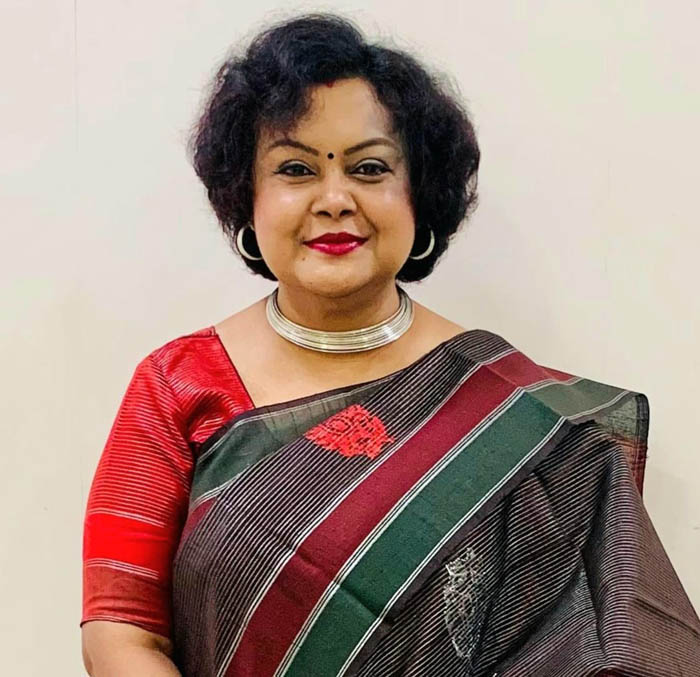
Phalguni Sahu is a development leader who has spent twenty-five years shaping transformative initiatives across government, public sector institutions, and international development organizations. An MBA in Rural Management from the Xavier Institute of Management, Bhubaneswar, she carries into her writing the same depth of insight and quiet sincerity that define her professional journey.
For Phalguni, writing is a sanctuary- an inner courtyard where thoughts unfurl gently and truth finds its voice. She is an ardent reader, forever drawn to the reflective rhythms of literature, and her creative work spans contemplative spiritual blogs and evocative short stories.
A CITY CALLED AMMA
Deepika Sahu
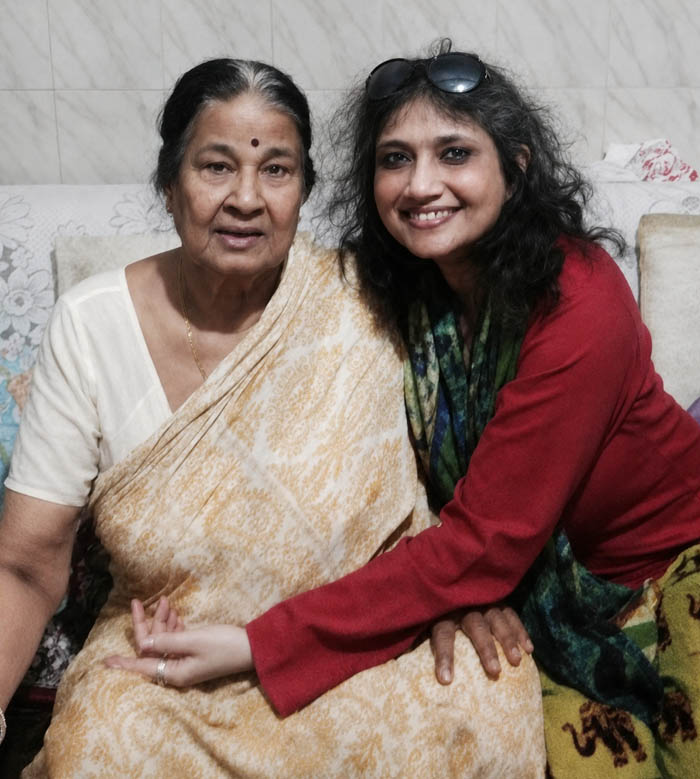
When I had come for my job interview at the Times of India, Ahmedabad, the editor cheekily asked me, “Why do you want to shift from Bangalore to Ahmedabad (where your mother-in-law lives)? I mean, who does that?” I told him, “I want to live in my Amma’s city.” From that moment, Ahmedabad became a city called Amma.
It has been weeks since I lost my Amma and I have been thinking about her, missing her presence around me and remembering her with much fondness even as I am making an effort to navigate through life, love and loss in a city called Amma. For me, Amma is Ahmedabad. Ahmedabad is Amma.
We belong to people and in that belongingness, we belong to cities. Without those people’s love, belongingness, care and support, cities become meaningless and soulless. When I went out on the streets of Ahmedabad hours after Amma’s mortal remains were consigned to flames, everything was the same — the same neon lit busy streets, the same grocery shops, the 24x7 Silver Leaf restaurant of Cama Hotel, the ice gola man standing in his usual space but everything seemed dark and distant to me. From being an intimate lover, suddenly the city felt like a stranger.
Amma embraced Ahmedabad when she arrived here as a new bride from Kerala in the 60s. Almost 40 years later, it was Amma who helped me discover Ahmedabad in myriad ways. She was my banyan tree in a city that does not really have too many trees. I always knew there’s a door with Amma’s name and there was a world of love, laughter and good food. It was her love, care, cups of tea with masala dosa, parippu vadas, undhiyu and khatti mithi dal that made life in Ahmedabad beautiful. I could run from the streets to her home for my share of warm love and I could leave her home to chase stories on the streets. It was all organic and seamless. With her going away, there is a deep sense of loss that has crept into my life in this city.
Living is never easy or conflict proof. Living means one has to live, laugh, fight and then probably again come to embrace love. The same goes true for cities too. Cities go through many transformations in their lifetime. Some pleasant, some not so pleasant. Cities are living beings and they too go through the cycle of love and loss.
In many ways, my city was different from Amma’s city. As a journalist, I have been trained to see the city with different eyes and take a lot of things around me with a pinch of salt. I become both an insider and outside in my own city without even realising myself. Amma looked at the city without thinking a lot. She sailed through without looking for sociological understanding and too many whys and whats.
When I moved from Bangalore to Ahmedabad, I stayed with her for a little more than two months before moving into my own apartment. In my early years in Ahmedabad, it was she and her neighbour Jo Aunty who took me to explore the Walled City. In their company, I discovered the lanes and by-lanes of Dhalgarwad, Rani No Haziro and Manek Chowk. We stopped at Sabuwala’s crowded shop to buy cotton bedsheets and I was introduced as the daughter/in-law who has just shifted her base to Ahmedabad. I was welcomed with a cup of tea at the shop. Both Amma and aunty patiently spent hours looking for a particular colour combination of Ajrakh cotton dress material I wanted. From Amma, I learnt about the vintage Rajhans Tea shop in one of the lanes of a very busy street. When I accompanied her to Madhopura’s spice market on a hot summer morning, I discovered a world of multiple colours and heady smells. It was a world I had never experienced before. It was Amma who encouraged me to go to the terrace on Uttarayan to experience Ahmedabad’s obsession with kite-flying. Amma knew her Ahmedabad and she happily introduced me to the inner courtyards of her Ahmedabad. She was sharing knowledge, lived in experiences and her precious memories too. She wanted to pass on the city’s baton to me. I hope I will do justice to her baton as I move forward. But I could never master her bargaining skills. I failed miserably on that front.
The river Sabarmati is the one that connects our intimate worlds yet it is the same river that separates our world. Ahmedabad is a city that thrives on two diametrically opposite worlds on either side of the river. There is an Eastern ( warm, intimate Old city with a substantial Muslim population) side and the Western side ( all chic, glass, concrete, sky-kissing and Hindu dominated) and these two worlds are like chalk and cheese. And having my Amma in the Walled City gave me a unique perspective and gave me the ability to understand the nuances of the many layers of this 615 year old city. In that way, it made me a flaneur who could walk around for hours exploring many little streets and layers. Amma planted the seed and taught me to walk and revel in the joys of discovering a city.
In Ahmedabad, in our own intimate ways, we both missed Kerala and Odisha’s pouring rain and red earth. On some occasions, when both of us stood closely and looked at the Ahmedabad rains from the window on her third floor apartment, we silently remembered the rains from our own lands we left behind years ago. And in that moment of longing and remembering, the city we lived in started to pixelate.
Beyond the grind of the brutal world of news, it’s Amma’s typical Nair woman sense of humour, her doodhwali chai, her delicious food and her warmth — that gave a contour to my existence in western Ahmedabad that’s high on soulless development, almost incomprehensible fusion cuisine and supremely expensive frothy cappuccinos. It was Amma’s simple no-frills love that gave me a sense of grounding and gentleness in times of mindless brutality, hyper consumerism and toxic masculinity.
We are living in a time when cities are both becoming unlivable and at the same time unaffordable for most. The concreteness of cities is making it almost impossible to breathe. Almost everything shiny in our cities looks soulless and tailored only for the rich. The cities are taking us away from trees, rivers, lakes, green public spaces, stars and intimate communities and all this is happening in the name of development (read Vikas).
How do I live in a city called Amma without Amma? Right now, my heart is figuring it out. I know, one day I will be larger than the grief I am experiencing right now. And probably by that time, the city will be changed beyond recognition. But one thing I can only wish for young girls starting their marital journey— may they always find their own safe loving city and also their own banyan tree in their mother-in-laws (Amma in my case) as they start a whole new journey. Let our cities be kind and gentle to our girls.
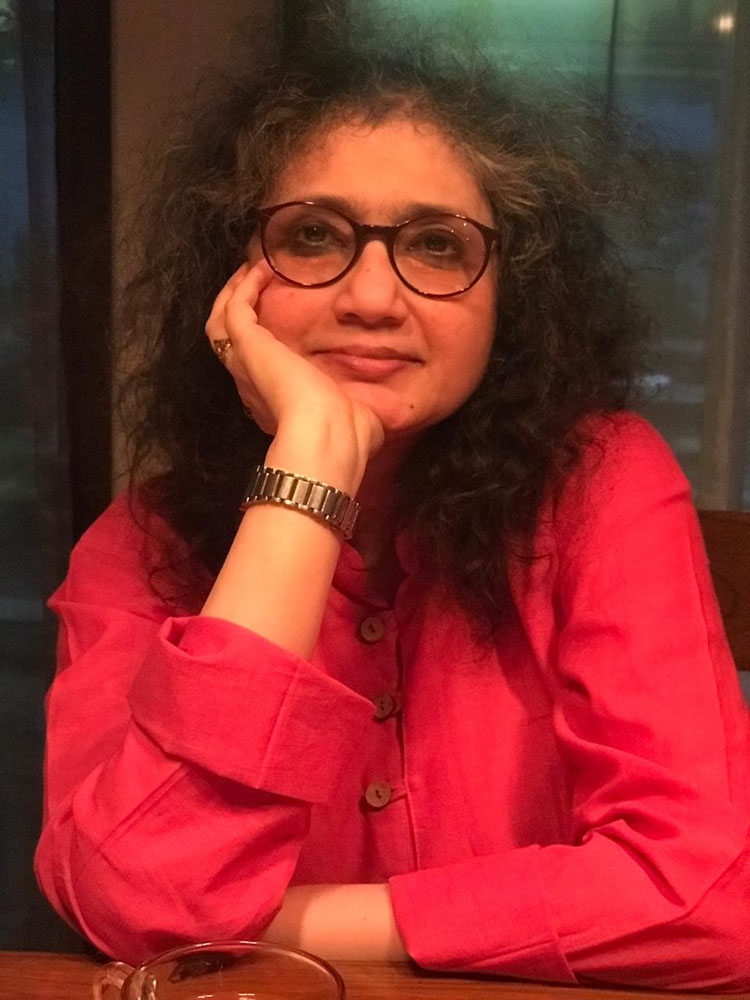
Deepika Sahu is an Ahmedabad-based senior journalist with a career spanning since 1995. During her career, she has worked with India's premier media organisations, including the Press Trust of India (PTI) in New Delhi, Deccan Herald in Bengaluru, and The Times of India in Ahmedabad. Currently, she is contributing India-centric features to Melbourne-based The Indian Sun, a cutting edge media platform. In addition to her journalism career, Deepika is involved in teaching English and Communication Skills to learners from different parts of India through Manzil, a Delhi-based NGO. Beyond her professional endeavors, Deepika is passionate about India's rich diversity, literature, blogging, quiet hours at a cafe and enjoying a cup of tea.
When he bought the helmet, Raghavan thought he was purchasing a piece of plastic.
He was twenty-one then, a college student in Kochi, impatient with advice and impatient with life itself. His father, a retired schoolteacher, accompanied him to the shop.
"Buy a good one," the old man said.
Raghavan laughed.
"A helmet is a helmet."
His father said nothing. He simply paid the extra money for the better one.
For years, the helmet hung from the handlebar of Raghavan's motorcycle. Sometimes he wore it. Sometimes he did not. Like most young men, he believed accidents belonged to other people.
Then one monsoon evening, fate introduced itself.
A bus emerged suddenly from a curtain of rain. Brakes screamed. Metal collided.
When Raghavan opened his eyes in the hospital, his head ached, but he was alive.
The doctor held up the shattered helmet.
"Another inch," he said quietly, "and your story would have ended here."
For the first time, Raghavan looked at the cracked shell with respect.
The helmet had taken the blow that was meant for him.
Years passed.
He became an engineer. Married. Had children.
The helmet aged with him.
The black paint faded.
The straps became worn.
Yet he never discarded it.
Whenever he looked at it, he remembered the strange truth that life survives not only because of its own strength but because something else often absorbs the blows intended for it.
One day his son asked,
"Papa, why don't you throw away this old thing?"
Raghavan smiled.
"Because it taught me something."
"What?"
"That most of us are alive because someone else stood between us and danger."
The boy did not understand.
Children rarely do.
But life would teach him.
Years later, when Raghavan's father lay dying, the old teacher called him to his bedside.
His voice had become faint.
"Do you still have that helmet?"
Raghavan nodded.
The old man's eyes filled with satisfaction.
"Good."
That was all.
A few days later, he was gone.
Only then did Raghavan understand.
The helmet had never been merely a helmet.
It was his father.
For years the old man had done exactly what the helmet had done on that rainy evening.
Quietly absorbing shocks.
Paying unseen costs.
Standing between his son and countless dangers.
Taking blows without complaint.
A parent is often a human helmet.
Children rarely notice.
They see only restrictions, warnings, and rules.
They do not see the dangers that never reached them.
They do not see the sacrifices that prevented invisible accidents.
Time continued its relentless march.
Raghavan's hair turned grey.
His son grew into a man.
One morning, while travelling on a highway near Thrissur, the son narrowly escaped a serious accident.
His helmet was badly damaged.
That evening he came home carrying it.
For the first time, he placed the broken helmet gently before his father.
Neither spoke.
Neither needed to.
A circle had been completed.
The son had finally learned the lesson.
Years later, when Raghavan himself entered the evening of life, he often sat on his veranda watching the sunset.
The old helmet rested nearby.
Its surface was scarred.
Its colour had faded.
Its usefulness had long ended.
Yet it remained precious.
It had become a scripture.
A silent teacher.
Looking at it one evening, Raghavan realised that the entire universe resembles a helmet.
The earth protects us from the cold emptiness of space.
The atmosphere shields us from deadly radiation.
The trees protect us from heat.
The rivers protect us from thirst.
Society protects us from chaos.
Parents protect children.
Friends protect hope.
And perhaps God Himself stands unseen behind all these protections.
We notice Him only when something cracks.
We notice Him only after danger has passed.
We notice Him only when we realise how many blows never reached us.
That night, before sleeping, Raghavan touched the old helmet one last time.
He whispered a prayer.
"Thank you for every visible protection and every invisible one."
For in the end, wisdom is not merely knowing what saved us.
Wisdom is recognising how much of our life was preserved by sacrifices we never saw.
And like a helmet hanging quietly in a corner, the greatest forms of love often go unnoticed—not because they are unimportant, but because they have done their work so well.
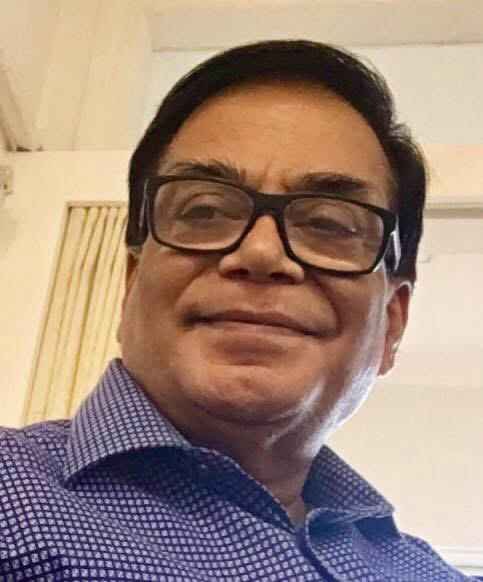
Rabi Dash is a recent entrant to the world of creative writing. After a lifetime of varied experiences and observations, he now writes primarily for the joy of storytelling and reflection. His interests include spirituality, history, human nature, and the small moments that reveal deeper truths. Writing, for him, is less a pursuit of publication and more a way of sharing thoughts, memories, and wonder with fellow readers.
He is a retired officer from the Indian Revenue Service (IRS) who served as the Director General of International Taxation and subsequently acted as a Member in the Tribunal for Prevention of Money Laundering.
SOME INNOVATIVE EXPERIMENTS WITH WOMEN WEAVERS FOR MAKING THE DEVELOPMENT INCLUSIVE AND SUSTAINABLE
Dr. Sanjay Kumar Panda
“Roti, Kapda and Makan” are the three basic needs of a human being. After food, clothing is critical for all. This need used to be met by the handloom weavers for ages. Along with fulfilling the need, hand operated looms were providing livelihood to lakhs of weaving households in the rural areas. After the industrial revolution, production of fabrics by power loom at a lower cost affected viability of the handloom industry and the weavers adversely. Notwithstanding support from central and state governments under several programs, the number of active looms has been declining, and youths from the traditional weavers’ family have been opting for other occupations.
2. In this background, SHRADDHA civil society organisation (founded in 1994 by Dr Sanjay Kumar Panda IAS retired, former Secretary, Ministry of Textile) has been working for promotion of handloom with focus on increasing earnings of the weavers on a long-term and sustainable basis. The organisation was revamped in 2022 with active support of people sharing the common goal of giving back to the society including Shri Bijan Behari Pal (former Director, Weavers Service Centre) and Shri Surendra Kumar Patra (former Deputy Director, Weavers Service Centre), who have decades’ long practical experience and domain knowledge of handloom.
3. Based on field experience of collaborating with the weavers and long ranging discussion with other stakeholders of handloom, SHRADDHA has evolved a strategy based on the following.
- Handloom must be promoted as a niche (Khas - extraordinary) product based on its inherent strengths, and not as an alternative to power loom weaves.
- Consumers need to be made aware of the fascinating, high skill, and labour-intensive aspects of handlooms fabrics. Those, who have liking for handwoven products and disposable income need to be targeted as potential customers for handloom throughout the year beyond the normal family functions, festive seasons, and rebate-based sale.
- The weavers need to be made aware of the changing market conditions and persuaded to make quality weaves, free of any defect, with new designs, new colour, and new products (dress materials in place of saree) as per the taste of the customers as referred to above.
- The weavers should be guided with time & patience by handholding for using mobile phone to contact the customers, know their taste, weave and sell products directly to the customers (D 2 C basis), which would eliminate the intermediaries and increase their earnings.
- Simultaneously enterprising youths may be encouraged and supported for launching their “Startups” for sourcing and marketing.
- The Weaver Service Centre, an excellent organization, may be strengthened with more technical staff (with degree/ diploma in handloom) and deployed in the handloom clusters to guide the weavers.
- Potential of handloom for generating a decent income in their existing houses along with other advantages should be exploited for empowering women with traditional handloom background under “Mission Shakti” and other ongoing programs.
- Supply of quality raw materials at a reasonable price, easy working capital, branding, and marketing in the metropolis may be supported adequately.
4. The previously mentioned strategy for increasing the earnings of the weavers needs a change in thinking in the existing approach. It has two key components, namely.
- Change in production for weaving fabrics (a) with quality, new and contemporary design, new colour, and new fabrics like dress material in place of saree, and (b) for the customers, who have preference for handwoven fabrics and disposable income; and
- Change in marketing by connecting the producer weavers directly with the consumers using mobile phone and social media in a gradual manner, which will eliminate intermediaries and reduce transaction cost drastically.
5. The above strategy was executed by SHRADDHA with a group of women weavers of the Maland village, Tirtol block, Jagatsinghpur district under a project sanctioned by the Haridaspur - Paradip Railway Company Limited (HPRCL) under its Corporate Social Responsibility (CSR) interventions during 2024-25. The project was taken up under the personal supervision and technical guidance of Dr Sanjay Kumar Panda, President and Shri Surendra Kumar Patra, Vice President. The training program aimed at sensitizing the weavers along with provision of market information, skill and assets for weaving fabrics with new design, colour and new fabrics (dress material in place of saree) as per the taste of elite customers, who have taste for hand woven fabrics and disposable income. The trainees were provided soft skill and taken on exposure visit to the Weavers Service Centre and Kalabhoomi and participate in an innovative marketing intervention in Bhubaneswar.
6. The 45-day long training program concluded on the 21st of March 25, within a few days of celebration of the International Women’s Day. Smt Taapoi Nandi and Smt Lovabati Sahu, two weavers trained under the project, narrated their experiences of the training. With confidence and pride, they mentioned that support received under the project enabled them to diversify production from saree with traditional designs and color meant for the rural consumers to dress materials and saree with lighter shades and smart designs for the new generation customers and that this led to increasing their earnings by about 50%.
7. On the second component of the strategy related to marketing, SHRADDHA organized a day long handloom sale exhibition in the Banquet Hall pf Royal Lagoon residential complex, Patia, Bhubaneswar, a gated society of over seven hundred high net worth families on the 9th of March 2025. Appreciating the noble purpose, the management volunteered and made their facilities available at a reduced rate. Necessary arrangements for publicity, display, lunch etc. for the participating weavers were made by SHRADDHA. Six weavers from Maniabandha, Gopalpur, Jagatsinghpur and Bargarh handloom clusters participated with a range of handloom products. Smt Snehaprava Dash, an elderly inmate of the complex eagerly came forward to put on a saree with contemporary design woven by the women weavers of Maland village and inaugurated the event. Her gesture and kind words of encouragement generated lots of enthusiasm among the weavers.
The weavers were encouraged to sell their fabrics with a marginal markup on the price; they sell in their villages. This position was explained to the visitors, who appreciated it as they found the price to be reasonable and lower than the rate at which it is available in the city shops. Over one hundred customers visited the stalls and fabrics worth Rs 2.30 lakhs were sold without any discount/ support from government. The participating weavers left for their villages happy, as they got the sale value instantly and about 30% more than what they would have got otherwise in their village.
This small experiment of SHRADDHA (working on the spirit of the contribution of the squirrel to making of the Rama Sethu in the Ramayana) led to.
- Enhancing the confidence and earnings of the producer weaver and provided an opportunity to meet potential customers for handloom, know about their taste and liking as well as contact numbers. And
- Sensitising the potential customers to quality handloom fabrics for buying at a reasonable price, along with the pride of promoting tradition and culture and happiness of helping the less privileged.
This experiment has established that earnings of the traditional weavers can be doubled by making them aware of the vast market for handloom, and the new customers with taste for handwoven fabrics, and disposable income. One of the fascinating developments is the enthusiasm and seal with which the rural women weavers have been participating in the digital zoom meeting held by SHRADDHA one each Saturday at 7.30PM. It is hoped that in due course the weavers will be able to contact the customers using mobile phone, producing fabrics as per their taste and selling directly which will eliminate the intermediaries and increase their earnings on a continuous basis.
This island of excellence needs to be appreciated and supported for replicating it at other places for promotion of handloom.
Few pictures, which are self-explanatory, are enclosed.
- “Malapati” saree woven with deep colours (before the training)
- Saree woven with lighter shades (after the training)
- Dress material woven with pastel / lighter shades (after the training) & dress stitched out of it.
- Glimpses of low-cost marketing intervention organized in the Royal Lagoon on the 9th March 2025
- Contact details of some the trained weavers.
- A brief about SHRADDHA, details are on website: http://www.shraddha-handloom.com/,
.
|
|
|
“Malapati” saree woven with deep colours and old designs (before the training) |

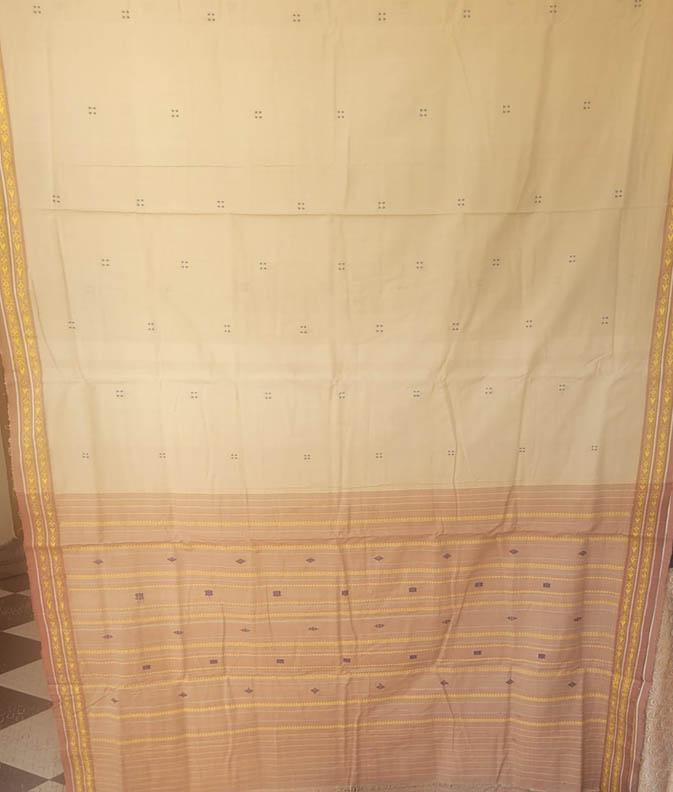
|
Saree woven with lighter shades (after the training) |
|
|
|
Saree woven with lighter shades (after the training) |
|
|
|
Dess material woven with pastel / lighter shades (after the training) |
|
|
|
Shirt, stitched out of fabrics handwoven by SHRADDHA weavers |
|
|
|
Dess material woven with pastel / lighter shades after the training |
|
|
|
Shirt, stitched out of fabrics handwoven by SHRADDHA weavers |
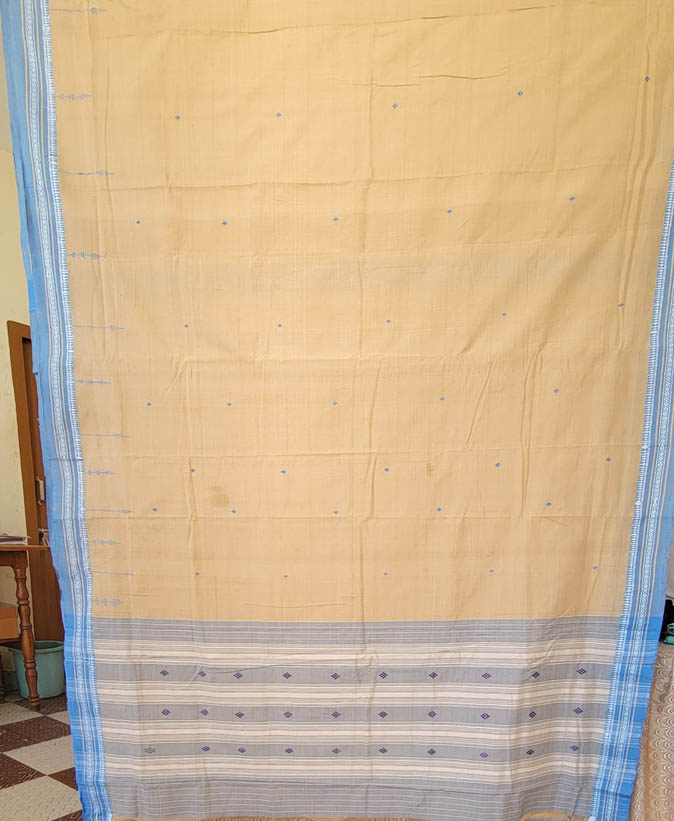


|
Glimpses of an innovative, low-cost intervention for marketing Handloom fabrics Organized by SHRADDHA in the Royal Lagoon Residential complex on the 9th of March 2025 |
|
|
|
Smt Snehaprava Dash, an elderly inmate of the complex inaugurating the event |
|
|
|
Enthusiastic response of the buyers to traditional handloom & encouraging the weavers |
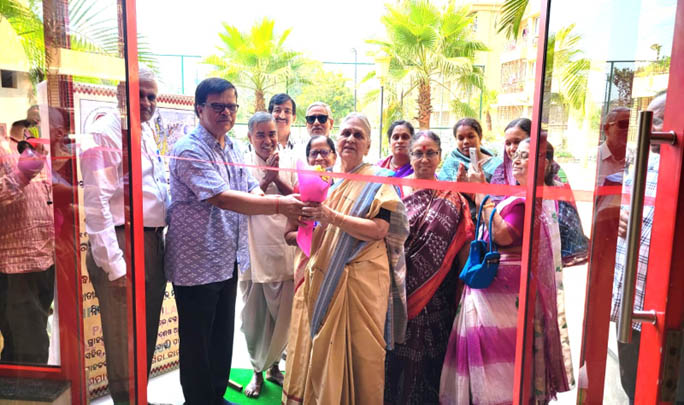
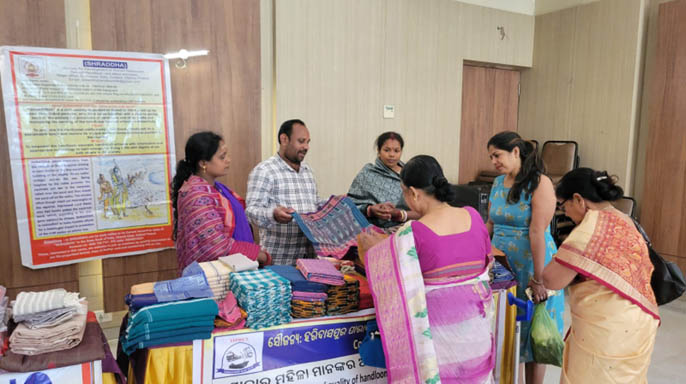
|
Name and contact details of the weavers empowered under the program |
||
|
Smt Tapaoi Nandi Mobile no +91 89840 44762 Village: Bakharpur Block: Tirtol District: Jagatsinghpur Wife of Shri Bijay Kumar Nandi |
|
All the twenty weavers, covered under the program, are literate and have education up to higher secondary level. They live in the rural area with their family and weave cotton fabrics (80 and 100 counts) for supplementing the oncome of their family. They have been weaving sarees and scarves in deep shades with matching designs as per the prevailing demand in the village, the district, and the state. The woven products are sold either to the Primary Weavers Cooperative Society (PWCS) or to businessperson dealing with handloom fabrics in the village. The PWCS sales the fabrics to the Apex Weavers Cooperative Society, which sales it through its retails chain “Boyonika.” The weavers showed keen interest in learning new techniques of designing with jala and dobby. They appreciated the need to change and weave for the elite customers, who have liking for handwoven fabrics and have disposable income. They also understood the advantages of dealing with the customers directly, which will eliminate agents and increase their earning. |
|
Smt Nayana Behera Mobile no +91 96584 46949 Village: Bakharpur Block: Tirtol District: Jagatsinghpur Wife of Durga Ch Behera |
|
|
|
Smt Sulochana Behera Mobile no +91 77353 21819 Village: Bakharpur Block: Tirtol District: Jagatsinghpur Wife of Shri Purna Chandra Behera |
|
|
|
Smt Namita Behera Mobile no +91 72056 43811 Village: Bakharpur Block: Tirtol District: Jagatsinghpur Wife of Shri Debendra Behera |
|
|
A brief on the organization SHRADDHA
|
|
SHRADDHA (Society for Development of Human Resources through Handloom and allied activities) Regd office: Sidheswar Sahi, Cuttack, Odisha 753008 Email: shraddhahandloom94@gmail.com Instagram: @shraddhahandloom94 Website: http://www.shraddha-handloom.com/ |
|
|
Registered under (i) Societies Registration Act, Odisha vide no: 19575 of 1994-95, (ii) Darpan Portal unique ID OR/2022/0334023 of Niti Aayog and (iii) sections 12 A and 80G of the Income tax Act vide unique Reg no AACAS4415-QE20221 and QF20221 dated 10-12-2022) and (iv) number CSR00050638 dated 29-03-2023 of MoCA for undertaking CSR activities |
||
|
About SHRADDHA and promotion of the craft sector “SHRADDHA” is a civil society organization based in Odisha, set up by some likeminded persons, who have come together with a view to giving back to the society in the field of promotion of handloom and other crafts and increasing the earning of the handloom weaver/ artisans substantially. VisionTo promote the traditional crafts namely handloom, handicraft on a sustainable basis and restore its unique socio-economic-cultural position in the country. MissionEmpower the handloom weavers, handicraft artisans with appropriate technology to earn enough for living a life with dignity at par with others in the society. |
||
SHRADDHA draws inspiration from the episode of the Ramayana relating to contribution of the tiny squirrels to making of the mighty ‘Rama sethu’ (bridge) across the sea.Being inspired by its noble purpose, the squirrels got wet in the seawater, rolled over the sand, and then shook the sand off on the sethu.Lord Rama was pleased by the sincerity and effort of the squirrels, though small yet meaningful. He had fondly patted the squirrels in their back, which according to the epic, gave the squirrels its stripes.SHRADDHA is committed to making humble efforts for promotion of craft in a meaningful manner on similar lines. |
|
|
|
All contribution /donations (covered for under section 80G of the Income Tax Act) to SHRADDHA may please be sent online to UPI ID 40987597141@sbi or bank (i) Name of Account holder: "SHRADDHA",(ii) Account: Current ,(iii)Account number: 40987597141, (iv)Bank: State Bank of India,(v) Branch: Chandi Chak, Cuttack,(vi) IFSC code: SBIN0010251 and details thereof may be sent on Email to :shraddhahandloom94@gmail.com . Those interested to support the cause, are welcome to join as members by sending information as per the prescribed format, copy of Aadhar card and membership fees @ Rs 1,100/- by cheque / on line. |
||

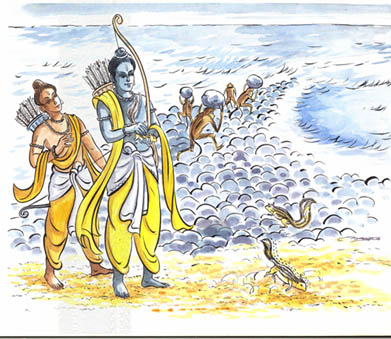

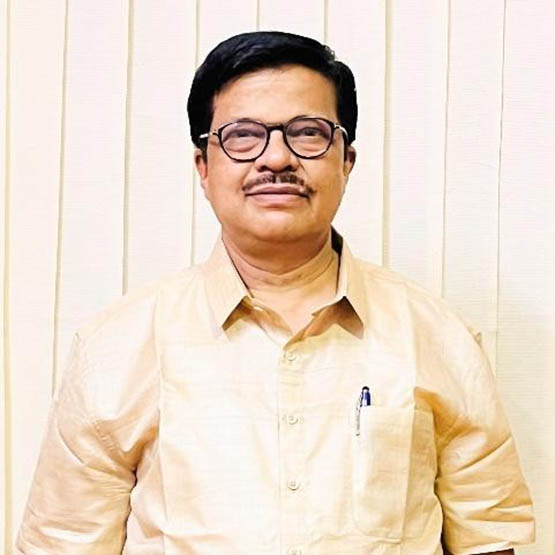
Dr. Sanjay Kumar Panda, a career civil servant, joined the Indian Administrative Service in 1980 and was allotted Tripura cadre. As a distinguished bureaucrat, he served the people in the states of Tripura, Odisha, and Government of India till his superannuation in December 2015. including as the Secretary to Government of India, Ministry of Textiles (2014-15) and the Chief Secretary, Tripura (2010-14). He had a brilliant academic career with university gold medal(s) as the Best Graduate and in master’s in science (Chemistry), silver medal in Public Administration from IIPA, Diploma in Forestry from AIFC, Dehradun, and Ph. D in Economics.
He was awarded the prestigious International Louis Pasteur award for outstanding contribution to sericulture and silk industry. His major publications include Corporate Social Responsibility (CSR) in India, Promotion of Sericulture in new areas empowering tribal women and Making One plus One Eleven (Making changes Transformational), which have been cited by various scholars. He is associated with the National Institute of Fashion Technology, Indian Institute of Corporate Affairs, National Institute of Science & Technology as adjunct professor/faculty.
Post retirement, Dr Panda has devoted himself for promotion of Handlooms with focus on increasing the earnings of the weavers to a respectable level. Based on his long association and field experience as Director of Textiles, Odisha (1989-1994), he has been pursuing the cause with indomitable zeal, passion, and dedication.
As the Founder-President of SHRADDHA2, Non-Government Organization, he has been spearheading the movement at the grassroot level for empowering the weavers, women in particular, with confidence, skill and market information for producing fabrics with quality, zero defect, new design & color combinations and new products for winning the trust and satisfaction of the customers. Its long-term vision envisages weavers contacting the customers directly online and taking up production and sale on Direct to Customer (“D” 2 “C”) basis. This will avoid the intermediaries and increase their earnings. One of the recent interventions of SHRADDHA based on a new strategy for promotion of handlooms with the cotton weavers of Jagatsinghpur District, Odisha, has increased the earnings of the semiskilled weavers by about fifty percent. It has ushered in an era of inclusive and sustainable development. (https://youtu.be/HD6vJiv7qGg)
MY MODEL TEACHER
Sujatha Krishnamurthy
July 2025-My iPhone alarm chimed a soothing tune at 7 am. Sunday is the day I love my beauty sleep to last until 8 am. A day to relax and lounge until noon before making any plans for the day. Unlike all other Sundays, today is a very special day for me. Out of the ordinary, I hear myself humming a few tunes in the shower. Today I have plans to meet Ms. Johnson, my fourth grade teacher, over brunch at noon in a newly opened Indian restaurant in town called Indian Delight .
Soon after I graduated from High School, she took early retirement and moved to Florida to take care of her ailing mom. It has been a while since we met due to Covid and other circumstances . Ms. Johnson is my all time model teacher. She played a pivotal role, not once but twice, in changing the course of my life.
While growing up, my parents professions took them to different parts of the world. Until I moved to college dorm, for the most part I have been a latch key kid. My parents made sure that there was one parent present to take care of my needs and take me to soccer tournaments and piano classes. Even as a child I could feel the tension and frustration of my parents struggling to find a work home balance. Many times I have wondered whether life would have been easier if I was enrolled in a boarding school instead.
Act One: November 2003-I was a fourth grader in Lakewood Elementary School in Paw Paw, Michigan. With so much going on at home, the only thing that kept me grounded were those interesting books Ms. Johnson assigned us to read and write reports on. It is vividly etched in my memory the day she asked me to read my first short story in front of the entire class and at the end of my story all my friends clapped. I was so excited that I came home and hung the short story on our fridge with pretty magnets. Sadly, it went unnoticed by my parents. As a nine year old, I was very confused.
That was when Ms. Johnson turned out be my savior. She didn’t know my family set up, but she realized early on my flare and focus for writing. Honestly, without her encouragement, I would have not taken books or myself seriously. At UM, I earned my degree with a major in English and a minor in creative writing to the chagrin of my parents who wanted me to pursue medicine. I also managed to earn a Michigan teaching certificate on line before embarking on my job hunt. I will not be a teacher today if not for Ms. Johnson either. After graduating from UM(University of Michigan) I applied to many public and private schools, in and around Michigan. I even applied to schools as far as Texas and Georgia. No luck. I was getting a bit restless and frustrated. By the time I graduated from college, both my parents took up jobs in the Bay Area in west coast leaving the house for me, move in ready. Most of my friends by then had moved out of Kalamazoo for work or marriage, and I was feeling quite lonely. That was another time I was feeling pretty low. To make matters worse my parents started pressurizing me to move to California. That was the last thing I needed at that time. Ms. Johnson rescued me once again.
Act Two: December 2018. Call it serendipity. One cold and snowy afternoon, I met Mrs. Johnson at our local grocery store. It was such a pleasure to be recognized by my fourth grade teacher. In between exchanging pleasantries, she asked,” What are you doing now Tanisha?” I was floored that she even remembered my name after all these years. “Since graduation from Michigan, I am on the lookout for a teaching position” I replied. She immediately said,” Would you be interested in working at Lakewood? I heard Ms. Smith, who replaced me quit on medical grounds. I can talk with the current principal Dr. Dwight and put in a word for you.”The rest is history. Don’t get me wrong. I admit that all these years as a teacher has not been a cake walk or rather been a roller coaster ride . The class room has changed and so has the roles of teachers and students. The school administration is pushing teachers hard to learn AI and latest technology. There is a lot of pressure to bump up the scores on standardized tests and attendance. Quite a challenge!
Covid has made it even worse. Teachers and students had to scramble to teaching and learning on line. Now we are back in classrooms and unfortunately the isolation has made many of us forget how to communicate with each other, teachers included. Blah! Blah! Blah! But you know what. I love my career choice and will never regret for pursuing my childhood dream. Thanks to Ms. Johnson, my model teacher, who rescued me not once, but twice and guided me in the right path.
It’s already 11.30 am. I add the address of the Indian restaurant(Indian Delight) on Google Map on the GPS in my dashboard. The map says ETA(estimated time of arrival) as 11.50 am. With a smile on my face, I settle in my Toyota Prius and start backing up on my driveway.
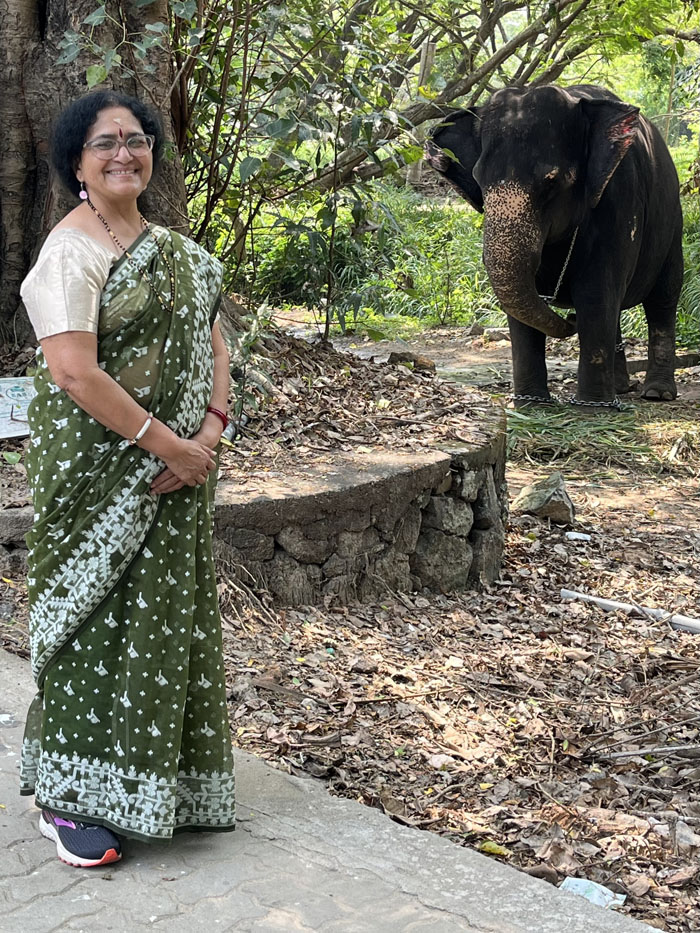
Hi
I am Sujatha Krishnamurthy writing from Kalamazoo, Michigan, USA. Born and raised as a true Kolkatan, studied at Andhra Association School and Shivnath Sastri College, and worked at Central Cottage Industries. Moved to Pasadena, CA, USA in ’84 and later to Kalamazoo, MI in ’91. Studied, worked, and retired after a stint of 20 years in different organizations, including family owned business , NPO(Non-Profit Org) , and MNC( Multi National Corp).
A habitual reader and writer since younger years, a habit cultivated in the banks of the Ganges, has continued to flow till date. Since 2023, my contributions have been published in my alma mater’s monthly e- magazine SPARKZ. I also contribute regularly to our Indo American Cultural Center and Temple’s monthly e-newsletter covering cultural activities in and around town.
As a full time volunteer, I dedicate many hours at our local Hindu temple (Indo American Cultural Center and Temple). Have served in the temple board of directors in many leadership positions, such as, Religious Committee Chairperson, President, and Chairperson. I am the Bal Vihar teacher of 25 years teaching Indian scriptures, teachings, and bhajans to the next generation.
As the Community Outreach Program Coordinator of our temple, I bridge our Indian community with the rest by taking our Indian culture and heritage to local schools and institutions of higher learning. My role facilitates in bringing several visiting Indian artists and American Indian talents to our temple and community. My efforts have been successful in drawing many local, city, and state officials, including Governor, Mayor, and City Counselors and Indian Consul from Indian Consulate, to our temple’s land mark events, such as 25th anniversary and others.
Since 2019, I have been recording audio books for the visually impaired for Samarthanam Trust For The Disabled, an organization based out of Bengaluru. I am currently working towards my goal of reaching the century mark for the Samarthanam Library. My other hobbies include globe trotting, music listening and singing, tasting and trying out new recipes, being an active influencer in social media, and above all, staying close to my families and friends.
Rebirth
" Chechi, if there is a rebirth, I want to be a parrot."
"Why a parrot?"
"I can be free and fly wherever I want without doing any work." Kanaka's young maid replied with a faraway dreamy look in her eyes.
" I want to be a cat, Amma, then I can curl up and sleep and not go to school. But one condition."
Kanaka raised her eyebrows questioningly. " A cat in your house or a cat lover's house." So the young ones are already thinking of rebirth, a life they would enjoy.
For Kanaka, it was to be a free woman. ( LPS)
Space Adventure.
Kanaka dozed off the moment the aircraft took off. She meandered through the fleecy clouds and came to a strange land where she saw ET. His quaint, elf-like appearance made him adorable. She wanted him as a pet. Last time he gave her the slip and jumped out of the window. Today she will catch him surely. With her arms spread out, she went behind him and caught him. “ Paattie don't squeeze me,” screamed Dany. Kanaka sheepishly opened her eyes and found she still had her arms around her grandson who was a bit scared, it being his first flight.
(LP S)
Lottery/ My Teacher
My failure in two papers in English was a turning point. A final year BSc Zoology student I stood only one more chance in September. I sat crying. I felt a gentle touch on my shoulders. My English Professor wiped away my tears and said, "Let us think of future action." She offered to teach me and help me prepare for the examinations. I went home confident I would pass. And I did. Looking back I think of it as a lottery, I won. I thanked God for giving me such a teacher who opened up my life for me.(LPS)
Pet
Ken's demise left her devastated. The emptiness could not be explained. The pitter - patter sound of his feet and his endearing barks, echoed in her ears. The void and the open Kennel that greeted her, tore her heart.
Niranjan noticed everything. Then one day Niranjan told her ”Kanaka I have an appointment to keep, I will be late too.” When she opened the door for him in the evening, he had something wriggling under his arms. She squeaked in delight, a two month old puppy exactly like Ken. An eternal gift. A robot puppy that would fill up the space.( LP S)
zumba/ Temptation
Latha Prem Sakhya
The clucking music woke me up.
“What a sight! A brood of hens doing Zumba! I delightfully joined them. After three sets they waddled off for food. I followed them. I found worms and won their hearts. I had a lovely time with those hens. The hot sun made us sleepy. I perched on a nearby branch and dozed off. When I woke up it was night the hens had disappeared. I thought I was bewitched. Frightened, I climbed up on a safer branch and waited for dawn. I learnt a lesson too. Never to follow strange hens again. ( 100)
An acclaimed Painter, a published poet, a self-styled green woman passionately planting fruit trees, a published translator, and a former Professor, Lathaprem Sakhya, was born to Tamil parents settled in Kerala. Widely anthologized, she is a regular contributor of poems, short stories and paintings to several e-magazines and print books. Recently published anthologies in which her stories have come out are Ether Ore, Cocoon Stories, and He She It: The Grammar of Marriage. She is a member of the executive board of Aksharasthree the Literary Woman and editor of the e - magazines - Aksharasthree and Science Shore. She is also a vibrant participant in 5 Poetry groups. Aksharasthree - The Literary Woman, Literary Vibes, India Poetry Circle and New Voices and Poetry Chain. Her poetry books are Memory Rain, 2008, Nature At My Doorstep, 2011 and Vernal Strokes, 2015. She has done two translations of novels from Malayalam to English, Kunjathol 2022, (A translation of Shanthini Tom's Kunjathol) and Rabboni 2023 ( a Translation of Rosy Thampy's Malayalam novel Rabboni) and currently she is busy with two more projects.
THE DAY OF RETIREMENT
Dr. Sukanti Mohapatra
There was only one day left for her tenure to end. Yet, Sharmistha did not quite feel right. Just like any other day, she went to college that morning, only to be caught completely by surprise and felt overwhelmed. The moment she stepped out of her car, the students gathered around to welcome her. They placed a thick garland of roses around her neck. Saying, "Please come, Madam," they escorted her into the massive seminar hall.
On the wall, a large banner adorned with balloons and flowers featured her full-length photograph. On the table, a beautiful floral-print cloth was laid out, and the vase and microphone were all set. These elaborate arrangements seemed to whisper to her repeatedly—the time to leave has finally arrived.
When the students of her department read out a citation filled with praise and deep emotion, and sang a farewell song, tears of untold emotions began to flow from her eyes involuntarily. For the first time, she could not deliver her final speech to her students properly. Choked with emotion, the words caught in her throat. Yet, a loud round of applause erupted. She was virtually buried under bouquets and ceremonial shawls. On top of that, a grand feast had been arranged. She felt overwhelmed, and a bit self-conscious too.
Why did her heart suddenly feel so heavy? Was it because, after tomorrow, she would no longer see these smiling, beautiful faces brimming with youth?
That night, sleep did not even touch Sharmistha’s eyes. She had thought that since tomorrow was her last day, she would sleep well tonight so she wouldn't look dull at the staff farewell meeting. How many times had she sat in the common room and snapped at her colleagues, saying, "Oh please, there’s no joy left in this job anymore. A seven-hour stay, biometrics—it’s all a farce. I don’t wish to stay even for a single day. I am literally counting down the days to retirement."
A talkative male colleague had chimed in, "Well, the salary increases accordingly, who on earth dislikes a job?"
"No, brother, no! I don’t have the slightest desire anymore. My husband is all alone in our Bhubaneswar house. My mind is no longer in this place. How can a person travel anywhere in peace with all this college work and responsibility?"
"Alright, just stay on, it's a matter of only two more years!" Anupama Madam had remarked sympathetically.
Those two years slipped away as if in two blinks of an eye.
The sleepless night gave way to the morning of her so-called much-awaited superannuation day. Looking at her reflection in the mirror, Sharmistha was startled. Her eyes were puffy, her skin looked dull, and her face appeared slightly wrinkled. She didn't look sixty; she looked ten years older. She thought of going to a parlor to get some makeup done. But what kind of numbness was this gripping her body and mind?
Where had the imagined joy, saved up for this very day, vanished? Where went the desire to reign over her own home in Bhubaneswar? The thrill she used to feel earlier just thinking about the absolute freedom she would get—the eager joy of spending time with her family and grandchildren—into what lifeless emptiness had it all dissolved?
The phone rang; it was the Staff Club Secretary from the college. "Happy retirement day, Madam. Today is your special day. The meeting starts exactly at 11:00 AM. Please arrive before that."
Saying a brief "Alright," she hung up. She had to go, after all. Sharmistha prepared herself.
As she sat down to put on a newly purchased, expensive Sambalpuri saree, her phone rang again. On the other end was her pampered granddaughter’s voice, a blend of affection and mischief: "Happy beginning of a new life, Maa! Do you know, we are all coming to you today—the whole family—to celebrate with you this evening. Today is truly a happy day my sweetest and dearest Grandma!"
And there it was! A gust of that misplaced joy suddenly swept through her entire being. Her face beaming, Sharmistha called the parlor and said, "Just a quick hairstyle and light makeup, as fast as possible."
As she got into the car, she checked her face in the side mirror. It reflected the glimmer of happiness.
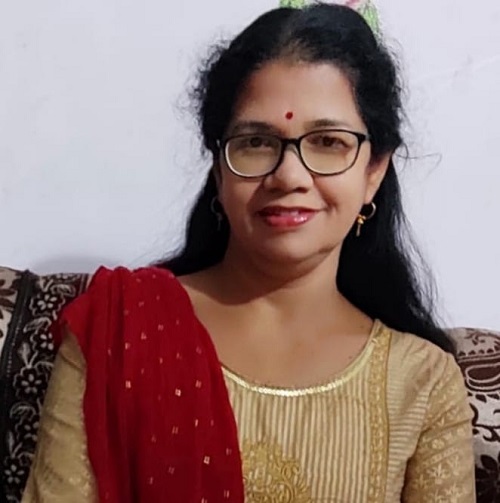
Dr. Sukanti Mohapatra, a senior lecturer in English in the Higher Education Department, Govt. of Odisha is a bilingual writer writing both in Odia and English with equal flair. Her poems, stories and articles are published in many state, national and international magazines and journals. She has three published anthologies of poems to her credit. Besides, she has published many research articles in different research journals. She contributes regularly to Radio Bulbul.
A TRIP TO REYKJAVíK: SMOKE, STONE, AND SAGA: NOTES FROM THE ISFNR CONFERENCE, JUNE 2026
Annapurna Pandey
I never imagined I would travel this far north to attend a conference. I always guessed it would be so cold! Reykjavík sits at a latitude of 64°08′ N, just south of the Arctic Circle, making it the world's northernmost capital of a sovereign nation — a striking distinction in its own right, even without reaching for the North Pole as a point of comparison (which lies roughly 2,600 km further north).
This year, the International Society for Folk Narrative Research (ISFNR) conference was held in Reykjavík in June 2026. It was a new country, a new culture, and a new terrain, and I decided, why not? It has been magical to spend 10 days in Iceland.
Our hotel, Reykjavik Natura, lies near a small forest part of the state’s reforestation process at the bottom of a hill, where the world-famous Perlan museum is situated. This dome shaped museum combines exhibits on icebergs, volcanoes, and the expansive Atlantic and Arctic oceans surrounding this island.
Iceland has a population of about 400,000, and roughly 260,000 of them live in the capital region of Reykjavík. The rest of the country is mostly rural, and much of the interior remains uninhabited — shaped by ice and fire: glaciers, desert, mountains, volcanoes, lava fields, and the surrounding North Atlantic and Arctic oceans. Only 20-25% of the land on this island is habitable.

Iceland is geologically young by any measure — the island as a whole has been forming for roughly 16 to 18 million years through ongoing volcanic activity. However, the land we walk on today is, geologically speaking, still being made. The tectonic plates pull apart by about 2 cm per year, and the landmass is continually opening up, making volcanic eruptions a constant feature. Icebergs are melting, opening up new spaces.
First, the Norse settlers, the Vikings, came primarily from western Norway, with some arriving via the Norse settlements in the British Isles. Icelandic genetic studies have shown a notable Celtic component alongside the Norse, since many of the women who settled the island were Gaelic, brought from Ireland and Scotland during Viking voyages there — a more layered and complicated story than any single tale of Norsemen and their wives. Our tour guide offered his own version of the legend anyway: "Look at the Icelandic women. Since the Vikings married beautiful women, women in Iceland are beautiful."
Reykjavík is not an ancient city by European standards. According to the medieval "Book of Settlements," the Viking Ingólfur Arnarson was the first permanent Norse settler, arriving around 874 AD. As he approached the island, he and his crew found steam rising from hot springs along the coast, and so he named the place Reykjavík: reykja meaning "smoke" or "steam," and vík meaning "bay." Smoke Bay is named for the geothermal vapor that still defines the city's character today.
After their arrival, the island's ecosystem was drastically altered. The settlers introduced cattle, sheep, pigs, goats, dogs, mice, and horses to an island where no land mammals had previously roamed beyond the Arctic fox. When the Norse settlers arrived in the 9th century, they cleared a substantial share of the island's original birch woodland, cutting trees for houses, furniture, and export to Norway, Sweden, and Denmark. Within a few centuries, much of the original forest was gone. As a result, much of the country became barren. It is heartening to know that Iceland now plants around two million trees every year to restore its greenery. Today, horses and sheep are the main farm animals, raised by farmers in farmhouses scattered all over the country. Sheep and horses roam freely in the summer and look very happy.
Folklore in the Streets
Reykjavik is rich in folklore — trolls, elves, hidden people, and other spirits. The uncanny nature of the land seems to invite them all. Walking the oldest streets near Aðalstræti, you encounter layers of the city's founding story at every turn: the first settlers, Norse pagans who worshipped Odin, Thor, Freyr, Frigg, Freyja, and others, and who carried their own beliefs about what came after death. Streets are named after them.
Norse mythology features a rich, complex pantheon divided into two main tribes of gods: the Æsir, the warriors and rulers, and the Vanir, associated with nature and fertility. Among the chief deities is Odin, the "All-Father" and supreme ruler of the gods, associated with wisdom, war, poetry, and magic. He is said to have traded an eye for infinite knowledge and to have hung on the World Tree, Yggdrasil, to learn the secrets of the runes. Thor, the thunder god and Odin's son, is the strongest of the gods physically, protecting both mortals and deities from giants with his hammer, Mjölnir. Frigg, queen of the Æsir and Odin's wife, is the goddess of marriage, motherhood, and prophecy, known for her protective nature.
Among the Vanir, the fertility gods, is Freyja, goddess of love, beauty, fertility, and war, and is highly skilled in seiðr, a form of magic. Her twin brother, Freyr, is the god of peace, fertility, rain, and sunshine, known for his magical ship and for riding a glowing golden boar.
Other prominent figures populate the pantheon as well: Loki, the infamous trickster god who causes chaos but sometimes aids the gods with his cunning; Heimdall, the ever-watchful guardian of the Bifröst, the rainbow bridge, who will sound the horn signaling Ragnarök; Baldr, the beloved, radiant god of light and purity whose death sets the events of Ragnarök into motion; Týr, the courageous god of law, justice, and single combat; and Njörðr, father to Freyr and Freyja, god of the sea, seafaring, and wealth.
At the city center is the garden of the Einar Jónsson Museum, dedicated to Iceland's first professional sculptor. The garden has bronze casts of his symbolist work, with figures drawn from Norse mythology and Christian allegory. One of the pieces is Ymir og Auðhumla: the primordial cow Auðhumla licking salt-laced ice for sustenance, while the giant Ymir fed on her milk. Over three days, her licking uncovered Búri, the first of the gods, from the ice. It reminded me of the cow as the sustaining divine being in the Hindu tradition.
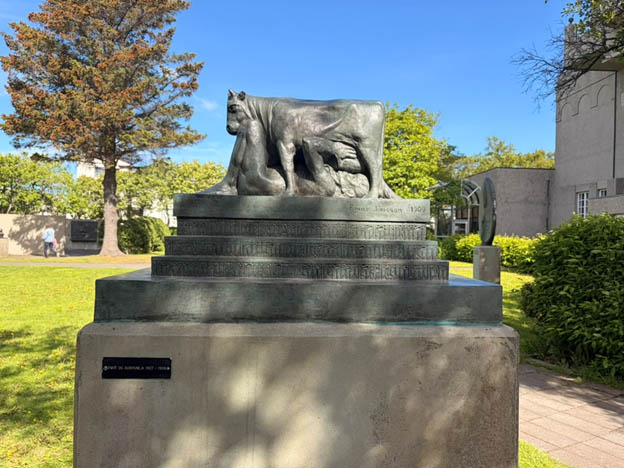
In the 21st century, I felt these old presences very much alive in this land. You feel them in the ocean breeze, the heavy wind, the glaciers layering against the volcanoes, and the miles and miles of open sky.
The city buzzes with music, art, and culture. Reykjavík is a city of art, sculptures, and colorful houses.
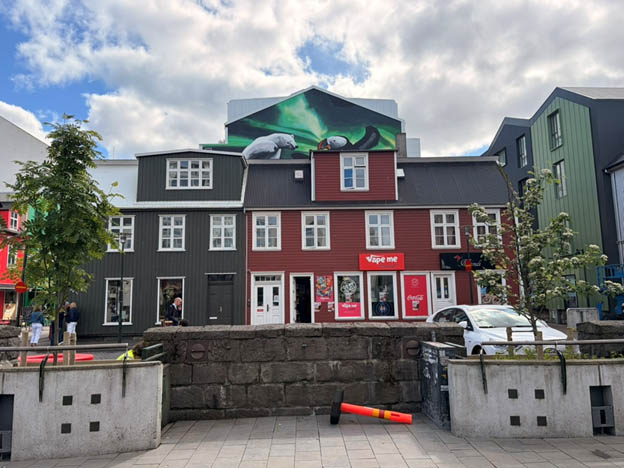

In the main city center, one street, Skólavörðustígur, is permanently painted in rainbow colors, originally to celebrate Pride Day in 2015 and now a permanent feature. What a beautiful idea. Nearby stands Harpa, the city's modern glass concert hall.
Hallgrímskirkja Curch: The Landmark of Reykjavik
You cannot miss the Hallgrímskirkja church. From almost anywhere in the city, its 74.5-meter tower is visible, its stepped concrete sides modeled on the basalt columns found in Icelandic lava formations. Designed by state architect Guðjón Samúelsson in 1937, the church took roughly four decades to complete. The facade has rows of narrow concrete columns fanning out from the central tower, giving it both an angular, modern look and the shape of a natural rock formation.
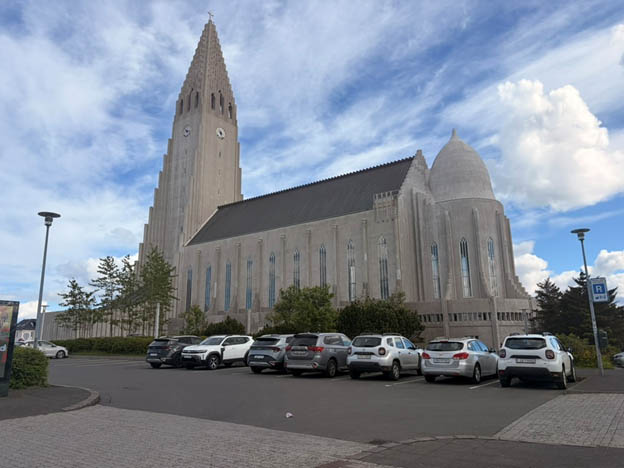
The entrance is also worth a look: dark doors flanked by carved panels, with a tall, narrow window rising above them. Inside, the nave is long, white, and plain, leading the eye toward the large pipe organ on the west wall. The organ was built in 1992 by the German organ builder Johannes Klais and has 5,275 pipes.
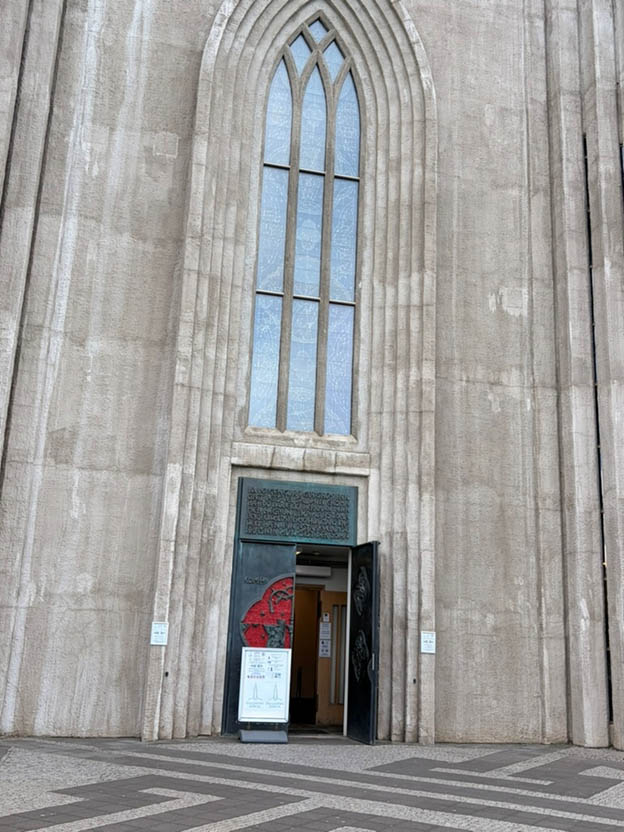
Tour
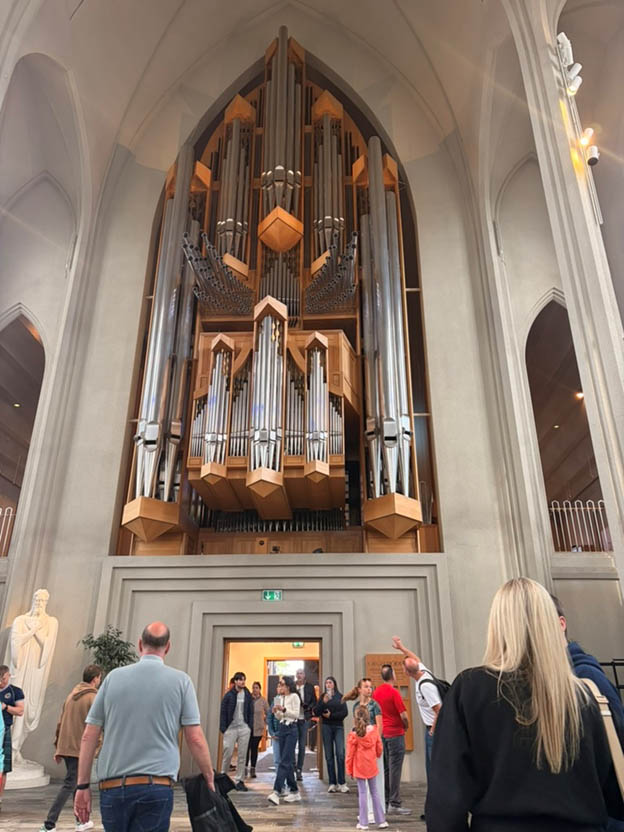
Tourism, Rule, and Independence
Tourism is now the country's main source of income, drawing roughly two million visitors a year, mainly from the United States, the United Kingdom, and Germany. Fishing has historically been the other major economic pillar. As a fish-loving Odia, I enjoyed Icelandic cod, Arctic char, and monkfish. Different species of whales, namely Orca, Mink, and Fin, among others, and puffins are both sensitive to ocean changes, including warming and rising acidity, which affect the food supply of krill and other small fish like capelin. Fin whales are mainly exported to Japan for huge profit and are listed as endangered.
Iceland's fishing history, tied to its political history, runs through Norway and Denmark, with brief periods of British and American military presence during the Second World War rather than formal rule. Iceland came under Norwegian rule in 1262. When the Norwegian and Danish crowns were united in 1380, Iceland passed into the Danish realm along with Norway. The Lutheran Reformation reached Iceland in the 16th century, imposed by royal decree under the Danish crown; today, around 92 percent of Icelanders are nominally Lutheran.
The 15th century is sometimes called "the English Century" in Icelandic history, a period of English fishing fleets and coastal trade, followed by growing Hanseatic trade from Germany. Danish control tightened in the centuries that followed, including a long royal trade monopoly. During the Second World War, when Denmark itself was under Nazi occupation and unable to govern its distant territory, Iceland took the opportunity to move toward full independence.
June 17th is celebrated as Independence Day, marking the founding of the Republic of Iceland in 1944. I feel fortunate to be part of the celebration this year. U.S. military forces remained in Iceland until 1947, and later returned under a 1951 bilateral defense agreement that lasted until 2006. Icelanders credit the U.S. presence with several lasting contributions, including the country's ring road and international airport, as well as other developments in communication and transportation.
An Expensive, Happy Country
Iceland is one of the most expensive countries one can imagine. Here, a small pizza can cost about $40, and a simple meal at least $40. The cheapest thing, by contrast, is electricity, produced almost entirely from geothermal and hydropower. The water, drawn straight from glacial sources, tastes extraordinary. The country is well known for its swimming pool culture and the geothermal hot springs found all around it: nearly every town, however small, has its own heated public pool, and Icelanders of every age treat a soak as a daily ritual rather than an occasional indulgence — a social institution as much as a recreational one. People socialize in swimming pools the way others might at a café or a park; our guide mentioned that there are some 128 local pools with hot tubs in and around Reykjavík alone.
Wild and Unbothered
What struck me most, though, was how at ease the animals seemed everywhere I went. Sheep and the sturdy, relaxed Icelandic horses graze freely across the open countryside, loosely fenced if at all, and seem unbothered by passing traffic or tourists with cameras.
On a whale-watching and puffin-watching tour, I saw puffins guarding their eggs on the cliff side and humpback whales surfacing and diving in the open ocean nearby. I also learned that Arctic terns, which nest in the open on beaches and grassy fields rather than in trees, fiercely defend their eggs and chicks, diving at anyone, human or otherwise, who comes too close to their nest.


We missed the famous northern lights, since there is almost round-the-clock daylight in the summer — a different charm of its own, a memorable one all the same.
One asks why Iceland is consistently ranked among the world's happiest countries. I would say: nature in abundance, a sense of equanimity among people, and a strong social fabric. Even the prime minister's and the president's offices have minimal visible security, and the person standing next to you in the grocery store could be a national leader. Our tour guide gave us a small quiz along these lines: could we guess the only place in the country that has visible security? While we were still guessing, he answered it himself — the American Embassy.


A Conference Well Hosted
The ISFNR conference itself went well. Our hosts from the University of Iceland made sure we experienced the country's cultural institutions alongside the academic program, organizing visits to the National Museum, the Art Museum, and The Edda, home to the Árni Magnússon Institute's manuscript exhibition, among others, and hosting both a reception and a farewell party at these venues. It was a generous way to send us off — a job well done.
Now I realize that if I had not come to this country, I would have missed out on what this tiny little island has to offer in terms of its rich folklore, geological formation, and culture — a true combination of fire and ice.

Annapurna Pandey is a cultural anthropologist at the University of California, Santa Cruz. Originally from Cuttack, Odisha, she moved to Santa Cruz, California in 1989. She is a travel enthusiast and loves to write travelogues highlighting her exotic experiences in different parts of the world.
KAILASH CALLED US
Upali Aparajita
A Spiritual Pilgrimage to Mount Kailash and Lake Mansarovar
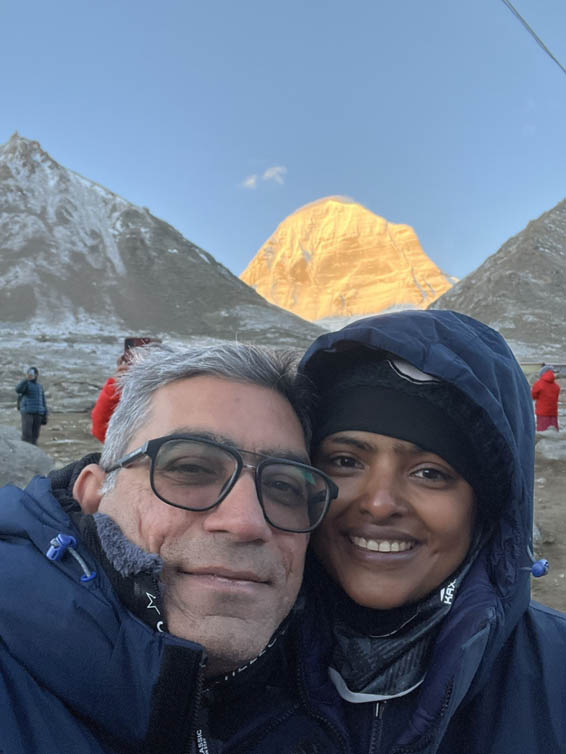
Golden Darshan of Mount Kailash at Dirapuk - a blessing beyond words.
The Route of the Yatra
28 May to 7 June 2026: Delhi - Kathmandu - Syabrubesi - Gyirong - Saga - Lake Mansarovar - Darchen - Dirapuk - Darchen - Saga - Kathmandu - Delhi.
|
Day |
Route |
Key Experience |
|
Day 1 - 28 May |
Delhi to Kathmandu, then drive to Syabrubesi |
The journey begins; straight into the mountains |
|
Day 2 |
Syabrubesi to Gyirong |
Landslide delays and long immigration wait |
|
Day 3 |
Gyirong to Saga |
Entering the vast Tibetan plateau |
|
Day 4 |
Saga to Lake Mansarovar |
First sight of the sacred waters |
|
Day 5 |
Mansarovar to Darchen |
Gateway to Kailash and the Kora |
|
Day 6 |
Darchen to Dirapuk |
First day of Kora; 14 km walk |
|
Day 7 |
Dirapuk to Darchen |
Golden Darshan and return |
|
Day 8 |
Darchen to Saga |
Carrying Kailash within |
|
Day 9 |
Saga to Kathmandu |
Return through immigration |
|
Day 10 |
Kathmandu |
Temple blessings at the end of the trip |
|
Day 11 |
Kathmandu to Delhi |
Homeward bound |
Prologue - When the Mountain Calls
There are journeys we plan, and there are journeys that choose us.
For years, Mount Kailash occupied a sacred place in my heart. Revered by Hindus as the abode of Lord Shiva, by Buddhists as the axis of the universe, by Jains as a place of liberation, and by followers of Bon as a seat of spiritual power, Kailash is not merely a mountain. It is a realm beyond ordinary understanding.
Like countless devotees before us, we had dreamt of standing before the sacred peak and offering our prayers beside the holy waters of Lake Mansarovar. Finally, in May 2026, that dream became reality.
Little did I know that this journey would teach us patience, surrender, gratitude, and above all, faith. For one does not conquer Kailash. One simply receives the blessing of being called
|
Om Namah Shivaya - I bow to Lord Shiva. |
Day 1 - 28 May | Delhi to Kathmandu to Syabrubesi
Our journey began in Delhi, filled with excitement, prayers, nervous energy and blessings from family and friends. The first flight took us to Kathmandu, but this was not the day for sightseeing or temple visits. The yatra had already begun, and after landing we moved straight into the mountains.
As we left Kathmandu behind and drove towards Syabrubesi, the city slowly gave way to green hills, rivers and winding mountain roads. There was something symbolic about that first day. We were leaving the familiar world behind and entering a different rhythm - the rhythm of the Himalayas.
The road was long, the body was tired, but the heart was alert. Every bend in the road felt like a step closer to something sacred. By the time we reached Syabrubesi, the pilgrimage had truly begun.
A chance meeting with a Tibetan monk at Delhi Airport - a quiet blessing before the yatra began.
Day 2 | Syabrubesi to Gyirong - Lessons in Patience
The Himalayas teach humility very quickly. Nature decides the schedule, not us.
On the second day, our drive from Syabrubesi to Gyirong was interrupted by landslides. What should have been a difficult but straightforward mountain crossing became a long test of patience, with almost four hours lost waiting for the road to clear.
Then came the border and immigration. The process took nearly nine hours. It was tiring, confusing and at times frustrating. Everyone was exhausted, yet strangely, this was also the day when strangers began becoming fellow yatris. People shared food, stories and words of encouragement. Laughter appeared in unexpected places.
By the time we finally entered Tibet and reached Gyirong, we were completely drained. But the first lesson of Kailash had already arrived: patience is not optional on a pilgrimage. It is part of the path.
|
Faith leads to wisdom. - Bhagavad Gita |
Day 3 | Gyirong to Saga - Entering Another World
From Gyirong to Saga, the world began to change. The lush green valleys slowly gave way to the wide, open landscapes of Tibet.
The sky seemed larger here. The silence felt deeper. Snow-capped mountains appeared in the distance, wild animals grazed beside the road, and the vast plateau stretched endlessly around us. There were long stretches where there was nothing but earth, sky, wind and prayer.
Some journeys are beautiful because of what they show you. This one was beautiful because of what it slowly removed - noise, urgency, distraction, and the illusion that we are in control.
Somewhere beyond those distant peaks stood Kailash. We could not see it yet, but we could feel ourselves moving closer.
Life on the Tibetan plateau - simple, silent and resilient.
Day 4 | Saga to Lake Mansarovar - The Sacred Waters
Nothing can truly prepare you for the first sight of Lake Mansarovar.
At an altitude of over 15,000 feet, the lake appeared like a mirror placed between earth and heaven. Its blue waters shimmered beneath the vast Tibetan sky, with snow-covered mountains standing silently in the distance.
Many pilgrims became quiet. Some chanted. Some folded their hands. Some simply stood still, unable to speak. Mansarovar is not just seen with the eyes. It is felt somewhere much deeper.
For centuries, saints and seekers have believed that a single drop of Mansarovar purifies lifetimes of karma. Standing beside those sacred waters, I understood why. There are moments when words become too small. This was one of them.
At Lake Mansarovar - sacred waters, open sky and the stillness of prayer.
Mount Kailash seen across the waters of Mansarovar.
|
May all sacred rivers be present in these waters. |
Rakshastal - stark, beautiful and mysterious beside the sacred Mansarovar region.
Prayer flags carrying countless prayers into the wind.
Day 5 | Mansarovar to Darchen - Gateway to Kailash
Darchen is not just a town. It is the gateway to the Kora, the sacred circumambulation of Mount Kailash.
By this stage, excitement had turned into anticipation. The mountain was near. The questions in our minds were simple but heavy: Would we have the strength? Would the altitude affect us? Would the weather allow clear darshan? Would Lord Shiva bless us?
That day, we saw Kailash from Darchen and also came close to the Southwest Face. The mountain looked powerful, unapproachable and deeply peaceful at the same time.
As night fell, everyone prepared quietly. Bags were checked, warm layers were arranged, walking sticks were kept ready. Sleep came slowly. The Kora would begin the next morning.
First views of Kailash from Darchen - the anticipation before the Kora.
At the Southwest Face of Kailash - joy, gratitude and disbelief at being so close.
Day 6 | Darchen to Dirapuk - Walking with Faith
The first day of the Kora was a walk of faith.
From Darchen to Dirapuk, we walked approximately 14 kilometres. The distance may not sound impossible, but at that altitude, with cold winds and thin air, every step demanded respect. The walk took around eight hours, with nearly two more hours of delay along the way.
There were moments when the body became tired. There were moments when breathing felt harder than usual. But the mind kept returning to one thought: we had been called here, and we would walk with faith.
Along the route, horses, porters and fellow pilgrims moved slowly through the rocky terrain. Nobody was in a hurry. Kailash does not allow hurry. It asks you to slow down, breathe, surrender and continue.
And then, as we approached Dirapuk, the North Face of Mount Kailash revealed itself. Majestic. Silent. Timeless.
Standing there, every hardship faded. The mountain did not need to speak. Its silence said everything.
Horses and helpers on the rugged trail to Dirapuk.
Near Dirapuk - prayer flags, stone paths and the sacred presence of Kailash.
|
I bow before the Lord of Kailash. |
Day 7 | Dirapuk to Darchen - The Golden Darshan
Before sunrise at Dirapuk, pilgrims quietly stepped outside into the cold. The air was sharp, the ground was frozen, and the sky was slowly beginning to soften.
Then came the miracle.
As the first rays of the sun touched the North Face of Mount Kailash, the mountain transformed into gold. The sacred peak glowed as if lit from within. For a few magical moments, heaven seemed to descend upon earth.
We stood there in silence. There was no need to speak. How could words describe such beauty? Some moments are not meant to be explained. They are meant to be received.
That Golden Darshan became one of the most powerful memories of the entire yatra. It felt like a blessing, a confirmation, a silent embrace from the divine.
Later, as we began our return from Dirapuk to Darchen, the body was tired but the heart was full. We were no longer simply walking back. We were carrying Kailash within us.
Golden Kailash - the unforgettable sunrise blessing at Dirapuk.
Very fortunate to receive the Golden Darshan of Kailash.
|
I am Shiva, I am Divine. |
Day 8 | Darchen to Saga - Carrying Kailash Within
Leaving Kailash was not easy.
As we drove away from Darchen towards Saga, the landscape moved past us quietly. The same mountains, the same sky, the same vastness - but something inside us had changed.
There was less conversation that day. Not because we were unhappy, but because the journey had moved inward. Kailash had quietened something within us.
We had seen the sacred peak. We had walked under its gaze. We had received the golden dawn. Now the pilgrimage was no longer outside; it had become a memory, a prayer and a presence within.

A small restaurant on the way back - simple joy after the sacred journey.
Day 9 | Saga to Kathmandu - Returning to the World
The journey from Saga back to Kathmandu was long, and once again immigration tested our patience with a delay of around three hours.
But this time, something was different. The impatience of the early days had softened. We had learned acceptance. We had learned that waiting, too, can be part of the pilgrimage.
As we crossed back into Nepal and returned to Kathmandu, civilization suddenly felt noisy again. Roads, lights, shops, people, conversations - the world had not changed, but we had.
Kailash had given us silence, and that silence came back with us.
Day 10 | Kathmandu - Temple Blessings at the End of the Yatra
Our temple visits in Kathmandu came at the end of the trip, after the Kailash and Mansarovar yatra had been completed. That made them feel even more meaningful.
At Pashupatinath, Lord Shiva welcomed us once again. After having seen Kailash, the temple felt different. The same devotion, the same chants, the same sacred atmosphere - but now there was a deeper connection.
We visited Bhaleshwar Mahadev, experienced the divine atmosphere of Sleeping Vishnu, and offered our gratitude for the safe completion of the pilgrimage. These temple visits felt like a closing circle. The yatra had begun with faith and ended with blessings.
Perhaps this was Shiva's way of saying goodbye. Or perhaps He was reminding us that Kailash is not only in Tibet. Kailash also lives within the heart.
At Pashupatinath Temple with our guide and fellow yatris - gratitude at the end of the journey.
Pashupatinath Temple - offering thanks after the Kailash Yatra.
Sleeping Vishnu - a serene final blessing in Kathmandu.
Bhaleshwar Mahadev - temple blessings in Kathmandu.
Chandragiri cable car - mist, mountains and a gentle return to the world.

Chandragiri Hills - joy after the completion of the pilgrimage.
Day 11 | Kathmandu to Delhi - Homeward Bound
As our flight left Kathmandu for Delhi, we looked down one final time at the land of mountains and temples.
Eleven days. Thousands of kilometres. Landslides, immigration delays, long drives, thin air, sacred waters, prayer flags, snowfall, fatigue, silence, and the Golden Darshan of Kailash.
People often ask, "Did you complete Kailash?"
The truth is, no one completes Kailash. Kailash completes us.
A moment of devotion and celebration in Kathmandu before returning home.
Epilogue - The Mountain Remains
Months may pass. Photographs may be shared. Videos may be edited. Life may return to its usual rhythm.
Yet sometimes, in moments of silence, I still find myself standing beside the sacred waters of Mansarovar. I still see the golden rays of dawn touching Mount Kailash. I still hear prayer flags dancing in the wind. I still feel the presence of something eternal.
Kailash is not a destination that ends when the journey ends. It stays with you. It changes the way you remember, the way you pray, and the way you understand surrender.
Some journeys are not vacations. They are blessings.
And somewhere beneath those eternal snows, Lord Shiva remains - silent, timeless and waiting for those whom He chooses to call.
|
Mahamrityunjaya Mantra - a prayer for liberation, healing and grace.
|
|
Because some journeys are not vacations. They are blessings. |

I am Upali Aparajita, a writer, yoga educator, and wellness practitioner based in Singapore, originally from Odisha, India.
I hold a bachelor degree in electrical Engg and an MBA from Singapore.
After a career spanning banking and international marketing, I transitioned to the wellness industry in 2017 and now I teach yoga both in-person and online. My interests include art, dance, fitness, trekking, mindfulness, and creative writing. Drawing from my diverse life experiences, my writing explores themes of identity, transformation, inner growth, and human connection.
Ms Summer, an American citizen, who came to India as part of an ‘exchange visitor’ program is about to return to her homeland tomorrow with ‘Mazha,’ a kitten she adopted from Kerala. The little animal who ran into Summer’s car on a rainy day was quick to win the tourist’s heart. If you believe in luck, you might feel jealous about Mazha. All the relevant documents required to take Mazha abroad including fitness certificate from Govt. Veterinary Hospital are ready with Summer. The chipping too had been done. In future, the once-stray animal of Kerala might become a permanent green-card holder, who knows !!
A 40,000 rupees worth health insurance coverage, 24/7 supply of milk to drink, a luxurious accommodation to stay and a cozy bed to sleep- thus runs the list of facilities that are beckoning Mazha. And the real icing on the cake- she can accompany Summer to any destination she goes. I guess, the kitten could not have asked for more ! A life that could have been wasted roaming around the National Highways of Kerala, a life that could have ended under the wheels of some state-car rashly driven by the driver of some privileged Malayali politician, has changed drastically.
While reading about this ‘wonder-cat’ as a full-page news story in Metro Manorama, I was reminded of Rajeswari, a friend of mine whose life was changed drastically because of USA, the dreamland of many a Malayalee youth. We have heard of teenagers in wealthy families migrating to US for higher studies, and also IT professionals who are sent there to work on projects and/or process-related trainings. However, Rajeswari’s US tale belonged to neither category. My story is about her, the middle-class family born girl hailing from Thiruvananthapuram, who had to fly to USA.
Hers was a family that comprised of parents and three daughters. Father is a not-so -successful ‘gulf-returned’ Malayalee who later became neck-deep in debts because of his flopped business ventures. Now, he stays at a rented apartment. A handful of foreign objects purchased from the Middle East and three daughters are his only assets in life. Alcohol consumption has been a source of comfort for him for quite some time now. His second daughter Rajeswari studies well when compared to the other two. The youngest one failed in her tenth grade twice and decided to call it quits. The eldest daughter was an average student. The way the ex-NRI ran his poverty-struck family spending each penny with extreme care, was no different from how an average drunkard in Kerala made both ends meet.
Overcoming all adverse circumstances, our heroine Rajeswari has managed to become the proud holder of M Sc and B Ed degrees. Less equipped financially to ‘buy’ a teacher’s job in govt schools, and wary of the ‘tiring duties with less pay’ situation at private schools, she was well aware that a low salary is never going to be enough for a five-member-family to survive. It was at that time the family had to face a severe tragedy. Rajeswari’s younger sister fell in love and eloped with a customs officer in the neighbourhood. Post this incident, the grief-stricken family started distancing themselves from the society out of shame.
A distant relative of Rajeswari’s mother is settled in USA. The 50 year old lady had already written several times to that relative seeking help. Due to her mother’s constant pressurizing, Rajeswari attained through this relative, a fellowship in an American university to do research. Thus, at the age of 23, the girl who never crossed the borders of Lord Padmanabhan’s soil (T’puram) till then, flew to USA with her degree certificates just like boys fly to the Middle East in search of a living. She completed her studies in USA and successfully attained a job there.
Eight years passed. The responsible family-oriented Rajeswari saved each and every dollar she earned in US and sent it home. She thus managed to get her elder sister married. The hard-earned dollars helped Rajeswari’s family buy a house in T’puram. At the age of 31 when she came home for vacation, her parents got her married to a suitable bride-groom. Within three months, she was able to get a job ready for her husband in USA and take him there.
Many a reader would have expected a happy ending there. But as the proverb goes- man proposes, God disposes. Rajeswari lost her husband in an accident as her six-month-long family life met with an unfortunate premature end. Her parents flew to US to console her and stayed with her there for a year. They tried hard to convince her about a second marriage before coming home.
Upon return, they witnessed the comeback of Rajeswari’s sister who eloped a decade ago. They were not able to recognize her because of her malnourished beggar-like appearance. She had two kids as well. The parents were in for further shock when they learned from her that the so-called ‘customs officer’ whom she eloped with was not somebody whom he actually claimed to be before marriage. In reality, he was a servant at the customs officers’ quarters. The officers used to give him their uniforms for washing. This guy used to wear that and supply foreign cosmetics to Rajeswari’s sister. Faking the identity of a customs officer, he lured her into believing him. After the thrill and excitement of a love affair died down, he ended the relationship and became untraceable. A relative hailing from T’puram met her at Kozhikode when she was living there independently. The relative told her, “Your sister Rajeswari has managed to save your family. They are financially well settled now. You better go home, apologize to parents for your mistakes and beg them to accommodate you at least as a maid servant there.” The deepest of the wounds are healed by time. The parents were too soft-hearted to not forgive their daughter. They accepted her and the two kids.
Within a few days, Rajeswari’s drunkard father passed away. After that, Rajeswari’s mother did not bother to pressurize her for a second marriage. Two kids well below the age of 10 to be brought up, an illiterate daughter (the kids’ mother) who won’t be able to find a decent job for sure- these were the immediate thoughts that flashed across the old lady’s mind. Rajeswari thus decided to step forward, take the responsibility of supporting these kids financially and returned to USA. She bore all their day to day expenses until their marriage was over.
Today, Rajeswari is 50 years old. She ended her family support mission from USA (something she started at the age of 23) finally and returned home with all the wealth she accumulated from her ‘foreign’ life. Her mother had passed away years ago. Rajeswari’s younger sister is currently enjoying a wealthy life; thanks to Rajeswari’s efforts. In the meanwhile, her husband, the fake customs officer made a timely entry into the scene just before daughters’ marriage and patched up with the family knowing that he can live lavishly free of all responsibilities with Rajeswari’s money. The house Rajeswari funded for years with her blood, sweat and tears shed in USA, was virtually stolen by the parasitic couple.
Today, Rajeswari lives all alone in another small house where she spend days and nights thinking about her American past. Being a green card holder and a pensioner, the doors of US are still open for her. But she was dejected that the same snakes (relatives) whom she fed for years with milk, spewed the venom of selfishness on her. Aaraattu, Attukal Pongala and other T’puram-specific festivals were something which she had to sacrifice for 22 years to fund her family. “I will spend the rest of my life in my homeland, bow down before Lord Padmanabhan, and finally die here,” decided Rajeswari.
To sum up, it will be foolish and too early for Mazha, the cat to feel lucky to win an American trip. “Don’t forget who you are and where you came from once you reach USA. Count your blessings always and live happily there with your guardian Summer.” This is a humble advice that can be given to the animal. Had Rajeswari been selfish enough to not care about her relatives, had she got married to a school teacher or a college lecturer, she could have lead a peaceful family life today. Fate ! What else to blame it all on ? To the cat that is currently on cloud nine thinking about leading a happy life in USA, somebody like Rajeswari might want to say, “As Narayanan, the character played by actor Innocent in movie Ishtam rightly puts it through, I am somebody who failed to build a life of my own because of USA. I wish the future doesn’t hold anything similar for you my dear kitten!”
A purely imaginative story written by,
Mary Josey Malayil,
Thiruvananthapuram.

Mary Josey Malayil, a native of Thiruvananthapuram, Kerala, is a talented writer with a rich family legacy. As the second daughter of T. R. Johny, retired Chief Engineer of the Kerala State Electricity Board, and the late Rosily Chirayath, sister of the renowned actor C. I. Paul, Mary was born on June 22, 1964. Her primary education spanned various locations, including Pallam, Palakkad, Thrissur, and Thiruvananthapuram, before earning her B. Com degree from All Saints College, Thiruvananthapuram, in 1985. She then moved to Alappuzha, joining the esteemed Catholic family of Malayil Thomas, Senior Manager at SBT, as his daughter-in-law. Mary is married to Josey Thomas Malayil, a skilled cartoonist and medical illustrator, and they have a son, Thomas Josey Malayil, who works in corporate communications at Technopark, Thiruvananthapuram. During the lockdown, Mary discovered her passion for writing, driven by a desire to overcome boredom. Since then, she has contributed stories to numerous esteemed publications, including Karmabhumi, Arsha Bhoomi, Malayala Manorama Online, KSEB Pension Bulletin, Keralathanima, Malayalam Rachanakal Online, Koottaksharangal, Ima, and Malayil Varthapatrika. She gratefully acknowledges Raju Shankarathil, Chief Editor of Malayali Manassu in Philadelphia, for his mentorship and support, which led to her appointment as an editorial board member. Mary draws inspiration from her maternal uncles C. I. Paul (late) and C. I. Joy, brother T. J. Raphael (former General Manager of South Indian Bank), sister and fellow writer, Rita Manuel, and Mary’s online community, including Nirmala Ambatt, Chief Admin of the ‘Samskruthi Facebook Writing Group’ and ‘Arsha Bharati’. Surrounded by a rich storytelling heritage, Mary continues to contribute to the world of literature. She currently resides in Thiruvananthapuram with her family, where she weaves her own unique literature.
BLOWS FROM THE PAST
Mani Menon
Doreen Garnier parked her car at the curb side and, carrying her many shopping bags, walked to the front door of her house in the pleasant neighborhood of suburban Edgewood and rang the doorbell. While waiting for her husband Antony to open the door, she gazed lovingly at the neatly mowed lawn and flowering shrubs in myriad brilliant colors. She could hear a movie going on on her TV. Antony must be totally engrossed in the movie, she decided, and using her own key, opened the door and stepped into the bright, airy living room. She looked at the large TV screen just in time to realize that Antony was watching Alfred Hitchcock’s ‘Psycho’ and Janet Leigh was in the shower. Doreen looked away as she didn’t have the stomach for gory scenes. It was then she noticed that her husband was not in his favorite couch but sprawled on the ground! His grey shirt had turned deep red and his face was coated with his blood!
Doreen screamed just as Janet Leigh began screaming in the shower! The shopping bags slipped from her hands and she ran out howling “My God! He has been killed!!!” Two of her neighbors called the cops and rushed over to calm her down. In a few minutes a patrol car screeched to a halt and two cops stepped out and walked briskly to Doreen. “Antony has been killed!” she blurted out, indicating the wide open door. “Stay here…” one of the cops said calmly and they entered the large living room. One of them, checked for signs of life and murmured “He’s gone…” to his older partner. A minute later, an ambulance arrived to take the dead man away. Doreen was beside herself with shock and grief. The two cops stayed back to make notes of the murder scene. It was very obvious the man had put up a quite a fight before he was killed. He must have been in his sixties, tall and big built with a slight paunch. His blue eyes were wide open with pain and horror. He had been bludgeoned on his head and his face repeatedly by his killer. The cops jotted down whatever they could see. It was obvious burglary had certainly not been the motive. “Someone was very crazed with blind rage”, observed Juan Hortez, the elder officer and Brad Carter, his younger partner nodded in agreement. They got along very well though they shared nothing in common except their job. Juan Hortez was a tall slim man in his mid-forties, happily married and with three kids. Brad Carter on the other hand, was a shorter, heavy built man in his early twenties and was unmarried. He lived in a beautiful little house and often had women friends spending their nights there. Brad’s passion, apart from his profession, was carpentry. Most of the furniture in the Precinct House was made by him!
While the forensic department’s technicians got busy dusting for fingerprints, Juan Hortez and Brad Carter went about the unpleasant task of interviewing the victim’s wife who was, frankly, in no condition to answer questions. A few neighbors helpfully filled in the blanks by providing details about Antony and Doreen Garnier. Both were in their late sixties. Their son lived in Minnesota while their daughter’s whereabouts were unknown ever since she had left home years ago. Both, Antony and Doreen, had retired as doctors; he as a respected Psychologist while she was a well-known Physician. They had opted for early retirement and had decided to settle down in this quiet safe neighborhood. Both were deeply religious and were involved in social activities. Being a prosperous locality, this suburb had also attracted the attention of burglars and drug dealers and other lowlife. Antony counseled the church congregation against drug abuse. This had earned him a few foes among the drug dealers who perceived him as a threat to their very livelihood. Some of the neighbors told the two cops about a couple of confrontations the drug dealers had had with Antony Garnier.
Armed with this piece of information, Juan Hortez and Brad Carter returned to their Precinct and got busy with their Sergeant, organizing the rounding up all the usual suspects. And there were quite a lot too! Intense grilling got the cops nowhere as the dealers provided iron clad alibis. Almost all confessed that they’d have just loved to bump Antony Garnier off as he was a big time hindrance to their business. They were let off, though some of the cops there would’ve loved nothing more than killing them personally. Very slowly.
The next day, an elderly woman walked into the Precinct House and what she had to say, got everyone’s attention. She claimed that a few minutes after Doreen Garnier had gone shopping, she saw a man walk down the street and ring their doorbell. When asked to describe this man, she couldn’t offer much as she hadn’t had a good look at him. She did say that he was wearing an old tattered trench coat and walked with a shuffle. She looked at all the cops standing around and pointed at Brad Carter. “He was the same height as this police officer.” She added a bit coquettishly, “Though not as smart and handsome as he is” Brad blushed.
The cops began looking for such a man but met with no success. They still felt a drug dealer was somehow involved in the brutal killing.
Antony Garnier’s funeral was held with doctors and nurses from the hospital in full attendance. Almost everyone who lived in the Garniers’ neighborhood was present. Their son, Mark, had flown in from Minnesota. Juan Hortez and Brad Carter stood with the people, carefully studying their faces and expressions.
Events leading to the brutal murder of Antony Garnier were set in motion six months ago……
He watched his mother as she prepared breakfast. Being a single mother had taken its toll on her but that hadn’t stopped her from giving her son a good education. He, in turn, had excelled in studies and sports and with the help of scholarships, had seen to it that his mother never had to spend any more money on him. The question ‘Who is my father?” was taboo and his mother would give a sad smile and say softly, “You needn’t know, dear. So much water under the bridge” He stopped asking. One morning, six months ago, she collapsed as she was preparing breakfast. By the time the ambulance could arrive, it was too late.
Not wishing to spend time in an empty house, he expended all his time and energy in his work. A month ago, he decided to give his mother’s good dresses and shoes to charity. As he was clearing her closet he noticed a cardboard box that was far larger than a conventional shoe box. Placing it aside, he busied himself folding her dresses and placing them in a suitcase. Her shoes went into another box. Driving to town, he dropped them off at a charity store.
Late that night, he opened that cardboard box. There were photographs of his mother as a young beautiful woman in a nurse’s uniform. And many of her carrying her infant son. Her smile in these snaps were tinged with sadness. Then came the thick bunch of letters tied with a pink satin ribbon. Feeling very guilty, he untied the bow. They were all letters from a person named ‘Tony’. As he read the letters, he discovered that this Tony had been the cause of all the troubles his mother had had to endure. Tony had left this young nurse pregnant and had got married to a doctor from the same hospital. His mother had refused to go in for an abortion. The last letter from Tony was an abrupt and cold goodbye and he’d made it clear that she was never to bother him again. Then came the newspaper cuttings and clippings from magazines. His hands shook as he recognized the man called ‘Tony’! “You bastard! It was you?!” He went through other newspaper cuttings to make sure he wasn’t making a mistake. He wasn’t. The final one was a photograph of Tony and his bride emerging from church. “Oh my poor mom!” he had wept.
From the next day onward, whenever time permitted, he began trailing Tony. On that particular day, he had seen Tony’s wife drive off in her car. He wore an old trench coat and walked with a shuffle to the front door and rang the doorbell. Antony Garnier opened the door. Smiling, he asked, “What do you want?’’. The intruder pushed him in. Antony stumbled and landed awkwardly on the couch. He watched the man take out a hammer from his trench coat. Antony tried to get up and he said, “You can take the money in that wallet” indicating a table on which were a wallet, a wristwatch and some jewelry. The hammer rose and fell with deadly precision on Antony’s head and face! Again and again. There was an explosion of blood. The intruder identified the movie on the TV as ‘Psycho’. He wiped the hammer on Antony’s shirt and stepping out of the front door, locked it shut behind him.
In the early hours of the next morning, he drove his car to the shores of the lake a few miles away from town. It was still dark. He sat in the car and scanned the area with his binoculars. There was not a soul in sight. He walked to the water’s edge, carrying the hammer wrapped in a sheet of plastic. With all his might, he swung the hammer into the air. Describing a huge arc, it fell into the icy water a good distance away with barely a splash.
As he drove home, Brad Carter reminded himself to buy a new hammer………
Mani Menon worked in Mumbai and presently lives in Chennai. Three of his books have been published and are available on Amazon and Flipkart:
1.SUMMERS IN THE PAST TENSE
2. MATHS MASTI AND MOVIES
3. ANPEKSHIT
Besides writing, his hobbies are Sketching----Pen n Ink---- and Cooking and listening to music for a mellow mood.
LIVING WITH GUILT
T. V. Sreekumar

Living with guilt is the biggest punishment one faces in life. It is pain of the worst kind which the mind and body face and the torture is unbearable. The crime may not intentional and the decision taken considering the pros and cons at that point of time might have appeared right. When life moves with the good and the bad in various mixtures, the so-called crime takes a back seat, surfacing in its wild form at a later date with vengeance.
Having only one child was our common decision after marriage which our moderate income could support and life was happy and content. We could provide for the best within our means for the child and life flowed smoothly with our single-child decision standing strong. It so happened that one day wife told me in confidence that she missed her periods.
I was shocked, stared at her in disbelief and said,
“It can be due to other factors. Let us get it tested within a week”
It was done and the result stared at me - “Positive”
No second thoughts or discussions.
“Let us get the abortion done as early as possible,” I said.
Looking back, the guilt lashes me, as the decision was unilateral. My partner had no say in it at that time and her shock, mental trauma and the sorrowful looks still follow me, haunt me.
At that time my only thought was whether we had the means to have a bigger family and it was a big NO. Decision-making at a young age is easy as it is without much thought or sentiments. It is fast, strong and determined. Like an obliging partner she stood by me supressing all her inner feelings.
That she was carrying a life in her and I was the culprit which killed it never flashed in my mind seriously. It was something to be eliminated for the sake of the family. There was no space for another one and the decision was firm. There were people out there craving to have a child and undergoing long, expensive treatments followed by spiritual offerings without a positiveresult. One of my friends struggling to have a child for years in spite of no physical or medical problems for either one never even crossed my mind. The needy ones were denied a child and some others, like us, given in excess.
The imbalance of giving and denying was nature's way though it was unjust and cruel.
At the hospital it was all done in a professional way as if it was a daily affair. She was wheeled into the operation theatre and looking back, I realize the trauma she must have gone through. It must have been very painful and the realization dawns on me only now.
Why this repentance, why this grief, why these tears now?
She fell ill at an early age later and was diagnosed with the dreaded disease. Repeated sessions of chemo and radiation and she became physically weak, with her lovely looks fading and the flowing hair falling. I never gave her an opportunity to look into the mirror but she was aware of her changed looks and kept her head always covered. Once at a very painful stage she said, as if to herself,
“All this is for what I have done”
I never realized then what she meant but with time I could decipher her words. Today, with life in its sunset years and many dear and near ones having parted to a different world, thoughts haunt me day and night. Our only child is a big man now, away with a good life of his own. Memories keep me engaged and at times they are pricking and haunting. This act of cruelty which I realize only now, is killing me. I label myself a murderer. A child’s face flashes in my mind and it has a look of grief. I firmly believe it is my unborn child and I plead for mercy for the crime committed out of my selfish interests.
Somehow I feel Mercy will not be given to me.
I am destined to “Live with Guilt”
T. V. Sreekumar is a retired Engineer stationed at Pondicherry with a passion for writing. He was a blogger with Sulekha for over fifteen years and a regular contributor writing under the name SuchisreeSreekumar.
Some of his stories were published in Women's Era. “THE HINDU” had also published some of his writings on its Open Page..
A DEADLY MIX-UP
Ashok Kumar Mishra
Manjari had already made up her mind to celebrate Durga Puja in Rourkela, just as she had every other year. Since her marriage to Ramakanta three decades ago, she had never missed the Puja festival in the steel city. She was steadfast and adamant about not missing it this year, refusing to stay any longer in Mumbai with her daughter, Ananya, and her son-in-law, Manohar. She had already overstayed her visit in Mumbai by a month, even though her initial plan was to stay for only four weeks. She insisted that Manohar book her advance ticket today on his way home from the office.
Since Manjari’s marriage to Ramakanta, Rourkela—its air, water, sky, people, flora, and fauna—had cast a spell over her. The industrial hum of the steel plant, punctuated by the occasional wail of a siren, the hustle and bustle of workmen, and the constant movement on the busy roads day and night always filled her mind with positive vibes and freshness. During the night, when the rising flames from the blast furnace blew upward, covering the night sky with smoke until the stars lost their address, Manjari felt as if hundreds of human dreams were playing hide-and-seek and slowly taking shape. The red-hot sparks of molten magma carried upward and sprayed across the dark night sky, resembling the wavering orange-gold silk robe of Lord Krishna in the sky to her.
The frequent wailing of the steel plant’s siren was a reliable call of challenge to humanity’s resilient and tenacious spirit to move ahead amidst all odds. Here, sturdy iron ore gave up, melted, and flowed, surrendering to human resolve and grit. The rhythmic sound of the moving trains running through the city created a symphony when combined with the din of the town. The movement of workers continued shift after shift; nobody knew when the city ever paused to sleep.
Similarly, when an occasional drizzle or a heavy shower during the rainy season drenched the city amidst thunder and lightning, Manjari used to sit beside her window and enjoy the rhythmic music of the falling raindrops. The rain would clear the night sky, and the intoxicating aroma of drenched soil would rise and fill the air.
Still, Manjari had thoroughly enjoyed her stay with Ananya and Manohar, visiting all the nearby tourist attractions in Mumbai: Marine Drive, Chowpatty, Juhu Beach, the Siddhivinayak Temple, and the Elephanta Caves. Manohar had once taken her to the Churchgate metro station. However, she found the massive crowds and terrifying traffic overwhelming and wanted to escape to her home city at the earliest.
When Manjari had first landed in Rourkela after completing her education in Puri and marrying Ramakanta, she found the scorching summers and harsh winters unbearable. It had taken her several years to adjust. She deeply missed the gentle, humid sea breeze of Puri, which was replaced by the smoky, dust-filled, dry air of Rourkela. Ramakanta used to joke that she might even find the water of the Koel River tasteless simply because it came from her in-laws’ town.
After Ramakanta earned his engineering degree from Rourkela Engineering College and joined the steel plant, the facility became his entire world. Slowly, both Ramakanta and Manjari found life in Rourkela to be very cozy and comfortable, and their small family grew quickly with the arrival of two daughters.
Now, both daughters were married and well-settled. Their elder daughter, Ahalya, and her husband lived in Delhi, where both taught at the Delhi School of Economics. Following the marriage of their younger daughter, Ananya, to Manohar, Ramakanta and Manjari led a solitary life in Rourkela.
“Do not forget to book my advance ticket to Rourkela,” Manjari reminded Manohar as he prepared to leave for the office. “Ramakanta is all alone there and must be finding it difficult. Since your marriage to Ananya two years ago, you have hardly stayed with us for more than a few days. This time, book tickets for you and Ananya along with mine. We can all enjoy Durga Puja in Rourkela together.”
“I will remind you when you are at the office, Manohar. But don’t book my return ticket just yet,” Ananya chimed in. “I want to stay as long as my heart desires, and you can come and fetch me when I call you later.”
“One more thing,” Ananya added. “Don’t forget to bring Banarasi betel leaves for Ma. You know how restless she gets without her paan. Last time you forgot and bought a few from a local shop, but they didn’t last long. Here, only the tiny South Indian variety is available, which isn’t to her liking.” Manohar nodded in agreement.
Manohar was usually very jolly but inherently forgetful. It wasn’t exactly that he was absent-minded; rather, he became too intensely involved in his tasks and forgot about everything else. While playing chess or gossiping with friends, he would forget to eat or sleep. Much to Manjari’s disapproval, Manohar had on several occasions gone to play chess with friends in the evening and only returned home the next morning. In her view, a family man needed to have discipline. She had advised Ananya several times to exert some control over Manohar, warning that bad habits in bad company could ruin family peace.
Ananya always defended him. “He is not like that, Ma. You are unnecessarily thinking negatively about him.” But Ananya knowingly kept it to herself that Manohar occasionally drank liquor with his friends. Even so, she knew Manohar well and had full confidence in him.
Manohar was a native of Chakradharpur in the Jharkhand province, but he and Ananya had studied together in Ranchi. Manohar had lost his father at an early age. His elder brother managed the family transport business and Manohar’s mother lived with him in Chakradharpur. Manohar visited his mother frequently. This time, he planned to drop Ananya off in Rourkela and then proceed to Chakradharpur to spend time with his mother and his brother’s family.
Once the advance tickets were booked and Manohar’s leave was sanctioned, Manjari immediately started preparing for the return trip.
Three days before their journey on the Mumbai-Howrah Mail, Manohar asked Ananya to pack his chessboard in his suitcase. His friend, Bijan Chakrabarty, was traveling to Kolkata on the very same train, though in a different compartment.
“Don’t forget about us and travel all the way to Kolkata playing chess with your friend,” Ananya joked.
Bijan arrived at the platform on time and informed them of a slight delay in the train’s departure. Manjari and Ananya occupied their berths, and Manohar moved over to Bijan’s compartment. Manjari quickly struck up a friendship with a nearby Odia family, while Ananya rested on her berth.
In Bijan’s compartment, the gossip quickly began. Since both men had already eaten dinner at home, they drank tea and analyzed everything from office politics and cricket to national and international events, followed by a game of chess.
The pantry car boy walked down the aisle taking orders for dinner and the next morning’s breakfast from the other passengers. Many had already tucked themselves under their cozy blankets, with only their heads visible like tortoises. The train sped up to make up for the delay. The chess game completely gripped both players, and they continued their session under the reading lights. The Howrah-Mumbai Mail left one station after another behind as the two friends remained engrossed in planning their next moves. Around them, the other passengers drifted off to sleep. After a while, the train crossed Pune station; the friends purchased a packet of bhakarwadi (a special snack from Pune) and kept playing.
Then, Manohar’s phone rang. It was Manjari, inquiring when he would return to their compartment.
“I am going to purchase some oranges for Father at Nagpur, and then I’ll come straight back to our compartment. Don’t worry, just wait for me,” Manohar replied.
An hour later, the Mumbai-Howrah Mail pulled onto platform number two at Nagpur. Saying goodbye to Bijan, Manohar stepped onto the platform to look for oranges but couldn’t find any. Someone suggested that orange packets and boxes were readily available near the exit gate of platform number one. Because the train stopped at Nagpur for fifteen minutes, Manohar figured he had enough time. He ran up the stairs of the footbridge to cross over to platform one and bought a box of oranges. After paying the vendor, he handed the box to a porter, telling him to hurry back to the Mumbai-Howrah Mail waiting at the platform.
The porter rushed ahead, loaded the box into a moving train, received his payment from Manohar, and Manohar raced into the compartment right behind him. Out of breath, Manohar felt a wave of relief that he had made the purchase just in time. Sitting down on an open berth, he decided to rest for a moment, planning to locate his actual compartment during the train’s next scheduled halt.
A co-passenger inquired about the price of the oranges, commenting that the taste of Nagpur oranges had no equal in the country. When the man asked where Manohar’s seat was, Manohar informed him that his wife and mother-in-law were also on the train and that he would rejoin them shortly.
The co-passenger handed Manohar a water bottle. Manohar gulped down some water, thanked him, and asked where the man was heading.
The passenger replied, “I’m going to Mumbai. We’ll be there in the morning.”
Manohar felt the earth shift beneath his feet. He handed back the water bottle, his mind racing as he wondered if he had boarded the wrong train. But when he had stepped on board, he had clearly seen “Howrah-Mumbai Mail” inscribed on the side of the carriage. He had given clear instructions to the porter to load the box onto the Howrah-Mumbai Mail.
Suddenly, the horrible truth dawned on him. When his Up train (the Mumbai-Howrah Mail) was sitting on platform number two, the Down train (the Howrah-Mumbai Mail) had arrived simultaneously on platform number three. Running down the steps from platform number one with the porter, Manohar hadn’t noticed that the porter had guided him to the Down train heading to Mumbai instead of the Up train heading to Howrah. While he was hurtling backward toward Mumbai, Ananya, Manjari, and Bijan were traveling in the exact opposite direction toward Kolkata.
What was he supposed to do in the middle of the night? How could he break the news to Ananya and Manjari? They would be waking up soon, shocked by this terrible mix-up. Pulling the emergency chain to stop the train wouldn’t help. Yet, he had to act fast; with every passing second, the physical distance between them was widening. Finally, he decided to call Ramakanta.
“Hello, Manohar? What’s the matter?” Ramakanta answered his voice thick with sleep. “What made you call me in the middle of the night? I know you’re all reaching Rourkela in the morning, and I’ve already arranged a vehicle to pick you up from the station and drop you at the house.”
“No, I’m not coming. There’s a small problem.”
“A small problem?”
“No… I mean, a massive mix-up.”
“What on earth is the matter? Are you in your senses? Tell me clearly.”
Manohar explained the entire situation. Ramakanta immediately agreed to go to the Rourkela station to pick up Manjari and Ananya in the morning. Meanwhile, Manohar called Bijan, who walked over to Manjari and Ananya’s compartment to explain the chaotic mix-up at Nagpur station.
The next morning, the women disembarked at Rourkela and were met by a relieved Ramakanta. As for Manohar, it was decided that he would disembark at the very next station halt and catch the earliest available train back to Rourkela.
(The End)
(9491213015)
Completed his MA and M Phil in Political studies from JNU and served as Deputy General Manager in NABARD. He made pioneering contribution in building up Self Help Group movement in Odisha and popularized Amrapally mango plantation in the state. He has authored several books and written several articles on micro credit movement. Four tele films were made on his book titled “A Small Step forward”. He served as Director of a bank for over six Years.
An acclaimed Short story writer in Odia and English. His stories are rooted in the soil and have sublime human touch. Many of his short stories in Odia have been published in reputed magazines. His short story collection “Michha jharanara pani” was released recently.
(9491213015)(m)
IF LUCK FAVORS
Dr. Rajamouly Katta
of land and trillions of wealth and so they were unrivalled in the region in having land and riches. Irony was that they were childless. They felt extremely sorry about their issueless plight.
The people were commenting on them, “Somu and Sumati have all, except children…What is that they are enjoying in their life…? Are they happy with their riches and treasures? We don’t think that they are happy.”
Time fled without blessing them well with children. Their cherished dream of having a child of their own was not fulfilled. They had the darshan of gods and goddesses at various places. They performed ‘Yaga’ with all devotion. They waited for the blessings of the divines. One fine day, they started smiling heartily in happiness that knew no bounds.
Somu was seen smiling as never. The people, dear and near, in the region were surprised at the smile on the face of Somu. They were eager to know the reason for his smile. A man who was very close to him was curious to know the secret. He thought that it would be great surprise, a surprise of surprises.
“I hope you have found a gold mine in your agricultural field while plowing,” said his friend to Somu.
Somu smiled and smiled to surprise him highly. The reason was that it was a million-dollar answer Somu was to give.
“We have never seen smile in your face. Now, your face is glittering like stars in multitude in the sky. What happened? Let me know the reason for your charming happiness,” said his friend curiously.
The old man Somu was very happy, but he did not reveal the secret of his happiness soon. He wanted to surprise his friend and all.
“You are not revealing the secret of your joy…. I hope you have won a lottery ticket,” said his friend.
“I am happy…very happy…very happy…I am indeed delighted to reveal the secret of my joy…. My wife became pregnant… She is big with young… the most joyous moment in my life,” said Somu.
“Wonderful news…the most wonderful news… Hearty congratulations to you on the happy occasion…,” said all happily.
Time traversed in joy for Somu and Sumati… After nine months Sumati delivered a female child to fulfil their long-cherished desire. It was the first happy moment in their life as the couple and their faces glowed like the joys of newly bloomed flowers.
The news became everybody’s talk in the region. It was the surprise of all surprises and the wonder of all wonders as Sumati and Somu were blessed with a daughter when they did not expect any issue at the age, they were. Somu was happy like King Janaka who found a box with a baby in it while plowing the field.
On the day of child’s naming ceremony, all in the region were present sharing the pleasures of the couple. They named the baby Divija happily and they felt that she as a goddess had descended from heaven.
“You enjoy bringing up the child with love and affection… When you perform your child Divija’s marriage, don’t send her to the house of her in-laws as a daughter-in-law in her marriage. Instead, you can have your son-in-law, her husband, in your house. It is the best choice of yours,” said all women in one voice.
All clapped and cheered on the happy occasion of the naming ceremony of their child. They expressed their happy views in diverse ways,
“Sumati and Somu are lucky to be blessed with a daughter in the age.”
“God as Creator knows how to bless you as parents.”
“A boy to marry Divija is growing somewhere to become the son-in-law of Somu and Sumati.”
Somu and Sumati were happy because of the advice given by all guests. They hoped to have Divija looking after them in their old age even after her marriage if they keep their son-in-law in their house.
Divija was growing happily and healthily. As parents, Somu and Sumati were very happy in bringing her up with lovely care.
… … … … …
Time passed in the incessant flow for children to grow into youths. They were to enjoy the spring of their youth.
A group of youths were in the mood to conduct a group discussion sitting under a neem tree. They were free to discuss any matter they liked. Suddenly a youth named Sankalp expressed his happiness in reaching his goal by means of his sheer hard work. He said to others,
“Without efforts nothing can be gained…Fruits wait for those who make sincere efforts. My achievement is quintessential for that.”
Some of them supported Sankalp’s view, clapping and congratulating him on his success by means of his hard work. Others were silent by not congratulating him as they were indifferent to his opinion.
“I can achieve anything in a fraction of time if I want. It is my will power… It is my specialty and specificity,” said Dheeraj sportively. His friends clapped supporting his view.
“How come?” said Sankalp.
“Yes, what I say is right…Not only I but also many are coming up overnight without shedding sweat and toiling hard, “said Dheeraj stressing his view.
“What you say is not correct…The achievement that they get is not real achievement,” said Sankalp.
“No… No… You do not know the fact that no efforts are needed to have success…I was irregular to classes. I was not a hardworking student. I did not study well to pass the examination…Just I resorted to malpractice and passed the examination…I know businessmen and political leaders who became rich magnets in a short time without working hard. It is not possible to you as you talk of efforts and hard work to reap success… It is sheer nonsense, you have talked,” said Dheeraj confidently.
His friends supported him as they all got through the examination just by copying. They said they had knacks and tactics of copying in the examination. They said openly feeling credit for their success,
“Luck favors those who know knacks and tactics, gimmicks and tricks.”
Finally, there were two groups, one, Sankalp, supporting one group saying hard work is essential, the other, Dheeraj supporting those who preferred knacks and tactics to have success in false ways.
Sankalp and his supporters tried his best to convince Dheeraj in many ways, but he was never convinced.
Dheeraj kept on referring to his ways, supporting himself. “First, if luck favors, we are surely bestowed success on us. Secondly, we can achieve success by means of tricks and knacks, gimmicks and tactics…No ‘thirdly’… only two ways,” said Dheeraj.
Sankalp hoped that Dheeraj would refer to efforts and hard work to have success in life one fine day.
Sankalp and Dheeraj had confidence in respective ways and so they were not convinced with those of each other. Their topic became debatable and with two groups, their group discussion transformed into a debate.
“Dear friend, I will show I shall come up in life in my own ways well before you come up in life. You become old when you find yourself struggling and working hard to come up. I show many people working hard but they have not witnessed progress… Even then I wish you all success, my friend,” said Dheeraj confidently.
Sankalp felt discouraged but he never deviated from his path. He continued to work hard to reach his goal. He believed in toiling like ants and working hard like bees. He adopted the ideal profession of teaching, keeping rishis of olden golden days in his view.
Dheeraj was seen now and then spending his time idly. He did not mind getting a job like Sankalp. He did some trifles and spent his time. All thought that he would never come up in life.
… … … …
Somu and Sumati were happy to perform marriage of their daughter Divija. They were searching for a suitable match for their lovely daughter. They recalled what the women had said when the naming ceremony of their child was celebrated grandly. They searched for a boy who was ready to come to their house as a son-in-law to live with them lifelong.
In their search, they found only the youth Dheeraj ready to live in their house as son-in-law lifelong. They thought that he was the most suitable youth as he was ready to live with them as son-in-law as per wish.
When Somu and Sumati contacted Dheeraj, he came to visit their house happily. When they expressed their view to him, he readily welcomed their view.
The parents of Dheeraj were also happy keeping in view the treasures: land and trillions of Somu and Sumati.
It was the beautifully decorated venue for the marriage of Divija and Dheeraj. Divija entered the venue amidst the tunes of musical instruments. The priest was chanting matrimonial mantras. Dheeraj joined Divija on the stage with all smiles.
All the guests started to comment on the bride and bridegroom while witnessing their marriage:
“Dheeraj achieved his goal of marrying a girl from a rich family. Now he is the owner of hundreds of acres of land and a lot of riches…Wonderful... If luck favors, one can achieve one’s goal. Dheeraj is happy as he achieved his goal successfully in his own way.”
“Every youth should get a bride with all treasures… There is no youth as lucky as Dheeraj to have all…One shot and two birds…Divija and the riches of her parents.”
“Let him have all but he has to live in the house of in-laws.”
“In-laws are very old…Management of the family will be in the hands of Dheeraj…
How lucky he is…! Really, he is lucky.”
Dheeraj met his friends, Sankalp and others at the venue in the hall. They all congratulated him heartily.
Guests had bountiful banquet…They relished the dishes of multiple variety. They often talked of Dheeraj for his unrivalled luck in finding Divija as his better half. It was the talk of the wedding, echoing in every corner of the function hall.
… … … …
Divija and Dheeraj were on their honeymoon enjoying the sights and sounds in nature and the carving and chiseling of sculptures in famous temples.
Divija and Dheeraj were watching the beauty of nature for their gaiety. The sight they were enjoying first was enchanting with exuberant verdant plants in multitude. The freshly bloomed flowers filled the park with fragrance. Butterflies were hovering round flowers. Birds were singing. In the inspiring beautiful sights with melodies of songbirds, they opened their conversation:
“I congratulate myself on marrying you, a beautiful woman… I hope you congratulate me in the same spirit,” said Dheeraj happily.
“I too congratulate you on the happy occasion…I am happy that you promised to live with us and help my parents in their old age,” said Divija.
“Surely, I help your parents as they made me reach my goal of becoming rich without hard work…It is my long-cherished wish…It came true when I became the owner of acres of land and treasures of wealth… On the happiest moment I congratulate myself… We congratulate each other on my success ... I opened my heart, welcoming you to dwell in it. Like me, you can welcome your heart,” said Dheeraj, smiling heartily.
“Now I am happy to express my views like you…,” said Divija.
“Most welcome, I am ready to listen to your views,” said Dheeraj.
“You may find my views indifferent to your liking… You are the owner of my treasures and wealth for the name’s sake only… Mind it… To all intents and purposes, I am the owner of my land and treasures,” said Divija looking into the sky.
Dheeraj fell into deep thoughts for a while…Finally, he thought that however, he had reached the goal of becoming rich overnight without any hard work and struggle. Meanwhile Divija called Dheeraj touching his shoulders.
“You are to know my feelings… You need to remember one main thing that you should not reveal it to others especially to my friends that you are the owner of your land and riches. Let it be a secret…the secret of secrets…,” said Dheeraj looking at doves on the tree nearby.
There were two doves sitting on a branch and courting in love. It was a sight clearly visible to them as newly married couple. They sang their first duet, dancing in grace. They went further to visit the beauty of carving and chiseling of sculptures in happy moods. After their honeymoon, they came back home.
One day Dhreeraj met Sankalp and other friends. All congratulated him once again on his success in reaching his goal of becoming rich sans working hard.
All were happy and hilarious at their meeting. One of his supporters was laughing at him, expressing his views,
“Dheeraj, you lose your freedom in all respects in the house of in-laws though you are the owner of Somu’s properties. You are the owner for the name’s sake… It happens so when a son-in-law lives at the house of his in-laws. It is just the gist of your life in detail in the house of in-laws.”
All laughed wholeheartedly but Dheeraj didn’t. He looked into the sky.
Dr. Rajamouly Katta, M.A., M. Phil., Ph. D., Professor of English by profession and poet, short story writer, novelist, writer, critic and translator by predilection, has to his credit 64 books of all genres and 344 poems, short stories, articles and translations published in journals and anthologies of high repute. He has so far written 3456 poems collected in 18 anthologies, 200 short stories in 9 anthologies, nine novels 18 skits. Creative Craft of Dr. Rajamouly Katta: Sensibilities and Realities is a collection of articles on his works. As a poet, he has won THIRD Place FIVE times in Poetry Contest in India conducted by Metverse Muse rajamoulykatta@gmail.com
SHERLOCK HOLMES AND THE IMPS
Sukumaran C.V.
Francis Bacon, father of the essay in English, says in his essay Of Studies: “Reading maketh a full Man." As far as I am concerned, this statement is absolutely correct. The benefits of reading is manifold. Reading leads us into the different parts of the world we will never be able to visit. Reading leads us into the labyrinths of human thoughts and emotions through the characters of great literary works. Reading helps us put aside the hurdles life puts in our paths.
Reading has repeatedly helped me overcome traumatic experiences whenever painful events in life weighed me down heavily. Reading has also "inspired" me to pranks that come into the orbit of petty crimes.
In my late teens, reading led me to imitate the naughty activities of the characters of my favourite authors. One of the Malayalam novels that I still love is Oru Desathinte Katha (The Story of a Village) written by S. K. Pottekkatt who was awarded Jnanpith in 1980 for the novel. The novel depicts the story of a village called Athiraanippaadam seen through the eyes of a youth named Sreedharan, the protagonist of the novel. No other novel in Malayalam inspires such nostalgic feelings in the reader as this Jnanpith winning novel does. The most appealing thing in the novel, especially for the youth, is the Supper Sarkeet Sangam (the gang that patrols after supper). Sreedharan and his friends patrol the streets of the village after supper at night. During this patrolling, they would commit many pranks like stealing the favorite flower plant from the compound of one home, unhinging the gates of the homes of those who are their common enemies and swap the gates, taking care to swap the gates of those who were at loggerheads, etc. In the morning, the house owners would be surprised to see the gate of their enemies put in front of their homes and they would quarrel over the issue. The real culprits would enjoy the quarrels joining the onlookers.
Inspired by the Supper Sarkeet Sangam, I and my friends started walking through our village at night performing harmless mischiefs. Our mischiefs included ‘stealing’ the electric bulbs in front of the homes while they were burning, plucking tender coconuts from a spacious coconut farm in full moon days etc. People knew that the electric-bulbs were not stolen by thieves. They believed that it was the handiwork of imps who don’t like electric lights. Once we decided to take the bulb from a home that had very high compound walls. I jumped the wall and reached where the bulb was hanging. It was too high for me to touch it. As it would be shame for me to see my friends without having the bulb, I jumped and in the split second I was in the air, caught hold of the holder with my left hand and twisted the bulb with the right hand. When I landed on the ground, the bulb was in my hand!
The next day, my father told me: “People talk about imps, but I don’t believe in them. It seems that you and your friends are the imps.” He detected that I was behind the disappearance of the bulbs because of an operational fault of me while doing the mischiefs. The fault was that I didn't steal the bulb in front of my own home. While all the front-side bulbs of the neighbourhood were missing, the bulb outside our home which could easily be removed, wasn’t. I should have ‘stolen’ it first. I practiced nepotism and I didn’t know that there was a Sherlock Holmes in my father. Then my gang and I stopped the mischiefs altogether and the people thought that the imps had disappeared.
The author who hails from Palakkad district of Kerala has completed his post graduation from JNU (Jawaharlal Nehru University), New Delhi. His articles on gender, environmental and other socio-political issues are published in The Hindu, The New Indian Express, The Hans India and the current affairs weekly Mainstream etc. His writings focus on the serenity of Nature and he writes against the Environmental destruction the humans are perpetrating in the name of development that brings climate catastrophes and ecological disasters like the 2015 Chennai floods and the floods Kerala witnessed in 2018 August and 2019 August. A collection of his published articles titled Leaves torn out of life: Woman the real spine of the home and other articles was published in 2019. He is a person of great literary talent and esoteric taste. One of his articles (Where have all the birds gone?) published in The Hindu is included in the Class XII English textbook in Maharashtra by the Maharashtra State Board of Secondary and Higher Secondary Education.
MEGHADUTA BY LEGENDARY POET KALIDASA
Sreechandra Banerjee
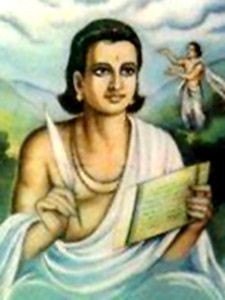
Comes the month of June and the first rains of southwest monsoon lash on our land. It is a time when we are reminded of the great lyrical poem “Meghad?ta” or “Meghdootam” – un unforgettable masterpiece by the great literary legend Kalidasa.
A lyrical poem is one in which personal feelings and emotions are expressed, usually in first person. (The concept of lyric poem emerged from ancient Greek literature where Greek lyric poetry existed. In this form of poetry, a poem was defined by the type of instrument that accompanied the recitation of that poem. In some other article, I will write about these similarities in ancient cultures and literatures).
This monsoon, I thought of paying my tribute to the immortal all time literary legend Kalidasa. So much to write about him and his works. It is not possible to write in one post. So, here I will write about his creation “Meghaduta” or “Cloud Messenger”.
Now, let me compose a poem about the story of Meghaduta.
Comes the rain-bearing cloud,
A lovelorn lover calls out loud,
From Ramgiri to Alaka, to go.
To his lovelorn beloved, lo!
To carry his love message
In exile, his only assuage!
Which way do the clouds go?
That too the poet shows!
Crossing vales and over mountains,
with peacocks and flowing fountains.
A description, vivid and imaginative,
fabulous, fantastic, and fascinating!
(This poem composed by Sreechandra Banerjee)
Well, that’s what the lyric poem ‘Meghaduta’, composed by Kalidasa, is about. This is his most famous work. The poem is divided into two parts: - ‘Purva-Megha’ and ‘Uttara-Megha’.
Kalidasa, considered to be the greatest Indian poet of any epoch, is believed to have been one of the nine gems that adorned the court of Vikramaditya (King Chandragupta II, reigned c.375/380- c.414/415). There is, however, controversy over the exact dates and it is believed that Kalidasa lived sometime in the 4th, 5th or according to some schools, may be in the sixth century.
This lyric poem Meghaduta has 120 stanzas each comprising four lines. It is set in ‘mandãkrãnta” meter which imparts a lyrical sweetness. This meter was founded by Kalidasa. In Sanskrit, mandãkrãnta means "slow stepping" or "slowly advancing". This slow advancement thus increases the sense of longing that the poet wanted to convey in this majestic work of his!
As the monsoon cloud makes it way, to satiate the scorched earth, a lovelorn heart would long to be with his beloved!
Yaksha, who was a servant of the God Kuber(God of wealth), had allowed God Indra’s elephant to invade Kuber’s garden. Thus, he was exiled away in the solitude of Mount Ramgiri as a punishment by his master.
(Yaksas are the nature spirits or deities of nature in charge of water, sky, etc. They are found in Hindu, Jain, and Buddhist Literature and as guardian deities of ancient and medieval era temples of South Asia and Southeast Asia.)
Eight months had already passed when the south-west monsoon begins its northward journey. Yaksha could hardly bear this separation from his beloved wife any longer. He thus invokes the cloud to be his messenger to her.
The genre of this lyric poem is that of ‘Sandesha Kavya’ or ‘messenger poem’ where some natural element is invoked to carry the “sandesa” or “message”.
Kalidasa’s works are in allegorical style referring to many contemporary works and tales (philosophical and mythological). Thus, exact translations are hard to find, but the meaning is conveyed in some of the interpretations of his works found on the internet and in other texts.
Here are the lines of Meghaduta from one such interpretation:
“A certain `yaksha` who had been negligent in the execution of his own duties, deprived of his powers on account of a curse from his master which was to be endured for a year
and which was onerous as it separated him from his beloved, made his residence among the hermitages of Ramagiri, whose waters were blessed by the bathing of the daughter of Janaka [Sita] and whose shade trees grew in profusion”
Meghaduta then speaks about Yaksha’s seeing a cloud:
“That lover, separated from his beloved, whose gold armlet had slipped from his bare forearm, having dwelt on that mountain for some months,
on the first day of the month of Asadha, saw a cloud embracing the summit, which resembled a mature elephant playfully butting a bank.”
Kalidasa thus visualized images formed in clouds which he described with superb metaphors, allegories, comparisons etc.
Meghaduta continues:
“Managing with difficulty to stand up in front of that cloud which was the cause of the renewal of his enthusiasm, that attendant of the king of kings, pondered while holding back his tears.
Even the mind of a happy person is excited at the sight of a cloud. How much more so, when the one who longs to cling to his neck is far away?”
Kuber, fortunately heard this prayer and remitted the rest of his exile (about four months) and thus Yaksha could again unite with his wife.
On its way to the city of Alakã, on Mount Kailash (Himalayas), where Yaksha’s wife lived, the cloud would traverse through a beautiful land, whose fabulous description forms the main essence of the lyric poem.
Mr. Horace Hayman Wilson was the first to translate Kalidasa into English in the year 1813. An excerpt from his translation:
“Pleased on each terrace dancing with delight
The friendly peacock hails thy grateful flight:
Delay then, certain in Ujjain to find
All that restores the frame or cheers the mind,
Hence with new zeal to Siva homage pay,
The God whom earth, and hell, and heaven obey:
For at his shoulders like a dusky robe,
Mantling impends thy vast and shadowy globe:
Where ample forests, stretched its skirts below,
Projecting trees like dangling limbs bestow:
And vermeil roses fiercely blooming shed
Their rich reflected glow, their blood-resembling red.”
As I always say, translations can hardly do justice to the original text. Besides, the number of syllables in the original Sanskrit line is almost double than in the meter adopted for this translation.
Apart from the imagery sketched of mountains, valleys, forests, landmarks, Meghaduta also brings out the emotions of Yaksha in imaginary dialogues between Yaksha and the cloud.
Meghaduta has also been an inspiration for many works of art and literature. Plays and programmes have been staged ever since based on this fascinating all-time work of Kalidasa.
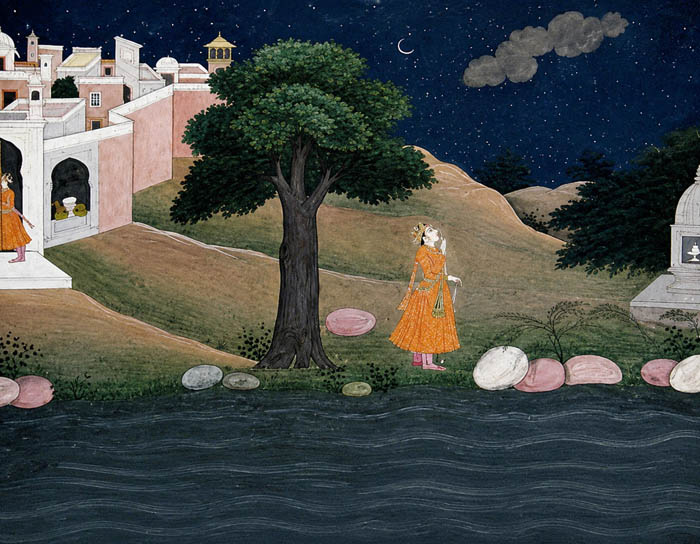
King looking at a cloud in a night sky.
Meghad?ta illustration.
Guler School of Pahari painting, c. 1800.
Lahore Museum
Deepa Mehta’s film ‘Water’ quotes an excerpt from Meghaduta. Gustav Holst’s ‘The Cloud Messenger’ Op 30, (1909-1910) was inspired by this great lyric poem.
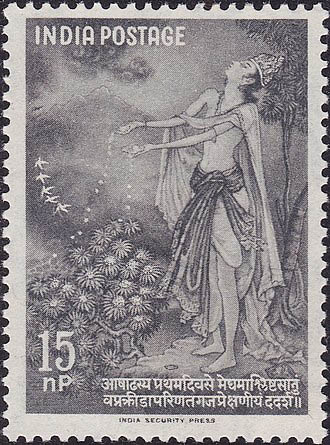
Meghaduta Illustration
On stamp of India.
The first lines of the poem are written on the stamp.
So as the sweet music of the first rains keep ringing in our ears, its Kalidasa’s Meghaduta that keeps coming back and back, traversing across the boundaries of eternity, just as the waves of the south-west monsoonal winds traverse through boundaries to drench our hearts with loving melodies of the pitter patter outside.
Greeting you all Happy Monsoons.
May you all rejoice and rejuvenate with the resplendence of the rains!
This I reposted after minor editing.
Source: The Great Authors and Poets of India by Crest Publishing House
The Internet (All photos are from the internet and I have no right to these)
All information and quotes are from books and internet only – to which I have no right. (Disclaimer).
Copyright Sreechandra Banerjee. All rights reserved, except for the quotations, translations, images, and words of Kalidasa, etc. that are taken from the internet (Disclaimer).
No part of this article can be used or reproduced by anyone.
The poem at the beginning, about Meghaduta was composed by me.

Sreechandra Banerjee is a Chemical Engineer who has worked for many years on prestigious projects. She is also a writer and musician and has published a book titled “Tapestry of Stories” (Publisher “Writers’ Workshop). Many of her short stories, articles, travelogues, poems, etc. have been published by various newspapers and journals like Northern India Patrika (Allahabad), Times of India, etc. Sulekha.com has published one of her short stories (one of the awardees for the month of November 2007 of Sulekha-Penguin Blogprint Alliance Award) in the book: ‘Unwind: A Whirlwind of Writings’.
There are also technical publications (national and international) to her credit, some of which have fetched awards and were included in collector’s editions.
A LEAF FROM HISTORY: THE NOBEL STORY OF "ENOUGH", FROM ECONOMICS TO LIFE STYLE
Mr Nitish Nivedan Barik
Modern life seems to run on a single message: acquire more, achieve more, and never stop striving for something better. We are surrounded by countless choices in education, careers, technology, and consumption. Yet this abundance has not necessarily made people happier. On the contrary, anxiety, indecision, and dissatisfaction often accompany the search for the "Best." Long before these concerns became common topics of discussion, a remarkable scholar offered a different way of looking at human decision-making.
That scholar was Herbert Alexander Simon (1916–2001), one of the most versatile intellectuals of the twentieth century. His work spanned economics, public administration, psychology, political science, and organizational studies. Simon questioned many assumptions that had long dominated economic thought and sought to understand how people actually make decisions in real-life situations rather than how they are expected to decide in theory.
His influential book Administrative Behavior, first published in 1947, marked a turning point in the study of organizations and administration. At a time when many scholars believed that individuals acted with complete rationality, Simon argued that real-world decision-making was far more complicated. His insights reshaped the understanding of human behaviour in institutions and eventually earned him the Nobel Memorial Prize in Economic Sciences in 1978.
Traditional economic theory generally portrayed human beings as perfectly rational actors. According to this view, individuals possessed all relevant information, carefully evaluated every possible alternative, and ultimately selected the best available option. Simon found this image unrealistic. In everyday life, people rarely enjoy such ideal conditions. Information is often incomplete, time is limited, and the future remains uncertain.
Drawing upon his observations of organizations and administrative systems, Simon proposed a more realistic understanding of human behaviour. He observed that people operate within numerous constraints. They may lack adequate information, face pressing deadlines, or simply be unable to process every available alternative. Consequently, decision-making occurs under practical limitations rather than under conditions of perfect knowledge.
To describe this situation, Simon introduced the idea of “Bounded Rationality”. Human beings are rational, but only within certain limits. Their reasoning is shaped by the information they possess, the resources available to them, and the cognitive capacities they can bring to a problem. Whether one is a civil servant preparing a policy, a business executive evaluating investments, or an ordinary citizen making household decisions, choices are often made with less-than-perfect information.
This insight laid the foundation for one of Simon's most celebrated contributions—the concept of “Satisficing”. The term blends two words: satisfy and suffice. Simon argued that people frequently stop searching once they find an option that adequately meets their needs. Instead of investing endless effort in locating the absolute best alternative, they choose one that is good enough to achieve their objectives.
The idea may sound simple, but it captures an important aspect of everyday life. Imagine a student searching for a textbook. Rather than visiting every bookshop in the city to identify the cheapest and most perfect copy, the student usually purchases a suitable book once it meets essential requirements. The same principle can apply to governments and organizations. Faced with urgent social or administrative problems, they often adopt workable solutions rather than waiting indefinitely for an ideal answer.
Simon believed that this tendency was not a weakness but a practical necessity. In a complex world, insisting on perfection can sometimes delay action and increase costs. Decisions often need to be timely, realistic, and effective rather than flawless. This understanding transformed the study of administration and organizational behaviour, shifting attention from abstract models of perfect rationality to the realities of human decision-making.
The significance of satisficing extends far beyond government offices and corporate boardrooms. It speaks directly to the challenges of everyday life in the twenty-first century. Never before have people been confronted with so many choices. From mobile phones and online courses to careers, travel plans, and social media content, modern individuals are constantly encouraged to compare alternatives and seek the "best" possible option. Yet an abundance of choice does not always produce satisfaction. Quite often, it creates confusion, indecision, and a lingering fear of having chosen poorly. Thus, ironically, more choices often lead to greater anxiety and dissatisfaction. Simon's insight was that a reasonable choice, one that adequately serves our purpose, is frequently more beneficial than an endless search for perfection.
Interestingly, this perspective echoes ideas long present in Indian thought. Mahatma Gandhi consistently cautioned against unchecked material desires and excessive consumption. His well-known observation that the Earth has enough for everyone's needs but not for everyone's greed captures a sentiment remarkably close to the logic of satisficing. Gandhi believed that simplicity, moderation, and self-discipline were essential for both personal well-being and social harmony. In his view, the relentless expansion of human wants could never become the foundation of a truly contented life.
A similar concern can be seen in contemporary discussions on sustainable living. Prime Minister Narendra Modi's advocacy of Mission LiFE (Lifestyle for Environment) emphasizes responsible consumption, conservation of resources, and environmentally conscious habits. Citizens are encouraged to avoid waste, make thoughtful choices, and adopt lifestyles that are both sustainable and socially responsible. Although arising from a different context, these initiatives reflect the broader principle that progress need not be measured by limitless consumption.
The environmental dimension of Simon's ideas deserves special attention. The modern economy often rewards continuous production and consumption, placing enormous pressure on natural resources. Forests, water bodies, minerals, and energy reserves are increasingly strained by growing demands. Climate change and ecological degradation remind us that the pursuit of "more" carries significant consequences. The philosophy of satisficing offers an alternative perspective. By recognizing the value of sufficiency rather than excess, individuals and societies can reduce waste, conserve resources, and contribute to a more sustainable future.
The business world, too, provides numerous examples of the practicality of Simon's approach. Managers frequently operate under tight deadlines, uncertain market conditions, and incomplete information. Waiting indefinitely for the perfect decision can result in missed opportunities and costly delays. Effective leadership often involves selecting an option that is workable, timely, and reasonably effective. In such situations, satisficing becomes not a compromise but a sensible strategy for navigating complexity.
Some critics have suggested that an emphasis on "good enough" may discourage excellence or innovation. Such criticism, however, misunderstands Simon's argument. He never advocated complacency or mediocrity. His concern was with the realities of decision-making. Human beings must often act despite uncertainty, limited resources, and imperfect knowledge. Under such conditions, practical and achievable solutions may prove more valuable than ideal outcomes that remain forever out of reach.
More than five decades after its formulation, the concept of satisficing continues to illuminate contemporary challenges. Governments grapple with complex policy choices, organizations confront rapidly changing environments, and individuals struggle with information overload. In each of these settings, Simon's theory offers a useful reminder: effective decisions are not necessarily perfect decisions. What matters is whether they adequately address the problem at hand.
Perhaps Simon's greatest achievement was his willingness to acknowledge the limits of human capability. Rather than viewing these limits as weaknesses, he regarded them as an essential feature of real life. His work replaced unrealistic assumptions with a more humane understanding of how people think, choose, and act. The enduring appeal of satisficing lies in this realism. It teaches that wisdom is not always found in maximizing every opportunity but in recognizing when a choice is sufficient for one's purpose.
His philosophy was reflected in the simplicity of his personal life. Katherine Simon recalled that her father often remarked that a person needed only three sets of clothes, one being worn, one in the wash, and in the closet ready to wear. He followed a remarkably consistent routine, eating the same breakfast each day, oatmeal, half a grapefruit, and black coffee, and lived in the same house for forty-six years. Katherine also noted that her father habitually purchased only a single brand of socks. By doing so, he eliminated the need to choose among colours, patterns, or styles each morning. These habits illustrated his belief that unnecessary choices consume valuable mental energy that could be better devoted to more important pursuits.
The lesson remains strikingly relevant today. Those who spend their lives chasing the "best" often find themselves trapped in comparison, regret, and dissatisfaction. By contrast, individuals who seek what is appropriate, sufficient, and meaningful are more likely to experience contentment with their decisions. Herbert Simon's message was never about lowering standards; it was about understanding reality. In a world that constantly urges us to want more, his gentle reminder that "enough" can sometimes be enough remains one of the most valuable lessons of modern thought.
Thus, we may end our story with these words: Those who endlessly pursue the "best" often find themselves dissatisfied and comparing their choices with others. Satisficers seek what is "good enough" and are therefore more likely to feel content with the decisions they make.
Mr Nitish Nivedan Barik hails from Cuttack,Odisha and is a young IT professional working as a Team Lead with Accenture at Bangalore.
THE FLAME
Dr. Mrutyunjay Sarangi
Snehlata adjusted the tie on her husband's shirt and gave him a small pat on the cheek,
"Oye, what has happened to you these days? You are extra careful while leaving for office, the perfume, the gel on the hair, the trimmed moustache? Some new flame in the office?"
Ramesh Patnaik's heart skipped a beat! Wives! Blast their sixth sense! The next moment he steadied himself and gave back a naughty pat to her,
"You only have taught me to be smart and sprightly all the time. After all Odisha's Tourism Secretary has to present himself to the world with a flourish and glamour! Now let me leave. It's getting late. God knows who would be waiting for me! Tourism department is going places now! And look at you, all you can think of is a flame!"
xxxxxxxxxxxxxxx
The "Flame", at that precise moment, was walking briskly from the bus stand to the Secretariat. She was nervous. Just a month into the job she didn't want to incur the displeasure of the boss. Anima, the Flame, was the Junior P.A. to the Tourism Secretary. She knew the moment Sir came to office, he would send for her and if she had not reached, he would shout at the Senior P.A. Banamali Garabadu. Isn't he teaching office discipline to his junior? Why is she coming late to office? Banamali babu, the seasoned P.A. sensed the impatience of the colourful boss to meet the blooming flower which had fallen into the office like a gift from Cupid. The boss would be aware that it was not yet ten o clock, Anima was not late, only in his eagerness to see her on a Monday morning, Sir had come to office ten minutes early. But being an expert in handling bosses, Banamali babu would say,
"She must be on the way, Sir. A very efficient and capable lady, perfect in typing and dictation".
Ramesh Patnaik would snort in impatience,
"Yes, yes, I know that, I know that. Send her in for dictation the moment she comes."
"If there is anything urgent, I can take the dictation Sir."
"No, no, you attend to phone calls, let her take dictation."
xxxxxxxxxxx
Dictation? Of course the boss knew Banmali babu was very seasoned and good in dictation. In fact he was good in everything. Actually, Ramesh Patnaik liked him a lot. A humble, God fearing old man, he would bend from the waist in the morning and evening while saying Namaskar to the boss. He would give the impression that the boss was God, as much to be revered as the gods and goddesses adorning the framed photo in the wall in the entrance room. Banamali Garabadu was efficiency personified. Anything that the boss needed was done in a jiffy! Madam wanted to go shopping for sarees, Banamali Babu would call the show room and alert them; their fifteen year old son Mayank wanted to go on a picnic with his friends to Konark, the efficient PA would make all arrangements; the twelve year old daughter Ananya forgot to remind about payment of school fees, no problem, Banamali Babu would rush to the school and pay the fees without late fee. But still, when it came to giving dictation, Ramesh Patnaik hungered for the young, nubile Anima, not for the old, efficient Banamali Babu.
xxxxxxxxxxxxxx
Banamali Babu knew there was nothing urgent. The same boss never used to bother with dictation when Sanatan was the Junior P.A. Ever since Anima had joined in the place of Sanatan, Sir is overflowing with new ideas and unending dictation. This eager man in his mid forties was quite a handful, his eyes wandering over Anima's sensuous body left no one in doubt about what must be going on in his dirty mind.
xxxxxxxxxxxxxxxx
The mind of Ramesh Patnaik was in a turmoil, why was Anima late? Had something happened to her? Impatient, he looked at the clock. It was five minutes past ten and Anima had still not come in. He had been thinking of her all the way to office. What coloured saree would she be wearing today? The yellow chiffon with the green dots which hugs her slim figure so nicely, accentuating the gentle curves, or the light green cotton saree which sits on her like a soft veil, or the violet one which suits her fair colour so well? Would she have left her hair undone or tied it into a bun? And the bindi on her forehead, would it be a round one or of a small diamond shape? What ever she wore she looked ravishing, a succulent fruit waiting to be enjoyed with relish.
He was waiting to spend a good one hour with her pretending to give dictation, thinking of words and officialese but actually looking at her sitting demurely, eyes downcast and lips trembling like the tremor of soft rose petals. The moment she came in Ramesh Patnaik smiled like a copy, young lover,
"Come come Anima, I have been waiting for you, sit and take a dictation about my programme for today".
11 am - Telephone call to JS Ministry of Tourism, Govt. of India
No no, make it AS, let me speak to the Additional Secretary, or you think JS will be better? Ok, keep it JS.
11.30 - Speak to batch mate Anil Mahajan about Trade Fair in Patna.
But is it a bit early? Trade Fair is still six months away. Last year Trade Fair was in Bangalore, remind me to check the file to find out when we started the process here.
12.30 pm - Dictation
1.30 - Lunch in office
3.00 - Meeting with JS and US in charge of Light and Sound show at Dhauligiri.
Or should I finish the beautification of Sisupalagarh first? When you go from here ask Banamali babu to connect me to MD Tourism. Let me check the progress with him.
4.30 Dictation
Ramesh Patnaik, while giving dictation, would be looking at her like a hungry dog, fantasising in his mind all the while - Ah, Anima, leave all this useless stuff. Let's change the whole programme to 11 am - Clearing Files assisted by Ms. Anima, Junior P.A. 12.30 Dictation to Anima. 1.30 Lunch with Anima (Special lunch of Biriyani and Fish Fry to be ordered by the office from Pantha Nivas). 3.30- Dictation to Anima 5 pm Tea with Anima, I know you don't like tea, but all that you have to do is touch the cup with your sweet lips and hand it over to me, I will sip it drop by drop like it was nectar from heaven. Ah, when will you give me that chance Anima, when?
xxxxxxxxxxxxxxxx
When will Sir let me go, Anima was getting restless. For the past forty five minutes he had been dictating his programme for the day, saying something, changing it, repeating it, asking her for her opinion as if she was a fountainhead of knowledge! Anima had no doubt about the dirty intention of her boss. Being exceptionally beautiful she was always an object of unwelcome attention from class mates and lecherous lecturers, but she had managed to ward off all kinds of danger by being aloof, travelling by ladies' special buses and avoiding offers of lift from class mates in their scooters or motorbikes. She knew she would be subject to such harassment till she got married. Actually she herself wanted to get married, but she had to save some money from her salary. She knew her father who was a retired school teacher had already spent all his savings on the marriage of her two elder sisters.
Ramesh Patnaik looked at her with naked hunger gleaming in his eyes. In a sky coloured saree with deep red borders she was looking just out of the world. Should he ask her to join him for lunch? Ah, what a joy that would be! Next moment he was assailed by a doubt, would she agree? These days with all the Me Too scandals, what if she told everyone that he was trying to force a piece of fish fry into her dainty mouth? Any way, let him order fish fry first.
Anima came out of her reverie when the boss pressed the intercom and ordered fish fry from Pantha Nivas, the government owned Tourism hotel. Two plates of fish fry.
xxxxxxxxxxxxxxx
Fish fry? Banamali babu was surprised. He knew Sir had a severe problem of irritable bowel syndrome and that's why madam sent only plain rice and non spicy dishes from home. Why did he order fish fry from Pantha Nivas? And two plates? Is he expecting guests at lunch? When Anima came in after dictation he asked her, was Sir talking to someone on the mobile phone, has he invited someone for lunch? She shook her head, she hadn't heard anything of the sort. But she certainly heard him asking Banamali babu to get fish fry from Pantha Nivas.
xxxxxxxxxxxxxxxxx
Pantha Nivas? She had heard about the hotel from others. How big would be the rooms? She imagined the rooms, coloured walls, white bed sheets, good sofa sets. When she got married she would probably have the wedding in Pantha Nivas. As the Junior PA to the Tourism Secretary she would try to get special service. In all innocence she asked Banamali Babu,
"Sir, how big is Pantha Nivas? How many rooms are there? How is the food? Is it a good place to have a marriage?"
Banamali Babu looked at her in amusement,
"Are you getting married? You haven't told us so far? Where is the Mithaai? Who is the lucky man - to get an apsara like you as a wife?"
Anima blushed a deep red, as deep as the border of her saree,
"No, no, it's for a class mate of mine. She was enquiring the other day."
Banamali babu teased her,
"Why only the class mate, even for you also we will make all arrangements in Pantha Nivas. The manager calls me for something or the other three times every day. Last year I had got my daughter's wedding conducted there. They gave me a hefty discount and took special care to make all arrangements, from wedding to reception to honeymoon."
The old man's face broke into a wicked smile and he looked pointedly at Anima, who blushed an even deeper red at the word honeymoon.
xxxxxxxxxxxxxxxxxxxx
Honeymoon? Isn't it too early to think of honeymoon - Anita wondered. Let me first decide about my marriage, which is probably still two years away. But no harm in taking a look at Pantha Nivas. She smiled to herself, may be as the Tourism Secretary's P.A. she can ask for the biggest suite there for her honeymoon. She blushed again and was aware of the intense gaze of Banamali babu at her face. She looked at him and said,
"Sir, can we go and have a look at Pantha Nivas one of these days? I am just curious to know how the best hotel of the government looks and feels".
"Yes, of course. Sir is going to Delhi for three days on Wednesday. His flight is at two in the afternoon. So he won't come to office, or even if he comes he will leave by the noon. We will visit Pantha Nivas that day. I will ask the Manager to be present and take us round. We will have lunch also, courtesy, Odisha Torism Develeopment Corporation. I will ask them to make Mutton Biriyani and Fish fry. Hope you like them. Don't bring lunch from home on Wednesday."
Anima hadn't known the Boss would be away for three days. Good riddance from dictation of Sir!
xxxxxxxxxxxxxxx
Sir had pressed the buzzer. Banamali babu lifted the receiver,
"Yes Sir?"
"What happened to the flight ticket? Have the Pantha Nivas people delivered it?"
"Sir it must be on the way. I had reminded the Manager in the morning. It seems the Area Manager for the Beverage company has changed, so it's taking a little longer. But the manager of Pantha Nivas has promised to send it today without fail Sir. Rest assured Sir"
"Ok ok, don't forget to take copies of the ticket. Claim it correctly in the TA bill. It should be around forty four thousand rupees."
"Yes Sir, forty four thousand three hundred seventy two sir, I have already noted it for the TA bill."
"Good, let me know as soon as you receive the ticket."
xxxxxxxxxxxxxx
The ticket? Anima was looking questioningly at Banamali babu. She asked him,
"Sir? The ticket is coming from Pantha Nivas?"
"Yes. It always comes from there."
"But you told Sir you will claim it in TA bill? If Pantha Nivas is paying for the ticket why are you claiming it in Sir's TA bill?"
Banamali babu laughed loudly,
"Oh my God, what an innocent little babe you are! Wait, you will learn a lot of things in due course. Arey Pagli, you think Pantha Nivas is paying for it? They will always make the beverage contractor, the civil contractor or the catering contractor to buy the ticket. And since this is a government tour Sir claims it in his TA bill. Forty four thousand is just pocket money for him!"
Anima was horrified,
"But Sir, this is wrong! Why should Boss claim the amount if he has not spent it? And you are such a religious person, with a prominent mark of Chandan on your forehead, burning incense sticks in the morning before the photograph of Maa Saraswati, Ganesh and Maa Laxmi on the wall. Why are you being a party to this immoral act?"
Banamali babu's laughter got even louder,
"Aha, aha, such innocence! Straight from the university, aren't you? That's why you don't know the ways of the world!"
xxxxxxxxxxxxxxxxx
Ways of the world? What ways of the world? Do such things really happen? Anima couldn't resist asking,
"What else happens around here, Sir?"
"Oh, a lot. Our boss often throws parties at Pantha Nivas for his friends and colleagues. Not a single paise goes out of his pocket. I was once P. A. to another very senior officer. Every month he would organise parties in big hotels with unlimited flow of drinks and sumptuous food. The PRO of some Industry or Businessman would be waiting in the wings to pick up the bill which would be in lakhs."
Anima couldn't believe this,
"Are all officers like this?"
"O no, not all are like this, but those who host small parties at home are ridiculed by their friends. After all who is interested in soft drinks, boiled peanuts and fried pakodas? Where is the comparison with scotch whiskey, vodka, chicken tikka, sheek kebabs and prawn fries that you get in hotels? Once I was asked to contact a few officers for a party at home by one of my honest bosses. Out of eight persons I contacted, only one agreed to come. The others had no interest in a party at home."
xxxxxxxxxxxxxx
Home? Anima remembered there was a call from home when she was with Sir taking dictation. She opened the mobile, it was her brother Aniket. He had run into a small problem. In his B.A. Certificate his name had been misspelt as Anicut, it must have been due to some spell check issue and he had been running to the College to get it corrected, but the clerk there was only smiling at him, without making any attempt to correct it. She called Aniket at home. The poor chap again expressed his anger and frustration. She said she would check what could be done.
Banamali Babu had heard her part of the conversation, he asked her,
"Any problem Anima? We are colleagues - your problem is mine and mine is yours. Tell me, anything I can do to help?"
She told him, he was surprised,
"We have been seeing each other for the past one month, but you never told me; am I such a bad person, not fit to know about your problems? Now leave it to me. My friend Ajay's brother-in-law is the Section Officer in BJB college, we meet often over sumptuous lunches of mutton curry and fish fry. Let me talk to him."
Sir was busy on the phone talking to the JS in Delhi. Banamali babu called on his mobile, Ghanshyam picked up the phone on the first ring,
"Hello Bhaina, pranam, saashtaang pranam, long time no meet!"
"Meat? Didn't we have meat curry at my home last week? Now it is your turn, get some crab from Chilika next week and myself and Ajay will come to your place. Now, leave the meat shit business, I have some work with you".
"Work, Bhaina, what work, just order me, I will walk on my head and come over to you to deliver."
Banamali babu gave the phone to Anima, she explained the problem to Ghanashyam and handed back the phone to Banamali Babu.
"Bhaina, what has this world come to? If my clerk smiles and smiles and doesn't do it, madam's brother should understand what needs to be done. Anyway tell her the work is done, a free service from Ghanashyam to Banamali Bhaina, his big brother. Let Aniket come and collect the corrected certificate tomorrow afternoon. And this Sunday crab lunch at my place, ok Bhaina?"
Banamali babu ended the call and looked at Anima. Her face was glowing with happiness and relief. Such a cute, graceful girl! He looked forward to Wednesday when he would be taking her for lunch to Pantha Nivas. The buzzer sounded again, Sir wanted Anima to come in for dictation.
xxxxxxxxxxxxxxxxxx
The dictation meandered for one hour, with nothing particular. Some routine letters and useless notes for the subordinates. Ramesh Patnaik was getting absent minded again and again wondering whether he should invite Anima to join him for lunch. Banamali Babu had already informed that the fish fry had been delivered from Pantha Nivas. Sir was looking at Anima, sweat beads had started forming on his face, looking at Anima and his mind torn in a dilemma. Anima looked at her watch, it was nearing one thirty, Sir had been silent for almost two minutes, he was just looking at her and looking away, something was troubling him. She asked him very softly,
"Sir, if the dictation is over, can I leave? Today all the newly joined Junior P.A.s have been called for a debriefing by the G.A. department secretary over lunch. It is at 1.30. Can I go Sir?"
Suddenly Ramesh Patnaik felt relieved, all tension hooshed away like air from a balloon. So he was no longer in a dilemma. Anima was going for lunch elsewhere. May be he would think of giving her a lunch after his return from Delhi.
xxxxxxxxxxxxxxxxxxxxxx
Delhi had no particular attraction for Ramesh Patnaik. It was a waste of three days when there was a Delhi tour. He was not keen on attending the Review Meeting, the Ministry of Tourism had granted 30 crores for the beautification of Puri beach seven years back. The contract was awarded to the brother-in-law of the then Tourism Minister who was now the Revenue Minister. He spent just two crores and swallowed the balance amount. Five review meetings had already taken place with no progress at all. Who would recover the amount from the mighty Minister's powerful brother-in-law, now an MLA? The only attraction for the Delhi trip for Ramesh Patnaik was the forty four thousand he would pocket as the airfare.
But the flight from Bhubaneswar leaves at 2.10 pm. While returning from Delhi, it arrives at 1.30 pm. At normal times Ramesh Patnaik would have skipped office for all the three days, but this time the prospect of seeing Anima would bring him to office for a few hours both on Wednesday and Friday. And he would spend the whole time giving her dictation!
xxxxxxxxxxxxxxx
Dictation! Can he take Anima with him to Delhi on the pretext of giving urgent dictation? Ah, Delhi trip would be memorable if he could do that. Why, he may take her to Agra to show her Taj Mahal also, the monument to eternal love! But could he really take her to Delhi? With the press fellows hounding news like bloody dogs it could become a big scandal! And Anima, would she agree to come? Isn't it a little too early to expect her to accompany him to Delhi? May be he would get a good gift for her from Delhi! A necklace? Wow, that would be fabulous and would certainly tilt the scale for him, but Snehlata had this annoying habit of checking his credit card bills! Ok, ok, a good perfume paid by cash would perhaps be safer. May be he would try to touch her hand and feel its softness when he handed over the bottle of perfume to her. He smiled to himself at the prospect!
xxxxxxxxxxxxxx
The prospect of three days of freedom from Sir's dictation had made Anima light headed the next day. If she could just breeze through this Tuesday, she would enjoy the next three days. She was looking forward to the visit to Pantha Nivas on Wednesday. Banamali Babu was the first one to see a spring in her step when she entered the office.
"Anima, you look so happy! Any particular reason?" He asked her.
"Sir is going away for three days, this is the first time I will be free from work. No buzzer, no dictation!"
Banamali Babu laughed loudly. Sir had not yet come to office. So before Anima was called away for dictation he could talk freely to her,
"You are a young, beautiful, sensitive girl, like a flower fresh from the garden. You must have sensed by now why he calls you all the time for dictation?"
Anima looked down and nodded, yes, she knew.
Banamali babu, the old veteran, told her he had worked under another colourful boss like this many years back. He was a poet and romantic feelings were oozing out of him like tooth paste from a leaking tube. Those days Banamali babu was a Junior P.A. and the forty year old Pratima was the Senior P.A. She was a comely, lively spinster and was enamoured by the poems recited by the boss. She fell for him like a slim, shiny fish for a wiggling bait and sank hook, line and sinker. Sir went to Gopalpur on a tour and took her with him. And at the beach guest house they remained engrossed in the poetry of love till the boss's wife reached there from Bhubnaeswar and severely beat them up with a chappal. The boss returned to office the next day, but Pratima went on long leave and was transferred out to a far off district head quarters.
After a long time Banamali babu was seeing such a lecherous boss again.
Anima shuddered. The thought of accompanying Sir anywhere sickened her, boss or no boss!
xxxxxxxxxxxxxxxxxxxx
The boss barged in. Everyone stood up and greeted him and the gentleman accompanying him. His face lighted up like a colourful lamp as his eyes briefly swept over Anima, she was looking like a ripe pomegranate in her red saree and the red dot on the forehead. The unwelcome batchmate of his, the Tribal Affairs Secretary, had met him in the lift and walked in with him. The idiot! Did he know how much precious dictation time he would be taking away? He started listening to the endless chatter of his batch mate, although nothing was registering in his mind which was covered with a blanket of cloud.
xxxxxxxxxxxxxxxxxxxxx
A cloud had come over Anima's face also. The chirpiness was gone when the boss had walked in. Now she was weighed down by a problem she had brought from home. Her father had asked Anima to go over to the DPI's office today to get his pension papers cleared. Although he had retired six months back he was still getting provisional pension only, some query or the other was holding up the final clearance. He was tired of going to the DPI's office again and again. He had heard that one had to pay ten percent of the lump sum benefits to get his pension cleared, but he didn't know whom to offer or how. He thought Anima could go over and try her luck.
She asked Banamali Babu,
"Sir I have to go to the DPI's office for an hour today. Can I go when the Secretary Sir goes for the monthly review meeting with the Chief Secretary?"
"Yes, of course you can go. But why are you going there? It is a den of corruption and young and beautiful girls like you should not go there to get corrupted!"
Anima blushed, this was the second time in half an hour the Senior P.A. was calling her young and beautiful!
"My father's pension papers are stuck there. He had retired as a teacher from a government school six months back, But he is getting only provisional pension. I want to go and check what is holding it up."
Banamali Babu laughed, one of those knowing, condescending laughs he bestows on people ignorant of government business.
"I know what must be holding it up. You don't have to go there, why should you give pains to your dainty feet when I am sitting here, sharing this cabin with you? The PS to the DPI is my batch mate in the stenographer recruitment, we had shared so many samosas and rasagollas together in our youth. Just write down the details on a piece of paper. Let me call him."
After ten minutes he smiled at Anima in Mother Teresa style, all beaming with love and kindness,
"Tell your father to go and meet Abani Puhana, PS to DPI at ten o clock tomorrow. His work will be done in three days. When Abani promises something it is final."
Anima almost fell off her chair,
"Sir, you have taken away such a load from my mind! Is there anything, anything, that you cannot get done? You are a genius!"
Banamali Babu gloated. In his younger days such words from a dazzling beauty would have flooded him with pleasant waves all over, causing goosebumps! He allowed his mind to tickle itself to a mild fantasy. Tomorrow he would enjoy the company of this innocent beauty for a few hours going around in Pantha Nivas and having a sumptuous lunch followed by fabulous ice cream! For a moment he closed his eyes.
xxxxxxxxxxxxxxxxxxxxxxx
His eyes going repeatedly to the wall clock, Ramesh Patnaik finally got rid of his batch mate and immediately sent for Anima. For some reason she looked happy and buoyant. While going through the the motion of unnecessary and inane dictations, he wanted to ask her, what made her so bubbly, would she miss him as much as he would miss her when he went away to Delhi. He even thought of asking her what gift she wanted from Delhi, but thought the better of it. He wanted to give her a surprise, a bottle of costly perfume.
xxxxxxxxxxxxxxxxxxxxxx
The perfume bottle neatly packed and tucked into his briefcase, Ramesh Patnaik walked into the office on Friday afternoon, eager, impatient, restless. God knows how much he had missed the sweet, innocent face of the young and nubile Anima in the last three days. He wanted to hand over the bottle of perfume to her, look deep into her eyes and tell her how much he had missed her. He pressed the buzzer,
"Where is Anima? I didn't see her at her desk?"
"Sir, she called in the morning and asked for a day's leave. She is unwell Sir, but she said she would be back on Monday. There are two urgent letters Sir, should I come for taking dictation?"
Ramesh Patnaik slammed the phone down. He felt shattered; shouldn't Anima have called him on his mobile and asked for leave? Should she not confide in him? Now he wouldn't see her till Monday! And he wanted so much to touch her hand today while handing over the perfume bottle! He took out the bottle and carefully hid it in the drawer, locking it firmly. Too explosive to take home! For Snehlata he had bought some mixture and pastries.
He called the peon and asked him to get the car ready. He wanted to go home and take rest.
xxxxxxxxxxxxxxxxxxxxxx
Rest? Snehlata was worried. Why did her husband want to take rest? It was so unlike him! Did something untoward happen in Delhi? He was looking so downcast and haggard! He had not even changed into his customary kurta pyjama before going to bed. She went near him, he was looking vacantly at the roof. Ramesh Patnaik was debating in his mind whether he should call Anima's number and ask her what was the problem, what illness she was suffering from. But what if she was really ill and someone else answered the phone?
Snehlata pressed his head; was he having a headache? He shook his head, no he was just tired, no headache.
xxxxxxxxxxxxxxxxxxxx
No headache, but the heartache continued for Ramesh Patnaik through Saturday. He was depressed, it showed on his sad face like the after effects of a cyclone. On Sunday morning Snehlata insisted on going for a movie, Pyar Kaa Side Effects. The kids refused, their friends would make fun of them for weeks, they said. These days which kid accompanies parents for movies? The owner of Swati Talkies was Snehlata's classmate in college. She called him and asked for two passes for the box office for the afternoon show.
Ramesh Patnaik went to the movie just for a little distraction. It was not a bad movie. He started enjoying it. In the interval lights came up and people started going out for snacks and drinks. The manager sent a boy with popcorn and coca cola. Ramesh Patnaik had got up and started stretching his arm and legs. Snehlata nudged him, "I wish our daughter Ananya had come with us. Look at the father daughter duo there in the balcony, how she is holding his hand and they are going out for their drink and snacks."
Ramesh Patnaik looked, and the next moment his heart stopped; he sat down, shocked. Banamali Garabadu and Anima! Ye God, is there any fair play in your scheme of things? For the last one month Ramesh Patnaik was a moth dancing like mad, desperately trying to fall into the flame, and the flame chooses to jump into a bucket of ice! What magic did Banamali play on her? The hall became dark, as dark as his heart. He got up and told Snehlata he wanted to go home, he was having a splitting headache. He wished he could ask the old wizard on Monday to share the secret of his trick with him!
(Author's Note: Dear Readers, I have experimented with a new style in the story. The last words at the end of each paragraph is the beginning of the next paragraph. Hope you have enjoyed the story.)
Dr. Mrutyunjay Sarangi is a retired civil servant and a former Judge in a Tribunal. Currently his time is divided between writing poems, short stories and editing the eMagazine LiteraryVibes . Four collections of his short stories in English have been published under the title The Jasmine Girl at Haji Ali, A Train to Kolkata, Anjie, Pat and India's Poor, The Fourth Monkey. He has also to his credit nine books of short stories in Odiya. He has won a couple of awards, notably the Fakir Mohan Senapati Award for Short Stories from the Utkal Sahitya Samaj. He lives in Bhubaneswar.
Viewers Comments