
Literary Vibes - Edition CLX (26-Dec-2025) - SHORT STORIES
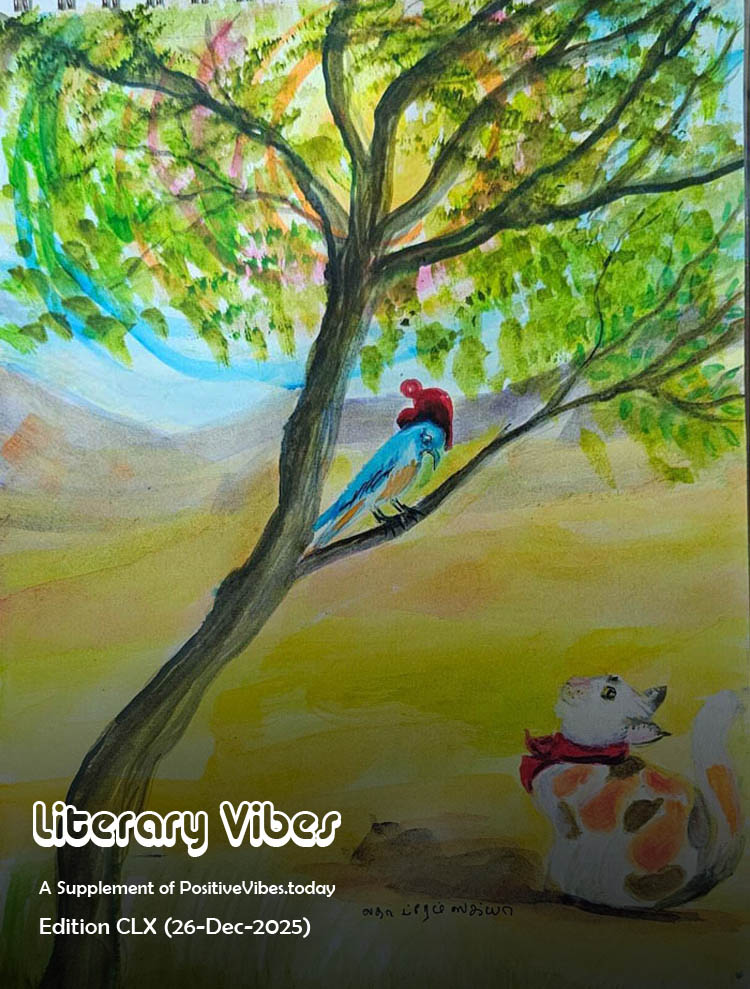
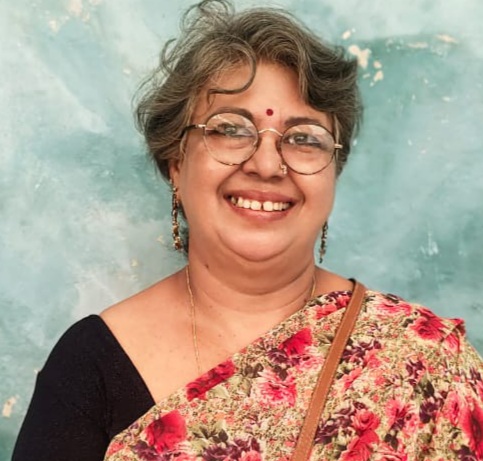
An acclaimed Painter, a published poet, a self-styled green woman passionately planting fruit trees, a published translator, and a former Professor, Lathaprem Sakhya, was born to Tamil parents settled in Kerala. Widely anthologized, she is a regular contributor of poems, short stories and paintings to several e-magazines and print books. Recently published anthologies in which her stories have come out are Ether Ore, Cocoon Stories, and He She It: The Grammar of Marriage. She is a member of the executive board of Aksharasthree the Literary Woman and editor of the e - magazines - Aksharasthree and Science Shore. She is also a vibrant participant in 5 Poetry groups. Aksharasthree - The Literary Woman, Literary Vibes, India Poetry Circle and New Voices and Poetry Chain. Her poetry books are Memory Rain, 2008, Nature At My Doorstep, 2011 and Vernal Strokes, 2015. She has done two translations of novels from Malayalam to English, Kunjathol 2022, (A translation of Shanthini Tom's Kunjathol) and Rabboni 2023 ( a Translation of Rosy Thampy's Malayalam novel Rabboni) and currently she is busy with two more projects.
Table of Contents :: Short Story
01) Prabhanjan K. Mishra
THE CURIOUS CASE OF A RUNAWAY WIFE
02) Sreekumar Ezhuththaani
BEYOND
03) Snehaprava Das
A HOUSE FOR THE DOLL
04) Usha Surya
THE COMPUTER GUY
05) Deepika Sahu
THE SOUND OF MEMORY
06) Phalguni Sahu
ECHOES OF AN UNSAID LOVE
07) Darsana Kalarickal
LANKADAHANAM
08) Ashok Kumar Mishra
OUT OF REACH (APAHANCHA DURATA)
09) T. V. Sreekumar
YOU ARE 16 GOING ON 17
10) S. Sundar Rajan
MAHA MRITYUNJAY TEMPLE NAIGAON
11) Bankim Chandra Tola
HOW DIPU RESHAPED HIS DESTINY
12) Sreechandra Banerjee
LETTER TO MR SANTA CLAUS
13) Dr. Rajamouly Katta
SERVANT MAID
14) Mr Nitish Nivedan Barik
A LEAF FROM HISTORY: AN ISLAND THAT IS A CITY OF GLOBAL ATTRACTION
15) Dr. Mrutyunjay Sarangi
CASSETTE
THE CURIOUS CASE OF A RUNAWAY WIFE
Prabhanjan K. Mishra
Koel, affectionately addressed by one and all as Koya, stood before her full-length mirror to appreciate her beauty. She did not see what Sagma had said to her - a statuesque beauty with chiselled and symmetrical features of goddess Venus with right curves at right places, a rose-milk complexion and exuding a honey odour.
She smelled her right hand; it smelled of spices she had been tempering her curry with. She moved her nose closer to her left armpit, a little damp with sweat. “Yuck!” it assailed her with the acrid smell of stale sweat. She felt disappointed to find none of those exquisite attributes in the mirror or smelled them.
Where was the goddess Venus or aroma of honey? Did the smell lie in the nostrils of the inhaler and beauty lie in the eyes of the beholder? The inhaler and observer, both converged into Sangma.
Suddenly Sangma’s compliments on her curves, and body odour made her feel shy, rather coy. She felt like hiding from herself, a strong urge to fade into invisibility. A man, other than her beloved husband, should have no right to her private things like physical curves and body odour. She got angry. Next moment, she wanted to hear more such complimentary drivel about herself, even from an uncouth man, Sangma.
She had been married for ten years. Her husband Som (short name for Somnath Sharma), her former college mate with whom she had eloped during the second year of her graduation, and had married him after the compulsive intervention of their families, as during their impatience of youth, Som had planted a seed in her soil.
Hers and Som’s studies stopped with their eloping and marriage. They started their household in a rented ramshackle bungalow. What Koya loved in Som best was his sacrifices for his love for her. He worked double shifts to earn sufficient to give her a good life. Whenever he had free time, he would give a hand to Koya in housekeeping also.
He drove an auto rickshaw during the daytime and worked as a delivery boy for an eatery in evenings. For the second job, he used his old two-wheeler across the length and breadth of their town to deliver food packets from the eatery.
In the morning, as Koya made tea and breakfast, he would make their two kids ready for school. After breakfast all three of them said bye to Koya, and Som would drop the kids at their school gate by his autorickshaw. He would then start picking up passengers, especially pilgrims, coming by bus and train who paid well.
At five, he would pick up his kids at the school gate and bring them home. He would have a cup of tea with Koya and a bite, spend a few minutes in chit-chat, and again embark upon his autorickshaw plying until eight in the evening. After parking his autorickshaw outside his home, he would report to the eatery on his old two-wheeler. The food delivery job would continue until eleven except some special nights like the fourteenth of February, when it could run almost to the wee hours. Just before daybreak he would return to Koya for their Valentine Eve celebration.
In the last few years, as his double-shift work increased, Koya missed their bungee jumping days in bed. Living together, at least sleeping intimately daily at night times, had, of course, sobered down her primal urges. Some nights once in a while, they fully redeemed their love’s wages at the first crow. that felt a novelty.
At this juncture of their quiet happiness, landed Sangma, who proclaimed himself as a monk by vocation, but a nattily dressed dapper man speaking Hindi with a queerly accented tongue, a singsong and halting baritone. One afternoon Som brought him home and said, "Koya, this poor monk from the hills of Arunachal Pradesh will live as our PG in the spare room in our house, and have both lodging and boarding facility.”
Before Koya could say anything, Som continued, “Don’t say ‘no’, my love. I have given him my word. He is not only a monk, but a scholar, and historian. He is writing the history of our town Ayodhya on his monastery’s scholarship and presently staying in a cheap hotel where he can’t write in peace. He has plans to stay for a year and study our culture to place it into his history book. That’s a noble turn to us as the people of Ayodhya. We were in myth, now our myth would be history.”
The Monk Sangma stayed over tea and snacks from Koya's kitchen. Before returning to his hotel, he said, “I like the PG room, your house, your locality, and all other things.” Koya instantly sensed by her womanly sixth sense that the monk’s 'and all other things' had very few exhibits, rather only one, ‘and your wife, Koya’. She felt unnerved.
Sangma had come as a tourist to their small-town Ayodhya at a very disturbed time who lodged and boarded in Som and Koya’s house. He appeared to see her through her clothes, and to smell her without coming close. In his presence she always felt naked. It burnt her in shame, made her suffer from guilt. She asked herself, by enjoying his compliments, was she betraying Som, her husband. Yet, a ticklish pleasure in Sangma’s compliments kept tickling her all through his stay as PG.
Koya would recall - the night the monk arrived with Som very late after checking out of his hotel, he straight went to bed as he had his dinner already. Next morning after saying bye to her school going children and her husband going to his job at seven thirty, she prepared a cup of tea for the monk and went to hand it over to the paying guest with a few toasts.
Sangma was sitting eyes closed. He opened his small eyes and without preamble uttered the compliment to Koya’s face turning her blushing pink, and the compliment that made her feel guilty as well as excited, the same compliment in various manners would repeat itself many times when the monk found alone.
The second day he asked Koya to bring another cup of tea for herself, “We will have a sacred tea ceremony, Koya.” The Tea Ceremony became a routine every morning. They would sit face to face, eyes closed, their steaming cups before them, say a shot chant, have a sip of the brew each keeping eyes shut, savour every sip like elixir, thanking the mother earth for her bounties.
The whole process would be repeated over every sip. The novelty caught Koya like hypnotism. By the time her cup was empty, Koya would be in a trance. She could feel, rather to a heightened level, but having no control over her senses. Sangma would bring her back to normal from her state of trance around two, about four hours spent over the tea ceremony, after making her sip water. He would send her to kitchen to cook food for all and get ready to receive her children and husband at five.
The monk's words over the days and his manners created a whirlpool or quicksand and Koya not only slipped into it but went sinking in its viscous medium. It felt like of warm honey consistency. The pit seemed filled with sweetness mixed with purity – a mixture of love, primal desire, and worship, all in a whorl of intimacy. More times she sank into it; more was her urge to sink in it, again and again.
The Tea Ceremony led to meditating together. That included closing eyes, getting rid of clothes, touching own body in a slow and intimate motion, sensing each area of one’s own body deeply, expressing feelings freely of liking, by uttering ‘Ooh, Aah, Yike, Wow, etc.!’, or disliking by ‘Yuck, Ugh, etc.!’, or surprise by ‘Hmm, Oh, Huh, etc.?’. Sangma explained it was advanced Tantra Yoga for a prolonged bliss and with luck, it could lead to eternal bliss, and salvation.
After that what followed, Koya would recall in distant future, was sort of a free fall. She would never know what really did happen during those four hours of Tantra Yoga, except she felt a pleasant lassitude all her conscious hours that followed her waking up from that Yoga session. She felt pleasantly drained, light in mind and body. In nights she slept like a log.
Those days, when Som would return bringing back children from school at five, he would wonder why Koya looked devoid of any energy as if in need of going to bed. Som would attribute her lassitude to household drudgery and lack of rest.
Koya, at times returning to full senses felt torn apart by her conflicting emotions - her home, hearth, children, husband and social order on one hand, and on the other, the fulfilment of her personal quest: union of body with soul in a confluence called salvation. The second need was inculcated into her by Sangma, who by now had been accepted by Koya as her Tantra Yoga Guru.
Over months, her housekeeping went to dogs, her household lay neglected and cluttered, her entire free time during her husband and children’s absence consumed by her Tantra Yoga. She had no time for her home. She would feel guilty of selfishness. But the moment the brief Tea Ceremony started leading to prolonged Tantra Yoga, she even forgot herself, all her doubts about duty towards home, husband and children, lapsing into oblivion.
Sangma, the monk, made her repeat, might be, thousands of times, ‘I am born a human being, by a rare grace of nature. My self is primal, innocent, and supreme, a sentient being, and must be harvested to yield the maximum produce.’ That daily rote, or mantra for Koya, she was to repeat to herself whenever she could. Som would notice with wonder Koya’s lips moving silently, but she would shy away if asked.
The monk never went out of his room, and maintained a low profile. He liked to remain unnoticed by the neighbourhood. Som, never found him in a state to have a word with him. When he got up in the morning until he left home with children he found him sitting cross-legged on the ground with eyes shut. When he returned bringing home his school-going kids, he found him meditating. By the time he returned home late in the night, the monk was tightly asleep.
Som bothered little what the innocent looking monk did during the day. He might be he researching on the local facts and culture and scripting the history of their holy town Ayodhya.
One late night, Som had a bad dream and he groped his side in the bed for Koya to seek comfort and reassurance in her arms, his emotional sanctuary and trusted reliquary. Koya was not in bed. She might be in the kitchen for a glass of water or in the rest room relieving herself, he thought. While waiting for Koya to return to bed, he dozed off.
Opening bleary eyes at dawn, Som did not find Koya in bed. To his touch and look her bed felt unslept. He got up wondering why had Koya remained out of her bed the whole night? And why? He looked in the kitchen, restroom, their little garden, and then in all the nook and corners of his house including the terrace. Koya was absent. He panicked.
Suddenly, he smelled a rat from small but distinct odd behaviour of Koya over the past few days, like her absentmindedness, lost look, lassitude, and heightened urge for his company in the middle of his exhausted sleep by waking him up. He looked around the house, looking untidy and cluttered, as if not getting Koya’s attention for a long time. In a nutshell, she had not been his usual Koya. She had been changing.
Now alerted by an impending disaster to his family he looked into the monk’s cupboards and then Koya’s. Nothing was left. They both seemed to have disappeared with their personal belongings, might be together. Had Koya eloped again, this time with the monk, as she had eloped with him ten years ago? He slapped himself for that evil thought about his beloved wife, his heartthrob, and the mother of their children.
One thing consoled him to find that she had not gone empty handed but had taken with her the entire saving from the family kit that was kept with her. At least she wouldn’t starve while camping with that pauper Sangma.
He found her diary on the side table by their bed. Its last entry was Koya’s letter to him, timed the last night, "My dear Som, I am leaving with the monk Sangma in search of eternal life. Don't look for me. I am going for ever. Sangma ji, now my Yoga Guru, tells me that to find the true meaning of life, one lifetime’s search may be too short. But I tell you it is worth trying. I may not have another life as he explains. But our children? They are our precious and sacred creations. We can't both leave them to seek our personal bliss and push them into a dreary existence.”
Som turned the page, and read, “So, my loving husband, take care of our two kids as a good father. I know you love them as much as you love me, and would not neglect them. So, I have no worries, no guilt on that count. Cherish my memory as I do yours. Wish me success. Bye. Yours loving wife, Koya.”
Som was at his wit's end. What did turn his lovely and simple Koya into such a mystic? Was it the mischief of the cultist monk, making her imbibe bhang, or some other alkaloid in guise of a medicine or in tea? Had Koya in her innocence walked into a charlatan’s trap? Som was worried for Koya, and her safety.
But he had to first protect Koya’s image, it could not be allowed to be muddied. Her diary had to be hidden. None would understand her high sounding dramatic diary entry, or that her Koya was in danger. Rather all would presume Koya had eloped with her PG, as she had once with Som. He must coin a believable alibi for Koya’s absence that would keep her children, relatives, and neighbours convinced.
He racked his brain. When his children after getting up looked for their mama, he told them with a sudden inspiration, “Your mama left very early in the morning to visit pilgrimages with her college day friends. She kissed you both ‘bye’ but you were sleep-groggy to understand that. Until her return, you both are in my care.” He told the same story to all that enquired about Koya.
He could not possibly tell them the truth even to his close friends. He could not think of starting an all-out search with their help, not even by engaging the police by filing a missing person complaint. He decided to search her out personally and discreetly to save her from Sangma’s evil clutches and not to soil her image.
He suspended his night shift work of food delivery temporarily with a request to the eatery owner on the ground of bad health and promised to resume the service when his health felt better. His eatery employer was solicitous, “Here is a little bonus money that may help in your treatment.”
“How long would my cock and bull story hold, would keep all diverted about Koya?” worried Som. He tried to extend his story someway to gain more time, not making Koya appear cheap, a run-away wife. People might spread lurid scandals about her and the monk.
He launched a discreet and personal search. He had carried pilgrims to almost all hotels and lodges in Ayodhya and he knew someone or other in each of their staff. He asked about the monk showing his photograph to them. But his efforts drew a blank.
Keeping a close friend at home for a week to look after his two children in his absence, he visited the monastery in Arunachal Pradesh that had sent Sangma to Ayodhya on a scholarship. The monastery was not of much help. He did not tell them about Sangma disappearing with his wife, but had told them Sangma owed him money and went without a forward address.
The monastery head said, “Yes, Sangma is working on our scholarship. But he remains broke and take small loans around. During his earlier projects also, we had to repay many of his loans. But basically, he is not a bad fellow. He is too much into Tantra that we Buddhists here don’t like. For the whole of last month, he neither wrote nor took our telephones. We have therefore not dispatched his scholarship amount. Give your address, if he does not pay, write to us, we will pay his loan.”
By and by, as two months wore on a few neighbourhood women came to his house to look for Koya; and asked, “When would her pilgrimage end, Som?” After the passage of a few more months his story of Koya on pilgrimage appeared to hold little water. His children also started feeling that something was amiss. Chocolates or ice creams seemed insufficient bribe to keep them happy.
Som stopped plying autorickshaw and walked around Ayodhya, a lonely, broken man. He hardly talked to anyone. His children were growing restless. Now his in-laws grew restless. Som fumbled with moist eyes to their probing questions – when, what, how, which? After the pilgrimage story sounded stale, he met questions with silence. Many left him alone thinking he had gone into depression as his wife was not returning home from pilgrimage. But many suspected foul-play.
In-laws would be in-laws, practical, probing, and focused. They doubted their son-in-law’s fair intention. They found Koya’s in her house. Thay suspected a rat.
They went to the police and lodged a complaint that they were suspicious of Som’s story of Koya visiting pilgrimage, leaving her mobile phone behind at home. Somnath, their son-in-law, had no other witness to vouch for his pilgrimage story. Even he was not giving the names of Koya’s accompanying friends.
Som was detained for proper questioning in police custody. When he failed to reply a few probing questions by the police, his children were taken away by their maternal grandparents for temporary care. After interrogation, Som was arrested on suspicion of murdering his wife, and disposing her body in secret, and misguiding police with lies. The case was handed over for a fast-track trial. Still Som did not open his mouth about the monk or his runaway Koya.
The case was tried. The court allotted a government lawyer to defend Som as he had no lawyer. But again, to save Koya’s reputation Som’s mouth remained sealed before his own lawyer. The trial ran one-sided and the case reached its finality quickly. The judge banged his gavel and declared, “The court has finished hearing. It is adjourned for today and we will reassemble here tomorrow when I will deliver the verdict.”
The media trial of the case was going parallel with the first track court trial. Before the court verdict, media had already issued death penalty to Som. The press was baying for his blood.
The verdict of the judge was forgone in public conscience. Som had decided to accept death or life term stoically for his beloved Koya’s reputation. He would rather take his secret to his grave. The odds weighed against him. He thought only a miracle could save him.
And a miracle happened.
As the court resumed the next day, the judge sailed in impassively as judges would do. The court was crowded to hear the justice to be given to a murdered wife. When all stood up to greet the judge, a burqa-clad woman followed by one of the town’s eminent criminal lawyers walked in. It transpired the lawyer would defend Som by producing some water-tight evidence. Though Som had read the Colombian author Marquez’s strange fiction, ‘Chronicle of a Death Foretold’, yet he had not forgotten that in rare cases facts could be stranger than fictions.
The judge asked, “Mr Athavale, please produce your evidence.” The lawyer Athavale put the burqa-clad woman in witness box, and for seconds maintained a dramatic silence. Again, the judge urged, “Produce the evidence, Mr Athavale.”
The woman took off her burqa. Som’s relatives and in-laws present saw Koya herself standing in the witness box, hale and hearty. To Athavale’s question, the witness stated, “I am Koel Somnath Sharma, wife of Somnath Sharma. I have just returned from my pilgrimage.” Then lawyer Athavale addressed the judge, “Me Lord, I have produced Adhaar and Passport of Koel Sharma as proof of her identity.” Judge nodded his head looking at Koel Sharma aka Koya’s identity proofs.
The prosecution lawyer said he had nothing to ask to the witness. The judge announced his verdict after minutes. “The victim Koel Sharma is alive. Somnath told the truth about her pilgrimage. He did not murder his wife. I release him as an innocent victim of the misplaced investigation by the police. The police are warned to be careful in future. The case is closed.” He hit his gavel and announced, “Next case please.”
The balance of the day and the evening until midnight, in Som and Koya’s house, the children’s happy clamouring, the neighbours’ greetings etc. kept the house crowded and noisy.
Finally, tucking the children to their bed, when the husband and wife retired to bed, Koya was expecting probing questions – where, how, what, when etc. but instead she found Som like an inquisitive explorer who was searching her all over, touching, pressing, pinching, squeezing, slapping, sniffing, listening, as if trying to find a lost relic. To her question, Som replied, “I was looking for you Koya. And I found you in one piece, intact, unadulterated, pure, and whole.” Both laughed.
Koya questioned, “Som, wouldn’t you like to know what all happened to me in that more than a year’s time?” Som replied, “But really, I know all I want to know. Facts I don’t know are not worth knowing.” Koya started, “But….” Som put his hand on her mouth, “I feel you are Laila and I am Majnu. In fact, at this instant only you and me matter. No one else.” With that he continued his exploration. (END)
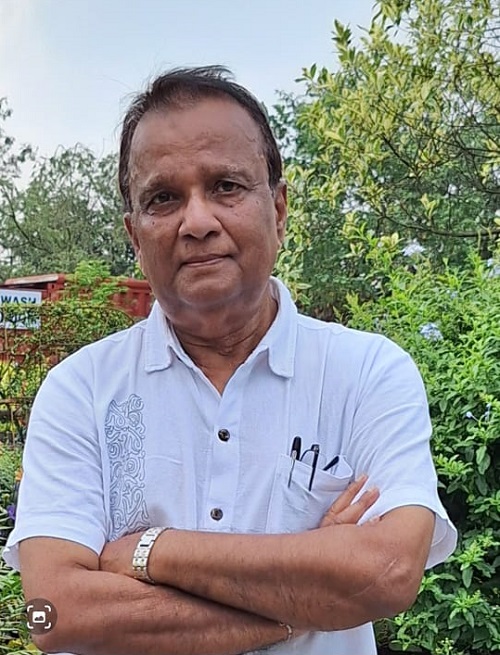
Prabhanjan K. Mishra is an award-winning Indian poet from India, besides being a story writer, translator, editor, and critic; a former president of Poetry Circle, Bombay (Mumbai), an association of Indo-English poets. He edited POIESIS, the literary magazine of this poets’ association for eight years. His poems have been widely published, his own works and translation from the works of other poets. He has published three books of his poems and his poems have appeared in twenty anthologies in India and abroad.
Sreekumar Ezhuththaani
There was still some time left for my blood test results to come. Nothing serious though, I just wanted to know my ESR count because of a wound on my leg.The lab technician said it would take about two more hours.
I looked around to find a place to sit, but every chair was already taken by people waiting for their test results, just like me.
Since there was plenty of time, I thought of walking around a bit.
As I walked down the corridor, I noticed a few empty chairs outside the ICU.
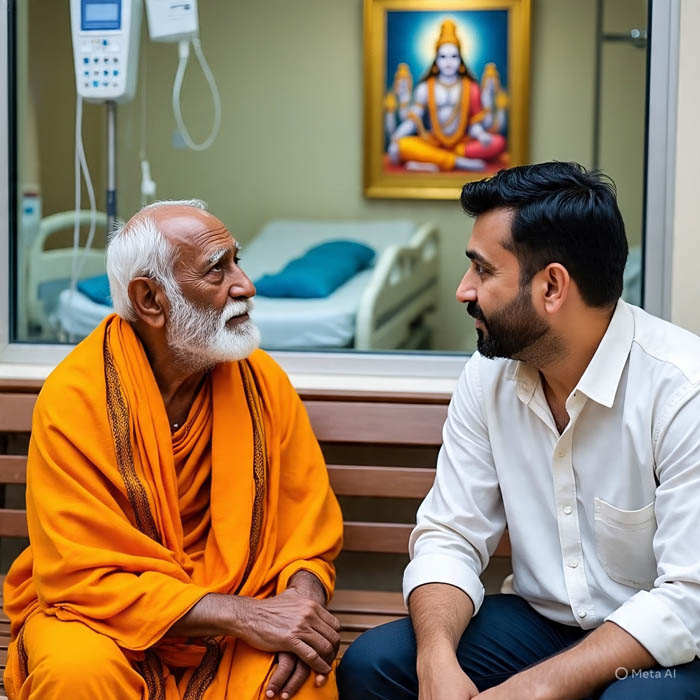
An elderly man in safron robes sat on one of them, eyes half-closed as if lost in thought or sleep.
I quietly sat beside him. He opened his eyes almost immediately.
“Who’s inside?” he asked.
“No one. I’m just waiting for my lab results,” I said.
“Then why aren’t you sitting over there?” His question was plain enough, but it carried a hint of unnecessary curiosity.
“There’s no seat left,” I replied.
He smiled faintly. “True. Here we’ve got more chairs than people to sit.
“Not like the old days, they don’t keep patients too long in the ICU now. Every room has almost all the set up . And when recovery looks impossible, it’s usually the family who asks to remove the ventilator.”
My last line startled him. It felt like something that I shouldn’t have said.
Trying to soften the moment, I asked, “Is it your wife inside?”.
“No,” he said quietly. “Someone more important than that. My wife passed away years ago.”
“Oh… what happened?”
“My wife ? She had jaundice.”
“l Mean the person inside now”
“Oh, nothing too serious. Just high BP. Happens often. “
He chuckled, and the ease in his tone told me it wasn’t something too grave.
I was curious. Who could be more important than his wife for him? But I didn’t dare ask. Instead, I nodded at his safron robe.
“Oh, this?” he said, glancing down with a smile. “Once upon a time, I felt drawn to the life of a monk. Tried it for a while too after my wife's death. “
Why had he become a monk… and why did he give it up later? Before I could ask, he began to speak again.
“I can tell you why I wore this robe and why I took it off. You’re not in a hurry, are you?”
I checked my phone. Still one and a half hours to go.
“Everyone in my family followed a spiritual path,” he continued. “After my wife’s death, I too went that way. Traveled a lot. Lived without money. Did small jobs to survive. I realized how empty desires are. Really speaking you only need food to eat and a place to sleep in.
“Slowly, every desire left me — not because I fought them, but because their truth revealed itself. When that happened, they simply vanished.”
“How long did that take?” I asked.“
“Time doesn’t really matter. Still, it took me about fifteen years,” he said.
He fell silent for a moment, as if tracing back memories of some deep loss.
“So why did you give it up?” I finally asked.
“Ego,” he replied softly. “I began to feel proud, thinking I had achieved what few could. Spiritual pride, you know, is the most dangerous kind.”
“I know,” I said.
“Oh? How?”
“I’ve read about it somewhere. Many great souls have stumbled there.”
He smiled. “I didn’t just stumble into a pit — my fall was greater than that.
“Those years without desire felt like paradise. I never realized if my ego hurt others. But one day, God tested me… brought before me, out of nowhere, a married woman from Rajasthan — like a bird carrying a pearl across the skies.”
I frowned, confused.
“She fainted during a temple visit,” he continued. “Everyone hesitated to touch her, but I was a monk, so I carried her myself, took her to a hospital in an auto-rickshaw.
She used to come everyday to the temple. And I… I didn’t leave.”
“Which temple?” I asked quietly.
“Why does that matter, eh ?” He smiled again. “Malleeshwara Temple.”
“No reason. Just curious.”
“Well, it was the right question. That incident was a great test — and I failed.”
“A test or a temptation?”
“It was both,” he said.
“I believed I had conquered all desires. But if that were true, why couldn’t I just walk away? Why did I keep finding reasons to see her again?
“She was the kind of woman I might have prayed for before birth. Everything about her fit naturally into my being. Two months later, I returned home — and she came with me. Since then, there hasn’t been a single day when our bond hasn’t deepened in some new way. We think the same, speak the same words, even wake up at the same time,” he said, wiping a tear with a smile.
“Life wasn’t easy. We went through hardships, loss, illness… but—”
“But what?” I asked, leaning forward.
“I realized there are things even heaven cannot offer. Do you like poetry?”
“Not particularly.”
“Still, you must’ve heard these lines once — about love so deep that even heaven’s call couldn’t draw one away.”
“Oh yes, from Daivathinte Vikrithikal — Madhusoodanan Nair’s lyrics, right?”
He laughed. “He wrote it for poetry, not cinema. But I understand what he meant. And I hope someday you will too.”
Just then, a nurse came out from the ICU and called him in. A brief exchange later, he returned with a bright face.
“All good now,” he said. “They’re shifting her to a room. We can go home tomorrow.”
From the lab, I heard my name being called. Though it hadn’t been two full hours, I rushed off, telling him I’d be right back.
When I picked up my report, I didn’t even open it. I hurried back to find him again — standing respectfully near him, hoping to glimpse the woman inside.
After a while, they brought her out on a stretcher. She was smallish and looked rather fragile.
As he walked beside her, he looked back and smiled.
“See you around,” he said gently.
I folded my hands at both of them instinctively.
My eyes closed on their own.
In my mind, there came up, a stone temple, far away, somewhere in Rajasthan.
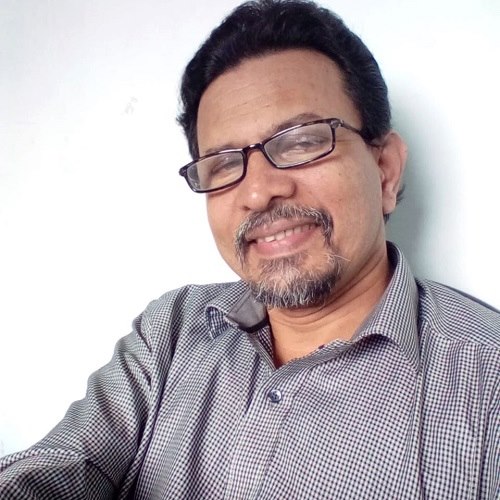
Sreekumar Ezhuththaani known more as SK, writes in English and Malayalam. He also translates into both languages and works as a facilitator at L' ecole Chempaka International, a school in Trivandrum, Kerala.
Snehaprava Das
She could feel the movement. It was very light, almost negligible as if someone was pulling the chair she sat on. She stood up and looked around the room. It was her study room in the upstairs. Though sparsely furnished the room was comfortable and cozy. There was a study table on which there was a laptop, and a chair. A single bed, a small cushioned bench a wardrobe and a book rack completed the furniture set up. Her doll, in her glitzy red gown sat in a neatly carved niche on the wall. She had other playthings, too. But the doll was special. She would never let it out of her sight. Her father had got the niche specially designed for the special doll.
It was early evening and she had come upstairs to study after saying her prayers. She sat down again and opened her notebook. The chair shook immediately as she did so. This time the movement was more clear and defined. She sprang up from the chair as the ceiling fan began to sway. The books fell on the floor in random scatters. Even as she turned to look at it, scared out of her wits, the doll took a headlong dive to the floor. She picked up the doll hurriedly.
And the lights went out
Screaming, she stumbled down the steps that led to downstairs. She ran into her mother's arms who was coming out of the kitchen, bewildered. Mother sat down holding her in her arms. She buried her face in her mother's lap, shuttling her eyes tightly. 'Do not fear, dear,' her mother said. 'It is a mild tremor and will soon pass', she added to comfort her. But she did not open her eyes and kept pressed her face hard into her mother's lap.
+ + + + + +
She lay on the wet floor , her face buried in her mother's bosom, gripping the doll tightly.
'Do not panic my darling, the storm will pass soon,' mother repeated. 'Keep praying, ' she added and mumbled her prayers. The storm howled like a monster gone mad. The thatch of the room in which they sat clutching and grabbing each other was blown away and floated in the air like an ugly mass of grey cotton wool before breaking into pieces. She screamed wildly as the heavy rafter came blundering down on them.
The weather was fine in the morning. The morning was bright and slightly warm. The leaves in the big acacia and fig trees fluttered in the comforting breeze blowing from the south. She and Jhuma played with the doll in the backyard of her house. The doll was an amazement. It was dressed in a bright red gown. Its hair flowed in silky tresses around its chubby face. The most beautiful thing about the doll were its blue eyes which closed and opened when it moved its head. The eyes get shut if it was laid down in a sleeping position, and opened when it sat up. It looked like a tiny, live girl. She had been asking her father to get her a doll like that since many months. Father said he would bring one when he went to town to sell the farm produce. At last after a long wait her wish was fulfilled. She was more than happy. Mother called out to her. 'Won't you eat your midday meal today? Come and take bath. Your father will be here soon. '
'We will play again in the afternoon. You go and and eat your midday meal.' She said to Jhuma before she left for her home in the other street.
Mother asked her to take a nap. 'Don't go out in the sun, ' she warned. 'You will be punished if you do.'
She lay in the bed waiting for her mother to sleep. Slowly, careful not to make a sound, she slid off the bed when she heard her mother's light snoring. She picked up the doll that was lying on the bed by her side. Opening the door softly she tiptoed to the courtyard, unlatched the bamboo-screen gate and came out. She walked to Jhuma's house and called out her name. Jhuma came out immediately as if she was waiting for her call.
Let's play in the mango orchard.'
''Alright. Come!'
It suddenly became cloudy as they reached the mango orchard which was at a little distance from their house. The sun hid behind the thick patches of clouds that floated into the sky from nowhere.
'It may rain. '
Jhuma said looking at the sky. They could hear the light rustle in the trees. As they looked at the river in the distance
something like z black column rose spiralling from the water. The girls watched wide eyed, rooted to the place where they stood. Within seconds the black column of smoke grew huge and enormous and began to gyrate at an unbelievable speed. The girls ran back to their homes as fast as their legs could carry them. They saw people who worked in the fields running towards the village. In no time the village was wrapped in a blanket of black and it was impenitrablly dark. She clutched at her mother with all her strength and began to scream.
'Where is your father?' Mother cried out a prayer, holding her tight. Father came running into the courtyard and the bamboo screen door of the courtyard went whirling up into the sky the next instant. The air was loud with the cries of the men and women and the howls of the animals. Hens and ducks rose into the air, drifted blindly for a moment flapping their wings and came crashing down. Even cats and dogs were blown away and were thrown down by the raging wind. The earsplitting noise of the thunder clap, the rattle of massive trees careening down, and the monstrous roar of the wind turned the village to a bedlam. The thatches of houses flew in the air like torn patches of brown--grey sheets before they were swept away towards the river. The cows bellowed wildly, the dogs howled, and the birds screeched like crazy.
And then it began to rain.
Streams of water hurling down from a swollen sky like liquid splinters lashed at the remains of the houses with a vengeful delight.
Mother slumped down on the wet floor.
She pressed her head hard into her mother's lap and whimpered.
'Do not be scared, dear. The storm will pass soon.' She said and resumed her prayers
'Mother Goddess!! Save us' she kept repeating like a litany.
She wondered where her father was. Perhaps he had gone to the cowshed at the back yard. Will the cowshed be there now? The wind must have blown it away. Where is father, then?' She wanted to call out but her lips felt stiff.
She tried to raise her head, but her mother pressed herself on her small body as the rafter came hurtling down. She heard the shrill scream of mother before she blacked out.
She was still clutching at the doll when the ODRAF team rescued her from under the debris. The tornado had smashed the village beyond recognition. All the thatched houses were razed to the ground. Dead and injured bodies of both humans and animals and birds lay scattered around were beginning to stink. She looked at her mother who lay still under the heavy rafter, her face reduced to a pulp. She winced and shut her eyes. Then she began to cry....,hard, choking sobs shook her small frail body.
They took her to the relief camp where many men, women and children who had lost their family members and were rendered homeless had taken shelter. Days later she was taken to the orphanage. There were many children of her age there. Some were older and some were younger than her.
They slept in one room on the floor, ate coarse rice and dal in the dining hall and washed their utensils.
Some months passed.
She made a few friends in the orphanage. But the doll was her best friend. She talked to the doll and cried cursing her own fate. Sometimes she played with other children but she did not let any one to play with her doll.
More month passed.
One night the matron came to their room before they went to bed. The matron asked them to get up early next morning.
'We are having visitors. All of you should take bath and dress up before they arrive.'
The visitors arrived in a cab. A good looking middle aged man and a woman of the same age with a smiling face and kind eyes. The matron welcomed them and guided them to the large visitor's hall wher the children waited. She sat stiff cradling the doll in the crook of her arm, looking down. The matron introduced them to the visitors. Then the man and woman walked outside followed by the matron. They stood discussing something. The matron turned her gaze again and again to the bench where she sat clutching her doll. Then she nodded and the three of them came inside.
'Come to me my child!' The woman said softly, stretching a hand towards her. She looked at the matron helplessly. The matron smiled and gestured her to go to the woman. She rose to her feet and walked to the woman. The woman took her in her arms. 'Would you like to come to our home with us to stay, my dear?' She asked affectionately and touched her face. I will get you toys and chocolates. You will also go to school and study.' She did not say a word but she did not feel bad. In fact she felt quite comfortable with the woman. She wished the woman would keep speaking to her nice and kind words for a long time. After an hour or so the man and the woman went away. She felt a bit sad when they left.
That night she dreamt of the woman. It was rather strange, she thought. She often dreamt of her mother and woke up in the middle of the night, moaning and tears rolling down her eyes. It was after months another person had visited her dream and she did not wake up whimpering and shedding tears. She was filled with a sort of happiness when she woke up in the morning. She wished the kindly woman to return and take her in her arms. She somehow felt safe there.
She sat looking through the window waitiing. The woman had said she would take her and her doll to her home. 'May be, she just said it for the sake of saying something.She had actually no intention of taking her to her home,' she thought feeling disappointed.
It was a fortnight before they returned. The formalities were completed and the matron asked her to accompany the man and the woman to their house. . The woman smiled fondly when she saw her. She gathered up in her arms. ' Call me Ma,' she said and kissed her.
The children of the orphanage bade her goodbye waving hands. The matron gifted her a new dress, 'You wear this dress, child.' She said, touching her head. Be happy,' she gave her blessings.
'Can I take my doll to your house madam?' She asked guardedly. The woman gathered her up in her arms. 'I am your mother. Call me Ma,' she said and kissed her forehead.
+ + + + + + + + + + +
It was a palace compared to her small clay house by the riverside. She missed her parents a lot and cried in the nights. But Ma pulled her close to her and solaced her. And she got familiarized with the new home and her new parents. Ma and Baba never made her feel that she was not their own child. They had put her in a school. She had her own room, nicely furnished with a small wardrobe, a bookshelf, a small cushioned bench, a study table a chair and her own bed. But she slept with Ma most nights. And her doll sat ensconced in the neatly carved niche in the wall, smiling its chubby smile. Life was limping back to normal mode.
Everything went on well till the evening that shook the doll's house once again flinging it down from its cosy seat. She could hear voices outside. People had come out of their houses and were calling at one another.
'It must be another whirlwind,' she thought pressing her head harder into Ma's lap. 'What is she going to do if the roof comes crashing down!! It was as of that disastrous evening has returned and this time with a determination to destroy her house and her Ma and Baba. She sobbed inconsolably and her body trembled violently. After a few seconds everything was calm and quiet. There was no more sound, no more throbbing. Even the power was restored. Cautiously she raised her head to look. Ma was sitting still joining her palms, saying a prayer. The voices outside died away as people returned to their homes. Ma opened her eyes and looked around. ' Thank God! It is over!!'
The calling bell jangled. Ma got up and opened the front door. Father, breathless and worried sick strode in. 'Are you both ok? He asked anxiously. ' Don't worry, ' Ma replied soothingly. 'The tremor lasted for a few seconds only.'
'Yes, ' Father said, breathing a sigh of relief. Thank God! It could have been nasty.' He pulled his daughter into his arms.
That night she slept clinging to Ma. She had also put the doll in the bed close to her. 'God is not always cruel,' she thought as she said her prayers. 'Thank you God! You have not destroyed the doll's house this time!' She covered the doll with a small towel and caressed her face. Then she closed her eyes and drifted into a dreamless sleep.
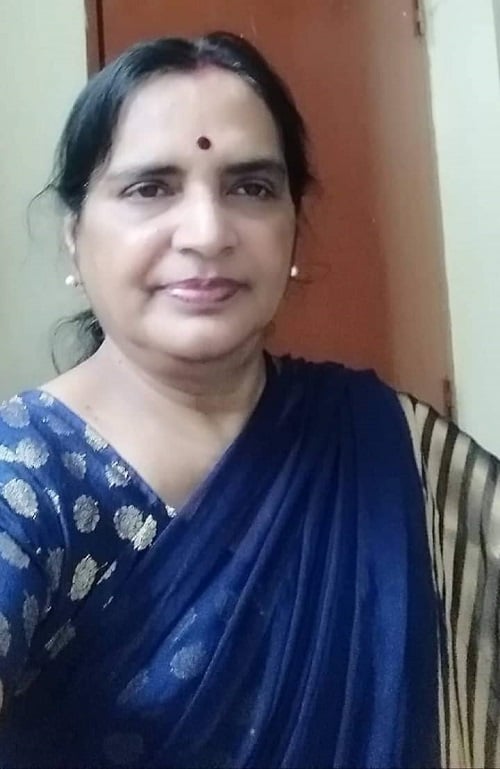
Dr.Snehaprava Das, former Associate Professor of English, is an acclaimed translator of Odisha. She has translated a number of Odia texts, both classic and contemporary into English. Among the early writings she had rendered in English, worth mentioning are FakirMohan Senapati's novel Prayaschitta (The Penance) and his long poem Utkala Bhramanam, which is believed to be a.poetic journey through Odisha's cultural space(A Tour through Odisha). As a translator Dr.Das is inclined to explore the different possibilities the act of translating involves, while rendering texts of Odia in to English.Besides being a translator Dr.Das is also a poet and a story teller and has five anthologies of English poems to her credit. Her recently published title Night of the Snake (a collection of English stories) where she has shifted her focus from the broader spectrum of social realities to the inner conscious of the protagonist, has been well received by the readers. Her poems display her effort to transport the individual suffering to a heightened plane of the universal.
Dr. Snehaprava Das has received the Prabashi Bhasha Sahitya Sammana award The Intellect (New Delhi), The Jivanananda Das Translation award (The Antonym, Kolkata), and The FakirMohan Sahitya parishad award(Odisha) for her translation.
Usha Surya
Visalam Patti was making those delicious bondas. She dipped the spicy potato curry which had been made into beautiful small balls in the batter and deep fried them one by one in the hot oil. Perfect circle!! No protruding "tails" - drops of batter - anywhere !! Everyone knew that she was an expert in making these fritters and always entrusted her with this job. Well, all of them had been prepared and packed into two huge casseroles so that they would keep warm.
Geetha had made delicious burfis in the morning and stacked them in the steel canister.
The coffee decoction in the two filters was fresh. There was enough to prepare thirty cups. Sudha, the daughter-in-law of the house, was always extravagant. She had a very broad mind that was displayed in the quantity of dishes she prepared. She was very fortunate...Geetha and Visalam never treated her as the daughter-in-law of the house. She was yet another daughter to them - to all the elders in fact - just like Shwetha the daughter of the house.
(Before going any further let me tell you that all these hectic preparations in the kitchen were due to the fact that Shwetha - the daughter - was to be the heroine of the day, as she was getting ready for the BRIDE SEEING CEREMONY!!)
Sudha emerged from the room with little Arun on her waist who looked cute in the new dress.
"Now, don't get dirty! I shall give you a burfi and you just sit quietly in a corner and eat it, " she said to the kid. Her husband Vivek, the son of the house, had gone on tour to Delhi for a seminar.
The calling bell chimed and Shwetha opened the front door.
It was not yet five in the evening and the BOY's party was expected to come only after that.
She was expecting the Computer Service man since three and guessed it must be him.
Her face lit up seeing him and asked him to step inside.
"Who is it, Shweha?" asked Geetha from the kitchen. She was getting ready to change into a nice saree.
"The computer guy, Amma" said Shwetha and the young man followed her.
"What a time to come," Visalam muttered in a low voice and Geetha responded saying, "It is only past four Amma. They will be coming only after five." She vanished into her bedroom.
Shwetha directed the young man to the study-room and pointing to a chair, asked him to sit.
"The owner said he would send you by eleven thirty but that you were out on work. Thank God, you came at least now," she said and took the other chair. The young man tried to say something but Shwetha started complaining to him about how the item "Word Document " had vanished from the 'Desk Top' and how she had been searching for it. It had been frustrating and she had to call the Computer servicing centre. She was a writer and all her stories had been written and saved there and she had been planning to upload them in the Net , but this had happened! She was almost in tears when she said this.
He smiled at her and said "Don't worry madam. You must have pressed something and it must have vanished from the scene. I shall retrieve it for you. Any other complaints? "
"Not really. " she said, brightening with hope.
Meanwhile he received a phone call and he took an elegant mobile phone from his pocket and whispered, "I am busy right now. I shall call you back." in perfect English.
Shwetha looked at him with a stunned expression.
"Gosh!! Are you really a Service guy? I remember that the Centre has always been sending boys who spoke only in Tamil."
He smiled and said , "Well. I m the owner madam The fellows have gone out and since you had telephoned twice...you said...I dropped in. I am the owner and actually I work in a company. This is my hobby. I can take apart a computer and put it back and make it work beautifully!!"
She was flustered "Oh! I am so sorry."
"It does not matter. See, your "Word" had got hidden!! And now it is right here. Just check and see whether everything you have written is here."
She drew the chair and saw that her file was still there.
She was ecstatic and thanked him profusely.
"You must always read the windows that appear on the screen asking you whether to BLOCK or ALLOW. I think you have ignored this!!"
Sudhe walked in with Arun on her hip and asked "Is it over ? The repair I mean?"
Shwetha said, "Sudha...meet Mr..."
"Kumar ..." the Computer Guy said smiling.
"Yes...Mr Kumar is the owner actually and is working for a big firm. This is just his hobby and he has come only because I had telephoned twice,"
Shwetha said apologetically.
"It does not matter madam," Mr Kumar said smiling.
"I think it's done. Once you type your stories you can transfer them to a pendrive or better still, copy paste them in your mail. The latter option would be better," he said.
As Shwetha had expected, the news had been conveyed to her mother and grandmother.
Her mother came in with a cup of steaming hot coffee.
"My daughter-in-law told me that you are the owner and actually an Engineer working in a big company," she said.
"Thank you Amma.The coffee was not necessary. I have finished my work. But thank you, it smells so good," he said smiling.
Grandma took a peep from the door and told Sudha.
"Yes, he is really good looking with such bright eyes and sharp nose. Like a "king" as you said. I will ask my son to get his horoscope for your sister Preeti. You said that your parents were searching for a boy for her, " she said.
She could not help her curiosity and went into the study.
" I am Visalam, Shwets's paatti. Nice to see you. Which is your native place? " she asked him.
Shweta was embarrassed and whispered to him in low voice
"Please bear with her. She always asks embarrassing questions!!"
He smiled and said quickly, " Don't bother. I have a grandmother too who keeps asking questions to my friends!! Can't help it."
He turned towards the old lady and said, " I hail from Palghat Patti."
"Oh!! We are also from Palghat! Where exactly from Palghat?"
Visalam persisted.
Before he could reply, Ramabhadran walked in with his wife Geeta. He had just come into the house and Geetha had hurriedly told him all the news about Kumar- the Computer Guy.
Little Arun came running and got on to Kumar's lap.
"Here! Don't disturb uncle! He has to get back," Geetha said, trying to pull him away.
But the Computer Guy held him on his lap.
"It does not matter, Amma. I love children," he said.
Introductions were made and Ramabhadran was profusely apologetic.
"I am sorry you had to come. Please let me know the bill amount and I shall give you a check.You know, my daughter is a very impatient one!! And you have taken all the trouble to come."
Ramabhadran took him to the drawing room and asked him to take a seat.
"My wife said that you are an engineer. Where do you work?"
he asked.
The conversation was interrupted by the calling bell.
Ramabhadran turned towards Geetha before he opened the door and said excitedly, " Must be them."
A couple walked in and they were all smiles.
"We are sorry. We are a bit early."
"That's perfectly okay. Please be seated", said Ramabhadran.
His eyes were searching for the "prospective bridegroom" who had not followed his parents.
The couple looked at the Computer Guy and beamed.
"Ah! You have been here for more than thirty minutes. So what is your decision?" the gentleman asked.
Ramabhadran looked at them in confusion.
By now Sudha, Viasalam and Shweta had stepped into the living room.
The lady looked at the Computer Guy and asked him, "You didn't tell them who you were?" and turning towards Ramabhadran said, "This is our son Shravan Kumar. He insisted on coming ahead and talking to your daughter."
Shravan smiled at Ramabhadran and said "Where ! Your daughter did not give me an opportunity to introduce myslf! She opened the door and yelled " The Computer Guy has come". And amused at my vain attempts later to tell her who I was, I decided to act "The Computer Guy"!! Ask her if she is ready to marry the "COMPUTER GUY"? I am a hundred percent happy."
All of them broke into a chatter and laughter.
Shweta felt a warm glow enveloping her body and she blushed.
Do brides blush these days?
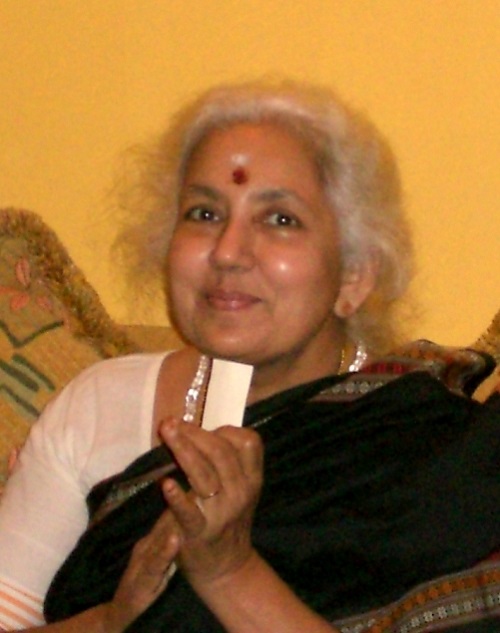
Usha Surya.- Have been writing for fifty years. Was a regular blogger at Sulekha.com and a few stories in Storymirror.com. Have published fifteen books in Amazon / Kindle ... a few short story collections, a book on a few Temples and Detective Novels and a Recipe book. A member of the International Photo Blogging site- Aminus3.com for the past thirteen years...being a photographer.
Deepika Sahu

Memory is a lover, memory is a stranger. Memory also changes colour as we add our own dash of imagination to it. Memory also carries a slice of romance. Memory is like a collage – there is an image, there is a sound and there’s an element of touch too. There are some sounds which we can still listen to. There are some sounds we lose as loss is a part of growing up. Even if we are not hearing them now, these sounds still play in the deep crevices of our hearts. Here I am listening back and soaking in the sound of memory.
The sound of thunderstorms and falling raindrops: There’s something about the sound of rain in Odisha. In the stillness of the night, when you listen to the falling raindrops, it’s like God singing a lullaby for you. You can feel the magic in your heart.And there’s a distinct sound of Odisha’s thunderstorms The anticipation of the rains lashing, the sky changing its colours and the darkness enveloping everything around you and taking you to a surreal world. Now, far away from home, the sound of raindrops (no matter where I am) takes me on a retro ride. Some might say rain sounds the same everywhere. But I beg to differ on this.
The voices of street hawkers walking in our neighbourhood: Each one of them had a distinct voice. They carried their signature voice with their footprints. The one with the kulfi, ice-cream and sonpapdi always came with a bell. The moment we used to hear the sound of his bell, we used to run outside to get our share of joy and happiness. There was a man who used to come on a bicycle to sell fish. And he used to shout at the top of his voice, “maccha”, “machcha” (which means fish in Odia). We could hear him from a distance and brace ourselves to buy the fish. “ Paper, Paper,” shouted the man who collected old newspapers, books, magazines and any junk household items. Moodhi (puffed rice), moodhi – the man on the cycle selling it said in a voice with rhythm.
There was an old man who used to come to our neighbourhood every evening with a bag full of peanut laddoos (sweets). We never heard his voice. He came to our neighbourhood exactly at 5 pm every evening. His timing was his voice. He needed no sound to mark his presence. We used to wait outside at 5 pm to buy goodies from him. He had a dignity that was unmatched and that dignity was his voice. It has been decades since he left this world but he remains a part of my childhood memory.
The cuckoo bird’s lovely voice: Our favourite childhood activity was to say ‘Ku ku’ just immediately after the cuckoo’s (koel) lovely mesmerising note. For some reason, the louder we said, ‘Ku ku’, the cuckoo used to be in competition with us. It used to go on and on till we used to get a scolding from my mom to not to irritate the precious bird. Now, when I hear a cuckoo bird, I smile and just soak in the richness of life, nature and memory.
My mother’s glass bangles: My mother always wore glass bangles. There was a very soft sound of those colourful bangles. When she stirred a curry on the pan or just moved her hands, it was always accompanied by the sound of the bangles. Sometimes, while sleeping next to her, I just moved her bangles upwards so that it would make a sound. In absence of my mother, the sound of glass bangles are gone from my house. Sometimes, I now wear glass bangles just to feel that sound in my heart. I knowingly move the bangles upwards or shake my hand a little bit so that I can go back to the sound of my mother’s bangles.
My father’s arrival: First it was the little bell on the right side of the cycle. And that bell announced the arrival of Baba. And then my father’s Bajaj scooter arrived and the sound of his arrival changed. One of my happiest memories was going for a scooter ride with my father. I felt like a little bird. And when I was in middle school, my father got an Ambassador car and again the sound of his arrival changed. From the little steel bell of the humble cycle to the honking of the car, the sound announcing the arrival of my father changed. It was also a sign of his journey of earning a living through hard work and integrity. His coming home was always a happy sound for me. Later on as an adult when I used to visit home during vacations, I used to sit on the balcony waiting to hear the sound of his car’s horn. From a distance, I could make it out that it was his car and it invariably made me happy. The sound of his home coming was always reassuring — a kind of continuation of life with its myriad emotions. With his passing away, only the memory of the sound of his home-coming remains.
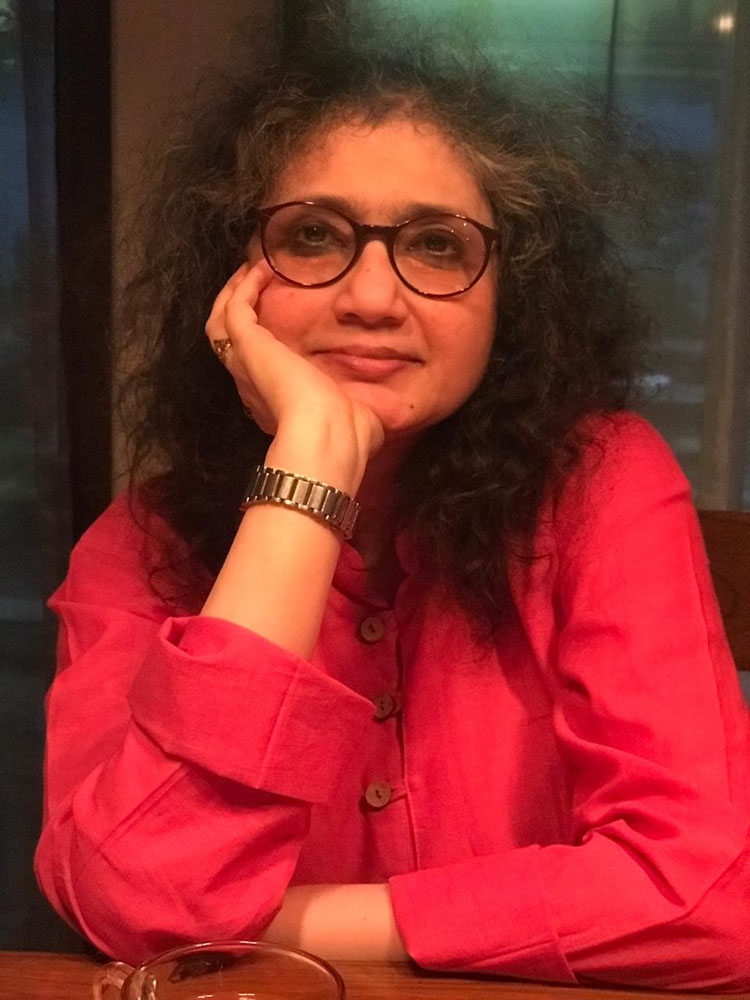
Deepika Sahu is an Ahmedabad-based senior journalist with a career spanning since 1995. During her career, she has worked with India's premier media organisations, including the Press Trust of India (PTI) in New Delhi, Deccan Herald in Bengaluru, and The Times of India in Ahmedabad. Currently, she is contributing India-centric features to Melbourne-based The Indian Sun, a cutting edge media platform. In addition to her journalism career, Deepika is involved in teaching English and Communication Skills to learners from different parts of India through Manzil, a Delhi-based NGO. Beyond her professional endeavors, Deepika is passionate about India's rich diversity, literature, blogging, quiet hours at a cafe and enjoying a cup of tea.
Phalguni Sahu
Neha stood by the wide glass window of her office, watching the city glitter beneath her like scattered stars. Yet her thoughts drifted far from the skyline- to old corridors, quiet classrooms, and memories that refused to fade. Back then, silence had been her constant companion, and shyness her invisible armour. She rarely spoke unless Neelam or Arti pulled her into their whirlwind of chatter. Hidden corners of the college felt safer than the noisy world she could never quite enter.
It was there, one afternoon, that her friends suddenly squealed in excitement. “There he is! Look, look!” Neelam whispered, tugging Neha’s sleeve. “Who?” Neha asked, blinking and adjusting her glasses. Arti sighed dramatically. “The Hunk! Have you seen him? He looks straight out of a magazine!”
Neha squinted at the tall figure walking across the courtyard. Her eyesight blurred his features, but she could sense her friends’ thrill. Later, she learned his name- Mohit, her senior in the Zoology department.
Days rolled on. Neha continued to walk through college halls quietly, until one afternoon Snigdha, her hostel senior, called out, “Neha! Come, I want you to meet someone.” Beside her stood Mohit himself; confident, well-dressed, warm-eyed. “Hi, I’m Mohit. We’re planning a seminar on the Mandal Commission Report. Would you like to help?” Neha’s voice got stuck somewhere in her throat, so she simply nodded. But inside she wondered desperately- Why me? Why talk to someone invisible in her own class? Snigdha laughed softly, patting her shoulder. “She will help. She’s brilliant.”
The moment she returned to her friends, Arti nearly collapsed. “OH GOD! Neha, you were talking to Mohit!” Neha could only smile shyly and walk on.
Over the next few weeks, she bumped into Mohit often- in the library, the corridor, near the canteen. Their exchanges were brief, but every “hello” from him felt like sunlight breaking through her carefully guarded world. One evening, Snigdha informed her that a guest was waiting in the lobby. Neha reached the hall and froze. Mohit sat there, waiting for her. “Hope I didn’t surprise you,” he said with a shy smile. They sat and talked for nearly two hours; about books, music, even stray thoughts she had never imagined sharing with anyone. That night Neha lay awake, her heart full, her mind racing. Somewhere between his questions and her hesitant answers, she had fallen in love.
But love made her even more nervous. She avoided Mohit when she could, choosing different paths deliberately, a habit she hid with careful precision. She never revealed that inside her heart, Mohit’s presence had taken root like a soft, persistent echo.
Exam time arrived. On the night she left for Bhubaneswar with Snigdha, fate surprised her! Mohit boarded the same bus and sat right behind her. Her heartbeat was so loud she thought everyone could hear it. During the journey, he mentioned casually, “I’ll be back next year for my Second-Year exam. I skipped it for medical prep.” Neha felt joy bloom silently inside her.
Months passed. She prepared for her Final Year and the MBA entrance, but in her heart, she counted down to the day Mohit would return. And he did. Their meeting was brief, but something felt different. His warmth had dimmed. His tone was unusually distant. Neha tried to ignore it, but unease simmered within her.
On the last day of college, as she walked back to her hostel after her exam, she spotted him with his friends. Gathering every shred of courage, she called out, “Mohit… I just wanted to say… all the best.” He stopped, turned, and suddenly said something she would never forget. “Neha, don’t be so timid. Have you ever seen yourself? You’re shy, diffident… so insignificant. Be someone in life. Otherwise, no one will care.”
Then, he walked away. Neha stood rooted, tears spilling before she could stop
them.
Back home, his words echoed endlessly. Days passed, then weeks, but the wound
remained fresh. Yet, somewhere inside, something hardened- not in bitterness, but in resolve. She used his words like fuel. She studied relentlessly, cleared CAT, and joined IIM Ahmedabad. Her transformation was complete; she emerged confident, articulate, charismatic!
And still, on every achievement, one name rose in her mind- Mohit. The only truth she held close was that he had joined the Combined Defence Services. She looked for him across all social media, chasing traces of a man who lived like a whisper- close enough to feel, yet too distant to find.
Two decades swept by. Neha became the founder of a successful company, admired and celebrated. One evening, she ran into her childhood bestie, Colonel Deepak. Over dinner, she shared the old story she had never told anyone in full. Deepak looked stunned. “Mohit? You mean Mohit Dash.? He was my batchmate at the Academy! Want his number?”
“Hello… Mohit?” she said softly. A pause. “Yes… who’s this?” came the voice. “It’s Neha. From college. Your junior from Zoology department.” A long silence followed. Then, finally, “Neha? My God… it’s been years.”
They agreed to meet for coffee. Neha arrived early. When Mohit walked in, he stopped mid-step, stunned. “Neha… I wouldn’t have recognized you. You look… incredible.” She smiled gently. “It’s been a long journey.” He sat down, still staring as if trying to reconcile his memories with the woman before him. “I’ve wondered about you,” he admitted. “Where life took you.” “Life took me far, Mohit,” she replied softly.
He exhaled, regret flickering in his eyes. “About that day… what I said” She interrupted gently, “Let’s not dig old graves,” though her eyes held a thousand unspoken questions. Mohit leaned forward, voice barely above a whisper. “Neha… the truth is, I…” But he never finished. A gust of wind blew in through the cafe door, scattering napkins across the counter. He turned instinctively, just for a moment. When he looked back, Neha’s expression had changed- calm, unreadable, quietly guarded.
With a faint smile, she whispered, “Some truths don’t need to be spoken, Mohit. Some… are meant to stay where they belong.” He searched her eyes for meaning, but she
gave none. They stood together and walked toward the exit. He hesitated at the exit, as if wanting to say more- or take something back- but instead, he simply nodded. Neha watched him walk away. He didn’t turn back; She didn’t call out.
Outside, the world carried on as if nothing had happened!
Inside, Neha felt something shift - a door closing, another opening. What Mohit had tried to say… and what Neha had understood… were known only to the silence between them.
And perhaps, that silence held the real ending - or the beginning that never
came.
Phalguni Sahu is a development leader who has spent twenty-five years shaping transformative initiatives across government, public sector institutions, and international development organizations. An MBA in Rural Management from the Xavier Institute of Management, Bhubaneswar, she carries into her writing the same depth of insight and quiet sincerity that define her professional journey.
For Phalguni, writing is a sanctuary- an inner courtyard where thoughts unfurl gently and truth finds its voice. She is an ardent reader, forever drawn to the reflective rhythms of literature, and her creative work spans contemplative spiritual blogs and evocative short stories.
Darsana Kalarickal
“Why are you sitting there like someone who’s bitten into raw ginger? Hurry up and chop it, man.”
Startled by Rukku’s sharp voice, Rama, who was slicing ginger, jerked slightly. He looked her hardly . Unable to bear that stare, Rukku turned toward Dakshayani.
Mother, please make it speedy, won’t take more time. He is holding ginger there, and here’s the lemons. I told you to cut the green chilies. Only after that I can put the tamarind on to boil.”
“Then you go on cutting. Or else, drink a little of that tamarind you’ve put to boil. Might cure your stomach cramps.”
Muttering under her breath, Dakshayani began slicing the lemon. Knowing well that arguing with mother was pointless, Rukku moved toward the stove. Dakshaayani was her mother , but shows more softness towards Rama.
“Grandma, no need to ask anything. Father went for his alumni meet yesterday.”
Kalyani said this, biting into a piece of lemon, her face twisting with its sourness. Rama looked at his daughter helplessly.
“What’s wrong with that, Rama? Shouldn’t one be happy after attending a get-together?”
Just then, like a clap of thunder, came a voice.
“ Must have remembered her, that’s why.”
When Dakshayani looked, Rukku stood there near the stove, smoking like it.
“If you keep scratching with words like that—” Rama began to jump up with the knife in his hand, but Kalyani quickly caught hold of him and forced him back down.
“Don’t, don’t. When I say stop, she climbs right over my head.”
Rama muttered.
“That’s exactly what he wants.”
Striking her chest twice, wiping her eyes with the edge of her saree, Rukku stomped inside. Somewhere inside, a door slammed loudly.
“That’s her trick. An excuse to avoid work.”
Rama muttered to his daughter, smiling as she looked in the direction her mother had gone.
“That's true. She’s terribly lazy today.”
It was during the time when the company shut down and there was no work that they started Rukku’s Catering. They began it during Onam season with pickles, ginger curd, and other curries. Gradually, they started preparing small sadya meals. The unadulterated traditional flavors caught on quickly. Orders began to come in steadily. There was a sadya scheduled two days later. If pickles and other items were prepared in advance, the taste would be better. It was in the midst of these preparations that the quarrel broke out.
She had a bit of temper, that was all—poor thing. It had started when Rama mentioned going to the reunion yesterday. After the previous reunion, he had thought he’d never go again. But memories—someone or the other would always dig them up.
“What exactly happened yesterday, Father?”
“Krishna came and insisted. I couldn’t refuse. He promised no one would bring up old memories. Everything was going pleasantly until Shyamala came and said, ‘In memory of our Seetha,’ and sang the song Seetha used to sing.
She sang it when we were in sixth grade—the day before the school closed. That evening, at the temple grove, she strung fallen palash flowers into a garland and placed it around my neck. She said, ‘When we grow up, you must return this garland to me, Rama.’
Krishna and I failed fifth and sixth grade at that time. The only reason we passed seventh was because of her. When we were in eighth grade, just before Onam, a landslide happened after heavy rains. Like a tear, she was swept away. Her entire family perished. Many were never found.
Who knows if she’s dead or alive?”
Rama’s eyes brimmed over.
“Oh! Rama… how many times will you keep saying this? Just stop.”
Krishna entered carrying two large wriggling stripped murrel fish in a basket.
“Hey, sister…”
A long call.
“Squeeze a little lime and bring it here. I’m terribly thirsty.”
At that moment, the sound of a door opening came from inside. Rukku appeared, with hair loosely tied.
“What’s wrong with your swollen face? Did Rama say something bad about you?”
“She needs a reason to cry. Might burst into tears any minute.”
Rama vented his anger on the ginger slices.
“Found them on the way.”
After handing over the basket with the flapping fish, Krishna joined Rama.
“Leave all those old things behind.”
“What has he done ? She’s snapping ropes over such trivial matters.”
Adding slit green chilies, salt, and turmeric to the chopped lemon and mixing it well, Dakshayani lined up the vessels and stood up.
“I’ll clean the fish. Give it to me.”
For years she had always been that way. Fish and meat must be cleaned by herself. Kalyani followed grandmother.
“Still, my Rama—you love her?"
Krishna laughed loudly.
“It wasn’t love, Krishna. You won’t understand it.”
Rama’s smile faded.
Slowly, the sunlight began to soften.
---
Near the palash tree by the garden, Seetha stood motionless, holding a fallen flower close to her nose. It was odourless. In her memories, an overgrown sacred grove emerged. Two people swinging on creepers in the wind. Near the darkening grove, a girl who placed a garland of palash flowers around a boy’s neck and ran away. When she turned, the boy stood frozen like a statue.
Her eyes filled.
“Seetha.”
She quickly wiped her eyes and turned. Behind her stood Lankesh.
“Nostalgic…”
Looking at the palash flower in her hand, he murmured, his beautiful smile intact. Seetha did not look at his face. These days, his smile gave her a strange dizziness—an unsettling feeling of losing herself. In his eyes always shimmered hope. So many nights, when she was trapped and rising in floodwaters, those anxious eyes watched over her.
From that day onward, their hands had held on together.
She drifted backward into one of the years where scattered fragments of memory were pieced together. Those who connected the memories pointed out that Rama had changed a lot. She had rushed forward, wanting to stood before him and say, “I am Seetha.”
But she froze when she saw a little girl in silk skirt and blouse running ahead of him. He was with a woman. Vermillion dust glowed red on the woman’s sweaty forehead. Jasmine flowers clung stubbornly to the ends of her long, wind-swaying hair. Rama stood frowning at the question rising on her face.
Lost in the roar of a rushing river, Seetha lost all sense of time and space. Lankesh pulled her into his arms. As they drove back silently, even while Rama played with the little girl, kissing her cheeks, his astonished gaze followed Seetha.
Perhaps to drown out the helpless sobs rising behind them, Lankesh turned the music volume up that day.
Later, many times, Lankesh went abroad alone—and returned alone. But he never disturbed Seetha. He waited, believing she would come once she understood herself.
Today, after a long time, she looked into his eyes.
This is not Lanka to burn yourself down.
It is your life, Seetha.
It felt as though his eyes were whispered to her.
She held his outstretched hand tightly.
The intoxicating fragrance of flowers in the garden covered them.
*Darsana K.R., residing in Venginissery, Thrissur district, is an employee at Venginissery Service Cooperative Bank and a passionate poet. Her published works include the poetry collections *Kavithaye Pranayichaval, Pranayathil Akappettathinte Ezhaam Naal, and Kuldharaayil Oru Pakal; the short story collection Thekkedathamma V/S Ramakavi (co-authored with Dr. Ajay Narayanan); the memoir Kunnirangunna Kothiyormakal; and the poetry study Kavithayude Veraazhangal. Her poems and articles have been featured in various periodicals and online platforms. phone : 9645748219, email darsanakr1973@gmail.com.
OUT OF REACH (APAHANCHA DURATA)
Ashok Kumar Mishra
Today’s morning was somewhat different and unique, felt Surama. Since long life had become otherwise dull and colourless. Time flowed routinely, unnoticed, uneventful and without any spark. She gazed above as the new sun sprinkled vibrant golden hue across the azure sky, filling positive vibe and warmth everywhere. Birds were leaving their nests chirping around. Myna, parrot, house crow, black drongo, oriole, kingfisher and many such small birds were chirping around Surama’s kitchen garden as if making their presence felt. Husband Ramakanta, who usually listens to devotional songs from YouTube with full volume lying on his bed till late morning had surprisingly got up early to-day and was busy searching something. Fisherman Anadi, who promised to come and catch fish from the house-pond, was yet to report. But Ramakanta was unperturbed. He was busy in his own world searching for something vigorously.
A house crow had been sitting on the drainpipe of the water-tank and cawing continuously. Surama pondered how the crow knew that his son, daughter-in-law and grandson were coming that day after three long years.
“Please make a call to Anadi, he is so careless” Surama urged to Ramakanta.
“Oh, You are unnecessarily worried Surama. He will come of his own in time” said Ramakanta.
“Tell me what are you looking for so long early in the morning?” Abinash with wife Smruti and son Omkar will arrive any time in the afternoon and you are busy with unnecessary things.”
Ramakanta said “Don’t worry, I will call Anadi. You are keeping my things here and there and I have to search for them everywhere, when I require them badly. I carefully covered and kept Ramakanta’s childhood day cycle which you have misplaced without informing me. Abinash used to like that cycle and was very much attached to his first cycle. I got it repaired and kept in running condition. Once here, whole day Abinash and Smruti would be busy with laptops in their rooms. I would teach Omkar how to ride on that cycle.”
“You have not changed at all. Will Omkar look at that old-fashioned cycle- forget riding? I have kept it above the rice bags in the store-room.”
For a while Ramakanta was lost in his past, how young Abinash insisted to purchase that cycle for him. Within his meager salary income as a junior clerk he had a hand to mouth existence and there was no scope to be extravagant. Senior head clerk Mohantybabu purchased a sports cycle for his son Mantu from Kolkata and Abi insisted he wanted exactly the same cycle. Every salary day he would take some alibi, lie to Abinash and would promise to purchase a cycle on some future date, but ultimately to keep him in good spirit, borrowed money from a colleague and purchased the cycle for Abinash from Tatanagar.
The cycle soon became Abinash’s obsession. Every evening when Ramakanta was little free, on Abi’s insistence both would go to the nearby football field. Abi would find difficulty in balancing the two-wheeler, as his legs remained few inches above the ground and Ramakanta would be running holding and balancing the cycle from behind. Occasionally Abi would look back to find if Ramakanta is doing his job properly. Once Abi mastered riding he would never part with the cycle even for a moment.
However, the enthusiasm did not last long with pressure of study slowly weighing heavy on the young shoulders of Abi. The load of schoolwork, tuition, coaching, karate training grew continuously and the passion for cycle became smaller. Ramakanta became nostalgic- how soon Abinash grew up before he could realize the same. He and Surama pushed young Abinash into the rate race for a brighter future sacrificing his childhood. Soon the cycle became a steel junk and became another unnecessary show-piece.
How many innocent childhoods are not lost in the dreams of their middle class parents? Ramakanta and Surama have sacrificed everything in building a bright career for Abinash. On his part Abinash too had given his best. Surama spent two years with Abinash in Kota for IIT coaching, leaving Ramakanta behind. Abinash was school topper and secured top rank at state level. After passing out from IIT Mumbai he did his management degree from IIM, Bangalore and subsequently joined an American tech-company at Texas.
Both Surama and Ramakanta would take pride while mentioning about the accomplishments of Abinash. After Ramakanta’s retirement and since Abinash went out for higher studies they are alone in their house. Both have aged and have become weak. Surama always missed Abinash and shed tears in private. Ramakanta too felt absence of Omkar. Had he been nearby he would have often visited him. Getting American visa is so cumbersome. It was silent suffering.
Abinashon his own selected Smruti as his life partner. Smruti preferred to stay in America. Whenever she came to India she stayed with her parents in Delhi and hardly came to her in-law’s house. She did her MBA in hospitality management after marriage to Abinash and had been working since then in US. Initially she took excuse for study and work pressure and on that pregnancy followed by caring for Omkar. Abinash kept on insisting that instead they go to USA and stay long with them like Smruti’s parents.
Since marriage to Smruti seven years ago, Abinash came home twice. But each time after staying for a day or two he would leave for his in-law’s place and fly back to US. It hurt Surama who shed tears. Every time she complained to Ramakanta that he was responsible for distancing her child away from her by sowing big dreams in Abi’s mind. Abinash justified “to survive in cut throat completion what is important is hard work and sacrifice. Where is the scope for rest, holidays and family?”
Several times Ramakanta warned Abinash “while running in life’s race to achieve, one must not forget to remember the faces of his near and dear ones. Whether you are distancing yourself too far away from them where their faces look hazy.” He took a long breathe and lifted the cycle from atop the rice bags, dusted and oiled the cycle and asked Surama “tell me now whether our Omkar would like it or not?”
“Let the child come home first. My house would be full of life. If he does not like the cycle make Omkar sit on your shoulder and roam around.”
When Abinash visited last three years back both Surama and Ramakanta wanted to celebrate Omkar’s birthday in the house. But Smruti insisted to organize Omkar’s birthday at Delhi with her parents. There they stayed for more than a week but did not stay two more days here to have the function here.
Two years back Abinash came on office work to Singapur; he took a break at Delhi but did not find time to visit his own parents. Ramakanta felt bad about it but did not disclose this to Surama. Then came corona epidemic that forced everyone to confine to their homes. When Ramakanta contacted Abinash he advised “stay at home carefully, as millions are dying and he would visit home when situation improves.” Post first phase of corona he said “due to slow down of economy, cancellation of flights, uncertainty many Indians are losing jobs and were finding it difficult to return to US. Then it was second phase of Corona, restrictions, quarantine and what not; all came on way to visit India.”
When Surama asked “if we suffer from Corona here or children suffer in America what we can do to help each other? When millions working outside home in Mumbai, Surat, Ahmedabad and Delhi are returning home for safety, why Abinash is not returning?” questioned Surama. Ramakanta consoled Surama “let them stay safe wherever they are.”
In the mean time Anadi came and did his job. Surama remained busy as before. Sun reached its zenith.
Surama urged to call Abinash and find out if their flight reached Delhi.
“It is only 1 PM, Abi’s flight would arrive Delhi only at 3 PM. His mobile would be in flight mode. If you worry the flight pilot will not increase speed of the plane. Abinash promised to call on arrival at Delhi airport. Have patience” said Ramakanta.
Ramakanta was worried but he kept it to himself. Abinash had six hours stop over at Heathrow airport. He did not call before takeoff from London. Yesterday he heard about spread of Monkey pox incidents in London. “Are they in any difficulty?” They were coming after long three years. Abi did not inform anything. “If the flight was cancelled due to some reason what will they do? How will he pass this information to Surama?” After so many days he observed smile on her face. She would be heart-broken.
Ramakanta was nervous, but he was not revealing anything to Surama. He was moving in and out of the house and praying Lord Jagannath to bring everyone safe home. All his happiness evaporated suddenly. Every minute looked like an hour. Abinash should have reached Delhi, one hour before by this time. Why did not he call on arrival at Delhi airport? Did he miss the flight or was the flight cancelled? Who will tell him what happened. He feared to call Abinash. Finally he made a call to Abinash’s mobile.
“The phone you are trying to connect is unreachable” came the information. “Let the children reach home safe irrespective of whether we get information or not” Ramakanta prayed silently. He came near Surama and sat silently. Surama could imagine something wrong and felt it is not in her luck to see Omkar.
At the same moment a car stopped in front of their gate with screeching sound. Abi, Smruti and Omkar came running inside. Omkar went straight to Surama and hanged around her neck. Abi and Smruti greeted and said “our flight did not go to London due to monkey pox pandemic and the flight reached Kolkata after a brief stop-over via Dubai. We took a taxi and came home straight.”
9491213015(m)
(The End)
Completed his MA and M Phil in Political studies from JNU and served as Deputy General Manager in NABARD. He made pioneering contribution in building up Self Help Group movement in Odisha and popularized Amrapally mango plantation in the state. He has authored several books and written several articles on micro credit movement. Four tele films were made on his book titled “A Small Step forward”. He served as Director of a bank for over six Years.
An acclaimed Short story writer in Odia and English. His stories are rooted in the soil and have sublime human touch. Many of his short stories in Odia have been published in reputed magazines. His short story collection “Michha jharanara pani” was released recently.
(9491213015)(m)
T. V. Sreekumar
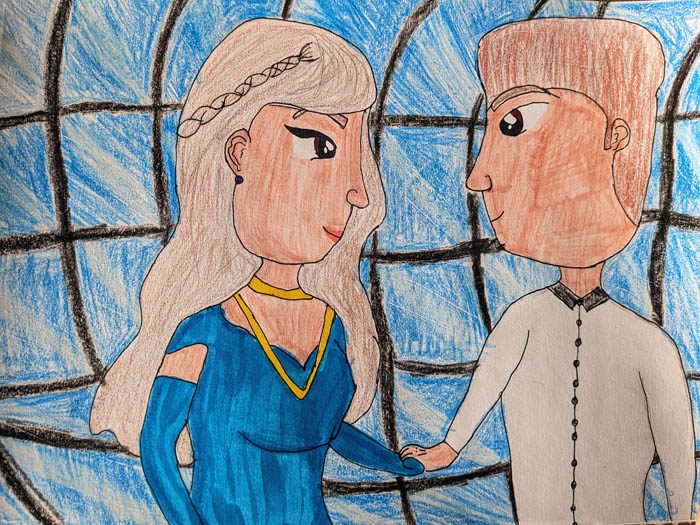
The movie “Sound of music” and the magical dance song in it was into my mind, body and soul during my early teens. The dance and the romantic movements in rhythm made the young one in me crazy. I visualized dancing with a partner and it remained a dream to happen and believe me, dancing together with an unknown one often came into my dreams. I used to take steps with an imaginary partner in the privacy of my room and had to force my dad to buy the record and I kept listening to it on and off. The lyrics were at the tip of my tongue and my body would start gyrating to the tune unknowingly.
I was in an Anglo-Indian School in the Anglo-Indian pocket of my town and at entry to the area the arch stood tall as if a cultural divide, and in real, the changes were seen beyond the arch in dress and language carrying one to a western world. The boys’ and girls’ school there stood side by side but the strict discipline kept our eyes off from the girls.
The cycle group to school gathered regularly at a point and we were going together as a team. The girls going to school on the way were an added attraction and one among them caught my attention and friends noticed it. She, an Anglo Indian, was sweet looking but the way she walked was the highlight, as if there was a spring on her feet. The jumping motion made her hair flutter and it was a very impressive sight. This observation by me went on for days and weeks and one day my friends put up a challenge.
“Why don’t you talk to her?"
That was never in my thoughts and I shuddered to think of it. With coaxing and encouragement from friends, I started to pick up courage and one day cycled towards her from behind and said,
“Hello, good morning”
Her spring like motion turned in surprise and a bright smile. She wished me in return.
That was the beginning of my interaction with my first girlfriend Rebecca.
With days going by I became more friendly with her and also her family. I often used to visit her home. We discussed movies and songs and “You are 16” stood on top. As for me the craving to perform was pinching and I told Rebecca about it. She said that we would suggest it to school during inter-school cultural competition.
“But I have never danced” I confessed.
“As you are so passionate you will learn very easily",.she said putting my hesitation to rest.
The idea was to put it forward to teachers later and when I did it, a few of them were sceptical but gave us hope saying,
“We will decide after a trial performance”
Hard practice for days under the guidance of a staff who knew dancing and at the trial performance my feet just glided along with the music almost perfectly. I was surprised at my performance proving that the dancer in me was just waiting to be tapped. The teachers were very much impressed and graded our dance on top.
Inter-school festival and western dance section we won hands down. The next day papers carried our photo and we became a popular pair. We were later called for a few private performances and it was fun. My dream became a reality.
School days for me were over and Rebecca being junior had two more years left. It was painful parting with her as my studies took me to a faraway place. I tried to keep track of her. Gifted her Daphne du Maurier’s “Rebecca” and she was surprised seeing a book in her name. Years later I came to know of her marriage and in the process of building our separate lifves she was lost to memory.
Much water flowed in the river of time and with marriage, children we remained busy. In the journey of life a few close-to-heart passed away without even living half their life. The unfortunate incidents left the living lonely, in shock and misery. Rebecca often came into my thoughts. She was a sweet one who made me happy in my teens. Once while practicing dance, she had said,
“Kumar, you have lovely curly hair”
My hands felt for it now and could get to the few strands left. In the autograph when I left school she had written in her lovely handwriting,
“Deep in a valley
Carved in a rock
Three little words
Forget me not”
I must have read it a million times then and one day late in life the sad news of Rebecca’s death reached me months after her demise. That was heartbreaking. She was special then and special now.
Had Rebecca been alive, we would have danced now for old times’ sake singing,
“You are 60 going on 61”
T. V. Sreekumar is a retired Engineer stationed at Pondicherry with a passion for writing. He was a blogger with Sulekha for over fifteen years and a regular contributor writing under the name SuchisreeSreekumar.
Some of his stories were published in Women's Era. “THE HINDU” had also published some of his writings on its Open Page..
MAHA MRITYUNJAY TEMPLE NAIGAON
S. Sundar Rajan
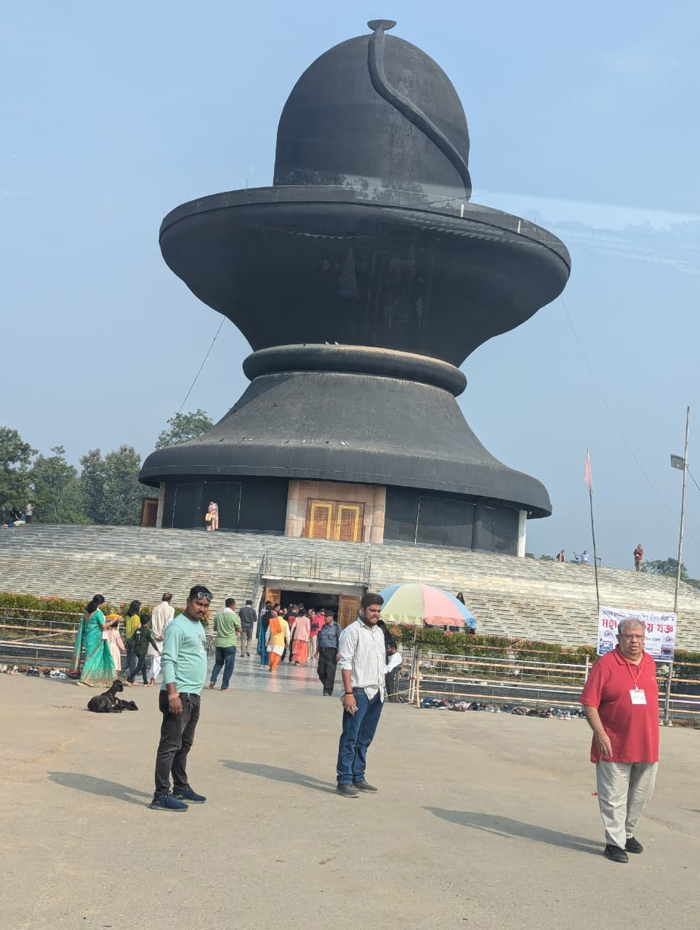
We began our sixth day from our hotel at Kaziranga forest at 8 am to Cherapunji in Shillong. Our tour operator cautioned us that the ride would take about nine hours covering a distance of around 250 kms. He also felt, closer to Shillong the heavy traffic would slow us down.
The vehicle stopped for a short while for us to pick up some tea packets as local souvenirs. The shop keeper on seeing the volume, presented our tour leader with a cap bearing the shop name and emblem. He in turn gifted it to our tour guide from Agartala.
We drove across a well laid two lane Highway. The speed was regulated due to speed breakers at specific points, identified as animal corridors and to allow traffic coming from the opposite direction. The driver also had to navigate through slopes and hair pin bends. Wherever the roads straightened out, the driver picked up speed. After traversing about 120 kms, the driver took a right turn and a few minutes later he slowed down to take a left turn. There were excited voices all around in our van. I looked out of the window to view the towering Siva Lingam before us. We had reached the Maha Mrityunjay Temple, the structured on a Shiva Linga. My eyes slowly rose up skyward to fully drink in the 126 feet structural engineering marvel before me, being the world's largest Shiva Linga. My joy knew no bounds. Even as our vans came to a halt we were out in a trice and walked briskly towards the entrance, where we removed our footwear.
We walked across the well laid out pathway, with three water tanks on either side of the pathway, with colourful fishes moving serenely in the still waters of the tank, along with a few water turtles. We then alighted about thirty steps and it led us to the left side of the circular structure on the northern side. A wooden door opened on the right and we entered the sanctum sanctorum. We stood there in a trance. At the centre of the circular hall is structured the main sanctum with four main square pillars at a distance of about thirty feet on each side at the perimeter, in my estimation. The pillars are closed with a circular tabletop structure, about three feet high from the ground and of about a foot in width. I found an opening of about two inches below the tabletop and on the tabletop was neatly written "For Donations". This is very unique and appealed to me.
On the southern side there is an opening for the priests to enter the sanctorum. Behind the closed eastern door, the pooja instruments are neatly arranged against the wall.
The Lingam is placed at the center of the hall with an overhang horizontal circular plate and a channel behind the lingam, for Abhishek. Next to the Lingam is the Nandhi with a snake and behind the Lingam is a trishul. Near the Nandhi, we noticed a lamp in a box.
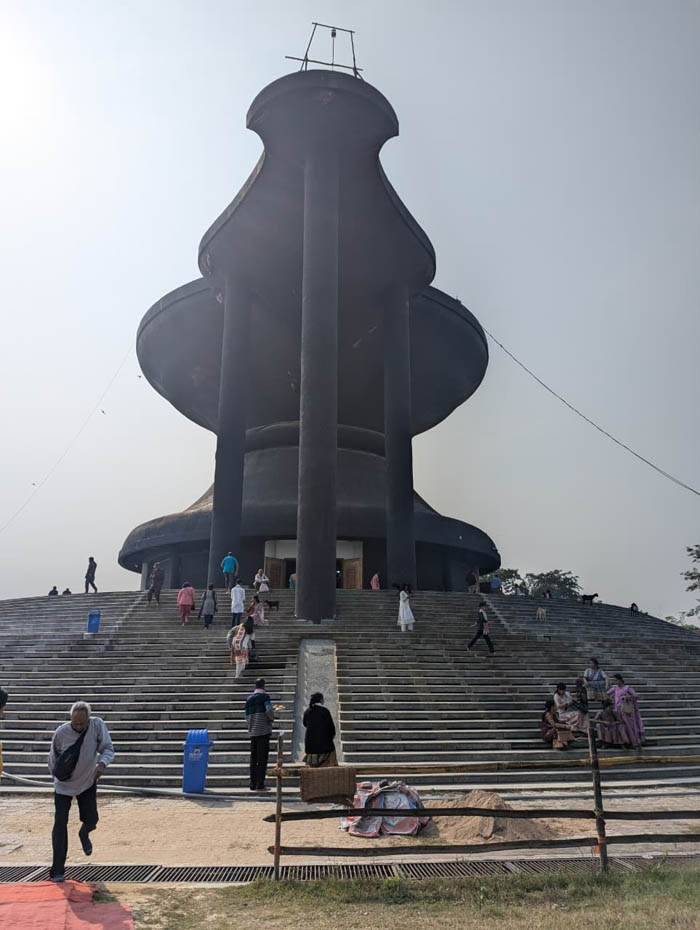
Close to the Lingam were placed lighted lamps with the other pooja paraphernalia.The ceiling wears an ornamental look with a lotus over the lingam on which is inscribed "ohm" and trishul.
We realised that we were just in time when the archana started.
After the initial formalities to start the pooja, a poojari picked up a plate with six compartments, lit the five compartments, leaving the one compartment at the rear, free. As the head priest started chanting the Hymns, with the slow beat of three drummers accompanied by the jangle of the cymbals, one of the priests performed the arthi to match the music. As the beat of the drums and cymbals increased, the priest also increased the frequency of the arthi across the Lingam. As the rhythmic beat raised to a high pitch, we had an inner feeling of ecstasy and tranquility, transforming us into a moment of nothingness with a calming effect.
On completion of a part of the Hymns, the priest placed the Arthi plate down. He then took another Arthi spoon and lighted a single lamp. Three more priests joined the seva and as the head priest continued with fresh Hymns, the other formalities were carried out by the other priests, the arthi was also being performed simultaneously. At the conclusion of the pooja, all the priests prostrated in front of the Lingam and the assembled devotees followed suit. One of the priests went round sprinkling the holy water on the bowed heads of the devotees. Another priest applied sandle paste on the forehead and one more started distributing the plantain as prasad.
I was curious to learn more about the instruments used but was told it was a restricted area. So we moved to the exit. We climbed down a flight of stairs on the western side which led us to the Durga shrine, where a priest blessed us by applying kumkum on our forehead and with prasad.
We thanked our tour guides for handling the temple yatra with quiet efficiency, which ensured we had a very blessed darshan and headed for our bus with fulfillment and renewed energy.
Inputs
# Mrityunjay : Means "Conqueror of Death" or " Victorious on Death". This Sanskrit name is an epithet of Lord Shiva and symbolises immortality and strength.
# Naigaon : Means "new village" derived from the Assamese word "na" (new) and "gaon" (village).
# The site is believed to be where the Mahamrityunjaya Mantra was composed 1000s of years ago.
# The construction of the temple was completed in Feb.'21.
S. Sundar Rajan is a Chartered Accountant with his independent consultancy. He is a published poet and writer. His collection of short stories in English has been translated into Tamil,Hindi, Malayalam, Telugu, Kannada and Gujarati. His stories translated in Tamil have been broadcast in community radios in Chennai
and Canada. He was on the editorial team of three anthologies, Madras Hues, Myriad Views, Green Awakenings, and Literary Vibes 100. He has published a unique e anthology, wherein his poem in English "Full Moon Night" has been translated into fifteen foreign languages and thirteen Indian regional languages.
An avid photographer and Nature lover, he is involved in tree planting initiatives in his neighbourhood. He lives his life true to his motto - Boundless Boundaries Beckon.
Bankim Chandra Tola
"Bhiksyaam Dehi” – an old, bearded monk pleaded at the door of Dipendra’s house one Sunday morning at about 11 o' clock.
“Dipu, see someone is outside.” - Grandma asked Dipu (Dipendra) from the inner courtyard of her house.
Coming out of his study room Dipu saw an old monk with a begging bowl standing in front of his door. He ran inside and said – “Grand Ma, a bearded monk is asking for alms.”.
“Don’t know where from these bogus monks come every day for begging in the morning.” – yelled Grandma from inside. “Give him some rice from the pot.”
Dipu went to the kitchen to get some rice. He searched the rice pot for some time and after collecting some rice in a bowl, he came out to give it to the monk, but by then the monk had left. Dipu thought, perhaps he might have heard the harsh words of grandma and left. He felt very sad and said to himself, in future he would never mistreat any beggar whosoever he may be. He returned with the rice and said, “Grandma, the monk has left before I came with the rice to offer What shall I do?”
“Let him go, keep it in the pot.” said his grandma.
Coming back to his study room, Dipu tried to focus on his lessons, but his mind kept drifting. Each time he read a sentence, the serene face with a deep look of the monk flashed before him. He thought – why did he become a monk to beg instead of working for earning his livelihood? Dipu wondered - what could be his problem? Maybe he has no house or no one in his family. Even then, he could have worked like many others having no house, no lands or nobody of their own. What compelled him to ask for alms wandering from door to door? He has seen many beggars, but they aren’t monks. What could be his aim?
Likewise, several questions hounded Dipu. Finding no answer, he became upset – leaving his study table he came near his grandma and asked, “Grand Ma, why do people become monks?”
“Either a lazy fellow or a cheat becomes a monk, only to find an easy way of living by begging.” Replied his grandma very casually.
“But grandma, that is also a work; as they have to walk miles daily from door to door with the hope of getting some alms and that is also not guaranteed as it happened today when he had to leave empty handed after hearing harsh words from you.” Said Dipu.
“Pooh! No more.” Chided Grandma. “Let him go. It doesn’t matter whether he did mind it; many such beggars, monks come and go daily. Don’t worry about them.”
Unsatisfied Dipu returned to his study room; but he was so obsessed with the incident that he couldn’t hold himself calm. He thought he must get his mind cleared about this somehow. Again, he thought, is it the only reason - to avoid doing physical labour, a healthy man becomes a monk and wanders about begging? No, it can’t be. There are also beggars who are not monks. Having done a lot of brainstorming exercise, Dipu decided to ask this question to his class teacher next day in the school. He thought, had his parents been alive, he could have got his puzzle solved. Dipu had not seen his grandfather who expired long before his birth and he lost his parents in his infancy, his grandma had told him.
Next day while going to school, all those unresolved questions about the monk tormented his brain. He thought today in the classroom he must raise this question before his class teacher and clear his doubts.
In the class as the teacher was about to start the lesson, Dipu stood up to draw his attention.
Teacher, “Yes Dipendra, what is your problem?”
Dipu – “Sir, why do some people become monks?
Teacher : “Why do you ask this question? Do you want to become a monk?” the teacher remarked with a smile.
Dipu – “No sir, yesterday a well-built bearded monk came to my house begging but before I came with the alms, he had left. When I asked my grandma about this, she told me that these monks are lazy fellows who do not want to work and go on begging from door to door for their living.”
Teacher – “To some extent your grandma is right. There are many such fake monks for whom people are disgusted with giving alms every day; her such reaction is not unfounded. Now, about your query on monks – actually, all beggars are not monks. Only a few of them stick to asceticism. Again, all monks do not go for begging. One becomes a monk when he has no interest in and no attachment with material things and worldly bondage. Such persons renouncing the worldly life practise penance for attaining perfection. Anyway, this is a very difficult and complex subject to discuss in this class since this is in no way related to our curriculum and above all, our life.”
Dipu – “Sir, do they succeed in their pursuit for achieving their goal?
Teacher – “Not known for certain. As you read more you can know many things about this. Our literature says, Gautam Buddha and Maharshies like Viswamitra, Vasista, Durbasa, Vyasa and many others could attain enlightenment.”
Then Dipu did not ask further questions albeit his mind at that moment was blown away to an unknown world roving aimlessly in quest of a shelter. After the school was closed, as he came home, he felt quite uneasy thinking of the scene that happened in the morning. He asked himself as to why did he not go out on the village lane to see where he had gone? Had the monk been near, he could have run to him to offer alms. He was sad. At night after dinner as he went to sleep, the same scene relayed in his mind until his eyelids were locked in slumber.
Days rolled by. Dipu was in High School then doing very well in his class particularly in mathematics. One day when he was playing in front of his house, one Yogi wearing saffron clothes closed in to his house. Yogi asked Dipu, “Anybody home?”
Dipu – “Yes, my grandma is there. Please wait, let me call her.”
Dipu came with his grandma near the Yogi. Yogi said, “Mother, today I want to take my meal in your house. Could it be arranged?”
“Okay Baba, but it will take some time to cook as I am busy now with cleaning work.” Replied Grandma.
Yogi – “No no, you don’t have to do anything for me. Give an earthen pot, some rice and dal. I shall cook for myself here in the open.”
Grandma – “Dipu, fetch a new earthen pot from our storeroom. Let me get some rice, dal and vegetables with water.” To the Yogi she said, “For cooking you may use this dry wood as fuel.”
The Yogi with all the materials started cooking. Dipu stood beside him watching everything. Out of curiosity he asked, “Baba! Why did you become a Yogi? Don’t you have a house and a family of your own?”
Yogi looked deep into the eyes of Dipu and said, “My boy, yes, I do have a house and a family like yours. But I have renounced domestic life in search of peace, shunning all worldly ties and now practising penance to attain enlightenment.”
“What is enlightenment? Asked Dipu.
Yogi, “Enlightenment is the achievement of highest spiritual state where there is no desire, no misery - absolute peace and contentment.”
Dipu – “What do you gain by that?
Yogi – “There is no point of gain or loss but by achieving the state of absolute contentment, the path to attain salvation will be clear.”
Dipu – “What is salvation?
Yogi – “Good question. Salvation is liberation from this material world so that there won’t be births and deaths.”
Dipu - "Baba! As I have read, for attaining liberation from births and deaths, one has to undertake rigorous austerities and pursue deep meditation in a solitary place. But how about you?"
Yogi, “True. According to Gautam Buddha, enlightenment doesn’t come either through excessive indulgence or by torturing the body. Body gives energy to perform all that you want to do. ‘Sariramadyam khalu dharma sadhanam’ that means: - the body is surely the foremost instrument for doing good deeds. So, if I do not take care of my body, I would have no strength, no energy to do my duty to accomplish my objective of attaining perfection in life.”
Dipu – “Baba, in this way is it guaranteed to attain perfection?”
Yogi – “If one’s perseverance is sublime and meditation is unshattered, one can reach the state of perfection in this life and that will pave one’s way for attaining salvation – a state from where there is no return to this mortal world and his soul will merge with whole from where all of us have emerged.”
Dipu – “Baba, in that case what will happen to the members of your family who depend on you? Is it not an act of selfishness?"
Yogi - “Good question. Every individual is an independent entity. Everyone has come alone and will go alone. No one is dependent on anybody. Each must make their own way. Yes, being in a family there may be some difficulty for others initially but with the passage of time that also shall vanish. As regards your query of selfishness – one may be called selfish when one grabs all the good effects of one’s actions being in this material world without sharing them with family and others. But an ascetic who has renounced the world and attains enlightenment by virtue of one’s resolute meditation, fosters welfare to humanity by enlightening others with his wisdom and knowledge gained. If you read the life of Gautam Buddha, all your doubts will be cleared fully.’
Dipu was confused hearing all this and took leave to have a bath as it was noon by then.
x x x
“Dipu, ask the Yogi if he wants anything more. I think his cooking must be over by now.” Grandma told Dipu from inside her kitchen.
“Yes Grandma.” Dipu came to Yogi and asked, “Baba, do you want anything more?”
Yogi, “Nothing, you also come here to take some khichdi with me. Get a plate, I’ll serve you some.” Said Yogi.
Dipu was excited to taste the recipe prepared by him and ran inside to bring a plate.
Dipu had never tasted such nice khichdi until then. He ate to his heart’s content and said “Baba, khichdi is the best ever I have taken.”
Yogi – “Okay my boy, I am happy. Both your grandma and you come here; I will bless you and leave.”
After blessing Dipu and his grandma, the Yogi said, “Mother, I am highly pleased with you for the hospitality. Ask for anything you want. I would like to give you a boon.”
Grandma, “What more shall I ask for me at this age, just counting the days for His call to lift me. Baba, if you want to give us something please bless my grandson, Dipu, to become a good human being and stand on his own feet in this complex world.”
Yogi – “Your grandson is a jewel; he will rise in his life beyond your expectation. My blessing will always be there for him. Now let me go. I may come some other day to see you both.”
With this the Yogi left their premises. Dipu asked his grandma, “Do you see, all monks are not fake and lazy as you said on that day. He is a great man. I couldn’t understand fully what he said about enlightenment and salvation; yet I agree that his sayings have immense value and deep meaning. I think he didn’t come here simply to ask for food but to bless us.”
X x x
Dipu had now grown to adulthood under the disciplined parenting of his grandma. He had seen how his grandma toiled hard to make their living and made him grow with the meagre pension amount that she was getting per month. Now he was a graduate; it would be his responsibility to free her from this load and let her live a happy life in her old age. With his B. Com degree, he started his search for a job frantically.
One evening – when he was returning from the weekly market with some vegetables by his bicycle, he saw a scooter lying on the road, and a lady had fallen in a dry drain beside it. On leaving his bicycle, instantly he ran to lift the lady and laid her on a plain grassy surface. He tried to bring her to senses. Because of evening time, the lane was empty; he could not find any instant help. Also, he could not find a source of water nearby to sprinkle on her face. He was clueless. Then he searched for the vegetables he bought from the market. Luckily, he bought two cucumbers. He then put the cucumbers in his handkerchief and crushed them to pieces by a stone lying beside. Then he took the pulp in his palm and squeezed it on her eyes. The lady somehow came back to senses and slowly got up to sit on the grass.
Dipu – “Ma’am, perhaps you met with an accident, and you fell into that drain senseless. How do you feel now?”
“Yes, it was a bad accident, when a car hit my scooter from behind and sped away. I was thrown into the drain. At that moment I felt as if I had lost my eyesight as I couldn’t see anything and then I lost my senses. Thank God you saved my life," said the lady.
Dipu – “No Ma’am, anybody in my place would have done this minimum. I have lifted your scooter which was lying on the road. You may check if it is in running condition.”
The young lady tried to start her scooter and Dipu stood beside to help her if anything went wrong. Wah! The scooter started. She said to Dipu, “Thank you very much. I can now go home. By the way, I am Rinky. May I know your name please?”
“I am Dipendra, take care Rinky Ma’am while driving," said Dipu.
“O sure, thanks. We’ll meet again, now let me rush to my home, my mom must be waiting for me as I have been out for a long time. Bye, Dipendra.” Rinky left in her scooter fast; Dipu kept looking at her until she vanished in the horizon. While returning home he thought, O my God! why did he not ask her address or mobile number at least, so that he could have inquired about her about reaching home safe and whether she was fine. Now he could not do anything; so, praying to God for her safety and wellbeing, he returned home.
On reaching home, Rinky narrated all that had happened on her way home to her mom. Rinky’s Mom was shocked to hear her daughter lying unconscious in an abandoned drain, that too in the evening when passersby could hardly locate her lying senseless. Thank God the stranger boy could save her life. She, out of emotion said, “Rinky, you haven’t done good. At least, you should have invited the young man who saved your life to our house. What would he be thinking of you and your upbringing?”
Rinky felt sad and said, “Sorry Mom, I was in a hurry to inform you about the accident, so I forgot to invite him to our house and hurried back home.”
At that moment her father came in and having come to know of her accident, he asked his daughter, “Rinky, have you seen the car number at least the brand of the car and its colour?”
“No Dad, I was thrown out of my scooter and fell down, there was no chance to see the car when I became senseless.”
“O my God! My loving princess was in such a horrible condition. Who is that young man that saved you?”
“Baba, he is Dipendra, he tried his best to bring me to senses. It was evening then, the lane was empty, nobody was there to help and there was also no source of water nearby. Thank God! At that scary moment, by his ready wit, he could use the cucumber he bought from market to get a few drops of water to put on my face. Really Baba, he is a great guy. But in a hurry to get back home I forgot to take his address or mobile number and I even forgot to invite him to my house. I am sorry.”
“Thank God you returned home safe and sound. Rinky, what you have done is not good. The guy must be from a cultured family ordained with a true sense of humanity. If you ever meet him in future, never forget to invite him to our house. We stay obliged to his magnanimity.”
“Yes, Baba. I know his name, but no address.” Said Rinky.
x x x
Two months elapsed after that gruesome incident. For a few days Dipu was a bit worried about Rinky’s wellbeing. But under the pressure of his hectic search for a job, he forgot what had happened on the spot of the accident. By degrees, the faint image of Rinky too, got wiped out of his memory. Meanwhile he applied to some companies and appeared in two interviews also but no positive result came out.
On one Saturday at about 3 P.M. when Dipu was relaxing in his study room being worried about his future, he heard the postman calling his name. Eagerly he came out of his room, and the postman delivered a letter to him and left. Anxiously he opened the envelope. He was delighted to see that the famous vegetable oil company of the city situated about 10 kilometres from his house, had called him for an interview on Monday at 10 A.M. He ran to his grandmother with the letter in hand and said, “Grandma, I have got a call from that vegetable oil company for an interview. Remember, you had told me once to try for a job there?”
“Very good. Prepare well and appear with full confidence. I am sure you will be successful this time.” Said Grandma.
On the scheduled day, Dipu took the blessing of his grandma. hurried to reach the office of the company, well before time.
When he reached the destination, he was surprised to see a large edifice with armed guards standing in front of the gate. Closing in, he showed the call letter to the guard who opened the gate and allowed him to enter. At that time one gentleman came forward and guided him to the venue. It was a gorgeous drawing room with a fabulous sofa and well-decorated. He found two persons, may be the aspirants for the same post, were sitting on the sofa. He thought, if his luck favours, he might have a good opportunity to work in this big establishment. Thinking such hyperbolic things he occupied a seat. Dipu of his own introduced himself to them, “Hi I am Dipendra.”
“Hi, I am Ramen, a Chartered Accountant. You?”
Dipu got a jerk to see a C.A. for the post which he wanted to acquire. Humbly he replied “I am just a B. Com.”
“Hi, I am Rajendra, a Cost Accountant.” The other candidate introduced himself.
Dipu’s palpitation accelerated, having heard the qualification of the two contestants. He thought, this post also is going to slip through his fingers. An unexpected anxiety and fear occupied him, making him feel as if he was an odd man out there. After all, why would the Company like to recruit a mere B. Com when C. A. and cost accountants were available? Anyway, thinking of all these absurdities, he sat quietly and prayed to God to give him courage to face the interview.
Exactly at 10.30 A. M. the bearer called Rajendra, who came first, to get into the interview board room.
After about half an hour the next candidate, Ramen was called in. Dipu out of curiosity asked Rajendra about the pattern of interview. Rajendra casually said, “There are three persons in the board including a young lady. They asked me several questions on accountancy and how to make the company stand alone.” Then he left.
Dipu thought if such questions are asked, can he answer better than them? Only God is the last hope for him to get through.
After 20 minutes or so, Ramen came out. But he was not called. He thought, perhaps they have already selected a candidate; so, they did not call him. He became a bit nervous and lost all hope for his chance.
After about 15 minutes, the calling bell rang, and the bearer went in. Coming out of the chamber, the bearer asked Dipendra to get in.
Dipu took a deep breath and invoking his revered deity slowly but confidently opened the door,
Looking at the board members, uttered with a smile, “Good morning, sir.”
The member sitting in the middle, probably the chairman of the interview board said, “take your seat”.
Dipu, saying thank you sir, sat on a chair lying in front of the chairman.
Chairman, “What is your father?”
Dipu – “Sir, I lost my parents in my childhood. I was brought up by my widowed grandmother.”
Chairman, “What happened to your parents?”
Dipu, “Sir, as my grandma told me, after my birth my mother died, and after two years of her death my father died from a heart attack.”
The other two member said at a time “How sad, then how did your grandmother manage to bring you up?”
Dipu, “My grandfather was working in state Govt. After his death my grandmother has been getting some pension.”
Chairman, “Okay, can you perform the job of accounting for our factory and office? Can you comply with the reports and returns to be submitted to the Govt. including updating GST and IT?”
“Yes sir.” Dipu said confidently looking straight at the eyes of the chairman.
The young lady in the board, perhaps recognised Dipendra recollecting her accident and asked, “Well Mr. Dipendra, supposing you are going to the bank to deposit some cheques for clearance on the same day so that the proceeds can be utilised for releasing an urgent consignment failing which the company will suffer huge loss. But while going to the bank, you saw on your way a lady lying senseless beside the road, possibly hit by a speeding vehicle. Nobody cared to help her. Should you stop to lift her and take her to a nearby hospital for first aid or leave her as such like others for you have to perform your duty as an accountant of our company?”
Dipu – “Ma’am, my conscience will bite me if I leave her like that. I must do what best I can do at that moment, because for me humanity over-rides duty. If the clearing of cheques is not done for delayed deposit, the company might suffer some loss, but a life will be saved. For negligence of my duty, I may be charged by the company or at best be fired. No matter, I may suffer a lot by that, but I shall never be guilty before God.”
Lady, “Okay, did you ever help someone like this in the past?”
Dipu – “Yes Ma’am, about two months ago while returning from the market, I saw a lady lying unconscious in the dried drain beside the road and her scooter had fallen on the road. Instantly I lifted her and tried to bring her to senses but after gaining senses, she started the scooter and left. Though she thanked me, I couldn’t ask her address or mobile number to check whether she reached home safe. That remained a scar in my mind.”
Lady – “Can you recognise her?”
Dipu – “No Ma’am I was so panicked that I couldn’t see her face properly.”
Chairman – “But when you are on duty, is it not your prime responsibility to do your duty first and social work thereafter?”
Dipu - “Yes sir, you are right; duty first rest later, but when somebody's life is at stake, I shall prefer to postpone my duty for some time to help the victim and for that matter I shall not hesitate to accept any punishment given to me.” Said Dipu confidently without any hesitation.
“Okay, thank you. You may go now.” said the chairman.
Thanking the board Dipu came out of the chamber and left for home.
On reaching home, Dipu came to his grandma with a sullen face and said, "Grandma! Why every time something odd happens with me? Am I so unlucky to stand on my feet in this world? This time also my chance is remote as candidates more qualified than me were there.”
Grandma affectionately asked Dipu to sit beside her and putting her left palm on his head she said, “Look my boy, the world is a large stage, we are all players. We are simply allowed to play our role, but not to command the result to go in our favour. As a disciplined player, you have been doing your part best to hit the target, why do you worry before the result is announced? In the realm of God, not a single creature is overlooked or denied its place as deserved. At appropriate time, He will bestow what is due for you. So, my loving Dipu, don’t worry, if this time also you are turned down, it is not your failure, but a successful attempt in eliminating one more glitch. Go on pursuing your effort, a day will come when you shine better than expected.”
Grandma told Dipu to go and get refreshed so that she will serve some food for him.
Dipu now felt much relaxed as if all his anxieties, worries had evaporated.
A few days later, grandma told Dipu, “Why don’t you join a post graduate course instead of sitting idle at home and looking for a job?”
Dipu – “Grandma, no more studies, I must move out for work. I can’t see you toiling hard day and night for our living. I have applied for two more companies. Let me see what happens.”
“Okay Baba, if you are so determined to go for a job, it might come to your bag of its own. Just wait for the right time.” Said Grandma.
At that moment the postman came in and handed over an envelope addressed to Dipendra and left.
Dipu anxiously opened the envelope and was surprised out and out reading the content. Out of ecstasy of joy he ran straight to his grandma and touched her feet with the letter in hand.
At this, grandma couldn’t make out anything and out of curiosity asked Dipu, “What is the matter?”
With a mouthful of smile Dipu said, “Grandma, your blessing has borne fruit. I have got an appointment from the company where I had no hope of getting the job. They have offered me a salary of Rs. 50,000/- per month and asked me to join within seven days. Tell me on which day I shall join duty?”
Grandma was very pleased and hugged Dipu affectionately, kissing him on his forehead and told him, “Great news. Do you see, God is always great and kind. You may go to join on Monday. Had your Grandpa and parents been alive; they would have been highly pleased.”
Dipu – “Grandma, do you see the words of that Yogi came true. Otherwise, this miracle would never have happened.”
Grandma – “May be, but it is your soulful endeavour and strong determination that bore fruit. It is said, “Udyogi Purusasinhamupayati Lakshmi, Daiben deyameti kapurausa badanti – that means – Goddess Lakshmi favours the one who is a lion among men being enterprising and industrious. But the cowards say the success and riches are divine gifts. In other words, fortune favours the brave, not the cowards."
Monday morning was a busy time for both grandma and grandson. Dipu, after taking blessings from his grandma came out with his old bicycle to reach the company’s office before 10 A.M. But before stepping out of his house Dipu said, – “Grandma, never treat rough with any Yogi or monk or a beggar calling at our door for alms. Who knows God might be visiting to test us.”
On his way to join the new job, Dipu thought how would be his first day in the office. Neither he knew the work to be done nor their office decorum. Praying to God, he went on pedalling his bicycle fast.
The armed guard in the gate on that day did not ask for his identity, rather opened the gate, just on seeing him and showed him the direction to reach his office and also showed him the cycle stand.
As Dipu entered the office, there was none except a sweeper busy in wiping the tables. Dipu without asking anything, sat down on a chair waiting for other staff to come in. At 10 A.M. the staff started coming in one by one. Dipu out of anxiety asked one of them, “I am Dipendra. I have come here to join today. Could you please let me know to whom I shall report?”
The gentleman saw his appointment letter and said, “You are asked to report to our Madam who will come at any moment; until then please wait here.”
After about 10 minutes, an elegant lady well dressed in blue sari got into her chamber inside the office. The gentleman hinted Dipu to get into the chamber for reporting.
Dipu became alert and advanced towards the chamber. Coming near the door he knocked slowly. From inside a sweet voice was heard, “Come in.”
Dipu slowly opened the door and said, “May I come in Ma’am?”
“Yes, come in.”
Dipu – “Good morning,”
Lady – “Very good morning. Please sit down.”
Before sitting on a chair Dipu placed his credentials as advised in his appointment letter and sat down saying Thank you.
“Mr. Deependra, welcome to our company. Trust you will feel homely while working here. As one of the directors of this company, I assure you of necessary assistance. Initially you may go through the system followed here for housekeeping, reporting and complying with Govt. regulations pertaining to our company together with GST and IT returns. To help you two more assistants and a messenger will be there. In case of any doubt or any problem, you may feel free to come in to discuss with me at any moment during the office hours if I am available. Now let me introduce you to all the staff of this office.”
Both went out of her chamber and Dipu was introduced to all the staff. Then the director got back to her chamber.
Dipu, as advised, started digging into all files to get acquainted with systems and procedures of the company. During lunch break, the head of the office, Mr Behera, called Dipu to his side and said, “Dipendra, you are the luckiest chap to get this job kicking aside a chartered accountant and a cost accountant. How was it possible?”
Dipu – “I don’t know. Truly speaking, when I saw them on the day of interview, I was nervous and left all hope. Perhaps God blessed me to get it.”
Mr. Behera – “No, it was not that easy. As I came to know, once you had helped Ma’am when she met with a serious accident. Though the Managing Director of the Company who was conducting the interview as Chairman, wanted to recruit the C. A., Ma’am who is M.D.’s daughter prevailed upon him to select you only. So, you are here.”
“Thank you for the information.” Replied Dipu meekly.
Dipu thought – if the version of Mr. Behera is true, his selection was not on merit, but a favour; in that case, onus is on him to prove his worth by dint of his work and manner to uphold the image of Madam who selected him, overstepping her father’s choice. At the same time, he felt guilty to some extent having failed to recognise Ma’am who is Rinky only as she introduced her on that scary evening. Again, he thought it was not his fault, at that moment he was so nervous to bring her to senses that he couldn’t see her properly during the dusky visibility in the evening. Anyway, now it would be his prime responsibility to prove that her selection was not a favour. Coming to reality, he kept himself fully devoted to work.
Meanwhile, one month elapsed and Dipu by virtue of his sharp intelligence and wholehearted involvement, became conversant with all aspects of financial health of the company. At the same time, he also streamlined accounting procedure in such a way that he could place up-to-date financial status of the company on day-to-day basis. Having noticed this new development in accounting, Rinky Ma’am called Dipu into her chamber one day and said,
“Mr. Dipendra, you have done wonders by feeding us with up-to-date position of the company everyday which was hitherto unnoticed by us. The Managing Director, I mean my father, is extremely pleased with you for your performance. Please carry on like this.”
Dipu – “Ma’am, when I came to know from office staff that you have supported my appointment over the MD sir’s preference to hire a C.A. for the post, I thought it would be my biggest responsibility to perform assiduously to bring precision to procedure and structure of company’s accounting so as to uphold your decision of selecting me. I shall not stop here but I’ll try to find ways and means to minimise cost of production to enhance profitability of the company. Sorry Ma’am I apologize for not being able to place that you are Rinky Ma’am only, as I was nervous and unsettled on that fateful evening.”
“All right Mr Deependra, could we have our lunch together in hotel Maharaja today?,” she asked.
“Lunch with you? No Rinky ma’am, it won’t be necessary; I have brought mine for the day.” Replied Dipu.
Rinky – “You think so much for our company; should I not take care of you? Let us go for the lunch today at least.”
Dipu – “Excuse me Ma’am, you have given me a job, and that itself is great for me. What I have done was my duty and responsibility, nothing special in it. It is always better for me to stay within my limits. Thank you so much for inviting me for the lunch.”
Rinky didn’t proceed further nor did she feel offended; instead, appreciating Dipendra’s maturity and understanding of office environment, she left for lunch quietly with a pleasing smile on her beautiful face.
Bankim Chandra Tola, a retired Banker likes to pass time in travelling, gardening and writing small articles like the one posted here. He is not a writer or poet yet he hangs on with his pursuit of writing small miscellaneous articles for disseminating positive thoughts for better living and love for humanity. Best of luck.
Sreechandra Banerjee
To
Mr. Santa Claus.
Santa’s Grotto,
Reinderland,
XM4 5 HQ. 24th December 2025
Dear Mr. Claus,
Hope you and Ms. Claus are doing fine.
You must be very busy now tying satin ribbons onto the gifts.
The red-nosed Rudolph, your ninth and youngest reindeer must have shed his antler by this time. So, it must be Rudolph’s wife who will pull the sleigh tonight.
I read in the papers that Edinburgh University professors Gerald Lincoln and David Baird have said that Santa’s sleigh is drawn by female reindeer. This is because female reindeers don’t shed their antlers until spring while male reindeers shed their antlers before Christmas and don’t grow them until the following spring or February.
What are you bringing this year? Well, I know you will say that it’s a surprise.
But, but don’t in any case give me masks. I heard that you met King Ravana and gifted him masks to cover up his evil faces. I don’t have evil faces. Rather, I too kill demons and drive away evil from earth. In fact, Mr Claus, you, Devi Durga, I, we all drive away evil from earth.
How is Ms. Claus? You said that this year she herself in a red gown would go on globe-trotting and you will take rest. Last year you wrote that she is becoming a feminist and had protested your going around the world!
And now that she has become a feminist she will sure appreciate it if a female reindeer pulls her sleigh!
We will now start making preparations for tomorrow. There are problems with the oven this year– so maybe we will have no blueberry cakes and peach-cookies this year!
No, I won’t ask you to get our oven fixed as a Christmas Wish!
My Christmas Wish – is that I would like to visit India. It’s a fabulous land, White Himalayas garlanding on the North and the waves of Indian Ocean caress the South Coast. Then there’s more to it – Thar Desert on the West and picturesque mountainous terrain on the north-east.
Festivals are there throughout the year. They have Festival of Colours, Festival of Lights, Durga Puja, and many other joyous occasions!
Goddess Durga kills the demons herself; you know? I am simply fascinated. They say that her killing of demons symbolizes the triumph of good over evil! I also vouch for the same – you know – triumph of good over evil. So sure, there’s lot of scope for adventure there too! Why don’t you tell her to send me to India?
Oh, Father Christmas, please do tell Ms. J.K. Rowling that I want to have my next adventure in India. She wants me to fight the witches and others – so there in India – I can help Ma Durga too.
So please do tell her.
Yours forever,
Well, guess who am I?
I am…, yes Mr Claus, you got it right I am Harry Potter.
MERRY CHRISTMAS
and
A VERY HAPPY
NEW YEAR
2026
Copyright Sreechandra Banerjee.
All rights reserved.
Photo of Santa Claus toy is from our home collection.
Sreechandra Banerjee is a Chemical Engineer who has worked for many years on prestigious projects. She is also a writer and musician and has published a book titled “Tapestry of Stories” (Publisher “Writers’ Workshop). Many of her short stories, articles, travelogues, poems, etc. have been published by various newspapers and journals like Northern India Patrika (Allahabad), Times of India, etc. Sulekha.com has published one of her short stories (one of the awardees for the month of November 2007 of Sulekha-Penguin Blogprint Alliance Award) in the book: ‘Unwind: A Whirlwind of Writings’.
There are also technical publications (national and international) to her credit, some of which have fetched awards and were included in collector’s editions.
Dr. Rajamouly Katta
Malavika was very popular for her enormous knowledge and invaluable service. She studied privately and completed her graduation successfully. She got gold medals at all levels. All the people in the region were impressed by her multiple talents, charming manners and sweet disposition. She won respect from all sections of the people. As she was very popular in the region, she was to contest for the position of a legislator in the reservation quota. She won the ticket and contested the election. She was in the fray and canvassed for her success with her manifesto in favor of the poor and women. The poll was held without untoward incidents.
When the results were declared, Malavika got a landslide victory. The leader of the winning party in the state heard about her talent and her mandate with the highest number of votes in the state and informed the high command in the center of her talent as a leader. All women voted for him as she was popular as a woman leader to work for the empowerment of women. She got a phone call from the leader to the meeting of all elected candidates. She went to attend the meeting of the elected candidates.
“Ms. Malavika, Hearty congratulations to you on getting the highest majority as a candidate in the state… You are eligible to lead the members elected as you are the leader to have won the hearts of the people… You are in fact the people’s leader… You are in the good books of the high command,” said the leader in the state.
“Thank you very much, sir. You have spoken many good words about me… I want to mention here that I am junior to many others elected. Let there be a senior leader to be the Chief Minister of the State,” said Mallika humbly.
“I know that you are more talented than many others…You know how to serve the people…You know the pulse of the people,” said the high command.
“I know that the people are not happy due to various problems. The Government witnessed all atrocities by many culprits in the state. Mainly the problems confronted by women are drawing my attention. I love the portfolio of Women Welfare as a woman. I want full powers to stop all evils in the welfare of women,” said Malavika.
Malavika knew the people especially women and their problems. She came up in life by means of sheer hard work and intelligence. She wished to be successful in preventing the problems of women and win appreciation from the high command. Her dealing with the people was very impressive. The high command decided to make her the Chief Minister after her victory in the ensuing elections in the state. All the ministers, including the Chief Minister, sensed the high command’s decision. They started giving more respect to her. They regularly saw her to win her impression.
Time on its wheels passed incessantly and the first term fled at the speed of light. She contested the next election. She got the highest majority in the state. The Chief Minister won the election with a slight majority in one constituency. He was defeated in another constituency. He felt sorry as the results were against his expectations.
Malavika was elected the leader of the party to form the Government. The former Chief Minister was sorry for losing a chance again to form the Government as the leader to head the party in the state. She was sworn in as the Chief Minister of the state when the biggest gathering was present on the occasion. She addressed the gathering with love and affection for the people. Her speech touched their hearts. She spoke to the people referring to the problems confronted by the poor, narrating her pathetic past.
… … … … …
Malli was an orphan. She worked in houses like other orphans. They all lived together in a parish house. They were sincere, work-cultured and hardworking. Malli excelled the other orphans in all respects. One day, she was going in the street seeking work in a house.
Vikram was taking rounds in the wide-spread lawn on the premises of his house. His servant maid recently went on leave as she was pregnant to deliver in two months. He was in search of a servant maid. He saw Malli in her simple appearance going in the street. She appeared at the gate as if she were ready to work in a house.
Vikram was happy to find someone poor in the looks of a servant maid. She called the landlady of the house to come to him,
“Madam, Madam”, called Malli.
Vikram was happy for someone who came to work in his house. He recalled the previous servant maid’s promise to send a woman to work in the house. He came near the gate. Meanwhile, his wife Jahnavi, joined him.
“Madam, I am a poor orphan. In need of my livelihood, I am ready to work as a servant maid,” said Malli sincerely.
“Are you working anywhere now?” said Jahnavi.
“I was a laborer at a small village… I was working on a daily wage… I did not have a regular work and so I came here in search of a regular work, madam,” said Malli.
“What is your name?” said Jahnavi.
“Malli, Madam.”
“How much salary are you expecting for your work?” said Jahnavi.
“Whatever… Keeping in view my work…it is all up to you, madam,” said Malli.
“I give you whatever given to my previous servant maid,” said Jahnavi.
“Okay, madam,” said Malli.
“It seems that Malli is honest and hardworking…,” said Vikran to his wife.
“Yes, I too have the same opinion about Malli,” Jahnavi.
“Sir, you will come to know my sincerity and work-culture soon, Sir,” said Malli.
“Your face tells me that you are sincere and work-cultured,” said Vikram.
“I am happy for your kind opinion about me,” said Malli.
“You seem that you have a little education,” said Jahnavi.
“I’m unlettered and uneducated… I am in fact fond of learning… I want to learn how to read and write when I am free,” said Malli.
“Who advised you to come to my house? Did my previous servant maid inform you as per her promise before leaving our house for her delivery in short time,” said Jahnavi.
“None, madam…”
“We need a servant maid…When my previous servant maid is on leave, you are free to join your duty as early as possible,” said Jahnavi.
“She can join duty today if she is ready,” said Vikram.
“I’m ready to join today,” said Malli.
Malli joined her duty as a servant maid and was working sincerely in the house of Vikram and Jahnavi. She performed her duty without any complaints. Vikram understood her interests and talents. He bought the books for primary classes for her to study in her free time. She was very grateful to the couple for their encouragement in her studies.
Malli stayed in a parish house along with orphans for some time. When the couple asked her to stay in the house as they had a daughter studying in Class Two. She readily agreed to stay in the house. She informed the other orphans in the Parish house that she had a chance to work in a house.
Malli started learning in her free time. Vikram helped her whenever she needed his help. She learnt all the things in a short time. He was happy for the quick grasping and learning on her part.
The couple changed her name…They named her Malavika fondly. Malli was happy with the new name. She completed her graduation having registered with the name, Malavika.
Malavika now and then watched TV programs. She learnt all essential things in the programs. She was fond of watching the serial, Abhijnana Sakuntalam on TV. She learnt how Kanva Maharishi brought up Sakuntala. She saw Kanva in her master, Vikran. She saw the serial daily as she liked the character of Sakuntala. She became very humble by seeing the serial. She appeared for the school final SSC examination and passed in the first division with a distinction. Like that she completed her Intermediate and Graduation one after the other successfully. The couple encouraged her to do post-graduation with the subject of her choice. She was interested in social service. She thought of the subject and concluded regarding the study of M.A. with Social services.
Time in its passage brought an unexpected change in the family of Vikram. Jahnavi fell seriously ill. She underwent medical treatment for some time. She did not fully recover from her illness. She was unable to move without the support of someone in the family. Malavika helped Jahnavi until she stayed in the house. One day Jahnavi decided, and she wanted to tell her husband about it. She spoke to her husband with great difficulty as she was unable to speak. She opened her heart to her husband,
“Vikram, I have… full confidence… that you will… follow… my advice. We… have a daughter. One …should looked… after her…,” said Jahnavi.
“What do you want me to do,” said Vikram.
“You should… go for… your second… marriage,” said Jahnavi.
“You should not speak those words… I should not listen to them,” said Vikram.
“You… don’t know… what… will happen… in the future. Malavika… is there… to help me… now…,” said Jahnavi.
Jahnavi convinced her husband to go for his second marriage. He was bound to agree to his second marriage in the forced circumstances. He knew that she was unable to move from her bed. She was bed-ridden.
Vikram went for his second marriage. His would-be second wife, Sukanya promised to maintain the harmony of his family and look after his daughter, “Pearl” affectionately. He was happy with her for her solemn promise. As a new member she entered his house. She occupied the position in the house.
All had dinner after the marriage. Sukanya was fond of eating sweets. She was not satisfied with one or two sweets. She ate all kinds of sweets sans limit. All, including Malavika, felt surprised at her.
Sukanya was reasonably stout. She went on eating sweets as much as she could. She was putting on weight.
Days passed to witness unexpected changes in the house. Sukanya started to dominate over Malavika. Malavika felt all different after Sukanya’s emerging as the second wife of Vikram. Vikram was not happy with her attitude. He adopted the sense of adjustment for the harmony of the family.
As per the advice of Vikram, Malavika was preparing for the entrance test for her admission to her M. A. degree. On the day of the test, Malavika put on an old sari of her mistress to go the center of the entrance test. She looked dignified in the sari wearing. She was tall and beautiful. Sukanya looked at her with jealous looks. Malavika observed her feelings and was sorry. However, she went to appear for the entrance test.
Malavika came back from the entrance test smiling. Sukanya accosted her, saying, “When you are a servant maid, look like a servant maid…Don’t pose to look like a heroine in the traditional dress.”
“I wore the old sari of our mistress, Jahnavi… I’m after all your servant maid,” said Malavika.
“That is what I’m advising you…You should look like a servant maid and do all works sincerely. You needn’t study further… Be satisfied with whatever you have studied,” said Sukanya angrily.
After some days, the results of the M.A. entrance test were announced. She was first in the university. She preferred to seek admission to M.A. with Social services in the distant mode.
Sukanya treated Malavika very badly. She was unable to bear with her. She wanted to leave the house due to Sukanya’s ill-treatment. She decided to inform the couple, Vikram and Jahnavi, after thinking about the pros and cons of her decision.
Malavika as you know was in the habit of watching the serial, Abhijnana Sakuntalam. She was unhappy with the turn of events in Sakuntala’s life. Dushyanth forgot his love marriage with Sakuntanla. Malavika was unhappy with the turn of events. As an orphan, she was interested in Sakuntala as an orphan. In the next episode with the scene of Sakuntala’s losing the signet ring in the river. In the succeeding episodes, Sakuntala went to Dushyanth to remind him of his love marriage with her. When she was successful in uniting with Dushyanth, Malavika’s happiness knew no bounds. She bought sweets from a sweet shop and shared them with the members in the family and dear and dear.
Malavika disclosed her decision to leave the house and met the couple in that regard. She opened her heart with tears in her eyes,
“Sir and Madam, you are like my parents… I am sorry to leave you, but I am bound to leave the house while promising to work in the house at the same time… I am ready to work in the house but would like to stay outside,” said Malavika humbly.
“You are like my daughter… We cannot be happy without your stay at our house,” said Vikram
Jahnavi wept. She was unable to express her opinion but through gestures she expressed her feelings to Malavika.
“I am coming to you every day to attend my work as a servant maid. I am seen every day in your house to serve you and look after your daughter, Pearl,” said Malavika.
Malavika, however, continued to study M. A. social services. She was awarded the degree in the convocation by the Hon’ble President of the nation as the Chief Guest. She took her degree with all pride and honor. She spoke on taking the degree on the eve of the convocation. She was able to impress all especially the President and Chief Guest in the convocation. She referred to the duties and responsibilities of a citizen of the nation in the welfare of its society. The president and the Chief Guest also appreciated her for her keen response to the welfare of society. He opined that she had a bright future as a leader of the state and the nation.
Malavika was very happy for the compliments of the President and the Chief Guest. She was inspired by their appreciation. She was very grateful to them. She worked hard to reach her goal as per her strong determination and willpower.
Malavika maintained good relations with people. Though she was a servant maid, she was well known to all the women in the city and around. It was time for her to leave the job of servant maid in the house of Vikram. Now and then she visited Vikram and sought their advice.
It was time for the leaders interested in contesting the Assembly elections. Pressures laid on Malavika to contest the Assembly elections. She filed her nomination papers with the election officer. She was in the fray. She won the election with thumping majority for her single manifesto, “Welfare and empowerment of women”. The leader of the party in the center sent proposals to her as the chief Minister but she humbly rejected their proposal as she needed rich experience in all fields. She agreed to be the minister for women’s welfare and became the minister of the portfolio.
When Malavika was the minister, she fell in love with an IAS officer and married him. He was happy with her talents and merits. He was behind her, or she was behind him was a big question for their fans. Anyhow, they were successful in their fields for their distinctive services.
Malavika was successful in bringing about changes in the welfare and empowerment of the women. Every woman adored her in their hearts. The people dreamed of having daughters like Malavika. She drew the attention of the leaders of the nation.
Sukanya approached Ms. Malavika in her swearing in ceremony as the Chief Minister. She congratulated her on the occasion.
Sukanya became far fatter than she was in her marriage as she ate all food of proteins and all sorts of sweets. She was beyond recognition. As she was beside her husband Vikram, she was recognized as his wife.
Vikram and Sukanya looked like ‘10’. He was slim like figure ‘1’ and she looked like the zero ‘o’ as she grew fully round. They, therefore, looked like ‘10’.
Malavika stood at the sight of Vikram as a mark of respect for him as her master and father-like. She enquired about the health of her mistress, Jahnavi. She promised to give her in a multispecialty hospital and provide quality education to Pearl. She wished him with folded hands. Vikram was happy as the well-wisher of Malavika.
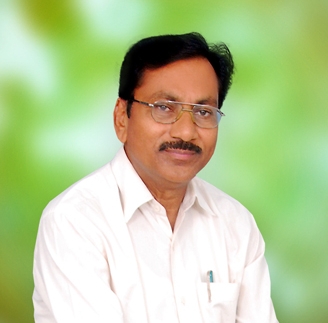
Dr. Rajamouly Katta, M.A., M. Phil., Ph. D., Professor of English by profession and poet, short story writer, novelist, writer, critic and translator by predilection, has to his credit 64 books of all genres and 344 poems, short stories, articles and translations published in journals and anthologies of high repute. He has so far written 3456 poems collected in 18 anthologies, 200 short stories in 9 anthologies, nine novels 18 skits. Creative Craft of Dr. Rajamouly Katta: Sensibilities and Realities is a collection of articles on his works. As a poet, he has won THIRD Place FIVE times in Poetry Contest in India conducted by Metverse Muse rajamoulykatta@gmail.com
A LEAF FROM HISTORY: AN ISLAND THAT IS A CITY OF GLOBAL ATTRACTION
Mr Nitish Nivedan Barik

We are talking here of Phuket that is both a city and an island in southern Thailand. The island located in the Andaman Sea, off the west coast of the Thai peninsula. Phuket City, situated in the southeastern part of the island, serves as an important port and commercial centre. Its harbour exports products such as tin, rubber, charcoal, timber, and seafood to Malaysia, Singapore, and Myanmar, while rice and manufactured goods are imported. Today, Phuket International Airport provides regular flights to many international cities.
Set against the turquoise waters of the Andaman Sea, Phuket stands as one of Thailand’s most distinctive destinations, where natural beauty, rich history, and modern tourism come together. More than just a popular holiday retreat, the island has played an important role as a trading port, cultural crossroads, and strategic stronghold. From its early settlements and foreign trade influences to its present-day global appeal, Phuket’s story is one of resilience, heritage, and transformation.
Historically, Phuket was part of various Tai states (local Chiefdoms, i.e. Tai-speaking political entities) before becoming incorporated into the Ayutthaya Kingdom around the 16th century. Its strategic position as a trading port attracted European powers such as the Portuguese, French, Dutch, and English, who established commercial ties but failed to conquer the island. Their presence, however, left a lasting legacy, most notably the Sino-Portuguese architectural influences found in Old Phuket Town.
There was an attempt to invade Phuket which was swiftly negated. Before the Burmese invasion of Thalang in 1785, during the conflict known as the “Nine Armies’ War,” Francis Light of the British East India Company warned local leaders in Phuket of an impending Burmese attack. At that time, the island’s governor had recently died, leading the Burmese to believe that Phuket would be easy to capture. In response, the governor’s widow, Than Phu Ying Chan, together with her sister Mook, organized the island’s defence. They instructed local women to dress as soldiers and position themselves along the city walls, creating the illusion of a strong defensive force. This strategy caused the Burmese to overestimate Phuket’s military strength. After a siege lasting approximately one month, the Burmese forces withdrew on 13 March 1785.
In recognition of their courage and leadership, King Rama I later bestowed upon the sisters the titles Thao Thep Kasattri and Thao Si Sunthon, honouring them as heroines of Phuket. More broadly, Thailand stands out in Southeast Asia as the only nation never formally colonized by European powers, having skilfully preserved its independence by balancing and negotiating between British and French colonial interests.
Today, the official seal of Phuket features the Two Heroines Monument, located along Highway 402. The seal is surrounded by a traditional Thai kranok pattern and has been in official use , normally said to be since 1985.
Phuket is well known for its rich tin deposits. Tin ore was found in lowland areas and shallow coastal waters and was extracted using river and sea dredging methods. Over time, the island has also developed into a major seaside resort destination. Phuket is connected to the mainland by a bridge across a narrow strait to the north, and a main road links key settlements such as Thalang, Phuket City, and Ban Rawai.
In December 2004, Phuket was severely affected by a tsunami caused by an earthquake in the Indian Ocean near Indonesia. Several thousand people lost their lives, including many foreign tourists.
The name “Phuket” is believed to be derived from the Malay word bukit, meaning “hill,” reflecting the island’s appearance when viewed from the sea. Due to its location on the Malay Peninsula, the island was originally inhabited by Austronesian Malay peoples before later being settled by the Thais during the southward expansion of Siamese kingdoms, most notably during the Rattanakosin period.
I recently got married on 26 November 2025 to Pragatika Rout, an IT engineer based in Bangalore. We chose Phuket as our honeymoon destination and stayed there from 4 December to 9 December. I had planned our honeymoon well in advance, approximately one month before the wedding, carefully organizing each day to ensure we had a memorable experience. As this was my wife’s first international trip, it was important to me that it would be truly special and worth remembering.
During our travels, including moments such as immigration checks where individuals must proceed separately, I never once felt that it was her first overseas journey. On the contrary, I often felt that she was guiding me; she is a star who understands things very quickly. We stayed at Amari Phuket, a five-star property so expansive that it would take days to fully explore the hotel premises alone. We visited several iconic locations, including Phuket Old Town, the Big Buddha, Maya Bay, and Phi Phi Island. The people of Phuket were warm and welcoming, making it an ideal destination for tourists and families alike. We enjoyed every moment of our stay.
Phuket is a city that beautifully combines popular tourist attractions with significant historical importance. One highlight of our trip was parasailing in Patong, which proved to be a once-in-a-lifetime experience and made our honeymoon even more exciting and memorable.
Today, Phuket remains a place where the past and present coexist harmoniously. Its historic streets, cultural landmarks, and stories of courage stand alongside world- renowned beaches and vibrant tourist experiences. My time in Phuket, especially during such a meaningful personal journey, highlighted how the island offers more than scenic beauty -- it offers depth, warmth, and a lasting connection to history. Whether explored through its heritage or experienced through its modern attractions, Phuket leaves an impression that continues long after the journey ends.
Mr Nitish Nivedan Barik hails from Cuttack,Odisha and is a young IT professional working as a Team Lead with Accenture at Bangalore.
Dr. Mrutyunjay Sarangi
Twelve kilometers from Shahranpur, on the way to Delhi, my old Fiat car stalled. I switched off the ignition and tried to start the car again. It refused to budge. My heart sank. It was three o’clock on a hot June afternoon in the tear 2012. In no time, the car turned into an oven,out to bake us. I got out of the car, looking around like a lost chicken in a furniture market. In her usual way Manjari, my wife, started abusing me and the car, and then the car and me, in turn. The fact that the car is of the same age as hers and is a favorite object of mine, did not escape her mention. If I discerned a tinge of jealousy in her words, I suppressed the urge to point it out. I am a peace-loving man and avoid confronting her.
Manjari’s harangue got stronger in pitch and tone. I took out a screw-driver, opened the bonnet of the car, but intimidated by the maze of wires and assortment of minor and major contraptions inside, shut it down in no time. A Professor of Political Science with a screw-driver in hands looked as incongruous as a traffic constable with a violin or a carpenter with a cooking pan.
Manjari broke into one of her favorite topics – the uselessness of her husband, the roguishness of the car, the grave injustice pervasive in the world, the cruel way in which life had treated her. This was her cassette number three. She has more than two dozen cassettes like this in her repertoire. She is a great artist and her talent has always left me spell-bound. Her art is in the non-traditional form – making mincemeat of the reputation of her husband and the children is her forte. She has recorded more than two dozen cassettes over the years and on very special occasions like her kitty party, or a gathering of ladies on someone’s birthday, when the discussion inevitably veers towards husband-bashing, she plays the cassettes with great gusto. She is extremely popular in her group of friends for the quality and variety of her cassettes.
In the early days of our marriage her favorite topic was her singular bad luck in marrying a mere lecturer, when there were proposals from bank officers, police officers, engineers and many other worthies. But because her father is an honest good-for-nothing government official, he couldn’t arrange dowry and Manjari had to marry a mere lecturer, another good-for-nothing man. While narrating this heart-breaking tragedy, her voice assumes the pathos of the melancholic singer Mukesh, her crying tone reverberates with the thin sepulchral echo of a Lata Mangeshkar song, capable of melting the listener’s heart into tears.
With age and time, Manjari’s talent has scaled new heights of excellence. The variety and range of themes in her more than two dozen cassettes are amazing:
- Husband’s useless job (‘Is it a job or a joke’?)
- The laughable salary of a lecturer (‘Can’t meet both ends, leaving them
loose all the time!’)
- Her good-for-nothing father should have arranged enough dowry for a better
husband for her (‘Not as if the President of India gave him a Padma Bhusan for honesty!’)
- Kids’ incessant tantrums (‘Offspring of a worthless monkey can only be useless
Wmonkeys!’)
- Not even one servant at home (‘Can’t remember a day without a peon or a
cook at my parent’s place!’)
- No decent furniture at home (‘Can’t invite even the poorest of the neighbors,
even their furniture is better than ours!’)
- The good-for-nothing husband joking with students all the time (‘That’s why
they call him sir, but treat him as yaar!’)
- Kids playing all the time (‘Time and tide wait for none!’)
- The useless kids listening to old songs all the time, like the useless father (‘God
knows what honey drips from those voices – the drunkard Saigal, the pathetic Mukesh, the vague Hemant Kumar, the maniac Kishore Kumar and his victim Lata Mangeshkar in agony!’)
Ranjit, our son, and Anjana, the daughter, have been brought up on the rich diet of their mother’s cassettes and my limitless love for them. Despite all the scolding and taunts of Manjari, they have unstinted loyalty for her, fighting many times with their friends to claim that no one in the world can make better chicken chowmein and prawn curry than her!
And their love for me? They think I am their heart-throb, although they can’t say that openly in Manjari’s presence, for fear of inducing her to make another cassette! Anjana fights with me all the time for small things, she calls it her entertainment! If Manjari scolds her for that, she shuts her up – “If I don’t fight with my Papa, do I go to your place to fight with your Papa?” Before going for her exam, she would say, “Hey Papa, the teacher says we should touch the feet of our parents before leaving for exams, So raise your feet, you don’t expect me to bend to touch your feet, do you?”
Ranjit left for the hostel at IIT Kharagpur after finishing his high school. When he came home for his first vacation, Manjari asked him, “So, did you miss my cooking in the hostel?” Ranjit stunned her with “Mummy, of course I missed your mouth-watering dishes, but you know what? I missed your cassettes more than your cooking!” We guessed Manjari was awfully pleased with the compliment, but we had no guts to ask her! We have always been scared of her instant cassette-making abilities!
Actually, she has the potential to produce one astounding cassette with assured commercial success. We hadn’t thought of it till Ranjit brought it to our notice during thetrip home in his third year of college.
Manjari is famous in our family and circle of relatives for an amazing quality – her instinctive fear of thieves and burglars. In the first few days of our marriage I had become familiar with this phobia. It was triggered by a minor incident of two burglars entering the compound of our house on a summer night.
Alerted by a small noise Manjari got up and within an instant came into her elements. In a voice that would have made a foghorn proud, she ran to the window shouting, “Hey, who is there? WHO IS THERE? Wait, wait, why are you running away? I am coming with a knife for you! You rascal? You think there is no man in the house? Look at me! Don’t run away!” It went on for a full fifteen minutes, long after the burglars must have run away from our compound and probably from the town itself! The only tangible benefit of the episode was Manjari announcing loud and clear who the man of the house was!
After that night of the runaway burglars, there was a dramatic change in our life. It became a daily habit with Manjari to get up at different hours of the night and start screaming in a ghastly voice, trying to drive away all human, non-human, super-human intruders from our compound. We might have seen one or two shadows against our window in the past many years, but terrified by her screams, they never took human form. However, thanks to her abnormal nocturnal behaviour, no shadow of a guest fell on our home. I was particularly happy to be rid of her brother Mukund, who had developed this annoying habit of coming to stay for the weekends, invading our intimate privacy so ardently coveted by a newly married couple!
It was Ranjit who gave us the brilliant idea that Manjari’s resounding screams can be recorded in DVDs and can be sold to every single home in the country. All over India people will start playing the disks after midnight for six hours and scare the poor burglars away. It will become a daily habit in every household, similar to putting the mosquito-repellent smoke emitters like Good Knight or Allout. And lo and behold, thieves, burglars, and peeps will take retirement from their profession to render voluntary labour in the villages!
Anjana added an absolutely smashing suggestion. Apart from translating the DVD into Punjabi, Tamil, Telugu, Gujarati, Marathi and all other Indian languages, we can even claim an international copyright and put it in the world market with an English, Latin, French and Arabic version and earn millions of dollars!
Buoyed by this wonderful prospect, I kept smiling sweetly like a benign drunk, but Ranjit and Anjana started dancing like a pair of deranged monkeys. To our utter amazement, Manjari nixed the idea – “My cassettes are not for sale! Forget it and keep quiet. Don’t behave like delirious juveniles and stop imitating your father!” It stopped the kids in their tracks. I opened my mouth to protest that I was not behaving like a juvenile, let alone a delirious juvenile, but for fear of provoking another cassette I kept quiet.
Our daughter Anjana got married a year ago and moved to a far-off town. Every night she calls on her mobile phone and chats with her mother for at least half an hour, twenty nine minutes of which will be Manjari’s complaint against me, my poor income, the uselessness of the work I am doing, her lack of friends (Cassette number five – “how can I invite anyone home, I don’t even have a decent set of furniture!), Anjana listens quietly and asks her mother to hand over the phone to me.
“Papa, everything seems to be normal! The day Mummy stops playing her cassettes, there will be a catastrophe and the world will come to an end. And personally, I will have a sleepless night, tossing on the bed, worrying what form the catastrophe will take! Go to sleep Papa, you are in safe hands!”
Over the past twenty eight years of marriage, I have climbed the professional ladder, moving from a lecturer to a reader, and then to a professor. And four years back I came to Delhi to join the National Council of Educational Research and Training as its Associate Director. But two things have not changed in my life - my financial condition has remained stable, but not very inspiring to meet Manjari’s high standards, and second, the ever-present harangue from her cassettes! I have accepted both as a part of my existence and moved on with life.
x x x x x x x x x x x x x x x
Today on the way back to Delhi from Shaharanpur after attending a meeting at the Glocal University there, my car ditched me in the most inappropriate manner. A hot June afternoon on a simmering highway is certainly not the ideal way for a car to announce its advancing age, its bronchial disorder, rheumatism or arthritis. I stood leaning on the car, a water bottle in hand, sweating profusely from Manjari’s scorching words, from the fire falling like blistering showers from the sky and the heat radiating from the road. A few Hondas, Toyotas and Nissans passed by dazzlingly, like kimono-clad Japanese geishas, but no one had time for the poor Fiat, no one stopped.
An old man passed by riding a bicycle, face and head covered with a white towel, his dress drenched with sweat. He peered at me and Manjari and stopped.
“Babuji Namaskar! What are you doing here?” He asked in Hindi.
Manjari whispered from inside the car, “Ignore him. Looks like a highway robber!” I wondered at the man’s manner of familiarity, as if he knew us. Why did he stop after looking at us? Does he know us? Who is he? I don’t remember him from anywhere!
“The car has suddenly stalled. Is there a workshop nearby?”
The man shook his head,
“Nothing for sixteen kilometers ahead of you and you have left Shahranpur twelve kilometers back. What’s wrong with the car?”
“No idea, it’s an old car.”
Manjari’s angry whispers again, “Don’t talk to him so much, he is trying to befriend you and then he will attack us!” I didn’t like Manjari’s approach, but, as usual, kept quiet.
“Don’t worry Babuji, both of you come with me to my house. My son Ramdin works as a mechanic at the garage in the government agricultural depot. He will return home by four. I will send him to look at your car and if it’s a minor problem, he will fix it and bring the car home.”
Manjari’s furious whispers became embarrassingly loud.
“Don’t listen to him. The old man will kill us and his son will sell away the car
for ten thousand rupees. Just get into the car and lock the door.”
The old man must have guessed the meaning of what she was saying to me in Oriya. His face was covered, only his eyes and mouth were visible. I thought I saw a faint glimmer of an apologetic smile. He shook his head,
“Babuji, Memsaab, please don’t worry. I am not a thief, nor a robber. I am from a
decent family. Trust me”
I somehow felt that I had heard these words sometime, somewhere in the past. But I could not recollect when or where. Our reluctance to go with him was palpable. The old man was insistent.
“Please come home with me. It’s not safe to be inside the car any longer. You will get dehydrated. Look at the hot wind, it can melt even the telephone poles. Please come. My wife will be very happy to see both of you.”
We realized we had no option. We were beginning to feel a bit breathless and nauseous. We started walking with him. His house was about a half kilometer away, after a turn from the highway. He told us his name was Brijgopal and his wife was Ramdulari.
We felt the heat was sapping our energy and by the time we reached his home we were thankful that for some time we would have a shelter over our head.
The old man hollered at his wife, “Arrey, Ramdulari, wake up! See, Babuji and Memsaab at our doorstep! You won’t believe your eyes!”
We looked at each other. Who are these two? How are they referring to us with so much familiarity? I could see that Manjari’s distrust of the person still lingered, but she had surrendered herself to whatever fate awaited us.
A lady came out of the house. Looking at her soft face with light wrinkles, I felt that she looked vaguely familiar, a blur from the past, but memory eluded me. She looked at us, bowed her head and touched our feet. Her face beamed with overflowing joy. She took us inside. The room was dark, an overhead fan was providing cool air, coming like a gust of relief from heaven. We sat on the bed, she switched on the light.
Brijgopal had gone inside to wash his face. He came in without the towel on his face and when I saw him along with Ramdulari, recognition came in a flash. I suddenly remembered where I had seen them. From my smile he could realize that I knew who they were. He folded his hands,
“Babuji, you remember that cold evening in Delhi? You may not believe how many times we have prayed to God to bless your family and to give us an opportunity to serve you in whatever way we can. God is merciful and today he has brought you to our humble door step.”
I looked at Manjari. She still looked bewildered. Brijgopal asked Ramdulari to make some lassi for us. When I asked her not to take the trouble, he felt hurt,
“Please Babuji, don’t say like that. We got a new lease of life that evening thanks to you and Memsaab. If you had not helped us, both of us would have died in some street corner in the freezing cold of Delhi.”
x x x x x x x x x x x x x x x
The memory of that evening came back to me. It was the middle of January, three and half years ago. Manjari and I had gone to New Delhi railway station to see off her brother Mukund’s wife who was leaving for Bhubaneswar. We came out of the station and got into the car. I turned on the ignition and was about to leave when I found an old man tapping the window of the car. Manjari screamed at me,
“Lock the door and let’s leave. The old man will take out a knife now and ask for money.”
The man didn’t take out a knife, nor did he threaten me. He folded his hands and said,
“Babuji, please help me. I lost all my money to a pick-pocket. I must go back to my village tonight. My son is at home, looking after the house and the cattle. If he doesn’t report for work tomorrow morning, he will lose his job.”
Manjari looked mad with rage,
“See, I told you. The same old trick. The usual story of a pocket getting picked and asking for money. Let’s leave. He looks dangerous”
She was screaming in Oriya. The man probably guessed her anger. He again folded his hands and implored,
“Please trust us. We are not thieves, nor robbers. We are not beggars, we are a decent family. See, my wife is standing there. I have really lost all my money to a pick-pocket. Please help us. God will bless you and your children.”
I looked at his wife. She was standing about fifteen feet away, head covered, a
cloth bag in her hand. She looked rustic, but there was a quiet dignity in her, a helpless pride, fear writ large on her face, caused by the misgivings of an unknown city, and the uncertainty of what was going to happen. I made up my mind to help them.
“Where are you going? How much is the ticket?”
“Babuji, we have to buy the ticket upto Shahranpur. It will be 175 rupees per person.”
Manjari went ballistic.
“What, are you crazy? You are really going to give money to these cheats? Can’t you see they are taking you for a ride?”
I ignored Manjari, took out four hundred rupee notes from my wallet and gave it to the old man.
“Take this money, buy your tickets for three hundred fifty rupees and take some food before boarding the train.”
The old man could not believe his eyes and almost burst into tears. The lady came
forward. Both of them stood with folded hands, bowed their heads and thanked us from the depth of their heart,
“Babuji, Memsaab, may God bless you and your children with abundant love. You have saved our lives tonight.”
They wanted to say more, but sensing Manjari’s unabating anger, they bowed their head and left.
Manjari burst like a cloud of rains.
“What an insensible idiot you are! Do we pluck money from the trees that we waste it like this? If you felt pity on them, you could have given them twenty-thirty rupees. How could you throw away four hundred rupees? When will you learn to be smart?”
I was upset with her. While driving out of the parking lot I told her,
“Manjari, they are not beggars to go and beg for twenty-thirty rupees from dozens of people. They are in real trouble. You must learn to believe someone sometime in life. They certainly didn’t look like thieves or cheats. If we help someone in trouble, God will help us.”
“Don’t give me that nonsense. I have been doing regular prayers and observing so many fasts for the last twenty four years. What has God given me, except penury and misery? I don’t have money to even buy a decent set of furniture. And you waste money like this!’
“Manjari, don’t say that. Your prayers and God’s blessings have given us two precious kids, perhaps the best kids in the world. What more do we want?”
Manjari didn’t relent. Throughout the way she kept on scolding me, finding a
hundred faults with me and with her life. When we reached home, she poured out her heart to Anjana, about my stupidity, my fallibility for tricks of the cheats, about her sufferings in life at the hands of a good-for-nothing husband. Anjana came to my defense,
“Mummy, Papa doesn’t make mistakes in his judgment of people. Don’t worry. It’s just four hundred rupees. Forget it.”
Manjari accused her of taking sides with me and went inside the bedroom and
shut the door. Anjana looked at me and said, “Papa, cassette number twenty-two?”
I nodded in meek helplessness and kept quiet.
x x x x x x x x x x x x x x x
After three and half years, the memory of that evening came alive. We had not imagined that we would ever meet the old couple again. Fate had brought us together. We drank the lassi and kept chatting, asking them about the village life, their home, the vegetable garden and the cattle. Their son Ramdin came around four, touched our feet and went away taking the keys of the car from us.
Brijgopal brought us back to the memory of that evening again. It looked like he still couldn’t believe that we were with him in flesh and blood. A bit overwhelmed, he continued,
“You know Babuji, that night when we were returning by train, Ramdulari kept pulling me up, ‘Why did you take so much money from Babuji? Didn’t you see how Memsaab was upset with him? For our sake Babuji had to bear with so much scolding!’ But I was not convinced. I told her, ‘No Ramdulari, Memsaab didn’t look like a mean person. There are some people who are harsh with their words, but have a soft, sweet heart. Didn’t you see there was a rare glow on her face? Such glow can come only from a clean, flawless heart. She must be from a very good family. And Babuji has lived with her for so many years. He must be familiar with her heart of gold. Otherwise how could he give us four hundred rupees, when I was expecting only ten or twenty rupees from him? Such generosity can come only from great persons. Good men like Babuji can’t live in isolation. He and Memsaab must be a great couple, made for each other.”
Hearing this Manjari looked at me and lowered her head. We spent a few more
minutes at the home of Brijgopal and Ramdulari. It seems the problem with the car was very minor. Ramdin fixed it quickly and brought the car home. After thanking them profusely, we left for Delhi. On the way Manjari sat motionless in the car, lost in thought. I tried to cheer her up by cracking a joke or two, but she was unmoved.
We reached Delhi around nine and after a light dinner went off to sleep. Shortly after midnight I suddenly woke up. Manjari was not in her bed. I went out to look for her. The light in the living room was on. Manjari was sitting on the sofa, under the fan, lost in thought.
She had not seen me coming.
“What happened? Why did you get up?” I asked her.
Manjari looked up and rising slowly, she came near me, her eyes locked with mine.
“For the past twenty eight years you have been hearing my cassettes, so many of them! Just in one night today, I took out all the tapes from the cassettes, tore them to pieces and threw them away. From tomorrow you and the kids will not hear them again.”
I looked deeply into her eyes. They were filled with an incredible peace, like the
still, blue waters of a deep ocean. I put my arms around her and locked her in a soft, loving embrace. She rested her head on my shoulder. Slowly my shirt got drenched with her tears.
=====================
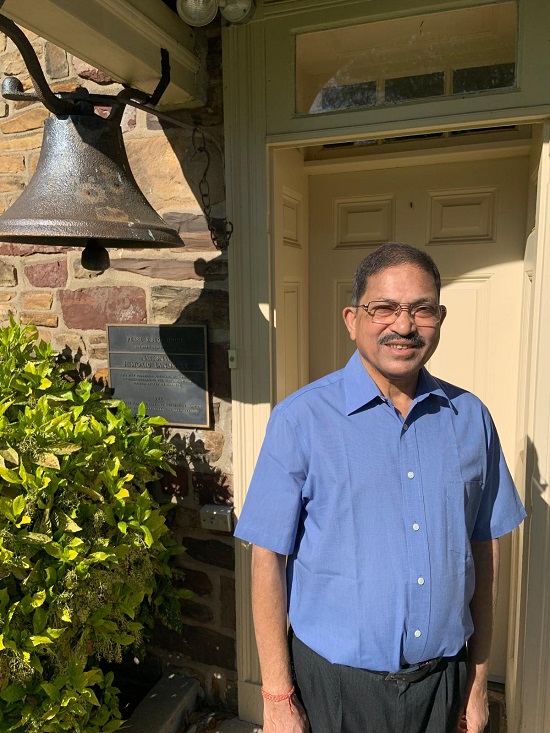
Dr. Mrutyunjay Sarangi is a retired civil servant and a former Judge in a Tribunal. Currently his time is divided between writing poems, short stories and editing the eMagazine LiteraryVibes . Four collections of his short stories in English have been published under the title The Jasmine Girl at Haji Ali, A Train to Kolkata, Anjie, Pat and India's Poor, The Fourth Monkey. He has also to his credit nine books of short stories in Odiya. He has won a couple of awards, notably the Fakir Mohan Senapati Award for Short Stories from the Utkal Sahitya Samaj. He lives in Bhubaneswar.
Viewers Comments