
Literary Vibes - Edition CLV (25-July-2025) - POEMS

Title : Alone (Watercolour by Ms. Latha Prem Sakya)
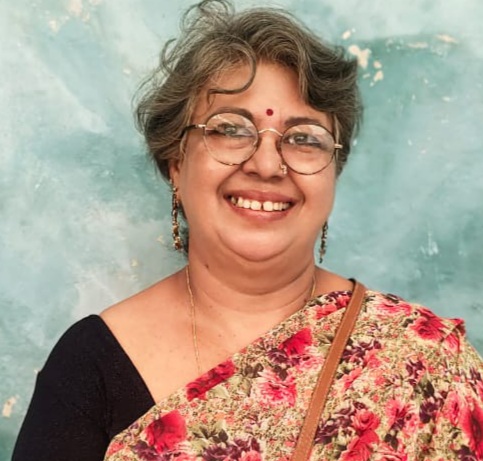
An acclaimed Painter, a published poet, a self-styled green woman passionately planting fruit trees, a published translator, and a former Professor, Lathaprem Sakhya, was born to Tamil parents settled in Kerala. Widely anthologized, she is a regular contributor of poems, short stories and paintings to several e-magazines and print books. Recently published anthologies in which her stories have come out are Ether Ore, Cocoon Stories, and He She It: The Grammar of Marriage. She is a member of the executive board of Aksharasthree the Literary Woman and editor of the e - magazines - Aksharasthree and Science Shore. She is also a vibrant participant in 5 Poetry groups. Aksharasthree - The Literary Woman, Literary Vibes, India Poetry Circle and New Voices and Poetry Chain. Her poetry books are Memory Rain, 2008, Nature At My Doorstep, 2011 and Vernal Strokes, 2015. She has done two translations of novels from Malayalam to English, Kunjathol 2022, (A translation of Shanthini Tom's Kunjathol) and Rabboni 2023 ( a Translation of Rosy Thampy's Malayalam novel Rabboni) and currently she is busy with two more projects.
Dear Readers,
Welcome to the 155th edition of LiteraryVibes. Happy to present to you more than 50 poems, short stories and Anecdotes, to keep you entertained for a month. Hope you will like them and share the precious literary gems with your friends and contacts.
In this edition we have a new poet Ms. Padmashree Chennojwala from Hyderabad, who writes beautiful poems, embellished with lovely metaphors. Let us welcome her to the family of LiteraryVibes and wish her plenty of success in her literary journey.
Last week, on a damp evening I had a strange experience. Getting bored sitting at home throughout the day because of rains, I went up to the roof for a stroll. The rains had stopped but the sky was overcast. The rooftop was covered with a blanket of darkness. The wind carried in it minute wet drops, guaranteed to cause a mild melancholic depression even to the liveliest of souls.
To overcome that sad feeling while taking the stroll, I started recounting the good songs that have unfailingly brought joy to the heart in the past, the movies that moved the soul and stayed within it for days, and the books that always elevated the spirit. I also recollected many excellent stories from the old editions of LiteraryVibes, from the pens of some of our stalwart LVians - Ananya Priyadarshini, Prof. Geetha Nair, Sreekumar and Prabhanjan Mishra - just to name a few.
A strange thing happened when my mind went through that kaleidoscopic experience. The depression melted away, to be replaced by a feeling of pure joy. And to my great amazement, the evening which had been shrouded by darkness an hour ago assumed a mild, sedate brightness. It was a never-before-seen wonder for me, the way the roof radiated a very suppressed yellow glow, like a soothing light from moon. I looked up, there was no moon, the sky was still covered with dense clouds, yet, a sudden brightness had uplifted my spirit.
However, I had forgotten that life is a strange mix of dhoop-chhaon - light and shadow. In my exuberance I entered my study room to pick up a book to read. The heaps and rows of books suddenly made me nervous. How did I collect so many of them? What will happen to them when I leave the world? Will they be thrown out, as unwanted garbage? I have, in the past two years, offered to donate the books to libraries but no one wants them. I always get the reply that these days no one reads books, busy as they are with TikTok, Instagram and Internet.
My effervescence of the evening suddenly evaporated and I returned to the confines of my room with a sunken heart. By a strange coincidence I received a story forwarded by a friend couple of days later. It confirmed my premonition about the sad fate of my books. Let me reproduce the story here:
A PRECIOUS PROBLEM
There are defining moments in the lives of nations—like wars, famine and revolutions. There are similar moments in the lives of individuals and families—like the birth of a child, a wedding or moving to a small house after retirement. For the missus and me, the last shift to a modest three-bedroom apartment was indeed a reality check.
While calculating the blessings of living in a compact home, we had sadly overlooked one important aspect. Our books! Books we have lugged around for decades across the country on different postings. Books of fiction, science, science fiction and verse. Books on cookery, crockery, crookery and worse. Books we have read or intended to read. Books we thought we should read but never did. Books we have kept only because they were nice titles to flaunt—like the eight volumes of the Mahatma by Tendulkar (Dinanath Gopal, not Sachin Ramesh).
Therefore, when we moved to the cramped quarters, our books overflowed from the shelves onto tables and chairs and to the floor. We had to place books on the bed and the dresser and even atop the fridge. But we still couldn’t reach a satisfactory arrangement for all the books—books written by Washington Irving and Irving Wallace; by K.M. Munshi and Munshi Prem Chand; by Agatha Christie and Emile Zola. Sadly, we concluded that we would have to drastically reduce the number of books if we were to have moving space in our home.
I asked our neighbours if any of them would like to take any books. None replied, except the taciturn weirdo from next door. He whispered through the wire screen that he would gladly take any Marx. I apologetically informed him that I had only The Communist Manifesto, which I offered to give immediately. He burst out laughing. “Surely you jest, brother. I didn’t mean Karl Marx. I meant Ted Marks!” His merriment confused my wife, while I pretended that I had never heard of the literary giant named Ted Marks.
Months passed and we still needed to shuffle books around before we sat down for dinner or lay down to sleep. In desperation, I took all the popular fiction to a nearby school. The prim headmistress happily accepted the Enid Blytons, the Jane Austens, the H.G. Wells, the Conan Doyles and the Ayn Rands. Unfortunately, I failed to warn her that The Arabian Nights collection in six volumes was the unexpurgated version. A week later, the lady indignantly summoned me to school and berated me for half an hour for trying to corrupt the unblemished souls of her wards. I couldn’t blame her. After all, the poetic lasciviousness of The Arabian Nights will enchant any adolescent!
We then tried to leave the bestsellers on a bench in the park, with a note inviting residents of our condo to help themselves. While not a single Chase or Wodehouse was taken, the maintenance staff complained to the Residents Welfare Association that we were leaving trash across the countryside. The association warned us against littering or clogging the garbage chutes and bins with our ‘junk’. Suddenly I realised that our books were proving to be more difficult to get rid of than Siward’s corpse in Macbeth!
As a last resort, the missus decided to call Nawab, the raddiwala (also referred to as the kabadi), who buys scrap and waste for pennies in our colony and sells them for gold mohurs somewhere else to make his fortune. We segregated the books, retaining our favourites, the rare ones and others of sentimental value. With a heavy heart, we stacked the rest near the front door for the kabadi to take away.
Nawab arrived and inspected the books. He also examined an idol of Tara that we keep near the entrance. I had purchased this exquisite piece on an impulse years ago, at a price that I could barely afford. But recently an expert in such matters had told me that the idol could now be worth a fancy amount.
Tentatively, Nawab asked, “What is this made of?” and I proudly informed him that the idol was made of ashtadhatu, the alloy of eight metals.
“Oh!” said Nawab, “Had it been plain brass, it would have fetched you a good price. It must be about 20 kilos, so at Rs. 300 per kilo, I could have offered you Rs. 6,000. But ashtadhatu…,” and he shook his head disapprovingly.
He then picked up a few books and declared that they were useless. “The page size is too small—I can offer only Rs 2 per kilo,” he said. He took another book and, while I cringed, he tore off a page and scrunched it in his fist. “See,” he said, “This paper is too old. It is unusable for making thongas—the paper bags for loose merchandise.” Quite ruthlessly, he also wrenched off the hard covers of the library editions, declaring that he did not need cardboard.
Much after Nawab had left, I remained sitting in a chair near Tara, with the leftover books and a few torn hard covers strewn on the floor.
“It seems what we consider priceless is actually worthless!” I said tearfully.
The missus, sitting beside me, said softly, “Don’t feel downhearted, dear. The value of the same thing can be vastly different in different universes.”
x x x x x
Believe it or not, dear readers, the last few lines of the story brought tears to my eyes, tears of regret, of pathos about what is happening to our society, where wealth accumlates, but values decay.
Please use the following links to forward the LV155 to all your friends and contacts:
https://positivevibes.today/article/newsview/601 (Poems and Book Review)
https://positivevibes.today/article/newsview/600 (Short Stories and Anecdotes)
https://positivevibes.today/article/newsview/599 (Young Magic)
There is also an Anecdote by the prolific gynecologist Dr. Gangadhar Sahoo at https://positivevibes.today/article/newsview/598
Sixteen enchanting stories are waiting for you in the Special Puja edition at https://positivevibes.today/article/newsview/562
And please remember that you can access all the 155 editions of LiteraryVibes at https://positivevibes.today/literaryvibes
So, do relax with the beautiful poems and lovely stories from LV155 and enjoy the rains - the rimjhim girey sawan..... - till we meet again on 29th August.
With warm regards
Mrutyunjay Sarangi
Editor, LiteraryVibes
Friday, the 25th July, 2025
Table of Contents :: Poems
01) Prabhanjan K. Mishra
SILENCES
THE PAIN, A SWEET SWAMP
02) Dilip Mohapatra
THE TRUTH BEHIND THE GLASS
SENSING THE NONSENSE
03) Abani Udgata
SUMMER
04) Pradeep Kumar Biswal
A HOLLOWED SILENCE
05) Fatema Zohra Haque
THE SCAR SHE BEARS
06) Baldev Samantaray
GAZA
07) Avantika Vijay Singh
A MORNING AT SHANKARACHARYA TEMPLE
A SUNSET IN KASHMIR
LORD OF DANCE
DANCE OF LIGHT AND SHADOWS
08) Kunal Roy
THE HERO
09) Darsana Kalarickal
HALLUCINATION
10) Snehaprava Das
SEASON CHANGE
11) Satish Pashine
THE WATCHER AT MY DOOR
12) Leena Thampi
MY SOUL NEEDS AN ESCAPE
13) Dr Bichitra Kumar Behura
SOFTLY, I RETURN
PENANCE
14) Ajit Patnaik
AN ETERNAL QUEST FOR LOVE
15) Mrs. Setaluri Padmavathi
THE SOUND OF SILENCE
16) Dr Nanda Kishore Biswal
THE EFFUSIVE MOON OF PANCHGANI
17) Bipin Patsani
THE MIRROR
ON LOOSENESS
18) Rudra Pati
SHACKLES
19) Arpita Priyadarsini
PRETTY LIES
20) Matralina Pati
TO MY DEAD GOLDFISH
21) Hema Ravi
RAINBOW’S END…
BE INCLUSIVE
22) Padmashree Chennojwala
THE ALPHABET
23) Chaitrakana Pati
THE WILLOW TREE
24) Dr. Rekha Mohanty
GIFT OF JOY
25) Sujata Dash
HUMANS AND SEASONS
26) Ms Gargi Saha
POETRY
HARMONY OF FLOWERS
INGLENOOK
27) Sreedharan Parokode
MORNING MESSAGE
28) S. Sundar Rajan
WO (OH) MAN
29) Dr. Rajamouly Katta
PRIME PEARLS OF POETRY
MY VILLAGE STILL I RECALL
30) Meenakshi Goswami
VEILED HORIZONS
31) Harisankar Sreedharan
THE RANGE-ANXIOUS
32) Dr. Mrutyunjay Sarangi
MARIGOLDS IN JUNE
Table of Contents :: Book Review
1) Matralina Pati
THE PARADOX OF CONFESSION AND CONCEALMENT
Prabhanjan K. Mishra
We crowded you, your room,
filled your personal space
that snoozed by the Mango tree.
Like clucking hens, we three
made a commotion of thirty.
And you sat in your bubble
of solitude, silent, wearing
an inscrutable mood
between downcast and detached.
A praying Buddha, eyes ajar.
You encompassed the silence
of eons, of humans, animals, and plants;
living, dead, spiritual, and feral;
on the earth, in the sea, and in the sky;
visible, sentient, and beyond.
After the informal tea, Sarojini,
Nani, and I, the three of us,
making the hubbub of thirty.
Sarojini, Nani, and you stood
beneath the giant Mango tree.
To say bye to me, the tree no more there
but still existing like the river Saraswati,
in your poetic myth; resolutely dead
but living indelibly in memory,
a yawn unfinished, a sneeze dodging.
Gone were the tree’s nesting birds,
the scurrying ants, but their ghosts
hobnob like the fruitlets that once
lent freshness to the swishing wind.
I stood apart from you three, basking.
For a change, all had fallen silent,
the infection from you was
catching us up of late like a footnote.
Nani and Sarojini appropriately
wearing their moods, to say 'Bye' to me.
But you, the Buddha, parted your lips,
making me, the poor greedy devil,
spread my napkin to collect
the poetic crumbs. But you said, "I love
the cacophony you bring along."
(A tribute to the poet Jayanta Mahapatra after he passed away, but based on what had happened once, if not literally but figuratively.)
Prabhanjan K. Mishra
It has been a week since scalpels
tore me open. A thirty-day-long pain
has taken to bed my opium dreams.
Exploding crude bombs, shock waves.
Needles, glass splinters, bee stings.
Tired like a mother through her childbirth,
pushing a live pain out, … push, … push.
I doze off, a nailed Jesus fainting
on the cross. Wish I could feel as holy!
Will scalpels end the years of that drought?
Wife, as always, hovers like a whiff
of autumn, caressingly collecting
every falling leaf from all over me.
One night, my insides, pain, and all,
also, the throb jump into her lap.
She hesitates but takes me home,
across pain, across my flailing parts
I trudge home, squelching across
the sweet swamp of pain;
the time waits patiently for the wave.
We remain afloat like lotuses
in a swamp, smelling sweetly acrid;
feeling heavenly, the seeker’s moksha
after a year-long wait, a bird finding
its sky, the Christ his cross.
(A hymn to the major operation I went under.)
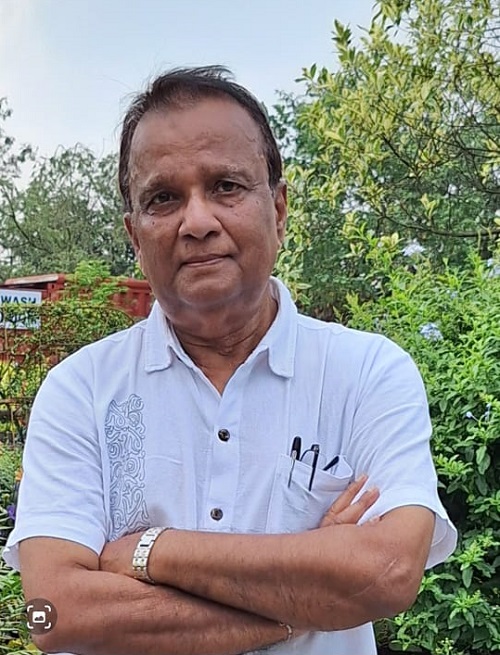
Prabhanjan K. Mishra is an award-winning Indian poet from India, besides being a story writer, translator, editor, and critic; a former president of Poetry Circle, Bombay (Mumbai), an association of Indo-English poets. He edited POIESIS, the literary magazine of this poets’ association for eight years. His poems have been widely published, his own works and translation from the works of other poets. He has published three books of his poems and his poems have appeared in twenty anthologies in India and abroad.
Dilip Mohapatra

Sometimes I wonder
why does one look into the mirror
what does one need to validate
amidst certain uncertainties
and uncertain certainties
why does one seek the reality
knowing very well
the image to be virtual.
The mirror perhaps holds
more than your borrowed face—
hiding beneath its silver sheen
your svelte and solipsistic silences
whispering in undertones
your half-born thoughts
and your unshed tears
that dry before they fall.
It may not lie
or deliberately hide the truths
but it shows you what you wish to see—
a patient confessor
it waits for your gaze to deepen
your thoughts to reflect
past the skin of semblance
and meander into the marrow of memory
where truth doesn’t dazzle
but resonates quietly
with your hushed breaths.
It remembers
and reflects you
not as the world shaped you
but as you stood unmasked—
fragile
flawed and sometimes fragmented
but still luminous
in your unguarded becoming.
There behind the glass
the self you hide from others
the self that is unknown to you
stands bare
nods gently
and condescendingly
forgets and forgives.
Dilip Mohapatra
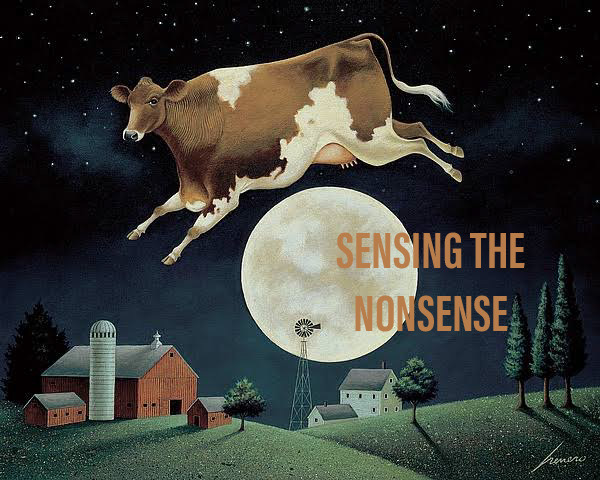
No one ever existed
with the name Diddle
and there was no cat
that ever did fiddle
while we are yet to find
the little dog
that laughed
when the cow jumped
over the moon
and the dish eloped
with the spoon
but we know
how delighted
and thrilled we are
when we are over the moon.
Yes it also makes sense
when Humpty Dumpty
falls off the wall
that a broken egg
can’t be made whole again…
and a tuffet can topple
when the spider scares
little Miss Muffet.
Somewhere
the jellyfish drinks
from the fountain of youth
spinning time’s thread
in reverse
and cocks a snook
at death.
Somewhere else
sparkling neon-blue waves
weave starlight
into liquid dreams
igniting the sea
and we wonder
what really joins foes
water and fire
in a sparkling truce!
All this while
the stilt rooted palms
of the rain forest
the restless wanderers
defy the earth’s pull to
keep them rooted
and chase the fleeting sun
while we don’t give up
and sense the nonsense
for we always see the reason.
We too are trees
turned topsy-turvy
like the baobab
that sends its roots
to the clouds
our heads atop
our roots burrowed
in mind’s soft earth
drinking deep
from our dreams
our limbs below
our branches
growing downwards
and souls presumably
caged within
sense the nonsense
and take to wings
to soar high in the heavens
like reckless eagles
scaling the sky’s
unending canvas
stitching stars to
the surreal twilight.
We surely are gifted
to find meaning
in almost anything
that may be abstract
absurd
or even bizarre
for we can see through
the cobwebs of
fantasy and fairy tales
the magical lens
of illusions and allusions
the labyrinth of
mazes and mirages
and sense the nonsense.
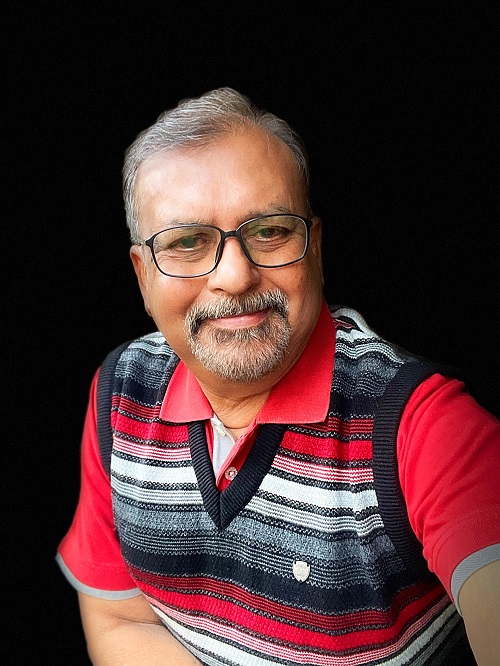
Dilip Mohapatra, a decorated Navy Veteran is a well acclaimed poet in contemporary English and his poems appear in many literary journals of repute and anthologies worldwide. He has seven poetry collections, one short story collection and two professional books to his credit. He is a regular contributor to Literary Vibes. He the recipient of multiple awards for his literary activities, which include the prestigious Honour Award for complete work under Naji Naaman Literary Awards for 2020. He holds the honorary title of ‘Member of Maison Naaman pour la Culture’. He lives in Pune and his email id is dilipmohapatra@gmail.com
Abani Udgata

Summer rested on my shoulders
in the gaunt, tree-less afternoons.
At the far end of the table I dreamt
of the deep waters under the cracks.
The war raged on somewhere.
Only the still-intact buildings waited
for their turn to be brought down,
sudden but sure as the rest of us
looked elsewhere, all given up.
Men piled on to their morsel of faith and prayer
like ants before the rains,
each a tiny piece of burning charcoal.
The dragon face of the leader
catches the mid day glare of the angry sun on the
marching Carnival.
Summer has kissed away the gleam
of the moon-lit night I planted on your now-dried lips .
The cracks on your lips are real.
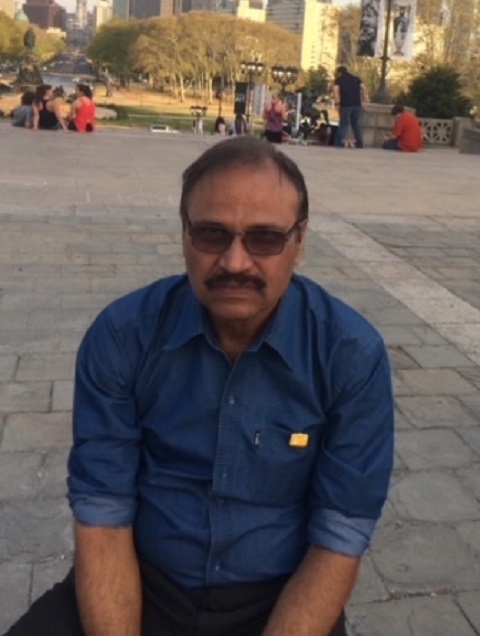
Abani Udgata lives in Bhubaneswar. Writes poems both in English and Odia. Udgata has been awarded in all-India poetry competitions and published in anthologies. He has been a regular contributor to LV. Email: abaniudgata@gmail.com
Pradeep Kumar Biswal
A hollowed silence
Where the echoes meet
A natural death
No word stirs the heart.
The dusts settled
Upon the pane
No distant murmur
No soft falling rain.
It grips the air
A vacuum stark and deep
Where the vibrant memories
Fall fast asleep.
The hum of living
Held at a bay
The stoic stillness
Pervading the day.
The absence seems
A void acutely cruel.
It’s space looking pale
Where smile used to gleam
Like a forgotten dream.
The walls absorb
The ghostly memories
Leaving a resonance
Profoundly still.
A hollowed silence
Vast and undefined
The sound of nothingness
Reveals a life utterly empty.

Mr. Pradeep Biswal is a bilingual poet writing both in Odia and English. His poems are widely anthologized. He is also an editor and translator of repute. A retired IAS Officer, Mr. Biswal presently holds the position of Member, Odisha Real Estate Regulatory Authority and stays with his family at Bhubaneswar. Views are Personal
Fatema Zohra Haque
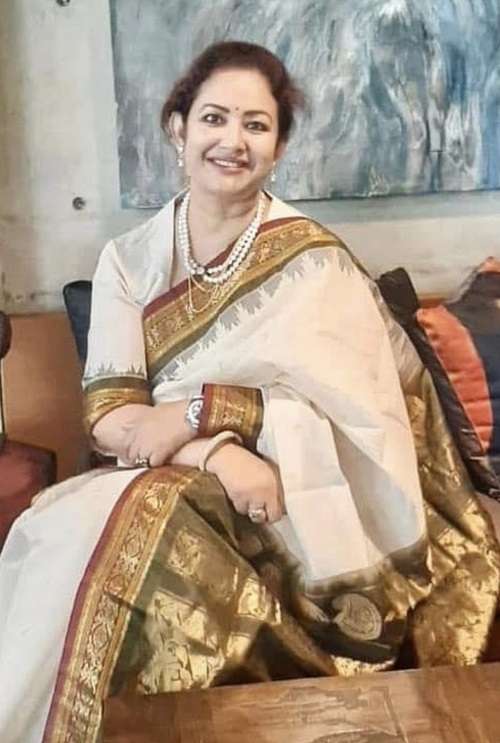
Fatema Zohra Haque, an esteemed international educator and Fulbright Scholar, has authored 25 poetry books. Her columns on education, literature, social issues, and translations appear worldwide in Bengali and English media. Her poetry, including "Selected Love Poems," "Weeping Sky Solitary River,” “Blinded Eyes Looted Dreams” and “Pain in The Epitaph of Art,” are cataloged by the Library of Congress and top 15 US universities. She is also a column editor for the New York-based News magazine The Bay Wave.
Baldev Samantaray
A MORNING AT SHANKARACHARYA TEMPLE
Avantika Vijay Singh
while the rest of India was sweltering,
this morning, in Kashmir, was drizzling…
a soft grey, in May
and that’s how began the day—
past the Dal Lake, we sped by,
which upon the morning seemed to sigh,
stirred by its tryst
with the breeze in the silver mist
we crossed the check post in time
and climbed the verdant hills sublime…
and then began the sheer climb…
steep, grey steps that each must take in their time
we slowly climbed, paused, and rested…
for the steep steps, our resilience tested,
then climbed again
till at last we saw the shrine main—
an imposing structure cobbled in grey
that you can only fully see from the crossway—
the temple, in splendour stands, silhouetted in greys
of the magnificence of its crossways,
with the lingam in its sanctum—
the formless in His iconic form…
where the finite
meets the infinite…
… in the sweeping splendour
of the Zabarwan range spread in languor,
swooping on the surface of the Dal Lake,
I dissolve in surrender to the landscape—
a crossway of sorts,
a confluence in time of thoughts
for here did Shankracharyaji meditate
and carried forth the word of the Advait,
and to these harmonies, the air still vibrates…
a cosmic crossing, the brahman merging…
… and I becoming…
Aham Brahmasmi…
Avantika Vijay Singh
a sunset I wanted to see
and my darling father obliged me…
but never in my wildest dreams did I imagine
the fire of passion
that lit up the skies
in the sun’s daily good-byes,
but more of that later
for the journey was equally major,
not something in your backyard
but in nature’s own backyard—
travelling miles and miles
into virgin mountainside that smiles,
bedecked in white summer flowers…
the evening ephemeral, as the fragrance of their showers…
we reached high up—a Land’s End—that none can surpass
on a road that allowed only one vehicle to pass,
unfolding our shaken limbs from those jouncing roads
we stretch and stretch… my imagination explodes…
our country’s majestic flag proudly flutters in the breeze,
embracing the valley of Kashmir that I see
laid out whole like a bowl, with the Jhelum,
a silver ribbon awash in twilight’s hues,
looping and turning, slowly meandering through…
the great dog, the men’s guardian against the bears nearby
jumped high in delight, looking for a friendly pat,
I wondered how my father had all those years
served the nation on frozen frontiers,
just like these men did now—
my respect grew for all those who don the olive green,
fearlessly forging into the unforeseen…
the roses, growing in the wild beside me,
I offer to all in time—past and present, in my mind’s eye…
Avantika Vijay Singh
in the space of mass, energy, and time,
the universe dances to its silent rhythm…
every atom and sub-atom sways and shifts,
changing shape and form in time’s mists…
in Ananda Tandava—the dance of bliss
a dance of creation and destruction,
the pulse of all matter and existence—
particles popping in and out of existence
in rapid fluctuation…
Shiva’s cosmic rhythm
the landscape of reality
an ever-changing dynamic illusion...
shifting and swaying
to His damaru
in the dance of creation and destruction
the world, a transient place
and I, a sentient being in contemplation,
seeking liberation…
from ignorance and illusion
that the Lord personifies with one foot raised high
the other foot planted firmly
on the back of ego/ignorance
crushing sorrow…
surrendering to the divine
paving the way for the awakening
in the silent rhythm of His dance,
where forms constantly shift on reality’s expanse
I am a fleeting quark in consciousness’ streams
glowing briefly like gold dust on sunbeams…
surrendering to Shiva’s dance in the visible universe
Avantika Vijay Singh
in the dance of the seasons,
as the sun transitions
from Dakshinayana (southern hemisphere)
to Uttarayana (northern hemisphere),
Bhishma’s crossing comes to mind—
resting upon a bed of arrows lined,
awaiting the cosmic gateway to liberation
with the north wind’s elevation,
following the path of light
where the soul rests bright…
moksha…
freedom from ties to earth,
freedom from the cycle of birth and death,
Om Shanti, Shanti, Shanti…
moksha…
disillusion of illusion
with deep self-realisation…
of one’s true nature in time and space—
attained by Lord Shiva’s grace,
the keeper of time himself
Mah?k?la—
eternal, luminous, floating free
Aham Brahmasami…

Avantika Vijay Singh is a communications professional, wearing the hats of a writer, editor, poet, researcher, and photographer. She has authored two solo anthologies, edited three anthologies, and has been published in national and international journals. She received the Nissim International Award Runner Up 2023, WE Gifted Poet 2024, and WE Illumination Award 2024.
Kunal Roy
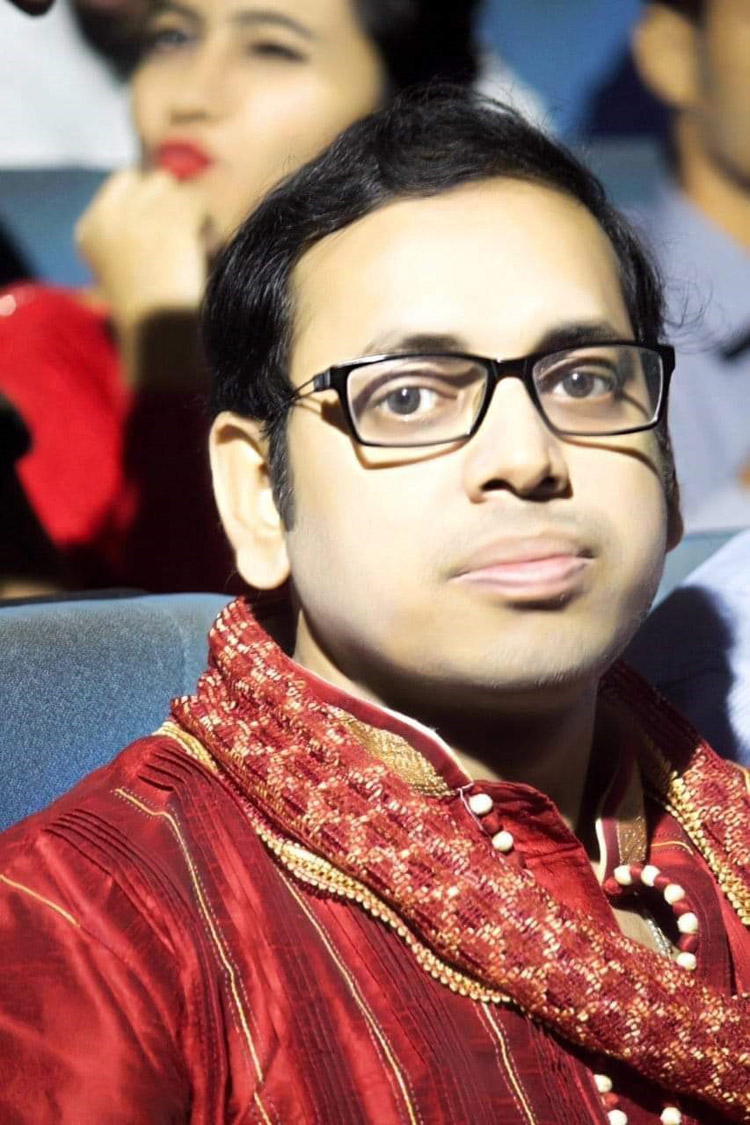
Kunal Roy has always been an ardent lover of literature. He has received various awards for his literary contributions. He is a poet and a critic of poetry. His works have been published both here and abroad. Currently working as an Assistant Professor of English Language and Communication in George Group of Colleges, Kolkata.
Darsana Kalarickal
Beyond my windows
In some meadow,
where the stramoniums are in full bloom,
I sometimes go mad, inhaling their intoxicating fragrance
and then let my thoughts run wild,
like a boat of straw that is blown madly by the wind.
The births and deaths of daynights are forgotten.
You may ask, why?
That is a secret only I know.
As I wandered through some pine forests in search of white daffodils blooming,
a dove would slowly approach me.
Tired from flying for many hours,
it would shake off the yellow dust that clung to its feathers and look at me.
Then a smalll brass cage tied to its legs would jingle.
That is a secret message to me.
You will secretly watch me,
thinking I am a spy,
unable to read the love message written in ancient scripts by a prince
I have never met from beyond the seven rivers.
Have you forgotten that his secret letters are inscribed
on the walls of caves near the mountain peaks?
Thus hardly I am trying to read his love.
I am not unaware that you are secretly following me,
as I travel into the depths of the forest in search of a script
to read the messages, absorbed in the moonlight.
Now, frustrated by the delay in returning of his messenger doves,
he sent a message in a drone.
And that resulted in a war between our countries.
Both countries are now
like the remains of some civilizations that collapsed in prehistoric ages.
The borders are still smoldering.
He is looking for ways to escape from the destroyed country.
I, unable to control the slipping pains,
crawl through the broken doors of the prison
in search of the flowers of the datura metal.
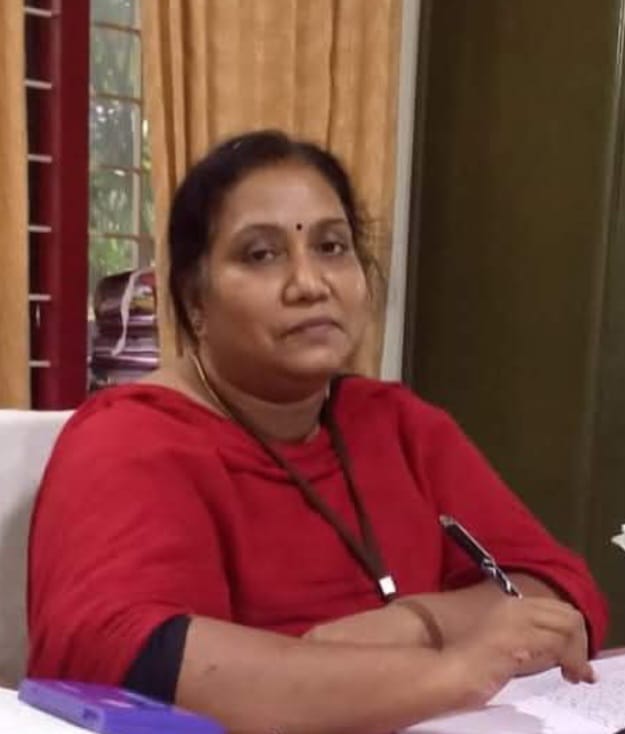
*Darsana K.R., residing in Venginissery, Thrissur district, is an employee at Venginissery Service Cooperative Bank and a passionate poet. Her published works include the poetry collections *Kavithaye Pranayichaval, Pranayathil Akappettathinte Ezhaam Naal, and Kuldharaayil Oru Pakal; the short story collection Thekkedathamma V/S Ramakavi (co-authored with Dr. Ajay Narayanan); the memoir Kunnirangunna Kothiyormakal; and the poetry study Kavithayude Veraazhangal. Her poems and articles have been featured in various periodicals and online platforms. phone : 9645748219, email darsanakr1973@gmail.com.
Snehaprava Das
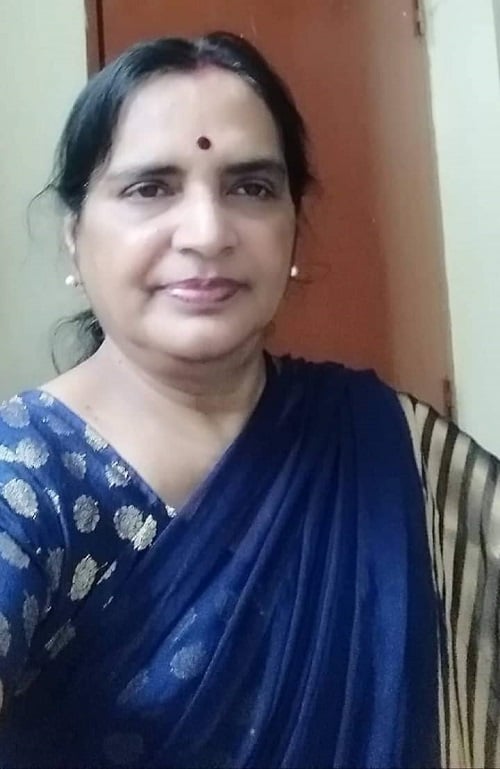
Dr.Snehaprava Das, former Associate Professor of English, is an acclaimed translator of Odisha. She has translated a number of Odia texts, both classic and contemporary into English. Among the early writings she had rendered in English, worth mentioning are FakirMohan Senapati's novel Prayaschitta (The Penance) and his long poem Utkala Bhramanam, which is believed to be a.poetic journey through Odisha's cultural space(A Tour through Odisha). As a translator Dr.Das is inclined to explore the different possibilities the act of translating involves, while rendering texts of Odia in to English.Besides being a translator Dr.Das is also a poet and a story teller and has five anthologies of English poems to her credit. Her recently published title Night of the Snake (a collection of English stories) where she has shifted her focus from the broader spectrum of social realities to the inner conscious of the protagonist, has been well received by the readers. Her poems display her effort to transport the individual suffering to a heightened plane of the universal.
Dr. Snehaprava Das has received the Prabashi Bhasha Sahitya Sammana award The Intellect (New Delhi), The Jivanananda Das Translation award (The Antonym, Kolkata), and The FakirMohan Sahitya parishad award(Odisha) for her translation.
Satish Pashine
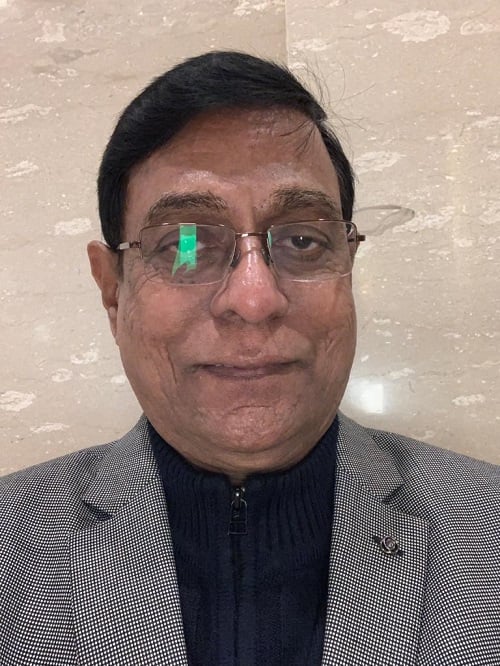
Shri Satish Pashine is a Metallurgical Engineer. Founder and Principal Consultant, Q-Tech Consultancy, he lives in Bhubaneswar and loves to dabble in literature.
Leena Thampi

Leena Thampi is a celebrated author and entrepreneur known for her captivating writing style that transcends the ordinary. With five published books and numerous internationally featured articles, her work has garnered widespread recognition and accolades. Recent accolades include four awards from" The Book Channel" for her four books across different categories, She's also the winner of the 'Women Face of the Year 2024' award by Fox Story India, and the City Excellence Awards by Bharat Times.
Her literary prowess has been recognized with Rabindranath Tagore Memorial literary honors and Gujarat Sahitya Academy honors. Leena's unique narrative voice blends luminous prose, magical realism, myths, and raw life realities, inviting readers into a world of wonder and introspection.
A multifaceted talent, Leena is a certified child psychologist, relationship coach, and TEFL trainer. She is the Co-founder and COO of HAVL Hi-Tech Pvt Ltd.
Her published works include "Rhythms of a Heart", "Autumn Blaze", "An Allusion To Time", "Embers to Flames", and "Celestial Melodies".
With over a hundred accolades from literary platforms worldwide, Leena continues to inspire with her writing. She is currently working on her sixth book, a collection of short stories. Her articles, poems, anthologies, interviews, and features have been published in national and international magazines and newspapers.
Dr Bichitra Kumar Behura
I don’t understand much,
Nor do I wish to.
The ache in my heart—
Even if I wanted to—
I couldn’t let it flow
Through teardrops.
Not because of sorrow.
Even in happiness,
It feels like nothing remains.
And yet, somehow,
My heart fills
With a strange emptiness.
In the breeze that hums
Like a wandering stream,
My eyes softly close.
A trembling hand
Rests on my chest,
As if to hold what stirs within.
The volcano inside lies still—
Yet slowly,
It begins to rise.
I feel nothing.
I don’t even wish to feel.
Seeing you no longer
Stirs those old feelings.
You walk beside me
As if nothing has changed.
No scar marks your face.
And in your eyes,
The chaos of the past
Has vanished.
I hold your hand,
And sense a gentle warmth.
But I don’t ask.
I don’t reveal
Old wounds.
I simply walk forward,
Carrying unspoken words
In my heart.
You quiet my emotional storms,
And I return to myself.
A part of me begins
To love you again.
But now,
I seek no promise,
No return.
I tuck my love deep within
And slowly savor
Its quiet taste.
Honestly—
If I had known
Love could feel this peaceful,
Would I have wasted
So much time?
Why did I wait
For love in return?
Now, this much is enough—
To think,
And to feel joy
In simply knowing:
I have found
A new and real meaning of love.
In the soft, restless breeze,
I receive love’s response.
But I no longer question
If it’s true or false.
I just keep loving—
Like a bird,
Used to its cage,
Singing
Without expecting a reply.
Dr Bichitra Kumar Behura
Why is there never time
to ask why I came?
I walked on, resolute—
with many ahead, many behind—
yet no one held the answer.
Beyond copying one another,
was there any other path at all?
In the beginning, it felt easy,
but disillusionment is only natural.
We walk these ancient roads,
behaving like something half-alive,
going through the motions
without a question.
You may call it life—
but to me, it is a journey of penance.
Even without knowing
the balance of sin and virtue,
it seems wiser to obey destiny’s quiet command.
Not to reach a fixed destination,
but in search of a soul I lost along the way.
Perhaps, unexpectedly,
I’ll find it
in some broken hut
by the side of the road.
I never set out to gain anything,
yet somehow, gained everything—
and in the midst of that,
lost much that mattered.
There is always something left behind.
My penance remains unfinished.
And so, I walk on—
into yet another life’s journey.
Though wholeness still escapes me,
the urge to move forward stirs within.
A quiet inspiration arises—
to cross the final horizon.
My stream of thought begins to shift—
from fullness toward sacred emptiness.
One by one,
I discard all I had saved,
burn away the pride of the giver.
It feels good now
to walk like a soul without a body—
no weight of sin,
no hunger for virtue.
Only the strange pull of emptiness remains.
And in that stillness,
with no reason to return,
my penance
comes to an end.

Dr. Bichitra Kumar Behura, is an Engineer from BITS, Pilani and has done his MBA and PhD in Marketing. He writes both in Odia and English. He has published three books on collection of English poems titled “The Mystic in the Land of Love” , “The Mystic is in Love” and “The Mystic’s Mysterious World of Love” and a non-fiction “Walking with Baba, the Mystic”. He has also published three books on collection of Odia Poems titled “ Ananta Sparsa”, “Lagna Deha” and “Nirab Pathika”. Dr Behura welcomes feedback @ bkbehura@gmail.com. One can visit him at bichitrabehura.org
Ajit Patnaik
Life was searching for love ever to embrace
It had smothered it thinking of it as an antithesis
Ever possessed by the demons of dry desire
To worry overmuch about crying mundane things.
It had inkling of it at kindergarten
Putting his innocent hand on the shoulder of another innocent
The reciprocating hands held tight and it was heady being called a son in law by friends
Was it not love though calf love?
It looked for it in the corridors of College
Standing and looking for it in the bevy of walking girls
One rainy afternoon the intense gaze got a catapulting response
And a book was borrowed from him
Was it not requited love though only through a token material medium?
It was dazzled by a beauty igniting the workplace
Everything seemed a perfect ballet
A whole hog dive was into the bewitching smile
One fine morning it crashed down like a house of cards with an invitation for reception.
It craved for it in the mountain heights of a hill station
Found a kindred soul speaking the similar words
Roamed intoxicated up and down the Scandal Point in perfect unison
The arrival of a friend revealing past hitching
Dropped like a Hiroshima flattening everything.
Life is a quest for ever into eternity longing for it
It is this sublime and heavenly emotion that gives life charm
An uplifting and consuming search after the elixir of life
All seek it invariably at all stages of life but has anyone got it unalloyed and undiluted?
Ajit Patnaik is a former government official who retired as the Deputy Comptroller and Auditor General of India. He is an avid reader of books particularly of the genre of spiritual. He has edited the book "Government Audit and Governance" and has contributed regularly to Professional journals.
Mrs. Setaluri Padmavathi
On the silence filled road
I discover only for the sound
Amidst the sound of swaying trees
Ah! How many new birds move!
Fresh flowing river in the valleys
The tides make my heart happy
The hard-working men in the forest
I do keenly hear dancers’ anklets!
The twirling lake sings along with birds
I enjoy and jump with joy
The Sunlight in the bluish sky
Brings new light to humankind!
The moving vehicles in the man less path
Everyone travels the path with a purpose
The usage of the inventors’ devices
Might often become worthless!
The 15 paise card brought messages then
You don’t need to pay for the phone calls now
Your attentiveness at your work
Shouldn’t become an obstacle for a talk!
The melodious song, I hear from nature
Certainly, becomes a remedy for my mind
Your silence can be felt in your pleasant smile
The silent raga must not be ridiculed!
Mrs. Setaluri Padmavathi, a postgraduate in English Literature with a B.Ed., has been in the field of education for more than three decades. Writing has always been her passion that translates itself into poems of different genres, short stories and articles on a variety of themes and topics. She is a bilingual poet and writes poems in Telugu and English. Her poems were published in many international anthologies and can be read on her blogsetaluripadma.wordpress.com. Padmavathi’s poems and other writings regularly appear on Muse India.com. Boloji.com, Science Shore, Setu, InnerChild Press Anthologies and Poemhunter.com
THE EFFUSIVE MOON OF PANCHGANI
Dr Nanda Kishore Biswal
The soft pitter- patter of the season’s first rain
outlives the torrid summer’s welcome
to beat a hasty retreat.
The petrichor permeates the whole of Panchgani
and its wilderness.
Its mountain, perfect and pristine,
lush like the luscious lips of a sonsy lass,
as its winsome smile brightens up the terrain.
Far up it, where clouds kiss the cliffs,
descends the moon in the look out of quietude
to escape the celestial chaos.
Silence is the language of God
and there is a bit of heaven in it.
Effusive is the moon’s persona;
its every step of movement causing stimulus
to others.
It descends to frolic in the rain, swim in the lake
and dance to the tune of the falling waterfalls.
Ineffable is Panchgani’s night sky.
Beautiful is the mountain here, who sits with a desolate heart -
empty within, silent like stars.
She exists in thousand agonies,
but acts well to dissemble her disappointment
with a cheerful tone and visage.
Her distant forlorn look tells her longing for the moon.
The moon’s glance, even once,
over the mountain
laden with wild flowers, emitting sweet smell
like a newlywed damsel
taking bath, sending ripples of scent
in a village pond.
Shaking off its sluggish mood,
the moon soon gets lovey-dovey,
falling into the mountain’s armed lock up and
lap up love.
Love for him is not any distraction –
it is the basis for what he does.
The mountain is shy enough,
as she can’t express everything in words.
Her language is a hot-hug, or a kiss passionate,
setting all restlessness at rest,
and sending all anxieties in banishment,
never ever to come again.
Dr Nanda Kishore Biswal, after teaching English language and literature for more than thirty five years in different colleges of Odisha, retired as an Associate professor. Passionate in reading poetry, intermittently, he has been writing poetry since his college days.1996 to1999 was his most fertile period when his Odia poems were published in almost all Odia dailies as well as in most of the Odia magazines. Also he writes English poems. He has authored The Fictional Transfiguration of History in the Novels of Salman Rushdie, Amitav Ghosh and Rohinton Mistry. Besides, he has edited Prananath Patnaik:A purveyor of Egalitarianism Currently, he is engaged in writing reviews of the poetry collections of the new poets who write in English.
Bipin Patsani
Liberal looseness
Is the luxury of the rich.
The poor and progressives
Have to be a little bit tight
If they are really sincere
In making things right.
Looseness is so cancerous
And the consequence immense,
That let loose for long,
It ruins the whole system
And things fall apart
As rules and tools don’t fit
Into the situation to save the centre
Without reassembling the machinery.
Wheels are made free to run,
But not to run away from the system.
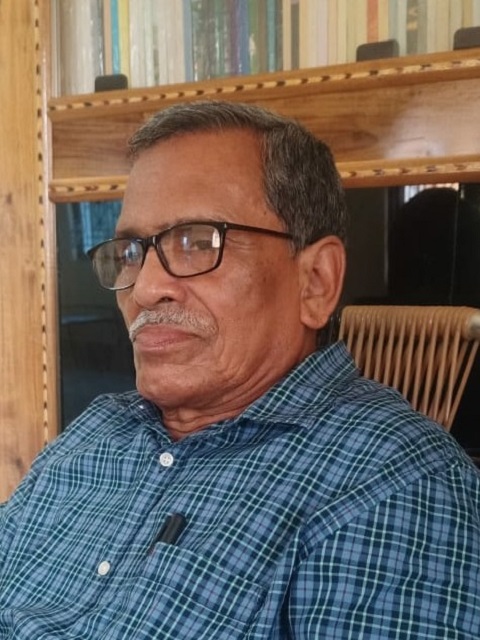
Bipin Patsani (b. 1951) has published poems in many prestigious journals and poetry anthologies including Indian Literature, Chandrabhaga, Journal of Indian Writing in English, Indian Scholar, Kavya Bharati, Poetcrit, International Poetry and Prophetic Voices etc. He has been translated to Spanish and Portuguese. He has three poetry collections to his credit (VOICE OF THE VALLEY, ANOTHER VOYAGE and HOMECOMING). He is a recipient of Michael Madhusudan Academy Award/ 1996 and Rock Pebbles National Award in 2018. He did his Post Graduation in English at Ravenshaw College, Cuttack in 1975 and served as a teacher in Arunachal Pradesh for 34 years till his superannuation in 2012. He also received Arunachal Pradesh State Government’s Award in 2002 for his dedicated service as a teacher. He lives with his family at Barunei Colony, Badatota in Khordha District of Odisha, India.
Rudra Pati
(Translated from Bengali by Matralina Pati)
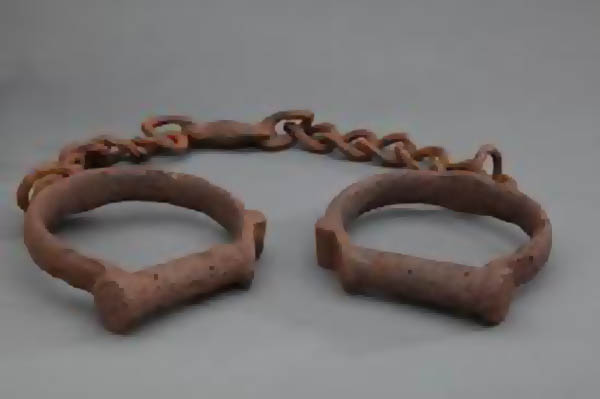
Chains of poverty have clasped
Onto her feet—her legs opened wide.
Pain has turned her pale blue;
Rice is all she has ever loved.
Truck drivers and factory labourers visit her.
So does that Dada from the political party—
The one who procured her the license.
He visits her late at night;
votes are all that he has ever loved.
Moonshine rollicks on her,
So do rain, heat, and dust.
Look—how this girl quivers along,
Her muffled screams at the end!
The jingling of chains
Twirls round her mortal frame,
Then mingles into
The night-borne air.
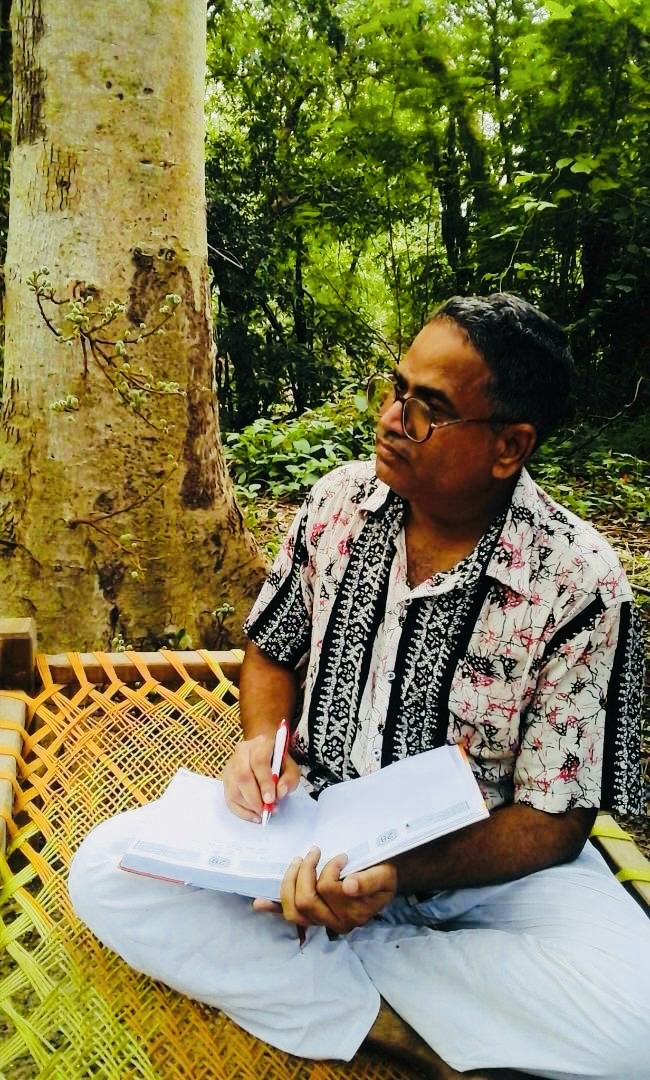
An eminent poet of contemporary Bengali literature, Rudra Pati (born in 1968) is an authentic representative of post-modern Bengali poetry. Rudra Pati teaches in a government-aided school and has a penchant for astronomy, Euclidean geometry, farming, and shepherding cattle in his native place, a drought-ridden rural region of Purulia in West Bengal. His published works include Prantik Chasha (1993), Lathe Othoba Osomprikto Hydrocarbon(1993), E Bachar Shrabon Bhalo (2004), Bekarer Kobita(2004), and Guchhomul (2005).
He was invited by All India Radio to present his poetry at Akashvani Bhawan, Kolkata. He has read his poetry at numerous literary festivals such as Paschim Banga Bangla Academy, Bangla Kobita Utsav, International Poetry Festival, Biswabangla Kabita Utsab, and many more. He is a recipient of the ‘Krishnamrittika Sahitya Award’ (1997). Rudra Pati says: "My dream shatters, yet I dream anew."
Arpita Priyadarsini
People lie
And try hiding
Beneath the mask of perfection
When all we're
Nothing but imperfections
Draped in floral wrappers and pretty ribbons
We all need only one person
To open us up carefully
And unwrap
Every single imperfection
That has ever existed in us
And kiss them like their own
We need to be heard and seen
Like never before
Heard in ways that whispers seem louder
And the silence grows deeper
Seen like we're much more
That these flesh and bones
The hands that caress us
Could also be the hands
That made us introduce
With the numerous possibilities
Of gain and loss
Yet sticked around to prove
That how everything is not gimmicky
We all are broken
With a heart such fragile
That is now afraid of
A strong gust of wind
Fearing the fact that
It'd erase away
The little that's been left
We're scared
Scared to open up too much
Or too little
Scared to get accepted
For the way we're
Cause somehow
We feel as if
We're not enough
And the things or people
That we're chasing
Are epitome of perfection
We forget the fact
That we're nothing
But mere pieces of broken porcelain
Existing in each other
Trying to find ways
To fit in and form a shape
That holds us close

Arpita Priyadarsini, currently working under Home department, Government of Odisha, has keen interest in literature. She loves reading fiction and poetry. She started writing poems few years back and has been published by an international publication house twice. Her Instagram handle is @elly__.writes, which is solely dedicated to her love for poetry.
Matralina Pati
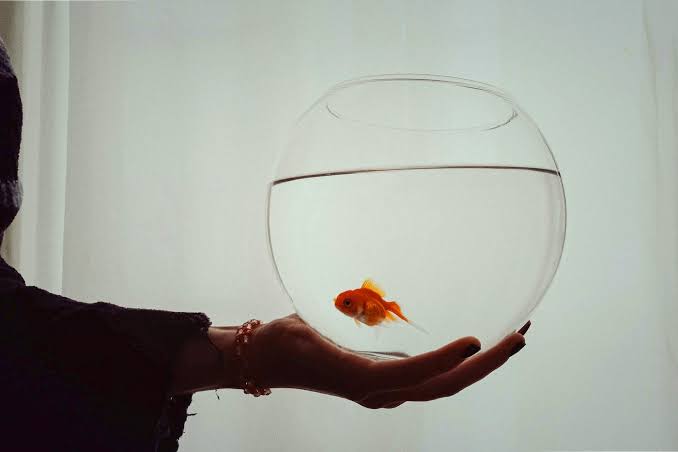
Shattered promises reel across
The moistened lane to an open eye
Memories of your fluttering fins_
Molten gold unleashed
Flash across my vision
Veiled shadow of the tender sun
Twirled within the bowl
Its eager face moved along
The valley of dusk.
You have swooned to nought.
And love retreats to a void
This day.

Matralina Pati, is a PhD research scholar working on marginal Indian bhasha literature (UGC Junior Research Fellow), a bilingual poet and a translator from Bankura, West Bengal. Her critical and creative writings have been published on national and international platforms. She has authored a book of translations titled Monsoon Seems Promising This Year (selected poems of postmodern poet Rudra Pati translated from Bengali into English).
Hema Ravi
In phlegm and dirt, homes lie splattered
Minds frozen, with souls tattered
As hapless warriors battered
Crouched all of them
In the bitter cold, teeth chattered.
It’s sheer mayhem!
When things do not happen our way
This shall pass! All others will say.
A wayfarer – await your day…
Hold your head high
From ideals and truths, don’t stray
Let scenes go by.
The gentle sun peeps through the rift
Trauma expounds the priceless gift –
Human life is precious. Clouds lift
Sights become clear.
No sooner than they do, act; Swift!
Your goal is near.
Hema Ravi
“You would not stand on the top of a burning building
hoping that Batman might swoop down and rescue you…”
If you do, it’s your choice, only yours. Not anyone else’s...
In the cool comfortable air-conditioned room,
if you are perspiring, it’s your personal predicament; only yours.
At the busy traffic intersection, if you choose
to honk persistently with annoyance,
please do! Irritation and
impatience is yours, exclusively yours…
If you thought fishes in the oceans can swim wherever and
birds have not a care flying across the bright blue skies, choose to be them..
To do or not to do is yours, by choice.
Be diligent, learn to discriminate, aspire
to be inclusive, not exclusive.
The world will remain a better place, with or without you…
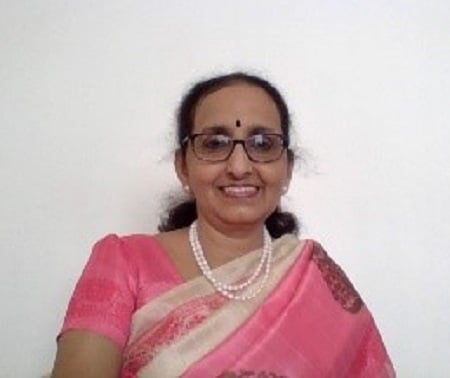
Hema Ravi is a poet, author, reviewer, editor (Efflorescence), independent researcher and resource person for language development courses... Her writings have been featured in several online and international print journals, notable among them being Metverse Muse, Amaravati Poetic Prism, International Writers Journal (USA), Culture and Quest (ISISAR), Setu Bilingual, INNSAEI journal and Science Shore Magazine. Her write ups and poems have won prizes in competitions.
She is the recipient of the Distinguished Writer International Award for excellence in Literature for securing the ninth place in the 7th Bharat Award, conducted by www.poesisonline.com. In addition, she has been awarded a ‘Certificate of Appreciation’ for her literary contributions by the Gujarat Sahitya Academy and Motivational Strips on the occasion of the 74th Independence Day (2020) and again. conferred with the ‘Order of Shakespeare Medal’ for her writing merit conforming to global standards.(2021). She is the recipient of cash prizes from the Pratilipi group, having secured the fourth place in the Radio Romeo Contest (2021), the sixth place in the Retelling of Fairy Tales (2021), the first prize in the Word Cloud competition (2020) and in the Children’s Day Special Contest (2020). She scripted, edited, and presented radio lessons on the Kalpakkam Community Radio titled 'Everyday English with Hema,' (2020) a series of lessons for learners to hone their language skills. Science Shore Magazine has been featuring her visual audios titled ‘English Errors of Indian Students.’
A brief stint in the Central Government, then as a teacher of English and Hindi for over two decades, Hema Ravi is currently freelancer for IELTS and Communicative English. With students ranging from 4 to 70, Hema is at ease with any age group, pursues her career and passion with great ease and comfort. As the Secretary of the Chennai Poets’ Circle, Chennai, she empowers the young and the not so young to unleash their creative potential efficiently
Padmashree Chennojwala
(Translated from Telugu by Elanaaga)
Akin to the shower of Sanku flowers
on a moonlit carpet,
blue ink’s beauty becomes manifest.
Finite might be the alphabet,
but it’s a storehouse of knowledge.
Just fifty-six are the letters,
but they’re a labour room for great tomes.
Letters may frisk around like deer,
or quit the team, but they turn into
beautiful words, ring sweet sense.
Words shake hands with one another,
a sentence shines to enchant, spills ideas,
ploughs the heart’s unrest.
A sprouted letter blossoms,
spreading scents of the lingo.
The poet’s heart turns
a bumble-bee, savours the nectar.
The moonlight of poetry capers
as a cataract in starry nights.
Nature’s beauty and the poet’s heart
become head and tail of a coin,
creating a charming poem
to enchant the readers’ minds.
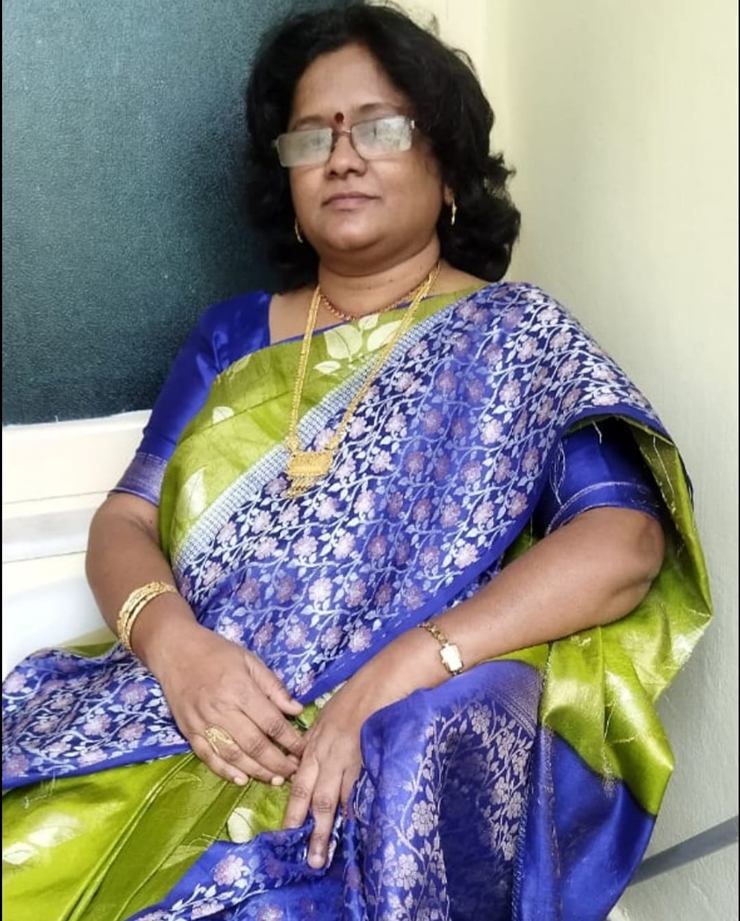
A home-maker with an M.A. degree and two post-graduate diplomas including one in music, Ch. Padmashree composes poetry and prose in Telugu. Her poems keep appearing in local periodicals on and off. She won a few prizes in poetry-writing competitions.
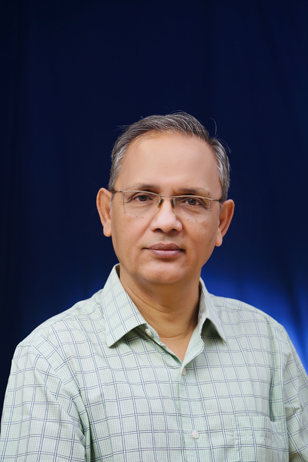
Elanaaga is a well-known poet, writer, translator, and critic in the field of Telugu literature. He is a paediatrician, but only pursuing his literary interest now. His actual name is Dr Surendra Nagaraju.
He penned 37 books so far, 18 of which are original writings (two in English), while 19 are translations. Of the latter, 10 are from English to Telugu and 9 from Telugu to English. His works comprise books of free verse, prosodic poems, experimental poetry, language-related essays, essays of criticism, standard crosswords and translations and so on.
He lives in Hyderabad. His email address is elanaaga@gmail.com.
Chaitrakana Pati
In Monsoon when soft dew lingers on the leaves
Of the large and brittle willow tree
Which grew where you were buried
Where there are flowers, birds or bees
Forever, resides only me.
I came to visit your grave
To leave a fresh bouquet
Of flowers I never gave,
And the moment I see the name
Written on your grave-stone’s front plate
I wish for you to take my place.
However, you are now nothing but a corpse
So, instead up I climb the willow’s top
And as I let the sunset be watched
I wonder if I will move on
From the regret that never stops
And the heart of mine which still rots.
But soon with you I shall lie
For slowly but surely I will die
And as I look up to the blue sky
And I feel the warmth of sunlight
I know I will not be missed, but that is fine.
For although I was you, you were far better than I.
Heaven and hell do not await us
Only the organisms that will make us one
Within the land’s infertile earth
When the one after me shall come
To mourn you from dawn to dusk
Then look at me with regret and leave my grave untouched.
When they, too, with us shall lie, there will come another
And the cycle will continue from Summer to Winter.
When the last one will come to look over
The willow tree that will grow so much larger
Their white hair and wrinkled eyes will be left to ponder
If they could have stayed a little longer.
When none is left to follow
We all shall become one with the willow
Till the tree’s trunk becomes hollow
When shall come the cry of the swallow
And Spring will come forth with luscious heather
On the only land we have ever known.
The swallow then will take our seeds from this land to the next
And so shall the land with any that behind is left
Before the willow’s bark will break slowly or in an instant.
But the willow tree will be dead
And we shall come to an end
Once our memories are truly forgotten.
Chaitrakana Pati, a student of the 10th standard, finds joy in expressing herself through poetry in English. She has a deep appreciation for literature and a quiet passion for painting, both of which inspire her creative journey. Alongside her love for the arts, she enjoys music and has a keen interest in storytelling. She loves nature and enjoys exploring new spheres of knowledge. With a curious mind and a thoughtful approach to creativity, she continues to explore and learn as she hopes to grow as a writer and an artist along the way.
Dr. Rekha Mohanty

Toys have wings,
No more destined
to be perched for decoration,
Not confined to market
play room or home,
Sneaked out beyond imagination,
To enliven the realm of orbit
escaping attraction of gravitation,
In pursuit of landing
on the pearly moon…
It’s a beloved companion
in space mission,
Role of a playful famous icon,
Characters like Angry bird,
cute baby Yoda,Frozen and so on,
Latest being the cygnet
‘Joy’ the adorable baby swan..
Toys play roles,
Keep the moral high,
Help to focus on goal,
Where day and night mingles
in vacuum of galaxy
of timeless zone,
They anchor human emotions,
They simply remind sweet home..
A small toy, a source of big joy,
Floats and oscillates
randomly in vast Milky Way,
Gives a comfort camaraderie
And promise of an
unflinched bravery,
They are cultural ambassadors,
They are Zero-G indicators,
They teach microgravity,
They are physics teachers
and demonstrators,
They inspire human spirit
to explore more,
In Tome of Curiosity science,
a new page appear..
The view of our planet
from outer space is
overwhelmingly beautiful
without any border,
In this wonderful universe
our earth is a mini toy,
We love to live collectively through our great endeavour..
Love you dear ‘JOY’
Col( Dr) Rekha Mohanty is an alumni of SCB Medical College, Cuttack, Odisha and she has spent most of her professional life in military hospitals in peace and field locations and on high altitude areas.She has participated in Operation Vijay (Kargil war)in 1999 and was selected for UN missions in Africa for her sincere involvement in crisis management of natural calamities in side the country and abroad where India is asked to do so in capacity of head QRT in Delhi for emergency medical supplies.She had also participated in military desert operation’ Op Parakram’ in Rajasthan border area.After relinquishing Army Medical Corps in 2009,she worked in Ex Servicemen Polyclinic in Delhi NCR and presently is working in a private multi-speciality hospital there to keep herself engaged.
Her hobby is writing poetry in English and Odia.She was writing for college journals and local magazines as a student in school.
Being a frequent traveler around the world,she writes travelogues.The writing habit was influenced by her father who was a Police Officer and used to write daily diary in English language he had mastered from school days in old time.Her mother was writing crisp devotional poems in Odia language and was an avid reader of Odia and Bengali books.Later her children and husband also encouraged.
Dr Rekha keeps herself occupied in free times for activities like painting, baking and playing card games the contract bridge.
She is a genuine pet lover and offers her services to animal welfare organisations and involves in rescue of injured stray dogs.Being always with pets at home since early childhood ,she gives treatment to other dogs in society when asked for in absence of a vet.She delivers talks on child and women health issues to educate the ladies in army and civil.
After sad demise of her husband Dr( Brig)B B Mohanty in February 2023,she devoted more time to writing and published her first poetry book’Resilient Leaf’in August 2023.Since then there is no stopping and she is going to publish her second book of poetry soon.
She enjoys reading E magazine LV , newspaper current affairs ,writing poetry and watching selected movies whenever she gets time.She keeps travelling places of interest in between for a change which is a passion as a girl since days roaming with parents and siblings .Her motto is to be happy by giving the best to self and to the society.She is lucky to have a supportive family.
Sujata Dash

Such a stifling hot day !
The season of summer shows its prowess
Thrusts its ruthless say
Parching throats make a beeline
For cold beverages
For such vendors, It is a heyday
In a few weeks of time
This season will metamorphose
Like seamless graduation of tender mangoes
We will breathe respite when dark clouds hover
The first spell will satiate arid acres
Sprinkle oodles of petrichor
Soon another shift
In a few months' time
The fall season with exotic color palettes
Will festoon earth's demeanor
Shedding old, beginning anew
Will become the obvious pattern
The earth will slowly shed inhibitions
Brace up for cold climes of winter
A lavish pristine quilt, the earth will sport
As winter sets in, stays afloat
Planets and stars will align differently
Augment paraphernalia for winter solstice
From hibernation to joyous celebrations
Each interlude will light up mind enthrall soul
Spring is never far behind winter
Nor spurns its allotted space and skips turn
It tiptoes to display an array of colors
The daffodils, the cherry blossoms
Limns quintessential hues of love
Warmer and longer days set the tune
For Growth and regeneration
The seasons are deeply ingrained
In our system
If we do not fall in line with
Their pulse and patterns
Our fate will be that of a lost ant
Misplaced from the queue
Deemed to be doomed forever.
Sujata Dash is a poet from Bhubaneswar, Odisha. She is a retired banker.She has four published poetry anthologies(More than Mere-a bunch of poems, Riot of hues and Eternal Rhythm and Humming Serenades -all by Authorspress, New Delhi) to her credit.She is a singer,avid lover of nature. She regularly contributes to anthologies worldwide.
Ms Gargi Saha
Poetry is noble
Poetry is divine
Poetry speaks volumes in silence
It uplifts the soul
Transports us to a different realm
Above the phenomenal world
Poetry is lofty
It is a remarkable feat
Much is conveyed than said...
Poetry speaks the unknown, abstract
Poetry is mysterious
It has layers of meanings
It is like peeling an onion
Layers after layers
Poetic justice is rum to comprehend
Topsyturvy seems the world
With infinite disparities
All that glitters is not gold
Old is gold
Let's sail to sublimity by poetry
Embrace love,serenity, tranquility.
Ms Gargi Saha
Against the green background
White, yellow ,red, purple, orange flowers
Smiling in a row
Makes one feel,hopeful, hilarious for a better tomorrow
Service before self,always a blessing
Action speaks louder than words, marvelous upbringing
Flowers smiles to the world harmoniously
I am grateful to God, for such a wonderful gift from Heaven
They pass away unheard,unlamented, unsaid
Blissfully ignorant about the woes of the world
I wish I was a flower, to serve Thee whole heartedly
I am placed at "His" Feet Honorably.
Ms Gargi Saha
In the distant far
The setting sun has spread its orangish aura
The mountains boldly overcoming the storms
Greenery gives solace to the tired eyes
The flames beaming high from the fire place
Providing warmth to the surroundings
But who lit the fire?
No trace of humans
Is it a dream?
Of far fetched realities
Burning the fire of revenge, gluttony, pandemonium
And awaiting a new sunshine of forgiveness, abstinence, serenity.
Ms Gargi Saha is a creative writer and has published two poem books namely, 'The Muse in My Salad Days ', and 'Letters to Him '.Her poems have been featured in National and International Journals. She has received the Rabindranath Tagore Memorial Award and the Independence Day Award for poetry. Presently she edits several scientific research papers. She can be reached at gargi.paik@gmail.com
Sreedharan Parokode
Some messages put persons
in peril, and make troubles.
If it is in morning time
tension mounts inexplicably!
For the source,
the authenticity, place of the
message sent are clearly
searched when it is received.
Some hidden meanings may
trouble the entire ways.
A plain message will not have
cruelty towards mankind.
It says of things,
in a clear manner, leaving
no room for suspecion.
One can easily see what is in it.
But the messages received
very early in the morning
thwart the whole day some times..
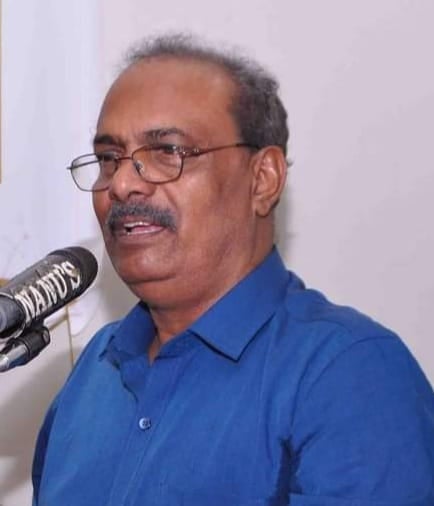
P.L.Sreedharan Parokode is a bi-lingual poet and lyricist from Malappuram district, Kerala. He has a Master's degree in English literature and Population Studies and a Post Graduate Diploma in Parental Education. Sreedharan has thirty books of poetry to his credit, including 'Weeping Womb', 'Slum Flowers,'Mahatma Gandhi' 'Nelson Mandela',Poems', 'Don't mum Please' etc. He has also written songs for professional dramas, for albums, songs for competitions, devotional songs etc. He has written songs for animation film also.
Sreedharan has attended various literary conferences in India and abroad. He presented his poems at World Congress of Poets, in Taiwan, 2015, China, 2018, and literary conference in Serbia, 2007.
He has received awards and honours from various organisations, such as, Sahitya shree Award, Sahitya Shiromani Award, Shan E Adab Award etc. He has also received an Hony.Doctorate from the World Academy of Art and Culture
Sreedharan is currently engaged in Doctoral Research in Population Studies from Annamalai University. Earlier he was working in the Administrative wing of the University of Calicut.
S. Sundar Rajan
Oh man! Can you address the morning milk?
Oh sure! Why not he says, without a blink.
Woman finds milk on the dining table
But not steaming coffee, as in fable.
Oh man! Can you address washing the clothes?
Oh sure! Why not, he says, with cheerful looks.
Woman finds in the tub, well washed clothes with ease
But not on the clothes line for Sun and breeze.
Oh man! Can you address the coffee cups?
Oh sure? Why not he says with smiling lips.
Woman finds the well washed cups in the sink
But not in usual place after the drink.
Oh man! Can you address the dried clothes?
Oh sure! Why not, he says, knowing the ropes.
Woman finds the dried clothes stacked on the bed
But not in the cupboard, as expected.
Oh man! You follow instructions to the 't'?
Oh sure! If possible I try to be.
Woman finds him so very very disarming,
But not discounting as a perfect darling. my poem for July'25
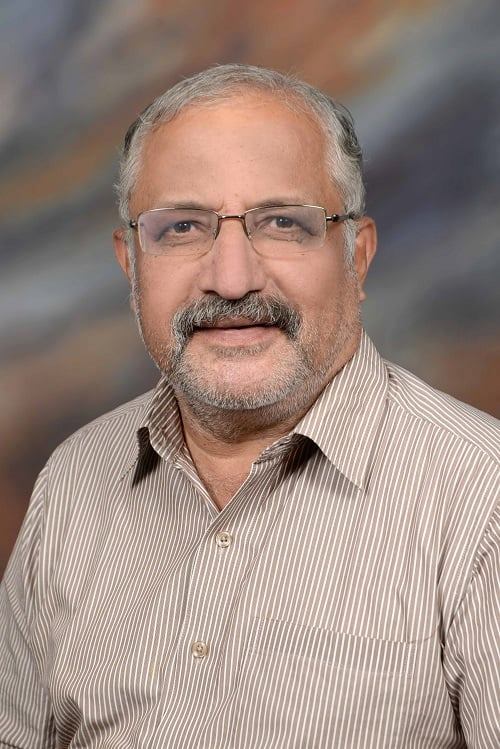
S. Sundar Rajan is a Chartered Accountant with his independent consultancy. He is a published poet and writer. His collection of short stories in English has been translated into Tamil,Hindi, Malayalam, Telugu, Kannada and Gujarati. His stories translated in Tamil have been broadcast in community radios in Chennai
and Canada. He was on the editorial team of three anthologies, Madras Hues, Myriad Views, Green Awakenings, and Literary Vibes 100. He has published a unique e anthology, wherein his poem in English "Full Moon Night" has been translated into fifteen foreign languages and thirteen Indian regional languages.
An avid photographer and Nature lover, he is involved in tree planting initiatives in his neighbourhood. He lives his life true to his motto - Boundless Boundaries Beckon.
Dr. Rajamouly Katta
Pearls at the bottom of the ocean
Too deep to the physical eye
They shine as stars in the sky
For they are prime for imagination.
Flowers bloom on stems in freedom
With multi treasures to fill
The poet’s mind is in thrill
As queens to rule the plant kingdom.
Amidst dark clouds shine lightning
Its span too short to reckon
The poet’s eye owns it won
To gush in the poem as the musing.
Tides in their strides seem to ride
Like ideas in youth robust
Like glows of spring in lust
Poets paint them in poetry in pride.
Coo…coos of cuckoos are melodious
Touch the senses and hearts
Trasport to the realm of arts
Aesthetic to rouse fancy tremendous.
Peacocks dance in the fullest grace
At dark blue clouds’ sight
Touches poets’ keen might
Glitters like mantles in inklings’ pace.
There is no poetry without a source
Like the pearls at bottom
Like twinkles of stardom
All stir poets’ imagination to course.
Dr. Rajamouly Katta
My village I still recall
It’s small but it’s all
Its image is so spectacular
That it stands a dear mother
With all love and affection,
The treasure-trove, its distinction
Nature all around to delight
By its specials as its highlight
With thick thickets on mounds
To the west, small fruits like berries
For our palatal bliss.
A rivulet flows to its south
To offer joy in swim and play
Building sand doons when bare
It whirls towards the east
With green fields on its banks
A beautiful sight in sheen,
There is a tank to overflow in rain
To the eyes a feast with its tides,
Touching the shore with their strides
I still recall my village
With all memorable all around
All sights so fantastic in high measures
As rich treasures for our pleasures
Apart from the hills excel from distance
In its four sides for delight to the core
Variety in their shapes for beauty,
One to the north like a big snake
Crawling slowly sans our notice
One to the west like a bull
Sitting in rapt prayers
One to the south like a grain stack
As a product of the backbone,
One on it to the east with a big tree
A lovely sight for our delight,
In vicinity and at a distance I still
Recall all the treasures of my village
My mother and my motherland
All abounds in beauties in bounty
In childhood for my hive of memoirs.

Dr. Rajamouly Katta, M.A., M. Phil., Ph. D., Professor of English by profession and poet, short story writer, novelist, writer, critic and translator by predilection, has to his credit 64 books of all genres and 344 poems, short stories, articles and translations published in journals and anthologies of high repute. He has so far written 3456 poems collected in 18 anthologies, 200 short stories in 9 anthologies, nine novels 18 skits. Creative Craft of Dr. Rajamouly Katta: Sensibilities and Realities is a collection of articles on his works. As a poet, he has won THIRD Place FIVE times in Poetry Contest in India conducted by Metverse Muse rajamoulykatta@gmail.com
Meenakshi Goswami
I sealed the gates,
Softly now, I tread with care.
No need for clamor,
It’s my choice to close.
Perhaps I’m unworthy
To exchange even whispers.
My solitude I honor,
My sanctuary reigns supreme.
I refrain from judgment,
Simply pause and observe.
I stay beyond the boundary,
Silent, distant, still.
I let the ache settle deep,
I let the moments drift by.
Seasons may yet shift,
Blossoms will awaken anew.
The skies will unfold,
Winds will weave through.
My streams will dance,
This earth will thrive again.
How can yesterday linger?
Those echoes have dimmed.
Time carves its essence,
I, too, am transformed.
I wish myself only joy,
Boundless in its grace.
Should I seek refuge,
My heart remains a haven.
With a quiet smile,
I await the tide’s turn.
A glimmer of sorrow veiled,
My wounds stay unseen.
I let myself find peace
Within these guarded walls.
No claim have I
To pry my barriers open.
I let myself soar unbound
Beyond the veiled horizons...
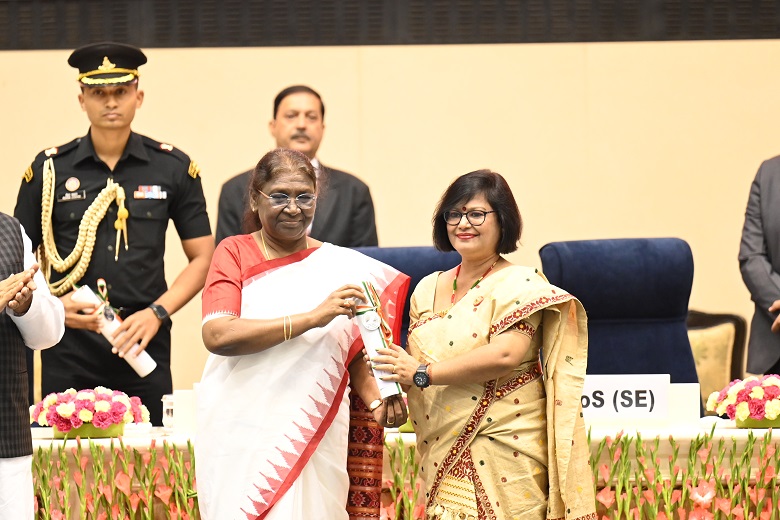
(Ms. Meenakshi Goswami receiving the National Award to Teachers on 5th September from the President of India)
Meenakshi Goswami is the proud recipient of National Awards to Teachers 2022 given by Her Excellency The President of India on 5th September 2022. She is the Principal of CNS Higher Secondary School, Tezpur , Sonitpur, Assam. A Member of the North East Writers' Forum, India, she is also into sports organisations and anchoring at various functions.
She has been awarded on International Women's Day 2007 by the Indian Medical Association and on India's Republic Day 2019 by the Govt. of Assam for her dedicated service towards human resources, arts and culture. She has been awarded The State Award for Teachers by Govt. of Assam on 5th of September 2018. Meenakshi is a proud recipient of the prestigious OIL SHIKSHYA RATNA PURASKAR - 2016' , In recognition of all round excellence as an educationist . Her debut book of poems "The Sensuous Zephyr" was launched in Melbourne on 11th January 2014 where she was invited for poetry session. Meenakshi Goswami also participated in many International Poetry Festivals. Her poems are published in many National and International Multilingual Anthologies.
She has been conferred The Star Ambassador of World Literature by Philosophique Poetica & Grand Canada at World Poetry Conference for her contribution to World Literature as A Poet, A Committed Educator and Scholar of a High Order. The Sensuous Zephyr and Waltzing Words are two of her famous poetry books. As an outstanding interpreter of poetry & an excellent poet, Meenakshi has attended many Poetry Festivals in India and abroad.
Harisankar Sreedharan
Yes, I admit
I'm range anxious..
If you're asking, why
So belatedly? It's simply
Because the realization
Came a bit too late!
I know, I'm not able
To reach you,
With my writings, nor
Through my speeches...
Words, have started
Failing me, now (as thence!)
I guess, it's the comparative
Progression of evolution,
Expressions in a faster track
Me, a tad slow, in the beaten track
I failed to catch up....
My attire catches a glance,
Not any more, even in the
Crowd of friends and since
So long among acquaintances
I failed to measure up...
The thesaurus has dried up,
Unable tofind the right terms
I'm out of Sync, You say
My parts of speech are out of joint,
I failed to set them right *
It was becoming tortuous
Looking over my shoulder
I started running, my caricature
Cast on the earth reluctant to follow
I failed to make sense
Hitting the search engine was
In desperation, it carried me
Around a world of it's own and
Dropped me where l was picked up
Said I failed to add up!
The path was branching ahead
The proverbial tree stood in the middle
I asked, which way now? The tree said
If you're unsure, it doesn't matter which
Suddenly, everything added up
I'm at peace, with myself and the world
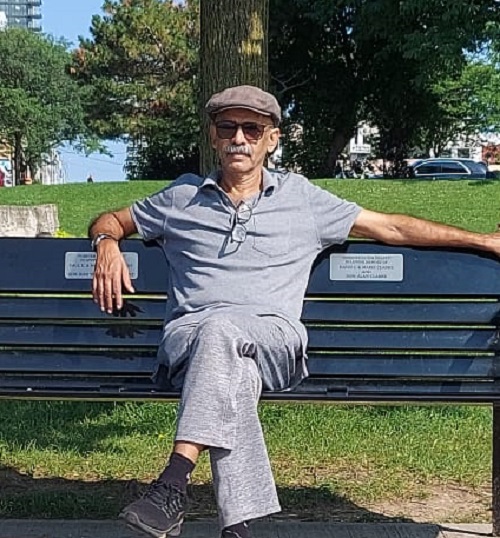
Harisankar Sreedharan is a banker by profession. Retired from service in 2020. Still active in the profession. Pursuing interests in literature - poetry and drama. Associated with the theatre movement. Own creations are in Malayalam. Occasionally write English poems too.
A Traveller... fascinated by the time unframed in places - seemingly enjoying the whiff of smoke from cooking pots and tea kettles, smothered by the conversion among the local people .... to stand, watch and let the world pass by ..
Passionate driver, bike rider and trainer.
Dr. Mrutyunjay Sarangi
Tread softly on my dreams,
Zindagi! I am here to stay.
Sitting in the shadow
Of the floating clouds
Listening to the murmur of lilting streams.
Voices come floating
From lands known and unknown,
And keep playing in my heart,
Songs laden with love and loss.
Of sighs and moans,
Of cries and groans.
Leaning on a tree,
I want to look deep into time
And rummage from it
Priceless nuggets
That will bring me
The roses in December,
And marigolds in June.
And fill my heart with the colour of the sky,
Those moments would come back
And dance before my eyes
With a delightful abandon.
I want to see again,
My village pond, its emerald water
And the moon swimming in it,
The dust laden path
And the bullock cart
Slowly trudging by,
In a timeless journey,
The palm trees from my orchard
following it in a silent procession
In the moonlit night.
I want to inhale
The fragrance of solitude
Taking the shape of nubile desires,
I just want to close my eyes
And feel the slow throbs of my heart
Singing a celebratory song.
You move on Zindagi,
In your swift caravan,
I will give you a bye,
And sit here looking at my trail,
Strewn with the shadows of my dreams,
Dancing to a cascading music
Played by unseen fairies,
My past lovers coming back to me!
Dr. Mrutyunjay Sarangi is a retired civil servant and a former Judge in a Tribunal. Currently his time is divided between writing poems, short stories and editing the eMagazine LiteraryVibes . Four collections of his short stories in English have been published under the title The Jasmine Girl at Haji Ali, A Train to Kolkata, Anjie, Pat and India's Poor, The Fourth Monkey. He has also to his credit nine books of short stories in Odiya. He has won a couple of awards, notably the Fakir Mohan Senapati Award for Short Stories from the Utkal Sahitya Samaj. He lives in Bhubaneswar.
BOOK REVIEW
THE PARADOX OF CONFESSION AND CONCEALMENT
Matralina Pati
A Book Review of the half-confession by Jaydeep Sarangi, Published from Penprints India, with ISBN: 978-81-975894-3-o; ISBN IO: 81-975894-3-7; 2020, pp. 96. Priced Rs 350, $40
At its core, poet Jaydeep Sarangi’s the half-confession: soulful poems operates as a paradox—an assertion that simultaneously reveals and withdraws. The poetry collection unfolds a discourse that oscillates between the urge for self-exposure and the necessity of self-preservation. Unlike the traditional confessional narratives that seek catharsis or redemption, this work resists closure. The poems in the collection succeed in undermining the very structure of confession as an epistemological act. The text neither limits itself to unidimensional objectives of St. Augustine or Rousseau, nor does it conform to the structured revelations of modern autobiographical literature. Instead, it situates itself within a lineage of literary and philosophical works which seek to interrogate the very act of self-disclosure. The poems in the collection have gleaned novel literary-critical perspectives from the fractured narratives of Samuel Beckett, the linguistic opacity of Paul Celan, and the existential equivocation of Clarice Lispector.
The book unfolds not as a linear revelation but as a fragmented mosaic, where voices collide, dissolve, and re-emerge in a polyphonic interplay. The confessional first person is replete with polyphonic voices and is essentially unstable. It aims at resisting coherence. Instead the voices disperse across multiple registers including the lyrical, the philosophical, the anecdotal, and the aphoristic. In doing so, the half-confession enacts a fundamental resistance to the biographical impulse that seeks to unify subjectivity into a coherent arc. Rather than presenting a stable self, the text underscores the fractures and dissonances of identity as it aligns itself with a broader postmodern skepticism toward the reliability of narrative as a vessel for truth.
The structure of the half-confession is a deliberate disruption of linearity. It culminates in an aesthetic strategy which mirrors the psychic recesses of the poet. His creative insight traverses across cultures and time-frames. The refusal to adhere to conventional chronology is not merely a stylistic choice but a fundamental statement on the instability of memory and identity. The book’s fragmented form echoes the works of modernist and postmodernist predecessors. Thus the poetry-collection becomes reminiscent of the disrupted temporality and the mosaic-like assembly of Faulkner’s The Sound and the Fury. In place of a singular, coherent trajectory, the half-confession presents a constellation of moments across time and space which, in turn, resonate with disparate yet interconnected tenors.
The interplay of forms and allusions within the collection enhances its polyphonic nature. This multiplicity of voices creates an ever-shifting ground which prevents the reader from settling into a singular interpretative mode. Language itself becomes unstable. It shifts between poetic introspection and raw, fragmented utterances, much like the linguistic experiments of Beckett or the syntactic disruptions found in Hélène Cixous’s écriture féminine. The text’s oscillation between these registers is not simply an aesthetic maneuver but a means of enacting the tension between articulation and erasure, between revelation and withdrawal.
At the thematic core of the half-confession lies the fundamental tension between confession and concealment, between the desire to be known and the fear of exposure. The text engages with the long history of confessional literature. Still, it subverts the traditional aims of the genre. Unlike St. Augustine’s Confessions, where confession serves as a pathway to divine grace, or Rousseau’s Confessions, which seeks to establish an unvarnished truth of the self, the half-confession withholds as much as it discloses. The revelations of the poetic personae are partial, interrupted, laced with ambiguity. These emphasise the inherent impossibility of full disclosure. In “Road to Pompei” the poet writes:
“Whispers of the wind are tales shared,/ loans taken from night cloud’s haze.” (Road to Pompeii, 33)
This refusal of closure aligns the text with a broader philosophical critique of confession as a discursive practice. Michel Foucault, in The History of Sexuality, famously theorized confession as a mechanism of power, a process through which individuals become subjects of discourse, disciplined by the very act of revealing themselves. In the half-confession, this dynamic is complicated further. Confession is neither a path to redemption nor a submission to external authority but an agonizing negotiation between self-expression and self-erasure. The act of confession, rather than offering clarity, deepens the narrator’s existential uncertainty. In “Songs of the Stone” the poet writes:
“The Mahanadi is free, without clothes./ marks and scars on its bare watery body/ asking me, what was I doing all these years among the words?”.
Furthermore, the text interrogates the role of memory in self-construction. In Memory, History, Forgetting Paul Ricoeur argues that memory is never a pure recollection but always a narrative act. This act is forged as much by forgetting as by remembering. In the half-confession, the struggle of the narrator to articulate a coherent past underscores this instability. It demonstrates how memory fractures under the weight of trauma and self-doubt. Thus the text aligns itself with a postmodern skepticism toward the idea of an authentic self. The poems, in turn, suggest that identity is always in flux, perpetually deferred. Neither collective memory nor personal memory is ever fully retrievable.
The most striking aspect of the half-confession is its refusal to offer resolution. The text resists the reader’s expectation of narrative coherence. Instead it draws them into a liminal space where meaning remains perpetually elusive. This aligns with Barthes’ notion of the “writerly text”. In this regard it ought to be noted that a writerly text unravels a work which does not passively convey meaning. Rather, it demands the active participation of the reader in constructing it. The silences, omissions, and contradictions embedded within the half-confession compel the reader to navigate the text as an unfinished puzzle, where gaps are as significant as the words themselves.
This very quality grants the poetry collection its depth and complexity. It is precisely this tension between emotional immediacy and intellectual abstraction that defines the book’s unique aesthetic and philosophical stance. In its refusal to adhere to traditional narrative logic, the half-confession transforms the act of reading into an experience of fragmentation. It demands engagement rather than passive consumption.
In the landscape of contemporary literature, the half-confession stands as a radical meditation on selfhood, language, and the nature of storytelling. Its rejection of conventional narrative structure aligns it with a tradition of literary experimentation that includes writers such as Borges, Nabokov, and Lispector. Yet, beyond its formal innovations, the book offers a profound philosophical inquiry into the nature of confession itself—revealing its limits, exposing its contradictions, and ultimately leaving the reader with more questions than answers.
The very act of engaging with the half-confession becomes a form of confession in itself. While going through this collection of poems the reader, like the poetic persona, is drawn into an unfinished dialogue where meaning is perpetually deferred. In this sense, the book does not merely recount a confession. It enacts the existential condition of confession which is an endless negotiation between self-expression and silence, between the desire to be understood and the impossibility of full disclosure. The confession remains incomplete, suspended in its own contradictions which ensure that its echoes persist long after the final page.
Jaydeep Sarangi is an Indian poet with ten poetry collections in English latest being Memories of Words, poetry activist and scholar on postcolonial studies and Indian Writings with forty one books anchored in Kolkata/Jhargram,.. With Rob Harle he has edited six anthologies of poems from Australia and India which are a wealthy literary link between the nations. With Amelia Walker, he has guest edited a special issue for TEXT, Adelaide (Australia). His recent books include, Mapping the Mind , Minding The Map:Twenty Contemporary Indian English Poets , Sahitya Akademi, 2023 and A Life Uprooted: A Bengali Dalit Refugee Remembers, Sahitya Akademi, 2023. Mapping the Mind, Minding the Map ( 2023, Sahitya Akademi) is his latest book. Sarangi is currently the President of Guild of Indian English Writers, Editors and Critics (GIEWEC) and Vice President, EC, Intercultural Poetry and Performance Library, Kolkata. Living with poets and poetry, Sarangi is principal of New Alipore College, KolkataHe may be reached at: jaydeepsarangi1@gmail.com Website : https://jaydeepsarangi.in/
Matralina Pati, is a PhD research scholar working on marginal Indian bhasha literature (UGC Junior Research Fellow), a bilingual poet and a translator from Bankura, West Bengal. Her critical and creative writings have been published on national and international platforms. She has authored a book of translations titled Monsoon Seems Promising This Year (selected poems of postmodern poet Rudra Pati translated from Bengali into English).
Viewers Comments