
Literary Vibes - Edition CLXI (30-Jan-2026) - SHORT STORIES

Title : Tranquility (Acrylic by Ms. Latha Prem Sakya)
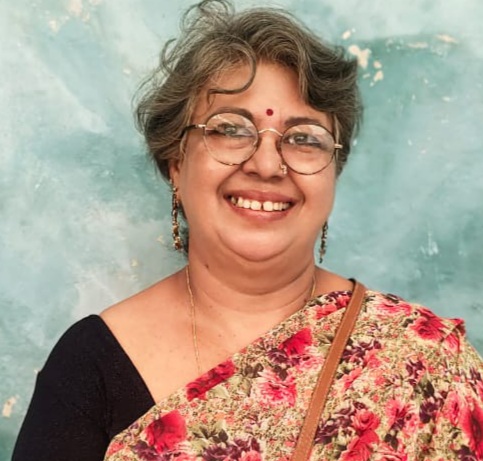
An acclaimed Painter, a published poet, a self-styled green woman passionately planting fruit trees, a published translator, and a former Professor, Lathaprem Sakhya, was born to Tamil parents settled in Kerala. Widely anthologized, she is a regular contributor of poems, short stories and paintings to several e-magazines and print books. Recently published anthologies in which her stories have come out are Ether Ore, Cocoon Stories, and He She It: The Grammar of Marriage. She is a member of the executive board of Aksharasthree the Literary Woman and editor of the e - magazines - Aksharasthree and Science Shore. She is also a vibrant participant in 5 Poetry groups. Aksharasthree - The Literary Woman, Literary Vibes, India Poetry Circle and New Voices and Poetry Chain. Her poetry books are Memory Rain, 2008, Nature At My Doorstep, 2011 and Vernal Strokes, 2015. She has done two translations of novels from Malayalam to English, Kunjathol 2022, (A translation of Shanthini Tom's Kunjathol) and Rabboni 2023 ( a Translation of Rosy Thampy's Malayalam novel Rabboni) and currently she is busy with two more projects.
Table of Contents :: Short Story
01) Prabhanjan K. Mishra
FOR WHOM THE HEART BEATS
02) Sreekumar Ezhuththaani
DIVERSITY
OH, IT’S COMPLICATED
03) Usha Surya
WITH NEW WINGS
04) Malabika Patel
NALDANGA KOTHI
05) Satish Pashine
A WINTER ROAD TRIP TO WAI, PANCHGANI AND MAHABALESHWAR
06) Phalguni Sahu
WHEN FORGETTING ANSWERED FIRST
07) Triloki Nath Pandey
LIFE IN THE INTERNATIONAL HOUSE
08) Annapurna Pandey
LISTEN TO THE THENGAPALLI WOMEN WHO PROTECT THE FOREST IN ODISHA
09) Anita Panda
CHARMING CHARLESTON!
10) T. V. Sreekumar
STARS AS WITNESS
11) Dr. Rajamouly Katta
BEGGAR’S PATRIOTISM
12) S. Sundar Rajan
BASHISHTHA TEMPLE
THE SACRED COW
13) Sreechandra Banerjee
SMALL TALK
14) Mr Nitish Nivedan Barik
LEAF FROM HISTORY: ABOUT “THE AMERICAN PRESIDENT”
15) Dr. Mrutyunjay Sarangi
JUHI, VISHAL, AND A WINTER EVENING IN DELHI
Prabhanjan K. Mishra
For Komal every minute of waiting was like a year. She stood at the glass pane of the window in her room looking at the dimming light of the approaching evening. Her gaze was rivetted on the entrance gate of the Hotel Trupti’s compound wall. The nest returning birds had started their evening clamour.
Hotel Trupti, a three-star joint, offered comfortable stay at the Juhu Beach of Mumbai with its cozy ambience. Her waiting seemed to be over as she saw Riyaz Khan’s car ambling into the Hotel Trupti’s compound.
She recalled when she had arranged that evening’s meeting in the early afternoon, she had said to Riyaz, “I have something very special to tell you, honey.” Riyaz had insisted not to keep him anxious until they met. But she had giggled and wriggle out, “No, sweetheart, it is a piece of very sweet news. And the waiting would make it sweeter. So long, my Riyaz.”
The room in which she had been waiting had been permanently reserved by Riyaz, for himself and Komal, their love nest. They would spend time together, enter and leave without hassles, having their personal keys to the room. But generally, they met once or twice a week by prearrangement, spent quality time from afternoon till midnight. They had been meeting like that in that room for about five years.
They considered the room as their lucky charm as their first intimacy had happed there. That evening, she had in mind, to give her best gift to Riyaz, the news that she was carrying Riyaz’s child.
Komal had a guilt that she also had plans to reveal to Riyaz along with her good news, and get absolved from the burden of that guilt. She wanted to tell him that the name ‘Komal’ was her business sobriquet, and she was Rehana, a Muslim woman like Riyaz Khan. She wanted to tell Riyaz that the fact had slipped out of her mind in those fastmoving happy years and she knew that Riyaz would forgive her small slip.
She wondered how frank was her Riyaz. His mind was as transparent as clear glass. When he had wanted to bare himself fully to her his mind, his heart, and his background, she had put a hand to his mouth, “No, don’t. I want to know you only as my Riyaz and everything else is not worth knowing for me. I want to live, get old with you and die in your arms as they say in great love stories.” And that was that. She knew that Riyaz was an affluent businessman in Mumbai. She had his mobile number. Beyond that she knew nothing about Riyaz.
Though they had not discussed about her finances after she discontinued her job as a high-priced escort girl after being close to Riyaz, though not Riyaz’s wife because he had said that he had been married, yet Riyaz had deposited a sizeable amount in Komal’s account, euphemistically called a returnable loan, that generated for her a decent monthly income in interest, making her financially fluid.
The idea of Riyaz might be to wean her off her job as a professional escort woman. An escort woman would travel generally with a businessman, not savvy with new places or modern gadgets and appliances, to help him feel at home and be comfortable during his tour. The escort woman would act as sort of his temporary personal secretary during the business tour.
But for indiscretions of a very few of their tribe, who crossed the limits of professional decency of escort business by giving personal entertainment the tourist for her personal gains, the escort women’s job had developed a lurid stink with sexual overtone. Though Riyaz knew Komal had a clean background, yet the complicated sexual matrix surrounding escort business had bothered him and he wanted Komal to be away from all that.
Another loan, after a time gap, extended by Riyaz on his own had financed Rehana to set up a dress-cum-cosmetic boutique with a few sales staff in Andheri’s posh area. This Riyaz did, she knew, to keep her occupied when they were not together. With the boutique, she had turned into a businesswoman overnight. The boutique earned good money and she was learning the tricks of the trade as a confident business woman.
Her meeting with Riyaz, she would recall, had been accidental in the foyer of a five-star hotel. Riyaz was cooling his heels waiting for a few business people for a meeting and striking a deal, and Komal had gone there as a prospect hunter, to find elderly tourists who might hire her as an escort woman for their tours.
As both hanged around the gift counters that day, and coincidentally proceeded together to the book shop of the hotel’s sprawling lobby, Rehana sensed the whiff of a male presence by her side, and saw Riyaz, an affable and tastefully dressed man trying to buy books. Their eyes met. Riyaz asked, “May I be of any help, madam?” She had replied off-handedly, “No. Thank you. I am waiting for a friend.”
Suddenly her telephone rang, “Excuse me”, she said to Riyaz and took the call. Mobile was the town’s new toy of the rich and powerful those days. Riyaz’s telephone rang too. When both finished talking into phones, she lied without knowing why, “That call was from my friend. She is not coming.”
As if that was a cue for Riyaz to jump into the prospect of making friends with the pretty, young woman. He said, “The same here. My business people are not coming. That telephone was from my secretary who had arranged the meeting here.” He hesitated before speaking, “If you don’t mind, madam, let’s take a five-minute break over a sip of coffee in the adjacent coffee-shop before going on our separate ways.”
She hesitated like any lady with self-pride that impressed Riyaz. A little more persuasion and she agreed with a small shrug, “You are too suave in your ways to be refused easily. So, I give you my five minutes, and you give me a sip of coffee.” Riyaz was impressed, her imperceptible shrug and reply oozed culture and good breed.
The five minutes coffee break for the two lingered to hours of friendly talk, exchange of names, ideas, and numbers. and other essentials like habits, likings, hobbies over many cups of the stimulant brew, and sparsely ordered portions of snacks. When Riyaz introduced himself as a small businessman and asked her what she did for a living, after a lot of inner-struggle, she revealed to Riyaz that she had been in the escort service, but her services were strictly professional and never crossed any limits that tended to the zone of indecencies as often rumoured.
It was, she informed on insistence from Riyaz, always booked through her escort-providing agency who collected the standard booking fees for the escort services along their agency rates in advance besides a small refundable deposit for a minimum period. She gave Riyaz her company’s business card where her name stood as ‘Komal’ what she had already revealed to Riyaz.
She was using the sobriquet ‘Komal’ on the advice of her agency, she was bluntly told, “A Muslim name made Hindu’s and Christians uneasy in India, where as a Hindu name was gladly accepted even by Muslim patrons.”
The next day, her agency informed Komal that one Riyaz Khan had booked her escort services for a week of business tour to Japan. The man’s photo and the Adhaar Card, the copy of which she received via her agency, had a Calcutta address and Riyaz’s photograph and telephone number he had given her.
Komal was intrigued as Riyaz’s tour of Japan turned out to have little to do with business but it was a tour to enjoy various spots of tourist attraction arounds Japan. It appeared Riyaz was testing waters with Komal as new couples would spend time in their first date or honeymoon. But all along the tour, they stayed in separate rooms booked in their names by Riyaz and he never crossed the limits of social decorum with his escort woman, Komal.
But Komal felt in last few days she had gone beyond escort services, helping Riyaz beyond professionalism, because she had developed immense liking for the man. Further whenever Riyaz was close to her, his warmth and smell troubled her inner demons. Whenever he touched her accidentally in the normal course of give and take, she felt a warm flux in her body.
What Riyaz felt about her she could not hazard. From his soft and warm behaviour, she could guess he was very kind and considerate to her, but he never did give her any clue about his feelings for her.
From airport, on returning from Tokyo, instead of going home, she did not know where he lived in Mumbai, he drove to Hotel Trupti with her and checked into that very room in which Komal was waiting for him. It was almost small hours of the night.
Only one room was reserved unlike two in each hotel during their Japan tour. The desk clerk offered his apologies about the scarcity of rooms when the hotel received the booking call. For reasons even unknown to herself, Komal did not mind checking into that single room with Riyaz instead of going home.
After the bell boys left depositing their bags and taking their tips, they put off lights, and like with a huge mutual understanding and agreement, they collapsed into each other with their tired and unwashed bodies and without changing into sleeping gears, as if, each was in a great hurry to go in search of a reliquary in the other to place her or his precious feelings; as if, the world was going to end, the sun was setting for ever, or they had to make hay when that last sun was shining.
Komal would recall later the only great event in the epochal wee hours of that night was their hearts beating wildly against each other, almost thrashing with pleasure for the release.
That is how their ice of restraint melted and vaporized in the heat of their union. They stayed in that room, cooped up for three days, falling in love bit by bit, building monopoly over each other. The pleasant but tired intimate date that started between them that night, proved to be a long love journey.
As Komal while waiting for Riyaz in their regular room was feeling a lassitude, might it be for her being in the family way, or might it be the release of tension after sighting Riyaz’s car entering Hotel Trupti, and she moved to the freshly made double bed and spread herself into a relaxed posture. While waiting for Riyaz, Komal drifted into sleep.
When she opened her eyes, feeling like only a few seconds had passed, the clock on the wall showed it was ten in the evening. She was napping for almost four hours. But where was Riyaz?
She inquired with the manager at the hotel Trupti’s reception desk, who told her, “Two government officers were waiting in our lobby, and as Riyaz Saheb entered, they had a discussion with him. They all then drove away in Riyaz Saheb’s car. Don’t worry, he my return anytime. I will sound you as soon as he steps in. Madam, would you like to have something for dinner now, or wait for Riyaz Saheb to have dinner with him?”
She was angry as well as apprehensive. What sort of a situation could have made Riyaz keep her waiting without information. But Komal would never guess the man had vanished into thin air for the next ten to eleven years. She also never knew, every moment from then onward, she would expect her Riyaz to materialize from nowhere. But he would prove elusive, a will-o’-the-wisp leading her into a swamp of depression.
Komal was devasted without having any communication with her Riyaz. She had nothing except a mobile number and an office address in Calcutta as on his Adhaar Card. The mobile number went dead. The Calcutta address appeared to belong to people who had bought the property from someone, but not from any Riyaz Khan. Komal guessed the property might have changed many hands after Riyaz sold it and shifted to Mumbai.
She kept waiting with pounding heart for days, then weeks, months, and followed by her losing the count of time. She suffered from a massive depression and other health problems and was taken away to Dubai by her mother, who worked as a house manager in a Sheikh’s house there.
She would never know what happened to their love-nest of five long years, the room in Hotel Trupti. She had no courage to revisit or ask the manager of Hotel Trupti about Riyaz.
Before her nervous breakdown, she had continued to run her boutique for some time. But, perhaps, her lack of enthusiasm and bad health caused her boutique to undergo heavy loss. She at last sold the boutique. It brought a good price. She deposited it along with the other deposits from Riyaz to earn interest, that kept her afloat in her finances.
In her severe depression and ill health, the memory of Riyaz was her life jacket from drowning. The psychiatrist, counsellors, and other doctors looked after her mental and physical health. It took many years to feel healthy both physically and mentally. She had lost weight and glamour. Now she tried to piece together her life again and learn to live without Riyaz. During her stay in Dubai, helping her mother around the Sheikh’s house, she had learnt a bit of house management.
Eleven years of Komal’s disoriented dreary life ended abruptly, as it had started. Now she was Rehana Khatun, no more Komal, her adopted name.
She landed a job though an appointing agent as the house manager and chief of staff in a household, having a bevy of retainers as servants, maids, gardeners, drivers and cooks. She was appointed after a brief interview in the morning, as Rehana Khatun, by one Urvashi Mukherji, the wife of Subrat Mukherji, the owner of a three-storeyed sprawling bungalow in the middle of a big walled property in the eastern part of Andheri area of Mumbai.
The day passed in knowing the house, its various demands and peculiarities and the nature of the staff whom Rehana had to supervise. It was an early evening. Rehana, the house-manager, was standing in the big front sitting room when at seven-thirty a car came to the portico of the house. The uniformed driver carrying a briefcase in his left hand and a bundle of files under the left arm came around to open the door to the back seat with his right.
And lo! Who did emerge from the back seat of the car, and marched into the room where Rehana stood? It was Riyaz in office regalia, suited, booted, complete with a necktie at his collar, and with officious reserve. He took Rehana’s breath away as he was Subrat Mukherji, she would be introduced by Urvashi, his wife who had come and emerged from behind Rehana.
Rehana flinched but not Riyaz. Urvashi introduced her to her husband, “Subrat, this is Rehana Khatun, our new chief of staff and house manager, I have interviewed and appointed today.” Urvashi did not notice the utter amazement, followed by a flash of joy mixed with immense hurt on Rehana’s face, when her eyes fell on her Riyaz, now Urvashi’s Subrat.
Rehana was overwhelmed with joy, sadness, but also with absolution from a long-carried guilt of hiding her real name from Riyaz, as she now found Riyaz had committed the same small sin. She was happy to meet her Riyaz, hale and hearty, after eleven years; and it felt like fulfilment of her long arduous prayers to Allah for her man’s wellness.
She felt sad because Riyaz, now Urvashi’s husband, seemed to have either forgotten her, or could not equate her present unglamorous state as a retainer in his own household with his past glamorous Komal, his heartthrob of five long years.
She felt confused why Riyaz alias Subrat had taken her, Komal alias Rehana, as a lover when she had a pretty comely wife, Urvashi, at home? Was he a playboy as her mother in Dubai had diagnosed him?
Now she was in a double mind, if to stay under the nose of Subrat’s unsuspecting innocent wife like another traitorous vamp in a plot of triangular love story, or resign and go away into the anonymous crowd of the big sin city called Mumbai.
But then her conscience prevailed over her final decision. Why not to linger a few more days and know the truth if Subrat had used her for his sexual escapades as her mother always accused him of? Why not to know a bit more of Urvashi and know the equation between them?
Rehana had been given her living quarters, a big sparsely furnished room with attached toilet-cum-bath facility. It was one among the several servant quarters, a series of backside facing rooms on the top floor of the bungalow. Urvashi and Subrat used the two floors below.
By eleven in the night, after finishing all her job-related responsibilities, eating an absentminded frugal dinner, Rehana retired to her room. She suddenly felt terribly lonely.
As the night progressed beyond mid night, Rehana was sleepless and feeling no peace of mind. Then muffled knuckles against her door alerted her. Through the eyehole she saw the profile of Subrat etched against the distant faint glow of street lamps behind the house.
Her week heart gave a lurch and beat wildly. She gingerly unbolted the door for him, and her heartthrob breezed in like a wisp. She found herself in Subrat’s warm grip reminiscent of old times the next instant. She felt Subrat was crying; and she joined him in that luxury spontaneously.
They stood at the spot, holding each other, their hearts beating against each other like two prongs of a tuning fork, vibrating to the same frequency and wave length. The reunion was sweet, wordless, searching, melting, dreamlike, like a goddess receiving her god in her earnest. Suddenly, each uttered the identical question, “Where did you vanish all these long years?”
When they recounted their stories to each other, the night remained fully awake, but it was like a livid nightmare, combining two nightmares. By the first call of the birds at the dawn, Subrat giving her a last affectionate squeeze, left like a shadow, leaving Rehana happy, spent, but ready in body and mind to face the day in her new abode where lived her heartthrob.
She came to know – that fatal evening at Hotel Trupti people from Enforcement Directorate picked him up and seized his mobile phone from his pocket, and his laptop from his car while detaining him for questioning that led to his arrest. He was charged with non-bailable criminal offences like money laundering etc. All his appeals in the courts even with the help of his lawyers regarding his innocence and bailing him out failed in law’s deaf ears. He stayed in jail for two and half years before being out on bail, but his mobile phone and passport being retained by the court.
When, Subrat took Komal alias Rehana’s number from the manager of the Hotel Trupti, and telephoned her nationally it said, “The number was nonexistent.” When he made an international mobile call, a harsh female voice indicted him, supposed to be from Dubai replied, “It is my Rehana’s number. No Komal stays here. You are calling a wrong number.”
That was his last straw. He thought Komal had surrendered her number that had been allotted a female by the name, Rehana, who lived or was visiting Dubai at the time. He decided to wait and started an all-out search discreetly. His wait and search, both ended that very evening at the door of his own house when he met Komal as Rehana in the sitting room.
He said, “Do you recall Komal, when I wanted to tell you all about me, you strictly restricted me. I wanted to tell you my real identity and the great fiasco of my family life I had been living. But you thought it was against a great love story that was unfolding between us. But frankly speaking, had I known that, a great misfortune like my arrest by ED was going to happen, I would have forced those details on you. But alas, destiny had its own plans.”
In her turn, Komal alias Rehana brought up Subrat with her turmoil during the eleven years of her separation. She told the much-delayed good news to her heartthrob that she wanted to regale him with as her surprise gift eleven years ago that momentous evening when their fate turned turtle.
She said, “Do you recall Riyaz, that evening before all hell broke loose, I had a piece of good news to surprise you? I will tell you that good news now, the surprise of all surprises. I was tested positive for pregnancy that day. Our ten-year old daughter, Lolita, is studying in class four in a school at Dubai, staying with her grandma.”
Subrat recalled telling her, “I love the name ‘Lolita’ the heroin of the novel of the same name, LOLITA, by a Russian author. If ever we have a daughter, promise me not to give her any other name, but Lolita.” His happiness knew no bounds to know about their Lolita and see her photograph in Rehan’s mobile. They started planning how to bring her to India and rehabilitate her in her own country.
Rehana knew that the new chapter of her life was going to be turbulent. Subrat visited her every night for almost a week, and then twice a week and a routine of once a week had set in like their days of Hotel Trupti. Rehana realized she was pregnant again, and her guess took it back to their first reunion in her servant quarters. She felt disturbed about her baby on its way, its uncertain reception in the world.
As days passed in Urvashi’s employment, Rehana started knowing the real Urvashi. Urvashi was a creature of the night. In most days, she would leave bed at around five in the evening, and leave home around ten or eleven in late evenings to join some party. This routine might be breached if she had a social-service engagement during the daytime, as she was office bearer of many a charity group. Because of their life-styles the wife hardly met her husband. Urvashi and Subrat slept in separate rooms. Some sort of estrangement, living together but living apart.
One night Subrat spent time in Rehana’s room. Suddenly, there was a knock on the door. Rehana and Riyaz could not guess – just naked hell was waiting outside. Urvashi, like a 440-volt live wire barged into the room showering abuses – Bastard, worm, Sinner, Maid servant abuser, Creep, magot of the drain…. and other abusive epithets, on her husband. She left the room like the hurricane. Pindrop silence followed. The next day saw changes in Mukherji household that it had never seen.
Mukherji business house got temporarily closed. Bankruptcy was declared. All staff got a package of three month’s salary, one bonus, and a notice to leave. Urvashi packed and left for her late parents’ abode in Calcutta lying vacant with a threat of divorce and alimony.
All household retainers of Mukherji mansion were given six months’ salary with request to leave. They left. Subrat Mukherji packed and left by evening, none knew his next address.
The last person to wind up everything in Mukherji Bungalow’s titbits was Rehana, the house manager and chief of staff. She entrusted everything to the care of the senior most lawyer looking into Subrat Mukherji’s legal affairs who had been loyal to him. She then left purportedly for Dubai, her new job.
Two years passed. A neighbour of Subrat’s past, saw a fellow hobnobbing at the Lonavala’s subji-mandi (wholesale vegetable and fruit market) who looked like the great Subrat Mukherji of his earlier neighbourhood but wearing a Pathani suit. People around told him that the fellow in the Pathani suit was Riyaz Khan. He thought, the folk-belief was perhaps true that an appearance is shared by seven individuals on the earth.
The family headed by Riyaz Khan had moved to Talwadi Village on the outskirts of Lonavala in recent years, and had settled as a man of landed property, buying orchards of fruits and farmlands of vegetables. His family had five members – himself, Rehana, his wife, their daughter Lolita studying in class eight of a school at Lonavala, and the family’s dowager matriarch Sultana Begum, the mother-in-law of Riyaz, besides a baby boy of around two years old who toddled around adding a sense of belonging to their Talwadi abode.
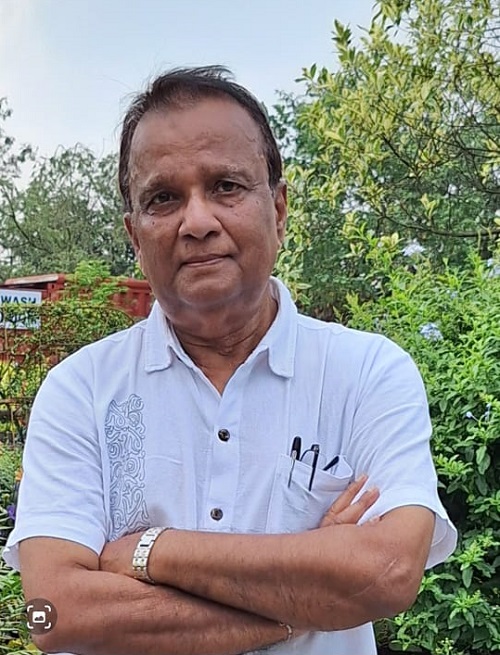
Prabhanjan K. Mishra is an award-winning Indian poet from India, besides being a story writer, translator, editor, and critic; a former president of Poetry Circle, Bombay (Mumbai), an association of Indo-English poets. He edited POIESIS, the literary magazine of this poets’ association for eight years. His poems have been widely published, his own works and translation from the works of other poets. He has published three books of his poems and his poems have appeared in twenty anthologies in India and abroad.
Sreekumar Ezhuththaani
During my school years, because I disliked my Hindi teacher, I developed a dislike for the language itself. That’s how it usually goes, isn't it?
Later, though I lived in various parts of India for two or three years at a time, I never had to hear any language other than English because I was always within school campuses. Even the woman who came to work at my house spoke Queen’s English.
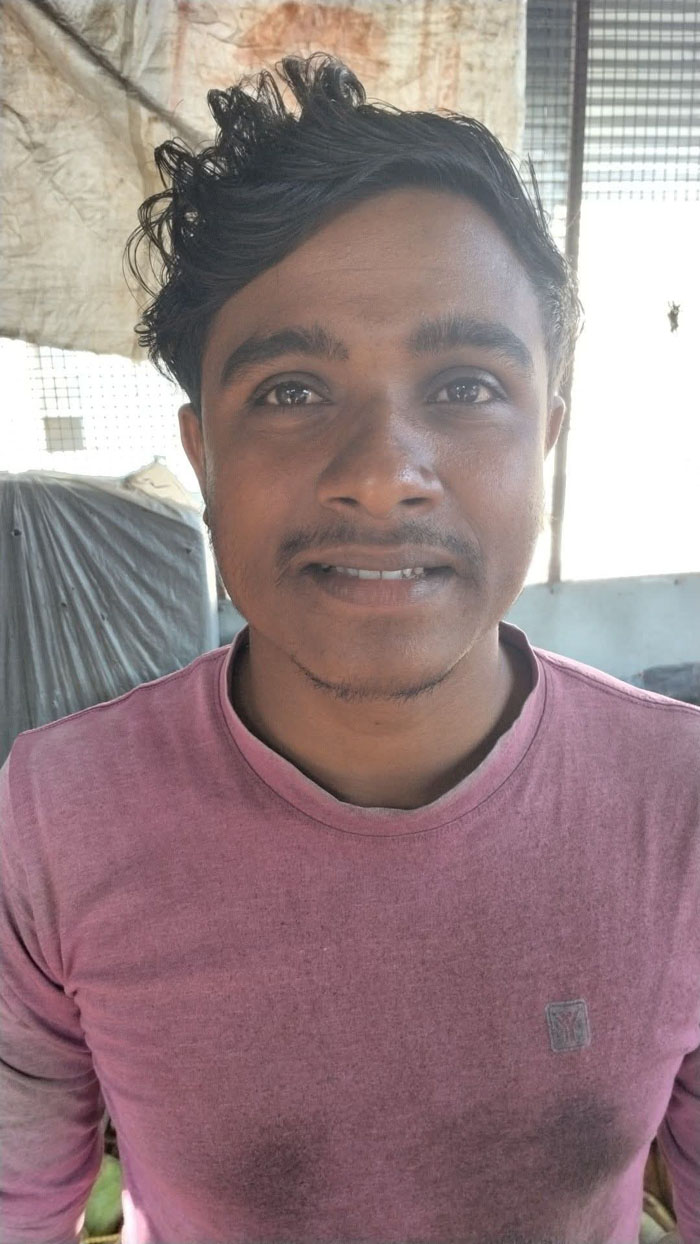
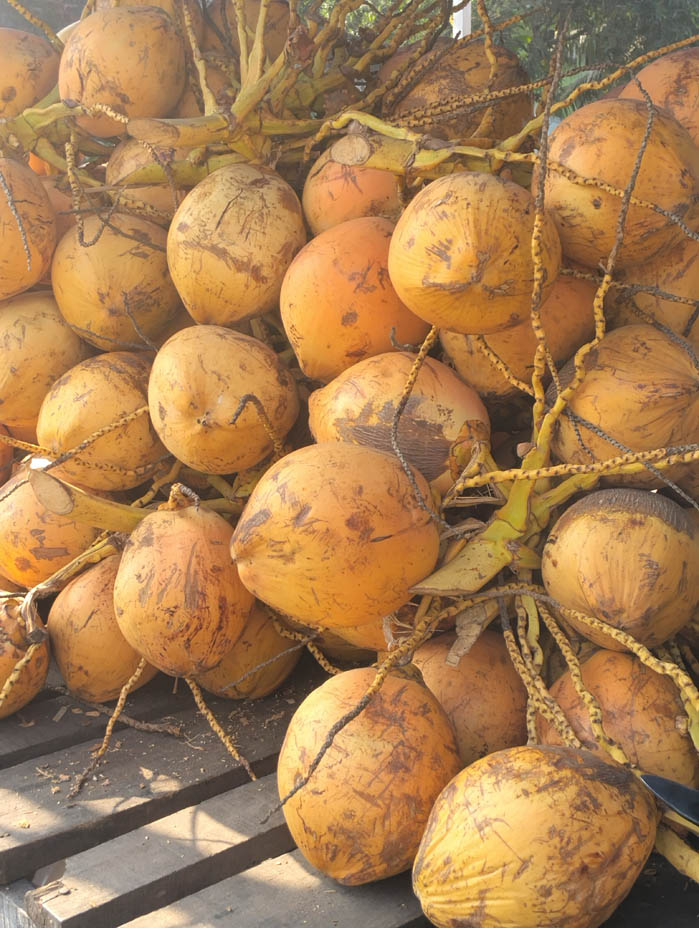
Recently, when I moved into a new house by the roadside, there was a young man selling tender coconuts in front of it. For us Keralites, any migrant worker is a "Bengali." So, in my mind, I labelled him too a Bengali.
He slowly became my "ATM." If I sent him money via G-Pay, he would give me currency notes whenever I needed them. He never hesitated.
Since I live alone, whenever I make tea, it’s always in excess. Besides, there’s no joy in sitting and drinking something alone. So, every evening when I make tea, I take a cup each to that "Bengali" and a chechi selling fish nearby (even though I call her chechi [elder sister], she is younger than me). I exchange pleasantries with both. I often ask the same questions I asked the day before, and I promptly forget.
The lady’s speech is in a dialect; in it, you can hear the tones of love and care. And the ocean.
The "Bengali" would say things to me very slowly in Hindi. I would listen intently and repeat them in my mind. I thought he spoke slowly so that I could understand. It took me some time to realise that wasn't the case.
I had a private motive for giving tea to this "Bengali" who came from Timbuktu. By talking to him, I could learn some Hindi. I even learned to say broken sentences like, "Dus minute par tum niche aao aur chai piyo". Sometimes, when the poor guy, unaware of my plan, would say in English, ‘coming ten minutes after,’ and I’d wonder if he felt annoyed that I was learning Hindi from him without paying a fee.
He has an uncanny sense of cleanliness. Seeing him wash the cups as if it were a temple ritual, I thought he was a Bengali Brahmin. But when I asked his name, he said ‘Abdul’.
Once, he came upstairs for tea. I was in the kitchen. He stepped inside and looked around. Even though I had kept it extremely clean, it was clear he didn't find it clean for his standards.
Another time, around four o'clock, he came down to the house saying he needed to use the toilet. When I told him to have tea before going back to his shop, he suggested that he would make the tea himself.
That was a "Mega Tea-Making" session. I learned that tea could be made like this too.
First, he washed all the cups, poured boiling water into them to warm them up, wiped them, and set them aside. Then, when the water was boiling vigorously, he suddenly threw in two or three spoons of tea and immediately took it off the stove.
He doesn't heat the milk from the packet. We shouldn't do that, he said He gave me a lecture on how that milk is already boiled and cooled before being packed.
By then, three or four minutes had passed. When I asked if the brewed tea hadn’t gone cold, he replied, "No, it’s been kept covered." The entire conversation was in sign language. It was a "break time" for my Hindi class.
He mixed off-white creamy milk and jet black tea in almost equal proportion, frothed it well by pouring it between cups, and gave me a cup. He didn't add sugar. He took a cup for himself the same way.
Usually, I take three cups of tea in the evening. That day, I had to be satisfied with one.
And I was satisfied. Because it was such a magnificent tea.
Two days later, I went to my "Human ATM." He was writing something.
"Kya likho?" I asked.
"Meri mata ko chitti likha hun," he said.
"Mujhe dekhte chahiye," I said, discarding formal politeness.
"Haam ji," he replied.
He showed me the letter. It was written in the English script. My god, does he know English this well?
But when I read it, I realised that wasn't it. It was just the English script; the letter was in "heavy" Hindi. I couldn't understand a single word. Was he a Hindi scholar as well?
I took a photo of it on my phone, converted it to text, and showed it to him.
"Intezar karo", I said, and translated it using Google.
It was a long letter. Words filled with love. One line struck my heart:
"I continue to learn Hindi from the officer in the nearby house. His feet are not in good health. Mother, you must pray for him too."
Good heavens! The hunter was the hunted. Was I teaching him Hindi, or was he teaching me?
In my sudden agitation, I didn't care about the language. I asked:
"Kya ninte language?"
"Assamese, ji."
So that’s it. That was the reason for his epic tea-making.
Assamese does have its own script, but of late, more and more people use the English script, which they find easier to write and convenient on digital platforms.
I, a Malayali, called a Muslim man a "Bengali Brahmin" and made him my Hindi teacher, and he writes letters to his mother in the Assamese language using English script, asking her to pray for the recovery of a man she doesn't even know.
The traffic was thickening; it must be 10 o'clock.
In the nearby school, the assembly had begun. I could hear the children reciting the pledge loudly.
"and I am proud of its.."
Sreekumar Ezhuththaani

It was our third date, mine and Nimisha’s. She was a little more modern than me, always surrounded by friends, always on the move. Without my knowing, she went on trips with them, posted pictures, lived her life wide open to the world.
That evening, she looked at me with her usual coy smile and said, “Hey, is it okay if I go to a DJ party with a friend this weekend?”
The question struck somewhere quiet inside me. I didn’t like the idea. I didn’t want to sound possessive either. I almost said I could come along, but I had another engagement that day. So I swallowed my reluctance and said, “Sure, go ahead.”
There was never a fourth date. After that night, Nimisha stopped answering my calls. For weeks, I tried to understand what had gone wrong. I thought too much, blamed too little, and eventually let her memory dissolve into silence.
Months later, I ran into Hema, Nimisha’s best friend.
Over coffee, curiosity got the better of me. “What really happened between us?” I asked.
“Why did Nimisha stop talking to me?”
Hema smiled faintly. “Why did you allow her to go to that party?”
“What else was I supposed to do? Forbid her?”
“Maybe you could’ve shown that you cared enough to say no.”
I frowned. “Wouldn’t she have thought I was narrow-minded?”
Hema leaned back. “You don’t get it. When she realized you weren’t possessive at all, she lost interest. We girls, we’re complicated. We like the feeling that our men care enough to want us a little too much.”
“Seriously?”
“Seriously,” she said. “You can say anything in public about freedom or equality. But when it comes to love, a little possessiveness feels… comforting.”
Then something softened in her voice. “You know what else? Because of you, she and I didn’t talk for a while. I was jealous of her. When you two broke up, I finally felt peace. She’s my best friend, yes, but that didn’t stop me from resenting what she had.”
Silence settled between us. Then I asked quietly, “Hema, you never married, right?”
She nodded.
“I’m still single too,” I said. “Maybe we could… live together?”
Hema didn’t answer. She picked up a glass of water from the table, and was about to splash it on my face.
“Did I say something wrong?” I asked, instinctively covering my face.
“No,” she said. “You said it too late. All this time, you never thought to ask me.”
“So you’re saying yes?”
“No.”
“No?”
“I don’t like you.”
“You could still give it a chance.”
“I could have,” she replied calmly. “But when I said no, and you didn’t look disappointed, I knew it was the right answer. A man who can accept a woman’s no gracefully, that’s maturity.”
“That’s good, isn’t it?” I asked.
“Women like mature men, don’t they?”
“Who told you that?” she laughed. “That’s not always true.”
“Then what is?”
She stood up, her smile turning enigmatic. “If you’re free tomorrow evening, I’ll come by.”
“And?”
“Yes, a hundred times yes.”
I exhaled. “Thank God.”
“But one condition,” she said, turning to leave. “Don’t take a bath before I come.”
I blinked, half-embarrassed. “What? Why not?”
She looked back and said softly, “Because I… I like your scent too much.”
I instinctively lifted my arm halfway to my nose, then stopped. Maybe some things are meant to be felt, not tested.
Seeing that, Hema laughed, a laugh that turned into something warmer, something that smelled faintly of a red rose.
Sreekumar Ezhuththaani known more as SK, writes in English and Malayalam. He also translates into both languages and works as a facilitator at L' ecole Chempaka International, a school in Trivandrum, Kerala.
Usha Surya
Shyamala stood on the balcony and watched till the car vanished from her sight.
She heaved a sigh of relief as she sat in one of the cane chairs. In the distance she could see the blue sea. The sun rising slowly from the waters looked fantastic. The water glittered like gold. The sky was a riot of colours and she sat stunned drinking in the enchanting charm of the hues changing in the horizon.
It was an awesome sight which she had been missing for quite some time. No, quite a few years.
In the far distance she could spot a fishing boat that had set out early to try the day's luck for a good haul.
Hope the fellow is able to catch a full sack, she wished.
Yes...wishing for a fisherman whose face was unknown to her!
Her husband Rajendran and her mother-in-law were travelling to Mayiladuthurai to sell their ancestral home that had been lying vacant and locked for the past few years. It was kept locked till her father-in-law was alive and now her mother-in-law decided to get rid of the big ancient house. Shyamala had visited the house with Rajendran when her father-in-law was alive. It was a big bungalow with nine rooms and an outhouse for a maid and her family. The compound was large with coconut and other fruit- bearing trees and the front yard had a flower garden. After Rajendran's father's death, his mother moved in with them.
Rajendran had bought an apartment in Chennai which was huge. His father had invested a big amount in it and Rajendran had contributed a fairly large sum and the house was registered in his name.
Rajendran and Shyamala had no children and they were going to complete five years of their life together. They had been to the Doctor and it was discovered that the short-coming was in Rajendran's biological makeup. He had not wanted to divulge the truth to his mother. Her husband's mother Bhagyam made a huge hue and cry every month and Shyamala was happy that her office work gave her real refuge at those tense moments.
To put it in a nutshell, Rajendran was a "Mama's Boy" and totally obsessed with her demeanour that left no room for any criticism and Shyamala was beginning to feel alienated and claustrophobic.
Her mother Meera was never possessive with her brother Arun.
Meera,her mother, never gave her opinion unless she was asked and her brother's wife Jyothi adored her. Shyamala's brother Arun and his wife Jyothi were in U K now and they had two kids one of whom was seven years old and the other four.
Meera would visit them in the U K once in two years but refused to move in with them. She had her sessions of Music Concerts and Temple visits here and her own circle of friends. Shyamala's father had expired when she was seventeen and her mother Meera wasted no effort in bringing up her daughter, and son who was five years older than Shyamala.
A strong woman, Meera was also very compassionate and charitable. Her neighbours and relatives loved and respected her.
Shyamala could not help comparing her mother with her mother-in-law who was possessive, arrogant, avaricious and critical of every single relative and acquaintance. They could not be called friends in the literal sense of the word. Those whom she considered as her friends were just polite and civil to her. Nothing beyond this.
Shyamala was very happy today as she had availed of the lapsed casual leave and taken five days off. She needed to attend office only on Monday next week and Rajendran and his mother would be back on Sunday.
She telephoned her mother Meera.
"Amma. I am coming home to spend four days with you," she said.
Her mother was taken by surprise.
"You are coming to stay for four days? Your mother-in-law does not mind?" she asked.
Shyamala told her that Rajendran and his mother had left for Mayiladuthurai and would be back only on Sunday. That gave her a week.
She said, "Don't be cooking anything amma. We shall do some shopping and eat out today. Ask Shanthamma if she will come with us." .
Shanthamma managed the kitchen for her mother, being with her for many years and she was more than a cook.
"Shanthamma won't come, Shyamal. She would rather watch T V or read a book. I'll wait for you. What time are you coming?" Meera asked.
"I will be there a little after eight after having some toast amma," she said and a few moments of excited conversation between the daughter and mother followed.
She packed a few clothes in a bag, left it in the living room and went for a shower humming happily!!
Aw!! Looked like eons had vanished since she had hummed.
"Mai pyaar ka rahi hoon...theri julf ki chaaye mein..."
Rajendran and his mother were not fond of music.
'Aurangseb's descendents; Shyamala would whisper to herself.
She recalled her college days. Any intercollege music competition would spot her singing on the stage. She was called the ' nightingale' of her college and had won the cup for her college every year.
She felt thrilled as the water fell on her from the shower.
She quickly changed into a crisp cotton saree, lit the lamp and closed her eyes. She toasted two slices of bread, had a quick breakfast and came down the stairs humming another song.
She felt as excited as a child.
"Going somewhere?" the next door Lily asked.
Shyamala smiled and said, "Yes. To my mother's place for four days."
"Have a great time Shyamala," Lily said.
Shyamala came out of the gate and hailed a passing auto.
The initial two months of her married life exposed Rajendran's real nature. Shyamala was working in a bank and was happy with her clerical post. Though she was brilliant, she did not wish to write the officer's exam as it would entail transfers. Rajendran was working in a company and both of them earned enough that allowed for small luxuries.
She was a bit shocked to discover that he was a "mama's boy."
He sought permission for everything from his mother at the drop of a hat. He phoned her everyday from Chennai when his parents were in Mayiladuthurai..
Things turned topsy-turvy when Bhagyam- her mother-in-law - moved in with them.
On her first visit to Mayiladuthurai, Shyamala's wonderful father-in-law had warned her sufficiently. He was alive then..
"Shyamala. Have an eye on Rajendran. Bhagyam loves to keep people under her thumb. You have seen how silent I am and how everything here is executed only according to her wish."
He did not say anything more at that time. Shyamala understood the impact of his wise words only after the mother-in-law moved in with them. Yes, she kept Rajendran under her thumb!
She remembered her father-in-law's words.
"Shyamala, my child. My parents named me Shantharaman and I have always been a calm and quiet person. It was a bit too late when I wanted to assert myself and things had gone out of hand! I realised how helpless I had become with a wife like Bhagyam. At least you should be bold!! Your parents have named you 'Shyamala'. It is the Devi's name. You are Shakthi! You should assert yourself. Else the "remote control" will make a mincemeat of you." He called his wife "remote control" which was very true! Rajendran would call his mother at Mayiladuthurai for each and everything.
Ever since Bhagyam moved into their Chennai apartment, Shyamala had lost all her freedom.
It was always -
"Amma said this, Amma thinks, Amma prefers..." Rajendran seemed to have been fettered to her MIL's "apron strings!!
It started with buying a new Television.
"Amma said to buy this particular brand. You know, she saw this T V in my aunt's house and the colours are good, she says."
The "Amma" narration continued.
"I have also called amma to accompany us for the movie. Of course she may not appreciate English movies but what will she do all alone at home?"
True! Bhagyam did not like the movie. And that was THE end as far as English movies were concerned.
"Why go to English movies when amma doesn
like them?" Rajendran said.
He even hid the fact from his mother that he lacked the biological makeup to bring forth a progeny.
He had told her,
"The doctor has said that nothing is wrong with us and we shall get a baby soon"...leaving Shyamala to bear the brunt of his mother's angry outbursts every month.
"After all, it's my mother who scolds you. Why do you take it to heart? She must be really longing for a grandchild." he would say.
Shyamala was getting fed up.
What sort of a life was she leading ?
"Ultimately I am only a cook and a money-maker in this house!! Nothing else." This realisation hurt her deeply. Many times she had decided to walk out from the house where she remained just a machine. But the thought that her mother might feel devastated, stopped her from doing it.
Rajendran would watch all the regional serials with his mother ; all the movies on the idiot box with her. The quality of the serials or movies mattered a little.
Shyamala would curl up with a book in the night after cleaning up the dining table and kitchen and read till her eyes became heavy with sleep.
It seemed ages since she had gone to her mother's place to stay with her.
"You cannot just go for two days. You know my mother can't manage all the cooking," her husband would say.
His zest for food was something unheard of ! Once - she recalled - he came back at ten thirty from the office after an audit and she had said
"I shall make some hot crisp dosas for you by the time you wash up."
He walked towards the bathroom, towel in hand but paused to ask her, "What is the side dish?"
She remembered replying, " I have sambhar and of course the idly powder is there too."
He had told her, "Grind some chutney. You must be having yam in the house. Keep a piece of yam too. Amma always keeps a piece of yam along with the coconut and chutney dal. It adds to the taste"
And at that late hour she had to grate the coconut and grind chutney!! Such "passion" for food!!
She recalled her father who had come home a little after nine in the night and her mother saying -
"Have a quick bath. I shall make some hot upma for you. I know you love the stuff."
He had replied, "At this hour? No Meera. Don't strain yourself. You must be having the morning's leftover rice. I will have some curd rice and mango pickle. Don't trouble yourself!!"
He had gone out of station and was expected back only the next day.
Now she had this opportunity to go to her place and savour only love! She almost danced with happiness. She paid a hefty amount as a tip to the auto driver who was stunned at this gesture.
As she walked into her mother's home, she put behind all her sadness.
"Amma, I have come" she said and hugged her mother like a child.
"God!! You are suffocating me Shyamal. What has got into you?" Meera seemed very happy nevertheless..
Her daughter would come leaving her office a bit early twice a month and that was all she could manage! But now she was here for four days.
Shanthamma came from the kitchen wiping her hand in her saree pallu.
"Aw!! Amma said you will be here for four days. Now give me a list of all the dishes you wish to eat," she said smiling at Shyamala and holding her hands.
" Shanthamma...I want your small onion sambhar, your avial and a lot of other things!! I shall tell you," she said.
Shanthamma had been in this house with her mother since Shyamala was twelve and though age had her toll on the lady the affection was still the same.
The four days just vanished. They had gone on a massive shopping spree on the day that Shyamala arrived and had enjoyed a meal at the hotel of Meera's choice. The mother and daughter spoke all day and kept awake till late hours in the night. Her mother was working in the Postal services before she retired and received a good amount as pension and her father had left quite some amount after being in business. The apartment belonged to her too.
Shyamala came back to her place after four days and got busy with preparing some pickles and jams. All this effort for Rajendran. Yes - food and movies were his ' hobbies' as he put it. The mother and son would arrive on Sunday and her tense days would commence again.
She curled up with an Agatha Christie when the phone pinged.
It was her friend Rama's mother. Rama and she were at college together and Rama's parents were very fond of her. Rama had shifted to the U S and uncle and aunty had visited her twice.
"Shyamala, we are planning to go to the U S next week. You must be aware that Rama is due with her second kid. She will need our help. The cook Ranjitham was to move in with her niece for three months but the niece and her husband have accompanied a busload of pilgrims who are visiting Temples in Andhra and will be back only next month. So, for a month she has no place to stay. Can you allow her to move in with you for a month? She will do all the cooking and she is very honest. She cooks very well too."
Shyamala replied, " No problem aunty. I'll only be too happy. I am on leave till Monday and she can report any time."
"Oh! Thank you so much Shyamala. I shall send her to your place by tomorrow afternoon. I have already paid her for three months and she is a very quiet person." Rama's mother added.
"Don't worry at all aunty. I shall also pay her for her cooking here till she moves out."
Ranjitham, the cook, came by noon the next day and was very happy to see Shyamala.
Shyamala had met her in her college days while going over to meet Rama. Ranjitham remembered her.
Everything moved smoothly and Ranjitham cooked really well and Shyamala enjoyed her rest.
Rajendran and his mother had come back on Sunday evening and were initially not very happy with Ranjitam, but started appreciating her dishes soon.
"Foodie" that he was, Rajendran waded through Ranjitham's chutneys and dishes.
"Thank God," thought Shyamala.
Her mother-in-law Bhagyam was eventually very pleased with the cook and ordered her about, demanding that she make "this and that" !!
Shyamala experienced a sense of relief as Ranjitham was there to take care of the kitchen. She had plenty of time in her hands in the evenings now. But the routine continued. Yes, the mother and son watched the television as usual and enjoyed their meals. Ranjitham was definitely a great cook.
A week after she reported to work having had a blissful time, Shyamala received a phone call from Shanthamma that shook her.
"Shyamala, your mother has been admitted to the hospital. She complained of severe pain in the chest. The Doctor wants to see you immediately. Can you come?" She mentioned the name of the hospital.
Shyamala wasted no time and rushed to the hospital after informing the Manager of her bank.
Meera had to undergo a surgery in the heart immediately and the Doctor insisted on it. He spoke to Shyamala and after some tests Meera was wheeled into the operation theatre. Shyamala arranged for everything in the meantime and telephoned Rajendran.
"What? Your mother has been admitted into the hospital? Is it that serious? Okay. Let me know after the surgery is over," Rajendran said.
Shyamala felt a tinge of disappointment. She expected Rajendran to come immediately and be with her...give her moral support.
"Maybe he has to ask his mother's permission," she thought bitterly.
She rushed to the bank and drew some cash and the formalities were done accordingly.
The surgery took four hours. Meera had four major blocks and it was a complicated surgery.
Once the surgery was over, the Surgeon called her.
" Madam, the surgery is over, thank God. Now she will regain consciousness only after twenty four hours. You go home now but come back and there is room for the attendants of the patients. You can wait there. There are reclining chairs. Have you no male relatives?"
"My brother is in the UK Doctor and is currently on tour to Germany. My sister-in-law cannot come immediately as the two children they have are writing their exams. Maybe they will come in two weeks. I can manage, Doctor, " she smiled.
"Good!! We shall move her to her room after observing her for two days."
She went to have a look at Meera who was under anaesthesia.
She told Shanthamma to go home and remained in the hospital.
She expected Rajendran to turn up but was disappointed. He did not even call her.
The next morning Shyamala left the hospital to go home. She decided to take a shower, have something to eat and return.
It was pathetic to see her mother in Cardiac Care with all the tubes tucked into her. The silence scared her. She could only pray that everything turned out well. She had reclined on the chair at night with a lot of others in the room. Sleep had eluded her for a long time.She recalled the childhood days when she was unwell and how her mother had sat awake in the night near her, watching over her and soothing her. The patience with which she explained the tough sums in Math. The tenderness with which she had cajoled her to eat in time for the school. The love and affection that laced her lunchbox with whatever that was packed. She had never seen her mother losing her temper either with her or her brother. Both the children adored their parents. The children had ali the freedom and the only thing that was instilled in them was discipline. Their parents never anticipated anything from the children. Ideal parents !!
When she got back home, Ranjitham enquired after her mother.
"Don't worry my child. God will always take care of good people. Don't worry about the kitchen here. I shall take care to see that it runs smoothly. Luckily your mother-in-law and husband appreciate my cooking. I shall extend my stay here by two more weeks if you wish to."
Shyamala was touched by her words.
Rajendran had not come to the hospital.
He sat with the newspaper as she entered and told her that he would visit her with "Amma" after his mother-in-law gets discharged and goes home.
Shyamala thought - "Amma would have told him not to go to the hospital. And he is one who does not cross the "Lakshman rekha" drawn by her.
Bhagyam asked her as a matter of fact "Everything went of well I suppose! Well, a human body is always prone to falling ill. It is nothing unusual."
Shyamala could only laugh at the inhuman statement she was making. It was 'falling ill' was it? And not a complicated Heart Surgery?
For a few minutes she was angry. But then, could she ever express her feelings?
The next two days were hectic ones for her and on the third day Meera was shifted to a private room.
Shyamala stayed in the room with her mother only to leave for home every morning to take her shower, change and have her breakfast. The hospital took care of providing breakfast, lunch and dinner for Meera. Shyamala ate in the canteen not wishing to harass Ranjitham by asking her to pack her lunch or bring dinner for her. The nurses assured her that there was nothing to worry and that she can come at leisure by nine a m. to the hospital after her bath and breakfast.
"Post-operative" care is very important, madam. I hope you will take care. Bring her here after a month for a review. She is doing very well now," the surgeon told her with a smile.
Meera was discharged on the seventh day. Shyamala went home as usual but packed a bag with a couple of sarees to stay with her mother for a week.
Rajendran saw her packing a bag and asked,
"Are you going to stay with your mother?"
She replied, "Yes. Till Shanthamma gets used to the routine I should be with my mother." .
Her mother-in-law also came to the room at that moment.
"Who will take care of the house if you are away for a week? As it is, you have been staying at the hospital for ten days."
Shyamala could visualise her father-in-law, saying,"You are Shakthi!! Remember your name is Shyamala! When will you become bold?"
She looked at Rajendran's mother and said, "Remember, I took three weeks' leave and came to Mayiladuthurai when you were down with just viral fever? My mother has undergone a surgery. I have to be at home till my brother comes with his family. That will be ten days."
The mother and son retreated to the living room.
She went to the kitchen and said to Ranjitham,
"Ranjitham, I have to be away for two weeks more. I am giving you two months's salary. Please wait for three more weeks. Will you?"
Ranjitham said "Come when you can amma. Don't worry about the house. I shall take care. The maid is also here and both of us will really manage well."
She walked towards the living room with the packed bag.
"I shall call everyday. I will be back soon." she said looking towards Rajendran and his mother.
Meera came home and Shyamala and Shanthamma took care to see that she had absolutely no worry about the household. There were no diet restrictions since she was free of diabetes or blood pressure. Arun would be coming in ten days and Jyothi and children would be landing a week later and they would stay for a month as the children had their Spring Break.
After six days, Ranjitham called.
"Amma, do give me your mother's address. I shall come there and return the extra payment you have given me."
Her voice trembled.
"What really happened, Ranjitham? Are you leaving?" Shyamala asked her.
"Yes Amma. I am planning to leave. I cannot stay here anymore. Last evening I accidentally dropped a little ghee on the floor and your mother in law scolded me and called me a "garbage-licking-dog"! I have dignity, my child. I am quitting!"
"Okay Ranjitham. I am sorry for all that has happened. You need not pay me back the money I have given you. You keep it. I shall meet you at Rama's place once aunty and uncle are back."
Shyamala felt sad that Ranjithm had been scolded using derogatory terms!! But then, it was typical of her arrogant mother-in-law.
Three days later Rajendran called.
She was surprised to see his name appearing on the phone.
"Aw!! Finally he decided to ask about my mother. Of course he was not one to miss her. All he wanted in life was good food, costly clothes and his mother !! "
Rajendran asked her, "When are you coming home?"
She could feel a sense of anger brewing in her heart.
No inquiry about her mother. Not even a hint that he was missing her!!
Well, she had known all these years that he had "no need" for a wife.
All they both wanted was a cook.
"When are you going to assert yourself?" her dead father-in-law's face appeared before her eyes. She closed her eyelids.
"What has happened?" she asked.
"The cook has left. Amma is finding it very difficult to cook.She has to make breakfast and cook lunch and make dinner also. And pack lunch for me," he said.
She said that she would come in an hour.
She kept her words and went.
No enquiries about her mother.
Bhagyam told her,"You have to make dinner. It is already six and you know that we sit to eat at eight."
Rajendran was silently standing near his mother.
Shyamala made no effort toreply..
She went to her room and packed her clothes in a suitcase. She packed her books in two other suitcases. She rolled all the three suitcases into the living room.
"Where are you going?" Bhagyam asked.
When she replied after a few seconds,her voice was calm. But very firm.
"I am leaving. I am NOT coming back to this house to live with both of you. You can hire a cook. There are plenty available."
She walked out.
She felt like a bird which had grown new wings.
She could taste freedom.
Usha Surya.- Have been writing for fifty years. Was a regular blogger at Sulekha.com and a few stories in Storymirror.com. Have published fifteen books in Amazon / Kindle ... a few short story collections, a book on a few Temples and Detective Novels and a Recipe book. A member of the International Photo Blogging site- Aminus3.com for the past thirteen years...being a photographer.
Malabika Patel
Naldanga kothi, a dilapidated mansion was strictly forbidden for the children. The once majestic edifice was situated at one end of the town, not far from the seashore. Time and elements had left their footprint on the abandoned structure. The rundown façade - crumbling at different places and vegetation popping out of its crevices - stood as a sad reminder of its’ once-happier-times. The red three storied mansion with four proud square minaret-like towers rising above, had ornate porches looking out to the sea. And the sea was only five hundred meters away. The front porch had been ravaged by the salt laden sea breeze and stood starkly naked, inviting trespassers. The once heavily carved wooden doors - trounced by the incessant sea breeze - had been pillaged long ago, stripping the hallways bare. The boundary wall of the mansion had given way to sand dunes. No wonder, none of the town folk ventured into its premises, fearing it to be a den of small time criminals. Built by the erstwhile Naldanga Zamindars of Bengal for their summer retreat, the Naldanga kothi stood in utter ruins.
Bulu, all of eight years never understood why Naldanga kothi was a no-go zone for him. What lurked behind its heavy red walls, he wondered. He had heard elders whisper about its dungeon like rooms upstairs and the dark winding staircases which led to the windswept terrace rooftop. He could never gather enough courage to ask his father for permission to go inside. He remembered his father saying that the horse stable of the kothi once boasted of the best horses… Well, Bulu was not interested in horses; he just wanted to climb the minaret- like towers from the rooftop of the Kothi so that he could see what lay beyond the sea horizon. The towers for him were the vantage point to see beyond the sea. Where the sea merged with the clouds was a mystery to him. The more he thought of unraveling the mystery, the more he dreamt of climbing up to the forbidden terrace with its tall towers.
The clouds had a strangle hold on Bulu. He could see all sorts of images in the clouds; the flowers of their garden, the lotus in the ponds, his pet doggie Tommy, his cat Chandini, the cartoon characters, even the images of Gods in his mother’s puja room all came alive in the clouds, whenever he looked up the sky on a clear afternoon with wispy clouds floating by.
On a Sunday afternoon after his parents, grandpa and sister had gone for their siesta following a heavy Sunday lunch, Bulu quietly sneaked out of his house and made his way to Naldanga kothi. The day was windy and the autumn sun was mild. Bulu walked the small stretch of the lonely dusty road behind his house and then came upon a thick sandy patch. He had to go on plopping his feet on the thick sand all the way to the Kothi. The sun rays were slanted and digging his feet on the layers of the sand was not so bad, only his slippers felt like giving away. The sand deposit had come up to the broken gates of the mansion. Bulu reached the gate and found it deserted with not a soul in sight. This is the best time to enter the premises, he thought to himself with no one watching.
Slowly he found his way to the foot of the staircase which was near the horse stable, his Father used to talk about. As he had heard, the staircase was spiral, dark and dingy. He peered hard into the darkness to see the steps, but could hardly see anything. Then he put forward his foot to feel the steps. Yes they were there, but the steps were steep and winding. Bulu was not to be deterred though. His dream of going near the clouds egged him on to climb up the staircase that will take him right up to the top floor.
Once he lands on the top floor terrace, there will be surprises he was sure of it. Imagine sharing his discoveries with his best friend Mantu. The other day Mantu was boasting of Phantom coming in his dreams. Now he can say that the real Phantom lives where the clouds merge with the sea. Mantu will gape with an open mouth when he says he has seen him with his naked eyes, touched him with his hands and not as they happen in dreams. The picture of an awestruck Mantu made Bulu laugh to himself. Immersed in his dreams, he had in the meantime managed to climb the steps and reach the terrace. Lo! Suddenly there was lightness around. He could see the floating clouds, so near to him.
Looking up towards the floating clouds and dreaming of Phantom on his horse; ‘Hero’, Bulu stepped on to something… It was a huge net spread on the ground below his feet. A huge swathe of fishes of all shapes and size were slithering on the net trying to escape. The fishes were clambering on top of each other. Soon, Bulu found himself in the company of the slimy things. Suddenly he saw wings coming out of their fins. In a bid to escape the net they were wrestling with each other. Slowly he sensed the net was rising up and up. The fishes were holding on to the net in their mouth and with wings flapping, they were now airborne flying in the direction of the sea. Bulu could not believe his eyes. Quickly he clutched on to one corner of the net with both his hands and found his legs dangling in the air. And lo he was airborne! The net flew above the Naldanga towers! Why he could almost touch the spire of the thing. He could feel the strong sea air sweeping his face with a whishing sound while the horizon seemed to roll back and beyond. He felt like whistling in joy like the whistling sound of the wind. The net was held on all sides by the winged fishes and they kept flying farther and farther away from the towers. What a thrill... The houses below looked smaller and smaller like tiny toys, from the corner of his eyes, Bulu could see Naldanga Kothi like a small castle as in his fairy tale books. The net kept soaring higher and nearer to the clouds. Bulu was squealing in rapturous joy.
In a fit of ecstasy, Bulu tried to touch the clouds by stretching his hands. The white fluffy clouds were like cotton rolls. He wanted to fly through the spools and see who all reside in that fluffy fairy land. A stretch of his hand and he lost his grip on the net. Then something happened. It was a sinking feeling. Something was going down. In fear Bulu shut his eyes. Now he could feel, it was the net which had started descending. It was hurtling down speedily till it came crashing down, falling with a thud on a wooden plank.
Bulu opened his eyes and found himself lying inside the hulk of a fishing boat. How did he come here? He was stunned. Last he remembered standing near the horse stable at the foot of the staircase. He looked around and saw himself entangled by a fishing net. There were more nets, broken boats, rudders and rows all spread around on the sand. The stinking smell of the fishes strewn in the net pervaded the air. Bulu felt like vomiting. His head was spinning. Some fishermen were smoking bidis sitting on the edge of another boat. They came up and disentangled him from the net.
Bulu could hear their swear words ‘you crazy boy. You thought you have wings on you’ amidst guffaws of laughter.
They were holding knives and daggers. One even spanked him on his back and signaled him to run. Bulu ran for his life with sea-sand smeared all over his stinking body. All the way he was wondering how he went up the sky, saw the clouds from so near and again came crashing down. The images of fishes with wings remained stuck in his mind. And the large net flying like a magic carpet was flashing before his eyes.
It seems on the abandoned horse stable of Naldanga kothi, the fishermen had spread their wares. The fishing net that day was full of the day’s catch and was still lying on the hulk of the boat into which Bulu in his dream-walk had stepped in.
After Bulu was disentangled from the net and driven away the fishermen got busy stocking their catches All the while they were cracking jokes about the small boy with big dreams of flying.

Literature, both Odia and English, fascinates Malabika Patel. She has been experimenting on poems and short stories. Her first translation “Chilika –A love story “ of Shri Krupasagar Sahoo’s Sahitya Academy award winning Odia novella, “Sesha Sarat” was published in 2011. She is also into translating of rare old Odia documents and classics into English. A banker by profession, she retired from Reserve Bank of India as General Manager in 2016 and is presently settled in Bhubaneswar.
A WINTER ROAD TRIP TO WAI, PANCHGANI AND MAHABALESHWAR
Satish Pashine
Family road trips have a charm no carefully planned holiday can replicate. They unfold at their own pace—unhurried, imperfect, and shaped as much by small negotiations as by destinations themselves. Someone wants to stop for tea, someone else wants to push on; music choices are debated, silence settles in unexpectedly, and laughter arrives without warning. What such journeys leave behind are not photographs alone, but shared memories—formed quietly somewhere between half-finished conversations, winding curves in the road, sudden viewpoints, and cups of roadside chai.
This winter journey brought together three generations under one plan. My younger daughter Geeti travelled with her daughter Ishani; my elder daughter Neha’s daughter Samaira joined us too, adding her own energy and curiosity to the group. And then there were the two of us—Archana and I—watching the dynamic unfold with the quiet pleasure that comes from seeing family threads weave themselves naturally. We planned a relaxed two-night, three-day drive from Pune to Panchgani and Mahabaleshwar, consciously avoiding the temptation to pack the itinerary too tightly.
Our stay was booked at Monsoon Mist, a hill villa located about five kilometres from Panchgani’s Mall Road. We reserved three rooms for ?26,500, choosing comfort and space over proximity to crowds. Monsoon Mist carries the understated legacy of Panchgani’s old hill retreats—properties originally conceived as seasonal escapes during the British era, when the town itself was being shaped as a sanatorium and summer refuge. Over the decades, such villas evolved from private colonial residences into quiet homestays, retaining their sloping roofs, wide verandas, and a relationship with mist and rain that defines life in these hills. True to its name, Monsoon Mist sits where clouds drift low and mornings begin with silence, broken only by birds and the distant rustle of trees—an atmosphere that encourages slowing down rather than sightseeing in haste.
The idea of breaking the journey midway came from Milind Khanjode, a friend from our morning walks at EON Homes in Hinjewadi. Instead of driving straight through, he suggested halting at Wai—a town that holds layers of Maratha and Peshwa-era history within its narrow lanes and riverfront ghats. Wai once served as an important cultural and religious centre, patronised by the Peshwas, and its many temples still reflect that period of prosperity and devotion.
The plan, in that moment, felt unquestionably right. There was no checklist to chase, no schedule pressing from behind. Nothing rushed. Nothing overpacked. Just enough space for the journey to unfold as it wished, setting a rhythm that would carry us gently through the days ahead.
Day 1 – 26 December 2025
Pune → Wai → Panchgani
We woke up at 5:00 a.m., though the clock, as always on such mornings, had little respect for our intentions. Alarms rang, were snoozed, and rang again. With five people getting ready, each with their own rhythm and requirements, departures tend to take on a life of their own. Bags were repacked, jackets reconsidered, water bottles refilled, and last-minute checks repeated more than once. By the time we finally set off at 8:15 a.m., the morning had fully announced itself, my pearl-white Creta pointed west and waiting patiently for the road ahead.
Traffic on Pune’s outskirts was heavier than expected, the familiar congestion reminding us that weekends rarely begin smoothly. Yet road trips have their compensations. The slow movement allowed conversations to pick up where they had left off, music to play without interruption, and the sense of travel to ease in gradually rather than announce itself abruptly. Somewhere around 9:30 a.m., hunger made its presence felt, firm enough to override any thoughts of pressing on. We pulled into a modest roadside eatery at Lonarwada, shown as Pune-Haveli on the google map—nothing polished and nothing that advertised itself loudly, except the reassuring smell of fresh food and the quiet confidence of a place accustomed to feeding travellers day after day.
The reward was immediate and generous. Plates of misal pav, Sabu dana vada, Wada pav, and steaming cups of tea arrived, all piping hot and unapologetically satisfying. It was the kind of breakfast that doesn’t ask for reviews or photographs—only attention. The bill came to ?525 for the five of us, a figure that felt almost nostalgic in a world of inflated menus and curated cafés. Good food has a way of smoothing over delays, turning lost time into part of the journey rather than a flaw in it.
From Lonarwada, we continued towards Wai, the road gradually easing into a quieter rhythm as traffic thinned and the landscape began to open up. The stretch between Lonarwada and Wai runs through fertile river-fed countryside—fields broken by clusters of homes, roadside shrines, and the occasional sugarcane trucks/tractors moving at their own pace. The terrain here is gently undulating, shaped by the Krishna basin, and the road, though largely smooth, demands attention with its mix of local traffic, slow-moving tractors, and sudden turns into village lanes. It was the kind of drive that encourages patience rather than speed.
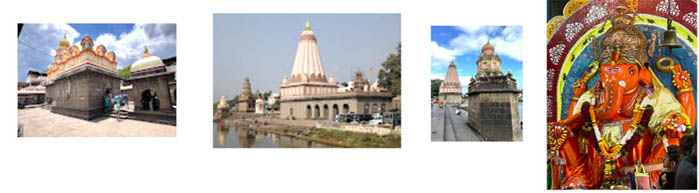
We reached Wai around 1:45 p.m., the afternoon sun soft but steady. Stepping out at Ganpati Ghat, the pace of the day shifted almost immediately. The Krishna River moved quietly alongside the long flight of ancient stone steps, its surface reflecting the pale sky above. The ghat, shaped during the Peshwa period, showed its age without feeling diminished by it, and the fatigue of the drive seemed to dissolve in that calm setting.
Nearby, Dholya Ganapati and the Kashi Vishweshwar (Mahadev) Temple stood rooted in quiet continuity rather than display. These were not places that demanded attention; they invited it. Bells chimed softly, chants rose and fell, and pilgrims moved with an ease that suggested familiarity rather than ritual urgency. Time felt less measured here, devotion flowing as steadily as the river itself.
We stayed longer than intended, not drawn by activity but by the absence of it. Sitting by the ghat, watching the water pass, conversation softened into pauses that felt comfortable rather than awkward. Even the children seemed to sense the stillness. It was a deliberate pause—a moment of grounding—before the road narrowed, curved, and began its steady climb into the hills ahead.
By 2:30 p.m., we were back on the road, heading towards Panchgani. Leaving Wai, the geography began to change noticeably. The flat river plains gave way to rising terrain as the road curved steadily upward into the hills of the Western Ghats. The climb is gradual at first, then more pronounced, with long bends offering glimpses of valleys below and the occasional viewpoint opening unexpectedly between trees. The air grew cooler, the light softer, and traffic thinned further as we moved away from towns and into forested stretches.
Anticipating a late arrival, we pre-ordered lunch (paneer bhurji, jeera aloo, dal fry, rotis, rice, and papad)at the villa while en route, hoping for a hot meal waiting when we reached Monsoon Mist. It felt like a small but thoughtful decision—one that acknowledged the slow, layered nature of the day’s travel. The road ahead promised mist, altitude, and rest, and we settled into the final stretch with that quiet satisfaction that comes when a journey unfolds exactly as it should.
Monsoon Mist: Arrival and First Impressions
We reached Monsoon Mist at around 3:30 p.m., the light already softening as clouds drifted lazily across the hills. The drive had been longer than anticipated, and everyone was ready to settle in. Lunch followed soon after—homely in intention, clearly prepared with warmth, but uneven in execution. For the price of ?1,900, expectations naturally rise, and some dishes struggled to meet them. The jeera aloo, in particular, leaned heavily on onions, with the jeera more implied than present. I shared my feedback with the staff—calmly, though perhaps more directly than my daughter would have preferred. She later remarked that consistently high ratings can dull attention to detail; I remain convinced that honest, respectful feedback is what keeps standards alive.
Later in the afternoon, we headed out toward Panchgani market to pick up beer and soft drinks. The road leading into town is narrow in places, bending sharply and leaving little margin for error. On one such stretch, a sedan cut across unexpectedly. Despite braking in time, the space was simply too tight, and both cars ended up with minor scratches. There were no raised voices, no escalation—just a brief exchange, a mutual assessment of damage, and an unspoken agreement to move on. Nothing serious, yet enough to unsettle the mood for a few minutes, a reminder of how quickly calm can be interrupted.
As if to add another footnote to the day’s sequence of small adventures, we missed our turn while returning to the villa. The road, already narrow and winding, offered little room for correction, and traffic—though not heavy—was steady enough to demand caution. What should have been a simple right turn slipped past unnoticed, and within moments we were committed to a stretch that allowed no easy escape.
Attempting a U-turn on that road required patience and a steady nerve. The curve limited visibility, vehicles approached from both directions, and the margin for error was slim. We waited, signalled, waited again, inching forward only when the gap felt genuinely safe. No horns, no raised tempers—just the quiet tension that accompanies such manoeuvres. Eventually, with careful coordination and a shared breath of relief, the car was pointed back the way it should have been.
Once the turn was completed, the remaining distance felt shorter than it was. Conversation resumed, the earlier tension easing into familiar calm. By the time we reached the villa, the episode had already begun to lose its sharpness, becoming just another small detail folded into the day—a reminder that it is often these minor mishaps, rather than the smooth stretches, that give a journey its texture and linger longest in memory.
On returning to the villa, we were asked to park near an electrical circuit breaker installation. I declined. Parking a vehicle close to electrical equipment felt like an unnecessary risk, especially when there was open space available nearby. It wasn’t about stubbornness—just a preference for caution where it costs nothing. The matter was resolved without argument, and the car was parked where it felt safe and sensible.
Tea was ordered next—four cups for three people, simply because the cups were small and the day had been long. These minor excesses, unplanned and practical, are part of travelling together. I went upstairs to freshen up, expecting to return quickly. Nearly forty minutes passed—bags unpacked, faces washed, the body finally beginning to slow—when the tea arrived downstairs. And just as the cups were being set down, a small, thoroughly modern crisis began to unfold, quietly but unmistakably.
The Missing Phone
My iPhone was nowhere to be found.
The room was searched first—carefully, then more urgently. Bags were opened and closed, beds checked, surfaces scanned repeatedly as if the phone might appear simply by looking hard enough. When that yielded nothing, the car was searched next: seats pushed forward, compartments opened, floor mats lifted. Still nothing. With each unsuccessful check, thoughts began to spiral, moving far faster than the situation deserved.
Blocking accounts, changing passwords, retracing steps—the sheer inconvenience of it all crowded the mind at once. It wasn’t panic, exactly, but a tight, persistent unease that refused to be ignored. Sensing my anxiety without needing it spelled out, Geeti quietly went back for one last look. There was no announcement, no expectation—just a final, instinctive sweep of the space.
She returned within a minute, phone in hand. It had been resting quietly on a black window sill, perfectly camouflaged, visible only once you knew where to look. The tension lifted instantly, replaced by a relief that was unmistakably physical—shoulders easing, breath slowing, the mind reassembling itself with surprising speed.
With that moment behind us, the day softened. Evening settled gently over the hills, light fading without urgency. The delays, the minor irritations, even the brief spike of anxiety receded into the background. What remained was the simple reassurance of being together, safe and settled—exactly where we had planned to be, and quietly grateful for it.
A Quiet Party
The party announced itself quietly. Wine was poured into whisky glass as the kitchenet did not have wine glasses, chilled beer opened, and for those who preferred it, Maaza and cola were set out alongside simple snacks—nachos and peanuts in unpretentious bowls. Nothing elaborate, nothing staged. Just enough to mark the evening as a pause rather than an event.
Beer, peanuts, and conversation—that was the party. There was no music playing in the background, no agenda to follow, no effort to make the moment memorable. Stories surfaced naturally, some repeated, some new, each one greeted with shared laughter or quiet recognition. Time loosened its grip as it often does in such settings, stretching gently without anyone noticing.
The fatigue of the day dissolved into the cool Panchgani night, the air carrying a hint of dry earth and distant silence. One by one, voices softened, pauses grew longer, and the conversation tapered off not with intention, but with comfort. Eventually, sleep claimed us all, easily and without resistance.
Day 2 – 27 December 2025
Slow Mornings and Crowded Roads
Morning arrived gently, without announcement. At 4:50 a.m., habit rather than intention nudged me awake, the hills still wrapped in darkness and silence. A quiet trip to the bathroom, meant to disturb no one, did exactly the opposite. The subtle sounds of movement stirred the others, and before long, the villa filled with a surprisingly coordinated snoring concert—each participant contributing in their own rhythm. By 6:00 a.m., resistance felt pointless, and I surrendered, gathering myself and moving to the other room to let sleep reclaim the rest.
Downstairs, the restaurant remained shut, chairs stacked neatly on tables, the space waiting patiently for the day to begin. Tea, we were told, would come only after the milk van arrived at 7:30 a.m., a reminder that in hill towns, schedules often bow to logistics. There was nothing to do but wait. We sat quietly, watching the light change almost imperceptibly—dark outlines of trees softening into shapes, mist thinning, birds beginning their tentative conversations.
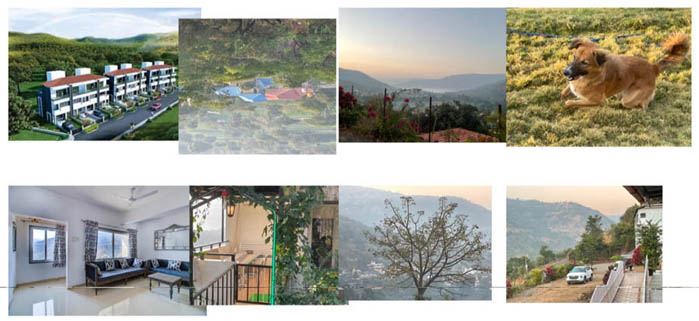
Tea finally arrived around 8:00 a.m.—four cups again, for three of us, simply because small cups have a way of disappearing too quickly. We lingered over it without urgency, warming our hands as much as ourselves. Photographs were taken, laughter surfaced without any clear reason, and somewhere along the way we made friends with two resident dogs. They moved about with the assurance of hosts, inspecting our presence and settling nearby as if the morning belonged as much to them as to anyone.
Breakfast required negotiation. Menus were studied, opinions exchanged, and preferences reconsidered more than once. Nothing quite spoke to the younger girls, who weighed options with polite disinterest. Eventually, the elders settled on cheese masala omelettes, dependable and satisfying. The girls chose to skip breakfast altogether, opting instead for cold coffee—served without a straw, which the staff simply didn’t have. It felt oddly appropriate. The day had begun slowly, imperfectly, and exactly as it should.
Mapro and the Reality of Holidays
On the way to Mapro Garden, we pulled over at a roadside blue pottery shop, its shelves lined with shades of turquoise, cobalt, and white that stood out sharply against the muted greens of the hills. The ceramics, we were told, were sourced from Uttar Pradesh, and whether or not one knew the tradition behind them, they carried a quiet elegance—plates, bowls, tiles, and planters that invited handling rather than display. What was meant to be a brief stop stretched into nearly an hour, conversations drifting between aesthetics, utility, and the small pleasure of discovering something unexpected on a familiar route.
By the time we reached Mapro Garden at around 12:30 p.m., the place was already overflowing. Cars were lined up well beyond the designated parking, and the crowd moved with the restless energy of people determined to enjoy themselves despite the heat and the wait. Inside, the usual indulgences followed—strawberry cream, pizza, fries—comfortably predictable and oddly reassuring. The atmosphere was festive, crowded but cheerful, with families, school groups, and tourists negotiating space with good humour. It wasn’t quiet, and it wasn’t relaxed, but it was unmistakably part of the Mahabaleshwar experience.
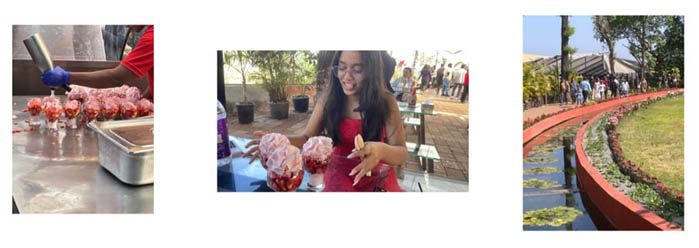
We left around 2:30 p.m., expecting the drive to Tapola—barely ten kilometres away—to be straightforward. It wasn’t. Traffic slowed almost immediately, then crawled, then seemed to stop altogether in places. Narrow roads, parked vehicles, and oncoming traffic reduced progress to a patient inching forward. At one point, we were asked to pay ?300 for pollution control, though the receipt handed over showed ?150. Under normal circumstances, it might have prompted a discussion. That afternoon, fatigue won. We paid and moved on.
The return drive to the villa—barely 19 kilometres—took close to two hours, the slow crawl noticeably affecting fuel efficiency. The car’s mileage dropped steadily, a quiet but persistent reminder of how demanding hill traffic can be during peak hours. We topped up at the nearest fuel station, more out of caution than necessity.
As daylight faded, the final approach road to the villa became genuinely stressful. It was narrow, poorly lit, and left little room for error, especially with occasional oncoming vehicles. Night driving on that stretch demanded full attention and steady nerves—something worth keeping in mind for anyone planning a self-drive stay in this area.
The climb to the villa itself involved a sharp hairpin turn on a steep, narrow access road. Despite the incline, the Creta automatic handled it without difficulty, even while running in Eco mode—a small reassurance at the end of a long and tiring day.
Adieu Party:
We still had some leftover wine, beer, Maaza, and snacks from the previous evening. On opening the fridge, we discovered that it had been set to summer mode, and the drinks had almost frozen—bottles sweating, cans rigid to the touch. For a moment it felt like yet another small inconvenience at the tail end of a long day. A quick check, guided by Google’s sensible advice, helped us thaw them slowly and safely, without risking the gas inside. It became an unexpectedly shared activity, handled with patience rather than irritation.
Once salvaged, the drinks became the basis of a small, unplanned adieu party. Nothing formal—just a quiet closing note to the day. Glasses were filled sparingly, snacks were shared, and the conversation drifted easily, as if acknowledging that the energy for anything more had already been spent. It wasn’t a celebration so much as a gentle winding down, marking the end of a full and demanding day.
Dinner that night was unavoidable rather than optional. We ordered one kilo of chicken curry, priced at ?1,800, along with chapatis and jeera rice. It was expensive by any measure, especially for a simple meal, but the chicken was undeniably excellent—well-cooked, balanced, and deeply comforting after the day’s exertions. By then, conversation had thinned. We ate quietly, settled in without ceremony, and allowed the night to do the rest.
Day 3 – 28 December 2025
The Road Back:
We woke around 7:15 a.m., the morning already brighter than expected, with the hills shedding their last traces of mist. The girls followed at a gentler pace, closer to 8:15, easing into the day without hurry. Packing was methodical rather than rushed—bags checked, forgotten items rediscovered, and the quiet acceptance that departure always takes longer than planned. Four cups of tea appeared again, their real purpose less about caffeine and more about the gentle urging required to get everyone moving in the same direction.
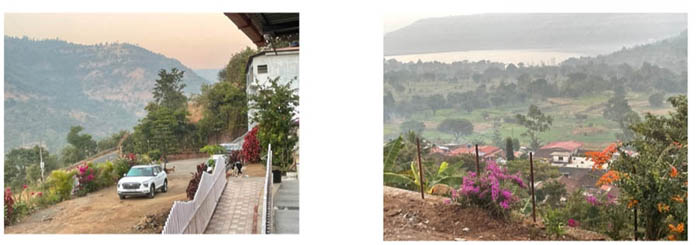
With the staff’s help, we loaded the car carefully, making sure nothing was left behind. The pending food bill of ?5,250 was settled, and we left a ?1,000 tip, appreciative of the effort and patience extended over our stay. As we pulled away, I set Simond’s Café as our first stop, a final indulgence before the drive home properly began. Simond’s Café is one of Mahabaleshwar’s quieter, understated stops—less about spectacle and more about comfort. Tucked discreetly off the main road, it’s easy to miss unless you know where to look, which perhaps adds to its appeal. The café offers familiar South Indian staples alongside coffee and cold beverages, serving travellers who prefer a calm pause over crowded viewpoints. With its unhurried service and modest setting, Simond’s feels like the kind of place meant for refuelling gently—both body and mood—before the road continues.
We missed the café the first time—the entrance sits discreetly off the main road, easy to overlook when attention is divided between curves, traffic, and scenery. Turning back, we found it without difficulty. Breakfast unfolded easily: dosa, vada–sambar, hot coffee, and an iced latte for those already leaning toward the afternoon. The setting was relaxed, the service unhurried, and the bill—?1,250—felt entirely reasonable for a last hill-town meal.
Not far from the café on our way back, we stopped briefly at a small Ganesh temple by the roadside. Modest and quiet, it offered a moment of pause rather than ceremony. A short prayer, folded hands, and a sense of closure—simple gestures before the long drive ahead.
As we retraced the serpentine road past the villa, Monsoon Mist came into view once more, framed by trees and curves we now recognised. Seeing it again felt oddly reassuring, as if the place was acknowledging our departure. The road then opened toward Mahu Dam, where we stopped briefly. Mahu Dam is a small, quietly situated reservoir near Panchgani, known more for its surroundings than for scale. Set amid gently rolling terrain and open skies, it offers a brief visual pause on the drive rather than a destination in itself. The calm water, sparse traffic, and absence of commercial activity make it a convenient spot to stop, stretch, and take in the landscape—especially for travellers transitioning from the hill roads back toward the plains.
The water in the reservoir lay calm, reflecting the sky, and the setting invited photographs without asking for too much time.
Nearby, an antique scooter, placed almost casually, became an unexpected focal point. It drew everyone in. Photos followed—posed, unposed, serious, playful—capturing the mood of the journey more honestly than landscapes ever could.
From Mahu Dam, the route carried us onward via Karad and Kudal, the landscape changing steadily with every kilometre. The tight hill roads eased into broader stretches, curves relaxing as altitude gave way to open plains. Forested slopes thinned out, replaced by cultivated land, and the sense of enclosure that defines the hills slowly lifted. Driving here felt less demanding, the road inviting a steadier pace and longer sightlines.
Small towns and villages appeared at regular intervals—clusters of well-built homes, roadside shops, schools, and sugarcane transport vehicles signalling an economy rooted in agriculture. There was a visible sense of quiet prosperity: concrete houses with fresh paint, tractors parked neatly, and busy local markets functioning without hurry. Life here seemed measured and practical, shaped by seasons rather than schedules.
Along several stretches, strawberry plantations lined the road, their neat, low rows protected by plastic mulch, evidence of careful cultivation. The fields were orderly and productive, reflecting the region’s success with high-value horticulture. We stopped at one such patch to buy strawberries directly from the growers—freshly picked, fragrant, and vivid in colour, carrying the unmistakable taste of the soil they came from. The exchange was brief and wordless, the kind of transaction that doesn’t need explanation.
As the road led us further on, we picked up Satara’s kandi pedhe, a small but essential takeaway. It felt like a ritual rather than a purchase—something to carry home not just as a sweet, but as a reminder of the region’s flavours, its rhythm, and the understated abundance that defines this stretch of the journey.
Lunch happened around 1:30 p.m., unplanned but welcome—a rustic mutton with Bajra bhakri at a roadside eatery which offered ample parking space. The food was simple, hearty, and exactly what the moment required. Ice cream followed, more out of habit than hunger, marking the slow shift from travel to return. The bill was a very modest INR 1400/-
By 3:45 p.m., we were back on the road to Pune, the drive smooth and familiar now. Traffic cooperated, and by 4:15 p.m., we rolled into EON Homes, Hinjewadi. The journey ended without ceremony, carrying with it a collection of small moments—quiet temples, winding roads, shared meals, and laughter—that lingered long after the bags were unpacked.
Closing the Circle:
As the gates closed behind us, a familiar feeling settled in—the kind every good family trip leaves behind. It was a quiet contentment, gently tinged with reluctance, as if part of us had stayed back on those winding roads and misted hills. The return marked an ending, but not an abrupt one; it felt more like a soft pause, allowing the experience to sink in before daily life resumed.
The joy of the journey had little to do with distances covered or places checked off an itinerary. It lived instead in shared meals eaten without hurry, in winding roads that demanded patience and rewarded attention, and in minor irritations that slowly transformed into stories worth retelling. There were moments of laughter, moments of silence, and long stretches of unspoken understanding—those rare spaces where companionship needs no explanation.
We returned home carrying more than strawberries and kandi pedhe. We carried memories shaped by early mornings, late-night conversations, unexpected detours, and the simple comfort of being together. These were the kind of memories that surface quietly—weeks later, perhaps triggered by a familiar smell, a photograph, or an idle conversation—long after the hills had disappeared from the rear-view mirror.
In every meaningful way, it was an immensely enjoyable family trip—uncomplicated, fulfilling, and surprisingly affordable, coming to about The total came to about ?50,000, not counting personal purchases along the way. Careful choices, a self-drive plan, and a conscious effort to keep things simple allowed us to travel comfortably without excess or compromise. Had we opted for a driven SUV, the expense alone would have increased by another ?15,000, without necessarily adding anything meaningful to the experience.
As for the minor bruises the car collected along the way, they felt almost symbolic—small marks of travel rather than damage worth worrying about. Perhaps they can remain, quietly doing their duty of warding off the evil eye, or be attended to later through insurance if needed. Either way, they seemed a small price to pay for a journey that gave us far more than it took.
The journey was not perfect, and it never tried to be. There were small challenges—traffic delays, minor irritations, moments of fatigue—but none of them overshadowed what truly mattered. Instead, they became part of the narrative, details that added texture rather than inconvenience.
What remained at the end was a sense of completeness: shared meals, long conversations, easy silences, and the warmth that comes from spending unhurried time together across generations. It was a reminder that meaningful travel isn’t defined by luxury or precision, but by presence—by being together, attentive to the moment, and open to the quiet joy of time well spent.
Shri Satish Pashine is a Metallurgical Engineer. Founder and Principal Consultant, Q-Tech Consultancy, he lives in Bhubaneswar and loves to dabble in literature.
WHEN FORGETTING ANSWERED FIRST
Phalguni Sahu
Gunjan believed that silence was never empty; it was crowded with truths people were afraid to pronounce. She had learned, over the years, to listen to it closely. Silence revealed loyalties, betrayals, hesitations. And sometimes, it revealed love.
When Ravi replaced her former boss, the office atmosphere hardened overnight. He arrived carrying other people’s opinions like inherited luggage- heavy, unexamined, and inconveniently biased. By the time Gunjan met him, her reputation had already been rehearsed in his mind, stripped of nuance.
Their first meeting was unkind. Ravi spoke with calculated severity, refusing her greeting, dismissing her smile. His questions were edged, his pauses deliberate, as though he were weighing how much resistance she could endure. Gunjan felt the tremor beneath her composure, but she did not bend. She had learned that dignity, when tested, must be worn like armour; quiet and unpolished.
Her work intervened where words could not.
Slowly, Ravi’s suspicion yielded to reluctant respect. Files returned to her desk marked with trust. Critical assignments followed. Conversations lengthened beyond necessity. Coffee appeared; not announced, not planned; shared in the hush of his cabin, where time behaved differently.
Ravi was a man of restraint. He spoke little, yet his silences lingered too long. His gaze paused, retreated, returned. Gunjan noticed the hesitation, the unspoken pull between restraint and curiosity. Both married. Both are aware of the invisible fences they must not cross. And yet, something restless stirred- quiet, persistent, unnamed.
Nothing improper occurred. No confessions. No promises. Still, something irreversible took shape in the space between glances and pauses. Their conversations remained professional, but their silences grew intimate.
Then, as abruptly as he had arrived, he was transferred.
The distance did not sever them immediately. Calls continued, light on purpose but heavy with familiarity. Work talk dissolved into weather, passing thoughts, fragments of days. He waited for her messages. She waited for something else, clarity, perhaps, or courage.
Gunjan never spoke of what she felt. She believed some truths, once uttered, lost their power. Yet she often wondered if Ravi sensed it; that steady presence beneath her words, the careful warmth she never allowed to rise too close to the surface.
Time, patient and unkind, began to rearrange them.
The calls thinned, then shifted. She dialled more often. He still answered, still spoke at length, but his voice carried a distance she could not bridge. It felt like standing before a familiar door that no longer opened fully.
Then came the news without ceremony: Ravi had resigned. His own Start Up in the USA, someone said. No farewell. No explanation. Just absence.
Gunjan felt the ground shift, not enough to make her fall, but enough to make her uncertain of where she stood. Months passed. She continued to call occasionally, holding on to the remnants of a connection that now lived mostly in memory.
One evening, a colleague mentioned, almost casually, that Ravi had been in town recently. The information ignited a small, dangerous hope. Perhaps he had been busy. Perhaps he would still reach out.
Later, when she asked him, his reply came easily.
“Oh… I forgot to meet you.”
The words were simple, almost careless. Yet they settled heavily within her, like dust on a long-kept surface. In that moment, she understood; not with anger, not even with sorrow, but with clarity that forgetting, too, was a kind of answer.
She laughed softly on the phone, asked about his well-being, and listened to a story she had heard before. When the call ended, she sat still, letting the quiet surround her.
That night, she made herself coffee and watched the steam rise, twist, and vanish. She thought about pauses, how they could hold warmth without permanence, how they could feel complete despite their brevity.
Much later, Ravi called her one evening, unannounced. His voice sounded familiar, yet oddly distant, like a place she once lived in but could no longer return to. They spoke easily- about work, about trivialities, about nothing that mattered enough to stay.
There was a pause then. A long one.
Gunjan waited, sensing that something hovered at the edge of his silence. Perhaps a confession. Perhaps an apology. Or perhaps just the weight of remembering.
Instead, he said, almost thoughtfully, “You know… sometimes I wonder if there was a moment we missed.”
Gunjan smiled, though he could not see it. “Maybe,” she replied. “Or maybe it wasn’t meant to be a moment at all.”
He didn’t answer immediately. When he did, his voice had softened. “You always had a way of understanding things before I did.”
She let that settle between them.
After the call ended, Gunjan did not re-play his words the way she once would have. She didn’t search them for hidden meanings or belated truths. She simply acknowledged them like a door gently closed, not slammed shut.
The next morning, she made her coffee and drank it without pausing, without waiting for it to cool. The warmth was brief, complete, and enough!
Some stories, she realized, do not end in loss or fulfillment. They end in recognition of what was shared, what was spared, and what quietly shaped us before letting us go.
Phalguni Sahu is a development leader who has spent twenty-five years shaping transformative initiatives across government, public sector institutions, and international development organizations. An MBA in Rural Management from the Xavier Institute of Management, Bhubaneswar, she carries into her writing the same depth of insight and quiet sincerity that define her professional journey.
For Phalguni, writing is a sanctuary- an inner courtyard where thoughts unfurl gently and truth finds its voice. She is an ardent reader, forever drawn to the reflective rhythms of literature, and her creative work spans contemplative spiritual blogs and evocative short stories.
LIFE IN THE INTERNATIONAL HOUSE
Triloki Nath Pandey
I mentioned earlier that my host family, Ada and Fred Bonakar, dropped me at the International House at the University of Chicago. It was my home for the first two academic years, the last two I moved to an apartment in Blackstone Villa, four blocks north of the International House. The Social Science building which housed anthropology department on the third floor was just seven minutes walk from the International House. The director of the International House, John Kerridge, greeted me warmly and asked me to see the Bursar next door. He gave me my room keys and asked an assistant to take me to my room, 403, on the fourth floor. It was a nice room and from its wide window I can get a glance of the great Lake Michigan which was about six blocks away. It appeared like an ocean to me.
It was for the first time that I lived in a co-residential house. There were women and men graduate students from Canada, Egypt, India, Japan, Lebanon, Pakistan, the Philippines, Sri Lanka, and the United States that I met there. The largest number of foreign students were from Canada - well over 200. Next to them were from India. I was told that there were 120 graduate students from India. A majority of them were men who had come on J-I or F-student visa. I was on a J-1 visa.
Almost 50 of the Indian students lived in the International House. It was a well organized group. We formed an association and elected Mr. Parikh as president and I was elected treasurer. We showed a Bollywood movie every quarter-one dollar per ticket. During spring quarter in 1964, I remember we collected some $330.
There were about 400 Indian students in mostly Illinois Institute of Technology, North western, and the University of Chicago.Now there are 400 Indians in every neighbourhood in Chicago I remember one Punjabi gentleman bringing his two marriageable daughters for every movie show. We also sponsored visitors from India- J.B. Kripalani, P.C. Mahalanobis, and a Yogi whose name I do not remember now. Their presentations were lively and well attended. I remember Professor Mahalanobis giving a glowing picture of how China was mobilizing its vast population in the economic development of the country. He had gone to China for two weeks and stopped in the United States en route to India. Kripalani implored us that we must return to India after our graduation to contribute to its modernization. I still remember the pithy response the Yogi gave to a question from an American student about the caste system in India. He said, “ You have castes in every society. Here in America as well. The only difference is that we in India have made it a system”.
I was the youngest graduate student among the Indians. There were half a dozen post-graduate fellows living there. I well remember a few of them. Vidya Bhushan in education, R.S. Khare in anthropology, Vishwa Mohan Khanna in Chemistry. They were there on one year’s appointment. I was friends with two of them- Vidya Bhushan and Khanna ji. They kept in contact with me even after leaving Chicago. I will see Khanna Ji in Delhi University whenever I went to see my friends in anthropology there. I saw Vidya Bhushan in Quebec City in Canada in August 1983, when I was there to participate in the 11th International Congress of Anthropology and Ethnology. He visited with me in Santa Cruz two years later. I remember meeting his wife and two children.
R.S. Khare had come on an International House fellowship sponsored by anthropologist McKimMarriott who has been an external examiner of his Ph.D. thesis at lucknow University. He was T.N. Madan’s first Ph.D. student there. He went back home and after a year returned with his wife and sister to take up a job at the Kenosha campus of the University of Wisconsin. A few years later he moved to the University of Virginia. He brought his family to visit with me during the early 1980.
The International House was like a mini South Asia during those days. Indian students from various states - Andhra Pradesh, Bihar,Gujarat, Kernataka, Kerela, Odisha, Maharashtra, Tamil Nadu, and Uttar Pradesh were studying different subjects. A majority of them were in Biological and Physical sciences. Astronomy, physics, mathematics and statistics were quite popular, and prominent professors of Indian background - Raghuraj Bahadur, Subramanayam Chandrasekhar, and Ramchandran were well respected members. Anthropology, economics, sociology and social work in social sciences attracted a handful of Indian students. Those days very few students from South Asia were studying political science, psychology, and history. History was in social science division and there were two Indian post - doctoral fellows in it. A.K Ramanujan, a poet and linguist, played an important role in mentoring students who were working in South India.
The University of Chicago had developed an outstanding center for the study of Indian cultures, civilization, economics, history, and languages. Bengali, Hindi, Sanskrit, Tamil, and Urdu were offered. Edward Dimock was teaching Bengali, Kali Charan Bahl, D.P.S. Dwarikesh, and Shyam Manohar Pandey were involved in teaching Hindi. Officially, Norman Zide was professor of Hindi and Mundari languages and he was assisted by Ram Dayal Munda and Dash babu. He asked me to meet with his Hindi students- four of them – for an hour every week. Since I was paid for that work by the University, I got my Social Security card in 1964.
A Dutch scholar, J. A. B. van Buitenen, was professor of Sanskrit. Since it was hard to follow his Sanskrit or even English pronunciation, Professor Joshi from Pune was brought in on a two year contract. Professor Marriott asked me to serve as a priest at a mock wedding he had arranged for his course on Indian civilization for undergraduates in the College.There were over one hundred students and faculty- Fred Eggan, Mercea Eliade, Edward Shills, Miltan Singer- witnessing the event. Later, Professor Edward Shills told me that many people were impressed that a Hindu priest, wearing kurta-dhoti, was conducting the ceremony in Sanskrit and explaining it in English.
` C.M. Naim, who was a student at Lucknow University a couple of years before me was teaching Urdu. Naim Sahib, I used to call him, was quite popular with American students. A distinguished Odia scholar, D.P. Pattanayak, came from Cornell to give a job talk and was offered a faculty appointment to teach Odia, but he returned to Santiniketan where he had taught Odia for a decade. There were American scholars in anthropology and sociology who had done their research in Odisha. They wanted someone who can teach Odia as well.
For me the real problem was food. As a vegetarian, I had limited choices in the cafeteria. Usually, I ate rice, bread, boiled vegetables and salad every day. I missed Dal so I put gravy on my rice. I discovered that it had small pieces of bacon, which I removed, Professor Joshi joined me at lunch and dinner and took the same items I had on my plate. Once he asked me “ Pandey Ji, what is that you remove from the gravy all the time”. I told him “Joshiji, this is some kind of American vegetable which I do not like”, My American friends had a big hearty laugh hearing our conversation.
The other problem was taking the shower/bath completely nude. Usually, I got up at 5 A.M. and right away went to the bath room. Hardly any one was there that early in the morning. Once I heard a Muslim Fulbright scholar telling some Pakistani visitors, “Toba, Toba eedhar nahi aiye. Log nange naha rahe hai, Please do not come here. People are taking nude bath” One takes time to get adjusted to western ways of living.
There were several Pakistani men and women who had come to the United States to get training in education. They were much older and hardly interacted with us but for two women. These women were school teachers from Lahore. One of them was very jovial. When she was alone, she came to my table in the dining hall. Once she told me “ Mere sowhar lucknow se hai. Aap to mere devar huye- My husband is from Lucknow. You are my brother-in-law.” Whenever I saw her I called her bhabhi- sister-in-law and we both had a good laugh.
Usually I hung out with my Indian friends. Some of them I have mentioned earlier. My friends from Uttar Pradesh- Ravi Katiyar, B.S. Parihar, Sant Singh, lectures from Kashi Vidyapith, and D.P.S. Dwarikesh from Agra. We often got together and on saturdays we went to Nicky’s pizza place on 53rd street close to where the Obamas have their house now. We socialized together, spoke in Hindi, and discussed what was going on in our day-to day lives. I seldom felt lonely.
One day an older student from Tamil Nadu joined me for breakfast. During the course of our conversation he broke down and began sobbing. I was startled and asked him what was wrong. He said he was feeling home sick, missing his wife and children. He wanted to go back to India. I got together with a few friends and K.L.Krishna who was studying economics, and this year he was awarded Padma Shri by the Central government.
We collected money in order to buy his return ticket and took him to the airport. Director of the International House must have heard this. A month later he asked me to see him in his office. He handed me a certificate and an envelope. I learned that he had nominated me for a leadership award of $ 2,000, That amount went towards buying an overcoat and other woollen clothes for the harsh winter in Chicago.
At the end of the academic year I had to take an exam lasting for 8 hours spread on two days. On the last day - I think it was May 24th - I heard on the radio that Prime Minister Nehru had passed away. When I returned to the International House I learned that the director was looking for me. I went to his office and he told me that the Time - Life was working on an obituary and needed someone to help. He said in an hour their car will come to pick you up. I went to their offices and stayed there for four hours. I helped in checking names, locations, and proper spellings of what its writers had written. They drove me back to the International House and gave me $ 200 for my services.
In June of 1964, I packed my room and stored things in the basement of the International House and got ready to go to New Mexico to take part in the fieldwork training program financed by the National Science Foundation. There were seven students in our group – three from Chicago, one from Columbia, two from Michigan, and one from Oregon. Professor David Aberle from Oregon was the director of the program and Alfonso Ortiz, one year my senior at The University of Chicago, was the fieldwork coordinator. Since I was interested in the study of religion, I was placed in a Navajo family- the Chatos of Ramah- well known in the works of many scholars from Harvard. Later, I wrote about my field experience in two papers which appear in Encounter and Experience and Fieldworker and the Field – two path breaking books in anthropology and sociology. I will discuss their importance in coming sections.

Triloki Nath Pandey is a well known anthropologist, educated at University of Lucknow (B.A., M.A.), University of Cambridge (M.A.) and the University of Chicago (Ph.D.). He has taught anthropology at various Western Universities—Chicago, Pittsburgh, N.Y.U., Columbia, and Cambridge, and since 1973, at the University of California, Santa Cruz. He often visits India for lectures, and on teaching and research assignments. He is a well respected scholar of indigeneity.
Triloki Nath Pandey
Professor Emeritus of Anthropology
University of California, Santa Cruz
California, 95064, USA
LISTEN TO THE THENGAPALLI WOMEN WHO PROTECT THE FOREST IN ODISHA
Annapurna Pandey

On 8th January 2025, Bhagyalaxmi Biswal of Vasundhara (an NGO working on Indigenous Land rights) and I arrived in Gunduribadi, a village of about 27 Kondh (Adivasi) families in Darpanarayanpur panchayat, Nayagarh district, Odisha. Forty-some-year-old Chheta Pradhan, the President of the local Thengapalli group, greeted us with a big smile. We walked through the rows of houses, a mix of mud and thatch. Chheta's mother-in-law, the veteran warrior of the forest, now in her 80s, watched at the door of her house, smiling. Women were drying their freshly harvested paddy on the village path to prepare parboiled rice for year-long consumption. The villagers live off the forest produce and some agriculture. For the last 27 years, the women of this village have been protecting the forest.
A group of animated women in colorful saris welcomed me at a makeshift one-room community hall to discuss how they guard their forest surrounding Ma Mani Nag (Jewel of the Cobra), Hill Range, against all the threats from loggers, developers, and forest officials. They call their Hills and jungle 'Ma,' mother, and father, all-inclusive. These women are the climate heroes whose motto is to protect the forest, which provides them with sustenance, Livelihood, and identity.
Women in 212 villages of Odisha observe 'thengapalli' to safeguard the trees and forest resources from outsiders. 'Thengapalli' translates to 'thenga,' meaning sticks, and 'palli,' meaning turn.' In groups of four to six, they patrol the forest in three shifts, with one group leaving sticks at a neighbor's door to take their turn. When asked how it works, the women said, "It is very simple. We go by trust".
Ma Mani Nag Hill is known for its expensive sal, Piasal (Indian Kino), and sagwan (teak wood), among other rare trees. Sal and Siali leaves are very valuable; women collect the fallen leaves, dry them, and make leaf plates to sell in the local market. Every morning, women go to the forest to collect wild leaves, a variety of potatoes, greens, mushrooms, and vegetables. Fruits like mangoes and jackfruits are abundant. They never cut a tree but collect dry wood for fuel and plant new ones to protect the forest.
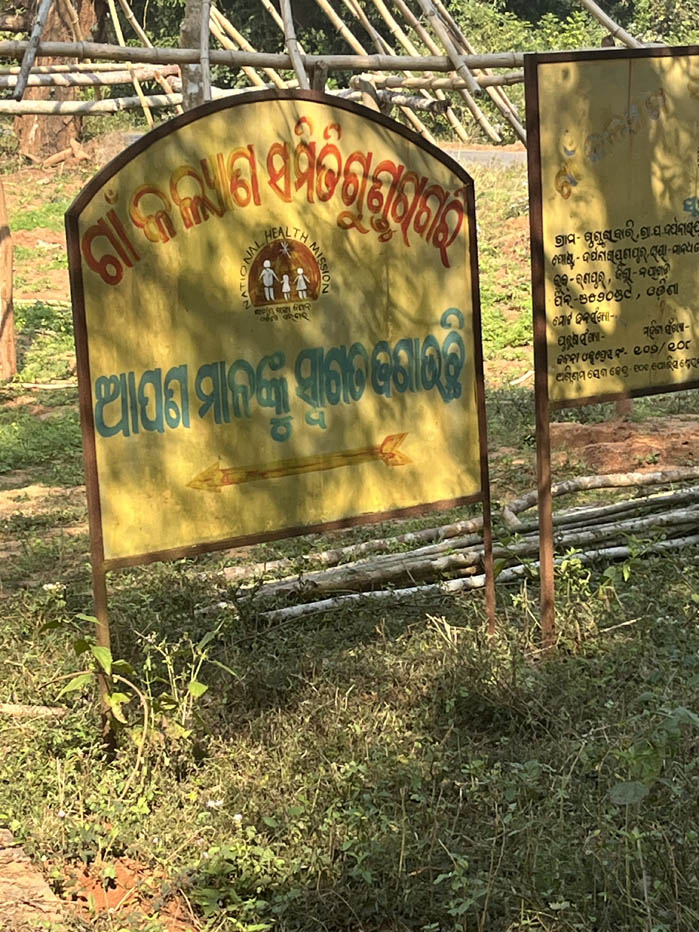
While visiting the goddess Kalia Sandha (black bull), nestled in the foothills of Mani Nag Mountain in Ranpur, Odisha, my Thengapalli friend Chheta said, "Ask Ma whatever you want, and it will happen." It was midday. The gate to the deity was closed. But we could see the goddess through the iron frame gate. Four or five women from the village took me to dig wild potatoes and to visit the Siali plant, whose leaves are used to make leaf plates. We came back to the temple after an hour. Chheta picked up a bag of a few bananas left on the iron gate. While offering the bananas, she said, "I told Ma, we have a guest from so far. But we have nothing to offer her. Will you send her empty-handed"?
Chheta's statement was very revealing to me. It implies that humans are not the only ones who can hear one another. The goddess, made of stone, adorned with vermillion paste, bells, and bangles, and wearing a red sari, protects her people and the environment in her own goddess way. The goddess is the protector of the people and the guide, mentor, and companion of these women as they protect the deep forest full of elk, tigers, and hyenas. The goddesses' thoughts have life-or-death consequences for people. With her strength, these women fight with the loggers, foresters, and city dwellers who are destroying the forest. Besides, several divine, Bagha Devi (Tiger goddess), Jhara Devi (Spring goddess), and Ghoda Devi (horse goddess), are partnering with the humans to protect them from injustice. "The whole climate crisis, one could argue," Edward Kohn says, "is the product of people increasingly treating nature as a thing rather than a set of relationships." The indigenous women of the Mani Nag hills partner with the androgynous goddess, and all the sentient beings, e.g., the mountain, the forest, and develop a dialogical agency to regenerate the forest on the mountain, protecting it from the loggers, foresters, and city dwellers.
But if we anthropologists begin to attribute thought, a higher-order function, to nonhuman life-forms, these beings are looked upon as partners to protect the human and the environment. Edward Kohn says, "If a forest is sentient, then it can't exactly be understood as property, right?" "So, all sorts of things change."
I learned that community forest protection in this area started in the 1970s, led by men. In the 1990s, the forests were dwindling, the hills were barren, and men in the villages in charge of the community forests were fighting with each other over their vested interests. The loggers and foresters were making the jungle bare, stealing expensive timber, and plundering forest resources, leaving the villagers starving. Kondh women joined with their Dalit and general-caste neighbors to protect their forest. They established a federation, Ma Mani Nag Jungle Surakshya Parishad (Forest Protection Council). Now, the federation is led by a woman, Pratima Jena, from the neighboring village of Darpanarayanpur. These women are united as 'thengapalli' to protect the forest, keep the food chain thriving, and pass on the abundant forest to the next generation, making it part of their heritage and identity. These women have earned community forest rights (CFR) to their forest under the 2006 Forest Rights Act.
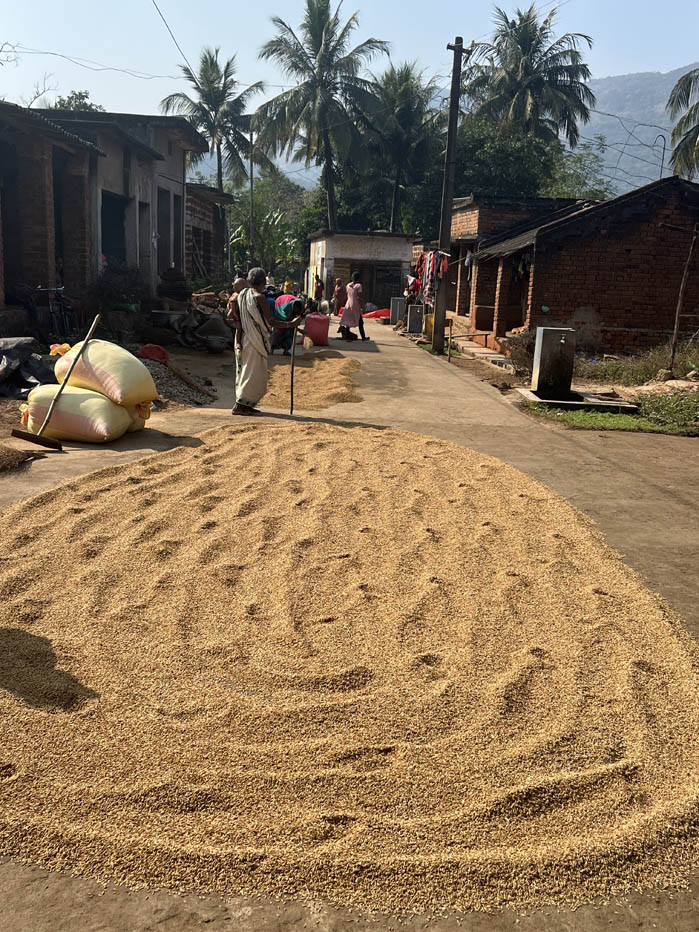
Women's Stories:
These women say that their lives revolve around the trees and the forest. The ladies of Gunduribadi village told me about their recent triumph. Last December, they discovered a colossal teakwood tree chopped into logs on a rainy morning. The women informed the villagers and guarded the logs. When the forest rangers came to collect the logs, the women demanded to meet the culprits. Chetta says, "There is no thief without the forest official. They collaborate on destroying the forest". The women would not release the wood and insisted that the chopped logs belonged to the village and that the offenders be publicly exposed.
One young ranger, herself an Adivasi, was very abusive. She asked Ujjal, one of the older Thengapali women, "Why are you so possessive about the wood? Have you nurtured this teak with your urine?" Offended, Ujjal responded, "The wood belongs to our forest; it is ours." The rangers realized that these non-literate women were tough. Finally, they had to give in; they brought the wood to the village, and the loggers publicly apologized.
The 'thengapalli' women have created an awareness that the forest is sacred; it provides food to the people, and rain brings in such a good harvest. If the forest is depleted, the food chain is lost. Ma Mani Nag hills will become bare, and people will lose their Livelihood and identity. During COVID-19, the villagers took pride in the fact that there was not even a single death in the village. They would not let anyone in from outside and survived by living off the hills and forests.
I wondered who the role models were for these 'thengapalli' women. Where do they gain the strength to manage the forest besides caring for their family and children? The women took me to visit their androgynous goddess, Kalia Sandha (Black Bull). They said, "She is our mentor and companion in protecting us and our jungle.
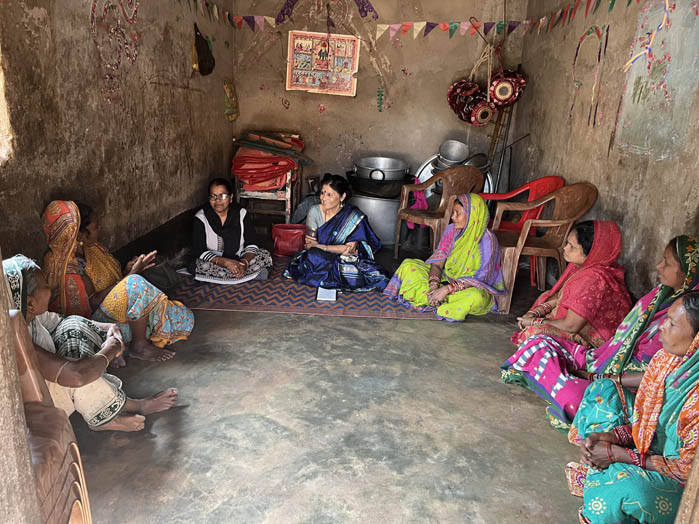
The women told me the developers and forest officials have made several attempts to take away their autonomy over their land and forest. "A developer proposed a crusher machine next to the village primary school and promised the women many goodies, such as feasts and gifts for the village to run the stone-crushing unit. The women realized that the dust from crushing the stones would harm their trees and stunt their growth. The noise would be deafening, affecting their health and children's education. Bhagyalaxmi Biswal of Vasundhara helped them draft a petition, send it to the state Education, Health, and Environment departments, and copy the chief minister. Even though the state government had already sanctioned the installation of the crusher, the developer had to withdraw from the venture. This was a significant victory for the thengapalli women, and they felt proud to keep their village free from concrete pollution.
There is a lot of pressure from the forest department to introduce Vana Sarakhyana Samiti (VSS) as part of the Odisha Forestry Sector Development Project to share the produce and the profit between the state and the people half and half. But these women know that if the forest department takes over the forest preservation, their jungle will be orphaned. In the name of development, the forest will be gone; the Ma Mani Nag hills will be lost in the sad development of progress and modernity.
I have learned three things from these amazing women. First, the women protect the forest and pass down the leadership to their daughters-in-law, and the daughters take the tradition to the villages where they are married off. The children learn the value of the forest from their elders. Second, all the residents of the villages—Dalits, Kandhas, and general castes—live side by side, and the women, irrespective of caste and tribe, work together to protect the forest. Third, the women recognize the androgynous divine power of the forest, which ensures their well-being.
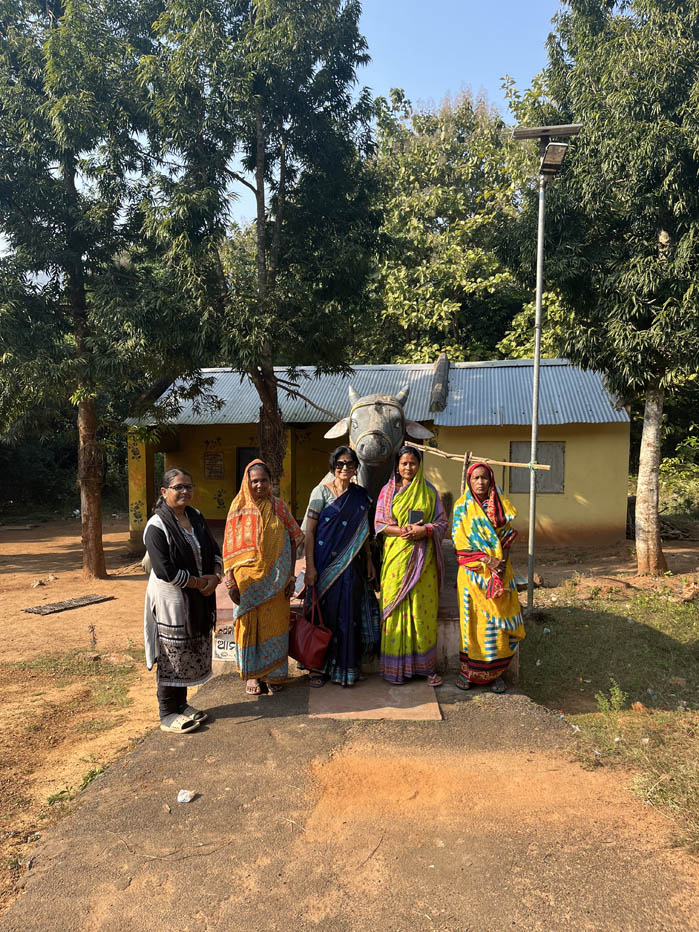
I realized these women hardly had any material resources and struggled to support their families. Before I left, they had a request. A Khali (leaf plate) machine would benefit several villages where women collect Sal and Siali leaves from the forest and make leaf plates by hand. After hours of hard labor, they fetch only a dollar for 100 plates. A machine would help them produce plates faster, and they would earn 3 dollars for 100 plates. Their earnings would multiply.
Prof. Debendra Das, Professor Emeritus at the University of Alaska, was visiting Odisha. He heard my story and offered to pay $600, half the cost of the $1200 double machine that produces leaf plates and bowls. As part of the South Asia Study Initiative (https://thesasi.org), a small non-profit in the USA, we bought the machine before I left Odisha. Many women have called me to share their joy and happiness. Chetta says, "Madam, I could make 200 plates in one hour. My children have become experts in making the plates and bowls". I thank Prof. Das for his generosity. The Thengapalli women have taught me the joy of sharing and the value of the forest and hills as intrinsic to our well-being.
The women of 212 villages will benefit from machines for cashew processing, Khali making, and tea cup-making. If anyone is interested in supporting them, please contact the author.

Annapurna Pandey is a cultural anthropologist at the University of California, Santa Cruz. Originally from Cuttack, Odisha, she moved to Santa Cruz, California in 1989. She is a travel enthusiast and loves to write travelogues highlighting her exotic experiences in different parts of the world.
Anita Panda
“Wanderlust and Southern city dust”…
Is it overwhelming to describe a place where “moments take your breath away!” This historic, serene, charming coastal city, located on the Atlantic coast at the confluence of Ashley and Cooper rivers is the state capital of Columbia, in South Carolina, USA. A laid back haven with a relaxed, old world charm, it derives its name from the English ‘Charlestown’, meaning “Charles’s settlement”, after King Charles II of England, who founded this South Carolina city in 1670. The city adopted the modern spelling ‘Charleston’ in 1783.
Known for its warm, friendly Southern vibe, quaint, cobblestone streets, forts, plantations and colonial architecture, it is a major port and tourist haven tucked away in South Carolina, USA. A hub for history lovers, foodies and those seeking Southern hospitality, it boasts of many FIRSTS- America’s first museum, first golf game, first theatre and a public library along with a thriving economy in tech & aerospace. Its water front views are stunning and its thriving arts & cultural scene is exciting!
Famed for its rich colonial & civil wars history, stunning beauty and antebellum architecture, world class Southern cuisine, beautiful coasts & beaches, vibrant art scene, its significant role in the slave trade & Gullah heritage, here is a little gem waiting to be discovered. Earning it nicknames like the ‘Holy City’ and ‘Silicon
Harbour’.
Its dark history is rooted in slavery and the American Civil War, making it significant for comprehending racial injustice while uncovering eerie tales of ghosts, pirates, hidden alleys, criminals & paranormal lore (its old jails, churches, POWs & historic buildings). It reflects a complex past of wealth stemming from brutal exploitation.
The southern American culture is very prominent here and its Gullah heritage (descendents of slaves) brings in many African influences.
kEY ATTRACTIONS IN CHALESTON:-
*Carriage tours*
*Fort Sumer National Monument
*The Charleston Museum
*Rainbow Row
*The Battery & White Point Garden
*Old Slave Matt Museum
*Historic Houses of Worship*
*Plantation Tours & Parks.
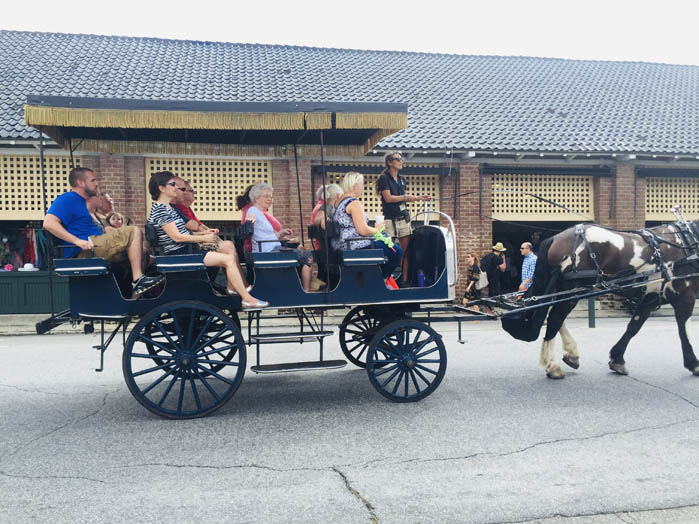
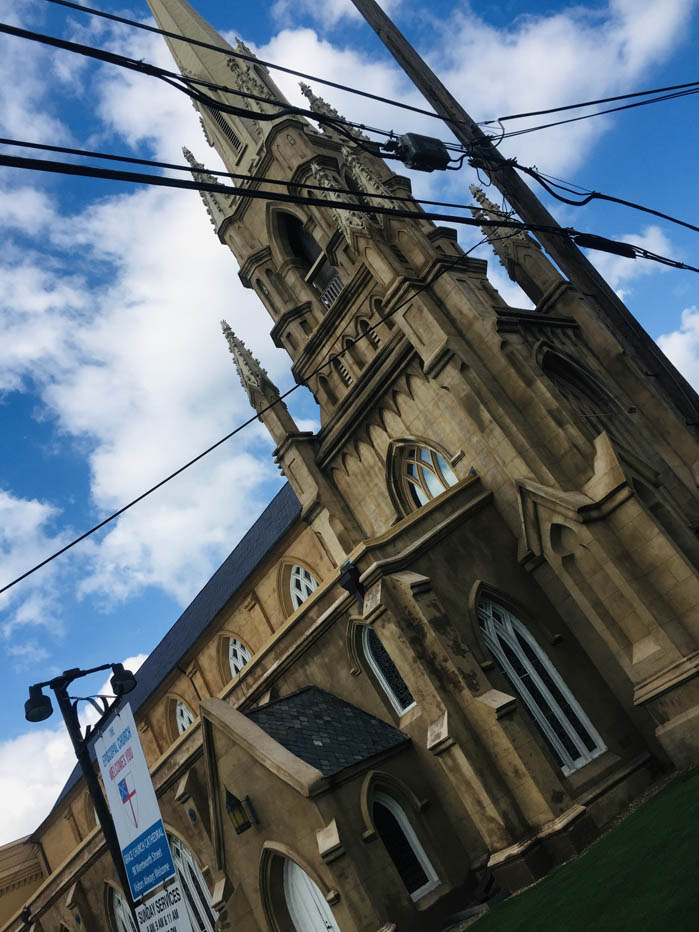
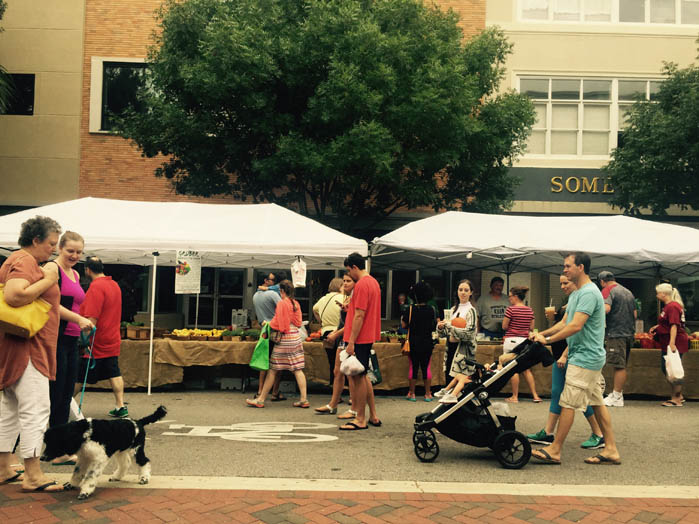

WORLD CLASS CUISINE:-
One of the top reasons to visit Charleston is its lip-smacking low country cuisine that makes it a food lover’s delight. Food isn’t just a meal here, it’s a way of life. Its signature dishes are- thick, creamy she-crab soup, smoky shrimp & grits, flaky biscuits, fried green tomatoes & Okra stew- recipes born from Southern & Gullah traditions and the soul of Charleston’s cuisine. The city embraces its casual side too, with amazing indie coffee shops, praline pastries, craft breweries & cocktail bars.
From its moss-draped oak trees to its rooftop taverns, Charleston offers a unique blend of history, culture, cuisine and coastal beauty that few cities can match.
The city’s walkable charm and friendly vibe make it an enchanting destination for all. Art lovers soak up its galleries and live music, food lovers love its gourmet meals and history enthusiasts admire its cobblestone lanes and revolutionary war sites.
BEST TIME TO TRAVEL HERE- In Spring (March-May) and Fall (September- November) when the weather is pleasantly warm. The blooming flowers and outdoor activities makes it the perfect time with smaller crowds and beach weather.
HOW TO REACH CHARLESTON- Fly into Charleston International Airport (CHS) from around the world connecting through major U..S. hubs- Charlotte, Atlanta, Dallas, Chicago or D.C. as most International flights require one layover, domestic flights from many US cities, an Amtrak train for East coast travel, taxis, rideshares, Carta Bus or rental cars for local transport. A mesmerising getaway and an incredible experience of a lifetime to cherish!

Anita Panda is a bilingual author-poet, nature lover & an aspiring TEDx speaker. She penned ‘GENESIS’ (2021) in honour of her Late valiant soldier brother, debuted with her own book ‘SONGS OF MY SOUL’ (2023). Her work is widely anthologised in prestigious national and global Anthologies & notable publications.
Her debut Hindi book-  was recently published by AUTHORSPRESS (2025) and set to be formally launched.
T. V. Sreekumar

Retired couple we are and we have been teachers. We try to make our life lively at this late age and often come up with something new for a change. That day after dinner I suggested to Gowri, my wife that we go out and do watching, telling stories that came to our mind. Our small home which we had constructed during our service was our palace and for most of the happenings in our life the root was from “Gowri Shankaram”, the name we had chosen together. We were particular to have a small lawn in the limited space and with greenery all around the visit of birds, squirrels, butterflies and others gave us company. Two big benches in bamboo adjacent to each other added to the charm.
Lying side by side I showed her the Great Bear and Little Bear constellations. Locating the Pole star was a new lesson for her. Thoughts of those earlier days when we first met flashed upon my mind in between. That day the principal was on leave and I was in charge. A new teacher was to join that day and being a small school in a remote place the students and staff were very anxious and enthusiastic.
Lying stretched on that bamboo comfort I asked Gowri,
“Do you remember the day you came to join?”
“Will I ever forget that day and the later days till today?"
A lean, simple-looking girl had walked in with fear and embarrassment radiating with the attention she received at the entrance. Later I introduced her in the assembly with all importance. Within days she proved to be a teacher of great class. Her attitude towards the students made her popular and injecting curiosity into young minds was her skill. She was staying as a paying guest with a family and I was put up in a lodge. I found her an interesting character because of her craving towards learning and teaching and also her insatiable passion towards Malayalam literature. It came as a surprise that M T and Basheer were our heroes and while talking their names always propped up. Analysing their writings and dissecting the characters threadbare was our brain teaser.
The school was elevated to high school after a few months and responsibilities increased with new faces also joining in between. Days were passing by when a new thought crept in. Gowri had become an inseparable part; and why not ask her hand for a life together. In between I had asked about her family - her only brother was working abroad and parents were retired. That evening while alone I put the question to her. She was a bit nervous and replied
“You should ask my parents.”
Fair enough, and a week later I went to her place with my parents’ consent and asked them.
We got married after a few months and a life together started. Our house was built soon afterwards.
Laxmi, our daughter came after a few years and she, growing up right in front of our eyes from a baby to a girl to a young woman, was beauty in magic to us. Off she had gone to JNU for her higher studies and during one vacation she told us,
“I am interested in a boy studying with me. He is from Tamil Nadu and only with your permission will I go ahead”
That was least expected and did put us into a lot of confusion and mental stress. Finally, I told Gowri,
“Had you been from a different state or different caste I would have still married you.”
That thought put all our confusions to rest and after a few years we got Laxmi married to Vignesh and both statrted living in a far-off place.
Lying side by side we were holding our hands and sharing all those moments in life we had crossed together. Suddenly it came from me,
“Gowri, when we leave this world it must be almost together”
Gowri squeezed my hand tightly and I knew that she couldn’t even think about it. I could hear her sobbing.
“It is a reality and the bitter truth we have to face dear”
I will write about this and file it and Laxmi will find it and the title will be
“WITH STAR AS WITNESS”
------------------------------------------------------------
I am Laxmi, daughter of Madhavan and Gowri as my parents. I have been very fortunate to have such wonderful parents who taught me the values of life through theirs. They have been so understanding when I expressed my wish about marriage and I firmly believe they were right in going along with me in choosing my partner. Vignesh is such a wonderful person and loves and respects my parents greatly.
The above writing I got from my dad’s file and as mentioned in it, two months later my dad passed away and surprisingly ten days later Amma also joined him. It was as they had desired. The pledge they had taken was fulfilled.
“WITH STAR AS WITNESS”
T. V. Sreekumar is a retired Engineer stationed at Pondicherry with a passion for writing. He was a blogger with Sulekha for over fifteen years and a regular contributor writing under the name SuchisreeSreekumar.
Some of his stories were published in Women's Era. “THE HINDU” had also published some of his writings on its Open Page..
Dr. Rajamouly Katta
“Good news… good news for all of us,” Srimanth said to the villagers around him.
“What news is that?” the villagers curiously said to him around.
“Notification for Panchayath elections…,” Srimanth replied happily.
“Election-fest today onwards… until the election is held,” cheered the villagers around him.
“Time has come for me to be in the fray…I contest the election… I will get your unstinted support in the way you did in the election last year… A notification was given today morning for the conduct of local body elections for Sarpanch and ward members in villages,” Srimanth said with deep reflections on how to win the election without fail.
The long-awaited aspirants jumped into the arena of election campaigns with all wherewithal necessary for the battle of elections. They had already kept strong drinks, and currency notes ready for the voters in all villages. All knew well that it was the trend of the day for the leaders to offer something for votes as practice though it was illegal. They firmly decided to offer more drinks and more notes to the voters to win the election than before.
There were some more aspirants apart from Srimanth, aspiring to be in the fray. He wanted to achieve hectic this time as an unrivalled leader in the village. Siddhartha, a sincere youth, was another candidate who was supported by most of the villagers for the first time. They filed their nomination papers to be in the fray.
The scene was set for the campaign by all the aspirants like Srimanth. He was a rich landlord. During the Panchayat elections, he spent a lot in the past. This time he took the winning of election as the question of prestige. He aimed at winning the election spending a lot. He was busy campaigning, covering important people in the village.
Srimanth learnt that most of the villagers were supporting Siddhartha. All of them were talking about his landslide victory in the election.
To win the election became prestige question for Srimanth. He was prepared to offer the voters far more than before. He, along with his supporters, went to almost all houses, promising many benefits to every voter. He met the people with folded hands.
After the date of withdrawal, there were only two—Srimanth and Siddharth-- in the fray. Both were serious about their victory. Time was to decide who was to win the election this time.
“Dear people, you voted for me every time. Bless me this time too with your valuable votes in my favour,” Srimanth said to the villagers, bowing his head to them.
“Elections come and go, but we do not witness any progress…,” a householder said with all feelings in her face.
“You can witness the fruits of my efforts as in my previous tenure. This time I am sure that you will find real progress in the village in near future. It is underway to be seen by the eyes of all,” Srimanth and his supporters said with folded hands.
“Your promises are age old… nothing new…I do not know when I find progress in the village,” a householder in the second house.
“I am at your service… I am like the shepherd to look after you and the people are like the sheep in my supervision,” Srimanth said, smiling.
“Yes, the shepherd is becoming far fatter than before, and the sheep too are becoming far weaker than before,” said householder in the second house.
“Dear Sir, I have come here to make a humble appeal to you, all. You remember to vote for me this time also,” Srimanth said to the householder in the third house.
“We remember you to eradicate poverty. You have already eradicated poverty but ‘eradication of poverty’ is the slogan every time in campaign to win the election,” the householder in the fourth house said furiously.
“There is progress as you know…You will surely witness the progress as per your wish… Poverty is surely eradicated,” Srimanth said humbly while leaving the house.
In some houses, there was a complaint against the monkeys’ menace in the village. The leader Srimanth promised to pick up and leave the monkeys in a thick forest nearby.
In every house there was similar response echoing from their mouths. Every householder expected the same that he was averse to village welfare. In every house, he hinted that they would get all in the night. He secretly supplied fifteen thousand rupees for every vote. In addition, a whiskey bottle for man and sari and a silver ring for woman in a family.
At the crossroads they happened to witness tears rolling down from the eyes of Gandhiji’s statue at the crossroads of the village. They foolishly thought that tears were snow drops, appearing to be coming from the eyes. They never realized that they were doing all against the dreams of Mahatma Gandhi. They minded doing their evil practices and so they were busy executing them against democratic rules enshrined in the Indian constitution.
Srimanth secretly supplied all in every house at midnight. The villagers participated in a wet party every night until the election was held. On the other side Siddhartha, with his supporters, was campaigning in his own way. He was able to convince the people with his promises in a public meeting,
“I am contesting the election keeping in view the welfare of the people in the village. I make my promises true, or else I shall not stand before you to ask for votes from you all the next time. You have heard the slogan of Eradication of Poverty since independence. I am for the people of the village.”
Siddhartha decided to give the people whatever was possible by him. It was very less, and in fact it was nothing when it was compared with those offered by SrImanth. The contestants who had withdrawn from the fray expected big amounts from him. He was able to give them everything possible.
Siddhartha had his own style of electioneering, and it was very convincing. He at last went to a beggar’s house. He showed due concern to the family though it had only two votes. He went to the beggar with folded hands. He said to the beggar humbly,
“Dear voter, you know poverty, I need not tell you about poverty.”
“Yes, I know…Why there are the rich and why there are the poor. There is a clash between the rich and the poor. The clash was not created by our Mother India. It was created by the political leaders born and brought up by her in the past,” the beggar Bhumaiah said with feelings.
“I know… I know…All have equal rights in owning land and doing agriculture for their livelihood in the agricultural country like India. This never happened in the past and will never happen in the future,” Siddhartha said with all feelings.
“What you have expressed is absolutely true…If land were given to all people, there would not be the pangs of hunger and the pathetic plight of the beggars in the rich nation like India with all resources,” Bhumaiah said with feelings.
“I am moved by your pathetic plight,” said Siddhartha said with deep feelings.
“No leader thought of solving the problem of poverty,” said Bhumaiah.
“Keeping in view the present situation that every leader is giving small or high to voters, I would like to give you twenty thousand rupees. I know that you vote for me though I don’t give you anything,” said Siddhartha humbly.
“I don’t want to take even a single pie from you. Leaders like you must be elected. This is not the age for the sincere people to be elected. Even then you ought to be in the fray, you can impress the people with your virtues and values as a leader,” said Bhumaiah with all glittering smiles.
“You can take the amount…for my satisfaction…,” said Siddhartha humbly.
“No, I don’t take it… I live in a democratic nation. I have loved my nation since I was born here. Bharatmata is great…my mother India. If I take the amount from you for the votes in my family, it is sheer humiliation to my nation. Regarding my voting for you, I don’t want to take any kind of gift. My greatest gift is to vote for a good person…for a great nation. That is what my Mother India, Bharath Matha, wants whole heartedly. I respect her from the bottom of my heart,” said Bhumaiah openly with patriotic feelings.
“Sir, we don’t take anything from you,” said Bumaiah’s wife with folded hands from their poor hut.
Siddhartha hugged the beggar as he was moved by the beggar, Bhumaiah’s principle of patriotism, saying, “People like you must live in India as leaders.”
“We vote for you…There is no doubt about it. We wish you all the best,” Beggar Bhumaiah and his wife said with love and affection.
Siddhartha and his followers went ahead campaigning. He went to every house and requested the inhabitants with folded hands to vote for hm. He had confidence that he would win but he had the fear of being defeated as his opponent Srimanth hosted parties and feasted for them every day, spending all his wealth. Totally different scenes were seen. The people were swinging in the lovely swing of intoxication.
When Srimanth spent a lot to offer money and drinks to the voters of the village, he was sure of winning the election.
Amid the efforts of the contestants, the election for Sarpanch and ward members took place in a peaceful manner.
Polling was going on. Srimanth was still making his efforts to get votes cast in his favour. Siddhartha was found wherever he went with folded hands as a mark of respect for the people and reverence for a democratic nation.
Beggar Bhumaiah and his wife came to the polling booth and exercised their rights as citizens of the nation. They performed their duty in casting their votes in a democratic nation.
After the election, the counting process was going on. The polling personnel were busy. They were very cautious not to make mistakes unknowingly. They counted the votes under the tight security of the police.
The result was in their hands. Total number of votes polled was 500. Siddhartha got 251 votes to get victory in the election. Srimanth, who was trailing closely behind, got 249 votes to be defeated in the poll.
Srimanth and his supporters demanded recounting. The polling officials counted the votes again. They found the same difference of votes between Siddhartha and Srimanth. Siddhartha was declared elected in the poll.
After the declaration of results Siddhartha came to Bhumaiah and hugged him with all love and affection, with tears in his eyes.
“I have full confidence and courage to say that my victory is ascribed to Bhumaiah’s and his wife’s voting in my favour. Your votes made me win the election. It is the fact, the truth…the truth of truths behind my victory. The two voters voted for me as per the principles of democracy. Democracy has won this time. If he and his wife had voted for Srimanth, he would have lost the battle with two votes. They wholeheartedly voted for me to win,” Siddhartha said to Bhumaiah while shedding tears.
There was a jubilant procession in view of Siddartha’s victory in the village. All were enjoying the occasion. Srimanth borrowed loans at higher rate of interest. He sold off all his property. He was known for his riches in the village. He became penniless. Moreover, he fell into heavy debts. He had no way to clear them off. He shut the doors of his house inside and kept on crying for his antidemocratic practices. His wife and children joined him, crying. He was to lead his life like a beggar in the street.
After a month of Siddhartha’s success, there was a felicitation function going on in the presence of all villagers. It was felicitation offered to Beggar Bhumaian couple in a befitting manner. Siddhartha presented two acres of land with the document of registration related to it. Bhumaiah readily agreed to receive the felicitation. His happiness knew no bounds as democracy won for the first time at the village level.
Siddhartha wanted to express his views with mixed feelings. All clapped when he came to the podium and expressed his response, “At the outset I would like to express my deep sense of gratitude to my model nation, Bharath Mata who became free from the clutches of the Whites under the leadership of Mahatma Gandhi. She became free for the rule as per democratic means. My victory is ascribed to Smt. & Sri Bhumaiah’s voting in my favour. If they had not voted, I would have got two votes less than Sri Srimanth. It was they who voted for me and helped me reap the fruits of my success. I thank all the people wholeheartedly. I serve the people of my village with love and affection, commitment and devotion. It will be the best village not only in the state but also in my beloved nation. I bring to your notice the murder attempt against me before the election. They did not want to see me in the fray. Had they killed me in the dense forest near the village, I would not have stood before you as the sarpanch of the village. Your strong will and unstinted support led me on the journey of my victory. Thank you …one and all.”
Bhumaiah came forward to the podium to express his response, “At the outset, I offer my respects to Bharathmata, I congratulate Sri Sidhartha and the ward members on their victory in the election. It is the success of democracy…not the success of any one…a single person here… the success of everyone here. I congratulate everyone here. As citizens, we should love our village. We should struggle and strive to serve it. For that we should elect a suitable leader in the panchayat election. In the state, we should be wise in electing a worthy leader in the MLA election to rule the state successfully. We as the citizens, we should also elect a right leader in the parliamentary election to find ourselves happy under his able and stable rule at the centre… As you all know that I am a beggar, living on begging… You may not believe in me…At first Srimanth sent thirty thousand rupees through his supporters. I bluntly refused to take the amount and other things from them (All clapped). I overheard Srimanth’s words: “If a beggar and his wife do not vote for me nothing will happen to my victory…I have solid votes and thumping majority for my landslide victory.”
I should also tell you about the victor in the election, Siddhartha. He also came to me before the election to offer me twenty thousand rupees and so on. I politely rejected his offer. My wife too cooperated with me. In fact, the prevailing practice made him get ready for that. I was not ready to take even a single pie from him (all clapped heartily). If the evil practice goes on, poverty will never be eradicated…It is used as a mere slogan in every election… I wish Sri Siddhartha all success in proving himself as the worthy son of Bharat Mata and make all keep their heads high. Let us join hands with him for his success. Now I wholeheartedly thank Sri Siddhartha for the gift of two acres of land to me. This is the only way leading the leader to success in the eradication of poverty. Now I am not a beggar…I am the backbone of my nation. I appreciate Sri Siddhartha for the right reform in the eradication of poverty. Such steps lay a sure road to our progress and jubilation. The leader should think on these lines… Wish the victors all the best…Thank you all for felicitating me on the auspicious occasion, Thanks to one and all…”
All listened to the wise Beggar Bhumaiah’s speech spell bound. The people who had taken money and other things before the election were in realization on the lines his speech. It became not only a blow but also a worthy lesson to them.
8DEC2025
Dr. Rajamouly Katta, M.A., M. Phil., Ph. D., Professor of English by profession and poet, short story writer, novelist, writer, critic and translator by predilection, has to his credit 64 books of all genres and 344 poems, short stories, articles and translations published in journals and anthologies of high repute. He has so far written 3456 poems collected in 18 anthologies, 200 short stories in 9 anthologies, nine novels 18 skits. Creative Craft of Dr. Rajamouly Katta: Sensibilities and Realities is a collection of articles on his works. As a poet, he has won THIRD Place FIVE times in Poetry Contest in India conducted by Metverse Muse rajamoulykatta@gmail.com
S. Sundar Rajan
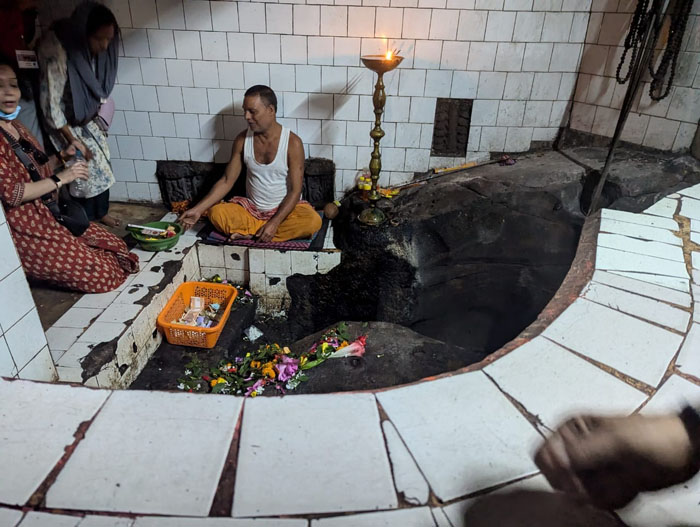
This temple is about twelve kilometres from the Gauhati railway station and is built within the precincts of Vasishta Ashram, located in the Sandhya Chal (meaning meditation or evening prayers) hills in the South East corner of Gauhati city. It is on the banks of the three mystical mountain streams named Sandhya, Lalita and Kanta originating from the Garo/ Kasi/Jaintia range of Meghalaya. These rivers, we were informed by our guide, currently are the Bashishtha and Bahim/Bharula, flowing through the city, after the confluence at Janali point.
This Ashram dates back to the Vedic age and was built by the renowned sage Vashistha, who is believed to be the Guru of Lord Rama. The temple was constructed by Adam King Rajeswar Singha in 1764 and was built on the site where Sage Vashistha is believed to have carried out his penance in a cave here.
The Shiva temple is on a hillock with well laid out pathway. At the entry were structures with various shrines and appropriate captions. We climbed about fifty steps to reach the entrance to the temple, where we removed our footwear at a specific area on the left. We noticed that the temple architecture was of the traditional Nilachal style with dome shaped roof and intricate carvings. Along the passage to the temple, there were various shrines and deities lined up along the temple walls. At the left side of the entrance to the temple, was a cluster of bells and a huge drum for use during poojas. We had to descend into a dimly lit cave through age-old steps to reach the sanctum. A priest patiently offered each one of us the holy waters to pay obeisance to the swayambu of the over 22 feet Shiva Linga of Mangaleshwar, remaining hidden in the wells present inside the temple.
After this, our guide briefed us about the history of the Ashram and the temple, when we all gathered outside the temple, with three mini waterfalls, flowing in the background. It turned out to be an enlightening experience which will resonate forever with me.
S. Sundar Rajan
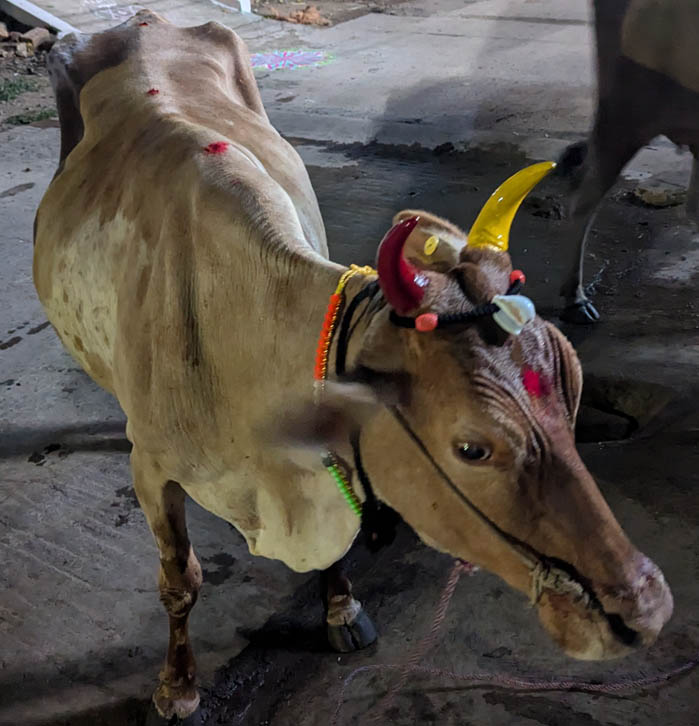
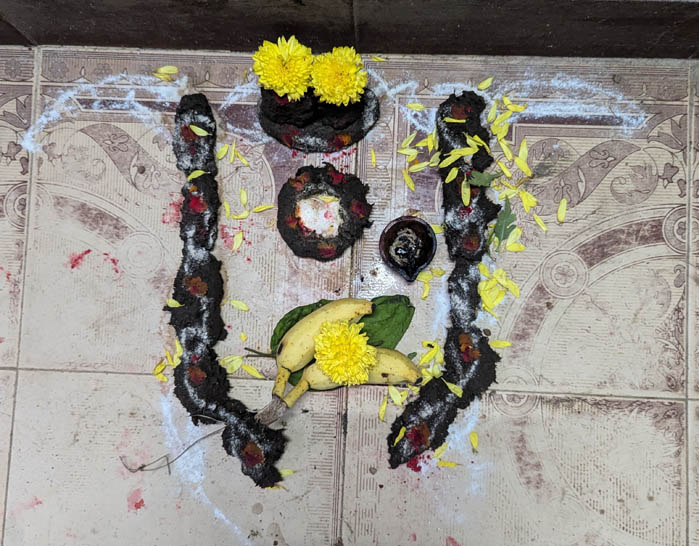
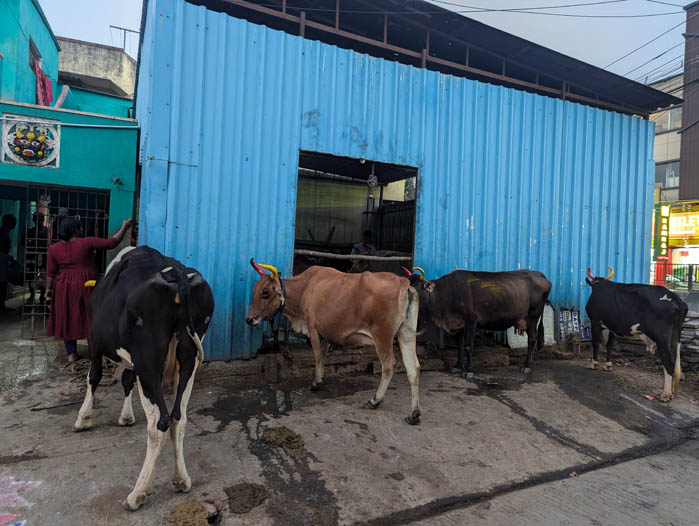

Every year, if I am in town in Chennai, I visit my neighbourhood cowshed to celebrate Mattu Pongal. It's now over a decade and the experience is emotional which I would like to share. I should add here that these cows are an integral part of my household as I source manure from here for my organic garden at home.
In the morning, on Mattu Pongal, an area in the cow shed is cleaned, kolam is drawn and a compact enclosure is made out of cow dung. Lord Vinayaka is then created, again out of cow dung. Lighted lamp and offerings with plantains and betel leaves are placed before the Lord. The decoration of the cows takes place in the evening as the cows return home after grazing in the neighborhood during the day. I was there at the cow shed when the decorations had just commenced. I found that in the current year, the head count of the cows have increased to over a score, with about half a dozen calves also joining the family.
All the family members operate as a team to decorate each cow. To start with, each cow is given a bath and then the horns are painted. This time the right horn is painted yellow and the left horn painted red for all the cows in the shed uniformly. A black rope is tied across the forehead with a white conch. A few bells adorn the neck which chimes as the cows shake their heads.
Finally, turmeric and kumkum are placed on the forehead and in select areas of the body of each cow, which is very pleasing to the eyes.
In the earlier years, all the decorated cows were taken round the neighborhood and also to select houses where the milk was delivered regularly. But now due to practical constraints, this practice has been dispensed with. Instead, one of the cows is additionally decorated and is taken to the nearby temple, to seek the blessings of the Lord. In this case a special colourful collection of beads is tied round the neck of the selected sacred cow.
When so decorated all the cows were so attractive with divine grace embracing the atmosphere. These are moments to cherish even in this fast paced materialistic world, which will linger in our minds for long.
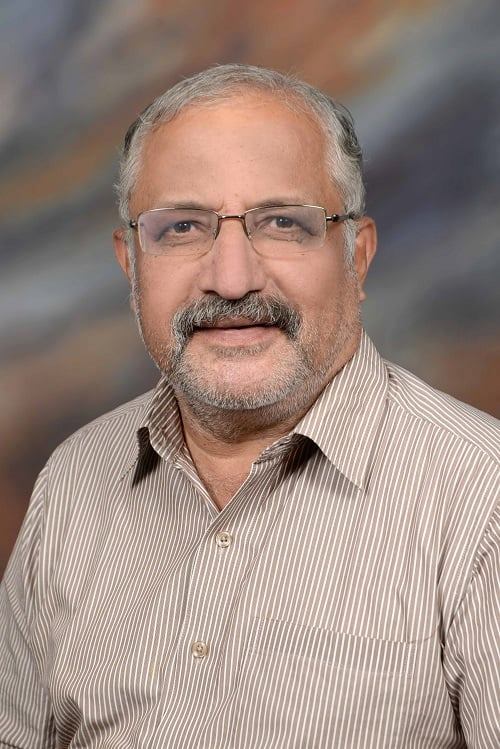
S. Sundar Rajan is a Chartered Accountant with his independent consultancy. He is a published poet and writer. His collection of short stories in English has been translated into Tamil,Hindi, Malayalam, Telugu, Kannada and Gujarati. His stories translated in Tamil have been broadcast in community radios in Chennai
and Canada. He was on the editorial team of three anthologies, Madras Hues, Myriad Views, Green Awakenings, and Literary Vibes 100. He has published a unique e anthology, wherein his poem in English "Full Moon Night" has been translated into fifteen foreign languages and thirteen Indian regional languages.
An avid photographer and Nature lover, he is involved in tree planting initiatives in his neighbourhood. He lives his life true to his motto - Boundless Boundaries Beckon.
Sreechandra Banerjee

“Voting date is here and now you are scaring me that I must strengthen my campaigning as my opponents are stronger” exclaimed Member of Parliament Sampurna, who was contesting for the second time.
- “Yes Didimoni, you must win. I have asked all people here and in the nearby Santhal settlements to help us as your opponents are taking all measures” said Janaki, the village woman who had known Sampurna from her very childhood.
It was difficult campaigning at this time of the year with summer approaching. Summer here in Massanjore was not as hot as the rest of the region, yet mercury often kissed the 40-degree mark on the Celsius scale.
The tropical deciduous forests adorning the low surrounding hills with a green hue, had imparted a cooler look to this region. These hills probably merged with the Chotanagpur plateau. Year after year, summer was becoming intolerable as the wheels of modern civilization were cutting through these forests.
Urbanization was the staple objective, though in some places, slopes were terraced for cultivation and in some other places, the innate love for forests have driven the aboriginal Santhals, Paharias and Mundas to save some of these forests.
The River Mayurakshi was the main artery pulsing water through this region. More often the existence of the river was a curse than a boon when vast areas of land were inundated. So, in an effort to harness the power of the mighty river, Massanjore dam was constructed. Vast areas of cropland got irrigated and wheels started rotating to generate hydroelectric power.
Sampurna, or Purna as she was called, was born and brought up in this land. Now that her parents were no more, she lived in the palace with some relatives and cousins who had moved in.
- “Till you are married off and settled elsewhere with your husband, we are here to look after you Purna” reassured her maternal aunt, mother of a good-for-nothing son who had decided to stay abroad even for a sweeper’s job.
How much her aunts and uncles had tried to marry her off!
- “Oh, you needn’t worry about me. I very well know the reasons why you are here!” an outspoken Purna used to scowl.
Yet it was probably better than living in a palace alone in this less populated town on the Bengal Jharkhand border in Birbhum.
Her great grandfathers were kings who became the “zamindars” during the British Raj. Although monarchy didn’t exist these days, yet the glamour of being born as descendants of one-time kings, was always precious.
Purna was never in the good books of her mother who hailed from a middle-class family. She was the fourth daughter in a family of five daughters followed by a son. Purna had heard that her maternal grandfather had to dole out a huge dowry to marry her mother off. Rumors said that after her marriage, her mother was found to be ill; probably she had tuberculosis of the uterus.
Rumors were in abundance, but even from her very childhood, Purna was disinclined to rumors.
- “Your Ma was so ill before you were born, she was confined indoors and was not allowed to see us you know,” her aunt used to say.
- “Stop spitting rubbish about my Ma” Purna couldn’t tolerate her aunt saying all this about her mother although she herself never got on well with her mother who cared more for her adopted brother.
In want of a male heir, her parents had adopted a son on constant pestering of her grandmother. Purna was then four years old and was hurt that they hated her because she was a girl child.
Her father behaved indifferently towards her, especially during her early childhood. Relations, however, improved as she grew up and her father started caring for her although he, for some reason, wanted her to stay away from the palace and had sent her to a boarding school in Siuri. Probably he had not wanted Purna to meddle much with other people in the palace.
Purna had always fared brilliantly in academics, and she obtained an MA in anthropology from a renowned university in Kolkata.
It was the talk of the town that she became such a scholar despite being the daughter of a school dropout father and a non-matriculate mother.
Her adopted brother went to some local school, got into bad company and became a drug addict. Later, he became a political worker and was killed in some political rivalry.
This happened when her parents were alive, and she was teaching in a college in Kolkata. Her father wanted her to return, but her mother had vehemently objected. It was the first and last time that her mother had ever written to her:
- ‘You are now well settled in Kolkata. You needn’t come here. We are doing fine.’
This very letter made her adamant to return. It was when she decided to join politics. The urge was also to do good for the people, to set things right. Atrocities against women appalled her. The hardship of people like Janaki-bai struck her the most.
- “Didimoni, you have to become a scholar, you must study and stand on your own feet.”
Janaki-bai used to motivate her in her childhood days.
- “You said your maternal grandfather was an engineer who was involved in the construction of this Massanjore dam. Why didn’t your maternal uncle let you continue with your studies?”
- “It’s a long story Didimoni. My grandfather moved to Siuri during the construction and later the beauty of this place made him settle here. I was sent to stay with my maternal uncle here when both my parents died. I was in Class IX then. Both my parents were professors, and I wanted to become a scholar myself. But faith….” lamented Janaki-bai.
- “But your cousin sister, a few years older than you, she went to the university in Shantiniketan, so why couldn’t you continue with your studies?”
- “They were not financially very well off. And then, not everyone gets an opportunity to study. But Moni, you have to study and be established.”
Sometimes Janaki-bai fondly addressed Purna as “Moni”.
Purna remembered how Janaki-bai used to come regularly to the servant’s quarters to sell all sorts of things. This was probably how she earned a living. Whenever she came, she used to discreetly send for Purna. These clandestine meetings were held backdoors as per Janaki-bai’s wishes. Once her mother had seen them cajoling and had scorned:
- “Don’t you talk to that bad woman. If I ever see you talking to her again, see what I do!”
How old was Purna then? Seven or eight years old!
Janaki-bai never came to the palace again after this incidence as long as her mother was alive.
However, Purna used to meet Janaki-bai when she went to attend the folk festivals of the Santhals- a tribe famous for their distinct cultural traits and heritage. Purna used to sneak out with one of the Santhal maidservants who even taught her some Santhali language and also some of the Olchiki script in which Santhali alphabets were written.
Folklore attracted Purna a lot and she always attended Santhal cultural expositions despite objections of her mother who forbade her from going out much. It was a good thing that she had studied in a boarding school and later in Kolkata or else the claustrophobic indoors of the dilapidated palace would have freed her existence to the ultimate “outdoors”.
Purna, who felt lonely in a warmth-lacking home, thus grew up amidst Santhal festivals, experiencing which was a must for her whenever she came home during the vacations. Everything was so ornate, the flower head-wears, colorful clothing, and all the arboreal things that they used for decorations.
She used to be fascinated by the different Santhal musical instruments like the Dhodrobanam, Tirio, Phetbanam, Junko and the Singa. Folkdances were often performed to the accompaniment of a drum like instrument called the ‘Madal’. Purna had somewhere heard that this ‘Madal’ was probably of Nepali origin.
These Santhals were gifted with the ability to make mats, baskets, food, agricultural and musical instruments from plant products. What Purna found astonishing was that these tribal people knew how to use plants for treating chronic diseases.
Purna often thought about the paintings that decorated the Santhal homes. The famous Santhal paintings called ‘Jadu Patua’ made with organic materials were spectacular.
When the first full length Santhali feature film ‘Chandu Lekhon’ was released, Purna was then in Kolkata and had seen the premier show.
Janaki-bai used to narrate many tales of the region and of yesteryears, especially about her cousin’s wedding. One day Purna had asked her:
- “Why didn’t you marry Janaki-bai and have children? You would have been a nice doting mother!”
- “Oh! Didimoni, I never felt like marrying. But you must marry and live happily.”
- “I am quite happy, I don’t want to marry. Why do you all think that happiness and fulfillment only come out of marriage?” Purna regretted saying this. How could a simple woman like Janaki-bai, who had spent most of her years amongst the simple nature loving Santhals, understand what Purna wanted to say?
Well! She might have understood as Janaki-bai always nurtured modern ideas as far as emancipation of women was concerned.
And now election time was full of activities. It was a small constituency and Purna went campaigning everyday, more due to the instigation of Janaki-bai who also cautioned her to be careful. Of late, political unrest and insurgency have reigned supreme and political workers of different parties have been killed.
Finally, the day of counting votes arrived. They all sat in the party office for the results to be declared. Janaki-bai was probably the most anxious person.
The final results were declared. Yes, Purna won for the second time. Janaki-bai couldn’t refrain herself from hugging Purna.
- “My daughter has won” she exclaimed.
The entire town, it seemed, had come to cheer Purna. Some in the mob said:
- “Oh Janakibai, now that she is a Member of Parliament, you have made her your daughter!”
Some taunted: “Oh! she never married because she was incapable of bearing a child and now, she thinks that everyone is her child.”
Someone shouted: “Women and specially these “bazaar” women are always like that.”
Janaki-bai veiled her face like she always did when such things were said about her.
It was indeed a night of celebrations. Many became intoxicated with a local variety of wine made by fermenting ‘Mahua’ flowers.
Janaki-bai was about to leave but what she had said struck Sampurna who asked her to meet her the next day.
- “Why did you call me your daughter, Janaki-mashi?” she asked her inside closed doors.
Janaki-bai couldn’t utter a single word. Her tear clogged eyes, however revealed the joy of a mother, yes, the joy of a biological mother! Who knows, probably the joy of a biological mother, deprived of bringing her child up, seeing her daughter trying to change society, is more than that of a biological mother, who is privileged to bring her child up!
Janaki felt like screaming and telling the whole world how she was sold by her uncle to be a biological mother so that they could marry off their own daughter.
It was Durga Puja time and Janaki with her cousin sister had gone to the palace to attend the Puja festival there. The day after, Sampurna’s grandmother had sent this proposal to Janaki’s uncle. Sampurna’s grandparents were in desperate need of a male heir and her mother could not conceive. They had thought that a ‘man’ like Sampurna’s father could only begot a son.
How could Janaki forget how she was forced to go to the palace everyday till she had conceived! Every time she was forced to submit with her face veiled and her limbs tied. She could never forget the cruelty done to her at the tender age of 18, to endure the pain all her life without any pleasure to comfort her. The nine months followed in some dark rooms in the basement of the palace. Never for a moment could she feel the joy of the fetus slowly growing inside her womb. Fear had always engulfed her.
Now that her daughter was well established, could she still declare that Sampurna was her daughter? No, she couldn’t! Not because of her promise to her uncle but because of how society at large would take this! Janaki would love to live to see her daughter being successful in life. Besides, knowing Sampurna’s background, people might not accept her as their leader!
So better, it would be that no one knew anything about it and Sampurna won the elections over and over again. At least, society would be benefited.
(Note: Some years back, I saw a movie “A Handmaid’s Tale” written by Margaret Atwood and had decided to write a short story on such exploitation of women. This story is from my book “Tapestry of Stories” published in 2011.)
No part of this story can be reproduced by anyone.
Image above is from the internet to which I have no right (Disclaimer).
Copyright Sreechandra Banerjee. All rights reserved except as noted.

Sreechandra Banerjee is a Chemical Engineer who has worked for many years on prestigious projects. She is also a writer and musician and has published a book titled “Tapestry of Stories” (Publisher “Writers’ Workshop). Many of her short stories, articles, travelogues, poems, etc. have been published by various newspapers and journals like Northern India Patrika (Allahabad), Times of India, etc. Sulekha.com has published one of her short stories (one of the awardees for the month of November 2007 of Sulekha-Penguin Blogprint Alliance Award) in the book: ‘Unwind: A Whirlwind of Writings’.
There are also technical publications (national and international) to her credit, some of which have fetched awards and were included in collector’s editions.
LEAF FROM HISTORY: ABOUT “THE AMERICAN PRESIDENT”
Mr Nitish Nivedan Barik
About nearly twenty years ago, in 1995, a popular Democratic president was quietly preparing for re-election. He was intelligent, disciplined, and cautious by nature. Opinion polls favoured him, and his advisers agreed that the safest path forward was to avoid controversy. As President of the United States, the most powerful political office in the world, his decisions carried weight far beyond national borders. What he chose to defend, or ignore, would shape not only his legacy but the future of global responsibility.
At the same time, a major environmental bill was moving through Congress. Its goal was clear: reduce pollution, limit carbon emissions, and respond to the growing threat of climate change. The bill’s most outspoken supporter was Sydney Ellen Wade, a principled environmental lobbyist who refused to soften her message for political comfort. To her, climate action was urgent, moral, and non-negotiable.
The president Shepherd and the lobbyist Sydney formed a personal relationship, and when news of it surfaced, his political opponents seized the opportunity. Sydney was labelled a radical environmental extremist. The climate bill was reframed as “anti-business,” and the president was portrayed as weak and easily influenced. What had been a debate about policy quickly became an attack on character. Advisors warned the president that the White House effect. how things looked politically, mattered more than the actual climate impact of the legislation.
Poll numbers began to slip. Panic followed. The president was urged to compromise, to soften the bill, to distance himself from Sydney. Climate policy, they argued, could wait. Re-election could not. Choosing safety over conviction, he weakened the legislation and publicly stepped back from both the bill and the woman who had championed it.
Sydney confronted him. She accused him of confusing leadership with caution and power with comfort. Refusing to be treated as a political liability, she walked away—from him and from Washington.
Only then did the president fully grasp what he had lost. By protecting his position, he had sacrificed integrity. By prioritizing short-term political optics, he had abandoned meaningful climate action. The personal failure and the policy failure were inseparable.
He chose to change course. At a major press conference, he stopped playing defense. He rejected fear-based politics, confronted his opponent directly, and reframed climate responsibility as a core American value. Climate change was no longer negotiable—it was a duty of leadership.
Momentum returned. Sydney came back. The environmental bill regained strength. The president regained authority—not through compromise, but through courage.
The story ends with optimism: that honesty can defeat cynicism, that climate action is a leadership issue rather than a fringe concern, and that voters will respond to principle when it is clearly spoken.
By the end of the story now, readers would not find it difficult to realize that it is not drawn from actual political history, but from a work of cinema, The American President, which explores what leadership might look like when the most powerful man in the world chooses principle over fear. The American President is a 1995 American political romantic comedy-drama directed and produced by Rob Reiner, and written by Aaron Sorkin.
Rob Reiner was long regarded as a principled and influential voice in the creative community. Over a Hollywood career that spanned more than six decades, he worked as a writer, director, producer, and actor, using popular cinema to explore themes of ethics, leadership, and public responsibility. His films and activism earned him widespread respect across the industry and beyond. Tragically, in December 2025, Reiner and his wife, Michele Singer Reiner, were found dead at their home in the Brentwood neighborhood of Los Angeles in an apparent homicide. Law enforcement confirmed that both had suffered fatal stab wounds and that their son was arrested on suspicion of murder. The shock of their deaths has been felt deeply by family, colleagues, and audiences around the world, and the idealism reflected in Reiner’s work continues to resonate as climate-related disasters and debates about leadership and responsibility weigh on the public conscience.
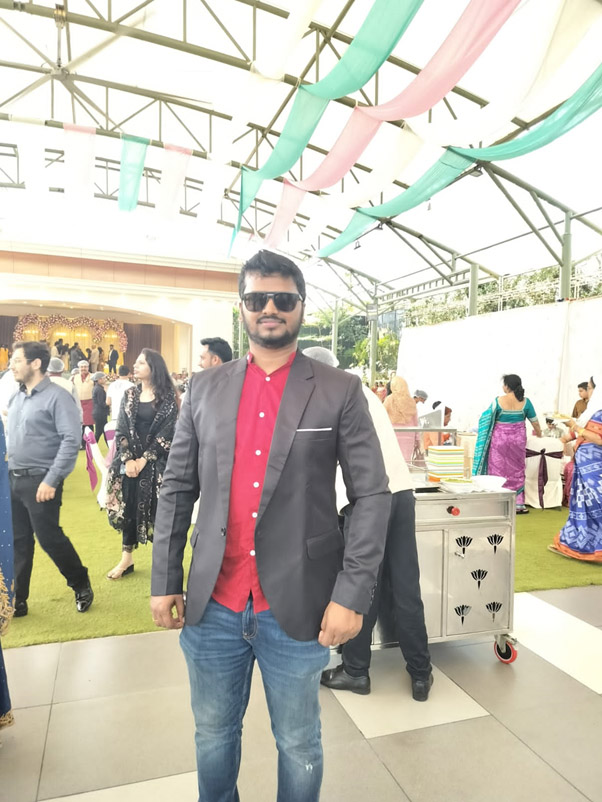
Mr Nitish Nivedan Barik hails from Cuttack,Odisha and is a young IT professional working as a Team Lead with Accenture at Bangalore.
JUHI, VISHAL, AND A WINTER EVENING IN DELHI
Dr. Mrutyunjay Sarangi
November evenings in Delhi have a beauty of their own. There is an air of expectancy everywhere, with people waiting for the approaching winter, which has a cute habit of stealthily creeping in and making itself comfortable in layers of quilts and soft comforters. A light fog descends on the streets and settles on the tree-tops. Weary travellers returning home are treated to a wonderful display of flickering street lights playing hide and seek under the covers of the white fog.
On such a beautiful November evening, I locked up the Bank where I work as a Manager and got into my white Maruti. I was in a hurry, aware that my parents and Bhabhi, my elder brother’s wife, will be waiting for me at home. Despite my promise to them that I would return early that evening, I just couldn’t get out in time. The evening was pleasantly cold. A light breeze added to the dream-like fragrance of the winter. For me, a young man of twenty-six, there was romance in the air, a pining for someone cute, soft and loving!
At the Tuglaq Road traffic signal I stopped the car. A motor cycle came zooming down and braked on my right side. Drawn by the sudden movement I looked out. A young couple was on the bike – a very handsome young man and an extremely beautiful cracker of a girl. I was stunned looking at her. She was slim, and fair like freshly churned butter, with a face resplendent with colour of youth, cheeks glowing like a pink rose and bright eyes alive like a flashlight. The boy was tall, fair with a sharp nose and a shining face. He must be a Pahaadi or a Jat. Both must be around twenty or twenty one years of age. They were made for each other, in looks and appearance.
The boy sat still, looking straight ahead, not moving his eyes. The girl was talking excitedly, saying something to him and he pretended not listening to her. She was sitting very close to him, her petite body glued to him, her hands around his waist. I just couldn’t take my eyes off her. Girls have this peculiar sixth sense when somebody stares at them. Suddenly she turned and looked at me. I felt embarrassed, for staring at her so yearningly. The light turned green and we moved on.
At the next traffic crossing, where Lodi Road meets Aurobindo Marg, the motor cycle again stopped by my side. I looked out eagerly to catch a glimpse of the lovely girl again. She was talking non-stop, the boy was silent. Something had obviously excited her. Once or twice the boy spoke to her and that made her talk even more excitedly.
I was curious. On this winter evening, with the air filled with romance, what was going on between them? From the way they were sitting, glued to each other, they appeared to be either a very young husband and wife, or more likely, a pair of young lovers. What is it they might be talking? The girl, a rare beauty, what is she telling him so excitedly? Must be offering her unconditional love to him!
The girl looked at me again and flashed a big smile and went back talking to her companion. She placed her head on his shoulder and whispered something in his ears. He shook his head.
We moved again. The heavy traffic was moving very slowly due to the dense fog which usually hangs over the Safdarjung airport flyover at this time of the year. For the next few hundred meters, the couple drove by my side. I was getting distracted, stealing glances at them repeatedly. The girl was saying something to her companion, but he was disquietingly silent. At the next traffic signal at INA market, I sensed something was wrong. For some strange reason they had started quarreling. I was surprised. What happened so suddenly? Why were the lovey-dovey couple who were sitting glued to each other a few minutes back quarreling now?
Without being conscious about it, I had been looking at them continuously, unable to take my eyes off them. Suddenly the girl said something, half angry, and half imploringly and started mildly hitting the boy’s shoulder with her fists. It was a gesture of surrender and intense plea. I wondered what has gone wrong. Without realizing what I was doing and propelled by some kind of acquired right over their affairs due to the proximity of a moving car and a motor bike, I gave a mild honk to draw her attention.
Startled, she looked at me. I gestured at her, asking what happened! Why were they quarreling? I got a stab in my heart, seeing her sad face. A drop of tear had welled up in her lovely eyes, which looked like a pair of cute golden bowls filled to the brim in silvery water, waiting to overflow at the touch of a finger. She gave me an excruciatingly sad look, and looked away. I knew the girl must have been deeply disturbed. Otherwise a smart and modern girl like her would have hurled abuses at me for taking such an unwarranted liberty!
Before I could ask her again, the traffic eased and everyone drove fast. In no time the motor bike disappeared from my eyes. I felt sad and empty, realizing with regret that I would probably never get a chance to see her again. Sometimes it so happens, a whole life- time is not enough to know a person, but a few moments of familiarity can bring two people together in a bond of lasting memory.
With a heavy heart I kept driving fast. I had got really late, stuck in the traffic jam on Safdarjung airport flyover. On the Ring Road my eyes got riveted to a new, beautiful bus shelter which must have opened that day or a day before. Airtel company had sponsored a beautiful advertisement on the bus shelter. It was bright red, glowing with a carefully crafted maze of resplendent colour. I crossed it and suddenly applied the brake to the car. Wait a minute, the girl sitting on a forlorn bench under the shelter! Was it not the same girl? The one on the bike? I parked the car to the left, locked it and walked back.
My heart jumped with joy and wonder. Yes, it was the very same girl, the one in light green dress with yellow dotted flowers. All alone? In this desolate bus-shelter at eight thirty on a winter evening? Where is the boy?
I went and sat near her. She looked at me, and her eyes registered recognition. For full two minutes we were silent, waiting for each other to break the ice. Finally I asked her,
“What happened?”
I was half expecting her to shout at me, “Mind your own business” or something like that. She simply looked up at me, eyes welling up with tears. I repeated the question.
“What happened? Why are you sitting all alone here?”
Her voice choked with tears. She said, “He left me here.”
I was shocked, “Left you here, in this desolate bus-shelter? What kind of a boy is he?”
Her eyes flashed with anger. I realized she wasn’t prepared to hear any harsh words against the boy.
“Actually he didn’t leave me. I forced him to drop me here.”
“Why?”
“If he is not prepared to give me company for the rest of my life, what’s the point in spending a few more minutes with him?”
It sounded logical. But I was not convinced.
“At least he could have dropped you home. How could he be so irresponsible?”
“Irresponsible? Vishal? No, he is not irresponsible. For the last ten years, he has been dropping me home every single evening. Not even for a day he has neglected to do that.”
“So? What happened today?”
“Today he told me, ‘Juhi, this is where we stop. From now on we go our separate ways’.”
“Why? Why did he say that?”
She didn’t answer. I waited for a minute.
“Your name is Juhi?”
“Yes.”
“Such a beautiful name! It suits you.”
She flashed a cute smile and relapsed to an agonizing silence.
“And his is Vishal?”
She nodded.
“Fits him. The name means “big”, the boy is big.”
She laughed, it helped in easing the tension.
“You sound amused. Have you ever had a cut in your finger? By a knife?”
I was surprised at the unexpected question.
“Yes, many times, once the cut was quite deep.”
“When you cut the finger, for the first minute or so, there will be no pain. And then it starts, and lingers, till your entire attention goes there and remains fixed.”
“You are right”
“I feel the same way at the moment. I was angry with him and asked him to drop me here. He simply stopped the motor bike and drove away when I got down. The idiot didn’t even look back at my crying face.”
“How heartless of him!”
“Heartless? Vishal? No, for the last ten years he has been with me like a shadow. In fact he has practically done nothing else, other than being a bodyguard to me and a soul-mate.”
“You two are childhood friends?”
“Yes, we were class-mates in the Central School, from fifth grade. When we passed out of Central School, he went to Venkateswara College, my dad put me in Kamala Nehru – a girls’ college. But Vishal comes every afternoon to pick me up after the classes and drops me home. For the past one year he has started working in a call centre, but he has chosen the night shift so that he can spend the afternoon with me after the college.”
“So what’s the problem?”
“Problem? The problem is, Vishal’s father is a clerk in the same office where my dad is the Chief Engineer. Right from our childhood days, my parents don’t like Vishal’s friendship with me. They behave rudely with him, but Vishal doesn’t mind. He is an exceptionally nice chap. I have never heard him speak against my parents. Actually he not only doesn’t speak against others, he doesn’t even think bad about anyone.”
“Such a nice boy?” I asked teasingly.
“You can’t believe what a fine gentleman he is. His entire family is like that. They are from Himachal Pradesh. Vishal has a younger brother. All of them mind their own work, and never speak ill of others. And you should see how helpful they are. The house will always have a guest or two from their village in Himachal. Vishal’s uncles, other relatives bring rajma and apple from home and stay there for days. His parents never object to relatives coming and staying with them, although Vishal’s father doesn’t earn a big salary.”
“And your parents? How are they?”
Juhi’s face clouded with a touch of sadness.
“I am the only child in the family. My father has tons of money, and lots of arrogance which typically comes from ill-gotten wealth. My mom loves to splurge money. No matter how much money my dad gives her, she is never satisfied. They fight most of the times, over money. I hate it when they fight. My father insists that I go to college by car, but I take the bus.”
“So that Vishal can drop you home after the college is over?”
Juhi flashed another of those cute smiles and nodded.
“There must have been many handsome boys in your school. How did you fall for Vishal?”
“Vishal is so handsome and such a nice boy that if I had not taken him, he would have been snapped up by a dozen other girls.”
“Oh, is he so much in demand! Is he a Hrithik Roshan or what?”
“Vishal? Even a dozen Hrithik Roshans cannot match him.”
Juhi had relaxed completely. She wanted to talk, to unburden her heart.
“You know, I was so thin as a girl that others in the class used to call me “Hawa Hawaii”. They used to harass me, take away my snacks and empty my water bottle during the lunch break. I was helpless and used to cry. One day Vishal stood by me. Whoever came to snatch the food or the water, he took his hand and twisted it, causing him to shriek in agony. He was a big boy even at that time. From that day, all teasing and harassment stopped. Vishal became my closest friend and was like a shadow, giving me company. For the past ten years, Vishal is my body-guard. If he is with me, I am not afraid of anything or anybody.”
“Why did you quarrel today?”
“My parents are seriously looking for a life-partner for me. Vishal has been asking me to get married to the man of my parent’s choice. I have told Vishal clearly that I will marry him and nobody else, I just can’t live without him. For the past one month we have been fighting over this issue. Today Vishal said, ‘Juhi, let us part ways. From tomorrow I won’t come to your college to pick you up.’ He had taken me on our final trip to the Coffee House in Connaught Place. We were returning from there when you saw us at the Tughlaq Road traffic signal.”
“Why does he want to break off your relationship?”
“Two years back my dad had called Vishal’s father and asked him to stop Vishal from seeing me. Vishal didn’t come to meet me for a week. I called him and made it clear to him that I will take poison and kill myself. He tried to reason with me, ‘Juhi, your parents will find a suitable boy for you, someone with a big job and lots of money. He will make you very happy. You shouldn’t cause any tension for your parents. Nobody gets happiness in life by displeasing his parents.’ I told him, ‘I want to marry you and only you. You may leave me, but I won’t leave you. If you say no to marrying me, I will kill myself. Then I will become a spirit, and your shoulder is where I will sit all the time and scare away every other girl who comes near you’.”
I felt like laughing, imagining the cute Juhi as a scary spirit, a sort of lady-ghost.
But looking at her sad face I restrained myself.
“What is special about today? Why are you parting ways?”
“Yesterday when we were going home on his bike, I had told him that my parents are quite serious about a particular match, and want to finalize it. So Vishal wanted me to be free from any commitment towards him. And the monkey dropped me just like that!”
Juhi started crying silently, trying to hide her tears from me. I kept quiet for a minute or two.
“How far have you gone with each other?”
“What do you mean?”
Juhi looked up and wiped her face with her dupatta.
I just kept quiet and continued to stare at her.
She understood the question. Her eyes flashed with deep anger.
“Hey mister, I don’t even know who you are. How dare you ask me a question like that? You think Juhi is a cheap girl? I may be a friend to many and moving around with Vishal. But I have too much respect for my culture and my parents to bring dishonour to them. And Vishal? One just can’t think of him doing anything wrong. Believe me, he is not that type – he is a one-in-a-million kind of boy.”
It took me some time to absorb that statement. We were lost in our thoughts.
Finally I stood up and told her,
“Come, I will drop you at your house. It is going to be nine-thirty. You won’t get a bus now.”
She hesitated for a moment and then smiled,
“You seem to be a good chap, like my Vishal. I feel I can trust you. What’s your name?”
“Vishwas.” There was a naughty smile on my face.
“Vishwas? You mean ‘Trust’? Making fun of me, are you? Or is that your real name?”
I just smiled and kept mum.
On the way to Sector Two, Yamuna Vihar, I tried to reason with Juhi – what Vishal says is correct. He is doing a small job, and may not be earning more than ten or twelve thousand rupees a month. Moreover, Vishal’s father is only a clerk in Juhi’s dad’s office. That might be embarrassing for her parents. They must have arranged a better match for her. Does she know any details about that?
Juhi said, “I really don’t know. My mom was trying to say something in the morning when I was leaving for college. I just shut my ears with my hands and ran away.”
“Juhi, I think Vishal is right. It is one thing to be a friend, even a close friend, but marriage is a different matter. One has to be very careful.”
Juhi turned to me and fixed me with a steady gaze. Somehow I felt quite disoriented with that gaze – it strangely combined the intense heat of a raging fire and the iciness of a cold glacier.
“You won’t understand. If I had shared my body with Vishal, I could have gone to another person and offered myself to him. But I have surrendered my heart to him. Heart is like a flowing stream, once it merges with another stream, it loses its identity. Believe me, I just can’t give my heart to anybody else, and die a slow, excruciating death for the rest of my life. In a way that only a heart can understand, I have nothing left to give to anyone.”
We reached Sector Two of Yamuna Vihar. Juhi had given her address to me. I turned the car on the first main road. The second house on the right was Juhi’s. From a distance I could see a motor bike at the corner of the house and a big, handsome boy standing near it, hands crossed over the chest. Juhi didn’t even stop for the car to come to a halt. She just opened the door and ran towards him. In a moment they were locked in a tight hug.
Suddenly I realized my mobile phone’s light was blinking repeatedly in my shirt pocket. Oh God, I had put it on the silent mode when I went for a meeting in the evening and had completely forgotten to set it back to normal mode. The evening had been rather eventful for me and right since the moment I had seen Juhi on the pillion of the motor bike at Tughlaq Road Crossing, I had practically forgotten everything else. I took out the mobile from my pocket. It was Bhabhi, my elder brother’s wife.
My Bhabhi has a booming voice and when she speaks it sounds like a rapid machine gun fire. Now, because she was excited, her voice seemed to cause a minor earth-quake in the mobile phone.
“Babula, where have you been? I must have made a dozen missed calls on your mobile.”
“Sorry Bhabhi, I was stuck with some work.”
“Arrey, forget the sorry, forry, yaar. Listen to what great fun we had. Because you were late and didn’t call us, we phoned up Tripathy Sahab to send his car. So Baba, Maa, Moonmoon and I went to his house to meet the girl.”
“Oh, Bhabhi, I had forgotten about that. Did you like her?”
“Like her? What do you mean, ‘like’ her? We didn’t get a chance to meet her! She was missing!”
“Missing? What do you mean, missing? Have they filed a police report?”
“Arrey, Nehin yaar! There is no need for that! The girl has some other problem. We finished the samosas, kachodi, sandesh and coffee, and waited for more than an hour. Tripathy Sahab and his wife kept telling us that the girl was getting delayed at the college. I thought it was rather strange that the girl returns home so late in the evening. I went inside to use the toilet. When I came out, the girl’s cousin was waiting for me. She told me that the girl is madly in love with a childhood friend. She has threatened to commit suicide if she is forced by her parents to marry somebody else. When I heard that, I told Tripathy Sahab that it was getting awfully late and Moonmoon had to go to sleep early because her school bus comes at 6.30 in the morning. With that excuse we came away.”
“Aha, Bhabhi, you missed out on the girl. But at least you had a good meal at her house!”
“Meal? Blast the meal! Tripathy Sahab has no business to waste our time! He should have known better. If his daughter is having an affair, why does he bother others with offers of a match? Anyway, I am happy for you Babula. You would have simply wasted your time and unnecessarily driven twenty miles all the way to Sector Two Yamuna Vihar on this cold winter evening. That girl is characterless! Good riddance for you. So you come back home. We will find another girl for you.”
The torrent of words stopped. As Bhabhi’s machine gun fell silent, I switched off the mobile and looked at Juhi and Vishal. They were talking, laughing and behaving like two young teenagers lost in each other’s bliss. It was a lovely sight, one that could fill anyone’s heart with pure joy.
I smiled to myself. Characterless? Juhi? Who has given away her heart to her best friend and believes she has nothing left for anyone else! I remembered Bhabhi and silently muttered to myself, “Sorry Bhabhi, you are wrong. For a priceless girl like Juhi, to peep into her heart and see the brilliant lustre of fathomless love in it, twenty miles in life’s long journey is just nothing. I am prepared to keep looking for her, walking on a long road, shivering under the cover of a thick fog on a thousand winter nights. But you know Bhabhi, my regret is, the journey will be endless, the milestones will keep receding and I will never be able to touch them”.
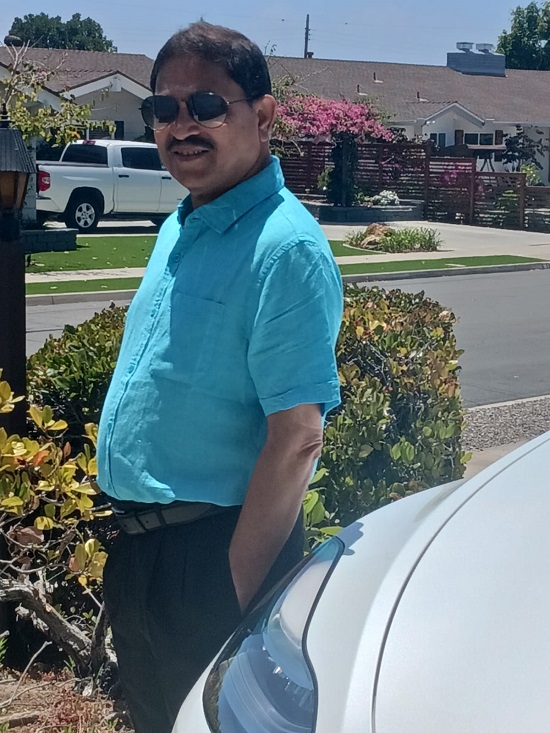
Dr. Mrutyunjay Sarangi is a retired civil servant and a former Judge in a Tribunal. Currently his time is divided between writing poems, short stories and editing the eMagazine LiteraryVibes . Four collections of his short stories in English have been published under the title The Jasmine Girl at Haji Ali, A Train to Kolkata, Anjie, Pat and India's Poor, The Fourth Monkey. He has also to his credit nine books of short stories in Odiya. He has won a couple of awards, notably the Fakir Mohan Senapati Award for Short Stories from the Utkal Sahitya Samaj. He lives in Bhubaneswar.
Viewers Comments