
Literary Vibes - Edition CLXII (27-Feb-2026) - SHORT STORIES
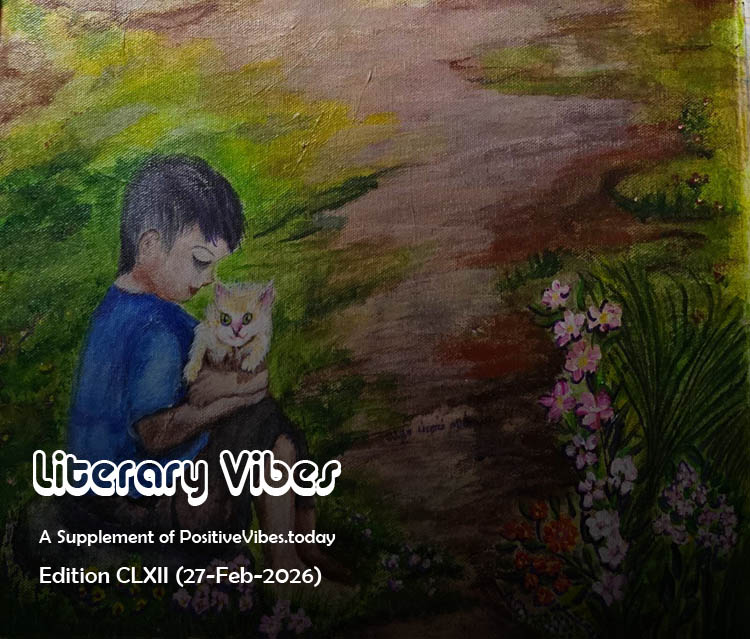
Title : Kitty n Me (Acrylic on Canvas by Ms. Latha Prem Sakya)

An acclaimed Painter, a published poet, a self-styled green woman passionately planting fruit trees, a published translator, and a former Professor, Lathaprem Sakhya, was born to Tamil parents settled in Kerala. Widely anthologized, she is a regular contributor of poems, short stories and paintings to several e-magazines and print books. Recently published anthologies in which her stories have come out are Ether Ore, Cocoon Stories, and He She It: The Grammar of Marriage. She is a member of the executive board of Aksharasthree the Literary Woman and editor of the e - magazines - Aksharasthree and Science Shore. She is also a vibrant participant in 5 Poetry groups. Aksharasthree - The Literary Woman, Literary Vibes, India Poetry Circle and New Voices and Poetry Chain. Her poetry books are Memory Rain, 2008, Nature At My Doorstep, 2011 and Vernal Strokes, 2015. She has done two translations of novels from Malayalam to English, Kunjathol 2022, (A translation of Shanthini Tom's Kunjathol) and Rabboni 2023 ( a Translation of Rosy Thampy's Malayalam novel Rabboni) and currently she is busy with two more projects.

Title : Anime Legends (Doodle Art by Aleena R. Bright)

Aleena R. Bright is an enthusiastic BA Journalism student at Christ Nagar College, Maranalloor, Thiruvananthapuram. She is passionate about creative expressions and media-related activities. Her hobbies include drawing, editing, watching movies, and wildlife photography, which help her improve her creativity and observational skills.
Her goal is to become a successful professional in the field of journalism and media, contributing meaningful and impactful work to society.
Table of Contents :: Short Story
01) Prabhanjan K. Mishra
ONE LONELY NIGHT
02) Sreekumar Ezhuththaani
AGE-OLD OLD AGE
BEEF, PAROTTA AND KERALA
03) Dr. Sukanti Mohapatra
MOKSHA
04) Phalguni Sahu
BLUEPRINTS OF THE HEART
05) Usha Surya
THE DOLL SPOKE
06) Deepika Sahu
A WALK THROUGH AHMEDABAD, INDIA’S FIRST UNESCO WORLD HERITAGE CITY
07) Dr. Satya Narayan Mohanty
THE JAPA MAID
08) Annapurna Pandey
FAMILY BEYOND BLOOD
09) Satish Pashine
JAI SOAP
WHY DON’T YOU CHANGE?
10) Darsana Kalarickal
UNKNOWN WANDERINGS
11) Ashok Kumar Mishra
SAPTAPARNI
12) T. V. Sreekumar
BLOSSOMING
13) Bankim Chandra Tola
IF I WERE KING
14) P. S. Sowmya
CUCKOO’S CALL
15) Sreechandra Banerjee
ON LOVE AND VALENTINE’S DAY
16) Dr. Rajamouly Katta
THE CUCKOO
17) Mr Nitish Nivedan Barik
A LEAF FROM HISTORY: THE TOAST THAT BECAME A NATION’S CULINARY HERITAGE!
18) Dr. Mrutyunjay Sarangi
THE STALKER
Prabhanjan K. Mishra
Baliar Singh Padhiar went out of his room to the verandah of the small cottage. It was the government guesthouse in the deep jungle of Simlipal National Park. The time was three in the night.
He felt terribly lonely. The silent night, cicadas, distant flapping of wings by bats on wild fruit trees made him more lonely than usual. He had not slept a wink. The sleep appeared to have given him the slip. He returned into his room and walked to-and-fro, from wall to wall. Memories tortured him, especially those that lay open-ended, and unresolved. Loss of Nilam who never was found in spite of long and arduous search.
Padhiar was visiting the remote guest house meant for government officers of the jungle department. Built around half a kilometer from the nearest Adivasi settlement of about fifty families, a small village in the middle of the Simlipal Tiger Reserve, or Simlipal National Park.
The national park was famous for its elephants, Royal Bengal Tigers and bio-diverse flora and fauna. The officer Padhiar had reached the guest house late in the evening. His dinner was ready and the watchman along with the caretaker warmed his dinner and served him. He liked the simple food cooked by a village woman, Kumud by name, he was told.
Kumud had already left by the time Padhiar reached the guesthouse. All the three retainers, the security watchman, caretaker and the woman who cleaned and cooked were from the close by Adivasi village.
Baliar Singh Padhiar came out of his room around six-thirty in the morning. The jungle looked mysterious under a light pall of mist. He stretched, breathed deep repeatedly taking in the refreshing air fragrant with purity and green-ions as is said of jungles. He shouted for a cup of tea, and as if on cue, Kumud, the cleaning-and-cooking maid came out from the third and last room, the kitchen, with his steaming cup of tea in hand.
He took the steaming cup of tea gratefully from Kumud’s hand with a smile and ‘thank you’ and took a hot sip of satisfaction. He was a single man at his matured forty-nine still in love with a memory.
The memory of Nilam, a girl who studied in a class two years behind him in his college. They were deeply in love. But Nilam left him in youth before marriage. She left for greener pastures, said his friends who knew them and their affair, as he was still unemployed. But he did not believe them.
“Nilam may have some unavoidable compulsions”, he would tell all who had even half an ear for him. He recalled a bewitching face breaking into slow smiles in happy times, sullen with sulk when resenting something, and a few half-bloomed kisses they had exchanged and some intimacy.
With that treasure trove of memories, he had tried to ward off his occasional lonely moments. When solitude would turn into a predator called ‘feeling lonely’ he would open that box containing the precious moments with his one and only one love, whom his close friends refer to as ‘your crush…’.
Suddenly the maid of the departmental guest house brought Nilam to his mind. Why? He searched her face. “Yes, there is a resemblance.” When Kumud smiled back over the cup of steaming tea in response to his smiling ‘thank you’ she looked a little like the young Nilam, as had Nilam looked in the hay day of their love. He recalled, Nilam cherished jungles and animals in the wild. She would often visit various jungles along with a few other adventurous girls taking long trekking.
After Nilam went missing, he stopped competing for ‘IAS Etc. Services’ and started competing for the Indian Forest Service. It was because Nilam loved forests. He cracked the Indian Forest Service examination, and joined the forest department in Odisha cadre more than two decades ago.
He was a high-ranking forest officer, a very senior IFS. He was on tour and was visiting that little guest house deep in the jungle by choice as if to cherish Nilam’s dreams for a jungle home for their future. As soon as he thought of how Nilam might have relished to live a few nights in that jungle lodge, he basked unabashedly.
Suddenly he had an epiphany, he heard Nilam asking, “Why are you smiling?” He looked up with a start. No, it was Kumud, not Nilam, who was asking. She had even a resemblance in her voice, her way of asking questions. Or his feelings were a déjà vu? “What would you have for breakfast?” Kumud was asking. He replied, “Whatever. I don’t know what you have in your larder.”
Padhiar then ordered a frugal breakfast. Kumud made a face again like Nilam and remonstrated, “You are a well-built man. If you eat like a rabbit, you will lose health.” He was so carried away he swallowed visibly, stumbled over his spit and coughed.
His transparent mind appeared readable to Kumud. She gave a knowing smile, “Did you recall someone – your daughter, wife, or mother? It happens, sahib, when we recall a happy moment, we forget to swallow our own spit and stumble over it.”
Padhiar was happy, but found the happiness too unbearable. He doubted his self-control. Kumud’s resemblance with Nilam might catch him on wrong feet and Kumud might misunderstand his emotion.
So, he ran into the room he had come out minutes earlier with his hot cup of tea, spilling a few drops in his awkwardness, and shut the door. He stood shivering with goose bumps as if just saved from an attack of emotional fit. After drinking the tea, having breakfast, he got ready by nine for three-hour trekking through the jungle floor in the company of Raghu, the caretaker. He was doing something that Nilam would have loved to do.
He loved those walks along the pathways made by the pickers of deadwood, and gatherers of honey, wild fruits and berries, mushrooms, eggs of wild fowls, and medicinal roots and herbs. He loved the jungle’s silence heighted by the whistling of thrush, drone of cicada, or the rare call of peacocks or other birds, if lucky, the distant roar of a tiger or trumpeting of elephants.
The previous evening, Raghu, the caretaker of the lodge, had agreed to accompany him in his trekking as his guide for a payment so that he might not stray into unsafe areas like swamps or predator infested dense forest. He saw Ragu, the caretaker, coming with a leering smile, and when Padhiar ignored his leering, and barked, “Should we start?”
He did not know why Ragu irritated him. Might be his oily ways of smiling and talking. But Raghu went a few notches more in his being obsequious as if he had an obscene agenda up his sleeves for his big boss. He begged, “I may be excused sir, only for today, my wife is very unwell and needs me by her side. You know these young women, throwing tantrums of illness when all they want is their husbands by their side and…you know what.”
Padhiar hissed, “Shut up and run to your wife. She might be really ill. Take her to the village health centre. Don’t stand leering here. I will manage my trekking on my own. Learn to respect wives and women in general. Get out.”
He saw Raghu whispering to Kumud before leaving and Kumud looking down with embarrassment. Raghu gave furtive glances in his direction before bolting in doubles.
Kumud came to Padhiar, “Sahib, I will go with you. I will carry a scythe… say, for your safety against predators. Kumud with her scythe is equal to ten tigers. I also know this jungle like the back of my hand. I will take you around, show you the best areas, much better than Raghu. Raghu, sahib, knows only one thing in life. He thinks all that big sahibs are only after….you know what.” Padhiar felt a chocking over that ‘you know what’.
After a lot of hem and haw in mind, Padhiar thought, “If I don’t go with Kumud as my jungle guide, she may think I am also only after that …’you know what.’ So, he started with Kumud who carried a thermos filled with hot tea, disposable paper cups and napkins, and some packets of biscuits besides a bottle of water in a small tote bag.
Kumud really knew the jungle. They talked like old friends. Padhiar recalled a scene from an old black and white movie ‘Bhuvan Shome’ that had pocketed that year’s national award for the best feature film. In the film Bhuvan Shome, a high-ranking sourpuss officer goes hunting with a guide who was a sprightly young girl in her early teens. The jolly and cheerful company of the cherubic guide infected the gaunt sourpuss officer’s attitude towards life.
Bhuvan started laughing, staying cheerful, and enjoying fun. He forgot his hunting, forgot his game in the swampy jungle, and enjoyed his few days’ stay in that village cheerfully in the company of the teen girl. Finally, Bhuvan parted company of the jolly cherubic girl without any game but his takeaway was lots of happy memory of fun-soaked moments. Padhiar thought as if he was another Bhuvan Shome, Kumud was his cheer-leader and companion during his trekking.
Kumud kept talking and walking swinging her hand with the scythe with a carefree gait leading Baliar Singh Padhiar into the underbelly of the forest. The trees above made a dense canopy and the thick silence grew thicker. The dense overhead foliage prevented sunlight to fall on the jungle floor and the jungle floor was damp and shadowy as a result. The jungle all around seemed to whisper mysteriously. Baliar felt transported into a fairy tale.
After about an hour, Kumud stopped and said, “A special area starts from here, sahib. I will show you today the bird nesting area. Acres and acres of forest with low hanging branches. Birds of all feathers for some mysterious reason choose this patch of the jungle to build their nests, lay eggs, and raise their young. Sahib, it may grow a bit denser, a little muddier ahead for some distance; but it is safe. So, have your tea here, on the dry patch of the forest before we enter the wet land.”
She poured tea into a cup for Padhiar, and on his insistence, she also poured tea into another cup for herself. Both sat on a low hanging branch and sipped tea like friends. Kumud was sipping her tea as if it was ambrosia.
She said, “You are a kind man, Sahib. I needed this tea badly but I had no courage to ask. I am a poor housemaid at the guesthouse. Other officers never looked at a maid’s comfort. They never respect a maid but treat her like dirt. They have their eyes riveted on only one thing… you know what…. And to get there they would not hesitate to lick a maid’s feet. Another officer in your shoes instead would try to have paid me a rupee and extracted his pound of flesh worth hundreds on the jungle floor itself. They know we are poor and a poor woman has no izzat (honour).”
Padhiar was taken aback, Kumud’s sweeping complaint was a shameful slur against the entire male community but especially the officer class to which he himself belonged. He kept quiet as he had no idea of the length and breadth of her suffering and hurt. The wearer of the shoe had not yet revealed where the shoe was pinching. He decided to wait, watch, and hear the aggrieved girl.
After the tea break as they walked into the narrow, gloomy and a little damp path of the jungle land, on both sides as far as his eyes could see, he saw nests of various shapes and sizes perched on low foliage, on which birds of different colours and sizes were clamouring. Contents of many nests in very low branches were visible. He could see a few with eggs, a few others with little baby birds in various stages of growth.
Some parents were feeding babies putting food into their eager mouths, a few sat like meditating in nests; they might be incubating eggs beneath their warm underbellies.
He guessed why that patch of the jungle land was chosen by the birds of all feathers for nesting. Because of dense forest and low growing branches, the floor remained wet and infested with earth worms and other insects. That might be the easy source of feed for baby birds. Besides some reason might be preventing snakes into the area who were the most feared predator for eggs and baby birds.
Padhiar recalled the saying, ‘speak of the Devil, and the Devil is here’, as then, just then, he saw a small snake slithering towards a nest on a very low-hanging branch with two little newborn chicks. Padhiar broke a thick branch to hit the snake.
But Kumud put a hand on him, “No, please don’t wound the snake, sahib. It would die of infection. He might be having a family. Just shake the branch a little. It will run away.” Padhiar followed her advice and wondered, “How like Nilam! Nilam even would desist from killing a mosquito with a mosquito-racket. She always advised in favor of mosquito repellants.”
He thanked Kumud for the rare experience. At many nests birds shrieked at them when they stood around to have a good look. Kumud commiserated with them, “Do we look like harming your eggs or newborns?” Like responding to her commiseration, one of the birds, looking like a magpie, came and sat on Kumud’s left shoulder.
Kumud from her bag produced a fistful of grain and offered to it. The bird hesitated a lot before accepting few pecks. Kumud said, “I know her, sahib. She used to come to me in the guest house for food. She has been absent for the last few days. I was wondering what was the matter with her. And now I know she has been busy tending her babies.”
Padhiar was intrigued, “How do you know, Kumud, it is a ‘she’, not a ‘he’. Because my reading says, both male and female birds take care of their nest, eggs, and babies turn by turn.”
“That was simple, sahib. You saw for yourself how hesitantly, full of self-pride, it accepted only a little grain daintily from my palm, just like any proud honorable woman. Had it been a male, I mean a ‘he’, he would be a shameless go-grabber. The male member of any species, human, bird, or animal is a go-grabber, having no patience, no pride, no hesitation to usurp a thing.” Padhiar thought how cleverly she delivered a back-handed slap to the entire male community, bird, beast, or human! Though a lowly employee, but a witty and informed one.
During their second tea break with biscuits, Padhiar asked, “How did you wound your neck, Kumud? The red mark is livid on your neck.” “Oh, it is nothing sir.” She tried to hide it under her scarf. But he insisted to know, “Your husband? Did he hit you there?”
Kumud brushed away a tear, “No sahib, my man died two years ago by snake bite. He loved me a lot. I was given in marriage to him when I was hardly twenty. We had a daughter. She is five now. I live with my mother, who lost her mind when I was in her womb. She was found by our village chief lying unconscious from snake bite in the forest around twenty-five years ago. She was brought home by him and was treated by our witch doctor. She regained her consciousness to live, but lost her mind and memory. She was carrying me at that time and I was born here.”
Kumud cried little, “My mother was adopted by our childless chief as their daughter and named her ‘Kamal’. She is about your age Sahib but looks older for our poverty and her non-working mind. The chief and his wife also adopted me as their grandchild at my birth and brought me up as best as they could. We are very poor, sahib, as my grandparents are outgoing in their giving spree. To help anybody in need, they would spend their last copper, an Adivasi culture.” Padhiar expressed surprise, “What a wonderful culture, Kumud!”
“Then who hit you so hard, Kumud?” he insisted. She went red as if ashamed to reveal, and shyly said putting her head down, “It appears you wouldn’t spare me until you know the truth. I will tell you. It is your Jyotiraditya sahib who works at Baripada, in shot Jyoti sahib. He visited here just before your visit. He forced himself on me. I think this rascal Ragu encouraged his advances towards me. I have heard Raghu brings village girls secretly for a payment to various sahibs. Joti sahib paid me a tenner for this bite wound and many other wounds he inflicted on me.”
She added after controlling a sob, “We are a poor lot, sahib. No one is there to protect us. All are predators in our life. We are game for them like the wild beasts in the jungle. Even this morning, the rascal Raghu was telling me, “Keep yourself washed and freshly dressed. Padhiar sahib may need your massage tonight. He would pay very well.”
It was a shock to Padhiar, “Do I look like a predator, Kumud?” She shook her head, fixing her gaze on the ground. Padhiar went on, “Are you not my daughter’s age?” She nodded.
Padhiar went on, “Raghu is a rascal, as you rightly said. Had I married my girlfriend who walked away without a forward address, I would be having a daughter or son of your age. On meeting you this morning, I thought I met her, my young Nilam. You looked almost like her when she was your age. You speak like her also. We were going to marry. She had told me, she was pregnant with our child. One day, she went out with some girls and vanished into thin air. All the searches brought no result. I never could know what really happened to my Nilam.”
That evening Raghu came with a complaint, “Kumud ran away before dark, sahib. She cooked your food and asked me to warm them and serve you for dinner. She disobeyed me when I asked her to stay a little late as you may need her services.”
Padhiar was trembling with anger that Raghu could not make out from his behind. He turned and Raghu froze after seeing his face, a mask of glowing red-hot coal. He barked, “Did you ask Kumud today morning that she should stay late to give me a nightly massage?”
Raghu fumbled for words. Padhiar hissed, “Did I ask you for a massage by Kumud, or any woman for anything? You bloody pimp. I myself asked her to return to village before dark.” This time Raghu mumbled incoherently…
Padhiar shouted, “You are dismissed. Don’t come here from tomorrow. If I see you around here, I will shoot you with my licensed pistol. Get out. I have many complaints against your Jyoti sahib. I am going to suspend him and set up an inquiry into his conduct.”
Next morning, Kumud came and made tea and breakfast. She informed, “Raghu has high fever and he is delirious about his job. Padhiar Sir, he mumbles that you dismissed him. But his family is poor. His wife and kids will starve for no fault of theirs.” Parihar went to see Raghu at his village cottage from a humanitarian angle.
The settlement was a sleepy village. At Raghu’s place, his wife with two little kids cried piteously, “Sahib, forgive him. He is uncultured and uncouth. We are a poor and miserable lot. Without his job, we will all die without food. Have pity on us.” Padhiar took pity. He said, “Raghu, you come with me to Baripada. I will see what I can do for you.” Raghu, the rascal, immediately got up rejuvenated. Padhiar sighed with relief and amusement, “Nautanki...!” meaning ‘bloody dramatist!’
Kumud walked with him proudly as his guide along the village lanes. She took him to their chief’s house, her adopted grandpa so that another villager could be appointed in dismissed Raghu’s place as the caretaker of the guesthouse on her grandpa’s recommendation.
From a distance Padhiar saw an old woman in village chief’s verandah, bent with malnutrition and lack of self-care, with a head of gray unkempt hair, she was scratching. As he approached nearer, Padhiar thought he knew the woman.
He stopped short of her and gasped, “My God, it is you, Nilam.” He took Nilam in his arms and to the amazement of all the villagers gathered around to see the big ‘sahib’. They found the sahib himself crying and the mad woman who shunned all who had ever tried going close to her, was quietly nestling in his arms.
The next year has seen many new events. Jyotiraditya Parmar sahib, an Indian Forest Service officer posted at Baripada as a probationer has been sacked after an inquiry, which found him guilty of misconduct and misbehavior with lady employees of the department. Raghu, the rascal, now a changed man, is serving as the head caretaker at the Baripada’s big guesthouse of the jungle department.
Nilam Devi, the mother of Kumud, is being treated by a famous shrink, and has regained memory and lucidity to a little extent. She has married the senior IFS Mr. Baliar Singh Padhiar. Their widowed daughter Kumud Padhiar and her five-year old son, Aditya, are living at Bhubaneswar with Padhiar and his wife Nilam Devi. Padhiar and Nilam are having playful happy time with Aditya, their little grandson.
(END)

Prabhanjan K. Mishra is an award-winning Indian poet from India, besides being a story writer, translator, editor, and critic; a former president of Poetry Circle, Bombay (Mumbai), an association of Indo-English poets. He edited POIESIS, the literary magazine of this poets’ association for eight years. His poems have been widely published, his own works and translation from the works of other poets. He has published three books of his poems and his poems have appeared in twenty anthologies in India and abroad.
Sreekumar Ezhuththaani
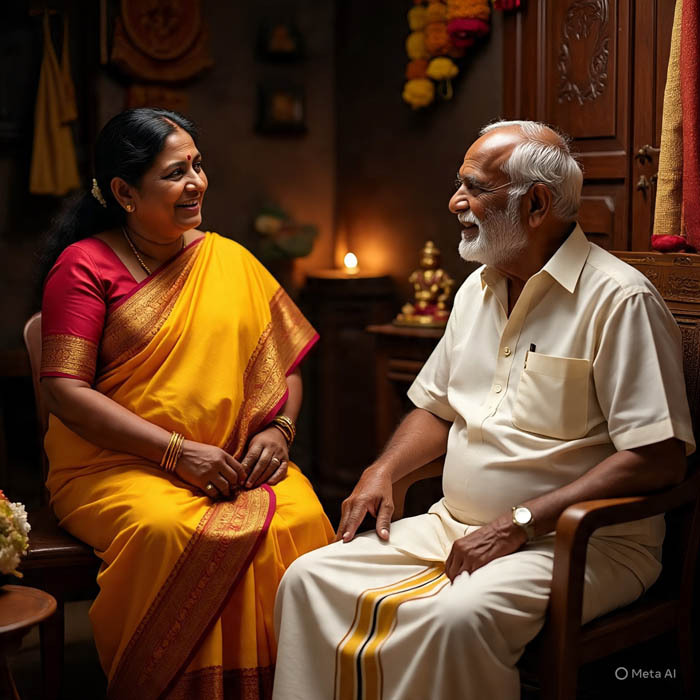
Raghavettan had just finished making uppumavu.
The smell of roasted semolina still clung to his fingers as he carried the last steel plate down the dim corridor of the old age home.
He moved from room to room, knocking softly, placing small portions into waiting hands—hands that trembled, hands that once held ploughs, pens, children.
He never ate with them. He preferred to stand aside, leaning against the peeling wall, watching them swallow.
When he returned to his room, wiping his hands on the edge of his faded towel, he saw her climbing the stairs.
Sandhya Mary.
He had not expected her. The last he had heard of her was through fragments—someone mentioning that her daughter Daisy had finished her MSc.
The stage lights had gone out long ago; the men who once declaimed dialogues in painted moustaches now waited for medicines in plastic covers.
She stood before him, slightly breathless, holding a wedding invitation.
“Daisy’s wedding,” she said.
He took the card, ran his fingers over the embossed letters, as if reading them by touch.
He remembered Daisy as a girl who clung to her mother’s sari end backstage while he rehearsed lines about betrayal and destiny.
After a few hesitant pleasantries, she looked past him into the narrow room.
“Do you really have to end up here?” she asked quietly. “Don’t you have children?”
“They called,” he lied. “I didn’t go. Let them call when I’m on my last legs. That’s the proper time, isn’t it?”
She frowned.
“Those are old sayings boss. The world has changed. You don’t even eat the food they give you here. You give it away. How long can you go on like this?”
“Today I’ll manage. Tomorrow can wait for itself.”
“I’m not joking. Either marry again, or go live with your children. Seeing you like this…” She did not finish.
He smiled, the familiar smile he used whenever a scene turned heavy.
“We can solve it now. You don’t go back. We’ll get married today itself, rent a house, settle down.”
She laughed, because that was what he always did—turn the blade into a joke before it cut too deep.
Then he said, “If I had married you back then, your fate wouldn't have been the same. Once you marry off your daughter, what will you do?”
“I’m not marrying her off,” she replied. “She’s marrying that boy and they are going to stay with me. He’s agreed they can stay in my house.”
He looked at her, surprised.
“There are six or seven boys in his house,” she explained. “One less won’t matter. And I built a good house. Two extra bedrooms. I thought ahead.”
“You were always clever. You should have taught me thi.”
“Does anyone need to teach us such things? We only have to watch how the world moves.”
He was silent for a while.
“Until Sumati died,” he said at last, “there were no big issues. If something went wrong, she would smooth it out. After she left, the daughters-in-law began to rule.”
“You have to tolerate a little.”
“I tolerated. Until I couldn’t. Then I walked out.”
“They called you back.”
“I didn’t go.”
“You needed a good beating,” she said, half-smiling. “Why didn’t you go?”
He looked at the corridor, at the thin doors, at the shadows beneath them.
“I realized something,” he said. “I didn’t raise them right.”
She shook her head. “Don’t talk like that.”
“Their eyes were on the comforts I gave them. They want everything from their father— but not the father.”
“That’s your imagination,” she said. “My daughter throws tantrums too. Sulks for days. But in old age, we have them, don’t we? They’ll look after us.”
“If that’s true, you’re lucky.”
She straightened a little.
“Maybe the way we raise them shapes our journey. Every house has its own way.”
Her words stung. He did not argue.
He said he would attend the wedding.
Before she left, he pressed five hundred rupees into her palm. She tried to refuse; he insisted.
A year passed.
Sandhya Mary became a grandmother. The child’s small cries filled her house. She told herself that this was reward enough—that in her second childhood, she had company.
Her daughter began working. With two incomes, the house changed. New curtains, a refrigerator that hummed like a distant generator, a maid who came in the mornings.
Even as her joints began to ache and her breath shortened, Sandhya said nothing.
Quietly, without telling anyone, she sent small amounts of money to Raghavan.
She often imagined him standing in that corridor, distributing food.
Then they bought a bigger house.
To buy it, they sold the old one. But the sale money was not enough.
They took a loan.
The new house was a flat on the seventh floor. Sandhya stood at the balcony and felt the ground had been erased. To touch earth she had to descend using a metal box. She was afraid.
The maid stopped coming. For a few days Sandhya thought the girl was sick. Later she learned they had let her go.
“With the loan and everything…” her daughter said. “We can’t afford her now. There’s a washing machine, vacuum cleaner, grinder, mixer, dishwasher. Why do we need her?”
Sandhya learned to use them all.
She had once read that machines were invented to give humans leisure. She now understood that this was one of those white lies told in textbooks. The machines only multiplied tasks. There was always something humming, spinning, blinking.
She moved from one to another, as if performing in a play without intermission.
She managed her daughter, her son-in-law, and the child.
When the child started school, she found herself alone in the flat from morning till evening.
Silence settled differently there. It was not the silence of a village afternoon. It was a sealed silence, pressed in by concrete.
Sometimes she called Raghavan.
He would say he was busy
distributing food. They received meals anyway, he would tell her, but giving away his portion was his joy.
Once, in the middle of a minor argument, she half-jokingly told her daughter, “Perhaps I should go to an old age home.”
Her daughter’s face hardened. “Don’t ever say that.”
The words struck her more sharply than anger.
Raghavettan had been right, she thought. No matter how you raise them, the new generation grows in another climate.
During her long afternoons, she began searching online for old age homes. Photographs of clean corridors, smiling elders, prayer halls.
Each time, at the top of the results, appeared the name of Raghavettan’s place.
She would stare at it for a long time.
Going there was impossible.
He had once joked about living together; the joke now felt like a prophecy she had ignored.
To appear there now would be to admit something she was not ready to name.
Her defeat was clear to her.
But she decided he did not need to know.
Sreekumar Ezhuththaani
Once, Beef and Parotta set out to go to Kashi.
When it poured rain, Parotta stood as an umbrella over Beef.
Then, when the wind blew, Beef climbed on top of Parotta to keep it from flying away.
When wind and rain came together, the Kerala people became their shelter and shade.
They never went to Kashi again.
Kashi came searching for them.

Sreekumar Ezhuththaani known more as SK, writes in English and Malayalam. He also translates into both languages and works as a facilitator at L' ecole Chempaka International, a school in Trivandrum, Kerala.
Dr. Sukanti Mohapatra
The environment held the heavy stillness that follows a storm. The night was growing older by the hour. Those who had returned from the cremation ground had long since departed after the customary meal of parched rice and molasses. Family and kin, having shared the bitter meal of mourning, had retired to their beds. But in Pranab’s eyes, there was neither sleep nor tears. He sat there, motionless, like a statue. From the hollow of the mango tree in the backyard, the intermittent hooting of an owl pierced the silence. The moon had already faded from the aging sky, and the stars seemed smothered by a blanket of clouds. In that profound darkness, the void within Pranab’s soul found its reflection.
Nayana had been the sanctuary of his soul's light. The day she crossed their threshold—a nineteen-year-old girl wrapped in the grace of a new bride—a strange, ethereal fragrance seemed to bloom within the very walls of the house. Pranab felt it instantly. Her big, black eyes, the sculpted elegance of her form, and the melodic cadence of her footsteps stirred a restlessness in his youth that he could neither name nor ignore. He never dared to label the quiet storm of affection that took root within him; yet, in the silent depths of his heart, he knew it was the primal, inevitable pull of nature—an attraction as ancient as it was forbidden.
Pranab was not highly educated like his elder brother. In the eyes of the neighborhood, however, he was a man of many talents. There was no task he couldn't handle. From household chores to managing the family business, he had taken the reins with efficiency from a very young age. After their father’s death, his brother stayed in a hostel to pursue his studies. Pranab was the only one left to care for their chronically ill, widowed mother. Sometimes, his mother would lament, "Panu, your education was cut short because of me." Pranab would simply smile and say, "Ma, I studied until Matriculation. If I study further, I’d have to go far away like Brother. Who would look after the shop, the land, and the cattle? I will handle all this. I have no wish to leave home or you." Tears would well up in his mother’s eyes as she stroked his forehead affectionately, whispering, "You silly boy."
Through Pranab's wit and dedication, the family’s condition gradually improved. He cleared his father’s debts and sent money every month for his brother’s education. It wasn't that his brother was a brilliant student—he failed twice before finally passing his BA on the third attempt. Eventually, a clerk’s job was secured for him in a college five kilometers away, albeit through a donation.
Pranab provided for everything: household expenses, his mother’s medicines, festivals, and social obligations. His small shop grew into a large enterprise. As it became too much to handle alone, he hired two assistants. Their mud house was replaced by a concrete building. People were employed for both domestic and outdoor work. Around this time, his brother also began receiving a government salary. While some were envious of their prosperity, everyone held Pranab in high regard. They understood that this progress was entirely his doing.
As their mother’s health declined, the search for a bride for the elder brother began. Nayana was everyone’s choice. Pranab had heard she was beautiful and kind, but he saw her for the first time only when she stepped across the threshold as the new bride.
Whenever his eyes met Nayana’s wide, expressive gaze, it was Pranab—not the bride—who would blush with shyness. He avoided her as much as possible. Since his brother was away during the day, Pranab stopped coming home for lunch. Nayana would carefully pack his meal in a hot-case and send it through the shop assistant. Sitting down to eat, Pranab’s heart would fill with an indescribable joy. Why did Nayana’s cooking taste so much better than his mother’s? Why did a strange intoxication cloud his senses? During dinner, when she would insist he eat more, or when her soft hand accidentally brushed against his while serving, a bolt of electricity would surge through his body.
Pranab understood his infatuation, his attraction, and his obsession with Nayana. He was a spirited young man; any girl would have been happy to choose him as a partner. But his heart was occupied by a single image; one woman was the center of his entire universe. He knew it was wrong. But alas, if only the heart could listen to the logic of the mind!
Time marched on. Nayana became a mother to two children. Her motherhood only added a sublime grace to her beauty. Everyone saw Pranab’s affection for his sister-in-law —as if he were Lakshman to her Sita. Pranab himself never knew how Nayana perceived his singular devotion and care.
Many marriage proposals came for Pranab, but he brushed them all aside. "I have too much work; I value my freedom. I don't want to get into the mess of marriage," he would say to avoid the topic. People whispered, but they had no evidence to validate their suspicions. Over time, his behavior toward Nayana became more composed. His love for his nephew and niece knew no bounds. But did everyone truly fail to see the depth of his feelings for Nayana? Because she liked he would search high and low for large river prawns. In the evenings, he would bring snacks like bara and pakoda from the market. On festivals, he bought her the finest sarees. If she looked even slightly unwell, Pranab was the first to notice and take her to the doctor. To the world, these were merely a deep, natural bond between a brother-in-law and his sister-in-law.
One chilly January night, after only two days of fever, his mother passed away. That day, for the first time, Nayana sat silently by his side, sharing his grief. He had a desperate urge to reach out and clasp her soft hands in his. But he couldn't. It wasn't fear of anyone else; he simply didn't want to fall in her eyes. He wanted her to retain the dignity she deserved by virtue of age and relationship. Pranab never wished to cross those social and familial boundaries. His feelings, his love, his longing—they were his alone, buried in the depths of his soul.
Three years after their mother’s passing, his brother died of a sudden heart attack at forty-five. Watching Nayana wail in grief, Pranab felt a pain sharper than the loss of his brother. A mix of jealousy and anguish tore at his chest. He struggled to suppress a forbidden, long-standing thirst—the urge to pull her tear-streaked, beautiful face to his chest and comfort her.
Years passed. The children grew up, studied, found jobs, married, and settled into their lives. Their respect for Pranab remained unshaken. Nayana’s black tresses were now streaked with silver. Dark circles deepened under her eyes. Eventually, they were the only two left in the house—Nayana and Pranab. At their advanced age, no one questioned their living under the same roof. Yet, Pranab’s hesitation and sense of propriety kept him from getting too close. Every night He retired to his room only after Nayana had slept in her room. Sometimes, if she forgot to put up the mosquito net, he would gently tuck it in or light a mosquito coil for her. He continued to handpick things from the market that she liked. Life flowed on quietly for years following the routine.
Today, at ten in the morning, Nayana fell into her final sleep. She had been ill for some time—cancer, in its terminal stage. Her daughter and daughter-in-law had come to nurse her. But Nayana’s eyes had searched for Pranab at every moment. Whenever he approached her bed with a glass of fruit juice, her pale face would brighten. Two nights ago, Nayana had asked her daughter and daughter-in-law to sleep, requesting Pranab to stay by her side. Pranab’s heart had raced that night. This was his first night-long vigil beside the woman who had been his silent muse for a lifetime.
In the thick, velvet silence of that night, Pranab sat by her bed, a solitary witness to her fading light. For the first time in a lifetime, he did not avert his gaze. He watched the map of her life written in the hollows of her face—a face that, even in its transition to dust, held the echoes of the girl who once laughed in the kitchen and dried her rain-washed hair in the sun.
When Nayana opened her eyes, she found him there. Two silver tracks of grief spilled over her cheeks, and for the first time, Pranab reached out. As his fingers brushed away her tears, her lips trembled, heavy with the weight of a thousand unsaid words. But with a single look, he pleaded for her silence; some truths are too sacred to be trapped in speech. In that wordless exchange, the barriers of decades dissolved.
The next morning, as he touched the sacred flowers to her lips and brow, it wasn't just a ritual. It was the key to her cage. In that final, fleeting contact, Nayana found her Moksha—a release from the body, and perhaps, from the beautiful burden of being loved so silently.
Pranab rose, his movements light, as if the very air of the house had grown thin. His work here was finished; the hearth he had kept burning for decades was now a cold altar. He had surrendered everything—the earth, the stone, the legacy of his sweat and toil—into the hands of the children. He left them the walls, but he kept the silence.
He was no longer a pillar of the home, but a leaf caught in the breath of the infinite. As the pre-dawn mist clung to the earth, he walked toward the station to meet the morning train. He carried no baggage, for he had already deposited his heart at the feet of the only woman who ever owned it. The tracks stretched out before him like an unwritten prayer. His destination was no longer a map o but a total surrender into the vast, timeless shadow of Mahakal. Behind him, the house slept; before him, the horizon waited for his arrival.
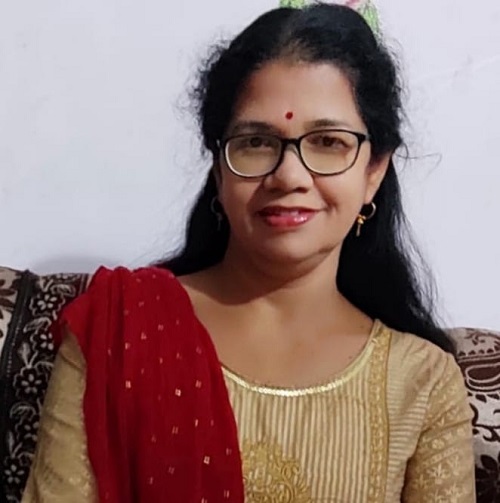
Dr. Sukanti Mohapatra, a senior lecturer in English in the Higher Education Department, Govt. of Odisha is a bilingual writer writing both in Odia and English with equal flair. Her poems, stories and articles are published in many state, national and international magazines and journals. She has three published anthologies of poems to her credit. Besides, she has published many research articles in different research journals. She contributes regularly to Radio Bulbul.
Phalguni Sahu
The applause had barely faded when Aditya finally allowed himself to sink into the leather chair behind his new desk. Managing Director, Spatial Delights. The words still felt unreal, like a beautifully rendered design that one admires before daring to believe it can be built. The room smelled of polished wood and quiet triumph. Yet, while his body occupied the present, his heart wandered, softly, stubbornly- twelve years into the past.
Two decades ago, he had walked into this very firm as an intern, a final-year B.Arch. student from Piloo Mody College of Architecture, Cuttack. Back then, Aditya was delightfully uncomplicated; a cheerful, live-in-the-moment soul with no towering ambitions. He did not dream of corner offices or nameplates heavy with authority. Life, to him, was about laughter, friendships, and savouring the now. The internship was merely a compulsory checkpoint on his academic map.
What he did not know was that destiny, like an unseen architect, had already drawn a far more intricate plan!
A week into his internship, the HR manager called him in and introduced him to Aadya- a consultant of rare calibre, accomplished in her craft, and possessed of a presence that commanded attention the moment she entered the room. “You’ll be working together,” HR had said pleasantly. “Aadya will lead the assignment.”
Aditya noticed her instantly. Tall, elegant, effortlessly stylish; she carried herself with a confidence that filled the room before her words did. And when she spoke, words danced obediently to her will. He was impressed, perhaps even intimidated, though he masked it behind his trademark smile.
Their initial interactions were strictly professional. Drawings, deadlines, discussions. But soon, Aadya would call him into her cabin under some pretext or the other. “Aditya, come, sit,” she would say, gesturing casually. “Tell me, what do you think about this façade?” Conversations slowly wandered beyond blueprints and load calculations, drifting into music, childhood memories, philosophies of life.
Aditya resisted at first. “She’s married. She’s, my senior.” His conscience whispered warnings. But Aadya’s warmth was persuasive, and Aditya’s heart- soft, earnest, and deeply emotional began to listen less to reason and more to feeling.
The firm’s Chief Architect was notorious; an ill-tempered tyrant who arrived punctually at 5 p.m. and ensured no one left before 8. The practice was cruel, but fate has a way of using even cruelty as a catalyst. Those extended hours became stolen moments, shared tea, quiet laughter, lingering glances.
Aadya’s care for Aditya became unmistakable. And Aditya, poor fellow, loved with his eyes before his lips ever dared to confess. She told him she was separated, that the divorce was only a matter of legal time. He believed her because he wanted to. He began to imagine a future where her name followed his, where their lives merged as seamlessly as intersecting lines on tracing paper.
One evening, Aadya asked softly,
“Aditya… do you have feelings for me?”
His heart thundered, but fear won.
“No,” he lied gently. “You’re a very close friend.”
A week later, she looked straight at him and said,
“I think I am in love with you.”
The sky burst into fireworks for him that day. He floated on air, dreaming recklessly of shared mornings and lifelong togetherness. Office gossip bloomed like wild creepers, but love, when young, is blissfully deaf.
Then came the truth; sharp, sudden, and merciless. Aadya was not living separately. She still resided in her in-laws’ house. Aditya felt the ground slip beneath his feet. He withdrew; became formal, distant, professional to the bone. After three days, Aadya broke down in the middle of the office, tears flowing unrestrained, eyes searching for him while colleagues watched in stunned silence.
That afternoon, over untouched coffee cups, she pleaded, “Why have you changed? What did I do?”
His voice trembled as he finally spoke the truth. She spoke of lives lived under the same roof yet worlds apart, of separate rooms and colder silences, and of her impending departure to seek refuge once more in her father’s home. Against his better judgment, he believed her again. Love, after all, is skilled at silencing doubt.
Soon after, Aadya took a month’s leave to prepare for the Assistant Town Planner examination with the Government of Odisha. Distance did nothing to diminish her presence. Calls and messages flowed without pause- unceasing, enveloping, and quietly all-consuming. Aditya would sneak to the office terrace to speak to her, ignoring curious glances. He missed her fiercely.
Then came the phone call that fractured something inside him.
“My mother knows about us,” Aadya said. “She made me promise to stop.”
Trying to be noble, he replied,
“Then we should stop… for her sake.”
Her voice hardened instantly.
“So easily? Maybe you never loved me.”
Those words undid him. He agreed to continue secretly and cautiously.
On the day of her exam, Aadya left her phone with her father. Unaware, Aditya called her during lunch break. The damage was irreversible. Her father learned everything.
That evening, Aadya lashed out.
“You are utterly immature, Aditya. Because of you, my preparation suffered and my performance in the examination faltered. I see no future with you. Why did you call at all? Do you never pause to consider the consequences of your actions?” He said nothing. Silence became his only defence.
That night, something changed. He resolved to become someone the world could not dismiss; someone worthy, formidable, accomplished.
Life moved on. Aadya returned to work; Aditya returned to his college. They stayed in touch, but the warmth had cooled. Meanwhile, Aditya immersed himself in relentless preparation; defence examinations, academic pursuits, and an ambition tempered and hardened by the quiet agony of heartbreak.
Diwali arrived cruelly. He failed the CDS interview and sat alone in a hotel room while fireworks mocked his despair. Aadya’s social media glowed with smiling family pictures.
When he called her, her voice was distant.
“Do we have a future?” he asked desperately.
“No,” she replied firmly. “I need maturity. Stability. You have neither.”
His pleas fell into silence. His first love ended; not with drama, but with finality.
He cried, broke, rebuilt himself brick by brick. He went on to earn his Master’s degree from the prestigious Harvard Graduate School of Design (GSD), USA, where his craft was refined, his vision broadened, and his architectural sensibilities reached a higher plane of discipline and distinction. Years passed. Effort compounded into excellence. And today, he stood triumphant at the summit of his journey, having surged far ahead while many of his contemporaries still trailed in the shadows of what might have been.
Yet he knew, without Aadya, without that pain, he might never have risen so high.
The peon’s voice interrupted his reverie.
“Sir, the Chief Architect requests permission to meet you.”
Aditya nodded absently.
The door opened.
Time stopped.
Standing there was Aadya!
Aditya rose slowly from his chair, his fingers instinctively straightening the cuff of his sleeve, an old habit he had developed while masking nervousness. Aadya stood at the threshold, dignified, poised, yet carrying an unfamiliar stillness in her eyes. Time had refined her beauty into something quieter, more introspective.
For a fleeting moment, neither spoke.
“May I come in, Sir?” she asked formally, her voice measured, almost rehearsed.
The word “Sir” echoed strangely in the room, bouncing off memories that still breathed between them.
Aditya gestured toward the chair opposite him. “Please… have a seat.”
She sat, placing a file neatly on his desk, as if building a careful barrier between their past and present. He observed her hands; once animated and unrestrained were now steady, restrained, and veiled in a quiet defensiveness.
“Sir I sincerely apologize for not being able to attend your welcome ceremony,” she began, her tone professional, “but I wanted to personally congratulate you. Spatial Delights is fortunate to have you leading it.”
Aditya allowed a faint smile to appear, though his mind swirled with unfinished sentences from another lifetime.
“Thank you, Chief Architect,” he replied deliberately, allowing the designation to hang in the air like an unsolved riddle.
A brief silence followed. Outside, the hum of office activity continued, indifferent to the quiet storm gathering inside the cabin.
Aadya opened the file and proceeded to outline the forthcoming design proposals, her voice measured and eloquent, bearing the same unaltered authority that had always defined her presence. Aditya listened attentively, responding with clarity and composure. To an outsider, it was simply a meeting between two seasoned professionals.
Yet beneath the structured exchange of ideas, memories flickered- terrace phone calls, hurried coffees, unspoken promises, shattered illusions.
At one point, as she explained a redevelopment blueprint, her fingers paused over a sketch. She looked up, meeting his eyes for the first time since entering the room. Something fragile passed between them; recognition, perhaps… or regret… or maybe gratitude neither of them could name.
“You’ve redesigned the structure beautifully,” she said softly, though it was unclear whether she spoke about the project file or something far more intangible.
Their eyes lingered for a second longer than professionalism demanded. Then Aadya closed the file gently and stood up.
“Looking forward to working under your leadership,” she said, extending her hand.
Aditya shook it- firm, composed, distant… yet not entirely detached.
As she turned to leave, she paused at the door. Without turning around, she asked quietly,
“Aditya… do you ever revisit old blueprints?”
He glanced at the sprawling cityscape visible through his glass window; the city that had grown, collapsed, rebuilt, and risen again.
“Only to understand,” he answered after a pause, “why certain designs were never meant to be constructed… yet were essential to learn how to build.”
Aadya gave a faint nod, almost imperceptible and walked out.
The door closed.
Aditya remained standing, watching his reflection merge with the city lights beginning to flicker outside. On his desk lay the project file she had left behind. As he opened it, a loose sheet slipped out- a preliminary sketch, unsigned, unfinished. It depicted two parallel corridors… running close… never intersecting… yet leading to the same open courtyard at the end.
He stared at it for a long time.
Outside, dusk quietly surrendered to night, and somewhere within the labyrinth of Spatial Delights, two architects resumed designing spaces for others; while leaving their own story suspended between what was… what could have been… and what, perhaps, still lingered in the silent geometry of fate.

Phalguni Sahu is a development leader who has spent twenty-five years shaping transformative initiatives across government, public sector institutions, and international development organizations. An MBA in Rural Management from the Xavier Institute of Management, Bhubaneswar, she carries into her writing the same depth of insight and quiet sincerity that define her professional journey.
For Phalguni, writing is a sanctuary- an inner courtyard where thoughts unfurl gently and truth finds its voice. She is an ardent reader, forever drawn to the reflective rhythms of literature, and her creative work spans contemplative spiritual blogs and evocative short stories.
Usha Surya
Margaret was busy in the kitchen. Christmas was always a hectic season for her. But she loved Christmas.
She was baking scones today - three days before Christmas. Her husband Williams and daughter Sylvia had put up the Christmas tree and had decorated it with glittering beads, gleaming baubles, miniature dolls and exotic shiny garlands.
Vincent, Margaret's son, had gone to the airport to fetch Gloria who was coming from Germany to celebrate Christmas with them. On the way she had halted at Dubai for three days with her mother's sister Meera.
Gloria had enrolled in the Bharatha Natyam classes at a well-known dance centre in Chennai to get trained for three months with the Guru. The Guru was a famous danseuse Shyamala who had devoted her whole life to dancing. She was also a fantastic dancer with the theory at her finger-tips. She was very beautiful to look at.
Gloria had met her in Munich at a performance and had expressed a desire to take a few classes. Gloria was already well versed in Bharatha Natyam but wanted to learn theory and also a few specific items.
She would be staying with her uncle Williams and his family for five months and the whole house looked forward to her arrival.
Her taste in dancing was acquired from her mother's side. Her mother Kalyani was a famous danseuse those days and had married Margaret's brother Roger in Munich. Roger was working in a popular company in Munich and had met Kalyani quite a few times at her performances. He was very fond of Indian Cultural Events.. Kalyani was studying in a University there and being a well qualified Bharatha Natyam dancer, was staging a few performances in well-known cultural centers. Of course it created a furore those days as Margaret's parents were critical of Roger's choice. But the boy was stubborn in his choice. The wedding took place In a Church in Pondicherry where the family was staying and Kalyani's parents washed their hands off their daughter. They could never accept Roger as a son-in-law.
Both Kalyani and Roger were very happy and the sweet daughter Gloria made their cup of joy full.
The little girl had her mother's long dark hair and lovely eyes and Roger's sharp nose. She was a beauty.
Like a fish that needs no lessons in swimming, she had started dancing at the age of four as she watched her mother giving lessons to a handful of girls. They were settled in Munich and Gloria was now seventeen years old.
Roger was in constant touch with his sister Margaret and whenever he visited his mother in Pondicherry, he would make a visit to Chennai and stay with his sister. It had been three years since Gloria, Kalyani and Roger came to India. Margaret's husband Williams, son Vincent and daughter Sylvia looked forward to their visits .
Kalyani and Shyamala the Dancer, had studied Bharatha Natyam together under the same Guru before Kalyani left for Munich. Shyamala was very well versed in the theory of dancing and had also published a book laced with photographs from the famous Temple at Chidambaram.
Gloria was learning Music in her University and also pursuing dancing. She had fixed up with Shyamala's classes for three months on the topic "Bharatha Natyam and its resemblance to Ballet and a few South Asian forms of Dance. " The classes were to start only from the first week of January and the family had planned a visit to Pondicherry after Christmas to spend four or five days with Margaet's mother Vanessa.
The sound of the car drawing up set a flurry of activities and Sylvia, Margaret and Williams rushed to open the door.
Finally Gloria had arrived and she and Vincent had brought in the bags .
Gloria presented a picture of joy as Margaret hugged her.
"So, you broke your journey and stayed in Dubai for two days? How is aunt Meera and the family doing?" Margatret asked her. "Every time she comes to Chennai to visit her in-laws she drops in here. Such a sweet lady."
"Well, she has sent you a box of your favourite sweets she made with coconut and sugar, " said Gloria.
After a sumptuous lunch that Margaret had cooked, Gloria took out the small- according to her- gifts that she had brought for them.
An old but ornamental pipe that she had picked out from a sale for Williams - she knew that he was a connoisseur of Pipes and had a collection of twenty six from all over the world and a couple of very ancient ones he had picked up from Africa. Williams was thrilled to see the pipe.
She pulled out a sweatshirt for Vincent with a picture of a big mug and coffee beans scattered around, that said "I am a BEAN BOY". She knew that he was a coffee addict.
She had brought two bottles of perfume and a big jar of 'cocoa butter' for her aunt Margaret. Margaret loved beauty products and experimented with all perfumes.
" This is a new perfume, Aunt Margharet. It has an unusual fragrance. You will love it. It was Mama's choice." said Gloria and Margaret hugged her niece.
"Sylvia...I know you are still collecting dolls. Do you still have that soft lamb with you when you go to sleep? " and seeing Sylvia nod her head, continued , "I knew !! I have brought a doll for you that plays Beethovan's "Fur Elise". I know you love that piece . At every hour the music spills from the doll's mouth and it looks as if the doll is alive. It has blue eyes that close when you make it lie down!! But it plays the tune every hour and whispers the time af at the end of the song."
She pulled out the doll carefully and unwrapped the thin paper around it.It was about a foot and a half in length and wore a lovely printed dress. Sylvia's eyes shone with joy as she hugged the doll. It was going to be two in the afternoon and in a few minutes, Beethovan's Fur Elise wafted across the room and ended with whispers of 'two p m' in a soft voice. Everyone was thrilled to see the doll.
"You can keep it on your study table Sylvi dear so that you can always glance at it as you study, " Gloria looked fondly at Sylvia who was hugging the doll.
'"Oh!! She looks lovely Gloria! I am going to call her Laura," Sylvia said and hugged Gloria.
After Christmas they drove to Pondicherry and Margaret's mother Vanessa was overjoyed to see Gloria.
At the age of eighty five she was frail but strong and still loved to cook. Baking was her speciality. Gloria loved the muffins that she baked and also the peach cobbler. Vanessa's ancestors were French and she was easy with so many French recipes . The time just flew by in Pondicherry and as soon as the family got back home in Chennai, Gloria contacted Shyamala. Her classes also started and while Sylvia studied, she also went deep into the Theory of Dancing and was writing a paper on the subject.
Sylvia's bedroom had her study-table and a bed and an additional bed and table were brought into the room so that Gloria could sit and do her work. It was a huge room which could accommodate three more beds. There was a big cupboard with sliding glass doors that accommodated Sylvia's toy collection. The room had two windows and the curtains had been drawn allowing sunlight to stream through the open grill work. A mango tree close to the window allowed ample shade.
Gloria seemed to enjoy what she was doing.
The semester had started after the Christmas vacation and Sylvia was writing an essay that had to be presented the next day. Gloria was also pouring over her laptop and writing simultaneously.
"Hi Sylvia. Good evening to you."
The sweet voice made her glance up from her note book.
She glanced around to find that there was no one in the room and Gloria was writing seriously.
Sylvia was confused. She looked around again.. Yes, there was no one else in the room. She shrugged her shoulders and bent down on her work and continued writing.
"Hi! I am Laura and wish to talk to you."
The voice wafted again.
Sylvia was in for a shock and glanced up at the lovely doll that was seated across her on her table. The blue eyes seemed fixed on her. The lips smiled as always. But then that was how it was.
"Ah! You don't believe that I can talk? I am actually Matilda - your aunt who was killed in a car accident along with your uncle Samuel Yoder in Pennsylvania a few years back. Can you believe it? "
Sylvia was startled and feeling uncomfortable but certainly not panicky.
She moved her chair a little and looked at Gloria who was now typing something seriously. She was wondering whether to share her weird experience.
She got up and rushed towards her cousin.
"I say, Glory...can you stop for a while?"
Gloria stopped typing and looked up at her.
"You may not believe this but this DOLL - Laura - spoke!!"
"What? Are you kidding?"
Gloria rolled her eyes as if shocked.
"Yes. It said that Laura isn't her name. That she is Matilda...our aunt who died in the car crash in Pennsylvania."
Gloria looked at her cousin for a while and asked.
"Are you sure? Are you still reading that book you told me about? That book on those Spirits, Souls and Reincarnation ...bla..bla bl..etc. written by Michael...something ?"
"Good God!! Michael Newton? No. I am yet to finish reading the book. Surely you don't presume..." Sylvia dragged.
"I mean it!! I think you are imagining things! Maggie aunty was telling us about Aunt Matilda last night. You must have been thinking about it. Something you call...subconscious...well, being a psychology student, you will be knowing more about it. And added to all this, that book!! Now leave me alone for a few more minutes. I am typing something important. We can have this discussion later. You and your imagination! Ha ha ha !! A Doll talking ! Phew! You do amuse me Sylvie !" Gloria ended her conversation and continued with her laptop.
Sylvia went back and looked at the doll. It was sitting innocently. But she was sure it spoke !
Or could it be that she was imagining things as Gloria said ?
She had read Carl Jung, Tucker...to name a few and they had all attributed some psychological explanation on the topic of rebirth or of Souls journeying. Science is yet to prove the "Reincarnation Theory" they had said.
But Dr Michael Newton was different. A psychiatrist , he took his patients on a "regression path" and attributed their diseases to their previous births and 'karma'. Yes, he believed in the 'karma' theory of the Hindus and Budhists. He was also of the opinion that many Bishops - though Catholics did not believe in the rebirth 'phenomenon' - believed in this but were afraid to speak out. And Dr Muchael Newton had been definite about it.
So, could it be the "journey" of aunt Matilda's soul? That her soul had entered this Doll? But why?
She sat for a few minutes totally disturbed. Gloria closed her laptop and settled near Sylvia.
"Okay! Let me ask a few questions to this doll," she said.
But the doll refused to answer. It just sat there with the blue eyes , her smile and innocent look.
"Maybe it won't talk to me. Or...you must be imagining things!! Come, let's go down for dinner. I am hungry. "
Sylvia said , "Fine. Maybe you are correct. But I really don't know."
Gloria said, "Don't talk about this to Aunt Maggie. The doll may not answer aunt's questions...if she wants to test it. And she may end up thinking you are crazy!! Just put it out of your mind!! Or you may be lugged to a Psychiatrist and Counselling Sessions. I am sure you don't want it."
They had their dinner but sleep eluded Sylvia for a long time.
Originally Sylvia's father was working in Kerala- Trivandrum to be precise- and Vincent and Sylvia studied in an English Medium Convent there. Both of them picked up the local language beautifully and became proficient in reading and writing Malayalam.
It was with acute sadness that they shifted to Chennai as Williams wanted to start his own business and decided that Kerala was not the place for it. So they had shifted to Chennai. But Sylvia's penchant for Malayalam movies was something special. As she tossed in bed she thought of the movie Manichitrathaazh in which her favourite actors Mohanlal and Shobhana had acted. She recalled Mohanlal in the role of Dr Sunny, a U S returned Psychiatrist and his encounter with Shobhana who was possessed by Nagavalli, a dead dancer who could be seen only in a portrait. He called it " Multiple Personality Disorder" or Dissociative Identity Disorder.
But what about the "Possession" of the heroine by Nagavalli's soul...yes... the dead Nagavalli's Soul entering Shobhana's body? It was confusing. Sylvia believed in Transmigration of Souls despite being a Catholic. And Dr Michael Newton's book proved beyond doubt that souls did travel. She spent sleepless moments, thinking of Psychiatry and the doll!! She did not believe in the "Dissociative Identity Disorder " that Dr Sunny talked about in the movie. But she loved the movie and never gave a thought to the subject till Laura - the Doll - started talking. Maybe her imagination was playing tricks?
She did not realise when she fell asleep.
The next day at the college was a busy one.
She discussed the topic of reincarnation and possession by SPIRITS with her close friend Saroja but had avoided talking about Laura the doll.
Saroja was from a Vedic Scholar's family and believed in Karma and Rebirth and the two friends had been having a lively discussion on the subject.
"What Dr Newton says is one hundred percent true! ! Wish I could meet him! His belief in Karma is really astonishing." Saoja said.
Sylvia asked her about Nagavalli's character in the Movie Manichitrathaazh.
Saroja said, "I have not seen that movie but I have seen the remakes...Chandramukhi in Tamil and the Hindi one Bhool Bhulaiya starring Akshay Kumar and Vidyabalan."
"Gosh" Sylvia said , "They had made a mockery 9f the movie Manichitrathaazh! I could not watch those for more than an hour! You should see the Malayalam version. Now, forget the movies, what do you think of the Psychiatrist's explanation?"
Saroja was silent for a minute, "The movie was good. BUT...I believe in SPIRITS!! I still think the spirit of that Dancer did enter into the heroine! This is where I disagree with what the Doctor in the movie says ! "
"Well. Let us then prove that "SPIRITS" do exist. But then I wonder how we can do it ! " Sylvia said with a smile and quickly finishing their meals rushed to the classroom.
The next evening was eventless.
Gloria talked to Sylvia at length about her teacher. She was filled with awe and seemed all taken by the aura of the teacher.
She admitted that she was making progress with her writing . Her table was full of books...all relating to Oriental Dance forms. She enjoyed what she was doing.
Laura the doll was quiet that day and Sylvia was almost convinced that she may have been imagining things.
As they said 'Good Night' to each other, Gloria asked, "Did Laura speak to you after that?"
Sylvia replied, "No.I can only hear Beerhovan's Fur Elise...nothing else. "
"See! I told you , you were imagining things! Okay go to sleep. I have a long class tomorrow and I may come home only after five in the evening. Anyway Aunt Maggie said that Vincent will pick me up. I am not worried."
It was past nine in the night the next day and both the girls settled down in their room after a tasty meal and lively chatter in the dining room. Margaret sat in the living room with her embroidery. Williams was watching cricket on the television with Vincent.
"You go to bed if you wish to, Sylvia. I have some writing to do. I will be up for at least forty five minutes. Anyway tomorrow is Sunday and I shall get up late," said Gloria as she sat at the table and opened the laptop.
"I have an essay to write Glori. It will take me at least an hour.
The topic is "Cultural influences on Moods and Mental Health." Sylvia smiled- "Looks more like a topic for you!!"
"Hahaha! True!! You know Sylvie, I am so happy I have joined Guru Shyamala's classes. I am learning a lot. Sure, my mood is upbeat these days.. Okay, you carry on. I have work to do," said Gloria and started typing furiously.
Sylvia also started on her essay.
"Hello Sylvia. Busy with your essay?"
Sylvia looked up. It was Laura the doll!
"I am sorry to disturb you. Just thought I will talk to you. You seem busy," the doll continued.
Sylvia looked at the doll. She also recalled what she had read in the Google search. The Shinto religion in Japan believed that spirits could occupy inanimate objects like rocks and dolls. But then, only if they- the spirits- had an attachment for the dolls or rocks they had played with. This doll was from the shop and the lips hardly moved when the doll addressed her. But the lips just moved while the song "Fur Elise" played or when the Time had to be repeated.,. Sylvia thought.
The search also revealed theories like "animism" which talked about spirits entering inanimate objects. There was plenty of information about EVIL SPIRITS entering inanimate objects but nothing had been Scientifically authenticated so far! And Matilda who had entered Laura, the doll, was certainly not EVIL.
Sylvia had laughed when she read about Spirits.
She was NOT scared! That was a positive point!!
"Okay/ You continue with your essay. I will not disturb," the doll said.
Sylvia got busy with her essay.
The doll- Laura spoke the next three days too. But Sylvia did not disclose this to Gloria.
Gloria had some preconceived notions and certainly never believed that dolls could speak. It was very apparent from her first outburst that she did not believe Sylvia when she had reported about Matilda's spirit. Sylvia's thoughts were always on the doll.
"Oh ! God !! Am I just just being paranoid? ! But then i heard the doll speak clearly!!"
Yes, the doll asked her a lot of questions on Psychology which did seem a bit strange. In fact, the doll had even asked her whether she had read the book "Many Masters Many Lives " by Brian Weiss.
Sylvia had her own doubts which she never shared with Gloria.
The first one was -
"Why did the doll remain silent when Gloria was not present in the room ?"
The next, related to the 'movement'.
Yes, there was not even the movement of eyes or lips. She decided to go into Google search again and read about the Shinto religion and Animism.
It was a Sunday mid morning and well over three weeks since Gloria arrived.
"Shall we go down if you have finished with your studies? I am thinking of chatting with Vincent. Vincent said that he is off to Delhi tomorrow and will be away for a week. I am off to Chidambaram for two days with my Guru to explore the Dance forms in the sculptures on the pillars in the huge Temple there. I better go down and catch up with him," Gloria said.
"You go down Glori. I have some more reading to do and I better finish it so that I can be free . I shall come down in an hour, " Sylvia said.
Gloria went down humming a song.
Sylvia looked at the retreating figure. What a talented Girl this Gloria is. When she had talked about Gloria with Kalyani, her friend, Kalyani had replied, "Don't forget she is a COCKTAIL . Ha ha ha ! They are supposed to be very multifaceted and talented.Your very creative and good looking South Indian aunt and a brilliant creative uncle!! What do you expect?" she had said with a smile.
Sylvia took her book and continued to read. But she could not concentrate. Her heart was on Shintoism and Animism and Laura the doll, and of course Matilda's spirit.
She looked at the doll. It was seated quietly.
She wanted some cold water.
Williams had wanted to buy for his daughter a small fridge for her room so that she could store some juices and water. But Margaret was dead against it,
"Goodness Wiillie!! Is there no limit to pampering her ? Let her come down and have her cold water or juice. As it is she never comes down! Either she is reading a book or listening to music or glued to that computer!! A girl of her age has to move around a bit!!"
Sylvia recalled this conversation and closed the book. She went down the stairs... well... almost , but stopped on the way. . She heard her name being mentioned. Yes, Vincent and Gloria were in deep conversation. Margaret and Williams had gone to the Church and were calling on a friend on their way back and had not returned.
"So, you say you us "ventriloquism" and threw your voice and made the doll speak? What a genius you are!! And poor Sylvia is under the impression that the doll is speaking? I wish I were there Glori," Vincent was saying.
"You might give away everything Vincent !! " Gloria was saying.
"I only hope my sister is not scared !! " there was concern in Vincent's voice, though only for a few seconds. " But I just can't help laughing !! Keep me informed of the "talks" that are going on. You can call me after eight in the hotel. I will be all ears! "
" I certainly shall. She has not been talking to me about her conversations and I am having a great time !! Well, I must put an end to it soon. Maybe before I go to Chidambaram." Gloria was saying.
So? It was all a charade ? Laura never spoke ?
Sylvia tiptoed back to her room. She was smiling.
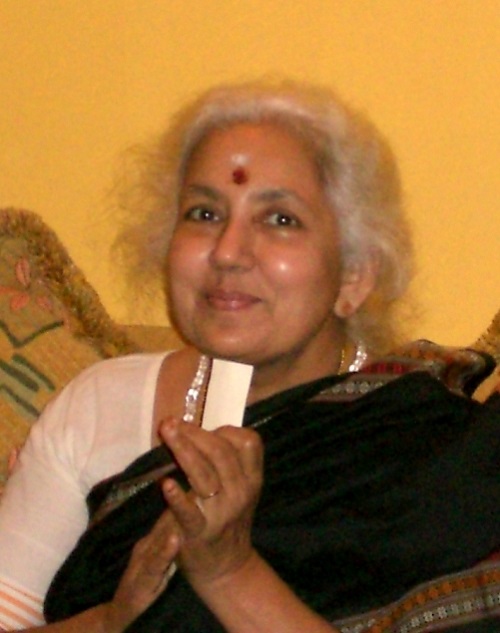
Usha Surya.- Have been writing for fifty years. Was a regular blogger at Sulekha.com and a few stories in Storymirror.com. Have published fifteen books in Amazon / Kindle ... a few short story collections, a book on a few Temples and Detective Novels and a Recipe book. A member of the International Photo Blogging site- Aminus3.com for the past thirteen years...being a photographer.
A WALK THROUGH AHMEDABAD, INDIA’S FIRST UNESCO WORLD HERITAGE CITY
Deepika Sahu
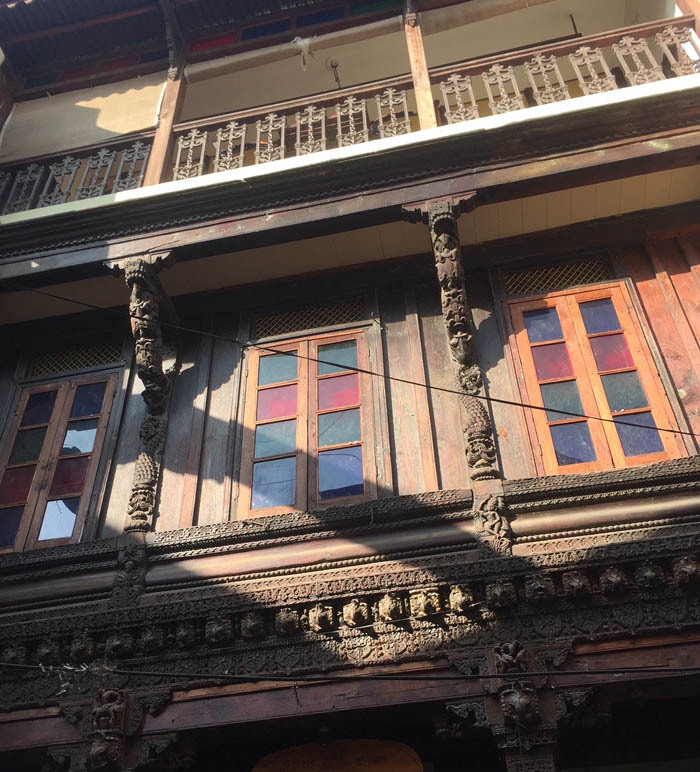
Ahmedabad, India's first UNESCO World Heritage City, celebrates its foundation day every year on 26 February. Founded in 1411 by Sultan Ahmed Shah on the banks of the Sabarmati River, Ahmedabad was declared as India’s first UNESCO World Heritage City in 2017. The walled city area (a stretch of 5.5 km) with approximately four lakh people living in century old wooden houses in around 600 pols or neighbourhoods is regarded as living heritage. One of the best ways to experience this is to go for a heritage walk in the Walled City.
Ahmedabad’s walled city boasts of some of the finest Indo-Islamic architecture, exquisite Hindu and Jain temples, chabutaras (bird feeders), the secret passages, intricately carved wooden houses that are a reflection of vernacular architecture along with different influences from across the world. The heritage walk makes one aware of the walled city’s rich varied history and its organic community living.
As you navigate through narrow lanes and bylanes, you understand the nuances of pol architecture with its share of gates, cul-de-sacs and secret passages. The pol community living, its beautiful old wooden houses, the chabutaras and community meeting spaces gives you a glimpse of the city’s textured heritage. Their lifestyle also shows how beautifully connected they are to each other and also to their immediate environment. The colourful bird feeders are a part of the pol life and they wonderfully represent people’s connection with nature. The pol living is all about community bonding. The close physical proximity makes it easy for people to connect with each other at an intimate level and that gives a sense of physical and social security.
AHMEDABAD HERITAGE WALK (MORNING): 90 MINUTES OF SHEER JOY
The heritage walk is organised by Ahmedabad Municipal Corporation (AMC) with Akshar Travels Pvt.Ltd as the project advisor. The morning tour starts from the 19th century Swaminarayan Temple Kalupur at (8 am) and navigates through narrow lanes and bylanes, numerous pols, chowks and ends at 10.30 am at the magnificent 15th century Jama Masjid. Before starting the 90 minute walk, the heritage enthusiast walkers are shown a short slide show. The guided tour is all about soaking in the city’s rich textured history, heritage and living architecture.
One of the main highlights of the walk is the Kavi Dalpatram Chowk, Lambeshwar ni Pol, which is famous for the house of the 19th century Gujarati poet Dalpatram. The chowk houses a statue of the great poet with nuanced details like – the kathiyawadi embroidery on his kurta, Kavi Dalpatram was a reformist poet, who played a major role in the promotion of Gujarati language. Interestingly, the poet also played a pivotal role in laying the underground drainage and water supply line in Desai-ni-pol (One of the first in the country). Through his poems, he created awareness about the importance of sanitation.
During the walk, one comes across the Calico Dome, which is a reminder of Ahmedabad’s rich textile heritage when the city was known as Manchester of the East.
The walk takes you through the Doshivada ni Pol, which is a real visual delight. This area is mostly inhabited by the goldsmith community. There are many haveli type houses with stunningly decorated facades in the pol which is a treat for the eye. Towards the end of the pol is a beautiful carved chabutara (bird feeder) with stained glasses. This is a unique example of colonial-influence on architecture of chabutaras.
The walk also gives a chance to have a look at the old Ahmedabad Stock Exchange building. ASE started operating from this building in 1921. Now it is no longer associated with it.
As we make our way through the narrow lanes and bylanes, one can see shops selling dry nasto (snacks). And then comes Manek Chowk, which has the unique distinction of being a silver jewellery market in the day and a foodie’s paradise in the night. The vibrancy, warmth and the duality of this place attracts many visitors every day. This is also the place where one can gorge on ice-cream sandwich, pineapple sandwich, and Gwalior dosa (plain dosa wth dollops of butter)
We also come across the Badshah-no- Hajiro and Rani- no- Hajiro. At Badshah no Hajiro, which was built in the year 1446, rests the mortal remains of the founder of Ahmedabad, Ahmed Shah I. The place is located to the western side of Manek Chowk, just outside the eastern gate of Jama Masjid. Rani-no-Hajiro was built in the 15 century by the great sultan Ahmed Shah. The hajiro is a vault for graves and served as the last resting place for queens of this empire.
From Badshah-no-Hajiro, Rani-no-Hajiro, we move to the Jama Masjid which is known for its architectural marvel and that is the last point of the walk. The mosque is located south of the processional axis that runs from the Maidan-i Shah at the door with three arches, Teen Darwaza.The inscription on the mihrab commemorates the inauguration of the mosque on January 4, 1424 by Sultan Ahmad Shah I.
The walk has ended, Ahmedabad’s old city is getting ready to start the day. The shops are starting their day with new hope. People are queuing up to have their share of cutting chai and nashto. And life in Ahmedabad's walled city feels rich and vibrant amid centuries of history and heritage.
Deepika Sahu is an Ahmedabad-based senior journalist with a career spanning since 1995. During her career, she has worked with India's premier media organisations, including the Press Trust of India (PTI) in New Delhi, Deccan Herald in Bengaluru, and The Times of India in Ahmedabad. Currently, she is contributing India-centric features to Melbourne-based The Indian Sun, a cutting edge media platform. In addition to her journalism career, Deepika is involved in teaching English and Communication Skills to learners from different parts of India through Manzil, a Delhi-based NGO. Beyond her professional endeavors, Deepika is passionate about India's rich diversity, literature, blogging, quiet hours at a cafe and enjoying a cup of tea.
Dr. Satya Narayan Mohanty
Dr. Pathiv Chudsama was facing one of the major problems of his career. As a Gynecologist in Leelavati hospital , he had handled his dilemmas with aplomb but now he is facing a problem which is very delicate and his entire family look ed up to him to take the decision. That too quickly. Actually, the decision has been taken by others in a way, but everyone wanted him to put the final stamp of approval. If accepted it, he should have an alternative on hand immediately. If he did not, he should have an extenuating grounds. Others should at least join him or share his point of view.
This pertained to the Japa Maid since Sharmista came home after delivery with the baby. A Japa maid has always been around. Japa maid is a post-partem caregiver trained to help both mother and give care to the newborn care after delivery in the early weeks after birth.It is particularly helpful for mothers requiring extra help. In a city like Mumbai it is important because of missing family support and the inevitability of the mother resuming her work within 3-4 months time of delivery.
The problem was during the last three months time. two of the maids had already changed. He was lucky to get a replacement quickly on both occasions. It was no less aided by a clear cut decision taken by both Parthiv and Sharmista. But this time around the decision appeared a lot more complicated. Complaint came from the cook and housemaid very clearly and now Sharmista has joined in to make it an invincible coalition.
The first maid was a Roman Catholic from Bandra. She was good at her job, but first she suggested that the cook should be changed and she would bring a nice Catholic cook. Everyone dismissed it as an unsolicited canvassing, not to be taken seriously. Then she suggested firmly that the top maid should be changed. When asked for the reason, she said “A nice catholic housemaid will come with good values”. Everyone perked up now, there was something deeper than usual friction between domestic workers in play. Parthiv had clearly pointed out that every religion’s value is good by itself and there was no need for imbibing a particular religion’s value surperseding one’s own. Sharmista suspected that the church might have guided the members to canvas employment for other members.
Parthiv was not happy with the princely sum they were paying; Rs.1,50,000/- a month. Now of course he was convinced that the wage demanded has no correlation to kind of work done by the Japa maid.
It depended on what the maid was getting earlier or how she perceived the desperation in the clients. Sometimes it was only aspirational kite flying to begin with but open to hard bargaining.
She was costly, but given her methodical approach the wages appeared okay. The family was discussing about dismissing her when she herself came and informed that she was to move to Dubai for six months. The prickly decision was avoided and they got much needed time to get the replacement.
Valeria Fernadez’s replacement was Archana Mhahtre from Nagpur. The agency recommended her. She was 40 year old and did her work with apparent diligence. Sharmista found her cooing “mere Lala, Ram Lala”. The gender mistake appeared pardonable. The baby was a girl but it was fine.After all, it was only a term of endearment. Until Parthiv heard her cradling the baby and saying “Jai Shriram, Jai Shriram”. To a cosmopolitan like Parthiv it was anachronistic.
But she had come with a monthly wage of Rs.100000/-, a big step down from Rs.150000/- which Valerie used to take. Having been bitten once they were shy to take action. But they were always on the look out for alternatives. When pointed out, her reply was “what was wrong with “Jai Shriram”? Sharmista believed that children absorb all that is sung to them and that did not bode well. They were not fastidiously religious and were not comfortable with this chant.
One day Parthiv spotted some kachara in the milk bottle and pointed out that she should be careful about the milk bottle. Instance of negligence started popping up time and again. The second time Parthiv pointed out presence of some kachara in the bottle, his tone was firm and he meant business.
“I can’t take this from a gent” she decisively pronounced and then marched out lock, stock and barrel. But not before collecting 7 days wages because she had worked for six days. Travel time to Nagpur was included and an additional day’s wage was collected along with train ticket to Nagpur.
Sharmista remembered her cousin's maid Malaika who was diligent, well-groomed, appeared clean and methodical in her work. She had heard that Megha, her neice would not need her after a week. That was four five days earlier. She had fleeting interest in her as she knew the quick turnover in the Japa maid market. They immediately established contact and she agreed to switch over almost immediately. A gap of a few hours intervened between Archana’s departure and new Japa maid’s entry.
Malaika knew her boundaries. She was a caregiver and restraint should mark her activity.She used to come in at 6 AM, wash her hands thoroughly and nod silently towards Puja room. The first act pleased Parthiv and the last one Sharmista. Then she used to check the diaper of the baby, clean her gently with warm water, speaking in soft Hindi soothing the baby. During the oil massage, her hands moved with assurance as she murmurs comfort "Bas, Bas, Shant". The baby bath follows. She usually worked quickly but tenderly shielding the child from drafts, wrapping the baby snugly. She carefully hands the infant to the mother.
Post this she prepares food for the mother, according to instruction. It is warm light and nourishing — soft rice, plain dal and jeera water. She supports breastfeeding, adjusts pillows and helps the mother to sit or lie down.
When Sharmista complains about pain, fear and exhaustion, she listens carefully.
For Malaika it was a seamless transition with a slight hike in wages @ 75000 from the earlier Rs 60000/- a month.
Sharmista didn't know much about Malaika. She was 30 years old and was from Khurda in Odisha. She had a bad marriage in Gurugram and she was now rebuilding her life. Her work was clean, she was diligent and the kid took to her naturally. She was also willing to stay full time with them in a room meant for servant which happened to be vacant then. She was a non-vegetarian and so were the house owners but the non-veg used to come through Swiggy. She was happy with this arrangement . Her competence created trust.
During mid-day, she washes the baby clothes and dries them in the sun. In the afternoon, when the baby sleeps, she massages mother’s back and legs, mindful of pressure and pain. If and when the mother sleeps, she watches the baby as if protecting a flame. Even if the child becomes restless, she rocks the baby gently and sometimes hums the various lullabies, mostly Odia lullaby without words.
In the night, she stays alert also through broken sleep and comes in on her own when the baby cries.
Parthiv&Sharmista were pleased that their prayer has been answered finally. Her presence was unobtrusive, her functioning competent and she appeared completely trustworthy until Sharmista, cook and the housemaid marched in. The allegation was, she was saying ‘kalma’ while rocking the baby. . How were they sure? The cook said she stayed in a Muslim area and could spot ‘kalma’ from a mile. The top-maid said that she enquired and spied on her and then she figured out that the cook was telling the correct.
Sharmista said she is cooing wordless ‘kalma’.
“Then it is not ‘kalma’. For ’ kalma’one will have to say words,” Parthiv said.
Sharmista’s reply was “it was unhealthy for the kid to listen to ‘kalma’ without words.”
Parthiv was surprised with the new found vehemence of Sharmista. It was uncharacteristic of her. Clearly she has been influenced.
“If only the child could speak, it would have been an important input,” Parthiv thought.
“Is she humming a Odia lullaby? We don’t know. Should we not check with her?” Parthiv asked. He grew up in Surat and had seen an Odia maid cradling a baby in neighbours house singing lullaby. As the nanny rocks the baby the child slowly falls asleep and she was singing an Odia lullaby with similar body movement.
“No, I may not be a fanatic. But there is no place for Kalma in this home. Suppose you dad or mom come to this house, there will be pandemonium. In three months time I will resume work and the baby will be entirely with the Jappa maid. That will be terrible,” Sharmista said.
“Apart from this, is there anything suspicious?” was Parthiv’s enquiry.
“No. Nothing at all”
“Ok, you have left the problem with me. Give me time till tomorrow evening I will decide and inform you”. He ended the conversation .
All three were not entirely happy. They wanted instant decision which didn’t come.
Parthiv had seen in Madrasa the stereotypy – a repetitive, rhythmic and self generated movement that support focus,regulation and help in memorizing. Gently rocking , swaying and nodding while reading synchronizes breath, voice and rhythm to the text. The somatic rhythm helps in consigning the reading to memory without fatigue. Even Brahmin pupil of south move, but differently while learning Vedas. In bothmemorizing the scripture, reading Kalma or cradling a baby, the same logic operates; rhythm and care. As the maid rocks the baby into sleep, the recite of kalma in the sub-continent rocks the words into memory to be remembered with accuracy. Intersting thing is the reciter or the hummer don’t fall asleep. The instant case can be a case of misunderstanding because of cultural difference.
Parthiv knew what he had to do. To decide whether the silent ‘kalma’ of Mallaicka is a wordless Odia lullaby. First thing in the morning he would ask and he also knew how to do the inquest.
Dr. Satya Mohanty, a former officer of the Indian Administrative Service , was the Union Education Secretary as well as Secretary General of the National Human Rights Commission before superannuation. He has also held several senior positions in the Government of Andhra Pradesh, a state in the Indian Union. HE has authored a book of essay in Odia, The Mirror Does not Lie and a book of poems in English( Dancing on the Edge). He is a columnist writing regularly on economic and socio- political issues, Mohanty was an Edward S, Mason Fellow in Harvard University and a SPURS visiting scholar in Massachusetts Institute of Technology in Cambridge, USA. He has been an Adjunct Professor of Economics in two universities and is a leading public communicator. His second volume of poetry will come out soon, He lives in Delhi.
Annapurna Pandey

In the New Year of 2026, following Christmas 2025, Prof. Triloki N. Pandey and I spent the entire holiday in Kolkata and Santiniketan at the home of Justice Arijit Banerjee, whom we have known for nearly four decades. What I experienced in his home led me to reconsider, once again, what we mean by the term family.
Banerjee's house stands in an old, well-established neighborhood in Kolkata. His parents are no longer alive, yet they are everywhere. A large portrait of his father, a London-trained and distinguished barrister, greets visitors at the entrance. The walls of the elegant three-storey home are lined with photographs—his mother smiling in her youth, their wedding, gatherings of uncles, aunts, cousins, and friends.
The ground floor still houses the office and library, with the large desk where Barrister Banerjee once worked alongside many assistants, as I remember from earlier years. The first floor bears his mother's loving touch: the kitchen, the dining room, and the main bedroom—now a guest room, which we occupied—where her beautiful photograph rests upon the harmonium, watching gently over the space.
The judge lives on the second floor, where he reads files brought home from court, deciding the fate of many lives late into the night, while his two golden retrievers, Happy and Hiru, patiently wait for him to come to bed. He is deeply spiritual; his room is adorned with images of Sri Rama Chandra Paramahansa, Ma Sarada, Swami Vivekananda, and Sri Satyasai Baba. The house feels remarkably unchanged, even after the decades since I first stepped into it in 1989.
I remember how Masima, his mother, would sit with us during meals, urging us to eat more and more, her care expressed through insistence and affection. Now the judge himself sits with guests at the table, ensuring plates are full, quietly filling the space her presence once held.
But the most striking thing is not the photographs. It is the life inside the house.
Justice, the only child of his parents, does not live here in a conventional “nuclear family,” but with two beloved four-legged companions and about seven people who manage the household: Ram, Nageswar (alias Naga), Tulsi, Samir, Babon, and others—many of whom have been with him for years. They, in turn, support families of their own back in their villages: children in school, aging parents who fall ill, sisters and daughters whose marriages must be arranged. The concerns of distant homes travel daily into this one.
One young man, the son of the house manager Ram, has moved from the village to the judge’s home to prepare for his law examinations. Another saves steadily to educate his children. Yet another must arrange his daughter’s wedding. Their employer knows the details of their lives—not out of curiosity, but because their struggles shape the rhythms of the household.
When I asked the judge about family, he said, “They are my family. We share the joys and sorrows of life, the ups and downs. When I fall ill, or one of them falls ill, we are there for each other. They are my children. God has made me the head of the family.”
Promod, originally from Samastipur in Bihar, has worked here as a driver for more than a decade. His family life reflects a pattern common in today’s India: his wife and daughter remain in the village, while he and his middle brother work in Kolkata. Yet distance does not weaken his responsibilities. His earnings, his leave, even his emotional calendar are organized around his family’s needs. This year, he is especially excited to return home for his daughter’s seventh birthday—something work obligations had prevented in earlier years.
When one staff member takes leave, others quietly rearrange their duties so everything continues to run smoothly. Care circulates not only upward toward the employer but sideways among the workers themselves.
Family is a universal institution found in every society. The traditional joint family in India is frequently described as a declining institution, weakened by urbanization, modernization, and globalization. Census data and sociological surveys emphasize shrinking household size and the growing prevalence of nuclear families, often interpreted as evidence of social breakdown (Uberoi 1993; Srinivas 1995). Yet such interpretations conflate household structure with kinship itself, overlooking the moral and relational dimensions through which family life is sustained.
Family matters deeply here, including among those we too easily label “working class.” When Promod’s eldest brother became incapacitated due to substance abuse, Promod and his older brother took responsibility for his children. Financing the wedding of an elder niece was not seen as a sacrifice but as a duty. When one member falters, others absorb the strain. Obligation shifts, but the family holds.
Justice often says he is “in charge of seven families,” and he means it. His income sustains not just one household, but a web of lives.
Sociologists frequently argue that the Indian joint family is disappearing—replaced by small nuclear-family apartments, migration, and individual careers. Census figures do show shrinking households. However, when we look closely at how lives are actually lived—whether among the migrant working class or in households where workers become members—we see that alongside rural-to-urban migration, family continues through remittances, duties, and everyday obligations. Family may not be defined solely by structure or by sentiment, but by both.
Anthropological scholarship has long cautioned against equating co-residence with the existence of kinship. Jack Goody’s comparative work demonstrates that family systems transform alongside shifts in political economy rather than disappearing altogether (Goody 1976, 1983). Similarly, Sylvia Yanagisako argues that kinship and economy must be analyzed together, as families are key sites for the circulation of labor, care, and resources (Yanagisako 1979, 2002; Yanagisako & Collier 1987). From this perspective, the joint family in contemporary India has not dissolved; it has reconfigured its form while retaining its ethical core.
We tend to equate family with co-residence—sleeping under the same roof. Yet kinship is not merely a matter of walls and rooms. It is a matter of responsibility that transcends distance.
In this Kolkata home, authority and hierarchy certainly exist. Yet so do care, obligation, and long-term commitment. When a staff member’s relative falls ill, help is arranged. When a child needs education, support is provided. When aging sisters—now living alone in apartment buildings converted from ancestral homes—feel lonely, they come here, to the one house that still feels like a joint family in spirit.
I am part of this story too. I first met Arijit in 1988 when we were both on our way to Cambridge—he, a young law student; I, a new mother with an infant, beginning a postdoctoral fellowship. Far from home, we became siblings through circumstance and affection. I gained a younger brother; he found a family. Over the years, life took us to different continents, but the bond endured. The baby he named then is now in his thirties, with his own family and a toddler son.
None of this fits neatly into categories like “nuclear” or “joint.” Yet it is deeply, recognizably family.
Across India—and across the world—people continue to send money home, raise siblings’ children, care for aging relatives, and absorb one another’s crises. Family stretches across cities, countries, and social roles. Employers become guardians. Friends become siblings. Responsibility flows sideways and downward, not just from parent to child.
Perhaps the joint family has not vanished. It has changed shape and boundary.
What endures is not shared walls, but shared obligation. Not blood alone, but the everyday work of care.
Family, in the end, may be less about whom we are born to and more about whom we remain responsible for.
From Kolkata, along with Happy and Hiru, the seven staff members, his older cousins, and other relatives, we traveled to his home in Santiniketan. After days of eating together, resting, ending the nights with Rabindra Sangeet lovingly led by the judge, and quietly observing the family at work, we left after the New Year carrying a renewed understanding of family—not simply as a household, but as dharma: duty, obligation, and shared responsibility.

Annapurna Pandey is a cultural anthropologist at the University of California, Santa Cruz. Originally from Cuttack, Odisha, she moved to Santa Cruz, California in 1989. She is a travel enthusiast and loves to write travelogues highlighting her exotic experiences in different parts of the world.
Satish Pashine
You may change the village’s name, yet the story will still sound familiar.
Because in almost every village there lives someone like Shanta Kaki.
Kaki had seven children — six daughters and the eldest, a son, Gopal.
Her husband Hariram worked in the fields. Grain was never lacking in their home. The kothi stayed full of wheat, the jars held dal and atta, and no one slept hungry. Only cash money was always scarce.
They lived in a joint family house — a wide angan, a neem tree casting afternoon shade, and in the veranda an old iron cupboard.
That cupboard was Kaki’s bank, locker and treasury.
Every month, when the ration arrived, she quietly kept a little aside — a tin of sugar, a lump of gud, half a packet of tea… and, most carefully, a bar of soap.
One afternoon a neighbour laughed,
“Kaki, why do you hide these things?”
Kaki lowered her voice.
“Daughters must be married. I have no money… so these become money.”
The eldest daughter Lata was not yet fifteen when a proposal came.
The boy was a municipal overseer, nearly twelve years older.
Hariram hesitated.
“She is still a child.”
Kaki sighed.
“He earns. The family is decent. Where will we find a better kismat for a girl?”
The wedding was fixed for summer.
The village school became the Jan vasa. A mandap rose in the courtyard. Bhatts sang lineage songs, the Nain and Dhobin collected their neg, the measured wrists. Smoke from the chulha mingled with wedding songs.
That same day Kaki’s ten-year-old nephew Mannu secretly bought an eight-anna ticket and slipped into the talkies to watch Kaagaz Ke Phool.
When he returned, Kaki asked,
“Where had you gone?”
“To cinema… but I didn’t understand anything. Everyone was crying. I felt sleepy.”
Kaki smiled.
A deeper story had already begun at home.
The second daughter Kanti was dark but brilliant in studies. Suitors kept refusing.
The third, Aarti — tall and fair — seemed older than her age. Soon another overseer’s proposal arrived, again from a much older man.
Hariram worried,
“What will people say?”
Kaki replied quietly,
“Will people feed us?”
And the marriage took place.
Mannu was eleven now.
To him weddings meant laddus, a halwai, and the honour of rolling a few beside the elders.
After some weeks Aarti came for her first visit to her Maayka.
Mannu noticed she had changed.
She spoke carefully, walked softly, and laughed less. A constant alertness lived in her eyes.
In their house clothes were washed with Sunlight soap and everyone bathed with Lifebuoy.
That morning Kaki called,
“Mannu! Run to the shop and bring Jai soap for Aarti.”
Mannu blinked.
“Kaki… why Jai? We all use Lifebuoy.”
Aarti said nothing.
Kaki snapped,
“Too many questions. Take six-and-a-half annas and go.”
On the way Mannu kept thinking:
Same house. Same well water.
Why a different soap for one person?
At the shop the grocer asked,
“What do you need?”
“Jai soap.”
“For yourself?”
Mannu hesitated.
“No… for my didi.”
The grocer looked at him briefly and handed over the bar.
Aarti quietly took the soap and went inside.
Mannu followed and whispered,
“Didi… why don’t you bathe with Lifebuoy?”
She tried to avoid answering. Then slowly said,
“In my sasural they told me… the smell of my parents’ house should not remain.”
“Smell?”
“Yes. Everyone there uses fragrant soap. They said,
‘Now you belong to our home.’”
Mannu stood still.
After a moment he asked,
“So… you are not ours anymore?”
Aarti’s eyes filled, though she smiled.
“Relationships don’t change… only their rules change.”
That night Mannu sat long beneath the neem tree.
For the first time he understood — a wedding is not only songs, sweets and drums.
Something leaves quietly, so quietly that no one hears it go.
The next day he again saw Kaki opening the cupboard and hiding things inside.
“What are you keeping?”
“Your younger sister’s wedding must also be done.”
Inside lay sugar, jaggery… and another new bar of Jai soap.
Mannu asked softly,
“Kaki… in marriage, does the girl leave… or does her home leave her?”
Kaki stayed silent for a long time.
Finally she said,
“Beta… the girl doesn’t go.
Her childhood goes.”
Mannu whispered,
“And the fragrance?”
Kaki closed the cupboard.
“That… remains in memories.”
Satish Pashine
For them, moving from Odisha to Maharashtra was not merely a change of address; it changed the rhythm of their days. The familiar sounds of their old neighbourhood — the vegetable vendor’s call, the temple bell at dusk, the slow conversations with known faces — were replaced by the hurried anonymity of a new city. A truck arrived carrying their belongings: rope-tied trunks, cartons of books they could never throw away, carefully wrapped utensils, and small household objects soaked in years of memory. Behind the truck came their old car, dusty from the long highway journey — a silent witness to family trips, pilgrimages, and late-night returns after weddings and visits.
Standing in the balcony of their new flat, his wife looked down at the parked car and said with relief,
“At least this came with us… it already feels a little like home.”
He watched it quietly and smiled.
“Yes… once the registration is transferred, we’ll truly belong here.”
They believed it would be a simple formality — paperwork and a few signatures.
In Odisha they had carefully obtained the NOC. On the application they had written “Pune,” so the certificate mentioned Pune. The file was neatly arranged in a transparent folder. He had deliberately not engaged any agent. He neither liked shortcuts nor believed in bribing people. He had time — and more than time, he had a stubborn faith that correct work, done correctly, must eventually succeed.
At the Pimpri-Chinchwad RTO, the clerk glanced at the papers and immediately shut the file.
“This won’t work.”
He was startled.
“Why?”
The clerk spoke without anger and without sympathy, like someone repeating a sentence for the hundredth time.
“Your address falls in Pimpri-Chinchwad. This is a Pune RTO NOC. Either bring a new NOC or give Pune address proof and go to Pune city RTO.”
“But we live here,” he said almost apologetically.
The clerk finally looked up.
“Sir… according to the system, you don’t live anywhere until you show proof.”
They stepped outside holding the same papers that had seemed valid an hour ago but now felt useless.
Near the gate an agent approached them immediately, as if he could recognise confusion from a distance.
“Sir, I’ll get the whole work done for nineteen thousand.”
“How?” he asked cautiously.
The agent leaned closer and lowered his voice.
“We’ll make a Pune rent agreement. Work finished. Later we’ll change the address.”
He straightened.
“We won’t make fake papers.”
The agent laughed casually.
“Uncle… you’ve grown old. At least now change.”
His wife felt embarrassed.
“Let’s go home,” she said softly.
That evening while walking in the society compound, they met a senior-citizen neighbour on a bench.
“What happened to the car?” the neighbour asked.
He explained everything.
The neighbour laughed.
“My car has been running with outside registration for three years. Nobody stopped me.”
“But the rules?” he asked quietly.
“If they stop you, give a hundred or five hundred and go. When you sell the car, settle it back in your state. Why trouble yourself? You’ll pay tax here, then pay bribe here, then bribe there for refund.”
He listened but said only one thing.
“No… we won’t do anything wrong.”
The neighbour shook his head with mild pity.
“You people make life difficult for yourselves.”
He did not argue. Yet his decision did not move even slightly.
He called a friend in Odisha.
“Please help a little…”
For nearly a month the friend kept moving from office to office — queues, counters, signatures, objections. Each week a fresh requirement emerged, another “missing” document was discovered. The process seemed to stretch rather than conclude. At one stage they even asked that the car be brought there for inspection. He wrote to the minister, respectfully explaining, “Sir, how can I take the car two thousand kilometres? Kindly advise them to allow a video inspection.” No reply ever came.
Finally, the friend said over the phone, tired but practical,
“Let me hire a consultant here. Otherwise, it won’t happen.”
After two months a fresh NOC arrived. It had cost nine thousand rupees.
They felt real relief — almost celebration.
His wife said,
“We should send him something.”
He bought a good, branded T-shirt as gratitude. With document courier and small expenses, the amount touched nearly twelve thousand.
He joked lightly, “Let’s add this to the flat’s cost. Everything is happening because of this flat anyway.”
His wife smiled faintly and said softly,
“Entering it in your Excel sheet may ease your conscience, but it doesn’t change the reality — honest people are still paying just to complete lawful work. And now it has gone beyond all limits… we are practically paying bribes in order to pay revenue to our own elected government.”
With new confidence he went again to the RTO. But now the forms themselves became the barrier — columns, codes, abbreviations, instructions written for experts rather than citizens.
Finally, he too hired a consultant- a legitimate channel to pay bribes .
“Ten - twenty minutes’ work. Please sit,” the consultant assured.
They sat on a plastic stool in the veranda and could see the agent through the glass door.
An hour passed.
Then another.
Other clients were served first, especially those who paid immediately. Files moved, names were called, signatures taken — but not his.
He asked politely,
“Sir, when will ours be done?”
“It will happen, Uncle. Relax,” the consultant replied without looking up.
At last, the consultant called an assistant. “Go take 20-25 engine number tracings.”
The car was parked far away. The assistant took him along. He smelled of country liquor.
First trip — no paper.
Second — no proper pencil.
Third — couldn’t locate the number.
Fourth — another missing item.
Under the afternoon sun they walked repeatedly across the compound. Heat rose from the concrete. By evening his phone showed nearly seven thousand steps. He felt weak and dizzy; his shirt was soaked.
His wife handed him water she had carried from home.
He returned and asked gently,
“Couldn’t this have been done in one go?”
The consultant came close, irritation visible. The smell of alcohol lingered on his breath.
“You talk too much…
You said you’re seventy-four going on seventy-five…
Why don’t you change now at least?”
He remained silent for a moment. Around them stamps thudded, names were shouted, files moved, people argued.
Then he spoke calmly.
“All his life he has tried not to change by doing wrong.
If honesty now appears foolish… perhaps it is not he who needs to change.”
For the first time the consultant did not laugh.
The sun outside was the same. The file in his hand was the same. The car still waited in the parking lot. Yet while walking home he felt lighter.
That day he understood — the struggle had never been about a car registration.
It was about a man’s quiet decision:
how much inconvenience he is willing to suffer,
simply to remain the person he believes he should be.

Shri Satish Pashine is a Metallurgical Engineer. Founder and Principal Consultant, Q-Tech Consultancy, he lives in Bhubaneswar and loves to dabble in literature.
Darsana Kalarickal
“It was a midnight.
Perhaps you may interpret it as the story of a woman who wanders off the path in stories—more precisely, as the absence of a story.
Yet, it was true.
Because it had ploughed and overturned my mind completely.”
I paused midway.
“Don’t drag it like this. Just say what happened.”
Praveen said without even lifting his face from the laptop.
“I was inside a forest.
If I tell you why I went there, you will be shocked.”
“Go on.”
“A little girl took me there.
But when I followed her into the forest, she disappeared.”
“Anyway, tell the rest. Even if it is foolish, it sounds interesting.”
“Suddenly it began to rain.
What a rain it was!
The forest vanished in the rain.
I was shivering with cold.
I just wanted to return.
I turned back to walk…
But the path I came by was gone.”
“And then how did you reach here?”
There was sarcasm in Praveen’s voice.
He turned his attention back to the laptop.
“Look, Praveen, this is not a joke.
It really happened.”
“Oh really? At midnight you go into a forest.
A child takes you there. Then it rains. The forest disappears.
Pure nonsense.
You should stop your late-night reading.”
He shut the laptop, pushed it aside, and lay down closing his eyes.
I shook him.
“But Praveen, you saw me come in drenched, didn’t you?”
“Fine. I can believe this much.
It was a rainy day.
At night you felt like getting drenched in the rain.
You went out to the yard, got soaked, and when I came looking for you, you were walking back in the rain.
This much I can believe.
But a forest?
Do you know how many kilometres one must travel from this city to reach a forest?
Anyway, try to sleep now.
Tomorrow morning we’ll go see a psychiatrist.”
I sat there for a long time.
I couldn’t understand what it was that Praveen refused to believe.
In truth, I had been inside a forest.
“Are you not planning to switch off the light yet? Come and sleep, Shyama.”
“After a while, Praveen. I can’t sleep.”
“Alright. Good night.”
And the moment he said that, he fell asleep.
How easily people fall asleep.
I went into my reading room.
“Who stirred up your mind again today?”
A muffled laughter from near the bookshelf.
It was Divi. I lifted her and placed her on the table.
“You. Why did you leave Vali Aunty and go into the forest?”
“The ones in the forest needed my help.
So I had to go.
I have so many friends there—
Bahu Grandfather, Katti, Jabal, Alu, Hathi… so many.
It was such fun.”
“I feel like going too. I am tired of being here.”
“Next time I go, I’ll take you along.”
“My head hurts terribly,” I said.
“Lie down here. I’ll rub your forehead.”
I lay down with my head on her lap.
She gently caressed my forehead.
We both entered the forest.
She guided me; I followed her.
How different this forest is from the world afflicted by the paralysis of monotony.
I looked around. What greenness everywhere!
A parrot sat on a tree branch, staring at me.
How red its beak was!
“Divi, look there…”
………
The light was still on in the room.
The fan whirred above my head.
Where had Divi gone?
“This can’t go on anymore.
We must find a solution tomorrow itself.”
Who was raising their voice?
I turned and looked.
Praveen stood leaning against the wall, silent, arms folded.
Beside him were his father and mother.
“How did I come here?
Who brought me here?”
“Ask him.
If you give in to children’s whims, this is what happens.
Praveen,
you chose this life yourself—now you must live with it.”
His mother’s sharp words.
They walked out.
Praveen looked at me.
“What exactly is happening to you, Shyama?
I am really scared.
Are you feeling that lonely?”
“What were you shouting here all alone?
I was terrified.”
I couldn’t hold back my sorrow.
I burst into tears.
Praveen held me close.
His eyes were moist.
“Enough. Come, lie down.”
Sobbing, I obeyed him.
The next morning, it was Praveen who woke me up.
“What a sleep, Shyama!
Have some coffee and get ready quickly.”
“Where are we going?” I asked, surprised.
“To a place.
You promised me yesterday.”
After my bath, when I came back dressed, Praveen was packing bags.
I understood nothing.
Was he going to abandon me?
“Where are we going?
Praveen, if you leave me, I have no one.
I will follow the path my parents took.”
“You silly girl!
Didn’t I say yesterday we would see a psychiatrist?
That’s where we are going.”
He smiled, picked up the bags, and went downstairs.
I followed him silently.
His parents stood watching in surprise.
Praveen focused on driving.
Inside the car, Kishore Kumar’s voice flowed softly:
“My life remained like an unwritten paper…”
My life too felt like an unwritten sheet.
How long had we been travelling?
Praveen said nothing, unusually serious.
Do we have to come this far to see a psychiatrist?
I leaned back, closed my eyes, and drifted into thoughts.
I remembered the first time we met—
at a relative’s wedding.
I had noticed those eyes watching me intently.
Later came the marriage proposal.
After my parents died, I had been under my grandmother’s care.
Relatives were eager to hand over their responsibility quickly.
Within a few months after the wedding, my grandmother too passed away.
Praveen’s parents lived in their own world—high-ranking officials.
Praveen was always busy with work.
Distant housemaids.
From various conversations, I understood that this marriage had happened mainly due to Praveen’s insistence.
That discomfort was visible in his parents’ behaviour too.
My only solace was Praveen’s reading room.
Eventually, it became mine.
And now—where is this journey leading?
I don’t know.
The cold of the car and the weight of my thoughts…
I didn’t even realise when I fell asleep.
I opened my eyes only when Praveen called me.
A beautiful resort.
Forest all around.
A staff boy walked ahead carrying the luggage.
Windows opened directly toward the woods.
I ran to them.
Cool, gentle wind embraced me.
“What greenery…
It’s so cool.”
“Do you feel like walking into the forest?”
Praveen asked playfully from behind.
I turned.
“You said we were going to see a psychiatrist.”
“This is the psychiatrist.
We’ll stay here for a few days,” he smiled.
“Don’t you have to go to work?”
“I can work from here.
Life is more important, isn’t it?”
He smiled again.
Then he took out a book and a pen from the bag and held them out to me.
“From now on, don’t loudly announce your ‘foolish thoughts’ in front of others.
Write them quietly in this.
I will read them.”
He fell onto the bed.
My eyes filled with tears.
The forest wrapped itself around us.
*Darsana K.R., residing in Venginissery, Thrissur district, is an employee at Venginissery Service Cooperative Bank and a passionate poet. Her published works include the poetry collections *Kavithaye Pranayichaval, Pranayathil Akappettathinte Ezhaam Naal, and Kuldharaayil Oru Pakal; the short story collection Thekkedathamma V/S Ramakavi (co-authored with Dr. Ajay Narayanan); the memoir Kunnirangunna Kothiyormakal; and the poetry study Kavithayude Veraazhangal. Her poems and articles have been featured in various periodicals and online platforms. phone : 9645748219, email darsanakr1973@gmail.com.
Ashok Kumar Mishra
The hilly road was deserted. There was sunken feeling all over the place. Moreover it was a wet day- drizzling throughout with torrential downpour lashing the ghat road intermittently. Rain clouds were sitting pretty over the distant hills surrounding the valley. The overcast overview outside the bus was hazy as the mist engulfed the entire arena. Solitude was setting in fast along with darkness. The constant rain was not letting up even for a minute.
Occasional news of sudden cloudbursts in the region, bringing deluge pulling down and pulverizing everything from human habitats, human-made structures to the flora and fauna in the area, razing human dreams and comforts in a minute was quite common. They had always been a heart wrenching experience for the people of the area. The serpentine ghat(hilly) roads ran through the valley with high mountain range standing as guard walls on all sides. The sun had not set yet, but the whole area looked murky. The Uttarakhand Transport Corporation bus was going ahead very slowly fuming on its way up on the mountain tract like an obstinate unwilling child being dragged to school by parents on a wintry morning. At every turn the bus was battling its way encountering water streams which used to carry down along with it huge quantity of mud and small boulders. If there are cloudbursts followed by huge landslide nobody knew how long would be the wait to clear the blockade and the traffic bottleneck.
On way from Delhi railway station to Kathgodam there was extreme heat and sweltering sun throughout. From the station to the bus-stand it was still blazing. But like a sudden, surprise test came the rain and took the entire area under its shroud with darkness setting in quickly. Torrential rain came along with chilly wind that started blowing suddenly. It was raining heavily but sun’s faint golden rays were still visible crowning the distant hills. The head-light of the bus, while taking turns disseminated light on tall Deodar, Pine, Oak and Burans trees on both sides of the road. Amidst darkness occasional small animals were noticed crossing roads or taking shelter under foliage to avoid rain.
The hilly tracts were generally thinly populated with isolated human settlements. Blurry wavering lights from houses greeted the moving bus, when it got past them. It would be hardly half past five, yet it felt like night. For Abhijit Bhattacharya this ghat road journey experience was completely new. He felt what a great trouble he is in. He came along with the Nisithasurya drama troupe from Odisha to Delhi to participate in the All India Youth Drama Carnival. Their suspense thriller drama “The Yakshini on Saptaparni tree” got cheers and appreciation at the national level. Abhijit played the main lead role and directed the drama. His debut directional venture got appreciation all around, but he missed the Best Actor award by a whisker. Shravani playing lead female role in the drama however begged Best Actress award for her role. She earlier played many small roles but recognition playing lead role was a new experience. She came to Abhijit and handed over the award to him saying “it’s all your effort, otherwise what I know about acting?”
Shravani definitely spoke this to console Abhijit and who knew this better than him? Abhijit had no doubt about Shravani Bohidar’s acting talent since he met her first. As a skilled director he knew how she could chisel a lively danseuse from a raw piece of stone. Her lively broad pair of eyes offering a vulnerable tender look used to match with her youthful exuberance. He was sure her heart-shaped bright face with moist lips and dense black bushy hair would definitely fit the main female lead of the drama.
Shravani was doing her masters in Psychology from Sambalpur University. Coming from a modest background she was not averse to struggle. Her father was working as a Senior Division Clerk with Indian railways and was about to retire soon. Her mother was an arthritis patient who found difficulty to work long and younger brother, an MCA degree holder was working in far off Chennai, who managed his living within his meager salary. Shravani knew to live within his means and limited ambition. Occasionally she took to acting for Nisithasurya theatre group during her spare time. Her passion for local folk music and folk drama in local radio station offered scope for some extra pocket money. Abhijit himself was a baul singer and this passion for folk-art had brought them closer.
Although not too intimate yet both liked and respected each other. Abhijit used to like Shravani’s Sambalpuri songs and there was always demand for their songs after drama rehearsal. Abhijit used to travel from Jharsuguda to Sambalpur for drama rehearsal. Occasionally he shared a cigarette with Shravani and sometime Shravani purchased and kept one for Abhijit. Both spent their time talking to each other over a smoke on days when Abjit reached early for rehearsal.
During selection process of actors for the new drama when Abhijit suggested Shravani to wear a bunch of white Kurei flower on her hair replacing the jasmine flower she was wearing, it surprised Shravani. But when she decorated her hair with the Kurei flower bunch Abhijit asked everyone to tell whether Shravani would fit in as the new female lead of the drama and everyone agreed except mild grumbling by Maya, who so far used to play the female lead. She took excuse that she would not take part in the drama as she had urgent work and examination ahead and soon she left the selection process in spite of request by all others to stay back.
Abhijit explained like these locally grown Kurei flowers similar looking white bunch of sweet smelling forest flowers bloomed during Durga puja are Chhatian flowers also called Chhatim in Bengali and Saptaparni in Hindi. There is an interesting folk tale about those Saptaparni flowers which served as background for the drama. During Dasshera they bloom aplenty and their fragrance spread over wide areas. While Kurei flowers grow on medium sized Kurei shrubs, Saptaparni trees are very tall and grow straight. During festivals tribal youths pluck Kurei flower to present to their beloved and dance together wearing the same on their hair throughout the night.
Shravani added “yes, in Western Odisha Kurei plant is considered auspicious and it is a well-known practice during Nuakhai festival to serve offerings to Goddess Samlai on Kurei leaves.
“Similar looking Saptaparni flowers bloom in the wild and as night progresses its sweet fragrance spread miles across wider areas with increasing intensity. But this light wood tree is cursed world over as the home of the evil” said Abhijit. Someone added that he heard it is said to benot advisable to sleep below the Saptapani tree as it would invite diseases and children especially are asked to avoid even its shade. All were terrified hearing this.
“You know so much about Saptaparni tree because you are a science student, we only know it for its sweet intoxicating fragrance” said Shravani.
Abhijit was not only aesthetically inclined he was a nature lover too. Before doing his management degree he graduated with Botany honors from Kolkata University. He had his family home at Bansdroni and shunned the idea of looking for livelihood outside Kolkata. But three long years the MBA degree he finally joined famous Asian Paints Company as Area Manager at Jharsuguda. He had to extensively tour Chhattisgarh and western Odisha region, yet he found out time every evening to pursue his passion for acting. Their theatre group travels and performs in many other towns and cities.
Finding everyone anxious to know about the storyline of their new drama Abhijit narrated that there was a beautiful folk tale about a Yaksha and Yakshini. As per the story one night a love pair of Yaksha and his beloved was roaming in the forest when they were attracted by the intoxicating sweet fragrance of Saptaparni flowers blooming abundantly in the adjoining forest. As night progressed the intensity of fragrance of the flowers extended over the entire forest area. The trees standing tall were visible with their loads of white flowers even during the night.
Dear please bring me loads of those Saptaparni flowers, I am overwhelmed by their fragrance requested the Yakshini to her lover. The Yaksha to fulfill the wishes of her beloved moved out in search of the Saptaparni flowers in the late hours of the night and moved from tree to tree and collected a huge of Saptaparni flowers. While returning to his beloved he came across a band of robbers who were hiding inside deep forest in a secret place. Lest he would reveal their whereabouts to others, the robbers beheaded the lover and buried the body inside the forest.
The Yakshini waited in vain for days and nights together and looked for him inside the deep forest but could not find her lover. The identity of assasins were not known but when the Yakshini came to know about the death of her lover by the gang she presumed they would use the same road someday and to take revenge she waited on the edge of the forest as a beautiful attractive woman for any young passerby crossing the path and tried to use her charm and win away their love and invite them to her house. Day after day they were made to work and have physical relationship with Yakshini to satisfy her sexual desire while keeping them hungry and thirsty. Once they face death due to lack of food and water, she would look for fresh young man. Many innocent youth lost their lives as her thirst for blood and revenge continued. Finally one Brahmin youth who fell prey to her charm and carnal desire when attracted by her beauty succeeded in bringing change of heart of the Yakshini. The drama was based on this folktale. Everyone liked the story.
In the All India Drama carnival the production was liked by every critic and their performance soon became the central point of discussion. The young writer-cum-director’s effort to skillfully combine the theme of the drama to a folktale was appreciated by all art lovers and critics. Shravani could collect lot of praises and award for her performance and Nisithasurya theatre group got many invitations to other drama carnivals. But they got highest recognition when All India Sangeet and Natak Academy president madam Mridula Vyas leaving her seat came near Abhijit to personally congratulate him and invited to meet her. The same night she left for her Dehradun.
Next day after the Theatre group members boarded train to return Abhijit undertook the journey from Delhi to Kathgodam to meet Mridulajee.
Mridulajee resided at Tallital in her farm house within a peaceful and tranquil ambience. To reach Tallital he had to travel from Kathgodam to Debidhura and from their he had to board a bus to Tallital. To Abhijit’s misfortune the downpour on the ghat road journey was very annoying. Bus conductor informed that his bus does not enter into Debidhura town and he had to get down at the bye-pass road and wait at the bus-shed to board bus to Tallital. The same would come around 8 PM and would take further two hours to reach his destination.
Taking a biscuit Abhijit asked how much time the bus would take to the bye-pass. The conductor replied generally the bus should have reached by this time, may be within another half an hour it would reach the bye-pass.
After an hour, the bus dropped Abhijit at Debidhura bye-pass. He got down and looked around. He could see picturesque Debidhura town and its lights below. At a distance he could see the lighted bus-stand of the town and the lights from a few shops there. But it was raining and he could not proceed further. On the road side there was a long bench with covered roof, where he sat and waited for the bus. He planned to go to the shop and purchase some food when rain pause for a while.
After a while he found an attractive damsel, sitting on the other edge of the bench with an umbrella, whom he had not noticed earlier. She was wearing a bunch of very sweet smelling white flowers on her hair. He felt it would be better to spend some time with a lady co-passenger, who as a local could possibly share some information about the bus to Tallital. Abhijit could identify the flower to be Sapataparni, when she came closer and for a while he remembered the agony and suffering of the Yakshini. The lady enquired about his destination to Abhijit and knowing that he would travel to Tallital she said “I am too waiting for the same bus but would go little farther.”
When Abhijit expressed doubt about the arrival of the bus she said it would certainly come. In hilly areas they may be late but certain to come. From a close Abhijit could find her to be very attractive with bright eyes, cascading thick hair and attractive demeanor. He found talking to her very interesting.
The snow white saree the lady was wearing was very attractive. But her mysterious presence and intriguing words were very terrifying, reminding him about the Yakshini. Abhijit looked at his watch and it was approaching 9PM. He opened his biscuit packet and offered one to the lady.
She thanked Abhijit and said she had her dinner, may be he had not and it would be very difficult to find food here.
“I am not so hungry. But as the bus is taking time to arrive, if I can borrow your umbrella and buy some food from the shop?”
“Oh yes, you can very well do that, but I have some food which I can share” said the lady and started opening her bag and offered a paratta (flat bread) to Abhijit. Abhijit could not say no to her and took a bite but said “any how I need to go to buy a cigarette.” He took the umbrella from the lady and started moving towards the shop in the bus stand area.
“She then pointed towards a white two storied house and said that house is mine where I stay alone. In case the bus fails to come we can go and take rest for the night and next morning can take a bus from here.”
This unusual indecent offer from the lady stunned Abhijit and he was dumbfounded for a moment and was frightened. It was drizzling and he went in the direction of the shop with the umbrella from the lady protecting his head. When he moved nearer to the light to his utter surprise he could neither see any trace of the grand bus stand nor of any shop in that solitary place.
At the same time he could see the head light of a bus from his behind with fume and fury. Assuming it to be his bus he was waiting for he rushed back and quickly got into the bus. He could not see the lady in the entire bus and looked behind at the wretched bus shed, where she met the lady co-passenger. She could not find her there too.
“He remembered for sure he borrowed the umbrella from the lady and that has to be returned before he leaves the place.” She was telling she would take the same bus and go farther. After waiting so long how did she not board the bus when it arrived?” He asked the conductor of the bus did he see any other passenger waiting on the long bench in the bus shed? He narrated how he borrowed the umbrella to go to the nearby bus stand and buy some food from the shop.
The conductor gave a big smile. “Are you in a dream or are you drunk Sir, this is a wretched, desolate Debidhura bus shed on this bye-pass. Where are the bus stand and the shops and lights you are mentioning? Besides you came running drenched in rain when you boarded the bus and there was no umbrella in your hand?”
Abhijit could not believe what was happening and what he was hearing. He was sure he was holding the umbrella he borrowed from the lady. Where has it suddenly vanished?
(The end)
Completed his MA and M Phil in Political studies from JNU and served as Deputy General Manager in NABARD. He made pioneering contribution in building up Self Help Group movement in Odisha and popularized Amrapally mango plantation in the state. He has authored several books and written several articles on micro credit movement. Four tele films were made on his book titled “A Small Step forward”. He served as Director of a bank for over six Years.
An acclaimed Short story writer in Odia and English. His stories are rooted in the soil and have sublime human touch. Many of his short stories in Odia have been published in reputed magazines. His short story collection “Michha jharanara pani” was released recently.
(9491213015)(m)
T. V. Sreekumar

Daughter entering womanhood remains an event filled with emotions in plenty. Each father is certain to have gone through it.
As for me, when I held my little sweet girl child in my arms as a newborn, my eyes were blurred with joyful tears. My sight eclipsed with the light-weight soul with closed eyes in my arms. I caressed her with a look of comfort and protection. Wife gave me a smile of pride and I seeing through those misty eyes, said a thousand words of gratitude silently for the precious gift I was holding tightly. I felt like a king on his throne.
The little one started crawling, walking and running. Whenever the opportunity arose, I held her hand even if it was for a few seconds. The feeling it gave was joy which words will never be able to put across. It was pride, exhilaration and to put it bluntly, a feeling of possessiveness. She was mine and mine only. Clinging on to me when around, listening to my stories I read and created and the small little tricks I displayed and her eyes wide with surprise is a picture I hold close to my heart.
Time flies right in front of us and the little one gets promoted from play school to higher classes. She in school uniform had a look of achievement and I used to keep watching her till she vanished into the veranda of her school. The tales she brought back from school were endless and an impatient me became a patient one to listen to all of it without interruption. Her stories were practically used to be carried over till bed time.
With stories of joy and the little fights at school and studies of alphabets to words and to sentences the little one was growing mentally and physically. Holding hands was becoming a story of the past and she often ran away with her friends with a “Bye, Dad”.
It was expected and she was slowly becoming self-dependent and that’s what I wanted.
Thoughts flashing when I lie on the arm chair reflecting the bygone days seven decades back and this conversation rings loud and clear.
“Our daughter has matured”
Did I hear it right? Asked my wife to repeat it and the reality struck. The happenings are still fresh. I hugged and kissed my little girl. Was she a bit shy? I don’t know and even if she was, certainly it got diluted in my tight hug.
A girl loosening hands with the father. Responsibility increasing. I had to make her courageous, independent and confident. As I wished it turned out to be exactly that way and that frail little baby after years, makes me proud standing equal with others and gaining knowledge and skill in abundance and still going on with it. Stability in career and marriage follows and she has her own life.
Faded thoughts I brush up and they become clear and fresh. Time speeds by and years later a granddaughter in the family; I see her grow with the same emotions. I see the very same actions from her father and the cycle of life in play.
The phone rings that day and I search for my specks. Call from my daughter far away and I could feel the joy and pride in her voice when she said.
“Dad, your granddaughter has become a big girl. She has come of age”.
T. V. Sreekumar is a retired Engineer stationed at Pondicherry with a passion for writing. He was a blogger with Sulekha for over fifteen years and a regular contributor writing under the name SuchisreeSreekumar.
Some of his stories were published in Women's Era. “THE HINDU” had also published some of his writings on its Open Page..
Bankim Chandra Tola

What happens to some people in their advanced age - not simply the old age? Several geriatric problems crop up shattering the hope of enjoying old age anxiety-free after being relieved from the shackles of duties and responsibilities. However, my case is a bit different. By the grace of God, no such afflicting problems has seized me yet except occasional physical indispositions despite being in mid-eighties. Of late, I feel a bit insipid to think of creating something new and different as I used to do in my halcyon days when I was vibrant and vivacious in performing any job with precision. Otherwise, this retired life is blessed, pleasant and relaxing. No worries of family obligations like education, employment and marriage of children, no pressure from any corner to reach the target, no tension to make presentation – just free to wander about, to gossip with friends whenever desired, to go for gardening, travelling, attending to spiritual activities undertaken in my revered Gurudev’s Ashram and small social service like looking after the maintenance of a Child Care Institute. Above all, I try to pick moments of pleasure from the distant past by ruminating my achievements in bygone days while idling on an armchair beneath the green foliage of fruit trees of my garden. As it were, these are the resourceful avenues available around me to pass time in old age. Some say people after eighty years of age revert to childhood. This statement is not merely a vox populi but largely true. I, in my mid-eighties enjoy its charm to my heart’s content – like a boy of fourteen and sometimes as an ambitious college going student, I tend to wander in the dreamland.
As I recollect my childhood and college days, I had a bad habit of imagining fantasies and aspiring to do something improbable and implausible to acquire or achieve. Vainly I was running after mirage neglecting studies and not giving due attention to career building. Did I nurture this habit then only for pleasure which is purely ephemeral? But in hindsight, I realized one thing, albeit the pleasure was momentary, it did ignite in me the spirit to push me forward ambitiously building castles in the air with the hope of seeing at least one of these visionary projects come true someday.
My recollections brought me back to School and college days when I used to think of so many impossible and hyperbolic positions, situations and status which had no sequence nor any linkage with one another; yet they were interesting and delightful for me at that stage of life. For instance, once I thought, ‘If I were king’ not like that of the popular American quintessential swashbuckling biographical film made by Frank Lloyd, but as a common man, I relished that unique position where I’d have been a plutocrat to enjoy a vast kingdom having a large contingent of army, courtiers and servants at my beck and call. How happy I would have been then! Whenever I would have moved out of palace, men and women would be showering flowers on me singing my praise. All the kings of neighbouring states would bow down before me with total surrender. Oh! What a great feeling of supremacy! Perhaps more powerful and victorious than the conqueror, Alexander the great or the terror king Genghis Khan. But the fantasy faded next moment when I thought, all the great kings had great falls. So, I shouldn’t be a king; I can’t bear a terrifying perilous ending.
Then – another day, I thought if I were a singer like Md. Rafi, Mukesh or Kishore Kumar, I would have been a celebrity loved by one and all for my melodious voice and mind-blowing renditions. My voice would remain alive even after my death. Instantly it struck me. Oh no, the life of a singer is very painful, stormy and arduous despite all accolades. So, it would be promising if I were an eloquent speaker with extempore oratory. Then I would have mesmerized audience in large numbers and people would have been worshipping me as their role model.
Again, some other day, my imagination shifted to the sphere of invention. If I were a scientist like C.V. Raman, I would have won the Nobel Prize for my country, and my name would have been written in golden letters for posterity. Again, I was cautioned by the thought that scientific invention is not a joke to achieve so easily. For that matter, I would have to work hard devotedly for years and that is not possible for me. It would be better if I were a spiritual leader like Swami Vivekananda, I would have followers all over the world. Next moment I thought to rise to this position, knowledge for preaching religion has to be acquired and that requires a lot of studies and practice which would be an exceedingly long route. I can’t wait so long undertaking immense austerities.
But my imagination did not come to a halt there. I imagined if I were a brilliant student, I would become apple of the eyes of my teachers, professors and fetch rare successes. In this manner, I had contemplations of varied nature out and out aimless and inconsistent.
I think all that had happened to me at that time was not a mere hallucination but a boost to propel the engine of my life through inclement weathers. Imagination of anything wonderous is neither useless nor preposterous cognitive with positive stroke to lay foundation for building a promising superstructure of life. It is said, imagination is the mother of invention. I cannot say how others barring the scientists, philosophers, writers, poets, artists et al who have set examples of translating imagination to reality, have gained, but my feelings and my impressions were not simply confined to momentary pleasure rather they bolstered my courage and drove me to perform something special and different from others around me in various walks of life that I landed in course of pursuing the life’s strenuous journey. I think it won’t be outlandish if I pick just one out of many instances of unique achievements of my life to project how imagination of fantasies did help me to rewrite my destiny.
I tasted the crème of first such unique achievement when I saw my name was published in the local newspaper under first division column of matriculation result. In those days the number of students passing matriculation in first division in my whole state was numbered - limited to a few hundred only – much less than a thousand even; so the newspapers had the privilege of publishing their names and for other students passing in second and third division, only the roll numbers were published unlike the present day when the names of top ten students only are published as the number of students passing in first division in the state is huge, so to say - several thousand every year. Miraculously the result was so amazing that I was the only student in three High Schools under two police stations of my area to pass matric in first division in that year. I could not believe how a sweet ripe mango fell on my lap from nowhere when there wasn’t a mango tree around me. The story behind this rare success is soul searching dispelling darkness in life albeit extremely painful.
Can anybody believe that a student could study matriculation for four years with the help of one book, i.e., Trigonomentry and a rough khata only? Is it ever possible for that student to secure first division in final when none of his classmates could do with all study materials and tuitions? It may be strange but true. This incredible achievement was bagged by me then.
Obvious question may arise - how was it possible? Not a fantasy; may be an effect of imagining fantasy to some extent as far as my strong determination empowered by it was concerned. But that is not all; the real story that anchored courage in me to climb the ladder of success was something different. Let me open that page of my life to make it crystal clear.
Being a fatherless boy from very childhood coming from a remote village situated far from the beaten track, my uncles in our joint family asked me to work in the field to help in cultivation of lands after completion of my studies up to seventh class from a village minor school. My strong zeal to study in a High School then was not liked by my uncles and they engaged me doing field work without bothering about my tender age. To accomplish my desire, one day I went out of my house surreptitiously to meet the Headmaster of a High School situated at about 6 kilometres away from my village. The headmaster, a kind-hearted gentleman heard my pitiable condition and seeing my strong willingness to study admitted me on the spot and allowed free studentship and asking me to continue. At home my uncles having come to know of this, were very upset and exasperatedly ordered me to work daily in the field before going to school and said that they won’t buy even a single book or khata for me. At this, albeit I got an indirect ratification for my admission in High School, sky fell on me thinking of how to continue studies without course books and notebooks.
I came out for asking help from my relatives, neighbours who used to take help from my father when he was alive, but none ever came forward to listen to me. Disappointed as I was, I called on one of the teachers at minor School from where I passed M.E. securing first position, for help. The teacher who was liking me for my merit, heard my sorrowful plight patiently and said, “Look! I can’t give you financial support for buying course books etc, but I am giving you three annas to buy a cinema ticket to see a picture on the life of a renowned sage shown in the roving cinema at X village. I think after seeing that movie you will gain enough courage to study without seeking help from others.”
Mechanically I followed his advice and saw the film which was picturised on the life of Sri Sri Swami Swarupananda Paramahamsa Dev, a famous Rishi and a religious preacher of that time. The theme of the film left a deep mark in me on thinking of how Swamiji started his spiritual journey by renouncing all comfort, all luxuries provided to him by his rich and aristocrat parents and undertook immense austerities in quest of perfection in human life like that of Gautam Buddha. After coming back from the cinema hall, I thought if Swamiji could achieve rare success undertaking rigorous practice and immense austerities by renouncing all pleasure and happiness at home, why am I seeking help just for buying books for my studies from others? I took a firm resolution to pursue my studies without any material support from anybody and made up my mind to become Swamiji’s disciple at the earliest opportunity.
Where there is a will, there is a way. Opportunity came soon as a bliss from On High. One day when I had been to local market, I heard that Swamiji is coming to our area to address a religious meet. On the appointed day I got ready to go to attend the said religious conference. I saw my uncle and aunty and some neighbours too were also going to attend. I accompanied them and heard the vibrant speech of Swamiji on purpose and goal of human life for about one hour with rapt attention. In that meet it was declared that there will be an initiation ceremony on the following day. Anybody willing to be initiated may join tomorrow at 9 A.M. in empty stomach after taking bath and putting on clean clothes.
That night at home I couldn’t sleep well - waited eagerly when the Sun will rise. My uncle and aunty were going to get initiated, and I accompanied them though they refused to take me together for initiation as I was then a boy of fourteen only. But I was firm in my will and went with them. Approximately five hundred or more people gathered at the centre waiting for initiation. All were seated in rows and I being one among them waited anxiously. It was 2 P.M. then. As I didn’t eat anything - I was feeling very hungry and was unable to control my hunger. Even then I had to sit just pressing my belly. At about 3 P.M. Swamiji attired in pure white clothes came to the pandal. A list of persons gathered for initiation with their age was handed over to him. He just took a glance at the list and suddenly called me by name. I was surprised and stood up.
With a deep yet affectionate tone Swamiji said to me, “Why have you come here my boy? It isn’t your age for getting initiated. Go back, spend your childhood in studies. When you are grown up and you understand what initiation is, you may come to me then, and I shall initiate you. Now it is time for your studies, so you better go home.”
At this, I was disappointed and boldly said, “No Swamiji, I shall not go back before being initiated. I have seen the film on your life, and I am fully prepared to follow what you advise me. I want to read but for my poverty and being fatherless I am helpless. Do kindly give me your shelter so that I may become a man to stand on my own feet with value.”
Having observed my determination and strong will, Swamiji asked me to wait. As my turn came, I was initiated and he advised me to chant the Mantra silently but repeatedly. He also advised all devotees to pray and worship OM following the procedure given in his books which were supplied to us after the initiation ceremony. Then he allowed me to ouch his holy feet. The moment I touched his feet, my whole body shivered. As if a wave surged in my physique. Coming back home, I thought now I am blessed and can pursue my studies without any support.
Thereafter, a miraculous change came upon me. I didn’t feel the necessity of course books or a notebook like all my classmates had. I could remember everything verbatim taught in the class, and I had no problem in facing examinations year after year. Visualizing my condition my classmates, however, came forward voluntarily to share their books to revise lessons in the classroom only and that indeed was a big help for me as a bonus. Again, my classmates who were taking tuitions of different subject for preparation for final examination in eleventh class used to gather around me for help in doing their homework and that helped me a lot to have a thorough preparation. Thus, the unexpected success came to me.
If I look at it closely, I can comprehend, all that had happened to me might be the byproduct of imagining fantasy that engineered my passion to achieve something special for which I came out frantically in quest of ways and means and in such pursuit, heavenly bliss came to me to take the holy shelter of my revered Gurudev, Sri Sri Swami Swarupananda Paramahansa Dev by whose blessing I could empower my self-confidence to swim against the turbulent billows of an unrest sea. This was the beginning and later I could win all battles that I faced in life. God is always great to pull His ardent devotees out of disaster however colossal they might be – only one’s unaverred self-confidence and steadfast determination are required.
Bankim Chandra Tola, a retired Banker likes to pass time in travelling, gardening and writing small articles like the one posted here. He is not a writer or poet yet he hangs on with his pursuit of writing small miscellaneous articles for disseminating positive thoughts for better living and love for humanity. Best of luck.
P. S. Sowmya
I felt relieved when I heard the news. Finally, my parents have come across a good place to give me. The boy’s family is very well known to my father’s close friends. My father’s friends had called him and had given positive information about the boy and his family. I also heard that the boy earns well and, like me, he is the only child of his parents.
“My dear girl, the boy’s mother sounded very eager to have this marriage fixed. Their astrologer has told them that the horoscopes match well. We are lucky. Our good time has started. Go to the temple on the way to office, and pray to God that everything should turn out successful.”
“Yes Amma.”
There was excitement, happiness and relief in the air. I was feeling happy that my waiting for a ‘good boy’ has ended at last. Yes, this place is not like the others. We got news about the boy and his family from reliable source, the boy was looking ok, he earns well and the horoscopes match well. Generally, these four things don’t happen easily. If three things are ok, we may have problem in the fourth one and the plan for marriage would drop.
Generally, the parents of the boys are very problematic. First, they say that they don’t bother about horoscopes much and will ask us to see if the horoscopes match well. We have to approach some astrologer, pay him and know if the horoscopes match. If we say to the boy’s side that the horoscopes match, they aren’t satisfied; they again go to some other astrologer to get his opinion. Astrologers are also like doctors: no two astrologers have the same opinion about the horoscopes. If one says that they match well, the other would say just the opposite.
I was worried all these days that my waiting for a suitable boy would become an endless wait: like the wait of Valdimir and Eastragon in “Waiting for Godot”. I certainly should thank god that my waiting hasn’t become a waste and that it has come to a fruitful end. I went to temple and offered my prayers.
I went to office with new air of confidence and happiness. I saw the HR Head on the way to my floor. I was reminded of the questions he asked me during the HR Interview.
Hi Sandya! I am Andrew, the HR Head of this company. I have to decide whether a person is suitable for this company or not. Please feel free to talk to me. I am like your friend. Tell me about yourself.
I have done M. Phil. in English Literature. I have worked in e-Knowledge publishing Services Ltd. for two years and now I am here.
What are your interests Sandya?
I am interested in reading books and writing and I am a member of “Poets group”. We meet once a month, read our poems, discuss and share our views.
Hmmmm. When have you decided to get married Sandya?
Eeer… I don’t know when I will get married.
What?
Well there are so many things. My decision alone doesn’t matter. My parents are looking out for a suitable match for me.
So they have started looking out for a suitable boy?
..........
Will you take leave often Sandya? We generally don’t approve that.
No. I won’t take leave often. I will take leave only if I am not feeling well.
Right OK. When have you decided to get married ma?
That’s what I told you already. My decision alone doesn’t matter. Have you read Chetan Bhagat’s “Two States”?
No. But I have heard of him (he said with a smile on his face).
In that he would have said: Girl’s parents should like Boy’s parents, Boy’s parents should like Girl’s parents, Girl’s parents should like the Boy, Boy’s parents should like the Girl, then Girl should like the Boy, Boy should like the Girl, and above all the horoscopes should match. Then only an arranged marriage would take place. So there are so many things to be considered. My parents are looking out for a suitable boy for the past two years. I don’t know how long it would take.
Don’t worry ma you will find someone here.
Huuuuhh!!! Come on….. Are you joking?
Why ma won’t your parents accept, if you find someone for yourself?
Well… It’s …It’s…not …like …that… It’s not like my parents will find someone and I have to marry him blindly, nor it is like I find someone and inform them that I am going to marry him. We discuss and we take a decision together.
Hmmm. Ok. Why did you leave the previous company?...
Like that the interview went on and ended successfully.
I didn’t know that work and personal life of an unmarried girl are so very inter-related till I started looking out for a job. To whichever company I go, the HR asks about my marriage. I have to tell the HR that my marriage is not likely to occur in the near future. But the relationship between marriage and work doesn’t end in the HR interview itself. Even the boy’s side is worried about the girl’s ambition, work and the money she earns. The boy always wants a girl, who is of ‘family type’ and would adjust to the needs of the family and she should have a blend of traditional and modern values (I saw those words in matrimonial websites – beside the column called Expectations). At first I didn’t understand the meaning of those words; then, as time went by, as so many people came and went for the purpose of ‘seeing’ me, I understood the meaning of those words.
The girl should be modern enough to be well read, ambitious and career oriented, and should be traditional enough to sacrifice her ambitions and career for the sake of the family. She should be modern enough to earn, and traditional enough to give the money she earned to her husband. They want a ‘flexible girl’ who would do as per their bidding. Some boys demand that the girl should go to work even after marriage. Some demand that the girl should quit working after marriage. It is never left to the choice of the girl. Girls have no choice in either career or family. A girl in our society can’t say that she is not interested in getting pregnant. It is sacrilege to even think in those terms. The hard thing to digest is we don’t have choice in career as well. We have to do everything as per their bidding.
Women are often blamed of being a bundle of contradictions. But that’s how our society wants us to be. Will they like us if we are otherwise? They want a ‘family type’ girl with ‘modern views’.
I tried to put a full stop to all these analytical, disturbing thoughts as I didn’t want these thoughts to spoil my newfound happiness. These analytical thoughts aren’t in any way going to help me lead my life. I certainly need a Life Partner after my parents as I am their only child. I have to adjust to the demands of men as so many generations of women in my society have done. Who would like to lead a lonely, dull and drab life?
I was too happy and excited to concentrate in my work, but somehow managed to finish my work on time. I also reached home on time, as there wasn’t much traffic.
“How was the work today at office?”
“Everything was fine ma. Lavanya, the HR in our floor noticed that I am happy and asked me if there is any good news.”
“What did you say?”
“I didn’t tell her anything. I some how managed her question.”
“Here have some juice.”
“What did the boy’s mother say? When are they going to come to our house?”
“It seems the boy has some important work for now. She said that they will come to our house after fifteen days.”
“Fifteen days?! That’s too long, know?”
“Stupid girl! Why are you in a hurry? They will come after fifteen days that’s it. The days will pass in a jiffy.”
“Hhhhmmmmm OK.”
Today it is 4th June. Fifteen days from now would be 19th June. There are two weeks to go. I tried to read some of my favourite poems. Nevertheless, I was not able to concentrate, as the cuckoo’s call was distracting. Monsoon has begun to set and the climate was pleasant. And the cuckoo’s call added beauty to the already pleasant climate. I felt as though nature was reflecting my happy mood……
* * *
“Sandya, Wake up! Wake up!”
“Today it is Eekadesi. You have to go to the temple of Lord Srinivasa. Wake up soon and get ready. “
“But Eekadesi was on 22nd June.”
“Yes ma. It is 22nd June today. Get up ma.”
“Huuuuh 22nd? What about…”
“Oh shut up ma! Don’t talk before brushing your teeth. Go brush your teeth first, I will prepare some coffee for you.”
“Hmmm… OooooK.”
“Amma, Coffee!”
“Here have it. But wipe your face first.”
“You told me that the boy and his parents may come to see me after fifteen days. More than fifteen days have passed. What does his mother say?”
“She makes a call to us once in three or two days and says that they are very happy to have got our contact. She says that they are very keen on getting this marriage fixed, but doesn’t say when they are going to come.”
“Hmmmm.”
“How long can we wait? Today your father is going to make a call to them and ask about when they plan to come here. Get ready fast and go to the temple soon, as time goes by it will be crowded and you will go late for office.”
“OK ma.”
I went to take bath and get ready, wondering all the while as what causes their delay in coming to our house. I prayed to Lord Srinivasa in the nearby temple.
I reached office on time. The files were a bit tough, but Jagadish sir cleared my doubts and helped me to deliver the files on time. I thanked him and started from office on time.
I reached home half-an-hour late than usual because of the heavy traffic.
There was an uneasy silence in the house. My mom gave me the juice tumbler with an unsmiling face. She didn’t ask me about my work at office. I had my juice and went to my room. I wanted her to open the topic. I waited for an hour-and-a-half. She didn’t open the topic. Unable to bear the suspense I decided to ask her.
“What did they say ma?”
“Ptttttcccchhh. Forget them Sandya!”
“Why?!! What happened?”
“The boy’s mother had talked to him. It seems he was feeling a bit low that you have studied more than him. You have done M.Phil. and he has done only B.E.”
“But he is pursuing his M.B.A right?”
“He feels that he may not be able to complete his M.B.A course as he is already very busy at work.”
“Anyway who bothers about his qualification? He earns well, in fact even more than me and my father. Haven’t we already said that we aren’t bothered about his degree?”
“Yes, we have told them. But the boy is feeling a bit inferior. He wants to marry only a girl with a single degree.”
“Why didn’t his mother tell us about his complex right in the beginning itself? We would have said no to them right at the start.”
“His mother must have had interest in our family. She told me today that she tried to convince him, but he was firm. I told her that she needn’t have taken the trouble of convincing him all these days and should have told about the boy’s views to us right in the beginning itself.”
“So, in order to take time to convince that fool, she has been lying to us all these days that she hasn’t spoken to her son about us yet as he is too busy, and that they are very happy to have got our contact etc…Right? How can people be like this? Why should she raise false hopes in us? I believed that these people are good, only because we got positive information about them from father’s friends. Why did she lie to us?”
“Sandya dear, don’t get upset ma. Don’t shout. Calm down ma.”
“Why ma? Why should it happen like this to me? I was happy that at last everything was falling in to place and that I am going to settle down. All my friends have got married and people are questioning about my marriage wherever I go; be it any function or an interview in a company. Why did she lie to us for all these seventeen days? Why ma?”
“Don’t get upset ma. Now, now, don’t cry. They aren’t worthy enough to get you ma that’s all. Be happy that you aren’t trapped in such a family. The mother is a liar and the boy is having a complex. Whatever happens to us is for our good. Just thank God that you escaped from that family and forget them ma.”
“It is easy for you to say ma. I was happy all these days and I didn’t expect that the talks of marriage would come to an abrupt end like this.”
“I have prepared your favourite dishes. Have your dinner and go to sleep ma.”
“I don’t feel like having my dinner.” I went to my room and slammed the door.
I felt like I was caught in an ocean of anger and disappointment. I didn’t know whether to scream angrily or cry my heart out. I felt as though I will go mad. “Why should she lie to us? Why should this happen to me?” the questions were hammering in my mind endlessly.
I woke up listening to the cuckoo’s call. I didn’t know when I went to sleep. I felt very tired. It is Sunday today and I don’t have to worry about getting late for office. As soon as I woke up, the questions resurfaced and started to haunt me. The cuckoo’s call didn’t sound as pleasant to me as it sounded two days earlier. I decided to get rid of the haunting questions by writing down my feelings of disappointment.
Eyes that admire the beauty of
Dewdrops on the rose
Do not know that they are the
Tears of the flower, who hasn’t beheld
The benign looks of her sun.
Ears that enjoy the music of
Cuckoo’s call in monsoon
Do not realise that the bird is
Crying piteously for his lady love.
Nose that inhales the fragrance of
Night jasmine
Doesn’t suspect the least that
It is the cry of the flower
To be unified with her lover
People who enjoy the breeze
Do not know that it is the sigh of couples
Who haven’t had their first meeting yet.
After writing down these lines, I felt light. I felt jubilant that I have produced some thing worthy out of my bad experience. I felt like a Phoenix bird rising from its ashes.
Then, I got ready to go to temple in order to thank God for blessing me with such a talent to purge my emotions and to have saved me from that family.
P.S.Sowmya has completed her B.A. English literature in Meenakshi College for Women, M.A. in J. B. A. S College for Women and MPhil. in University of Madras. She has worked as a Lecturer (for a brief period), Language Editor and an Instructional Designer. She is a member of Chennai Poet’s Circle (CPC) and her poems are regularly published in the annual anthology of CPC “Efflorescence". A couple of her articles are published in a famous website ( paramparaa.in) and in an e-magazine "Tatvamasi" circulated among a close network of interested people. She is interested in reading, writing, gardening, painting and listening to music. She is a lover of Nature.
Sreechandra Banerjee

Now, what is love?
Love is indeed a deep emotional attachment binding us all and ultimately binding us to The Divine.
This love encompasses love of all genres, be it romantic love or friendly or affectionate love.
Ancient Greeks classified love into seven genres which are:-
- Romantic or passionate love which is Eros
- Affectionate or friendly love which is Philia
- Unconditional or familial love which is Storge
- Selfless or universal love which is Agape (this includes love for God, nature, etc.
- Playful or flirtatious love which is Ludus
- Committed or long-lasting love which is Pragma
- Self-love which is Philautia. According to ancient Greeks, this self-love is vital and healthy in order to give and receive love of any kind. The analogy cited for this is that it is not possible to pour from an empty cup. So, if one does not love and respect one own-self or does not have self-esteem for one own-self , how can one receive or give love of any kind?’
Well, Eros, Philia, Storge etc. are Greek terms for different genres of love.
Schools of Psychology recognize five main and common stages of love which are:-
- Infatuation (initial stages or the “honeymoon phase”)
- Merging (when individual boundaries no longer exist)
- Doubt/denial (realistic realization that all that glitters may not be gold)
- Initiation of dedication.
- Wholehearted love when total commitment reigns supreme.
These stages sketch how affection and crush might gradually develop into deep rooted bonding. ------------------------------------------------------
(Painting by legendary Nandalal Bose)
Now, let us go to the Swayambara Shava (the groom choosing ceremony by the bride herself) of a princess of the 4th/ 5th Century AD.
It was the third and last question. Like the other two, 'he' didn’t know the answer to this one too.
Nearby, on the portico, two pigeons were indulging in expressing their love for each other.

This amused him.
- “Look” he said “See those birds”
- “Yes, quite right, love is the sweetest thing on earth. I have got the answer to my question” she said.
So, the question was ‘what was the sweetest thing on earth?’
…and the answer was implied as “LOVE’.
“He” was Kalidas, who later became the great Sanskrit poet and dramatist, and she – Haimasree, princess of the then Kuntal Kingdom of Maharashtra. It was her Swayambara Shava and she had vowed to marry the man, who would be able to answer all her questions.
Thus, this emotion ‘love’ was openly pronounced as the sweetest thing, even during Gupta period, to which Kalidas belonged. Though the exact date is controversial, yet it is believed, that it was sometime between 4th century and 6th century.
-----------------------------------------------------------------------------------------------
Nowadays there is a lot of hype for Valentine’s Day.Well, every day is a day for embracing humanity with love and compassion. Benevolence should be the principle of life and should be extended on all days of the year (365 days and a bonus for the leap year).
Rig Veda and Love.
As I wrote before that Rig Veda says that it is love that brought this world into being.
KAMA DEVA, KAMASUTRA AND CUPID: -
Though Mallanaga Vatsyana’s ‘Kama Sutra’ essentially gives advice on how to be a good citizen and presents insights of men and women in relationships, it also deals with the sixty four forms of love and passion. The four main goals of life – ‘Dharma, Artha, Kama and Moksha are well narrated in this ancient text.
Kama Deva or The God of Love’ is celebrated in a hymn in Atharva Veda. This hymn “exalts Kama into a supreme God and Creator’. This desire or “Kama” is the good in general- the good of The Universe.
Kama Deva is analogous to the Roman God Cupid and the Greek God Eros. Dr. Muir wrote “that Greek Mythology connected Eros, The God of love, with the creation of the Universe in the same way” as was considered in the ancient Indian Vedas. Spring is the time when Kama Deva, Eros and Cupid are all celebrated in different ways.
There are similarities between Kama Deva and Cupid as well. Both carry bow and arrows- arrows which are ready to pierce hearts. This symbolizes the spread of love.

God Kamadeva

God Cupid
Anyway, as Valentine’s day is now celebrated the world over – years back I tried to find out the reasons of celebrations and wrote an article which was carried by Northern India Patrika and also here on Sulekha.
Now, what is Valentine’s Day?
February the Fourteenth
I send
Greetings umpteen.
As it is
The Valentine’s Day,
When Love embraces
our ways.
Season spring is now here,
With love’s magnanimity,
May Spring be in our hearts,
Throughout the year.
Love is in the air
And everywhere,
So, celebrate life
With a loving vibe!
This Valentine’s Day honours one or two early saints called Valentinus. It is a Western Christian Feast Day and celebrated for romantic love. The day, 14 th February is also known as Saint Valentine’s Day or Feast of Saint Valentine.
Celebrate or not – that is a different issue– but ‘love’ as per dictionary is “an intense feeling of deep affection” and so whether it is affectionate love, romantic love, unconditional love, or obsessive love, or may be even self-love – it is indeed a phenomenon that embraces all in this Universe.
So, here is my poem posted before: -
Love is everywhere there
Even if we don’t care
As love is humane
Nor fades, nor wanes!
As love is symbolical of the Divine
With which the Almighty intertwines
Us to the Eternal Bliss.
SAINT VALENTINE'S DAY: -
Saint Valentine’s Day often depicts Cupid. There are several legends pertaining to this day like the fertility festival of Lupercalia of ancient Rome, which was later abolished. St. Valentine’s Day is symbolic to romantic love because of one legend about a priest who was martyred on this day in 270 AD. He went against the Roman Emperor’s Orders and secretly married young men. This marriage prevented young men from compulsory joining the army. He secretly supported marriages of lovers.
While in jail, he cared for jailor’s blind daughter and finally wrote a farewell love message “from your Valentine” to her.

This day became associated with romantic love in the 14th and 15th centuries.
CELEBRATION OF VALENTINE'S DAY: -
With the wheels of globalization, Valentine’s Day is nowadays celebrated worldwide. Exchange of culture only enriches cultures as has been pointed out by many scholars. Rabindranath Tagore in his ‘Japan Jatri’ and the famous song ‘He Mor Tirtho..” highlighted this enrichment of culture.
Divine Life is unfathomable. The basic realization is to be happy, that is the only way to seek Infinite Joy with our finite means.
I feel that celebration of love only bestows Divine Joy.
As Swami Omkarananda says:
"Seek the Infinite, for that alone is Joy unlimited, imperishable, unfailing, self-sustaining, unconditional, timeless.
When you have this joy, human life becomes a paradise: the light, the grace, the power, the perfections of that which is highest in your inner consciousness, appear in your everyday life"
All images are from the Internet only to which I have no right (Disclaimer).
Copyright Sreechandra Banerjee. All rights reserved except as noted.
No part of this article can be reproduced by anyone.

Sreechandra Banerjee is a Chemical Engineer who has worked for many years on prestigious projects. She is also a writer and musician and has published a book titled “Tapestry of Stories” (Publisher “Writers’ Workshop). Many of her short stories, articles, travelogues, poems, etc. have been published by various newspapers and journals like Northern India Patrika (Allahabad), Times of India, etc. Sulekha.com has published one of her short stories (one of the awardees for the month of November 2007 of Sulekha-Penguin Blogprint Alliance Award) in the book: ‘Unwind: A Whirlwind of Writings’.
There are also technical publications (national and international) to her credit, some of which have fetched awards and were included in collector’s editions.
Dr. Rajamouly Katta
It was a forest. Birds were singing. Their sounds were echoing everywhere. It was very pleasant for the viewers. It all appeared as if it were ready to welcome nature lovers. Tickoo was there to make an eye-feast of all these sights and sounds in the forest.
Tickoo felt frustrated in his life as he lived in a society full of evils and ills. He expected all virtues and values related to human beings, but he did not find them even a bit. He felt that man was the biggest enemy of man. He had bitter experiences as he found most of the people playing with the lives of others. He was not happy with the people. He did not know where to go. He aimlessly went further and reached the forest.
Everything was very beautiful and delightful in the forest. Tickoo felt delighted amidst the beauties in bounty and variety. He heard a melodious song from close quarters. That song impressed him very highly. He approached the place from where he heard the song. He went there. He found the singing bird on a tree. It perched on the lowest branch of the tree. He was able to forget his worries in the world of the song.
Tickoo felt the bird affectionate and its song soothing. He felt like making friendship with it. He forgot all the worries that tortured him in the past. He found it friendly and fondly spoke to it,
'Dear cuckoo, you're great for you have melodious voice... I felt that I had enjoyed the sweetest fruit, seen the prettiest flower, and smelt the freshest perfume from the just bloomed flowers... I enjoyed your song, forgetting myself...,' said Tickoo.
'Thank you...,' said Cuckoo sweetly.
'Your voice is the sweetest one...My ears are enjoying your song while my heart is swinging in the cradle of joys...,' said Tickoo.
'Thank you for your appreciation,' said Cuckoo melodiously.
'I heard no man speaking so sweetly as you do...You’re far better than man in the world of humans,' said Tickoo.
'I'm bound to thank you for the recognition of my distinction,' said Cuckoo in a rhythmic way.
'I'm stating the facts that you’ve soft skills but not the man who often spoke of the skills in the need of the hour,' said Tickoo.
'You're soft in nature and so you speak of soft skills not to hurt anyone in life,' said Cuckoo very much pleasingly.
'Yes, I'm soft in nature... I wasn't rough to get on with the fellows to hurt others for their pleasures.
'I don't hurt but please others with my gifted skills,' said Cuckoo musically.
'Man as a social being should please his fellow beings as all live in society,' said Cuckoo openly.
'But man is not so... I'm here in the forest to live in the world of sights and sounds...You're my friend...my companion...my heart...my near and dear...I seek shelter in you...Yours is a cozy shelter...,' said Tickoo.
'Okay, I'm your friend...I make a feast to you by my melodies,' said Cuckoo.
'I live happily in your company in the verdant world, enjoying your sweet notes...I live in the heart of your heart, but I don't go to the world of humans,' said Tickoo.
'You're most welcome to my world,' said Cuckoo happily.
Cuckoo and Tickoo were happy. Tickoo had the guitar with him. He used to play it to call his friend, Cuckoo. The cuckoo sang to delight him. They became close friends. One was not able to live without the other.
Tickoo was able to forget all his woes and throes in the company of Cuckoo, as he was a nature lover.
Life for Tickoo was going on in a smooth manner in the world of birds and their sounds and sights of trees, hills, and fountains.
The Cuckoo was in hilarious mood and sang melodious songs for its guest, Tickoo. He was enjoying its music. It suddenly noticed a man from the high branch of a tree. It saw a different man like Tickoo.
The Cuckoo saw the man keeping some birds in his cage. It saw him carrying the cage with birds. The birds were crying. The sight was heart moving. It felt sympathy with the birds crying in the cage.
It later noticed the hunter lighting fire. He removed the feather of a bird. He was heating it. After heating it for a long while, he started to eat its flesh happily. He at the same time was singing a song, enjoying its flesh.
The hunter had some more birds in the cage. Cuckoo thought that Tickoo was also a hunter to kill the birds for his food.
Cuckoo deeply thought of man and his nature. All flashed upon its mind one after the other:
Tickoo is a man...The hunter is also a man...Tickoo is also a hunter as man...
Tickoo is a man with the temperament...It’s certain...
All people have same eating habits… and so they are same.
There is every possibility of Tickoo's killing me whenever he feels hunger...
Tickoo is my friend...As a man he may resort to killing birds and eating their flesh...
Tickoo may not be my friend when he is hungry...
Man is man...Tickoo is a man to fall into the ways of the hunter...
... ... ... ... ...
Cuckoo fell into a series of deep thoughts in that way. From a distance it heard the guitar played by Tickoo. It flew to the tree that was near him. It started to express its feelings in a sad mood,
'Tickoo, you're a man like the hunter,' said Cuckoo.
'No, I'm not a hunter...' said Tickoo.
'What do you eat to live...? The hunter, whom I saw, killed birds...I saw him eating the flesh of the birds he hunted,' said Cuckoo.
'I live on fruits and leaves. I satiate my hunger by eating lifeless things and quench my thirst by drinking water from the fountain nearby,' said Tickoo.
'As a man, you're also a hunter to drink my blood and eat my flesh...,' said Cuckoo.
'No, I'm not a non-vegetarian to eat the flesh of animals or birds...I'm a pure vegetarian to live on lifeless things...,' said Tickoo.
'No, I don't believe in your words...The words are like the words of the hunter... I saw a man killing birds and eating the flesh of one bird while singing joyfully, tasting its meat...You are also a man like the hunter killing birds...,' said Cuckoo.
'I'm not a liar... I don't pretend... I'm not a man of pretentious nature... I'm sure of my nature... I'm unlike other men. They go in a wrong way as I told you earlier when I met you first...I hate the race of man...though I’m a man...I'm not like the hunter,' said Tickoo to give assurance to Cuckoo.
'I don't believe you... If I believe you, I become prey to your hunger...a victim to your hunting one day if not today. You're also a man like the hunter... You kill me one day...,' said Cuckoo.
'I don't kill you...You're my dear...I don't kill you...It is my word...It's my solemn promise... It's my oath... Please believe in it...,' said Tickoo.
'No, you kill me,' said Cuckoo.
'Killing you happens never...,' said Tickoo.
'Killing me is quite possible for you...,' said Cuckoo.
'You're my friend...You've given me life...You've shown me a new world,' said Tickoo with tears in his eyes.
'A friend of man can’t be a friend forever but may be a foe for man one day... It's man's nature... He tends to change..., ' said Cuckoo.
'I'm your friend forever...You're my heaven in the birds of paradise...You're my divine...You're my permanent paradise,' said Tickoo.
'No, I want to fly to a new world where the humans aren't available...a different world... free from a hunter...,' said Cuckoo.
'How can you leave, my dear when I appeal to you...? Please give me life further...?' said Tickoo earnestly.
'You are man...You are what man is...The hunter is man...You're what the hunter is one day if not today,' said Cuckoo.
Cuckoo flew to a distant realm. Tickoo started to run on the ground in the direction of Cuckoo's flight. It flew to a different realm to leave Tickoo falling back to the old ways against his expectations.

Dr. Rajamouly Katta, M.A., M. Phil., Ph. D., Professor of English by profession and poet, short story writer, novelist, writer, critic and translator by predilection, has to his credit 64 books of all genres and 344 poems, short stories, articles and translations published in journals and anthologies of high repute. He has so far written 3456 poems collected in 18 anthologies, 200 short stories in 9 anthologies, nine novels 18 skits. Creative Craft of Dr. Rajamouly Katta: Sensibilities and Realities is a collection of articles on his works. As a poet, he has won THIRD Place FIVE times in Poetry Contest in India conducted by Metverse Muse rajamoulykatta@gmail.com
A LEAF FROM HISTORY: THE TOAST THAT BECAME A NATION’S CULINARY HERITAGE!
Mr Nitish Nivedan Barik

The rich culinary heritage we are speaking of, belongs to Singapore, a small island nation with an extraordinarily vibrant and diverse food culture. Like India, where regional cuisines vary dramatically in flavour, technique, and tradition, Singapore celebrates a tapestry of culinary influences shaped by migration, trade, and history. Around the world, local dishes often transcend borders, just as the South Indian dosa has evolved from a regional staple into a global favourite.
India itself offers many lesser-known treasures. From Odisha come delicacies such as Manda Pitha, a soft steamed rice cake filled with coconut and sweet cheese and Enduri Pitha, a fragrant rice cake steamed in turmeric leaves. Though rich in flavour and cultural meaning, these dishes are yet to gain widespread international recognition as Kentucky Fried Chicken or Italian Piza.
In Singapore, however, one seemingly simple creation has become an enduring culinary icon, i.e. Kaya Toast. This modest dish, crisp toasted bread layered with kaya (a fragrant coconut-egg jam) and butter, holds a special place in the hearts of both locals and visitors. Simple yet deeply flavourful, kaya toast is said to reflect the history, culture, and entrepreneurial spirit of the Hainanese community who are said to have played a pivotal role in shaping Singapore’s café culture.
Kaya toast is one of Singapore’s most beloved breakfast staples, though it is just as likely to be enjoyed later in the day as a light snack. Across the island-state, it is served in traditional coffee shops, known locally as kopitiams, as well as in hawker centres, food courts, and modern café chains. As long as a stall is open, this simple yet satisfying dish can be ordered at almost any hour. Soon after arriving in Singapore, even in the middle of the night, you can enjoy this crisp sweet delicacy to ease your jet lag at the lounges of Changi Airport.
The origins of kaya toast are commonly linked to Hainanese immigrants who had worked as cooks on British ships during the colonial period. Drawing on their experience with Western-style toast and jam, they adapted the idea to local tastes by substituting fruit preserves with kaya, a sweet spread ,as mentioned above, made from coconut milk, eggs, and sugar. When many of these immigrants later established their own kopitiams, kaya toast became a signature item on the menu and gradually embedded itself in Singapore’s everyday food culture. One of the iconic brands which serves this is Ya Kun Kaya Toast whose founder is said to be Loi Ah Koon.
Loi Ah Koon began his journey in Singapore as an assistant at a Hainanese coffee stall after arriving from Hainan as a young immigrant. Possessing a strong entrepreneurial spirit, he later joined forces with two fellow Chinese migrants to establish their own coffee business. When his partners eventually withdrew, Ah Koon did not give up. With determination and resilience, he carried on alone. At his stall, he served simple fare- coffee, tea, soft-boiled eggs, and toast—to a wide range of customers. Labourers, traders, moneylenders, police officers, and boatmen alike gathered there, starting their mornings with cups of freshly brewed coffee and slices of charcoal-toasted bread.
During one of his return visits to China, Ah Koon married, and in 1936 his wife joined him in Singapore. She became an essential partner in the business, helping to refine and perfect their homemade kaya. Dedicated to his customers, Ah Koon often chose to sleep at the shop rather than at home so he could open punctually at 5 a.m. to welcome the early crowd. Known for his warm smile and generous nature, he treated every customer with kindness and was even willing to offer food without charge to those who could not afford it. Today, the business continues under the management of his children and grandchildren, preserving the legacy he began.
Beyond its cultural roots, kaya toast has evolved with modern tastes while preserving its traditional preparation methods. The kaya is still slow-cooked over gentle heat and continuously stirred to achieve its smooth, custard-like texture and fragrant aroma. Still in some kopitiams, the bread is charcoal-grilled, giving it a crisp exterior and smoky flavour that distinguishes it from ordinary toast. The soft-boiled eggs are traditionally cracked into a bowl and seasoned according to personal preference, creating a uniquely interactive dining experience. Today, kaya toast sets are enjoyed not only in Singapore but also in neighbouring countries, reflecting its regional popularity. Despite modernization and expansion, iconic brands like Ya Kun Kaya Toast continue to maintain time-honoured recipes, ensuring that each serving carries the authentic taste of tradition.
Singapore has promoted traditional foods, including kaya toast, through its annual Singapore Food Festival, which celebrates local culinary heritage. As early as 1994, the festival included events to showcase perennial local favourites. Specifically, in 2004, kaya toast was featured by the Tourism Board as part of its “Uniquely Singapore Shop & Eat Tours” as a symbol of local snacks. In October 2021, the Monetary Authority of Singapore issued commemorative coins that feature kaya toast along with other local dishes to celebrate the inscription of Singapore’s hawker culture on the UNESCO Intangible Cultural Heritage list.
For seniors, kaya toast may recall mornings before school, quiet conversations with friends, or early days at work when life moved at a gentler pace. Today, though cafés are modern and air-conditioned, and bread is often machine-toasted, the essence remains unchanged. Kaya toast is not merely bread and jam. It is a story of migration, adaptation, colonial history, post-war resilience, and cultural continuity.
Thus this toast is not merely a traditional breakfast; it is a symbol of heritage, perseverance, and community. From the early struggles and determination of Loi Ah Koon to the continued success of Ya Kun Kaya Toast, the journey reflects dedication, sacrifice, and passion. My visit to Ya Kun Kaya Toast - Sun Plaza with my wife made the experience even more meaningful, as I was able to connect personally with this rich culinary tradition. Tasting the warm toast and freshly brewed coffee was not just about food, but about experiencing a piece of Singapore’s history and culture, a memory I will always cherish.
Mr Nitish Nivedan Barik hails from Cuttack,Odisha and is a young IT professional working as a Team Lead with Accenture at Bangalore.
Dr. Mrutyunjay Sarangi
Unlike other days Abdul Mian woke up as late as nine this morning. His eyelids were heavy, face a mask of deep worries when he came up and stood near the door waiting for his cup of tea. Ruksana saw her husband from the kitchen and came running.
"What happened today? Don't you have to go to work this morning? I have been waiting since six o' clock with your tea and breakfast. I have packed your lunch also. How come you kept on sleeping?"
Abdul just shook his head,
"Don't feel like going to work today. I have a splitting headache."
Ruksana's face darkened,
"Hai Allah! That's why you were tossing restlessly last night. I heard some whimpering and some incoherent words. Once you also cried out in pain. I tried to wake you up, but you just turned over and kept sleeping. What happened to you? Did you have a bad dream?"
Abdul winced at her words. Bad dream? Yes, he had a bad dream last night. Except that it was not a dream, it happened with him in the darkness of the road abutting the maidan. On the way to his basti. Last night a little after nine. In a matter of few minutes, a man turned into a monster.
Ruksana touched his forehead with her work-worn calloused hands. There was no fever. Yet Abdul was sweating like a sick, feverish man in this cold November morning. The poor chap must be ill, otherwise who sweats like this on a winter morning?
Ruksana had wormed up his tea by now and handed it to him. He looked at his wife,
"Where is Zeenat? Has she left for college?"
"No, she is taking a bath. Her friend Ameena is coming in ten minutes. Ameena has to take the bus to college today. It seems her scooty broke down last evening in the market."
Abdul had lifted the cup for a sip of the tea. For a moment it remained frozen in mid-air. His heart started pounding. He turned back to his room and wearily lowered himself to the bed. Ameena is coming in a few minutes! Does she know Abdul is at home? What if................
The pounding of Abdul's heart almost sounded like the thumping of the lathe machine in the factory where he worked. Like it had done a hundred times after he returned home, his mind went back to last night. A dark night, turned muggy with intermittent drizzles. Abdul had got down from the bus and started walking for home in his basti half a kilometre away. The road was deserted. Almost all the street lights were out.
Abdul saw someone walking a few steps ahead of him. He peered into the darkness and could make out it was a lady with a burkha draped on her. A lady! At this time of the night? She was almost running. The dark night, the lonely road and the slight drizzle must have put some fear in her. Abdul quickened his pace. He looked at her from behind, a sudden hunger rising deep in his stomach - a primordial hunger which knows no conscience and is unfettered by any qualms. For a moment he tried to guess if the woman was young or old, but decided it doesn't matter any more. Her walk was swift and lively, probably a young girl hurrying home. The hunger in his body grew, a silent growl seizing him like a coiling rope out to choke him in an insane desire.
Abdul started creeping up quickly, but silently. The woman should not know she was being followed. She had looked back only once, but luckily Abdul was under a thick tree at the time and she could not see him.
A dark night, a deserted road, a slight, shivering cold, and a frightened, lonely woman - what else one needs to warm up the night with some hot pleasure? For a fleeting moment he thought of his frustration at home - Ruksana was no longer the desirable woman she used to be, and for the last couple of years she has spurned his advances all the time, reminding him of the grown up daughter of marriageable age at home.
"Tobah, Tobah, what will Zeenat think if she gets the slightest hint of your insatiable appetite? Her Abba is a lecherous old man? Chhi Chhi, control yourself Zeenat ke Abba! Do your Namaz and read Quran for two hours everyday."
Namaz? Of course he does his Namaz five times a day, but at night his frustration becomes unbearable. Abdul tried to remember when was the last he had touched a woman's body. May be three months back. He had gone to the red light area one evening on the way back from office. But the woman who had charged him five hundred rupees for half an hour was not even worth a fifty. She had just lain on the dirty bed like a corpse when Abdul was humping all his passions into her. It was all over in ten minutes and she had kicked him out.
Abdul remained frustrated, the invisible hunger gnawing at his body all the time. The few women at the packing section in the factory flirted with him once in a while, but whenever he made a pass at anyone of them, they would roll in laughter, leaving him more frustrated and in nagging humiliation.
Abdul shivered with anticipation. Tonight he will not be kicked out. The woman under the Burkha will be at his command once he drags her into a bench in the park. She will do whatever he wants her to do. Abdul was only a few steps behind her now. Looks like a slim body, probably a young woman, he thought. Ah, let this be a night of intense pleasure, a compensation for months of frustration and deprivation!
Abdul looked to all sides. Nobody was in sight. The area outside the maidan was very very dark, the lights at the entrance were not working, thanks to the incompetence of the municipal staff of the small town. A slight drizzle had started falling. The night was getting colder.
With stealthy footsteps he came behind the woman. She must have sensed his presence. She tried to turn but Abdul gave her no chance. He pounced on her, put a hand on her mouth ad gripped her firmly. She started exerting to escape, but Abdul was too strong for her.
He started dragging her towards the entrance of the maidan. The body was light, and slim. Abdul's excitement was growing.
Suddenly he stumbled on the broken pavement near the entrance and his foot slipped. But he kept a firm grip on the woman. For a moment his hand slipped from her mouth and she started screaming,
"Please leave me, let me go, in the name of Allah have mercy on me".
Suddenly Abdul stood still! The voice sounded familiar! Is it some one he knows? Seizing the brief interlude of dilemma the girl looked back at the precise moment when there was a big lightning, the first lightning of the evening. She saw his face and shrieked,
"Chachajaan, I am Ameena, please let me go, please!"
Abdul winced as if a snake from the maidan had bitten his leg. Ammena? Zeenat's friend, who lives in the same street five houses away! Ya Allah!
Abdul's grip loosened and before he could recover, Ameena freed herself and ran away into the dark night towards their basti.
Abdul sat down on the pavement leading to the gate of the maidan. His mind was in a turmoil. Ya Allah, what did he do? How could he fall so low? How will he show his face to Ruksana and Zeenat when Ameena tells them about this?
Abdul kept sitting there, unmindful of the drizzle above and the muddy under his feet.
With his head bent with worry, Abdul came home at midnight. Ruksana was waiting for him with dinner. He just shook his head and went to the bathroom to change his soggy dress. When he came to bed, sleep eluded him. In the longest night of his life, he tossed and turned and had recurring nightmares. Once he saw Zeenat falling at his feet and begging him, Abba, let me go, please leave me. Another time he saw in his dreams a police man coming to his house and arresting him, telling everyone, this old man is a pervert, a criminal, and Ruksana falling at the policeman's feet, saying, do whatever you want with me but.please spare him. Every time Abdul closed his eyes, Ameena's shriek came back to haunt him. He would get up as if an electric current had passed through him. He desperately wanted to drink a glass of water but his limbs felt lifeless, refusing to carry him to the kitchen.
Remembering all these dreams brought tears to Abdul's eyes, Will Allah forgive him?
Abdul woke up from his reverie. Bits of conversation were wafting from the entrance room. Ameena must have come! Abdul broke into a sweat. He started shivering. His throat felt constricted as if a big ball had got stuck there. With leaden feet he dragged himself to the connecting door and stood there. Ruksana and Zeenat were sitting at the small dining table facing the main entrance door, with their back to Abdul's room. They could not see him standing at the door. But Ameena could, she was facing the connecting door.
Ruksana was asking Ameena,
"Hai Allah, how could you leave your scooty in the market? What if somebody steals it?"
"Chachijaan, how can someone steal the scooty? It refuses to start!"
Zeenat looked at her,
"So you came by bus from the market?"
"Yes, but you know what happened to me when I was walking down from the bus stop? I had the most horrible experience of my life. You won't believe if I tell you!"
Zeenat could not wait to hear what was the most horrible experience of her friend.
"What happened?"
Suddenly Ameena's eyes were drawn to a slight movement at the connecting door. Abdul Mian was standing there, like a forlorn, fallen ghost, with tears in his eyes and hands folded in a prayer for mercy.
It was just a fleeting glance, lasting fraction of a second and Ameena continued her tale.
"It was dark last night, almost all the street lights were out. The roads were deserted, thanks to the drizzle. I was scared, walking alone. Near the gate of the maidan someone pounced on me from behind. I almost died at the spot. I wanted to shout for help, but could not. The man held me in a tight grip and closed my mouth with his hand...
Ruksana jumped up,
"What? What are you saying?"
"Yes, Chachijaan, I felt as if my limbs were going limp. He started dragging me towards the park"
"Hai Allah, what kind of sick people are there, jumping on a young girl?"
"Chachijaan, I was in a burkha, he had no way of knowing whether it was a young girl or an old woman under the burkha"
Zeenat shouted,
"Even then the pervert had no business to pounce on you. How did you escape?"
"He stumbled on the pavement near the gate and I freed myself. i kept running till I reached home. I was so scared, I was shivering on the bed throughout the night. My Abbu had already gone to sleep, and you know Ammijaan has gone to Khala's place. I felt shy to tell Abbu, Anyway he would have scolded me for going to the market in the evening. So I am waiting for Ammijaan to return tomorrow. I will tell her".
Zeenat was seething with anger,
"What kind of horrible demon would do a despicable thing like that? Was he someone from our basti? Did you see his face?"
Ameena shook her head, with a deliberate, painful slowness.
"No, I told you it was pitch dark. I could not see his face."
"So, what are you going to do? Will you file a complaint with the police? May be the wretch had also got down from a bus and was following you. The police will find out in no time. He should be caught and sent to jail."
Ameena sat with her head bent for a few seconds, then she looked up. There was no anger in her eyes, only the hint of an infinite sadness.
"You know last night when I was shivering on bed out of fear, I was thinking on that line. but now I have changed my mind."
"Changed your mind? Are you crazy?", Zeenat shrieked.
Ameena shook her head,
"No, I am not crazy. May be the man has a family to support and his going to jail will devastate them. May be at this moment he is standing somewhere, with tears in his eyes and with folded hands begging for mercy and forgiveness. I want to give him a chance to reform."
Before a stunned Zeenat could recover, Ameena got up,
"Come, let's leave. We are getting late. With some luck we will still be able to catch the college bus".
Dr. Mrutyunjay Sarangi is a retired civil servant and a former Judge in a Tribunal. Currently his time is divided between writing poems, short stories and editing the eMagazine LiteraryVibes . Four collections of his short stories in English have been published under the title The Jasmine Girl at Haji Ali, A Train to Kolkata, Anjie, Pat and India's Poor, The Fourth Monkey. He has also to his credit nine books of short stories in Odiya. He has won a couple of awards, notably the Fakir Mohan Senapati Award for Short Stories from the Utkal Sahitya Samaj. He lives in Bhubaneswar.
Viewers Comments