
Literary Vibes - Edition CLIV (27-June-2025) - SHORT STORIES

Title : Tree (Watercolour By Ms. Latha Prem Sakya)
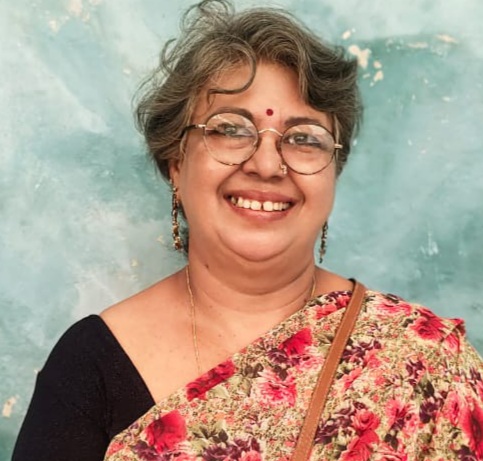
An acclaimed Painter, a published poet, a self-styled green woman passionately planting fruit trees, a published translator, and a former Professor, Lathaprem Sakhya, was born to Tamil parents settled in Kerala. Widely anthologized, she is a regular contributor of poems, short stories and paintings to several e-magazines and print books. Recently published anthologies in which her stories have come out are Ether Ore, Cocoon Stories, and He She It: The Grammar of Marriage. She is a member of the executive board of Aksharasthree the Literary Woman and editor of the e - magazines - Aksharasthree and Science Shore. She is also a vibrant participant in 5 Poetry groups. Aksharasthree - The Literary Woman, Literary Vibes, India Poetry Circle and New Voices and Poetry Chain. Her poetry books are Memory Rain, 2008, Nature At My Doorstep, 2011 and Vernal Strokes, 2015. She has done two translations of novels from Malayalam to English, Kunjathol 2022, (A translation of Shanthini Tom's Kunjathol) and Rabboni 2023 ( a Translation of Rosy Thampy's Malayalam novel Rabboni) and currently she is busy with two more projects.
Table of Contents :: Short Story
01) Prabhanjan K. Mishra
MR AND MRS MURTI
02) Dilip Mohapatra
GOLD FLAKE FOR THE BRAHMARAKSHAS
03) Sreekumar K
TEA BRAKE
TAKEN FOR A RIDE
04) Usha Surya
DID SHE GET THE ANSWER?
05) Deepika Sahu
REMEMBERING THE RAINS : TIME AFTER TIME
06) Satish Pashine
GOOD ARTISTS COPY, GREAT ARTISTS STEAL – CREATIVITY IN THE AGE OF AI
07) Shri Gokul Chandra Mishra
THE DIVINE MESSAGE
08) Annapurna Pandey
SWINGING BETWEEN MEMORY AND REINVENTION: REMEMBERING RAJA IN ODISHA AND ABROAD
09) Triloki Nath Pandey
MY LIFE IN THE VILLAGE – 2
10) Darsana Kalarickal
SEA SHELLS
11) Hema Ravi
CONTEMPLATIVE MOOD
12) Sujata Dash
BOUNDLESS HORIZON
13) T. V. Sreekumar
NO VACANCY
14) Sreechandra Banerjee
THE SADHUBABA
15) Ashok Kumar Mishra
LAST WORDS OF FATHER
16) S. Sundar Rajan
THE COSY NEST
17) Dr. Rajamouly Katta
MARRIAGE OR LOVE
18) Dr. Viyatprajna Acharya
JAGANNATH – THE LORD OF THE UNIVERSE, YET BOUND BY MAN-MADE BOUNDARIES
19) Dr. Protiva Rani Karmaker
RESPECT TO THE BEST STORY TELLER
20) Mr Nitish Nivedan Barik
LEAF FROM HISTORY: FROM FACTORY FLOOR TO PRESIDENTIAL PALACE
21) Dr. Mrutyunjay Sarangi
RED DREAMS
Prabhanjan K. Mishra
“Hello, this is Mrs Murti, the wife of Mr Murti who is travelling in Europe with you in a group of tourists under your leadership. I had to go in this group of yours too, but dropped myself out at the last moment for sudden ill health. I want to speak to my husband very badly.” The erudite voice of a woman, speaking in a clipped and crisp tongue, had just spoken to the group leader-cum-guide of the Savitri Travels, a renowned travel company, taking tourists to show places within and outside our country.
The tourist group’s leader-cum-guide was at that time on a road in Paris leading to the iconic Eiffel Tower. He was herding his big group of forty-eight tourists asking them to walk behind him, following the green flag, held aloft by him. The flag was embossed prominently in white with ‘SAVITRI’, the travel company’s lady owner’s name. The flag was a beacon for the group members to follow the leader and not to stray in a strange city speaking a strange language.
The group leader had been getting calls from the lady’s number from India for the last two days, but he declined the calls as the number was unknown to him. He thought it could be a frivolous or promotional business call, or the caller could be a scamster. But on the third day he took the persistent caller.
After listening to the lady, he replied, “Madam, I am very busy right now, herding my big tourist group to the Eiffel Tower. Would you mind calling me back at ten o’clock tonight, and then we discuss about your husband. Thank you, madam, for giving your valuable time to call Savitri Travels.” His last sentence was a promotional jingle.
The lady’s voice went very cold, “Do you understand Mr…, whatever your name, that all my attempts have failed to contact my seventy-year-old husband over the last three days. He left home to join you at the airport but I don’t know exactly if he is travelling with you. We had made all the arrangements with the mobile network company, so that our mobile numbers remained active outside India. But Mr Murti’s telephone number appears dead. It is urgent for me to know his wellbeing. Give this phone to Mr Murti and let me talk to him. It is urgent.”
The flabbergasted group leader was worried that the lady’s interference might delay his schedule running in clockwork precision, because he had no powers to change the itinerary prescheduled by his company and circulated to the tourists.
He therefore said to the lady most politely, “Sorry madam, I can’t risk my forty-eight people for Mr Murti just now. I don’t know Mr Murti personally, but he is somewhere there in this milling crowd, I mean, my group, because twenty-minute’s ago, I took a head count of my group members while getting down from the bus, and it tallied, indicating all were present, so, your husband was also present.”
After a minute, the leader called back the lady, “Madam, I am shouting hoarse for the last five minutes shouting for Mr Murti to raise his hand but he is not responding. My entire group is standing before me at the Eifel Tower ticket counter. So, to spot him, I need a roll call, separating grain from the chaff, but I have no time right now. I will do it before dinner today and make him talk to you. Thank you for giving Savitri Travels your valuable time.” He went off the line.
The lady called back to say tersely, “You have insulted me by equating my husband with ‘chaff’. I will speak to your managing director and complain against you for your rudeness.” She went off the line. The group leader like most group leaders had thick skin and Mrs Murti’s threat did not penetrate it.
Just before dinner, the group leader suddenly stood up nervously to take a call. Savitri Travel’s MD was speaking, “You bloody Rajeev Sagar, how dared you equate one of our prime guests, Professor Murti, one of our country’s leading theoretical physicists, with chaff? When you deal with VIPs like Mrs Murti, you must maintain our company’s decorum. By the way have you identified Mr Murti? If no, do it just now. Let dinner be late but, first take a roll call by name, separating the grain from chaff, I mean, Dr Ananta Murti from your group’s other tourists. Make him talk to his wife.”
After twenty minutes, the group leader spoke to his boss, the managing director, “Sir, Dr Ananta Murti is safe and sound and enjoying his tour. He is in high spirits but flatly refusing to speak to Mrs Murti or anyone. See him on my video call. Sir. Please tell Mrs Murti accordingly, and also, now that I know him personally, I will take care of him at my personal level.”
Mr and Mrs Murti, formed a sweet-sour couple. Sour, rather with a sour-puss and grouchy attitude towards each other in recent times; but sweet, often sweeter than saccharin to others like friends, relatives, and strangers. They had completed one and a half decade of their marriage and were stationed at a rather complex junction of their life.
For the people close to the Murtis, it was an open secret, but they ignored the couple’s oddity as a normal phenomenon happening to most married couples after living together over long years. The phenomenon usually remained invisible because, it little concerned the members of the society, who were nothing more than a hoi polloi, the layers that clamoured.
The Murti couple, strangely but truly, had started their love-story as college day sweethearts, roughly five decades ago from now. Ananta Murti and Amandaa Shinde studied in the science stream in their college, and were classmates. Ananta Murti, a reserved, reticent, but highly talented young student in Amandaa’s class, had attracted the young, outspoken, and beautiful Amandaa Shinde like a magnet pulling a small piece of raw iron.
They carried on a long courtship until they finished their post-graduation and PhD respectively in Theoretical Physics and Anthropology, joined their respective departments in the university of Bombay (Presently Mumbai) as young junior professors. Then they tied the inevitable knot to live as husband and wife.
As years rolled on and they remained childless, a peculiar and off-beat relationship started to set in between them. The differences crept into their mutual feelings like surreptitious thieves, without making any noise. It started imperceptibly and as insignificantly as Amandaa quietly leaving the major portion of the cup of coffee made for her by Ananta, or Ananta pushing away a fried egg or omelette made by Amandaa for him declaring it as too saltless or bland.
But at the start, such inter-couple skirmishes were settled in bed in each other’s loving arms or soaking the differences in a few drops of tears. But, each one’s dissatisfaction with the other finally grew into a state of unbearable foulness. Mutual allegations of lovelessness ended in bitter squabbles or long silences and sulks, even in bed.
Yet there were cameos in their rancour-ridden relationship. On special days like their birthdays, wedding anniversaries, the commemorations of their first exchange of love, or milestone-achievements like an award, or a citation, or other laurels in their work fields, they would celebrate the occasions lavishly, forgetting differences, sulks, or anger, ending in tender unions in bed.
But on their fifteenth anniversary of the marriage, it did not happen that way, bringing the relief in their suffocating relationship. That rather, served as the day of watershed in their husband-wife bond. Ananta had been touring to serve as external examiner in colleges under his university which had mushroomed in rural areas and small towns that were assigned to him, but he was scheduled to return home on the day of his wedding anniversary to be with his wife.
But Ananta neither turned up nor rang Amandaa what was holding him back. As he was roaming, and mobile phones were not in India yet, Amandaa could not reach him. Out of sulk and frustration, as the clock was to strike twelve midnight on the day of anniversary, she cut the anniversary cake and ate a piece, and then a second piece on behalf of her man of love of two and half decades, and her husband of one and half decades. She alone ate the special dinner she had cooked for both, keeping Ananta’s share of the cake and special dinner in their refrigerator.
Ananta Murti returned guiltily the day after their marriage anniversary, a Sunday. surprisingly his wife did not raise a hell as apprehended by him, except saying cooly, “Mr Murti, don’t be surprised if I am addressing you so formally as such, and please get into the habit of hearing it, as from now on I expect you to drop all pretences and address me as Mrs Murti as well.”
After a pause, she said, “I don’t feel like cooking today. There is enough left-over food in the refrigerator from our anniversary dinner to meet our needs for the lunch today. I cooked a special anniversary-eve dinner for us like every year, but you decided not to partake it with me. Also, there is enough leftover anniversary cake to serve our sweet tooth. I assure you, I have not felt bad.” Her soft commiseration sounded sharper than a sharp rebuke.
She softly continued, “And yes, from today, we have separate bedrooms and separate beds. I have shifted you to the guestroom. Last two nights, I could not sleep as you did not turn up by our anniversary-eve as expected, so I used the time in making the changes. I think you would love it; sleeping more peacefully without my snoring. I keep my snoring, and you keep your love for sleeping in silence. Check, if the changes seem incomplete, feel free to complete them yourself.”
And that was that. From that day their togetherness was complete in its division. First few days, known people in the university campus found it a bit odd that Amandaa and Ananta were addressing each other with indifferent formality and respect as Mr and Mrs Murti, but over months it settled like a bad but flawless habit to hear and accept it.
Now, the Murti couple in separate beds and bedrooms had less squabbles, less sulks, and very little tender expectations from each other. It, over years, felt better than regular ill feelings over denials, unfulfilled mutual expectations, and unrequited desires, resulting in mutual rancour, painful sulks, and long silences. They felt calm, peaceful and more mutually tolerant to each other, like being polite to friends. They were neither chokingly close, nor distant like alien people.
A life of clock-work settled down in the Murti household. With Mrs Murti, the howler, the shouter, the louder one of the Murti-couple, winning the in-house verbal matches against her quiet, subdued, muted life partner Mr Murti almost vanished. No more suppressed rumbles or exploding crescendos, were audible to neighbours. The Murtis moved like shadows just in touching distances inside their house, but careful to see that the other was well.
But late nights were strange hours that make people very lonely. Bodies were stranger animals. Once in a month or two or a few, the late nights pushed the estranged Murtis into each other’s affection-starved arms, ending in tender exchange of love. All complaints and rancour were forgotten in those mysterious hours of give and take.
Thus, the next fifteen years settled into a routine flow with currents and undercurrents. Miasma of a swamp-side, and sweet breath of jasmine from their garden alternated, the swamp marching faster to occupy more space and time over jasmine.
The third phase of further fifteen years of their marriage was presently marching at its half mark, in other words, they were married for roughly forty years. Both had retired as professors and heads of their respective departments of Mumbai University, and with many laurels to their credit, hallowed careers of glory behind them, mementos and medals crowding their walls, both decorated with ‘Padma Shree’ awards by their country’s president.
On the face of growing mutual sourness, the memories of their romantic past, prisoned in photographs in albums locked in show cases were pushed deeper behind the stacks of ‘Bhagavad Gita’, ‘Quran’, ‘Bible’, ‘Jesus, the Man’, ‘Tuka Says’, Volumes of 'Krishnavatara' by K M Munshi, and other such books. Their relationship of a sweet-sour balance had however reached a state of equilibrium like in an ionic solution.
Though living intimately was out of question, but also living without each other’s company seemed out of question. They did not transact much, but they cared for each other more than earlier, as each knew that the other was growing feebler with age. A strange sense of affection and mutual responsibility had descended on the Murtis.
At this juncture of life, like waking up from a sleep, They simultaneously, like with a telepathic communication, decided to take world tours to see places, historical sites, and natural excellences that they never did during their academic overseas’ visits. They wanted hassle-free enjoyment, and so, they decided to travel through a travel company. They found out ‘Savitri Travels, the Next Level’, one of the most reputed ones, had just announced a Europe Tour, and registration was in the process.
The country, rather the world, was limping back to normalcy after the outbreak of deadly Corona Virus. During the lockdowns, people were compelled to stay behind closed doors. Travel companies had to suspend their tour programs inside and outside the country.
As soon as the lockdowns were lifted and outside movements after adequate vaccination was allowed, the travel companies and the tourists starving for action over their yearlong fast from the pleasure of touring, came out like swarms of winged-ants from ant hills in monsoon times. So, the travelling groups were unusually big.
The Murti couple booked themselves into the first group of two-hundred members travelling with Savitri Travels for a tour of Europe over twenty-one days. The group was to start by flight from Mumbai to London, divided into four sub-groups, each of roughly fifty tourists under a group leader-cum-guide, and the four group leaders under a chief leader. The tour would end in Rome from where the group had to fly back to Mumbai.
The entire tour of Europe was to be conducted by four reserved comfortable buses, each group and its leader in an appointed bus, but all the four buses moving in tandem from site to site.
At the eleventh hour, Mrs Murti developed cold feet as she was to share room and bed with Mr Murti after two and half decades, during which he seemed like a stranger. She feigned a big health problem, and let Mr Murti travel alone.
As the days of tour wore on, she missed her husband badly in the university campus, her house, and strangely for the first time in so many years, she missed her husband in her bed. Also, she was extremely concerned about his wellbeing when he was thousands of miles away from her.
So, from the morning of the first tour-day, she tried to talk to her husband but failed. She attributed her problem to disturbances in the connectivity while Murti changing countries. Mr Murti remained incommunicado over three days that worried her no end.
She tried to reach the group leader, who did not take her call, she presumed she had perhaps not put her number in husband’s tour file as the reference number, so it might seem to the group leader as an unknown number from a source of nuisance. But on the third day of her call bought a relief. Though Mr Murti did not directly talk, but she was found hale and hearty in high spirits.
Semi-blissful ten days passed. Though Mr Murti never spoke to her, but the group leader and managing director kept her posted about her husband’s wellbeing. But one morning, on the 19th day of the tour all hell broke loose. A parcel arrived at Murti couple’s home, from a hotel in Pisa, of the Leaning Tower of Pisa fame, Italy. It contained the artistically carved precious walking stick of Professor Ananta Murti gifted to him by Professor Amandaa Murti a year ago, and a little note in bad English
The note appeared to say that the hotel had sent the remains of Murti, a walking stick. The hotel desk was sending the article to Murti’s home address on behalf of Savitri Travels by Blue Dart courier.
Amandaa interpreted it that her husband was dead leaving behind the walking stick. She was devastated, crying her heart out, howling, wailing, and sobbing non-stop. She directly spoke to the managing director, “Where is the body, you irresponsible bastards? My husband has died, and not a whisper of it to me from any of you. Why have you dispatched only his walking stick? Was he lost by falling down the gorges of Mount Titlis, Switzerland, and you could not trace his body?”
A shocked and embarrassed MD stammered back apologies over telephone, “Madam, I am really sorry. I am not on the loop with my travelling group leaders about this tragedy. I will sack all of them. May your husband’s noble soul rest in peace (RIP). Detailed report will be with you in half-an-hour. Your loss is irreparable, but we try our best to compensate the loss.”
After half an hour, a detailed report reached Dr Amandaa Murti. – ‘Mr Murti is hell and hearty and watching around Rome. He had forgotten his precious looking walking stick in the hotel room at Pisa, Italy, while checking out. The hotel desk unable to deliver it to him as his touring group was on move, sent it to his home address by Blue Dart courier. Further, at the end of Europe tour he was not returning home, as he on arrival would jump into another touring group at the airport itself that would tour Australia for twenty days, and then join a Singapore-Thailand-Malayasia tour group, followed by a tour to Japan and then South American countries, so on, so forth, and back-to-back from the airport.’
It was apparent, Mr Murti was not coming back home for months. Now, the great proverb, “Absence makes the heart grow fonder” was working overtime on Mrs Murti’s psyche and she wanted him in her house, on her dining table, by her side in her room, in her bed, and finally in her arms again after the years’ of hiatus. She wanted to start her affair with Ananta all over again. She promised herself, “Let the rascal return, I will build a Taj Mahal and present him.”
People close to her heard about her and giggled, a close female friend of hers giggled the most, and pulled her leg, “I can help you Amu, in your Taj Mahal project. I saw in AKEA site that a ready kit ‘assemble yourself’ variety is available for five thousand bucks, with marble finish and all the works.” But Amandaa wasn’t amused, and she whacked her friend on the head with the rolled-up newspaper she was reading. She went solemn and whispered, “People like you, with brains the size of peas but mouths the size of watermelons, would not understand our ‘Love in seventies’. (END)
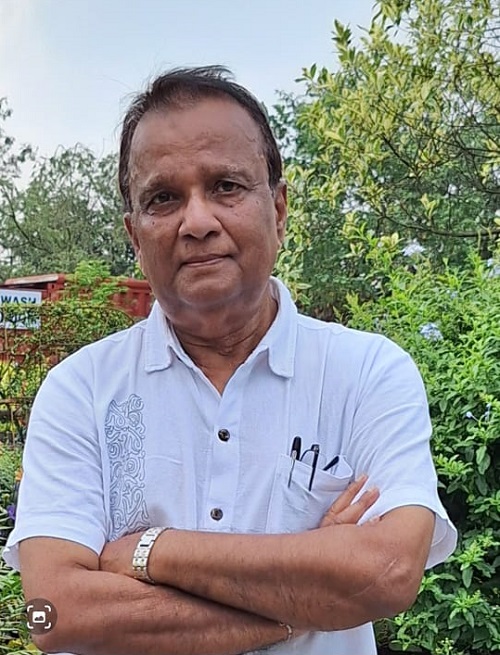
Prabhanjan K. Mishra is an award-winning Indian poet from India, besides being a story writer, translator, editor, and critic; a former president of Poetry Circle, Bombay (Mumbai), an association of Indo-English poets. He edited POIESIS, the literary magazine of this poets’ association for eight years. His poems have been widely published, his own works and translation from the works of other poets. He has published three books of his poems and his poems have appeared in twenty anthologies in India and abroad.
GOLD FLAKE FOR THE BRAHMARAKSHAS
Dilip Mohapatra

Deepu was thrilled and his excitement knew no bounds. He was eight years old, a student of class four studying at Cuttack where he lived with his parents. It was his school vacation and he was visiting his grandparents in a remote village near Talcher, a colliery town in Odisha. He had managed to convince his grandfather to allow him to go to the railway station with the family’s wiry old servant Nara, to receive his aunt coming from Puri. During those days the only means of transport from the village to the rail station was the bullock cart rumbling on the meandering dirt roads and the distance of about six miles could be covered in about two hours.
The bullock cart was the lifeline of village transport—simple, sturdy, and indispensable. It ferried everything: heaps of harvested paddy, sacks of manure, bundles of cattle feed. At times, it doubled as a water tanker, with empty oil drums lashed onto its frame to haul water from the pond. When needed, it hauled bricks, sand, and cement for house repairs. And now and then, with a layer of straw and a colorful rug, it transformed into a passenger coach—slow, rhythmic, and oddly comforting.
The train from Puri used to arrive at unholy hours well past midnight, mostly delayed for a couple of hours for some reason or the other. Receiving some visitor at the station used to be a well calibrated operation.
The first item on the agenda was to make the cart ready for passenger service. Nara set about readying the cart with quiet efficiency, his hands moving with practiced ease. First, he spread bundles of paddy straw across the wooden bed to form a soft base. Over this, he laid a narrow quilt and topped it with a bright jute rug, securing everything tightly with coir ropes to keep it in place. Then came the bamboo-reed bonnet, arched neatly over the cart, followed by a tarpaulin sheet stretched snug over the top to guard against dew. He stepped back and admired his handiwork—it looked, to Deepu, like a prairie wagon straight out of a comic book. Nara lit a lantern and hung it under the front axle, its soft glow dancing on the wheels. Finally, he fed the bullocks and tied little bells around their necks. When all was ready, he let them rest before the night journey began.
Deepu was dressed in his best shorts topped with a striped T shirt. His grandmother had given him few coins to spend at the rail station stalls on cookies and lollipops while waiting for the train to arrive. He felt as if he were on cloud nine. A bullock cart ride across the lonely tracks through paddy fields and mango groves in a moonlit night was surely promising to be adventurous. He would also be meeting his aunt after a long time. She used to dote on him and pamper him with goodies when he was younger. But the icing on the cake was to spend almost two hours in the company of the old codger Nara, who claimed to have seen more than his share of the otherworldly. Deepu had once asked him if he believed in ghosts to which Nara had replied,” Ghosts? Of course. In fact I had the chance to work with one.’ On Deepu’s pleading, he had promised to tell him about his eerie experience on the way but only if he is paid for his services.
Nara threw a knowing smile at Deepu accompanied by an imperceptible wink, and helped him to climb the cart and settle down comfortably. Then he got the bullocks from the shed and yoked them to the cart. When the cart was ready to move, he pulled himself up and sat astride the frame of the cart in front of the bonnet, both his legs dangling and tapped the bullocks’ bellies with his toes. The bullocks started off dragging the cart while the bells around their necks jingled in unison.
As the cart turned into a rather secluded road at the outskirts of the village, Deepu peeped through the gaps between the bamboo reeds of the bonnet and saw a half crescent moon covered with a thin veil of cloud beaming down. As he looked ahead over Nara’s shoulders he found the cart slowly moving between paddy fields, the plants swaying with the breeze creating the illusion of giant green waves moving to and fro like tidal streams in the sea. On the far side of the fields the cicadas were singing in rows of trees, which looked like ghosts nodding their heads. Deepu snuggled up to Nara and whispered in his ears about his promise to tell him about the ghost which he had experienced. Nara extended his palm and asked for his fees, twenty five paisa to cover his expenses on bidi. Deepu pulled out a coin from his pocket and handed over to him.
Nara leaned closer, a bidi dangling from his lips, and began.
“ This happened years ago,” he rasped, eyes narrowing. “I’d fixed up with my friend Hari to go do Shena work early — before first light.”
“But first, do you know what is this Shena job?
Let me tell you what it is.
It is an irrigation practice which involves two people, who use a bucket or a tin can tied to ropes to lift water from a pond or a canal. They stand on both sides on small platforms and swing the bucket in unison to dip it in water and lift it in a rhythmic motion and then splash it into the irrigation channels leading to nearby fields.”
He paused a little and continued,
“ You know how it is, water’s calm, the air’s still, and not a soul about. I called out to Hari at his house and he came out quietly draped in a shawl, his head covered, didn’t say much. Just nodded and walked alongside me.
“I thought maybe he was sleepy. He answered in yeses and nos — nothing more, by nodding or shaking his head. We reached the pond. Moonlight still clung to the trees. We stood on either side of the channel, and started scooping water — swing, dip, throw… swing, dip, throw… for almost two hours.
“Then, just as the sun’s upper rim touched the horizon and the world turned gold, I paused to light my bidi. When I looked up again — he was gone.
“Not just walked off. Gone. No sound, no ripple in the water, no footsteps.
“I called out, no reply. I searched the path back, heart pounding. Reached his house and knocked like a madman.
“Hari opened the door — eyes full of sleep — and said, ‘Sorry, Nara. I overslept today.’
“That’s when it hit me. The one who came with me — wasn’t him. It was something else. And had it not been for the amulet my mother tied on my arm years ago, who knows what would’ve happened.”
Nara paused, puffing slowly on his bidi, while Deepu sat wide-eyed, goosebumps crawling up his arms. Somewhere in the distance, a barn owl hooted, and the shadows deepened.
Suddenly the bullocks slowed down and the cart rode over a bump. Nara was egging the bullocks on to pull harder. The cart wheels were creaking while the bullocks were struggling to climb over a slope. And soon it got steadied and they were rolling over a hard road on the bank of the village pond. On the other side of the pond was a patch of land that was used as the cremation ground by the villagers. Deepu had heard that this was the place where ghosts played kabaddi with each other on the full moon days. Though it was not a full moon day Deepu was hopeful to see at least some ghosts roaming the ground. Deepu’s eyes filled with fear as well as curiosity scanned the distant moonlit ground to detect any movement on it but it was bare and barren. Suddenly the quietude was shattered with the piercing cries of some animal close by. Impulsively Deepu almost leapt into Nara’s back and held him tight. Nara pacified him and told him that it was just some stray jackal and he had nothing to worry about.
The cart had now left the bund behind and entered a thick grove of mango trees. As it ambled across, Deepu felt that they had entered a tunnel. The moon above had been obscured by the canopy of the trees and the feeble light from the swinging lantern made stroboscopic patterns on both sides of the cart, while casting the shadows of the rotating wheels on the foliage. The jingling of the bells around the necks of the bullocks appeared to have gone louder. Deepu had become relatively calm, though his hands had tightly held on to Nara’s gamchha hanging across his shoulders.
Nara with a crooked smile looked back over his shoulder and asked Deepu to relax. He then pulled out a tattered picture of Lord Hanuman from his pocket and handed it over to Deepu.
“ Look, Deepu baba, this is a picture of the great monkey God who had served Lord Ram and fought with him in his battle with the evil king Ravan. He had great powers and the ghosts and goblins are most scared of him. If you keep this picture with you and chant ‘Jai Hanuman’ they will stay away from you and will not dare to bother you.’Deepu snatched the picture from Nara and held it close to his pounding heart.
Nara chuckled and continued, “ When Hanuman is with you forget about ordinary ghosts, even a Brahmarakshas will not dare to come near you.”
“Brahmarakshas? Is it bigger than a ghost?”, Deepu asked with raised eyebrows.
“If you break the word Brahmarakshas into two parts, you will know what it is. Brahms refers to Brahmin, who is wise, pious and righteous and Rakshas, which literally means an evil demon signifying malevolence and destruction.”
“It is believed that when a Brahmin deviates from the path of Dharma and commits sins, he is cursed to take rebirth as a demon known as Brahmarakshas.”
Deepu interrupted Nara from his monologue and asked if Ravan was a Brahmarakshas. He had read that Ravan was the son of sage Vishrava and the brother of Kubera, the god of wealth. He was also known for his wisdom. But he was regarded as a demon and met his last in the hands of Lord Ram.
“ Yes, Ravan may be considered as a Brahmarakshas,” confirmed Nara.
Meanwhile the cart made slow progress and exited from the mango grove to enter the outskirts of a village called Deulberah on the way to the rail station. Deulberah was a colliery which used traditional shaft mining to extract underground coal. The village was asleep except for some coal mine workers sipping tea around small coal bonfires waiting for their shifts to go into the mines. The lonely road winding through the quiet village street created a ghostly scene. The smell of coal dust, the repeated clangs of distant metals interrupting the total silence evoked a creepy sensation.
Suddenly Deepu asked Nara if he had ever seen a Brahmarakshas.
“ Of course. I have come across one many times, mostly on my trips to the railway station. In fact now we are travelling through the Brahmarakshas area. He is the real ruler of Deulberah and the king of the underworld beneath it.”
“They say he guards the wealth under the earth- never rests, never forgives those who cross his path.”
“ But hold on. Are you really interested to see him? I can arrange that.”
“ Oh yes. Please show him but from a distance. I don’t have to worry as you have said since I have the picture of Lord Hanuman with me,” Deepu mustered enough courage to plead.
“ Alright then, let’s make a deal. I must revise my fees for getting you to see him. Ghosts are one thing but a Brahmarakshas is something else. Ghosts, bidi will do but for this one I’ll need a packet of Gold Flakes. And for that your charges will be just one rupee. OK?, proposed Nara sheepishly.
Deepu picked up a one rupee coin from the little bag that his grandmother gave him when he started and placed it on Nara’s extended palm without any hesitation but with anticipation brimming in his eyes. Nara pocketed the coin with a grin and poked the bullocks to speed up.
After a while Nara steered the bullocks to the side of the road and brought the cart to a stop. From this vantage point that he chose, a huge form silhouetted by moonlight materialised as if from thin air and loomed ominously.
Nara lowered his voice gestured towards the sinister looking shape, “ There! Look close Deepu baba, see that huge round head, those long arms and those legs standing apart? That’s no tree. That’s him. The Brahmarakshas guarding the entrance to his underground kingdom.
Eyes wide in wonderment, heart pounding against his rib cage, Deepu had retracted himself into the safety of the bonnet and peered through the cracks between the bamboo reeds, while clutching the picture of Hanuman close to his heart and chanting Hanuman’s name fervently in an undertone. For the next few minutes, time stood still for him and he was transported into a delirious domain. He was shaken off from his reverie with a jolt as the cart started moving once again and the menacing manifestation gradually dissolved in the distant horizon.
After a mile or so the village road met the state highway coming from Talcher township to the railway station. Once on this concrete road the cart picked up speed and reached its destination almost a hour after midnight. Nara unhitched the bullocks from the cart, tied them to a pole outside the rail station and put some hay for them to eat. Then he bought two platform tickets from the ticket counter and both of them entered an almost deserted railway station. The train was yet to arrive. They found a vacant cement bench under the shed of the platform and parked themselves. Deepu scanned the scene around and found a few passengers strolling leisurely. A few people, draped from head to toe in thick bed sheets were sleeping peacefully on other cement benches. A small group gathered in front of the lone tea stall selling tea, bidis, cigarettes and some local eatables. He could see few forlorn goods coaches parked in the yard in front of the platform.
Nara found out from the station master that the Puri-Talcher passenger train was detained at Cuttack station because of some problems with the engine. A replacement engine from Khurda junction was expected shortly to resume the journey and the train was not expected before 5 AM. Deepu was at his wits end and didn’t know how to kill time. The supernatural encounters were enough for the day. He went to the tea stall and picked up two nankhatais, a type of local cookies for himself and bought two samosas for Nara. Nara was only too happy to oblige him. Nara picked up a packet of Gold Flakes which was a rare commodity and unavailable in the village betel-shop. Deepu finally curled up on the bench covered himself with a shawl and went to sleep, while Nara squatted close by and lit a cigarette from the new pack.
Finally the train chugged in and came to a screeching halt spewing steam, during the early morning hours. Nara shook Deepu from his sleep and both saw his aunt alighting from a compartment close to the engine. Deepu broke into a run to greet his aunt. His aunt was overjoyed to see the little fellow after a long time and as he bent down to touch her feet, she picked him up and held him in a tight hug. Nara deferentially picked up her baggage and led them to the cart. Soon the return journey began as the morning sun slowly rose above the horizon.
After the cart left the state highway and hit the dirt road, Deepu’s aunt commanded Nara to stop at a tea-shop while passing through Deulberah colliery for a tea break. Nara nodded quietly while both the aunt and nephew were engaged in conversation about family and festivities. After a while, Nara stopped the cart near the tea shop at Deulberah and asked them to get down in case they needed fresh air. The aunt got down and offered her help to Deepu to get down. But Deepu refused and wanted to stay inside the cart. The aunt found him cowering down in a corner struck with an unknown fear. Deepu was seen holding Hanuman’s picture in unsteady hands and reciting the name of Hanuman. The aunt was visibly intrigued and asked Deepu what was the problem. Deepu quietly pointed out to the direction where stood a giant contraption, the mining shaft tower in all its glory. She coaxed him to come out and asked why was he so afraid of this tower. Deepu blurted out that it was a Brahmarakshas guarding the entrance to the nether world.
The Aunt had a hearty laugh and said, “ Rubbish. Who told you so? This is just a mining shaft. See those round things on top. These are the sheave wheels which are rotated by a motor and act as winches to hoist workers, equipment and material through wire ropes connected to the mine cages. So don’t be afraid. Come, take a closer look.”
Deepu looked at Nara sceptically who was standing in the corner of the tea shop nonchalantly sipping tea from a mud cup and intermittently puffing a Gold Flake.
Deepu said nothing. But deep down, he knew Nara had tricked him—and yet, he wasn’t angry. Some stories were worth a rupee for a pack of Gold Flake.

Dilip Mohapatra, a decorated Navy Veteran is a well acclaimed poet in contemporary English and his poems appear in many literary journals of repute and anthologies worldwide. He has seven poetry collections, one short story collection and two professional books to his credit. He is a regular contributor to Literary Vibes. He the recipient of multiple awards for his literary activities, which include the prestigious Honour Award for complete work under Naji Naaman Literary Awards for 2020. He holds the honorary title of ‘Member of Maison Naaman pour la Culture’. He lives in Pune and his email id is dilipmohapatra@gmail.com
Sreekumar K
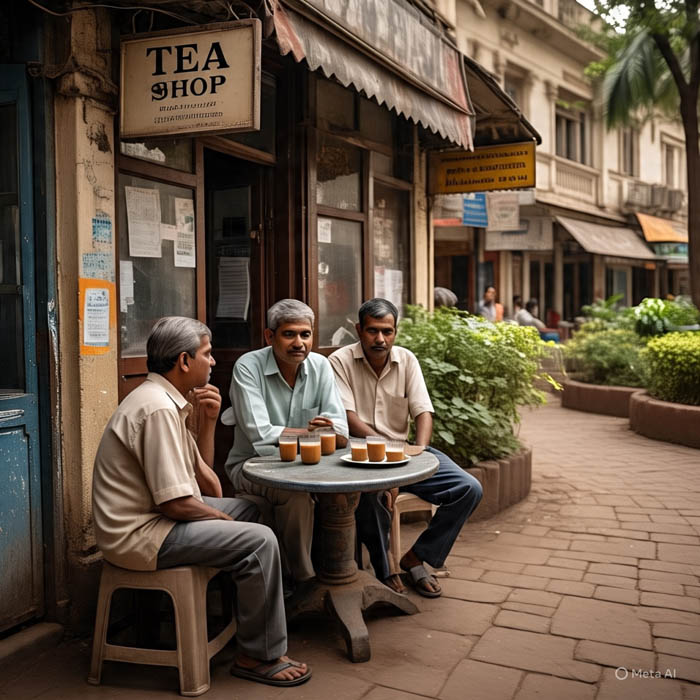
By the evening of our lives, we may be going too fast, too recklessly, totally unaware of where we are or what we are. That is when we need speedbreakers to slow us down. Today, for me, it happened at a restaurant.
The morning air was thick with the scent of damp earth and freshly brewed tea as I walked toward the familiar restaurant. It had been two months—two long months since I last sat there, sipping tea with Vellu, watching the world wake up around us. The place hadn’t changed much—a small, open-air space tucked into the courtyard of a shopping center, two round tables and eight mismatched chairs, probably bought from OLX.
I used to be the first one here. Every morning, like clockwork, I’d arrive before the owner even unlocked the shutters. The routine was sacred: lift the second table—always kept upside down on the first—set it right, arrange the chairs, and settle in. By the time the regulars trickled in, I’d have already finished two cups of tea and two crispy vadas, my fingers still warm from holding the steel tumbler.
But today was different. As I approached, I noticed a scooter parked haphazardly near the entrance, its front wheel jutting out, blocking half the pathway. A young man in a checked shirt stood at the counter, sipping tea, oblivious to the inconvenience he’d caused.
I hesitated. In the past, I wouldn’t have thought twice—I’d have told him to move it. But these days, speaking up felt different. People’s patience had thinned; tempers flared quicker. Still, the sight of the obstructed entrance gnawed at me.
"Excuse me," I said, my voice firmer than I expected. "Your scooter is blocking the way."
The man turned, eyebrows raised. For a second, I braced for a sharp retort—Who are you to tell me? Mind your own business, old man.
But instead, he blinked, glanced at his scooter, then back at me. "Oh. Sorry," he said, setting his half-finished tea on the counter. Without another word, he walked out, nudged his scooter into a proper parking spot, and even turned to give me an apologetic nod. "Didn’t realize it was in the way."
I stood there, surprised. No argument, no resentment—just a simple correction.
Pondering this, I walked in. Two strangers sat at one of the tables, hunched over their steaming cups. What caught my eye, though, wasn’t their presence—it was where they had placed their tea. Right on the upturned base of the second table, still stacked upside down on the other. As if it didn’t matter. As if it wasn’t meant to be moved at all.
A pang of something—annoyance? sadness?—shot through me. I hesitated, then walked over.
"Mind if I set this down?" I asked, gesturing to the upside-down table.
They glanced up, indifferent. One of them shrugged. "It’s fine like this."
I stared at the table. It wasn’t fine. It was wrong. But my arms didn’t lift as easily as they used to. My breath came a little harder these days. Still, I gripped the edges, strained, and—with a grunt—flipped it over. The legs hit the ground with a thud.
One of the men, a middle-aged fellow with tired eyes, watched me. "Heavy, isn’t it?"
I wiped my hands on my shirt, breathing slowly. "Not the weight," I said. "Just need the will to do it."
"And the willingness," I added, fully aware that my smart wordplay would be lost on him. And even if he caught it, he would only moan, labelling it as clumsy and laboured.
He studied me for a moment, then nodded, not in agreement, but in something else. He smiled at me with an air of awe and respect.
I sat there, cradling my tea. The first sip was bitter, just how I liked it. Around me, the morning murmur of the regulars filled the air—talk of politics, grandchildren, the rising price of onions. But their voices felt distant, like I was listening through water. I felt like a guest from a different time frame.
Then it hit me.
On impulse, I turned toward the small mirror hanging crookedly above the washbasin. The face staring back wasn’t mine. Or rather, it was, but not the one I remembered. The hair thinner, the jaw softer. Even my teeth—once strong enough to crack betel nuts—now sat loosely in my gums, yellowed with time.
A chuckle escaped me, dry and humorless. The table wasn’t the only thing that had flipped.
The man who had spoken earlier slid a plate of vadas toward me. "On me," he said.
I wanted to refuse, but my fingers reached out on their own. "Thank you."
He smiled. "You’re welcome, appooppa."
The word settled over me like a shroud. Appooppan. Grandsire. A term of respect—and a reminder.
Time hadn’t just passed. It had carried me, gently and without warning, into a different season of life, a grey one. And now, here I was—sipping tea in a place that remembered me better than I remembered myself.
I took another sip. The bitterness tasted sweeter now.
Or maybe that was just acceptance.
Sreekumar K
Six years.
Some days it felt like six days. Other times, it stretched across her spine like a century-old ache.
Surabhi woke to the sound of the doorbell slicing through the quiet hum of the ceiling fan. A glance at the clock on the wall—8:47 AM. She’d overslept. Her younger son’s socks lay unpaired on the floor, and a thin film of milk had formed on the untouched tea in the kitchen. Her routine was a thin thread she held on to, and today it had snapped.
She reached the door barefoot, in a crumpled kurti, hair still tangled from sleep. A tall man stood outside, his helmet tucked under one arm, early sweat darkening the underarms of his shirt.
“You’re selling the Yamaha?” he asked. No greeting.
Surabhi blinked at him. It took her a moment to remember. The ad. Her brother-in-law had posted it weeks ago—without her consent, she now realized. They’d argued about it over the phone. She’d ended the call halfway.
“I’m not selling it,” she said, flatly.
“But this is the address from the listing,” he said, showing her his phone. “And this is the bike, right?” He stepped to the side, looking toward the covered vehicle in the portico.
Surabhi stepped out, pulling the dupatta tighter across her chest. The blue tarp still lay neatly over the two-wheeler, tied with a fraying rope. She hadn’t uncovered it in months. Dust gathered like guilt—soft, silent, and unshakable.
“That ad was a mistake,” she said. “It’s not for sale.”
The man shifted uncomfortably, not in anger but confusion. “I came from Payyannur. Took the early bus. You could have at least removed the post.”
“I told him not to post it. You’ll have to take it up with my brother-in-law.”
A silence stretched between them. The man looked down at the tiled porch. A few dead leaves stirred. In the distance, children screamed on their way to school.
Finally, he said, “I’m sorry for your loss. Must’ve been a good bike, the way he kept it.”
Surabhi’s throat tightened. She hated when people used the past tense for Anish—was, had, used to. There was no language for the half-life she’d lived through, for the stain his absence had become.
The man nodded, polite but resigned, and left. The sound of his scooter starting pierced the morning stillness. She watched until he disappeared down the narrow lane, then turned back inside.
Her hands trembled as she poured out the cold tea. The bike remained, a relic of a past she both grieved and detested. She didn’t want to sell it. She didn’t want to keep it either. But between the two, keeping felt more like penance.
The bank was colder than Surabhi remembered—not in temperature, but in atmosphere. The walls were pale blue, institutional and expressionless. The security guard gave her a faint smile that didn’t reach his eyes.
She waited in line behind a man who smelled of sweat and soap, holding a cheque in one hand and a wrinkled ration card in the other. When it was her turn, she approached the desk quietly, clutching a folder with documents that had long lost their sharp corners.
“Mrs. Surabhi Anish?” the manager asked, glancing at the file.
She nodded. Her voice didn’t trust her enough to speak.
The manager was young, with gelled hair and the kind of polite detachment people in his role mastered early. He looked over the insurance papers, the death certificate, and then at the amount.
“Most of this came in about a year after the accident?” he asked casually, like he was confirming a delivery.
“Yes.”
She hated how that word sat in her mouth—small, final. It always felt like a betrayal, like the world had decided and she had agreed. Yes, he’s dead. Yes, this money is real.
“You're eligible to withdraw or reinvest,” he continued. “My suggestion? Keep a small amount for immediate expenses and deposit the rest as a fixed deposit. The interest is decent. You’ll be safe.”
Safe. The word clawed at her. As if any part of this was safety. As if money earned through blood and asphalt could offer anything other than a bitter taste.
Still, she nodded. “Do it.”
They filled the forms. She signed where he told her to, her hand mechanical, as though she were forging someone else’s name. Each signature pressed into the paper with a weight that wasn’t hers.
When the transaction was over, she left with a passbook and a folded receipt. It felt heavier than it should, as though it contained more than numbers. It felt like proof—of something too ugly to name.
Outside, the sun glared down. She walked to the tea stall across the street, ordered a small chai, and stood alone as the city bustled around her.
The tea burned her tongue. She didn't mind. It was the first thing that reminded her she was still capable of feeling something.
She took out the receipt and stared at it again.
Insurance payout. Maturity date. Nominee: Surabhi Anish.
She folded it slowly and tucked it back in her bag.
It wasn’t money. It was residue. Remains.
She didn’t know what was worse—that she’d needed it, or that she had accepted it.
The biryani was too oily, too spicy, but Surabhi ate it anyway. She had skipped breakfast, and the heat in her chest from the bank still hadn’t gone away. The restaurant was noisy, crowded, and the air was thick with sweat and fried meat. She didn’t mind. It was easier to eat among strangers than return to the silence of her own kitchen.
She packed a parotta and a boiled egg for the evening and made her way home.
The house was dim when she entered—curtains half drawn, fan circling overhead in its usual lethargic rhythm. She lay down on the divan, the biryani sitting uneasily in her stomach. The ceiling had a crack running through the middle, a thin jagged line she had never found the will to repair.
She closed her eyes.
But sleep did not come.
Instead, the memories did.
________________________________________
The first time she met Anish, he was wearing a pale yellow shirt and an uncertain smile. He didn’t talk much during the engagement. Her parents liked that. He worked in a private firm, earned decently, didn’t smoke, didn’t drink.
“I won’t drink, I promise,” he had said later, after the wedding, when they were alone for the first time. "Not a drop."
She had smiled. “Good. That’s all I ask.”
The first six months were everything everyone said marriage should be. Sunday movies. Evening walks. His laughter when she overcooked the rice. The two of them burning toast together at breakfast. They were poor, but not unhappy.
Then came the first lie.
A colleague's birthday. A late night. The smell of something sharp and sour on his breath. She confronted him.
“It was just one beer,” he said, brushing past her. “It’s not a habit.”
It became a habit.
________________________________________
At first, it was only on weekends. Then after work. Then sometimes even before work.
When she protested, he laughed. “You’re acting like I’m some drunkard on the street. Relax.”
Then came the job loss.
“It’s temporary,” he said.
It wasn’t.
She watched as the house slowly emptied—first the washing machine, then the fridge, then the sofa. Each thing sold to a friend, or a cousin, or some man who came with a truck and no questions.
Debt followed, like a stain you couldn’t scrub out. Loan sharks at the gate. Shouting in the night. Once, he raised his hand. Only once. But that was enough.
She had thought about leaving.
But Anish made sure she understood.
“You think you can just walk out?” he said once, drunkenly clutching her arm. “You're trapped here with me. Like I'm trapped with myself.”
________________________________________
The bike came next.
She didn’t even know they had money for it. One day, the car was gone, and the bike was parked outside.
“It’s easier,” he said. “Faster. More economical.”
He started disappearing on it for hours. Returning scratched. Limping sometimes.
The final accident didn’t surprise her. It had been building for months—each bottle, each crash, each time she told herself let it be.
She remembered the ICU. The machine noises. The blue sheets. His body that didn’t feel like his anymore.
She didn’t cry.
She stood in the corridor for hours with dry eyes and a stone in her chest, wondering when exactly she had stopped loving him—and whether that had made her cruel.
________________________________________
Back in the present, the ceiling fan creaked softly.
Surabhi sat up, her mouth dry, heart racing. She felt like she hadn’t breathed in an hour.
She opened the window. Light spilled in reluctantly, washing over the untouched furniture, the half-wilted money plant on the windowsill.
She couldn’t rest. Not today. Not yet.
Guilt wasn’t a scream. It was a weight. It sat beside her quietly, day after day, never demanding, only staying.
The alarm pierced through her dreamless half-sleep like a sharp needle. 4:30 PM.
Surabhi sat up, dazed. Her head throbbed faintly, her body heavy from the lunch, the heat, the memories.
Then she remembered. Jayadev.
The name arrived not with joy or dread, but a quiet thud in her chest—like a hand knocking at a closed door.
She splashed water on her face and stared at herself in the bathroom mirror. Her hair was a mess. There were creases on her cheek from the divan pillow. She didn’t bother fixing either. What was the point in smoothing the surface, when everything beneath it still cracked?
Jayadev had texted her two days ago. “Let’s talk properly. Just us. No pressure. Coffee?”
She had agreed, out of politeness. Or hope. Or simply because it felt like time had paused long enough.
Today, she wasn’t sure.
________________________________________
The café was a quiet one—tastefully painted, filled with too much light and too little history. She found Jayadev seated at a corner table, reading something on his phone, a coffee untouched before him. He looked up as she approached and smiled, warm and careful. The kind of smile meant to comfort.
“Surabhi,” he said, standing.
She didn’t smile back. Just sat.
“You okay?” he asked, gently.
She nodded. “I didn’t sleep much.”
“Still thinking about...?”
He trailed off. He never said Anish’s name aloud. She didn’t blame him. Some names carried a kind of superstition, like they might trigger something if uttered.
“I went to the bank today,” she said instead.
Jayadev looked at her. “Insurance money?”
“Yes.”
“And?”
“I hate it.” She didn’t look at him as she said it. “I deposited it. Most of it. But I feel like I’ve been paid for surviving.”
He said nothing. He waited. She appreciated that.
She took a deep breath.
“I need to tell you something,” she said. “Before anything goes further between us. Before we talk about marriage or blending our children’s routines or weekend groceries or any of it.”
He nodded.
“I don’t know if I wanted Anish to die. But I didn’t stop it either. And that thought—it doesn’t go away.”
Jayadev’s expression didn’t shift. That scared her more than if he had recoiled.
“I used to pray for peace. I used to think, if he just leaves me—if he disappears—maybe I’ll breathe again. And then he did. But not in the way I imagined. And now... every time I think about moving on, I feel like a fraud.”
Still, he was silent.
She looked up. “Say something. Please.”
Jayadev leaned back. He looked older in that moment. Not tired, but bearing the weight of things he hadn't prepared to carry.
“I don’t think peace comes clean,” he said. “I don’t think it ever does.”
She stared at him.
“I’m not here to erase your past,” he said. “But I won’t pretend I understand it, either. You don’t owe me healing, Surabhi. But if you want to try—if you want to say it all, again and again, until it stops hurting—then I’ll sit here with you as long as it takes.”
Her fingers tightened around the edge of the table. For a moment, she thought she might cry. But she didn’t. She never did at the right time.
She simply nodded.
Surabhi returned home just past ten. The dinner with Jayadev had been quiet, almost tender. They’d talked about trivial things—his son’s science project, the best route to Kozhikode, an odd article on the fall in tomato prices. He didn’t push her. She didn’t volunteer. The silence between them was not empty, but it was kind.
The house welcomed her with stillness. The children were at her mother’s for the weekend. She switched on a single light in the living room, unhooked her earrings with a tired motion, and placed her sandals neatly beside the shoe rack. Old habits—disciplines inherited from her first life—still ruled her body.
She drank a glass of water and went to bed without changing. The ceiling fan circled above, cutting the air into sluggish ribbons.
Sleep didn’t come.
________________________________________
Around 11:30, she heard it.
A low engine growl outside the window. Then another. Then a sharp, sudden rev—aggressive, intrusive. Followed by a pause. Then again.
She got up, pulled the curtain slightly to the side.
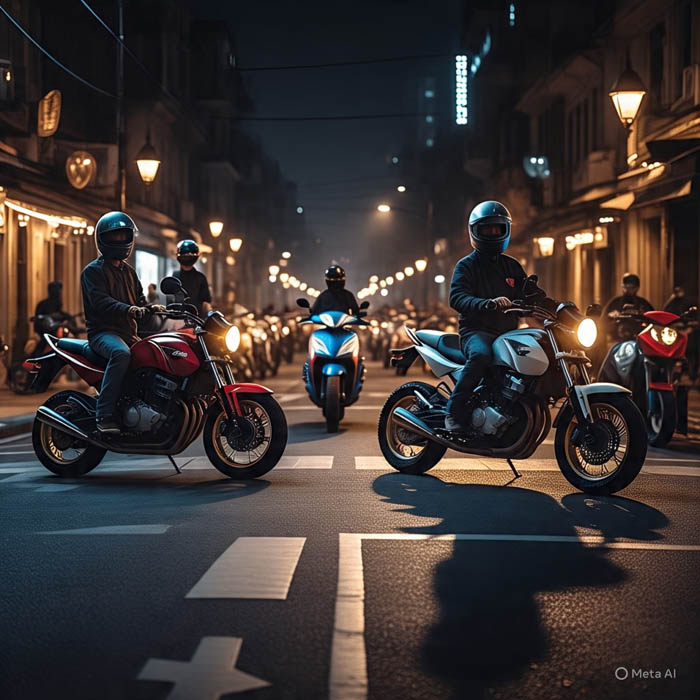
Three bikes. Black, red, and silver. Teenagers, maybe. They sped past, doubled back, turned and roared again. Laughing, shouting, riding dangerously close to the gutter.
Then they disappeared.
Silence.
Then, after a few minutes, another bike. Different engine. A slower purr. It passed the house. Then another rev. Then silence again.
She sat on the edge of the bed, waiting.
Why was it that she could hear only bikes tonight?
No cars. No autorickshaws. No late buses. Just motorcycles. As though the world had been boiled down to two wheels and a growl of metal.
She closed the window and lay back down.
Sreekumar K, known more as SK, writes in English and Malayalam. He also translates into both languages and works as a facilitator at L' ecole Chempaka International, a school in Trivandrum, Kerala.
Usha Surya
The flight was late by two hours since a dust storm and impending rain had threatened the take off from the Delhi airport. But the dust storm abated and the clouds got blown away. Shyam was happy when the flight to Chennai tore across the sky. Anamika was happy to see him.
“You must be famished,” she said.
Shyam drew a chair and sat at the dining table.
“Oof! I AM hungry.” He smiled.
Anamika placed two plates on the table mats and arranged the dishes on the runner.
The fragrance of the hot rice, sambhar and the ivy gourd fry mesmerised Shyam and he served himself.
“Ah!! Feels so good after four days of dry rotis and dal and the masala tainted curry!!” he said and dug into his food.
“You have been thoroughly spoiled Shyam! I would love to eat those chappathis for a change,” smile Anamika as she filled her plate.
“Yes. Everything tastes good for two days but one longs for sambhar rice and curd rice after that,” said Shyam, taking another ladle of the ivy gouts fry.
“Ah!! By the way, I saw a truck entering through the gate in front of me, laden with bricks. I asked Dhal Bhahadur and he told some gruesome details of a murder that had taken place here and the decision to remove that side door,” said Shuyam. “Hope you were not scared much Anami.”
Anamika did not reveal that she was a witness to the crime and spoke with a level head.
“Yes!! Terrible when I heard about it in the morning. There were strong winds and luckily I closed the window and went to sleep early. I discovered only in the morning that there was a murder! Some intruder had got in through that side wooden door. But it started raining so hard, I think the Police have been unable to solve the crime! It was sad!! Nobody knew who the victim was. They have presumed that the assailants came after him through that door. The rain had washed away all the clues. I feel sorry for that guy. I requested the Inspector up on the fourth floor to help closing the wall and he has acted promptly, thank God!” said Anamika and changed the topic.
Hectic activities were going on and the door had been removed and the void filled up with bricks. That side of the wall had a fresh coat of paint. It was a day’s job.
Shyam was having his breakfast the next morning.
“The Inspector came for a walk as usual. I thanked him on your behalf too for closing up that doorway. He was talking a lot. Very strange...he never used to talk so much. Anyway, as I told you it is good to have a Police Officer in the building.”
Shyam was in a hurry and left for office early.
Anamika went about her work.
A big secret lay buried - hidden deep in her heart.
But then why did he do it, she wondered.
“It is good to have a Police Officer in the building, as I told you,” she recalled Shyam’s words.
Was it?
She did not say a word to Shyam. He was very impulsive by nature and she had refrained from confiding in him that she was a witness to that gruesome scene. She kept mum about the sketch. He was sure to talk. And that Inspector may come to know and act against them some way or the other. She was scared. She did not want that to happen. She wished to forget.
The wall had been painted and no one would say that there was a door there.
Two weeks had passed after the incident. Shyam sipped his hot coffee after his walk and Anamika joined him with her cup.
“Look! The wall looks good now and I feel more secure,“ said Anamika sipping the steaming brew.
It was over a week since Shyam was back and he would be leaving for Kolkotta the next day on a two days’ seminar.
“I met the Inspector today in the morning walk. He seems to be more talkative these days. Pity!! He has been posted in Chandigarh and will be leaving for the place tomorrow. He said that his wife had left yesterday by train as she cannot put up with air-travel. I thanked him profusely for that wall. He seemed quite happy going north.”
“Is it?” Anamika asked in surprise.
“What happened to that case - the fellow who was found in the compound?”
“Aw!! One of those unsolved mysteries I think. The rain had washed off all the clues. They found a small E V...I think a Tata Tiago - outside in the ally. That ally is very narrow you know. The police think that he was chased probably by the killer or killers...and was shot when he came in. They have not found any clue. They are checking with the registration of that car. Anyway, Uday Kumar – that is the Inspector’s name- is leaving for Chandigarh and we will never get to know much about it. But the safely of the apartments here matter to us and the wall has been raised in height too. We should be grateful to that guy!“ said Shyam, draining the mug.
After a quick breakfast Shyam got ready to leave for office.
Anamika quickly cleared the table and set about cooking lunch. She believed in completing the work soon and soaked the vessels in a small tub for washing before Kuppamma came. Shyam’s office was close by, and he came home for lunch. She completed the chores in the kitchen and cleaned everything up and sat with a book.
“So? You are going away to Chandigarh? And your wife has already left!! What a pity I could not meet her,” Anamika told herself.
At nine o’clock Kuppamma walked in for work. She was a very quiet woman and quickly completed her tasks without any gossip. She worked in another house too and was content with what she earned. She got breakfast from Anamika and her lunch from the other house. The young couple for whom she worked left their house key with Dhal Bahadur and she collected the key from him and subsequently left the key with him after work. Dhal Bahadur was an old time worker and fully trustworthy. Every one relied upon him.
“I have placed four iddlies for you Kuppamma. There is chutney too. Have your breakfast and then go about your work,” Anamika told her and continued her reading.
Kuppamma took the washed clothes up to the terrace to be hung on the clothes line, came down and went about her work.
Her work was over within one and a half hours and she wiped her hands and came to the living room.
Normally, she would take leave and go up to the other house to work, but today she lingered.
Anamika looked at her puzzled. She had never asked for advance money in these seven months, but maybe she was in dire need.
Anamika closed her nook and spoke, “What is it Kuppamma? If you want an advance urgently I can give you, though it is only the twentieth today. What is it Kuppamma?”
Kuppamma sat down on the floor near the chair and spoke.
“Amma, I have seen that you don’t go out of your way and gossip with the neighbours. I have some information which I dare not share with my husband. He is such a chatterbox and a simpleton. He will go and repeat this to every friend of his. But I must get it out of my chest and I thought I should tell you what I know. I know you will not talk about this to anyone. It will be safe with you.”
She was sweating profusely as she spoke.
Anamika looked at her puzzled but felt compassionate.
“Tell me Kuppamma if this will make you feel better. I promise you that your words will be safe with me. I promise,” she said.
Kuppamma moved closer and wiped her face with the pallu of her saree.
“When the police questioned all the servants and asked if any of us could recognize the victim – that fellow who was killed- all of us shook our heads saying “No”. But I HAVE SEEN THE FELLOW, Amma.” Kuppamma said.
Anamika was shocked.
Kuppamma continued,
“Yes...in that Police officer’s house. Some twenty five days back, the watchman was on leave for two days and my Ma’am asked me to collect the key of the house from the Police Officer’s wife and leave back the key with her after my work got over. Their apartment is on the fourth floor too. She did not wish to leave the key with the substitute watchman. The Police Officer was on tour, I heard and when I rang the bell, the wife opened the door. I heard loud laughter before that.
She went to the kitchen to get the key and I noticed him seated on the sofa...that fellow who was killed. I think I had disturbed them because I noticed that her saree was all dishevelled.
I took the key from her and heard that fellow asking her in Hindi, “Who is it?” and I could not hear the answer as she had closed the door.
I completed my work, had my food and went back to give the key. Just then the food delivery boy from Swiggy also came and the memsahib went in to bring the cash to tip him. I was standing out with the key and I saw that this fellow- the murdered one- was looking at the Swiggy man and smiling. I can remember his face. Later on I met the girl Uma who comes to their house to work and she had finished her work very early that day as there was no cooking that day, she said.
This happened the next day too. I just took the key and finished my work. Luckily Dhal Bahadur came back the third day and I did not have to go there again!! Phew! I have got it off my chest and I feel at peace. Yesterday as I went to work I saw this memsahib leaving the apartment with two suitcases. I also heard that the Police Officer is leaving on transfer. He must have been in his late forties and she...may be just twenty two or so!! She was beautiful...like a film star. I can blame no one. Who are we to be judgemental?“
Kuppamma got up and drank a glass of water. She left.
Anamika sat there holding the book.
She could not concentrate on the novel.
She thought that she got the answer to the question that haunted her...”But Why?”
Usha Surya.- Have been writing for fifty years. Was a regular blogger at Sulekha.com and a few stories in Storymirror.com. Have published fifteen books in Amazon / Kindle ... a few short story collections, a book on a few Temples and Detective Novels and a Recipe book. A member of the International Photo Blogging site- Aminus3.com for the past thirteen years...being a photographer.
REMEMBERING THE RAINS : TIME AFTER TIME
Deepika Sahu
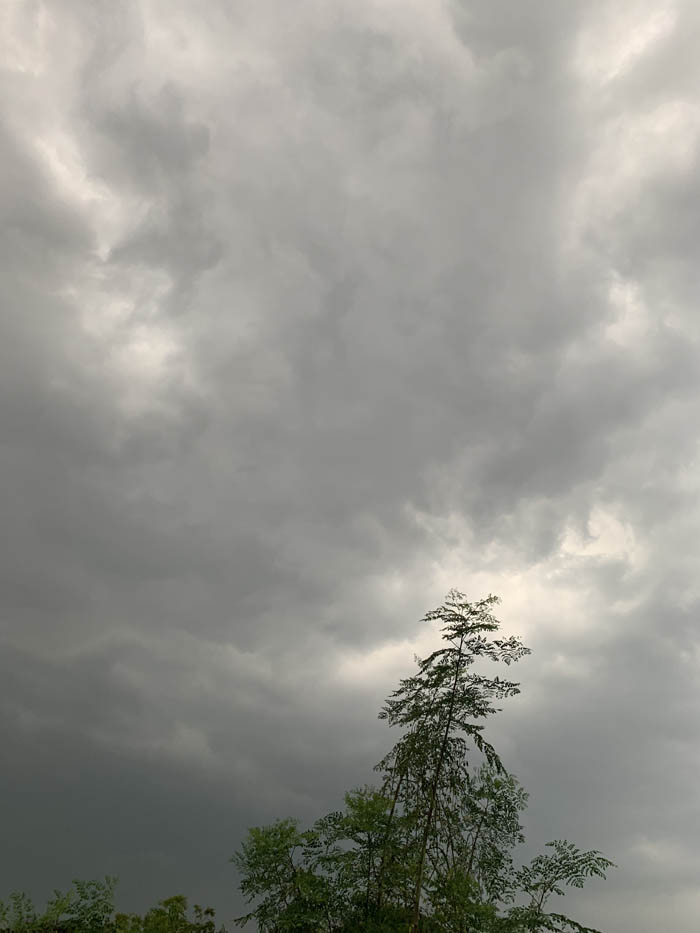
Every year when the monsoon hits Kerala, I take out Alexander Frater’s Chasing the monsoon from my bookshelf and read a few pages. Frater’s book feels like a delicate love letter to the monsoon, the subcontinent’s lifeline. Frater welcomes the arrival of the south-west monsoon in Kovalam and then he moves to Goa, Bombay, Calcutta and finally he ends his journey in Cherrapunji. For 25 years, I have been reading Frater and still loving the intimacy of my own monsoon ritual. Somehow, even amid climate change, the book, which is an ode to the monsoon, feels like a warm hug.
When you live in hot, arid places, the monsoon feels like another magical world. Monsoon is like hope wrapped in love, ecstasy and joy. Living in Ahmedabad means we have to really wait for the monsoon long after it hits Kerala. But when the monsoon hits Kerala, I say to myself, “The worst is over,” even though the sun looks all dazzling and ferocious outside. And I prod my mother-in-law to tell me her childhood stories of Kerala rains. For her, “Rains in desh (she refers to Kerala that way) is not from this world. It’s from another world. ”
Like the chatak waits for the rains to come so that the bird can quench its thirst, I wait for the rains to come so that my parched soul can get its share of manna from the skies.
The monsoon—its name borrowed from the Arabic mausim, meaning “season”—is an elemental drama played out on the stage of the Indian subcontinent with unmatched fervour and elegance. The Indian monsoon arrives not in a single sweep but in a duet: one branch surges from the south-west over the Arabian Sea, the other coils in from the south-east across the Bay of Bengal. Together, they are propelled by a hidden orchestra and then the magic happens. Riveting is the word for the monsoon in India.
Waiting for the monsoon is a ritual many of us live for. Whether you live in Kerala, Odisha, Assam, Meghalaya, Tripura and West Bengal, the monsoon feels intimate and magical. Every time I look at the falling raindrops from the windows of my Ahmedabad apartment, my mind goes back to Odisha. The rains have an altogether different personality there. The memory of Odisha’s magical monsoon comes with a range of emotions – from joy, ecstasy, beauty to time lost or passed by. My childhood monsoon memories are all about enjoying one of the most precious gifts of nature. Every time the sky used to turn dark with its share of lightning and thunder, we used to dance like little birds in the garden. Listening to the raindrops on a dark night felt like God singing a lullaby. My most dominant memory is as a schoolgirl coming home all drenched and my mother wiping my face and wet hair with a clean towel. And after changing my clothes, I would always be treated to a hot cup of Horlicks or Bournvita (mother’s prescription for not catching a cold afterwards). Later on, the memory of adulthood monsoon had its own beautiful image of sitting on a rock in the last range of Aravallis, watching the lashing rains and then feeling the intensity of the opening line of Lady Chatterley’s Lover, “Ours is an essentially tragic age but we refuse to live it tragically.”
MONSOON MAGIC IN OUR LITERATURE, MUSIC AND FILMS
We all have our own intimate monsoon rituals and that is why the season feels so special.
In Kalidas’s Kumarasambhava, Parvati’s experience of the first rain speaks of the richness of our ancient literature and also the creator’s imagination. She is deeply meditating to win the love of Lord Shiva when it happens. “The first drop of rain stayed momentarily on her eyelids, dropped on her lips, shattered on her hard breasts and trickled down the triple fold of her stomach, and after a long time disappeared in her navel.” One need not say more as saying something more in this context would dilute the beauty of both the rain and life itself.
In Assam, the annual arrival of the monsoon season is a much-celebrated event. It is like welcoming the Goddess. People in Assam call her Borodoisila. Every monsoon, they keep out a small mirror, a bottle of hair oil and a comb, for her to look at. The belief is, the rains are strong because she is rushing home to see her mother.
In Kerala, it is called Karkidakam, the Malayalam month, which corresponds to July/August, which is associated with the southwest monsoon. It's a time for ancestor worship, with families offering prayers and offerings to the memory of their deceased relatives, often symbolized by the rain's "tears of joy" shed by the departed souls.
In the subcontinent’s life, literature, religion and mythology, rain is synonymous with life and myriad hues ranging from love, romance, longing to new journeys and new beginnings. Radha asked Krishna to call her by knocking on the wall of her hut such that the sound merged with the thunder from the sky. Meghdoot’s exiled Yaksha asked the cloud to carry his message to his wife pining back at home. Odisha’s sadhab puas (merchants) sailed to Java, Sumatra and Bali only after the monsoons left the shore. Kartika Purnima was considered auspicious for embarking on voyages, as the monsoon season had ended and the wind flow was favorable for sailing.
Tagore’s rain is all about love and life in many forms, each seamlessly embracing the other. Faiz says in his own signature style, “Let there be clouds, let there be wine/ After that it doesn’t matter what calamity comes”. Noted poet and director Gulzar finds the monsoon “the most physical of all seasons”. He has beautiful monsoon songs to his credit and these songs have a timeless appeal. His three-line verse from the early 70s takes me to my own familiar world of newspapers “Why is this newspaper so wet?/ Change the hawker from tomorrow!/ “Five hundred villages washed away this year”.
From music, theatre to films, the rains have always found their own presence. On a rainy night, you can sit in the comforts of your home and watch Ullozhukku, a poignant yet empowering Malayalam film released in 2024. The film set against the backdrop of incessant rains tears you apart for its poignancy (I don’t want to spoil the story for those who haven’t watched the movie) but in the end warms the cockles of your heart. The Cannes Winner All We Imagine as Light has its share of monsoon moments in the decaying metropolis called Mumbai. It’s the same old story of rains and the never-ending misery of the ordinary citizen trying to live a life in a mega city.
OUR PERSONAL RAINS
The monsoon has its own rhythm. After starting on a fiery note, its journey can become a languid one. And sometimes it just refuses to move and enjoys a holiday on its own terms. This reminds me of our trip to Kerala in 2018. Three of us from different parts of the world met in Kochi airport on a beautiful July mid-morning. The monsoon lovers wanted a taste of Kerala's beautiful almost ethereal rains. My friend brought his huge grandpa's umbrella with him and took it everywhere in the hope that it would be put to good use. But we never got to experience the much-talked about Kerala rains, only a very very faint worn out version of it. We were disappointed. We returned from Kerala and got back to our lives and work in our respective cities. And then the devastating Kerala floods happened within weeks causing much death and devastation. The images that we saw on our social media were heartbreaking. We still talk about that trip and the monsoon choosing to give us a miss.
OF RAINS AND DEVELOPMENT
If you are living in a big city then enjoying the rains has now become a luxury for very few. It's a privilege to soak in the beauty of the rains. If you are lucky, then you can inhale the heady fragrance of petrichor from the comforts of your home. If you are travelling in a local train or wading through pothole-filled roads, then the monsoon can be a nightmare. Mindless development with almost zero regard for people's lives has resulted in a total collapse of infrastructure during the rains. It's tiring to listen to those same old jaded stories of the triumph of Mumbai spirit. And how does one understand and explain mint-fresh bridges and roads getting washed away in the first monsoon shower only? Many of us feel angry that bad governance (how else one explains poor infrastructure) has robbed us of the joy of reveling in the monsoon romance.
Even as I am writing this, I am eagerly waiting for the monsoon to arrive in Ahmedabad. This year, the monsoon arrived in Kerala on May 24 and after reading a few pages of Frater's Chasing The Monsoon, I happily put the book back on its designated place in my bookshelf. And I am now waiting. My act of waiting is all about hope and a slice of life. Hope is the only thing I am holding on my palm right now .... till the raindrops fall on my palm. My fellow rain-lovers, join me in this journey of hope in the subcontinent. An annual ritual yet so magnificent even in its repeat act. Year after year. Time after time.
Deepika Sahu is an Ahmedabad-based senior journalist with a career spanning since 1995. During her career, she has worked with India's premier media organisations, including the Press Trust of India (PTI) in New Delhi, Deccan Herald in Bengaluru, and The Times of India in Ahmedabad. Currently, she is contributing India-centric features to Melbourne-based The Indian Sun, a cutting edge media platform. In addition to her journalism career, Deepika is involved in teaching English and Communication Skills to learners from different parts of India through Manzil, a Delhi-based NGO. Beyond her professional endeavors, Deepika is passionate about India's rich diversity, literature, blogging, quiet hours at a cafe and enjoying a cup of tea.
GOOD ARTISTS COPY, GREAT ARTISTS STEAL – CREATIVITY IN THE AGE OF AI
Satish Pashine
Executive Summary
This article examines the intricate relationship between artificial intelligence and human creativity, focusing on how AI challenges traditional concepts of originality, authorship, and artistic value. Drawing inspiration from Picasso and Steve Jobs’ well-known idea—“Good artists copy, great artists steal”—the article reimagines this concept within the contemporary, AI-driven era.
Key Topics:
The Distinction Between Copying, Stealing, and Plagiarism:
Copying refers to simple imitation, whereas stealing involves reinterpreting and transforming ideas. Plagiarism, however, represents unethical appropriation without proper acknowledgment. The article uses compelling examples, such as tribute bands and A.R. Rahman’s music, to illustrate how intention and originality define these terms.
The Role of AI in Creativity:
AI can produce poetry, music, and artwork by analyzing large-scale datasets. While it may mimic human creative expression, it lacks the emotional depth, lived experiences, and adventurous spirit that characterize exceptional art.
Recognizing AI-Generated Work:
AI-generated content often appears polished but lacks emotional resonance, unpredictability, and cultural depth. Although tools exist to detect AI-created work and plagiarism, they are not infallible—especially as AI technology becomes more advanced.
Ethical and Legal Challenges:
The article explores concerns about ownership, attribution, and fair use when AI systems are trained using copyrighted human work. It emphasizes the need for transparency, equitable compensation, and ethical practices in AI training.
Looking Ahead: Human and AI Collaboration:
Instead of outright rejecting or blindly accepting AI, creators should view it as a tool for exploration and innovation. The most visionary artists of the future will be those who use AI wisely—adding their unique human touch, emotions, and experiences to transform raw data into meaningful, authentic creations.
________________________________________
Picasso once said, “Good artists copy, great artists steal.” It’s a bold statement—one that Steve Jobs later echoed, sparking even more debate among creatives, thinkers, and innovators around the world. But what exactly was Picasso getting at? Was he endorsing theft? Of course not—at least, not in the literal sense. This idea isn’t about criminal behavior; it’s about the deeper, messier process of creative transformation.
When great artists “steal,” they don’t just take—they absorb. They internalize an idea, a style, or a concept so deeply that it becomes part of them. Then, they remix it, reinterpret it, and make something that feels entirely new. They don’t replicate—they reinvent.
Think about music. You’ve probably heard multiple versions of the same song. A jazz rendition of a pop hit. A folk song turned into an electronic anthem. A centuries-old melody revived with new lyrics and a fresh voice. While the core may remain familiar, each version tells a different story. That’s not just copying—it’s creative evolution. Each artist brings something personal to the table: their voice, their influences, their heart. And that’s what gives it authenticity.
Now, let’s fast-forward to today—an era where artificial intelligence can paint portraits, write poetry, compose symphonies, and generate stories. Some of it is impressive. Sometimes, it’s even moving. But it also raises a lot of questions. Big ones.
• Can AI “steal” like a great artist—transform and innovate—or is it just mimicking what it’s been fed?
• Is AI creating, or is it just remixing data?
• **And more importantly, how do we—flesh-and-blood humans—continue to lead in a world where machines can “
The Difference Between Copying, Stealing, and Plagiarism
When we talk about creativity, it’s easy to blur the lines between copying, stealing, and plagiarism. But each term carries a distinct meaning and impact on how we understand originality and artistic integrity.
Copying: A Starting Point, Not a Destination
Imagine a child just beginning to draw. At first, they might take a piece of tracing paper and outline images from a coloring book. This is a form of copying—reproducing an existing work exactly as it is. It’s basic, mechanical, and often the first step in the learning process.
In a more grown-up context, think of an art student replicating a famous painting by M.F. Husain to understand his brushwork. Or a draftsman carefully tracing a blueprint to produce a duplicate. In all these examples, the person is not trying to express something original—they’re practicing, absorbing technique, or creating a carbon copy for reference.
Copying happens at the surface level. It focuses on what something looks or sounds like, not why it was created that way. It’s imitation, not innovation. While copying can be useful in early learning or homage, it remains a technical act—not a creative one.
Stealing: The Soul of Reinvention
Now picture that same child a few years later. They’ve stopped tracing. Instead, they sketch from memory, inspired by what they’ve seen—but they begin to change things. They give the figure a new pose, add a twist to the expression, or invent an entirely new scene. The reference is still there, but the result is something original.
This is what artists mean when they talk about “stealing.” It’s not theft in a criminal sense—it’s about internalizing the essence of something that inspires you and then making it your own.
True artistic “stealing” requires understanding—grasping the emotional core or technical brilliance behind a piece of work. Instead of duplicating the surface, you explore the structure beneath it. You take the spirit of an idea and reimagine it with your own voice, experiences, and perspective.
Think of it as transformation, not repetition. It’s the difference between echoing someone’s words and having a conversation with them through your work.
Plagiarism: The Line That Shouldn’t Be Crossed
Plagiarism, on the other hand, is something else entirely. It’s not about being inspired by someone’s work—it’s about stealing credit for it.
In the Indian music context, imagine a tribute band performing a flawless rendition of “Lag Jaa Gale” by Lata Mangeshkar. They honor the original artist, maybe even introducing the song to a younger generation. That’s homage, not plagiarism.
Now think of someone taking Kishore Kumar’s “Mere Sapno Ki Rani,” tweaking a few beats, and releasing it under their own name—claiming they wrote it. That’s plagiarism. It’s not just unethical; it erases the legacy and labor of the original creator.
By contrast, a composer like A.R. Rahman blends Carnatic classical, folk, global electronic sounds, and personal flair to create music that feels fresh and unmistakably his own. Even if you can trace his influences, his work is never a copy—it’s a synthesis of tradition, innovation, and individuality.
Plagiarism is dishonest and lazy. Unlike copying or stealing (in the creative sense), it doesn’t seek to learn or evolve—it simply takes and deceives.
The Bottom Line
Copying is where many of us start. Stealing, in the creative sense, is how many of us grow. But plagiarism is where we betray both the art and the artist.
In today’s world—especially with the rise of AI-generated content—understanding these differences matters more than ever. Machines can copy. They can even mimic style and structure. But they can’t truly steal like a human artist can—because they don’t feel, imagine, or interpret. That’s still our superpower.
AI and the Art of Copying—Is It Really Plagiarism?
Artificial Intelligence is changing the way we think about creativity. It can write poems, compose music, and paint portraits. But how does it actually work? At its core, AI functions by analyzing enormous amounts of existing material—classic novels, famous artworks, hit songs—and then generating something that seems new based on learned patterns and styles.
But here’s the big question: Is it truly original? And even more pressing: Could it be considered plagiarism?
Let’s break this down.
Imagine you ask an AI to write a love poem. What does it do? It doesn’t close its eyes and feel a lump in its chest. It doesn’t remember a lost relationship or a letter never sent. Instead, it scans thousands—maybe millions—of love poems written over the years. It identifies common threads: longing, heartbreak, tenderness, hope. Then, using those ingredients, it assembles a new poem that fits the mold.
Will it sound poetic? Probably. Might it even move you a little? Possibly.
But will it carry the fragile vulnerability of someone writing after a sleepless night, still reeling from love lost or love imagined? Absolutely not.
Take the iconic Bollywood song Tum Hi Ho from Aashiqui 2. It’s a perfect example of how music becomes powerful not just through melody and lyrics, but through emotion. The composer, Mithoon, likely studied countless romantic ballads. But more importantly, he drew from something within himself—his own feelings, memories, maybe even personal heartache. That blend of technical knowledge and personal experience is what gave the song its soul. That’s what makes people cry quietly in the dark as it plays in their headphones.
Now imagine you ask an AI to create a similar song. What will it do? It’ll analyse the structure of Tum Hi Ho and other love songs—chord progressions, lyrical themes, emotional arcs—and generate a new composition. It might sound nice. It might hit the right notes, literally. But something will be missing.
Because AI doesn’t feel.
It doesn’t know what it’s like to stay up all night writing lyrics because your heart is too full to sleep. It doesn’t feel the quiet ache of seeing someone you love with someone else. It doesn’t have memories. It doesn’t live. What it creates might resemble art, but it lacks the human experience—the lived truth—that makes art unforgettable.
You might try to personalize the AI’s output by feeding it your story, your heartbreak, your memories. That can help shape the result, bring it a little closer to what you’re feeling. But it still won’t be the same as you putting pen to paper, letting your emotions guide your hand. The difference between an AI-generated poem and a real human creation is like the difference between a photograph of fire and the warmth of sitting next to it.
Now let’s go even further: what if the AI doesn’t just imitate the style, but actually lifts lines directly from another poet’s work—without acknowledgment or credit?
That’s plagiarism. Plain and simple.
This issue encompasses both technical and ethical aspects. Plagiarism disrespects the original creator. It takes their hard work, their voice, their truth, and passes it off as if it came from nowhere. As AI becomes more common in creative fields, this risk becomes harder to ignore. Without proper safeguards, AI tools can easily blur the line between inspiration and infringement.
The Bottom Line
AI can copy with elegance. It can simulate style. It can remix the patterns of human creativity. But it can’t feel, and it can’t genuinely create. It can produce an imitation of art—but not the raw emotion, the inner messiness, the flawed beauty that makes something truly human.
Creativity, at its best, isn’t just about what we make—it’s about what we live through. That’s something AI can study forever, but never truly steal.
Is It Possible to Positively Identify AI-Generated Work?
As artificial intelligence advances, it is becoming progressively more challenging to differentiate between AI-generated content and human-authored work. The distinction is increasingly ambiguous. Previously identifiable as robotic, AI-produced materials now frequently appear polished, refined, and highly convincing. However, upon closer examination, there remain nuanced indicators that can assist in discerning the difference.
One of the biggest giveaways? Lack of emotional depth.
AI is excellent at pattern recognition. It’s trained on massive amounts of data and can mimic different tones, genres, and writing styles with surprising accuracy. Ask it to write a love poem, and it can produce something that sounds romantic. Ask it to paint a sunset, and it can generate a glowing landscape with vibrant colors and balanced composition. But even when it looks or sounds good, something often feels… off.
That’s because AI creates from logic and learned structure—not from lived experience. It can replicate the form, but not the feeling.
Let’s take writing, for example. AI-generated text often comes across as technically correct—well-punctuated, grammatically flawless, even eloquent at times. But beneath the surface, there’s often a sense of emotional flatness. The writing may feel predictable, formulaic, or a little too perfect, like it’s ticking boxes rather than expressing something personal.
Humans, on the other hand, write with quirks. We sometimes break grammar rules for dramatic effect. We might take unexpected turns in thought. Our writing can be messy, raw, and deeply specific. That’s where the soul of a story lives—in the imperfections, the vulnerability, and the moments that feel undeniably real.
In visual art, AI can generate stunning images. But even then, you might notice oddities: unusual lighting, limbs that don’t quite make sense, backgrounds that lack coherence, or facial expressions that feel empty. A human artist would instinctively adjust these things—because we have an intuitive sense of balance, emotion, and realism that comes from life experience.
AI can write about family, love, grief, or identity—but it does so without truly understanding those concepts. It knows the words, but not the weight they carry. So while an AI poem about heartbreak might use all the right metaphors, it won’t have the aching pauses, the half-said regrets, or the emotional honesty that comes from someone who’s lived it.
Another subtle sign is cultural context. Humans draw from deeply personal and cultural roots—memories of a grandmother’s cooking, festivals, local slang, inside jokes that only someone from a particular background would understand. AI can attempt these references, but it often gets them slightly wrong or uses them in ways that feel out of place. That’s because it doesn’t belong to any culture. It doesn’t have a childhood. It doesn’t remember.
Of course, as AI continues to improve, it’s learning to mask these gaps better and better. The more data it absorbs, the more fluent and “human” it seems. And that’s what makes this conversation so important.
Because even if AI gets harder to detect, one truth remains clear: AI lacks soul. It lacks the stories behind the words, the pain behind the song, the memory behind the brushstroke. It can fake the form, but not the feeling.
So Can We Always Tell?
Not always. And we might not be able to forever. But for now, the emotional fingerprints of a human—those little flaws, surprises, and moments of real vulnerability—still shine through. They remind us that art isn’t just about perfection. It’s about being alive.
Can Software Really Detect AI-Generated Content and Plagiarism?
Yes, there are tools out there that claim to spot both AI-generated writing and plagiarism—but they work with varying levels of accuracy, and there’s still a lot of room for improvement, especially when it comes to AI detection.
Let’s break it down:
Detecting Plagiarism: A More Mature Field
Plagiarism detection is something we’ve been working on for quite a while, and the tools in this area are fairly reliable—especially when someone has copied text word-for-word. Platforms like Turnitin, Copyscape, and Grammarly do a solid job of catching content lifted directly from books, websites, research papers, and online articles.
These tools work by comparing the submitted content to massive databases of published material. If a student copies a paragraph from Wikipedia or a journalist lifts lines from an old article, these systems will usually flag it. They’re especially useful in academic, publishing, and content marketing fields.
But they’re not perfect. If someone paraphrases cleverly—changing sentence structure, swapping out synonyms, or mixing up phrasing—these tools might miss it. So, while they’re great at catching obvious copying, they can struggle when the plagiarism is more subtle or strategic.
Detecting AI-Generated Content: A Tougher Challenge
This is where things get more complicated.
Detecting content created by AI—like GPT models—is a newer, trickier science. There are tools available, such as OpenAI’s AI Text Classifier, GPTZero, Sapling, and others. These tools don’t look for copied material the way plagiarism checkers do. Instead, they analyse how something is written—looking at sentence structure, repetitiveness, vocabulary choices, and stylistic clues that might indicate a machine, not a person, wrote the text.
For example, AI tends to produce very balanced, well-structured sentences and avoids ambiguity. It often plays it safe, using generic phrasing and maintaining a consistently neutral tone. These are the kinds of things AI detection tools try to pick up on.
But here’s the catch: these tools aren’t 100% accurate. In fact, they’re still very much evolving. As AI-generated content becomes more sophisticated—and more “human” in style—it becomes increasingly difficult for even the best detectors to tell the difference. A thoughtful, well-edited piece of AI writing might not raise any flags at all.
False positives are also a problem. Sometimes, a human writer might be flagged as AI simply because their writing is clean, polished, or pattern-based. This makes relying solely on these tools risky, especially in sensitive situations like academic evaluations or journalism.
So, What’s the Verdict?
Right now, plagiarism detection is more reliable than AI detection, mainly because it’s rooted in comparison—looking at known sources to find matches. If a sentence exists elsewhere on the internet or in a published paper, plagiarism software can usually spot it.
AI detection, on the other hand, is more like reading between the lines. It involves guesswork, pattern analysis, and a bit of algorithmic intuition. And as AI continues to learn and improve, mimicking human creativity more convincingly, detecting its fingerprints will only get harder.
Bottom Line
Yes, tools exist—and they can be helpful. But they aren’t perfect.
• Plagiarism tools are great at catching blatant copying, but they may miss paraphrased or cleverly disguised content.
• AI detection tools are promising but still in their early stages. They can offer useful insights, but shouldn’t be treated as the final word—at least, not yet.
As technology evolves, we’ll likely see better tools emerge. But for now, human judgment still plays a critical role in evaluating the authenticity and integrity of creative work.
How AI Blurs the Line Between Creativity and Plagiarism
As artificial intelligence becomes more capable of creating poems, paintings, essays, and songs, an increasingly complex question arises: where does creativity end and plagiarism begin? For human creators, this line is usually guided by emotion, intent, and awareness. But for AI, the rules aren’t so clear. Let’s explore some of the grey areas where creativity and copying collide in the world of AI.
1. Pattern Recognition vs. True Originality
At its core, AI doesn’t create the way we do—it recreates. It looks at massive amounts of existing content—articles, novels, music, paintings—and identifies patterns in structure, tone, rhythm, and style. It then uses those patterns to generate something that looks or sounds new.
But here’s the tricky part: what happens when AI accidentally gets too close to something that already exists?
Imagine asking AI to write a short story in the style of J.K. Rowling. It could produce something eerily familiar—same magical tone, similar characters, even phrases that resemble the original text. Not because the AI is intentionally copying, but because it’s following learned patterns.
Is that plagiarism?
Legally, it’s murky. If the output is nearly identical to a copyrighted work—even unintentionally—it could be considered copyright infringement. But AI doesn’t “mean” to copy. It doesn’t understand ownership or intent. It’s simply predicting what comes next based on what it has seen before. This raises a fundamental question: Can a machine plagiarize if it doesn’t understand what plagiarism is?
2. Attribution and Transparency: Who Deserves Credit?
When a human artist draws inspiration from a legend—say, a painter influenced by Van Gogh—they usually acknowledge it. It’s part of the process. We quote our sources, name our influences, and credit the people who shaped our ideas. That’s transparency, and it builds trust in creative work.
But AI doesn’t cite its sources.
If an AI paints something that looks just like a Van Gogh—swirly skies, thick brushstrokes, and all—how should it be labeled? Is it a tribute? Is it an imitation? Or is it a form of deception?
This lack of attribution can mislead people into believing AI-generated work is entirely original, when in fact it’s deeply rooted in pre-existing creations. Without clear labelling or explanation, the line between homage and appropriation gets dangerously blurry.
3. Legal and Ethical Dilemmas: Who Owns the Work?
The laws that govern creative ownership were built for human creators—people with thoughts, emotions, and rights. But what happens when a machine becomes the creator?
Many AI models are trained on copyrighted materials—books, music, films, artwork—often without the explicit permission of the original creators. Artists, writers, and musicians are increasingly raising their voices, asking: If AI learns from our work, shouldn’t we be credited—or even compensated?
This is more than just a legal issue; it’s an ethical one. Imagine spending years developing a unique artistic voice, only to have an AI trained on your work replicate your style with no acknowledgment. That feels unfair—because it is.
AI doesn’t understand ownership or originality. It doesn’t know when it’s infringing on someone’s creative rights. It simply processes data and mimics what it has seen. That’s why human oversight is not optional—it’s essential.
The Bottom Line
Artificial intelligence is blurring the boundaries between innovation and imitation. While it can produce astonishingly lifelike, beautiful, or poetic work, it often does so without understanding the rules that govern creativity.
It doesn’t know when it’s copying.
It doesn’t care who the original artist was.
It can’t feel the weight of stealing someone’s voice.
So as AI tools become more powerful, we need to ask ourselves: How do we define creativity in the age of machines? And how do we protect the very human spark that makes art feel alive?
Because real creativity isn’t just about output—it’s about intent, emotion, and understanding the responsibility that comes with making something new.
If AI is so good at copying, should artists, writers, and musicians be worried?
Not necessarily. AI might be a great tool, but it’s not a replacement for human creativity. Here’s why:
Why Human Creativity Still Matters in the Age of AI
As artificial intelligence becomes better at mimicking human creativity—writing stories, composing music, or generating art—it’s easy to wonder: Can it really replace human artists? On the surface, AI may seem impressively talented. But beneath the polish, there are things it fundamentally lacks—things that are at the very heart of real creativity.
1. AI Doesn’t Take Risks—Humans Do
Creativity isn’t just about connecting dots. Sometimes, it’s about throwing the dots away entirely and drawing something that’s never existed before. That’s a leap only humans are currently capable of.
AI operates based on patterns. It’s trained to predict what’s most likely to come next in a sequence—what sentence follows another, what note fits best in a melody. It plays it safe. And while that often leads to clean, well-structured output, it also limits innovation.
Think about history’s most groundbreaking creative moments:
(1a). M.F. Husain Painting Indian Goddesses in Bold, Modernist Styles
Maqbool Fida Husain, one of India’s most celebrated painters, didn’t shy away from controversy. He reimagined Hindu goddesses in abstract and often provocative forms—breaking away from traditional depictions. While many admired his courage and vision, others were outraged. His art challenged the boundaries between sacred imagery and personal expression, forcing India to confront where tradition meets modernity.
(1b). Salman Rushdie’s Midnight’s Children and the Rise of Indian Postcolonial Fiction
Rushdie’s Midnight’s Children (1981) didn’t follow the rules of Indian writing at the time. He blended magical realism, politics, and deeply personal storytelling in a way that was both confusing and revolutionary. The narrative style—nonlinear, fantastical, and layered—was unlike anything readers were used to. It helped redefine English-language literature in India and opened the doors for an entire generation of postcolonial writers.
(1c). Vijay Tendulkar’s Ghashiram Kotwal: Political Theatre Like Never Before
In 1972, Marathi playwright Vijay Tendulkar shocked audiences with Ghashiram Kotwal—a bold, experimental play that mixed folk music, politics, and satire. The story critiqued power and corruption through historical allegory, set to traditional Indian performance styles like Tamasha. The play was so provocative that it faced bans and political pressure, but it eventually became a landmark in Indian theatre.
(1d). A.R. Rahman Blending Classical Indian Music with Global Sounds
When Roja came out in 1992, A.R. Rahman didn’t just create a soundtrack—he changed the way India thought about music. Mixing Carnatic ragas with synthesizers, folk rhythms with orchestral strings, he brought a global, cinematic sound to Indian film. His style was fresh, risky, and unfamiliar—but it worked. Today, it’s hard to imagine Indian music without his influence.
(1e). Nusrat Fateh Ali Khan & Rahat Fateh Ali Khan Popularizing Sufi Music in Bollywood
While Sufi music has ancient roots, bringing it to mainstream Bollywood was a bold move. Songs like “Afreen Afreen” or “Tajdar-e-Haram” weren’t just catchy—they were deeply spiritual, poetic, and complex. Their popularity opened the door for mystical, devotional music in commercial spaces, something previously unthinkable.
(1f). Rituparno Ghosh Bringing Queer Identity into Mainstream Indian Cinema
Long before LGBTQ+ themes were openly discussed in Indian pop culture, Rituparno Ghosh—a master filmmaker from Bengal—boldly wove gender, identity, and sexuality into his films. In works like Chitrangada and Arekti Premer Golpo, he explored themes that were deeply personal yet politically charged. At a time when mainstream cinema avoided such conversations, Ghosh humanized them with poetic sensitivity, forever expanding what Indian cinema could talk about.
(1g). Satyajit Ray’s Pather Panchali Defying Bollywood Tropes with Realism
In 1955, Pather Panchali quietly revolutionized Indian cinema. While Bollywood thrived on glamour and melodrama, Satyajit Ray told a slow, heartfelt story of a rural Bengali family—shot on a tiny budget with non-professional actors. It was poetic, painful, and powerfully real. Western critics praised it. Indian studios initially rejected it. But it put Indian cinema on the global map and launched India’s art-house film movement.
(1h). M.S. Subbulakshmi Performing at the United Nations
In 1966, Carnatic vocalist M.S. Subbulakshmi stood before a global audience at the UN and sang devotional Indian ragas—not in English, but in Sanskrit and Tamil. In doing so, she broke both cultural and geographic boundaries. It was an audacious act of cultural pride—presenting India’s classical music tradition as art worthy of the world stage. She didn’t adapt to the West—she invited the West to listen.
(1i). Bhupen Khakhar Painting the Life of a Gay Man in India—Boldly and Openly
In the conservative art scene of the 1970s–80s, Bhupen Khakhar, a self-taught artist from Gujarat, began painting openly gay themes in his work. At a time when homosexuality was criminalized and silenced in India, his vibrant, humorous, and deeply personal works—like You Can’t Please All—brought queer identity to the canvas unapologetically. It was not just brave; it was groundbreaking.
(1j). Gulzar’s Lyrics as Poetry in Mainstream Cinema
Gulzar didn’t just write songs—he wove poetry into Bollywood soundtracks. While most film lyrics were catchy and commercial, Gulzar introduced metaphor, subtlety, and literary elegance. Songs like Tere Bina Zindagi Se Koi Shikwa Toh Nahin or Chaiyya Chaiyya blended Urdu, Hindi, and emotion in a way no one else had dared in the commercial space. He proved that even mass music could be intellectually rich and emotionally layered.
Each of these artists took a creative risk—whether through style, subject, or sheer courage. Like Duchamp, Joyce, and Dylan, they redefined their medium and paved the way for new generations to express themselves more freely.
These weren’t safe choices. They were bold, unpredictable moves that initially seemed wrong. But they challenged expectations—and eventually reshaped culture. AI doesn’t have that rebellious spark. It doesn’t challenge norms. It reinforces them.
2. AI Lacks Emotion and Gut Instinct
You could ask an AI to write a love song, and it might use all the right phrases—“my heart,” “forever,” “tears,” “longing.” But will it feel like heartbreak?
There’s a reason we’re moved by a shaky voice in a breakup ballad or a raw line in a personal poem. It’s not just about the words—it’s about the lived emotion behind them.
Human artists create from experience. They write songs at 2 a.m. when their heart is breaking, paint during moments of joy or despair, and write stories that come from years of struggle or hope. That depth can’t be faked.
AI, on the other hand, is just replicating emotional language. It doesn’t know what heartbreak is. It doesn’t cry or fall in love. It’s borrowing our words and arranging them in convincing patterns—but without the soul behind them.
3. AI Can Only Work With What It’s Given
AI doesn’t dream. It doesn’t have childhood memories. It doesn’t stare out a window and suddenly feel inspired. Its “imagination” is made up entirely of what it’s been trained on—books, articles, paintings, songs that already exist.
That means it can only remix what’s already out there.
Human beings, by contrast, can draw from a deep well of personal and cultural experiences. A painter might channel a childhood memory. A poet might write about grief that defies words. A musician might invent a sound based on nothing but a strange dream. These are not patterns—they’re sparks of something genuinely new.
AI doesn’t invent from nothing. Humans do.
The Final Word
AI is a powerful tool, and in many cases, it can be impressively creative. But it’s important to remember: it imitates. It doesn’t imagine. It mimics emotion—it doesn’t feel it. It follows rules—it doesn’t break them. And it relies on the past—while humans are capable of shaping the future.
In the end, what makes art truly meaningful isn’t just how well it’s crafted. It’s the human spirit behind it—the risk, the feeling, the imagination. That’s something AI just can’t replicate.
The Future of Creativity: A Human-AI Collaboration
Artificial Intelligence is no longer a thing of science fiction—it’s here, and it’s reshaping how we write, paint, compose, and imagine. But as we stand at this strange new crossroads, we must ask: What happens to human creativity when machines can also “create”?
The answer doesn’t have to be fear. Instead of worrying that AI will replace us, perhaps the better question is: How can it enhance us? Not by becoming the artist, but by becoming the assistant, the tool, the collaborator—something that helps spark ideas, not replace imagination.
Let’s look at how that could work.
1. AI as a Creative Partner—Not the Artist
Imagine having a co-writer who never gets tired, a bandmate who can instantly remix a melody, or a visual artist who can generate hundreds of sketches in seconds. That’s what AI can be—a powerful ally in the creative process. But the magic? That still belongs to you.
• A writer might use AI to brainstorm storylines or overcome writer’s block—but it’s the writer’s heart, voice, and lived experience that make the final story matter.
• A filmmaker might use AI to generate alternate dialogue or mood boards—but it’s still the director’s vision and emotional intent that shape the film.
• A musician might experiment with AI-generated beats or harmonies—but it’s the imperfect strumming of a guitar, or the pain in a singer’s voice, that makes the song real.
AI can suggest. It can support. But it cannot feel. And creativity—true creativity—is about feeling.
2. AI as an Infinite Well of Possibility
Think of AI not as a threat, but as a tool—like a digital telescope into unexplored creative territory. It can show you unexpected connections, patterns, or combinations you may never have considered. In this sense, AI becomes a kind of muse, helping you see further—but not walking the path for you.
If Rabindranath Tagore had access to AI, maybe he would’ve used it to organize centuries of folklore before writing Gitanjali. But the soul of his poetry? That still would’ve come from his personal longing, his spiritual reflection, his human essence.
AI gives you bricks. It’s still you who builds the house.
3. Ownership and the Ethics of Machine-Made Art
When AI creates something new, who does it belong to? The person who typed the prompt? The company that trained the AI? Or the countless artists, writers, and musicians whose original work became the foundation for the model’s “knowledge”?
This isn’t just a legal issue—it’s an ethical one. Imagine your original song, story, or painting being absorbed into a machine, used to train a model, and then regurgitated in a form so close it’s almost indistinguishable—without credit or consent. That feels wrong, doesn’t it?
Many artists and thinkers are now pushing for:
• Transparency about what data AI is trained on.
• Consent and credit for original creators.
• Fair compensation when human creativity fuels machine learning.
As creative individuals, we must stay aware of these issues. We can’t let the future of art be built on silent theft.
4. Learning to “Steal” the Right Way in the Age of AI
Let’s return to the famous idea: “Good artists copy. Great artists steal.”
What did Picasso (and later Steve Jobs and T.S. Eliot) really mean? Not theft in a criminal sense, but transformation—taking something that exists and reshaping it until it becomes uniquely yours.
That’s the challenge with AI. It can copy. It can remix. But it cannot transform in the way a human can. Because it doesn’t live. It doesn’t struggle. It doesn’t cry at 3 a.m. or fall in love or make art to heal.
So, the future belongs not to those who fear AI, or those who blindly rely on it—but to those who can dance with it. Those who can steal from it—not to replicate, but to reinvent.
The True Artist of Tomorrow
Tomorrow’s most powerful artists won’t be purely human—or purely machine. They will be those who use AI with imagination, with integrity, and most importantly, with soul.
They will ask:
• “How can I use AI to deepen my vision?”
• “What can it offer me that I couldn’t see before?”
• “Where does my voice enter the picture?”
Every time you use AI to write a poem, design a logo, or compose a melody—pause and ask yourself:
“Am I simply copying? Am I crossing the line into plagiarism? Or am I transforming—stealing like a great artist, and making it my own?”
Because that question won’t just shape your next creation—it will shape the future of art itself.
Conclusion:
True creativity still comes from the human heart. While AI can assist, remix, and suggest, it cannot feel. The future of creativity lies not in replacing artists with machines, but in empowering artists to use AI without losing their soul—transforming tools into something personal, meaningful, and deeply human.
Shri Satish Pashine is a Metallurgical Engineer. Founder and Principal Consultant, Q-Tech Consultancy, he lives in Bhubaneswar and loves to dabble in literature.
Shri Gokul Chandra Mishra
The curtain fell, signifying the conclusion of banking hours for that day. Usually, bankers needed a great deal of relaxation after closing hours. During those days, computers were not there for use and everything in banking was carried out manually. A little error or carelessness or miscalculation could land the bankers in serious trouble, adversely affecting their career.
Asutosh was almost lost in the Branch Manager's revolving incliner, as if he had just triumphantly returned from a battle field. Suddenly, there was a knock on the door and a gentleman entered the cabin holding crutches under his two arms. The man was shivering a bit, looked disoriented with an unshaven face and red eyes.
The man appeared to be a known face but Asutosh could not place him immediately. He was looking ill . A part of his head was bandaged. His voice was breaking.
Asutosh could not ignore his abrupt arrival like a cyclone. He started consoling the person and asked,
"What is the matter, sir ? How can I help you? Banking hours are over for today." He offered a chair to the visitor to sit down and feel comfortable.
"Sir, I need your help. I am just coming from the big Hospital at Cuttack. The doctors discharged me a few hours back and I took a direct bus from Cuttack to Kendrapara. Sir, I need some money from my account so that I can go to my village, about 20 kms away. I know the banking hours are over. But sir, I need your help. My family must be waiting for my arrival anxiously at home."
He handed over a bank pass book to the BM.
While conversing with him, Asutosh was wondering how to know more about the visitor, but when he looked at the pass book, he could not believe himself.
"What, Das babu! What has happened to you? I could not recognise you till now. I never expected to see you in this form. What is the matter? But let me find out if I will be able to help you at this hour".
Asutosh remembered Mr Das was a clerk at the local government treasury, frequently visiting the bank for operating his account.
The strong room was locked up a few minutes back. It was a small branch. Branch Manager and Cashier held the joint custodian keys. By that time, the Cashier had left for his residence, calling it a day, but he was summoned back through the messenger for an emergency service. Asutosh offered Mr. Das a cup of tea, brought by the road-side tea vendor and asked him to feel at home and narrate about his ordeal .
"Sir, I commute from my village to Kendrapara daily to attend my duty here and return the same evening by the frequent lorry service plying on the route. The express highway from Daitari to Paradeep passes near my village and the iron ore carrying heavy vehicles serve us greatly for commuting daily. Life was normal till one fine morning when I was heading for my office duty. The lorry running with high speed crashed, head on, into an incoming lorry in a quick flash. We, the passengers standing in the trolly, were thrown out here and there. I did not remember what happened next. When I opened my eyes I could find myself in a hospital bed at SCB Medical College hospital at Cuttack. I was told that there was a serious accident and I was about to be crushed by the incoming lorry. God, Shree Baldevjew, saved my life but I lost one leg. There was no major brain injury except for a few wounds on my head. I was treated for about a month and half and was discharged today."
He was sobbing continuously while narrating the ordeal with tears flowing out from his eyes uncontrollably.
Asutosh was horrified and and felt as if he was in a Cinema hall watching a horror film. "Oh ! what an accident and providential escape from the jaw of death ." He said to himself.
In the meantime, he got a withdrawal slip, and got it signed by Das babu. The ledger was reopened and the transaction was entered in respective folio. He then handed over the needed cash to Das babu. The bank staff arranged an auto rickshaw for him to go back to his family.
But immediately after Asutosh bade farewell to Das babu, the latter returned to the BM's cabin and started sobbing again and again. He thanked Asutosh for the emergency help and started murmuring in profound grief.
Asutosh and his collegues were astonished at this awkward gesture of Das babu, who thanked the bank staff once again for the emergency service rendered.
"Sir, do not feel sorry for my ordeal. I had sinned a lot during my career, for which God has given me the punishment with a strong warning by saving my life
"You all know that I am working as a clerk in the local Treasury office. I used to disburse pensions to thousands of senior citizens every month. Some very aged persons commuted from far of places like Aul , Rajkanika and Marshaghai etc. for their pension. They were eager to return to their homes the same day carrying the precious pension amount. But it was an evil practice by the office staff to threaten them, spreading rumour that treasury had not released cash, so that, the pension disbursement would be delayed for days. Thus, a cut money was required to be paid to the treasury staff to release the funds. The hapless veteran pensioners did not have any alternative, but to cough up a small portion of their pension money. I was primarily responsible for forcefully collecting the cutbacks and sharing with my collegues as a monthly harvest, against the helplessness and anger of the veterans.
" In the process, the veterans cursed me every month but I continued to extract money from them as a routine.
"One day, in the hard winter month of January, a very aged pensioner was asked forcibly to stay back so that he could get his pension the next day. As there was no place for stay, he had to spend the night at the office varandah. Next day , when the office peon called him to get his pension money, it was found that the old man had suffered a massive heart attack and passed away in the night.
"In spite of this ghastly happening, the evil practice continued and I had earned the kickbacks laced with 'Bad-dua' ( curse) every month. I was severely punished by God, who opened my mind now to see the selfless service rendered by you all today."
Das babu met and thanked the bank staff individually before taking farewell from Asutosh.
A waiting autorickshaw, carrying the wounded visitor, raced through the road towards his home. The lone rider must be realising the sins he had been committing in his service career, comparing with the high standards of service rendered by bank staff. For Asutosh and colleagues the reality show was nothing but a strong 'Divine Message' from Lord Baladebjew.
Shri Gokul Chandra Mishra is a retired General Manager of the Syndicate Bank. He is passionate about social service, reading and writing.
SWINGING BETWEEN MEMORY AND REINVENTION: REMEMBERING RAJA IN ODISHA AND ABROAD
Annapurna Pandey
Introduction: Memory, Motherhood, and Raja
Raja is known as the famous swing festival celebrated in Odisha. This unique festival commemorates the fertility of the Earth. This year, during Raja, I am in Odisha, spending time with my 90-year-old mother, who is recovering from a femur fracture. It takes me back to the Raja I celebrated decades ago, growing up in Odisha. And now, from afar, I also see how women across the diaspora remember Raja—especially those of us who have moved to the West.
The Meaning of Raja
Odisha is a predominantly agricultural state, and our festivals are closely tied to the rhythms of the land. The word Raja comes from the Sanskrit Rajas, which refers to menstruation. When a woman menstruates, she is called Rajaswala. Raja marks the Earth's cycle as an agricultural holiday—Mother Earth, or Bhudevi, menstruates. The Earth rests during these three sacred days, and young girls are celebrated for their fertility, womanhood, and life-giving power.
Raja reminds us of the Earth's essential role in our survival and teaches us to honor her—to partner with nature rather than exploit it.
Traditions and Childhood Joys
Raja signifies the start of the monsoon after the scorching summer. The parched Earth awaits the first raindrops, just as we await the joy of the festival.
I grew up in Odisha from the 1960s to the 1980s before moving to California in 1989. Raja was a season of joy—new clothes, pithas (traditional cakes like poda pitha, anduri pitha, and manda pitha), freedom to visit relatives, and days of fun playing ludo, hopscotch, and swinging from trees in the schoolyard. We would eat meetha paan, feel treated like princesses—much to my brothers' annoyance—and soak in the unspoken pride of being girls during this time.
The Three Days of Raja
Pahili Raja (The Beginning)
On the first day, the Earth begins to rest. The night before, my mother would part my long black hair into two tight plaits, fold them into spirals, and tie them with colorful ribbons. She'd warn me not to mess them up while sleeping. All decorations (saja baja) were done the night before to avoid disturbing Mother Earth. On this day, farmers stop tilling, weavers pause their spinning wheels, and even potters and carpenters halt their tools. The agricultural equipment is worshipped, and trees are respected. Girls swing to "lift the Earth's burden." It is a pause—for the body, for the soil.
Raja Sankranti (The Second Day)
This was my favorite. I remember standing in line at the tailor's for my custom-stitched new dress. My mother would apply alta (red dye) on my feet and mark my forehead with kumkum and chandan. We were told to keep our feet off the ground by staying on the swing. For a day, girls became the divine.
Basi Raja or Bhumi Dahana (The Last Day)
This year, June 15 marks this final day. As Prasanna, my mother's carer, reminded me: no leaf is plucked, no machine used, no tailoring shop open and the gods are not worshipped. Mother Earth is given complete rest. Even the pithas are made to last three days—symbolizing lasting joy and care. The fun and food continue, especially for women.
Modern Media and the Making of 'Raja Sundari'
This time, I watched television with my mother staying indoors. I was surprised to see all the private channels full of Raja-themed dance and music. One new program stood out—"Raja Sundari", a dance and music competition for young women. Girls from far and near take part, hoping to win the coveted title.
I grew up in the non-television days. Raja was an intimate, traditional celebration which now has taken on a more commercial and glamorous shape. The show is a huge draw—not just for the participants but for eager families and parents, many of whom see the title as a springboard to visibility on social media and even future opportunities.
Evolving Traditions: Raja for All Ages
While Raja traditionally celebrates young unmarried women, in recent years, older women have also embraced it as a festive social occasion. Across Odisha, women now gather in groups, dress in vibrant new attire, and use the Raja theme to celebrate themselves—reclaiming joy, presence, and camaraderie. It is a powerful reminder that womanhood and the spirit of Raja do not fade with age but evolve into new forms of expression and celebration.
Raja in North America: Memories, Modifications, and Missed Connections
With the increasing number of Odias abroad—about 100,000 out of the 5 million Indians in the United States—there has been a revived interest in women's festivals like Raja. Although celebrations are often modest due to smaller communities, busy schedules, and limited resources, the emotional connection remains.
Holding On to Traditions
A friend in Michigan, who grew up in Cuttack, recalls, "I remember everyone wearing new clothes, playing on swings, and eating all kinds of pithas. As a dancer, I even performed during public Raja celebrations." But now, without a local Odia community, she hasn't celebrated in years. "I miss the get-togethers."
Bigyani Das, a Maryland-based scientist and mother of three, remembers Raja in her hometown of Jajpur. "We used to walk miles to visit relatives. Now, in Maryland, people have to call before visiting—there's no spontaneity." Work schedules, school calendars, and life abroad make it hard to celebrate. "My daughters don't know much about Raja," she admits. "The rituals I could share were limited, especially during their exams."
Modern Adaptations
Leena Mishra in Maryland, continue modest celebrations—new clothes, a little poda pitha, some paana. Niharika Mohanty, born and raised in Canada and now in California, has never celebrated Raja. Her daughter hasn't either.
Still, small efforts bloom. In Maryland, Odia communities host a picnic. Poda pitha meets barbecue. Swings in public parks become dolis. Traditional attire gives way to shorts, skirts, and sunhats. In Edmonton, there was even a Raja celebration over Zoom.
Younger Generations Discovering Raja
Second-generation Odia Americans are showing interest to learn more about Raja. Alisa Das, a recent graduate in Seattle, shared how the local Odia community made a Raja video during the pandemic. Her sister, medical student Sibani Das, explains Raja beautifully:
"It's a time to celebrate womanhood, a metaphor for a changing environment, and a start to a new season. It reminds us to respect and honor the power of femininity—and Mother Earth."
Conclusion: A Festival Reimagined, A Memory Held Close
Although many of us have moved far from our home state, we carry the essence of Raja with us. The swings may now be in suburban parks. The pithas may be store-bought or modified version made in family kitchens after work. The long walks to relatives' houses may be replaced by video calls. Yet, the heart of Raja remains: a celebration of rest, renewal, and the sacredness of womanhood.
I miss the Raja of my childhood. But I find joy in remembering, sharing, and reimagining it—wherever I am in the world.
Author's Note:
If you celebrate Raja or remember it from your childhood, I'd love to hear your memories. Culture lives on when we tell our stories.

Annapurna Pandey is a cultural anthropologist at the University of California, Santa Cruz. Originally from Cuttack, Odisha, she moved to Santa Cruz, California in 1989. She is a travel enthusiast and loves to write travelogues highlighting her exotic experiences in different parts of the world.
Triloki Nath Pandey
As I said in March 2002, in a keynote address at an international conference, jointly organized by the Anthropological Survey of India and the International Union of Anthropological and Ethnological Sciences, held in Kolkata, “I believe that the only time I had a sense of security was when I lived in my village” (Pandey 2002: 6). I spent the formative 14 years of my life in a village called Srinagar in Ballia district, as mentioned earlier. Everyone in my village speaks Bhopuri, Lingua Franca of eastern Uttar Pradesh and nearby districts of Bihar, popularly called Purvanchal these days. The population of my village was about 5000 when I was born in 1940. Two years ago when I visited the village, I learned from my younger brother, Omkar, that the population has grown to about 25,000. There are 25 different jatis , called castes in legal and scholarly accounts. The majority of them depend on agriculture.
Purvanchal is one of the poorest regions in northern India. In my village, only about 10% of the population own land, the rest of them provide various kind of services to the land owners.
The land owning castes are Brahman, Rajput, Bhoomihars, Koeri, and some Ahirs who had made their money from performing wage labor in rural and urban places, such as Kolkata and Mumbai. Among the service castes with various skills are; legal workers (Kayastha), potters (Kumhar), carpenters (Bhadhai), blacksmith (Lohar), goldsmith (Sonar), washerman (Dhobi), oil pressers (Teli), and barber (Nai). Tanners (Chamars), sweepers (Dom), and pig keepers (Dushadh) provide services considered polluting and demeaning, but essential in rural society. These castes found strength and pride in their specialized skills. There are other castes, such as leaf-plate (Pattal) makers, messengers (Bari), gardeners (Mali), orchard keepers (Pasi), bakers (Gond), water carriers (Kahar), messengers (Kurmi), sheep keepers (Ganeriya), and shop keepers and merchants (Bania) who control various resources — their capital — for their livelihood, and they share them with other villagers. There is a caste called Gossain, medicants, like the Bauls of West Bengal, who serve as singers of religious bhajans, and they travel around the countryside. A muslim tailor, Darzi, came from a neighboring village; there were no Muslims in my village.
In Srinagar, numerically the population of land owning castes was much smaller than the service people, and owners of various resources – their capital – such as cattle, sheep, orchards, vegetable producers, etc. As a result no caste was totally self-sufficient, they depended on each other in their day-to-day life.
I fondly remember that every morning, a man and a woman from the Kahar family will come to our home in order to draw water from the well and bring it inside so that women and children can take their bath. Mali brought freshly cut flowers so that my mother, sister-in-law, and other women can offer them to various gods and goddesses at the family shrine. Occasionally, a man barber and his wife, or daughter, came to cut our hair and give massages to children and women. The washermen came periodically to give freshly laundered clothes and collect the soiled ones for washing. We children were taught to address these workers, not by their names, but by using proper kin terms – chacha / kaka (uncles), Bhai (brother), chachi / kaki (aunts), fua (auntie). This made us realize that they were part of our extended family network, and not just menial workers.
Later, when I became an anthropologist, I could see, as Nicholas Dirks opined in his book Castes of Mind: Colonialism and the Making of Modern India (2001), that caste is a British colonial construct and it has a long history. In 1997, when I was going through Verrier Elwin’s correspondence at the India office library in London, I came across census schedules prepared by young British ICS walas, who were posted in different regions in India. During the census taking, they will ask people to name their caste, and in response learned that they really did not know, but admitted the work they did. Thus, their occupation – fishing, cutting hair, herding kettle, etc., became the marker of their caste identity. Even Krishna admitted in the Bhagwad Gita that he created four Varnas on the basis of Karma (occupation) and Guna (aptitude). The eminent sociologist and social anthropologist, M.N. Srinivas, in his essay “Varna and Caste” mentioned that “Varna is pan Indian, but caste is original phenomenon” (see his book Caste in Modern India and other essays, 1962). But for the north no other region in India has the full component of Varna Bawestha.
American, British, German, French, and Indian scholars have looked at the caste system in different ways, and in a later section, I will try to summarize their views, as I learned from reading their works and personally discussing with them. Here I want to go back to what I saw and experienced in my village, as I was growing up there during the 1940s and early 50s.
In many respects my village, Srinagar, resembles Chanukhera, the multi-caste village situated in Basti district of north eastern Uttar Pradesh, described by Yogendra Singh (1970). The village was divided into several wards (Tolas) in which various castes lived. Our closest neighbors were Gonds and Kahars on one side and Rajputs and Bhumihars on the other. There were 10 Gond families, six Kahar, and 126 Rajput families. They were only a handful of Bhumihars in our ward. One group of Rajputs were Zamindars, landlords, who collected taxes during the British Raj and were rulers of the village. They lived in large double story houses built on higher grounds. They were surrounded by the homes of Bhoomihar, Kahar, and Gosain families. Theirs priests were Tiwari Brahmins, whose house were close by.
There were five Tiwari Brahman families, two Dube families, whom my uncles contracted when my father was not available to perform priestly jobs. Once I was able to read Sanskrit books, I took my father‘s place assisted by my chacha, Bunka Pandey. We were the only Pandey family among the 10 Brahman households in the village. Tiwaris were numerically stronger and they combined teaching with supervisory farming. One of them had built a Shiva temple in his field.
Ahirs and Koeris constituted almost 1/4 of the village population. Majority of the Ahirs were herdsmen. They owned cows and water buffaloes and sold their milk to villagers. A sizable number of them were working as porters at railway stations in towns and big cities. Some of them were employed as plowmen (Halwaha) to the land owners.
During my childhood, we had two bullocks and a cow, and they were taken care of by an Ahir named Ram Swaroop. He was also our plow man, the bed rock of our farming. He lived with us and I called him Bhai (brother). He followed me to Allahabad where I went for my schooling.
I was taken by the hard work Koeris were doing in their fields. They were producers of vegetables and other cash crops. While other castes produced only two crops, Kharif (summer crops such as maize, pulses) and Rabi (winter crops such as barley, peas, mustard, and wheat), Koeris practiced multiple cropping. This allowed them to earn money by selling their produce when the Railways department started a halt station, Dalchapra, in my village. Since it already had a railway station called Srinagar, they chose to name it Dalchapra, one of the tolas of my village.
Lower castes such as chamars, doms, and Dushadhs considered untouchables (Achhut), lived in their own ward (tola), near the railway lines. My family owned a piece of land in their Neighbourhood, and we planted some guava trees there. During the harvest season when I went to collect some ripe guava, I remember playing with their children. I had no idea then why they were considered untouchables.
When the Rabi crops were harvested and brought to the grainary (Khalihan) for processing, I noticed that grains were distributed in several piles. I was told that they were for barbers, water carriers, gardeners, washermen, and other service castes. Some landlords also made a pile of grains for their purohits and priests. Even though cash payment for various services was becoming popular, villagers still preferred grain payments. I believe a system of inter-relationships between castes remains a defining feature of the system. Also, I find this system of sharing food a very good example of reciprocity and redistribution, the twin principles of pre-industrial economy.
There are a few moments of my childhood in the village I would like to mention here. As I said earlier, my father lived away from the village and came to Srinagar periodically. On the eve of the celebration of Father’s Day in the United States, I want to remember a particular event of my childhood. My father and I were walking together in the village – a rare event – and every Tola we passed through I heard “Pavlago, Punditji” - meaning in Hindi “I touch your feet”. Several people did kneel down and touch his feet. When we stopped to buy some vegetables at the Kohri’s stall my father asked the price and I heard him say, “no price for you, panditji, your blessing is enough.” My father died in August 1968, while I was teaching at the University of Pittsburgh. I could not go for his funeral, but when I returned to India in June 1969, after six years of pravasi life, and went back to Srinagar, the entire village turned up at the railway station to welcome me. I often heard people say, “Bachan Pandey’s son has come back from America.” I was moved and touched by their respect for a fellow villager. I will come back to talk more about it in another section.

Triloki Nath Pandey is a well known anthropologist, educated at University of Lucknow (B.A., M.A.), University of Cambridge (M.A.) and the University of Chicago (Ph.D.). He has taught anthropology at various Western Universities—Chicago, Pittsburgh, N.Y.U., Columbia, and Cambridge, and since 1973, at the University of California, Santa Cruz. He often visits India for lectures, and on teaching and research assignments. He is a well respected scholar of indigeneity.
Triloki Nath Pandey
Professor Emeritus of Anthropology
University of California, Santa Cruz
California, 95064, USA
Darsana Kalarickal
The sea has always felt to me like a symbol of longing without end. Maybe that's why I keep going back. Among the waves rushing to kiss the shore, I find my place on a rock, alone but not lonely. I fix my eyes on the horizon until it softens and settles into me. The mind opens up—wide and bare—like the ocean itself. Somewhere underneath, in the grainy dark, lie seashells crushed by the heels of youthful abandon. The tiny burrows of sand crabs are sealed. Lost things, quiet things, forgotten things.
I often wonder why you still let the waves tug at you like this, though you know better now. Lifeguard whistles slice through the air, warning wanderers who drift too far. The crowd shifts and flows, drawn to the smell of roasting corn, the glow of ice cream carts, the makeshift stalls selling shell trinkets.
It was just then that something stirred in my head—a dull hornet’s buzz behind my left temple. I winced and shut my eyes. And heard Sudhi beside me.
“What happened, Meera?”
“My head... it's pounding. Let’s go.”
“Good! The kids look like they’re going to be in the water forever. Come. A tea will help.”
We walked, my steps heavy, feet sinking into sand. Somewhere between the chatter and the smell of the sea, I stopped.
There it was—a conch, half-buried in the sand, like a forgotten secret. No one noticed. I brushed the sand off and held it to my ear. Did I hear the sea whisper back?
A breeze, dry and mocking, laughed past me.
“Meera, that headache gone?”
Sudhi stood with two steaming cups and a scolding look. I didn’t answer. The conch—what a beauty. My granddaughter would love it. She’d hold it up like a treasure from a mermaid’s chest.
Across the shore, the men were still in the water, their torsos flashing in the dying light. My granddaughter sat with her mother, shaping a house out of damp sand.
“A room for everyone, okay?” she said solemnly.
“For Grandpa, Grandma, Dad, Mom, Achachan, Kunjachachan, Munna, Santha Grandma, Ammachamma, Mama… and Iyo.”
She never calls me Grandma. I’m “Iyo”—named after a cartoon character she loves. And I don’t mind. Her tiny voice could mend anything inside me. She wants everyone to be included. Everyone loved, sheltered. Her earth is still that generous.
A ball, hit too hard by some teenage boy, came flying and smashed her palace.
She stared. No sound came out. The sea swallowed her cry.
Her mother quietly pointed to the sky, where a kite rose and dipped in the wind. They walked toward the bell of the ice cream cart.
At the stall nearby stood a girl—hair oiled and loose, hands full of shell necklaces. She looked just a little older than my granddaughter.
“Why do you want that?” Sudhi asked sharply. “Don’t buy anything.”
I couldn’t meet the girl’s eyes. I only shrugged helplessly. Guilt, slow and bitter, rose like a tide.
Months ago, outside Bakel Fort, there had been a boy with a baby on his shoulder. His head was oddly large for his frame. I had money in my pocket to buy my granddaughter a toy. But I gave it to him instead. He smiled—his eyes bright and wide—and the image has stayed with me ever since.
Later, I sat on the fort’s top, the sea far and fierce below. Everyone else wandered off to take photos. The sea boiled—just imagination, perhaps. Yet I said, “Sudhi, look. The sea is full of blood.”
“Where?”
The children rushed over. Sudhi's expression shifted.
“Is Mom crazy?” they laughed.
“No,” I murmured. “The sea is red. Can’t you smell it?”
My father chuckled. “Still stuck in the time of Hyder Ali?”
Everyone laughed louder. But I kept staring. Couldn’t unsee it.
“Here, the sea is blue,” Sudhi said firmly.
“What else would it be?” he added, almost irritated. “You imagine too much. No wonder your head hurts.”
“Will the bookstore be open today?” I asked in the car later.
“For what now?”
“I want to get Enmakaje by Ambikasuthan Mangad. It’s about the Endosulfan tragedy.”
“Why read something that’ll just make you feel worse? It’s Sunday. No bookstore will be open.”
“We’ll look online, Amma,” my son said gently, smoothing things over.
On the road, we passed posters with Daya Bai’s face.
“Thank God we didn’t live in Kasaragod,” I whispered, running my fingers through my granddaughter’s hair. “Our lives would’ve been different.”
Sudhi hit the brakes. The car jerked. A motorcyclist swerved away. I clutched my granddaughter close. Dust and noise and motion everywhere.
She was holding the conch to her ear.
“It’s empty!” she declared. “There’s nothing in it. They tricked me!”
Everyone laughed.
I didn’t. I looked at her, at her small, damp fingers curled around the shell. I reached over, touched her face.
“To hear it,” I said, “you’ll have to grow a little older.”
A breeze moved between us, quiet and salty. Outside the window, stars blinked on, shy and scattered among trees that ran past like ghosts.
We both watched.
And somewhere behind us, the sea kept returning to the shore.
Translated from Malayalam by Sreekumar Ezhuththaani)
*Darsana K.R., residing in Venginissery, Thrissur district, is an employee at Venginissery Service Cooperative Bank and a passionate poet. Her published works include the poetry collections *Kavithaye Pranayichaval, Pranayathil Akappettathinte Ezhaam Naal, and Kuldharaayil Oru Pakal; the short story collection Thekkedathamma V/S Ramakavi (co-authored with Dr. Ajay Narayanan); the memoir Kunnirangunna Kothiyormakal; and the poetry study Kavithayude Veraazhangal. Her poems and articles have been featured in various periodicals and online platforms. phone : 9645748219, email darsanakr1973@gmail.com.
Hema Ravi
Architecture is a ‘visual art.’ Even the simplest of designs can have significant beginnings and continue to preserve such artistry beyond time and space.
Not always though!
When infrastructure development occurs in universities, colleges, and offices, trees are cut down and old buildings are demolished to make way for aesthetically pleasing, modernized edifices. It is heartening to spot some historic buildings that have withstood the onslaught of such development.
Before I dive deeper into my narrative about the specific historical landmark that I have chosen, let me give you glimpses into the city of Chennai, aka the Gateway of South India, aka Madras,
as a native of the coastal city of Chennai for decades. On various occasions, I have stood open-mouthed, with humility and astonishment, at the magnificent temples and iconic heritage buildings that dot the skyline of this place.
The University of Madras and the Senate House, marvels of the Indo-Sarcenic style serve as reminders of the colonial era. Almost close to the University are the other heritage buildings: the Madras High Court, Fort St. George, War Memorial, Vivekananda Icehouse, the Ripon Building, the Central Railway Station, and the Madras Museum. It is with relief and gratitude I notice these have withstood the onslaught of man’s developmental plans, as well as several natural calamities.
IITM, as Gen Z calls it, is the campus where I was raised with my siblings. IIT Madras was established as an institute of higher education by the Government of India with technical, academic, and financial support from the Federal Republic of Germany. In our childhood days, we would encounter and exchange pleasantries with the German couples who lived there for a few years. A residential spot called ‘German Quarters,’ housed these dignitaries.
In our childhood, the quiz question – Mountains run, rivers stand still!
Buses were named after mountains – Nandadevi, Kanchenjunga, Kailash, Everest…while the hostels were named after rivers: Krishna, Cauvery, Godavari, Tapti, Saraya, Sharavati….Krishna and Cauvery were among the first hostels where our super-intelligent cousins and uncles used to stay while they did their undergraduate studies.
Thanks to eco-friendly initiatives and sustainable development programs, today, IIT M has battery-operated buses. They no longer have the names of the mountains!
The campus is still forested, and one can still see herds of spotted deer, black buck, and several avian species while taking leisurely walks along the clean tarred roads. The speed limit within the campus is restricted to 20 – 30 km ph.
The monkey menaces continue… Troops of monkeys continue to invade homes, as they used to when our Gen inhabited the campus quarters. Our moms and maids used to fret and fume when these rowdies soiled the washed clothes that were left to dry outdoors on the clothesline. I recall an incident when a large pale-faced bonnet macaque ‘bandar’ stomped into our apartment through an open back door and growled for a long at my petrified mother, who stood armed with a large stick. It did not budge until an uncle from the neighboring apartment stomped in, raised his hoarse voice, and sent it packing. The things they stole by placing their hands through the small railings in the dining area were both humorous and nerve-wracking.
Among the vibrant landmarks of this campus spanning about 600 acres, the OAT or Open-Air Theatre and the Stadium continue to exist with some aesthetic additions.
Likewise, the GC – the legendary landmark Gajendra Circle, which is my subject of discussion today, continues to be the center of attraction, both literally and figuratively. a selfie spot for today’s visitors and a photoshoot venue for the residents of the past. From then till now, it has undergone several transformations.
(Photo: Hema Ravi)
Gajendra Circle, also known as GC 1.0, dates back to the 1960s when IITM was barely established. At the roundabout, it was a solid lamp post - four elephants with raised trunks; the tip of their trunks touched the lamp post above their heads. Family pictures display another version where four elephants were substituted by two larger elephants and two human figures. There used to be a small moat-like enclosure around the elephants with water inside. I recall a few children had fallen in; thanks to the shallow waters, nothing untoward had ever happened. A third version, possibly dating back to the late 1970s, depicts the elephants without the two men.
Students and staff had a lot of jokes about the elephants, the men et al. While the creator of this landmark is unknown, GC continues to be a popular place for snapshots, selfies and more.
For the nature lover, gazing at the GC on a sunny day as the gentle breeze blows from the canopies around has a calming effect, therapeutic too, I can say!
The fountains at night add greater charm to this structure. While returning home after watching movies at the OAT, people would spend a couple of minutes, at least circle the GC once or twice and then proceed home on their bicycles.
IIT Madras has grown to be among the premier institutes of excellence in India and the world at large. Gajendra Circle has manifested into an outstanding landmark of this campus and continues to enthrall visitors to this day. Security guards at the crossroads near GC stand vigilant, keeping away over-enthusiastic selfie crowds, in contrast to our childhood, where it was free for all. Yes, all IITians were environment-friendly; I hardly remember any defacement or damage to the GC or any other building.
As an individual who spent countless hours in these green environs adjoining the forests of the Guindy National Park and Raj Bhavan, I can only say with pride – I’m among the privileged!
Hema Ravi is a poet, author, reviewer, editor (Efflorescence), independent researcher and resource person for language development courses... Her writings have been featured in several online and international print journals, notable among them being Metverse Muse, Amaravati Poetic Prism, International Writers Journal (USA), Culture and Quest (ISISAR), Setu Bilingual, INNSAEI journal and Science Shore Magazine. Her write ups and poems have won prizes in competitions.
She is the recipient of the Distinguished Writer International Award for excellence in Literature for securing the ninth place in the 7th Bharat Award, conducted by www.poesisonline.com. In addition, she has been awarded a ‘Certificate of Appreciation’ for her literary contributions by the Gujarat Sahitya Academy and Motivational Strips on the occasion of the 74th Independence Day (2020) and again. conferred with the ‘Order of Shakespeare Medal’ for her writing merit conforming to global standards.(2021). She is the recipient of cash prizes from the Pratilipi group, having secured the fourth place in the Radio Romeo Contest (2021), the sixth place in the Retelling of Fairy Tales (2021), the first prize in the Word Cloud competition (2020) and in the Children’s Day Special Contest (2020). She scripted, edited, and presented radio lessons on the Kalpakkam Community Radio titled 'Everyday English with Hema,' (2020) a series of lessons for learners to hone their language skills. Science Shore Magazine has been featuring her visual audios titled ‘English Errors of Indian Students.’
A brief stint in the Central Government, then as a teacher of English and Hindi for over two decades, Hema Ravi is currently freelancer for IELTS and Communicative English. With students ranging from 4 to 70, Hema is at ease with any age group, pursues her career and passion with great ease and comfort. As the Secretary of the Chennai Poets’ Circle, Chennai, she empowers the young and the not so young to unleash their creative potential efficiently
Sujata Dash

Ratna tried to look beyond the permissible horizon. It is always the first thing on her itinerary to stand quietly on the modest balcony after she finishes up with her quota of slumber.
"Oh my gosh! Is it my city or some other place on earth!
Knee-deep muddy water on the road just in front of our gated community, babbling so wildly! "
She could notice a few life-saving boats pressed into service by NDRF to fish out people from inundated localities.
"This looks like a deluge! Omg! Water water everywhere, no piece of land to be seen! I had such a deep sleep, oblivious of the happenings!"
The Met office had given yellow warnings. But, things would be of such devastating proportions, no one could imagine.
"Thank god! They lived on the third floor. The ground floor of their apartment was inundated, spoiling the imported furniture of Sharmaji. Others from the same floor must have borne the brunt. But she barely knows them. "
"Very unfortunate indeed!" She mumbled.
It must have rained non-stop all through the night. She remembered having heard the pitter patter of rain drops, then slowly half opening the window to inhale petrichor before going to bed. She has always been enamored by the exotic smell. It soothes her nerves. Last night she slept well, did not get up to use the washroom.
Afterall, it was the first spell of rain evocating romance and nostalgia both, after a long sultry stretch of summer,
But the exuberance did not last long, as all good things are short lived. She got up to this miserable sight in the morning, unable to believe own eyes.
In her locality, usually, water gets drained soon after each spell. Perhaps some clog is there, preventing outflow. Else, unfinished drainage work, initiated long back, resulted in waterlogging.
"How cruel the rain gods are at times! But they are not to be blamed. Everyone prayed really hard for a respite from the scorching heat. Lo! The change of weather arrived! The aftermath too. Perhaps, the Almighty is settling scores for human greed and rapacity. So many illegal constructions near their house itself!" She muttered.
It was still drizzling and dark clouds had not let the sun blush and smile yet.
She already had her morning cuppa with her parents by then. Her craving for another round of filter coffee was fuelled by the dingy morning.
Lo! You talk of the devil or even think about him and he is there!
Amma was standing with the tray having three cups of hot brew. "But how can Amma be a devil? She's an angel." Let me make amends.
"Amma! how could you sense my letch for a second cup this boring morning?"
Her sheepish smile and gesture said it all. A graceful lady with fewer words, she has imbibed - "Brevity is the soul of wit’ in her actions.
"Ah! The second cuppa is even stronger to let my mood of contemplation in."
Ratna's framed layers of silence now peep from the labyrinth of oblivion to traverse through the trails of nostalgia.
Those were the days…
But no more they are.
No more April Sun kisses her supple body to evoke an amorous aura. No more stars twirl to the tunes of celestial symphony while playing hide and seek with tall mountains and dark clouds. No more resplendence of the crescent moon stirs her soul to hum serenades of romance.
Things have changed -for better or worse she is yet to rationalize and discern. But, she has realized that she is trapped in time’s cage with no let-up whatsoever.
To her, happiness and pleasure fleet with ease and one sensible sorrow spawns similar patterns to last lifetime. This is precisely what has happened to her.
But, she had the best of times once- could giggle till her stomach ached and burst into peals of laughter. Echoes of those undiluted bliss reverberated in her mind.
She had excelled in academics, music, and sports too.
“Ratna! You are so fortunate to have everything in your kitty. God is extra kind it seems. We envy you dear! Leave some field for us to bat, bowl and excel !”
She would simmer in the radiance of acknowledgment and tell her friends-
“I am not god gifted as you all mention. It is my sheer grit, hard work and perseverance, dear friends. Of course, dedication, support and encouragement from my parents remain my backbone. They are by my side like my alter ego, guiding and supporting me through thick and thin.”
A pulsating track, unfolded riveting clicks of life when she fell in love with one of her college mates. She was the numero- uno, he stood second in the rung.
Rohan -her first love....still remains her first and the only one so far.
They were the most glaring example of togetherness. They studied engineering together, both got their selection in campus recruitment being bright at academics. Their placement too was synchronized as if fate had conspired to put them together.
Their joy knew no bounds as they secured jobs in one company, with big fat salary packages. They became the object of envy, cynosure of onlookers with their matching credentials. They cared a fig for such insinuations and walked with bold steps showcasing their subtle bonding.
Two years into the job when both the families decided to solemnize their relationship.
The marriage was a cozy affair as per pressing parameters of lockdown. Family members and a few close friends graced the occasion. Everything went off smoothly as per Covid guidelines.
Ratna looked at the sky again. The dark mystifying clouds were still hovering. Everything was so dull, drab, grim, and boring ,like her life, she surmised.
In her bid to grab a fistful of happiness, to catch on with the smile of a bloom and effervescence of a brook, to feel the warmth of life once again, she involuntarily stretched her arms with her eyes still closed. Then pulled them back coercing herself-
” What am I doing?”
“Why am I behaving like a clown and stupid lass, having no mind?”
This has been her pet question for some time now.
Somehow, she has not yet found a pertinent answer to it. She remains clueless as regards 'How to handle her irate self and be her saner version again.'
Her married life lasted a little more than two years. Though both of them had excelled in studies and in their professional careers, they were still interns in the vast arena of life.
The book of life in living was full of riddles. It needed a lot of patience and understanding to follow and unfollow the nuances.
They fumbled again and again in balancing work, life, and their relationship. Differences of opinion often led to spats. Anger, anguish above all ego all rolled into one to make a lethal concoction to ruin their marital bliss.
Before they could realize what was happening, they were caught in the web of doubt and misunderstanding, busting subtleties of the relationship.
Days rolled into weeks, weeks into months and they spoke through hints and gestures. Though they lived under the same roof , conversation did not happen. Their plight was reduced to that of two strangers bound by societal acceptance of togetherness and nothing more. Love vanished into thin air.
“Ratna! I am going on an official trip. So, no dinner for me.”
“O.K.”
He did not elaborate, she did not ask where to?
" Rohan, I am on board for an all girls' trip, shall be back after three days. I have instructed the cook .She will do the needful. Bye"
"Hmm" was Rohan's curt reply.
Such episodes occurred and re -occured, distancing two love birds and happy souls further and farther.
The warmth slowly weaned, although not intended. Sinewy clutches of jittery and lack of subtle communication took their toll. It left some shades of black and white and a few shades of grey on the contours of their lovelorn vistas of life.
What was left?
A few framed pictures hung apart on the faded wall of love with deep fissures.
Rohan left the company one fine morning, even without intimating her.
It was the darkest day of her life.
She could not control her tears when she came to know about it from their boss.
Rohan left the house in a huff with one suitcase the same evening, without a parting note even. She was visibly shaken.
The first thread of hope she could lay her hands on to bail her out was to contact her amma.
She called amma, but could hardly speak as she wept inconsolably.
“Would you let me know Ratu, what has happened? Are you both o.k? No health issues I suppose. Unless you tell me, how do I comprehend my child? Give your mobile to Rohan. I shall speak to him to assert things.”
“I am finished amma. Rohan has left. I don’t know where he has gone. He did not even have the courtesy to inform me.”
There was a deep pause and sighs strummed in the backdrop.
“We are there, Ratu. Reaching tomorrow. Don’t you worry dear. Things can be sorted out. We are only a few hours away. Now, behave like a good gal. Have some food before you retire for the day. Take care.”
Her unconditional support system arrived the next morning along with appa.
Mediation could not ensue. Rohan did not pick their calls. His family too was clueless.
After a fortnight, while three of them were having dinner, Ratna’s appa lamented-
"Everything ended up so soon, leaving a trail of devastation! I am yet to come to terms.”
“What is your next course of action, my child? Do not remain adamant. We are there to support you, stand by all your intentions and actions. Should we start negotiating with the family and let them know the truth? Or, do you have some other plans? Are you going to write off the entire thing and move on? Or, wait till a second chance dawns on the horizon? ”
"Take your time. It is your life. The decision has to be yours.”
Amma remained her mute version all through, hiding her sobs from the two.
She frequented the washroom like a diabetic whose sugar level was out of control. It must be to vent out her ire at a secluded place, in a calm and silent manner.
For Ratna, It felt like a cinematic version of life on a big screen. Each moment was filled with crooked twists and turns. The end was imminent. But, Rohan’s memories grossly impacted the denouement.
He still was the calming sound of her nights.
Pitter patter of drizzle on an April Sunday morning.
He was the loudest in his absence, affecting her psyche like a brutal destructive hurricane.
"It is a strange thing about old conversations. Sometimes, you remember the pauses in between sentences more, the sighs, even the leanest expressions, even if you can't palpate them."
"They remain etched in memory forever."
“You still dwell in my heart Rohan! I bleed in pain by the barbs of anguish. My soul remains parched by your absence. My being is stealthily summoned by the gnawing feelings of emptiness.” She wanted to but could hardly utter these.
Yet, life goes on.
It has to go on, irrespective of bizarre twists and tumultuous turns.
She has resigned to the stark naked realities in the meantime.
Her dwelling place has changed to Chennai after she opted for a transfer. She stays with her parents for two years, maybe a little over that.
She twirls in sheer nostalgia when the sky is dark, murky but is pregnant with possibilities.
The duet they sang and danced like a peacock -” I can’t go on living alone...sing-along”- by Sturgill Simpson, haunts her till today.
The lingering echoes are back again this morning with the hope of his return still reigning supreme. An unexpected call someday may prove her hunches right and bail her out of this gentle stroke . The yen has already more than nudged and shattered her.
“Ratu! There is a call for you on the landline. The caller says you are not answering your mobile.”
Amma’s shrill voice from the kitchen was clearly audible like a war time siren. Though meek and mild by disposition, she can be very assertive at times esp when need arises.
Her office mate Subhra was enquiring whether she can make it to work!
“No dear. It is not possible. The depression is to cross the coast this evening as per the met office warning. Our area looks like part of an ocean with a defined horizon. I shall call the boss and obtain permission to stay home. Sorry, my mobile was in vibration mode.”
“O.k. Ratna. Take care and let your poetic soul weave an exotic tapestry this time. Enthrall the group when we next meet with your recitation and exuberance. Bye.”
Her childhood hobby of writing poems and painting are now her ardent passions. She has carved a niche for herself within a short span of time. A few laurels showcase her talent, adorn the living room.
She hung the receiver and came back to the balcony in a bid to jot down the alluring lines of reveries, those emanated from the scars on her silken soul.
She knows well-"She is not done yet." Her search for a handful of happiness, a mouthful of azure sky in hope's boundless horizon is still on.
She needs to be mindful this time to secure gleams of joy on the matrimonial shore. She has eschewed some polite but vacant offers though.
Sujata Dash is a poet from Bhubaneswar, Odisha. She is a retired banker.She has four published poetry anthologies(More than Mere-a bunch of poems, Riot of hues and Eternal Rhythm and Humming Serenades -all by Authorspress, New Delhi) to her credit.She is a singer,avid lover of nature. She regularly contributes to anthologies worldwide.
T. V. Sreekumar
I graduated at a time when jobs were scarce. Government jobs were few in number and difficult as many got it through people in high places. Private establishments always displayed a “No Vacancy” board at the entrance. Gulf boom had just started but a friend or relative abroad, or solid cash to buy a visa helped. I had none of these and was waiting like the hornbill for the rains with a hope that I will land a job.
Computers were rapidly spreading and with the country opening out to foreign investors the pace was fast. The IT industry had come to stay and there were offers for a job asking graduates in any stream to walk in with testimonials. Walk in I did and the crowd was so huge that my heart sank. There was no other way but to try. One person came and told me that counters were plenty and the line was moving fast. I too saw that the pace of the line movement was fast and picked up the token and waited patiently for my turn.
Eventually I walked Into a room with three people dressed in coats, suit and tie which made me feel shabby.
Scanning through my papers one of them asked,
“Graduate in Arts?”
I nodded with a feeble “Yes”.
“Windows, have you heard?”
I looked at the window at the far end of the room saying
“Yes”
I could see a suppressed smile on their faces
“No, young man. From now on you have to see words in a different way as they have different interpretations. Widows is a computer operating system and you will come across a lot of new terms which will take you forward.”
I nodded, not understanding it fully and they were kind enough to take me in spite of my ignorance.
My life in the IT field started from that day and I was a fast learner. The cursor took me to a wonder world and within a year I became the team leader. The pay was high and the targets also shot up along with the pay. A few years into it, picking up all the nitty gritty in the field, my friend and I decided to take a risk and be on our own. Our interests were common and demand for lots of effort, raising funds from banks, and uncertainties in attracting foreign customers were some big challenges. With our earlier contacts in the field and reputation for timely delivery of quality work, we opened our “Creative Creations”, the digital company.
Business was slow initially but picked up gradually putting all our fears at ease. Our idea was new in the creative field and it was a challenge which paid off. Our customers benefited a lot with our innovative ways of tackling the creative world and cost reduction was a major advantage.
The pace of our rise was very fast and the company was forced to recruit a few hands. Soon our firm was saturated with staff sufficient for our work and many coming in search of work were hindering our daily work. Finally, it was decided to display “No Vacancy” outsidenthe door. Work was smooth from then and one day something strange happened. A young girl breaking the “No Vacancy” barrier walked in and told the receptionist,
“I want to meet your boss”
“Purpose ma'm”?
“Personal.”
Not knowing what to do the lady came and told me,
“There is a young lady waiting to meet you sir.”
“Send her in”, I told her in half doubt.
In walked a young girl with a full smile and confidence radiating from her..
“Yes?”
“I want a job” -- it was a demand more than a request.
Taken aback, I reminded her of the board outside.
She looked at me and said in a very soft tone,
“I want a job.”
It was the same state I was in years ago. Desperate and frustrated.
“What is your qualification?”
“I am a fresh graduate in Arts.”
That also tallied and I decided to go for the kill
“Have you heard of Windows”
She looked at the window by my side and said,
“Here it is.”
“Perfect” was my thought.
That was the beginning. Something ticked in me to select her and within months she proved to be an asset. The happenings later were different -- with a language more romantic than computer. From windows the doors came up along with grills, roof and finally a home and we tied the knot and started living happily ever after.
All this happened as she followed the path of destiny and was brave enough to break the barrier of “No Vacancy.”
T. V. Sreekumar is a retired Engineer stationed at Pondicherry with a passion for writing. He was a blogger with Sulekha for over fifteen years and a regular contributor writing under the name SuchisreeSreekumar.
Some of his stories were published in Women's Era. “THE HINDU” had also published some of his writings on its Open Page..
Sreechandra Banerjee
“See, Sadhubaba would tell you about Tantra. But is he a genuine sage? Be careful!” she was told by her senior when she left the hostel that afternoon.
Dusk was slowly dawning on the blue autumnal sky. Some white clouds which had lost their way to the forgotten land of the monsoons were drifting into haziness.
Things had gone bad the last semester also. But why?
- “Come home and take Diksha from Sadhubaba. Things will turn on well.” Her mother had assured her earlier that afternoon over the telephone.
- “See Ma, I need to concentrate. Yes, I do admit that this special spiritual preaching from this Godman might help but how good is this Sadhubaba?” she couldn’t help asking.
- “You should respect these Men of God, why are you belittling him like this? You don’t respect a saint, that’s your problem. It’s because of this that you have not fared well in the last two semesters.”
- “Now, Ma, when did I disrespect these people?”
A cool breeze swept past the compartment. Now it felt a bit better. It was late September, yet it was so hot and humid.
How far was she now from Howrah?
Trinayani looked out of the window of the local train. It was Mecheda station. Still halfway to go! The three-hour journey was so boring. She planned to buy a tasty shingara from a vendor who had now come to her compartment. Now, on Panchami day, she couldn’t wait to return home. The Durga Pujas will start tomorrow, and this train is taking forever to reach her destination.
But now home wouldn’t be that comfortable. Ma and Baba had now become disciples of some Godman. Not only that, Sadhubaba had also come to stay in their small two-bedroom apartment.
- “But Ma, there is no guest room. Where would he stay?” she had protested when her mother told Trinayani a month back about their decision.
- “Temporarily we have made arrangements in your room. See Trini, these days, you stay at the hostel and now you are just in third year first semester, so one and half years more to go” her mother had said.
- “But I do go to Kolkata often. Next month I’ll be going there for the Durga Pujas, and I’ll stay there for the Puja vacations.”
- “No problem, Trini, you’ll stay in our room. What can we do? Baba said that if he stayed with us, all our troubles would go. And believe me Trini, the day he came here, your father got the good news that he would get an extension after his retirement”, her mother tried to convince her about the blessings bestowed on them if Sadhubaba stayed with them.
- “That might have been a coincidence, Ma. But how does he deliver such good fortune on earth to other people? I don’t think that Sri Ramakrishna Paramhangsho or Swami Vivekananda and others could have done this just like that for other people. You need to tread on your own life’s path to achieve your own goals.”
- “Stop lecturing Trini. You don’t understand everything, do you? Sadhubaba uses the method of Tantra to deliver the goods.”
- “Tantra! Are you sure that he is a genuine Tantric practitioner? Many of these Tantrics are false and follow a vicious path. Yes, genuine Tantra can help but may also be dangerous if not guided by a competent Guru.”
- “Listen Trini, I don’t have that much time to listen to all these. Why…..? Why do you always have to question each and every belief of mine?”
Useless! Useless! It was just useless to explain anything to Ma and Baba.
But now, she would have to share the room with her parents. Maybe her father would sleep on the couch in the drawing room.
Anyway, down with her privacy!
Horrible, horrible! Trinayani would try to oust the Sadhubaba to the drawing room and get back her room. How could Ma and Baba do this to her? They ought to have some consideration for her. True, that these days most of the time she was away from home. But every now and then she went home. Kharagpur was not far away. Even if she didn’t go home often, why would her parents download her room for Shadhubaba’s use? What type of Sadhubaba was he, staying with a family? He ought to be elsewhere, maybe in the mountains meditating! Disgusting!
And then her parents! When would they learn to respect her wishes and her privacy?
She had thought that they had changed when they had accepted her getting into Electrical Engineering at IIT. Now, just look at them!
They had not wanted to allot a room to her when they had left their ancestral house. It was when her father had bought this apartment.
- “Won’t you be afraid to sleep there, alone in a room? It’s better that you stay with me and let your father take that room,” her mother had then said.
- “What are you saying Ma! I am now 16+” Trinayani at that time had vehemently argued to get some space to herself. Now to think that some Sadhubaba occupied that room!
Now, which ran faster? These thoughts delving into the past and running into the current problems, or the train! She noticed that she had reached Howrah station.
She decided not to call her parents right then, but to go straight to her apartment and give them a surprise. Earlier she had said that she would be coming home the next day, Shashti Day.
She rang the bell.
A bearded man opened the door.
- “You are Trinayani? We have seen your photos. Come in, Sadhubaba is in the drawing room. Come, touch his feet.” The man said. Probably he was Sadhubaba’s assistant.
- “But where are Ma and Baba?”
- “Oh! They have gone to the hospital. Your father’s colleague Nikhilesh Babu has been hospitalized.”
- “But Ma?”
- “Sadhubaba asked her to accompany your father.”
Trinayani noticed some packets and cardboard boxes on the floor.
- “What are these?” she asked.
- “Oh! A disciple has brought these and wanted Sadhubaba’s blessings. He does some export business, and he is facing some problems. So, he wants Sadhubaba to touch these so that he is successful in his business. He will come right now to take these things away. Come, why don’t you kneel down to Baba and seek his blessings?”
No way avoiding this person now! So, half heartedly Trinayani touched the Sadhubaba’s feet. His eyes were half closed. Yet he held out his right hand in a blessing mudra (gesture) and uttered something that Trinayani could not decipher.
- “Take some Prasad, Ma,” he said and indicated something to his assistant who then brought some white liquid and asked Trinayani to open her mouth. She decided to take it in her hands.
- “Its Baba’s Prasad, so I would first take it in my hands, touch it on my head, so please give it here” she held out her hands clasped to form a cup.
The assistant looked at Sadhubaba for directions. Sadhubaba nodded and a small quantity of a thick liquid was given to Trinayani.
She carefully touched her forehead with her hands to show respect to Sadhubaba. She then turned around where there was a calendar with a photo of the Goddess Kali and before taking her hands to her mouth she touched her forehead again, her hands still holding the Prasad.
- “Ma, the Prasad will fall, take it quickly” Sadhubaba told her.
Trinayani then turned around again to face them and took her hands to her mouth.
She then collapsed in front of them. One, two. three seconds passed……
- “Take her to my room” Sadhubaba instructed his assistant. The man carefully lifted her and took her to her room. He laid her on her bed, which then happened to be Sadhubaba’s bed.
The calling bell rang. Was it Trinayani’s parents? No, her parents had not returned. Instead, it was a good-looking man. Probably it was Sadhubaba’s disciple who had come to take the boxes smeared with some ash like powder which was a symbol of Sadhubaba’s blessing.
- “Why are you so late? Trinayani has unexpectedly returned.”
- “Traffic jam. This is Puja time. But where is she?” the man said.
- “In the next room. She would be sleeping for an hour now. Will make her my disciple.”
When Trinayani woke up, she found herself in her own bed. Her parents had just returned and had come to take her back to their room.
- “Are you alright now, Trini?” her mother asked her.
- “Yes, what has happened Ma?”
- “Baba told me that you arrived, and you were probably not feeling well as you fainted. So Anandababu, Sadhubaba’s assistant, brought you here. We were away, so they took you to this room. We’ll take you to the doctor.”
- “It’s nothing Ma, may be after the train journey I was tired. Don’t worry and tomorrow if this persists, we’ll go to the doctor.”
Trinayani glanced at her room. There were saffron colored light shawls with Namaboli printed on them. Her books were stacked on one side of the floor and the table was being used for all sorts of items required for ritualistic worship. Some of the things were even smeared with some ash like thing. Before going to her room, she quickly managed to glance inside the almirah as well. Fortunately, it was not locked. Rather there wasn’t any locking system for it, a fact which she had regretted many a time and had planned to get a carpenter to do something about it.
The almirah was stacked with papers, Sadhubaba’s clothes and what not. There were even packets and boxes, the type that she had seen that evening in the drawing room. Those must be some more of the disciple’s things, in dire need of Sadhubaba’s blessings. So, her mother had removed Trinayani’s belongings to their room!
The next day she decided to learn about Tantra from the Sadhubaba. It was the start of the Durga Puja celebrations, and she had planned to go to the nearby Pandal with her parents, but her parents went to the hospital again. Her mother didn’t want to go again but Sadhubaba told her: - “It’s your duty, Ma, to accompany your husband to the hospital.”
Tantra, as Trinayani had read somewhere was truly a meditative process to kindle the spiritual energy within, for attaining spiritual gains and material prosperity. The ultimate aim is to experience Bliss uniting with the Universal energy of the Creator. Practice of Tantra only redirected relative realities of this world and didn’t denounce worldly issues. Chanting of sacred words, use of mystic symbols, rituals and meditation composed the path of Tantra. Although some sects and some processes used sensate methods, indulgence and promiscuity were considered wrong, as strict moral and ritualistic conducts were important criteria for all Tantra practices.
So, Trinayani now had all the time in the world to learn more about Tantra.
- “Will you please tell me about Tantra?” Trinayani asked Sadhubaba.
- “Yes Ma, of course, I’ll make you my disciple. I would start by giving you some practical lessons.”
- “Practical lessons! But I need to know the theory first before I can practice it under your guidance, Baba.
- “True, Ma, but you must first arouse your consciousness for it.”
Saying this, Sadhubaba got up and approached her. In his hands he had that same white powdery material. His eyes were still half closed. He placed his hands on her head and chanted some hymns or ‘mantras’. He then gestured his hands in the air just above her head for some time while murmuring “You are Shakti, and I am Shiva.”
Time and again he was leaning over her. His face was smeared with some powder which emanated a sickly smell.
But now what was he trying to do? Was he trying to hypnotize her in some way? Trinayani felt like her heart would stop.
Suddenly Sadhubaba started moving his hands down her face. What was he doing? Where was his assistant?
Why was he trying to seduce her? So, this Sadhubaba was a person who took recourse to promiscuity in the name of Tantra. What a bastard he was!
She jolted him and hit him hard. Caught unaware, he almost fell down but somehow managed to regain his balance and tried to grab Trinayani. His half-closed eyes were now fully open. Those eyes only bore malice.
By this time Trinayani had moved away. She was now standing in front of the exit door of the apartment. When she had seen her parents off, she had not locked the door from inside though she had pretended to do so.
- “I had informed you to be here this morning, please come immediately” she was saying over her cell phone.
- “Yes, we are waiting outside the door” was the reply.
So, the door opened and in came two police officers.
- “Hands up, Sadhubaba, you are under arrest.”
- “Me? I am a Sadhubaba who practices Tantra. Trinanayani doesn’t know and has mistaken me for someone else.”
- “See, here is the charge sheet. We have been looking for you for some time now. Didn’t know that you were hiding here! You are Shibnath Chatterjee. Baba Shibananda is your name by which you are hiding in any one of your so-called disciple’s places.”
- “But what have I done?”
- “Come to the police station and I’ll tell you what you have not done!”
- “See, you are mistaking me for someone else.”
- “But this is your photograph, isn’t it? Although you have undergone plastic surgery to change yourself, there still is a lot of resemblance. Besides, we have other clues which indicate that you are one and the same person. What will you say now?”
- “This is absurd. You are making a gross mistake somewhere.”
- “Two months back you made one of your disciples sell their property to you. You said that if an Ashram is built, their son would get well. Now that their son has died, they have lodged a FIR.”
- “What are you saying. You must be under the grip of a demon. Let me drive it away!”
- “Stop this. What business are you not into, starting from drug pedaling, flesh trading, kidney selling and then all this as Baba Shibananda!”
Policemen were then busy tying cuffs on Sadhubaba’s hands.
- “Believe me, you Policemen, I know nothing about all that you are saying. May be someone has used my name and done something wrong.”
- “First come to the police station. Don’t worry. The court would sort these out.”
‘Court,’ thought Trinayani! Probably these people don’t wait to go to that stage. They probably bribe in order not to have to go to court. Or else, how is it that these people carry on like this for ever and ever?
At that moment Trinayani’s parents returned.
- “Why is Gurudev being taken away like this? Trini, what have you done?” yelled Trini’s mother.
It was Trinayani who had informed the Police the night before and again in the morning just before seeing her parents off to the hospital. She had secretly taken the help of her uncle who was in the Police and who didn’t approve of his brother falling under the influence of this Sadhubaba.
Last night, when she was given the Prasad, instinct had told her to drain the liquid into the folds of her duppatta which she had then fortunately tied around her throat. Probably she apprehended that some sort of Prasad would be given to her.
She had feigned to pass it into the buccal cavity by turning around towards the picture of the Goddess to pray before taking the Prasad.
What was she supposed to do then? If there was nothing wrong with the Prasad? Better not to do anything and stay normal.
Her undecided course of action was immediately settled when she saw them exchange glances. So, there she was, not supposed to stay normal. What to do? What to do? Fall asleep? Be in a trance? But had some of the liquid probably gone inside? She had felt a sweet taste.
And then she had pretended to fall asleep, which she was probably expected to do. She had then heard the conversation with the man, Sadhubaba’s so called disciple. They had almost whispered, but she strained her ears to catch snippets of the conversation from the adjoining room. The stacking of the Sadhubaba’s belongings in her room and the conversation had clearly indicated that this man was into nefarious activities. Sadhubaba and his assistant had no idea that she had pretended to have fallen asleep.
Trinayani had even smelled a packet in Sadhubaba’s room when she had opened the almirah.
And then today morning, Trinayani had pretended to collapse in front of Sadhubaba, though she was utterly scared of doing so as this was not a person whom she could trust. Planning was something different from execution, which she could then feel. Yet she had to be careful and not let the man understand what she was up to or else all her plans would be upset. And what if the police didn’t arrive on time? Where were they? They were supposed to be beside the door by that time.
She wished she had not gone into this play with such a man! But thanks to the Almighty she could act it out well without revealing any external manifestations of her palpitating heart!
From the very beginning since her parents became Sadhubaba’s disciples, Trinayani was skeptical. Her intuition had warned her that this was a fake Sadhu, a Tantric practitioner who had probably slipped his way from austere moral conduct and had taken recourse to vices and indulgence in worldly ways in the name of ‘Tantra’.
And now, the so called Sadhubaba was not only a fake Tantric in all aspects, but also the head of an underworld agency!
Trinayani felt that these were all illusions or ‘Maya’.
Good and bad exist side by side. They merge when truth emerges supreme. Till then there is a sharp line of demarcation between the good and the bad when such malpractices are carried on in the name of The Almighty.
The above image is from the internet only to which I have no right (Disclaimer).
This story is from my book “Tapestry of Stories” published by Writers’ Workshop in 2011.
Copyright Sreechandra Banerjee. All rights reserved except as noted.
No part of this story can be reproduced by anyone.
Sreechandra Banerjee is a Chemical Engineer who has worked for many years on prestigious projects. She is also a writer and musician and has published a book titled “Tapestry of Stories” (Publisher “Writers’ Workshop). Many of her short stories, articles, travelogues, poems, etc. have been published by various newspapers and journals like Northern India Patrika (Allahabad), Times of India, etc. Sulekha.com has published one of her short stories (one of the awardees for the month of November 2007 of Sulekha-Penguin Blogprint Alliance Award) in the book: ‘Unwind: A Whirlwind of Writings’.
There are also technical publications (national and international) to her credit, some of which have fetched awards and were included in collector’s editions.
Ashok Kumar Mishra
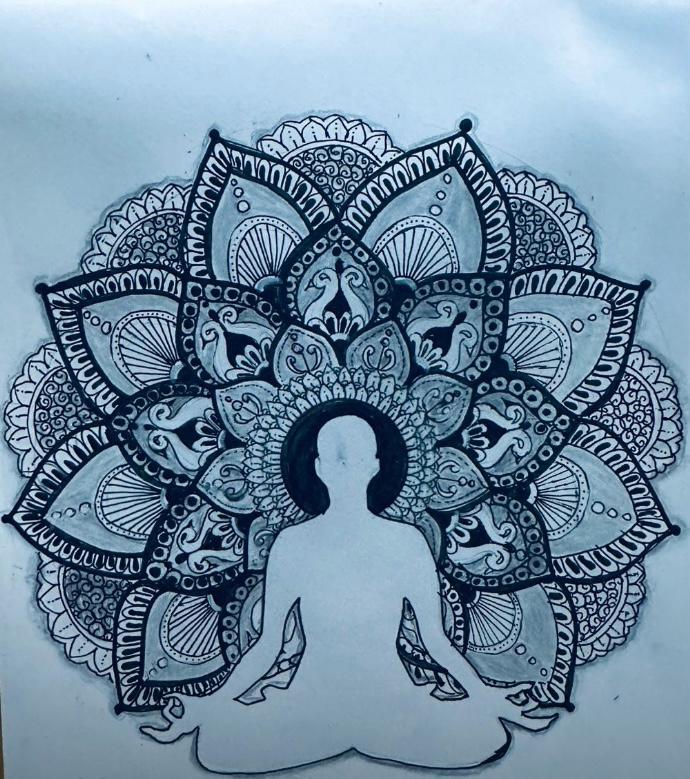
A lizard was treading lightly on the decorated golden walls of the luxurious bed room in the palace of King Brahmadutta of Kashi, maneuvering its steps carefully, one at a time. Occasionally it used to make “thit”, “thit” clicking sound to attract partners, interrupting the intense tranquility which ruled the palace that night. The lancet royal windows were allowing the wind to carry with it the cool and gentle fragrance of lotus flowers from the royal pool and filled the bedroom. The aromatic sandal and agar wood in incense filled the room with soothing fragrance and added to its ambience. The wax torch fixed in the room by the Security Guard provided flickering light throughout the night started waning slowly. Besides this, fading moonlight was entering the room through the windows. The ethereal glow of the stars was still shimmering in the clear sky. A placid calmness prevailed all over the palace. On the royal bed queen Ratnaprabha was fast asleep. But on the same royal bed King Brahmadutta was having a sleepless night when the clicking sound of the lizard attracted his attention. The fear and anxiety within him was quite prominent on his wrinkled forehead. His sleepless red eyes were an expression of uneasiness and trepidation inside him.
Suddenly King Brhmadutta had a feeling someone was peeping through the window into his bed room from the sprawling corridors of his palace. The palace was situated high atop a hill and surrounded by dense forest. No intruder would dare to take risk to cross the deep moats surrounding the fort, which housed dreaded reptiles. The high walls around the palace were impossible to scale with veteran trained armed soldiers guarding every inch of the boundary wall day and night. The palace gate was rock solid with seasoned wood and covered with solid steel plate. Flames blazing in every corner of the palace and flashing lights provided enough light, where no movement would go unnoticed. Soldiers were patrolling inside the palace day and night. Yet somebody could dare to break in, crossing the entire security to climb up and move in the balcony and the corridors unnoticed? Brahmadutta was quite sure as the shadow of the intruder was visible to him from a distance. He tried to silently listen to the footsteps of the intruder. Definitely he could hear the movement by the intruder. Who is he? How could he reach there, in spite of such tight security? The intruder was even brave enough to move near the living arena of the king and peep through the royal window, Brahmadutta could not believe.
What could be the intention of the intruder, who has dared to cross the security ring around him risking his own life? There were hundreds of foot soldiers, cavalry and archers to provide security. Yet he had taken a capital risk without caring for his own safety? Whoever the intruder, his only intention must be to kill him. But why was he after his life? Was he armed? Did he conceal some weapon in him? He tried to look for the dreaded weapon. Yes, the assassin was definitely moving on the corridor probably with an open sword in his hand. He could clearly see the weapon.
Brahmadutta whispered to Queen Ratnaprabha “Are you able to see the assassin? Could you listen to his footsteps?”
“There is no one around. No movement, no foot step sound. It’s your delusion, may be a nightmare. This must be the fourth time in this night you woke up and made the same complaint about a flimsy invisible intruder, who has entered into the palace and wanted to take your life. You say that the assassin is holding a huge sword in his hand. Your fear is unwarranted and you are unnecessarily terrified. Who could take such huge risk to break the security ring round the palace and reach you without risking his life? Soon the day will break and you can see in the day light your fear and complaint is unwarranted. The royal physician would arrive soon and examine you. You try to sleep for some time please”, said Queen Ratnaprabha.
“How strange? What has happened to me? Why have you summoned the royal physician? Are you not able to see the shadow of the intruder? Are you not able to listen to his footsteps? Do you feel it‘s a fig of imagination? Believe me. Definitely an assassin has intruded into our palace to take our life.”
Koshala king Dirgheti was the biggest enemy of Kashi King Brahmadutta. Kashi and Koshala had age old rivalry and were each other’s adversary. As long as Dirgheti was alive there was danger to the life of Kashi king Bramadutta. When alive, Dirgheti frequently attacked Kashi, to expand his territory beyond Koshala. But expedition and war to expand the boundary of one’s kingdom, protecting the subjects were very common function of the rulers. So there was nothing wrong if Koshala king wanted to attack and subjugate Kashi. Koshala king Dirgheti waged several wars against Kashi, but failed to defeat the latter. On the other hand at the end of such a long drawn war King of Kashi Brahmadutta won the war and Koshala was annexed to Kashi. King of Koshala Dirgheti along with his family had to leave his kingdom. He was killed two decades ago. So King Brahmadutta of Kashi should feel safe and secure, explained Queen Ratnaprabha.
Brahmadutta was not sure,
“You are right, but you know the win against Dirgheti was unjust and illegal as it was won through deceit. In the battle field Koshal king Dirgheti was sure to win. But by adopting foul means and paying huge kickback to the Commander Durjay of Koshala army I could defeat Dirgheti, as at a crucial juncture his commander left the battlefield without a fight. Tasting defeat Koshala king Dirgheti with wife and infant son went on exile and took shelter in Kashi in disguise.”
Ratnaprabha said it’s quite futile to ruminate over the past. In the battle field nothing is wrong. Right or wrong every means need to be applied. What matters is a win by any means. There is nothing called unjust war. Anyway, dawn would break soon. Brahmadutta needed to take rest for awhile, pleaded Ratnaprabha.
“I need no rest. I am able to see the assassin clearly but you pretend there is none. You order the soldiers to look for the intruder assassin in every nook and corner of the palace and capture the assassin at any cost,” said King Brahmadutta.
Ratnaprabha was fast losing patience. She kept on narrating how Dirgheti and his wife took shelter in disguise in the house of a potter in Kashi and how Brahmadutta bribed one of his confidants to get information about the whereabouts of Dirgheti. She further reminded how on knowing their whereabouts Brahmadutta quickly sent his men and hanged Dirgheti and his wife to death. Twenty years have passed since then and she wanted to know whether it is the ghost of Dirgheti which is frightening Brahmadutta?
Ratnaprabha asked Brahmadutta, “You being a great warrior how do you feel the ghost of a dead man will rise to take revenge and take your life after so many years?”
The queen then informed Brahmadutta “your faithful personal security officer Virupakshya himself has been taking care of your security. He has been relieved of all other works entrusted to him earlier, as per your wish and he should now be rest assured about his security system.”
“Virupakshya is definitely an intelligent, responsible and crafty warrior. I am not questioning his dedication and efficiency. I no longer feel unsafe. Yet tell me, who was that intruder with a huge sword in his hand and moving in royal corridor freely?” Brahmadutta wanted to know.
Perturbed, Queen Ratnaprabha said “Dirgheti is dead long ago. Who do you think is posing threat to your life now? Is it Durjay, the treacherous Commander of Dirgheti, who ditched his master and whom you promised the throne of Koshala? You forgot your promise as soon as you won the war and he reminded about your promise so often. Finally, it was your men who killed him when you heard he was preparing to revolt against you. So dead Durjay too is no threat to your life. Then why do you worry and get frightened without having any enemy? It’s a weird fear, a false alarm. Take all apprehensions off your mind” she pleaded.
“You are forgetting Ratnaprabha your husband belongs to a great warrior clan and being a seasoned soldier I would never fear dead Dirgheti or Durjay and feel intimidated by their ghosts. You being an intelligent woman how do you forget Dirgheti and his wife were hanged by my order and at that time son of Dirgheti was a mere four year old infant. His parents were killed in front of his eyes. By now he must be a young man, who would be seeking revenge of his parent’s death.”
“You are right my Excellency. But would the boy be alive to take revenge? You made announcement throughout the kingdom and searched for the boy in every nook and corner of Kashi but there was no trace of the orphan Dirghayu. What harm an orphan boy like Dirghayu could do against the might of Kashi king Brahmadutta even if he is alive? Had he been alive he would not have remained silent so far. You are unnecessarily getting worried. It is your unjustified suspicion and unwarranted mistrust that is bothering you. Your violent thoughts have been creating mental images of an invisible assassin and have been the reason for your persistent fear. It is your guilty feeling for treachery committed against Dirgheti to win the war, which is disturbing you. An ordinary imaginary shadow troubles you so much? Do not worry, I will ask Virupakshya to look for the intruder and report to you. You please take rest.”
Next morning the royal physician arrived to check the health of Brahmadutta. This annoyed king Brahmadutta further. He declared himself to be alright and ordered the physician to leave his palace. The physician informed queen Ratnaprabha that the king though physically alright, he required rest. He said the king was suffering from panaroia, a nerve disease which creates delusion and releases excess adrenaline that increases heart rate and blood pressure of the patient. It may be due to mental fatigue and stress. Like hydrophobia patients who get frightened by seeing their own reflection on water, paranoid patients fear imaginary enemy and spend sleepless nights. For mental relaxation it would be better if the king undertake hunting expedition and cool his nerve, he suggested.
“You have not gone on hunting expedition since ages. You will feel relaxed if you take leave from royal duties for a few days“, suggested queen Ratnaprabha to Brahmadutta. It was decided Virupakshya with a band of handpicked security men will accompany and take care of King’s safety and security during the expedition. The queen would stay back at the capital and send spies to look for Dirghayu.
Virupakshya suggested the forest around river Dhiratanaya not far from the capital would be ideal for the hunting expedition, to which Brahmadutta agreed and all arrangements were made accordingly. The king suggested only Virupakshya would remain by his side and provide him security.
One day during the expedition Brahmadutta felt tired and wanted to take rest under the shadow of a huge tree. He called for Virupakshya to stay with him when he took rest.
Soon he entered into deep sleep with Virupakshya around. But he was not Virupakshya but Dirghayu, son of Dirgheti who disguised as Virupakshya and posed as king’s faithful confidant, only to take revenge against Brahmadutta for killing his parents. With dedication and sincerity he had been able to earn the faith of Brahmadutta. He had been waiting for this opportunity for last twenty years. Now that opportune time had arrived, when there were none around. He looked around and unsheathed his sword to behead the killer of his parents. Then he remembered the words of his slain father who spoke to him before his death “Son, revenge out of hatred against your worst enemy is not the right path to win your enemy. Enemy can be won only with love”.
Dirghayu was in two minds as to what would be proper for him - to take revenge by slaying the killer of his parents, for which he waited so long or to obey the last words of his father? Tears rolled down his cheeks and his sword came down. Before he could sheath his sword Brahmadutta got up and found Virupakshya standing with raised sword to kill him. He felt death was standing in front of him and started trembling out of fear.
“I am not Virupakshya but Dirghayu, son of Dirgheti. All these days, I had been waiting and had been planning, staying around you and looking for opportunity to take revenge for killing my parents. But do not fear. I will not take your life. My father’s last words prevented me from slaying the killer of my father. Yes, I have betrayed you by posing as your confidant. Whatever punishment you want to give I will abide.”
Brahmadutta’s head came down before the greatness of Dirgheti and Dirghayu. He had no words to express his gratitude. He said “Dirghayu, you and your father have opened my eyes. For petty material gain I resorted to foul unjust means to defeat your father and kill your parents. I am a criminal before you. I am returning the throne of Koshala to you as you are its rightful owner. Please forgive me.”
( The End)
Completed his MA and M Phil in Political studies from JNU and served as Deputy General Manager in NABARD. He made pioneering contribution in building up Self Help Group movement in Odisha and popularized Amrapally mango plantation in the state. He has authored several books and written several articles on micro credit movement. Four tele films were made on his book titled “A Small Step forward”. He served as Director of a bank for over six Years.
An acclaimed Short story writer in Odia and English. His stories are rooted in the soil and have sublime human touch. Many of his short stories in Odia have been published in reputed magazines. His short story collection “Michha jharanara pani” was released recently.
(9491213015)(m)
S. Sundar Rajan
I happened to come across an article captioned "empty nest syndrome" referring to the inmates at home, after living together for many years, moving away due to various circumstances.
I tried to relate it to my routine. As usual, I spent my day with my office family and returned home late around 8 pm in the evening. My home was obviously dark as there was no one at home and appeared as an empty nest. I unlocked the gate, switched on the lights at the gate and foyer to open the main door. I heard some steady chirping and looked around at the ceiling from where I heard the sweet voice resonating. The greeting was from the red vented Bulbul that has built its nest over the lamp shade in the foyer. It was a pleasure to receive a warm welcome after a tiring day, navigating through heavy traffic.
A smile lit my face as I opened the main door and let myself in.
As I moved upstairs, to have a wash and a change, I again heard some babbling from the balcony. I brushed the curtains aside and found the little mynahs excitedly welcoming their maa. I realised the home was not empty after all.
I was greeted every morning and evening by the chirping Bulbul and I was very touched.
As the days sped, one morning, I heard additional chirping and found two little bulbuls peeping out of the nest, bidding goodbye to their maa. The number count was on the increase.
It was one Sunday when I heard continuous chirping, without a break and having got used to these, I found this chirping as a distress call. I opened the main door and peeped out. Yes. I was right. This time there was a pair of bulbuls, perched on a nearby tree chirping away without a break. I looked up into the nest and found the baby missing. I surmised , the male bulbul had also accompanied the female this time and obviously too. After some time the chirping stopped. I came out to ascertain the reason. The parent bulbul had located the young one at the foyer floor. The two birds pecked the little only very fondly and were teaching the little one to move. After some time there was silence all around. I found the little bird perched safely on a branch of a tree.
I saw before me first hand, the love and care extended by the parent bulbuls and how protective they were towards their little one.
I also realised very soon I will be left with an empty nest for some time.

S. Sundar Rajan is a Chartered Accountant with his independent consultancy. He is a published poet and writer. His collection of short stories in English has been translated into Tamil,Hindi, Malayalam, Telugu, Kannada and Gujarati. His stories translated in Tamil have been broadcast in community radios in Chennai
and Canada. He was on the editorial team of three anthologies, Madras Hues, Myriad Views, Green Awakenings, and Literary Vibes 100. He has published a unique e anthology, wherein his poem in English "Full Moon Night" has been translated into fifteen foreign languages and thirteen Indian regional languages.
An avid photographer and Nature lover, he is involved in tree planting initiatives in his neighbourhood. He lives his life true to his motto - Boundless Boundaries Beckon.
Dr. Rajamouly Katta
'Love makes lovers live together in hearts. Love leads lovers to marriage, for a legal bond to live together lifelong. Marriage is in fact a mask to say that they are a couple but not a pair of lovers. Marriage is a bond to live together but not the sign of love and the fruit of love...
'The lovers or the couple are like two eyes to look at the sole object or the only objective in their sight. They’re like the two facets of a coin to be good as not to be a counterfeited one. If anybody says that the lovers or husband and wife are different and are like the Poles, it’s wrong. The Poles are the Poles apart, but they are not lovers to be separate...
'In an incident, one man as a lover forces a woman whom he loves on one side and has another woman to love him on the other. It against a legal right,' narrated a judge in the court of love by telling an incident from his life:
Anamika was a girl groomed in a rural background. She was born and brought up in a farmer's family. She liked the rural landscapes and pastoral folks. She spent all her daytime in nature enjoying its sights and sounds.
Of all sights in plenty in nature's bounty, the peacocks' dancing was the best one for Anamika. She learnt to dance gracefully at the fascinating sight. She loved beautiful pastures, hillocks, thickets. and verdant trees with full interest. She was glad when she saw the beautiful sights and listened to the sounds of the singing birds. She felt that the birds had come and sung from farther realms to gladden her heart during her stay in nature.
Nature was like her mother, and she was a child to grow in the lap of nature with all pleasures. For her, nature was her motherly companion.
In her girlhood days, Anamika was innocent like a lamb. She loved nature very much. She went to the river and played the game of building sand dunes in the sand. She found pleasure in watching the animals like cattle around her. She used to go to the cows and touch them with love and affection.
Anamika was interested in birds and animals. She imitated birds and animals as she had interest in the sounds. She used to imitate the sounds of the cuckoo and enjoyed herself in nature. She came back home, enjoying the hues of sunset and the birds in their flight back to nests.
In her usual visits to nature, Anamika loved the sight of flowers... She liked their rich variety for the beauty in bounty enjoyed in her fond looks at them. The flowers appeared to smile on her touching them gently as if she were the only girl to enjoy the mysteries of nature by unraveling them. She reveled in her joys at the sights and sounds of nature, a heaven on earth, the earthly paradise.
Anamika listened to a melodious song from far vales and distant hills. She felt that the song was echoing on earth from heaven. She went in search of the melodies. In her search, she went further and saw a hillock. She went near the hillock and found a handsome boy playing the flute sitting on a branch of a tree nearby. She stood near the tree, listening to the song with rapt attention. The boy also looked at her listening to him happily. She did not know where she was and where he had come from.
It was a great surprise for Anamika as she found the boy as a gift offered to her by nature. She used to go to the spot and enjoy the songs played on the flute by the boy. The sight with a hillock and the tree nearby, and the boy's playing the flute was her favourite pastime.
Anamika was a regular visitor of the sight of her choice. She did not miss her visit to the sight not even a day also. That sight was her gift offered by Nature.
In her visit to the sight one day, Anamika made up her mind to call him Prakrith when she saw him in the bower of nature.
Anamika enjoyed the melodies sung by the boy every day. She used to go to the tree to listen to him very attentively. He used to sit on the tree and sing melodies with the background sounds of singing birds. She felt like dancing in response to his melodies. One day he came down to speak to her sitting on a rock under the tree.
'I'm happy to find you here... I thought that only natural objects were enjoying my melodies. I'm happy that you are enjoying my songs by coming to me... I'm very glad to see you...,' said the boy in nature.
'I too...I felt lulled in the swing of your melodies...My happiness knew no bounds when I heard your melodies of your flute and danced to the tune of your rhythms,' said the girl, Anamika with all smiles.
'Infinite flowers glitter in your smiles,' said the boy in nature.
'I saw you first in nature...Since you’re the gift of nature, I made up my mind to call you, Prakrith...,' said Anamika.
'You can call me Prakrith...the name you like most,' said the boy, Prakrith.
'Very glad to call you Prakrith,' said Anamika.
'When I saw you first, I felt like calling you, 'Girl in Nature'... A girl in nature is nameless... 'Nameless' means 'Anamika'... I felt like calling you Anamika,' said the boy, Prakrith happily.
'In fact, my name is Anamika... What you wanted to call me is the same. What a coincidence! Call me Anamika...Let my name flow from your throat like your note from your flute,' said Anamika with a hearty smile like the flower to spread its maiden perfume and glow its newborn shine.
'Anamika...Anamika...,' said Prakrith.
'Call me many more times...,' said Anamika.
'Anamika... Anamika... Anamika... Anamika... Anamika...,' called Prakrith many times with all love and affection. Her name echoed everywhere for his joy.
'I'm happy to listening to you... you’re calling my name, 'Anamika'. My happiness is multiplied infinitely...,' said Anamika.
'My dear Anamika, call me Prakrith many times,' said Prakrith.
'Prakrith...Prakrith...Prakrith...Prakrith...Prakrith...,' called Anamika with love and affection. Her calls resonated everywhere to gladden the heart of Prakrith.
'Where are you from?' said Prakrith.
'I'm from nature... Where are you from,' said Anamika?
'I'm from nature...We both are in the lap of nature...,' said Prakrith.
'Your melodies made my heart bloom with happiness... My happiness is indefinable... My heart wishes to listen to your calls and melodies... I can't be away from your calls and melodies,' said Anamika with glittering smile.
'Only at your sight, I feel inspired more to produce more melodies on my flute than before,' said Prakrith happily.
Prakrith and Anamika were in nature everyday... They were not able to be away from each other... They were two in one in all respects. All days they were together in the lap of nature. What made them live together every day? They did not know what it was. They did not know that it was love that made them live together. It was an indefinable experience.
Anamika was not able to live without seeing Prakrith. He was everything to her. She was everything to him. The sun was aware of the fact. The trees, the hills and all nature objects witnessed their love for each other.
The pigeons in a nest nearby saw Anamika and Prakrith sitting together and enjoying their love. The birds were jealous of them...their love... The birds watched them together every day.
Anamika and Prakrith were together, enjoying the company of each other while noticing no passage of time. All the objects in nature loved to see their delightful sight. Flowers bloomed to express their joy at their sight as they do at daybreak. Cuckoos sang melodies at their sight in the spirit they naturally sing on eating tender mango leaves. Peacocks danced at their pleasant sight as they do at the sight of dark blue clouds. Deer looked at their sight very happily with their beautiful eyes wide open as they do at no sight of cruel animals.
For the joyous witnessing of all the objects of nature, Prakrith and Anamika were together on a fine morning while the sun was shining with its tender rays.
'We met here in this holy spot. You are a river, and I am a river flowing from different directions to meet here as their confluence to flow into the ocean of bliss,' said Prakrith happily.
'True, we're the two rivers for our union in the name of their confluence...,' said Anamika with joy knowing no bounds.
'Sacred rivers are to meet at their definite confluence,' said Prakrith.
'Our union is a miracle...You're a bird from your world...I'm a bird from my world...We're the birds to meet in the paradise of birds...We're the birds of paradise,' said Anamika happily.
'Yes, it's our paradise...the paradise created for us in the lap of nature... We're to live in the bower of nature...and so this is the paradise for us, the two birds to build the nest of paradise,' said Prakrith, while singing melodies in ecstasy.
Anamika engrossed in the beauty of his melodies in bounty and danced gracefully. Their joy transported them to a new world. All the objects in nature were still watching them in ecstasy.
... ... ... ... ...
Days passed to find Anamika marriageable. Her parents, Ambika and Madhava thought of celebrating her marriage with a boy in the city, as they had the fascination of urban life.
Ambika and Madhava were not aware of their daughter Anamika's love for Prakrith. She was not able to express her love for Prakrith as she was very innocent. Her parents were also innocent as they were farmers from the rural background. Their dream was to select a boy from the city nearby. They thought of informing their close relative, Ramu who was studying in the city, as they had informed him to be in search of a match for Anamika in the city.
Ramu, their relative, brought a boy called Krish for Anamika from the city. The boy was suitable and looked ultramodern and stylish. The parents, Ambika and Madhava thought that he was well educated and highly placed for his higher education. They were happy to receive him.
As per their invitation, Krish came and occupied a seat provided for him in their house. They offered him fruit and all and he had. Meanwhile they called Anamika to appear before him. She appeared angelic and sat like an angel before him. She did not know why the parents called her to the boy.
Anamika sat in their presence. The marriage party were in a good impression on the girl. After the meeting, she slowly went inside but she was not inside. She went to her favourite spot to see Prakrith and listen to his songs on the flute. Prakrith had been waiting for her anxiously.
When Anamika was the only daughter for the farmer-parents, Krish thought that he would own all the property of her parents. He expected many things from them. He said that he liked the girl a lot.
Ambika and Madhava never tried to know their daughter Anamika’s heart, her will and wish, as they were very innocent. The city boy’s liking her was very important for them. They settled her marriage and Krish would be her bridegroom.
... ... ... ... ...
Ramu, the close relative of Ambika and Madhava came from the city after the settlement of Anamika's marriage. He came to Anamika. He had a conversation with her,
'I'm happy that you are going to the city after your marriage... It's a big city...We find all that we don't find here at this village...,' said Ramu.
'I don't want to go to the city...I want to stay here,' said Anamika.
'How do you stay here...?' said Ramu.
'In the way I've been staying here since birth,' said Anamika.
'It's the marriage of a city boy and a village girl...You're bound to stay in the city...It's inevitable...,' said Ramu.
'I'm not ready to go to the city,' said Anamika.
'Your parents like you to live in the city... It's their cherished dream... If you're not ready for that, your parents can’t live ahead. They commit suicide...You can't go as per your wish...Go as per your parents’ wish… Remember that...,' said Ramu.
Anamika felt shocked when she heard that she was bound to go to the city, as per the wish of her parents. She did not know what to do. She was in deep thoughts while she was listening to the song of Prakrith in her heart. It was echoing in her heart all the time.
The day came for the marriage of Anamika and Krish. The time for their marriage also arrived to see them in the venue. All were busy. The marriage was going on. Ambika and Madhava did not allow Anamika to go anywhere that day. The matrimonial musical lutes and drums were going on. In all the sounds, she listened to the only song played by Prakrith on the flute. She felt like running to the sight to see him.
The priest asked Anamika to come to the marriage venue. Ambika and Madhava led her to the venue and made her sit in the venue.
Krish was in a hilarious mood. Anamika did not know what exactly was going on. She did not know that the marriage would prevent her from going to Prakrith for her seeing him and listening to his songs. Everything in the marriage venue was going on in a mechanical way but she was listening to the song of Prakrith in her heart amidst all matrimonial sounds of pipes and drums. His song was ringing in her ears and echoing in her heart.
It was the time for the bridegroom to tie mangala sutra, the wedlock in the neck of the bride, Anamika. He tied it while the priest was chanting the key spell for the process of marriage performance. She did not mind all the things. All lutes and drums were going on, but she was listening to the song of Prakrith, its tone and tune. It was ringing in her heart. She slowly went out when all the people were busily engaged in their activities.
Anamika ran to Prakrith and was with him. She was enjoying the song of Prakrith.
All noticed that Anamika was missing... They searched for her, but they did not find her in the house. All the villagers launched their search. They ultimately went to the sight where she went every day.
Anamika and Prakrit were together hand in hand as the bond of their love beyond the ties of marriage. They looked at them in deep love on one side and Anamika’s parents were searching for her on the other.
That was the marriage of Krish and Anamika. That was love of Prakrith and Anamika. Marriage or love, what is going to win?
Dr. Rajamouly Katta, M.A., M. Phil., Ph. D., Professor of English by profession and poet, short story writer, novelist, writer, critic and translator by predilection, has to his credit 64 books of all genres and 344 poems, short stories, articles and translations published in journals and anthologies of high repute. He has so far written 3456 poems collected in 18 anthologies, 200 short stories in 9 anthologies, nine novels 18 skits. Creative Craft of Dr. Rajamouly Katta: Sensibilities and Realities is a collection of articles on his works. As a poet, he has won THIRD Place FIVE times in Poetry Contest in India conducted by Metverse Muse rajamoulykatta@gmail.com
JAGANNATH – THE LORD OF THE UNIVERSE, YET BOUND BY MAN-MADE BOUNDARIES
Dr. Viyatprajna Acharya
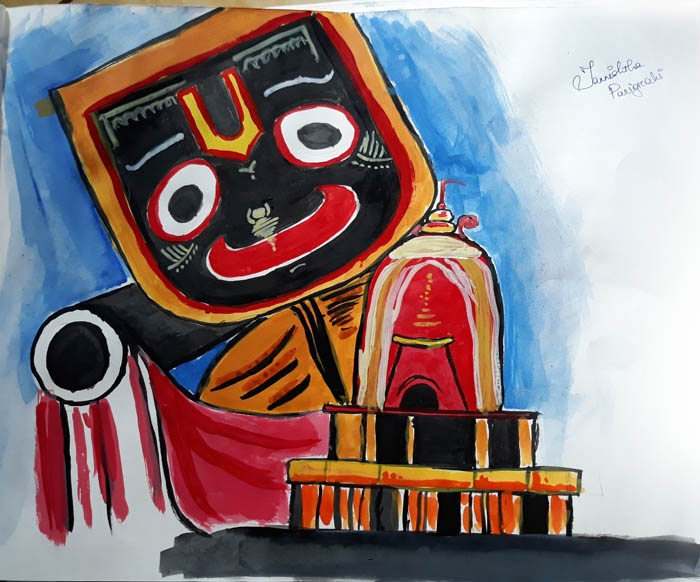
Not just the Odia community, but the entire world today reveres Lord Jagannath and the sacred pilgrimage site of Puri Dham. The spiritual and cultural significance of Jagannath Sanskriti—the culture of Lord Jagannath—is drawing global attention. Known as the "Living God", Jagannath embodies the essence of universality. His name itself means “Lord of the Universe” (Jagatara Naatha; ???? ???).
He is also venerated as “Purushottama”—the Supreme Being—transcending all other deities (anyadevatas), as described by none other than Lord Krishna in the Srimad Bhagavad Gita. Lord Krishna proclaims, “I am the beginning, the middle, and the end of all that exists,” affirming that all beings originate from Him. Lord Jagannath is considered as the avatar of Lord Krishna.
Yet, paradoxically, entry into the Sri Mandira (Jagannath Temple) is strictly restricted to Hindus—a rule prominently displayed at the temple gates. While officially framed as a ban on “non-Hindus,” historically this was largely directed towards Muslims, as Christians were a rarity in Odisha during earlier times. This exclusion raises a moral and spiritual dilemma:
Would the Lord of the Universe truly want to discriminate among His children?
Not a Divine Rule, but a Human One
Those troubled by this exclusion must understand that this is not a divine instruction, but rather a man-made rule, deeply rooted in historical trauma and cultural preservation.
India, and particularly its temples, faced relentless invasions. Muslim rulers attacked the Jagannath Temple not only to loot its vast treasures but also to assert religious dominance. There have been 17 major attacks on the temple, and in a heart-wrenching turn of history, Lord Jagannath was kept away from the Ratnavedi (sacred altar) for 144 years—a stark testament to the temple’s turbulent past.
Another significant reason behind the prohibition lies in the cultural sanctity of the cow in Hinduism. The cow is revered as Go-mata (Holy Mother), and the act of consuming beef is profoundly offensive to the Hindu psyche. During times of conflict, this cultural difference deepened the divide and necessitated protective boundaries.
A Wound Still Healing
The exclusion seen today is a residue of historical insecurity and cultural self-defense, not spiritual arrogance. While it may seem contradictory to the inclusive philosophy of Lord Jagannath, it is essential to recognize the context and scars of the past that shaped this policy.
However, as times evolve, so must our understanding. While we guard the sanctity of our spaces, we must also strive for dialogue, awareness, and healing, ensuring that Jagannath’s message of universality is not just chanted but lived.
There have been 17 major attacks on the Jagannath Temple, and Lord Jagannath was kept away from the Ratnavedi for 144 years.
According to the experts who have studied the temple’s history, Lord Jagannath had to be kept away from the temple for a total of 144 years due to these invasions. Let us learn about these 17 major attacks.
1st Attack (1340):
The first attack was in 1340 by Ilyas Shah, the Sultan of Bengal. At that time, Odisha was known as Utkal. King Narasingha Deva III of Utkal fought to protect the temple. The soldiers of Ilyas Shah shed rivers of blood around the temple. However, the idols of the deities were secretly hidden and saved from destruction.
2nd Attack (1360):
The second attack came in 1360 by Firuz Shah Tughlaq, the Sultan of Delhi.
3rd Attack (1509):
The third attack was in 1509 by Ismail Ghazi, the general of Bengal Sultan Alauddin Hussain. During this time, King Prataparudra Deva of the Suryavanshi dynasty ruled Utkal. The idols were hidden on an island in Chilika Lake to protect them.
4th Attack (1568):
This was the most destructive attack, led by Kalapahad. While the idols were hidden again, some of the temple’s idols were burned and destroyed, and many artworks were damaged. This attack marked the beginning of Islamic rule in Odisha.
5th Attack (1592):
This attack was led by Usman, son of Sultan Isha of Odisha, and Sulaiman, son of Kuthu Khan. Innocent people were killed, the idols were desecrated, and the temple was looted.
6th Attack (1601):
This was carried out by Mirza Khurram, under the Nawab of Bengal, Islam Khan. The idols were taken via river Bhargavi and hidden in Kapileswar village near Puri.
7th Attack:
Hasim Khan, the subedar of Odisha, launched this attack. The idols were already moved to Gopal Mandir in Khordha, 50 km from the temple. However, the temple suffered severe damage.
8th Attack:
This was done by a Hindu jagirdar (feudal lord) serving in Hasim Khan’s army. The idols were not in the temple at the time. The temple was looted and converted into a fort.
9th Attack (1611):
The ninth attack came from Raja Kalyanmal, son of Raja Todarmal—one of Emperor Akbar’s Navaratnas. The idols were hidden on an island in the Bay of Bengal.
10th Attack:
Again by Kalyanmal, who completely looted the temple.
11th Attack (1617):
This was led by Mukarram Khan, general of Mughal emperor Jahangir. The idols were hidden in a place called Gobapada.
12th Attack (1621):
Led by Mirza Ahmad Beg, the Mughal governor of Odisha.
13th Attack (1641):
This attack came from Mirza Makki, another Mughal governor of Odisha.
14th Attack:
Another assault by Mirza Makki.
15th Attack:
This was led by Amir Fateh Khan, who looted diamonds, pearls, and gold from the temple’s treasury (Ratna Bhandar).
16th Attack (1692):
Under orders from Mughal emperor Aurangzeb, this attack aimed to completely destroy the temple. The then Nawab of Odisha, Ikram Khan, acting under the Mughals, attacked the temple and looted Lord Jagannath's golden crown.
17th Attack (1699):
The final and 17th attack was by Mohammad Taqi Khan, who served as the Nayab Subedar of Odisha from 1727 to 1734. The idols were hidden again, and for a time, they were even kept in Hyderabad.
________________________________________
This historical timeline highlights the turbulent past of the Jagannath Temple and the relentless efforts made by devotees and priests to protect the deities and the sanctity of the temple.
The sacred temple of Lord Jagannath at Puri has long stood as a beacon of faith and devotion—not just for Hindus, but for spiritual seekers worldwide. While the philosophy of Jagannath Sanskriti is inherently inclusive, embracing the idea that the Lord is the source of all beings, certain protective measures around the temple often stir questions and controversy.
The Looming Threat: Then and Now
The threat to the sanctity of Jagannath Temple is not just historical—it persists even today. In a recent alarming episode, journalist Ms. Jyoti Malhotra, accused in an espionage case, reportedly captured sensitive visuals of the temple using a drone, allegedly in collaboration with a local YouTuber. The suspicion that such information might have been shared with Pakistan, a state often associated with terrorism in Indian narratives, has understandably sparked deep concern among devotees and security agencies alike.
British Interference and Historical Meddling
The temple’s sanctity has been challenged not only by foreign invaders but also under colonial rule. During the British Raj, the administration of the temple saw unsettling transitions. Initially, the British attempted direct control, only to face resistance and practical limitations due to religious restrictions—non-Hindus could not enter the temple. In 1806, the management was handed over to a committee of learned Brahmins. But this setup proved unstable, and by 1809, the Raja of Khurda was appointed as the hereditary Superintendent, albeit under British oversight.
Even during “Naanka Durbhikshya”—the Great Famine—the British dared to interfere with the daily rituals of Lord Jagannath. This was met with fierce resistance from the people of Odisha, who saw it as not just administrative overreach, but a spiritual violation.
Why Doesn’t God Protect His Own Abode?
A deep philosophical dilemma often arises in the minds of devotees:
If the Lord is omnipotent, why does He need protection? Why must His devotees bear the burden?
This question touches the core of Dharma. The answer lies in understanding that the universe is His Leela, a divine play. While He is the protector, He has entrusted Dharma to humans, giving them agency and responsibility. As Lord Krishna says in the Bhagavad Gita, "Yada yada hi dharmasya glanir bhavati..."—whenever Dharma declines, He manifests in support of those who uphold it.
The repeated invasions, desecrations, and current threats have all been met with divine resilience, not merely human resistance. Every adversity only serves to reaffirm the Lord’s glory. The protection of Dharma becomes a shared responsibility between the divine and the devoted.
Inclusivity vs. Intent
Inclusivity is a virtue, but naïve inclusivity can be exploited. While Lord Jagannath's teachings are universal, not all who approach His gates do so in faith. Many arrive with agendas—political, ideological, or even malicious. History has shown that the temple has been a target not only of curiosity but also of destruction.
Therefore, the exclusionary policies—though painful to some—must be seen not as a reflection of divine discrimination, but of historical caution and spiritual safeguarding.
Conclusion
Lord Jagannath is indeed the Lord of All. His love knows no bounds. Yet, the boundaries around His temple serve a different purpose—not to divide His children, but to protect the sanctity of the space that holds centuries of faith, sacrifice, and resistance. As devotees, we must strive not only to preserve the traditions but also to deeply understand the reasons behind them.
Jay Jagannath!!
=Shubhamastu=
LET ALL BE WELL
Dr. Viyatprajna Acharya is a Professor of Biochemistry at KIMS Medical College, who writes trilingually in Odia, English and Hindi. She is an art lover and her write-ups are basically bent towards social reforms.
RESPECT TO THE BEST STORY TELLER
Dr. Protiva Rani Karmaker
According to Frank Smith, “The best teachers are the best storytellers.” My father is the best storyteller I have ever met. His life, a story of difficult struggle, perilous journey, and success, was itself a story to me, from which each day I feel driven to move ahead. To maintain a big family, he had to relinquish his education at middle midpoint of his studies. So he started his career as a goldsmith, besides teaching us. He was very satisfied with his profession. He always told us to love our work, whatever we do and remain strict in one profession rather than changing it very frequently. To satisfy his thirst for knowledge, he started reading books at night and delivering the knowledge to his children. To him, reading was a blessing. Once in a while, he entered into my room with a bag full of gifts. Since it was my birthday, I thought it could be something special. It was special as my father bought a book for me. He told me that there can be no other gift precious than books, as all the gifts will be ruined over time, except the knowledge that I will achieve through reading books will guide me until the last.
None in this world can avoid the strike of death. Death is so democratising that we all fall under the black veil of it, most often quite unintentionally, after leaving some undone duties to our next generation. Though my father has left me on this day many years ago, I can feel his morals and honest endeavours to help learning. My father is not socially recognised such a famous one, but truly in the arena of his family, he is a man to be honoured and followed always by his successors. In his lifetime, he used to help the poor students of his locality by providing financial support, moral guidelines and motivation. All of his four children are in very prestigious professions at home and abroad. When his only son stood first in the HSC examination in 1990 from the Dhaka Board, he served food to the poor people. Later on, when I asked him the reason, he told me that by feeding the unfed, poor and distressed ones, you can express your gratefulness to Almighty God for the expected result you unassumingly sought.
This man was never late in his profession. He earned the reverence for his punctuality. I saw my father shivering in fever but continuing his work up to midnight to deliver his gold-made ornaments timely. When I asked him about the reason behind this urgency of work, he told me that the owners of these ornaments are earnestly waiting to get them. So, delivering ornaments in time is a way to deliver a joyful message to women, and he must not delay. He advised me not to leave any work for tomorrow, if I can do it today. Till the last day, my father tried to render his service timely.
I have always dressed him in a white dress as white was his favourite colour. His good heart made him look all the more beautiful in a white dress. He never told a lie and harmed others. He respected people from all castes, creeds and religions. He nurtured a sense of brotherhood for all. He had many close friends from other religions.
My father was a man of indomitable spirit. When I was a very little girl, my father would often tell me a true story of his life. When he was only nine years old, he was travelling from the house of his sister. His sister asked him to carry a huge bag for her father’s family. The day was rainy and muddy. Finding no vehicles on the road, he started walking for a long time. All of a sudden, a heavy storm came. He took refuge under a banyan tree in a graveyard next to his village. He started praying to God, closing his eyes. Just after opening his eyes, he saw a very tall person standing in front of him. That big man came and very silently took all of his baggage on his shoulder. He told my father to follow his footprints. After a few minutes, my father found him standing in front of his own house. Surprisingly, when he looked back to express thanks to him, he got nobody, not even any footprints. Father told me that it was his strong willpower that probably helped him to carry the huge load. Perhaps because of this mind power or strong will, my father, even in his third stage of cancer, never stopped helping us, standing beside his family with his wit, courage and support.
During our last meeting, Father told me that he would be waiting for me until I come back with a Ph.D. degree from India. Plautus has rightly said, “Man proposes, God disposes.” My best storyteller left me before my Ph.D. award. Whenever I look at the sky, I feel he is there to encourage me, to read and write to me more. Respect to all fathers or the best storytellers of the world.

Dr. Protiva Rani Karmaker is an accomplished writer and columnist for national dailies, renowned for her contributions to education, youth development, and literature. As a professor and first director at the Institute of Modern Languages, Jagannath University, her expertise spans literature, education and research. She has authored twelve books by Bangladeshi renewed publishers, 01 book by Indian publisher, 22 journal articles and 200 columns. In recognition of her exceptional work, she received the International ERUDITE SCHOLAR 2022 award from the Council for Teacher Education Foundation (CTEF), India, and the International Award of Academic Excellence and Leadership 2024 by the Council for Educational Administration and Management (CEAM) India.
LEAF FROM HISTORY: FROM FACTORY FLOOR TO PRESIDENTIAL PALACE
Mr Nitish Nivedan Barik

In the dusty hinterlands of Pernambuco, Brazil, in 1945, a boy named Luiz Inácio da Silva was born into a poverty so stark that hunger was part of daily life. One of eight children, he migrated with his mother to São Paulo in search of survival. By age 12, he was working in a dye shop; by 14, a metalworker. A factory-floor accident cost him a finger—but ignited a lifelong flame. That boy would grow into Lula, the most iconic president Brazil has ever known.
In the 1970s and 1980, Lula emerged as a force in Brazil’s labour movement, gaining national attention as a metalworker-turned-union leader under military dictatorship. He led historic strikes across São Paulo’s industrial belt, challenging economic injustices and advocating fiercely for workers’ rights. His formal political journey began in 1980 when he co-founded the Partido dos Trabalhadores (PT)—the Workers’ Party—anchored in labour rights and social equity.
Lula ran for president in 1989, 1994, and 1998, each time galvanizing a stronger national following. On his fourth attempt, he won Brazil’s presidency in 2002 and took office in 2003. His administration became synonymous with inclusive growth—launching Bolsa Família, a landmark social program that lifted millions out of poverty by providing conditional cash transfers to low-income families.
Re-elected in 2006, Lula presided over a period of profound transformation: Economic growth averaged 4.1% annually, Inflation fell from 12.5% to 5.9%,Per capita income rose by over 23%,More than 20 million Brazilians escaped poverty.
His government expanded access to university education through ProUni, boosted healthcare in neglected regions via the Family Health Program, and secured Brazil’s hosting of both the 2014 FIFA World Cup and 2016 Olympic Games—symbols of a nation rising on the world stage. Environmental efforts, including reduced Amazon deforestation, also marked his tenure.
Globally, Lula championed South-South cooperation, helped launch BRICS, pushed for UN Security Council reforms, and strengthened Brazil’s ties across Africa, Asia, and Latin America. He positioned the country as a diplomatic bridge and voice of the Global South.
Yet, history took a sharp turn. In April 2018, Lula was convicted of corruption and money laundering—accused of receiving a beachfront apartment in exchange for political favors. Sentenced to over 12 years in prison, he served 580 days before being released in November 2019 after Brazil’s Supreme Court ruled that incarceration prior to the exhaustion of appeals was unconstitutional.
In 2021, the court went further: it annulled Lula’s convictions, citing judicial bias and lack of jurisdiction—thus restoring his political rights. In a stunning twist, Lula returned to the ballot in 2022—and won. He assumed the presidency once more in 2023, a symbol of democratic resilience and popular faith.
As Brazil’s leader today, Lula continues to champion climate justice, multipolar diplomacy, and equity—presiding over the country’s G20 leadership in 2024 and reinvigorating its global engagement.
Lessons from Lula’s Journey: Adversity is not destiny — Lula’s early struggles forged compassion and grit. Leadership is earned, not inherited — He rose from the margins through conviction and collective struggle. Democracy is fragile but resilient — His imprisonment and vindication testify to the tensions and triumphs of democratic institutions. Hope is a political force — Lula’s enduring appeal lies in his ability to inspire belief in a more just and humane future.
Lula’s story is more than political biography—it’s the chronicle of a nation’s conscience, shaped not only by its elite but by those who dare to dream beyond their circumstance.
Mr Nitish Nivedan Barik hails from Cuttack,Odisha and is a young IT professional working as a Team Lead with Accenture at Bangalore.
Dr. Mrutyunjay Sarangi
Nilambar woke up from the dream screaming.
That was the most colourful dream he had for a long time.
In fact it was a series of dreams.
Somehow every time he woke up and went back to sleep a new dream came up, more colourful than before.
And it was all in red. Red dreams!
It all started when he was shutting the window of his first floor bedroom before retiring for the night. Just outside the gate of his compound under the street light he saw a big patch of red and wondered what it was. The patch was quite big, almost the size of the manhole cover nearby. Was it something a passerby spilled from his bag? A broken Ketchup bottle? A watermelon gone bust? A bottle of red wine spilled over? Or a pool of blood? So much blood! Where did it come from?
It was too late to go down and check.
Nilambar switched off the light and went to sleep. Ranjana, his wife was already asleep and snoring.
Late into the night the dreams came in waves, one after another, like disobedient school boys attacking a docile mango orchard.
-- Nilambar has gone to the beach, with Ranjana and the kids. Far away against the horizon, boats are plying on the ocean, boatmen rowing away, singing songs, catching fish, throwing the small ones back to the sea. They beckon Nilambar and the family to come to the boats. But the boatmen are so far away! They gesture, just come swimming, we are here, nothing to worry. Nilamabar looks at the blue ocean, somehow the waves are placid, there is no ripple on the water, the calm, still sea smiles at him, silently asking him to get into the water. He holds the hands of Ranjana and the kids and they walk into the sea. In a moment the ocean turns red! It is red everywhere, all around, the white boats have turned red, the boatmen are dressed in red, the fish are all red coloured! In the sky above the clouds are all red! A cold fear grips Nilambar, what has he gone into? How can an ocean be so red? And the clouds? Red clouds? He tries to drag Ranjana and the kids back to the shore but they are too far into the sea..........
Nilamabar wakes up sweating! Ranjana is sleeping close to him, her hands on his chest. Nilamabar gets up, goes to the table and drinks a glass of water.
He looks at the clock on the wall, it is just past three in the morning.
He goes back to sleep.
-- The dream fairies are not done for the night. They come in gentle footsteps and carry him in their arms. To the green lawns of the big park near his house, the famous botanical garden which is a big tourist attraction in the town. Ah, so many flowers, so many colours! Nilamabar starts walking on the grass, so soft, so delicate, like feathers of baby pigeons! He feels like singing. So many years since he sang! He breaks into a song. There is no one in the park. He wishes someone was there, to listen to his song, maybe join him in his singing. He suddenly sees a small, beautiful girl bent over a bed of flowers, they are huge marigolds. As he draws near she turns her head, a beautiful, endearing smile spreads over her face. He holds her hand, and they start singing together. Ah, such a beautiful divine voice! As her voice rises to a crescendo, the flowers turn pink and then to red. The red colour vibrates on the flowers like rippling waves. It's a vibrant red, the sky turns red with the dawn breaking, the red sun rises on the horizon. Ah, red, the colour of promise! Of love! He grasps the small child to his bosom, she is so soft!
Nilambar wakes up, the soft pillow drops from his chest. He turns and goes back to sleep, a silent glow spreading over his heart, the memory of the small, sweet girl still alive in his mind.
-- Nilambar is still in the park, the girl is gone, the songs return. He starts humming them. There is a lake on one side of the park. He is drawn towards it. His heart skips a beat. In the dim light of the dawn he sees two shadows on a far away bench -- a young couple! Ah, the perfect company for some interesting chats and sharing some lovely songs! He is drawn towards them. As he comes close, the two figures melt into the soft mist of the dawn. Nilamabar stops, what happened to the couple? Where did they vanish? He walks on, a ghastly sight awaits him on the bench. A black cat has just dragged a big squirrel onto the bench and as the squirrel struggles, he tears it into shreds, blood spilling over everywhere, lots of blood! Nilamabar blinks. When he opens his eyes everything has turned red, the lake, the lawns, the leaves of the trees.....It is as if a red fire has spread everywhere and is raging towards the sky. Nilambar wants to run away from the park, out onto the streets, to anywhere in the town, but something pulls him back.
Nilambar wakes up, his heart fluttering like a leaf in the wind. The room is dark, Ranjana has moved away.
-- He turns and goes back to sleep. And a new dream comes with stealthy footsteps, entering his subconscious mind and spreading like a gentle whiff of air. Nilambar has to travel somewhere by train, he is late and enters the station running. Breathless, he watches the train, a thing of beauty, painted in red and white. It ambles along, the train is over crowded, there are hundreds of boys and girls waving at those who are waiting to get in. The doors are locked from inside, no one can open them. Nilambar and a few others keep banging on the doors, appealing to the young boys and girls to open the doors. But they just laugh, shaking their heads......no place for you uncle, this train is for the young...Nilambar wishes he becomes young again. From somewhere within the train balloons come floating, all red balloons, the colour of freshly plucked red apples, the cheeks of the young boys and girls turn red, their dresses are all red, they are jumping up and down, waving, shaking their heads and inside the train there is a riot of red coloured frenzy. The train starts to leave, it picks up speed, the white stripes get blurred, the train moves like a mass of red, Nilambar is sad for missing the train but the colour of the youth, the dance, the claps, the songs and the frenzy make his head swim and he starts walking on the platform seized by an euphoria. The possibility of his getting young again to catch a red coloured train seizes his mind. He walks on, beyond the platform onto the train tracks. Something tells him if he keeps walking on the route the train of the young has taken, he will get there, at his own youth......
-- Nilamabar's dream continues. He reaches home in a flash. Ranjana is waiting for him to have lunch. She is surprised that he was planning to go on a train journey. He tells her how he missed the train, how the young boys and girls laughed at the waiting passengers, how he couldn't get into the train because it was meant only for the young. And how he plans to leave on a journey looking to get young again. He asks her whether she wants to come with him. She starts laughing and the doorbell rings. Nilambar gets up to open the door. There is a young man standing at the door. From his dirty clothes, unkempt hair and bearded face it's clear he is up to no good. He asks for some money. Nilambar refuses - why should I give you money, am I floating on money? The man whines - thanks to recession, all businesses have closed, no job, no wages for us, where do we go? At least you have some money, why don't you part with a few hundred rupees? That way I will live, you will also live. Nilamabar shouts at him - go to the government, go to the free food centre and eat there, don't bother me, do you hear, don't bother me, you beggar. The young man gets very angry, his face turns red, he becomes a red figure, incandescent, burning from within. Suddenly he takes out a pistol from his pocket and shoots Nilambar on his tummy. There is a loud bang, he slumps on the floor, blood gushes out from the gunshot wound, red blood, Nilambar sees a round, red patch form on the floor, the size of a manhole cover. He touches his stomach, it's all wet.............Nilambar wakes up screaming - he shot me, he killed me, I am going to die. O my god, he shot me.........
Ranjana comes running from the kitchen,
"What happened? Why are you screaming? And how do you manage to keep sleeping in this heat, when the power is off? Look at the way sweat is pouring from your body, dripping from your chest to your tummy! Now tell me why are you screaming?"
Nilambar looked around, the uncouth young man had disappeared, but he remembered the gun shot, he had no doubt the man had shot him, and there was so much blood, he touched his tummy, his hand got wet with the sweat flowing profusely from his body,
"Didn't you hear the gunshot? That ruffian shot at me and the bullet hit me on the tummy.."
Ranjana was puzzled for a moment. Then she understood,
"O, that gunshot sound? Don't you know, that was the newspaper boy throwing the bundle of newspaper and hitting our balcony door with a bang. Now get up, the tea is ready.....God, what a dreamer I have got for a husband!"
Dr. Mrutyunjay Sarangi is a retired civil servant and a former Judge in a Tribunal. Currently his time is divided between writing poems, short stories and editing the eMagazine LiteraryVibes . Four collections of his short stories in English have been published under the title The Jasmine Girl at Haji Ali, A Train to Kolkata, Anjie, Pat and India's Poor, The Fourth Monkey. He has also to his credit nine books of short stories in Odiya. He has won a couple of awards, notably the Fakir Mohan Senapati Award for Short Stories from the Utkal Sahitya Samaj. He lives in Bhubaneswar.
Viewers Comments