
Literary Vibes - Edition CLXIX (25-Sep-2026) - STORIES 2
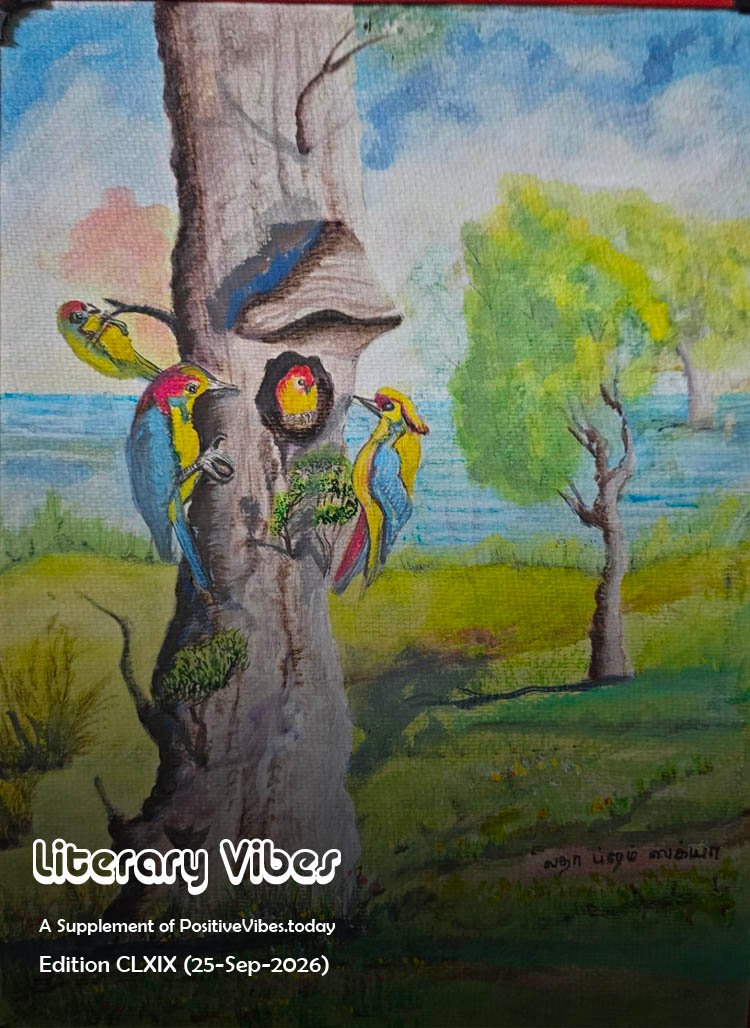
Title : Home Sweet Home (Water Colour by Lathaprem Sakhya)
An acclaimed Painter, a published poet, a self-styled green woman passionately planting fruit trees, a published translator, and a former Professor, Lathaprem Sakhya, was born to Tamil parents settled in Kerala. Widely anthologized, she is a regular contributor of poems, short stories and paintings to several e-magazines and print books. Recently published anthologies in which her stories have come out are Ether Ore, Cocoon Stories, and He She It: The Grammar of Marriage. She is a member of the executive board of Aksharasthree the Literary Woman and editor of the e - magazines - Aksharasthree and Science Shore. She is also a vibrant participant in 5 Poetry groups. Aksharasthree - The Literary Woman, Literary Vibes, India Poetry Circle and New Voices and Poetry Chain. Her poetry books are Memory Rain, 2008, Nature At My Doorstep, 2011 and Vernal Strokes, 2015. She has done two translations of novels from Malayalam to English, Kunjathol 2022, (A translation of Shanthini Tom's Kunjathol) and Rabboni 2023 ( a Translation of Rosy Thampy's Malayalam novel Rabboni) and currently she is busy with two more projects.
Table of Contents :: Short Story
11) Malabika Patel
BEAUTY AND THE BEAST WITH A TWIST
12) Ashok Kumar Mishra
13) Anita Panda
14) Dr. Viyatprajna Acharya
FLASH FICTIONS ON MENSTRUAL HYGIENE DAY
15) Upali Aparajita
TURKEY: BETWEEN CONTINENTS AND CENTURIES
16) Sujatha Krishnamurthy
17) Syamala Haridas
18) Dr Major Nalini Janardhanan
19) T. V. Sreekumar
20) T. V. Krishnakumar
21) Dr. Rajamouly Katta
22) Sreechandra Banerjee
23) Rameshan Blathur
24) Mr Nitish Nivedan Barik
A LEAF FROM HISTORY: WHERE STONES CONTINUE TO SPEAK
15) Usha Surya
26) Dr. Mrutyunjay Sarangi
BEAUTY AND THE BEAST WITH A TWIST
Malabika Patel
The University campus had two seasons — summer and rainy season. In 2000, a new girl joined the English Literature department and suddenly it felt like spring.
Simran Kaur from Patiala. First day, she walked into class in a yellow salwar, white jhumkas too big for her face, carrying a bag that said "I am not someone I am awesome."
She was stunningly beautiful, yes. But that wasn't why people remembered her. She remembered everyone's name. The chai bhaiya, the sweeper didi, the security guard who never smiled. She would say "Sat Sri Akal, uncle!" so loudly that the whole corridor would turn.
She topped the class without trying too hard, she won every debate, and she laughed in the library — a loud, open laugh that made the old librarian, keep a special eye on her.
In the same library, on the last row, near the fan that made a sound like krr-krr, sat a boy who was the opposite of noise.
Thomas Eapen from Alappuzha.
Final year, History. Big unkempt beard, old faded checked shirt on his dark and skinny body, headphones with one side not working. He had been in the same corner for three years. He came at 9, left at 6. He didn't talk. He didn't need to.
Juniors had named him Beast. Not to insult him. It was just... he was a creature of that corner. He growled if you took his seat. He stared if you were too loud. He was part of the furniture.
Simran noticed him in the second year.
It was raining. Bombay rains — neverending , torrential, flooding the roads in ten minutes.
The library was almost empty. Simran ran in, fully drenched, dupatta sticking to her. She had two paper cups of chai from the canteen.
She saw the corner. The boy was there, reading, as always.
She went and kept one cup on his table. Without asking.
He looked up, surprised.
"Why?" he said. His voice was hoarse, as if he hadn't used it in days.
"Because you looked cold. And because no one should drink chai alone in rain," she said, and sat opposite him, as if she had always sat there.
He didn't say thank you. But he drank the chai.
The next day, she came again. And the next day. After a week, he started keeping the chair empty for her.
She was all Punjab — from the land of milk and honey , wholesome , fast speech, stories about sarson ke khet and her grandmother's pickles.
He was all Kerala — slow, thoughtful, stories about backwaters and coconut oil and his mother's fish curry.
"You speak Malayalam? Teach me a bad word," she said one day.
He laughed. For the first time, he actually laughed. "You first. Teach me Punjabi."
"Okay. 'Teri toh.' It means... you are in trouble."
She taught him to say "Balle Balle" when he was happy. He taught her to say "Edi" when she was angry.
They started going to Juhilu beach for bhelpuri after library. She would eat with too much chutney and cry "Hayye mirch!" He would calmly give her his water.
In his company, she didn't have to be the perfect beautiful girl everyone stared at. She could be messy, silly, loud.
In her company, he didn't have to be the Beast everyone avoided.
It was December. Pre-exam pressure. The library was full, but the university generator was under repair.
At 5:30 pm, the lights went out. Complete darkness. Everyone groaned and started packing.
The librarian brought out two candles for the last row, because the Beast never left.
In that candlelight, with shadows on the old books, Amrit looked at him.
"Ebin," she said quietly. "Can I tell you something?"
"Hmm?"
"Do you know why I sit with you every day?"
He was nervous. His hands were tight around his book.
"Because... you pity me?"
"No, buddhu," she smiled. "Because when you look at me, you don't see 'the beautiful Punjabi girl.' You see me.
Who is scared of lizards and who can't write an essay without cutting three pages."
She leaned forward. The candle was between them.
"They call you Beast. But I know. You are just a boy who built a big wall around his garden, so no one would spoil the flowers inside. I saw the flowers."
That night, for a second, his hand brushed hers while reaching for the same book — Gitanjali by Tagore.
Neither of them moved their hand away for a while.
Final year ended like all final years do — with photos, promises, and addresses written on hands that would fade after the first wash.
Simran got a placement — content writer for a firm in Dubai. Good money.
Thomas went back to help his father with their small bookshop in Fort Kochi.
Some Beasts never become princes. Some Beauty dont get their Prince charming.
The story ended here. To tell the readers the truth it was written by AI on request.
I had only given the two characters Simran and Thomas on which the story was built by AI
But where is the twist in the story I asked AI
In a jiffy AI came up with the twist to the story
After final year everyone got scattered as it happens. Simran went for an internship to Dubai. Thomas went back to Kerala.
Years later two pieces of news circulated amongst the batch mates.
Thomas has ended his life
Nobody knows why.
And Simran has got married and settled in Dubai to a man much older already with a family.
Till now I am not able to fathom how AI came up with this twist which actually happened. I had not given any cues whatsoever to AI.
Was AI listening to my brain when I was thinking of the real life incident which happened two decades ago.
I am yet to recover from the threat of AI superbrain.

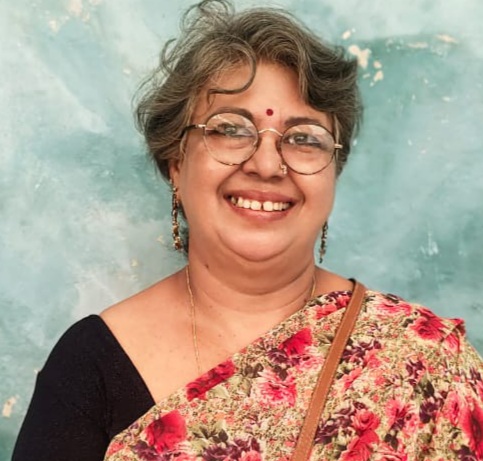
Literature, both Odia and English, fascinates Malabika Patel. She has been experimenting on poems and short stories. Her first translation “Chilika –A love story “ of Shri Krupasagar Sahoo’s Sahitya Academy award winning Odia novella, “Sesha Sarat” was published in 2011. She is also into translating of rare old Odia documents and classics into English. A banker by profession, she retired from Reserve Bank of India as General Manager in 2016 and is presently settled in Bhubaneswar.
HOMELAND KITCHEN
Ashok Kumar Mishra
The Commanding Officer of 8 Mountain Division at Kargil was fuming at the unusual request sent for his approval by his subordinates in the Divisional special meeting to celebrate Vijay Divas celebration preparations. How can a proposal, from a private catering unit to serve the troops stationed strategically at such high risk zone be entertained? It should have been rejected forthwith at a lower level. It was a risky proposition to serve food to jawans as lot of risk was involved besides the logistic, coordination problems at an elevation of 2676 metres(8780 feet) above sea level and temperature often dropping below -20 degree centigrade. It may involve prior permission from Head quarter at Khumbathang, in Ladakh. The request was summarily rejected.
But Sarita Chavan, a fighter throuout her life and who faced many odds with a never give-up attitude persisted. She wanted to serve the soldiers warm hand-cooked meals, who were guarding Kargil frontier against all odds in harsh freezing, sub-zero temperature and high Himalayan altitude lacking enough oxygen to breathe. She kept on sending her dream request for permission and her persistent effort helped realizing her dream when Kargil Mountain division finally allowed her and her dream materialized in 2022.
Sarita’s journey was not smooth. A river does not select its path, it bends, faces obstacles yet it moves ahead and its flow continues. So also Sarita, whose literally meaning is a river.
She says I did not understand my name when I was young. Now I do - face many obstacles yet continue to move.
Raised in comfort, in a home where life was orderly and expectations were clear not unlimited. Like many girls, she was educated just enough to become a good wife, a good daughter-in-law, a good mother. She accepted this quietly not knowing there could be another way.
She was married early to a man who chose her before she could choose for herself and led a life with him in abundance. Like any common citizen the couple had ups and downs- days of ease and indulgence, when she learned to adjust and endure. Soon the couple was blessed with three children- her greatest strength and deepest reason to keep going.
For a while, life flowed without disturbance. And then it did not. Then her husband lost his job. What followed was not just hardship- it was collapse- prolonged Illness, silence and isolation. The house that once echoed with celebration became heavy with worries. Responsibilities arrived before Sarita without any warning.
She had no experience of managing money and did not know how to run a life. But she learned- because she had to.
Soon the truth came to her, when her bank manager informed she was left with only 100 rupees in her account.
That day, something within her hardened-not into despair, but into decision to boldly face the world to survive.
She sold her mangalsutra-not as an act of loss, but as an act of beginning. Soon she moved into a single room with three children and an uncertain future, and started asking to herself a simple question.:
“What do I know?”
The answer was small- but it was enough.
“I knew how to cook.”
Sarita began with spice business- hand made, hand grinded and packed but made with care, sold door to door. To some the work may not look sophisticated and dignified but she had no choice and was proud of what she was doing. It was a fight for survival. She was confident one-day good business and return would bring in pride.
Each morning she left home with one promise: “I would not return until I have earned200 rupees.”
Door to door journey from rejection to acceptance. It grew day after day.
People began to trust Sarita . Her spices entered their kitchens, their meals and their hearts. Through her product she became a part of their life. What began as a necessity for her grew into something more.
A livelihood. A purpose.
She started a small catering service in her native Goa- Homeland Kitchen. It grew over time-quietly at first, then with confidence. Over time, her catering unit was cooking for film crews, for parties and official meetings. She learned new cuisine, new techniques, new ways of believing herself.
She had no formal training only persistence and will to survive.
If she did not know something she learned it. If she failed, she tried again.
Opportunities followed- unexpected, yet deeply transformative. Sarita was invited into spaces she had never imagined she would enter. She travelled beyond boundaries saw new worlds, and realized that her journey- however humble had a beginning and had meaning.
Her Homeland kitchen received many accolades and rewards. Goa government gave her prestigious Yashodamini award. She was awarded at Madrid Fusion Carnival for cooking. She got prestigious Orchid award and is considered one of the top 10chefs of the country.
Even now she still remembers the woman walking door to door, holding small packets of hope in her hands and the days of her struggle. After persistent “No” for six long years from Kargil Mountain Division Unit she has been permitted to cook meals for our sentinels at Kargil on Vijay Divas on 26 July of every year from 2022 onwards. Man and material, everything she airlifts for this venture to Kargil.
Adversity has taught her, even in uncertainty, there is possibility. That dignity can grow from small beginnings.
Because life does not wait for us to be ready.
It pushes, it pulls and It tests.
And like a river, we have only one choice:
To keep moving.
Not because the path ahead is clear. But because stopping is not an option.
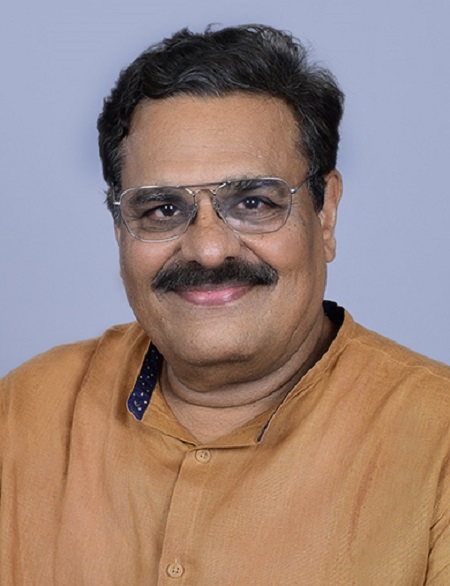
Completed his MA and M Phil in Political studies from JNU and served as Deputy General Manager in NABARD. He made pioneering contribution in building up Self Help Group movement in Odisha and popularized Amrapally mango plantation in the state. He has authored several books and written several articles on micro credit movement. Four tele films were made on his book titled “A Small Step forward”. He served as Director of a bank for over six Years.
An acclaimed Short story writer in Odia and English. His stories are rooted in the soil and have sublime human touch. Many of his short stories in Odia have been published in reputed magazines. His short story collection “Michha jharanara pani” was released recently.
(9491213015)(m)
Nestled amidst the stunning backdrop of rolling Sahyadri hills, shimmering man-made lakes, manicured landscapes and a verdant lush green, the Aamby Valley City sits on the outskirts of Pune, India. Welcome to India’s first self-contained, planned luxury ‘Hill City’ township
resort, developed by the Sahara India Parivar, under the leadership of Late Subrata Roy. This ultra-luxury gated township resort is for the fabless,
opulent, plutocratic, elite and the super-rich of India!
HISTORY- The Sahara Group acquired land in the mid-1990s and the township was officially conceptualised and master planned in 2003. The magnificent valley lies in the lap of the Western Ghats, offering panoramic vistas that turn a gorgeous green and magically misty in the Monsoons.
A vast, tranquil man-made lake forms the centrepiece of the township, ideal for leisurely walks, lakeside relaxation and cosy waterfront dining. The Korigad fort nearby provides breathtaking aerial
views mapping the entire layout of the valley and its water systems. Winding, well-paved, tree lined roads throughout the gated township offer a sheer visual treat for the eyes.
The exclusive property, spread over 10,000 acres of hilly terrain in the majestic Sahyadris, is equipped with a 28-hole golf course, water sports on the lake- kayaking, speed boating and giant swings overlooking the magnificent landscape.
Built for the elite, the township features curated, multi-crore Swiss style chalets, Spanish cottages and luxury villas integrated into the sloping hills that make it a dream destination!
It operates like an independent city with its own private air strip, schools, hospitals and power plants, housing ‘19 Degree North’, a popular adventure sports zone with ATV rides, zorbing, paintball, water sports & spectacular multimedia fountain shows.
Standard rooms and chalets here typically range from 7,500?-18,000? per night depending on the season, day of the week and accommodation type. Food & drinks inside the township can be sharply steep- costing far more than standard restaurant rates and typical five-star hotels. It features signature restaurants like the ‘Woodpecker’ for multi-cuisine dining & ‘Mabruk’ for Mediterranean dishes.
Spread over an expansive 40-kilometre radius, going around the property requires relying on resort buggies or personal
vehicles. It is a popular destination for opulent weddings and corporate events with multiple dedicated venues.
GETTING THERE:
From Mumbai: It takes around 2.5 hours by road (approx. 120 km) via the smooth Mumbai-Pune Expressway.
From Pune: It takes about an hour by road (approx.55km) via NH-48.
Via Air Travel: It features a private air strip supporting charter flights & helicopter transfers.
If one aspires to savour a slice of the swanky, ultra-luxe holiday experience, then alluring Aamby beckons…












Anita Panda is a passionate bilingual author-poet, nature lover, and an aspiring TEDx speaker. She dedicated ‘GENESIS’ (2021) to her valiant late soldier brother.
She debuted with her own book ‘SONGS OF MY SOUL’ (2023) and her debut Hindi book ‘Bhavnaon ki Dastak’ (2025), recently published by AUTHORSPRESS.
It formally launched on national and global platforms ‘Mudramoksh’ and ‘The Fertile Brains’ in 2026.
FLASH FICTIONS ON MENSTRUAL HYGIENE DAY
Dr. Viyatprajna Acharya
The Egg
“Stop, stop… stand right there! Don’t touch anything… Oh God! You had to trouble me at ten o’clock at night! Let me put some water on the stove. Go and take a bath after that.”
“Mother, when one egg comes out of a woman, you ask her to wash her hair and bathe even on a cold winter night… But when a man releases ten crore ‘eggs’ at a time, shouldn’t he be submerged in water all the time?”
“Hey! Stop it! Don’t make my head hurt even more!”
The divine abode
“You wretched girl! Didn’t your mother teach you anything? Stand still, stay there! My Ekadashi observance has been ruined… Couldn’t you be careful for just two days? What was the need to roam all around the house with your frock fluttering like that?”
“Mother, she is only a little child!”
“She is already eleven years old! Is she not old enough? At her age, I was already married and had gone to my in-laws’ house!”
“Hey, Chandi! For these four days, don’t even go near the prayer room. No worship, no prayers!”
“But Grandma, where should I keep God for these four days?”
“Hey girl! God will remain in the prayer room. What nonsense are you talking?”
“Grandma, I was asking—what should I do with the God who lives in my heart? Where should I keep Him for these four days? I have woven Him into every moment of my life; into every breath I take. Where shall I put Him?
Before I eat, I offer a portion of my food to Him as prasad, chanting my prayers. What should I do about that? Whenever I travel, I keep Him with me as my companion and my shield of protection. What should I do about Him?”
Mother and grandmother exchanged glances and simply stared at the girl, speechless. They had never loved God like this in their entire life.
________________________________________
Quarantine — Revenge
“Listen, Mother’s RT-PCR report has come positive. Let’s give her our bedroom. It has an AC and an attached bathroom. She will be comfortable there.”
“Hmmm… and why exactly should we do that? I am not going anywhere from this room! Anyway, I’ll arrange that room for her.”
“Which room are you talking about?”
“That one… the outhouse at the backyard.”
“Hey, you heartless woman! How can an old lady stay there alone?”
“What’s the problem? Do you remember how my child stayed there alone for seven days, crying relentlessly? I begged and pleaded so much. Did anyone listen to me then? Being a father, you never mustered courage to resist your mother and stood there silently. I was powerless then, not now, not anymore.”
“Now the wheel of Karma has taken a complete turn. Perhaps the taste of quarantine will remind everyone of the injustices of the past.”
________________________________________
The Broken Plate
“Go, sit in that corner… here, take this.”
The mother-in-law pushed a broken plate towards her daughter-in-law. Rice, curry and fried vegetables had all been served together on it.
“No, Mother. It’s alright. I am not used to eating like this.”
Tears did not fall from Sri’s eyes. Instead, they seemed to shower sparks of fire.
A moment later, the sound of Sri starting her scooter and riding away was heard outside.
Lakshmi had disappeared.
Durga had emerged.
________________________________________
A Sacred Sin
“I think Mother is having a heart attack! Sister, please send brother-in-law quickly. We can’t understand what to do!” Daughter-in-law of the house was calling frantically to her doctor sister-in-law, daughter of the house.
“Wait, I am coming myself. I’ll drive there. Your brother-in-law has an emergency operation today. He cannot leave.” Hurriedly she gave some information over phone and wheeled the car immediately.
Tejaswini hurriedly parked her car and rushed to her mother’s side. Her sister-in-law stood frozen against the wall.
“Hey! Is there nobody here? What have you all been doing till now?”
“How could I touch Mother? I am menstruating!”
“Oh my God! Come on, after all your education, you still remain the same! Was Mother cooking since you were menstruating? She must have felt dizzy and collapsed. It looks more like a vasovagal attack. Come on, hold her. Let us get an ECG done.”
“Hey, wait! I am menstruating too! Why don’t you give me some of your sins as well?”
After a while they were in the hospital and found the mother recuperating.
“Mother, how are you feeling now? You had fainted, but there is nothing to worry about now. However, in the meantime, we have committed so many sins! You are now completely defiled!”
Mother stared at Tejaswini in bewilderment.
“Your daughter-in-law and I, both are menstruating… and on top of that, this nurse and the female attendant too! Tell me, how will we ever free ourselves from this sin?”
Tejaswini asked mischievously, with a playful smile in her eyes.
Lowering her head, Mother replied, “This is a sacred sin… Akaale niyama nasti—in times of necessity, rules do not apply.”
Tejaswini burst out laughing.
“That muck is not going to leave your mind so easily! We will have to do something about it, Bhauja (Bhabhi)!”
________________________________________
India, which was once illuminated by the wisdom of women such as Gargi, Apala and Lilavati, gradually became burdened with numerous superstitions as women were deprived of education. Many practices that may once have had scientific reasoning were blindly distorted, misinterpreted and misused.
Menstruation is a natural physiological process. Yet, in many places, it has been turned into something mysterious and almost cosmic.
The Mother (Pondicherry) explained it very simply: Nature prepares a woman’s body for the possibility of pregnancy. The uterine lining develops in preparation for conception. When pregnancy does not occur, this lining is shed through menstruation.
There is no need to become excessively sensitive or apprehensive about it. A woman may continue her routine daily activities as far as her physical comfort permits. Menstrual pain and discomfort can be managed appropriately with medical advice.
Motherhood has been accorded one of the highest positions in society. Then how can the process that precedes the possibility of motherhood—menstruation—be considered impure or disgusting?
During menstruation, what is most important is proper cleanliness and hygiene, adequate nutrition and attention to one’s physical and emotional well-being.
Women must abandon the tendency of being hostile towards their own fraternity and extend their hands towards the upliftment and empowerment of women in every sphere of life.
May all be blessed.
Shubhamastu.
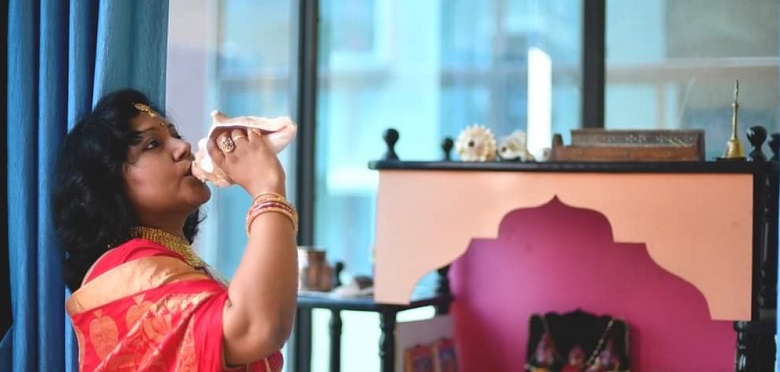
Dr. Viyatprajna Acharya is a Professor of Biochemistry at KIMS Medical College, who writes trilingually in Odia, English and Hindi. She is an art lover and her write-ups are basically bent towards social reforms.
TURKEY: BETWEEN CONTINENTS AND CENTURIES
Upali Aparajita
A Travel Memoir by Upali Aparajita
Prologue – The Turkey We Did Not Expect
Before travelling to Turkey, I imagined grand mosques, colourful bazaars and the famous balloons of Cappadocia. What I did not expect was a country that constantly moved between worlds. Over ten days we travelled from Istanbul to Ankara, Cappadocia, Konya, Pamukkale, Ephesus, Pergamum, Troy and Canakkale. Everywhere we went, history seemed to sit comfortably beside everyday life. The journey felt less like a holiday and more like walking through chapters of a living storybook.
The Mosque with Two Audiences
Blue Mosque immediately captured my attention. The blue floral motifs covering much of the interior explained how it earned its famous name. Yet the most memorable part was not the architecture.
Visitors stood quietly admiring the magnificent ceiling while local worshippers prayed nearby. Nobody seemed to disturb anybody else. Watching faith and tourism share the same sacred space reminded me that this was not merely a monument, it’s a living place of worship that continues to serve its original purpose centuries after it was built.
A Building with Many Lives
Hagia Sophia felt like a timeline carved into stone. Built as a cathedral, later transformed into a mosque, converted into a museum and then functioning again as a mosque, it has witnessed remarkable changes. As we walked through the building, traces of Christianity remained visible beside Islamic elements. Instead of feeling divided, the building felt united by history. I left with the feeling that Hagia Sophia belongs to no single era because it has survived and adapted through them all.
Crossing Continents Before Lunch
One of the simplest moments became one of the most memorable. Crossing the Bosphorus from Europe into Asia took only minutes. Most people board airplanes to move between continents. In
Istanbul, a bridge does the job. Looking across the skyline, I realized that Turkey’s character comes from being a meeting point of cultures, ideas and civilizations.
Figure 1: Standing in Europe with Asia in the background
The Art of Bargaining
The Grand Bazaar was a world of colours, fragrances and conversations. Carpets, spices – especially saffron and a variety of teas and dry fruits, ceramics and leather goods competed for attention. What fascinated me most was the bargaining. Vendors negotiated with enthusiasm while buyers negotiated with equal determination. Even when we were not buying anything, the interactions themselves were entertaining.
Meeting the Father of Modern Turkey
In Ankara, our visit to Atatürk Mausoleum provided an important historical perspective. Learning about Mustafa Kemal Atatürk helped us understand modern Turkey beyond the landmarks. The respect shown by visitors revealed how deeply his legacy remains woven into the country’s identity.
The 4 A.M. Alarm and Our First Flight Without Wings
The alarm rang at four in the morning. Normally I would never celebrate such an early start, but this morning was different. We were preparing for our first hot air balloon ride. The darkness, the anticipation and the quiet excitement among fellow travellers made the experience feel special long before the balloon left the ground. The first image below captures the ariel view from our balloon. As the sun began to rise, hundreds of balloons floated into the sky. Watching Cappadocia unfold beneath us was magical. Fairy chimneys, valleys and rock formations stretched to the horizon. The silence surprised me most. High above the ground, everything seemed calm. When we finally landed and
received our flight certificates, it felt like completing a milestone rather than simply finishing an excursion.
A Valley Built for Pigeons
Pigeon Valley revealed another side of Cappadocia. The cliffs were dotted with tiny man-made openings that once served as homes for pigeons. Learning about the practical role pigeons played in local agriculture made the landscape even more fascinating.
A City Beneath the Earth
If the balloon ride showed us Cappadocia from above, Kaymakli Underground City revealed it from below. Descending into tunnels and chambers, I tried to imagine entire communities living underground for protection. It was difficult to believe that such a complex hidden world could exist beneath the landscape we had admired only hours earlier.
An Evening of Music and Dance
The day ended with a lively belly dance performance. After a day filled with history and landscapes, the evening brought music, colour and celebration. It was a joyful reminder that culture is not only preserved in museums and monuments but also in performances and traditions.
Walking on Cotton Clouds
Pamukkale means Cotton Castle, and the name makes perfect sense when viewed from a distance. The white terraces looked almost like snow. Walking barefoot through the warm mineral-rich waters felt surreal. The thermal pools and our red-mud adventure added plenty of laughter to the day.
Listening to Ancient Stones
Walking through Ephesus felt like stepping into another age. Ancient streets, ruins and public spaces still hinted at the lives that once filled them. Every stone seemed to have a story waiting to be told.
A House Remembered for Two Thousand Years
The House of Virgin Mary was peaceful and reflective. Surrounded by trees and visited by pilgrims from around the world, it felt very different from the busy archaeological sites. The quiet atmosphere encouraged us to slow down and appreciate the significance the place holds for so many visitors.
A View Across Time
At Pergamum, we took a cable car to the Acropolis and looked out across the landscape below. Standing among ruins that had watched centuries pass by, I understood why hilltop cities held such strategic and cultural importance. The sunset views were unforgettable.
My Husband’s Unexpected Modelling Career
One of the funniest moments of the trip happened at a leather showroom near Kusadasi. What started as an ordinary shopping stop quickly became an unexpected fashion show. My husband was invited to participate, and before long we were cheering him on. We eventually purchased the most expensive leather jackets of our trip. Years later, we still consider them one of our best travel purchases because every time we wear them, the story comes back with them.
The Horse That Was Not the Horse
Growing up, I had heard stories of the Trojan Horse. Visiting Troy finally brought those stories to life. Discovering that the horse on display today is a replica did not diminish the experience. Sometimes the power of a story matters more than the physical object itself.
The Drive We Did Not Want to End
Our drive towards Canakkale offered beautiful coastal scenery and quiet moments to reflect on the journey. It reminded me that travel is not only about destinations. Sometimes the road connecting two places becomes a memory in its own right.
Food That Deserves a Journey of Its Own
Turkey surprised us also with its food. As vegetarians, we had wondered whether finding suitable meals would be difficult, but the country quickly put those concerns to rest. Almost every meal began with an impressive spread of fresh salads, olives, cheeses, breads and seasonal vegetables. The freshness of the ingredients was remarkable, and even the simplest dishes felt wholesome and full of flavour. We particularly enjoyed the traditional Turkish breakfasts, where a leisurely meal often felt like a celebration in itself.
No journey through Turkey would be complete without mentioning its sweets. Among our favourites was Künefe, a warm dessert made with crispy shredded pastry, melted cheese and sweet syrup, served fresh from the oven. Every bite was irresistibly rich and indulgent. We also discovered Baklava, with its delicate layers of filo pastry, nuts and honeyed syrup, and sampled Turkish Delight in a variety of flavours. Whether it was a simple glass of Turkish tea after a meal or a plate of beautifully crafted desserts shared with fellow travellers, Turkish food became an unforgettable part of our journey, offering its own delicious window into the country's culture and hospitality.
Epilogue – More Than a Holiday
Turkey gave us history, faith, culture, nature and countless stories. We crossed continents, floated over extraordinary landscapes, explored underground cities and walked through ancient civilizations. Yet what remains strongest are the moments between the landmarks: a prayer inside the Blue Mosque, a sunrise balloon ride, laughter during a leather fashion show and conversations during long drives. Those are the memories that continue travelling with us long after the trip ended.

I am Upali Aparajita, a writer, yoga educator, and wellness practitioner based in Singapore, originally from Odisha, India.
I hold a bachelor degree in electrical Engg and an MBA from Singapore.
After a career spanning banking and international marketing, I transitioned to the wellness industry in 2017 and now I teach yoga both in-person and online. My interests include art, dance, fitness, trekking, mindfulness, and creative writing. Drawing from my diverse life experiences, my writing explores themes of identity, transformation, inner growth, and human connection.
A LOT IN A NAME
Sujatha Krishnamurthy
My cell phone chimes and the name Daniel Jackson NASA flashes, our team director. “Hi Dan, what’s up?”, I start the conversation. “Hi Ratish, Is this a good time?” he responds and our discussion on our current project prolongs for over an hour.
Following our chat my memories take me back to my childhood years . Growing up in Grand Rapids, Michigan as a child, it did not bother me, that is my name, because I realized my name was my identity. Once I started fifth grade, my final year in elementary school, my name or rather my identity took a turn, so unexpectedly and suddenly, that I wanted it to be erased from my memory.
What my parents thought to be short and easy for any American tongue turned out to be a terror to me. Nothing complicated to say the least; it is just Ratish. How hard can that be pronounce? Right?
Wrong. For a few kids, not all, in School, Ratish very quickly became RAT, not only short, also easy to pick on. While getting into the school bus, my friend Nathan would say,“ Keep away Sara or you may get bitten by a Rat.” I used to feel like hiding under my seat.
There is another, among many, occasion that I remember vividly like it happened yesterday. We were all playing basketball and another friend Kevin screams, “Jason, pass the ball to me. Don’t pass it on to Rat-ish.” I somehow try not to cry in front of other kids in the gym.
Why couldn’t my parents find a name like John or Jacob or Kevin? While in America, why not give your son a decent American name like everyone else. Looking different from the rest of the class was one thing and having a ridiculous name like mine was ultimate level of humiliation.
I did not dare to confide either on my parents or my teacher, Mrs. Lachota, about being bullied at school. I can never forget that life altering day in my life. After a terrible day at school, I was sulking during dinner time. My mom after returning from work was busy making my favorite aloo puri and channa with paneer. My mom laid out the most mouth watering food on the table and we all sat around to dig in. Despite being hungry, I was so overwhelmed in my own world of despair. No dinner for me until they change my name.
Seeing my distraught look, my dad asked, “ How is school Rathu [that’s how my parents call me at home)?" You have been awfully quite these days.” My mom added, “ Is everything ok in class Rathu dear? Something bothering you? Mrs. Lachota (my teacher), called me at work. She mentioned, “ Ratish is a very brilliant student. Always ready to participate in class and help other students with assignments. Off late, I have noticed that he is extremely non-communicative and brooding in class. Is something bothering him?”
I couldn’t contain my tears anymore and burst out crying . My parents were even more confused with my unexpected reaction. They came and sat next to me on either side and gave me a tight hug. “Whatever it is Rathu, don’t hesitate to tell us. We are here to listen and help in whatever way we can.”
I felt at ease and in between sobs said,” Dad, Mom. I know you love me a lot and so do I. But why did you name me Ratish? Some kids at school are bullying and teasing me by calling me Rat, Rot,Rat-ish, Rot fish and what not. I hate my name and I
don’t feel like going to school. Can you please change my name to Anthony or Kevin?”
“Rathu, never make any important decision on empty stomach, comes from my dad. Mom has spent a lot of time making your favorite puri and chole with paneer.” He turns to my mom and says, “Rita, please pass on the chole to me. It smells delish and those puris look amazing.” My mom smiles and acknowledges the compliments and says, “ Oh Ritom. You are complimenting before even trying them out. Thanks anyway.” Before she completes her sentence my dad jumps in, “ Food is a complete sensory experience and it all starts from the looks and smell followed by the rest.” With a lighter heart we all dig in.
After dinner we all settle down in the family room. Instead of starting weekend movie on TV, my dad nudges the topic about my name. “Rathu.You want to know why we named you Ratish instead of Jason or Jacob.Right? In our Indian culture, it is customary to name the first son after his paternal grandpa. I got my name Ritom from my paternal grandpa, Ritom Sharma. My brother, your uncle Sharat, got my maternal grandpa’s name. His son is your namesake. This custom has been followed for thousands of years. Keeping up with this tradition, we named you after my dad, Ratish Sharma. He is the first Indian astronaut to have travelled to space.”
He brought out a family album and showed me many pictures of my grandpa in space suit and flying in zero gravity inside a spacecraft. “Next time when we travel to India, you can ask grandpa about his space odyssey.”
To a ten year old, something clicked like a light bulb. I ask, “ Can I please share these pictures with my class on Monday? I have a show and tell for ten minutes in front of my class. Tell me more about my grandpa and I want to share it with my class. When
grandpa and grandma visited us a few years ago, I remember building lego castles and kicking ball in our back yard with him.”
Dad briefed about grandpa for the next half an hour. I couldn’t wait for Monday to get back to school. I carefully packed a few pictures of my grandpa Ratish in my Batman backpack.
When my turn comes for show and tell to my class, I start with, “ Good morning friends. Do you know how I got my name Ratish? A few of my classmates start to giggle. “I am named after my grandpa, astronaut Ratish Sharma. My explanation about my name and how it traces our family genealogy over generations leaves everyone spell bound . I share the pictures of my grandpa in astronaut suit flying upside down inside the spacecraft. My talk about him and his interesting life for the next ten minutes leave everyone in awe and speechless.
All my friends including Nathan and Jason are totally impressed with my show and tell presentation. That afternoon they approach me in the playground. “Hey, Ratish. Thanks for sharing your grandpa’s cool pictures this morning. It is fascinating to learn about your culture and how you are named after your grandpa. Wow! I have never seen or known a real astronaut in my entire life. You are so lucky to have one in your family, that too your own grandpa. That’s so cool. Can you please get me an autographed picture from your grandpa ?”
Since that day I saw a real transformation in my friend’s behaviors. Then onwards they stopped calling me Rat or Rot or Rat-ish. Magically, I too started to love my own name. It made a lot of difference to be called by my real name Ratish and not that of a rodent. I totally disagree with Romeo’s famous Quote, “What’s in a name?" from the renowned play, Romeo and Juliet. “Sorry Mr. Shakespeare. There is a lot in a name.”
I am so proud of my grandpa. My respect and admiration for his larger than life persona helps me in making my own educational and career choices. He is my #1 hero and always will be. I look forward to our weekly FaceTime chats and laughs . He is a great listener and gives the right advise when asked for. Bearing his name comes with a huge responsibility. Hopefully one day, as a NASA scientist, I will also make my grandpa happy and proud of my contribution to the world of science and discovery.
On that note, I head out to my lab to meet with Dr. Daniel Johnson, as agreed over the phone conversation.
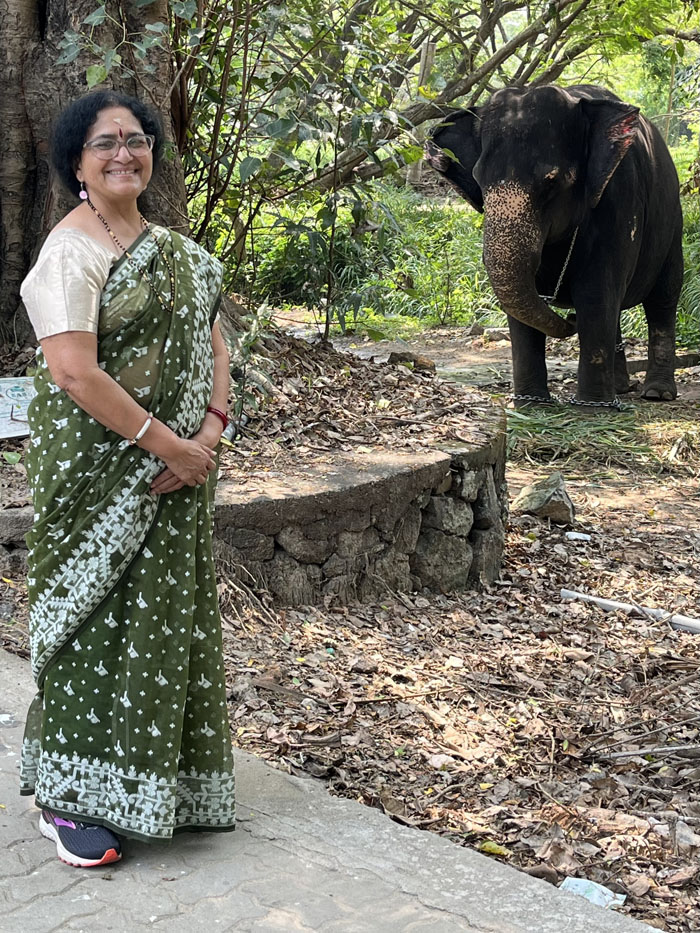
Hi
I am Sujatha Krishnamurthy writing from Kalamazoo, Michigan, USA. Born and raised as a true Kolkatan, studied at Andhra Association School and Shivnath Sastri College, and worked at Central Cottage Industries. Moved to Pasadena, CA, USA in ’84 and later to Kalamazoo, MI in ’91. Studied, worked, and retired after a stint of 20 years in different organizations, including family owned business , NPO(Non-Profit Org) , and MNC( Multi National Corp).
A habitual reader and writer since younger years, a habit cultivated in the banks of the Ganges, has continued to flow till date. Since 2023, my contributions have been published in my alma mater’s monthly e- magazine SPARKZ. I also contribute regularly to our Indo American Cultural Center and Temple’s monthly e-newsletter covering cultural activities in and around town.
As a full time volunteer, I dedicate many hours at our local Hindu temple (Indo American Cultural Center and Temple). Have served in the temple board of directors in many leadership positions, such as, Religious Committee Chairperson, President, and Chairperson. I am the Bal Vihar teacher of 25 years teaching Indian scriptures, teachings, and bhajans to the next generation.
As the Community Outreach Program Coordinator of our temple, I bridge our Indian community with the rest by taking our Indian culture and heritage to local schools and institutions of higher learning. My role facilitates in bringing several visiting Indian artists and American Indian talents to our temple and community. My efforts have been successful in drawing many local, city, and state officials, including Governor, Mayor, and City Counselors and Indian Consul from Indian Consulate, to our temple’s land mark events, such as 25th anniversary and others.
Since 2019, I have been recording audio books for the visually impaired for Samarthanam Trust For The Disabled, an organization based out of Bengaluru. I am currently working towards my goal of reaching the century mark for the Samarthanam Library. My other hobbies include globe trotting, music listening and singing, tasting and trying out new recipes, being an active influencer in social media, and above all, staying close to my families and friends.
The smell of wet soil lingered in the rainy alley like an old memory.
Chandu Nair had gone to a wedding at a relative's house a short distance away. Chandu Nair had a poor family consisting of a wife and fourteen children. He was tired of eating porridge and chammanti all the time when a wedding invitation came. As soon as he entered the wedding house, the delicious smell of fried chicken and biryani hit his nose. His mouth watered to the point of sailing. He thought without realizing it, "Wow, at least one day I'll get my favorite food that's rich in flavor, right?" His face was filled with joy. Hearing that, those nearby covered their mouths and laughed. That's when he realized the love he had for him.
A wave of rustle was beating somewhere inside him, like the ocean calling back waves.
He remembered. I will eat my fill today. But what about my sick wife and fourteen children?..... His eyes welled up like tears as he remembered. He wiped his eyes with the second hand on his shoulder so that no one would see.
At that time, everyone was coming. The pavilion was full. The wedding hour was approaching. The music was going on in a regular rhythm. In the meantime, a young man came and sat down on his seat. He was staring at it as if he had seen something amazing. Those eyes were all over the place. If Kalidasa had said, "Bti aade, bti aade," this stupid young man asked, "Where is my girl?" The people in the audience looked at him in surprise. At this time, relatives accompanied by drums and lamps went to meet the bride. The groom tried to get up from where he was sitting, saying, "Here he comes." Someone forcefully made him sit down. The bride walked slowly, patting her feet.
The hustle and bustle of videographers and photographers. She entered the stage accompanied by a rhythmic dance and came near him. He took her hand, which was next to him, and placed it in his lap.
With only moments left to tie the thali, she watches the groom, who is looking at her in surprise. The bride slowly asks the young man something. He replies with unrelated things. Suddenly, the incident took place there, shocking everyone. (Rupa is her name) She pointed her hand at him and exploded. I do not agree to this marriage. I am not ready to marry him. As the entire audience stood stunned, she said, "This is not the man who came to see me, girl. He is a fool. An impersonation has been done here."
Her words had incredible power.
Her decision was also firm.
Everyone was stunned. This was the first time they had seen a woman explode like this in a wedding hall. Some stood up indignantly. Others said they would see something in what she was saying. Some walked up to the old man. They made him get up from his seat and take him to the other side. They touched him and caressed him and understood things in a moment. It was his brother who had come to see the woman that day. He had another relationship with his twin children. When the wedding was approaching, he left home. They were making him act out this role with his dull-wittedness to make up for that disgrace and keep his promise. Then what happened there was a lot of commotion. No one had any idea what was going to happen. The hearts of those standing there were broken. Some suggested that they should immediately hand over these people to the police who had impersonated and deceived them on a sacred occasion like a wedding.
Most of the groom's men had left the place. The police had arrested his close relatives for impersonation and taken them away. This was not an issue for Chandu Nair. Alas, the wedding was canceled? Didn't he put a knife to his neck while waiting for the Dum Biryani to open? The sadness of losing his long-awaited Biryani was haunting him. Without thinking anything else, he quickly got up and ran to the dining hall. There, he chatted for a while, bought some Biryani, ate it, bought two packets, packed it, and walked away. Thus, he walked out with a humming song on his lips, happy that his wish had come true.
Considering the helplessness of the girl who was standing there with her head bowed in shame and the parents who were worried about everything that had been wasted after spending so much money and making all the preparations, a respectable person who came with the groom's party entered the stage. The person who entered the stage told the girl, her parents and her loved ones, "No girl's life should be ruined. If you all agree, I will take the place of the groom." All eyes turned to him. He said, "I will tell you my details. I am an I. A. S. officer. My father is dead. My mother is the only son. My mother is insisting on the wedding." With everyone's consent, Naveen placed a thali on Rupa's neck. There was a great applause and cheers from the audience. Rupa fell at the feet of that good man and bowed. Those feet were wet with her tears. He picked her up and held her close to him. The audience cheered.
After the wedding ceremony and the meal, the bride and groom left for the groom's house. Seeing the bride and groom coming from afar, the mother-in-law was standing in awe. The son who had gone to the wedding was also bringing a girl. Is that something a mother can bear? The mother could not believe her eyes. Is this a dream? How terrible must the shock in that mind be? What must be the feeling in that mind. They murmured. How long have I been telling him to get married? All that time he avoided it. Then, without even knowing it, he was bringing a girl. Those tears welled up. Seeing the sadness on his mother's face and the moisture in her tears, the son felt guilty. He went and hugged his mother. He covered her cheek with a kiss. He told his mother everything. Hearing everything, the mother praised her son to the skies. What a good thing you did. You saved that family that was mentally broken. What more does a mother need to be proud of than this.
The mother held her daughter-in-law's hand and walked into the house. "Mom, when you found your daughter-in-law, don't you beat me?" he said with a smile. She said, "Don't go," and moved towards him with a smile. The sound of joy, play, and laughter echoed throughout the place.
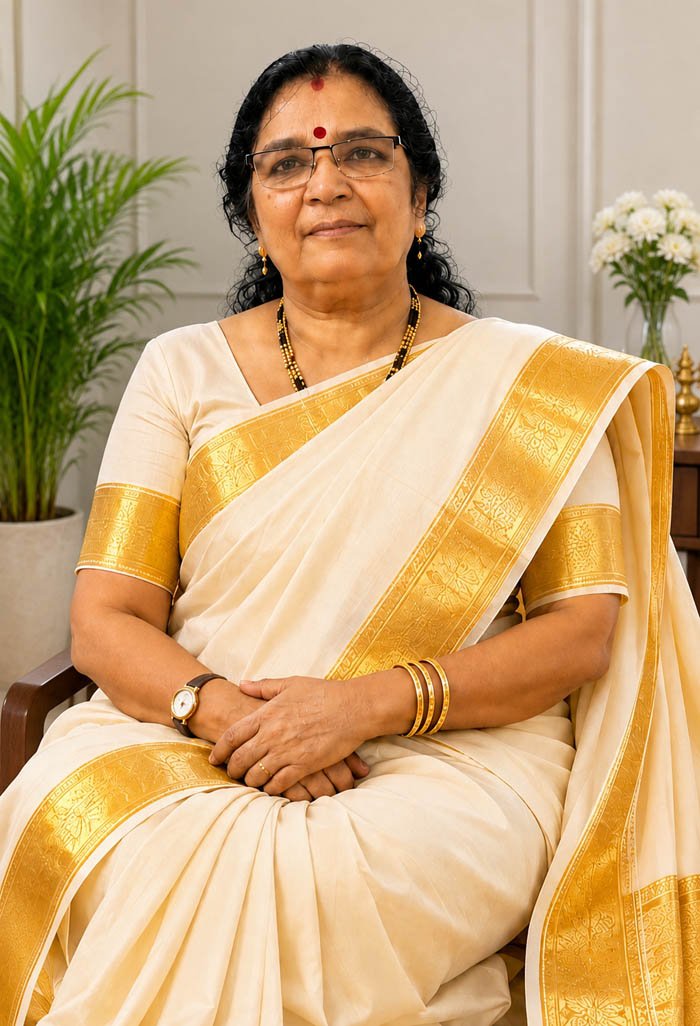
Syamala Haridas is an active presence on prominent online publishing platforms. She regularly writes poems, short stories, reviews, retellings of mythological tales, and articles for many online outlets including USA Malayali Manass, Manorama Online magazine, and an Australian online magazine. Her work has received several awards, including the Kerala Thanima Puraskaram, Sargga Kairali Puraskaram, Mayookham Sahitya Vedi Puraskaram, USA Malayali Manass Puraskaram, and the S. K. Publication Puraskaram. Her first novel, Manassinnullile Paruddeess (Heaven in the Mind), has already been published.
SONU
Dr Major Nalini Janardhanan
My Dear Sonu,
When I reminisce about our past, I miss you, the naughty little boy. How I wish to relive those nostalgic moments with you once again……You have grown up in the blink of an eye. Your Dad and I never compelled you to be a doctor or an engineer. We let you live your dreams and take up the profession you like. You worked hard to reach the present position of Vice President in a reputed company. You have many awards and achievements. You deserve them, being a talented, sincere and efficient person who trusts in God. You have a beautiful, intelligent, strong, independent and caring wife who is also in the same profession. You are a grown-up man with your ideas, thoughts, interests, talents and personality.
My dear child, when you held my hand and said goodbye yesterday, I could feel your concern and care. When you told me to count my blessings, I knew that you are the first and foremost blessing in my life. When you told us “Mom and Dad, I may not be able to express my love to both of you but I am always there for you”, I was touched by your unconditional love. When you smiled, I could see the same twinkle in your eyes that melted my heart when you were a kid.
Do your duty. Face the struggles of life with that beautiful smile on your cute face. Don’t change yourself for someone else. You are an awesome singer and a multitalented person with an innocent heart full of love and kindness. You will be a winner in life.
Love,
Mom.
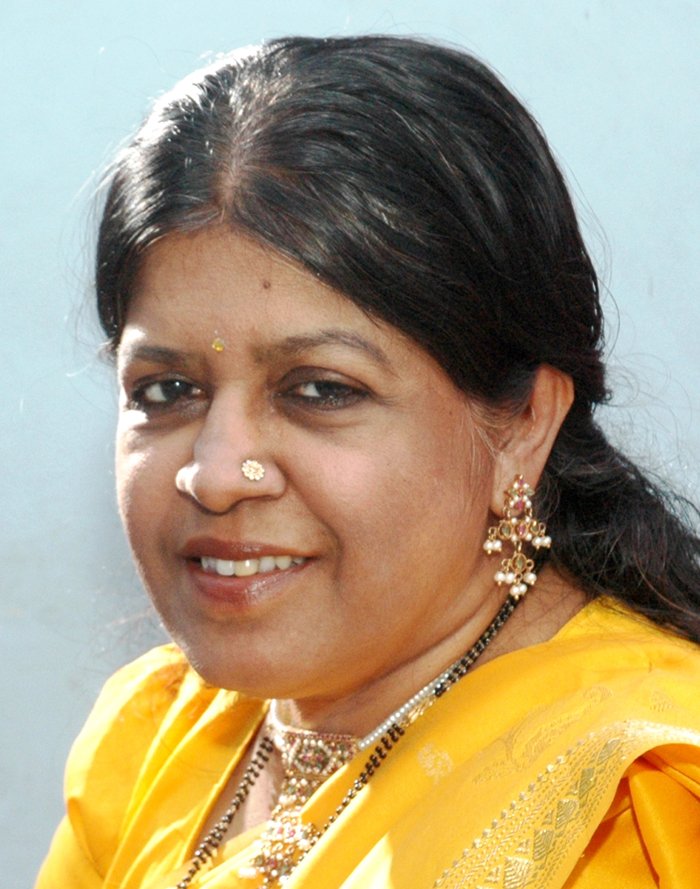
Dr Major Nalini Janardhanan is a doctor who served in Army,a writer and Akashvani approved artist of Ghazals and Bhajans.She is honored with many awards for her contributions in various fields.
COLD BLOODED MURDER
T. V. Sreekumar
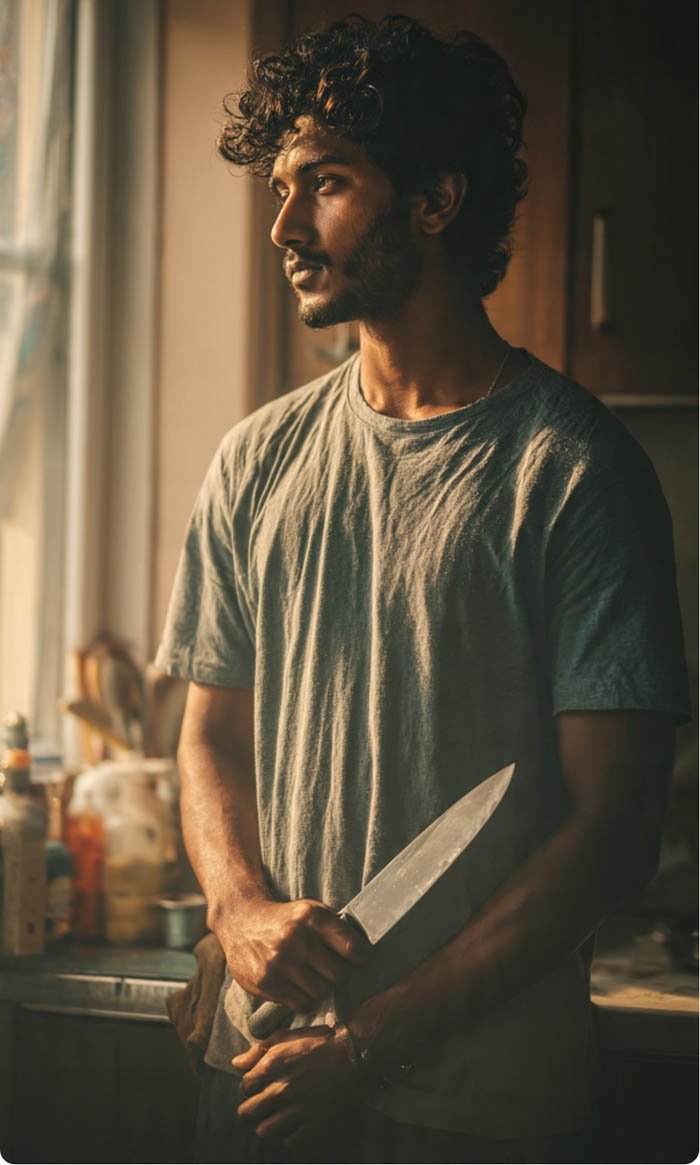
It read “Cold blooded murder” and the sadist in me awoke. I read further and it said the body was headless. The investigators were going to have a tough time identifying the body. It continued and in one place it was mentioned “Cut into pieces”. That was getting worse than I imagined. A headless body and that too cut into pieces. A soft heart will not be able to take this and it was certainly done by a heartless person. Having an interest in crime thrillers it triggered my interest and then came the shock. Both the legs cut off and a shocking and frightening sight. I wondered why the leg was spared from cutting into smaller pieces. Did it look beautiful to the murderer? It was found in a black plastic cover big enough to hold the body. As a precaution not one but two covers for safety. The killer was meticulous in his act. Under no circumstances the body should get strewn over or get damaged. It should hold all parts of the brutally killed one, even though in pieces.
Had I been the investigator it would have left me clueless why one should get into a murder so cruel? Was it vengeance that was kept under lock and key for a long time which ended in this bloodshed? It was obvious that the victim was unarmed and did not put up any resistance as the body had no other injury except for the brutal act of removing the head and cutting into pieces. It was said that forensic people had found chilli powder, pepper powder, raw chillies and also salt from the place of murder. It must have been to blind the victim as chillies along with salt are very painful and eyes cannot be opened. Very cruel were the people who did it and why? Why ' was my thought.
My thoughts went spiritual. Followers of Jainism avoid eating anything grown under the earth. This strict rule comes from their core belief in strict non – violence towards all living things. Even the tiny organism living in the dirt and the root vegetable hold many lives inside. Stopping the sprouting which kills the life inside to be avoided at all cost.
Why was a land with such high thoughts and practice so brutality extreme.
I was caught in confusion and it was obvious that both the deeds stood opposite and no preaching would convince the ones who had a liking for blood. I had to take a stand and it had to be fast. Yes, I did it and did it without an iota of regret.
Took the chicken leg piece and with my shining sharp knife gave deep cuts all over the lovely piece. How else would my masala get into it?
The murdered body marinated with my usual magic mix and I kept it aside. Then came the most romantic engagement of getting into the real process. I wanted it different and colourful today and my attempt finally turned out to be a success. Last, the lovely multi-coloured capsicums when spread on top appeared as an attire to my chicken dish and added beauty to the looks.
Curse me if you feel like but I prefer to be “The cold-blooded murderer”
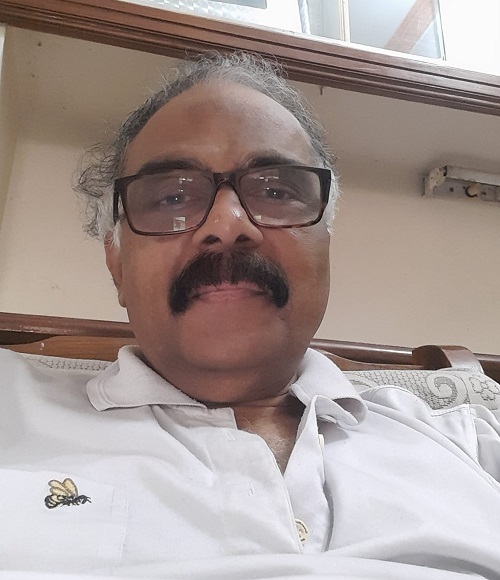
T. V. Sreekumar is a retired Engineer stationed at Pondicherry with a passion for writing. He was a blogger with Sulekha for over fifteen years and a regular contributor writing under the name SuchisreeSreekumar.
Some of his stories were published in Women's Era. “THE HINDU” had also published some of his writings on its Open Page..
MAMMIYUR MAHADEVA TEMPLE
T. V. Krishnakumar
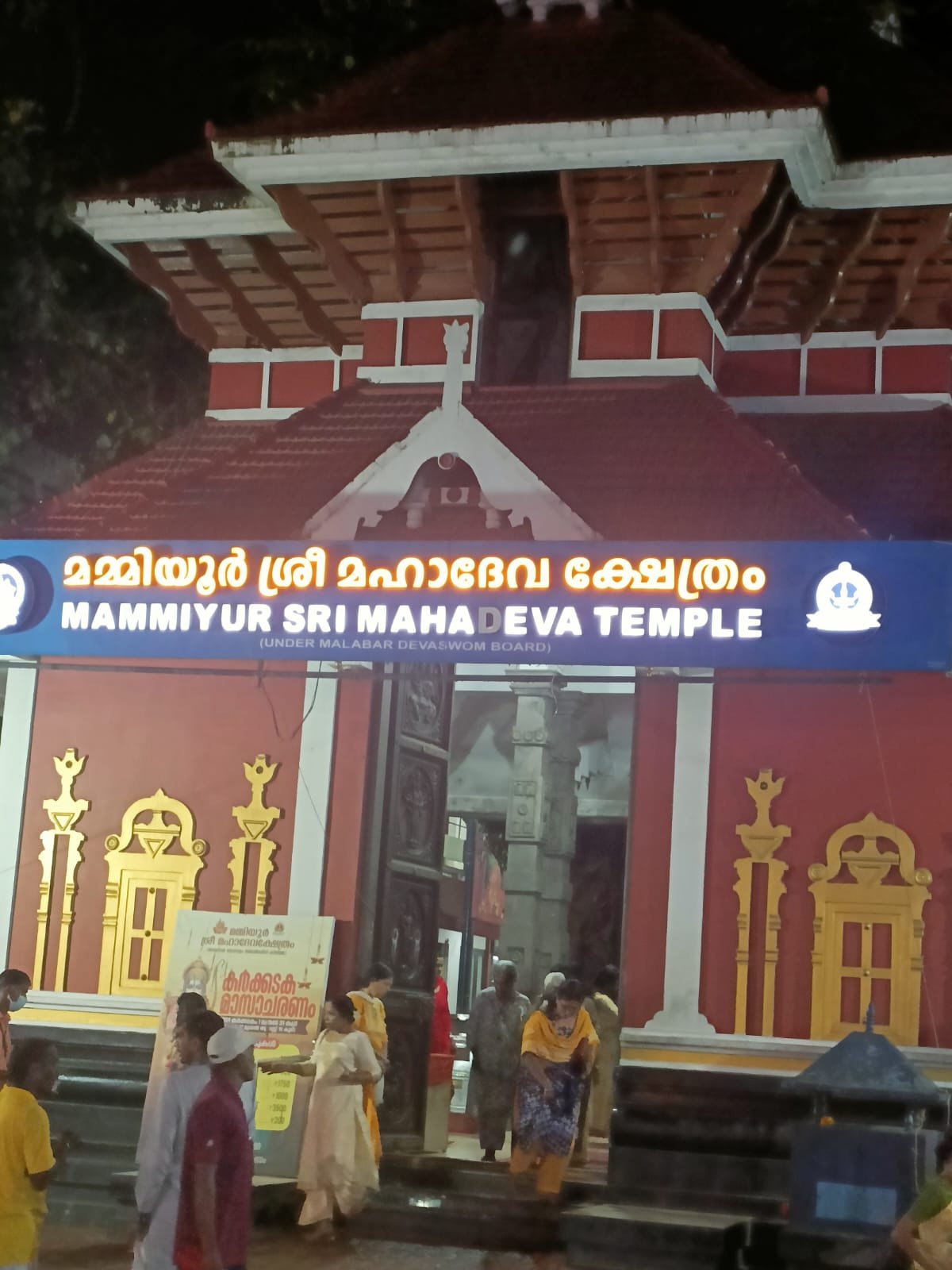
The Ancient Mammiyur Temple is Situated at a walkable distance Of 200 Metres North West to the Famous Guruvayoor Sree Krishna Temple.
The Main Deity is Lord Shiva in the form of Uma Maheswara. The Temple is governed and administered by Malabar Devaswom Board, which is under the Government of Kerala.
. The legendary history extends to the consecration of the famous Sree Guruvayur Temple - It was the final phase of Dwaparayuga. The great Deluge had submerged Sree Krishna's abode Dwaraka and the Lord, as a playful child, was frolicking on a banyan leaf tossed about by the surging waters. Devaguru Brihaspathi and Wind God Vayu stumble upon Him, where upon the Lord himself handed over to them the idol of the Supreme Lord that he has been worshipping at Dwaraka, with instructions to have it installed and consecrated at an appropriate spot on earth.
Guru and Vayu then descended on the banks of a sprawing lake Rudratheertha rendered holy by Lord Shiva who had been doing penance there for ages. Realizing the purpose of the visit Lord Shiva suggested the consecration there itself on the bank of Rudratheertha and obligingly moved over to a near by location on the other side of the Rudhra theertha.
The place where Guru and Vayu consecrated the idol of Lord Krishna became GURUVAYOOR and the site that Lord Shiva chose for himself and his consort Sree Parvathy became Mahimayur, "mahima"(meaning Glory) evolving out of the status bestowed on Lord Shiva for voluntarily relinquishing his initial abode to accommodate Lord Krishna. This in course of time got colloquially known as "MAMMIYUR". The devotees who come to pray in Guruvayur Sree Krishna Temple, as per custom, are supposed to come to this Temple and pray in this Temple. In case they are unable to visit Mammiyur, , people after worshipping Goddess Bhagawathi deity in Guruvayur Temple, face north-east, invoke Lord Shiva and pray. This serves as a better alternative to not having Darshan in Mammiyur. The Temple pond on the Northern side is known as Rudra Theertham, where devotees can take bath before entering the Temple.
After the Temple opens, the priest performs a ritual called " Vakacharthu" ,where herbal powder made out of the bark of "Vaka" Tree (mimosa herb) is applied. The act of applying is called " Charthu" in Malayalam. Later, oil Abhishekam is performed followed by offering of Pori (puffed rice) which is called "Malar" in Malayalam. Deeparadhana or Aaarathi is at a fixed time namely 6 PM. Apart from Lord Shiva or Mahadeva, there are other deities- namely Lord Ganesha, Lord Muruga, Lord Ayyappa, Goddess Parvathi and Lord Vishnu. Priests chant Rigveda and there will be a continuous pouring of water on Lord Shiva. This ritual is called "Dhaara". The Temple opens at 4.45AM and closes at 10 AM. The Temple opens again at 5 PM and closes at 8.30 PM. The inner enclosure surrounding the Central Sanctum Sanctorum(known as Sree Kovil) is called Nalambalam (meaning 4 sides surrounding the Central Sanctum Sanctorum. As per the Custom of the Temple, gents should not wear shirt, banian, shorts, lungi and pyjamas. Ladies can wear sarees or churidhars Another custom followed here is that soon after their marriage, couples should not enter Nalambalam. The Temple also restricts carrying of Prasadams from other Temples.
I had an opportunity to visit this Temple in early August this year. As per Custom, I always make it a point to visit and pray in this Temple whenever I go to Guruvayur .I feel very much blessed when I leave the Temple.
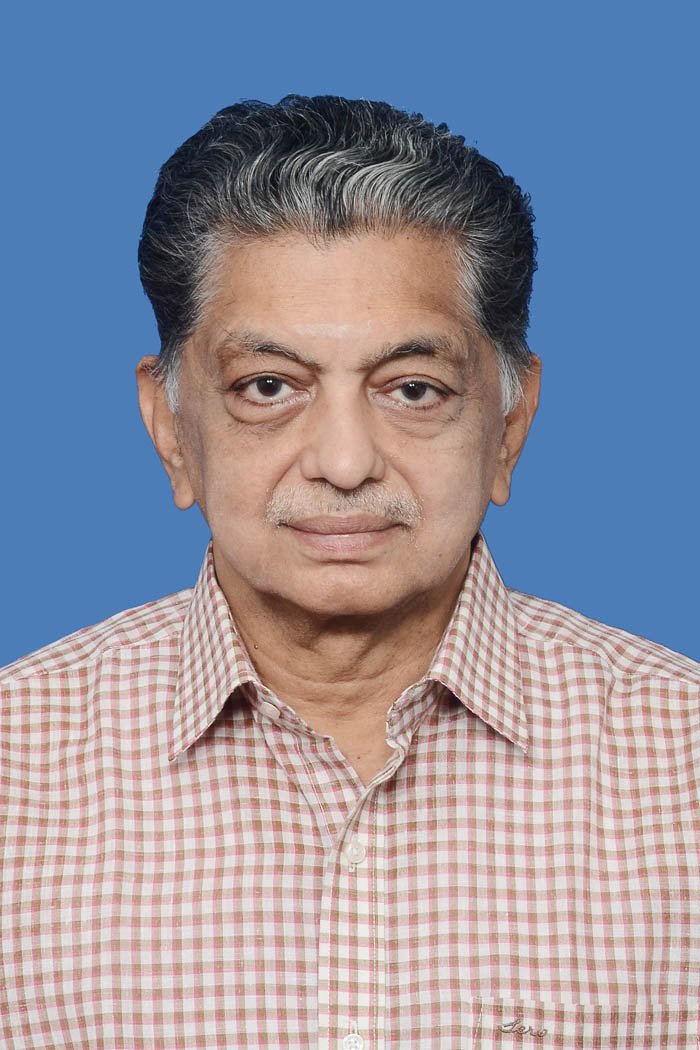
I am T.V.Krishnakumar, aged about 66 years. I am a C.A who was in employment in a U.S company in Chennai doing U.S accounting and U.S tax work for clients in the U.S.A. I was also employed in a logistics firm and later went for freelancing. I am now retired and post retirement I am in the Board of Nungambakkam Saswatha Dhanarakshaka Nidhi Ltd which is 144 years old and into the business of granting gold loans and mortgage loans to the lower strata of society.
SWEET MERCHANT
Dr. Rajamouly Katta
It is delightful to talk about a town. The people in the town were born with a silver spoon in their mouth. All of them were opulent yet they wanted to become more opulent than before. They wanted to reach their goals. It is not surprising to know that the town’s name is Lakshmipur. A merchant, Dhanpal by name, came and settled in the town long ago. He managed a mega store of all kinds of articles to meet the needs of all the people in the town.
Dhanpal was such a person in whom all found the most essential qualities of a good person. He in a short span became very close to the people of the town because of his usual jovial chat with them. He used to entertain them every day and so all thought that he was the only entertainer in the town. He spoke to them in friendly terms and conciliatory tone. Whenever he found time, he used to enquire about their health and their well-being. He gradually won the confidence of all the people. He reciprocated promptly after the people had greeted him on festive occasions. They invited him on important occasions like marriages and birthdays. He pleased them with his gracious presence on every occasion.
Dhanpal used to enquire with all the people some way or the other in a friendly way and conciliatory tone. When he saw a customer, he said,
“Last year I attended your son’s marriage and enjoyed delicious food items in the function. You’re lucky enough to get the bride. Are you singing lullabies to your granddaughter now?”
“Yes, I’m really enjoying my granddaughter’s tender smiles. You cordially greeted the couple to be blessed with a daughter in a year at any cost. One must become two to become three at least on the first marriage day,” said the customer.
“You, the people of this town must be happy so that I can be doubly happy. I wish you so as you are friendly and co-operative. You take me into your confidence as I help you by lending small amounts of money to meet your dire needs and primary necessities,” said Dhanpal.
“Yes, you’re right. Since you’re here, we’re happy. There’s no doubt about it,” said Dhanpal.
Dhanpal became a friend indeed because he helped them in need. They called him Sweet Merchant not because he was a sweet merchant, but he was a well established and well accomplished merchant of sweet talk and sweetheart. He sold all kinds of articles to cater to the needs of the people without any need to go to the neighboring town.
There was a wall poster in his shop with a saying, “Money begets money.” The people could not understand what it really meant. When Dhanpal spoke to them in intimate terms, they enquired about its meaning. The people, who were regular customers, learnt the meaning when he explained it,
“Suppose you keep a thousand rupees with me, it’ll become two thousand rupees after twenty months and four thousand rupees after forty months and so on. It’s in respect of money. In the event of keeping ten grams of gold, you’ll have twenty grams of gold in your house after twenty months. You’ll wear four earrings after twenty months if you keep with me two earrings. It’s in case of gold and ornaments. To tell in a nutshell, whatever you invest with me, it’ll become double, and you’ll get it without welcoming any trouble within the stipulated time.”
The innocent people of the town talked of the secret of earning money and becoming rich in a short period. The news of secrecy spread like wildfire not only in the town but also in the neighboring villages. All the customer-villagers thought,
“We’ll be rich in a short span.”
The people there wished that their every offspring should be born rich to compete with the richest man Bill Gates.
Almost all the people of the town and neighboring villages disposed of their properties and deposited the amounts with Dhanpal, Sweet Merchant with the hope of becoming rich in a short span. Those who had ornaments and gems brought them to keep them with the merchant. The people in slum areas afforded to save their small sums of money with him. They all undoubtedly dreamed of getting double what they had deposited with him.
Dhanpal used say to the people of the town in friendly terms:
“You all are born under a lucky star.”
Dhanpal infused courage in them to save money with him whatever they had. He went on to advise them as their well-wisher. He made them visualize their bright future. He said:
“The lucky days are very near for you to live with all comforts and luxuries in an air-conditioned building with your glittering better-halves.”
Dhanpal was able to impress in a unique way. All his words spoken to women were so fascinating,
“You’d scintillate like goddesses in the years to come.”
The words were always ringing, filling all the hopes in their hearts. All thought that fortune favoured them with the advent of Dhanpal to the town. Their faces were glowing with the gleams as time was fast moving in its course.
Dhanpal got millions of rupees and kilograms of gold. In the usual manner, he managed his business for some more days, reminding the people of the town of their better future in the years to come. They were in the mood for full hopes:
“All is well that ends well.”
One propitious morning the people of the town found the shutter of his mega store down with a safety lock on it. They at first surmised that the sweet merchant had gone to his relations and would come back in a day or two. They had mixed opinions about his absence in the town later. Many days elapsed but the safety lock to the shutter was still safe. It was found locked for some more days. The confidence he got in their hearts was still safe. It took some more days for them to realize that Dhanpal had deceived them. The newspapers too stated:
“The Act of Dhanpal is Sheer Deception.”
They could not believe themselves to have been cheated by their Sweet Merchant. They were unable to recover from the shock. The women felt stunned by his trickery and roguery and were unable to withstand the turn of events. They cursed him daily with tears in their eyes. The proverb: “Fortune turns like a wheel” stood topsy-turvy, invalid and outdated from their point of view.
One fine morning, all the customers of Dhanpal thronged not his shop but the police station, situated at the heart of Lakshmipur. The Inspector of Police, Mr. Mahatma, was very much present and was attentive to their earnest pleas. Some men were shouting, and other men were beating their chests realizing their misfortune, the bad turn of events while all the women were crying. They related to the Inspector how they had been exploited and deceived by Dhanpal. Mahatma responded positively with his words:
“I put an end to thefts, rapes and killings which have become very common in the post-Gandhian days.”
Jaya Prakash, an elderly person of the town came forward and said with sheer responsibility on his part as man as well as a victim,
“We all were misguided by Dhanpal. He deceived us by his sugarcoated words. We were unable to understand his sweet affections and false appearances. The so-called Sweet Merchant, Dhanpal robbed us of our sweat. We were somewhat rich then. Now we’ve lost all our earnings to become penniless. Sir… I gave him one hundred grams of gold and three lacks rupees… Kindly see that justice is done to me, Sir”.
Meanwhile Mr. Krishna Swamy rushed from the crowd in the ferocious mood and related,
“I was cheated in the broad daylight by Dhanpal. His sweet talk made us call him Sweet Merchant. In fact, he affected me so cunningly that I couldn’t understand his real nature. He was a crocodile to shed tears and the chameleon to cast colors. His slogan: ‘Money Begets Money’ misguided me and so I kept with him eight lakh rupees and one hundred and twenty grams of gold. My ambition to become rich drove me to this pathetic situation. Kindly see that everything of mine is recovered”.
Next Radha approached the Inspector, and tears were rolling from her cheeks, crying and saying,
“Sir, I’m the most unfortunate woman on earth as I was deceived most by dirty Dhanpal. He flattered me like anything and made me deposit with him all my ornaments, weighing one hundred grams. He extolled me that I’d shine like an angel with ornaments of two hundred grams of gold in twenty months. Now I don’t have any gold ornaments except this ‘mangala sutra’, the sacred sign of my wedlock. Sir, please help me recover what I lost”.
Meanwhile there was a wailing noise, echoing amidst the crowd. It was Lakshmi who came to the Inspector. She put forth her grievances,
“Sir, you’re the lord of law and order. I humbly appeal to you for your kind help in recovering what I gave the cheat Dhanpal. He told me cock and bull stories and made me believe him. He said that I’d be able to celebrate my daughter’s marriage in a grand manner and offer fat dowry to a handsome rich bridegroom whom I’d get for my daughter as her life-partner in her marriage when I got money from him after the period of four months… I deposited ten lakhs of rupees as floral tributes on his tomb. I am sorry… I’m sorry. My tears won’t go to waste. One day he’ll pay prices for all these sins. God will punish by awarding the most suitable punishment to him.”
Susheela, a middle-aged woman appeared on the scene with tears in her eyes and put forth her appeal before the Inspector,
“Dhanpal cheated me. I’m sorry for his roguery and treachery. I was easily deceived by the deceptive aura of simplicity in his eyes. He asked me to keep my earnings with him for twenty months as soon as he wore them to my ears. He promised to give me four earrings on the condition. He said that I’d wear four earrings to gleam like a queen of four ears. Like this, he deceived me by his sweet words and flattery. I failed to know the reality of his false eulogy. Please do justice in my case.”
Vivek, a youth who had muscular strength to fight against anyone in society came out from the crowd and said,
“I also became a victim to Dhanpal’s flattery. He exploited my innocence. He said that the Erstwhile M.L.A. wasn’t a suitable leader. It was I who would be the most suitable man to contest in the ensuing elections. He was sure of my victory in the forthcoming elections. For that, I would need fifty lakhs. So, he advised me to keep twelve and a half lakhs with him with a promise to see me in an elevated position. I blindly followed his advice. Now I curse myself for that lapse. Sir, I’m an innocent youth. Please help me regain my money.”
Next the people made a series of appeals from the crowd to the Inspector to do justice to them. The Inspector Mahatma reacted to this, listening to their appeals with rapt attention. He said to the public,
“I do assure you that I do my best to do justice to you as a committed Inspector. In fact, there was no necessity for you to involve yourselves in such illegal transaction… You’d have been satisfied with what you had… Anyhow it is my duty bounden to do justice to you. At this juncture, what you’ve to do is to lodge written complaints to me. I will proceed with my investigation soon. Don’t worry. You can go home.”
Maharshi, another victim of Dhanpal, suddenly rushed to the Inspector and said,
“Would you help us by taking one-tenth of the amount that you’re going to recover from Dhanpal? You can take it as our gift to you, Sir.”
The inspector reacted to this forthwith and said,
“I do my duty… I don’t need any gift or any bribe for that. I don’t expect anything from you for the execution of my duties. At your wish, you can sacrifice little sums for the welfare of the poor, the blind, the dumb, the deaf, the orphans, seriously sick, the mentally infirm, etc,” said Mahatma.
They all unanimously honored the noble aim of the Inspector in the heart of hearts with their applause.
Mr. Mahatma started his investigation systematically, obtaining photographs of Dhanpal as the special guest on the festive occasion of the town people...
Mahatma was successful in catching Dhanpal red-handed while he was participating in the auction for the purchase of a big factory in the neighboring state one day.
Mahatma was ferocious with Dhanpal and said,
“You’re a rogue. You deceived the innocent of Lakshmipur. You’re under arrest.”
“No... No…,” said Dhanpal.
“You’re a merchant of sweet talk. I know all that,” said Mahatma.
“I respect you in all respects. I humbly obey you. I’m ready to give you whatever you want. These words are confined to us, you and me,” said Dhanpal.
“I’m not what you think of me. You’re a smiling cheat… You’re a ‘smiling villain’… I as a sincere officer do feel tempted by what you offer. I want to wipe out their tears, the victims’ tears. I’m a true follower of Gandhi and his principles. An officer, who adheres to the principles, is acclaimed as a sincere officer indeed. Bloody fellow, what do you mean by me?” said Mahatma.
“Sir … Sir … Not that Sir,” said Dhanpal.
“Shut up, scoundrel,” said Mahatma.
All that Dhanpal had taken from his customers for the illegal transactions was seized from him and handed over to them safely according to their savings and deposits. In that case, Dhanpal was sentenced to severe imprisonment.
All the people of Lakshmipur and neighbouring villages donated handsome sums for the welfare society formed. A committee was constituted to that effect and Mr. Mahatma; the Inspector of Police of Lakshmipur Police station was unanimously elected President of the society. Society started functioning well and met the needs of the needy and the hungry up to the aspirations and expectations of Mahatma Gandhi and Mother Teresa. The press people were unable to write in the newspapers about such incidents except to write about the award functions and successful celebrations with Mahatma as the distinguished chief guest.
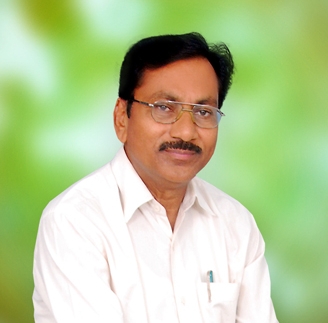
Dr. Rajamouly Katta, M.A., M. Phil., Ph. D., Professor of English by profession and poet, short story writer, novelist, writer, critic and translator by predilection, has to his credit 64 books of all genres and 344 poems, short stories, articles and translations published in journals and anthologies of high repute. He has so far written 3456 poems collected in 18 anthologies, 200 short stories in 9 anthologies, nine novels 18 skits. Creative Craft of Dr. Rajamouly Katta: Sensibilities and Realities is a collection of articles on his works. As a poet, he has won THIRD Place FIVE times in Poetry Contest in India conducted by Metverse Muse rajamoulykatta@gmail.com
DEVDAS THEN AND NOW
Sreechandra Banerjee
Returning after about ten years!
Oh no! I never wanted to return to Kolkata. What to do? Now that Baba is ill and Ma desperately wanted me to come home.
But what if I meet her again somewhere?
Is she still beautiful? How, how on earth can I forget her! My first love, my childhood puppy love. Don’t know when this puppy love had culminated in something so deep and profound.
No, no, I will not think of her. Yes, yes, I admit I made a mistake then… even after she…
Now this flight is delayed! Would have been nice if there was a direct flight from Paris to Kolkata.
Never wanted to return to Kolkata, especially for my parents – who would not accept it!
Now finally, they have announced security check for this flight.
But will still have to wait near the departure gate before one can board.
Wait a minute! Isn’t it? Looks like her. Have maintained herself so nicely over the years.
No, no, I won’t look at her. Why didn’t she keep in contact! Never replied to my messages. Even blocked me on WhatsApp.
What to do my parents never agreed as they were of a different caste. They lived in a small apartment in our Park Circus locality. Her parents felt offended when my parents didn’t agree to our marrying. Heard that they had arranged her marriage with a rich film producer and she had accepted.
I still remember our last meeting.
“you coward, first gave in to your parents’ wishes, then even when I went to see you that night to tell you that I won’t be able to live without you, let us elope, you didn’t agree,” she was almost in tears.
“What to do Charu? At that time, I had just become a film director and wasn’t sure of my career. You know the politics behind. How could we elope with such an uncertain future? You were also not earning then.”
“So what, I said that soon I will start a business of my own or take a job, and then you started vacillating!”
That was the end of everything!
And now, there she is, did she notice that I am here? Can she recognize me? Is she in Mumbai now, going to Kolkata to see her parents?
What if I talk to her? Will she answer?
I went and took the seat beside her. She got up and started walking!
“Charu, Charuuu, listen Charulata, I admit that it was my fault that I didn’t accept, but you must be happily married now, with a family. Listen to me, please do listen to me!”, I started walking beside her.
Probably it had become too filmy a scene as found people around us staring at us.
Probably the gazes at us made her stop and sit down. Afterall, the Charulata that I knew was a sensible person.
“What it is Dwijadas?” she seemed to be annoyed, “you have settled now in Paris, and you are a big producer now”.
So, now she addressed me as Dwijadas, my full name instead of the earlier shortened sweet ‘Dwija’.
“You are going to Kolkata; do you live there in Kolkata like before?”
“So what it is to you where I live?”
“Just was curious. Hope Aunty and Uncle are doing fine”.
“Lost my father two years back. Mother lives with me here in Mumbai”. I have recently started directing films and documentaries. But what does it matter to you. Hear that you are going on well with some famous French actress”.
“No Charu, never, how could I ever forget you, that was only a rumor as she was the heroine of my film and we were very good friends. You know how people can’t take a normal platonic man-woman relationship. They spread rumors. Before, you never believed in rumors. Specially these days, you know that man-woman relations may be normal human relations. May be, I benefited from her friendship a lot as I missed you terribly, but that doesn’t mean that I was head over heels in love with her.”
“But you were away, who knows what you did!” she exclaimed.
“No, I can assure you that I didn’t fall for anyone, nor did I have a Bohemian lifestyle.”
She seemed to soften a little.
And then it was announced that the flight was further delayed due to some technical fault.
So, we could talk for some more time. I felt a bit better.
“You said that you have started directing films, what projects are you now working on?” I asked casually.
“You know I always liked reading Sarat Chandra Chattopadhyay. Well, he was born in September, you know, on 15th September 1876. So, am planning to make a documentary on him and also a film “Devdas then and now’. You know Devdas has been adapted twenty times for feature films and several times for other entertaining features. Films were made in many languages like Telegu, Tamil, Urdu, Assamese, Malayalam besides Bengali, Hindustani and Hindu,” she said.
“Yes, Sarat Chandra is an all-time novelist and short story writer. His superb capturing of the then village life in his various works have conquered the hearts of not only his readers, but also the hearts of many film makers and the audience thereof,” I was also an avid reader of Sarat Chandra and we often discussed his novels.
“ I used to be mesmerized by his articulate narration and the fluent manner with which he used to create the most common characters and the everyday casual circumstances. His portrayal of lifestyle, struggle in all spheres of life etc, have touched many hearts. He had a deep insight into human nature; his writings bear testimony to his vivid style of depicting characters and events.
The flow of lucid language while analysing characters in a simple way did enthral readers.
So, I decided to pay my tribute by making a documentary on him too, she seemed to be engrossed with her dreams of making a documentary and revisiting Devdas”, she was sort of daydreaming!
“Some time back, I was also thinking of making a French Film on one of his works, at that time I found that Wikipedia had said: - “He remains the most popular, translated, adapted, and plagiarized Indian author of all time”.
“We know him as a legendary writer. But how many of us know that the writer was a multifaceted person- a good painter and a musician too. He could play instruments like flute, esraj, harmonium, pakhavaj. Having a good voice, he could sing Kirtans and Rabindra-sangeets very well.
When the writer lived in Rangoon, his musical skills had fetched him the title “Rangoon-Ratna Sarat Chandra” or “Gem of Rangoon Sarat Chandra”, she continued.
“Rangoon, as we all know is the present day ‘Yangon’, meaning ‘end of strife’, which was the former capital city of Myanmar or Burma.
Rangoon had played an important role in the history of Indian Independence Movement. Sarat Chandra Chattopadhyay’s patriotic novel, “Pather Dabi” or ‘Right of Way’ or ‘Demands of the Road’. It was set in the backdrop of Rangoon. The British had banned this novel because of its revolutionary idea,” I chirped in my knowledge on Rangoon.
She then said, “his novel “Srikanta” was translated. He was about to go abroad, but because of bad health couldn’t. It was a great opportunity missed. In fact, he had missed many other opportunities because of ill health.”
“Yes,” I said, “It is said that he could have also received Nobel Prize for Literature had health permitted. Bad luck for him and for us Indians that he didn’t. He couldn’t be present there and as per rules of the Nobel Prize Committee, one has to be living and present to receive this award.”
“Yes, so sad, that he didn’t,” she seemed to have mellowed a lot, so I dared to ask her about her family.
“Why are you asking? Just after I got a job, and after my wedding my husband didn’t want his wife to have an independent career of her own, just believe me, even in this century! So, I…. I divorced him and am now on my own.
I was dumbfounded. Just didn’t know what to say! Thank God boarding was announced.
Information and image of Sarat Chandra Chattopadhyay are from books and The Internet to which I have no right (Disclaimer).
Copyright Sreechandra Banerjee. All rights reserved except as noted.
No part of this story can be reproduced by anyone except for Wikipedia quotes and image of Sarat Chandra Chattopadhyay.
Sreechandra Banerjee is a Chemical Engineer who has worked for many years on prestigious projects. She is also a writer and musician and has published a book titled “Tapestry of Stories” (Publisher “Writers’ Workshop). Many of her short stories, articles, travelogues, poems, etc. have been published by various newspapers and journals like Northern India Patrika (Allahabad), Times of India, etc. Sulekha.com has published one of her short stories (one of the awardees for the month of November 2007 of Sulekha-Penguin Blogprint Alliance Award) in the book: ‘Unwind: A Whirlwind of Writings’.
There are also technical publications (national and international) to her credit, some of which have fetched awards and were included in collector’s editions.

Liar, Liar!
Without any embellishment or elaborate construction, I, a householder, am simply reproducing my inner thoughts.
I had given my wife strict instructions not to open the window behind the reading room. Ignoring the question mark on her face, I explained loudly enough for our son to hear.
“Suma, the whole compound is overgrown with weeds. The other day, a snake slithered out of the compound, crawled along the wall and tried to get in through the window. I chased it away.”
I don't like telling lies. But for the sake of the tailorbirds, I told Suma and Anu a harmless lie. I had read somewhere in a book that one could tell a lie for the sake of conveying a harmless message.
It was only last week that I discovered a tailorbird family in the clump of banana plants at the back of the house. On the edge of a banana leaf, the male bird had stitched two halves of the leaf together, making a pouch-like nest, and filled it with cotton and other soft materials.
From the window of the reading room, the entrance to the nest could be seen clearly. The banana leaves stood over the nest like a roof, protecting it from the sun. The remaining portion of the leaf had been arranged in such a way that the entrance to the nest could not be seen from below.
The first thing I noticed was a pair of tailorbirds, sitting together and chirping to each other. When I found them regularly in the banana clump, I began to watch them more closely.
These little birds, with what looked like vermilion on their foreheads, began stealing my time without my knowing it. Their amorous displays, rubbing their beaks together and singing “twee-twee,” inevitably awakened memories of the emotional days of my own honeymoon with Suma.
Suddenly, what came to my mind were some of the things we ourselves enjoyed, forgetting ourselves in the crowds at Anandavally... We had walked holding each other, without caring about our surroundings... I suppose everyone must be like that during those first few days of love. And then, at some point, such a memory returns unexpectedly, gives you a smile, and fades away.
Two days later, the female bird began coming out of the nest. Another day, at the edge of the nest, against the yellow glow of sunlight, I caught sight of two tiny red foreheads and delicate pointed beaks.
When the long-tailed father bird came with food, it would never fly straight to the nest. It would first perch on the branch of a dark tree standing close to the banana plants. It would rest there for a while, making sure that there were no enemies around, and then suddenly fly into the nest.
If any large bird or squirrel came near the nest, the father bird would make a great commotion and chase it away. Sometimes the tailorbird would also have the help of flowerpeckers.
From the moment I saw a crow lurking around the nest with a suspicious eye, I became the nest's guard whenever the father bird was away.
(Thoughts in ther bird brain)
When we decided to build a nest, we chose the banana plant in this house because we had seen the friendly atmosphere here. From inside our nest, if we looked through the window at the back of the house, we could clearly see the reading room and the central hall.
“These people who live in such affection still exist, don't they?” I said to my husband in wonder.
We had noticed that, whenever he had free time, the householder would come and stand near the window of the reading room and watch us with curiosity. Normally, when we feel that humans have noticed us, it is our habit to move our nests immediately. But somehow we felt a sense of security here and never even thought of moving.
Whenever crows came to attack the nest, the fact that the householder drove them away and protected us gave us great comfort.
But once the householder left for the office and their son went to school, the suspicious gaze of a man on a motorcycle falling upon the house saddened both me and my husband.
“What will happen to these humans?” I wondered anxiously.
My heart melted at the thought that a crow might be able to enter this happy nest-house, and I prayed that it would not happen.
One afternoon, while I was feeding the chicks, my husband flew towards me in great excitement.
“If you want to see something interesting, look inside the house.”
Inside the house there were only the lady of the house and that suspicious man on the motorcycle.
We knew that peeping like that was wrong. Yet, unable to restrain our curiosity, we remained silent and fixed our eyes on the scene inside.
With remarkable freedom, the young man was holding the lady of the house by the hand and laughing and enjoying himself.
I kept praying.
“God, please don't let there be anything improper between them...”
Perhaps God heard our prayers.
The woman pulled her hand violently away from the young man. Her face reddened with anger and she raised her voice at him. When he tried to placate her again, the woman turned into a tigress once more.
With his head bowed, the young man left the house, got on his motorcycle and sped away.
That was the happiest day of our lives.
(I’m back!)
Knowing nothing of these stories, the innocent householder continues his thoughts:
“But who will save the tailorbird family from the mischief of my fifth-standard son? Who will save the tailorbird chicks from his stone?”
It was this fear that prompted me to close and bolt the window, lest the afternoon wind from the west blow it open, and also prompted me to tell a lie.
That evening, after returning from the office and having my tea, I opened the door of the reading room, which I had left ajar, and stepped inside.
I was horrified by what I saw.
The window, which I had kept closed, was open.
My son was standing there, looking at the tailorbird's nest.
The moment he saw me, he hurriedly tried to shut the window and move outside.
His guilty expression told me that he had discovered the tailorbird.
“What are you doing there?”
I deliberately made my voice stern.
“Nothing.”
He tried to brush me off casually and get out, but I stopped him.
I had to save my little birds.
After a long questioning, he finally opened his heart.
“There is a bird's nest in the banana plant. There are two chicks in it. They are my friends. Whenever Dad isn't around, I come and stand here and talk to them.
I sing them the new songs our school teacher has taught us. Then they sing back to me, ‘twee, twee...’”
He continued, stammering,
“I didn't tell Dad because I thought that if he saw me, the birds might leave the nest. I read in a book that birds don't like human beings...”
I bent down and kissed my sobbing son's head.
Only then did I notice a smile spreading through his tear-filled eyes, and the song of the tailorbird awakening on his soft lips.
Suma, who had heard our quarrel, came from the kitchen into the room and pressed herself against me.
Holding me tightly, Suma began to cry.
Why was Suma crying, I wondered.
Ramesan Blathur is an essayist, story writer, novelist, teacher, and the editor of a famous Malayalam Literary Magazine named Akam Masika.
‘Seismographil theliyathava’, a collection of stories, is his first work. He has edited a book on Artist Namboothiri named ‘Namboothiri’ and has collected famous Malayalam Satirist Sanjayan’s works (Sanjayan Haasya Krithikal) and has divided into 10 volumes under different topics. This work has given an opportunity to the new readers to read Sanjayan meaningfully.
In 1992, he was given ‘Bhaashaykkoru Dollar Award’ by FOCANA for the essay.
‘Perum Aaal’ is his first novel, which has already bagged 5 notable awards:
Ankanam Novel Award
Mundassery Award
Abudabi Sakthi Award
Kadathanattu Udayavarma Novel Prathibha Puraskaram
Atlas–Kairali Novel Puraskaram
A LEAF FROM HISTORY: WHERE STONES CONTINUE TO SPEAK
Mr Nitish Nivedan Barik
When we speak of the great centres of learning of ancient India, two names immediately come to mind: Takshashila and Nalanda. Takshashila, in the north-west of the Indian subcontinent, is remembered as one of the earliest great centres of intellectual and cultural exchange, while Nalanda in Bihar occupies a celebrated place in the history of higher learning in Asia. Their names have travelled across centuries and are now familiar even to those who know little about the history of ancient Indian education.
But there is another remarkable chapter in this history that has remained comparatively less known. In ancient Odisha, in the landscape of present-day Jajpur and Cuttack districts, there flourished a remarkable cluster of Buddhist monastic and intellectual establishments, later associated by some scholars with the ancient centre known as Pushpagiri. The archaeological remains of Lalitgiri, Ratnagiri and Udayagiri, often described collectively as Odisha's Buddhist “Diamond Triangle”, testify to the extraordinary intellectual, religious and artistic life that once animated this region.
The story of Pushpagiri is therefore not merely the story of an archaeological site. It is the story of Odisha's place in the intellectual geography of ancient India.
A Historic Centre of Learning at Our Doorstep
The word Pushpagiri evokes the image of a “flower-covered hill”, but its historical significance is far greater than the poetic beauty of its name. Ancient Buddhist traditions and historical accounts point towards the existence of a significant centre of Buddhist learning in Kalinga. The Chinese Buddhist pilgrim Xuanzang (Hiuen Tsang), who travelled through India in the seventh century CE, refers to a Buddhist establishment whose name has been transcribed in Chinese sources as Pu-se-po-k'i-li, generally understood by scholars to refer to Pushpagiri.
Modern archaeological investigations have added another dimension to this historical memory. Excavations across the region have revealed monasteries, stupas, sculptures, prayer halls, meditation chambers and other structures. Some archaeological interpretations have suggested that Lalitgiri, Ratnagiri, Udayagiri and nearby Langudi may have formed part of a wider intellectual and religious landscape associated with Pushpagiri, perhaps representing a major centre of learning comparable in importance to other renowned institutions of ancient India. The association of these sites with Pushpagiri, however, remains a subject of scholarly discussion.
This uncertainty does not diminish their significance. On the contrary, it makes the search for Pushpagiri all the more fascinating. What is beyond doubt is that these hills preserve the remains of important Buddhist establishments that flourished in Odisha over several centuries.
Lalitgiri: One of the Earliest Centres
Among the three principal sites, Lalitgiri is generally regarded as the oldest. Situated between the Birupa and Chitrotpala rivers, it represents a remarkably long phase of Buddhist activity in Odisha. The site is regarded as the oldest of the Buddhist Diamond Triangle, with evidence of a Buddhist monastery dating back to the early centuries of the Common Era.
The archaeological remains include monasteries, a magnificent Mahastupa, a Chaityagriha or prayer hall, votive stupas and numerous sculptures. Particularly remarkable was the discovery of a relic casket within the Mahastupa. The casket contained nested containers of stone, silver and gold and a small bone relic. Because the caskets were not inscribed, scholars have appropriately been cautious about definitively identifying the relic as that of the Buddha. Yet the discovery gives Lalitgiri an extraordinary religious and historical significance.
Lalitgiri also reveals the changing character of Buddhist thought in Odisha. Archaeological evidence points to the presence of early Buddhist traditions and Mahayana, with later developments associated with Vajrayana. The site thus provides a window into the evolution of Buddhist thought rather than representing a static religious establishment.
Ratnagiri: Another Great Centre of Learning
While Lalitgiri provides evidence of the early and enduring Buddhist presence in Odisha, Ratnagiri reveals the remarkable intellectual, artistic and monastic flowering of this tradition.
Extensively excavated during the twentieth century, Ratnagiri has yielded the remains of monasteries, stupas, temples, prayer halls, sculptures and hundreds of votive stupas. Its imposing monastery, richly decorated gateway and sophisticated sculptural tradition demonstrate the high level of artistic and intellectual culture that developed here. Inscriptions and archaeological remains point to Ratnagiri Mahavihara as an important centre of Buddhist learning, particularly in philosophy, yoga and tantric practices.
The importance of Ratnagiri lies particularly in its association with Mahayana and Vajrayana Buddhism. Images of Buddha, Bodhisattvas and various Buddhist deities, together with the architectural remains, suggest that this was more than simply a place of worship. It was a setting in which religious ideas were studied, interpreted and transmitted.
Ratnagiri also helps us understand what an ancient centre of learning might have looked like. It was not a university in the modern sense—with lecture halls, departments and degrees—but a residential intellectual and monastic community, where religious practice, meditation, teaching and philosophical inquiry formed part of a larger way of life.
Udayagiri: Another Major Monastic Complex
The third major component of Odisha's Buddhist Diamond Triangle is Udayagiri, which should not be confused with the famous Udayagiri-Khandagiri Jain caves near Bhubaneswar.
Udayagiri is the largest and one of the most extensive Buddhist archaeological complexes of the triad. Excavations have revealed two important establishments, Madhavapura Mahavihara and Simhaprastha Mahavihara, together with a Mahastupa, prayer halls, meditation chambers, votive stupas and numerous sculptures. A large part of the site, however, remains to be excavated.
The sculptures of Buddha and other Buddhist divinities, together with the architectural remains, reveal the continuing vitality and richness of Buddhist religious and artistic traditions in Odisha over several centuries.
Taken together, Lalitgiri, Ratnagiri and Udayagiri reveal something extraordinary: these were not isolated monastic establishments, but parts of a wider and interconnected Buddhist intellectual landscape.
From Kalinga to the Wider Buddhist World
The significance of Pushpagiri becomes even clearer when we place it within the larger history of Kalinga, the historical region that broadly corresponds to present-day Odisha.
Odisha occupied an important geographical position on the eastern coast of India. Its connections with the wider Bay of Bengal world facilitated the movement of people, ideas, artistic traditions and religious practices between the Indian subcontinent and Southeast Asia.
Buddhism had deep roots in Odisha. The association of the region with Emperor Ashoka and the Kalinga War provides an important early historical context for the later history of Buddhism in the region. Over the following centuries, Buddhism developed in Odisha into a sophisticated intellectual, artistic and monastic tradition.
The archaeological remains of the Diamond Triangle also reveal the coexistence and evolution of different Buddhist traditions—from early forms of Buddhism to Mahayana and eventually Vajrayana. This makes Odisha particularly important for understanding the intellectual transformation of Buddhism in eastern India.
Why Have We Heard So Little About Pushpagiri?
Why does the average educated Indian immediately recognise the names Takshashila and Nalanda, while Pushpagiri remains relatively unfamiliar?
Part of the answer may lie in the relative obscurity of the sites until their archaeological rediscovery. Nalanda became an internationally recognised archaeological and historical symbol, while the Buddhist heritage of Odisha remained comparatively little known for a long time. The systematic archaeological exploration of Lalitgiri, Ratnagiri and Udayagiri is relatively recent, gradually revealing the scale and sophistication of the Buddhist civilisation that had flourished here.
There is also a larger problem in the way the history of ancient India is popularly remembered. We often imagine ancient Indian knowledge through a small number of famous names and institutions. But the intellectual landscape of ancient India was much more extensive and geographically diverse.
Pushpagiri reminds us that the history of Indian learning did not belong to one region alone. From Taxila in the north-west to Nalanda in Bihar and the Buddhist establishments of Odisha in the east, India possessed a diverse landscape of intellectual centres, linked by wider currents of religious thought, pilgrimage, learning and cultural exchange.
Remembering Pushpagiri !
Today, the hills of Lalitgiri, Ratnagiri and Udayagiri may appear quiet. Their monasteries are ruins; the communities of monks and students who once inhabited them have long disappeared; and the debates that once animated their courtyards have fallen silent.
Yet the stones continue to speak. They offer a glimpse into a time when Kalinga was not merely a political or geographical region, but also an important centre of Buddhist intellectual and spiritual life. The remains of monasteries, stupas, sculptures and other structures suggest communities devoted to religious practice, learning and artistic expression. Although the names and individual histories of most of the monks, teachers and artists who lived and worked here have been lost to history, something of their intellectual and cultural world survives in the archaeological remains they left behind.
Pushpagiri therefore deserves to be remembered alongside the better-known institutions of ancient India—not necessarily because we can prove that it was a “university” in precisely the modern sense, but because the archaeological evidence reveals an extraordinary network of Buddhist monastic and learning centres in ancient Odisha.
The story of Pushpagiri is, ultimately, a reminder that the intellectual map of ancient India was much larger than the names we commonly remember. When we speak of Takshashila and Nalanda, we should also remember Odisha's Lalitgiri, Ratnagiri and Udayagiri—and the fascinating possibility that these hills preserve part of the story of ancient Pushpagiri.
Much has been excavated, studied and preserved, yet the hills may still have more stories to reveal. Perhaps that is what makes a visit to these sites so meaningful: one does not merely encounter archaeological ruins, but fragments of a past in which learning, faith and artistic expression flourished together. And the remarkable thing is that this history is not somewhere far away—it is, quite literally, at our doorstep.
(Mr Nitish Nivedan Barik hails from Cuttack,Odisha and is a young IT professional working as an Associate Manager with Accenture at Bangalore.)
“In all, there will be two males and two females in the house. You have to prepare lunch only for the females. The two men will be having their lunch in the canteen as the factory is at a distance from home. If you wish I can send a lady constable also in civilian clothes to cut the vegetables and do odd jobs in the kitchen. Will it be difficult?”
Stephen asked Charu.
( Before going any further with the story, I must tell you that Charulatha Girish is a very popular crime fiction wrirrd and a close fiend of Inspector Stephen whom she had assisted a few times in solving murder cases.Charu works as a spy, ingratiating herself in the premises where a murder has raken place and the duo solve crimes. She is aged seventy five and has a son who is in the U K and who comes every year to spend a fortnight with her or she goes to London to spend three months with him
every year. Basically settled in Madras she writes novels)
“ No need to send me any assistand Stephen. The servant has been there for more than seven years you said. I am sure sjhe can cut the vegetables for me. Don’t worry,” Charu said smiling.
”I am sure we can crack the mystery within two weeks, if not before that.” he said and after sipping some lovely coffee she had made for him, he continued.
“To give you a quick runover...the man of the nouse- the factory owner Ranjith - was stabbed in his bed two days ago. He was in his late forties. His wife had passed away four years back due to cancer. The son , married a couple of years ago, had gone the previous day to Tanjore to see his wife and his new born baby of two days...we had to ask him to rush down. He will be going again after a week to Tanjore to his in-law’s place for three days. At present this boy’s grandmother – his mother’s mother, his aunt and and uncle- a bachelor- are staying in their house. The grandmother is very rich and they are staying here temperorily as their big house in T Nagar was demolished and flats are coming up there. So, these people shifted here. The dead man’s son and wife’s brother will be running the factory now. The wife’s sister is a lecturer in some private college. The old lady speaks very good English and looks a very healthy one....a stylish one and of a domineering personality!! There is a secretary – a young fellow who comes every day and does some typing for the dead man , I mean ‘did’ - Ranjith was a writer too apart from running this factory. He was a PhD in Chemistry. The factory does some Chrome Electroplating. There is a driver and a cook. The driver goes home at seven in the evening ; the cook was staying with them. Now she is away on a pilgrimage and was supposed to come back on the day Ranjith was killed! But she came and has since then, refused to work there. She seemed to be in a state of shock and the old lady has given her a month off. The old lady - Ranjith’s mother-in-law Sunanda- was complaining to me that she is finding it difficult without a cook and it occurred to me that you will fit in perfectly at this time!! I have told this lady- Sunanda that you were available for a month as your emploters have gone on a holiday for a month and that you were staying with us temporarily. I hope you don’t mind”
He looked at her. Charu smiled at him and said
“Absoulutely no! Any theory as to whom you suspect? Do you want me to track secretly any character there?” Charu asked.
Stephen smiled.
“ I feel that it was an inside job! It had been raining that night. Sunanda - she is a widow- her son Prakash , daughter Seema and Ranjith - the murdered person- and the secratery were having their dinner as usual. Since the cook was on leave, they were catering dinner from outside for a month. In the afternoon, the men eat in the facto0ry premises and Seema was taking food in the college canteen. The secretary brings his own lunch and so Sunanda had this cooking done only for herself on week days. On the weekends they managed from the caterer who supplied them dinner everyday. It had been raining heavily that day. The secretary had stayed back and took his dinner with them. Ah!! Since it was raining very heavily, the servant spent the night there as her home was two bus stops away. The murder had taken place a little after midnight as the Doctor says. The maid was unaware of this as she left at seven in the morning promising to come back by nine thirty. Sunanda had made some iddlies and was awaiting everyone at the dining table. Not seeing Ranjith at the table as he used to be a stickler for time, she had sent her son Prakash to call his brother in law and that was when they discovered that the man had been stabbed in his bed! The forensic fellow- a very efficienr guy- says the knife found in his chest is not the one that killed him. The knife we recovered from the body must have been from the kitchen drawer –rather blunt at the tip and used for cutting vegetables. The murderer must have used a pointed sharp one - - what we call a bichuva--a small dagger with sharp blades and tip curved and sharp. The murderer had killed him with that and pulling it out carefully, had subsituted this in it’s place. But we are clueless as to where the weapon is . There were footsteps - shoe marks-. from the verandah door to the bed...the verandah door that is in the corridoor which leads to the room...the only muddy shoe prints . The rain water in the verandah had washed away all the other prints. The murderer must have come from outside and done his job! The driver was fast asleep in the garage...yes he splept in the garage that day...not going home in the evening due to the heavy rain. I wish we could eliminate all the characters in the house and take it that the killer was from outsie, But my gut feeling says that it was an in side job. But whom to suspect? The man Ranjith’s brother-in-law- Prakash is a sissy fellow. I’m unable to suspect him. He was being employed by Ranjith and his son out of sheer pity. And certainly not intelligent enough to switch the weapons. We descretely searched his room also but the weapon was not there. “
“Like your gut feeling my female intuition talls me that the murder will be solved!!” Charu said.
***
Sunanda placed herself in front of Charu who was making a dish for the night .
“Smells so good!! You cook so well Paaru,” she said.
Charu had removed her gold chain and earrings before she left her home and was wearing a faded cotton saree and a small necklace of tiny black beads with some locket which was also losing its shine. She called herself ‘PaaRu.’
“ I cook well ma’am and my employers love my cooking. Even in Stephen Sir’s house I make the chappathis and subji for the night. Of course his mother makes all the non-veg stuff. My employers are vegetarian like you and so am I.”she said smiling.
“Well. It is more than two weeks since son-in-law passed away. What to do!! We three will have to stay here since our accommodation will be ready only after six months!!” Sunantda said.
“I am available for a month. You can perhaps look out for a cook if you need to ...fifteen days this side or that side does not matter,” Charu said. She was rolling out chappathis.
“That will be good. I may not have to look out for a new cook.The previous cook might come back by then, I suppose. I don’t know. By the way, I forgot to tell you that Seema , Prakash and I will be off tomorrow to our Kuladeivam’s Temple ...our annual family Devi worship. We will back in three days. Since a Police Inspector has appointed you here, I am leaving the house in your care without any qualms. I am sure you won’t mind it. In fact I had neen asking Ranjith to marry Seema . Fate had takrn her sister few years back. Seema was also willing. But Ranjith was very adament !! He refused a second marriage . Not much age difference between them. But then he used to get angry!! Well! What can one say!! He is no more now!! My daughter Seema could have been ruling the house now!!’
Charu decided on a small gossip and ferret out some information. “Amma. Your daughter Seema is very pretty. But what can we do now? She could have been the mistress here now. May be the power of her mangalsutra would have kept him alive !! Does destiny leave any one safe ?” She pretended to be very serious as she put off the oven and wiped her hands.
“Even the day before he died, we had an argument about the marriage only. Seema had gone to the room to prepare some notes. It was raining and the secretary boy took his glass of milk and went upstairs to the spare bedroom. Ranjith also carried his milk to his room. Before he left, I had opened the wedding topic. I saw him talking to Seema at the dinner table with great interest. Thought he would have had a change of mind. But no!! What irks me is the jewels I had made for Seetha...my other daughter who had died.”
Charu’s thougts became very acute.
“What will happen to all those jewels now?”
She asked innocently.
“Jewels? Hmm.. one necklace set he gave to his daughter in law. The others were of peculiar designs...some he had sold to some foreigners who bought some from him. He used to play Golf and was a member of Gymkhana Club and knew a lot of rich people.. He hasd a lot of foreign friends. He was very fond of making money. I believe he sold the rare pieces of jewelry. Very stingy...I thought. He could have given a few pieces to Seema. But then ...he told me I remember , “Seetha’s jewelry are mine now. I can do whatever I want with them.” We fought on that too! Of course...friendly banters!! Nothing serious, “ Sunanda laughed,
“ But honestly. He could have given half to his daughter in law and the other half to Seema.”
Charu looked at Sunanda. Even at this age she looked pretty.. Yes, she was very strict about what she ate and went for morning walks every day. She carried herself with grace and had good – read RICH- friends in the society, being member of various clubs. Charu had read about such ladies in English novels.
Charu decided to pursue a little more.
“Of course you are rich ma’am. But he could have left a large part of money for Seema. Afterall, youe son is also working in the factory...does he keep late hours?”
“My son ? No. He comes home and goes to his club with a few friends.You know...he plays cards with money!! He is a gambler and makes a lot of money...but then he has no family. He does not wish to marry though I insist. But he is very obedient. Will listen to whatever I say.” She said proudly.
Charu smiled.” Very difficult to find such sons these days ma’am. “
Sunanda said, “True ! That reminds me. I did not tell you in detail. My son, Seema and I are off to Madurai tomorrow morning by car. We will be going to the Kula Deivam (Familiy deity) for our annua; worship. It is my son’s birthday too. We intend spending a day in TRichi also and will come back the day after tomorrow. Since the Inspector has positioned you here, my children say that it is safe to leave the house with you. If you want, you can ask Rakkamma the maid to sleep here in the night. We will be back the third day.”
“Don’t worry about me ma’am. I can manage. I stay alone and am not afraid at all.” Charu said smiling. Seema walked in for a cup of coffee and Charu mixed her one.
“Have you told Aunty that we are off tomorrow amma? “she asked as she sipped the coffee.
“ Yes. She said she will take care.’
Both the mother and daughter walked out.
Prakash had his sinner early that day. He had become very friendly with Charu in this short time. Of couse, it was understandable since he was a “Foodie”
”Aunty, your parathas are great!! I have eaten similar parathas in Delhi” he said as he dipped a piece in a large amout of gravy.
“I am happy. I love cooking and I love more the appreciations of those who partake. Your sister does not open her mouth while eating! And so does your brother-in-law, Of course he goes off to Tanjore to see his wife and the baby every weekend!”
Charu wanted the ‘characters’ here in the house to open up. She knew they would, since she was accustomed to them by now.
“Oh! She has always been quiet! She is pasionate about her ‘botany’ and loves travelling. She wants to remain single and not get entangled in family life and instead devote her time to reading about plants!. She will be going to the Himalayas next month as she wants to visit the Valley of Flowers there,” he said wolfing a big piece of ghee oaked paratha.
Charu served him one more and said with caution and at ease, “Your mother was talking to me about your
late brorher-in-law and how she wished that he had married your sister,”
He laughed!
“So, amma has told you also! Aunty...it’s all pure money!! Amma wanted Ranjith to give his wife’s jewels to Seema too. She was thinking that all the property and money would go to Seema!! But it bever happened.”
“Well, all mothers wish that their daughters are settled well. Thare’s nothing wrong though! Well Seema never wanted this perhaps, like your dead brother-in-law.”
“Now...I will not say thet!! We are rich, perhaps But additional finance means easy travel to as many places as she wanted. She might have married him to travel...even to international Botanical gardens!! Well she is a deep one!! She never shares her feelings. She remains an enigma to me.”
He had got up and gone to the library to watch T V.
“Well, so she is a deep one who was fond of money in the sense that she could have travelled a lot. “
Well, her ‘dead sister’s husband’ – murdered now - was an incorrigible TRAVE BUG too. Collecting various International artifacts! Charo had seen that his room was full of articles from Africa, the Mid East, Norway...to name a few. In fact it was like mini museum!! There were also swords from Rajasthan and old Chozha period stuffs ... Charu wondered.
“Amma, “ called Rakkamma the next morning after Charu settled down to read.
“Ranjith Ayya’s room has to be dusted. I used to do it twice every week. Then the police locked it and forbade us from going in. Now thsy have opened it after conducting their search. I am scared to go in alone. Will you come there and sit while I dust the things there?” she asked Charu.
Charu settled in a corner chair in that room with her book. The room was really large in size. Apart from the huge bed and side tables , a table with a P C, two cane chairs and a book shelf teeming with books, the only other interesting features were the collection he had made. The walls had shields with daggers; along the wall was a huge narrow table with artifacrs he had brought from various places. There were peculiar wall hangings with strange alphabets. Charu kept looking at them with interest. She had left the book she was reading, on a table.
She was called suddenly by the maid.
“Amma! There was a Bichua here in this clay pot with various other knives! That one is missing !! I am sure it was there a month ago when I dusted all these things!! Ayya used to say, “Careful with the knives in that pot Raakkamma. They are very sharp!! Don’t let them cut your fingers”. Wel!! Every other type of knife is here except this!! It is missing !! “
Charu was taken aback.
THE MISSING WEAPON !!
“ I am scared amma. Wonder where it has gone. May be that policeman took it? But then why should he? They found the knife also in Ayya’s chest!!”
Charu told her.
“ Maybe Ayya himself had sold it . Yes, I heard he had many foreign friends!!”
Raakkamma nodded her head and said, “Could be amma.”
She completed dusting all the displayed items and brought the aluminium ladder and cleaned the fan.
Charu was wondering as to who could it be who had stolen the small dagger. May be someone who had seen this in the collection and used it to mur4der Ranjith and fled the scene. But Stephen was confident tracking the clues and coming to the coclusion that it was an inside job.
The son ahd the cook were away! Their alibis were strong.
That left the driver who slept in the garage. Charu had talked to him and his tears looked sincere.
The secretary...no. He had been fast asleep after working on Ranjith’s book. Yes Ranjith wsa writing a travelogue and the boy was correcting the manuscript. But he had no reason to kill Ranjith. Charu had earned a title that she was a chatterbox. She had asked this boy...”Tell me about Ranjith Sir. You say, you were correctinhg his manuscripts. My husband was also a proof reader when he died!! He used to bring home some manuscripts and I used to help him correcting them. Yes I have studied half- B A. when I got married. After he died I ended up as a cook, as his brothers and sisters took away all the money. Now I am with a family for the past ten years. I like to read a lot. “
He had looked at her in wonder.
“Sir was writing a travelogue. I grew very interested in it. The descriptions, the way of living by some people in some remote places, the jewellery some women wore, the food habits!! In fact I have never read anything as interesting. I was waiting everyday to come here to work!! He was very generous and paid me very well,” his voice broke.
Charu decided. “This boy could never kill despite his rough beard and moustache and messed up hair....he was a “Paavam”( innocent) and child-like!! She ruled him out of the list of murderers!! Who else could it be?
Her attention and stream of thoughts were broken by Raakkamma, who had by now drawn the ladder to a huge glass almirah which she was cleaning.
“Amma!! That DAGGER is here!! How did it come on top of this cupboard?”
Charu sprang to her feet.
“Don’t take it Raakkamma. Get off and bring me an empty plastic cover from the kitchen.” She shouted
Raakkamma was off to the kitchen.
Charu climbed the ladder.
There it was ...
the Small Dagger...”Bichuva” The tip was bloodstained. Blood had dried. There were a few dry drops of blood stains below the weapon.
Whoever murdered Ranjith had thrown it there!! Raakkamma handed her the plastic bag and Charu gingerly picked weapon with her hankie and placed it in and closed it.
“Thank my Pillayaarappa amma!! I am so scared! I would have have gone mad with fright had I been alone in this cursed room!!” she said.
Charu got off the ladder and it was removed and the room was mopped up.
Raakkamma took leave promising to come in the evening and Charu said to her,
“You need to come only tomorrow morning Raakkamma. There won’t be any work now.” Raakkamma was happy at this unusual leave for half a day.
She thanked Charu profusely.
“ I can go and see a movie today Amma. I will finish my work in the house also and ring up my husband asking hime to come early. Ages since I saw a Rajini movie!! “ She seemed very happy.
Charu locked the front dooe and dialled Stephen. He picked up his mobile phone immediately.
“Well Charu? Are you okay there? Have you made any progress? “
She laughed loud and said, “Only I am here Stephen. Sunanda, her son and daughter left foe Madurai for their family deity’s annual worship. The new father has gone to Tanjore to see his wife and kid. The boy who comes to correct Ranjith’s manuscipts is off today. I am fine!! I have a great news for you. Can you come here immediately?”
Charu said nothing about the weapon or her surmise.
Every thing was clear to her now. In a flash she recalled!
On the next day of her arrival, as she was taking the Vim packet from the service-area shelf near the kitchen where all the cleaning materials were kept , she chanced to glance upon a small bottle.
Sleeping Pills! Who could be eating sleeping pills here? Raakkamma who had come to take the mop had said, “The bottle was so pretty amma. I meant to take it home after work, It was in the dust bin and I put it here. But in all the confusion that took place here I completely forgot about it!! I found it in the dust bin on the day that Ayya was killed.”:
“It’;s okay Raakkamma. The bottle has to be cleaned well. I shall give it to you after three or four days.” She had said. She put away the bottle safely.
So....the two glasses of milk were tampered with.
Sleeping pills in the secretary’s and Ranjith’s milk. The former had slept like alog!!
The latter was stabbed mercilessly while he was in deep sleep!!
No pain would have beren felt! No struggle whatsoever.
She also remenbered Raakkamma drying Sunanda’s walking shoes and drying them on top of the motor-shed...
“Periymma’s walking shoes. I jusr forgot about them among all this confusion! I washed them clean off mud the morning Ayya died. Even after the rains she had gone walking !!!” ”
The shoes with mud?
Sunanda could not have gone for a walk that morning! It had been raining heavily the previous night!! The shoe marks...they were put in there near the bed purposely!! The verandah door had been left open on purpose!! To mislead everyone.
Oh!! “Hell hath no fury like a woman scorned”...it had been said!!
“ Here take these papayas amma. You can make curry with them “ Paakkamma had told Charu a day after her arrival.
“You plucked them Raakamma?” she had asked surprised.
“ Me ? No amma. That tree had to be cut. The ripe ones and a few raw ones I left in the kitches, Periamma plans to have a banana tree there, She cut this papaya tree with just one shot with sickle!! She is very strong amma. She just looks slim...that’s all.”
The anger in Sunanda;s eyes...the constanr refusal on Ranjith”s part to marry Seema...
The thought of all the money not coming to her younger daughter.
The rare jewels being sold to a millionaire from abroad.
God!!
Love for money!!
“The root of all Evil.”
Stephen walked in after half an hour, Charu welcomed him. When he asked her, “ I am all ears! What have you found out?”
Charu took a seat in front of him.
She handed over the plastic bag and said,
“The Missing Murder Weapon. You can find perhaps Sunanda’s finger prints on it.”
Stephen stared at her in utterdisbelief and surprise.
“You can arrest her for wilfully murdering her son-in-law Ranjith.”
*************************
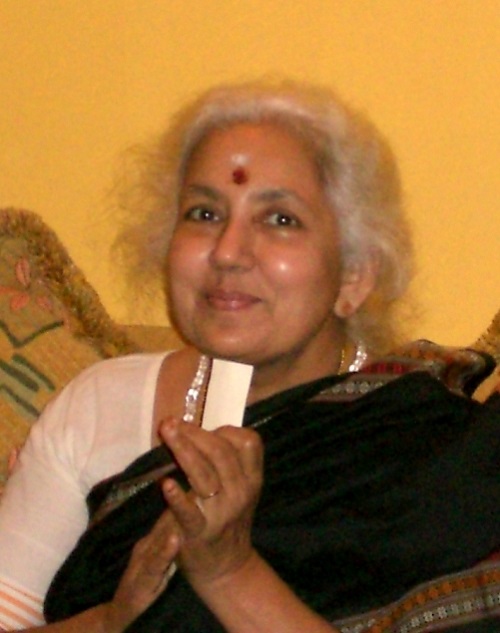
Usha Surya.- Have been writing for fifty years. Was a regular blogger at Sulekha.com and a few stories in Storymirror.com. Have published fifteen books in Amazon / Kindle ... a few short story collections, a book on a few Temples and Detective Novels and a Recipe book. A member of the International Photo Blogging site- Aminus3.com for the past thirteen years...being a photographer.
RETIRED........TIRED
Dr. Mrutyunjay Sarangi
Right from his childhood Sarveswar had been fed the myth that he who lived to be sixty in Kaliyug was a hero. It was a feat akin to scaling Mt. Everest or at a slightly terrestrial level, disrobing Marilyn Monroe. When he was a student in school and college his friends and cohorts used to imagine the thirty-forty years old teachers to be really, disgracingly aged. They often used to harbour a secret hope that one of the days some of the old fellows, preferably the relatively stricter ones, would kick the bucket and students would have a much sought after holiday. But the old folks looked impressive - weighed down by abundant wisdom, sagacity and an eagerness to distribute it in large dollops.
In due course Sarveswar and his friends reached that exalted age and found to their surprise, far from feeling old, they were bubbling with new energy, the all-important hormones trying to ooze out of them in shameless abandon. Instead of shaking in fear for impending death they were in a perennial state of anticipation for new pleasures, gastronomical delights being their never-ending obsession. They were thrilled to discover that there were many new avenues hitherto untraversed, many new games left unplayed.
Their wives, as wives are won't to do, would often pour cold water on their enthusiasm by pointing out their ever-expanding girth and the rapidly receding hairline. And to add insult to injury they would remind the husbands of the great achievements of their friends and neighbours - how so and so's husband is taking the family on pilgrimage to char dham, how such and such's husband has toured over the whole country with family. To rub salt over the wound, Sarveswar's wife Sushila would tell her husband,
"And look at you, of the four dhams spread over the four corners of India you have taken us only to Puri. And whenever we ask you to show us the tourist places, you would take out the map from the wall, and point to Taj Mahal at Agra, Qutub Minar at Delhi or Marina beach at Chennai. Is that all you can do? Show us the tourist places on a measly map?"
Sarveswar would smile at her,
"Wait, once I am retired I will take you everywhere. If I go on leave now the section I am heading at the Secretariat will collapse, government will come to a standstill. Do you want that to happen? Do you want to be responsible for an unprecedented catastrophe?"
Sushila had a lurking suspicion that her husband was only fantasizing about his importance in office. If he was actually so powerful, people would be visiting their home with gifts and with suitcases filled with cash, like it happened in her neighbour's home. But she knew there was a point up to which she could finger her husband, beyond that he was out of bounds - like a tortoise hiding its head inside the body, impervious to all insults, all innuendos. She would often chastise her husband,
"Look at my miserable life. The zeal you show in buying tons of vegetables for the humble home vanishes, when it comes to buy a saree for me. And jewellery? I have not seen the shadow of an ornament from you ever since I married you. You have even taken away the jewellery I had brought with me at my wedding and mortgaged them in the bank for the housing loan. Will I ever see them again? Do you have the capability to release my poor jewellery from the dark dungeon of the bank's secret chamber?"
Sarveswar would be all smiles and sweetness,
"Wait, the day I retire, the first thing I will do is to pay aff the bank loan out of the GPF and Gratuity amount and get your ornaments released from mortgage. And Sushy, my dear, why do you worry? We have only a son. Won't your daughter-in-law bring some fantastic ornaments as gifts for her mother-in-law? And what will I do with the left over money from my GPF and Gratuity? They will all be yours, to spend as you like - sarees, ornaments, you can do the whole the whole zing bang shopping. Just wait for a few more years. You will be rich, super rich!"
With a mixed dose of hopes, assurances and fantasies Sarveswar managed to weave a magic for Sushila. Sambit, the son, just out of college after doing his M.A., could guess the emptiness of the promises. In the internet age he had all information at his finger tips and knew how much his father earned and how little would be his pension. But like a good son to a doting mother, he didn't want to break her heart. His relationship with the father was like a roller-coaster ride, bumpy, stormy and nerve-wracking. He had refused to do a job, on the ground that he was preparing for competitive exams, but he knew, as did his father, it was an euphemism for enjoying a care-free life and stretching it as long as possible at the father's expense. He remained away from home throughout the day and returned late at night, claiming to be toiling at the library for the exams. The fact that his mouth emitted a foul smell of cigarette, often blending with alcohol, did not escape his father's notice. Long lectures stretching into midnight would follow and the son's resolve to leave home at the earliest would get progressively stronger.
At long last the blessed day arrived when Sarveswar hung his boots, rather his worn-out chappals, and retired from thirty seven years of toil and turmoil. The first day after retirement he slept till ten and kept on announcing loudly that he didn't have to go to office anymore. He was no longer a slave of the system and was prepared to deal a few kicks on its ass. To say that he felt liberated will be a gross understatement. The whole neighbourhood knew that Sarveswar had retired, he stood in the balcony displaying his bare body to whoever cared to look at it, refusing to take a shower till two o' clock. He bought a bottle of his favourite whiskey - Royal Challenge - and sat in the balcony till midnight drinking and making a raucous when Sushila asked him to come in for dinner. The next day was a repeat of the previous day, except that he was joined by two of the neighbours in the drinking session.
Soon Sushila saw a new avatar of her hitherto nondescript husband. Earlier she had half a husband at home and his full income came to her, post retirement it was full husband at home with half income. And that too a constantly nosey husband who found fault with the towels in the bathroom going for wash too early or too late, the cleansing liquid getting exhausted too fast, or the sofa set creaking too loudly for his comfort. He started questioning Sushila whether there was really a need for a fourth dish in lunch when they could manage with three, reminding her of his hard-earned pension. On top of it he demanded a cup of tea every two hours, a habit picked up from the office.
Sushila got exasperated. She had been warned of this unenviable predicament by her cousin whose husband had retired a year back - "Sushy, whatever happens, don't let the old blighter stay at home during the daytime after retirement. At 9.30 give him his usual tiffin box packed with lunch and ask him to leave home. Tell him to go anywhere he wants, the parks, cinemas, libraries and temples, and not to return before six. Otherwise you will go crazy." Sushila didn't have the heart to do that, she had been a devoted wife all her life, she couldn't suddenly turn heartless merely because her husband asked for a cup of tea every two hours! She did try to persuade him to take up a job somewhere,
"Look, your friend Bata Krishna Babu has taken up a job as a teacher at the Coaching Institute, and Suresh Babu has started looking after the accounts at Ghanshyam Seth's rice mill. Why don't you try something like that. There will be some additional income and you will find some engagement to keep yourself busy." She didn't add, although she meant it, "And you will cease to be a nuisance at home!"
Sarveswar felt scandalised at the idea. Working for a private person after serving the government for thirty seven years? Absolutely unthinkable! Yes, he admitted that he had not fulfilled Sushila's dream of floating on an obscene quantity of jewellery, but he assured that the daughter in law will do justice to that desire. The day after retirement Sarveswar, Sushila and Sambit had sat down to calculate what to do with the the post-retirement booty of fifty five lakh rupees gleaned from GPF, Gratuity, Leave Encashment and Commutation of pension. Twenty three lakhs went to repayment of the bank loan and retrieval of Sushila's precious jewellery, another two lakhs for paying off the scooter loan and computer loan. The pension amount was around forty thousand rupees. So it was necessary to put the remainder of the booty in Fixed Deposit to supplement the income from pension. Hopes of Sushila to buy heaps of jewellery and of Sambit to graduate from a bicycle to a motorbike were dashed to the ground. Sarveswar didn't care. He knew whatever amount came to the bank account will go into Sushila's hands and so long as he got his fish curry for lunch and snacks for whiskey in the evening, he was happy to be a domesticated pensioner.
Within six months of retirement Sarveswar found to his horror he had acquired a new status - an unwanted old slob who should be avoided like plague when sighted. His wife of thirty six years vintage wanted him to only eat, drink, sleep and leave her alone. The son always made it a point to leave home before the father got up in the morning and return only after the old man went to bed. In the company of his drinking partners Sarveswar competed with others to boast of what great things he had done in his career. His friends, all retired government officials, revelled in talking of how they had tortured their bosses, how so and so MLAs were insulted by them or how the Chief Secretary patted them on the back, terming them as jewels in the crown of government.
Gradually fantasy melted into reality and Sarveswar actually believed that he had done many wonders during his official career. At any gathering, in family functions or occasions like wedding receptions he went to great length in telling others how he was one of the leading architects of modern Odisha and if the government had any sense he should be honoured with at least a Padmashri. Friends and relatives, afraid of long lectures of meandering nonsense, tried to run away from him in such gatherings and he would often sit and eat alone, his mind in a turmoil, looking for eager listeners who were elusive. Within a few months he also found that there was no pleasure in eating fish curry and drinking whiskey every day. Mysterious rumblings in the stomach kept him awake at night.
Sarveswar took out his frustrations on his poor wife, finding fault with everything she did. His words pinched her, and she gave him back, word by word. He kept telling all who would listen, that every woman had two small sacks in her mouth - one was filled with honey and the other with chilly powder. Whenever she talked to anyone other than the husband honey would drip from her words. The moment she opened her mouth to speak to the old faithful - the poor husband, chilly powder would come flying with blinding effect. In due course she remained glued to the TV and he sat on the balcony on a rocking chair, looking at the passing traffic.
In about a year's time Sarveswar found he had lost interest in everything. Even sleeping till late morning, his dream come true
post-retirement, no longer attaracted him. Often he would get up early, make his own tea, try to read the newspaper, but very little would register in his mind. He would sit in the balcony sipping tea and looking outside, without seeing much. On one such morning, sitting in the balcony, bent over a newspaper he was startled to hear a lady crying. Thankfully it was not Sushila. Curious, he went inside to check. It was Sushila's friend Archana, whose husband Digambar had retired a year before Sarveswar. They were colleagues in the Secretariat sharing many cups of tea and samosas in their sunny days.
The way the poor lady was crying Sarveswar got a shock - did poor Digambar kick the bucket in the early hours of the day? But Sushila assured him that it was something less disastrous, although quite unprecedented in the history of the holy institution of matrimony. She prodded Archana to pour out her story to Sarveswar. Between muffled sobs she told him the cause of her grief. It seemed Digambar had woken her up in the morning and asked, "Dear, I have forgotten your name. Can you please tell me what is it?" Archana had thought he was joking, but no, he assured her he really had forgotten her name. Ever since their marriage he had called her lovingly as Baby, but knew that was not her real name. Her heart broke to pieces and she ran to meet her friend Sushy to pour out her grievance.
Sarveswar had a hearty laugh and retreated to his seat at the balcony. The two ladies kept chatting over tea. Sushila assured her friend that it was quite normal for oldies to forget things, although forgetting the spouse's name was a record-breaking feat.
"Look at my husband, he forgets names, places, events at the drop of a hat. The other day we had gone to a wedding reception, he pulled me aside and asked me,'That man in blue shirt there, drinking soup, what's his name? I know he is the husband of one of your cousins. But what the hell is his name?' I smiled and told him, ,'O, that man with the thin moustache wearing the blue shirt? He is Sadanand, my cousin Sumati's husband.' Fortified by this knowledge my hero went to the man with a big grin, 'So, Sadanand, how are you? How are the kids doing? Is your son Biswanath still in Bangalore or moved to Bombay-Fombay? Sadanand glared at him, 'Bhaina, you are confusing me with someone else. We have only one daughter, Ananya, since last year she is in US doing a Masters in Computer Science.' With a dirty look thrown at the surprised oldie, he walked away."
Archana laughed at the story, yes, indeed, there were people who forgot things, but forgetting one's wife's name, wasn't that unforgivable?
Sushila was not finished,
"You know what happened two months back? We were at another party. My husband walked to a man and said, 'So, Kuna (his name was Tuna), how are things with you? How are Uncle, Aunty doing? Where are they? Are they staying with you or moved to the village?' Tuna gave him a hard, burning stare and moved away. I was present there and gave my soulmate a hard pinch on the arm, he shrieked and couple of people looked in our direction. I didn't care. I told him, 'Why don't you ask me before saying something? His mother had passed away two years back in Corona, have you forgotten? How will he know where Aunty is, upstairs in heaven or downstairs in hell? And his name is Tuna, why did you address him as Kuna? When will you improve? Will you improve at all?' He looked at me in an embarrassed way, 'Sushy dear, I am already sixty two, you think I will improve? In Kaliyug, if you live till sixty you have scaled the Everest. I am retired, tired. Why do you want me to improve? For whom? You know me, I know you. At least I remember your name, isn't that enough?"
Archana thought, yes, that was enough. If only her husband Digambar could do it!
Mrutyunjay Sarangi is a retired civil servant and a former Judge in a Tribunal. Currently his time is divided between writing poems, short stories and editing the eMagazine LiteraryVibes . Four collections of his short stories in English have been published under the titles The Jasmine Girl at Haji Ali, A Train to Kolkata, Anjie, Pat and India's Poor and The Fourth Monkey . He has also to his credit ten books of short stories in Odiya. He has won a couple of awards, notably the Fakir Mohan Senapati Award for Short Stories from the Utkal Sahitya Samaj. He lives in Bhubaneswar.
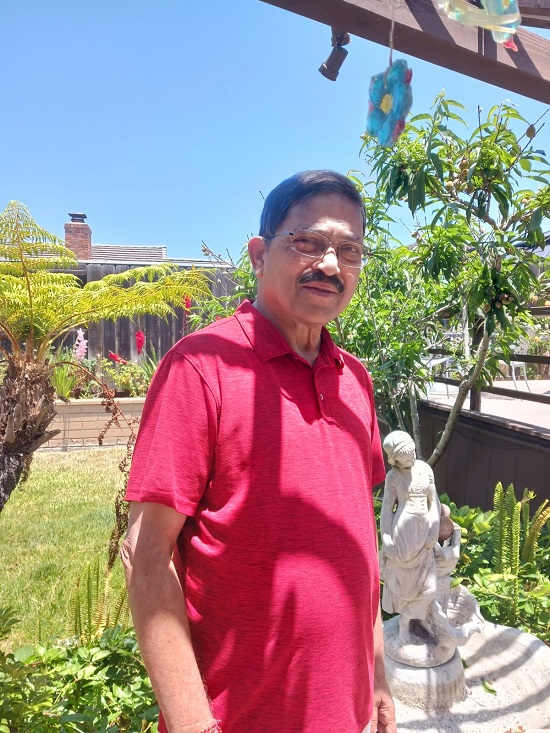
Dr. Mrutyunjay Sarangi is a retired civil servant and a former Judge in a Tribunal. Currently his time is divided between writing poems, short stories and editing the eMagazine LiteraryVibes . Four collections of his short stories in English have been published under the title The Jasmine Girl at Haji Ali, A Train to Kolkata, Anjie, Pat and India's Poor, The Fourth Monkey. He has also to his credit ten books of short stories in Odiya. He has won a couple of awards, notably the Fakir Mohan Senapati Award for Short Stories from the Utkal Sahitya Samaj. He lives in Bhubaneswar.
Viewers Comments