
Literary Vibes - Edition CLXIX (25-Sep-2026) - STORIES 1
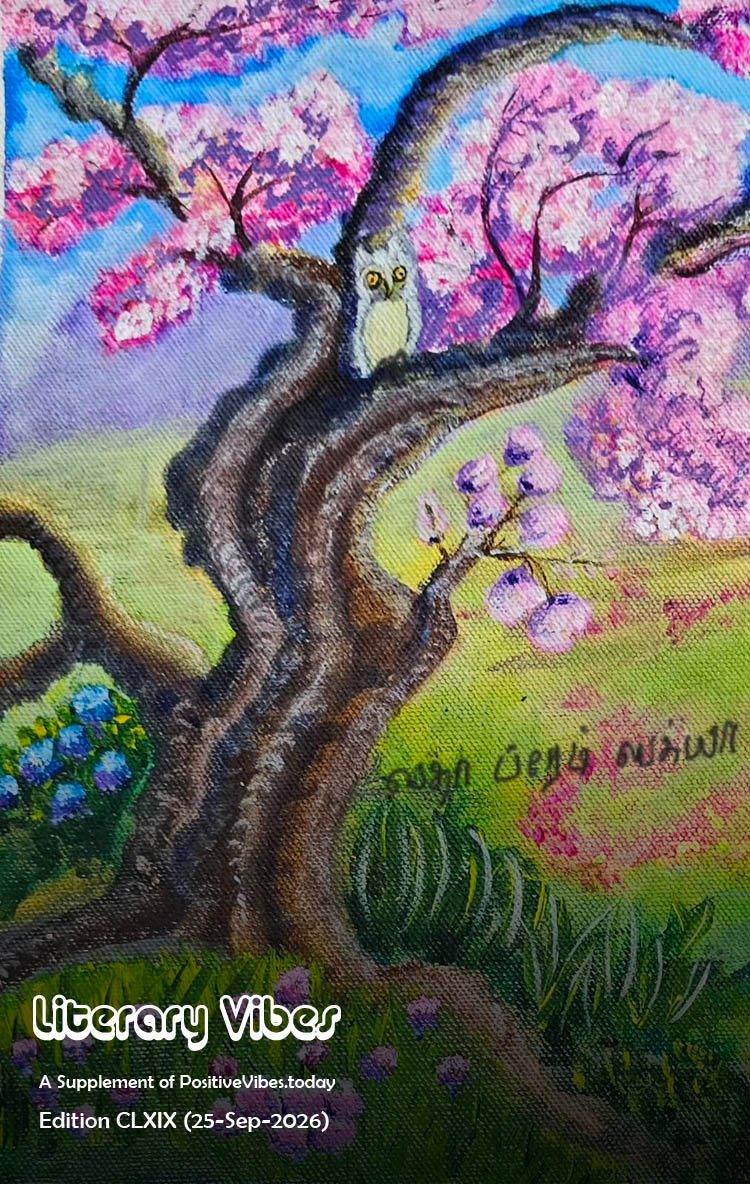
Title : The Cherry Blossom Owl (Acrylic on Canvas by Lathaprem Sakhya)
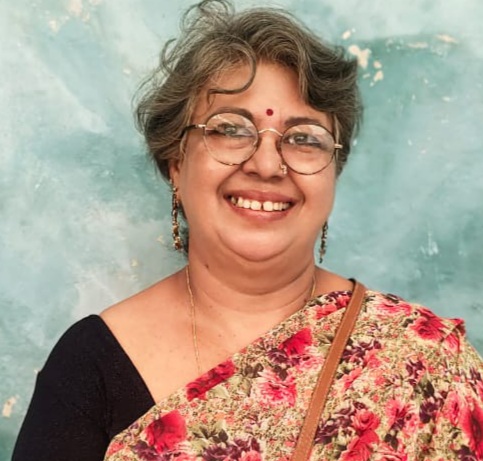
An acclaimed Painter, a published poet, a self-styled green woman passionately planting fruit trees, a published translator, and a former Professor, Lathaprem Sakhya, was born to Tamil parents settled in Kerala. Widely anthologized, she is a regular contributor of poems, short stories and paintings to several e-magazines and print books. Recently published anthologies in which her stories have come out are Ether Ore, Cocoon Stories, and He She It: The Grammar of Marriage. She is a member of the executive board of Aksharasthree the Literary Woman and editor of the e - magazines - Aksharasthree and Science Shore. She is also a vibrant participant in 5 Poetry groups. Aksharasthree - The Literary Woman, Literary Vibes, India Poetry Circle and New Voices and Poetry Chain. Her poetry books are Memory Rain, 2008, Nature At My Doorstep, 2011 and Vernal Strokes, 2015. She has done two translations of novels from Malayalam to English, Kunjathol 2022, (A translation of Shanthini Tom's Kunjathol) and Rabboni 2023 ( a Translation of Rosy Thampy's Malayalam novel Rabboni) and currently she is busy with two more projects.
Table of Contents :: Short Story
01) Prabhanjan K. Mishra
02) Sreekumar Ezhuththaani
A CUNNING SMILE
GRAVES
THE SMELL OF SAND
03) Rabi N. Dash
AFTER THE LAST GOODBYE
THE RETURN OF KRISHNA, ARJUNA AND GANDHI - AN INSPECTION OF BHARATVARSHA
THE LIGHTHOUSE, THE SHEPHERD, AND THE SEA
04) Darsana Kalarickal
05) Satish Pashine
BEFORE THE JUDGMENT
WHOM DO I CALL?
06) Deepika Sahu
THE ACT OF READING IN DIFFICULT TIMES
07) Mary Josey Malayil
FOOD..... SO NEAR, YET SO FAR---
08) Lata Krishnan
09) Annapurna Pandey
A CHUTNEY PARADE MARKS THE 50TH CALIFORNIA ODIA RETREAT IN SANTA BARBARA
10) Subrat Mishra
THE LONG SHADOW OF LOVE
Prabhanjan K. Mishra
That Saturday Prabha was excited from the morning about all that would happen during the following twenty-four ours. The first thing she did after getting up was to make her special egg omelet with cheese and veggies for Sadashiv, her husband, adding a lot of love and attention. For her there was an enchantment in the air.
After the morning’s great expectations of Prabha, the day sailed by quietly in polite gestures exchanged between her and her husband. Sadashiv, who did not look unhappy, did not look happy also. Prabha noticed he was evasive and absentminded. Prabha thought, “It happens once in a while in middle age. And her husband was in the middle of the conventionally calculated middle age for a man. He was fifty-three.”
Once Archana, her and her husband’s common friend, who dabbled in psychology, Tarot, and literature, told her, “Men don’t menstruate but in menopausal age like women, may feel a vestigial feeling of menopause and menopausal disturbances like feeling diffident, inadequate, forgetful, irritable, unsure and tentative.” She had added, “Careful handling of the symptoms by loved ones in matters of emotion would stand them in good stead.”
Sadashiv was perhaps feeling a bit dull. She found him playing solitaire. He would not win or lose anything, she knew, but the desultory game would keep his mind occupied. Except that, Prabha felt all was well in her house.
That Saturday after the smooth, though uninteresting sailing across the whole of daytime, the night arrived with expectations. Prabha felt that the age was catching up for them and pushing them into a more sober domain of interpersonal relationship. Finally, after the night advanced and they had a simple dinner, they retired behind the closed doors of their bedroom’s privacy.
Flapping wings of bats in Chiku trees outside by their bedroom windows kept Prabha’s eyes ajar. It appeared that the night had progressed to its middle mark. The darkness outside was filled with the shrieking and jabbering of bats, either fighting over ripe Chiku fruits or mating partners. Food and mating partners had been the eternal weaknesses of living beings, might they be bats, bees, or humans. Prabha smiled and looked at Sadashiv, musing to herself, “Is it so my Shiv? Let’s check it with you.”
Prabha sensed Sadashiv was awake. She placed a hand on Sadashiv as was her wont, her signal. She felt Sadashiv coming out of his lethargy to meet her midway.
Then the unspeakable, the unimaginable, the unprecedented and unexpected happened. Sadashiv unceremoniously removed Prabha’s hand, turning away from her, and lying inert. It had never happened like that earlier ever.
Prabha took it as Sadashiv’s reflex reaction in sleep-induced lethargy, not out of intention. So, she started it all over again, putting more honey, warmth and love to her fingers, and making her signal louder. But what Sadashiv did was unmentionable for Prabha. He not only threw away her hand with force but uttered harshly, “Don’t do it, Prabha. Have I no other business than being an entertainer and pleasuring agent?” She suddenly realized his rejection was deliberate, an all-out insult to her feminine identity in her husband’s life. The feeling was as if rising from her Shiv’s inner being.
Prabha sat up. Bats were still quarreling over mating partners or ripe fruits. Who was shouting, the female or the male one. She felt the bats had a better social order, freedom of expression. Females had not to hold back their tongues out of modesty or civility.
But with whom and for what would Prabha fight? Over, what mate, whose mate, or over what fruit? If Shiv was in no mood, that was natural for any individual; he could have said so in different ways, a whisper, by some sign language or just by politely stating his problem. But outright rudeness, rejection of her offerings, her fruits and her flowers!
Her face felt flushed and hot with shame. She felt devastated. She sat a long time like a sphinx on the bed, silent, gaunt, and unmoved. She knew Shiv was fully awake, but he did not react to console her for her discomfiture. She forgot the count of time until a rooster in some distant farmhouse announced that a new day was approaching. Her spell broke. She walked out of the house into the narrow flower patches between her house and the Chiku orchard.
Unlike other days, she went out without her basket in which she would collect fresh flowers for her gods. She was not sure if she could face her gods with her own facelessness and without her identity that she doubted now. Had she an identity crisis? Yes. Perhaps. Or, no, rather a revelation out of a fog that had kept her in a bafflement. She had to find out who she really was before facing her gods.
It was mid-November. There was a nip in the air. It was very pleasant in the garden. A mist was billowing in the slow breeze, gathering thicker among Chiku trees around Prabha. Like the hazy outside, her mind was in a blur, but the blur was painful. She felt numb as well as dumb. She felt a cold sweat sweeping over her. Her world was crashing. The mid-November mild and pleasurable winter was out of her reach.
***
Prabha recalled Archana, her friend, talking of the delusionist poet Loise Gluck the previous week. Louise Gluck, an American poet, who had recently bagged the Nobel for 2020 in literature for poetry. Her special position in literature, as held by critics, was to reflect austerity and suffering in beauty, failed and clashing relationship in the midst of apparent bonhomie, agony of self while grappling with disastrous encounters with family, friends, lovers.
In a nutshell, Loise Gluck’s work was a pointer towards the delusion, and false beliefs in life. Her poems had the general trend to reflect how humans doused themselves in a false sense of wellbeing.
In her poems she was the disillusioned poem-persona, because her poems were crowded with relatives, friends and places of association and her interaction with them leading to the bringing out of the falsehood, lies and loss. She also brought forth disillusionment in nature, like lovely flowers wilting, innocent birds falling dead, forests catching fire.
Archana, Prabha’s intellectual friend, explained that the poet Gluck had a distinct poetic genre of finding beauty and aesthetic invariably dressed with undergarments of frustration, sorrow, and delusion in life. Prabha could not appreciate such a poetic stand. Life could not be so cruel and harsh.
If Gluck’s poem-persona was an angry individual in life, Prabha wondered, how did poetic aesthetics flow out of her angry pen? Poetry was sublime and it must worship loveliness, beauty and love. She was a fan of Tagore and she clearly recalled even her friend Archana had been one. Archana’s conversion to Gluck camp had been recent and she was not aware of any episode in her life that might have given her the shove.
Today, Prabha, however, had a feeling that Gluck could be true. It could happen exactly as she was said to have visualized and positioned herself. A monstrous thing might be lurking inside all pristine exteriors. Prabha had a distant desire of writing down her angst of rejection by her beloved for no rhyme or reason. It could be a poem, a story or an article of delusion as her life’s bedrock.
But having no experience of creating anything in those artforms, she felt unequal to the task of writing a poem or anything for that sort. Had she been a poet or had she had the flair in any sublime art, she would have penned her first poem or painted her first abstract. But it had not to be.
“Love, said to be the enchanting Elixir of life, is in fact, the crucial factor of disenchantment in life, also says Gluck.” Archana, her writer, and intellectual friend, had pontificated only last week. But Prabha, in her earthy experiences of life, having little knowledge of, or reach to the life’s distilled intellectual experiences, had disagreed with her friend, “No, Archana love is so beautiful. It enchants and enchants only.
Their discussion started after the newspapers, YouTube, and TV channels went gaga over Louise Gluck, the American poet in her late seventies, bagging the Literature Nobel of 2020. Madam Gluck was described by her reviewers as a poet of disenchantment and disillusionment in life’s rite of passage, embracing family, home, childhood, relatives, interpersonal relationships, love, aging, et al.
After reading the articles and erudite discussions about the poetry of this English professor Ms. Gluck of the Yale University, America, unknown to her until almost yesterday, Archana had expressed her allegiance to the Nobel Laureate’s idea and general world view.
Archana was of the opinion that she had also felt disillusionment at many turns of her life, but could not comprehend or express her delusion in an organized terms as Gluck did in her poetry or as did the Nobel Prize Committee in their seminal and keynote address about Gluck.
Prabha had little exposure to Gluck, at present or in the past, but had by now had an overall idea of the Nobel Laureate’s life-philosophy from Archana’s elaborate expositions. Gluck, Prabha gathered, elaborated ‘disenchantment and disillusionment’ as the loadstones of life in her poetry.
Prabha had read a little from certain Indian poets, including India’s own son of the soil Rabindranath Tagore, who had bagged the Nobel Prize in 1913. She had read Tagore’s vibrant poetry including Gitanjali in original Bengali, as well as in translation.
Tagore wrote celebrating life in poetry, rooted in hope and optimism, enchanted by luminous imagery. Often, they might be beautiful illusions. Archana, before knowing Gluck, had been at home with Tagore’s poetic philosophy like a fish taking to water.
Prabha immediately reminded Archana of her own words and views based on Rabindranath Tagore’s poetry a few days earlier. The life-philosophy embedded in Tagore’s works that Archana had espoused clashed with her latest one preached by her as the ‘worldview’, after knowing and reading about Gluck’s work. Archana responded with a look of sobriety, rather bordering a sense, grim and somber, “Prabha, it is called maturity, Prabha my friend.”
She continued, “Yeah Prabha, I was a great fan of the idea that life had been a celebration all along. I assumed that life was sunshine and we were hay-makers; we make hay when the sun shines. I saw the pits not as my falls but a chance to prove that I could rise out of them stronger, and the experience of rising from a fall would be ecstatic, rather than staying up and above on high grounds all the time.”
She hesitated before adding, “But I will admit, things have not been hunky-dory in my life. Rises have not followed my falls in most cases. I have lived in endless hopes. I have felt defeated, disillusioned, rather concluding that guiding allusions have been, in fact, delusions like the adage, ‘The meek and humble … would inherit the kingdom of heaven.’ But when and how? Does anybody know? Has it even happened?”
“My life has been rather caught in a tailspin and I am caught in that downward fall, nosediving. I now feel, all along I have been a damn fool, I lived in a golden chrysalis of dreams. A happy-go-lucky bubble. I am to walk out of that billowing sweet smoke; I have decided.”
Then, the two friends had not argued further. Prabha had felt the weight of Archana’s gloom crushing her soul. Her own jest for life as if was caught in a tailspin. Small and big frustrations and failures floated up in her mind’s fluidity. Vicariously she felt one with Archana. The disillusionment-bubbles appeared materializing all around her. The two friends sipped their peaceful tea in Prabha’s kitchen, the peace seemed like that of a graveyard. Their peace stood silent and had no movement.
The two friends noticed while sipping tea, Prabha’s husband Sadashiv pottering about in the garden among the flower beds. He looked tentative in his movements, a desultory figure not knowing what exactly he wanted to do there. As in the garden, so in life, was her Sadashiv, thought Prabha, most of the time. Now and then, he would bend at a rose bush or a potted jasmine in bloom with his small pickaxe but would straighten up and walk away after minutes without doing anything at all.
Prabha wondered, “What does this most important man in her life think about love, life, and dreams? Does her Tagore or Archana’s Gluck bear any significance in Sadashiv’s life floating around Chiku-fruits, his labour force, his wife (herself) and other material things?”
Her question remained hanging in the midair of her mind like a soap-bubble, drifting. Her husband Sadashiv had always been a reassuring figure for Prabha, and now, without saying a word from his tentative posturing in the garden, he exuded a hope that nothing had been lost after all, Gluck or no Gluck.
There reigned peace and silence all around, enhanced by the deep and loud tooting in succession of a big brown bird of pheasant class, that had been identified by a visiting friend from Odisha as ‘Kumbhatua’ in her native Odia tongue. It was a nesting bird found by water edges. It was a frequent visitor to Prabha-Sadashiv’s Chiku (Sapodilla) orchard. It was now perhaps tooting for its female mate like a cuckoo, as if in urgency.
Things were changing, however, in looks, style, norms, habit, and almost in every other aspect of life, kaleidoscopically, after Archana’s Gluck theory in poetry; Prabha thought at that very instant over quiet sips of tea with her friend Archana by her side.
All the nuts and bolts were as if loosened and they needed rebooting, servicing, and retightening. The past was calling her to attention at various points like her visits to strange lands, and the future was pulling her to unsure lands. She stood between enchanting meadows or fallow fields of disenchantment. A question haunted him, was she in the middle of a mirage?
Even her Shiv’s pottering around the flower beds, tooting of Kumbhatua bird, the wind lightly singing in the sapodilla foliage of the fruit garden seemed insufficient to hold her peace. Taking her reassuring husband Sadashiv and friend Archana in a single boat seemed falling apart after Gluck’s exposition. They, the two resolute figures in her life, each a Rock of Gibraltar, were pulling her apart like in an upheaval in an earthquake.
***
Prabha and Sadashiv had married almost two decades ago, had no children. They lived on a patch of land at Palghar, around hundred kilometers north of Mumbai. They lived in a bungalow in an orchard of Chiku or sapodilla trees measuring roughly twenty acres, inherited by Shiv from his father. Producing and selling Chiku, the fruit of sapodilla trees, was the source of their livelihood. But they had enough and to spare.
They had day labourers who looked after the trees in their orchard under their overall supervision. The labourers were local and permanent. For house-help, Prabha had employed a permanent middle-aged widow Shraddha, who lived with them, given a room with a toilet-cum-bath facility.
Shraddha was treated like a family member. She had been a social derelict, but a good help and very good company to Prabha, a few years older to her. She was honest, hardworking, and grateful. Life for Prabha was hunky-dory with a dotting husband Shiv, a grateful housemaid Shraddha, and a loving friend Archana, all of them loyal to her in their own way.
They lived a restful life with very little excitement but a lot of contentment. Prabha was the apple of her husband’s eyes and basked in his affection. Not to be ungrateful, she reciprocated her husband's affection with equal or greater measure.
Despite her approaching middle-age, Prabha and the already late-middle-aged Sadashiv loved each other’s company in and out of their house, as well as in and out of their bed. They were good companions mentally and physically, Prabha felt. The childlessness had not cooled their bind of twenty winters together.
The innocent little unremarkable games they played in the yards of their minds and bodies kept their interpersonal relationship fresh and sweet like the Chiku fruits ripening in their orchard, filling their house with a rich aroma of love and camaraderie. When she read Rabindranath, or discussed the Bengali poet with Archana, Prabha would always draw parallels in her mind between the poet’s amalgamation of sensuality with spirituality and the same in her own happily married life at Palghar.
Materially however she had nothing to call her own, or personal. She wore little gold. She had no jewellery in her cupboard or locker or any land to her name. No house, no money in any bank, or savings in hand or at home in her cupboard. She did not jointly hold any bank account with Sadashiv either. But she never felt any scarcity or any of her needs left unfulfilled. She was free to dig her hand into Sadashiv’s pockets for all the money she needed for whatever purpose.
To hear this weird theory, Archana would crinkle a nose loud-thinking, “How cute, but how abnormal. You are a sweet little quaint fool, my Prabha!”
Prabha knew she was the unquestioned queen off her husband’s heart, head, body, bed and world. Sadashiv belonged to her lock-stock-and-barrel. She would sigh with satisfaction that none except her, shared with Shiv those sacred spaces. To her Sadashiv was her lord Shiva and their bedroom, her Kailash Dham. She loved him almost worshipfully, and felt his reciprocation in abundance in the deep core of her awakened senses and spirit.
***
But that Saturday was different. Rejected in bed by Sadashiv, lying sleepless the rest of the night, tossing between Tagore and Gluck, Prabha walked aimlessly in the orchard, without gathering flowers for her gods, without her cup of morning tea with Sadashiv or attending to her other morning regimen.
She heard Shraddha, her house-help, calling her name aloud. It first appeared like a call from another world, incorporeal. But that call repeated almost next to her ears brought her to reality. She walked back to the house, sat at the daily tea table where Sadashiv was stirring sugar into a cup of tea.
He proffered the ready to drink cup of tea in his hand to her, but she neither accepted it, nor rejected. Rather, with robotic hands she took another cup, poured tea into it, stirred-in sugar, and got to sipping at it soundlessly. She felt she was a dead little ancient carcass of a woman in a glass-case of a museum.
After half an hour, she realized her cup of tea in fact had been lying almost full, only a sip or two taken, and had gone cold. She had forgotten her cup after two three sips. Sadashiv who had been sitting across the coffee table, was conspicuous by his absence now. He might have left the coffee table silently. She did not know all those when, why, who, what, and did not bother to know.
Prabha was sitting alone. Sadashiv unlike his routine had left, had not spoken a word to her like earlier time when they would be routinely using words playfully at the morning tea. She felt that Sadashiv had put his seal and signature on his rejection of her in bed the previous night and now out of bed too. It had not been an accidental, or unmindful, or the ‘spur of the moment’s impulsive reaction as might have happened to any one in some stage of life. It was deliberate, cold, calculated and planned.
The maid Shraddha came to ask, “Madam, give me an idea, what would you two like to have for breakfast?” Prabha could not look at Shraddha, because the maid’s sweet words were enough to make her eyes ooze, and her throat to go dry. She did not want to show her maid that she was on the verge of crying. She took a little time to steady her voice and reply, “Whatever.” The clever maid perhaps understood everything and left to cook one of the couple’s favorite breakfasts, the one they liked together.
Without a telephone or WhatsApp message, Archana arrived in her car and announced, “I have invited myself to breakfast with you both. Don’t mind.” She came and sat by Prabha in silence. Prabha didn’t know how or why had Archana come without checking with her if she had been home. Did she come just like that on an impulse or was given a call either by her husband or maid to cap the volcano before it exploded and spewed lava into their life? She felt so indifferent that she had no desire to know.
Archana after a while, started sipping from the cup that the maid had placed before her, and talking desultorily with Prabha, nothing in particular. Sadashiv remained away, as if sulking, in the bedroom. He was visible in a mirror, standing at an open window, looking out, his face inscrutable as could be seen from the verandah where Archana sat with Prabha.
Suddenly, Prabha asked Archana, “Archie, can I come to live with you for a few days? I would shift to another accommodation as soon as I find a job and a place to stay, say, a working women’s hostel or a suitable PG arrangement.” As if Prabha had asked for the most natural thing, as if Archana was expecting that question and was ready with an answer.
“Yes, Prabha, why not? Come and stay with me, as long as you like. I will love it.” Prabha guessed, it was her husband who had called Archana that morning and had some sort of discussion. It could be Shraddha as well. She could not hazard how much did Archana know about her crisis. She felt awkward to blow a trumpet before Archana over Sadashiv’s rejection of her in bed and then during the morning tea.
Prabha got up and went inside, was back in five minutes with a middle-size traveling bag, kept it in Archana’s car-boot. She went back to bring a little money, hesitated before dipping her hand into Sadashiv’s purse, then gave up the idea. She thought to take a temporary loan from Archana and manage until a job was found for her.
She said a formal bye to her husband, “Shiv, going on a holiday. Bye.” She had no courage to say bye to Shraddha, and sat in her friend’s car as if she was doing the most natural thing. She knew Sadashiv would live comfortably in Shraddha’s care for his food, cleaning, ironing and other ordinary needs in life.
Only she had no idea what or who would fill up the vacuum she was leaving behind in Sadashiv’s life by going away. His emotional and bodily needs? In spite of her devastation and ruins she could not stop loving the man she had been in love half her lifetime. She knew, at times in the middle of the night he would need comforting by a shoulder rub, pressing of head or even a few reassuring words. Some nights, out of their longtime appointed Saturdays, he would get up restless to need her closely and she would accommodate him in her unwilling body.
Prabha sitting in the moving car with Archana was thinking while looking the other way to control her tears, “A journey without Sadashiv earlier would have sounded out of the context in her life. She was not sure if she would just ask Archana to stop her car and would get down and say bye to her also, and go somewhere she was not sure of. She might as well ask her to drive back to her house and live there separately in a room like an endangered species before extinction. She could also just walk away and get lost into an unknown world.”
Suddenly she asked, “Archie, won’t you like to know how long I am going to stay with you.” Archana replied, “Does it matter? Often life is an endless lane, at other times the lane is blind, it ends without a scope to walk ahead. It depends how you take it. Like Rabindranath, a romantic poet, who spoke of a fragrant smoke, a lovely fog; or like Gluck, knowing well the delusions in life, building bridges or paths for survival. For both of the great poets, more than a century apart, life was precious. It has to be lived and loved either way, to be saved by all means.”
Prabha was thinking, “I may return to Sadashiv today, tomorrow, in a few days’ time, or never. But would I return as me, the Prabha of yesterday, if at all I returned? The person returning with my looks and in my garb, might not be the real Prabha at all, who had owned Sadashiv or had been owned by him. An imposter might return in my guise.” She could now appreciate what Archana had said about the Nobel Selection Committee on the winner Gluck’s poetry.
Archana was calling, “We are home, Prabha.” “Home! What home? Whose home?” was Praha’s stark irony.
(END)
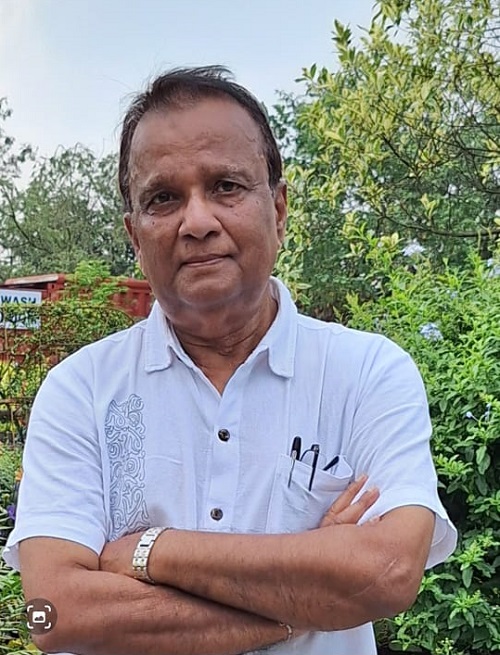
Prabhanjan K. Mishra is an award-winning Indian poet from India, besides being a story writer, translator, editor, and critic; a former president of Poetry Circle, Bombay (Mumbai), an association of Indo-English poets. He edited POIESIS, the literary magazine of this poets’ association for eight years. His poems have been widely published, his own works and translation from the works of other poets. He has published three books of his poems and his poems have appeared in twenty anthologies in India and abroad.
A CUNNING SMILE
Sreekumar Ezhuththaani
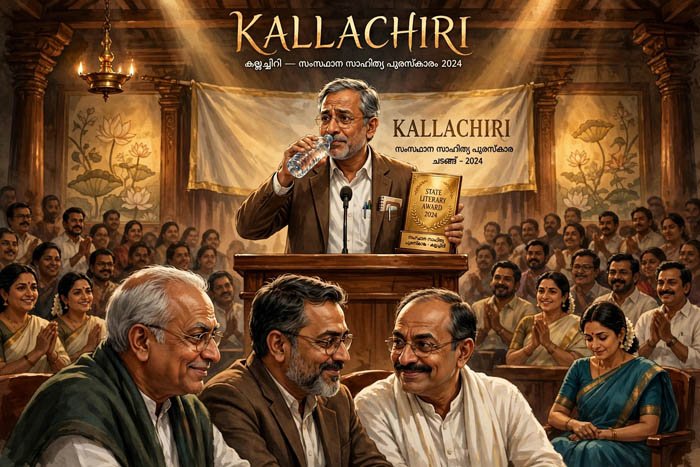
After receiving the award, he stood in front of the microphone.
The applause in the hall had still not died down.
He unscrewed the cap of the water bottle and drank a little water. Then, he smiled, looking at those sitting before him.
?"Actually," he began. The audience fell silent. "I still don't understand why I got this award."
More applause.
He smiled.
It was a smile of modesty. But underneath it, there was a tiny trace of doubt.
"If you have read my book, you will understand."
Some in the audience nodded.
"I am a scientist. Not a writer."
Here he paused.
"The book I wrote is not a work of literature. It's a very dry scientific text. Honestly, sometimes even I get bored reading it again."
Laughter.
He smiled too.
"The subjects in it are not things ordinary people would find interesting. For years, I've been writing scientific articles. Many have told me directly—‘Your articles are so boring, could you please stop?’"
Laughter in the hall again.
It took him a little longer to smile this time.
"That is exactly why this award comes as a surprise to me."
One of the members of the judging committee sitting in the front looked at another.
A small smile appeared on their lips.
A cunning smile.
He didn't see that.
"Perhaps," he continued, "science might be boring. But language doesn't have to be. Maybe this book got the award because of the science in it. Just like Winston Churchill, who had never written a single story, was given the Nobel Prize for Literature."
He thought for a moment.
"If that's the case... there is someone else behind it."
This time, his eyes drifted to the right side of the audience.
She was sitting there.
She lowered her head.
And offered him a small smile.
There was pride in that smile.
The pride of seeing her beloved person receive one of the country's greatest literary awards.
And along with it, there was something else.
Something he couldn't quite recognize.
She had first noticed him through his scientific articles.
She didn't have much interest in science.
When reading his articles, by the time she reached the third page, her eyes would wander off somewhere else.
Even so, she told him:
"I like what you write."
Whether that was a lie, even she didn't really know.
Later, they grew closer.
First, notes.
Then, long notes.
Then, every day.
Finally, they created a private Facebook group meant just for the two of them.
The outside world had no way of entering that group.
She would post songs.
Scenes from old movies.
Poems.
Paintings.
Video clips.
A photo of the rain.
The large mango tree in the courtyard of the school where she studied.
Once, a song no one else had heard.
He didn't know music.
He didn't have much knowledge of movies either.
While she would post three things a day, he would have nothing to post.
So he started writing.
First, a short note.
Then another.
She would read it and reply:
"This is good."
The next day he would write again.
She would say:
"Today's is better than yesterday's."
He would write again.
Thus, a year passed.
Without even realizing it, his language began to change.
Sentences became shorter.
Silence crept between words.
Stepping out of the dry world of science, he began for the first time to write, touching upon the small, ordinary things of human life.
The strange, unseen, and unheard phenomena of man within the colorful biological world.
He wrote them all down.
She read them.
She smiled.
Sometimes she said nothing at all.
He wrote again.
One day, another article of his was published.
Someone who read it called him up.
"There is some change in your writing."
He was surprised.
"What change?"
"I don't know. The language has somehow come alive."
He sat quietly for a long time after putting the phone down.
The next day, someone else said:
"Now your writing is actually readable."
He couldn't figure out if that was a compliment or an insult.
Still, he was happy.
Because he could feel the change himself.
Yet, he still didn't have high hopes for his scientific book.
The book was released.
A few people read it.
Some of those who read it praised it.
Most remained silent.
The book's subjects were difficult.
Pages full of scientific explanations.
Data.
Theories.
Formulas.
References.
He himself felt there was nothing in it to hold a reader's attention.
Then one day, a phone call came.
"You have won the State Sahitya Akademi Award."
He remained silent for a moment.
"What?"
"The Sahitya Akademi Award. Not the central one, the state one. Though the central one isn't impossible to get either."
He laughed.
"For my book?"
"Yes."
After hanging up, the first person he called was her.
She didn't pick up the phone.
That night, she sat in front of her computer.
Read the news of the award once more.
She smiled.
Another window was open on her screen.
It was that private group.
One day, she had sent its password, known only to the two of them, to a member of the judging committee.
He didn't know what was inside.
The first judge opened it and looked.
Then sent it to the second.
The second to the third.
Thus, the door of that private room opened.
Inside was not the book submitted for the literary award.
Instead, there was an entire year of one human being writing to another.
The first note.
The notes that followed.
Mistakes.
Corrections.
Short sentences.
Long nights.
Things left unsaid.
Hundreds of words written in the name of love, yet never speaking directly about love.
The judging committee read them.
Tens of thousands of beautiful, unseen words.
Over three thousand posts.
An argument arose among them.
"But his book..."
"Yes. The book is boring."
"Very boring."
"Is it worthy of a literary award?"
"Considered on its own, no."
Silence for a moment.
Then someone said:
"But this man writes brilliantly."
Another, without taking eyes off the screen, said:
"He writes without realizing it. Social media is something we can consider, but the problem here is that this is a private group."
They read again.
Month by month, he had transformed.
At first, he used heavy, dense words.
Later, the words began to use him.
That was not in the book.
It was published nowhere.
It was never meant to be read by anyone.
It was a secret between two people.
Finally, one of the members of the judging committee said:
"What is here is sublime literature."
Another asked:
"But which one should the award be given to?"
"The only published book he has is this one."
Silence again.
"Then let's give it for the book itself."
They decided on that.
?Up on the stage, he was still speaking.
"I still believe," he said, "that a writer's language is their true wealth. To a scientist, this is often foreign."
Applause from the audience.
She looked up.
He looked at her.
That smile was back on her lips.
This time, it was a little larger.
He read it as affection.
The judging committee read it as something else.
"The reason I received this award," he said, concluding, "will remain a secret forever, much like the vast yet tiny phenomena of this universe."
The three judges sitting in the front looked at each other.
The exact same smile on their faces.
A small, cunning smile.
He didn't understand its meaning.
She knew.
The judges knew too.
But the man who won the award was the only one who didn't.
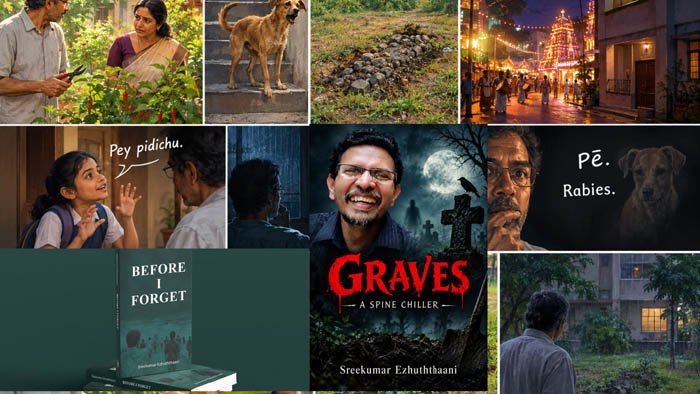
I stood there in the kitchen garden that the two of us tended together, unable to believe what I had just heard.
There was a pair of pruning scissors in my hand. I had been about to cut a dry branch from the chilli plant. I had bought it from Flipkart the previous day
“Ten thousand rupees?”
Lalitha Teacher nodded.
“Yes.”
“For a dog bite?”
“Not just a dog bite. A rabid dog.”
She said it with the grave expression of someone who had narrowly escaped a landslide
Our apartment building has only three floors. I live in the apartment on the ground floor.
Lalitha Teacher lives in the one next to mine. Another family, the family who owned the dog, lives on the first floor.
I knew the dog. It was small. Its body was the colour of mud, and one of its ears never stood straight. Whenever it saw me, it would look at me suspiciously and then come barking down the stairs.
I would stop. It would stop.
“Come,” I would say.
“Woof,” it would answer.
“Can't we be friends?”
“Woof.”
“Will you bite me?”
It would wag its tail. Then bark again. I had tried several times to befriend it.
Once I asked its owners,“What food does it like?”
“Nothing.”
“Nothing?”
“It's very particular.”
“Then what does it eat?”
“We don't know.”
I tried biscuits, rice, milk, even pieces of egg. Nothing seemed to impress it.
It chased me, barking several times, but I had never thought of it as dangerous.
I knew that it had bitten someone before, but nothing happened to that person.
So when Lalitha Teacher told me that she had spent ten thousand rupees because of the dog, I couldn't help feeling that her anxiety had got the better of her.
“How bad was the bite?” I asked.
“There was blood gushing out.”
I remembered Julius Caesar’s blood gushing out to see if it was really Brutus’s dagger.
“Did those honourable people take you to the hospital?”
“No.”
“Then?”
“I went on my own because my daughter advised me. She is a doctor, know.”
I knew. Her doctor was a homoeopathic medical practitioner.
“ The lady upstairs told me she would apply borosil.”
“Who?.”
“The one who owns the dog, don’t you know her?”
“Yes. When did all this happen?”
She paused.
“About a month and a half ago.”
She scratched her oily head and continued, “I did what my daughter told me. Caught an Uber taxi and went to Ramakrishna Mission Hospital.Two injections.”
“Anti-rabies?”
She nodded. I smiled.
“Then you don't have to worry.”
She looked at me.
“Easy for you to say that.”
“What?”
“You weren't the one who was bitten.”
I laughed.
“If it had been me, I would have washed the wound and put some Borosil on it.”
She didn't laugh.
“Don't say things like that.”
“Why?”
“What if it really had rabies?”
I shrugged.
“It is such a small dog. Doesn’t leave their home much.”
She looked at me for a moment and went back to watering the plants more generously.
I waded a wasp and went back in.
________________________________________
There was something I should have revealed to her. I had almost forgotten the incident.
A month ago, one morning, I went out for my walk.
It was still early. But my friends at the tea shop might be ther already.
In the vacant plot next to ours, I noticed two people.
A woman and a young man, picking up stones.
At first I thought they were collecting them for some construction work.
I walked past them.
When I returned from my walk, they were still there.
But now the stones had been arranged in a shape.
Long and narrow. A little raised at the sides. Lower in the middle.
It looked like a small grave.
I stood for a moment. Perhaps a cat had died. Or a dog. Or some other animal.
I didn't ask. I went home.
________________________________________
The festival at the nearby temple began a few days later.
Our neighbourhood changed overnight. Drums. Nadaswaram. Loudspeakers.
More lights on deserted streets. Tiny colour bulbs hanging from tall trees, twinkling the whole night.
The smell of flowers and food drifted through the lanes.
But the apartment upstairs remained unusually quiet. Their windows were lit, but their door stayed shut. One evening, I went upstairs.
I rang the bell. The young man opened the door.
“Where's the dog?”
He looked at me.
“It died.”
“What happened?”
He didn't answer.
Someone inside called out,
“Who is it?”
“Uncle.”
The door closed.
I stood there for a moment.
Then I came downstairs.
As I walked back to my apartment, I remembered the stones in the vacant plot.
________________________________________
Arathi was the schoolgirl who lived in that apartment.
She sometimes came to my place for help with her homework.
“Uncle, how do I do this?”
“Read the question.”
“I don't know.”
“Then read it again.”
“You tell me.”
She would sit on the chair with her feet tucked underneath her and watch me solve the problem.
One day, after finishing her homework, she began telling me the usual collection of school and neighbourhood news.
Then I remembered the dog.
“Arathi.”
“What?”
“How did your dog die?”
She looked at me.
“Pey pidichu.”
I didn't understand for a moment.
“What?”
“Pey pidichu.”
She stood up and made a strange face.
Then she stretched out her hands and pretended to be frightened.
“Ghost! Ghost!”
I laughed.
“The dog was possessed by a ghost?”
She laughed too.
“Pey pidichu.”
“Who told you that?”
She shrugged.
“I don't know.”
“Your mother?”
“I don't know.”
She put her books into her bag.
“I'll go.”
“Okay.”
At the door, she turned back.
“Are you afraid, Uncle?”
“Me?”
She nodded.
“No.”
She smiled and ran away.
________________________________________
That night I happened to watch a ghost film on television.
I was alone. It was raining outside. The sound of the rain filled the room.
On the television, someone was walking through a dark house.
I wasn't really watching. Arathi's words had stayed with me.
Pey pidichu.
Then suddenly I understood.
Not pey. The girl had misheard what her people discussed.
P?.
Rabies.
The dog had rabies. That was how it died.
I sat upright and put the pieces together.
The silence upstairs, the cancelled celebrations, the stones in the vacant plot. the little grave.
And Lalitha Teacher.
My mind went back to that morning in the garden.
“Two injections.”
I remembered what I had said.
I would have washed the wound and put some Borosil on it.
The sentence didn't sound funny now.
________________________________________
The next morning again, Lalitha Teacher came into the garden. She looked fresh and charming to me for the first time.
She looked at me.
“You look tired.”
“I didn't sleep well.”
“Why?”
“Nothing.”
She continued looking at me.
“Are you still thinking about the dog?”
“A little.”
She smiled.
“ Oh, just leave it. My daughter tells me I worry too much.”
“She is a doctor.”
“Yes.”
I wanted to hug her like her daughter would have hugged her if she heard what I kept to myself.
She plucked three ripe papayas; she took the big one, gave me the small one and took the medium sized one one upstairs for the family there.
________________________________________
That evening, I walked past the vacant plot.
The stones were still there.
Rain had loosened some of them. To me, it didn’t look like a dog’s grave now.
Fresh grass had sprouted around it.
THE SMELL OF SAND
Sreekumar Ezhuththaani
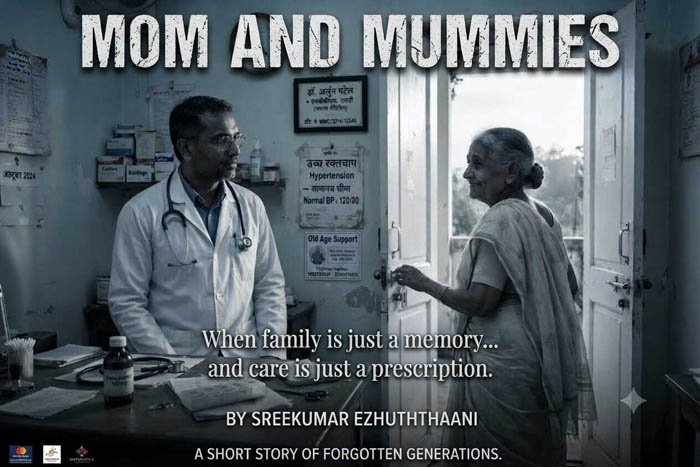
The clock on the wall moved slowly.
Dr Devadas watched the second hand make its patient journey around the dial while the old woman sitting before him struggled to find the right words.
"Doctor..."
She stopped.
"Take your time," he said.
"I've been having a strange dream for some time."
"What kind of dream?"
She looked down at her hands.
"Whenever I fall asleep, I see pyramids. Huge pyramids. And sand. Nothing but sand. Sometimes there are mummies too."
"Mummies?"
She nodded.
"Always the same?"
"More or less. The place changes a little. But the pyramids are always there. The sand. The mummies."
Devadas leaned back in his chair.
"How long has this been happening?"
"I don't remember exactly. A few months, perhaps."
"And you wake up frightened?"
"Not frightened."
She thought for a moment.
"Just... disturbed."
The word hung between them.
"Do you remember anything else from the dream?"
"No."
"Does your son have anything to do with Egypt?"
The woman's face changed slightly.
"My son works there."
"Ah."
"He has been there for years. He doesn't come home much."
There was no accusation in her voice.
Only a tired acceptance.
"So I thought perhaps that's why I'm seeing these things. He talks about Egypt sometimes. Maybe I've heard too much about it."
Devadas nodded.
"Anything else troubling you?"
She hesitated.
"My skin."
"What's wrong?"
"It has been itching badly. Especially at night. Sometimes the skin peels."
"Any rash?"
"A little."
"What have you been using?"
She opened her handbag.
"Actually, my son sent me something."
She rummaged through the bag and took out a small bottle.
"I told him about the itching when he called. I said Egypt must have good oils and medicines for the skin. I asked him to send me something."
She placed the bottle on the desk.
Devadas looked at it.
The label was in English.
EMBALMING FLUID
He did not immediately say anything.
The woman continued.
"He sent this. I started applying it about three weeks ago."
Devadas lifted his eyes from the bottle to her face.
"And the dreams?"
"They became worse after that."
Silence.
The clock ticked.
Devadas picked up the bottle.
He turned it slowly in his hand.
"Amma..."
She looked at him.
"This isn't a skin oil."
She stared at him.
"What is it, doctor?"
He put the bottle down.
"Embalming fluid."
She looked at the label.
Then back at him.
For several seconds she said nothing.
"My son wouldn't knowingly send me something like that."
"I'm sure he wouldn't."
"Perhaps he bought it by mistake."
"Perhaps."
Devadas reached for his prescription pad.
"Don't use it anymore. The itching is probably a seasonal allergy. The heat can cause this kind of irritation. I'll give you something for it."
"And the dreams?"
"They may stop once you stop using this."
She nodded slowly.
Devadas tore off the prescription.
"Here."
She took it.
He looked at her for a moment.
Then he stood up.
"Amma..."
She raised her eyes.
"You don't have to worry about this."
He walked around the desk and put his arm gently around her shoulders to guide her toward the door.
"You're like my own mother."
For a moment she remained still.
Then something in her seemed to give way.
She leaned into him briefly.
"Son..."
Neither spoke.
The clock continued its slow movement above them.
When she finally pulled away, she wiped the corner of her eye with the edge of her sari.
"I can come again if I have any trouble, can't I?"
"Of course."
She nodded, a faint, relieved smile touching her lips.
At the door she turned back.
"Thank you, my son."
Then she stepped out, and the white door closed softly behind her.
Devadas stood there for a moment in the quiet room.
On the desk, the small bottle sat half-lit by the afternoon light.
The cap was slightly loose.
A faint, chemical sharpness drifted into the air—a heavy, medicinal smell that seemed to linger in the corners of the small clinic.
Devadas walked over, picked up the bottle, and screwed the cap tightly shut.
Then he opened his desk drawer, placed the bottle inside, and slid it shut.
He sat back down in his chair.
Outside, the evening traffic hummed, and the clock on the wall went on ticking, measuring out the quiet moments of the day.
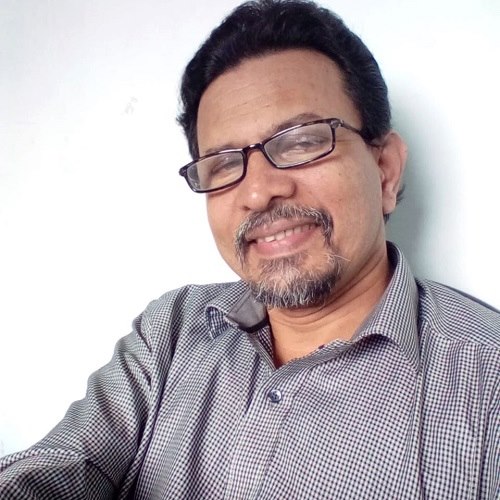
Sreekumar Ezhuththaani known more as SK, writes in English and Malayalam. He also translates into both languages and works as a facilitator at L' ecole Chempaka International, a school in Trivandrum, Kerala.
AFTER THE LAST GOODBYE
Rabi N. Dash
The sun was setting over Bhubaneswar.
From the balcony of her apartment, Rita watched the evening sky slowly surrender its colours. Streaks of gold melted into crimson, and crimson into a deepening violet. The city below was settling into its familiar rhythm. Children were being called home. Office-goers hurried through the traffic. Lights began to appear in distant windows. A week earlier, Rita had signed the divorce papers. Forty-three years after she had married Raj Pradhan, she had finally set him free.
The strange thing was that she felt neither victorious nor defeated. Only tired. The kind of tiredness that comes not from a day’s work, but from carrying the weight of a lifetime. As she gazed at the setting sun, memories rose silently from the depths of her mind.
There was a time when she had believed herself to be the luckiest woman alive. She had met Raj when she was twenty-three, almost a half century back. He was everything a young woman could dream of—tall, handsome, intelligent and fiercely ambitious. He possessed that rare gift of making every person in a room feel noticed. Women admired him. Men sought his company. Success seemed to follow him effortlessly. Rita herself was no ordinary woman. Exceptionally beautiful, highly educated and confident, she had never lacked admirers. Yet Raj captivated her in a way no one else had. Their courtship was brief. Their love seemed absolute. Within a year they were married. The early years felt like a fairy tale.
Raj’s career advanced rapidly. Promotions came one after another. With success came power, prestige and wealth. They moved into larger homes, travelled widely and enjoyed a life of comfort few could imagine. Raj adored her, Or so she believed. He showered her with affection, gifts, expensive sarees and jewellery. Their marriage was passionate. When their first daughter was born, Raj wept with happiness. They named her Ananya. Three years later came Nandini. With the arrival of her daughters, Rita’s world expanded. Motherhood filled her life with a joy she had never known before. Her daughters became the centre of her universe. She balanced family responsibilities with a successful professional career and often wondered whether life could possibly offer more.
Looking back, she realised that those had been the happiest years of her life. And perhaps the most deceptive. The warning signs had always been there. A friend’s awkward silence. A sympathetic glance. A conversation that ended abruptly when she entered a room. People seemed to know something she did not.
She ignored it all. Trust has a curious way of blinding us to what lies directly before our eyes. The truth arrived one ordinary afternoon.
A meeting was cancelled unexpectedly, and Rita returned home earlier than planned. She entered quietly. What she saw destroyed the life she thought she knew. For several seconds she stood frozen. Neither she nor Raj spoke. Words were unnecessary. The truth was standing naked before her. In the weeks that followed, the full extent of Raj’s double life began to emerge. The woman she had discovered was not the first. Nor the second. Nor even the third. There had been many others. A maid servant. A secretary. The wife of a close friend. Women from social circles. Women from professional circles. Young women drawn by his charm, older women attracted by his influence, lonely women seeking affection, ambitious women seeking advantage. Raj seemed incapable of resisting desire. And desire seemed incapable of resisting Raj.
What hurt Rita most was not the infidelity itself. It was the discovery that so many others had known. People had whispered about Raj for years. She alone had remained unaware. Or perhaps unwilling to see. The betrayal shattered something deep within her. For months she struggled to understand how the man she had loved could live such a life. Raj apologised repeatedly. He promised reform. He pleaded for forgiveness. But eventually Rita understood a painful truth. Raj was not a man who occasionally strayed. He was a man who could not remain faithful. The difference was enormous. Some weaknesses can be corrected. Some become part of a person’s nature. She realised she could neither save him nor change him. So she chose another path. Instead of seeking revenge, she chose distance. She accepted a senior professional position in Delhi and left Bhubaneswar. There was no public scandal.
No dramatic confrontation. No courtroom battle. She simply walked away. The marriage survived on paper. Nothing else survived. The years that followed became unexpectedly productive. Away from Raj’s shadow, Rita flourished. Her intelligence, discipline and integrity earned widespread respect. She rose steadily in her profession and built an identity entirely her own. Meanwhile, her daughters excelled. Ananya and Nandini completed their education, joined multinational corporations and eventually settled in the United States. Watching their success gave Rita immense satisfaction.
She felt she had finally emerged from the darkness. Life, however, had one more lesson to teach her. And then another. Ananya had always been sensitive. More sensitive than anyone realised. Beneath her success lay wounds that had never completely healed. The silent fracture in her parents’ marriage had affected her more deeply than either parent understood. One winter morning Rita received a call from America. The voice on the other end spoke gently. The words struck like lightning.
Ananya was dead. She had taken her own life. The world seemed to stop. Rita flew to America and brought her daughter home for the final rites. No grief compares with that of a parent carrying a child to the cremation ground. Raj was nowhere to be seen.
For the first time in many years, Rita felt something deeper than anger. She felt disappointment. A father had failed his daughter one final time. Nandini became her mother’s anchor after Ananya’s death. They spoke almost every day. They travelled together. They tried, in their own way, to heal.
Then fate struck again. Cancer, Cruel and indifferent. Within two years Nandini too was gone. Rita saw her dying slow by slow, breath by breath. Standing beside her second daughter’s funeral pyre, Rita felt strangely calm. Not because she was strong. But because grief had travelled beyond tears. There was simply nothing left to cry. The silence that followed was immense. The house that had once overflowed with laughter now echoed with absence.
Meanwhile Raj continued much as he always had. Age had silvered his hair but had done little to diminish his appetite for companionship. In his later years he became deeply attached to a younger doctor named Kavya Sen. He wanted to marry her. For that he needed a divorce. For years he requested one. For years Rita refused.
Then one day she realised she was holding on to something that no longer existed. The marriage had died decades earlier. The daughters were gone. The anger was gone. Even the pain had become one with her body and mind.
What purpose remained in denying him freedom? So she signed the papers. Forty-three years after saying “yes,” she finally said “enough.” And now she sat alone on her balcony watching the sun disappear beyond the horizon. She thought of the young woman who had once fallen in love with Raj. The devoted wife. The proud mother. The betrayed woman. The successful professional. The grieving parent. All those women had been Rita, but seemed different, all moving around her. Yet none of them fully defined her.
For the first time, she saw her life as a whole, Its joys, Its wounds, Its triumphs and Its tragedies. Nothing had lasted. Not beauty. Not passion. Not marriage.Not children. Not grief. Everything had passed through her hands like water. And yet, somehow, she had endured. The last edge of sunlight vanished. The sky darkened. Rita closed her eyes.
“Goodbye, Ananya.”
“Goodbye, Nandini.”
“Goodbye, Raj.”
The words carried neither bitterness nor sorrow. Only acceptance. When she opened her eyes, the first evening star had appeared in the sky. Tomorrow there would be another sunrise. For the first time in many years, she found herself looking forward to it. She rose slowly from her chair and walked inside. Behind her, the night settled gently over the city. Ahead of her lay whatever remained of life.
And for the first time since she was a young woman, that seemed enough.
THE RETURN OF KRISHNA, ARJUNA AND GANDHI - AN INSPECTION OF BHARATVARSHA
Rabi N. Dash
One day in heaven, Basudev Krishna appeared unusually thoughtful. Arjuna noticed.
“Madhava, you seem worried.”
Before Krishna could answer, Mohandas Gandhi arrived carrying a well-thumbed copy of the Bhagavad Gita.
“What is the matter?” asked Gandhi. Krishna sighed.
“For centuries I have been hearing prayers from Bharatvarsha. Every politician invokes Dharma, every citizen invokes patriotism, every television channel invokes nationalism, every saint invokes spirituality, and every businessman invokes public service. I have become curious.”
Arjuna smiled.
“That sounds encouraging.”
Krishna replied,
“That is precisely why I am worried.”
A fact-finding mission was immediately approved.
Thus began the Great Inspection Tour.
Scene One
Vrindavan: The Land of Divine Content Creators
Their first halt was Vrindavan. The town was bursting with devotion. Every wall carried Krishna’s image. Every shop sold Krishna’s flute. Every loudspeaker broadcast Krishna’s glory. Krishna was delighted. Then he observed something remarkable. Thousands of devotees stood before the deity with folded hands. For exactly three seconds. The remaining twenty-seven minutes were spent taking photographs of themselves standing before the deity.
One young influencer rushed towards Krishna.
“Sir, your costume is amazing.”
“My costume?”
“Yes. Which production house are you working for?”
“I am Krishna.”
“Wonderful branding. May I tag you?”
Within minutes, Krishna’s photograph appeared online under the caption:
“Local artist dresses as Krishna. Incredible realism.”
The post received six million likes. Gandhi smiled.
“The modern world has solved the problem of humility.”
“How?”
“Nobody is interested in God anymore. Everyone is busy worshipping their own image.”
Scene Two
Mathura: Freedom Through Security
At Krishna’s birthplace in Mathura they encountered extraordinary security. Identity checks. Biometric verification. Metal detectors. CCTV cameras. Drone surveillance. Armed personnel. Arjuna whispered,
“Is Jarasandha attacking?”
“No.”
“Has Kansa returned?”
“No.”
“Then why so much security?”
A security officer replied proudly,
“Sir, this is democracy.”
Krishna looked puzzled.
“When I was born here, only Kansa was afraid.”
He looked around.
“Today everyone seems afraid.”
Gandhi added softly,
“In every age rulers promise freedom.
Then they build systems to monitor and restrict it.”
Scene Three
Kurukshetra: The Permanent Election
Kurukshetra filled Arjuna with emotion.
“This is where we fought for Dharma.” To honour the occasion they turned on a television. Within seconds they witnessed a prime-time debate. Twelve participants. Fourteen opinions. Zero listening. Everybody shouting. Nobody thinking, contemplating. One politician accused another of destroying the nation. The second accused the first of destroying civilisation. The third accused both of destroying culture. The anchor accused everybody of not allowing him to speak. Arjuna watched for twenty minutes. Then quietly laid down the Gandiva.
“Krishna, I withdraw.”
“Why?”
“I survived Bhishma, Drona, Karna and Ashwatthama.”
“Yes.”
“But these people frighten me.”
Krishna nodded.
“The Mahabharata lasted eighteen days.”
“And this?”
“This is Season 78.”
Gandhi added,
“With no signs of cancellation.”
Scene Four
Dwaraka and the Marketplace of Moksha
Dwaraka looked magnificent. The temples glittered. The crowds were immense. Faith flourished. Commerce flourished even more. Krishna stopped before a signboard.
VIP Darshan: ?2000
Premium Darshan: ?5000
Divine Express Darshan: ?10000
Corporate Spiritual Package Available
Krishna stared at the sign. Then at Gandhi. Then back at the sign. Finally he asked,
“Have they privatised salvation?”
A priest replied,
“No Lord. Only access.”
Gandhi smiled.
“Ah yes. Equality of blessings. Differential access.”
Arjuna laughed.
“In our time kings sought your blessings.”
Krishna replied,
“In this age blessings seek investors.”
Scene Five
Sabarmati: The Confession
The three finally reached Sabarmati Ashram. The silence was refreshing. Gandhi sat where he had once read the Gita every morning. For a while nobody spoke. Then Gandhi broke the silence.
“Let us be honest with each other.”
Krishna nodded. Gandhi continued.
“You descended to establish Dharma.”
“Yes.”
“Did you succeed?”
Krishna thought for a long time.
“I eliminated Kansa.”
“Good.”
“But greed survived.”
“I defeated tyrants.”
“Excellent.”
“But arrogance survived.”
“I delivered the Gita.”
“Wonderful.”
“But ego survived.”
Now Gandhi turned towards Arjuna.
“And you?”
Arjuna sighed.
“I fought the greatest war in history.”
“And?”
“The descendants of both Pandavas and Kauravas appear to be contesting elections.”
Even Krishna laughed. Then both looked at Gandhi.
“What about your Rama Rajya?”
Gandhi removed his spectacles.
“My Rama Rajya appears every five years.”
“Where?”
“In election manifestos.”
Scene Six
The Annual Dharma Awards
The next day the three attended an award ceremony. The categories included:
Best Use of Religion for Political Purposes
Best Use of Patriotism for Commercial Purposes
Best Use of Public Service for Private Gain
Outstanding Achievement in Selective Outrage
Lifetime Contribution to Hypocrisy
The competition was intense. The judges recused. The winners protested the results. The losers demanded a judicial inquiry. The inquiry committee sought an extension. Everyone declared victory. Krishna whispered,
“This civilisation has achieved levels of creativity even Narada never reported.”
Scene Seven
Announcement of Dharma Yuddha 2.0
As the tour concluded, Krishna called a press conference. Journalists arrived. Politicians arrived. Influencers arrived. Consultants arrived. Several self-appointed experts arrived before being invited.
Krishna stood up.
Arjuna picked up the Gandiva.
Gandhi adjusted his shawl.
The nation held its breath. Krishna announced:
“After careful inspection, we have reached a unanimous conclusion.”
The crowd became silent.
“We failed.”
A collective gasp followed. Arjuna continued.
“We thought defeating the Kauravas would establish Dharma.”
Gandhi added.
“I thought political freedom would automatically create moral freedom.”
Krishna smiled.
“And I thought humanity would eventually learn.”
A journalist stood up.
“Lord, what happens now?”
Krishna’s eyes sparkled.
“Another Dharma Yuddha.”
Arjuna instinctively tightened his grip on the Gandiva. Gandhi looked alarmed. Krishna laughed.
“No arrows. No swords. No missiles. No nuclear weapons. The next Dharma Yuddha will be fought against ignorance, greed, corruption, hatred, hypocrisy, manipulation, blind partisanship and the worship of power.”
A politician immediately asked,
“Which party will lead it?”
Krishna replied,
“That question explains why it is necessary.”
Another asked,
“Who is the enemy?”
Krishna smiled.
“The person each of us sees in the mirror every morning.”
A profound silence followed. It lasted almost seven full seconds. Then everybody returned to blaming somebody else. As Krishna, Arjuna and Gandhi departed for heaven, Gandhi asked,
“Do you think they understood?”
Krishna looked down at Bharatvarsha.
“Not yet.”
“And what should we do?”
Krishna smiled mischievously.
“Wait.”
“For what?”
“The next election. My name will certainly be invoked again.”
Even Arjuna laughed.
And somewhere in the distance, above the noise of debates, manifestos, slogans, advertisements and social media outrage, the faint sound of Krishna’s flute could still be heard—patiently waiting for Bharatvarsha to listen.
THE LIGHTHOUSE, THE SHEPHERD, AND THE SEA
Rabi N. Dash
The Arabian Sea was calm that evening. Fishing boats were returning with the tide, and the last rays of the setting sun painted the waters in shades of gold and crimson. From the verandah of his ancestral home in Valiyathura, a small town on the Kerala coast, eighty-year-old Elias Varghese sat surrounded by his grandchildren.
“Appuppan, is it true that you once built the tallest lighthouse on the Malabar Coast?” the eldest asked.
Elias smiled and looked toward the distant beam of a lighthouse flashing across the darkening sea.
“Yes,” he replied. “And losing it taught me the most valuable lesson of my life.”
The children settled around him. Elias was silent for a moment, gathering memories from a distant past.
“When I was a young man,” he began, “I believed that success came entirely from talent, hard work, and determination. I had studied engineering in Kochi and returned to my hometown full of ambition. Fortune seemed to favour me. Every project I undertook succeeded. Harbours, bridges, and seawalls brought me recognition far beyond Kerala. People praised my work, newspapers carried my photographs, and invitations to public functions became frequent.
“Gradually, without realising it, I began to believe that I alone was responsible for everything I had achieved.
“It was during those years that I was entrusted with the design and construction of a great lighthouse on a rocky headland overlooking the Arabian Sea. For four years I devoted myself to the project. When it was completed, it stood proudly above the coast, guiding ships safely through darkness and storm. The inauguration was attended by ministers, officials, and townspeople. Listening to the speeches and applause, I felt an immense pride. Looking back, I now understand that pride had quietly become arrogance.”
Elias paused and smiled ruefully.
“The sea, however, has a way of teaching lessons that no classroom can impart.
“That year the monsoon arrived with unusual fury. The fishermen sensed danger long before the weather office issued warnings. Then came a cyclone of extraordinary force. Throughout the night the winds howled and giant waves battered the coast. By morning the storm had passed, but the cliffs beneath the lighthouse had suffered severe damage. Deep cracks appeared in the foundation, and engineers declared the structure unsafe. Within a few weeks it had to be dismantled.
“I cannot adequately describe my disappointment. Four years of effort had vanished. What troubled me most was not the loss of the structure itself but the collapse of the image I had created of myself. I had mistaken achievement for identity.
“For many months I wandered along the coast, troubled and restless. One evening my wandering brought me to a small village where I met an elderly shepherd named Mathai. Shepherds were uncommon in that part of Kerala, yet he tended a flock on a narrow stretch of green land between the backwaters and the sea.
“Seeing that I was weary, he invited me into his simple home. He offered me food and shelter, and over the next few days he persuaded me to stay and help him with his work.
“At first I found the tasks rather humbling. I had spent years supervising large construction projects, and now I was repairing fences, carrying water, clearing thorn bushes, and helping search for stray sheep. Yet Mathai possessed a serenity that fascinated me. He lived with very few possessions, but he seemed richer in contentment than many people I had known who possessed far greater wealth.
“One evening, while we sat watching the sun descend into the sea, I asked him the secret of his peace.
“Mathai did not answer immediately. Instead, he pointed toward a fishing boat returning to shore and asked, ‘Who controls the tide that carries that boat home?’
“‘No one,’ I replied.
“‘And who commands the monsoon winds?’
“‘No one.’
“He nodded thoughtfully and then said, ‘The trouble with successful people is not their success. It is their forgetfulness. They begin to believe that they are the source of their gifts rather than their beneficiaries.’
“I never forgot those words.
“Over the following weeks I observed the way he cared for his flock. He was patient with the weak, attentive to the injured, and tireless in searching for those that wandered away. One night a severe storm struck the coast, and several sheep became trapped by rising water. Despite his age, Mathai went out into the storm to rescue them. I accompanied him.
“As we struggled through wind and rain to bring the animals to safety, something became clear to me. The sheep had done nothing to earn the shepherd’s care. They belonged to him, and that was enough. He protected them because they were his.
“That night I finally understood what Mathai had been trying to teach me. Everything I had considered my own—my intelligence, my opportunities, my strength, and even my capacity for hard work—had first been given to me. I had spent years celebrating the gifts while paying little attention to their source.”
The grandchildren listened quietly as the darkness deepened around them.
“What happened after that, Appuppan?” one of them asked.
“I returned to my profession,” Elias replied. “A few years later another lighthouse was built at a safer location along the coast, and I was asked to lead the project.”
“Was it better than the first one?”
“Yes,” Elias said with a gentle smile. “The design was better, the foundation was stronger, and the technology was more advanced. But the greatest difference was not in the lighthouse. It was in the man who built it.”
The children looked at him curiously.
“The first lighthouse was built by a young engineer eager to prove his greatness. The second was built by someone who had learned that talent is a trust, not a possession, and that achievement finds its highest purpose in service.”
For a few moments no one spoke. The beam from the distant lighthouse swept across the sea and then disappeared into the darkness beyond.
Elias watched it silently.
“That old shepherd never built a lighthouse,” he said at last. “Yet he illuminated my life more than any lighthouse ever could. Through his wisdom I learned that gratitude is greater than pride, stewardship greater than ownership, and service greater than self-importance. Once I learned that lesson, success no longer inflated me and failure no longer broke me. Both became simply part of the journey.”
The children followed his gaze toward the distant light flashing steadily across the Arabian Sea.
And as the evening tide rolled gently toward the shore, the lighthouse seemed to stand not merely as a guide for ships, but as a reminder that the brightest lives are often those that quietly reflect a light greater than their own.
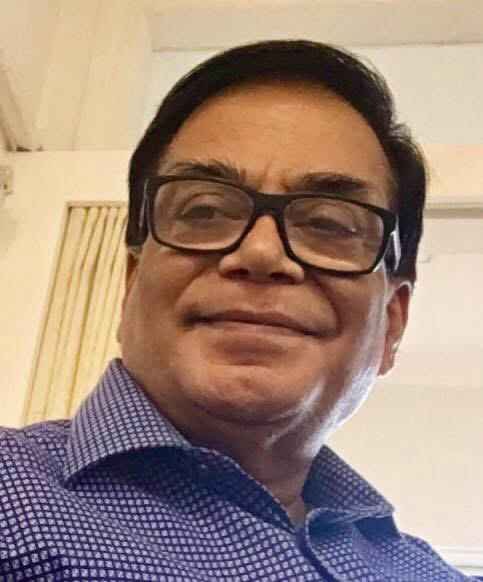
Rabi Dash is a recent entrant to the world of creative writing. After a lifetime of varied experiences and observations, he now writes primarily for the joy of storytelling and reflection. His interests include spirituality, history, human nature, and the small moments that reveal deeper truths. Writing, for him, is less a pursuit of publication and more a way of sharing thoughts, memories, and wonder with fellow readers.
He is a retired officer from the Indian Revenue Service (IRS) who served as the Director General of International Taxation and subsequently acted as a Member in the Tribunal for Prevention of Money Laundering.
Do you know?
My Ouija board is a rather extraordinary one.
Communicating with spirits through it at night had become a habit of mine.
(Spirits, after all, are far more bearable than human beings.)
But this time, what came through the Ouija board was not a spirit.
It was a dragon.
A dragon blazing like the sun—
yet its eyes were blue.
I had heard that golden dragons never have blue eyes.
When he appeared, the wind howled with such force that it seemed the very roof tiles might be torn away.
My entire bedroom was flooded with a golden light.
Perhaps you might imagine that I possessed some secret magic for bringing dragons under my command.
“Why did you summon me?”
His deep, commanding voice startled me.
“I wasn’t expecting you,” I whispered.
“You thought of me when your finger touched the coin, didn’t you?”
He was right.
But I had never imagined that the thought would become real.
“I need to escape from here.”
“You are free to leave,” he said, laughing.
His blue eyes narrowed. His lips curled into a crooked smile, and his sharp fangs gleamed.
And then I remembered the countless camera eyes that kept intruding upon my freedom;
the innumerable documents lying hidden before me,
demanding that I prove my identity.
The secrets of my father had vanished with my mother, who died immediately after giving birth to me.
Even those who were supposed to help , were away from me, searching their own roots.
I had begun to grow tired of this place.
I was afraid of dying.
And I did not want to fill prisons either.
“Can you take me to a Buddhist monastery?”
I asked him desperately.
“You don’t like the Buddha, do you?” he laughed.
It was true.
Ever since Gopa abandoned him, I had never liked the Buddha.
“I want to become a nun.”
“You are not ready to become a nun yet,” he said mockingly.
I did not tell him that, in this country, only monks were safe.
Still, he was willing to help me.
I took my Ouija board.
“You won’t be needing that anymore,” he stopped .
I climbed onto his back.
Ah! What a wonderful journey.
Through the darkness,
like a streak of lightning,
we reached the monastery in no time.
The monks were waiting there, awake.
“We knew you would come,” they said.
I bowed my head.
I had never wanted to become a monk.
And yet, here I was, preparing to meditate.
I turned around to look at the dragon.
He had left without a sign.
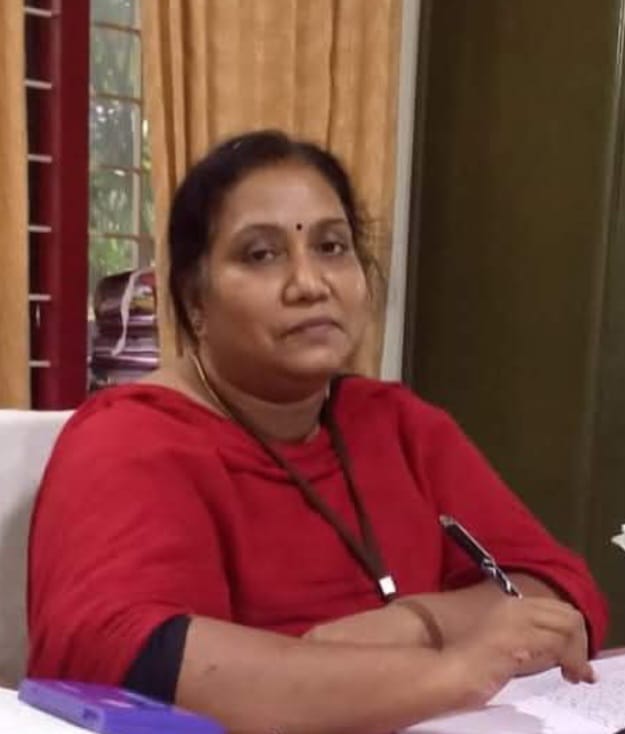
*Darsana K.R., residing in Venginissery, Thrissur district, is an employee at Venginissery Service Cooperative Bank and a passionate poet. Her published works include the poetry collections *Kavithaye Pranayichaval, Pranayathil Akappettathinte Ezhaam Naal, and Kuldharaayil Oru Pakal; the short story collection Thekkedathamma V/S Ramakavi (co-authored with Dr. Ajay Narayanan); the memoir Kunnirangunna Kothiyormakal; and the poetry study Kavithayude Veraazhangal. Her poems and articles have been featured in various periodicals and online platforms. phone : 9645748219, email darsanakr1973@gmail.com.
BEFORE THE JUDGMENT
Satish Pashine
Prologue
The envelope lay unopened on the dining table.
Naina had been looking at it for several minutes.
There was nothing unusual about the envelope itself. White paper. A legal firm’s name printed neatly in one corner. Her name and address typed beneath it.
But she knew what was inside.
Once she signed it, there would be no pretending that everything could somehow return to normal.
Her father noticed the envelope.
“What is it?”
Naina looked at him.
“A legal notice.”
“To him?”
She nodded.
For a moment, neither spoke.
Arun picked up his glasses and put them on, though he did not need them to read the envelope.
“Are you sure?”
Naina looked towards the window.
“I have been asking myself that question for almost a year.”
“And?”
She took a slow breath.
“I think I have waited long enough.”
Arun said nothing.
Outside, a scooter passed on the road. Somewhere in the neighbourhood, a pressure cooker whistled. Ordinary sounds from an ordinary afternoon.
Yet inside that house, a marriage of almost twenty years had reached a point from which there might be no return.
Arun looked again at his daughter.
“What happened to you both?”
Naina gave a tired smile.
“That is the problem, Papa. I don’t think there is one answer anymore.”
Perhaps there never is.
A marriage rarely breaks on a single day. Sometimes it begins with something small—a silence, a suspicion, an old grievance brought back to life. Sometimes the cracks remain invisible for years, covered by children, work, family occasions and the comfortable routine of living together.
And sometimes, after twenty years, two people can look back at exactly the same life and remember two completely different marriages.
This is one such story.
It is not a story about a good person and a bad person.
It is about memory, trust, accusation and the strange ways in which people reinterpret the past when the present becomes unbearable.
And before anyone decides who was right, there is something else that must be done.
The whole story must be heard.
The Past That Would Not Stay Buried
Long before Naina met Rohan, there had been another chapter in her life.
She was young then.
Too young, perhaps, to understand how decisions made in one season of life can follow a person into another.
There had been a legal marriage.
But it had never become a marriage in the ordinary sense. The couple had never really established a home together. They had not built a life as husband and wife.
Still, a legal relationship carries consequences even when a personal relationship never takes shape.
The matter became complicated. There was anxiety, family pressure and legal uncertainty. Naina and her parents went through a period they desperately wanted to put behind them.
Eventually, it ended.
The family believed the chapter was closed.
Then Naina met Rohan.
They were introduced through friends. Nothing dramatic happened at first. They talked. They met again. Conversation became friendship, and friendship slowly became something more serious.
Marriage was eventually discussed.
So was Naina’s past.
Her father, Arun, was uncomfortable with the idea of Rohan entering the marriage without knowing what had happened earlier.
One evening, he sat before his computer and wrote him an email.
He kept it factual.
He did not want to frighten him. He did not want to dramatize what had happened. He simply wanted him to know.
When Rohan received the email, he forwarded it to Naina.
She read it twice.
Then she called him.
“You’ve read Papa’s email?”
“Yes.”
“What do you want to know?”
“Everything I need to know.”
They talked.
Rohan had a past too. He had been involved in a serious relationship before meeting Naina.
Perhaps that made it easier for both of them to understand that nobody arrives at marriage without a history.
They decided to move forward.
The past, they believed, belonged to the past.
Years later, that decision would be questioned.
What had Rohan actually known?
What had been told to him?
What had not been told to his family?
Those questions would eventually become central to the dispute.
Arun’s memory of those years was clear on one point: nothing had deliberately been hidden from Rohan.
There had, however, been a decision not to discuss the matter with Rohan’s family.
That decision had been made because Rohan himself did not want his family to know.
Years later, when the issue resurfaced, Arun produced material from that period.
Rohan saw it.
For a moment, there was nothing to say.
Then he acknowledged that he understood the situation.
But by then, the marriage was already facing problems that seemed much larger than an old chapter in Naina’s life.
Twenty Years
Naina and Rohan married.
They had a daughter.
And life settled into the familiar rhythm of family.
School admissions. Holidays. Birthdays. Festivals. Relatives dropping in. Family dinners. Career changes. The thousand small decisions that make up a marriage.
Almost twenty years passed.
For much of that time, the two families were close.
Arun and his wife were not outsiders in Rohan’s life. They met regularly. They attended family occasions. They shared celebrations and difficult moments.
Of course, there were disagreements.
There always are.
But nobody looking at the families from outside would have imagined that communication between them would one day almost disappear.
Then Rohan said he wanted to leave the marriage.
At first, Naina did not understand.
“After all these years?”
“I can’t continue like this.”
“What does that mean?”
“It means I have to move on.”
The old issue about Naina’s earlier marriage returned.
Rohan said the marriage had begun with something he had not fully known.
Naina was stunned.
“You knew about it.”
“I knew something.”
“You knew enough to decide to marry me.”
“I don’t see it that way anymore.”
That sentence stayed with her.
Not because it answered anything.
Because it changed everything.
Arun found himself struggling with the same question.
If the issue had been so serious, why had the marriage continued for almost twenty years?
Why had the families remained close?
Why had no one raised it earlier?
But the questions did not stop there.
Rohan began describing himself as someone who had suffered emotionally for years.
He said that Naina’s family had also been responsible.
At one point, he described their behaviour as “teamwork.”
On another occasion, he said he had been treated like an ATM.
Arun found the accusation particularly difficult to accept.
An ATM?
He could understand anger. He could understand resentment. He could even understand that Rohan might have his own version of events.
But that word hurt.
Because Arun had never believed that his family had treated Rohan as a source of money.
The same twenty years were now being described in two entirely different languages.
And neither side seemed capable of hearing the other.
The Man He Was Becoming
There was another change that Naina had begun noticing.
Rohan was doing very well professionally.
His career had taken off. His financial position had improved considerably.
His life became more focused on himself.
He joined a gym.
He became careful about his diet.
He bought expensive clothes.
He spent money on things that mattered to him.
None of this was wrong.
A person is entitled to enjoy the fruits of success.
But Naina began to notice something else.
When it came to her, money suddenly seemed to have a different value.
She became conscious of small expenses.
The contrast was difficult for her to ignore.
One Holi, their daughter wanted a new Pichkari(water gun.)
She had seen one she liked and came home excited.
“Can I have this one?”
Rohan looked at her.
“You already have one.”
“But that one is old.”
“It still works.”
The conversation ended there.
It was a trivial incident.
Arun knew that.
A water gun was hardly evidence of anything.
Yet families rarely remember individual incidents because of their monetary value. They remember how those incidents made them feel.
For Naina, the problem was not the water gun.
It was the growing feeling that her needs were becoming an inconvenience while Rohan’s wants remained important.
Then something more serious entered the marriage.
Suspicion.
Questions
Rohan began questioning Naina’s friendships with men.
Some were old friends.
Some were family acquaintances.
Yet suddenly, ordinary relationships appeared suspicious to him.
Naina denied the allegations.
“How can you even think that about me?”
“I have my reasons.”
“What reasons?”
“Things I have noticed.”
“Then tell me.”
But explanations rarely followed.
One of the men mentioned by Rohan was someone he himself knew.
There had been nothing secret about the friendship. Rohan had once visited his home with Arun. Years later, he had even taken Naina’s sister to meet the same family.
Yet the meaning of old relationships seemed to change once trust had disappeared.
And Naina began having questions of her own.
She noticed changes in Rohan.
Then she came across WhatsApp messages involving other women.
She also found information about hotel bookings in Mumbai.
She stared at the details for a long time.
Finally, she confronted him.
“Who were you with?”
“No one.”
“Then why are there hotel bookings?”
“It doesn’t mean what you think.”
“What am I supposed to think?”
“There is nothing going on.”
Naina wanted to believe him.
But belief is fragile when trust has already been damaged.
She did not accuse him of anything she could not prove.
She simply carried the questions with her.
And that was perhaps the saddest part.
They were no longer trying to understand each other.
They were trying to defend themselves against each other.
The Woman Who Had to Start Again
Eventually, the emotional distance became impossible to ignore.
Rohan wanted to move on.
Naina wanted to save the marriage.
“We have spent almost twenty years together,” she told him one evening. “Can we not start again?”
“I have already moved on.”
“Then why don’t you end it?”
Rohan did not answer immediately.
Instead, he proposed something Naina found difficult to understand.
They could remain married.
They could continue living under the same roof.
But each could live a separate personal life.
“At least until our daughter finishes college,” he suggested.
Naina stared at him.
“You want us to remain husband and wife?”
“Legally, yes.”
“And everything else?”
“We don’t have to make things complicated.”
She shook her head.
“This is already complicated.”
For Naina, marriage could not be reduced to a legal arrangement.
She could not live beside someone while knowing that he had emotionally left the relationship.
She asked him again to reconsider.
He did not.
And slowly, she began preparing for a life she had never expected to live.
There was another problem.
Money.
Naina had been away from her profession for more than two years. The career gap made finding work difficult.
Applications went out.
Interviews came and went.
Some ended with polite emails.
Some ended with silence.
Meanwhile, her expenses continued.
There came a point when Arun had to transfer money to his daughter.
He did it without hesitation.
But afterwards, he sat quietly for a long time.
His wife noticed.
“What are you thinking?”
“Nothing.”
“You are.”
Arun looked at her.
“She shouldn’t have to ask us for money.”
His wife said nothing.
Both knew what he meant.
Their daughter had spent years putting family before career.
Now she was having to rebuild both her confidence and her independence at the same time.
The stress affected the entire family.
Naina’s daughter could feel what was happening at home.
Arun’s own health began suffering under the prolonged anxiety. His wife, too, struggled with the pressure.
But Naina kept going.
Eventually, she found a job.
It was not merely a job.
It was the first piece of ground she could call her own.
She began rebuilding her routine.
Work in the morning.
Home in the evening.
Responsibilities.
Bills.
A daughter who needed stability.
And somewhere underneath all of it, a woman trying to remember who she had been before her marriage began falling apart.
Then the panic attacks started.
Sometimes her heart raced for no obvious reason.
Sometimes fear arrived without warning.
Sometimes she simply felt that she could not breathe properly.
Her doctor explained what stress could do to the body.
Naina listened.
She did not tell everyone how frightened she was.
But she continued.
One day at a time.
Something inside her was changing.
She was no longer trying only to save her marriage.
She was beginning to save herself.
The Possibility of Another Life
There came a time when Naina realised that waiting had also become a decision.
Every month she waited was another month of her life.
Rohan had said he had moved on.
Perhaps she needed to do the same.
That did not mean forgetting.
It meant accepting that one person’s decision could not determine the rest of another person’s life.
Around this time, she met a man who had also experienced the end of a long relationship.
They did not immediately become a couple.
There was no dramatic beginning.
There were conversations.
Long conversations.
Both had known what it meant to lose something they once believed would last.
Both understood loneliness.
Both understood the awkwardness of beginning again when one was no longer young enough to believe that life automatically resets itself.
Naina was cautious.
She had every reason to be.
Arun was even more cautious.
One evening, he spoke to her about it.
“Are you sure you are doing this for the right reason?”
“What do you mean?”
“I don’t want you to choose someone simply because you are hurt.”
“I am not.”
“I hope not.”
She smiled faintly.
“Papa, I am not looking for someone to rescue me.”
Arun looked at her.
“What are you looking for?”
Naina was silent for a moment.
“Perhaps someone with whom I don’t have to defend my existence.”
The answer stayed with him.
He still worried.
He had watched his daughter lose confidence. He had seen her struggle financially and emotionally. He did not want another disappointment to undo the fragile recovery she had made.
But he also understood something a parent sometimes learns painfully late.
A child can be protected only so far.
Eventually, the choice has to be hers.
The Conversation That Never Happened
There was one thing Arun wanted more than anything else.
A conversation.
Not an argument.
Not a confrontation.
A conversation.
He wanted to sit with Rohan’s family and tell them what he remembered.
He wanted them to hear his side before forming their judgment.
After nearly twenty years of family closeness, their silence was painful.
“Why don’t you call them?” Arun asked himself more than once.
But every time he considered it, Naina stopped him.
“Papa, what is the point?”
“They should know.”
“Know what?”
“My side.”
“They don’t want to hear it.”
“How do you know?”
“Because if they wanted to know, they would have asked.”
Her sister agreed.
“Let it go.”
Arun found that difficult.
There are moments when silence feels almost like surrender.
He wanted to say:
I was there.
I remember.
That isn’t how it happened.
You have heard one version. Please hear mine.
But eventually, he said nothing.
Perhaps he realised that there are some battles in which proving your version of the past does not change the future.
And perhaps he also realised something harder.
People do not always judge after hearing the facts.
Sometimes they judge first—and then select the facts that support the judgment.
A Marriage in Name
Rohan continued to offer Naina what he described as security.
“Stay here,” he told her.
“You don’t have to worry.”
“About what?”
“Your future.”
Naina looked at him.
“And what happens to our marriage?”
“Maybe things will become better.”
“When?”
“Give it some time.”
“How much?”
He hesitated.
“Five years. Six. Maybe seven.”
She almost laughed.
“Seven years?”
“Things change.”
“But you told me you have moved on.”
“I have.”
“Then what exactly am I waiting for?”
There was no answer.
Naina finally understood.
He was asking her to put her life on hold for a possibility that he himself did not believe in enough to name.
She could not do it.
She had already given almost twenty years to the marriage.
She had put her career aside.
She had raised their daughter.
She had tried to repair what was breaking.
She had listened to accusations.
She had defended friendships.
She had answered questions about her past.
She had asked questions about his present.
And now she had to decide whether remaining married in name was enough.
It wasn’t.
The legal notice was prepared.
She read it carefully.
Then she signed.
Her hand did not shake.
That surprised her.
For so long she had been afraid of what would happen if she took this step.
Now that she had taken it, there was another feeling.
Not happiness.
Not victory.
Something quieter.
Relief.
Before the Judgment
Arun still did not know whether Naina had made the right decision.
Perhaps no parent ever knows.
He knew only what he had seen.
He had seen his daughter struggle.
He had seen her lose confidence and slowly regain it.
He had seen her marriage change from companionship to conflict.
He had heard accusations.
He had heard denials.
He had also seen how easily twenty years of shared history could be rewritten once trust disappeared.
But he knew something else.
He had not lived inside their marriage.
Neither had anyone else.
That was the difficulty.
A marriage belongs to two people, but once it begins to break, everyone around them develops a version of the story.
The husband has his truth.
The wife has hers.
Parents have their memories.
Children have their own wounds.
Friends hear fragments.
Families take sides.
And somewhere between all these versions lies a truth that may never be completely known.
Perhaps that is why judgment is so easy from a distance.
We hear one story and think we understand the whole life.
But a life is never a single story.
Naina had a past.
Rohan had a past.
They had a shared past.
And now they had different memories of it.
So what should Naina have done?
Should she have remained in a marriage that existed mainly in name?
Should she have waited six or seven years for the possibility that something might change?
Should she have accepted security in exchange for uncertainty?
Or had she finally earned the right to choose a future for herself?
Perhaps Rohan had his reasons.
Perhaps Naina had hers.
Perhaps both believed they were protecting themselves.
Perhaps both had been hurt.
Perhaps some accusations were true, some misunderstood, and some created by years of mistrust.
The reader may never know every answer.
But there is one question that remains.
When a marriage has lost love, trust and respect, what exactly is left to save?
The legal notice had been sent.
The past could no longer be changed.
The future had not yet been written.
And somewhere between the two stood Naina—with fear behind her, uncertainty ahead of her, and for the first time in many years, a decision that belonged entirely to her.
Before passing judgment, perhaps we should ask ourselves one final question:
If you had been Naina, what would you have done?
This version deliberately does not declare Naina right or Rohan wrong. It also avoids sounding like an autobiographical account by making the story more scene-driven and giving Arun, Naina and Rohan their own voices.
Most importantly, the opening now creates a “what happened?” question, while the legal notice becomes a narrative thread that pulls the reader through the earlier events.
WHOM DO I CALL?
Satish Pashine
A Narrative Based on True Events
Disclaimer
This story is based on true events and personal experiences. Names of people, places, doctors, hospitals and certain identifying details have been changed to protect privacy. Some incidents have been condensed, rearranged or presented through reconstructed dialogue for narrative clarity.
The events and medical experiences described here represent the recollections and understanding of the narrator. They are not intended to constitute medical advice or a professional assessment of any individual, treatment, doctor or institution. The purpose of the story is to explore the changing relationship between patients, families and the medical profession across generations.
The Boy from Devgarh
Long before Sanjay Pradhan began questioning modern medicine, he had grown up in a house where medicine was something that could be found in an old wooden cupboard.
He was born and raised in Devgarh, a small town in central India. His family had, according to family tradition, migrated there from the western districts of Rajasthan several generations earlier, when the region was still part of the Central Provinces and Berar.
Devgarh was not the sort of place where people hurried.
Everyone seemed to know everyone else. A shopkeeper knew which family had a wedding coming up. A schoolteacher knew whose father was looking for work. A doctor often knew the patient’s family before the patient entered his consulting room.
It was a different world.
Sanjay’s father had studied only up to high school. Yet, to his son, he was one of the most knowledgeable men he had ever known.
He had been involved in covert activities during the freedom struggle and was a staunch supporter of the Congress. At the same time, he admired those who believed that British rule could be challenged through armed resistance. He rarely discussed his own role in great detail. Perhaps some memories were better left unspoken.
What he lacked in formal education, he made up for in curiosity, common sense and an extraordinary ability to absorb knowledge.
He was particularly interested in the Indian systems of medicine.
But he was also very good in English.
When Sanjay was in Class V and had only recently begun learning the alphabet, his father became his first English teacher.
The lessons were not conducted like school lessons.
His father would pick up a newspaper, point to a word and ask, “Do you know what this means?”
“No.”
“Then find out.”
“How?”
His father would smile.
“First learn how to find out.”
It was a lesson that would stay with Sanjay far longer than any vocabulary list.
His father also loved music and poetry.
An old hand-cranked HMV gramophone occupied a place of honour in the house. On it played the music of Cliff Richard, K. L. Saigal and Shamshad Begum.
Sanjay listened from wherever he happened to be.
The music became part of his childhood.
Years later, when he received his first salary, one of the first things he bought was an HMV Safari record player.
He never forgot the connection.
But there was another side to his father that fascinated him even more.
The medicine cupboard.
The Medicine in the Cupboard
As a child, Sanjay loved exploring the old wooden almirahs in the family home.
Inside one of them were notebooks filled with his father’s handwriting.
Some were written in Hindi.
Others contained Sanskrit passages.
They described illnesses, symptoms and Ayurvedic treatments.
Beside the notebooks were bundles of dried herbs and medicinal ingredients, each carefully labelled in his father’s handwriting.
To Sanjay, the cupboard was almost magical.
He would open it, pull out a notebook and try to understand what the strange words meant.
His father noticed him one day.
“What are you looking for?”
“Nothing.”
“Then why are you opening my books?”
“I want to see what is inside.”
His father laughed.
“Good. But if you open a book, read it.”
That was how Sanjay’s curiosity about medicine began.
In the family, ordinary ailments were usually treated at home.
Seasonal fevers, stomach problems and other common illnesses were handled with herbs, herbal preparations and kadhas—concoctions prepared by boiling a mixture of medicinal ingredients.
If his father needed something that was not available at home, he would write out a prescription.
“Take this to the herbal shop.”
Someone would go.
The ingredients were inexpensive and easily available.
There was little talk of specialists.
There was little talk of tests.
And there was certainly no question of choosing a hospital by looking at online reviews.
The family itself was large enough to qualify as a small community.
Sanjay’s father and his three brothers lived together in a joint family. Two permanent relatives and several live-in servants were also part of the household. At times, nearly forty people lived under the same roof.
Sanjay had five brothers and three sisters.
When the children of his uncles were counted, the extended family included fourteen brothers and fourteen sisters.
The ages ranged from tiny children to grown adults.
There was even a relationship that confused Sanjay as a child.
His eldest sister had married when he was still a toddler. Her eldest son was only about a year younger than Sanjay.
Technically, Sanjay was his maternal uncle.
He strongly objected to the idea.
“How can he be my nephew?” he once complained.
His mother laughed.
“Because he is.”
“But he is almost my age!”
“Age doesn’t change relationships.”
Sanjay never found that explanation satisfactory.
In a household of that size, healthcare was inevitably part of everyday life.
Children were born at home with the help of midwives. Modern medicines were generally avoided unless there was an emergency.
The older women prepared Batisa laddus after childbirth, made from dry fruits and thirty-two medicinal herbs.
They also made ordinary laddus for the children.
The children preferred those.
Decades later, Sanjay watched the next generation move steadily away from many of these traditions.
His wife and her sisters continued making the traditional laddus for their daughters. But the daughters were more educated, more conscious of calories and considerably less impressed by the quantity of desi ghee.
They preferred modern medicine.
Sanjay’s own daughters, for instance, eventually had Caesarean deliveries, paid for through insurance.
In his childhood, he had rarely even heard the word Caesarean.
Even at the government hospital, surgery during childbirth appeared to be considered only when the life of the mother or baby was seriously threatened.
Medicine had changed.
Sanjay had simply grown old enough to notice.
When a Doctor Was a Doctor
Devgarh had a government hospital.
It was headed by an ex-Army MBBS doctor and supported by a few other MBBS doctors.
In those days, an MBBS degree carried enormous prestige.
To Sanjay’s family, an MBBS doctor was simply a doctor.
There was no long list of letters after the name.
No MD.
No MS.
No DM.
No superspecialist.
The doctors at the government hospital treated almost everything that came through the door.
If they encountered something they could not handle, they consulted a senior colleague or referred the patient to the medical college hospital in Nandipur, roughly two and a half hours away by train or bus.
It was understood that a doctor could not know everything.
That did not make him less of a doctor.
In Sanjay’s locality there were two homeopaths and an Ayurvedic father-and-son team.
There was also a Jhola Doctor who claimed to be an RMP.
Nobody had ever seen his diploma.
Nobody seemed particularly concerned.
Sanjay’s family relied mainly on Ayurvedic physicians who followed traditions associated with Charaka and Sushruta.
There was also a charitable Ayurvedic clinic in town.
They never went there.
His father had a simple explanation.
“That clinic is for people who cannot afford treatment elsewhere.”
The clinic had been funded by a wealthy business family and headed by Dr Joshi, whose son happened to be Sanjay’s classmate.
Devgarh was small enough that such connections were everywhere.
The son of a wealthy businessman could sit beside the son of a farm labourer in the same classroom.
Teachers treated them almost equally.
Almost.
Some barefoot children, conscious of their poverty, preferred to sit separately from the better-dressed children.
Sanjay noticed the difference.
He did not yet understand what it meant.
“Call Dr Mehta”
Sanjay’s father knew many things.
But perhaps one of his greatest strengths was knowing what he did not know.
When an illness went beyond his own understanding, he did not experiment indefinitely.
He called the family physician.
The doctor in this story will be called Dr Mehta.
Dr Mehta usually arrived with his son, whom he was training to enter the profession.
The two made an interesting pair.
Dr Mehta wore a dhoti, white shirt, black coat and black topi. A stethoscope hung around his neck.
His son wore trousers and a bush shirt or a long-sleeved shirt.
When they arrived at the house, someone would immediately carry their bags.
It was a gesture of respect.
The examination was simple.
If the patient could sit up, the doctor examined him in the baithak, the family drawing room. If the illness was serious, the doctor went to the bedside.
He checked the pulse.
He looked at the tongue.
He examined the eyes.
He listened to the chest with his stethoscope.
For older patients, he measured blood pressure.
Then came the prescription.
Usually powders.
Someone would go to the doctor’s clinic to collect them.
“Take this with warm water,” the doctor would say.
Or:
“Mix it with a little honey.”
There were usually instructions about food as well.
“Don’t eat this.”
“Eat more of that.”
“Rest.”
“Walk.”
There was no lengthy printed prescription.
No QR code.
No app.
No automated appointment reminder.
Yet there was something that Sanjay would remember much later.
The doctor knew the family.
He knew the history.
And when Sanjay’s father called him, there was never any doubt about whom he was calling.
That certainty would become important many decades later.
But first came an experience that would permanently change Sanjay’s view of doctors.
The Surgeon
Sanjay suffered from recurring tonsillitis.
His father’s remedies did not appeal to him.
One involved rubbing the infected tonsils with salt on his fingertips, apparently in an attempt to drain blood and pus.
Sanjay hated it.
There was another treatment he disliked even more.
His father would take the central part of the waxy white flower of Madar, or Rui—the giant calotrope—and place it in the boy’s nostril.
Then he would tap the flower from outside.
Sanjay never understood the science behind it.
He understood only that he wanted it to stop.
Eventually, the family took him to the government hospital.
The doctor recommended surgery.
At nine or ten years of age, Sanjay knew only one thing about surgery.
It was something adults decided you needed.
He had no idea what was about to happen.
The operation went badly.
Or at least that was how it appeared to the frightened child who woke from anaesthesia.
The doctor had apparently removed the uvula along with the tonsils.
The bleeding did not stop.
A piece of surgical gauze was pressed against the wound using a tong-like instrument with long handles. The handles protruded from Sanjay’s open mouth, which was being held open by a surgical device.
He had been given general anaesthesia using chloroform.
Before losing consciousness, he remembered the doctor talking to him.
Then darkness.
When he woke, he was strapped to the bed.
The instrument was still in his mouth.
His head was pounding.
He felt sick.
For a child, it was terrifying.
It seemed less like a hospital and more like something from a medieval torture chamber.
It took about eight days before he could eat normally.
His mouth remained painful from having been held open for so long.
The family complained.
His father was furious.
For a while, he wanted to confront the surgeon.
Then anger gave way to something more characteristic of him.
Common sense.
The head doctor told him that the uvula was not an essential organ and suggested that its accidental removal might not cause serious harm.
Sanjay went home.
But the experience never really left him.
Even decades later, his mouth tended to become dry and occasionally, while eating, food seemed to enter the windpipe.
Much later he learned that the uvula may have several functions, including helping lubricate the throat, contributing to the gag reflex and helping prevent food from entering the nasal passage.
Whether those functions explained his symptoms or not, the lesson had already been learned.
A doctor could make a mistake.
And the patient might carry the consequences long after the doctor had forgotten the case.
________________________________________
Fufajee
After the tonsil operation, the family lost confidence in surgery at the government hospital.
For surgical procedures, they began going to the nursing home of a relative of Sanjay’s father’s first cousin.
Everyone called him Fufajee.
He was fond of Sanjay’s father and always addressed him as “Mister”.
There was a reason for that affection.
Years earlier, Sanjay’s father had looked after Fufajee and his wife when both had been seriously ill with influenza, an illness that could be dangerous in those days.
Fufajee was only an LMP—a licentiate medical practitioner.
Yet he was a highly respected surgeon in Nandipur.
He ran a well-equipped nursing home in the city’s Gandhi Bagh area and charged substantial fees.
But he never charged Sanjay’s family.
Not for the operation.
Not for medicines.
Not even for the room.
At a time when a tonsil operation might cost around ?200, a Fiat car cost less than ?10,000 and gold was around ?112 for ten grams, Fufajee treated members of the family without accepting a rupee.
To Sanjay, he was not a famous surgeon.
He was simply an elderly, friendly and compassionate man.
Eventually, age prevented Fufajee from operating himself.
But he continued to visit the operating theatre.
He would stand beside younger surgeons and guide them.
Sanjay remembered him for something that went beyond his qualifications.
He had skills.
He had experience.
But, most importantly, he cared.
For Sanjay, that became an important part of what a doctor was supposed to be.
A doctor was not merely someone who knew medicine.
A doctor was someone a patient could trust.
________________________________________
The Day His Father Died
Sanjay’s father suffered from low blood pressure.
He had fainted two or three times, often after bathing and standing up to change his clothes.
Usually, he recovered quickly.
The family called the Ayurvedic physician.
The advice remained the same.
Nutritious food.
Exercise.
No medicines.
No elaborate investigations.
Nobody seemed particularly worried.
Years later, Sanjay would wonder whether they should have been.
Then came the journey that changed everything.
His father had travelled to another town for work. On the way home, he was travelling by train with one of Sanjay’s brothers.
At some point, he apparently became severely dehydrated.
His blood pressure fell.
He fainted.
His brother wanted to get off the train at an intermediate station.
His father refused.
“Let’s go home.”
They continued.
Later, he vomited and became unconscious.
By the time they brought him home, he was in a coma and breathing with great difficulty.
Someone called Dr Mehta.
Sanjay ran to the government hospital.
There was no emergency department in the modern sense.
The head doctor was asleep in his quarters.
Sanjay explained what had happened.
“He is unconscious,” he said. “He is breathing with difficulty.”
The response was matter-of-fact.
“Bring him to the hospital at nine.”
Sanjay stared at the doctor.
“But he needs help now.”
The doctor did not come.
Sanjay ran home.
As he entered the gate, he saw his eldest brother.
There were tears in his eyes.
“Father is no more.”
He was not even fifty-five.
For most of his life, he had been a strong man—a bodybuilder in his younger days, an akhara enthusiast and an expert with the lathi.
Yet he had died after what Sanjay would later believe might have been a preventable medical crisis.
A doctor relative in Nandipur subsequently told the family that, had they sought appropriate treatment earlier, his father might have survived and lived a normal life.
Sanjay never forgot that possibility.
It did not make him hate doctors.
It made him wary of complacency.
And it left him with a question he could not yet put into words:
What happens when the person you need is not available when you need him most?
He would have to wait many years before he discovered the answer.
Medicine Becomes Complicated
As Sanjay grew older, medicine became more complicated.
The simple world of Dr Mehta, handwritten prescriptions and family knowledge gradually disappeared. Hospitals became larger. Machines became more sophisticated. Medical specialities multiplied. A patient could now be referred from one doctor to another, from one department to another and from one hospital to another.
In many ways, this was progress.
Sanjay had no difficulty accepting that.
He had seen enough of the limitations of the old system to understand the value of modern medicine. But progress also brought a new problem.
The patient sometimes knew less about what was happening than ever before.
For almost two decades, Sanjay occasionally experienced a strange problem. After periods of intense mental work, his vision would become blurred for a few moments.
It happened infrequently, so he did not take it very seriously.
Then, around 2005, he mentioned it to a physician at a newly established corporate hospital.
The doctor suggested that he undergo several investigations.
Blood tests were done, including tests for diabetes. His eyes were examined. A CT scan was followed by an MRI.
Nothing significant was found.
During the process, a young radiologist looked at the brain images and asked him a rather unexpected question.
“Do you use alcohol or drugs?”
Sanjay was surprised.
“No.”
The radiologist looked at the scan again.
“Your brain looks somewhat shrunken for your age.”
The remark stayed with him.
It was not a diagnosis, but it was enough to make a patient worry.
He consulted neurologists.
They were reassuring.
One of them explained that there was no clinical evidence connecting the radiological observation with Sanjay’s occasional blurred vision.
Another neurologist put the matter in a much broader perspective.
“Science still understands only a small part of the human brain,” he told him.
Sanjay liked that answer.
It reminded him of something his father had understood instinctively.
A doctor does not have to know everything.
But a good doctor should know the limits of what is known.
________________________________________
When Different Medicines Worked
Sanjay’s wife had her own experiences with medicine.
When she was expecting their first child in Durgapur, she developed severe breathlessness.
The family was worried.
She consulted a homoeopathic doctor.
The treatment was inexpensive. There were a few medicines and one unusual piece of advice.
“Eat an apple every day.”
She followed the treatment.
Over the next two or three months, the breathlessness disappeared.
It never returned.
Years later, in Delhi, she developed a small boil-like growth on her eyelid.
An eye surgeon examined it and suggested surgery.
She was frightened.
She did not want an operation on her face.
Instead, she consulted a homoeopath, who prescribed drops three times a day.
Over the next three months, the growth gradually disappeared.
Sanjay never concluded from these experiences that homoeopathy was superior to modern medicine.
He knew there could be many explanations.
The condition might have improved naturally. The treatment might have helped. Lifestyle changes might have contributed.
There was simply no way for him to know.
But the experiences made him less dismissive of different approaches to treatment.
His own experience with a persistent cough made the question even more complicated.
________________________________________
The Cough That Would Not Go Away
For a long time, Sanjay suffered from a severe cough, particularly at night.
An ENT specialist in Mumbai examined him and found swelling in the oesophagus. Steroids helped temporarily, but the problem returned.
Later, while in Coimbatore, he visited an ENT super-speciality hospital.
This time the diagnosis was gastroesophageal reflux disease, or GERD.
The treatment was straightforward.
A proton-pump inhibitor helped.
For a while, Sanjay felt he had finally found the answer.
But after returning to Bhubaneswar, the symptoms came back.
A gastroenterologist conducted further investigations and confirmed the diagnosis. More medication was prescribed, along with lifestyle changes.
Again, there was improvement.
Again, the symptoms returned.
Sanjay was becoming frustrated.
Eventually, someone suggested a homoeopath in Dehradun.
He was not expecting much.
The doctor treated him for almost a year, communicating partly by post and advising changes in diet.
Within a few weeks, Sanjay felt considerably better.
Eventually, the cough disappeared.
What had cured him?
He could not say.
Perhaps it was the treatment.
Perhaps the dietary changes.
Perhaps the earlier medicines had already done their work.
Perhaps the condition simply settled down with time.
He did not pretend to know.
What the experience changed was his attitude.
He became more willing to say, “I don’t know.”
And he began to believe that patients should be allowed to explore reasonable alternatives, provided serious conditions were properly evaluated and dangerous delays were avoided.
The Prescription
Another incident taught him something different.
In 2019, Sanjay developed painful swelling around the knuckles of his left hand.
He went to a corporate hospital.
An orthopaedic doctor examined him and referred him to a rheumatologist.
X-rays and blood tests were done.
The results did not appear alarming.
The rheumatologist diagnosed rheumatoid arthritis and prescribed medicines for two months.
Sanjay returned home and began taking the tablets.
Four days later, he noticed something odd.
The tablets had been numbered.
He looked more carefully at the prescription.
One of the medicines was an active drug with specific dosing instructions. The others were largely supportive medication, including folic acid.
He became uncomfortable.
Had he understood the prescription correctly?
He contacted the doctor.
The explanation surprised him.
The doctor told him that patients often misunderstood prescriptions and that, because Sanjay was educated, he had assumed that he would understand what had been prescribed.
The doctor also advised regular blood counts and repeat investigations.
Sanjay was fortunate.
Nothing serious happened.
But the incident stayed with him.
Education did not make a patient medically knowledgeable.
A patient could be a professor, engineer, scientist or businessman and still know very little about what a particular medicine did.
The doctor might understand it completely.
The patient might understand nothing.
There was therefore a responsibility to explain.
Not because the patient was demanding.
Because the patient was swallowing the medicine.
The Business of Medicine
By then Sanjay had begun to notice another change.
Hospitals were increasingly being run like businesses.
He understood why.
Doctors needed good equipment. Hospitals needed buildings, nurses, technicians, support staff and expensive machines. Salaries had to be paid. Investors expected returns.
There was nothing inherently wrong with that.
But healthcare was different from selling shoes or cars.
The customer did not enter a hospital because he wanted something.
He entered because he was afraid.
And fear could make people vulnerable.
Sanjay knew the general manager of marketing at a well-known hospital chain.
In conversation, the man described a system in which referrals from private doctors could sometimes be connected to commissions or billing arrangements.
Sanjay had heard similar claims from pharmaceutical representatives.
But he could not independently verify them.
He therefore did not regard those conversations as proof that such practices were widespread.
Still, the possibility troubled him.
He also heard stories about hospitals, diagnostic centres, pharmacies and insurance companies working within the same ecosystem.
Again, he did not know how widespread the problem was.
But he knew what the patient experienced.
A test was recommended.
Then another.
A scan.
A procedure.
A specialist.
A medicine.
Perhaps every individual recommendation was justified.
Perhaps not.
The patient rarely had the knowledge to decide.
Insurance could make the situation even more complicated.
Once someone else was paying at least part of the bill, the patient’s perception of cost could change.
But insurance policies came with exclusions, co-payments, limits and non-network expenses.
And in an emergency, there was no time to compare hospitals.
Nobody standing outside an emergency room was going to say, “Give me fifteen minutes. I want to compare three quotations.”
The Medical Detective
Sanjay believed that a good doctor had to be more than a specialist.
A good doctor had to be a detective.
The symptoms might be confusing.
The reports might be incomplete.
The patient might describe the problem poorly.
The doctor had to connect the pieces.
He remembered an anecdote from a seminar attended by spinal surgeons.
An X-ray was shown to a group of surgeons.
Many recommended surgery.
Then the audience was told that the X-ray belonged to the presenter’s wife.
Fewer surgeons recommended surgery.
Then the presenter revealed that it was his own X-ray.
The recommendations changed dramatically.
Sanjay knew this was only an anecdote. It was not scientific evidence that surgeons routinely recommend unnecessary operations.
But the story illustrated something he considered important.
Doctors are human beings.
Their judgement can be influenced by context.
Patients are human beings too.
Their fear can influence their decisions.
The relationship between the two therefore needs trust.
Without trust, even technically correct medicine can leave a patient uneasy.
The Pain in His Leg
In July 2023, Sanjay experienced severe pain in his left hip that travelled down his leg like an electric current.
It was difficult to walk.
He went to an orthopaedic specialist.
An MRI was done.
The report showed degenerative changes that were considered broadly consistent with his age. It also mentioned a cyst, which the doctor did not consider important.
The doctor recommended physiotherapy and pain medication.
Then came another suggestion.
A steroid injection into the hip.
The procedure would cost about ?10,000.
Sanjay later learned that the medicine itself cost only a few hundred rupees.
The difference, he understood, was for the procedure, expertise and hospital facilities.
That was not necessarily unreasonable.
But he wanted to understand whether he really needed it.
He researched the injection and learned that steroids could provide temporary relief but also carried risks.
The doctor had delayed the appointment for the procedure, giving him another day to think.
Sanjay used the time.
He decided not to go ahead.
His daughter, who was living in Kolkata, suggested that he consult a young orthopaedic surgeon there through a video consultation.
The young doctor suggested an injection near the ankle rather than the hip.
Sanjay travelled to Kolkata.
A new MRI was performed.
The doctor said the earlier scan had not been of sufficient resolution.
Sanjay found this confusing because both scans had apparently been performed on similar machines.
The cyst that had appeared in the first scan did not appear in the second.
He proceeded with the injection.
It was painful.
When he reacted to the pain, he felt that the doctor became impatient.
After the procedure, the relief lasted only about forty-eight hours.
Then another symptom appeared.
His left foot became numb.
The doctor suggested that the changes might simply be age-related and that Sanjay might have to learn to live with the pain.
The trip had cost him roughly ?50,000, excluding accommodation.
Back home, Sanjay stopped the allopathic medicines.
He began electrical nerve stimulation therapy and completed about twenty-five sessions.
Gradually, the pain improved.
He bought a small device so that he could continue the treatment at home.
He also experimented with herbal and homoeopathic approaches.
Again, he did not claim to know which treatment had worked.
What he did know was that he had almost agreed to an invasive procedure without fully understanding his condition.
That frightened him more than the pain.
From then on, he followed three rules.
Understand the condition.
Ask questions.
And if something does not feel right, get a second opinion.
When Fear Takes Over
His wife’s experience with hypertension showed him another side of the problem.
One day in Pune, her blood pressure suddenly became very high.
Their daughter was alarmed.
The family rushed her to a corporate hospital.
The doctor immediately spoke in terms of a possible stroke protocol.
The family was frightened.
The hospital asked for a deposit of around ?1 lakh.
In an emergency, nobody stopped to negotiate.
She was admitted to the ICU and later moved to a regular room.
After two days, she was discharged, though she continued to experience vertigo.
Her blood-pressure medication was changed to a more expensive brand and another medicine was added.
The total bill came to roughly ?85,000.
Sanjay did not know whether every decision had been medically necessary.
But he understood why families accepted whatever was recommended.
Fear changes the balance of power.
A frightened family does not behave like an informed consumer.
And perhaps that is why the patient needs someone within the medical system whom he can trust even more than he needs another machine.
His Brother’s Operation
The most painful experience came with Sanjay’s elder brother.
His brother was diagnosed with cancer of the food pipe around 2016–17.
He underwent chemotherapy and radiation.
Most of the scans looked encouraging, except for one area that remained doubtful.
Surgery was recommended.
The family sought another specialist and eventually travelled to Pune.
The hospital repeated the investigations.
The surgeon was optimistic.
“It is a good case,” the family was told.
The chances of recovery appeared favourable.
The family agreed to the operation package.
Then came an additional expense.
Special clips were required.
They cost around ?80,000.
The operation itself was considered successful.
But the complications began afterward.
The package included only two nights in the ICU.
His brother remained there for about fourteen days.
His lungs collapsed.
He required a ventilator.
The bill climbed to approximately ?14 lakh.
The doctors eventually told the family that the prolonged oxygen deprivation had probably caused severe brain damage.
By then, the family had reached the limits of what it could afford.
They were asked to clear the outstanding bill and arrange transfer to another hospital.
His brother was moved to Nagpur on life support, accompanied by a doctor.
The family eventually requested withdrawal of life support.
He died shortly afterward.
The surgeon maintained that the operation itself had been successful and that the subsequent complications were unrelated to the surgery.
The family did not pursue the matter further.
They had neither the emotional strength nor the resources.
But Sanjay was left with a disturbing thought.
Even when the treatment itself was successful, could the family survive the treatment?
How Much Is a Life Worth?
By now, Sanjay had accumulated too many stories.
His father’s death.
His own experiences.
His wife’s experiences.
His brother’s final illness.
He knew he could continue writing about them.
But he also knew that the issue was larger than any individual incident.
One morning, during a walk, a friend spoke about what he wanted if he ever developed a serious, irreversible illness.
“I don’t want my family to spend everything keeping me alive,” the friend said.
He wanted his wife to have enough money left to live with dignity.
Sanjay understood.
For retired people, medical expenses were not simply medical expenses.
They were sometimes years of savings.
A few months in an ICU could consume what had taken decades to accumulate.
He worried about people of his generation.
They had retired.
Their income had fallen.
Their children had their own responsibilities.
Their savings represented security for the remaining years.
What happens when that security is gradually consumed by medical treatment?
He did not claim to have an answer.
He was not an expert in hospital economics.
He did not know how many doctors, hospitals or diagnostic centres followed questionable practices.
He did not know how often insurance influenced treatment decisions.
He did not want to make sweeping accusations.
There were excellent doctors.
There were compassionate hospitals.
There were doctors who stayed with patients long after their official responsibility ended.
Sanjay knew this.
But he also believed that healthcare was too important to allow patients to develop a general feeling that illness had turned them into sources of revenue.
A patient should never feel that his disease was somebody else’s business opportunity.
The Hospital During COVID
The COVID years provided another experience that stayed with him.
Sanjay’s friend and his wife were admitted to a corporate hospital.
Their daughter believed that the hospital was not providing any particularly specialised treatment.
Yet the couple remained there.
The bills continued.
Eventually, after the insurance limit had nearly been exhausted, they were discharged “at their own risk”.
The family was unhappy.
They felt they had been kept in the hospital longer than necessary.
But Sanjay was careful even then.
He could not say their friendly couple had been cheated.
He was not in a position to know.
What he knew was how the family felt.
And that feeling mattered.
In medicine, perception is important because the patient rarely has enough information to reconstruct what happened behind the scenes.
A hospital may believe that it followed every protocol correctly.
The family may believe it was treated as an insurance claim.
Both can walk away from the same event with completely different understandings.
That is why communication matters so much.
The Day Everything Changed
And then came the day when Sanjay himself needed a cardiologist.
Until then, his concerns about modern medicine had been mostly philosophical.
Now they became personal.
He had a cardiologist.
The doctor appeared competent.
The consultations were satisfactory.
There was only one problem.
Sanjay could not reach him in an emergency.
The doctor did not share his mobile number.
Patients were expected to communicate through the doctor’s business WhatsApp.
Even then, the process was cumbersome.
A patient had to post the prescription and other details before the matter could be taken up.
For a routine consultation, perhaps that system worked.
For an emergency, it did not.
Sanjay understood that a doctor could not be available to every patient twenty-four hours a day.
He did not expect that.
Doctors needed rest too.
They had families.
They had other patients.
They could not personally answer every telephone call.
But there had to be a route.
A doctor.
An assistant.
A clinic number.
An emergency contact.
Someone who could decide whether the patient should wait, come to the hospital or go immediately to an emergency department.
Sanjay eventually changed cardiologists.
The decision was not because he believed the first doctor was incompetent.
It was because he had lost confidence in the communication system around him.
And that brought him back to his childhood.
He remembered Dr Mehta arriving at the house.
He remembered his father calling him.
He remembered someone in the family saying, “Call the doctor.”
There had been no WhatsApp.
No appointment portal.
No automated response.
No customer-care executive.
There was simply a relationship.
The medicine available to Dr Mehta was primitive compared with what modern medicine could offer today.
But when the family needed him, they knew whom to call.
________________________________________
Whom Do I Call?
Sanjay did not want to romanticise the past.
He knew that the medicine of his childhood had its own limitations.
His father’s death was a painful reminder.
There were no modern emergency services.
There were fewer specialists.
There were fewer diagnostic tools.
Some diseases that can now be treated easily were once frightening.
Modern medicine had saved countless lives.
Sanjay was grateful for it.
He was also grateful for the doctors who had helped him and his family over the years.
But medicine was not only about knowledge.
It was also about trust.
A patient could accept that a doctor did not know everything.
He could accept that a treatment might fail.
He could even accept that medicine sometimes had no answer.
What was harder to accept was not knowing whom to contact when something went wrong.
At seventy-five, Sanjay had begun to think differently about his future.
He did not want to spend the remaining years of his life fearing illness.
He wanted to remain curious.
He wanted to walk, even if more slowly than before.
He wanted to read.
He wanted to write.
He wanted to spend time with people he loved.
He wanted to travel when he could.
He understood now that the body could impose limits.
But curiosity did not have to slow down with the body.
Perhaps that was the real lesson.
His father had taught him to ask questions.
Medicine had taught him to ask more.
And age had taught him that the most important question was sometimes not:
“What is wrong with me?”
It was:
“Whom do I call?”
For an elderly patient, that question is not merely about convenience.
It is about reassurance.
It is about knowing that when fear arrives suddenly, someone will answer.
Perhaps that is what Sanjay had been searching for all his life—not a doctor who could cure everything, but a doctor, a system or a human being who would not leave him wondering whom to call.
WHOM DO I CALL?
Satish Pashine
A Narrative Based on True Events
Names of people, places, doctors, hospitals and certain identifying details have been changed. Some events have been condensed, rearranged or presented through reconstructed dialogue for narrative clarity. The medical experiences described are personal recollections and should not be taken as medical advice or as judgments on any individual or institution.
Whom Do I Call?
Sanjay Pradhan grew up in a small town called Devgarh, in a time when medicine was much simpler and, in some ways, much more personal.
His family had lived there for generations. According to family history, his ancestors had come from western Rajasthan when the region was still part of the Central Provinces and Berar. Devgarh was a small town where people knew one another, doctors knew their patients’ families, and a person’s reputation often mattered more than his qualifications written on a piece of paper.
Sanjay’s father had studied only up to high school, but he was one of the most knowledgeable men in the family. He had quietly participated in activities connected with the freedom movement and remained a staunch Congress supporter. He admired those who had chosen more radical ways of fighting British rule, but he rarely spoke about his own involvement.
What he lacked in formal education, he made up for with curiosity, common sense and an extraordinary appetite for knowledge.
He was particularly interested in Indian medicine. The old wooden cupboards in their house contained notebooks filled with Hindi and Sanskrit writing, along with herbs and medicinal ingredients carefully labelled in his handwriting. Seasonal fevers, stomach ailments and other common illnesses were usually treated at home. His father would prepare a kadha, mix herbs, or write a handwritten prescription that someone would take to a local herbal shop.
But his knowledge extended beyond medicine.
He loved music and poetry. An old hand-cranked HMV gramophone played Cliff Richard, K. L. Saigal and Shamshad Begum in the house. Years later, when Sanjay received his first salary, one of his first purchases was an HMV Safari record player. Perhaps without realising it, he was buying more than a piece of equipment. He was bringing a piece of his childhood into his adult life.
His father also became his first English teacher.
When Sanjay was in Class V, his father would pick up a newspaper and point to a word.
“Do you know what this means?”
“No.”
“Then find out.”
“How?”
His father smiled.
“First learn how to find out.”
That lesson stayed with him.
The family itself was large. His father and three brothers lived together, along with other relatives and servants. At times nearly forty people shared the same household. Sanjay had five brothers and three sisters, and the extended family included fourteen brothers and fourteen sisters.
In such a household, illness was not an occasional event. Someone was always unwell, recovering from something or having a baby.
Childbirth generally took place at home, assisted by traditional midwives. Modern medicine was used when there was an emergency, but it was not the first choice. After childbirth, the women of the family prepared battisa laddus made from dry fruits and thirty-two medicinal herbs. The children received ordinary laddus.
The next generation gradually changed all this. Sanjay’s daughters and their generation preferred modern medicine. Caesarean deliveries, which had seemed almost unimaginable during his childhood, eventually became part of ordinary family life.
Medicine was changing.
Sanjay was changing with it.
When a Doctor Was a Doctor
Devgarh had a government hospital headed by an ex-Army MBBS doctor and supported by a few other doctors.
An MBBS degree carried enormous respect in those days.
There were no long lists of qualifications after a doctor’s name. MD, MS, DM and superspecialist were not part of ordinary conversation. A doctor treated what he could, consulted colleagues when necessary and referred difficult cases to the medical college hospital in Nandipur, about two and a half hours away by train or bus.
The town also had homeopaths, Ayurvedic practitioners and a local Jhola Doctor who claimed to be an RMP. Nobody seemed particularly interested in checking his credentials.
Sanjay’s family relied mainly on Ayurvedic physicians who followed the traditions associated with Charaka and Sushruta. There was also a charitable Ayurvedic clinic funded by a wealthy business family. Its head, Dr Joshi, had a son who was Sanjay’s classmate.
Sanjay’s father never took the family there.
“That clinic is for people who cannot afford treatment elsewhere,” he would explain.
Devgarh was socially mixed in a way that Sanjay did not fully appreciate as a child. The son of a farm labourer could sit beside the son of a millionaire in school. Teachers were generally treated with equal respect. Yet some of the poorest children, often barefoot, preferred to sit separately.
The town had its inequalities, but it also had a certain intimacy.
The family doctor was Dr Mehta.
He usually arrived wearing a dhoti, white shirt, black coat and black topi, with a stethoscope around his neck. His son sometimes accompanied him, wearing trousers and a bush shirt. Someone from the family would carry their bags.
The examination was simple. Pulse, tongue, eyes, chest and blood pressure. The doctor would ask a few questions and write a prescription, often for powders to be collected from his clinic.
“Take this with warm water.”
“Mix this with honey.”
“Don’t eat this for a few days.”
“Rest.”
There were no printed instructions and no digital records.
But there was something else.
The doctor knew the family.
When Sanjay’s father called him, he knew who was calling.
That relationship would become important many decades later.
The Surgeon
Sanjay suffered repeatedly from tonsillitis.
His father’s remedies were not always pleasant. One involved rubbing salt over the infected tonsils. Another involved placing the central part of the flower of Madar, or Rui, in the nostril and tapping it from outside.
Sanjay disliked both.
Eventually the family took him to the government hospital.
The doctor recommended surgery.
Sanjay was about nine or ten.
He had no idea what surgery meant.
The operation became one of the most frightening experiences of his childhood.
Something went wrong.
The bleeding did not stop. Gauze was pressed against the wound with a long-handled instrument. His mouth was held open by a surgical device. He had been given chloroform, and before losing consciousness he remembered the doctor talking to him.
When he woke, he was strapped to the bed.
The instrument was still in his mouth.
His head was pounding and he felt sick.
To a frightened child, it seemed like a scene from a medieval torture chamber.
It took many days before he could eat normally.
The family complained. His father was furious. The head doctor eventually told him that the uvula was not essential and that its accidental removal might not cause serious harm.
Sanjay went home.
But the experience remained with him.
Even years later, he sometimes experienced dryness in his mouth and the uncomfortable sensation of food entering the windpipe. Whether these symptoms were actually related to the surgery, he could not say. What remained certain was the memory of being helpless on a hospital bed.
After that experience, the family turned to another surgeon, known within the family simply as Fufajee.
Fufajee was an LMP but a highly respected surgeon in Nandipur. He ran a well-equipped nursing home and was especially fond of Sanjay’s father.
Years earlier, during a serious bout of influenza, Sanjay’s father had helped look after Fufajee and his wife.
Fufajee never forgot it.
Whenever someone from Sanjay’s family needed surgery, he would treat them without charging for the operation, medicines or room.
He was eventually too old to operate himself, but he continued to stand beside younger surgeons and guide them.
To Sanjay, Fufajee represented something important.
Medical knowledge mattered.
Skill mattered.
But character mattered too.
The Night His Father Died
Sanjay’s father had suffered from low blood pressure for years. Occasionally he would faint after bathing or standing up. Usually he recovered quickly.
An Ayurvedic physician advised him to improve his nutrition and exercise.
No medicines were prescribed.
There was no detailed investigation.
Then, one day, his father travelled out of town for work and returned by train with one of Sanjay’s brothers.
During the journey, he became severely dehydrated and his blood pressure fell.
He fainted.
His brother wanted to get off the train at an intermediate station and seek medical help.
His father refused.
“Let’s go home.”
They continued.
Later he vomited and became unconscious.
By the time they reached home, he was in a coma and breathing with great difficulty.
Someone called Dr Mehta.
Sanjay ran to the government hospital.
There was no modern emergency department. The head doctor was asleep in his quarters.
Sanjay explained the situation.
“He is unconscious and breathing with difficulty.”
The doctor told him to bring the patient to the hospital at nine in the morning.
Sanjay ran home.
His eldest brother met him at the door.
“Father is no more.”
He was not yet fifty-five.
Later, a doctor in the family told them that with timely treatment, his father might have survived.
Sanjay could never know whether that was true.
But the possibility remained with him.
His father’s death taught him a lesson that no medical textbook could teach:
Knowing whom to call can sometimes be as important as knowing what medicine to take.
When Medicine Became a System
Decades passed.
Medicine changed dramatically.
Hospitals became larger. Diagnostic equipment became more sophisticated. Specialisations multiplied. Patients could now consult doctors who knew more about particular diseases than any general physician of Sanjay’s childhood could possibly have known.
He welcomed these changes.
Yet he slowly discovered a new problem.
The more sophisticated the system became, the more difficult it sometimes became for the patient to understand it.
Around 2005, Sanjay began experiencing occasional blurred vision after periods of intense mental work. A physician suggested tests for diabetes, an eye examination, CT and MRI scans.
The reports did not reveal a clear cause.
During one examination, a young radiologist looked at his brain scan and asked whether he used alcohol or drugs.
“No.”
The radiologist looked again.
“Your brain looks somewhat shrunken for your age.”
The comment disturbed him.
Neurologists later reassured him that there was no clinical evidence connecting the observation with his symptoms.
One neurologist put the matter simply.
“Science still understands very little about the brain.”
Sanjay liked that answer.
It reminded him of his father.
A good doctor did not have to know everything.
A good doctor had to know what he did not know.
The Things That Worked—and the Things That Didn’t
Over the years, Sanjay and his wife experienced both modern and alternative forms of treatment.
When his wife was expecting their first child in Durgapur, she developed severe breathlessness. A homoeopathic doctor prescribed medicines and advised her to eat an apple every day. Over the following months, the problem disappeared.
Years later in Delhi, she developed a small growth on her eyelid. An eye surgeon suggested surgery. She was reluctant and tried homoeopathic drops instead. The growth gradually disappeared.
Sanjay never concluded that homoeopathy had cured either condition.
He knew that illness could improve naturally. He also knew that several things could happen at the same time.
His own prolonged cough produced a similar dilemma.
An ENT specialist in Mumbai found swelling in his oesophagus and prescribed steroids. They helped temporarily. Later, an ENT specialist in Coimbatore diagnosed GERD. Medication helped, but the symptoms returned after he went back to Bhubaneswar.
A gastroenterologist investigated the problem and confirmed the diagnosis.
Again there was improvement.
Again the symptoms returned.
Eventually Sanjay consulted a homoeopath in Dehradun. The treatment continued for nearly a year and included dietary changes. Within weeks he began feeling better, and eventually the cough disappeared.
What had cured him?
He did not know.
The experience did not make him reject modern medicine. It simply made him cautious about dismissing experiences that did not fit neatly into one system.
The Patient Has to Ask Questions
In 2019, Sanjay developed painful swelling around the knuckles of his left hand.
A corporate hospital referred him from orthopaedics to rheumatology. X-rays and blood tests were performed. The rheumatologist diagnosed rheumatoid arthritis and prescribed medicines.
Four days later, Sanjay noticed that the tablets had been numbered.
He looked more carefully at the prescription.
One was an active drug requiring specific dosing. The others included supportive medicines such as folic acid.
He contacted the doctor.
The doctor explained that he had assumed an educated patient would understand the prescription.
Sanjay found that explanation unsatisfactory.
Education did not make a person a doctor.
A patient could be an engineer, professor or scientist and still have no idea what a particular tablet did.
The doctor understood.
The patient swallowed it.
The gap between those two facts had to be bridged.
That experience reinforced a belief that had been growing in him for years:
A patient must ask questions.
Not because every doctor is careless.
Because no patient should take an important medicine without understanding why.
The Business of Healthcare
As hospitals became corporate institutions, Sanjay began to think about the economics of healthcare.
He understood why hospitals needed money.
Buildings cost money.
Machines cost money.
Doctors, nurses and technicians had to be paid.
Research and infrastructure were expensive.
There was nothing wrong with a hospital being financially sustainable.
But healthcare was different from most other businesses.
The customer did not come because he wanted something.
He came because he was afraid.
Sanjay had heard claims about referral arrangements between doctors and hospitals. He had also heard similar claims from people working in the pharmaceutical industry.
He could not independently verify these claims and did not consider them proof that such practices were widespread.
Still, they troubled him.
He had also heard stories about unnecessary tests and procedures.
Again, he could not know how many were justified and how many were not.
But he understood the patient’s difficulty.
When a doctor recommends a scan, how does an ordinary patient decide whether it is necessary?
When surgery is recommended, how does he know whether to agree?
When a hospital asks for a deposit, how does a frightened family negotiate?
An emergency room is not a marketplace.
Nobody standing outside a hospital with a critically ill relative is going to compare three quotations.
That is why trust matters so much.
The Medical Detective
Sanjay believed that the best doctors were medical detectives.
They listened.
They questioned.
They connected apparently unrelated symptoms.
They were willing to say, “Let us find out.”
He remembered an anecdote from a seminar attended by spinal surgeons.
An X-ray was shown to a group of surgeons. Many recommended surgery.
Then they were told it belonged to the presenter’s wife.
The number recommending surgery fell.
Then they were told it was the presenter’s own X-ray.
The recommendations changed again.
Sanjay knew this was only an anecdote, not scientific evidence.
But it illustrated something he found important.
Doctors were human beings.
Their judgement could be influenced by context.
Patients were human beings too.
Their judgement could be influenced by fear.
That made the relationship between doctor and patient especially important.
The Pain That Took Him to Kolkata
In July 2023, Sanjay developed severe pain in his left hip that travelled down his leg like an electric current.
An orthopaedic specialist ordered an MRI.
The scan showed age-related degenerative changes and a cyst that the doctor did not consider significant.
Physiotherapy and medication were recommended.
Then came the suggestion of a steroid injection into the hip.
Sanjay researched the procedure before agreeing.
He learned that such injections could provide relief but also carried risks and might not offer a permanent solution.
He decided to wait.
His daughter recommended another orthopaedic surgeon in Kolkata.
The second doctor suggested an injection at a different location.
Sanjay travelled to Kolkata.
Another MRI was performed. The doctor felt the earlier scan had not been sufficiently detailed. The cyst seen in the first scan was not seen in the second.
Sanjay nevertheless proceeded with the injection.
It was painful.
The relief lasted about two days.
Then his left foot became numb.
The doctor suggested that some of the changes might simply be age-related.
Sanjay returned home.
The journey had cost him roughly ?50,000, excluding accommodation.
Eventually he stopped the medicines, underwent electrical nerve stimulation therapy and completed around twenty-five sessions.
The pain improved.
He bought a device to continue the treatment at home.
He also tried herbal and homoeopathic approaches.
Once again, he could not say which treatment had produced the improvement.
But he had learned something important.
He did not have to accept every recommendation simply because it came from a specialist.
He could ask.
He could research.
He could seek another opinion.
And he could say no.
When Fear Takes Over
His wife’s experience with high blood pressure showed him why this was easier said than done.
One day in Pune, her blood pressure suddenly rose.
Their daughter panicked.
The family rushed her to a corporate hospital.
The doctor spoke about a possible stroke protocol.
A deposit of around ?1 lakh was required.
Nobody argued.
She was admitted to the ICU and later moved to a room.
After two days she was discharged, although she continued to suffer from vertigo. Her blood-pressure medicine was changed and another medicine was added. The bill came to roughly ?85,000.
Sanjay did not know whether every decision had been necessary.
What he did know was that frightened families do not behave like informed consumers.
Fear changes the balance of power.
And that is precisely when patients need the greatest clarity.
His Brother’s Last Battle
The most difficult experience involved Sanjay’s elder brother.
Around 2016–17, his brother was diagnosed with cancer of the food pipe.
He underwent chemotherapy and radiation.
Most of the scans were encouraging, although one area remained doubtful.
Surgery was recommended.
The family sought another opinion and travelled to Pune.
The hospital repeated the investigations.
The surgeon was optimistic.
“It is a good case,” the family was told.
They agreed to the operation.
Then came an additional expense for special clips.
The operation itself was considered successful.
But complications followed.
His brother remained in the ICU far longer than expected. His lungs collapsed. He required ventilation.
The bill eventually reached roughly ?14 lakh.
The doctors later told the family that prolonged oxygen deprivation had probably caused severe brain damage.
The family could no longer afford the treatment.
They were asked to clear the bill and arrange a transfer.
His brother was moved to Nagpur on life support, accompanied by a doctor.
Eventually, the family asked for life support to be withdrawn.
He died soon afterward.
The surgeon maintained that the operation had been successful and that the later complications were unrelated.
The family did not pursue the matter.
They were exhausted.
They were grieving.
And they had already spent more than they could afford.
For Sanjay, the episode raised a question that went beyond the success or failure of an operation.
Can a family survive the cost of saving a life?
What Happens to the Savings?
By then Sanjay had accumulated too many stories to ignore the larger question.
A friend on his morning walk once spoke about what he wanted if he ever developed a serious, irreversible illness.
“I don’t want my family to spend everything keeping me alive,” he said.
He wanted his wife to have enough money left to live with dignity.
Sanjay understood.
For retired people, medical expenditure could represent decades of savings.
A few months of intensive treatment could consume what had taken a lifetime to build.
He worried particularly about people of his generation.
They had retired.
Their income had fallen.
Their children had their own families and responsibilities.
Their savings were supposed to provide security for the years ahead.
Yet serious illness could consume those savings frighteningly quickly.
Sanjay did not claim that doctors, hospitals, diagnostic centres, pharmacies and insurance companies routinely worked together against patients.
He did not know whether that was true.
He knew only that such a perception existed.
And he believed that healthcare was too important to allow that perception to grow unchecked.
A patient should never feel that his illness had turned him into a source of revenue.
The Question That Remained
During the COVID period, Sanjay’s friend and his wife were admitted to a corporate hospital.
Their daughter felt that they were not receiving any particularly specialised treatment. Yet they remained in the hospital.
Eventually, after the insurance limit had almost been exhausted, they were discharged “at their own risk”.
The family was unhappy.
They felt that they had been kept in the hospital longer than necessary.
Sanjay was careful about the conclusion.
He could not say they had been cheated.
He simply knew how they had felt.
That distinction mattered to him.
A hospital might believe it had followed every protocol correctly.
A family might leave believing it had been treated primarily as an insurance claim.
Both could walk away from the same event with completely different memories.
And that is why communication mattered.
The Day Everything Changed
Then came the day when Sanjay himself needed a cardiologist.
His earlier experiences with medicine had been observations accumulated over a lifetime.
Now the issue became immediate.
His cardiologist appeared competent.
The consultations were satisfactory.
There was, however, one problem.
Sanjay could not reach him in an emergency.
The doctor did not share his mobile number.
Patients were expected to communicate through a business WhatsApp account, often by sending the prescription and other details before the matter could be taken up.
For routine consultations, perhaps the system worked.
But Sanjay had begun to understand the difference between routine medicine and an emergency.
He did not expect his doctor to answer every call at every hour.
Doctors needed rest.
They had families.
They had other patients.
No doctor could personally remain available twenty-four hours a day.
But there had to be a clear route.
A clinic.
An assistant.
An emergency number.
Someone who could say:
Come immediately.
Or:
You can wait until morning.
Sanjay eventually changed cardiologists.
Not because he believed the first doctor was incompetent.
He changed because he no longer felt secure about what would happen when he needed help urgently.
And suddenly, something from his childhood came back to him.
He remembered his father calling Dr Mehta.
He remembered someone in the family saying:
“Call the doctor.”
There had been no WhatsApp.
No appointment portal.
No automated response.
No customer-care executive.
There was simply a person whom they knew.
Whom Do I Call?
Sanjay did not want to romanticise the past.
The medicine of his childhood had many limitations.
His father’s death was a painful reminder.
There were fewer specialists.
Fewer investigations.
Fewer emergency facilities.
Some diseases that modern medicine can treat today were once almost impossible to manage.
Modern medicine had saved countless lives.
Sanjay was grateful for it.
He was equally grateful to the many doctors who had helped him and his family over the years.
His concern was not about choosing between old medicine and new medicine.
It was about something more basic.
Trust.
A patient can accept that a doctor does not know everything.
He can accept that a treatment may fail.
He can even accept that medicine sometimes has no answer.
What is difficult to accept is uncertainty about whom to contact when something goes wrong.
At seventy-five, Sanjay had begun thinking differently about the years ahead.
He knew the body would slow down.
He also knew that curiosity did not have to.
He wanted to read.
He wanted to write.
He wanted to walk, even if more slowly than before.
He wanted to travel when possible.
He wanted to remain engaged with the world.
Perhaps that was what his father had given him without realising it—the habit of asking questions.
Medicine had given him more questions.
Age had given those questions a different urgency.
And now, when he thought about illness, he realised that the most important question was sometimes not:
“What is wrong with me?”
It was much simpler.
“Whom do I call?”
For an older person, that question is not merely about convenience.
It is about reassurance.
It is about knowing that when fear arrives suddenly, someone will answer.
Perhaps a patient does not need a doctor who can cure everything.
Perhaps he needs a doctor he can trust when there is nothing simple left to do.
And perhaps, after all these years, that is what Sanjay had really been looking for.
Shri Satish Pashine is a Metallurgical Engineer. Founder and Principal Consultant, Q-Tech Consultancy, he lives in Bhubaneswar and loves to dabble in literature.
THE ACT OF READING IN DIFFICULT TIMES
Deepika Sahu
A peaceful public book-reading session in Ahmedabad was attacked and disrupted by a right-wing mob on August 27, 2026. The attackers (around 30 to 40 people)—some armed with sticks, baseball bats, and iron lathis—arrived at the venue claiming affiliation with the Bajrang Dal and Vishwa Hindu Parishad (VHP). They raised slogans, shouted abuse and tore copies of the books being read. Recently, an FIR has been registered against the attackers. The public book-reading was organized in response to a prior controversy at Anand Niketan School in the Shilaj area, where right-wing protests forced the school to drop Malala Yousafzai’s memoir I Am Malala and Anne Frank’s The Diary of a Young Girl from its reading lists.Years ago, I had gifted Anne Frank’s The Diary of a Young Girl to my father. Reading about the incident sent chills down my spine even though I was away from Ahmedabad during that time.
I grew up in a house surrounded by books. I still remember the colourful cover pages of my father’s chemistry books (he was a chemistry professor). The books with their attractive covers looked enticing though they were just beyond my comprehension by any stretch of imagination. Even now it continues to remain the same. My mother’s Odia novels and stack of magazines felt a lot closer. To be able to read is a privilege. Reading is a radical act of self-care. It is one of the most immersive personal activities a person can give to herself/himself. Reading introduces you to diversity. Reading introduces you to alternative lives and the universe. Reading introduces you to possibilities. But there is cache, reading has to be melted in totality and your inner landscape has to absorb it. Merely reading on the surface level might not be that elevating for the soul.
When I was seven or eight, I was waiting at a railway station with my father. I don’t even remember which station it was. There were two foreigners also waiting on the platform. They were untouched by the chaos. The man was reading a book and the woman was writing in a notebook. She was filling up pages after pages and her handwriting was beautiful. They were engrossed in their own world of reading and writing. I had made a secret resolution in my heart at that moment that I would always read and write in a notebook. And today, reading and writing are precious to my being. Wherever I go, I am always accompanied by either a book or my kindle, a notebook and pens. I am never alone in that sense.
How can a nation evolve without its citizens engaged in the act of thinking, discussing, reading and writing? I often think about this. Cities in India are now dotted with huge malls, lifestyle stores, multi-cuisine restaurants and swanky coffee shops but there are hardly any bookstores and public libraries. There is a sensory overload. We are not given a chance to pause and reflect. Reading gives you an opportunity to pause. You can ruminate over a word, a phrase, a thought. You can go back to a page if that calls you back. There is a lingering feeling of deliciousness. Nigerian-American writer Chimmamanda Adichi feels when you make books accessible and affordable, people will read. We have to create an environment for reading to thrive and flourish.For that we need public libraries. Every time I am waiting in an airport, I always make note of how many people are either reading a book or a kindle. Most of the time, the number does not even go beyond two/three.
YOU DON’T CHOOSE A BOOK, A BOOK CHOOSES YOU: It was 2016 and I was reading an interview of Arundhati Roy which was published in the Elle magazine. Arundhati Roy was asked in the interview about what she was reading then and to that question, Roy had said, "I’m reading a book called Chernobyl Prayer by Svetlana Alexievich. It’s such a beautifully written book, it’s been years since I had to look away from a page because it was just too heartbreaking to go on." To be honest, Svetlana Alexievich was not a part of my 'to be read' list. And within a few days, I got the book. Once I started reading the book, Chernobyl's lost universe became my universe. Chernobyl Prayer is all about ordinary men and women telling their stories of love, loss, tears and pain. What do you do when your beautiful home, garden land, trees, stream, bushes turn poisonous? What do you do when you can't pick an apple from the tree in your garden and eat? How do you feel when you can't step into your home because it has turned toxic?
Since July 2016, every time I have boarded a bus, train or plane, Chernobyl Prayer has accompanied me. Whether I am in Amritsar, Goa, Kochi or Jaipur, Chernobyl travels with me. It has been my constant companion in all journeys since 2016. Now a dear friend of mine gifted me a digital copy of the book. I did not choose the book, the book chose me.
BOOK IT: Once, I did an interview with my niece Simrita, who then lived in Atlanta. The interview was about ‘A day in my school : An Indian American Girl shares’. In her school, after lunch hour, they did Creative Reading. When I asked her to explain the act, she shared, “ We just pick up any book we want to read. We can get a book from home, pick it up from our class library/ school library/ public library. But you have to read for 50 minutes.” Then I asked Simrita (matching with my great Indian sensibilities) suppose one just stares at the book and not read. Simrita gave me one of those exasperated looks and said, “Well, how can you just stare at a book for an hour? You must be really crazy to do that. When you can pick a book you like, why shouldn’t you read?” Point, well taken. The Indian aunt had to agree with her then 11-year-old niece. That love of reading has stayed with her and now she lives in New Jersey and is a part of the bookclub.
READING IS NOW BECOMING A PERFORMATIVE ACT: In the age of social media, reading has become a performative act. There are hundred and hundred curated pics of books with beautiful tea cups, candles, flowers and cookies to create a visual delight. Reading which was previously seen as a personal act has now become a community act in big cities. People are meeting in cafes, parks and on beaches to read together. The act of community reading is also now being seen as a means to forge new connections as life is becoming largely isolated in urban India.
Even as the social-economic-cultural fabric of India keeps on changing beyond comprehension, may the act of reading thrive without fear and violence. May India be known as a nation of readers.
Deepika Sahu is an Ahmedabad-based senior journalist with a career spanning since 1995. During her career, she has worked with India's premier media organisations, including the Press Trust of India (PTI) in New Delhi, Deccan Herald in Bengaluru, and The Times of India in Ahmedabad. Currently, she is contributing India-centric features to Melbourne-based The Indian Sun, a cutting edge media platform. In addition to her journalism career, Deepika is involved in teaching English and Communication Skills to learners from different parts of India through Manzil, a Delhi-based NGO. Beyond her professional endeavors, Deepika is passionate about India's rich diversity, literature, blogging, quiet hours at a cafe and enjoying a cup of tea.
FOOD..... SO NEAR, YET SO FAR---
Mary Josey Malayil
Food....so near, yet so far
Recently,I went to Tvpm Club to attend a marriage.After witnessing the celebrations there,I couldn't help telling this.
The function (s) at the church concluded two hours early.After that,we travelled about 7to8km and reached club for lunch.In the past,normally at marriage functions,there used to be long queues that resembled the ones at Maveli stores.These queues lead to the food counters from where food was collected and people used to sit and stand and eat.
Good that the 'buffet-culture 'has almost died down.Arrangements are done in such a way that each table is surrounded by six to eight royal chairs.Food for eight guests has been neatly packed with foil and kept on the table along with mineral water bottles.
The same bride who looked like an angel clad in white gown at church,has transformed within minutes into a jewellery shop model -her body loaded heavily with ornaments from head to foot.The guests were staring anxiously at the stage.
.All were feeling excited about how soon the bride changed her attire. It was then someone told, "as soon as the bride-groom puts MANTHRA KODI on bride's head it is handed over to the beautician." The beautician and her assistants would start stitching on the ornaments onto the Manthrakodi. Cake - cutting and the gentle clash of wine glasses to say "CHEERS" got over soon.
All were about to begin having their food when suddenly someone appeared on the left side of the stage with a small stick exclaiming, "LADIES AND GENTLEMEN" ! Some photo-slide exhibitions started happening on the screen in the backdrop. Photos taken when the bride was a newborn infant, her Baptism and First Holy Communion snaps and various other pics that showed the girl's various stages of life started appearing like a sequence on screen.
It also included the photos of prizes the girl won at school starting from class 1. Whenever shots of the girl receiving proficiency prizes from the chief guest came up, the stick-bearer encouraged the audience to applaud and make some noise. All the while the hungry audience are sitting like a bunch of impatient cats waiting to pounce on fried fish. Food is hardly few centimetres away from their hands and mouth. But their decency and etiquette are not allowing them to begin eating. Time is already past 2:00 pm. In the photo slide exhibition, our heroine's (bride) growth has somehow managed to reach her B. Tech days. The audience heaved a sigh of relief. A few more slides showing her campus placement will come up to conclude the whole thing, they thought. At least some of them might have surely thanked Vijayaraghavan Sir for bringing Technopark to Trivandrum.
But the audience were in for some unpleasant surprise. The slide show then proceeded to show the history, monthly turnover and the pomp and splendour of her company. Bride's friends started taking turns to appear on stage and shower words of appreciation on her. Time was 2:30 pm. The stick - bearer left. Suddenly, another person appeared on the right side of the stage. He has brought with him an equally lengthy power point presentation of the bride-groom's achievements and stages of life.
The audience ran out of patience as they broke the shackles of decency and decorum and started devouring the delicacies in front of them like a pack of hungry wolves.
Mary Josey Malayil, a native of Thiruvananthapuram, Kerala, is a talented writer with a rich family legacy. As the second daughter of T. R. Johny, retired Chief Engineer of the Kerala State Electricity Board, and the late Rosily Chirayath, sister of the renowned actor C. I. Paul, Mary was born on June 22, 1964. Her primary education spanned various locations, including Pallam, Palakkad, Thrissur, and Thiruvananthapuram, before earning her B. Com degree from All Saints College, Thiruvananthapuram, in 1985. She then moved to Alappuzha, joining the esteemed Catholic family of Malayil Thomas, Senior Manager at SBT, as his daughter-in-law. Mary is married to Josey Thomas Malayil, a skilled cartoonist and medical illustrator, and they have a son, Thomas Josey Malayil, who works in corporate communications at Technopark, Thiruvananthapuram. During the lockdown, Mary discovered her passion for writing, driven by a desire to overcome boredom. Since then, she has contributed stories to numerous esteemed publications, including Karmabhumi, Arsha Bhoomi, Malayala Manorama Online, KSEB Pension Bulletin, Keralathanima, Malayalam Rachanakal Online, Koottaksharangal, Ima, and Malayil Varthapatrika. She gratefully acknowledges Raju Shankarathil, Chief Editor of Malayali Manassu in Philadelphia, for his mentorship and support, which led to her appointment as an editorial board member. Mary draws inspiration from her maternal uncles C. I. Paul (late) and C. I. Joy, brother T. J. Raphael (former General Manager of South Indian Bank), sister and fellow writer, Rita Manuel, and Mary’s online community, including Nirmala Ambatt, Chief Admin of the ‘Samskruthi Facebook Writing Group’ and ‘Arsha Bharati’. Surrounded by a rich storytelling heritage, Mary continues to contribute to the world of literature. She currently resides in Thiruvananthapuram with her family, where she weaves her own unique literature.
APPEARANCES ARE DECEPTIVE
Lata Krishnan
“I am totally exhausted today and my back has given up. I can’t move a muscle anymore. Tomorrow, I have to go to the school and stand the whole day. ‘’ My wife flopped down on the couch we had just arranged in the living room.
Being a Sunday, we decided to shift all our furniture and things to our new
house that we had built painstakingly for the past one year. My work as a Bank Manager kept me busy with office work and so could not contribute much to the planning and execution of the details of the house. My wife working as a teacher, did most of the running around after school hours. We were tired after a whole day’s shifting. I too dropped my weight beside her when the
doorbell rang. I knew my wife would not get up to answer the door. So, I got up reluctantly and opened the door a little irritably. A short old man maybe in his late 60’s stood there with a grey beard and salt and pepper hair clad in a crumpled dhothi and shirt.
“Yes, what do you want?” I did not invite him inside.
My voice did show a bit of impatience although I hid my irritation.
“Sorry to disturb you Sir. I needed a help from you please if you don’t mind. I heard you moved in today. I stay a couple of streets away from your house. Your neighbor told me you are shifting here and that you are working in MNN bank. Can you please help me to close my deposit with your bank? The due
date is already over. I am not very knowledgeable about banking you see…and the branch is so far from here. It would be a great help.” He looked at me pleading for a positive reply.
I was truly irritated now. Why is my neighbor spreading the news of my bank employment? We have just moved in! I had a casual talk with my neighbor in
the morning introducing myself and he has started talking to every one. People don’t seem to have any work except to gossip, I muttered to myself.
“Can you help me Sir” he again asked as I was wondering what to say.
“Don’t say No please. I am not very educated, so I don’t know how to go about it. Please help me. I’ll bring them tomorrow.”
Something stopped me from refusing rudely. “OK, but can I know your name please? Does the bank have your present address? I will also need a letter from
you authorizing me to collect and credit the money to your account with our bank. “
“My name is Narayanan Sir. My address has not changed and thank you so much. I will write the letter in Tamil and give it to you. I am not proficient in English you see….” I nodded. He gave me a broad smile, folded his hands in a namaste and left with profuse thanks.
“Who was at the door?” my wife asked.
I told her. “I really couldn’t refuse bluntly. An old brahmin he looked like. He is a total stranger but I suppose I can return it back if his signature does not match our records. We don’t usually do such things unless we know them
personally. What if it is stolen or something? “I wondered aloud. Oh! What a spot of trouble!
“You say he is old and may be genuinely needing help. What do you lose by helping him? You are going to give the money to him after verifying his ID anyway.”
The next day early in the morning at about 7AM, the door-bell rang. We had just got up and had our coffee. I answered the door and found the old man standing with a yellow bag in his hand. He smiled at me. I too did out of
politeness.
“Come in Sir “I invited him inside.
“No, I won’t take up much of your time. Here is my deposit receipt signed at the back, the authorization letter and this is my Aadhar card and ration card Just for your verification and this is my passbook. It’s not updated Sir but my account number is there and I have written my mobile number in the pass book Sir. I hope I have given everything you need?” He looked at me
enquiringly.
The deposit receipt was for Rs.20,000/-. The maturity date was two days back. I looked at the Aadhar card and ration card. Only two persons were mentioned in his ration card. He and a female, his wife perhaps. Does he not have
children? At the back of my mind the question arose. I did not ask him. My wife also joined me at the door then and nodded at the old man, looked at the deposit receipt and looked at me with an unspoken plea to accept it.
“Why don’t you come in for a coffee” my wife invited him.
“No Ma, I just had. Thank you. This itself is a great help. I am so sorry to disturb you so but you see my son expired a few years back. He had actually made this deposit for me. I don’t know much about bank affairs. I devote myself to
serving God. Thankfully he taught me to use the ATM card.” I felt a pity stirring in me for the old man.
“Ok Sir. Please come tomorrow morning. I will update your passbook and credit the deposit money to your account today.” He conveyed his thanks and left.
When I went to office that day, I saw the staff excitedly in conversation with
one another even forgetting to say the cursory good morning. My junior officer came into my cabin.
“What’s the matter? What is the commotion about?” I asked
“Sir, yesterday night Sudhir, our customer, has been arrested for defrauding banks.” He said with wide eyes and excitement.
“What?” I was shocked. For, he was a valued customer of our bank for the past 1 year. A handsome man in his 40’s and well educated with excellent english.
He had applied for a loan of Rs.2 Crores for his business and it was under process. He was well known in our branch for his smooth talk, behavior and Diwali gifts for everyone of the staff. Everyone vouched for him.
“He has taken crores as loans from other banks it seems Sir. His IT business is also a sham. Sir we escaped by a whisker. Thank the lord”.
“How did you know? I haven’t seen the paper today. “
“It came out in the news today morning and RBI has sent a circular just now.” He gave me the circular.
“But we visited his office? Verified his business? How come?”
“Oh! He is smart Sir. He must have forged all documents and set it up for our view. A big fraud like that can go to any extent to fool us.”
I just sat dazed and relieved at the same time. A whisker indeed. I was going to send the proposal today. What a day!!
I then remembered the deposit receipts given by the old man. Handed it over to my junior to do the needful. Thankfully the day went by without any other disturbing news or events.
I went home and told my wife how I had escaped a near suspension from my job. After all, only the Managers are blamed for every fraud even if there is pressure from high ups to give the loan.
Next morning the old man was at my door. I invited him in and gave him his passbook. “The amount is deposited in your SB account. Please verify your passbook. “He was profuse in his thanks which in fact made me squirm in
shame. He then gave my wife a big packet.
“Please you must accept it for your new home. It’s a small token of thanks. This has been a great help. Usually, I don’t disturb anybody but as I was wondering how to get the deposit encashed, I heard about you. After my son left us, my
wife and I manage with the income from my puja and my son’s deposits. We are simple folks you see. When I heard you were working in that bank, I came to you for help even though we are not familiar with each other. I was anxious
lest you refuse to do it. You were godsent. I would not know how to do it alone Sir.”
“Please don’t hesitate. Even in future if you need any help please feel free to ask us. There is no need for any gift really. It’s been a pleasure to help good people like you” My wife added.
My wife and I asked him to have some coffee. He again refused.
We opened the packet he had given. It was a beautiful Papier mache figurine of Gaja Lakshmi in pink and gold. Not pricy but divine, just what my wife wanted for our new home. Even though we refused he left it for us. Something twisted my insides. I knew my wife hid her tears too. I thanked him with a choked throat.
I just slumped on the sofa after he left. Why did I judge him? Why was I reluctant to help? Was it his appearance? His demeanor? Or was it because he was not educated and English speaking? There was Sudhir, all suave and educated as he claimed (MBA from Oxford) defrauding everyone and I trusted him? How appearances are deceptive!
Lata Krishnan is a writer presently based in Coimbatore, India. Having spent her growing up years in Kolkata, she became enamoured with poetries and litrature and started penning a few lines now and then. After finishing her education in Kolkata where she spent almost 32 years, she shifted to Chennai and many others cities due to demands of her office work as a Bank Manager. After her retirement from the banking industry, she decided to indulge in her love for writing. Her experiences with life reflects in her work. She explores themes of nature, life, love, and self- reflection. She is the author of the poetry collection "Strewn Petals of the Heart" which she published in 2023.
A CHUTNEY PARADE MARKS THE 50TH CALIFORNIA ODIA RETREAT IN SANTA BARBARA
Annapurna Pandey
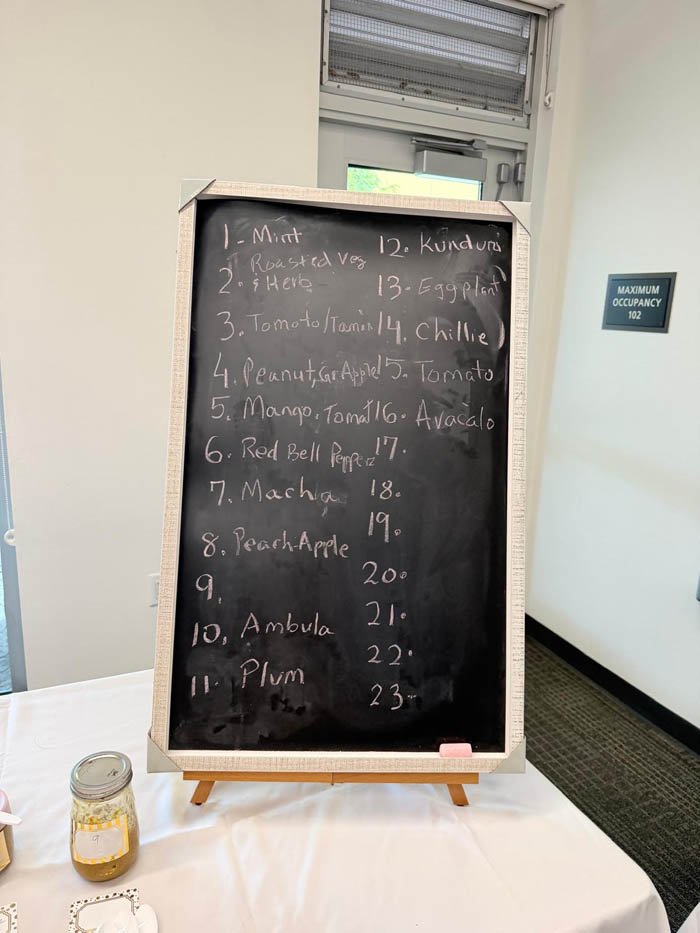
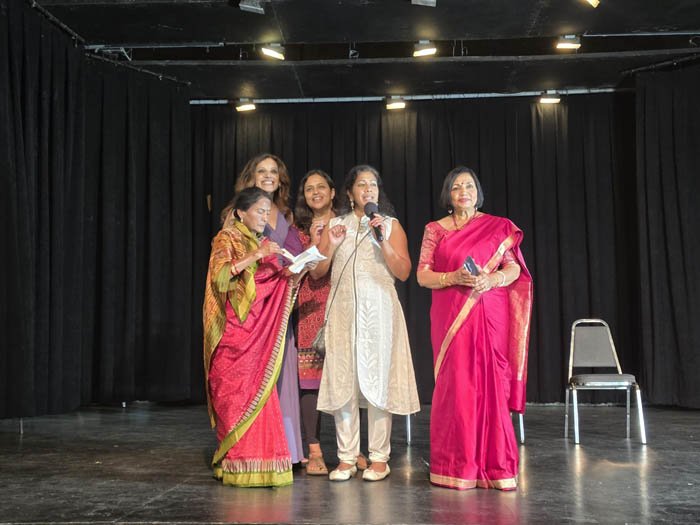
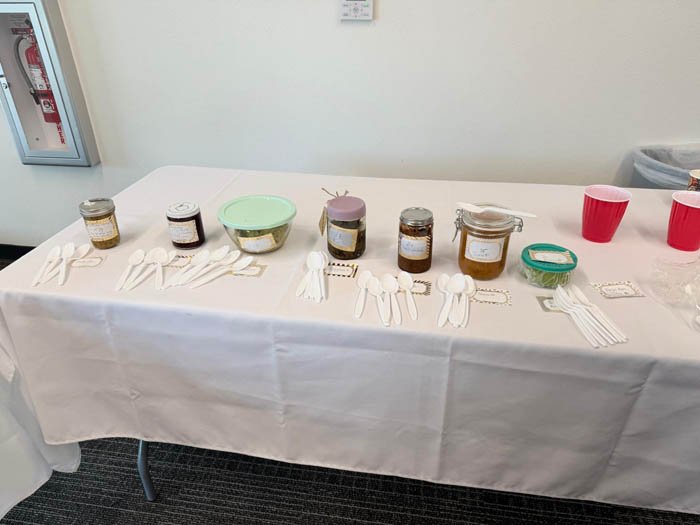
I just got back from a three-day California Odia Retreat, held at the University of California, Santa Barbara campus over the Aug 28th weekend. 2026 marked its 50th anniversary, as it began in 1976 with four to five families. Some of the original participants drove nearly 250 miles to join this year's celebration. On the closing Monday, I saw a dozen seniors in their 70s and 80s lingering at the breakfast hall — chit-chatting, taking photos, hugging each other, visibly sad to part ways.
About 100,000 Odia Americans make up a share of the 5.5 million people of Indian origin in the United States. The Odias in California have introduced this retreat, where members share a common space for three days to celebrate their Odia culture through food, dance, music, storytelling, and just hanging out with each other. I joined this annual ritual after I moved to the Bay Area in 1989. In the last three decades, I have watched a model for how we gather now, three generations deep. Now it takes place during the Labor Day weekend every two years. The first generation, who came to this country in the 1960s and '70s, will tell you that organizing this retreat and taking part in it is not work but passion and joy; their happiness comes from watching the community grow, from watching the younger ones, the third generation, join in. Those who arrived in the 1990s are still, in some ways, occasional participants, arriving after the foundation was already set. They feel accepted, included, encouraged to come. And now the second generation—the adult children of the founders—are bringing their own children, trying to instill in them the values and sense of community they were handed when they were young. The youngest ones, in traditional attire, perform, run around, and hang out together, mostly unaware that they've become the heartthrobs of this get-together.
This year, chutney making became the unlikely center of it all. Two of the organizers — themselves seniors, Kasturee Mohapatra and Kabita Mishra — introduced a chutney parade, a friendly competition inviting all three generations to make chutney. I thought I would watch and enjoy. Our son Akash was coming with his wife and their almost-three-year-old, Sena. He had volunteered to enter the competition but opted out after arriving late to the retreat. My friend Nita Panda, from Southern California, was in charge, and she reached out to many of us — so I became a skeptical participant in the chutney mela.
A Childhood in Chutney
I grew up eating chutneys as a condiment for every meal. My vivid memory is of hot summer days, fresh green mangoes picked from the orchard of the Secondary Board High School compound next to our house in Cuttack. When the sun sat directly overhead and an afternoon nap was impossible, especially with sweat running down my body like a stream, I would jump the low fence into the school grounds and get to work, sometimes enticing a lone neighborhood young man to climb up and shake down the sour green ones. I'd fill my frock pockets and walk home chewing on the freshest of them.
While the house slept beneath the loud whir of the ceiling fan, I would peel and cut the mangoes lengthwise, remove the tender white pit, and lay them on the flat stone mortar — the sila, then smash them with the stone roller, the pata, adding salt from a little coconut shell on the kitchen shelf and green chilies from the morning's haul at Chhatra Bazar, the vegetable market. I made a feast of that chutney every time, a summer ritual that has stayed fresh in my mind ever since — the aroma of green mango, the hot sting of chili on my fingers, my mouth dripping with its hot, savory taste.
On rainy days, there were no green mangoes. My mother would roast okra, ridge gourd, or tomatoes, then mix them with peeled shallots, roasted red chili, and dried mango or tamarind to make a chutney that made an ordinary meal special. I later learned this chutney was the staple of the women of the house. Since they ate last, there was often no vegetable curry left for their turn, so they made this roast, still smoking from the freshly burned coal in the wood stove, and relished it with rice. Even after eating with my father and brothers, I would join my mother just for the taste of her chutney.
In winter, when fresh vegetables were abundant, the varieties of chutney multiplied — coriander, mint, tomato, wood apple — each one marking the season as surely as the calendar did.
This year, the chutney parade drew the whole of Odia identity out into the open, in as many tastes and flavors as there were jars on the table.
Friday: Pakhala
We arrived on Friday — a hundred and thirty-three of us, including thirty children under sixteen — filling the housing complex at Lot 65 on the UC Santa Barbara campus. Friday evening's welcome was pakhala: rice steeped in fresh water, yogurt, lemon, and salt, served the way it has always been served, alongside fish fry, chingudi (prawn), saaga (spinach), potato fry, and bharta — that particular Odia alchemy of potato, dried fried lentil balls, chili, and pickle, mashed together until it becomes its own dish entirely. Pakhala remains the marker of Odia identity. It is the meal you eat when you want to taste 1976 and this year in the same bite.
Saturday Morning: Twenty-Five Jars
Saturday began with a bhajan (devotional song) by a group of avid singers at 7 am. After breakfast, the chutney entries were set out on an L-shaped table in the community hall, under a banner that read We are family, yeh, we are here — bringing all of us under one roof, one identity and one tradition.
Nita Panda, a veteran of the retreat, had announced the idea weeks earlier: a medley of chutneys showcasing people's culinary skills, childhood memories, and creative endeavors. She recruited seniors and second-generation members alike as judges and reached out to many of us — including the younger generation, especially our adult children — to enter.
Twenty-five glass jars lined the table, with a couple of lidded glass bowls standing among them, like a few of us Odias who never liked rules. Reading the table was its own kind of genealogy. Dried mango chutney arrived from a couple visiting from India. Beside it sat their son's entry — plum and tomato, a chutney no grandmother in Cuttack ever made, invented by a man raising his own children in Northern California, who had taken his parents' method and pointed it at whatever fruit grew near him instead. A second-generation cook who had spent years in Japan brought fish chutney, pungent and particular — the kind of dish you either grew up eating, or didn't. And then the long middle of the table: mint, coriander, tomato, scarlet gourd, red bell pepper, chutney after chutney in the familiar register — mine among them, a red bell pepper and tomato chutney sitting there like one more sentence in a language everyone at that table was still, in their own way, learning to speak.
Nita Panda and the organizers had one rule: no handwriting on the labels, in case someone recognized it. So each jar got a printed tag instead, a number standing in for a name, an attempt, for one afternoon, to let the chutney speak before the family did. I was tag number 6, and they gave me the number with my name attached, lest I forget it was mine.
Around ten that morning, the five judges bent over the jars with their scorecards, tasting and writing, tasting and writing, while the rest of the hall moved on to the day's other business.
The Rest of the Day
My friend Reina Haque — a second-generation daughter, wife, mother, besides a full-time medical career — and I had asked for time that morning to open a conversation of our own: about family, gender roles, duty, and self-care, about what three generations of Odia women had each been expected to carry, quietly, without ever being asked whether they wanted to. It sparked a lively exchange between generations, opening up facets of experience none of us had said aloud before. That will be another write-up.
By afternoon we were at Goleta Beach — pizza and salad on paper plates, children running everywhere. Sena, my almost-three-year-old grandson, eyed the Brewer's Blackbirds warily as they closed in on the pizza crusts and cookie crumbs piling up in the trash baskets. Some of us walked the wharf; the younger crowd went wine tasting; the rest hit the pool.
By evening, the community hall in downtown Santa Barbara had turned into something out of another decade and another country. I wore a black-and-silver check sari with my traditional jewelry; around me, sari after sari, salwar kameez after salwar kameez, kurta after kurta — fifty years of families dressed the way their parents had dressed, for a fiftieth-anniversary photograph they hadn't yet imagined taking. Little girls in their beautiful lehengas, salwar kameez, and dupattas ready to perform on the stage. Dinner came from a Bangladeshi restaurant in LA — jackfruit, saag paneer, chicken — laid out beside rice and dal cooked fresh in the hall's own kitchen, two kinds of care on the same table.
The Announcement
Only after all of it — after the beach, after the sari, after the last plate was cleared — did the winner's announcement come.
The judges came up to the stage together: Anjalika Pattnaik and Gopa Pattnaik, first-generation women from San Jose and San Diego, and behind them Anita, Millie, and Sarina, three second-generation doctors still chatting about what they were going to say.
I wasn't watching the stage. I was mid-conversation with a group of young women at their first retreat, listening to how they'd found their way here through Deba Mohapatra and his wife, Kasturee. Around us, the hall had that particular restlessness of a party winding down — someone stacking chairs, someone else still holding a plate. It was Dr. Anjalika Pattnaik's voice that pulled me back into the room. Something in her tone. "Number six."
For a second the number meant nothing. Then it meant everything. It was me.
I could not believe my ears. With so many entries, I hadn't let myself expect a chance — it was a clear surprise. But my childhood memory came alive all at once: red bell pepper and tomato, the easy modern base, topped with a seasoning of typical Odia-style mustard, curry leaves, dry chili, and hing. That must have been what gave it away — not the ingredients, but the tempering.
Second and third prize went to two second-generation Odias for mint chutney and cilantro chutney — flavors that belonged, unmistakably, to a different kitchen than mine — no less real Odia food for it.
Full Circle
I jumped for joy. My childhood memory of chutney had come full circle. Akash in the crowd congratulated me. His wife, Anna, told him, "I can see where your taste and interest in chutney come from." He sent a photo to the family WhatsApp group, with the caption, "Bou (mother) won first place in the chutney competition. Blind tasting of 40 entrants, so no way Papa could've stuffed the ballot box."
Annapurna Pandey is a cultural anthropologist at the University of California, Santa Cruz. Originally from Cuttack, Odisha, she moved to Santa Cruz, California in 1989. She is a travel enthusiast and loves to write travelogues highlighting her exotic experiences in different parts of the world.
THE ICU WAITING ROOM
Subrat Mishra
The ICU waiting room of a small Indian hospital exists in suspended animation—not as metaphor, but as condition. Time does not pass through this place; it is detained— a pause hovering within four walls . Inside people are held in a charged stillness, oscillating between breaths, between decisions, between the instinct to hold on and the courage to let go.
Plastic chairs line the walls, their weary legs bearing more than bodies. They carry hope, fear, regret and relentless negotiations with fate. They support the living, yes—but also the weight of thoughts and emotions left unresolved. Tubelights glow without conviction, neither bright enough to console nor dim enough to concede. Their faint flicker feels deliberate, as though even light hesitates here, uncertain how long it must remain vigilant. On the wall, the clock advances with embarrassed diffidence, unaware that in this room time does not flow—it accumulates.
In the adjacent hall behind the closed door, lives are rendered into rhythms :
Soft beeps,
Steady Sighs,
Blinking lights — evidences that someone is still negotiating for a place in the world.
Outside the hospital, the city proceeds with its familiar choreography. Tea kettles hiss at curbside stalls, steam curling up through dust and early light. Buses groan, autos cough awake, scooters weave through narrow gaps with screeching horns. A man steadies a tray of earthen cups, chai sloshing perilously inside . A woman adjusts her dupatta and crosses the road waving frantically at traffic from both sides. Ambulances arrive and depart without drama, absorbed into the wider pulse. Life does not stop here—it adapts, negotiates, persists, carrying errands, hungers, and modest hopes past the hospital gates, as though normalcy itself were a sacred obligation.
Inside, usefulness dissolves. No one is needed elsewhere. No one is late for anything. Waiting has cancelled all other appointments. People converse without introductions, names feel unnecessary. This is a Republic of waiting where titles, incomes, religions and convictions are checked in at the door beside the footwears.
A woman turns prayer beads, each bead a small, private bargain. A man studies the floor with scholarly devotion, as though meaning might rise from the cracks.Nearby, a young girl sits cross-legged on the floor, eating a frugal lunch laid on old newspaper , mustering as much dignity as she could while satiating hunger pangs— her tears not yet fully dried. Another woman sleeps curled across two chairs, daylight soothing her after a night without rest. In the ICU waiting room, privacy has no shelter and grief allows life's primal, essential functions. Someone holds a phone with a dark screen, hope brighter than signal. Someone else whispers animatedly into the mouth piece. Words are rationed. Silence circulates freely.
Hope and fear do not alternate here; they coexist. They sit side by side like uneasy relatives at a funeral ceremony. Every footstep in the corridor becomes an oracle. Every glance is overread, overfelt, overlived. Even breathing grows deliberate, as though air itself must be conserved.
Waiting sharpens love. It strips affection of habit and leaves it exposed—raw, exacting, awake. Regret rises without drama: visits postponed, kindness delayed, ordinary days once squandered now revealed as irreplaceable. Gratitude follows, sudden and painful in its clarity—for a voice heard yesterday, for a hand once held without ceremony, for a life that had seemed so assured.
Certainty does not survive this room like the adjacent one. Control loosens its grip and quietly leaves. The body, once trusted like a loyal servant, now negotiates breath by breath with invisible forces. The arrogance of health and wealth dissolves. What returns is something older and truer: humility.
Faith enters barefoot; not as thunder, not as argument. It arrives shyly and sits beside you. It does not promise rescue; it offers companionship. Some fold their palms. Some close their eyes. Some simply sit straighter, breathing more gently, as though breath itself were the last honest prayer left.
The waiting room teaches a severe grace: patience without assurance. Not heroic, not luminous—just enduring. Hour after hour, it holds people who did not know they could be held this way. Presence becomes an offering. Silence learns how to carry weight without breaking.
When the door finally opens, it rearranges lives with a sentence. Relief makes knees forget their strength. Grief drains colour from the air. Someone stands lighter than before, someone sinks heavier . The room receives both without preference. It has learned the art of equanimity.
And when one eventually steps out—altered, emptied, or quietly spared—the waiting room remains behind. Unmoved. Unpraised. Ready again.
A small, overlooked sanctuary where human beings are returned to their truest measure.
Not powerful.
Not powerless.
Only finite—
and therefore capable of a love that waits without guarantees,
and still refuses to leave.
Beginning his journey in public service, Subrat Mishra served with distinction as an officer of the Indian Revenue Service, eventually retiring from the position of Principal Chief Commissioner of Income Tax. He holds an M.A. in Political Science from the University of Delhi. In recent years, he has turned to writing, exploring poetry and reflective prose as an occasional amateur writer. His interests span sports, culture, philosophy, travel, and nature photography. He lives in Bhubaneswar.
Viewers Comments