
Literary Vibes - Edition CLXXI (27-Nov-2026) - STORIES

Title : Shoeflowers in the Rain (Water colour by Lathaprem Sakhya)
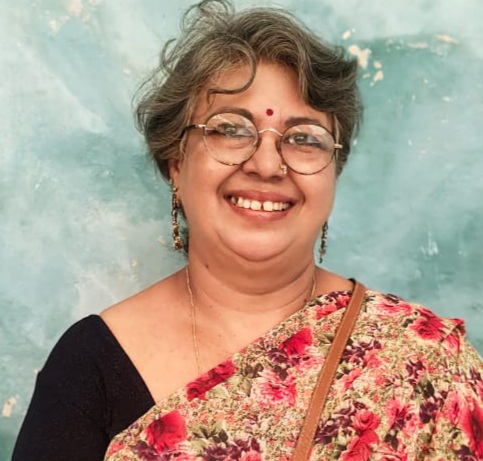
An acclaimed Painter, a published poet, a self-styled green woman passionately planting fruit trees, a published translator, and a former Professor, Lathaprem Sakhya, was born to Tamil parents settled in Kerala. Widely anthologized, she is a regular contributor of poems, short stories and paintings to several e-magazines and print books. Recently published anthologies in which her stories have come out are Ether Ore, Cocoon Stories, and He She It: The Grammar of Marriage. She is a member of the executive board of Aksharasthree the Literary Woman and editor of the e - magazines - Aksharasthree and Science Shore. She is also a vibrant participant in 5 Poetry groups. Aksharasthree - The Literary Woman, Literary Vibes, India Poetry Circle and New Voices and Poetry Chain. Her poetry books are Memory Rain, 2008, Nature At My Doorstep, 2011 and Vernal Strokes, 2015. She has done two translations of novels from Malayalam to English, Kunjathol 2022, (A translation of Shanthini Tom's Kunjathol) and Rabboni 2023 ( a Translation of Rosy Thampy's Malayalam novel Rabboni) and currently she is busy with two more projects.
Table of Contents :: Short Story
01) Prabhanjan K. Mishra
02) Sreekumar Ezhuththaani
LIFE IMPRISONMENT
CASTLES ABOVE US
03) Rabi N. Dash
THE PRICE OF A SIGNATURE
THE THINGS WE CARRY
THE LITTLE DIYA
FRIDAY THE 13TH: WHEN SUPERSTITION MEETS COMMON SENSE! - A COMEDY OF ERRORS, THIRTEEN ALMONDS AND ONE VERY NERVOUS CHRISTIAN
THE RIVER THAT REFUSED TO TAKE SIDES
04) Anil K Upadhyay
SONG AND DANCE IN GANGSTER’S DEN
05) Lopamudra Mishra
06) Snehaprava Das
07) Usha Surya
THE CHILD IS THE FATHER OF MAN
08) Jacintha Morris
09) Satish Pashine
LANDFALL
REPLACEABLE
IREPLACEABLE
RECONCILIATION OR RESOLUTION?
AI AND CREATIVITY
10) Darsana Kalarickal
11) Annapurna Pandey
GOD`S OWN COUNTRY: CARE, COMMUNITY, AND HEALING AT A KERALA ASHRAM
12) Mary Josey Malayil
13) Subrat Mishra
14) Sujatha Krishnamurthy
15) T. V. Sreekumar
16) Dr Jyotshna Mahapatra
THE GRANDMA WE FOUND
THE BOSS AND THE PEON IN BUSINESS CLASS
17) Shri Gokul Chandra Mishra
18) T. V. Krishnakumar
19) Sreechandra Banerjee
20) Syamala Haridas
CHAPTER 1 THE WEIGHT OF THE KINA
21) Mr Nitish Nivedan Barik
TASHKENT: A HISTORIC LANDMARK OF PEACE AND INDIA’S ENDURING FRIENDSHIP WITH UZBEKISTAN
22) Dr. Rajamouly Katta
23) Dr. Mrutyunjay Sarangi
KAMADHENU, A SAGA
Prabhanjan K. Mishra
I am an ordinary old cow, and in the ongoing context, a holy cow, a Gau-mata, irony of a sort. Now, I am lying down on a grassy patch under an Acasia tree, and chewing cud. My official name is Kamadhenu.
The members of my human family, who lovingly brought me up in their cowshed, called me by various affectionate nicknames, but mostly as Kammu. I loved that name.
I grew up by my Abba, my human papa, Hasan bhai Ali, a Gujarati from Morbi town in Saurashtra area. My Abba, after graduating in Zoology, had joined B Pharma course. But before he could complete his Pharmaceutical Diploma course, his family circumstances compelled him to leave studies and join a job as the assistant manager of a medium-scale tannery in Morbi Town.
His educational knowledge in the science of medicines had little to do with his job, supervising tanning. He often felt frustrated that his time, energy and money invested in his studies were a total waste.
While lying in lazy evenings in our inner yard, and chewing the cud, I would eavesdrop on Abba sharing a bit of what he knew from his studies or what he had just learnt from newspapers or what he had heard from sources with Amma, his wife, or his two children. It could be about history, geography, science, philosophy, or current news.
I would also carefully take mental notes when Ameena and Abbas, the two children of Abba and Amma, learnt their lessons aloud. Being an attentive cow myself, most of those ideas and information would be sedimented into my mind. Though my grasp was slow, but my memory was lasting.
Now I am old, and poor because of my circumstances, but still a proud cow at the dusk of my life. I am lying down under my favorite acacia tree in an open ground belonging to the Morbi Municipality and chewing cud. I have adopted this little patch of grassy ground under the huge acacia as present home.
I suddenly become conscious of a thing – my cud tastes like a mouthful of unchewable plastic bags. Out of disgust, I put it out of my mouth. Yes, it is a plastic bag, I might have swallowed in agony of hunger with stale food an hour ago at a garbage dump.
This misery of fending ourselves by eating stale and inedible fare at garbage dumps, and living on patches of unoccupied government land have been happening for almost last three years to us, the poor cows, who have retired from their milk-yielding days. The same fate has happened to our male peers, the bullocks, who have retired from their productive years of service like pulling loaded carts, tilling fields etc. for age or sickness.
The cattle folk who cannot serve for their weakness for age or sickness, have been driven to streets by their helpless poor owners because they cannot afford to feed them. The reasons being new manmade developments in the name of progress.
I have heard from my Abba’s mouth, a cow-welfare law has been imposed, that bans killing of cows and cattle in general. This ban has created groups of cow-vigilantes who privately misuse the ban to their own advantage.
They accuse all cattle transporters as cow-smugglers. They accuse them of taking cattle to butchers to make beef. Genuine transport of cattle either to and from cattle trade-fairs or to and from vets for treatment become suspect in their eyes. Surprisingly, the police give them support.
In many cases the vigilantes demand bribes, if not paid, the transporters are ruthlessly beaten and given to the police. Their livestock were confiscated, often the beating leads to lynching to death. The impunity of this malpractice by vigilantes and the hand-in-gloves police made people in various business connected to cows to stop their ventures. Many families depended on milk business for livelihood. Many had business in cow hide tanning. All such families were drove to dire poverty. Being unable to feed their cattle their caring human families pushed them to streets to fend themselves for food and shelter.
In addition to discontinuation of cattle related business and small-scale industries because of the cow-welfare law, a new game changer was imposed without doing any homework about its side effects. To stop printing and circulation of counterfeit bank notes and to make hoarded black money in 500 0r 1000 rupee-banknotes, demonetization was announced to make them defunct overnight without giving people a breathing space or time.
There was no supply of newly designed banknotes of similar high denomination by the Reserve Bank of India, who were informed of the upheaval only a day earlier to the notebandi to start printing the newly designed banknotes of rupees 500 and 2000.
The small-scale industries including cottage industries as well as small businesses that depended on cash transaction faced a total drought of cash for all transactions for almost a month or more until the normalcy was restored by RBI. But in the meantime, most of them closed down. This had an effect on job market, and people in lakhs went jobless.
This directly hit Gau-mata and the cattle in general. Many maintaining cows and bullocks for personal use like cows for milk for family and bullocks for ploughing or pulling carts; and families engaged in small-scale milk business became so poor that they could not afford to feed and shelter non-productive cows and bullocks. So, such cattle were left on the streets to fend for themselves.
Yes, I am an old stray cow left on streets now, but with a difference. My family did not push me out of home but I myself decided to walk out to save my family from some misery. To make the long story short –
My story was a reverse of the ‘Rags to riches’. It was ‘Riches to rags.’ A Gau-mata turned into a skinny shabby pariah cow with no home, no guarantee of the next meal, no one to care, no one to even give a small loving pat to my skin and bone body.
I had a caring home once, and that word ‘once’ sounds today like ‘once upon a time’ to my own ears, seems like a hoary past. A shed behind my Abba’s inherited house was home to my cow-mother and me, a little jolly calf. We had a manger for food. We always ate stomach full.
In festive occasions when Amma made goodies for her husband and children, she prepared mouthwatering laddus for us, my mother and me, from a mix of roasted and rough-ground corns, groundnut oil, and jaggery. It was an all-time favorite sweetmeat for all the cattle progeny.
When I came age to understand the world, I knew that my Abba and Amma had two children, Ameena and Abbas, studying in a school. My cow-mother provided milk to the family and now I joined her. We provided milk simultaneously or turn by turn.
A part of our milk went to supplement family’s food basket, as milk or milk products like curd, buttermilk, ghee etc. The rest of the milk was sold by Amma to neighbors and the money coming from the sale of milk funded the family piggy, in addition to Abba’s small salary. The same way Amma made compost manure of our dung and urine and sold them to neighboring farmers. Also, our calves when weaned of milk were sold at cattle fares to earn a little money for the family.
My cow-mother’s seasonal pregnancy stopped after a few years, indicating the unset of retirement from providing milk. Abba declared, “Kammu’s old mother has retired from her active life. It is her time to eat, take rest, and enjoy the joy of leisure. We all would take her utmost care.
The family, especially my Abba, would shower care and affection on me whenever we came face to face, either in the shed or the inner yard of the house. He would have a pat or a kind word for me always. He was expressive in his affection unlike others in the family who loved me as much but would show it only in action, like giving a bite from what they were eating. I felt secure and loved, knowing well that I would also be taken care of in my retired days like my mother.
I heard that new ‘cow-laws’ had come into force to promote our welfare. It gladdened me. Then I heard, some fringe elements behaved like hooligans and misused those new laws for their personal benefit. They were called cow-vigilante. Those violent groups roamed in little gangs and harassed cow-transporters on their route of taking bovine stock to cattle-fairs or vets or to own shed after buying them. Often cow-transporters were lynched for alleged selling to butchers. A terror haunted the people in business involving cows after the cow-welfare law.
The fear of lynching brought milk business almost to stand still, for cows could not be procured or sold or given treatment at a vet. Stoppage of skinning dead cows created a shortage of raw material of leather industry. The food industry thriving on biryani also suffered as all meat became suspect as beef.
One evening Abba returned home almost in tears. His owner had drawn shutters of his factory for shortage of cow hide and drought in cash supply because of demonetization. So also, all colleagues of my Abba lost jobs.
Amma consoled him, “We will manage eating two rotis less a day each until you get another job. We would use less milk from Kammu for our food-supplement and sell its major portion to finance our house.” I grunted softly, “Abba, I would graze more green grass and try to lactate more milk.” I rubbed my head against him as my moral support that I knew Abba would understand.
My Abba became a handcart puller after losing his managerial job in the tannery. By handcart he transported goods from place to place. By evening when he returned home with so little earning, might be only enough or less to buy a day’s ration, his palms were scabbed with ulcerated skin. He had never done that sort of menial labor. It broke my heart to see Amma applying ointment to his wounds to heal overnight.
The demonetization, following cow-welfare laws made more small business and small and cottage industries shut down pushing more jobless people to streets looking for jobs even below their station. In that competitive market, Abba’s income became less by the day and irregular. People’s finances were taking a nosedive in general. Any new job for him was not in sight.
Abba still maintained me and my old mother besides his family, though we all lived frugally. My old cow-mother died quietly one night. In my shed I felt very lonely after my mother’s death. At nights, Abba would come with a reed-mat and a pillow to sleep by me in my shed. His soft snores were so reassuring! I would try to snuggle to him to keep him warm in cold nights, and in return absorbing his love for me.
Like a silver lining in a black cloud, I heard of coming of Ramrajya. This overjoyed me, because I had heard of Ramrajya, a period of peace and prosperity during Lord Ram’s rule. But what followed was opposite.
Because of demonetization, almost none of ordinary people had enough of newly issued money tenders that could buy things like grocery, veggies, snacks, or meals in restaurants, or pay bills in cash for daily essential services like in hospitals, doctor’s fees, hotels, buses, taxies, autorickshaws and event managements like marriage or the like.
The old money could not be exchanged in banks easily as was proclaimed. There were kilometer-long beelines of people to exchange money from old to new notes before bank counters everywhere. Also, people needed to draw cash from their own saving accounts for their purposes, but banks had little new currency notes.
My distraught Abba returned from his bank empty handed in the evening after standing the whole day in a queue. He told us the horrendous mismanagement by the banks and how a few in his Q had sun-stroke standing in hot sun the whole day. A man had even collapsed and died before my Abba’s eyes.
For days on, the money market starved. My Abba would take out his handcart and park it at his appointed spot in the middle of a market area waiting for his callers for the transport of their packages. His clients were grocers, construction site supervisors or cloth merchants and the like. The business was so dull for want of new cash and the old cash turning into scrap paper that Abba had no orders. By evening he would return with a rueful face, as if feeling guilty for his empty pocket.
The day, Amma’s larder turned empty of food provisions and Abba’s pocket went totally empty, two important decisions were taken by Abba. Abba decided to sell his handcart at throwaway price to have money for about a week’s frugal supply of ration and declared that from the next morning he would turn into a day laborer.
The second decision he took, “I can’t see Kammu starving. We can’t give her adequate food. Her cowherd has reported not a blade of grass in grazing grounds for drought and the summer sun, so he has stopped coming to take her out for grazing. From tomorrow after milking her, she would be left loose to roam our neighborhood to look for reject eatables and return home whenever she would feel like. The outside food would supplement what little we feed her.”
I understood my Abba’s predicament and saw his silent tears when he made me free after milking the next morning. I grunted, “I understand Abba.”
I didn’t know what went wrong to my constitution. Was it the garbage I ate at garbage dumps or my age, after a few more seasons of giving milk, I stopped coming to heat or getting pregnant. Abba declared, “Kammu has also retired, our family’s last earning member. But let us give her more care and affection than before. She served us so lovingly all her entire active life, it is time we return her debt.” His words moved me to tears.
I would have a well-oiled soft roti from Amma’s hand, her first roti or rotla (the thick roti of Bajra or Jowar smeared with oil) rolled for the day, and go out to forage for food with the soft morning sun shining on my hide. When I would return at the sunset to rest my tired bones in my shed, Abba would feed me his last roti of the dinner affectionately. The roti would test like ambrosia smeared with Abba’s love.
To pay the school expenses of Abbas and Ameena, his children, Abba decided to sell his house, the last legacy from his parents. He had already built a hutment dwelling in a nearby slum area by bribing the local strongman and we moved there. I had a little corner on its backside for lying down that was kept spick and span by Amma. Abba had got white sand from a construction site to spread in my small enclosure to keep me a dry and give me a soft bed. There was a little solvency in the family for a year after the sale of the house.
Ameena graduated, and Abbas passed his tenth standard with flying colors. Further education seemed impossible as funds had vanished over the passage of time, most part gone to wipe out earlier loans on high interest rate in family’s slim time. So, Abba planned moving to the City of Ahmedabad. It was a decision in desperation. He had information of getting work in construction sites as supervisor, Amma getting work as a house-help. He said, Abbas could study in a better school. Ameena could pursue her postgraduation in some technical institute like a course in designing or management.
The day my Abba and others of my human family boarded a bus for the city, I walked up to the bus stop with all, nudging them with affection with my head. Each of them patted and gave me their love, and hugged me before entering the bus. They were sorry with hangdog faces, perhaps feeling guilty for leaving me behind alone without any arrangement for my care. I grunted several times, “Don’t worry. I will manage.”
Abba whispered into my ears, “Ma Kammu, my little one Kammu, like a brave girl keep yourself fit by eating whatever you get till we return. You lie down inside our hut in nights and guard it for us. I have talked to Abdul bhai, the man in-charge of the hutment colony. He has given his word no one would dare harassing you until he is in charge. I will return soon to take you to join us in the city.”
I stood alone for hours at the spot after the bus had left blowing dust into my eyes. I wailed and grunted my heart out for my family. I felt, my world was crashing around me. I cursed the new cow-laws and note-bandi, and the so-called Ramrajya. I stood at the bus-stop until the breeze blew away the last scent of my loving family.
I then walked desultorily wherever my feet took me, ate whatever looked and smelled edible lying on the road or in garbage heaps. By evening I returned to my father’s empty hut, made of sticks, gunny bags, and plastic sheets to rest my tired bones in my corner. It somehow gave me a sense of belonging, and hope that my Abba would return soon. I felt like the legendary boy, Casabianca, standing on the deck of a burning ship, and waiting for his father who had gone into the burning ship promising to return.
One day, a strong wind and squall swept away Abba’s ramshackle hut gone rickety and falling apart from disrepair. I could not rebuild Abba’s hut again. That day I cursed my cow-birth and my inability even to maintain the last umbilical string between Abba and me. But I continued sleeping at that vacant spot in nights with a promise, I must keep it reserved for my family, as Abba had asked me to.
One Sunday, I stood by a hutment and saw their TV through a small window. An impressive looking old bearded leader in a weird headgear was announcing on the screen of the TV, “The GOOD DAYS have finally arrived. We are living in the Amrit Bela (golden period). Feel it, savor it, live it my countrymen. I have dedicated it to you all, people of my nation.”
A shiver of joy passed through my body. At last, …. Perhaps my Abba and family would return, prosperous and happy. I felt so relieved to hear this man on TV. He might be a big leader to have come on TV. Big leaders would never tell lies. For what they would say, the world would hear and see, and record it as history.
So, the whole of that day I roamed the streets under the spell of the leader’s magical words. It was sort of walking and dreaming of a time of plenty and prosperity with my family back at Morbi in our own house, and I eating from Abba’s hands soft grass and oil-drenched rotis.
I looked around wherever I went, and looked for the things changing for the better, the arrival of ‘Amrit Bela’. But finding no evidence, by evening I decided, “Now I am hungry and tired. Let me have a little to eat at some garbage dump, and go to my resting place where had stood my father’s hut. I will have a thorough search tomorrow for the ‘Amrit Bela’ that was said to have arrived.”
When I reached my resting place, it was gone. Another poor family had built its hut of tin and gunny cloth at that exact spot. A woman whom her neighbor addressed as Komal Apaa, meaning the soft-hearted sister, drove me away harshly with a stick. Had I not hurried away, the stick in her hand would have badly bruised my rib bones sticking out of my skinny body.
Humans had no idea how it pained in old age for a cow when she was struck on her sticking out skinny bones. Still, I decided to forgive the poor woman, I knew, poverty would drive anyone mad.
That evening I chose this spot on a grassy patch under the Acacia tree and adopted it as my resting spot. This spot was surrounded by Municipal ground reserved for the cattle-grazing and I presumed no one would drive me away, and lo, I am still here after years.
Days of search proved to me that the Amrit Bela had not reached Morvi town. Might be it was on the way. I wished it should reach my Aapa’s town first. I could wait.
Recently, while lying down in market places, and crowded lanes, I heard certain things I did not know. The seventy-fifth Independence Day was approaching, and a lot of talk was going on about our nation builders like Gandhi, Nehru, Patel, the Maulana, Indira, Rajiv, and, the last, one Modi from my Gujarat who was currently busy in nation building.
A little smile played on my face that day. I thought it over deeply. Shouldn’t my saga, rather the saga of our cattle fraternity, as nation builders be put on record for posterity? Are we less nation builders than the lot whose names were reverberating in the market places. For the nation building chapter I especially would like to record -
“This old cow, Kammu, and her community have also their humble share in nation building. They gave their milk to humans to make them healthy and brainy architects of India. That very thought gave me immense satisfaction and justified my and my peers’ proud title Gau-mata.
Our sons and grandsons have been tilling the land to give bumper crops. Oxen and bulls have drawn carriages transporting goods and humans from ancient times. Cow-milk, along with their various milk-products have contributed as a major part of the human’s protein needs, besides entertaining their tastebuds with delicacies like curd, cottage cheese, buttermilk and various cottage-cheese or khoya-based sweetmeats.
We have fertilized fields with our dung and urine as manure. Our dung has been dried in rural India to feed the cooking stoves in poor families in villages as a major fuel. Our milk has been the source of calcium that built strong bones of children and the source of protein that gave them healthy tissues.
Our dung has been used to keep rural houses clean, deodorized, and pest-free when mixed with water and mud to smear the floors and walls of mud houses. Diluted with water, dung and urine are sprayed as pest-repellants on standing crops in fields. Cow-dung and urine are medicinal ingredient in Ayurveda.
The list of our services would go on unending. Our contribution to human mental health and spirituality has been immense. Cow-worship and feeding Gau-mata has cured more patients from mental insecurity and guilt than any band of psychiatrists.”
It is early in the evening under a starry sky. For whatever reason, I feel tired, very tired. I doze off and dream a lovely dream under my Acacia tree. Abba and his family have returned. They have found me out under my Acacia tree in deep sleep. Abba is trying unsuccessfully to break my sleep, make me alert and is whispering into my ears, “Kammu, my little Kammu, get up. Bad days are over. We are going home. We would live together in a nice house and there would be plenty of food for all. Get up my old girl.”
I try to open my eyes that gets heavier. But I am happy. I enjoy Abba’s caressing hand all over my skinny hide. I decide with my head in Abba’s lap to enjoy it forever, never to open my eyes to see the miserable land around me again. I feel like sleeping forever with my head in Abba’s lap.
(End)

Prabhanjan K. Mishra is an award-winning Indian poet from India, besides being a story writer, translator, editor, and critic; a former president of Poetry Circle, Bombay (Mumbai), an association of Indo-English poets. He edited POIESIS, the literary magazine of this poets’ association for eight years. His poems have been widely published, his own works and translation from the works of other poets. He has published three books of his poems and his poems have appeared in twenty anthologies in India and abroad.
LIFE IMPRISONMENT
Sreekumar Ezhuththaani
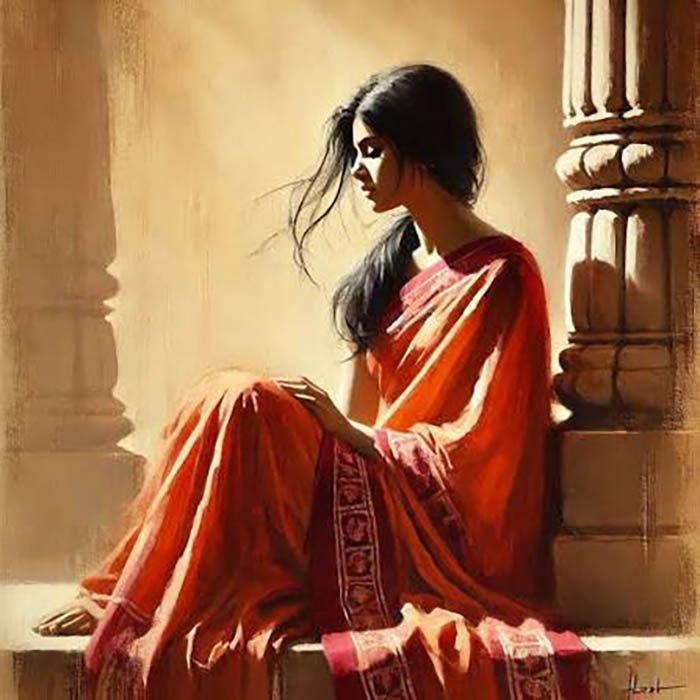
When it started to rain, Radhika closed the kitchen window. The rusted latch at the edge of the windowpane never quite fell into place properly; it took two tugs to secure it.
“If you close that window, it’ll feel suffocating in the kitchen,” Sumitra called out from the room.
Radhika opened the window again.
“The rain is splashing inside, Chechi.”
“Everything is a problem for you these days.”
Radhika said nothing. The tea on the stove had begun to boil over. She lowered the gas. Rainwater trickled down the windowsill, wetting the cloth used for wiping dishes.
Their house was old. The roots of the mango tree in the courtyard had broken the concrete flooring in several places. On the front verandah, there was a cane chair their father had bought; when rain fell on its armrests, the color of the wood changed. Sumitra used to have the habit of reading the newspaper sitting in that chair. Nowadays, she read the paper mostly sitting on her bed in the bedroom.
When Radhika reached the room with the tea, Sumitra was reading the obituary column in the paper.
“Do you remember that Vasudevan Nair who died yesterday?” she asked.
“Who?”
“The one who used to be a peon at our school. Poor man. Apparently, none of his children were with him.”
Sumitra took the tea. After taking a sip, she placed the cup on the table.
“What’s the use of having children? In the end, everyone looks out for themselves.”
Radhika smoothed out the bedsheet.
“One day, you’ll be like that too.”
Radhika couldn't tell if that was a prophecy or a complaint. She walked outside under the pretext of checking whether water was pooling in the flowerpots by the window.
She was thirty-two years old. Sumitra was forty-two. Seven years had passed since their father and mother died. With their father’s pension having stopped, Sumitra managed by doing tailoring work and Radhika by handling accounts at a small private firm. Sumitra’s marriage never took place. Radhika’s did, but it didn't last long. When she returned to this house after separating from her husband, it was Sumitra who had welcomed her.
“Does my younger sister have any other home besides this one?” Sumitra had asked their relatives back then.
That sentence remained stored in Radhika’s mind like a promissory note, even today.
Radhika had met Madhavan when he came to her firm for an audit. He helped her correct a small error in the accounts. When she left after work, it was raining. They had to stand together at the bus stop.
“Do you always work this late?” he asked.
“On some days.”
“Who is at home?”
“My elder sister.”
“Husband?”
“We are separated.”
He didn't ask anything further. When the bus arrived, she got on. The next day at the office, he nodded and smiled. That was all there was to it.
Later, they began talking during lunch breaks. He had a habit of reading books. Although Radhika liked reading, she hadn't found the time for it in years. If she tried reading at home, Sumitra would assign her some chore. At night when she went to bed and opened a book, her sister would approach with a list of things she had done for her during the day.
Once, Madhavan gave her a book.
“Read it and let me know what you think.”
Radhika took the book and put it in her bag. When she reached home, Sumitra saw it.
“Who gave this to you?”
“A friend from the office.”
“A man or a woman?”
“A man.”
Sumitra took the book in her hands. She flipped through several pages.
“What time do you even have to read these things now? There is so much work at home. Besides, you should think before trusting people. I know your life.”
She handed the book back.
Radhika put it inside the cupboard. In the days that followed, she didn't open the book.
When Madhavan asked, she told him she hadn't started reading it.
“Don't you like to read?”
“I do.”
“Then what is it?”
“There are some problems at home.”
He looked at her. She tried to smile.
“Doesn't every home have them?”
“They do.”
“Well, our home has a few more problems than usual.”
She said just that and fell silent. Madhavan didn't ask again.
One Sunday, Madhavan invited her to the city book fair.
“Just two hours are enough. We can get back by noon.”
When Radhika mentioned it at home, Sumitra raised her head and looked at her.
“Isn't it Sunday? We need to buy some provisions that day. Have to go to the bank. If you go, who will do all that?”
“I’ll go in the morning and come back by afternoon.”
“And I won't be able to walk alone, is that it?”
Sumitra had no difficulty walking. Even so, Radhika looked down at her feet.
“I’m not going, Chechi.”
That evening when Madhavan called, she didn't pick up the phone. The next day at the office, he asked,
“What happened?”
“Chechi wasn't well.”
“Is she better now?”
“Yes.”
“Then we can go next Sunday.”
Radhika smiled.
“We’ll see.”
Madhavan looked at her for a moment.
“Radhika, don't you ever feel like doing something of your own accord?”
She suddenly felt angry.
“Everything I do is of my own accord.”
“Alright.”
He changed the subject. But the doubt on his face disturbed her the whole day.
That night, after Sumitra had fallen asleep, Radhika opened the cupboard and took out the book. On the first page, Madhavan had written:
*For Radhika. May you find time to read.*
She stared at that sentence for a while. Then she folded the book away.
At the bottom of the cupboard was an old photo album. A photograph slipped out of it and fell to the floor: five-year-old Radhika sitting on her father’s lap, with a stern look on Sumitra’s face as she stood behind them. Radhika remembered that Sumitra had been fifteen years old on the day the photo was taken.
After their mother died, it was Sumitra who used to tie her hair. Who fed her rice when she was late for school. Who kept watch without sleeping on nights when she had a fever. She couldn't deny any of this.
Yet, what was the meaning of the sternness she saw on Sumitra’s face in that photograph?
She had no answer for it back then.
As her closeness with Madhavan grew, small changes occurred in Radhika’s life. After leaving the office, she began walking ten minutes longer. She bought a masala dosa of her liking from a roadside shop and ate it. Once, she even went to the cinema with Madhavan.
When she returned, it was nine-thirty at night.
Sumitra had left the verandah light on. Her dinner was covered on the table.
“Where were you?”
“Went to a movie.”
“With whom?”
“With Madhavan.”
Sumitra stayed silent for a moment.
“And you didn't even feel like telling me.”
“I thought Chechi would be asleep.”
“You’ll only find peace if I die.”
The bag in Radhika’s hand dropped to the floor.
“What is Chechi saying?”
“Nothing. Did you eat?”
“I ate.”
“Good. Naturally, you don't care that someone was waiting here.”
Radhika went to the kitchen. She opened the lid of the rice pot. A layer of condensed steam water had collected on top. She put the lid back on.
When they went to bed at night, Sumitra called out to her.
“Radhi.”
“What is it, Chechi?”
“Do you remember when you had a fever as a little girl? It was me who carried you and walked around the hospital the whole night. Father wasn't home that day.”
Radhika didn't remember that incident.
“Don't you remember?”
“No.”
“That’s it. Just like I remember nothing, you too will forget everything.”
Radhika sat up on the bed.
“I haven't forgotten, Chechi.”
“Then you should show it.”
“How?”
Sumitra looked at her, then turned away.
“You know.”
Radhika couldn't sleep that night.
Madhavan began to understand things when it came to money.
Radhika had a small gold chain left to her by her mother. She had once mentioned that it was mortgaged to repair Sumitra’s sewing machine. Later, when Madhavan asked, he inquired if the chain had been redeemed.
“No. We haven't got the money.”
“How much was the amount?”
She told him the sum.
“Did fixing the machine take that much?”
Radhika didn't reply.
“I just asked.”
“Chechi had some debts. That was paid off too.”
“With your money?”
“Our money.”
Madhavan looked at her.
“Isn't the money you earn yours?”
That question felt alien to her.
“Don't we live together in the house?”
“Yes. Does that mean all your earnings have to belong to someone else?”
“Chechi brought me up.”
“You’ve said that many times.”
There was no mockery in his voice. Yet Radhika felt insulted.
“You don't know anything about our situation.”
“That’s true. I don't. But there are certain contradictions in what you say.”
She got up and left the place.
For the next two days, she didn't speak to Madhavan.
On the third day at noon, he came to her desk with a cup of tea.
“Forgive me if I hurt you.”
She said nothing.
“It may be true that your elder sister raised and cared for you. Why should you have to give your entire life away because of that?”
“That is Chechi’s life too.”
“Then where is your life?”
She lowered her head.
He placed the tea on her desk and left.
When she reached home that evening, Sumitra was working at the sewing machine. The machine needle rapidly moved up and down through the cloth.
“What all did you tell Madhavan?” she asked.
Radhika was startled.
“What?”
“He has started finding out all about your affairs, hasn't he?”
“I didn't say anything.”
“So he figured it out on his own? Did he say your sister is exploiting you?”
Radhika remained silent.
Sumitra stopped the machine.
“Is that what you feel about me?”
“I didn't say that.”
“But you’ve started feeling that way.”
She folded the cloth.
“Fine. If you want to leave, go ahead. I won't stop you. Just assume that everything I did all these years was my mistake.”
Radhika went up to her.
“Chechi, don't say things like that.”
“I’m not saying anything.”
Sumitra operated the machine again.
Amidst that sound, Radhika’s words were lost.
Madhavan once asked her:
“What does your sister say about you the most?”
Radhika thought about it.
“That I am ungrateful.”
“Do you think you are?”
“Sometimes.”
“Being grateful and living like a slave are two different things, Radhika.”
The looked at him.
“It’s easy for you to say all this. She isn't your sister.”
“That’s true. She isn't my sister. That’s why I have no old grudge against your sister. What I see is how you are living.”
“Do you think I am not happy?”
“I don't know if you are happy. But you are afraid when you do things you like.”
Hearing those words made her want to cry. She turned her face away.
Madhavan didn't try to comfort her.
After a short while, she said on her own:
“Sometimes I feel like I should live somewhere else.”
“And?”
“I don't feel like leaving Chechi alone.”
“Isn't there anyone else to look after her?”
“There are relatives. But Chechi isn't very close to them.”
“Is the entire responsibility of that yours?”
Radhika didn't reply.
When returning home that evening, she got off at the bus stop and walked for a bit. An old building by the roadside was being demolished. Only the circular mark of a clock on the wall remained. The clock must have been removed earlier.
She stood staring at that mark for a while, then walked home.
Finally, Radhika decided to speak to her sister.
That afternoon, Sumitra’s sewing machine wasn't running; the power had gone out. She was sitting by the window, trimming loose threads from a piece of cloth.
“Chechi, I have something to tell you.”
“Speak.”
“I’m going to go live somewhere else.”
Sumitra laid down the scissors in her hand.
“When?”
“Next month.”
“Where?”
“Madhavan has looked at a house. A small room, near the office.”
Sumitra smiled. It was impossible to tell whether that smile held happiness or mockery.
“So everything has been decided.”
“I’m telling Chechi, aren't I?”
“You told me. So what?”
Radhika stayed silent.
“You go ahead. You need to look after your life. I am not standing in anyone’s way.”
“Are you angry with me, Chechi?”
“For what?”
“For my leaving.”
Sumitra picked up the scissors again.
“No anger.”
She clipped a thread.
“But once you leave, you won't know what remains in this house.”
Radhika’s throat went dry.
“What will remain?”
“Nothing.”
Sumitra folded the cloth and put it in the cupboard.
“You go.”
That night, Radhika felt like speaking to her sister, but she didn't go into the room. The next morning, Sumitra made tea as usual, putting less sugar in Radhika’s cup.
“Are you leaving early for the office today?” she asked.
“Yes.”
“I’ve kept the rice ready then.”
The conversation was so ordinary. Radhika couldn't find any hint in it.
In the days that followed, Sumitra grew calmer. She didn't bring up old matters. She didn't ask about Radhika’s phone calls. She pretended not to notice when Radhika made preparations to leave.
It was this calmness that disturbed Radhika even more.
On Friday morning, as she set out for the office, Sumitra was sitting in the cane chair on the verandah. Dry leaves kept falling from the mango tree in the courtyard.
“You’ll come back in the evening, won't you?” Sumitra asked.
“I will.”
“Alright.”
Radhika stepped down. When she reached the gate, she looked back. Sumitra was sitting in the exact same way.
Returning from the office in the evening, Madhavan was waiting for her at the bus stop.
“Don't go home today.”
She looked at him.
“What happened?”
“A neighbor called me saying someone tried calling your sister and she isn't picking up the phone. Apparently, she didn't have your number.”
Radhika’s hands went cold.
When they reached the house, two people were standing in front of the gate: the neighbor woman and another relative. The front door of the house stood open.
Stepping inside, the first thing Radhika saw was the teacup on the table. A drop of tea that had begun to dry was trickling down the side of the cup.
Then she saw the people.
Sumitra had died.
No one explained the details to Radhika. There was no need to. The unusual silence inside the room, the faces of the neighbors, and Sumitra’s slippers propped against the corner were enough for her.
On the table in the bedroom lay a letter.
The police looked through it and handed it to Radhika.
There weren't many words in the letter. Memories of childhood days. Recollections of living for her younger sister. A sentence expressing the wish that her younger sister live happily. Written at the very end:
*You won't have to remember me anymore. Nor will I be waiting for you.*
Radhika tried to fold the letter. Her hands trembled. The paper tore.
Madhavan stood beside her. She didn't look at him.
People came. Relatives spoke. Someone cried. Someone said good things about Sumitra.
“She lived entirely for her younger sister.”
That sentence struck Radhika’s ear.
She felt like saying: *No. It wasn't like that.*
But she had no voice.
After the funeral, the number of people in the house dwindled. The relatives returned one by one. Food remained in the kitchen vessels. The flowers someone had brought began to wither.
Radhika sat near the cane chair on the verandah.
Madhavan placed a glass of water in front of her.
“Drink at least a little.”
She took the glass, brought it close to her lips, and then put it back down.
“Did I kill her?”
Madhavan was startled.
“What are you saying?”
“If I hadn't left, Chechi wouldn't have died.”
“You don't know that.”
“I know.”
“Radhika, she didn't have to commit suicide just because you told her you were going to live elsewhere.”
She looked at him.
“Then why did she die?”
Madhavan had no reply.
“I thought she said it to scare me. Didn't she always say it? That Chechi would die if I left. This time, I didn't believe it.”
Her voice grew faint.
“If I had spoken to her just once more...”
“No matter how many times you spoke, you couldn't control her decision.”
“Still, I went away.”
Madhavan sat down beside her.
“You went to live your own life.”
“Chechi couldn't bear that.”
She stayed silent for a moment.
“I shouldn't have gone.”
Madhavan tried to hold her hand. She didn't pull her hand away, but she didn't hold his back either.
Radhika stayed in that house for a few more days. Madhavan didn't pressure her. He took leave from the office, brought food, and spoke to the relatives when they came.
One day, while sorting through things in the cupboard, Radhika found the old photo album. She took it out and placed it on the verandah table.
She saw the photograph of herself as a five-year-old sitting on her father’s lap once again. Sumitra standing behind them.
Beside the photograph, the date was written in their mother’s handwriting.
She stared at that photo for a long time.
It was true that Sumitra had raised and loved her. It might also be true that she had given up many things for her sake. At the same time, it was also true that she had tried to claim her younger sister’s life in exchange for those sacrifices.
Even though Radhika understood that both could be true at the same time, it brought her no comfort.
Closing the album, she walked into the kitchen.
On the table lay two teacups. One was Madhavan’s. The other was hers. Out of habit, her hand reached out to take a third cup. Then she stopped.
She took a cup from the cupboard and put it back.
When she went to bed that night, Sumitra’s voice came to her memory:
*You too will be like that one day.*
Radhika lay with her eyes open. The ceiling fan was spinning. Beyond the window, the sound of mango leaves rubbing together could be heard.
She got up and opened the window. The rusted latch caught halfway as usual. After trying for a moment, she left it open.
When Madhavan called her in the morning, she was in the kitchen. The tea was boiling.
“Radhika, let’s move tomorrow. The room is ready there.”
“We’ll see.”
“What?”
“Nothing.”
She turned off the gas.
She took out Sumitra’s letter from the table and read it again. She pressed her finger on the last line for a brief moment.
Then she folded the letter and put it in her bag.
Madhavan watched her.
“Are you taking that too?”
“Yes.”
“Why?”
Radhika didn't answer.
She zipped up her bag. She left the window open. A dry mango leaf blew in from outside and fell on the floor.
Radhika bent down to pick it up and put it in the dustbin. Then, as if remembering something, she kept it in her hand.
“Madhavan,” she called out.
“What?”
“Didn't I love Chechi?”
He came over to her.
“You loved her.”
“Then why did I feel so much anger?”
He tried to reply. But she asked again:
“Did Chechi die because I left?”
Madhavan looked into her face. He could have repeated the words he had said many times before. That she wasn't at fault. That love and servitude were two different things. That she wasn't responsible for someone else’s decision.
Yet he felt that what she needed right now was a different explanation. An answer she would never get.
He said nothing.
Radhika placed the dry leaf she held onto the table.
“Chechi didn't like it that I left.”
“Yes.”
“Chechi knew I was going to leave.”
“Yes.”
“Even so...”
She didn't finish the sentence.
Madhavan looked out past the window. New leaves were beginning to appear on the mango tree in the courtyard. Some of the old leaves still hung from the branches.
Radhika picked up her bag and placed it near the door.
“Let’s go tomorrow,” she said.
He nodded.
At bedtime, Radhika took an extra plate from the kitchen and put it in the cupboard. Then she took it back out, washed it, wiped away the water, and neatly tucked it away among the other plates.
Madhavan saw it from the doorway.
He didn't feel like stopping her.
That plate remained right there.
The next morning, when they locked up the house and stepped out, Radhika looked back one last time. Rainwater had pooled in the cane chair on the verandah.
She closed the gate.
After walking a short distance, she suddenly stopped.
“What is it?” Madhavan asked.
“I haven't closed the window in Chechi’s room.”
“It’s alright. Do you want to go back?”
She thought for a moment.
“No.”
They walked on again.
Yet, until they reached the bus stop, she looked back multiple times. Even when the house was no longer visible, she didn't stop looking back.
Madhavan asked nothing.
There was silence between them. Only Radhika knew whether Sumitra’s voice could be heard within that silence.
She touched the letter inside her bag.
When the bus arrived, Madhavan got on first. Radhika climbed in after him and sat by the window seat. As the bus began to move, she reached her hand out and pulled the windowpane shut.
The latch didn't fall.
She tried again.
This time, it clicked shut.
CASTLES ABOVE US
Sreekumar Ezhuththaani

The bus is crowded. Luckily, there is a single unoccupied seat. I am an architect.
The woman next to me gave me a disapproving look. That is fine. She might not drag me into a conversation. Men can be surprisingly intrusive when they start talking on a bus.
My online connection with Varghese Sir wasn't really with him as a person. His unusual interest in architecture and interior design drew me to him.
He had never made a video of his own. But he would tag me if he came across anything interesting and worth trying.
A video of a staircase drawer in a small house in Japan. A hidden light in a kitchen in Italy. Things like that.
"Look at this, Sir. This could work for your projects."
True. They did work. After that, every video he sent became a must-try.
The conductor came asking for the ticket.
"Thalassery."
He tore out the ticket, straightened the note, took out some coins from his pocket and handed me the change. The bus moved on.
Mahe, the old French colony which M Mukundan had made famous. Then it became famous on its own for tax-free liquor. It is really a very small town.
Thinly populated with dilapidated houses few and far between.
Varghese used to talk about them. He said Goa was a replica.
He too had only houses in his mind.
Architecture looked like his hobby. His mind was full of houses. He only wanted to see them and think about them.
That was the difference between us. It was my profession.
He repeatedly invited me to meet him at Karuvakkundu. I hated travelling. I tried to deter him with lame excuses.
"My wife just had a change of job. Let's wait till she can take a couple of days off."
Or,
"Exam season for my daughter. She wants me every minute to help her."
"Sir, post a video of your house." I had asked him several times. He would laugh.
"My house is very ordinary, Sir. Nothing like yours. The house I enjoy is the earth itsel.f"
Then he would recite poems or hum film songs which had the same idea.
The world is a rented house. We will be asked to leave some day.
Without notice.
I didn't believe what he said about his residence. How could the house of someone who knew so much about houses be ordinary? What kind of conveniences would he have inside? What would the lighting be like?
A wedding pandal by the roadside. White cloth had been stretched around it, splashed with mud. Inside, someone was trying to fix a speaker. The sound kept tearing apart.
The bus was nearing Thalassery; time to get down.
Outside, it was too sultry.
"Is there a bus to Karuvakkundu?"
There was. But not for another hour.
Safe to wait at the bus stand. Had a cup of tea. Too sweet.
Finally, the Karuvakkundu bus arrived.
An old bus. Got in.
It went through one little village after another.
Places whose names meant nothing to me.
Houses passed by the window. Small houses. Tiled houses. New houses. Houses still being built.
Varghese Sir would have liked some of them.
Got down at Karuvakkundu. There is no need to ask anyone.
Right at the junction, a crowd in the courtyard of a big old building.
A black flag on an electric post. I went closer.
"Varghese Sir's house?"
An old lady stared at me and pointed towards the courtyard.
It wasn't a house. I stood in a small courtyard in front of a three-story lodge.
Above it hung a half-faded sign:
Manasa Lodge.
Inside an open room on the ground floor were a cot and a table.
A charger stuck in a plug socket blinked in red.
Nothing else was in the room. The doors were left wide open.
His body was laid in the centre of the courtyard. Rites were going on.
In a far corner, his clothes, bed and two broken cane chairs were being burnt.
I moved closer to get a good look at his face. Then I turned back. No need to wait for the rites to get over.
I walked away and looked back at the lodge.
In the glare, it looked globular.

Sreekumar Ezhuththaani known more as SK, writes in English and Malayalam. He also translates into both languages and works as a facilitator at L' ecole Chempaka International, a school in Trivandrum, Kerala.
THE PRICE OF A SIGNATURE
Rabi N. Dash
The rain had stopped just before sunset, leaving the city streets glistening under the amber glow of streetlights. In the glass towers of the business district, offices were still illuminated, though most of the city had begun its evening retreat.
For Arvind Mehra, Managing Director of a rapidly expanding infrastructure company, success had become a habit. He had the house in the right neighbourhood, the car that announced his arrival, memberships in exclusive clubs and a name that opened doors.
His wife, Nandita, had once told him that she missed the man she had married.
He had laughed.
"Darling, I am doing all this for the family."
She had not argued. Some conversations become pointless when one person has mistaken wealth for happiness.
Arvind's latest project was a prestigious government contract. It was large enough to transform the company's fortunes and, more importantly, his own standing in the business community.
The technical evaluation was complete. His company had qualified comfortably. Only a final administrative approval remained.
One afternoon, a senior official called him into his office.
"The file is almost ready," the official said, adjusting his spectacles. "There are certain expectations. You understand how these things work."
Arvind understood perfectly.
A discreet payment would ensure a smooth passage. It would be routed through a consultancy, described as professional assistance and forgotten by everyone who mattered.
Everyone, perhaps, except the man who had to sign the cheque.
That evening, Arvind mentioned the matter at dinner.
His son, Karan, a young architect recently returned from London, looked up.
"Is it necessary, Papa? Didn't we win the contract on merit?"
Arvind smiled indulgently.
"You are young. The world doesn't work on principles alone."
Karan put down his fork.
"Then the world needs people who still believe in them."
The remark irritated Arvind more than he cared to show.
A few days later, the family gathered for Nandita's birthday. The dining table was crowded with expensive flowers, imported wine and elaborate dishes.
Friends complimented Arvind on his latest acquisition, a holiday home in the hills.
Yet Nandita seemed unusually quiet.
After the guests left, she found him in his study, examining the final payment papers.
"Arvind," she said gently, "do you remember the house in which we began our married life?"
"Of course."
"We had very little then. But I remember sleeping peacefully. I never worried about who might knock at our door, what might appear in tomorrow's newspaper, or whether our son would one day be ashamed of his father's name."
Arvind continued looking at the papers.
"Are you suggesting that I have done something wrong?"
"I am suggesting that we have enough."
He looked up.
"Enough? Do you know how many people would give anything to be where I am?"
Nandita smiled sadly.
"Yes. But how many would give anything to have what we once had?"
The following morning, Arvind arrived at his office early. The payment papers were waiting on his desk. His accountant had prepared everything. One signature, and the arrangement would be complete.
He picked up his pen.
Then, almost involuntarily, he remembered Karan's question.
He remembered Nandita's words. Most unexpectedly, he remembered his father, a modest teacher who had once refused a promotion because it required him to recommend an undeserving candidate.
His father had never owned a large house. He had never travelled abroad. Yet, years after his retirement, former students still visited him to seek his blessings.
Arvind put down the pen.
"Cancel this payment," he told his accountant. "We will proceed only through the proper channel. If the contract is ours on merit, we shall have it. If not, we shall find other work."
The accountant stared at him.
"Sir, this may cost us the project."
"Then let it cost us the project."
The contract was delayed. There were uncomfortable calls, veiled threats and a few weeks of uncertainty. Eventually, the company received the approval through the regular process. It took longer, but it came without the questionable payment.
Nothing dramatic happened after that.
Arvind did not become a saint. He continued to enjoy his comforts, his business and his occasional indulgences. But something in his relationship with his family changed.
Karan began discussing his work with him again. Nandita started smiling more often. And one Sunday, Arvind found himself accompanying his wife to an old-age home where she volunteered.
There, an elderly man recognised him.
"Are you the son of Professor Mehra?"
Arvind nodded.
The old man held his hand.
"Your father taught me mathematics. I could never repay him. He taught us that a man's real earnings are what remain of him in the hearts of others."
Arvind drove home that evening without switching on the car radio.
For the first time in years, he was not calculating his next acquisition, his next deal or his next promotion.
He was thinking about his father
And about the home he had almost lost while trying to make it richer.
THE THINGS WE CARRY
Rabi N. Dash
"Congratulations, Vikram! I hear you have been appointed Executive Director."
"Thank you, Raghav. Long overdue, I must say."
"Well deserved. I hope you enjoy the new responsibility."
Vikram looked at him with a half-smile.
"That's very generous of you. I thought you might be disappointed."
"Why should I be?"
"Come on, Raghav. We both know you were in the running. You had more years of service, a better record and considerable support."
"Yes, I was in the running. But the decision has been made."
"And you accept it just like that?"
"What else should I do? Challenge the appointment? Stop speaking to people? Spend the next six months asking why I was overlooked?"
"Well, I wouldn't take it so easily."
"I know, Vikram. That's where we differ."
Vikram laughed, but there was little warmth in it.
"You're always like this. You never show what you feel."
"Who told you I don't feel? I was disappointed. I was angry for a few days. I even wondered whether my work had been properly recognised. But I have learnt not to let one decision define my entire life."
"Easy to say when you have a comfortable position."
"Is that what you think? I have had my share of disappointments. I have seen people junior to me move ahead. I have watched some of my ideas receive recognition only after someone else presented them. It happens."
"And you never resented it?"
"Sometimes I did. But resentment has a curious way of occupying more space than the person who caused it."
Vikram poured himself some coffee.
"You know what really irritates me? People who get ahead without deserving it. They are praised, promoted and invited everywhere. Meanwhile, those who actually do the work are forgotten."
Raghav looked at him.
"Do you remember Mehta?"
"Which Mehta?"
"The one who became our regional head three years ago."
"Of course. I still don't know how he got that position."
"At his farewell, you refused to attend."
"He never deserved my congratulations."
"His wife was seriously ill at the time. He was going through a difficult period. Did you know that?"
Vikram said nothing.
"I am not defending his appointment," Raghav continued. "I am only saying that we rarely know the whole story of another person's life."
"You're making excuses for everyone."
"No. I am making room for the possibility that I may not know everything."
Vikram shook his head.
"Your philosophy will never get you anywhere."
Raghav smiled.
"That may be true. But it has helped me sleep."
Three months later, the institution faced a serious financial setback. An investment decision made by the previous board came under scrutiny. Emails, minutes and internal recommendations were examined.
One morning, Vikram walked into Raghav's office without knocking.
"Have you seen the latest report?"
"Yes."
"They are trying to put the entire responsibility on the committee."
"Were we not all part of the committee?"
"That is precisely the problem. Some people are now pretending they had reservations."
"Do you have the original minutes?"
"Of course."
"Then let us place everything on record."
Vikram raised his voice.
"You don't understand. I have been told that the chairman wants to make an example of someone. And I know who he is looking at."
"Who?"
"Me."
"Then you must defend yourself with facts."
"Facts! You think facts always win?"
"They have a better chance when presented without anger."
Vikram struck the table with his palm.
"How can you remain so composed? Your own reputation is involved!"
"That is why I want to be careful."
"Careful? I would have gone straight to the chairman."
"And said what?"
"That this is unfair!"
"Then let us establish why it is unfair. Shouting will not strengthen our case."
Vikram walked towards the window.
"Sometimes I think you don't have enough fire in you."
Raghav gathered the papers.
"Fire is useful in a kitchen, Vikram. In a boardroom, it can burn the documents."
For the first time that morning, Vikram laughed.
The inquiry eventually established that the investment had been approved collectively and that no individual had concealed information. The loss was attributed largely to an unexpected change in market conditions.
At the next board meeting, Raghav was publicly commended for his handling of the matter.
Vikram congratulated him, but his expression changed when another director remarked:
"Raghav has a remarkable ability to keep his head when everyone else is losing theirs."
That evening, Vikram went home visibly irritated.
His wife, Meera, was arranging dinner.
"What's wrong now?"
"Nothing."
"You have been saying that for years. Yet you come home angry almost every evening."
"Work pressure."
"Raghav's name came up again today, didn't it?"
Vikram looked at her.
"How do you know?"
"Because whenever something good happens to him, something bad happens to your mood."
"That's ridiculous."
"Is it? When he was overlooked for promotion, you were pleased. When he received an award, you called it publicity. When his proposal succeeded, you said he had been lucky. Tell me, Vikram, when will you be satisfied?"
"Meera, you have no idea what goes on in that office."
"Maybe not. But I know what goes on in this house. Our daughter calls you, and you tell her you are busy. Your friends stop inviting you because every conversation becomes a complaint. Even when we go on holiday, you spend half the time discussing people who have got ahead of you."
"Should I simply accept everything?"
"No. But why must somebody else's success become your personal defeat?"
He did not answer.
Meera placed the food on the table.
"Do you remember our silver wedding anniversary? You spent the entire evening discussing the promotion given to a colleague. I had invited your old friends. Everyone was happy. You were the only unhappy man in the room."
Vikram looked down at his plate.
"Maybe I have become difficult to live with."
"Maybe you have become difficult to live with yourself."
A few weeks later, Raghav announced his retirement.
Vikram visited him on his last working day.
"So, you're leaving us?"
"Eventually, everyone leaves, Vikram."
"What's next?"
"Some reading. A little travelling. More time with my grandchildren. I have promised my wife that I will stop carrying office files home."
"Do you really think you can switch off after so many years?"
"I don't know. But I intend to try."
Vikram sat down.
"Can I ask you something personal?"
"Go ahead."
"Have you ever felt that life has been unfair to you?"
Raghav took a moment before answering.
"Many times."
"Then how did you manage?"
"I stopped expecting life to settle every account in my favour."
Vikram looked puzzled.
"What do you mean?"
"Some people will get more recognition. Some will earn more money. Some will have better positions. Some will receive opportunities we never get. If I spend my remaining years keeping score, what will I have left to enjoy?"
"But isn't ambition necessary?"
"Certainly. Ambition makes us work, compete and improve. But there is a difference between wanting something for yourself and being unhappy because someone else has it."
Vikram remained silent.
Raghav continued.
"Look at us. We have spent forty years in the same profession. We have families, friends, memories and enough to be grateful for. Yet we have allowed designations and comparisons to occupy so much of our minds."
"You're making me feel rather uncomfortable."
"Good. It means we are having an honest conversation."
They both laughed.
As Vikram got up to leave, he noticed a small photograph on Raghav's desk. It showed Raghav with his wife, children and grandchildren.
"That is a lovely family photograph."
"Taken last winter. My grandson insisted that I stand in the middle."
"You're fortunate."
Raghav looked at him.
"So are you, Vikram. You just need to look at what you have without first looking at what somebody else has."
Several years passed.
One Sunday morning, Vikram received a telephone call from Raghav.
"How are you, old friend?"
"Managing. And you?"
"Doing well. I was thinking we should meet."
"Certainly. Come home for lunch."
When Raghav arrived, Vikram's wife greeted him warmly.
"Thank you for coming. He has been talking about you."
Over lunch, they discussed old colleagues, family weddings and the changing institution.
At one point, Vikram said:
"Do you know something, Raghav? I think I wasted a considerable part of my life."
"Why do you say that?"
"I was always waiting for the next promotion, the next recognition, the next opportunity to prove that I was better than somebody else. I got some of those things, but I was never satisfied."
"And now?"
"Now I find pleasure in very ordinary things. My daughter's visits. My wife's cooking. An afternoon with an old friend. I wish I had discovered this earlier."
Raghav smiled.
"Life has a way of teaching us, though not always when we are ready to learn."
Vikram looked at him thoughtfully.
"One thing still puzzles me. How did you manage not to become bitter?"
Raghav put down his glass.
"I cannot claim that I never became bitter. I did. But whenever I noticed that bitterness was taking hold, I tried to ask myself a simple question: Is this worth losing another day of my life?"
"And was it?"
"Usually not."
Vikram nodded.
For a while, neither spoke. Then Vikram's granddaughter came running into the room.
"Grandpa, come! I want to show you something."
Vikram got up immediately.
"Coming, my dear."
Raghav watched him go, smiling.
On the table lay two old photographs from their working days. Two ambitious young men, dressed in formal suits, standing together at the beginning of their careers.
They had received almost the same opportunities, faced similar disappointments and competed for many of the same positions.
Yet they had carried their experiences very differently.
One had learnt to put down what he could not control.
The other had taken years to discover how heavy it was.
And that, in the end, was the difference between two lives.
On Diwali evening, an old man sat quietly on the verandah of his house, watching the neighbourhood come alive with lights, laughter and fireworks.
His grandchildren were busy decorating the courtyard with colourful rangoli and placing rows of little diyas along the steps.
One little girl noticed that her grandfather had placed a single earthen lamp near an old photograph of her grandmother.
“Dadu, why is this diya separate from all the others?” she asked.
The old man smiled.
“This one is for someone who is not here with us tonight.”
The little girl looked at the lamp. Its flame trembled gently in the evening breeze.
“But Dadu, there are so many lights everywhere. Will she be able to see this little one?”
He held her hand and replied,
“My dear, Diwali is not only about lighting our homes. It is about keeping alive the light of those who once made our lives beautiful. Some people leave us, but their love never leaves.”
The little girl thought for a moment. Then she picked up another diya and placed it beside his.
“This one is for Grandma too,” she said. “So that she has company.”
The old man's eyes grew moist. He put his arm around her shoulders.
That evening, while the entire neighbourhood glittered with electric lights, the two little earthen lamps near the photograph seemed to shine brighter than all the others.
And the old man realised that the true meaning of Diwali was not merely the victory of light over darkness, but the triumph of love over absence, hope over despair, and memories over time.
For a diya does not need to be large to dispel darkness. It only needs a flame.
May we always have the wisdom to illuminate not just our homes, but also the hearts of those around us.
We light lamps to celebrate the return of Lord Rama, but also to remind ourselves that every home needs the light of compassion, affection and togetherness.
FRIDAY THE 13TH: WHEN SUPERSTITION MEETS COMMON SENSE! - A COMEDY OF ERRORS, THIRTEEN ALMONDS AND ONE VERY NERVOUS CHRISTIAN
Rabi N. Dash
Thomas D’Souza was a devout Christian. He attended Sunday Mass regularly, said his prayers faithfully and believed that God was in control of everything.
Almost everything, that is.
There was one thing that could make his faith wobble rather badly: Friday the 13th.
That morning, he woke up, glanced at the calendar and let out a cry that could have awakened the entire neighbourhood.
“Good Lord! Friday the 13th!”
His wife Margaret, who had been married to him for 38 years, calmly continued sipping her tea.
“What happened, Thomas? Has the Pope resigned?”
“Don’t be sarcastic! Today is Friday the 13th!”
“So? Is the sun not going to rise?”
“You don’t understand. This is an inauspicious day!”
Margaret put down her cup.
“Thomas, you go to church, read the Bible, receive Holy Communion and profess your faith in God. And now you are frightened of two numbers and a day of the week?”
“Margaret, please don’t mix religion with practical wisdom. One can never be too careful!”
“Quite right. I married you without being too careful. Look where that got me!”
Thomas decided that silence was the safest option.
The day’s precautions
He immediately cancelled his morning walk, postponed his meeting with the banker and announced that he would not take the car because its registration number contained the dreaded 13.
Margaret asked, “And how do you propose to travel?”
“I shall stay at home.”
“Excellent. Shall I also cancel your appointment with the doctor? After all, illness might be waiting for you outside!”
At breakfast, Margaret placed thirteen almonds on his plate.
Thomas counted them twice.
“Thirteen! Margaret, have you completely lost your mind?”
Without batting an eyelid, she picked one up and ate it.
“There. Twelve. Now the universe is back in balance. Eat!”
Thomas pushed the plate away.
“I don’t find this funny.”
“Neither do I. I had planned to give you fourteen. But I thought that might finish you off!”
Enter Father Michael
At about ten o’clock, Father Michael, their parish priest and an old family friend, dropped in.
Thomas was delighted.
“Father, thank goodness you have come. I need a theological clarification.”
Father Michael smiled. “That sounds serious. Have you discovered a new gospel?”
“No, Father. Is Friday the 13th unlucky?”
“Who told you that?”
“Well, there were thirteen people at the Last Supper, and Jesus was crucified on a Friday. Surely there must be some significance?”
“Certainly. There were thirteen at the Last Supper. Jesus was crucified on Good Friday. But what happened three days later?”
“The Resurrection.”
“Exactly! Death was defeated, and Christ rose again. And you, Thomas, are defeated by a calendar!”
Margaret burst out laughing.
Father Michael continued, “Tell me, my son, do you believe in God’s providence?”
“Absolutely, Father!”
“Then why are you allowing a date to frighten you?”
Thomas thought for a moment.
“Father, I believe in God. I just don’t want to test Him unnecessarily!”
Father Michael shook his head.
“Thomas, you don’t need an exorcist. You need a calendar with fewer frightening possibilities!”
The club gets involved
Feeling somewhat reassured, Thomas decided to visit his club.
Unfortunately, his car’s fuel indicator was almost empty.
He stared at it in disbelief.
“Even the petrol is against me today!”
At the club, his friends were discussing the notorious date.
One gentleman announced, “I signed a property agreement on Friday the 13th, booked an international flight and got married on the same date.”
Thomas looked horrified.
“And you survived?”
“Of course! We are celebrating our silver wedding anniversary today.”
Another friend chipped in.
“I was born on Friday the 13th.”
Thomas looked at him sympathetically.
“Ah! That explains a lot!”
His friend laughed. “And I have had a perfectly happy life.”
Thomas shook his head.
“Perhaps you were born before the superstition started!”
The whole table erupted in laughter.
The final blow
Just as Thomas was beginning to recover his composure, his mobile phone rang.
It was Margaret.
“Thomas, wonderful news! Your pension has been credited, the plumber has fixed the leak and I have booked our holiday tickets.”
“Splendid! When are we travelling?”
“Friday the 13th next month.”
There was a long silence.
Then came a desperate voice.
“Margaret! Have you booked the tickets or arranged our funeral?”
“Neither, darling. Just a holiday. Though, after 38 years of marriage, I suppose you might consider it a narrow escape!”
“Can’t you change the date?”
“Certainly. But the airline wants an additional fare.”
“How much?”
“Enough to make you wish we had travelled on the 13th!”
Thomas surrendered.
Thirteen candles and a revelation
That evening, Thomas attended Mass. The sermon was about faith, trust and freedom from fear.
He listened rather attentively. Perhaps the message was finally sinking in.
When he returned home, Margaret had arranged a small birthday celebration for their grandson.
A cake stood on the dining table, decorated with thirteen candles.
Thomas stopped in his tracks.
“Margaret! Not again!”
She smiled sweetly.
“Relax, darling. I have consulted Father Michael. He has confirmed that the candles are blessed, the cake is harmless and heaven is not accepting complaints about the number thirteen!”
Thomas finally burst out laughing.
He blew out all thirteen candles in one breath.
Margaret clapped.
“Wonderful! See? You have survived Friday the 13th!”
Thomas replied, “Yes. But I shall reserve my final judgement until tomorrow morning!”
THE MORAL OF THE STORY
Christianity is built on faith, hope, love and the triumph of the Resurrection. It was never meant to be a religion of lucky numbers, unlucky dates and fearful calculations.
God does not consult the calendar before deciding to bless us.
And if Friday the 13th brings you good news, accept it with gratitude. Don’t postpone your happiness until Saturday!
After all, the greatest misfortune of Friday the 13th is not what might happen to you.
It is what you allow yourself to miss while worrying about what might happen!
And as Margaret wisely observed:
“Thomas, if you really want to avoid an unlucky day, try being married to me on the 14th. That’s when the bills arrive!”
THE RIVER THAT REFUSED TO TAKE SIDES
Rabi N. Dash
A tale of pride, memory, justice and the wisdom of restraint
The Brahmaputra was a river of contradictions. At dawn, it lay beneath a veil of silver mist, its immense waters reflecting the pale sky. By noon, it could turn restless and formidable, devouring sandbanks, uprooting trees and redrawing the boundaries of the land. At sunset, its waters assumed a golden hue, concealing beneath their beauty the immense power of their currents.
On its southern bank, in a village called Sonapur, stood an ancestral mansion named Neel Kamal. Its weathered pillars and spacious verandahs had witnessed three generations of women, their triumphs, disappointments, affections and rivalries.
Five women inhabited the mansion.
Devyani, the eighty-year-old matriarch, presided over the household with the authority of age and the accumulated wisdom of experience.
Her widowed daughter, Mrinalini, possessed a formidable intellect, although life’s disappointments had left her suspicious of human intentions.
Mrinalini’s daughter, Ira, was a spirited young architect who had returned from Delhi to restore the ancestral property.
The remaining two were Charulata and Bina, daughters of Devyani’s younger sister. They had grown up under the same roof, shared innumerable memories and yet, over the years, had become increasingly estranged.
The fifth woman was Parul, the household caretaker. She had arrived as a fourteen-year-old orphan and, through decades of loyalty and affection, had become an indispensable member of the family.
They shared a home, a history and an inheritance. What they did not share was an understanding of one another.
The Brahmaputra had witnessed it all.
I. The First Stone
The trouble began with an account book.
Ira had discovered that the old riverside passage connecting the mansion to a wooden jetty was dangerously unstable. She proposed rebuilding it and strengthening the embankment. The restoration fund was substantial, but a preliminary audit revealed an unexplained withdrawal of eighteen lakh rupees three years earlier.
The transaction bore Charulata’s signature.
Bina brought the discrepancy to the family’s attention one evening.
“Would Charulata care to explain what happened to the eighteen lakh rupees?”
Charulata looked up from her tea.
“What exactly are you suggesting?”
“Nothing beyond what the accounts reveal. The money was withdrawn under your signature.”
“Then ask me for an explanation. Do not make an accusation disguised as a question.”
Bina’s expression hardened.
“An innocent person should have no difficulty explaining a financial transaction.”
That sentence changed the atmosphere.
Mrinalini intervened. “This is family money. We cannot overlook an unexplained withdrawal.”
Charulata rose from her chair.
“Then let us examine every withdrawal. Including the money spent on Ira’s education. Was that not family money as well?”
Ira looked at her mother. Bina smiled without warmth.
Within minutes, the discussion had abandoned the account book. Old grievances surfaced, forgotten favours were recalled, and private disappointments became public weapons.
What began as a legitimate financial inquiry was turning into a trial of character.
Devyani watched the proceedings without intervening.
Outside, the Brahmaputra struck the embankment with increasing force.
II. The Keeper of a Secret
There was one person who knew exactly where the eighteen lakh rupees had gone.
Her name was Parul.
Three years earlier, an extraordinary flood had devastated several settlements along the river. Six families had lost their homes, their possessions and almost every document establishing their ownership of land.
Charulata had been deeply affected by their plight. Without informing the family, she had withdrawn the money and purchased a parcel of land further inland for their rehabilitation.
She had acted without consultation, but not for personal gain.
There was a complication. The displaced families belonged to a neighbouring settlement whose inhabitants had been embroiled in a longstanding boundary dispute with the women of Neel Kamal.
Charulata feared that disclosing her intentions would invite objections and prevent the purchase. She therefore arranged the transaction through an intermediary, intending to regularise the paperwork later.
Unfortunately, the original documents had disappeared.
Parul had accompanied Charulata to the bank, witnessed the purchase and helped distribute the proceeds among the affected families.
She had promised not to disclose the arrangement.
For three years, she had honoured that promise.
But circumstances had changed. The family’s accusations were spreading through the village. Some women believed Charulata had misappropriated the money; others suspected Bina of manufacturing a scandal to secure greater control over the ancestral property.
An incomplete account had become a complete indictment in the minds of those who heard it.
And Parul was beginning to understand that a promise made to protect someone could, under different circumstances, become a shield for an injustice.
III. When the River Broke Its Banks
Three nights later, the Brahmaputra rose with terrifying speed.
Relentless rainfall in the upper reaches had swollen its waters. By midnight, the wooden jetty had disappeared beneath the current. At two in the morning, the old embankment began to fracture.
Ira rushed through the corridors, waking the household.
“Everyone must move to higher ground. The river is breaching the embankment!”
The women gathered their essential belongings and hurried towards the upper rooms.
Devyani refused to leave without the old iron trunk in her bedroom. It contained ancestral letters, land deeds, photographs and the diaries of her late mother.
“Those papers are the history of our family,” she insisted.
“Ma, no document is worth your life,” Mrinalini pleaded.
But Devyani would not be persuaded.
Ira and Parul returned to retrieve the trunk. Water was already entering the ground floor. Together, they dragged it towards the staircase.
At that moment, a section of the courtyard wall collapsed.
The current swept through the passage with tremendous force.
Bina, attempting to reach the staircase, slipped on the flooded steps. Charulata, standing nearby, lunged forward and caught her wrist.
For a terrifying instant, both women were suspended between the staircase and the rushing water.
Charulata held on.
With Ira’s help, they pulled Bina to safety.
The two cousins looked at each other, their faces pale with exhaustion.
No apology was exchanged. No accusation was recalled.
Yet something had changed.
In the face of an immediate danger, the grievances that had seemed so important only hours earlier had lost their power.
The river had breached the embankment, but it had also exposed the fragility of the walls these women had built between themselves.
IV. The Letter That Changed Everything
By morning, the waters had receded sufficiently for the women to inspect the damage.
The courtyard was covered in silt. The lower rooms were flooded, the jetty had vanished and the boundary wall lay in fragments.
Devyani sat beside the iron trunk, carefully drying its contents.
Among the old documents, she discovered an envelope bearing her name. The handwriting belonged to her mother.
The letter was nearly sixty years old.
She opened it with trembling fingers.
It contained a confession.
When her father had divided the ancestral property, he had inadvertently allotted a smaller share to her aunt. Her mother had discovered the error after his death but had never corrected it.
She had feared that reopening the matter would divide the family.
Devyani read the letter twice.
For most of her life, she had accepted the family narrative that her aunt was greedy, demanding and perpetually dissatisfied. Her mother’s letter suggested that the woman had been defending a legitimate grievance all along.
An entire generation had inherited a judgment based on an incomplete truth.
Devyani placed the letter on her lap.
“We have spent years believing that our aunt was the cause of every family dispute,” she said. “It now appears that she was asking for something that was rightfully hers.”
Mrinalini read the letter and lowered her eyes.
“All these years, we have repeated a story without knowing its beginning.”
Devyani looked towards the damaged courtyard.
“An old mistake becomes a new injustice when it is passed down as the truth.”
Nobody disputed her observation.
V. The Reckoning
That afternoon, the women assembled in the verandah.
Bina spoke first.
“I still want an explanation of the eighteen lakh rupees. Whatever Charulata’s intentions, the accounts must be reconciled.”
Charulata nodded.
“That is entirely reasonable.”
Mrinalini turned towards Parul.
“You know something about this transaction, don’t you?”
Parul looked at Charulata. The latter gave her a slight nod.
Parul then recounted everything: the flood, the displaced families, the purchase of land and the missing documentation.
Bina listened in disbelief.
“You mean the money was spent on those families?”
“Yes,” Parul replied. “I accompanied Charulata. I saw the transaction and helped distribute the funds.”
“Why was this never disclosed?”
Charulata answered before Parul could.
“Because I was afraid that the family would object. I believed I was doing something necessary, but I had no right to bypass everyone. My intentions were good; my method was not.”
Bina looked at her cousin for a long moment.
“I should have asked you for an explanation before allowing my suspicions to become accusations.”
Mrinalini intervened.
“Let us be careful not to replace one unfair judgment with another. Charulata must account for the money. Bina was entitled to question the discrepancy. Neither of them deserves to have her character reduced to this one incident.”
Devyani finally spoke.
“Justice does not require us to manufacture a villain. Compassion does not require us to overlook a mistake. We must establish the facts, correct what needs correcting and allow each person the dignity of being heard.”
The women agreed to obtain the land records, verify the payments and formally transfer the property to the rehabilitated families.
Charulata would acknowledge her failure to follow proper procedures. Bina would withdraw the allegations she had circulated. The family trust would adopt transparent financial arrangements.
There would be accountability without humiliation, correction without vengeance and reconciliation without pretending that nothing had happened.
For once, the women were prepared to distinguish between seeking the truth and seeking victory.
VI. What the River Remembered
Several weeks later, the women stood together on the riverbank.
The old jetty had disappeared, and the courtyard wall had been rebuilt. Ira had designed the new embankment with a small public platform overlooking the river, where village women could gather, read and hold meetings.
Devyani had insisted that the platform be named Maitri — friendship.
Bina and Charulata had begun working together on the rehabilitation of flood-affected families. Mrinalini had assumed responsibility for the accounts of the family trust. Parul had been appointed its administrator, with proper remuneration and authority.
The household had not become a place without disagreements. That would have been an unreasonable expectation.
But disagreements no longer had to become declarations of war.
One evening, Bina turned towards Charulata.
“Do you think our grandmother realised that the original division of property was unfair?”
“She certainly knew before she wrote that letter,” Charulata replied. “She may have believed that withholding the truth would preserve the family.”
“Instead, her silence became the foundation of generations of resentment.”
Devyani, who had been listening, joined them.
“Some truths must be spoken, even when they are uncomfortable. But the manner and moment of speaking matter. A question can invite an explanation, or it can become the beginning of an indictment.”
She paused and looked at the immense river.
“Look at the Brahmaputra. It encounters islands, rocks, sandbanks and obstacles at every turn. It does not stop to quarrel with them. It finds its passage. Yet when its waters are confined beyond their limits, the smallest breach can become a catastrophe.”
Ira smiled.
“Are you suggesting that we should all learn patience from a river?”
“Not merely patience,” Devyani replied. “Judgment. Restraint. And the courage to recognise when we are wrong.”
The women stood watching the sun descend behind the distant hills. A boatwoman was returning to her village, singing an old Assamese folk melody. Its notes travelled across the water, mingling with the sound of the current.
The Brahmaputra continued its journey, indifferent to human pride, family histories and the verdicts people passed upon one another.
It had carried away their old jetty, damaged their mansion and exposed a secret buried for three years. But it had also given them an opportunity to reconsider the stories they had believed and the judgments they had made.
Devyani looked at the four women beside her.
“Remember one thing. An accusation, once released, travels farther than its author intends. A careless word can divide people who may never find their way back to one another. And a person who is wrongly condemned carries an injury that an apology may not always erase.”
She turned towards Bina and Charulata.
“Never confuse the desire to settle a matter with the desire to defeat someone.”
Nobody spoke for a while.
The river flowed on, carrying fragments of fallen branches and the reflections of the evening sky.
Neel Kamal had survived the flood. More importantly, its inhabitants had begun to understand that a family could withstand differences, but it could be destroyed by the way those differences were handled.
And that was a lesson worth preserving.
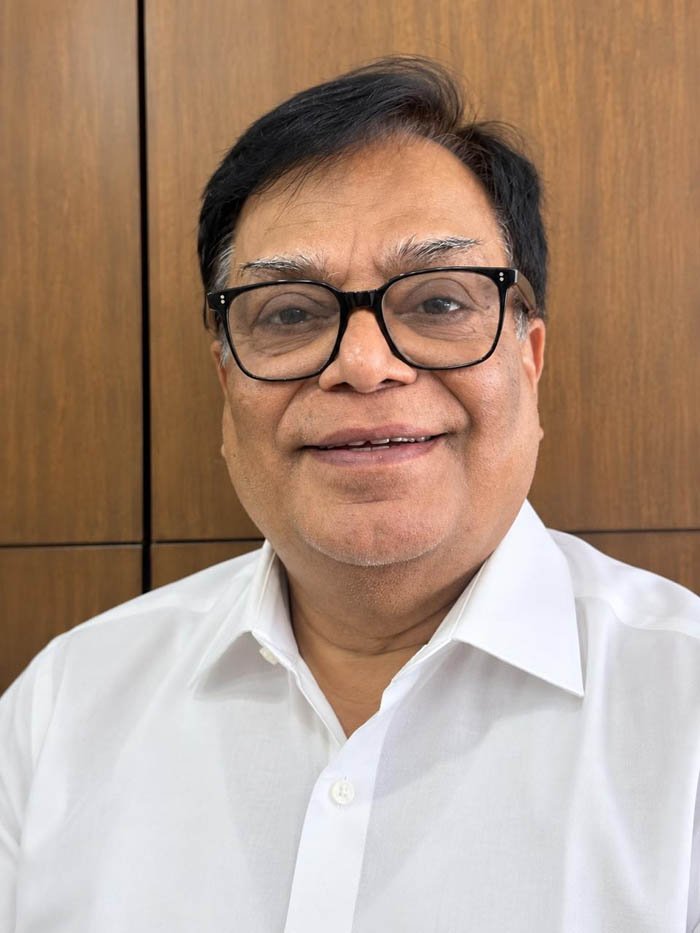
Rabi Dash is a recent entrant to the world of creative writing. After a lifetime of varied experiences and observations, he now writes primarily for the joy of storytelling and reflection. His interests include spirituality, history, human nature, and the small moments that reveal deeper truths. Writing, for him, is less a pursuit of publication and more a way of sharing thoughts, memories, and wonder with fellow readers.
He is a retired officer from the Indian Revenue Service (IRS) who served as the Director General of International Taxation and subsequently acted as a Member in the Tribunal for Prevention of Money Laundering.
THE SEVENTEENTH WEEK
Lopamudra Mishra
The morning sun slipped quietly through the curtains, painting soft patterns on the floor. She stood beside the window, one hand resting on the chair, preparing herself for the first few steps of another day. Every morning began with a silent conversation between her heart and her injured leg.
"Will today be easier?"
Sometimes the answer was yes. Sometimes it was only silence.
Before the accident, walking had never been a thought. It was simply life flowing forward. But on a quiet afternoon in March, a single fracture changed the rhythm of everything. The calendar continued turning its pages, but time inside her seemed to slow into tiny, measured steps.
The cast came first.
Then the waiting.
Then the questions.
Would she walk again without fear? Would the stiffness ever leave? Would the swelling disappear? Would life return to what it once had been?
Doctors spoke in weeks. Physiotherapists spoke in exercises. Friends spoke in encouragement. But none of them lived inside her body. None of them felt the strange ache that appeared without warning, or the frustration of watching one leg obey while the other hesitated.
The hardest battles were not fought in hospitals.
They were fought in the quiet hours.
Every evening she watched people walking outside her window. Children raced each other without thinking. Elderly couples moved slowly but confidently. Delivery boys hurried past. Life seemed so effortless for everyone else.
She never envied their speed.
She envied their freedom.
The mirror became both friend and stranger. It reflected a woman who smiled politely when people asked, "How are you now?"
"I'm getting better."
The answer was true.
It was also incomplete.
Getting better was not a straight road. Some mornings she felt almost normal. By afternoon her ankle swelled. Some days she walked with confidence. The next day her knee felt weak again. Every improvement seemed to arrive holding the hand of another challenge.
Hope became a disciplined habit rather than a feeling.
Physiotherapy was rarely dramatic. There were no miraculous moments. There were repetitions. Bend. Hold. Lift. Balance. Walk. Rest.
Again.
Again.
Again.
At times she questioned whether any of it mattered. Could a few simple exercises really rebuild a life interrupted by one unexpected fall?
Yet, week after week, invisible changes accumulated. Muscles remembered forgotten work. Bones quietly healed beneath the skin. Confidence, though fragile, slowly returned.
Recovery taught her a language no school had ever offered.
It taught her that healing is rarely visible while it is happening.
A seed does not become a tree overnight.
Neither does a wounded spirit.
The loneliness surprised her most.
People cared. They called. They asked questions. They wished her well.
But pain has a room where only one person can sit.
In that room she met impatience, fear, anger, gratitude, faith, exhaustion, and resilience. They visited like unexpected guests, each leaving something behind.
There were evenings she cried, not because the pain was unbearable, but because she wanted one ordinary day.
One day without calculating every staircase.
One day without thinking about swelling.
One day without wondering if tomorrow would finally be easier.
Then came the smallest victories.
Standing a little longer.
Taking ten steps without hesitation.
Sleeping without waking because of discomfort.
Climbing a few stairs.
Trying a gentle squat.
Stretching a little farther than yesterday.
To the world they were tiny achievements.
To her they were mountains conquered.
The fracture had not only broken bone.
It had broken certainty.
She had always believed effort guaranteed progress. But recovery introduced another truth: effort sometimes produces results too slowly for the impatient heart to notice.
She learned to celebrate fractions instead of miracles.
One degree more movement.
One minute more walking.
One little reduction in limping.
One morning with less fear.
Some afternoons she imagined the future.
She pictured herself walking through busy streets, travelling, attending cultural programmes, standing confidently before an audience, smiling without secretly measuring every step.
Those images became promises rather than fantasies.
Faith, she discovered, was not believing that healing would happen tomorrow.
Faith was continuing today's exercises despite not knowing exactly when tomorrow would arrive.
People often think courage appears loudly.
They imagine speeches, applause, dramatic victories.
Real courage, she found, was much quieter.
It was putting one foot in front of the other despite disappointment.
It was beginning again after an uncomfortable day.
It was refusing to let one difficult morning define the entire journey.
There were setbacks.
An ankle swollen after standing too long.
A knee that suddenly felt stiff.
A moment when the leg buckled unexpectedly, sending fear rushing through her mind faster than pain itself.
Each setback whispered, "Perhaps this is just unfolding ".
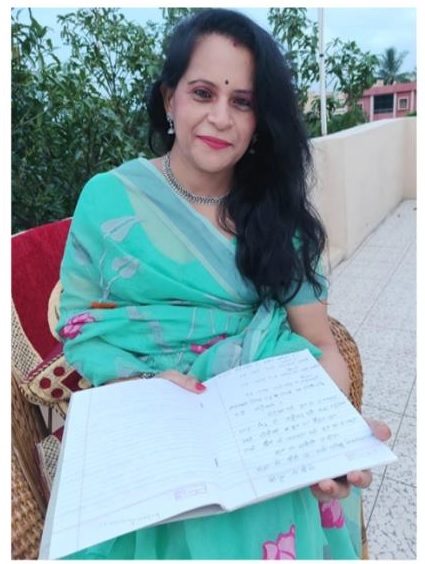
Lopamudra Mishra, a contemporary poet, author, translator, editor, social activist, motivational speaker, orator and personality development coach, hails from Bhubaneswar, Odisha.
Her writings are intended to touch the inner chord softly by emphasizing on "Sense and
Sensibility" of attachment and bonding. She has six books till date on her name- “Rhyme of Rain”,
“First Rain”,” Tingling Parables”, “Rivulet of Emotions”, “Red Tulips” and “Hurricane Heart under the Honeyed Sky”. Her poems have been published in various magazines and anthologies. She has been Editor of Radical Rhythm-4 & Co-editor of Radical Rhythm Series and Durga.
She is a proud alumnus of Sailabala Women’s college and Ravenshaw University.
SONG AND DANCE IN GANGSTER’S DEN
Anil K Upadhyay
If there is a dreaded gangster living on an island, especially fortified, you can trust our hero would make an entry in the climax. If the man has threatened that he would destroy our dear country India by deadly drugs or adulterated foodgrains, or missiles all loaded and targeted no time could be lost. If he has kidnapped the hero’s girl, all the more reason to make an entry. Nothing exceptional in that as it is not a Hindi film speciality. It is mistakenly believed that it is a trope of our films.
Bruce Lee entered the dragon to avenge his sister. After assessing the enemy, he slayed everyone. James Bond always entered the den, that was his raison d'être. He charmed the Gangster’s Mole enough in the bed to help him. In the Cold War era the enemy was Russia. The collapse of the Soviet Block led to a new search for the enemy. Chinese were very touchy people; they were not amused at any attempt to show them as the villain. Thus, the villain became a rogue scientist of an indeterminate nationality. It became absolutely necessary to liquidate him otherwise he would have threatened the entire world with his deadly secrets.
Sherlock Holmes did not desist from entering London’s den of dreaded criminals, or drug dealers, such as in Twisted Lips or Empty House or The Sign of Four. If he suspected that the game was afoot at some place, he would dash off to Charing Cross or Paddington to catch the 10.20 or 11.15 to some small station. He was a boxer in his school days. He would often display his skills, and was not averse to using weapons.
The Western hero often took on the outlaws single-handed in the Main Street, and he always drew the gun faster than the criminals. After doing what a man gotta do, he rode off into the sunset, without wating for the accolades.
There was one difference though in Hindi film heroes. Entering the gangster’s den was an important enough event and they were justified in making a song and dance about it. In many films they entered barely disguised, as head of a song and dance troupe. They often declared their intention they had come to finish the gangster. The dumb gangster sometimes joined the revelry; when he caught on to it there would be fighting for some time until he was prevailed upon. Sometimes, the cops arrived after everything was over.
1. Rang jamakar jayenge, chakkar chalakar jayenge, ghoom ke sabko ghumake jayenge by Rafi, Kishore Kumar, Shailendra Singh, Asha Bhosle and Usha Mangeshkar from Naseeb (1981), lyrics Anand Bakshi, music Laxmikant Pyarelal
Manmohan Desai was a man of excesses. He stretched the boundaries of disbelief. In this film, not only there were three heroes, he had assembled all the villains on the planet. Yet our heroes make an entry in full view with declaration of their intention – sabko ghuma ke jayenge, hero ko zero bana ke jayenge. This is my favourite song of the genre.
https://www.youtube.com/watch?v=kgAy5MEjKjg&list=RDkgAy5MEjKjg&start_radio=1
2. Yamma yamma yamma yamma, kya kubsoorat saman, bas aaj ki raat hai zindagi, kal hum kahan tum kahan by RD Burman and Rafi from Shaan (1980), lyrics Anand Bakshi, music RD Burman
In this one, the heroes enter even less disguised, and declare even more openly, Bas aaj ki raat hai zindagi kal hum kahan tum kahan. I find only one villain in the film, but one sadistic Kulbhushan Kharbanda (Shakal) whose favourite pastime is throwing men into a pool of boiling acid to maneater crocodiles, is good enough. That was a classic James Bond. After some ups and downs, our heroes prevail over Shakal. His dangerous island is all blown up, and the heroes make their escape in the nick of time.
https://www.youtube.com/watch?v=pk3JWY6KsmQ&list=RDpk3JWY6KsmQ&start_radio=1
3. Haan jab tak hai jaan jaan-e-jahan main nachungi by Lata Mangeshkar from Sholay (1975), lyrics Anand Bakhshi, music RD Burman
This is not a song and dance troupe entry in the Gangster’s den. Gabbar was the most dreaded gangster, yet at various points, Dharmendra, Amitabh Bachchan, Sanjeev Kumar enter the den. The girl has been perhaps abducted, drawing her lover who screams his famous dialogue, Basanti, in kutton ke saamne mat naachna. But to save her lover’s life she has to dance nevertheless.
https://www.youtube.com/watch?v=5mGfoHptxG4&list=RD5mGfoHptxG4&start_radio=1
4. Bijli giraane mein hun aayi, kahte hain mujhko hawa hawai by Kavita Krishnamoorthy from Mr India (1987), lyrics Javed Akhtar, music Laxmikant-Pyarelal
A most memorable entry in recent memory is by Hawa hawai girl. She is recognized by Mogambo’s henchman, and is recused by Mr. India. Mogambo realises now he can get the invisibility cloak he was after. Nothing would please him more than destroying India. Mogambo khush hua was his favourite line whenever he got the good news that pebbles had been added to grains, dust to atta, sand to cement, and adulterated drugs was klillng the children in droves, and so on. Finally, the hero deactivates the ballistic missiles which blow up the fortified island, but the hero, heroine and the kids make their escape in time.
https://www.youtube.com/watch?v=IgKdXLfxgQQ&list=RDIgKdXLfxgQQ&start_radio=1
5. O babul pyare roye paayal ki chham chham by Lata Mankeshkar from Johnny Mera Naam (1970), lyrics Indeevar, music Kalyanji-Anandji
This superhit film had many elements. Two brothers Mohan and Sohan separated at a young age – one growing as a gangster Premnath’s henchman Pran, Sohan becoming a CID officer, who takes different disguises to solve crimes. Therefore, you know Sohan would finally enter the den, where the brothers would discover their identity from their boxing cries as they used to box in childhood. In between, there was a comedian IS Johar who was actually three identical brothers – Pehlaram, Doojaram, Teeja Ram. There was Dev Anand’s love interest Hema Malini, too, in the den, who was searching her own father, held captive by the gangster. There is more mayhem now, the brothers’ identity is disclosed to the gangster, but he is ahead of theses guys. He gets the budhiya (their mother) abducted. All is well that ends well.
https://www.youtube.com/watch?v=SOsHkk75Z44&list=RDSOsHkk75Z44&start_radio=1
6. Duniya mein logon ko dhokha kabhi ho jata hai by RD Burman and Asha Bhosle from Apna Desh (1972), lyrics Anand Bakshi, music RD Burman
Rajesh Khanna is incorruptible which makes him inconvenient to his crooked bosses. They try to bribe him, but he is smart to get out of their plans. But they abduct his brother. It has become imperative to enter the den in disguise to rescue him. In this scene you see our popular senior-bald comedian and two comic villains who, like an idiot,a take part in the song and dance.
https://www.youtube.com/watch?v=ZaM6F7gmNAA&list=RDZaM6F7gmNAA&start_radio=1
7. Mera naam hai chameli main hun maalan albeli chali aayi main akeli Bikaner se by Lata Mangeshkar from Raja Aur Rank (1968), lyrics Anand Bakshi, music Laxmikant-Pyarelal
By now Laxmikant-Pyarelal were getting the best projects, or they had magic in their compositions to turn everlasting songs making the films they figured in, super duper hits. This is not a classic song and dance troupe entry. But Kumkum, lip-synching Lata Mangeshkar did not need any props. She was sufficient to lit up the screen. The prince and pauper are identical looking, but born to different parents (doppelganger) at the same time, and grow up in different financial circumstances. Fate brings them face to face with each other, and they decide to switch identities causing no end of troubles to both the families. The flower-woman from Bikaner charms the jail guard for her to make an entry.
https://www.youtube.com/watch?v=_XkYXXrByx0&list=RD_XkYXXrByx0&start_radio=1
8. Gore nahin hum kale sahi, hum nachnewale gane sahi, tum sa ek nahin by Laxmikant Kudalikar and Asha Bhosle from Desh Premee (1982), lyrics Anand Bakshi, music Pyarelal
This dance song and the film is another example of Manmohan Desai excess. Since Amitabh Bachchan was a superhit hero, I remember he inflicted two of them. Since he revelled in multi-starrers, the film had many more – it was not clear who was doing what. The Mahanayak from Bengal, Uttam Kumar, was in the role of a small-time Sikh goon. Sad end to his forays in Hindi cinema. Hindi cinema was fit for Biswajit and Joy Mukherjee. Bollywood had its way of putting down any intellectual pretensions. The sadi ke Mahanayak, the Big B was MMD’s favourite. The older one was the Desh Premee, whom you can see at the dining table. Therefore, this one must be his waster of a son. With overdone black colour on his face and that of his beloved Hema Malini, they enter the gangster’s den leading a song and dance troupe. They prevail over the goons, redeeming themselves in the eyes of the Desh Premee.
https://www.youtube.com/watch?v=z4Y1T2NUuvg&list=RDz4Y1T2NUuvg&start_radio=1
9. Kahin pe nigahein kahin pe nishana by Shamshad Begum from CID (1956), lyrics Majrooh Sultanpuri, music OP Nayyar
This is a wonderful composition by OP Nayyar in the film with all the songs superhits. The hero Dev Anand, A CID inspector, has entered the den, and the beautiful gangster’s mole in a proper dress falls for the charming hero. The gangster’s henchman suspects something, but the mole sends a coded message to the CID Inspector through this song: Aaya shikari O panchhi tu smbhal ja, ek jaal hai zulfon ka tu chupke se nikal ja, ud ja wo panchhi shikari hai diwana. Waheeds Rahman was so beautiful; why did she have to die in the film? The cultural context is clear. Her association with gangster’s den makes her morally tainted, and secondly, Dev Anand already had Shakila in the film and our films did not permit ménage à trois those days. This was akin to solving a triangle by elimination of a superfluous side.
https://www.youtube.com/watch?v=iTg4ga4ffa0&list=RDiTg4ga4ffa0&start_radio=1
10. Maar diya jaye ki chhod diya jaye bol tere saath kya sulook kiya jaye by Lata Mangeshkar from Mera Gaon Mera Desh (1971), lyrics Anand Bakshi, music Laxmikant-Pyarelal
A reformed petty criminal Darmendra is employed in the village for farming where he falls in love with Asha Parekh. The dreaded, handsome dacoit, Vinod Khanna, with handlebar moustache is terrorising the village, and now the righteous Dharmendra decides to take on the dacoit. As a revenge, he abducts the heroine and asks Dharmendra to come alone. The dacoit now holds him captive too and ties both the hero and the heroine to trees. Now their fate lies in the hands of Laxmi Chhaya who performs this dance song. She acts as if she is going to kill them, but she has her own axe to grind for all the slights she had to suffer at the dacoit’s hands. As the dacoits fall into sleep by overdrinking, Laxmi Chhaya cuts the ropes of Dharmendra and Asha Parekh to set them free.
https://www.youtube.com/watch?v=APjCgLx8TJg&list=RDAPjCgLx8TJg&start_radio=1
A retired IAS Officer of 1975 Batch (Bihar cadre) Anil Kumar Upadhyay retired as Secreatry, Ministry of Road Transport & Highways - cum - Chairman NHAI. Post retirement he was posted as Member (Administrative) Central Administrative Tribunal. A reputed aficianado of Hindi music he runs a blog "Songs of Yore" which attracts thousands of music lovers from India and abroad.
Rishi entered the room eleven days after they had carried her away from there. Everything looked neat and carefully looked after. His mother always liked things to be kept in their appropriate places. There was not a single crease on the bedspread. The pillow covers too looked washed and perfectly fitted to the pillows.
His sister perhaps had kept the room in its right shape. The wooden idol of Lord Jagannath that stood on the top of the closet did not have a speck of dust on it. The mirror fitted to the door of the closet too was dusted and polished. The TV set, the writing table and the large book case filled with many books of English and Hindi and Odia which his mother had either bought and collected ...everything looked neat. The assortments of decorative pieces on the shelves looked the same as they used to look years ago.
Rishi looked at his father who lay
on the armchair, looking sightlessly at the roof. His father who loved to talk and snapped at mother at the smallest slip had suddenly become mute. The tastefully furnished room sagged under the load of a strange silence.
A blue cylindrical object lying at one edge of the top of the closet caught his eyes. Curious, he pulled it out carefully. An umbrella, that was perhaps bright blue once but now had gone patchy and faded, was kept neatly folded in its plastic cover.
He remembered the umbrella. It was the same one his mother used to carry in her handbag while going to office. She held it over his and his sister's head while they walked to the the school which was some three hundred meters away from their home. During those days children did not go to school in the school bus or in their parents' car or on the bike of the father, like they do now. They mostly walked to the school.The umbrella served a double purpose. It protected him and his sister from rain when it rained and from the heat of the sun too. Mother never let them walk without the protective shade of the blue umbrella. The umbrella, like his mother always held its caring drape stretched over her children, anxious to keep all the trouble at bay.
He had forgotten the umbrella after leaving school. He studied higher secondary for two years in a local college and then left his hometown. Later he went out of state for doing a specialized course. Life had been so rushed that he did not find time to communicate much with his mother. Most of his conversations were with his father. His sister too got married in the meantime. Somehow, he shrank inside as he confessed to himself, he had begun to feel indifferent towards his mother, as if he had lost the need of her in his life. Father continued to snub mother as ineffectual and incompetent as he had been doing all through out drowning mother's feeble protests with his loud counter arguements. Rishi and his sister too had now realized that their mother knew nothing much about outside world.
A laconic, self-contained person, mother never tried to defend herself or explain things to the children whom she had given birth and reared up with utmost care.
She did not dress in the way sophisticated ladies did. She wore her hair in a long braid, did not apply make up to her face. Rishi could not remember a day when mother had clad herself in an expensive sari or did her hair in modern fashion. All put together, his mother to Rishi, was an outdated woman who loved to live in the past. The glamour of the institute where he did his specialized course had gone into his head. Whenever her mother wanted to pay a visit to the hostel, Rishi stopped her on several pretexts.
He remembered the convocation ceremony. Almost all the students had invited their parents. But Rishi had shied away from the thought. Father could have come but he was afraid that if father mentioned the convocation ceremony mother might want to accompany him
So he did not let them know about the ceremony. Later, mother had learnt about it from one of her colleagues whose son also studied in the same institute. 'Have you not told aunty about the convocation ceremony?'
His friend asked. 'Why do you ask that?'
'She said she did not know about the function when my mother asked her why she didn't come,' his friend said.
'I told her. She might have forgotten it. You know she keeps so busy ...'
Rishi was preparing excuses to justify his fault as he travelled home in the holidays that followed the function.
But mother never mentioned it. She got busy in preparing the dishes he loved and taking all care to see that he spent his days at home in comfort and happiness. The day on which he returned to the institute his mother got up early in the morning, did the puja and made breakfast for him. She had packed snacks and sweets in plastic jars for him. For a brief moment as he bid goodbye he looked into his mother's eyes. There was something in them he could not describe but which made him feel guilty. It appeared as if she strove to push back words that were about to escape her defying all her resistance.
Thereafter whenever he met his mother he found her strangely quiet..She never made him feel that she was trying to distant herself from him but he could sense it and felt ill at ease in her presence. He got a job and was posted in another city. Mother came and arranged things in his new house. Both father and mother stayed there for a few days and left. He too got married after a couple of years. Mother loved Sheila, his wife and cared for her in the same way she did for him.
Though not obvious but the distance between them some how increased after his marriage. Mother and father came to live with them after his son was born. They were very happy and spent most of their time with their grandson. Since he and his wife worked in a multinational company and had to leave home around eight in the morning mother had to take care of the household responsibilities. She had to look after the baby too which in itself was a full time job. Sometimes he felt guilty to burden his parents especially his mother with these responsibilities at this age but he too had no alternative. May be mothers are, as his father often commented, are taken for granted people.
If she felt overworked or weary mother never complained. She appeared to be really enjoying herself in the company of her grandson. However his wife was not too happy about the way mother cooked traditional dishes of his choice. Like all women she also had her dreams of cooking new items for her husband. But she had no choice too.She had to depend on her parents-in-law for the safety and proper rearing up of her child. But she was dissatisfied with the whole arrangement. Rishi realized that his wife disliked her mother-in-law's extra involvement in certain matters, especially her interest in cooking special dishes for her son and the rearing up of the baby. Mother liked to feed the baby the food which she used to feed her own children. But his wife was in favor of following the nutrionist's diet plan for the baby. Though she never expressed it Rishi could understand his wife's unspoken resentment. He also understood that it was his duty to keep his wife happy. He recollected how he had adopted an apparently discrete way for doing so.
'I have made coconut cutlets, your favorite', mother said, coming out of the kitchen. 'Taste this one...' she put one cutlet on the plate. Rishi and his wife were eating a quick breakfast. His wife cast a glance of disapproval at Rishi. Rishi picked up the cutlet and kept it aside on another plate. 'Pack them in my lunch box mother, ' he said, 'we will eat it during lunchtime.'
'I have packed them for both of you in your respective lunch boxes. This one is just for tasting..'
'We are getting late,' Rishi cut in. 'There is no time for tasting it. We will eat it with our lunch', he said and got up.
He knew he sounded rude but he had no choice. 'Mother would forget it. She never minds my words,' he thought to himself and left for the office.
He couldn't detect any sign of accusation on mother's face when he and his wife returned in the evening. Mother and father were playing and laughing with his son and looked happy. But, Rishi could now recollect, mother had thereafter never urged him to eat any of her specialties. She would cook and serve but never ask to eat more as she had been doing. Every thing seemed to have become very formal. He had not taken note of it at that time. The memory of one after another such incidents like this, which he had not cared to take seriously then, came flooding back, drowning him in a deep sense of regret. After his son started going to school, mother and father returned to their hometown. A year or so after Rishi and his wife left India to settle abroad.
His father, who was used to touring places while he was in office, found it difficult to spend long hours at home. And he took his frustration and boredom out on mother. Mother too had retired but her retirement was not taken seriously as her doing a job. Rishi and his wife mostly communed with father. Mother only wanted to ensure that they were all happy and in good health.
She hardly discussed anything beyond that.
Perhaps, Rishi tried to reason now, father would have cut her short or snapped at her if she tried to prolong her conversation with her son.
Rishi could not remember any occasion since his childhood when his mother had countered his father. That might be the reason why he and his sister had got to ignore their mother's advice and suggestions, and believed her to be thoroughly incompetent and useless as other family members did. Even after all these years it was father who dominated the conversation.
Now as he stood holding the umbrella neatly packed in its plastic cover he realized why the woman who had spread out herself like an awning of love and protection over them became cocooned inside a closed world. She had ungrudgingly folded herself and squeezed into the cover of her self-rejection.
Rishi took the umbrella out of its cover and opened it. He held it over his head for a while and then folded it. He ran his hand over the cloth that had gathered the patina of time over it and then put it back inside its cover.
His wife was doing the packing. They would be leaving the next day. His sister would stay for some more time with father and make the necessary arrangements.
'What is this?' His wife asked, holding out the blue umbrella. 'Why have you put it here in this suitcase?'
'I will take it,' Rishi said grimly, 'pack it along with my clothings'.
'But...' His wife tried to say something but held her words back.
'I will take my mother with me ... she has always tried to keep me close to her but has always been cruelly defeated. From now on she will always be with me.' Rishi promises to himself as he wiped his eyes.
Dr.Snehaprava Das, former Associate Professor of English, is an acclaimed translator of Odisha. She has translated a number of Odia texts, both classic and contemporary into English. Among the early writings she had rendered in English, worth mentioning are FakirMohan Senapati's novel Prayaschitta (The Penance) and his long poem Utkala Bhramanam, which is believed to be a.poetic journey through Odisha's cultural space(A Tour through Odisha). As a translator Dr.Das is inclined to explore the different possibilities the act of translating involves, while rendering texts of Odia in to English.Besides being a translator Dr.Das is also a poet and a story teller and has five anthologies of English poems to her credit. Her recently published title Night of the Snake (a collection of English stories) where she has shifted her focus from the broader spectrum of social realities to the inner conscious of the protagonist, has been well received by the readers. Her poems display her effort to transport the individual suffering to a heightened plane of the universal.
Dr. Snehaprava Das has received the Prabashi Bhasha Sahitya Sammana award The Intellect (New Delhi), The Jivanananda Das Translation award (The Antonym, Kolkata), and The FakirMohan Sahitya parishad award(Odisha) for her translation.
THE CHILD IS THE FATHER OF MAN
Usha Surya
I was sipping hot tea in Padma’s house. I had gone there on a visit to discuss the final arrangements for the Diwali Celebrations we were to have in our Gated Community.
Padma had called me and said. “I am on my way Janu. Stopping at the grocer’s for a while and will be home in fifteen minutes. Ask Kala to make you a strong ginger tea and wait for me.”
And so I was at Padma’s house, relishing the hot ginger tea prepared by her cook Kala and taking bites from the ginger cookies in between. Padma was a great baker and she had baked this heavenly stuff
“Hi Aunty” piped Padma’s daughter Ramya as she barged in straight in from school and without waiting for my response dashed off to her room to change from her uniform to casual clothes after having her wash.
I finished drinking my tea and eating the biscuits.
“I’ll talk to Kala and join you aunty” she said and headed towards the kitchen.
She had a tablet in her hand ( not the ‘medicine
but the technical thingummy today’s kids are mostly armed with these days).
I sighed.
If there is something that annoys me these days it is these ‘accessories” that have become a part of today’s kids.
Children rarely play outdoors now! You can see them hooked on to their phones and their dainty fingers working busily ( furiously) at these modern ‘technical monsters ‘. What a loss of childhood!! I temember as a kid, rushing out after swalloing my milk and ‘tiffin’ and playing with the kids of my age. We would climb trees or play ‘I spy’ or hopscotch...
Ramya headed straight to Kala in the kitchen who was rolling out rotis.
She smiled at Ramya and asked her in broken English “Now..what will I give you? Eat or drink?”
Ramya was seen typing furiously on her tablet and then held it up to Kala.
Out of sheer curiosity I walked towards them.
Kala knew only Hindi and Telugu. This little girl knew only English, Spanish and French. She could ‘understand’ Tamil, her mothertongue but rarely spoke the language !! Now, how will she - wnen her parents spoke to her in English always? No way.
The little girl held up the tablet to Kala who read and nodded her head.
Ramya saw me and said, “Come aunty and sit with me . Mom will be back soon,” and both of us sat at the dining table.
“What was that Ramya? Kala Knows English? Why did you not speak to her but showed the phone?”
She laughed and said, “ No aunty. I typed in English that I wanted banana slices in chocolate milk and some peanuts and two cookies. She will bring them to me. I type in English and go to the Google Translater and get my sentence tanslated into Telugu. She reads them and gets me what I want!!”
I stared at her an amazement!!
I saw Kala bringing a tray with a bowl of chocolate milk, bananas , a few peanuts and the cookies. Ramya smiled at her and said “Thank you” sweetly.
She startd having snacks ... this nine year old kid!
These gadgets ARE useful!!
I told myself!! What a fine way to get things done! And as I watched Ramya cleared the table and placed everything in the kitchen sink and smiled at me and said, “ I am off to play Aunty. Bye,” and ran out.
I heard Padma’s voice soon.
“Hi sweetie. Off to play? Okay but come as soon as the street lights come on ,okay?”
Did I learn something today?
Usha Surya.- Have been writing for fifty years. Was a regular blogger at Sulekha.com and a few stories in Storymirror.com. Have published fifteen books in Amazon / Kindle ... a few short story collections, a book on a few Temples and Detective Novels and a Recipe book. A member of the International Photo Blogging site- Aminus3.com for the past thirteen years...being a photographer.
CHANDRA HAIR CUTTING
Jacintha Morris
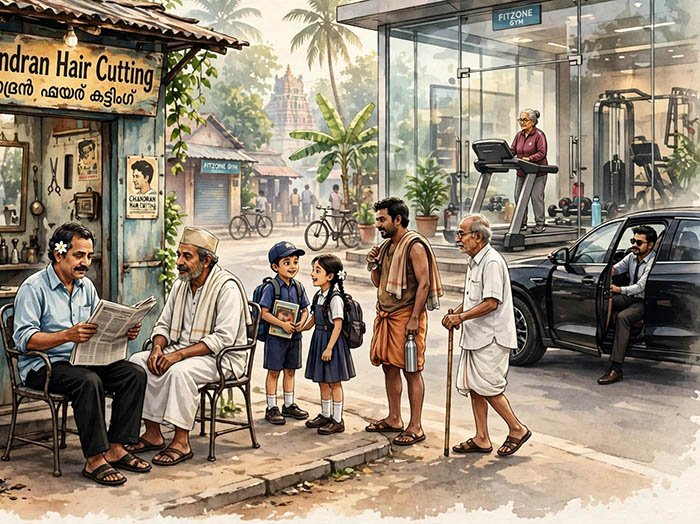
(Translated from Malayalam by Sreekumar Ezhuththaani)
Thirty-seven years.
Spent three-fourths of my life in government service.
When I retired, what I got in my hands were a pension and a few terminal benefits. Along with them came some unsolicited gifts: a worn-out spine, swelling all over my body, and chronic respiratory issues from breathing in dusty old files.
My financial benefits dwindled with time. But the health issues? They just kept multiplying.
Thinking, "At least I should enjoy my retired life," I decided the first step was to get fit. So, I joined a gym.
Gyms aren’t what they used to be a quarter-century ago. Back then, it was just a few basic machines... now? AC, glass walls, smart setups, heavy weightlifting, and the works.
Walking in, I was low-key shook. Not a single senior citizen around. Mostly school kids, college students, and Gen Z.
Some looked like actual skeletons, but were grinding away at workouts as if winning Mr. Olympia depended on it. Most of them didn't even notice me.
I felt like some phantom ghost completely invisible to their radar.
Seeing them lift heavy weights like it was nothing, I felt tempted too, but didn't dare try. Because with a stomach sticking out like a permanent baby bump, there are bound to be single-celled life forms multiplying in there without permission. If all that heavy lifting unleashed the gas they produce, a rogue fart would totally destroy me.
So, I played it safe and stuck to the treadmill and exercise cycle for longer stretches.
While working out, you get a clear view of the shops lining the main road. One of them is 'Chandran Hair Cutting'.
Right at 7:00 AM sharp, the shop owner shows up. Let's just call him Chandran, since we don't really know his name.
Total vibe! A newspaper tucked under his arm, and a tiny bit of jasmine or crossandra flowers tucked behind his ear.
He pulls out the key tucked away in the roof rafters and unlocks the shop. Then, taking an empty can, he heads to the next house to fill it with water. He waters the money plant in the pots outside and a Chinese feng shui plant that’s supposed to "bring good luck." Finally, he grabs a twig broom, sweeps up the dry leaves, and sets them on fire.
Eventually, he pulls out two iron chairs from inside and places them outside. Sitting on one, he starts reading the newspaper.
Most days, he wears a light blue shirt and black pants.
Shortly after, an elderly guy rolls up on a bicycle wearing a cap. He parks his bike right in the middle of the shop entrance with supreme authority, then takes the vacant iron chair right next to Chandrettan.
Chandrettan hands over the read pages of the newspaper to him. And just like that, the two of them sit together and read the paper, followed by some heavy-duty discussions.
From across the road, while grinding away on the treadmill, I couldn't hear what they were talking about through the glass panes. But I could see them. Both nodding along in sync.
Right in the middle of all this, customers keep popping in.
Chandrettan immediately gets up and heads inside. Through the half-closed door, I can catch shadowy glimpses in the dim light—making the customer sit in the rocking chair, draping a sheet over them, and snipping away with scissors.
Once the customer leaves, he walks back out and picks up the conversation right where he left it with his cycling buddy.
I soon realized how popular Chandrettan is with everyone passing by, as they constantly greet each other.
From little kids to seniors walking with walking sticks, people flock to this shop. It's honestly mind-blowing! A tiny shop cobbled together with a few asbestos sheets at the front of a building. Zero modern amenities.
Some people walking in look like they could be homeless; others look fresh off manual labor jobs, completely covered in dust and mud.
On top of that, big shots and high-rollers pull up in premium cars and bikes just to get a haircut at this very spot.
What's the secret sauce here? We've all heard stories of ice cream parlors booming because they secretly spiked their scoops. But what's pulling people into this tiny room?
I had to figure it out. My inner curiosity went into overdrive mode, and my eyes basically turned into micro-lenses.
That's when I finally spotted it.
A guy who looked like a total vagrant walked in for a haircut. Messy clothes, greasy, long, unkempt hair. The first customer of the day.
Time dragged on. Ten minutes passed. Outside, more customers lined up patiently, waiting their turn.
Then out walked an absolute hunk! Wait, who is this? When did he even go in? I totally missed it!
That's when my eyes zoomed in on his outfit. Wait, isn't this the exact same dude who walked in looking like a roadside wanderer earlier?
My eyes refused to process what I was seeing. A complete transformation in ten minutes flat felt straight-up illegal.
The kind of glow-up you wouldn't get even after spending thousands at high-end luxury salons.
He looked younger, sharper, and his confidence was visibly unlocked.
That was my lightbulb moment. Just like chefs, farmers, architects, and doctors have their unique touch, barbers running roadside shacks have their own magic touch too.
"Ma'am, are you done with the exercise cycle?"
A young girl. She wanted me to free up the treadmill. That's why she asked.
Even in her words, I caught a glimpse of that exact same effortless touch.
With a smile, I happily gave up the treadmill to the next-gen.

Jacintha Morris, a well-known social worker and a trilingual author from Kerala, is a multifaceted personality. She writes, sings, dances, organises fashion shows, acts and makes films. This is her first contribution to Literary Vibes.
The Shore He Had Prepared
Disclaimer
Inspired by real people and life experiences, this story blends reality with imagination. While its emotional foundations may be drawn from life, the narrative, characters, and events have been shaped by the author’s creative interpretation. It is, ultimately, a work of fiction.
—
The Story Begins
Captain Arvind Rao had spent thirty-five years at sea. He had commanded cargo ships carrying iron ore, coal, grain and containers across oceans where the weather could turn hostile without warning. He had sailed through the Arabian Sea during the fury of the monsoon, crossed the Indian Ocean under endless skies, and navigated narrow channels where a moment’s inattention could cost millions of dollars and, sometimes, human lives.
He had learnt to trust instruments, respect procedures and make decisions when others were still weighing their options. His officers knew that he expected punctuality, precision and discipline. His crew respected him, though not everyone found him easy to approach.
Arvind was not a man who raised his voice unnecessarily. He did not need to. A brief instruction from him usually carried sufficient weight.
At fifty-eight, he retired from active command with a record he had every reason to be proud of. His finances were in order, his children were settled, and he had provided well for his wife, Meera. He had saved carefully, invested prudently and avoided the financial recklessness that had ruined several men he knew.
Retirement, therefore, appeared to him less like an ending and more like the beginning of a well-earned second innings.
For years, he had spoken of the life he would lead once he came ashore for good. There would be books to read, memoirs to write, old friends to meet and places to visit. Most importantly, there would be time for Meera.
During his long absences, she had learned to live alone, managed the home, brought up the children, attended family functions alone and dealt with the ordinary emergencies of life without the comfort of having her husband around. Arvind knew this, although he had never fully understood what such a life demanded of her. In his mind, his absences had been unavoidable. The sea had been his profession, and his profession had provided the security they enjoyed.
Now, at last, he would make up for lost time.
The Retirement Plan
He had spent considerable thought and money preparing their retirement home in Mumbai. It was a large terrace flat in a good residential locality, spacious enough for two people to live comfortably without getting in each other’s way. The living room opened into a broad terrace where Meera could keep her plants and sit in the morning sun. One room had been set aside as his study, with bookshelves, a writing desk and a comfortable chair. The spare rooms would accommodate visiting children and friends.
He had personally supervised the furnishing. He had compared quotations, checked measurements and insisted on good-quality fittings. The electrician had to return twice to correct the placement of the lights in his study. The carpenter had been asked to adjust a shelf because it was not perfectly level.
Meera had watched these preparations with amusement.
“You are furnishing a home, Arvind, not fitting out a ship,” she had told him once.
“A home also needs proper planning,” he had replied.
She had laughed. “Of course. I should have known.”
He had not noticed the affectionate irony in her voice.
The terrace flat represented more than property. It was a promise he had made to himself and, indirectly, to her. After years of departures and arrivals, they would finally have a place where neither had to count the days until the next sailing.
He imagined leisurely breakfasts, evening walks and conversations that did not have to be fitted into a telephone call between port operations. He would write his memoirs. Meera would pursue her interests in painting and music. They would travel when they pleased, entertain friends and perhaps discover that they had more in common than the practical business of running a family.
He had drawn up a list of things to do during the first six months of retirement. It was neatly typed and divided into categories.
The first item was to arrange his study.
The second was to organise his papers.
The third was to begin his memoirs.
Meera had suggested that they should first spend a month doing nothing in particular.
“Doing nothing is not a programme,” he had said.
“Perhaps that is exactly what retirement should be,” she had replied.
He had smiled, assuming she was joking.
The first few weeks were pleasant. Arvind woke early, went for a walk, read the newspaper and checked his emails. He arranged his books, sorted documents accumulated over decades and spoke to former colleagues. People continued to address him as Captain, and he enjoyed the respect that came with the title.
He had not realised how much of his identity had become tied to it.
Then came the telephone call from Pune.
A Responsibility Ashore
Meera’s father, whom everyone called Baba, was finding it increasingly difficult to manage on his own. His mobility had declined, and the ordinary routines of daily life were becoming burdensome. Meera’s unmarried aunt, known in the family as Bua, lived with him and had been looking after many things. But she too was ageing, and her own health was no longer as dependable as it once had been.
They were not helpless. They were, however, reaching a stage when living without regular family support was becoming difficult.
Meera listened quietly as her father explained the situation. When she put the telephone down, Arvind saw the worry on her face.
“We must go to Pune,” she said.
“For a visit, certainly.”
“Not just a visit, Arvind. We need to see what arrangements are required. Baba cannot manage everything himself, and Bua cannot be expected to do it all.”
Arvind looked towards the terrace, where the morning light fell across the pots he had helped arrange.
“We have only just settled here.”
“I know.”
“We have not even begun the things we planned.”
“I know that too.”
He waited for her to add something that would make the decision easier. She did not.
He disliked situations in which the correct course of action was obvious but inconvenient. In his professional life, inconvenience had never been a sufficient reason to abandon responsibility. He could hardly apply a different principle at home.
“All right,” he said at last. “We shall go and assess the situation.”
The words came naturally to him. They suggested that the problem could be examined, broken into parts and resolved.
He began making arrangements that evening. He checked travel options, listed the medicines his father-in-law was taking and asked Meera to collect the latest medical reports. He also began thinking about domestic help, transport and the possibility of arranging regular visits by a doctor.
They travelled to Pune, intending to stay for a few weeks.
They stayed much longer.
A Different Kind of Command
Pune greeted Arvind with the familiar mixture of traffic, construction, dust and the unhurried confidence of a city that had grown faster than its roads. He had visited several times over the years, but a visit was different from a stay. On a visit, one noticed the restaurants and the weather. On a stay, one discovered the chemist who closed early, the plumber who promised to come tomorrow, and the driver who was never available when one needed him.
Meera’s father lived in an old house in a residential part of the city. The building was well maintained, but the entrance had steps that were becoming difficult for him to negotiate.
His sister, Bua to Meera and Arvind, had lived there for years. She was a big, sharp-eyed woman who had never married and had long regarded the household as her responsibility. She knew the habits of every shopkeeper in the neighbourhood and could tell from the sound of the pressure cooker whether lunch was ready. Her independence was a matter of pride, not merely habit.
When Arvind entered the house, she greeted him warmly.
“So, Captain Sahib, you have finally come to inspect our little ship.”
Arvind smiled. “I hope the vessel is seaworthy.”
“More or less,” she replied. “But the chief engineer is getting old, and the crew is not what it used to be.”
Meera laughed. Her father, seated near the window, smiled at the exchange.
For the first few days, Arvind observed. He accompanied Baba to the doctor, checked the medicines and noted the dates of the next appointments. He inspected the bathroom, the lighting and the arrangements for meals. He contacted agencies for domestic help.
Within a week, he had prepared a schedule.
Medicines were listed by time. Medical appointments were entered into his phone. Emergency numbers were written on a sheet and placed near the telephone. He arranged for a helper to come in the morning and a local shop to deliver groceries when required.
The results were encouraging. Baba appreciated the orderliness, even if he occasionally forgot to follow the schedule. Bua was relieved to have some of the physical work taken off her shoulders.
But Arvind’s efficiency had a price.
He began correcting things that had never seemed to need correction before. He questioned why the medicines were kept in one cupboard rather than another. He wanted the helper to arrive at a precise time. He suggested that meals could be planned more systematically.
“I have managed this house for forty years,” Bua told him one afternoon. “We have not done too badly.”
“I am sure you have not,” he replied. “But a little organisation will make things easier.”
“For whom?” she asked.
He did not immediately understand the question.
Meera understood it perfectly.
One evening, she found him reviewing the medical bills at the dining table.
“Everything is under control,” he announced.
“Good.”
“The doctor says Baba is stable. The helper is reliable. We have arranged transport for appointments. I think we can return to Mumbai in a few weeks.”
Meera sat opposite him.
“Arvind, I think we should stay a little longer.”
He looked up. “Why? We have made all the arrangements.”
“Arrangements are not the same as support. Baba gets anxious when he is alone for too long. Bua is managing, but she is tired. And there are things they do not tell us because they do not want to trouble us.”
“Then we should arrange more help.”
“Perhaps. But they also need us.”
Arvind put down his pen.
“I am here, am I not?”
“Yes. But you are here as a manager. You want to make everything work and then leave.”
“That is an unfair description.”
“Is it?”
He felt the familiar irritation of a man whose competence was being questioned. He had spent decades solving difficult problems. He was not accustomed to being told that the solution itself was inadequate.
“I am trying to help,” he said.
“I know you are. I am not asking you to stop helping. I am asking you to understand what help means to them.”
He had no immediate answer.
Over the following weeks, he began to see what Meera meant. Baba sometimes wanted company more than assistance. He liked to sit with Arvind after dinner and talk about old friends, politics and the changes in Pune. Bua wanted someone to accompany her to the temple occasionally, not because she could not go alone, but because she enjoyed having company.
Neither need could be entered into a spreadsheet.
At sea, the captain’s decisions had consequences for the entire vessel. At home, Arvind had carried that authority ashore without noticing that the people around him were not his crew.
He could arrange care, reduce risks and ensure that appointments were kept. What he did not know was how to sit beside an ageing man without feeling that he ought to be doing something, or how to help a proud woman without making her feel that her life had been taken over.
He was learning, slowly.
A Housekeeper and a New Arrangement
The first serious medical scare came one night when Baba became suddenly weak and nearly fell while trying to get out of bed. Arvind called for an ambulance, and Meera accompanied her father to the hospital. Bua remained at home, frightened and exhausted.
The doctors examined Baba, ran tests and kept him under observation. There was no single dramatic explanation that settled everything at once. His age, his existing medical problems and the possibility of dehydration all had to be considered.
The night passed slowly.
Arvind moved between the nurses’ station and the waiting area, collecting information, making calls and ensuring that the admission formalities were completed. He was useful, calm and methodical. Yet he was increasingly restless at the number of things he could not control.
By morning, Baba was stable. The doctors advised continued observation and regular follow-up.
When they brought him home, Bua was waiting with tea. She had barely slept.
“See, Captain Sahib? I am not ready to abandon ship yet,” Baba joked weakly.
Arvind smiled. “Good. We still have work to do.”
Everyone laughed, but the incident had changed something. It had shown them that the existing arrangements were not enough and that they could not rely on Bua to manage everything indefinitely.
It also made Meera and Arvind confront a practical question. How could they care for Baba and Bua without giving up their own retirement altogether?
Their children were settled abroad. They had their own families and responsibilities. They could visit, but they could not be present every day. Meera and Arvind were the family members best placed to provide regular support, yet neither of them wanted their remaining years to become a continuous round of medical appointments and household emergencies.
One evening, while they sat together after dinner, Meera suggested a solution.
“Why don’t we find a kind, dependable lady who can work as a cook-cum-housekeeper and stay here for extended periods?”
Arvind considered it.
“Someone who can live in the house?”
“Yes. We would provide her lodging and boarding. She could look after the cooking, help with the household routine and remain available when we need to travel for a few days.”
“And what about her leave, working hours and other arrangements?”
“We will work those out fairly. I am not suggesting that she should be available every minute. But we need someone who is comfortable living here and who genuinely cares about the people she looks after.”
Arvind was silent for a while.
His first instinct was to think of the difficulties. Finding a suitable person would not be easy. Trust would have to be established. Duties and expectations would need to be clear. There would be the question of reliability, particularly when they were away.
Then he looked towards the adjoining room, where Bua was helping Baba settle down for the night.
The alternative was to expect two ageing people to manage with occasional help, while Meera remained permanently tied to the house.
“All right,” he said. “Let us look for someone suitable.”
They were fortunate. Through a local contact, they found a compassionate, middle-aged woman who had experience working in family homes. She was comfortable with the idea of staying for extended periods, provided her duties, rest days and personal arrangements were agreed upon in advance.
Meera spent time talking to her before making a decision. Arvind checked her references and discussed the practical details. They agreed to provide her with a room and meals in the house, along with appropriate time off and a fair arrangement for her work.
The woman, whom they came to know as Shanta, proved dependable and considerate. She was not a trained nurse, and they did not expect her to be one. Her role was to manage the household, prepare meals, help with ordinary daily needs and ensure that Baba and Bua were not left without support during the periods when Meera and Arvind travelled. Medical emergencies would still require professional assistance.
Bua was initially suspicious.
“Will she now decide what I should cook in my own kitchen?” she asked.
Meera laughed. “No, Bua. You can still be the chief cook whenever you feel like it.”
“And who will decide whether I feel like it?”
“You will,” Arvind said, before Meera could answer.
Bua looked at him with surprise.
He smiled. “We are arranging help, not taking over your house.”
She seemed satisfied.
Over time, Shanta became a familiar and reassuring presence. She learnt Baba’s habits, understood Bua’s preferences and managed the household without unnecessary interference. There were occasional misunderstandings, as there would be in any home, but the arrangement worked.
For the first time since their arrival in Pune, Meera could leave the house without worrying about every small detail.
And Arvind began to understand that accepting help was not a failure of responsibility. Sometimes, it was the most responsible thing to do.
The Mumbai Flat Finds a New Purpose
Their next problem was what to do with the terrace flat in Mumbai.
It was too valuable to leave unoccupied for long periods, and maintaining it from Pune was becoming inconvenient. At the same time, neither Arvind nor Meera wanted to sell a home they had prepared with such care.
They discussed renting it out.
A corporate house eventually approached them with a proposal to lease the flat for the use of its senior executives. The company was willing to take it on an extended lease, subject to agreed termination provisions and notice periods. The arrangement would provide a dependable rental income while preserving their ability to recover possession in accordance with the contract.
Arvind studied the proposed agreement carefully. He had dealt with contracts throughout his career and knew the importance of defining obligations clearly. He ensured that the lease period, maintenance responsibilities, termination conditions and notice requirements were properly documented.
Meera, meanwhile, was more concerned about the terrace plants and the furnishings.
“What will happen to my plants?” she asked.
“We can arrange for the gardener to look after them, if the company agrees.”
“And the study?”
“We will have to pack away some of the books and personal papers.”
She walked through the flat one last time before handing it over.
The study was still as Arvind had arranged it. The books stood in neat rows, the writing desk was polished and the chair faced the window. He had imagined spending years there, writing his memoirs and reading without interruption.
He stood in the doorway for a long time.
“Are you all right?” Meera asked.
“Yes.”
She knew that he was disappointed, but she also knew that he would not easily admit it.
“We are not losing the flat,” she reminded him. “We are making practical use of it for the time being. We can return when circumstances permit.”
He nodded.
The decision was sensible. The rent would help meet their expenses, the property would remain an asset, and they would not have to worry about its upkeep while living in Pune.
Still, it was a reminder that retirement had not unfolded as he had imagined.
The home he had prepared as the centre of their new life had become an investment that supported a different life altogether.
Yet, for the first time, he did not regard the change as a defeat.
They had made a decision based on the circumstances before them. It was not necessary to pretend that nothing had changed.
Life Goes On in Pune
With Shanta managing the household and the Mumbai flat leased to the corporate house, Arvind and Meera began to settle into a different rhythm.
They remained based in Pune, where Baba and Bua needed their support. But they were no longer tied to the house every hour of every day. They could visit Mumbai, travel to meet friends and spend time with their children when opportunities arose.
They took short trips when the arrangements permitted.
Sometimes they were away for two or three days; on other occasions, they stayed a little longer. Shanta remained at the house, and a nearby relative could be contacted if an emergency arose. Medical appointments were coordinated in advance, and the family kept the necessary contact numbers and reports accessible.
The system was not foolproof. No system could be. But it gave everyone a little breathing space.
Arvind resumed writing his memoirs, though not as regularly as he had intended. He also accepted a limited consultancy assignment with a maritime training institute, helping younger officers understand the practical realities of command and safety at sea.
He discovered that he enjoyed teaching when he did not have to prove that he knew more than everyone else. He could share his experience, ask questions and allow young officers to arrive at their own conclusions.
Meera resumed her interests in painting, pottery and sailing. She met friends, attended programmes and occasionally complained that Arvind still tried to organise their outings as if they were port calls.
He had not completely changed. But, Meera liked to be her own person.
He still liked schedules, clear responsibilities and well-defined plans. But he had learnt to leave some space for the unexpected.
There were days when Baba felt well enough to sit with them for tea and discuss old memories.
There were other days when he was tired and preferred to rest. Bua continued to insist on doing many things herself, although she had gradually learnt to accept Shanta’s help.
Arvind began to recognise that their lives were not problems to be solved. They were lives to be supported, with as much dignity and independence as their circumstances allowed.
The change was subtle but important.
He no longer regarded every departure from the schedule as a failure. If Baba wanted to visit a relative, they tried to make it possible. If Bua wanted to cook a particular meal, Shanta helped her rather than taking over. If Meera wanted to spend an afternoon with a friend, Arvind did not assume that every domestic detail required his approval.
He was learning that a home was not a ship, and that the people in it were not his crew.
Life went on.
Not exactly as he had planned, but with its own small pleasures, anxieties, adjustments and moments of happiness.
The Final Landfall
Over the following years, Baba’s health declined gradually. There were several admissions to the intensive care unit, each one bringing fresh uncertainty and another anxious vigil at the hospital.
At first, every admission seemed to offer the possibility of recovery and a return to the familiar routine. The doctors would stabilise him, adjust his treatment and send him home with instructions. Meera and Arvind would reorganise their days around his needs, while Shanta and Bua managed the household.
Each time, they hoped that the worst had passed.
Each time, another crisis eventually came.
Arvind became familiar with the hospital corridors, the waiting areas and the guarded expressions of doctors who had to balance hope with the realities of an ageing body. He learnt to ask questions without demanding promises no one could make.
Meera bore the emotional weight of watching her father grow weaker. Bua, who had spent much of her life looking after him, found it increasingly difficult to accept that she could no longer do everything for him.
Arvind tried to support them both. He attended consultations, helped with decisions and remained available when the family needed him. But he also learnt when to sit quietly, when to listen and when not to offer reassurance merely because silence made him uncomfortable.
Eventually, after several admissions to the ICU, Baba passed away.
His death brought grief, but it also brought an end to the long uncertainty that had shaped their lives for years. Meera mourned her father. Bua had lost the person with whom she had shared a home and a lifetime of memories.
The house felt different after his death.
For a while, everyone moved through the familiar rooms as if expecting to hear his voice from the adjoining room. His chair remained by the window. His medicines, no longer needed, had to be sorted and put away. Small domestic routines continued, but the person around whom they had revolved was gone.
Meera was grieving her father. Arvind was grieving too, though in a different way. He had not always agreed with Baba, and he had sometimes found his reluctance to accept advice frustrating. Yet over time, he had come to appreciate the old man’s quiet wisdom and his determination to retain his independence.
He also knew that the end of Baba’s life did not end their responsibility towards Bua.
She remained in the house, now without her brother, with whom she had shared so many years. She was older, more dependent than she had once been and deeply affected by his death. The familiar household still existed, but its emotional centre was gone.
Managing Bua was difficult. She had strong opinions, long-established habits and little patience for being told what to do. She could be stubborn, occasionally unreasonable and unwilling to accept that age had imposed limits she could no longer ignore.
Meera did what she could, but the responsibility was emotionally exhausting. Bua was not her mother, yet she was family. The years she had spent with Baba made it impossible to treat her as merely another person who needed domestic assistance.
Arvind recognised that the situation could not be resolved by hiring a housekeeper and assuming that everything would fall into place. Shanta could provide practical support, but Bua needed family, reassurance and the confidence that she would not be left alone to manage a life that had become increasingly difficult.
One evening, Meera sat beside him after Bua had retired to her room.
“I don’t know how long we can continue like this,” she said. “Bua needs us, but sometimes I feel I have nothing left to give.”
Arvind listened.
He knew that Meera had carried much of the emotional burden for years. He also knew that he had a choice. He could regard Bua’s needs as an extension of his wife’s family responsibilities, or he could accept them as his own.
He thought of his childhood.
His mother had died when he was still a young boy. His grandfather and father had brought him up, but despite their care, he had often felt as though he were growing up alone. The house was orderly and secure, yet it lacked the warmth and everyday presence of a mother. As he grew older, he watched his father carry on without complaint, making no demands on others and managing life on his own terms.
Later, when Arvind wanted his father to move in with him and Meera, his father had refused. He preferred to remain in his own home, independent and unwilling to become a responsibility for his son. Arvind had admired that independence, seeing in it the strength and dignity of a man who could stand on his own feet. But as the years passed, he began to understand the price that such independence could exact.
He remembered the quiet house of his childhood, the absence of a mother’s voice and the way his father rarely complained, even when he was unwell or needed company. What Arvind had once regarded as admirable self-reliance now seemed, at times, like a loneliness borne in silence.
He had spent much of his adult life at sea, often away from home for months. He had always assumed that his father was managing well on his own because he never asked for anything.
Perhaps he had been managing. That did not mean he had not been lonely.
Arvind looked at Meera.
“Bua is our responsibility now,” he said. “We will look after her.”
Meera was silent for a moment.
“I know it will not be easy,” he continued. “We will have to be patient. We will need help, and we will have to make arrangements that allow us to live our own lives too. But we cannot leave her to face everything alone.”
For the first time, he was not speaking as a manager assessing a problem or a captain issuing an instruction. He was making a personal commitment.
His own mother had died when he was a child. His father had lived alone. He understood, perhaps more clearly than before, what it meant to grow old without the everyday presence of family.
He could not undo his father’s loneliness, nor could he restore the years that Meera and Bua had spent caring for Baba. But he could make a different choice now.
And he did.
Arvind took on the responsibility of ensuring that Bua was cared for, that her needs were heard and that her dignity was preserved. He continued to work with Shanta and the other support arrangements, but he no longer thought of Bua’s care as something that belonged solely to Meera.
There were difficult days. Bua resisted changes, questioned decisions and occasionally made unreasonable demands. Arvind sometimes lost patience, then reminded himself that grief and ageing did not always make people easier to live with. He learnt to distinguish between the things that mattered and those that could safely be overlooked.
He and Meera continued to travel when they could. They did not abandon their own lives, nor did they pretend that family responsibilities had disappeared. They learnt to balance the two, accepting that neither would ever be entirely free of inconvenience.
The Mumbai flat remained leased to the corporate house under the agreed terms. The arrangement provided income and spared them the burden of maintaining an unused property. Their base was Pune, where they continued to build a life around family, friendship, writing and occasional journeys.
Arvind’s memoirs progressed slowly. He wrote about the sea, the ships he had commanded, the storms he had faced and the people who had served with him. But he also wrote about retirement, about the terrace flat he had prepared so carefully, about the journey to Pune and about the people whose needs had changed his understanding of responsibility.
He wrote about the difference between being useful and being present.
He wrote about a life in which not everything could be planned, controlled or repaired.
And he wrote about landfall.
For most of his career, he had believed that a successful voyage ended when a ship reached port safely. He had taken pride in bringing his vessel, its cargo and its crew through difficult waters.
Retirement had taught him that reaching port was only the beginning of another kind of responsibility.
He had come ashore expecting to reclaim the time he had lost. Instead, he had discovered that time could not be returned. It could only be used differently.
The shore he had prepared was not the shore on which he had finally landed. The flat in Mumbai had been ready, the study furnished and the plans neatly written. Yet life had taken him elsewhere, towards responsibilities he had not anticipated and relationships that required him to change.
He had not become a different man. He was still disciplined, practical and proud of his profession. He still liked things to be done properly. He still found uncertainty uncomfortable.
But he had begun to understand that not every problem required his command, not every moment needed a purpose, and not every good thing had to wait until the work was finished.
A captain could bring a ship safely to harbour and still have much to learn about being at home.
Arvind Rao had spent thirty-five years mastering the sea. His final years were teaching him something more difficult: how to remain responsible without becoming controlling, how to care without taking over, and how to accept that love sometimes meant staying when leaving would have been easier.
The voyage had changed. The responsibilities had changed. The shore itself had changed.
But he had finally understood that landfall was not merely the end of a journey.
It was the beginning of learning how to live on shore.
Epilogue
As the days passed, Bua grew older and weaker. There were repeated hospital visits and several admissions to the ICU, each bringing fresh anxiety and renewed hope. Arvind and Meera stood by her through every difficult episode until, eventually, Bua passed away.
With both Baba and Bua gone, Arvind and Meera were free to return to Mumbai and resume their life in their spacious terrace flat. Arvind was seventy now. But by then, Pune had grown on them, and they found themselves reluctant to leave.
Meera had her friends here, and Arvind had found a new purpose in volunteering for the cause of cancer patients. He often travelled on their behalf, paying for his own travel and hotel expenses.
He also taught young mariners without charging a fee. He tended to the plants and trees around the house, finding quiet satisfaction in caring for them. Their home had also become a welcoming stop for old friends passing through the city.
Over time, they had built a life in Pune, formed friendships, and grown attached to its familiar rhythms. They decided to stay on in the same house.
The years spent caring for Baba and Bua had changed Arvind. He had learnt that responsibility was not merely about taking charge, but about standing by people when they needed you most.
The captain had fulfilled his duty. It was time to enjoy the shore he and Meera had made their own.
A story of love, loneliness, obsession, and the things that cannot be replaced
1. The Girl Who Was Born to Be Free
When Meera got married at twenty, her mother had only one serious concern about her.
“How will you manage a household after marriage? You don’t even know where you leave your slippers!”
Meera would laugh, throw her arms around her mother, and reply, “Ma, I am getting married, not being appointed the manager of a hotel. And don’t worry about my husband. He is marrying me, not a cleaning machine!”
Her father would hide his smile behind his newspaper.
Meera was bindas—carefree, spontaneous, sociable, and full of life. She could spend an afternoon chatting with a friend, forget an errand, and charm her way out of trouble with a joke. A messy room did not disturb her, a stain on her dress did not ruin her day, and unexpected guests were always welcome.
“Life is too short to worry about cushions and curtains,” she often declared.
Her mother would shake her head. “One day, your husband will teach you.”
“Then I hope I get a husband who knows how to laugh!”
She got Arun.
Their marriage was arranged through family acquaintances, but their courtship was easy and warm. Arun was an engineer, methodical and dependable. He liked plans, punctuality, and knowing what came next. Meera preferred surprises and discovering what the day had in store.
At their first meeting, she arrived fifteen minutes late.
“Sorry,” she said cheerfully. “My friend called just as I was leaving. She had an emergency.”
Arun looked concerned. “What happened?”
“She couldn’t decide whether to buy a blue sari or a green one.”
He stared at her.
“And you spent fifteen minutes helping her?”
“Of course! It was a matter of national importance.”
Arun burst out laughing.
That was how it began.
He loved her spontaneity; she loved his steadiness. Neither expected the other to become a different person.
Their first home was a modest, rented flat with a leaking bathroom tap, a small balcony, and a kitchen that never seemed to have enough storage space.
Meera loved it.
“Look at this balcony! We can have tea here every day.”
“Provided you remember to buy tea,” Arun replied.
“Provided you remember to bring home your salary!”
They laughed until a neighbour knocked on the wall.
The house was never immaculate, but it was full of life. If a friend dropped in, Meera pulled out another chair. If dinner was delayed, she improvised. Unfolded laundry could wait until morning. After returning late from a movie, she would toss her sari into a wicker basket and push it under the bed, forgetting about it until she needed it again.
Arun would chide her with a smile. “If you take care of your clothes, they will take care of you.”
Sometimes he returned from work to find her sitting on the bed, engrossed in a crime magazine, with a pile of clothes beside her.
“Shouldn’t you be folding these?”
“Certainly. But first, tell me what happened at the office. Chehre pe baara kyun baj rahe hain? Boss ne daanta kya?”
He would sit beside her, and she would put the magazine aside to listen.
The laundry could wait. Their life together could not.
Neither knew that the woman who could once leave a room untidy without a second thought would eventually struggle to leave even a tiny mark unattended.
2. When Love Became Responsibility
Their first daughter, Ritu, arrived two years after their marriage. Naina followed three years later.
Motherhood transformed Meera’s days. Feeding, bathing, school preparations, doctor’s appointments, and sleepless nights filled her schedule. She took to it with energy and enthusiasm.
The woman who once forgot to buy groceries now remembered every vaccination date, school project, and food preference. She could prepare two school tiffins while answering the telephone and reminding Arun about a meeting.
“You have become remarkably organised,” he observed one morning.
“Did you ever doubt my abilities?”
“I am simply amazed that you have managed to organise yourself.”
She threw a dish towel at him.
Their home grew busier. Toys appeared beneath the sofa, schoolbags occupied dining chairs, and colourful drawings covered the refrigerator.
Meera taught the girls to wash their hands, put away their toys, and keep their books in place. At first, her concern for cleanliness was perfectly ordinary. She wanted her children to grow up in a healthy environment.
Gradually, however, cleanliness began to acquire a different importance.
As the girls grew and Arun’s career advanced, life brought changes she could not always control. The house offered something predictable. She could arrange a cupboard, wipe a counter, or make a room look exactly as she wanted.
“Didn’t you wipe this table ten minutes ago?” Arun asked one evening.
“Yes, but the girls were eating.”
“They were eating biscuits.”
“Biscuits leave crumbs.”
He examined the spotless surface. “Meera, there isn’t a single crumb here.”
“That’s because I cleaned it.”
He smiled and returned to his newspaper.
Then came the repeated checks.
Had the maid swept properly? Was there dust behind the sofa? Had the bathroom corners been scrubbed? Were the kitchen utensils clean enough?
A quick glance became a second inspection. Eventually, Meera found it difficult to feel at ease until she had checked things herself.
“Check, recheck, and check again,” she would tell her daughters.
Arun teased her. “There you go again with your three Cs—check, recheck, and check again!”
“If you continue like this, the dust will resign from the house.”
“Very funny—you yourself told me about the three Cs.”
“Are you serious? That was in a different context altogether! You are working harder than the people you employ.”
“Because they don’t do things properly.”
“Then let them learn.”
“They never learn!”
Arun thought she was being stubborn. Meera believed he did not understand the standards required to maintain a home.
Neither recognised that her need to check was gradually becoming something she found difficult to control. Cleaning brought temporary relief, but soon there was something else to inspect.
Her world was becoming smaller, even as her responsibilities grew.
3. The Maids and the Woman Behind the Mop
As the girls grew older, they needed their mother less. School, friends, examinations, and eventually college occupied the hours that had once belonged to Meera.
She was proud of her daughters, but their growing independence left long stretches of the day unfilled.
The maids became her companions.
Shanta arrived every morning to sweep and mop. Lata helped with the dishes and kitchen cleaning, while Farida came on certain days to wash the bathrooms.
Meera knew their families, worries, and dreams.
“Shanta, how is your son doing in school?”
“Madam, he wants to become an engineer.”
“Good! Then make sure he studies. He cannot become an engineer by hitting sixes!”
Shanta laughed.
Meera listened to stories of difficult marriages, school fees, and family quarrels. She offered advice, old clothes, and occasional financial help. The women were her employees, but they were also her daily social circle.
There was, however, a contradiction in the relationship. Meera could be generous about their lives and unforgiving about their work.
“Shanta, how many times must I tell you to clean behind the bucket?”
“Sorry, madam. I will do it again.”
Once, Lata said gently, “Madam, you work harder than all of us. You should sit down and rest.”
Meera laughed. “If I sit down, who will see whether you have done your work?”
It was meant as a joke, but it revealed how much she had taken upon herself. She had become the supervisor of every small activity in the house, including those for which she paid other people.
When Arun suggested going out with friends, she would say, “Let me finish the cleaning first.”
When he proposed a weekend trip, she worried about leaving the house in someone else’s hands.
Whenever he offered to help, she gave him elaborate instructions and then redid whatever he had done.
“You don’t have to wipe the counter again,” he protested one Sunday.
“You’ve left streaks.”
“Then I shall improve my technique.”
“This isn’t funny, Arun.”
His smile faded.
“If you need help, you must learn to accept it. Everybody cannot do things exactly the way you do.”
Meera said nothing. She was not deliberately trying to make his life difficult. In her mind, she was maintaining standards and ensuring that things were done properly. Yet no amount of effort seemed sufficient.
She had little time left for herself, but surrendering control was difficult.
The house needed her, she told herself.
Perhaps, without realising it, she also needed the house to need her.
4. The Daughters Fly Away
Ritu’s wedding was a happy, exhausting affair. Relatives arrived, rooms filled with luggage, flowers covered the tables, and the kitchen became a place of continuous activity. Meera supervised the caterers, checked the guest rooms, and inspected the linen.
At midnight, Arun found her rearranging the cutlery.
“Meera, please go to sleep.”
“How can I sleep? The relatives arrive tomorrow.”
“The relatives are coming for the wedding, not to inspect the cutlery.”
“Arun, I have a hundred things to do.”
“And I have a wife who has not sat down for ten minutes.”
“I will sit down after the wedding.”
He said no more.
The wedding was beautiful. Ritu looked radiant, Naina cried during the farewell, and Meera held her daughter for a long time before letting her go.
“Take care of yourself,” she whispered. “Call me when you reach. Eat properly. Don’t forget your medicines.”
Ritu laughed through her tears. “Ma, I am getting married, not going to war!”
Everyone laughed, including Meera.
Then the car disappeared, and the house was suddenly too quiet.
In the days that followed, Meera found reasons to enter Ritu’s room. She folded the clothes left behind, arranged the books, and cleaned the shelves.
Arun found her standing beside the empty wardrobe.
“Missing her?”
“Of course.”
“Come. Let’s go out for dinner.”
“Not tonight. I have to finish this room.”
“Meera, the room will still be here tomorrow.”
She did not answer.
Naina’s wedding followed two years later. Again, there were celebrations and tears, followed by the silence of an emptier home.
The daughters called and visited, and eventually they had children of their own. Meera loved her grandchildren fiercely, but her growing need for cleanliness began to intrude upon the easy affection she wanted to share with them.
“Ma, please don’t make the children bathe every time they come back from playing,” Ritu said during one visit.
“But they’ve been playing outside!”
“They’re children, Ma. They’re supposed to play.”
“And they’ll bring all that dirt and bacteria into the house.”
Ritu sighed. She remembered how her mother had once allowed them to turn the whole house upside down.
“Mummy, you used to let us make a little mess. We never bathed after school—we just washed our hands and face.”
“That was different.”
“How?”
Meera had no answer.
Naina tried another approach.
“Ma, come and stay with us for a week. We’ll go shopping, visit the park, and take the children out.”
“Who will look after my plants?”
“The maids can.”
“No, I can’t trust them with my keys.”
Naina stared at her. “Ma, you can keep the other rooms locked.”
Meera gave a small, uneasy laugh. “Exactly! That will give them enough time to make duplicate keys.”
The sisters exchanged a glance. They loved their mother and remembered her warmth, spontaneity, and carefree spirit. But the woman who had once been so bindas was becoming increasingly trapped by her routines, unable to leave the house without worrying about everything that might go wrong in her absence.
They worried about her, but they did not know how to reach her.
5. Even the World Outside Became Dirty
By the time Arun retired, Meera’s need for cleanliness had extended beyond the house.
Everyone returning from an outing had to bathe or change, with outdoor clothes going straight into the washing machine. Arun had once worn the same clothes for two days in his air-conditioned office, changing daily only when he worked in a factory.
Arun might return from his morning walk carrying nothing more than his newspaper and a packet of milk.
“Go and wash the milk packet first,” Meera would say.
“Why? It’s clean enough.”
“Please don’t argue. Several people may have handled it.”
Whether he visited the market or a friend, he could not sit on the sofa until he had bathed and changed. Otherwise, he had to use a dining chair she could wipe clean.
At first, Arun complied, hoping to ease her worries.
But the rules kept expanding.
One afternoon, he returned from the chemist with a packet of medicines.
“Where are you going?” Meera asked.
“To keep the medicines in the drawer.”
“Wipe the strips and bottles first. Then follow the usual rules.”
“Meera, pharmaceutical plants are cleaner than our house.”
“The chemist has touched them. And your clothes have been outside.”
“So have I. Shall I put myself in the washing machine too?”
She did not laugh. “Just take a bath, Arun.”
“Why must you make everything difficult?”
Arun wiped the medicines, changed, put his clothes in the washing machine and washed his hands. Then he stood in the bedroom doorway.
“Are you happy now?”
Meera looked hurt.
“Why do you speak to me like that?”
“Because whatever I do, it isn’t enough. If I comply, you add another rule; if I question it, we quarrel. Where does it end?”
She had no answer.
The rules also overshadowed visits from their daughters and grandchildren.
“Ma, we have only been to the garden,” Ritu protested when asked to change the children’s clothes.
“After touching the swings and playing in the grass and sand? They can’t come in like that.”
“Ma, we cannot make every visit a bath-and-laundry exercise,” Naina said gently.
Meera took this as criticism.
“So, you think I’m unreasonable too? That I’m mad?”
“No, Ma. We’re worried about how unhappy you are. And these rules make it hard for us to feel comfortable here.”
Meera turned away.
She remembered being young, returning from an outing, and throwing herself onto the sofa to recount the day’s adventures. She had never needed to wash her clothes simply because they had travelled outside.
Now even a short trip to the market could trigger an elaborate routine.
She did not want to live this way. Yet she found it increasingly difficult to leave things undone. Cleaning brought relief, but only briefly; soon another doubt appeared.
The more she tried to control her surroundings, the more things seemed to demand control. And the more she insisted that Arun follow the same rules, the more their companionship became entangled with her anxiety.
She was no longer simply trying to keep the house clean. She was struggling to find relief from an uneasiness that cleanliness could never entirely silence.
6. The Suitcases That Could Not Rest
When Arun retired, he looked forward to travelling.
“We shall wake up late, have long breakfasts, meet friends, and do absolutely nothing whenever we feel like it,” he announced.
Meera smiled.
“Doing nothing is your idea of retirement.”
“Precisely. I have worked all my life to earn the right to do nothing.”
“And I have worked all my life to ensure that you can do nothing.”
He laughed and pulled her towards him.
“Then we shall do nothing together.”
For a few weeks, their new home seemed to offer a fresh beginning. Meera selected curtains, organised cupboards, and arranged the kitchen.
“Look at this kitchen,” she told Arun. “Everything has a place.”
“Wonderful.”
“And everything will remain in its place.”
“I shall seek written permission before touching a spoon.”
She laughed. But soon the inspections resumed, and even holidays became another source of work.
Before leaving, Meera checked the kitchen, inspected the bathrooms, emptied the bins, and gave the maids a long list of instructions.
“Meera, we are going for a week, not emigrating,” Arun said, waiting at the door with the suitcases.
“Please don’t start. I just want to leave the house properly.”
“You have checked everything twice.”
“Three times,” she corrected him, returning to the kitchen for one last look.
The holidays themselves were often enjoyable. Meera admired beautiful landscapes, enjoyed restaurant meals, and laughed with Arun over old memories. For a few days, she seemed to escape the demands of her routine.
But the holiday was not over when they returned.
The suitcases had barely reached the bedroom when she opened them.
“Leave them for tomorrow,” Arun suggested. “We have travelled all day. Let’s eat something and rest.”
“Tomorrow? Why should I leave dirty clothes lying around?”
“They are inside the suitcase.”
“Exactly!”
She sorted the laundry, emptied the toiletry bags, washed it with soap and water, wiped the suitcase inside-out, cleaned the handles and wheels, and left the luggage open to air. Even unused clothes always went into the washing machine simply because they had travelled in the suitcase.
Arun watched her in disbelief.
“Meera, I didn’t even wear this shirt. It was packed as a spare.”
“It has been inside the suitcase with everything else.”
“But it is clean!”
“How can you be sure?”
“Because I didn’t wear it!”
She gave him a look that ended the discussion.
“And the suitcase?” he asked. “Will you wash that too?”
“Not wash. Clean.”
“Ah, there is a difference.”
“Arun, please don’t make fun of me.”
One evening, he found her washing unused sweaters.
“Why are you washing that? You never wore it.”
“They weren’t washed for a long time.”
He watched her for a moment.
“Do you realise that we have spent the entire day at home, and you have not sat down once?”
“I will sit when I finish.”
“You always say that.”
She continued rinsing the sweater.
“I go on holiday with my wife,” Arun said quietly, “but when we come home, I lose her again. We have a lovely time together, and then you spend the next day making sure that nothing from the holiday has entered our home.”
She stopped washing.
For a moment, she saw the absurdity of it. They had travelled to escape their routine, only to spend the following day restoring it.
“I don’t know why I do it,” she whispered. “I just cannot settle until it is done.”
Arun’s anger softened.
“Then perhaps we should find out why. This is no longer about a clean suitcase or a washed shirt. It is about you being unable to rest, even when you want to.”
She looked down at the sweater.
“I know.”
But knowing did not make stopping easy.
7. The House That Kept Them Prisoners
The same pattern began to affect their medical appointments.
As they grew older, visits to doctors became more frequent. Arun liked to leave early, allowing for traffic and waiting times. Meera, however, could rarely leave at the appointed hour.
The maids had to arrive, the floors had to be mopped, and the bathrooms had to be checked. Even when the work was supposedly finished, she might discover something that needed attention.
“Meera, we have to leave,” Arun would call.
“Five minutes.”
“You said that fifteen minutes ago.”
“Shanta has not finished the kitchen.”
“Then let her finish it!”
“But I have to check it.”
“Why? You employed her to do the work.”
“Because I cannot leave without knowing it has been done properly.”
Once, they had a specialist appointment that had taken weeks to arrange. Arun had kept the reports ready and arranged transport. That morning, the maid arrived late, and Meera followed her from the living room to the kitchen, checking her work.
“Please check the bathroom once more,” she instructed.
“Madam, I have already cleaned it.”
“Just check it.”
Arun called from the bedroom. “Meera, we must leave now.”
“One minute!”
She appeared at last with her handbag, then turned back.
“What now?” he asked.
“I forgot to check the kitchen counter.”
He stared at her.
“The kitchen counter? We are going to the doctor, Meera. The counter can wait.”
“But what if—”
“Nothing will happen to the counter while we are away!”
They left late. By the time they reached the hospital, Arun was tense and Meera was silent.
In the waiting room, he turned to her.
“Do you realise what is happening to us? We are getting late for everything because we cannot leave the house alone.”
“I was only making sure—”
“I know. But what are we making sure of? That the floor is clean? That the counter has no mark? What about our health, our time together, and the life we are supposed to be living?”
She looked away.
He softened his voice.
“I don’t want to fight with you. I want you to be well. I want us to go to the doctor when we need to, travel when we want to, and visit our children without turning every return home into a cleaning operation.”
Her eyes filled with tears.
“I don’t know why I cannot leave things alone.”
“Then perhaps we need to find out. We cannot go on like this.”
For a moment, she leaned against him.
But when they returned home, her first question was whether the maid had finished cleaning the bathrooms.
Arun closed his eyes. Their conversation at the hospital had not been enough to silence the anxiety that followed her home.
He began to feel that their lives were organised around a household that could never be clean enough. Meera felt trapped too, but she could not easily stop following the rules that exhausted her.
Neither knew how to break the cycle.
8. The Words That Broke Her Heart
Meera’s expectations gradually extended to every aspect of their life together.
She wanted Arun to change after every outing, inspect the work of the maids, and follow the routines that made her feel safer. He wanted to sit with her after dinner, take walks, meet friends, and enjoy the retirement they had worked towards.
One evening, he said, “Meera, I miss you.”
She looked up from the kitchen counter.
“What do you mean? I am right here.”
“You are physically here. But most of your attention is somewhere else.”
“I am doing the work that needs to be done.”
“And when will it be finished?”
“When everything is in order.”
He looked around their spotless kitchen.
“Perhaps that is the problem. Everything is always almost in order, but never quite enough for you to stop.”
She turned away.
“Easy for you to say.”
He had no answer that could reach her.
The incident that changed their relationship began with a small mark on the living-room floor.
Shanta had swept and mopped before leaving for another house. Meera noticed a faint mark near the dining table and cleaned it herself. Then she found another near the sofa. While moving a side table to inspect the floor beneath it, she discovered dust and began cleaning again.
By the time Arun finished breakfast, she was still at it.
“Meera, come and have tea.”
“Not now.”
“You have been at it for over an hour.”
“I cannot leave it like this.”
He looked at the floor. It was spotless.
“What exactly cannot be left like this?”
“The floor!”
“Meera, there is nothing wrong with it.”
“There is a mark.”
“Which you have already cleaned. And after that, you will find something else.”
She glared at him.
“What do you want me to do? Leave the house dirty?”
“I want you to stop behaving as though the household will collapse if you sit down for ten minutes.”
“You have no idea how much I do!”
“I have eyes, Meera. I see what you do. I also see what it is doing to you.”
Her voice rose.
“Of course. You see only what is wrong with me. You sit comfortably while I work all day.”
“Then stop doing everything!”
“And let the house become filthy?”
“Let it be imperfect!”
She stared at him, hurt and defensive.
“It is easy for you to say. You have never had to manage a house.”
That stung him. He was tired of the arguments, the rules, and watching their time together disappear. He should have walked away or taken a breath.
Instead, he said the words that would remain with Meera long after the argument had ended.
“You are replaceable, Meera. Whatever you do around this house, the maids can do.”
For a moment, she did not move.
The mop was still in her hand. A little water had gathered near her feet. Somewhere outside, a pressure cooker whistled in a neighbouring flat.
“Replaceable?” she asked.
Arun realised immediately that he had gone too far.
“Meera, I—”
“No. Tell me. Is that what you think?”
“I was angry.”
“Is that what you think of me?”
“No, I didn’t mean—”
“You said it.”
She placed the mop against the wall with unusual care.
For years, she had believed that her efforts were an expression of love. She had remembered his preferences, prepared his meals, arranged his clothes, and worked tirelessly to keep their home comfortable.
Now she wondered whether he had ever seen anything beyond the chores.
Had she made herself indispensable because she was afraid of being unnecessary?
Perhaps. But she had never imagined that the person for whom she had done so much could look at her and see someone whose place could be filled by a maid.
She walked into the bedroom. Arun followed.
“Meera, please listen to me.”
“What should I listen to? That you didn’t mean it? You meant it enough to say it.”
“I was frustrated.”
“And I am not?”
He had no answer.
She sat on the edge of the bed and covered her face.
“I have spent my whole life looking after this home. I know I have become difficult. I know I keep checking things. But I never thought you would look at me and see nothing more than the work I do.”
Arun sat beside her.
“I am sorry.”
She withdrew her hand when he tried to hold it.
“Please leave me alone.”
He went out and closed the door.
For the rest of the day, the house remained unnaturally quiet. For the first time in many years, Meera could not bring herself to clean it.
9. The Question She Could Not Answer
That night, Meera lay awake beside Arun.
She thought of the maids. Shanta could sweep the floors, Lata could wash the dishes, and Farida could clean the bathrooms. Someone else could cook, wash, fold, arrange, and organise.
Perhaps every task she performed could indeed be performed by someone else.
The thought should have brought relief. Instead, it frightened her.
If her work could be replaced, what remained of her?
Where had the carefree young woman gone? The girl who laughed at a messy room, helped a friend choose a sari, and never needed a perfect home to feel at peace?
Had she disappeared when the children were born, when the daughters left, or when retirement brought longer days and a quieter house?
Or had she been disappearing a little every time she told herself she would rest after finishing one more task?
She turned towards Arun.
“Are you awake?”
“Yes.”
“Do you really think I am replaceable?”
He sat up.
“No.”
“Then why did you say it?”
“I was angry. I wanted you to understand how unhappy I have become with the way we live.”
“And you thought hurting me would help?”
“No.”
She wiped her eyes.
“Do you know what I heard? I heard that all these years, you valued me for what I did, not for who I was.”
Arun lowered his head.
“I am sorry.”
“I don’t know how to stop, Arun. I know the house is clean. I know the clothes don’t need another wash and the counter doesn’t need to be checked again. But when I try to leave things alone, I feel restless. I keep thinking about them until I go back.”
He listened without interrupting.
“I have tried to tell myself that it doesn’t matter. But it does matter to me, even when I know it shouldn’t. I am tired, Arun. I am so tired.”
For the first time, he understood that what he had treated as stubbornness might be something more complicated.
“Have you ever told anyone this?” he asked.
“Who would understand? Everyone thinks I am fussy. Even I think I am fussy.”
“Perhaps we have both been wrong about what is happening.”
He took her hand again, and this time she did not withdraw it.
“I shouldn’t have said what I said. You are not replaceable. I have never believed that.”
“But you said it.”
“I know.”
His apology did not erase the wound. For several days, they moved cautiously around each other.
Arun tried to be more patient, but Meera remained withdrawn. She no longer corrected him when he left his newspaper on the table or called him to inspect a cupboard.
He should have been pleased. Instead, he felt that something precious had been damaged.
He had wanted her to stop cleaning so much. He had not wanted her to stop believing that she mattered.
10. The Daughters Return
A week later, Ritu and Naina visited and immediately sensed that something was wrong.
“Ma, are you all right?” Ritu asked.
“Of course.”
“You don’t look all right.”
“Must I look cheerful every day?”
Ritu exchanged a glance with her father.
“What happened?”
Meera looked at Arun.
“Your father thinks I am replaceable.”
The room fell silent.
“Ma!” Naina exclaimed.
“He said everything I do in this house can be done by the maids.”
Arun lowered his eyes.
“Meera, I have apologised.”
“Yes, you have.”
Ritu sat beside her mother.
“Ma, he was wrong to say it. But you must also understand something. You have been working yourself to exhaustion for years. We have all tried to tell you.”
Meera stiffened.
“So now you all agree with him?”
“No, Ma. We love you. But we worry about you.”
Naina took her mother’s hand.
“Do you remember how you used to be when we were little? You would dance with us in the living room, let us make a mess while we played, and take us out for ice cream even if the kitchen was untidy.”
Meera’s eyes filled.
“I remember.”
“Where did that Mummy go?”
Meera looked down.
“I don’t know.”
The honesty of the answer silenced them.
Ritu spoke gently. “Ma, you don’t need to prove your love by doing everything. You have already done so much for us. We need you to enjoy your life now.”
“You don’t understand. When I try to leave something unfinished, I feel restless. I keep thinking about it until I go back and check.”
Naina looked at her father.
“Papa, perhaps she needs help.”
Arun nodded slowly.
“I have been thinking the same thing.”
Meera looked alarmed.
“What help? I am not mad.”
“No one is saying that, Ma,” Ritu replied. “But if something is making you unhappy and you cannot control it easily, why should you suffer alone?”
Naina leaned closer.
“You taught us to ask for help when we needed it. Why should you be any different?”
For a long time, Meera stared at the floor.
Then she whispered, “I don’t know how to be the woman I used to be.”
Arun moved towards her.
“Then we won’t ask you to become her overnight. We will find out what is happening, and we will take it one day at a time.”
For the first time since the argument, Meera allowed herself to cry in front of all three of them.
No one told her to stop or asked her to be strong. They simply sat beside her.
And that was the first small step towards a different kind of home.
11. Learning to Live in an Imperfect World
With her family’s encouragement, Meera agreed to speak with a mental health professional.
She was embarrassed at first. She had spent years believing that she simply had high standards, and she found it difficult to admit that she sometimes felt compelled to repeat tasks even when she knew they were unnecessary.
“I don’t understand why I do it,” she told the therapist. “I know the house is clean. But I still feel that something is wrong.”
“Does cleaning make the feeling go away?”
“For a little while.”
“And then?”
“Then I notice something else.”
Meera looked down.
“I have wasted so much time.”
“Let’s not begin by calling it wasted time,” the therapist said. “You have been trying to manage distress in the way you know. We can work on helping you respond differently.”
Meera began to understand that her behaviour was not simply a matter of choice or stubbornness. Her experiences suggested obsessive-compulsive symptoms, though a proper assessment would be needed to establish a diagnosis.
With professional guidance, she began working on small changes. Some days were encouraging. On others, the urge to inspect the same surface returned with such force that she found it difficult to think about anything else.
Arun also had to learn. He could not make the problem disappear by telling Meera to stop, nor could he help her by following every ritual she asked him to perform. They needed to support one another without allowing the rituals to govern their lives.
They made practical changes. The maids were allowed to complete their assigned work without Meera following them from room to room. Arun took responsibility for some household chores, and Meera began making time for activities unrelated to cleaning.
She resumed reading and met an old friend for lunch. She also began taking short walks with Arun.
One afternoon, after returning from a walk, Meera noticed that the maid had left a damp cloth on the kitchen counter.
Her immediate impulse was to wipe the surface.
She stood still, her hands restless, her mind insisting that she could not leave it there.
Arun noticed her expression.
“Shall we sit on the balcony?” he asked.
“The counter is wet.”
“Yes.”
“I need to wipe it.”
“You feel you need to wipe it.”
She looked at him.
“I don’t know if I can leave it.”
“Then let’s take a moment.”
They sat in the balcony. Meera watched the leaves move in the breeze and tried to allow the uneasiness to pass without immediately responding to it.
The anxiety did not vanish. But she had taken a small step towards a life no longer entirely dictated by cleaning.
Later that evening, she wiped the counter once as part of her normal kitchen routine and left it alone.
Arun did not congratulate her as though she were a child. He simply asked, “Would you like some tea?”
She smiled faintly.
“Yes. And this time, I shall drink it while it is hot.”
He laughed.
For a moment, she heard the old laughter between them. It was not the past returning. It was the present making room for something new.
12. The Holiday They Finally Took
Several months later, Arun suggested a short holiday.
“Somewhere peaceful,” he said. “A few days away from our routine.”
Meera hesitated.
“And the house?”
“The house will manage.”
“What about the maids?”
“They have managed before.”
“What about—”
He smiled. “Meera, I am not asking you to solve every household problem before we leave. I am asking you to come with me.”
She looked at him for a long moment, then nodded.
The morning of their departure was difficult. Meera wanted to inspect the kitchen again, check the bathrooms, and make sure the cupboards were closed.
Arun waited, but this time he did not join her in every inspection.
“Shall we leave?” he asked gently.
She looked around the house.
“I am trying.”
“I know.”
She picked up her handbag, and they left.
The holiday was not perfect. Meera still experienced moments of uneasiness, but she also laughed, enjoyed the scenery, and sat beside Arun during a long evening meal without repeatedly checking the time.
On the journey home, she grew quiet.
Arun knew what she was thinking.
“The suitcases will be there tomorrow,” he said.
“I know.”
“And the clothes?”
“I know.”
“And the house?”
She smiled faintly.
“Will still be there.”
They returned home in the evening. Meera unpacked the essentials, placed the suitcases aside, and resisted the urge to begin an immediate round of cleaning.
The anxiety was still there, waiting. But she sat beside Arun on the balcony.
“Would you like tea?” he asked.
“Yes.”
He returned with two cups. Meera took a sip.
“It is rather strong.”
“I knew it. I am replaceable.”
She looked at him. For a moment, neither spoke.
Then Meera laughed.
It was a small laugh, but Arun recognised it. It was the laugh of the girl he had married, the woman who had once found joy in an imperfect world.
The suitcases remained in the bedroom.
The clothes could wait.
And for that evening, the holiday had not ended.
13. What Cannot Be Replaced
One Sunday afternoon, Ritu and Naina arrived with the grandchildren. The children ran into the living room, threw their bags onto the sofa, and began arguing over a toy.
“Careful!” Meera called instinctively.
Then she stopped.
She looked at the scattered bags, the crooked cushions, and the little footprints on the floor. The old restlessness stirred within her.
She took a breath.
“Come here, you two. Who wants ice cream?”
The children cheered.
Arun watched from the doorway and smiled.
Later, after everyone had left, Meera and Arun sat together with tea.
“Do you remember the first house we lived in?” she asked.
“The one with the leaking tap?”
“And the balcony where we used to sit?”
“And the kitchen where you could never find the tea tin.”
She laughed.
“You were always complaining.”
“I was always looking for tea.”
They sat quietly for a while.
Then Meera said, “I have been thinking about what you said that day.”
Arun’s smile faded.
“Meera, I wish I had never said it.”
“I know. But I have been thinking about it differently now.”
He waited.
“You were right about one thing. The maids can do much of the work I do. They can clean, cook, wash, and arrange. There is nothing extraordinary about those tasks.”
“Meera—”
“Please let me finish.”
He nodded.
“I spent years believing that if I did everything perfectly, I would be needed. I made myself responsible for every little thing. Perhaps I was afraid that if I stopped, I would no longer have a purpose.”
She looked at him.
“When the girls left, the house became quieter. When you retired, I thought we would spend more time together, but I did not know how to stop doing what I had always done. Cleaning gave my days a structure. Somewhere along the way, I forgot that I was allowed to have a life beyond it.”
Arun listened; his eyes fixed on her face.
“I am sorry too,” she said. “I know I have hurt you by correcting everything you do. I have made it hard for you to relax in your own home.”
He reached for her hand.
“We have both been hurt.”
“Yes. But I don’t want us to spend whatever years we have left arguing about floors and cupboards.”
“Neither do I.”
She smiled.
“Good. Then from tomorrow, you will make the morning tea.”
Arun looked startled.
“Every day?”
“Every day.”
“And what if I make it badly?”
“I shall drink it.”
He laughed.
“Who are you, and what have you done with my wife?”
Meera laughed with him. It was a small joke, but it carried the warmth of an earlier time.
That evening, Arun found her standing near the dining table. A faint ring from a cup remained on the wood.
She looked at it for a moment, then turned away.
“Are you not going to wipe it?” he asked gently.
“Not now.”
“Why?”
“Because I want to sit with you.”
She came to the sofa and sat beside him.
Outside, the evening light was fading. Somewhere in the neighbourhood, a child called to a friend. A pressure cooker whistled. Ordinary sounds drifted through the open window.
Meera rested her head against Arun’s shoulder.
“Tell me something.”
“What?”
“Do you still think I am replaceable?”
He turned towards her.
“No.”
“Why not? The maids can do all the work.”
Arun took her hand.
“Because I never married you for the work you could do.”
“Then why did you say it?”
He was silent for a moment.
“Because I was frustrated, and I said something cruel. I saw all the things you were doing that hurt our life together, and I forgot to see the person who was struggling behind them. I wanted you to understand my pain, but I made you question your worth.”
His voice grew softer.
“You were never just the person who cooked my meals or kept our home in order. You were the girl who laughed at my serious plans. You were the woman who stood beside me when life was difficult. You were the mother of our daughters, the person who made our first home feel like a home, and the person with whom I wanted to grow old.”
He paused.
“I miss the woman who used to live bindas, Meera. But I know she has not disappeared completely. Perhaps we can help her find her way back.”
Meera’s eyes filled with tears.
“I am trying.”
“I know.”
“Some days I still cannot leave things alone.”
“Then we will deal with those days when they come.”
“And some days I will be difficult.”
“I have been married to you for decades. I have noticed.”
She swatted his arm, and he laughed. Then he drew her close.
They sat together as the room grew darker. The dining table still bore its faint ring. The cushions were not perfectly aligned. In the kitchen, a few dishes waited to be washed.
For once, none of these things stood between them.
Meera had spent much of her life trying to make her home perfect, believing that order would bring peace. She was only now learning that peace could exist in an imperfect home, and that love did not need to be earned afresh every morning through an endless list of chores.
She had once feared that she would become unnecessary if she stopped doing everything. Now she was beginning to understand that she had never needed to make herself indispensable to deserve love.
Arun, too, had learnt something. The person who irritates us most may also be the person who is struggling most deeply. Frustration is real, and boundaries are necessary, but neither gives us the right to strike at someone’s most vulnerable place.
The words he had spoken could not be erased. They would remain part of their story.
But they did not have to be the last word.
The following morning, Meera woke to the sound of cups in the kitchen.
She found Arun making tea. The counter was wet, the sugar tin was open, and a teaspoon lay beside the sink.
He noticed her expression.
“Before you say anything, I must inform you that this kitchen has been managed by an entirely unqualified person.”
Meera laughed.
“Clearly.”
“Would you like to take over?”
She looked at the cups, then at him.
“No. Carry on.”
He handed her a cup.
“Tea, madam.”
She took a sip.
“It is rather strong.”
“I knew it. I am replaceable.”
For a moment, they looked at each other.
Then Meera burst out laughing. Arun joined her, and the sound filled the kitchen.
It was not a perfect morning. The tea was too strong, the counter was wet, and the teaspoon still needed washing.
But the two people who had once allowed a household to come between them were laughing together again.
And that morning, the house could wait.
A story of love, loneliness, obsession, and the things that cannot be replaced
The Girl Who Was Born to Be Free
When Meera got married at twenty, her mother had only one serious concern about her.
“How will you manage a household after marriage? You don’t even know where you leave your slippers!”
Meera would laugh, throw her arms around her mother, and reply, “Ma, I am getting married, not being appointed the manager of a hotel. And don’t worry about my husband. He is marrying me, not a cleaning machine!”
Her father would hide his smile behind his newspaper.
Meera was bindas—carefree, spontaneous, sociable, and full of life. She could spend an afternoon chatting with a friend, forget an errand, and charm her way out of trouble with a joke. A messy room or a stain on her dress never bothered her, and unexpected guests were always welcome.
“Life is too short to worry about cushions and curtains,” she often declared.
Her mother would shake her head. “One day, your husband will teach you.”
“Then I hope I get a husband who knows how to laugh!”
She got Arun.
Their marriage was arranged through family acquaintances, but their courtship was warm and easy. Arun was an engineer, methodical and dependable. He liked plans, punctuality, and knowing what came next. Meera preferred surprises and discovering what the day had in store.
At their first meeting, she arrived fifteen minutes late.
“Sorry,” she said cheerfully. “My friend called just as I was leaving. She had an emergency.”
“What happened?” Arun asked.
“She couldn’t decide whether to buy a blue sari or a green one.”
He stared at her. “And you spent fifteen minutes helping her?”
“Of course! It was a matter of national importance.”
Arun burst out laughing. That was how it began. He loved her spontaneity; she loved his steadiness. Neither expected the other to become someone different.
Their first home was a modest rented flat with a leaking bathroom tap, a small balcony, and a kitchen that never seemed to have enough storage space. Meera loved it.
“Look at this balcony! We can have tea here every day.”
“Provided you remember to buy tea,” Arun replied.
“Provided you remember to bring home your salary!”
They laughed until a neighbour knocked on the wall.
The house was never immaculate, but it was full of life. Friends dropping in were always welcome, delayed dinners were improvised, and unfolded laundry could wait until morning. After returning late from a movie, Meera would toss her sari into a wicker basket and push it under the bed, forgetting about it until she needed it again.
Arun would chide her gently. “If you take care of your clothes, they will take care of you.”
Sometimes he returned from work to find her sitting on the bed, engrossed in a crime magazine, with a pile of clothes beside her.
“Shouldn’t you be folding these?”
“Certainly. But first, tell me what happened at the office. Chehre pe baara kyun baj rahe hain? Boss ne daanta kya?”
He would sit beside her, and she would put the magazine aside to listen. The laundry could wait. Their life together could not.
Neither knew that the woman who could once leave a room untidy without a second thought would eventually struggle to leave even the tiniest mark unattended.
When Love Became Responsibility
Their first daughter, Ritu, arrived two years after their marriage. Naina followed three years later.
Motherhood transformed Meera’s days. Feeding, bathing, school preparations, doctor’s appointments, and sleepless nights filled her schedule. She took to it enthusiastically. The woman who once forgot to buy groceries now remembered every vaccination date, school project, and food preference. She could prepare two school tiffins while answering the telephone and reminding Arun about a meeting.
“You have become remarkably organised,” he observed one morning.
“Did you ever doubt my abilities?”
“I am simply amazed that you have managed to organise yourself.”
She threw a dish towel at him.
Their home grew busier, with toys beneath the sofa, schoolbags on dining chairs, and colourful drawings covering the refrigerator. Meera taught the girls to wash their hands, put away their toys, and keep their books in place. Initially, her concern for cleanliness was perfectly normal. She simply wanted her children to grow up in a healthy environment.
Gradually, however, cleanliness began to acquire a different importance. As the girls grew and Arun’s career advanced, life brought changes Meera could not always control. The house offered something predictable. She could arrange a cupboard, wipe a counter, or make a room look exactly as she wanted.
“Didn’t you wipe this table ten minutes ago?” Arun asked one evening.
“Yes, but the girls were eating.”
“They were eating biscuits.”
“Biscuits leave crumbs.”
He examined the spotless surface. “Meera, there isn’t a single crumb here.”
“That’s because I cleaned it.”
He smiled and returned to his newspaper.
Soon, ordinary cleaning was accompanied by repeated checks. Had the maid swept properly? Was there dust behind the sofa? Were the bathroom corners clean? Were the kitchen utensils properly washed? A quick glance became a second inspection, and eventually Meera found it difficult to feel at ease until she had checked everything herself.
“Check, recheck, and check again,” she would tell her daughters.
Arun teased her. “There you go again with your three Cs—check, recheck, and check again!”
“If you continue like this, the dust will resign from the house.”
“Very funny. You yourself told me about the three Cs.”
“Are you serious? That was in a different context altogether! You are working harder than the people you employ.”
“Because they don’t do things properly.”
“Then let them learn.”
“They never learn!”
Arun thought she was being stubborn. Meera believed he did not understand the standards required to maintain a home. Neither recognised that her need to check was gradually becoming difficult to control. Cleaning brought temporary relief, but soon something else demanded her attention.
Her world was becoming smaller, even as her responsibilities grew.
The Maids and the Woman Behind the Mop
As the girls grew older, they needed their mother less. School, friends, examinations, and eventually college occupied the hours that had once belonged to Meera. She was proud of their independence, but it also left long stretches of the day unfilled.
The maids gradually became her companions. Shanta came every morning to sweep and mop, Lata helped with the dishes and kitchen, while Farida cleaned the bathrooms on certain days. Meera knew their families, worries, and dreams. She asked about their children, listened to their problems, and occasionally offered advice, old clothes, or financial help.
“Shanta, how is your son doing in school?”
“Madam, he wants to become an engineer.”
“Good! Then make sure he studies. He cannot become an engineer by hitting sixes!”
Shanta laughed.
Yet there was a contradiction in Meera’s relationship with them. She could be generous about their personal lives but unforgiving about their work.
“Shanta, how many times must I tell you to clean behind the bucket?”
“Sorry, madam. I will do it again.”
Once, Lata said gently, “Madam, you work harder than all of us. You should sit down and rest.”
Meera laughed. “If I sit down, who will see whether you have done your work?”
It was meant as a joke, but it revealed how much she had taken upon herself. She had become the supervisor of almost every household activity, including those for which she paid others.
When Arun suggested going out with friends, she would postpone it until the cleaning was finished. Weekend trips worried her because she would have to leave the house in someone else’s hands. Even when Arun offered to help, she gave him elaborate instructions and often redid his work.
“You don’t have to wipe the counter again,” he protested one Sunday.
“You’ve left streaks.”
“Then I shall improve my technique.”
“This isn’t funny, Arun.”
His smile faded. “If you need help, you must learn to accept it. Everybody cannot do things exactly the way you do.”
Meera said nothing. She believed she was simply maintaining standards and ensuring that things were done properly. Yet no amount of effort seemed sufficient. She had little time left for herself, but surrendering control was equally difficult.
The house needed her, she told herself. Perhaps, without realising it, she also needed the house to need her.
The Daughters Fly Away
Ritu’s wedding was a happy but exhausting affair. Relatives arrived, rooms filled with luggage, flowers covered the tables, and the kitchen remained busy throughout the day. Meera supervised the caterers, checked the guest rooms, and inspected the linen. At midnight, Arun found her rearranging the cutlery.
“Meera, please go to sleep.”
“How can I sleep? The relatives arrive tomorrow.”
“They are coming for the wedding, not to inspect the cutlery.”
“Arun, I have a hundred things to do.”
“And I have a wife who has not sat down for ten minutes.”
“I will sit down after the wedding.”
He said no more.
The wedding was beautiful. Ritu looked radiant, Naina cried during the farewell, and Meera held her daughter for a long time before letting her go.
“Take care of yourself. Call me when you reach. Eat properly. Don’t forget your medicines.”
Ritu laughed through her tears. “Ma, I am getting married, not going to war!”
Everyone laughed, including Meera. But when the car disappeared, the house suddenly seemed too quiet.
In the following days, Meera found reasons to enter Ritu’s room. She folded the clothes left behind, arranged the books, and cleaned the shelves. Arun found her standing beside the empty wardrobe.
“Missing her?”
“Of course.”
“Come, let’s go out for dinner.”
“Not tonight. I have to finish this room.”
“Meera, the room will still be here tomorrow.”
She did not answer.
Naina’s wedding followed two years later. Again, there were celebrations and tears, followed by the silence of an emptier home. The daughters continued to call and visit, and eventually had children of their own. Meera loved her grandchildren, but her growing preoccupation with cleanliness began to interfere with the easy affection she wanted to share with them.
“Ma, please don’t make the children bathe every time they come back from playing,” Ritu said during one visit.
“But they’ve been playing outside!”
“They’re children, Ma. They’re supposed to play.”
“And they’ll bring all that dirt and bacteria into the house.”
Ritu sighed. She remembered how her mother had once allowed them to turn the whole house upside down.
“Mummy, you used to let us make a little mess. We never bathed after school. We just washed our hands and face.”
“That was different.”
“How?”
Meera had no answer.
Naina tried another approach. “Ma, come and stay with us for a week. We’ll go shopping, visit the park, and take the children out.”
“Who will look after my plants?”
“The maids can.”
“No, I can’t trust them with my keys.”
Naina stared at her. “Ma, you can keep the other rooms locked.”
Meera gave an uneasy laugh. “Exactly! That will give them enough time to make duplicate keys.”
The sisters exchanged a glance. They loved their mother and remembered her warmth, spontaneity, and carefree spirit. But the woman who had once been so bindas was becoming increasingly trapped by her routines, unable to leave the house without worrying about everything that might go wrong in her absence.
They worried about her, but they did not know how to reach her.
Even the World Outside Became Dirty
By the time Arun retired, Meera’s need for cleanliness had extended beyond the house. Anyone returning from an outing had to bathe or change, with outdoor clothes going straight into the washing machine. Whether Arun visited the market or a friend, he could not sit on the sofa until he had changed and bathed. Otherwise, he had to use a dining chair that she could wipe clean.
Arun had once worn the same clothes for two days in his air-conditioned office, changing daily only when he worked in a factory. Now, even returning from his morning walk with nothing more than a newspaper and a packet of milk required special precautions.
“Go and wash the milk packet first,” Meera would say.
“Why? It’s clean enough.”
“Please don’t argue. Several people may have handled it.”
At first, Arun complied, hoping to ease her worries. But the rules kept expanding. One afternoon, he returned from the chemist with some medicines.
“Where are you going?” Meera asked.
“To keep the medicines in the drawer.”
“Wipe the strips and bottles first. Then follow the usual rules.”
“Meera, pharmaceutical plants are cleaner than our house.”
“The chemist has touched them. And your clothes have been outside.”
“So have I. Shall I put myself in the washing machine too?”
She did not laugh. “Just take a bath, Arun.”
“Why must you make everything difficult?”
He eventually wiped the medicines, changed his clothes, put them in the washing machine, and washed his hands. Then he stood in the bedroom doorway.
“Are you happy now?”
Meera looked hurt. “Why do you speak to me like that?”
“Because whatever I do, it isn’t enough. If I comply, you add another rule; if I question it, we quarrel. Where does it end?”
She had no answer.
The rules increasingly affected visits from their daughters and grandchildren. When Ritu objected to making the children change after playing in the garden, Meera insisted that they could not enter the house after touching swings, grass, and sand.
“Ma, we cannot make every visit a bath-and-laundry exercise,” Naina said gently.
Meera took it as criticism. “So, you think I’m unreasonable too? That I’m mad?”
“No, Ma. We’re worried about how unhappy you are. These rules make it difficult for us to feel comfortable here.”
Meera turned away.
She remembered being young, returning from an outing, and throwing herself onto the sofa to recount the day’s adventures. She had never needed to wash her clothes simply because they had travelled outside. Now, even a short trip to the market could trigger an elaborate routine.
She did not want to live this way, yet she found it increasingly difficult to leave things undone. Cleaning brought temporary relief, but soon another doubt appeared. The more she tried to control her surroundings, the more things seemed to demand her attention. Even her companionship with Arun was becoming entangled in these rules.
She was no longer simply trying to keep the house clean. She was struggling to find relief from an uneasiness that cleanliness could never entirely silence.
The Suitcases That Could Not Rest
When Arun retired, he looked forward to travelling.
“We shall wake up late, have long breakfasts, meet friends, and do absolutely nothing whenever we feel like it,” he announced.
Meera smiled. “Doing nothing is your idea of retirement.”
“Precisely. I have worked all my life to earn that right.”
“And I have worked all my life to ensure that you can do nothing.”
He laughed and pulled her towards him. “Then we shall do nothing together.”
For a few weeks, their new home seemed to offer a fresh beginning. Meera selected curtains, organised cupboards, and arranged the kitchen.
“Look at this kitchen. Everything has a place,” she told Arun.
“Wonderful.”
“And everything will remain in its place.”
“I shall seek written permission before touching a spoon.”
She laughed, but soon the inspections resumed, and even holidays became another source of work. Before leaving, Meera checked the kitchen and bathrooms, emptied the bins, and gave the maids a long list of instructions.
“Meera, we are going for a week, not emigrating,” Arun said, waiting with the suitcases.
“Please don’t start. I just want to leave the house properly.”
“You have checked everything twice.”
“Three times,” she corrected him, returning to the kitchen for one last look.
The holidays themselves were often enjoyable. Meera admired beautiful landscapes, enjoyed restaurant meals, and laughed with Arun over old memories. For a few days, she seemed free of her usual routines.
But the holiday did not end when they returned. The suitcases had barely reached the bedroom when she opened them.
“Leave them for tomorrow,” Arun suggested. “We have travelled all day. Let’s eat and rest.”
“Tomorrow? Why should I leave dirty clothes lying around?”
“They are inside the suitcase.”
“Exactly!”
She sorted the laundry, washed even unused clothes, cleaned the toiletry bags, and wiped the suitcase inside and out, including its handles and wheels. She then left it open to air.
Arun watched in disbelief. “Meera, I didn’t even wear this shirt. It was packed as a spare.”
“It has been inside the suitcase with everything else.”
“But it is clean!”
“How can you be sure?”
“And the suitcase? Will you wash that too?”
“Not wash. Clean.”
“Ah, there is a difference.”
“Arun, please don’t make fun of me.”
One evening, he found her washing unused sweaters.
“Why are you washing that? You never wore it.”
“They haven’t been washed for a long time.”
He watched her for a moment. “Do you realise that we have spent the entire day at home, and you haven’t sat down once?”
“I will sit when I finish.”
“You always say that.”
Then he said quietly, “I go on holiday with my wife, but when we come home, I lose her again. We have a lovely time together, and then you spend the next day making sure that nothing from the holiday has entered our home.”
Meera stopped washing. For a moment, she saw the absurdity of it. They had travelled to escape their routine, only to spend the following day restoring it.
“I don’t know why I do it,” she whispered. “I just cannot settle until it is done.”
Arun’s anger softened. “Then perhaps we should find out why. This is no longer about a clean suitcase or a washed shirt. It is about you being unable to rest, even when you want to.”
She looked down at the sweater.
“I know.”
But knowing did not make stopping easy.
The House That Kept Them Prisoners
The same pattern began to affect their medical appointments.
As they grew older, visits to doctors became more frequent. Arun liked to leave early, allowing for traffic and waiting times. Meera, however, could rarely leave at the appointed hour. The floors had to be mopped, the bathrooms checked, and the maids’ work inspected. Even when everything was supposedly finished, she would find something that needed attention.
“Meera, we have to leave,” Arun would call.
“Five minutes.”
“You said that fifteen minutes ago.”
“Shanta has not finished the kitchen.”
“Then let her finish it!”
“But I have to check it.”
“Why? You employed her to do the work.”
“Because I cannot leave without knowing it has been done properly.”
Once, they had a specialist appointment that had taken weeks to arrange. Arun had kept the medical reports ready and arranged transport. That morning, the maid arrived late, and Meera followed her from the living room to the kitchen, checking her work.
“Please check the bathroom once more,” she instructed.
“Madam, I have already cleaned it.”
“Just check it.”
Arun called from the bedroom. “Meera, we must leave now.”
“One minute!”
She finally appeared with her handbag, then turned back.
“What now?” he asked.
“I forgot to check the kitchen counter.”
He stared at her. “We are going to the doctor, Meera. The counter can wait!”
They left late. By the time they reached the hospital, Arun was tense and Meera was silent. In the waiting room, he turned to her.
“Do you realise what is happening to us? We are getting late for everything because we cannot leave the house alone.”
“I was only making sure—”
“I know. But what are we making sure of? That the floor is clean and the counter has no mark? What about our health, our time together, and the life we are supposed to be living?”
She looked away. He softened his voice.
“I don’t want to fight with you. I want you to be well. I want us to visit the doctor, travel, and see our children without turning every return home into a cleaning operation.”
Her eyes filled with tears.
“I don’t know why I cannot leave things alone.”
“Then perhaps we need to find out. We cannot go on like this.”
For a moment, she leaned against him. But when they returned home, her first question was whether the maid had finished cleaning the bathrooms.
Arun closed his eyes. Their conversation at the hospital had not been enough to silence the anxiety that followed her home. He began to feel that their lives revolved around a household that could never be clean enough. Meera felt trapped too, but could not stop following the very rules that exhausted her.
Neither knew how to break the cycle.
The Words That Broke Her Heart
Meera’s expectations gradually extended to every aspect of their life together. She wanted Arun to change after every outing, inspect the maids’ work, and follow the routines that made her feel safe. He wanted to spend time with her, take walks, meet friends, and enjoy their retirement.
One evening, he said, “Meera, I miss you.”
She looked up from the kitchen counter. “What do you mean? I am right here.”
“You are physically here, but most of your attention is somewhere else.”
“I am doing the work that needs to be done.”
“And when will it be finished?”
“When everything is in order.”
He looked around their spotless kitchen. “Perhaps that is the problem. Everything is always almost in order, but never enough for you to stop.”
She turned away. “Easy for you to say.”
He had no answer that could reach her.
The incident that changed their relationship began with a small mark on the living-room floor.
Shanta had swept and mopped before leaving. Meera noticed a faint mark near the dining table and cleaned it herself. Then she found another near the sofa. Moving a side table to inspect the floor beneath it, she discovered dust and began cleaning again.
By the time Arun finished breakfast, she was still at it.
“Meera, come and have tea.”
“Not now.”
“You have been at it for over an hour.”
“I cannot leave it like this.”
He looked at the spotless floor. “What exactly cannot be left like this?”
“The floor!”
“There is nothing wrong with it.”
“There is a mark.”
“Which you have already cleaned. And after that, you will find something else.”
She glared at him. “What do you want me to do? Leave the house dirty?”
“I want you to stop behaving as though the household will collapse if you sit down for ten minutes.”
“You have no idea how much I do!”
“I see what you do, Meera. I also see what it is doing to you.”
Her voice rose. “You see only what is wrong with me. You sit comfortably while I work all day.”
“Then stop doing everything!”
“And let the house become filthy?”
“Let it be imperfect!”
She stared at him, hurt and defensive. “You have never had to manage a house.”
That stung him. Tired of the arguments and the rules, he should have walked away. Instead, he said words that would remain with Meera long after the argument ended.
“You are replaceable, Meera. Whatever you do around this house, the maids can do.”
For a moment, she did not move. The mop was still in her hand, and a little water had gathered near her feet.
“Replaceable?” she asked.
Arun realised immediately that he had gone too far.
“Meera, I—”
“No. Tell me. Is that what you think?”
“I was angry.”
“Is that what you think of me?”
“No, I didn’t mean—”
“You said it.”
She placed the mop against the wall with unusual care.
For years, she had believed that her efforts were an expression of love. She remembered his preferences, prepared his meals, arranged his clothes, and worked tirelessly to keep their home comfortable. Now she wondered whether he had ever seen anything beyond the chores.
Had she made herself indispensable because she was afraid of becoming unnecessary? Perhaps. But she had never imagined that the person for whom she had done so much could see her as someone whose place could be filled by a maid.
She walked into the bedroom. Arun followed.
“Meera, please listen to me.”
“What should I listen to? That you didn’t mean it? You meant it enough to say it.”
“I was frustrated.”
“And I am not?”
He had no answer.
She sat on the edge of the bed and covered her face.
“I have spent my whole life looking after this home. I know I have become difficult. I know I keep checking things. But I never thought you would look at me and see nothing more than the work I do.”
Arun sat beside her. “I am sorry.”
When he tried to hold her hand, she withdrew it.
“Please leave me alone.”
He went out and closed the door.
For the rest of the day, the house remained unnaturally quiet. For the first time in many years, Meera could not bring herself to clean it.
The Question She Could Not Answer
That night, Meera lay awake beside Arun.
She thought of the maids. Shanta could sweep the floors, Lata could wash the dishes, and Farida could clean the bathrooms. Someone else could cook, wash, fold, arrange, and organise. Perhaps every task she performed could indeed be done by someone else.
The thought should have brought relief. Instead, it frightened her.
If her work could be replaced, what remained of her?
Where had the carefree young woman gone? The girl who laughed at a messy room, helped a friend choose a sari, and never needed a perfect home to feel at peace? Had she disappeared when the children were born, when the daughters left, or when retirement brought longer days and a quieter house? Or had she been disappearing each time she postponed rest to finish one more task?
She turned towards Arun.
“Are you awake?”
“Yes.”
“Do you really think I am replaceable?”
He sat up. “No.”
“Then why did you say it?”
“I was angry. I wanted you to understand how unhappy I have become with the way we live.”
“And you thought hurting me would help?”
“No.”
She wiped her eyes.
“Do you know what I heard? That all these years, you valued me for what I did, not for who I was.”
Arun lowered his head. “I am sorry.”
“I don’t know how to stop, Arun. I know the house is clean, the clothes don’t need another wash, and the counter doesn’t need checking. But when I try to leave things alone, I become restless. I keep thinking about them until I go back. I am tired, Arun. So tired.”
For the first time, he understood that what he had treated as stubbornness might be something more complicated.
“Have you ever told anyone this?” he asked.
“Who would understand? Everyone thinks I am fussy. Even I think I am fussy.”
“Perhaps we have both been wrong about what is happening.”
He took her hand again. This time, she did not withdraw it.
“I shouldn’t have said what I did. You are not replaceable. I have never believed that.”
“But you said it.”
“I know.”
His apology did not erase the wound. For several days, they moved cautiously around each other. Arun tried to be more patient, while Meera remained withdrawn. She no longer corrected him when he left his newspaper on the table or asked him to inspect a cupboard.
He should have been pleased. Instead, he felt that something precious had been damaged.
He had wanted her to stop cleaning so much. He had not wanted her to stop believing that she mattered.
The Daughters Return
A week later, Ritu and Naina visited and immediately sensed that something was wrong.
“Ma, are you all right?” Ritu asked.
“Of course.”
“You don’t look all right.”
“Must I look cheerful every day?”
Ritu exchanged a glance with her father. “What happened?”
Meera looked at Arun. “Your father thinks I am replaceable.”
The room fell silent.
“Ma!” Naina exclaimed.
“He said everything I do in this house can be done by the maids.”
Arun lowered his eyes. “Meera, I have apologised.”
“Yes, you have.”
Ritu sat beside her mother. “Ma, he was wrong to say that. But you must also understand that you have been working yourself to exhaustion for years. We have all tried to tell you.”
Meera stiffened. “So now you all agree with him?”
“No, Ma. We love you. But we worry about you.”
Naina took her hand. “Do you remember how you used to be when we were little? You danced with us, let us make a mess while playing, and took us out for ice cream even if the kitchen was untidy. Where did that Mummy go?”
Meera’s eyes filled. “I remember.”
“I don’t know,” she added quietly.
The honesty of her answer silenced them.
Ritu spoke gently. “Ma, you don’t need to prove your love by doing everything. You have already done so much for us. We want you to enjoy your life now.”
“You don’t understand. When I leave something unfinished, I feel restless. I keep thinking about it until I go back and check.”
Naina looked at her father. “Papa, perhaps she needs help.”
Arun nodded. “I have been thinking the same thing.”
Meera looked alarmed. “What help? I am not mad.”
“No one is saying that, Ma,” Ritu replied. “But if something is making you unhappy and you cannot control it easily, why should you suffer alone?”
Naina leaned closer. “You taught us to ask for help when we needed it. Why should you be any different?”
For a long time, Meera stared at the floor. Then she whispered, “I don’t know how to be the woman I used to be.”
Arun moved towards her. “Then we won’t ask you to become her overnight. We will find out what is happening and take it one day at a time.”
For the first time since the argument, Meera allowed herself to cry in front of all three of them. No one told her to stop or asked her to be strong. They simply sat beside her.
And that was the first small step towards a different kind of home.
Learning to Live in an Imperfect World
With her family’s encouragement, Meera agreed to speak with a mental health professional.
She was embarrassed at first. She had spent years believing that she simply had high standards, and she found it difficult to admit that she sometimes felt compelled to repeat tasks even when she knew they were unnecessary.
“I don’t understand why I do it,” she told the therapist. “I know the house is clean. But I still feel that something is wrong.”
“Does cleaning make the feeling go away?”
“For a little while.”
“And then?”
“Then I notice something else.”
Meera looked down.
“I have wasted so much time.”
“Let’s not begin by calling it wasted time,” the therapist said. “You have been trying to manage distress in the way you know. We can work on helping you respond differently.”
Meera began to understand that her behaviour was not simply a matter of choice or stubbornness. Her experiences suggested obsessive-compulsive symptoms, though a proper assessment would be needed to establish a diagnosis.
With professional guidance, she began working on small changes. Some days were encouraging. On others, the urge to inspect the same surface returned with such force that she found it difficult to think about anything else.
Arun also had to learn. He could not make the problem disappear by telling Meera to stop, nor could he help her by following every ritual she asked him to perform. They needed to support one another without allowing the rituals to govern their lives.
They made practical changes. The maids were allowed to complete their assigned work without Meera following them from room to room. Arun took responsibility for some household chores, and Meera began making time for activities unrelated to cleaning.
She resumed reading and met an old friend for lunch. She also began taking short walks with Arun.
One afternoon, after returning from a walk, Meera noticed that the maid had left a damp cloth on the kitchen counter.
Her immediate impulse was to wipe the surface.
She stood still, her hands restless, her mind insisting that she could not leave it there.
Arun noticed her expression.
“Shall we sit on the balcony?” he asked.
“The counter is wet.”
“Yes.”
“I need to wipe it.”
“You feel you need to wipe it.”
She looked at him.
“I don’t know if I can leave it.”
“Then let’s take a moment.”
They sat in the balcony. Meera watched the leaves move in the breeze and tried to allow the uneasiness to pass without immediately responding to it.
The anxiety did not vanish. But she had taken a small step towards a life no longer entirely dictated by cleaning.
Later that evening, she wiped the counter once as part of her normal kitchen routine and left it alone.
Arun did not congratulate her as though she were a child. He simply asked, “Would you like some tea?”
She smiled faintly.
“Yes. And this time, I shall drink it while it is hot.”
He laughed.
For a moment, she heard the old laughter between them. It was not the past returning. It was the present making room for something new.
The Holiday They Finally Took
Several months later, Arun suggested a short holiday.
“Somewhere peaceful,” he said. “A few days away from our routine.”
Meera hesitated.
“And the house?”
“The house will manage.”
“What about the maids?”
“They have managed before.”
“What about—”
He smiled. “Meera, I am not asking you to solve every household problem before we leave. I am asking you to come with me.”
She looked at him for a long moment, then nodded.
The morning of their departure was difficult. Meera wanted to inspect the kitchen again, check the bathrooms, and make sure the cupboards were closed.
Arun waited, but this time he did not join her in every inspection.
“Shall we leave?” he asked gently.
She looked around the house.
“I am trying.”
“I know.”
She picked up her handbag, and they left.
The holiday was not perfect. Meera still experienced moments of uneasiness, but she also laughed, enjoyed the scenery, and sat beside Arun during a long evening meal without repeatedly checking the time.
On the journey home, she grew quiet.
Arun knew what she was thinking.
“The suitcases will be there tomorrow,” he said.
“I know.”
“And the clothes?”
“I know.”
“And the house?”
She smiled faintly.
“Will still be there.”
They returned home in the evening. Meera unpacked the essentials, placed the suitcases aside, and resisted the urge to begin an immediate round of cleaning.
The anxiety was still there, waiting. But she sat beside Arun on the balcony.
“Would you like tea?” he asked.
“Yes.”
He returned with two cups. Meera took a sip.
“It is rather strong.”
“I knew it. I am replaceable.”
She looked at him. For a moment, neither spoke.
Then Meera laughed.
It was a small laugh, but Arun recognised it. It was the laugh of the girl he had married, the woman who had once found joy in an imperfect world.
The suitcases remained in the bedroom.
The clothes could wait.
And for that evening, the holiday had not ended.
What Cannot Be Replaced
One Sunday afternoon, Ritu and Naina arrived with the grandchildren. The children ran into the living room, threw their bags onto the sofa, and began arguing over a toy.
“Careful!” Meera called instinctively.
Then she stopped.
She looked at the scattered bags, the crooked cushions, and the little footprints on the floor. The old restlessness stirred within her.
She took a breath.
“Come here, you two. Who wants ice cream?”
The children cheered.
Arun watched from the doorway and smiled.
Later, after everyone had left, Meera and Arun sat together with tea.
“Do you remember the first house we lived in?” she asked.
“The one with the leaking tap?”
“And the balcony where we used to sit?”
“And the kitchen where you could never find the tea tin.”
She laughed.
“You were always complaining.”
“I was always looking for tea.”
They sat quietly for a while.
Then Meera said, “I have been thinking about what you said that day.”
Arun’s smile faded.
“Meera, I wish I had never said it.”
“I know. But I have been thinking about it differently now.”
He waited.
“You were right about one thing. The maids can do much of the work I do. They can clean, cook, wash, and arrange. There is nothing extraordinary about those tasks.”
“Meera—”
“Please let me finish.”
He nodded.
“I spent years believing that if I did everything perfectly, I would be needed. I made myself responsible for every little thing. Perhaps I was afraid that if I stopped, I would no longer have a purpose.”
She looked at him.
“When the girls left, the house became quieter. When you retired, I thought we would spend more time together, but I did not know how to stop doing what I had always done. Cleaning gave my days a structure. Somewhere along the way, I forgot that I was allowed to have a life beyond it.”
Arun listened; his eyes fixed on her face.
“I am sorry too,” she said. “I know I have hurt you by correcting everything you do. I have made it hard for you to relax in your own home.”
He reached for her hand.
“We have both been hurt.”
“Yes. But I don’t want us to spend whatever years we have left arguing about floors and cupboards.”
“Neither do I.”
She smiled.
“Good. Then from tomorrow, you will make the morning tea.”
Arun looked startled.
“Every day?”
“Every day.”
“And what if I make it badly?”
“I shall drink it.”
He laughed.
“Who are you, and what have you done with my wife?”
Meera laughed with him. It was a small joke, but it carried the warmth of an earlier time.
That evening, Arun found her standing near the dining table. A faint ring from a cup remained on the wood.
She looked at it for a moment, then turned away.
“Are you not going to wipe it?” he asked gently.
“Not now.”
“Why?”
“Because I want to sit with you.”
She came to the sofa and sat beside him.
Outside, the evening light was fading. Somewhere in the neighbourhood, a child called to a friend. A pressure cooker whistled. Ordinary sounds drifted through the open window.
Meera rested her head against Arun’s shoulder.
“Tell me something.”
“What?”
“Do you still think I am replaceable?”
He turned towards her.
“No.”
“Why not? The maids can do all the work.”
Arun took her hand.
“Because I never married you for the work you could do.”
“Then why did you say it?”
He was silent for a moment.
“Because I was frustrated, and I said something cruel. I saw all the things you were doing that hurt our life together, and I forgot to see the person who was struggling behind them. I wanted you to understand my pain, but I made you question your worth.”
His voice grew softer.
“You were never just the person who cooked my meals or kept our home in order. You were the girl who laughed at my serious plans. You were the woman who stood beside me when life was difficult. You were the mother of our daughters, the person who made our first home feel like a home, and the person with whom I wanted to grow old.”
He paused.
“I miss the woman who used to live bindas, Meera. But I know she has not disappeared completely. Perhaps we can help her find her way back.”
Meera’s eyes filled with tears.
“I am trying.”
“I know.”
“Some days I still cannot leave things alone.”
“Then we will deal with those days when they come.”
“And some days I will be difficult.”
“I have been married to you for decades. I have noticed.”
She swatted his arm, and he laughed. Then he drew her close.
They sat together as the room grew darker. The dining table still bore its faint ring. The cushions were not perfectly aligned. In the kitchen, a few dishes waited to be washed.
For once, none of these things stood between them.
Meera had spent much of her life trying to make her home perfect, believing that order would bring peace. She was only now learning that peace could exist in an imperfect home, and that love did not need to be earned afresh every morning through an endless list of chores.
She had once feared that she would become unnecessary if she stopped doing everything. Now she was beginning to understand that she had never needed to make herself indispensable to deserve love.
Arun, too, had learnt something. The person who irritates us most may also be the person who is struggling most deeply. Frustration is real, and boundaries are necessary, but neither gives us the right to strike at someone’s most vulnerable place.
The words he had spoken could not be erased. They would remain part of their story.
But they did not have to be the last word.
The following morning, Meera woke to the sound of cups in the kitchen.
She found Arun making tea. The counter was wet, the sugar tin was open, and a teaspoon lay beside the sink.
He noticed her expression.
“Before you say anything, I must inform you that this kitchen has been managed by an entirely unqualified person.”
Meera laughed.
“Clearly.”
“Would you like to take over?”
She looked at the cups, then at him.
“No. Carry on.”
He handed her a cup.
“Tea, madam.”
She took a sip.
“It is rather strong.”
“I knew it. I am replaceable.”
For a moment, they looked at each other.
Then Meera burst out laughing. Arun joined her, and the sound filled the kitchen.
It was not a perfect morning. The tea was too strong, the counter was wet, and the teaspoon still needed washing.
But the two people who had once allowed a household to come between them were laughing together again.
And that morning, the house could wait.
RECONCILIATION OR RESOLUTION?
Satish Pashine
* A Psychological and Family Drama *
A Marriage That Looked Perfect from the Outside
At first glance, Vikram and Maya appeared to be enjoying a normal and happy married life. They lived in a spacious and beautifully furnished apartment in Nayanagar, a rapidly developing city. Their home was tastefully done up, and they had a fairly large circle of friends and acquaintances. They enjoyed all the comforts that a young working couple could aspire to. Sometimes they travelled, occasionally invited friends home, and regularly attended family gatherings and social functions.
Looking at their outwardly comfortable lifestyle, nobody could have guessed that their relationship had been strained for several years. Ever since the birth of their daughter, the intimacy between husband and wife had gradually faded, and for nearly two years, their marriage had been going through an exceptionally difficult phase.
Maya was a friendly and outgoing person. She had several friends and actively participated in social activities. Vikram, on the other hand, was perpetually preoccupied with his work and career ambitions. He often remarked:
“My boss has got a flat and a Mercedes as a bonus. One day, I too will achieve all this.”
Maya would sometimes smile at his ambition and say, “The corporate world keeps dangling a jalebi in front of an elephant and making it run. However fast the elephant runs, the jalebi always remains a few steps ahead! Yes, perhaps at the end of the year, it gets a little piece of jaggery as a bonus!”
Vikram would dismiss her remarks as harmless humour not to be taken seriously but Maya meant every word of it.
He spent long hours at the office. His ambition to climb the corporate ladder kept him running an endless race in which there was seemingly no finishing line. By the time he returned home after a hectic day and the pressures of work, he had neither the energy nor the time to devote to his relationship.
In fact, today’s corporate world is taking away some of the best years of many young people’s lives. In the race for better designations, bigger pay packages, luxurious homes and expensive cars, peace of mind, family life and personal happiness are increasingly taking a back seat.
The irony was that when relationships began to fall apart, people often searched for the reasons within their homes, overlooking the possibility that the roots of the problem lay outside—in the relentless pursuit of professional success.
On one occasion, Maya wrote a social media post about work-life balance. She expressed concern about how the race for professional success in the corporate world was forcing people to sacrifice their family lives and personal relationships. Her father, who regularly contributed to social media, also wrote about subjects such as midlife and mid-career crises and how people could deal with them.
Vikram took these posts personally. He felt they were indirectly referring to him and was visibly upset.
He confronted Maya angrily. “How can you people do something like this? Are you trying to ruin my career? My bosses and colleagues might have read these posts. What must they be thinking about us? I simply cannot tolerate this!”
Their problems had not begun with one major quarrel or a particular incident. They had developed gradually through a series of minor disagreements, misunderstandings, emotional ups and downs, and an increasing lack of communication. With time, the emotional distance between them had grown so wide that bridging it seemed almost impossible.
Vikram had rarely been present at home, either physically or emotionally, and had never willingly shared family responsibilities. Now, he began distancing himself even further from his marital and family commitments. He also started having extramarital relationships. Maya had always known that Vikram was flirtatious by nature, but what followed went beyond anything she had expected.
When she confronted him with evidence of his relationships, his response was even more disturbing.
“You have several male friends yourself. You have so many relationships. Why shouldn’t I?”
For the first time, Maya saw a deeply hurtful side of Vikram’s thinking. He appeared to equate her friendships with men with his own extramarital relationships, as though the two were comparable. His response revealed an outlook that was narrow-minded and deeply regressive.
The very man for whom she had once put her own career ambitions on the back burner was now humiliating her, questioning her integrity, and showing little regard for the commitment, loyalty, and trust she had brought into their marriage.
One day, Vikram bluntly declared that he wanted out of the marriage.
“I have moved on. You should also move on with your life. I wish you all the best!”
For Maya, these words came as a devastating shock. She was completely stunned. She tried repeatedly to reason with him. Sometimes she appealed to his emotions, sometimes she offered logical arguments, and at other times she almost pleaded with him to give their marriage another chance.
But nothing seemed to affect Vikram.
He simply collected his belongings, moved into another room and soon went off to sleep peacefully, as though nothing had happened.
Maya spent the entire night awake. The same pattern continued for several nights. Although they lived under the same roof, an invisible wall had come up between them.
Before they realised it, nearly two years had passed this way.
The Growing Distance and Its Impact on the Daughter
Vikram had also stopped giving Maya money separately for her personal expenses. On one occasion, he snapped at her:
“I don’t have money to waste on your extravagances. What do you think I am, an ATM?”
He also began restricting Maya’s friends from visiting their home. His attitude towards people who had once been common friends of the couple became increasingly insulting.
“Don’t allow those good-for-nothing people to gather here. If anyone comes again and I happen to see them, I will throw them out of the house.”
Maya somehow managed to find a job and began keeping herself occupied with work. She had started making efforts to become financially independent. However, financial independence did not mean that she had emotionally recovered from her circumstances.
Living under the same roof as a person with whom she had shared so many years of her life, with whom she had once dreamt of a future, and with whom she had a fifteen- or sixteen-year-old daughter, had become an extremely painful experience. They had virtually become strangers to each other.
Vikram had also made his position regarding their daughter quite clear.
“My daughter is my responsibility. I will provide everything for her, but nothing for you.”
Their daughter silently witnessed everything that was happening at home. The tension between her parents, her father’s behaviour towards her mother and the strange silence that prevailed in the house were deeply affecting her young mind.
Gradually, she began developing a negative perception of men. Her academic performance at school also started deteriorating. Vikram, however, held Maya responsible for this as well.
“What do you do at home the whole day?”
One day, their daughter finally asked her mother:
“Why does this man even stay here?”
Maya remained silent for a few moments before replying:
“Until you complete your studies and leave for college, I suppose I will have to put up with him.”
Maya’s parents offered advice that was not very different.
“Try to adjust. The presence of a man in the house keeps society and relatives from talking. Otherwise, this world will not allow either you or us to live in peace.”
Their advice made Maya feel even more helpless. Only someone who has experienced it can understand how difficult it is to continue living in a relationship where respect, trust and emotional intimacy have ceased to exist, merely to preserve one’s social standing.
Some of her friends advised Maya to stand firmly by her daughter and take decisions about her own life independently.
Maya’s parents, too, wanted to stand by their daughter. However, they had no easy answers. They understood her suffering and could see her distress, but the pressures of society and uncertainties about the future left them feeling helpless.
Thus, a marriage that continued to look normal from the outside had virtually collapsed from within.
And the person paying the heaviest price was their adolescent daughter, for whom home was once supposed to be a place of security, love and belonging.
The Limits of Endurance
Everyone has a limit to how much they can endure. Maya had hers too.
By now, Vikram’s family had almost completely distanced themselves from Maya and her parents. Whenever there was a wedding or a family function, Maya was not even invited. Vikram attended such occasions alone. He did not take her along to office parties either. Even when he went out for lunch or dinner, he often did not inform her. It was as though she had been completely erased from his social life.
Things took an even more disturbing turn when Vikram created a profile on a dating site using his real name and photograph. One of his daughter’s friends came across it and showed her. Deeply disturbed by what she had seen, she eventually had to seek help from her school counsellor. Maya, meanwhile, was already undergoing regular counselling to cope with the emotional strain and maintain her own well-being.
Maya was now working from home. Gradually, her role in the marriage had been reduced from that of a wife and partner to someone who merely managed the household. Yet, out of habit and the emotional attachment built over so many years, she continued to look after Vikram’s likes and dislikes. She knew what he preferred to eat, what he avoided, and what arrangements would make him comfortable at home.
Perhaps habits survive relationships much longer than we imagine.
Meanwhile, Vikram had put passwords on his phone and cut off Maya’s access to his bank accounts. Even the credit card he had given her was blocked.
Maya now had to submit a list of household requirements to Vikram.
“Just give me a list of what you need for the house. I will arrange whatever is necessary.”
Even small household purchases had become a subject of argument. Maya was expected to justify almost every expense. Eventually, she began meeting most of the household expenses from her own salary.
Sometimes, Vikram would even tell their daughter: “Why should I be the only one paying? Ask your mother.”
What made the situation even more difficult to accept was that there had been no corresponding reduction in Vikram’s personal expenditure. Expensive clothes, domestic and international holidays, and an indulgent lifestyle continued as before. He was also spending generously on his twenty-five-year-old girlfriend, despite being forty-five himself.
The contrast was difficult to ignore. While Maya was expected to account for every household expense, Vikram continued to spend freely on himself and his new relationship.
Whenever Maya came to know about these things and questioned him, Vikram remained completely unconcerned. His behaviour was becoming increasingly brazen. It seemed that he no longer felt the need to hide anything.
Maya’s parents once asked her whether they should try speaking to Vikram and his family. Perhaps the intervention of elders might help find a way forward.
Maya firmly refused.
She knew that Vikram’s parents would not be willing to hear anything against their son. They might, instead, start finding fault with her. She did not want her parents to go through another humiliating experience.
Meanwhile, Maya discovered something even more disturbing. Vikram had been using recording devices inside the house. He had also gained unauthorised access to her email account and WhatsApp messages and had engaged a detective agency to keep her under surveillance.
Maya was now beginning to realise that Vikram was not merely distancing himself from her; he was also monitoring her private life. It appeared that he might be collecting evidence in anticipation of a possible legal battle.
During this stressful period, Maya gradually became close to a friend who seemed genuinely sympathetic towards her. He listened patiently, tried to understand her difficulties, and heard her out without passing judgement. Spending time with him offered her some relief from the constant tension at home.
After a long time, she felt she had found someone with whom she could speak freely, without fear or hesitation.
Vikram, however, made several distasteful allegations about this friendship too and even complained to Maya’s parents. Her father tried to explain that the man was simply a friend who was offering Maya emotional support. He also reminded Vikram that he himself had spoken of separation and that Maya was now trying to move on with her life .
Vikram snapped back:
“Yes, she has moved on.”
After discussing her situation with a few close friends and spending considerable time reflecting on her circumstances, Maya finally made up her mind. She approached a lawyer and handed over a detailed account of the incidents and the treatment she had been subjected to over the years.
The lawyer initially attempted to resolve the matter through discussions rather than immediately resorting to legal proceedings. Vikram was invited several times to meet and present his side of the story, but he continued to avoid these meetings.
With no progress through informal discussions, the lawyer eventually sent Vikram a formal legal notice on Maya’s behalf.
On receiving the notice, Vikram flew into a rage.
He confronted Maya and said:
“I don’t want a divorce. You can continue living like this. You are at home anyway, and I am hardly there for ninety per cent of the time. I am providing you security, paying the home loan EMI and taking care of the household expenses. What more do you want?”
Maya looked at him for a few moments.
For the first time, she realised that, in Vikram’s understanding, marriage perhaps meant nothing more than sharing a roof, enjoying certain financial comforts and maintaining the outward appearance of being married.
He seemed to have little concern for his wife’s emotional world, dignity, rights or individual identity.
He wanted to retain a marriage in which he would have to fulfil no emotional or marital responsibilities, while denying Maya the freedom to walk away from it.
Maya was now confronted with a fundamental question:
Could financial security and a shared home alone be called a marriage when respect, trust, affection and the willingness to live together had all but disappeared?
Between Hope and Uncertainty
For a few days after this, Vikram’s behaviour changed dramatically. He began behaving like an extremely caring husband.
One night, when Maya fell ill, he stayed beside her until well past midnight. He looked after her, repeatedly enquired about her health and made sure she was comfortable.
He also began making plans for the future. He spent generously, spoke enthusiastically about organising family functions and discussed various plans with considerable excitement. There was a warmth and affection in his behaviour that Maya had been longing to experience for a long time.
Maya began to feel that perhaps Vikram had finally realised his mistakes. Maybe he had reflected on his behaviour and genuinely wanted to change. A sense of hope returned to her.
She, too, decided to put the past behind her and give their relationship another chance. Gradually, she allowed the legal notice to be put on the back burner.
But the change did not last.
At times, without any apparent reason, Vikram’s behaviour would suddenly change. He would become withdrawn, irritable or appear deeply troubled. Maya could never understand what had happened.
Gradually, she began feeling that she was living with two entirely different versions of the same person.
The most difficult part was that she never knew which version of Vikram would be waiting for her when she returned home.
When he was cheerful and affectionate, Maya felt that perhaps the difficult days were finally behind them. Maybe their relationship would regain its earlier warmth and spontaneity.
But whenever his behaviour changed suddenly, the same questions returned to haunt her.
Was his earlier affection genuine, or was it merely temporary?
This uncertainty was beginning to exhaust Maya emotionally.
Slowly, she stopped building expectations. On good days, she allowed herself to be happy but no longer treated them as a sign of lasting change or began dreaming of a better future. On difficult days, she quietly endured the situation, never knowing when they would end or when the next pleasant phase would begin.
This was certainly not how Maya had imagined marriage.
Perhaps, she had never imagined it this way with Vikram.
After all, theirs had been a love marriage. Both were attractive, well-educated individuals who had chosen each other and dreamt of building a life together.
How had a relationship that had begun with so much affection and promise reached this stage?
A Festival That Was Never Celebrated
The preparations for Diwali began with great enthusiasm.
Vikram had decided that this year Diwali would be special. He wanted to host a grand get-together by inviting friends and relatives. He planned to decorate the house lavishly and make the occasion memorable.
Maya willingly took charge of the preparations. Decorative lights were ordered, festive accessories were purchased, flowers were selected and the living room was rearranged for the occasion. The guest list was discussed several times, and arrangements for food and refreshments were gradually finalised.
Maya was happy to see Vikram so enthusiastic, although she remained a little cautious. She liked this aspect of his personality. It was one of the qualities that had attracted her to him in the first place. Whenever Vikram was excited about something, he had the ability to fill the entire house with energy and enthusiasm.
“This Diwali, we will make it really special,” he told Maya.
She smiled and agreed.
Gradually, the house began wearing a festive look. The entrance was decorated, the balcony was illuminated with lights, and the living room was made ready for the gathering. Invitations had been sent to friends and relatives, and the food arrangements were almost finalised.
But then, quite suddenly, everything changed.
Vikram cancelled the entire programme.
He told Maya:
“I have spoken to my people. If we are going to separate anyway, why go through all this drama?”
Maya was completely taken aback. Only a few days earlier, the same man had been so enthusiastic about organising the event. Now he was dismissing the entire idea as meaningless.
The decorations remained in place. The purchases had already been made, and the expenses incurred. But the house, which had been filled with festive excitement just a few days earlier, was now enveloped in an unusual silence.
Diwali was approaching, but there was no festive spirit left in the house.
A little later, Vikram’s behaviour changed once again. Suddenly, he became extremely emotional and broke down completely. He began speaking about his loneliness, neglect and fear of spending the rest of his life alone.
“I will die all alone,” he said.
Maya simply stared at him. She could not understand what had brought about this sudden change.
Only a few days earlier, Vikram had been enthusiastically planning to invite friends and relatives home. Now he could not even bear the thought of the very gathering he had himself proposed and organised.
Maya tried to understand what was troubling him.
Had someone upset him? Was he hurt by something? Was there a problem with the arrangements or the proposed gathering? Or was there something happening that Maya knew nothing about?
But she received no satisfactory answers.
Two days later, Vikram’s behaviour changed yet again.
This time, he appeared cheerful and perfectly normal. He resumed everyday conversations and, one day, enthusiastically suggested to Maya:
“Come on, let’s buy you a new car. You deserve it. Let’s forget everything and try to live normally.”
It was a generous proposal, and his tone was affectionate. There was a time when such a gesture would have made Maya genuinely happy. But now, her mind was filled with questions.
Was there no need to discuss what had happened over the preceding few days? Was Vikram even aware of his sudden changes in behaviour? Was simply forgetting everything and returning to normal the real solution?
Or, perhaps, as far as Vikram was concerned, nothing had happened at all?
Maya kept searching for answers but chose not to say anything.
For Vikram, life had once again returned to normal.
But something remained unresolved in Maya’s mind.
That year, the house had lights, but no celebration. There were decorations, but no joy. And perhaps the deepest darkness prevailed in the very relationship that all these preparations had been intended to illuminate.
Diwali Evening
The grand Diwali party had already been cancelled. According to Vikram, the proposed gathering would have been pointless and almost unbearable for him.
However, on the evening of Diwali, he decided to go to the market himself to buy diyas and flowers. This time, the household preparations were completed properly.
In the evening, the family sat together for the Diwali puja. Everyone was dressed in their festive best. The house was beautifully illuminated with diyas and decorative lights.
For a brief while, it seemed as though everything had returned to normal. The happiness and excitement that Maya had been longing for appeared to have found their way back into the house.
After the puja, Vikram suggested that they order food at home.
Maya looked at the other members of the family. Everyone was dressed and ready to go out. She casually suggested:
“We are all ready. Why don’t we go out for dinner?”
It was a perfectly ordinary suggestion. For Maya, going out for a family dinner on a festive evening was a small opportunity to enjoy some quality time together.
But Vikram apparently did not like the suggestion.
He took out the car and started driving at an unusually high speed. His driving was clearly reckless. Maya became concerned and requested him to drive carefully.
That was enough to upset Vikram. His tone changed immediately, and he became angry.
Maya fell silent.
By the time they reached the restaurant, the festive excitement had almost disappeared. During dinner, Vikram hardly spoke to anyone. He even refused to get himself photographed with the family.
An evening that had begun with prayers, lights and happiness ended in an atmosphere of strange sadness.
Maya kept wondering how such a minor disagreement about dinner could take away the happiness of the entire family.
Was the issue really so trivial, or was there some deeper resentment behind it that she was unable to understand?
She had no answers.
That night, the diyas had certainly been lit, and carefully filtered photographs had found their way onto Instagram. None of the photographs included Vikram. The light of the diyas had failed to dispel the darkness that had settled over their relationships.
An Earlier Humiliation
Maya’s parents, Dev and Anjali, also carried some painful memories of their daughter’s marriage that they had never been able to forget.
They had never wanted to interfere unnecessarily in their daughter’s married life. They believed that a husband and wife should be given the opportunity to resolve their differences themselves. Parents should not get involved in every disagreement, whether minor or serious. After all, marriage was a relationship between two individuals, and the responsibility for sustaining it rested primarily with them.
However, an incident that had taken place nearly eighteen months earlier had left them deeply hurt.
They had visited Maya’s home at a time when relations between Vikram and Maya were already strained. Their intention was not simply to meet their daughter and son-in-law. They hoped that a conversation might help the couple understand each other better and restore some harmony to their relationship.
Unfortunately, the discussion gradually deteriorated.
Vikram’s behaviour became increasingly unpleasant. The argument escalated, and eventually he asked Maya’s parents to leave his house.
They left.
For Dev, the incident was particularly humiliating and painful. He had never imagined that he would be treated in such a manner in his own daughter’s home.
Anjali was equally hurt, but her concern for Maya was far greater than her own sense of humiliation.
On their way home, both remained silent for quite some time. Eventually, Anjali turned to her husband and asked:
“What happens now?”
Dev had no answer.
They did not want another confrontation with Vikram. They feared that doing so might make their daughter’s situation even more difficult. At the same time, they knew that simply ignoring the incident would, in some way, amount to accepting such behaviour.
Nearly six months later, Vikram himself came to meet them.
His behaviour was perfectly normal. He enquired about their well-being and engaged in casual conversation. There was no visible awkwardness or discomfort, and certainly no indication that he remembered the earlier confrontation.
What surprised them most was that he did not mention the incident at all. He neither expressed regret nor apologised. He made no attempt to acknowledge the way he had treated them that day. It was almost as though nothing had happened.
The only matter he brought up was Maya’s newfound friendship, about which he made his usual complaints.
Dev and Anjali, too, maintained their courtesy. Dev defended Maya, explaining that she needed someone sympathetic who would listen to her difficulties. They deliberately avoided bringing up the past. They did not want another unpleasant confrontation. Their priority remained unchanged: somehow, they wanted their daughter’s married life to become peaceful again.
But some incidents do not simply disappear because nobody talks about them again.
Dev and Anjali had not forgotten the humiliation. They had merely chosen to keep their pain to themselves.
Sometimes, silence in relationships is not a sign of peace. It is merely a way of concealing a hurt that one no longer has either the courage or the opportunity to express.
The Contradictions of Vikram
As the difficulties in their married life continued to grow, another aspect of Vikram’s behaviour became increasingly apparent. He had begun getting irritated even by ordinary conversations. Sometimes, even a simple phone call from Maya seemed to disturb him.
Maya would occasionally call just to enquire about his well-being. Yet Vikram would later complain that even these calls troubled him.
“Even when you just say hello, I get irritated. Please stop this drama.”
“Why do you people keep calling me?”
“Why do you send me messages?”
“Please leave me alone.”
“Why can’t you let me live in peace?”
“What is the need for all this pretence of caring about me? I can look after myself.”
His irritation was not limited to lengthy conversations or serious discussions. At times, even a brief message was enough to provoke him.
The same sensitivity to ordinary remarks began affecting their everyday interactions.
On one occasion, Maya underwent a root canal treatment and experienced some pain afterwards. When Vikram asked her what had happened, she explained that she had visited a good dentist. During the conversation, she casually suggested that Vikram, too, should consider getting a routine dental check-up and cleaning done.
That was enough to make him lose his temper.
“Why should I go? Do you mean my mouth smells bad?” he asked angrily.
Maya was taken aback. She had neither questioned his personal hygiene nor suggested that anything was wrong with his teeth. She had simply shared a general suggestion based on her own experience.
But Vikram interpreted it as a personal insult.
For Maya, this was yet another example of how an ordinary remark could turn into an unnecessary argument.
Vikram no longer wanted anyone visiting their home. He was equally reluctant to visit other people’s homes. Gradually, he was withdrawing from family gatherings and social obligations.
His statements about the future of their marriage were equally contradictory.
At times, he would say:
“I don’t want to have anything to do with you or your parents. I want to separate. I will live alone with my mother and brother.”
At other times, his position would be entirely different.
“I don’t want to separate.”
Maya found it increasingly difficult to understand what Vikram actually wanted. Did he simply need space, or was he genuinely interested in ending the marriage? Did he want to lead an independent life, or did he expect Maya to remain with him without questioning his behaviour?
There was another contradiction.
If Maya left him alone and went out with her friends over the weekend, Vikram would sometimes complain that he was being neglected. Yet, when he was at home and Maya called merely to enquire about his well-being, he would become irritated. On many occasions, he would not even answer her calls.
Maya could never understand when she was expected to stay close and when she was supposed to keep her distance.
There had been a time when conversations between husband and wife came naturally. Now, before making even a simple phone call, Maya had to think twice, wondering whether Vikram would get upset. She weighed her words before making even an ordinary suggestion and had gradually become hesitant about expressing her everyday needs.
There seemed to be no middle ground on which the two could comfortably coexist.
The greatest irony was that Vikram did not want Maya to leave him alone, yet he could not tolerate her presence either. He seemed to want the assurance of her availability without the responsibilities and everyday companionship that marriage demanded.
The Fear of Losing Everything
One day, following yet another disagreement, Vikram once again brought up the subject of separation.
“You want me to pack my suitcase and leave the house, don’t you?”
Maya looked at him in surprise.
“Who told you to leave the house?”
Vikram continued:
“You want me to keep paying the loan and hand over the house to you. Where will I go then?”
He appeared increasingly distressed.
“I will be ruined.”
Maya could not understand how a discussion about their marriage had suddenly turned into a fear of financial ruin.
Vikram often spoke about wanting to live alone. Yet, whenever the practical consequences of separation came up, he himself became anxious.
The house was no longer merely a place to live. For Vikram, it represented financial security, his achievements in life and perhaps the last familiar anchor in a world he was afraid of losing.
Maya was gradually beginning to understand that, for Vikram, separation was not simply an emotional issue. It was also closely connected with his identity, financial security and uncertainty about the future.
She did not know how far his fears were justified by the actual financial circumstances. However, she could understand that the thought of leaving the house made him feel as though he was losing the familiar world he had built for himself.
Maya had her own concerns. She did not want financial matters to become an instrument of emotional pressure. Nor did she want discussions about their future to be reduced to accusations about who wanted whom to leave the house.
If the marriage was to continue, both would have to find a way of living together with mutual respect and consideration.
If the marriage was to end, the financial and legal issues would have to be settled fairly and through the appropriate legal process.
Such important decisions could not be made on the basis of tears, accusations or sudden emotional declarations.
Two Different Memories
There was another incident that left Maya deeply disturbed.
Sometime earlier, Vikram had contracted dengue. It had been a difficult period for the family. Medical advice was sought, tests were conducted, medication was prescribed, and it took him some time to recover.
Maya remembered the entire episode quite clearly. His illness and treatment were part of their shared family experience.
However, much later, during an otherwise ordinary conversation, Vikram suddenly claimed that he had never suffered from dengue.
Maya was taken aback.
“What do you mean? You did have dengue. You underwent tests and received treatment as well.”
Vikram dismissed her statement.
“I never had dengue.”
Maya was at a loss for words.
Was Vikram deliberately denying an incident that she remembered so clearly? Had he genuinely forgotten it? Or was he unwilling to acknowledge the experience of being ill and having to depend on others during that period?
She could not reach any conclusion.
There had been other occasions when both of them remembered the same incident quite differently. A conversation that Maya found deeply unpleasant was described by Vikram as perfectly normal. A promise that Maya clearly remembered was something Vikram claimed to have no recollection of.
Sometimes Maya wondered whether they were living in the same marriage but carrying entirely different versions of it in their minds.
She began preserving important messages and documents. It was not that she wanted to build a case against Vikram. She simply wanted to maintain a reliable record of events and conversations.
She was finding it increasingly difficult to rely on verbal assurances and statements that seemed to change with time.
How uncomfortable this situation was for a wife!
Marriage was supposed to be a relationship built on shared experiences and memories. But gradually, they seemed to be living in two entirely different worlds of recollection.
What Was Going on in His Mind?
Maya sometimes wondered whether there could be an underlying psychological reason for Vikram’s behaviour.
She was not a doctor, nor did she want to label her husband as suffering from a mental disorder merely on the basis of a few incidents. However, she had begun reading about mood-related disorders.
She learnt that certain mood disorders could cause significant changes in a person’s mood, energy levels, sleep patterns, activity and decision-making. At times, a person might display unusually high levels of enthusiasm, irritability, excessive spending or periods of deep sadness.
She began wondering whether Bipolar Disorder could possibly explain some aspects of her husband’s behaviour.
The thought both frightened and confused her.
If Vikram was indeed struggling with a mental health condition, should she look at his behaviour from a different perspective? Should she be more patient with him? Could appropriate medical intervention and treatment help improve their married life?
Or was she merely searching for a medical explanation because she was finding it increasingly difficult to understand his behaviour?
A friend suggested that she encourage Vikram to consult a psychiatrist.
Maya was hesitant. She knew that Vikram might interpret such a suggestion as criticism or unnecessary interference in his personal life. Nevertheless, one day she gently raised the subject of seeking professional help.
Vikram was not enthusiastic about the idea. He felt that people were interfering unnecessarily in his life. He maintained that he could manage his problems himself and did not need anyone’s advice.
Maya understood that a person could not simply be compelled to undergo treatment because family members were concerned. Nor could a mental health condition be diagnosed merely by observing someone’s behaviour. A proper assessment by a qualified specialist was essential.
At the same time, she also knew that a possible problem could not simply be ignored because the person concerned was unwilling to discuss it.
Maya was now faced with another difficult question.
Was she struggling with a marriage that was falling apart, or was she living with someone who might himself need help in understanding his behaviour and emotional state?
She had no answer.
A Decision Maya Must Make
Time passes, but nothing changes permanently in Maya’s life.
At times, Vikram becomes affectionate and caring. At other times, he retreats into silence and resentment. Sometimes he makes plans for the future; at other times, he talks about separation. On some days, he makes Maya feel that she is an important part of his life. On others, he behaves as though her very existence makes little difference to him.
Maya is exhausted.
She tries to save the marriage. She makes compromises, lowers her expectations, adjusts her career and social life to suit the circumstances, and repeatedly puts her own self-respect on the back burner.
She continues to remember Vikram’s good qualities and tries to understand his difficult behaviour. But she is gradually beginning to realise that saving a relationship cannot be the responsibility of just one person.
Vikram, too, has to decide what he genuinely wants. Does he want to make the marriage work? Is he willing to acknowledge his mistakes and make a sincere effort to improve the relationship? Is he prepared to seek professional help if necessary? Or does he simply want Maya to remain available whenever it suits him, keeping her close at times and pushing her away at others?
One evening, Maya sits with her parents, Dev and Anjali. After remaining silent for quite some time, she finally asks:
“What would you do if you were in my place?”
Dev looks at his daughter. He remains quiet for a few moments before replying:
“Dear, we cannot make this decision for you. It is your life. But there is one thing we would certainly say. Do not put your entire life on hold because of society, in the name of your daughter’s future, or merely to preserve a marriage of so many years.”
Anjali gently holds her daughter’s hand.
“We want your marriage to work. But maintaining a home does not mean that you must carry the entire burden alone. Marriage requires mutual respect, trust and effort from both partners. If Vikram genuinely wants to change, he must demonstrate it through his actions. A few good days or grand promises are simply not enough.”
Dev continues:
“You can give him reasonable time and an opportunity to improve things. You could consider seeking help from a good marriage counsellor. If there is an underlying mental health concern, he should also undergo a proper assessment and treatment by a specialist. But remember, even a possible medical condition does not oblige you to continue enduring humiliation or insecurity.”
Anjali adds softly:
“And if he is unwilling to make an effort, you must think independently about your future. Look after your financial security, your legal rights and your daughter’s interests. We are with you. You do not have to make any decision alone.”
Maya remains lost in thought.
She remembers the good days she shares with Vikram. The time when they build their home together, dream about their future and celebrate the birth of their daughter. She does not want to erase those memories.
But can the difficulties of the present be endured indefinitely on the strength of happy memories alone?
She knows that Vikram is not an entirely bad person. He has his good qualities too. Perhaps he is himself going through some internal struggle. But a person’s good qualities do not erase the pain caused by his other actions.
That night, Maya lies awake for a long time.
For the first time, she begins to realise that perhaps the most important question is not what Vikram wants, but what she herself wants from life.
Does she wish to give the marriage another chance? On what conditions? For how long? And can she do so without compromising her self-respect and independence?
The next morning, she opens her diary and writes down a few thoughts.
She cannot rely merely on promises any longer. She needs to see consistent change in Vikram’s behaviour.
She wants to maintain her financial independence and social relationships. She does not want their daughter to become a medium through which her parents communicate their grievances or fight their battles.
She can encourage Vikram to seek professional help, but how long can she put her own life on hold, waiting for him to make up his mind?
If both of them are willing to rebuild their marriage on a foundation of mutual respect, trust and understanding, perhaps there is still a possibility.
But what if that proves impossible? Should separation then become an option she seriously considers?
She closes her diary.
No decision emerges that morning. She is still uncertain, still emotionally attached to the years they have spent together, and still hopeful that things might improve. But something has changed. She is beginning to recognise that her own happiness and dignity matter too.
Marriage is a partnership between two people. It should never become a test of how much one person can endure.
Perhaps there is a fine line between saving a relationship and losing oneself in the process.
But where does that line lie?
How much should one compromise to preserve a marriage? When does patience become self-neglect? Can a relationship survive when only one partner is willing to make an effort? And when children, financial security, family expectations and years of shared memories are involved, how does one decide when to continue and when to let go?
There are no easy answers.
Vikram and Maya are still at a crossroads. The future of their marriage remains uncertain.
What should Maya do? And perhaps, more importantly, what would you do if you were in her place?
AI AND CREATIVITY
Satish Pashine
Should We Fear the Tool or Celebrate What It Can Create?
Every major technological advancement has, at some point, unsettled established thinking. The printing press transformed publishing, photography challenged traditional portrait painting, recorded music changed the experience of live performance, and digital technology revolutionised communication. Yet, with each transformation, society gradually learned to accommodate the new possibilities.
Artificial Intelligence (AI) is the latest entrant in this continuing story of human ingenuity. Unlike many earlier technologies, however, AI has entered a particularly sensitive territory: creativity itself. It can write poems, compose music, generate paintings, translate languages, edit photographs and help develop ideas. This has prompted an uncomfortable question: if a machine participates in creating something, can the outcome still be considered genuinely creative?
The debate is understandable. Creativity has traditionally been regarded as a human quality, arising from imagination, emotion, experience, observation and intellectual effort. The possibility that a machine can now contribute to creative expression challenges this familiar understanding. But perhaps we are asking the wrong question. Instead of debating whether AI is creative in the human sense, should we examine how people can use it to improve the quality and reach of their own creative work?
The Lesson from Music
Consider the making of a film song. What finally reaches the audience is rarely an untouched recording of the singer’s voice. Sound engineers use sophisticated equipment and software to refine pitch, balance frequencies, remove unwanted sounds, improve clarity and blend different musical elements. Digital techniques can significantly transform the final listening experience.
The singer’s original, unprocessed voice may sound remarkably different from the finished recording. Does this make the song unethical? Does it diminish the singer’s contribution? Not necessarily. Such enhancement is a legitimate part of the creative process, provided it does not mislead the audience about the nature of the performance.
We accept that technology can improve the listening experience without questioning the legitimacy of the musical creation. Why, then, should writing or other forms of creative expression be treated differently? The analogy is not that sound engineering and AI are identical, but that the use of a tool does not, by itself, invalidate the human contribution.
A Lesson from Filmmaking
The same principle applies to filmmaking, particularly to films that rely heavily on visual effects and animation. Consider a film such as Jurassic Park. The dinosaurs we see on screen never existed in the form portrayed. They are brought to life through computer-generated imagery (CGI), animation, visual effects, sound design and the creative work of artists and technicians. Yet the audience experiences them as part of a convincing world. Animated films take this process further, creating entire worlds, characters and events digitally.
Documentaries about dinosaurs offer another example. No human has ever seen a living dinosaur. Filmmakers reconstruct their appearance, movements, behaviour and habitats using fossil evidence, scientific research, computer modelling and animation. What appears on screen is not an actual recording of prehistoric life, but a scientifically informed visual reconstruction.
AI is adding another dimension to this creative process. It can help generate images, create realistic movements, reconstruct environments, improve visual effects, reproduce voices and assist in developing entire scenes. It can reduce production time and cost while opening possibilities that were previously difficult or impossible to achieve. Yet the outcome still depends, to varying degrees, on human imagination, direction, judgement and artistic choices. AI can be a tool in the creative process without necessarily replacing the people behind it.
Does the use of AI make such films misleading or unethical? The answer depends on how it is used and presented. There is a difference between creating an imaginary dinosaur and presenting a digitally generated image as authentic documentary footage. Similarly, reconstructing a historical scene is different from passing it off as an actual recording.
The important distinction is between enhancement and deception. When the nature of the work is represented honestly and the audience is not deliberately misled about what is real, generated or reconstructed, the use of AI need not diminish its value. Technology has always extended the boundaries of human creativity. Ultimately, it is not the tool alone that determines the integrity of a creation, but the honesty and responsibility with which it is used.
From Oral Tradition to Artificial Intelligence
Before books existed, and even before writing systems developed, human beings shared stories through speech. Our ancestors passed down experiences, beliefs, histories, legends and wisdom from one generation to another. Stories were narrated around fires, at gatherings and within families. Each generation remembered and retold them, sometimes adding something of its own. Much of what we now recognise as folklore, mythology and traditional wisdom travelled through this oral tradition before eventually being recorded in writing.
The storyteller was not necessarily the original creator of every story. Yet the person who narrated it gave it life through memory, expression, imagination and personal interpretation. The absence of a written script did not make these stories any less meaningful. The medium changed over time, but the human desire to create and share stories remained.
Consider how books were prepared for publication in an earlier generation. Writers submitted handwritten or typed manuscripts to publishers. Editors examined the content, proofreaders corrected grammatical errors, and copy editors improved sentence construction, removed unnecessary repetition and refined the language. Sometimes entire passages were restructured to make a manuscript clearer and more readable.
The objective was not to replace the writer, but to make the manuscript more effective and accessible. A writer was not ordinarily accused of unethical conduct because a professional editor had improved the work. Editorial assistance was recognised as an important part of publishing.
Autobiographies offer an even more interesting example. A person with an extraordinary life story may not possess the writing skills needed to turn personal experiences into a readable book. The person may record hours of interviews, recalling childhood memories, professional achievements, relationships, failures and lessons learnt. A professional writer, often called a ghostwriter, studies these recordings, organises the material, develops a narrative and writes the book. The manuscript is then reviewed by the person whose life is being described, who corrects inaccuracies and approves the final account.
The published book may carry the name of the person whose life is being narrated, even though someone else has done much of the writing. The ghostwriter may remain uncredited or receive an acknowledgement. The autobiography is not automatically considered inauthentic because its subject did not personally write every sentence. The experiences, memories and reflections belong to the individual; the ghostwriter contributes the literary skill needed to communicate them.
The ghostwriter, in turn, may use interviews, recordings, research material, reference books, editing software and other tools. There is no inherent reason why AI should be excluded from this process. It can help organise interview transcripts, identify recurring themes, establish chronology, improve language and refine the narrative. The essential responsibility remains with the person whose life is being portrayed and the writer who shapes the account.
This raises an important question: if a ghostwriter can legitimately help someone tell a life story, why should a person who uses AI to express personal experiences and original thoughts automatically be treated differently? Human assistance and technological assistance are not identical, but the mere fact that one is used rather than the other does not, by itself, settle the question of authorship.
Today, AI can perform many functions traditionally undertaken by editors and copywriters. It can identify grammatical weaknesses, suggest clearer expressions, improve sentence flow, reorganise paragraphs, reduce ambiguity and assist with translation. It can also offer alternative ways of presenting an argument. In many situations, it makes the process faster and less expensive.
At the heart of this discussion lies an important distinction: the ability to formulate an idea and the ability to express it effectively are two different capabilities. A person may possess deep understanding, imagination and original thoughts but lack the language skills to communicate them. Conversely, someone may have an excellent command of language without necessarily having anything original or meaningful to say.
Imagine a person who has lived a rich and eventful life, experienced relationships, faced difficulties and developed interesting perspectives on the world. These experiences may provide the substance for stories, poems or reflections. Yet the person may lack the literary skills or confidence needed to express them effectively.
The person writes down these thoughts, perhaps imperfectly. AI then helps correct the grammar, refine sentences, improve vocabulary and give the writing a more polished form. Does this automatically make the resulting story or poem AI-written? I would argue that it does not. The experiences, observations, emotions, imagination and underlying thoughts belong to the individual. AI has helped bridge the gap between what the person wishes to express and how effectively the thoughts reach the reader.
There is, however, an important distinction between assistance and substitution. If AI corrects, refines, reorganises or improves material that originates with the individual, the person has made a substantial creative contribution. But if someone provides only a vague instruction and asks AI to invent the story, develop its characters, construct its arguments and produce the entire work, the nature of authorship is different. Claiming the whole creative contribution as one’s own in such circumstances would be misleading.
The extent of assistance matters. Correcting grammar is not the same as generating an entire chapter. Helping organise someone’s memories is not the same as inventing those memories. The nature of the contribution should be represented honestly, particularly when a work is presented as original, factual or autobiographical.
This is not fundamentally different from the responsibilities associated with a ghostwriter, editor or publisher. The person whose name appears on a book must stand behind its contents. Substantial contributions from others should be acknowledged where appropriate. AI should never become an excuse for concealing fabrication, plagiarism or the misrepresentation of someone else’s work.
We should therefore be careful not to judge creativity merely by the quality of the language in which it is presented. A person should not be denied recognition for an original thought simply because someone or something helped express it better. The value of a story lies not only in the words used to tell it, but also in the human experience, observation and imagination behind those words.
AI can give a voice to creativity that might otherwise remain unexpressed. That is an opportunity to widen participation in creative expression, not a reason to diminish the credit due to the individual.
The Artist and the Evolving Toolkit
The visual arts provide another useful comparison. An artist learns techniques, studies perspective, experiments with colours and uses different brushes and materials to achieve a desired effect. Photography, digital illustration and computer-assisted design have considerably expanded the artistic toolkit.
An artist who uses a camera, digital software or sophisticated printing techniques is not automatically considered less of an artist. The creative vision, choices and judgement continue to matter. Tools have always influenced artistic expression. What changes is their sophistication, accessibility and potential.
Why, then, should an author using AI-assisted editing or an artist using AI-assisted image enhancement automatically be considered to have compromised creative integrity? The answer should depend on the nature and extent of the assistance, not simply on the presence of the tool.
AI as an Extension of Human Capability
One of the greatest advantages of AI is its ability to reduce the distance between having an idea and expressing it effectively.
A person may have an interesting thought but struggle to put it into words. Someone with a lifetime of rich experiences may wish to write a memoir but lack confidence in grammar, vocabulary or sentence construction. A writer may have completed a story but find it difficult to recognise inconsistencies, repetitions or passages that weaken the narrative. In each of these situations, AI can provide valuable assistance.
It can function as an editor, a sounding board, a translator, a research assistant or simply a facilitator of language. It can suggest alternative expressions, question assumptions, identify gaps and help a writer explore possibilities that might otherwise remain unnoticed.
Yet the final responsibility remains with the human being. The writer must decide what to accept, what to reject and what to change. AI may suggest a sentence, but the writer must judge whether it conveys the intended meaning. It may improve the flow of a story, but the writer must decide whether the story still reflects the original experience and intention.
There is, therefore, a meaningful difference between asking AI to create a piece of writing independently and asking it to improve an existing piece while preserving the author’s ideas, voice and purpose. In the first case, a substantial part of the creative work may have been delegated to AI. In the second, AI may be performing a role similar to that of an editor or language assistant.
AI can extend human capability, but it can also take over tasks that a person might otherwise have performed. The real question is not simply whether AI was used, but how much it contributed and what remained the human being’s own work.
The Ethical Boundary
Embracing technology does not mean abandoning ethical standards. In fact, the greater the technological capability, the greater the need for responsible use.
Plagiarism remains plagiarism, whether committed manually or with AI assistance. Passing off another person’s work as one’s own is unacceptable. Fabricating research, quotations or references is equally objectionable. Generating an entire literary work through AI and presenting it as a wholly personal creation, without meaningful human contribution, raises genuine questions of authorship and transparency.
There are also concerns about copyright, the use of creative material without permission, misinformation and the reproduction of bias. These issues deserve serious attention. They should lead us towards sensible guidelines rather than a blanket rejection of technology.
We need to distinguish between assistance, collaboration, enhancement and substitution. A writer who originates a story, develops its characters, determines its direction and uses AI to improve its language has made a substantial creative contribution. A person who merely enters a general instruction and publishes the resulting story under their own name, without meaningful intervention, presents a different case.
The distinction is not always absolute. Creative processes exist on a continuum. Nevertheless, honest representation should remain central. Where AI has made a substantial contribution, transparency may be appropriate or necessary, depending on the purpose of the work and the standards of the institution or publication concerned.
The Danger of Confusing Effort with Creativity
There is another assumption worth questioning: that a work is more authentic simply because its creator struggled to produce it.
Historically, writing a good piece required considerable effort, including repeated revisions, dictionary searches, consultations and editorial assistance. But effort alone does not guarantee quality, just as ease of production does not necessarily imply a lack of creativity.
A calculator does not diminish the mathematical understanding of someone who uses it appropriately. A word processor does not make a writer less capable than someone who uses a typewriter. A camera does not automatically make every photograph artistic.
Technology can remove mechanical difficulties and allow human effort to concentrate on more meaningful decisions. Why should AI be an exception?
The objective of a creative process is to communicate an idea, evoke an emotion, tell a story or produce an experience. If technology helps achieve that objective more effectively, its contribution should be evaluated on its merits. The important question is whether the human being has exercised thought, judgement and responsibility, not how much difficulty was involved in producing the final result.
Will AI Eventually Replace Human Creativity?
This is perhaps the most frequently expressed fear. AI can generate convincing imitations of different writing styles, create visually impressive artwork and compose music in a variety of genres. Its speed and accessibility are remarkable.
But human creativity is rooted in more than the ability to assemble words, images or sounds. It emerges from lived experience, personal relationships, memories, disappointments, humour, social observations and an understanding of the world.
A machine may help express grief, but it has not necessarily experienced bereavement. It may produce a description of childhood nostalgia, but it has not lived through childhood. It can generate a story about human relationships, but it does not possess the personal history that gives those relationships meaning to an individual writer.
Human experience provides the raw material; imagination gives it direction; technology can help give it form.
This does not mean that AI-generated work cannot be moving or impressive. It means that we should recognise the different contributions involved rather than assume that all creative processes are identical. AI may produce an effective result, but the source of the ideas, the role of human judgement and the responsibility for the final work remain important questions.
An Opportunity, Particularly for Ordinary People
Perhaps the greatest promise of AI lies not only in helping established artists produce more, but also in enabling more people to express themselves.
A retired engineer may wish to write about professional experiences. A homemaker may have stories worth sharing but lack confidence in English. A student may have ideas but need help organising them. Someone who speaks one language may finally be able to communicate with readers in another.
I am reminded of my mother. She never went to school and could neither read nor write, yet she was a wonderful storyteller. She narrated vivid stories with remarkable expression, changing her voice for different characters, using gestures and the movement of her eyes to hold our attention. Each time she told a story again, she added a new detail, changed an incident or introduced a fresh turn. She knew how to keep us children interested; we never grew tired of listening.
Many of her stories seemed to come entirely from her own imagination. They were not stories she had read in books or learnt from written sources. I often wonder what might have happened if AI had existed in those days. She could have simply narrated her stories, while AI helped record them, arrange them into written form and preserve them for others to read. We might today have had an anthology of her stories.
Would she not have been their rightful author? The stories, characters, imagination and manner of narration were hers. AI would only have helped her overcome the barrier of writing. Her lack of formal education did not mean that she lacked creativity. Perhaps this is one of the most meaningful possibilities offered by AI: it can help preserve and give a lasting voice to talent that might otherwise remain confined to a family, a village or a generation.
AI can make these possibilities more accessible. It can reduce barriers created by language, technical skill and the cost of professional assistance. In this sense, it has the potential to democratise creative expression.
Of course, accessibility should not be confused with automatic excellence. Good writing still requires thought, judgement, revision and sensitivity. AI cannot relieve the human creator of responsibility for the final product. But it can make the journey less intimidating and allow more people to participate in it.
We Must Adapt, Not Retreat
Every generation inherits tools developed by the previous one and finds new ways to use them. The printing press did not destroy literature; it expanded its reach. Photography did not eliminate painting; it created new forms of visual expression. Digital recording did not end music; it transformed its production and distribution.
AI deserves to be approached with a similar openness, accompanied by appropriate ethical safeguards. We should encourage transparency where the extent of AI contribution is material, respect intellectual property, protect original creators and retain human accountability. Educational institutions, publishers and professional bodies must develop clear and proportionate standards.
But we should resist the temptation to equate technological assistance with dishonesty. Nor should we assume that a work has less value simply because its creator used a modern tool.
Ultimately, the worth of a creative work should depend on its originality, insight, emotional resonance, usefulness and integrity—not merely on whether its creator used a traditional or modern method.
The future of creativity need not be a contest between human beings and machines. It can be a collaboration in which human imagination provides the purpose and technology expands the possibilities.
Perhaps the most important question is not whether AI can create, but whether we are intelligent enough to use it creatively and responsibly.
We should fear the misuse of technology, not its legitimate use. We should protect creativity, not freeze the methods through which it evolves. After all, progress has never depended on doing things exactly as they were done before.
Technology should not take the credit for human creativity. But neither should human creativity be denied the benefits of technology.

Shri Satish Pashine is a Metallurgical Engineer. Founder and Principal Consultant, Q-Tech Consultancy, he lives in Bhubaneswar and loves to dabble in literature.
THE FLAT IN KAROL BAGH
Darsana Kalarickal
Yesterday...
I fell from the tenth-floor flat in Karol Bagh as an uprooted tree .
A tree torn away, roots and all.
The blood that stained my greying locks, scattered across the ground, turned them a reddish-brown. Later, it clotted and grew black.
My roommate, who captured the first photograph on his mobile phone, shared it with the media, greatly astonished by what he had witnessed.
He did not notice my broken neck or my shattered skull.
He merely observed that my half-closed eyes made my face look more peaceful than ever.
A single tear lingering at the corner of my eye, he said, reminded him of a dewdrop resting on the closed petal of a Venus flytrap.
When he recorded that the blood flowing around me had enhanced the beauty and fullness of my hair, you might have remembered the red-haired girl you had read about and long since forgotten in your childhood.
Do not blink.
All those who are dying are endowed with the knowledge of all three dimensions of time—
Freed from the bonds of past relationships, they know, see and hear everything.
They are everywhere.
The wind is nothing but their breath.
I, too, am one among them.
I can read your mind.
What you are experiencing now is a moment of bewilderment.
If I told you how many celebrated writers had shared sleep with me in my bed, in that tenth-floor flat in Karol Bagh, you would hardly believe me.
I, too, had longed to write like them.
But all of them, together, had ploughed through my brain.
I became a book that knew neither where to begin nor where to end.
To reach you, I had to break out of my prison.
From the porch of the multi-storeyed apartment in Karol Bagh, I have now moved into your eyes.
From this moment on, I alone shall control what you see.
Hey celebrated writers,
Sleep peacefully in my bed.
Let me begin my journey through this story.
*Darsana K.R., residing in Venginissery, Thrissur district, is an employee at Venginissery Service Cooperative Bank and a passionate poet. Her published works include the poetry collections *Kavithaye Pranayichaval, Pranayathil Akappettathinte Ezhaam Naal, and Kuldharaayil Oru Pakal; the short story collection Thekkedathamma V/S Ramakavi (co-authored with Dr. Ajay Narayanan); the memoir Kunnirangunna Kothiyormakal; and the poetry study Kavithayude Veraazhangal. Her poems and articles have been featured in various periodicals and online platforms. phone : 9645748219, email darsanakr1973@gmail.com.
GOD`S OWN COUNTRY: CARE, COMMUNITY, AND HEALING AT A KERALA ASHRAM
Annapurna Pandey

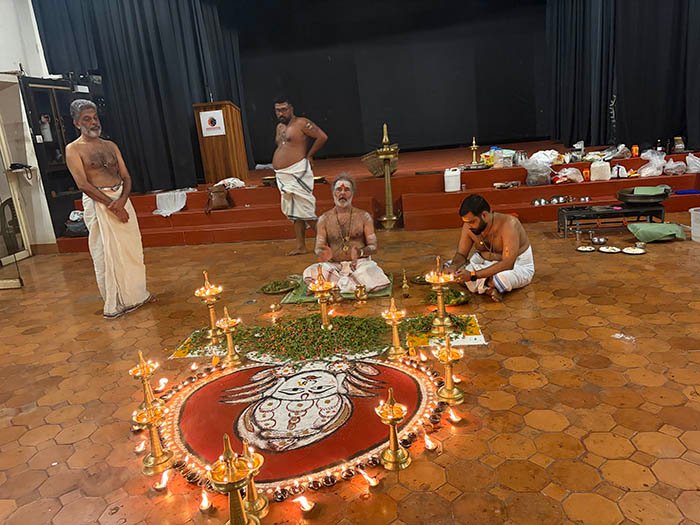
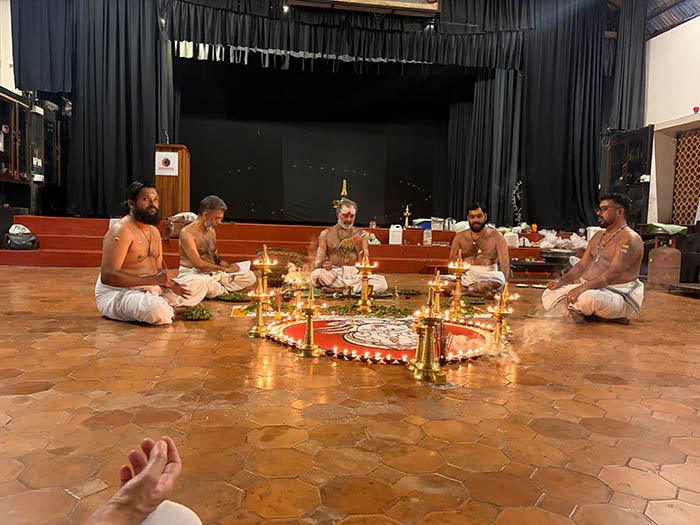
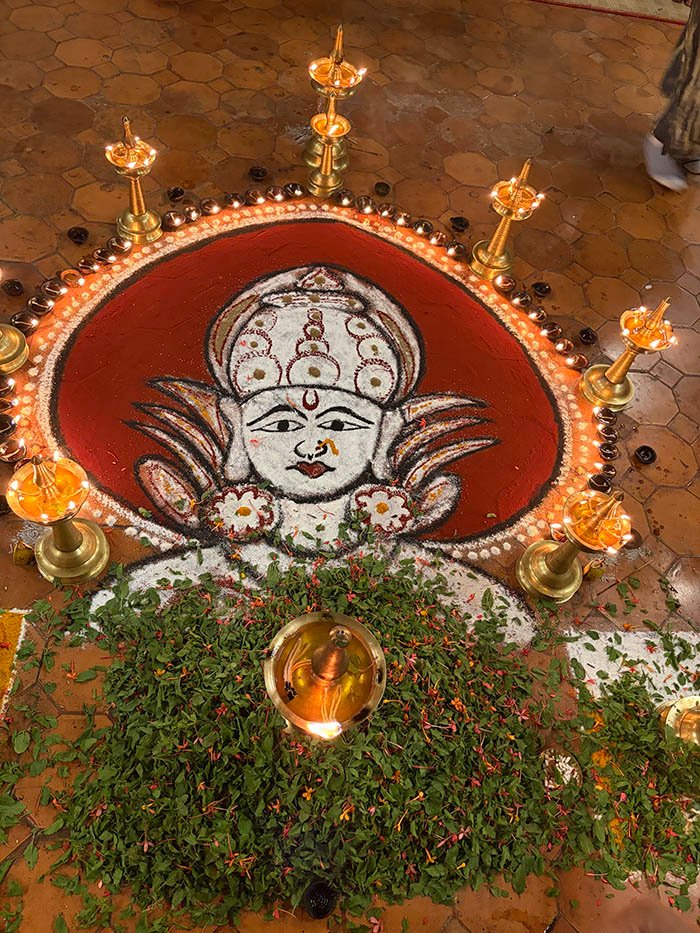
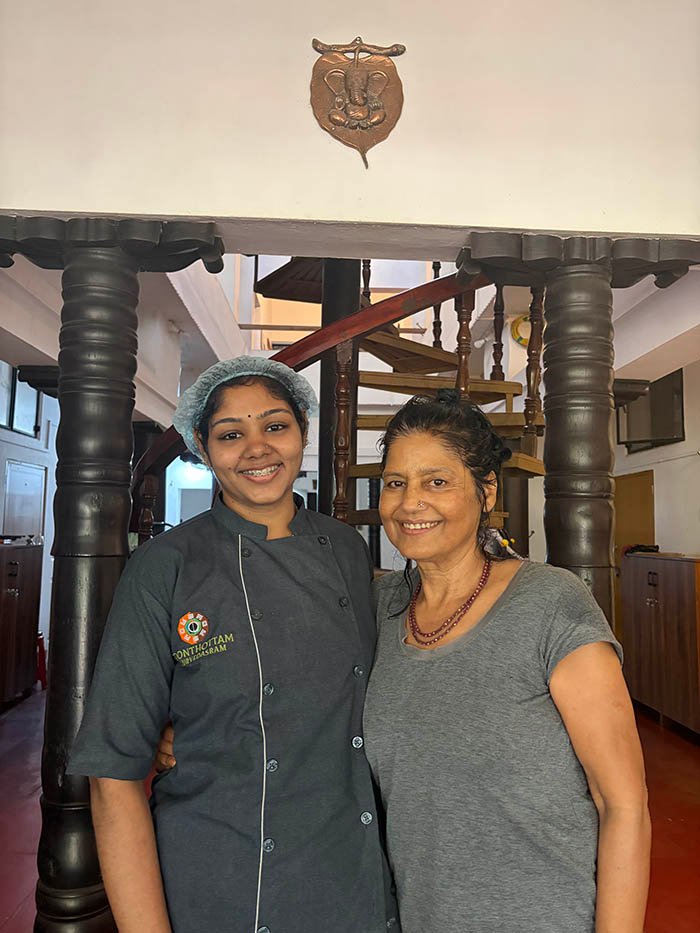
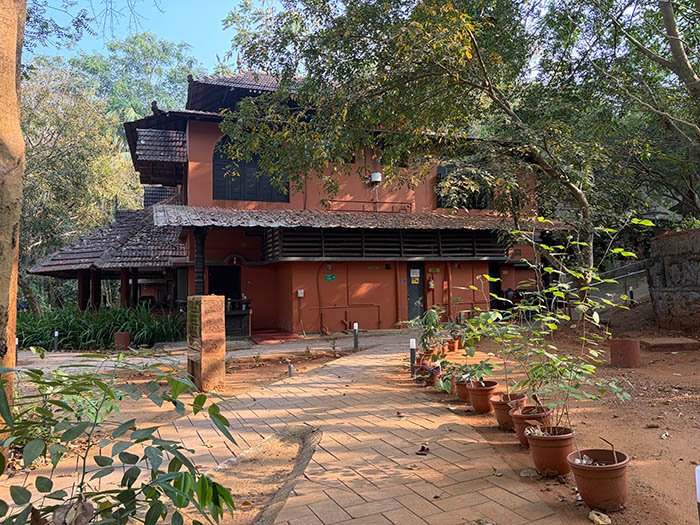
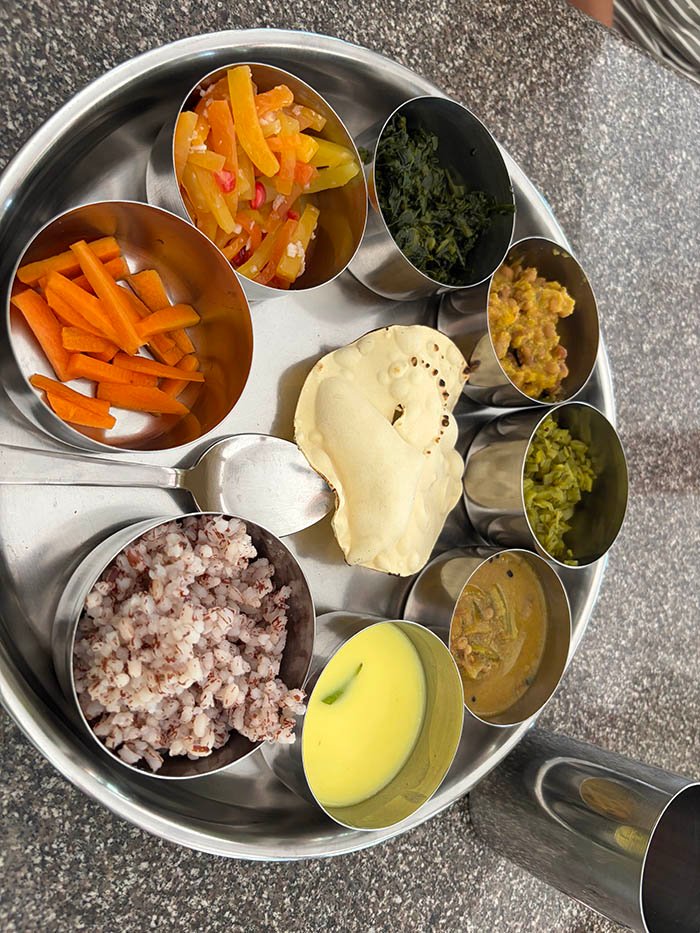
In Leslie Marmon Silko's book, Ceremony, Soldier Tayo, a native of Laguna Pueblo, New Mexico, returns from World War II with no visible wound. What he carries is guilt, anxiety, isolation, and a distance from his own people that modern medicine would call post-traumatic stress disorder (PTSD). Betonie, a medicine man of mixed Navajo and Mexican descent, does not hand him a diagnosis and prescription. He performs rituals and ceremonies to ease Tayo's mental turmoil and help him incorporate into his land, kin, clan, and community (Silko, 1977). In Silko's telling, healing restores the individual's connection to the community. Similarly, in a neighboring pueblo where Matilda Coxe Stevenson had worked in the 1890s, she compiled a compendium of Zuni healing practices (1904). She reports that many of her bodily afflictions, such as broken bones, were successfully cured by the rituals performed by Zuni medicine men.
Drawing on Silko and Stevenson, I want to share my own realization from spending two weeks at Poonthottam, an Ayurvedic ashram (retreat center) in Kerala's Palakkad district, in January–February 2026. My Indian colleagues in Anthropology at the University of California, Santa Cruz, strongly recommended this center. I was dealing with common health issues: a stiff neck, sleepless nights, and body aches I had accepted as part of life. I wanted to experience the healing tradition of the culture I was raised in. I found Poonthottam to be a community that nurtures people as much as it treats them, and that is not separate from the modern world. In India today, the state promotes Ayurveda, literally the knowledge of life, as a traditional healing practice, and traditional health providers tailor care to each client's medical, social, and emotional needs. The ancient Ayurvedic tradition has adapted to modern expectations as part of the Government of India's mission. Everyone comes to the center for their individual ailments. Yet, care is offered as part of a shared life: massage as sacred touch, food based on the balance between the individual body and the universe, breathing and meditation drawn from yoga, daily and periodic Hindu religious rituals, and days spent living together as part of the ecosystem.
In traditional healing systems, the sick person is treated as part of a whole, and individual recovery means being drawn back into that whole. Modern life tends to promote individualism and isolation. What I wanted to know, and what this essay asks, is whether a community gathered around individual ailments can restore connection the way Betonie's ceremony does.
The hill
On January 23, 2026, my husband and I landed at Coimbatore airport. We drove a rental taxi for three hours, past coffee houses, cinemas, and bus stations, then out through paddy fields, miles and miles of coconut groves and occasional South Indian restaurants until a signboard appeared on a hilltop in Palakkad. A narrow road wound up to a campus of about seven acres, spread across two levels. The newer lower campus has twenty rooms in a two-story building, beside a pond of white and pink lotuses and colored water lilies, with coconut trees providing shade all day. The older upper campus centers on a main hall, where a life-size photograph of the founder's guru looks over the room. Mango, jackfruit, and lychee trees, old enough to have outlived several generations of owners, surround another smaller building with about eight rooms. Dr. Ravi, the principal doctor, lives on the campus with his family, next to the small factory that makes the Ayurvedic medicines. The household has cows, chickens, and a Labrador on the upper campus. Street dogs, a common sight anywhere in India, are not welcome. The place is designed for residents who come for treatment, most of whom come from abroad.
The center is rooted in the guru-shishya tradition. P.M.S. Raveendranath, known as Dr. Ravi, has practiced for more than thirty-five years. With a degree in Ayurveda, he has been shaped by his revered guru, whose idol now presides over a shrine at the ashram's center. Every morning after his bath, Dr. Ravi, wearing a white lungi, walks to the tube well, carries fresh water to his guru's idol, bathes him with his own hands, performs a puja, and leaves the sacred water, flower offerings, and prasad. The roughly 135 people who keep the ashram running receive the blessed water and prasad each day. Knowledge is passed down here through devotion, care, and blessing, amid a working medical practice. Dr. Ravi's son, Jishnu, is now the CEO and will carry the practice forward. He is adding rooms at the lower campus, expanding the center, and has opened an Ayurvedic daycare clinic in Hyderabad. This modern agenda is to expand the campus in response to increasing demand for its services.
Each month the ashram holds a Bhagabati Puja for the well-being of everyone and every sentient being on the land. The mother goddess is drawn on the ground in rice powder, turmeric, and vermilion, and the Lalita Sahasranama is chanted for an hour. Humans and non-humans share this place. In the back of the upper campus, an open space is set aside to give the local spirits a home, and Dr. Ravi took me to the place where the ancestors are worshipped. Snake worship takes place once a year. This is a spiritual ritual practice to appease sacred beings, not a metaphor.
Healing as a system
Ayurveda, "the knowledge of life," is a whole-body health system that began in India more than three thousand years ago (Wujastyk, 2003). It holds that each person is made of three forces, or doshas, Vata, Pitta, and Kapha, and that everything in the universe is connected. An imbalance in one part is thought to affect the others, and if it is not corrected, illness follows. Wolfová (2022) describes Ayurveda as a way of body becoming through individual practice. Its care is never the same for two people. It draws on cleansing, a special diet, herbal medicines, oil massage, yoga, and mindfulness.
Part of its appeal lies in what it stands against. Alter et al. (2017) describe Nature Cure, a related movement that reached India from Europe, as taking shape in the industrial era as a self-consciously reactionary alternative to biomedicine. In colonial India, it offered a way to practice self-care in resistance to imperial medicine, and Gandhi's advocacy helped popularize it. They contrast its ecological holism with the reductionist logic of biomedical pharmaceuticalization. Nature Cure is not Ayurveda, but both now fall under India's Ministry of AYUSH, and the authors note that health tourism strongly affects Ayurvedic practice in Kerala. Gawande (2014), a surgeon, argues in his account of aging and dying that doctors committed to prolonging life too often overlook what matters to the patient.
When I sat across from Dr. Ravi, I realized I had been carrying a small constellation of complaints I had never thought to name together: sleeplessness, a stiff neck and shoulders, teeth grinding, and aches I had ignored as symptoms of nothing in particular. Biomedicine would have addressed each one on its own terms: a blood draw, an X-ray, a pill, or physical therapy. Dr. Ravi checked my pulses and identified one thread running through it all: a pitta imbalance. He prescribed oil for the body, Sirodhara for the head, Navarakizhi, a rice-and-milk poultice massage, and Sirolepa, a cooling paste of amla, curd, and medicinal plants.
Each day followed the same rhythm. The morning began with yoga and meditation at 6:30, followed by herbal tea. The doctors prescribed a medicinal oil massage, using sesame oil for the body and coconut oil for the head. Two portraits hung on the massage room wall. One was of Shiva, the god of destruction and recreation of the universe, and the other of his consort, Parvati, the mother goddess, who represents energy. Each time, before the massage, the therapist recited a sacred chant for health and well-being. In Navarakizhi, a therapy from Kerala, Navara rice (Oryza sativa) is tied in cotton boluses (kizhi), dipped in warm medicated oil and milk, and then worked over the body to strengthen muscles, nourish tissues, and ease pain. Vina and her assistant, Srija, were my daily massage partners. When they were away, Jyoti and her assistant, Serena, filled in. For an hour each day, local therapists gently massaged and nourished the whole body, with chanting before and a hymn for wellness at the end. They were the opposite of the invasive technology I wanted to leave behind.
Food was part of the cure, and it was where the community gathered. Meals follow a set schedule: a morning hot drink of ginger, jaggery, and other natural ingredients at 6:30; breakfast from 7:30 to 10; lunch from 1 to 3 pm; a light snack at 4 pm; and dinner from 7:30 to 9 pm. There is no tea or coffee. Lunch and dinner are organic and vegetarian. The kitchen follows a chart made for each resident, so a shared table holds different plates: no sugar, no excess oil, whatever each body's constitution is said to need. The only sweetness came in a jaggery-sweetened herbal tea that arrived every morning from a young woman named Anju.*
The guests assemble to eat together. The staff, women and men, serve us and eat separately, a different menu, somewhere we never saw.
The center does not grow the rice for my Navarakizhi or press the oils for my Sirodhara. The rice, oils, herbs, and other ingredients come from the local market. The ashram garden provides coconuts, moringa, curry leaves, and a few other vegetables. The food is cooked and served in a wholesome Ayurvedic way, nourishing my body naturally. Care here is specified for one person at a time, yet delivered in common, by the same local hands, from the same kitchen, down the same hill.
Residents known as Patients
Residents appear and disappear constantly. They may come for a short or long stay. About eighty percent of the guests come from the West. The rest are professional middle-class Indians. Two women from Germany, checking out in February, beamed and said, "We will see you next year. We generally come around this time." Vineeta, a Punjabi woman who lives in Mississippi, comes every year. She had already booked 2027 and left with three months of medicine, and the ashram will mail her any extra. Ann Catherine, from Belgium, was finishing her thirty-second day. Six years earlier she had come for three weeks. She runs a bed-and-breakfast at home and will return if she can.
Delphine, from French Brittany, wanted to extend her eight days and could not, because the ashram was full. Alfred, a very thin European, has lived for months in one of the plain, unair-conditioned rooms on the upper campus, and he will stay as long as he is allowed. For him, the ashram expenses are affordable, and the hands-on care is incomparable. Sudhakar Nair, from Palghat, was on his fourth visit. Fifteen years ago his doctor recommended surgery for his spondylitis, and he came here instead. At seventy-five, he still climbs steep ladders for his work in the hardboard industry, and he credits Ayurveda for his mobility. Two Tamil women from Dubai came for two weeks, left happy, and hoped to return. A Russian woman who works in Dubai had stayed for at least a couple of months and is deeply satisfied. A middle-aged man from Mumbai arrived while we were there. He had come on Poonthottam's reputation, since his mother lives in a nearby city. I was surprised that he had not even brought his diabetes medicine, though his blood sugar was high. He relied on Poonthottam to ease his acute ailment.
At mealtimes, we residents sat around the table, sharing our experiences with food and life at the ashram. We compared ailments and the food plans assigned to each of us, tailored to our needs. We also complained about the bland food, which was sometimes less palatable than we wished. Still, each of us wished to return to the ashram to heal our body and mind.
Staff
The ashram has about 135 employees, both women and men. Maintenance staff keep the rooms and grounds so clean that I never saw a weed or a fallen leaf. Kitchen staff cook, clean, serve, and carry food up from the lower campus to the guests on the upper campus; technicians and a handful of doctors round out the staff. Except for a few doctors, nearly everyone is local, and most are young. They wear Poonthottam uniforms. The doctors and administrators do not.
At dinner one evening, we asked for lemon pieces marinated in salt, as the "patients' food" served without spice or chili. Sunita*, who works in the kitchen and is in her forties, ran down forty steps to fetch them. Her knees already hurt from the stairs. She did it with so much affection and care as much as service, and it was also labor, and I could not separate one from the other.
Anju*, who brought our tea each morning, is thirty-three. She ties her hair in a bun under a kitchen net and wears the sky-blue official uniform. She has three boys, aged fourteen, ten, and four, and her husband drives a taxi. She wakes at four to cook for her family, including her in-laws, packs the children's lunch boxes, and is at work by 6:45 am. Beyond the money, she told me, the job lets her leave the house and gives her exposure to a new world. One day I saw her with her long, wavy hair down, in jeans, and she looked eighteen. She told me, laughing, that she keeps her uniform on even during her break, as part of the professional code. I asked how she stays so slim. She avoids oil and sugar, she said, and then, with a big smile: "I am happy."
The community was real, with two tiers: those who ate together and those who carried the food and ate apart. The employees have family lives of their own and feel able to pursue training and new opportunities. Still, they remain employees, and they are used to the work's stress and strain.
The wider world
Poonthottam is one of many Ayurvedic retreat centers that have sprung up in Kerala and neighboring states, as well as in Delhi, the capital. It is also part of a state project. India's Ministry of AYUSH, created in 2014, received Rs 4,408 crore in the 2026–27 Union Budget, roughly double its 2020–21 allocation (Ministry of Finance, 2026), and the finance minister announced three new All India Institutes of Ayurveda. A dedicated visa lets foreign patients stay up to a year at first, renewable for up to five years (Ministry of AYUSH, 2025). The Ministry of Tourism counts medical travelers without separating wellness from surgery. Its provisional figure for 2023 is 635,000 foreign arrivals for medical purposes, up from 183,000 in 2020 (Ministry of Tourism, 2024). Ayurveda is one thread in that count.
The tradition has also reached retail shelves abroad. In 2019, Vicks ZzzQuil, a Procter & Gamble brand, added a gummy combining melatonin with ashwagandha (Drug Store News, 2019), and the company tied the herb to Ayurvedic tradition in its announcement. The sleeplessness I carried to Kerala is the very condition that gummy is sold to soothe in the American market. In both places, individuals seek a remedy for a stress they are expected to manage themselves.
I wonder what draws people across oceans to a family-run ashram in Palakkad. It is not only relief from various ailments but the gratification of the senses: eyes, ears, nose, tongue, and skin. It is a longing for a medicine that no longer separates the symptom from the person, or the person from the world around them. However, the community they enter gathers around individual ailments. Sunita's knees absorb the daily logistics of other people's cures.
Betonie's hogan
This is where Betonie earns his place. Silko never lets Tayo's healing float without a history. Betonie's hogan sits within sight of the city, its medicine bundles kept beside old calendars and Coke bottles, because, for Silko, the old ceremonies had to change to survive contact with the world that wounded Tayo in the first place. "The people mistrusted the new ceremonies at first," Betonie tells him (Silko, 1977). The mistrust is not that the ceremonies failed. It is that they showed too plainly that nothing sacred stays unaffected by what surrounds it. Poonthottam's Bhagabati Puja and its place on a global wellness circuit are not, I came to think, contradictions. They are the same fact seen from two directions: a healing tradition surviving by adapting to, and being partly reshaped by, modernity, tourism, and a nation-state eager to promote what it can also sincerely revere.
I left Poonthottam on February 7, 2026 with my shoulders looser than they had been in years, and with Anju's voice staying with me longer than any of the treatments did. I am happy. I do not discount either fact. However, I no longer think "holistic" is enough to describe a place where a cow, a Ministry visa program, a therapist's aching knees, and a German woman's annual pilgrimage all belong to one system. Traditional healing, here as in Silko's Laguna Pueblo, is a cultural process that lives inside the modern world and changes with it. Pretending otherwise is its own kind of amnesia.
*Names of staff members are pseudonyms.
References
Alter, J. S., Nair, R. M., & Nair, R. (2017). Nature cure and non-communicable diseases: Ecological therapy as health care in India. International Journal of Environmental Research and Public Health, 14(12), Article 1525. https://doi.org/10.3390/ijerph14121525
Drug Store News. (2019, July 8). Vicks ZzzQuil expands Pure Zzzs lineup. https://drugstorenews.com/otc/vicks-zzzquil-expands-pure-zzzs-lineup
Gawande, A. (2014). Being mortal: Medicine and what matters in the end. Metropolitan Books.
Ministry of AYUSH. (2025, February 11). Beneficiaries of AYUSH visa (Rajya Sabha Unstarred Question No. 816). Government of India. https://rsdebate.nic.in/bitstream/123456789/758693/1/PQ_267_11022025_U816_p154_p155.pdf
Ministry of Finance. (2026). Union Budget 2026–27. Government of India. [Replace with the Expenditure Budget page for the Ministry of AYUSH.]
Ministry of Tourism. (2024, July 25). Medical tourism in the country (Rajya Sabha Unstarred Question No. 445). Government of India. https://tourism.gov.in/sites/default/files/2024-08/usq.445%20for%2025.07.2024.pdf
Silko, L. M. (1977). Ceremony. Viking Press.
Stevenson, M. C. (1904). The Zuni Indians: Their mythology, esoteric fraternities, and ceremonies. In Twenty-third annual report of the Bureau of American Ethnology to the Secretary of the Smithsonian Institution, 1901-1902 (pp. 3–634). Government Printing Office.
Wolfová, A. (2022). Becoming bodies: An ethnographic study of Ayurvedic practice [Doctoral dissertation, Charles University].
Wujastyk, D. (Ed. & Trans.). (2003). The roots of Ayurveda: Selections from Sanskrit medical writings (Rev. ed.). Penguin Books.

Annapurna Pandey is a cultural anthropologist at the University of California, Santa Cruz. Originally from Cuttack, Odisha, she moved to Santa Cruz, California in 1989. She is a travel enthusiast and loves to write travelogues highlighting her exotic experiences in different parts of the world.
For the past fifty years, seventy-year-old Bapputtykka had been running a small stationery shop in front of a school. It was a modest little shop selling a few notebooks, pens, pencils and various kinds of sweets. These days, however, hardly anyone visited the shop. With the arrival of shopping malls, children no longer seemed interested in stopping by. Still, having known no other trade and having no children to support him, he simply carried on with his little business.
In the evenings, a few of his contemporaries would gather at the shop to chat. There was a long bench inside where everyone could sit comfortably. As night fell, discussions on art, culture and politics would gather momentum.
Bapputtykka would often join them, partly because he wanted to avoid disturbing Sainaba's favourite television serials by going home too early. Once his friends began talking about water, Sulaimani tea and other things, he could comfortably stay back. After everyone dispersed, he would close the shop and head home. That had become his daily routine.
One evening, when his friends arrived, they found Bapputtykka sitting there looking unusually gloomy, almost like a monkey that had bitten into a piece of ginger. They immediately asked him what was wrong.
Bapputtykka had opened his first-ever bank account in Sainaba's name to receive the subsidy for their cooking gas. That morning, an unexpected SMS on his mobile phone had completely shattered his peace of mind. The message said that ?5,000 had been credited to the account.
His friends wondered whether he had any relatives or acquaintances who loved him enough to send him such a large amount of money. Bapputtykka firmly assured them that there was no one of that sort.
That was when each of them began sharing whatever they knew about such matters.
"This is a scam," said one of them. "The other day, someone received ?200 in his account. A stranger called him and said that he had mistakenly transferred ?200 and requested him to send it back. The moment the man returned the ?200, all the money in his bank account disappeared!"
Another friend had a different scam story to tell.
Someone had uploaded a photograph of his friend lying in a hospital bed on Facebook and Instagram. Along with the picture, a fake message had been posted claiming that the man was suffering from kidney disease and had no money for his next dialysis session. The post appealed to kind-hearted people to send financial help.
Moved by sympathy, many people believed the story and transferred ?10,000 each to the account mentioned in the message. The unfortunate friend had now filed a complaint with the Cyber Cell. Several people had already lost their money.
After hearing all these stories, whatever little courage Bapputtykka had left began to disappear.
Some suggested, "Since the money has come into your account, why don't we simply keep quiet?"
But Bapputtykka was a man of principles. He believed that he did not want even a single rupee that he had not earned through his own hard work.
Others suggested informing the police and letting them investigate.
"After all, isn't investigating such cases the police's job?"
But someone immediately disagreed.
"They hardly have time to investigate cases where people have lost lakhs of rupees. Will they bother about a mere five thousand? Besides, no fraud has actually taken place here, has it? You can go to the police station and file a complaint only when you have been cheated, can't you?"
Another friend then explained in detail a recent scam that had taken place in Malappuram. Apparently, the fraudsters had started by claiming to be officers from the Mumbai Police.
Some others mentioned the famous singer Amrutha Suresh, who had reportedly lost money through a similar scam. She had filed a police complaint, but apparently had not received her money back yet.
They also mentioned that a bank official named T. J. Raphael had even written a book on cybersecurity.
"Oh, my God! Do I have to buy and read all these things at this age just to stay safe?"
Words like OTP, QR Code and Cyber Helpline Number 1930 were completely new to Bapputtykka. Listening to all these unfamiliar terms made his head spin.
Some of the so-called intellectuals suggested that he should visit the bank and find out who had sent the money, from where and why.
Finally, they decided that the next morning, as soon as the bank opened, they would begin their investigation there. With that decision, everyone dispersed for the night.
Sainaba was waiting with hot pathiris and fish curry. Not wanting to spoil her mood, Bapputtykka pretended to have eaten his dinner and quietly slipped into bed without saying much. He lay still, pretending to sleep.
The next morning, it would not be entirely correct to say that he woke up early. The poor man had hardly slept a wink the whole night out of fear. So he got up much earlier than usual.
When he heard the call for the Fajr prayer, he performed his prayers. Without even waiting to complete his usual recitation of the Tasbeeh, he folded his prayer mat and hurried straight to open his shop. A couple of his friends had promised to accompany him to the bank for moral support.
Just then, an unexpected phone call came for Bapputtykka.
Since the number was unfamiliar, his heart began pounding like a drum. Was this it? The very call his friends had warned him about? Had the genie finally escaped from the bottle?
The moment he answered the call, Bapputtykka burst into tears and poured out his words in a single breath.
"Please, son, don't harm me. I am seventy years old. If anything happens to me, my wife will have no one to look after her. I am just a poor little shopkeeper, earning my daily bread through a small business. There are so many rich people in this country. They have money, manpower and influence. Why don't you approach them and ask for money? Please leave me alone!"
When there was no response from the other end for a few moments, Bapputtykka felt relieved.
"Ah! At least he seems to have understood what I said."
Then came a faint voice.
"Hello! Are you Bapputtykka, the man who runs the stationery shop in front of the school?
I was a student at that school, from Class One to Class Ten. Many times, I secretly stole notebooks, pens and sweets from your shop without your knowledge.
I always had a wish that one day, when I grew up, got a job and became someone in life, I would repay you for what I had taken.
Today, I am a bank employee. I have just received my very first salary. I have transferred ?5,000 to your bank account.
I called to let you know.
I felt too embarrassed to come and face you in person, so I chose this way of doing it.
Please, for God's sake, don't tell anyone who I am or why I sent you this money. I also have one request. Please don't try to find out my name or the branch where I work."
The young man finished speaking.
Bapputtykka listened in silence for a moment. Then he replied:
"May you prosper, my son! All the children of Adam make mistakes. Doesn't the Qur'an teach us that the best among those who sin are those who repent?
I will neither try to find you nor embarrass you. And I certainly won't go around telling anyone about this. You have my word."
When his friends, who had come ready to accompany him to the bank, asked what had happened, Bapputtykka had only one answer for them.
A broad, radiant smile.

Mary Josey Malayil, a native of Thiruvananthapuram, Kerala, is a talented writer with a rich family legacy. As the second daughter of T. R. Johny, retired Chief Engineer of the Kerala State Electricity Board, and the late Rosily Chirayath, sister of the renowned actor C. I. Paul, Mary was born on June 22, 1964. Her primary education spanned various locations, including Pallam, Palakkad, Thrissur, and Thiruvananthapuram, before earning her B. Com degree from All Saints College, Thiruvananthapuram, in 1985. She then moved to Alappuzha, joining the esteemed Catholic family of Malayil Thomas, Senior Manager at SBT, as his daughter-in-law. Mary is married to Josey Thomas Malayil, a skilled cartoonist and medical illustrator, and they have a son, Thomas Josey Malayil, who works in corporate communications at Technopark, Thiruvananthapuram. During the lockdown, Mary discovered her passion for writing, driven by a desire to overcome boredom. Since then, she has contributed stories to numerous esteemed publications, including Karmabhumi, Arsha Bhoomi, Malayala Manorama Online, KSEB Pension Bulletin, Keralathanima, Malayalam Rachanakal Online, Koottaksharangal, Ima, and Malayil Varthapatrika. She gratefully acknowledges Raju Shankarathil, Chief Editor of Malayali Manassu in Philadelphia, for his mentorship and support, which led to her appointment as an editorial board member. Mary draws inspiration from her maternal uncles C. I. Paul (late) and C. I. Joy, brother T. J. Raphael (former General Manager of South Indian Bank), sister and fellow writer, Rita Manuel, and Mary’s online community, including Nirmala Ambatt, Chief Admin of the ‘Samskruthi Facebook Writing Group’ and ‘Arsha Bharati’. Surrounded by a rich storytelling heritage, Mary continues to contribute to the world of literature. She currently resides in Thiruvananthapuram with her family, where she weaves her own unique literature.
THE “WORK” ACCORDING TO NANDU
Subrat Mishra
My friend Nandkumar, affectionately called Nandu, a Civil Service batchmate, former IPS officer, leading Cyber security expert and a polymath of sorts has an admirable knack for posting, among other beautiful gems, little pearls of wisdom in our batch whatsapp group. They arrive, usually in clusters without much ceremony, but occasionally have the rather unsettling effect of making one stop, read them again and, worse still, think. I have learnt not to take these offerings lightly. Some are merely interesting; others have a way of getting under one's skin.
Today's offering was particularly arresting. I do not know its source, and Nandu, as is sometimes the case with purveyors of wisdom, has not troubled us with that detail. But the thought itself was too intriguing to pass over:
“Spite makes you work harder. Curiosity makes you work longer. Discipline is what you need when you have neither.”
There are sentences that one reads, admires and promptly forgets. And then there are sentences that have the disagreeable habit of looking straight at you pointing accusing fingers. This was one of the latter. It was a moment of fundamental revelation, though not, I hasten to add, of any great physical exertion.
After sixty-five years of wandering through this world, I had finally found the answer to a question that had been troubling me for a very long time: Why is it that I cannot work hard or long— just the bare minimum to survive in this cruel heartless world!
The answer was staring me in the face. I possessed none of the three catalysts.
It was a devastating diagnosis, delivered with the clinical precision of a Neurosurgeon and the amicable manner of a Drill Sergeant. Worse, it explained a great deal about my personality that I had hitherto attributed to circumstances, the weather, a lunch on the heavier side or the general failure of the universe to cooperate.
Consider the first of these indispensable ingredients: spite.
There is no denying its efficacy. Some of the most industrious specimens of humanity are powered almost entirely by resentment. They have a rival to overtake, a detractor to silence, a former classmate whose success has become a personal affront, or an uncle who once remarked that they would never amount to anything. The offending remark may have been made thirty years ago, over a plate of samosas, but its recipient remembers every syllable. He has spent the intervening years accumulating degrees, fortunes, awards and occasionally a substantial waistline, all in the noble pursuit of proving the uncle wrong.
Spite, in short, is ambition with a grievance. It is the only fuel known to mankind that becomes more potent with age. A man may forget his wedding anniversary, his bank PIN and
the name of the person he has just been introduced to, but he will remember with photographic accuracy who got promoted ahead of him in 1998.
I have never quite possessed this advantage. I have had my share of disagreements, but my capacity for sustained resentment is distinctly underdeveloped. An insult may upset me in the morning, but by evening I am generally inclined to forgive the offender, largely because maintaining hostility requires an application of energy that I am incapable of garnering. Besides, there is always the possibility that the other fellow has forgotten the incident altogether. To continue fighting under those circumstances would be rather like playing Chess against an empty chair.
Then there is curiosity.
Curiosity is a more respectable motive, and perhaps the most agreeable of the three. It has produced scientists, explorers, inventors and people who take clocks apart to discover why they tick. A curious man can begin his morning by wondering why a particular bird sings at dawn and end the day with a working knowledge of ornithology, acoustics and the mating habits of birds in three continents.
I have always admired this species. They possess an inexhaustible appetite for knowing things. Their minds are like enthusiastic puppies, forever chasing something that has caught their attention.
My own curiosity, unfortunately, is of a less demanding variety. I enjoy wondering about things, provided the wondering does not lead to an obligation to investigate them. I can spend a pleasant hour speculating about why people behave in a certain way, but would regard an actual inquiry into the matter as an infringement of my leisure. The mystery is often more entertaining than its revelation unless somebody else undertakes the task of investigation. Indeed, I have occasionally found that acquiring knowledge about a subject considerably diminishes my interest in it.
Which brings us to discipline.
Discipline is the quality that saves those unfortunate souls who have neither a grudge to nurse nor a mystery to pursue. It is the internal Headmaster who insists that the homework be completed before the cricket match, the stern butler who announces that it is time to get dressed for dinner, and the military commander who can make a man get out of bed on a winter morning without first offering him a cup of tea and a philosophical discourse about the nature of duty.
I have nothing against discipline. On the contrary, I hold it in the highest esteem. I admire disciplined people in much the same way that I admire people who climb Everest. It is an extraordinary achievement, though one I have never felt personally called upon to attempt.
I have, on occasion, made serious efforts to cultivate it. I have purchased diaries, prepared schedules and drawn up lists of things to be done. The lists were particularly impressive. They had headings, subheadings and, in some instances, a chronological arrangement. Looking at
them, one could easily have mistaken me for a man on the verge of starting a major industrial undertaking.
Unfortunately, the enthusiasm invested in preparing these lists was rarely available for executing them. I discovered that planning to work produces a satisfaction remarkably similar to working to plan, without the tiresome business of perspiration and hyperventilation. One can even cross off an item occasionally, simply because circumstances have made it irrelevant.
My attitude towards deadlines has been equally unconventional. Most people regard a deadline as a solemn commitment. I regard it as a somewhat overconfident prediction about the future. It is a date or time selected by somebody who appears to have considerable faith in my ability to organise myself. I have never wished to disappoint such optimism, but neither have I considered it necessary to encourage it.
I prefer to give work time to settle into its surroundings. Some tasks, like fine wine, improve with age. Others merely become urgent. The distinction is not always clear, but I have found that waiting generally reveals it.
There is, however, a further complication. I have spent a considerable part of my life in an environment where work was not entirely optional. There were offices to attend, files to examine, meetings to survive and deadlines to meet that did not share my liberal views on time management. I managed to discharge these obligations, sometimes even with commendable efficiency. But I suspect that this was largely because the machinery of official life coupled with the mental image of a man holding a begging bowl at the traffic light supplied the motivation that nature had omitted to install.
Remove the machinery,remove the imagery and the original model reappears.
Retirement has provided the right and welcome harmonious ambiance for the flowering of that natural self. It has removed the external compulsion to work and left me alone with my intrinsic inclinations. The results have been illuminating, if not particularly productive. I now have the freedom to do whatever I wish, which is a wonderful arrangement until one discovers that one does not particularly wish to do anything.
I know retired friends who have approached this phase of life with the energy of persons who have just been informed that the world is about to end and that they are the chosen ones to avert, or at least stave off, the doomsday. First, they promptly unretire themselves, taking up employment often more arduous than the one they have just left behind. And when retirement finally becomes inevitable, they reinvent themselves as advisers, consultants, experts, mentors and fitness fanatics. They write books, learn languages, argue on TV ,take up painting, tee off at
4.30 in the morning, travel, garden and generally keep themselves occupied from dawn to midnight. They lift weights, walk, run, trek, cycle, practise Yoga, Tai Chi, Pilates, play Tennis, Badminton,Squash; seemingly determined to leave no avenue of self-improvement unexplored. Some even maintain elaborate schedules, as though the greatest challenge of retirement were to ensure that not a single moment is wasted to frivolities and idleness.
I have profound admiration for them and stand in awe of their extraordinary zest for endeavour. Every now and then, for a fleeting few seconds, I even entertain the ambition of emulating them. But my natural proclivities soon assert themselves. The recliner beckons, I settle into it with renewed conviction, reach for the remote, and binge watch the entire whodunit series to discover the identity of the murderer before Apocalypse strikes.
For myself, I have concluded,after deep introspection and attempted self motivation, that acquiring any of the three missing qualities at this late stage would be an unnecessary disturbance of the natural order. Spite would require me to find an enemy and then remember why I disliked him. Curiosity might lead me into subjects from which there would be no easy escape. Discipline would require the most drastic renovation of my personality, and I am not convinced that the existing occupant would consent to vacate the premises.
Besides, there is something to be said for the art of doing nothing, provided it is practised with sufficient seriousness. It is a highly underrated occupation. It requires patience, a comfortable couch and the ability to resist the temptation of feeling guilty when somebody asks what one has been doing all day.
After sixty-five years,the mystery has at last been solved. The trouble was never that I did not know what to do. The trouble was that I had no particular reason among the three to get up and do it.
This realisation is both comforting and, in its own way, profound. I am not lazy because I avoid work. I avoid work because I lack the necessary incentives to pursue it. This is an important distinction, and one that I intend to explain at length to anyone who accuses me of idleness.
Just when I thought I had made a reasonably convincing case for my lifelong shortcomings, and was preparing to retire from the intellectual exertion of the day, our irrepressible Nandu struck again. Another pearl came hurtling into the digital ether, this time with its credentials duly established:
“The reward for work well done is the opportunity to do more.”
— Jonas Salk
I stared at it in disbelief. Was this man suggesting that work was some kind of bounty that multiplied with good behaviour? One finishes a job, instead of being congratulated, compensated or, at the very least, allowed to put one's feet up, one is handed another.What sort of perverse incentive system is this? Even Sisyphus, I suspect, would have lodged a protest.What the Gods ordained as an eternal punishment, our good doctor has ingeniously rebranded as a reward.I suspect the venerable virologist himself fell victim, voluntarily or otherwise, to a rogue virus called workfluenza lurking in his own laboratory.
Here I was, having made a candid confession exposed my motivational deficiencies to public scrutiny and practically pleaded for a little understanding. And Nandu, instead of
extending a sympathetic hand, was now reinforcing the case for more work. First he diagnoses my shortcomings, then he prescribes, as panacea, the very affliction I have spent sixty-five years trying to avoid.
Enough is enough. There is only so much wisdom a man can take before it begins to interfere with his peace of mind and pace of heart.
Nandu,dear buddy, for heaven's sake, spare me. I came here looking for an explanation, not an employment opportunity.

Beginning his journey in public service, Subrat Mishra served with distinction as an officer of the Indian Revenue Service, eventually retiring from the position of Principal Chief Commissioner of Income Tax. He holds an M.A. in Political Science from the University of Delhi. In recent years, he has turned to writing, exploring poetry and reflective prose as an occasional amateur writer. His interests span sports, culture, philosophy, travel, and nature photography. He lives in Bhubaneswar.
UNFORGETTABLE TRIP
Sujatha Krishnamurthy
Ahh! Finally it is the 4th of July, Independence Day long weekend, the one we look forward to every year. For the last three years we four buddies have been spending the July 4th weekend camping in different camp sites. All four of us love outdoorsy activities, swimming, hiking, singing and chilling around bonfire.
Prabhakar aka Prabhs is our tour leader, who does all the researching and booking of camp sites. He is meticulous with his detailed planning. He sends us a flow chart of our entire trip from start to finish with every detail covered. My red Ford Mustang convertible, the one I bought after finding my first job, is our favorite vehicle for long drives, the one everyone loves to get behind the wheel of. Akash is good at stocking up all our food, beverages, and essentials for the trip . Sourav is our book keeper who tracks our expenses to the penny to be settled at the end of every trip.
Call it our good fortune and/or good fate brings the four of us together in this suburban town of Racine, Wisconsin. Despite our regional differences our friendship ties us together. Akash hails from Shimla, Sourav from Kolkata, Prabhs from Pune, and Sreedharan aka Sree, that’s me, from Calicut make up this foursome buddies.
Akash and Sourav are batch mates in electrical engineering program from University of Chicago(UC). Surprisingly, they both find attractive job in Fortune 500 company in town and move into the same apartment complex. Prabhs, after completing residency in University of Wisconsin (UW) medical school, starts his practice in a well known hospital in town. My interest in public and community health brings me to UW to pursue my doctoral studies. I land up in a job at the UW Population Health Institute.
What truly binds us together is our shared interest in cricket, camping, music, and our H1B visa status. UW has a sizable number of students from India and a few of them have founded a cricket association called Wisconsin Cricket Club. It attracts many Indians and a sprinkle of Indo Americans for weekly practices and inter club matches.
India Grocery is the only desi grocery store in our town. No surprise that we all happen to read about this cricket club from a flyer on the store window. This is how we all meet on the cricket ground, one fine Saturday morning. Believe it or not, we all hit it off right away, funnily more outside than inside the field.
Saturday morning practices on the cricket ground unfailing ends up in meeting in each other’s apartments for lunches /dinners. Sourav and I are the designated chefs, Prabhakar and Akash takes turn as dishwashers and/or kitchen cleaners. Post meals, entertainment invariably ends up with music sessions of Rabindra Sangeet(Sourav), movie songs in multiple languages(self), Marati Abhangs(Prabhs) with accompaniment on tabla by Akash. We from time to time participate in cultural events , such as, Diwali Night, Durga Puja Mahotsav, and other celebrations organized by Indian and Indo-American associations in and around town.
On one such Saturday in April we all gather at Prabh’s apartment for dinner. I bring along a big pot of onion theeyal, my mom’s secret recipe. Sourav brings tilapia in soresher bhata, his grandma’s heirloom recipe. Akash brings Lays chips and Coor’s Light. When we all arrive with our pot luck dish, Prabhs has rice set in the instant pot large enough to feed an army for a week.
In between eating and drinking, I moot the subject.”Guys, where can we go camping this year during July 4th weekend?” Sourav says, “ We have already camped in Illinois and Michigan. Maybe somewhere else?” Akash responds.” Why not take an extra couple of days off and go to Nashville for the summer outdoor music festival?” Prabhs says,” OK. Guys. Let us re-visit about our trip in a couple of weeks. Today’s match has been quite brutal. Let us chill with some Rabindra Sangeet, Film songs, and some liquid gold. We can finalize on the destination on another day.”
On another such meetings in my apartment, satiated with biryani and egg curry, we all agree to go camping for three nights in Copper Falls State Park in Northern Wisconsin. “Prabhs, you please chart out the logistics and you two come over to Prabhs. I will pick you all up. Is that ok?” With that we seal our trip for the upcoming long weekend.
Today I am supposed to meet the rest of the gang at Prabhs apartment at 9 a.m. So I load my trunk with a duffel bag with cloths, and day to day essentials. I add a couple of grocery bags with fruits, and veggies for barbecue. I throw in a blanket and an extra pillow, in case I need it in the log cabin.
On the way to Prabh’s apartment, I stop over to fill in gas, send a group text to all three to inform that I am on my way. A 12 minutes drive takes me to Prabh’s parking lot. The sight of Sourav and Akash’s car parked next to each other in the visitor’s parking lot brings a smile in my face.
Seeing my car in the parking lot, all three come out and say a big, “ Hi Sree. You are on the dot. We will start loading and can hit the road in another ten minutes”, says Sourav. I reciprocate their greetings with a big smile. One by one they start to load my trunk with their individual bags, many grocery bags filled with food items, a few packs of beer, bags of charcoal, and a couple of blankets.
With my convertible’s top down, we hit Interstate-41 towards Northern Wisconsin. One by one we play our favorite play list from our phones to sing along at the top of our lungs. The drive up north is breathtakingly beautiful. Tree lined roads and sights of intermittent lakes make our drive pleasant. Around noon we stop over at a local pizza place for lunch.
Our conversations touches all topics including our jobs, H1B visa situations, the uncertainty of re-entry to USA if we plan a trip to meet family in India. Finally a seven hours and change of drive added with a couple of breaks brings us to our cute little log cabin on Copper Falls State Park.
Our log cabin is artistically laid out with four bedrooms with attached baths, a well decorated living area, a small kitchen, and a wrap around veranda. To top it all, the view of the lake from every room including the kitchen is just out of this world. “ Thanks Prabhs for finding this exquisite log cabin for our long weekend. This is the best ever”, I tell. “ I totally agree, says Sourav. Me too”, adds Akash.
After a quick light dinner, we start the bonfire pit, sit around, and relax after all that driving. I check my phone and do not get signal or wifi connectivity. “Do you guys have phone signal or Wi-Fi?”, I ask. To my disappointment they all in unison shout,”NO.What a bummer. In case of an emergency what do we do?” I ask in a worried voice. Oh! What emergency? You are a worrier”, says Akash and they all burst out laughing. I hit the bed with a little uneasiness.
Next morning after breakfast we start out to explore the state park. OMG! It is so huge with play area for children, multiple trails, lakeshore to walk, and the expansive Lake Superior to swim. We are taken by surprise to see the place packed with kids and adults. As far as my eyes can reach, in a little elevation, I see many lake front homes with amazing view. This place is simply magical is all I can think of. Many campers and RVs are lined up on the parking lot of the camp site. Due to the long weekend the lake is full of vacationers like us, but the area is so spread out that it does not seem crowded.
We notice many trails and one sign with an arrow says Waterfalls-5 miles. “How about we hike up to the waterfalls today. Then hit the lakes tomorrow?” suggests Akash and we all agree to the plan.
Hiking up to the waterfalls is quite challenging in some areas. For the majority of the trail, we walk in pairs and in some narrow paths in single file. As we approach the waterfalls, we hear the sound of the water and the very first sight of the falls leave us speechless. Surrounded by tall trees the waterfall makes a mesmerizing scene. We sit on one of the rocks close to the falls and watch in silence and let the birds and water do the chattering. We return exhausted after the long 10 miles walk.Next day is our last day at the State Park.
Our cabin has a long wooden bridge leading to Loon Lake. There are two kayaks tied up to a pole on the shore for cabin renters. “Let’s go kayaking first," says Prabhs to which we all nod in agreement. Ahh! We go kayaking on the still waters of the lake for a couple of hours. So many Kayakers, solo and in pairs, we see enjoying the beautiful sunny day and the still waters of the lake. We return to our cabin for a quick bite and return to the lake for a leisurely swim. There too we see many sun bathers, swimmers, and walkers on the lakeshore. We walk all through the shore line from end to end and return to our cottage. Witnessing the Sunset from the beach is beyond description.
For dinner we start the barbecue pit to grill some burgers, hot dogs, and veggies. Later, we gather around the fire pit. I request, “Sourav, sing “Ekla Cholo, Ekla Cholo. I love that song” We all soak into his perfectly pitched and melodious voice and the philosophical words of Rabindranath Tagore. That follows by “Chingari” from Amar Prem and I try to do justice to Kishore Kumar. Prabhs sings Janaa Bhai’s famous “Dharila Pandaricha Chor” in his divine voice. We all erupt into “Sabaash. Kya Baath Hai” when Akash plays a very tricky solo on tabla. When music session ends our yapping session starts that lasts until the wee hours of the night. Three days of hiking, kayaking, swimming, and chatting leave us exhausted physically, but energized mentally. We all click hundreds of pictures, some funny, some serious, videos short and long on our phones to put together in an album for future views.
Before we hit the sack, I once again tell, “ Prabhs, thanks so much buddy for everything. I feel so relaxed. Wish we had a couple more days to spend in this heavenly space.Thank God there was no emergency situation, otherwise with no phone connectivity, I can’t even imagine…True," agrees the rest.
Next morning we wake up to a clear sunny sky without a single cloud in sight. We all have a quick bite , pack all our stuff, whatever is left of, and huddle into the car to drive back home.
A 20 minutes drive from the cabin, golf size hail starts to pound the car from all sides. Out of nowhere the sky turns into a sea of dark cloud. My car’s wipers are unable to keep up with the pounding rain. In utter panic, I turn on the radio. We hear the weather reporter almost shouting.” This is Mark Johnson reporting from the public and community Radio WXPR . There is a F5 tornado moving very quickly with 120 miles per hour wind across northern Wisconsin. There is a report of a sighting of a funnel near Copper Lake State Park. Many power lines are down, as well as, trees have fallen on cabins, RVs, and vehicles in the state park.Please take shelter if you are in that area. It is extremely dangerous to be out in the open. Please take shelter. Emergency Sirens are yet to be installed in many remote locations of the county .”
At that moment we hear a loud sound like a freight train approaching us. The sky becomes ominously dark. None of us dare to turn our heads towards the source of the most frightening sound behind us. Within a few seconds the sky clears and it is all very quiet. The reporter comes back on the radio with updates. “ Here are the latest updates. The good news is that the tornado has moved further north and is losing intensity. Unfortunately, we have received confirmation of at least ten casualties from the Copper Lake State Park and Camping Ground. Reports are still coming in about the heavy damages caused by high winds, fallen trees, and power lines in that state park. It is going to take weeks or months for normalcy to be restored in these affected areas. Good news is Copper Lake State Park and Lincoln county is now out of danger zone.”
With a racing heart I clutch the steering wheels tightly and I see Akash with ashen face sitting next to me with eyes closed. A look in the mirror I see Sourav in tears and Prabhs holding his hands. What an unforgettable trip it has turned out to be. Our minds are filled with mixed emotions for words, so we drive the rest of the miles in silence.
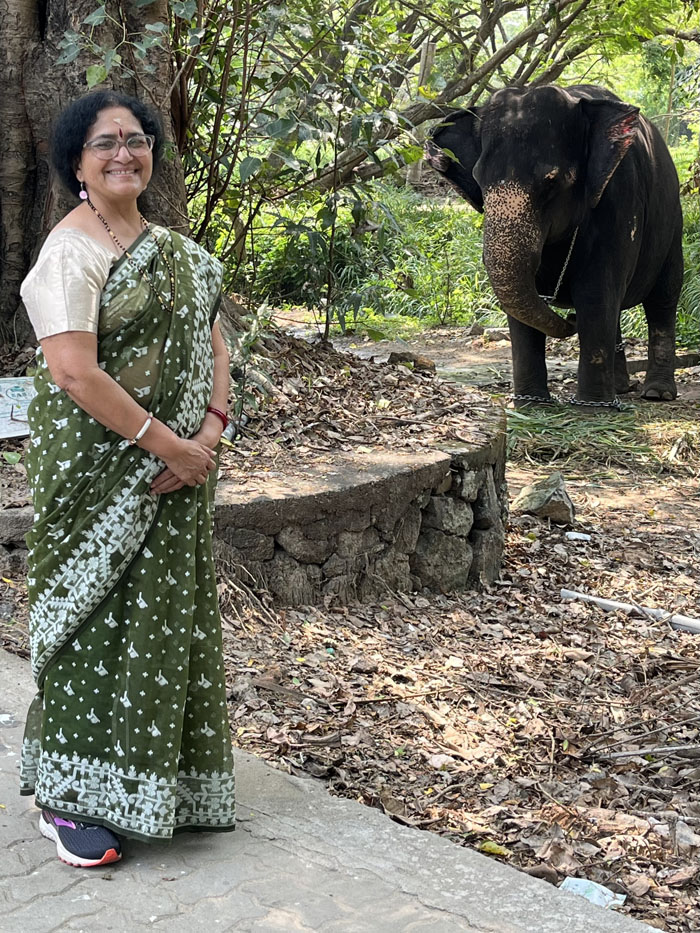
Hi
I am Sujatha Krishnamurthy writing from Kalamazoo, Michigan, USA. Born and raised as a true Kolkatan, studied at Andhra Association School and Shivnath Sastri College, and worked at Central Cottage Industries. Moved to Pasadena, CA, USA in ’84 and later to Kalamazoo, MI in ’91. Studied, worked, and retired after a stint of 20 years in different organizations, including family owned business , NPO(Non-Profit Org) , and MNC( Multi National Corp).
A habitual reader and writer since younger years, a habit cultivated in the banks of the Ganges, has continued to flow till date. Since 2023, my contributions have been published in my alma mater’s monthly e- magazine SPARKZ. I also contribute regularly to our Indo American Cultural Center and Temple’s monthly e-newsletter covering cultural activities in and around town.
As a full time volunteer, I dedicate many hours at our local Hindu temple (Indo American Cultural Center and Temple). Have served in the temple board of directors in many leadership positions, such as, Religious Committee Chairperson, President, and Chairperson. I am the Bal Vihar teacher of 25 years teaching Indian scriptures, teachings, and bhajans to the next generation.
As the Community Outreach Program Coordinator of our temple, I bridge our Indian community with the rest by taking our Indian culture and heritage to local schools and institutions of higher learning. My role facilitates in bringing several visiting Indian artists and American Indian talents to our temple and community. My efforts have been successful in drawing many local, city, and state officials, including Governor, Mayor, and City Counselors and Indian Consul from Indian Consulate, to our temple’s land mark events, such as 25th anniversary and others.
Since 2019, I have been recording audio books for the visually impaired for Samarthanam Trust For The Disabled, an organization based out of Bengaluru. I am currently working towards my goal of reaching the century mark for the Samarthanam Library. My other hobbies include globe trotting, music listening and singing, tasting and trying out new recipes, being an active influencer in social media, and above all, staying close to my families and friends.

This incident is almost four-decades old but the shame lingers and I feel ashamed of it even today after years of its happening. It clings to me like a leech and at times the Macbeth quote “All the perfumes of Arabia will not sweeten this little hand” comes into my mind in a different tone.
Late eighties and this place near my town had already become very famous for a spiritual reason. All because of the lady. Worshippers said that the Godwoman was an incarnation and a visit to the ashram and her blessings in person is the solution to all problems. There are none without problems and a few staunch believers vouched the collective saying. Off we went to the place with mother-in-law accompanying my wife and me. An hour’s drive and we were there. A massive crowd was already present. Huge buildings around and an expansive hall where the darshan was supposed to happen. We presented ourselves in the designated place and there began a continuous announcement of the do’s and don’ts when one approaches the spiritual one for blessing. The devotees were asked to stand in line as the darshan was about to happen. Then came this instruction. A few feet away from the divine person one has to be on one’s knees and approach for blessing dragging yourself on your knees. My wife walked out on hearing this and in spite of a lot of persuasion she said “I don’t need a blessing this way." I never gave much thought to it at that time and mother-in-law excused from the torture because of her advanced age.
Meanwhile further instructions followed. The divine lady will hug you but keep your hands stiff and do not touch her. My turn and she put her hand on me while I was on my knees. She was continuously talking to her people around not even aware of a soul on knees in front of her. Gave a toffee without even looking at me and I said something irrelevant. Certainly not asking for all good to happen to me but for the society.
The incident lingered in my thoughts and it kept on haunting me. I saw the depth of humiliation in the name of spirituality. I cursed myself for falling for it and felt like a worm. I started telling my experience to others to ease my guilt. A few disbelieved but they had to believe when I said it happened to me. The ashram is known worldwide and people all over also come here for blessings.
This happens in full throttle with various spiritual Gods around us. I happened to notice a photo of a swami in a star resort in Keralam. With flowing long hair and beard what I noticed was the hair was jet black. Wondered why a highly spiritual soul should make himself appear young. The combination didn’t sink and there was a mismatch. If he is one close to God he should present himself in his natural way without anything artificial to boost his looks. This prompted me to write on my blog page about this person titled “Swami and dye”.
Another Guru whose English language skill is flawless and any questions put to him answered logically attracts a lot of devotees. His talks are interesting and I used to listen to it off and on. But then there were a few allegations against him which the Guru denied and his devotees believed him. The Shivaratri festivals in the ashram are a much awaited happening. A five-star event where the rich and the famous gather for a whole night of dance and Bhajans. Entry needs high amounts of money and the poor and the needy who need the spiritual shower are left outside.
A person known to me was in his inner circle for a long time. Meeting him after years he said that he came out because things were not as seen from outside.
We live in a world where the greats had walked on this land and taught virtues. Sri Ramana Maharshi, Sree Narayana Guru, Chattampi Swamikal, Ayyankali and the likes. Mother Theresa showed us what compassion is and proclaimed that the most spiritual deed is taking care of the sick and the weak.
Ramayana, Mahabharata, Bible and Koran are there to learn from. The land of Buddha right is in front of us where the prince walks out of wealth to be an ordinary and now, we see the opposite happen.
Live your life sensibly, spiritual or otherwise without falling on your knees. My respect towards my partner multiplied for the upright stand she took at that time without a second thought. Any act done without any logic will make one regret later and you may have to live the rest of your life feeling ashamed.
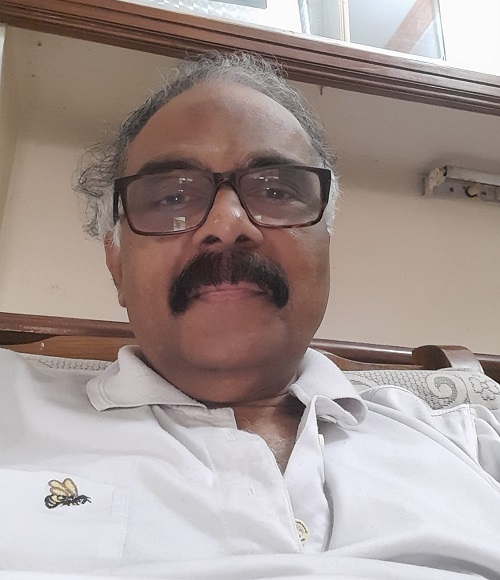
T. V. Sreekumar is a retired Engineer stationed at Pondicherry with a passion for writing. He was a blogger with Sulekha for over fifteen years and a regular contributor writing under the name SuchisreeSreekumar.
Some of his stories were published in Women's Era. “THE HINDU” had also published some of his writings on its Open Page..
THE GRANDMA WE FOUND
Dr Jyotshna Mahapatra
Mina was 7 years old. She had a Mama, a Papa, and a small happy home.But at school, all her friends talked about their grandmas."My grandma makes the best laddoos," said one.
"My grandma tells me stories every night," said another.
"My grandma braids my hair," said one more.Mina listened quietly. She had never seen a grandma. She had never hugged one.That evening, she asked her Mama, "Mama, where is my grandma?"Mama looked at Papa. Their eyes filled with tears.Mama and Papa had both grown up in an orphanage. They had never known their own mothers and fathers. They had no grandma to give to Mina.Papa held Mina close and said, "Beta, we don't have a grandma. But we have so much love for you."Mina smiled, but in her heart she still wished for a grandma.The next Sunday, Mama and Papa took Mina to an old-age home near their house. There were many old grandmas sitting alone. No one came to visit them. No one called them Amma or Dadi.In one corner sat an old lady with white hair and a very kind smile. Her name was Sarala Amma.Mina went and sat beside her. Sarala Amma patted her head and asked, "What is your name, child?"Mina said, "I don't have a grandma. Will you be my grandma?"Sarala Amma started crying. For years, no child had called her grandma.Mama said softly, "Amma, will you come and live with us? We don't have a mother, and our daughter doesn't have a grandma. We need you."From that day, Sarala Amma became Mina's grandma.She made laddoos for her. She braided her hair. She told her stories every night.And Mina gave her what she had missed for years - a family, a home, and a little girl who called her "Grandma."Mina learned that grandmas are not always born in the family. Sometimes, love finds them for us.
THE BOSS AND THE PEON IN BUSINESS CLASS
Dr Jyotshna Mahapatra
Mr. Mehra was a big boss of a big company. He was very proud. He always thought, "I am rich, I am important. Others are below me."
One day, he was travelling in a plane in Business Class. He was sitting comfortably, drinking juice, feeling very special.
Suddenly, he saw his peon, Ramesh, coming and sitting right next to him in Business Class!
Mr. Mehra got very angry.
"What are you doing here?" he shouted. "This must be a wrong ticket! This is Business Class. Peons sit in Economy Class, not here!"
Ramesh quietly showed his ticket. It was a proper Business Class ticket.
Mr. Mehra became even more annoyed. "Who gave you this ticket? How can you sit near me? I don't like this!"
The air hostess came and said politely, "Sir, his ticket is correct. Please let him sit."
Mr. Mehra kept grumbling the whole flight. He did not talk to Ramesh. He turned his face away.
After some time, the pilot announced, "Ladies and gentlemen, we are happy to tell you that today our company has won a big award, because of our best employee Ramesh. As a prize, the company has given him a Business Class ticket."
Everyone in the plane clapped for Ramesh.
Mr. Mehra didn't know Ramesh had left his company two years back and joined another company, one which was running an Airlines. He felt very ashamed. He understood that respect does not come from a seat or money. It comes from good work and good heart.
He slowly said, "Ramesh, I am sorry. I was proud. Today you taught me a lesson."
Ramesh smiled and said, "No problem, Sir. We are travelling together."
From that day, Mr. Mehra never looked down on anyone.
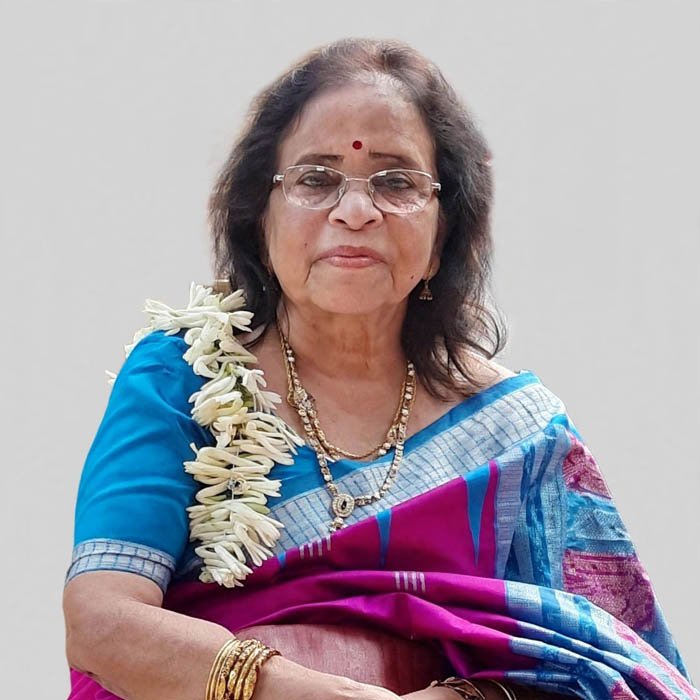
Dr Jyotshna Mahapatra
Published 18 books .Only daughter who published two biographies of her Parents
Prof Gokulananda Mahapatra (Father)
Mrs Kumudini Mahapatra
(Mother )
Has several Awards to her credit
THE GRASS FLOWERS
Shri Gokul Chandra Mishra
One, two, three...... 11 - Smita was engrossed in counting the grass flowers of the lavish green lawn in the backyard of their house. Yesterday the counting ended at 9. There were two more additions in a day.
This monotonous life was her daily routine in this new house of her husband at Summit, New Jersey, the garden state of US, since her arrival.
Winter had just passed, the carpet of snow had evaporated. The hush green woods started a new life and the lush green landscapes provided lots of comforts to the human eye.The landscape of the house was full of deciduous tall trees like oak, Norwegian and Japanese maples, pines bordered with various decorative bushes of rose, lavender, basils etc. Watering the lawn and plants through the spring fountains had become her daily ritual after Sambit leaves for work.
How could the thick blanket of grass remain silent without bringing its flowers when snow had bade adieu ??? The woods became ready to dress up with green once again, waiting for further changing colours in a month to come.
Sambit is an AI specialist working for Apple in New York for the last five years after hopping around two/three companies during his stay in US. A green card visa holder, he accepted the American way of life without, of course, forgetting his home land. His routine forced him to leave Smita alone in his New Jersy house and commute to Manhattan, NY for work. Nostalgia forced him to obey his parents and marry Smita, a damsel of an innocuous Maharashtrian village.
"Now evening has shown her face and it is time for return of Sambit. Let me go to make the dinner ready", she said to herself and started to warm up the food already prepared by her.
The cracking sound of the garage door confirmed to her about the arival of Sambit and she rushed to welcome him.
"Feeling bored?" asked Sambit, "Let me think of some engagement for you," he tried to comfort Smita.
"No, why should I feel bored or lonely ?" asserted Smita, "I am cool with the lawn , its green surroundings, the blossoms of little grass flowers and, of course, the sweet memories of our reunion after you return from office."
For Smita, the week days continued monotonously but the weekends brought lots of fun and frolic in the company of Sambit.
That weekend Sambit took her for trekking in the nearby woods, where the locals gathered in large numbers to enjoy the lonely river side. The tiny river attracted tourists in weekends to watch its waterfall.
Smita dribbled through the bushy serpentine path to reach the spot.
"Alas, it is not a river! Just a creek!! " Remarked Smita, "It is just a little wider than the waterway drain of our village where we used to float paper boats when streams appeared after rains."
Any way, the tourists were happily engaged in taking photo shoots of the stream and its waterfall of few feet high flowing down the stony path. And she enjoyed the company of Sambit more than the solitude of nature.
Life is mechanical in America for the working couple or for a housewife. The housewives, invariably, look for jobs to deal with the monotony. May be for few hours work. Sambit realised this and wanted to search for jobs for Smita. Attorneys were contacted to set right her visa and other regulatory requirements .
"Are you getting bored", asked Sambit sitting on a chair at the wooden plank overlooking the Hudson.
"No, not at all. looking at the grass flowers and waiting for your return from office ends my loneliness." replied Smita, once again looking at Hudson, the vast river flowing dividing Jersey City from Manhattan, Newyork.
The vastness of the flowing waters of Hudson kept the couple's eyes focussed. Its silverline ripples carried lots of their future dreams.
Smita narrated, "How vast is this river! Cruises are plying effortlessly to foreign shores. Boats are speeding with ease. Big ships are entering from unknown lands and anchoring in the nearby port. The river near my native place in India is no match."
Sambit smiled at the innocent comparison of Hudson to the mountain side river flowing near Smita's village.
"But, Smita, we can only view this vast river from its bank, but can we touch its water? Do you remember how we had enjoyed the visit to your villageside river ?"
"Yes," nodded Smita. "The river, 'Kumari', near my village, is not as big as Hudson but is laden with nature's bounty. Her golden whilte sandy bed, laden with colourful pebbles, is quite captivating. We used to play 'kabadi' on the sands, make dives to the flowing waters from the sandy domes."
"Of course, the adjacent small hill standing erect in one side of its banks feels proud," supplemented Sambit, who had gone only once to the village on his marriage day.
The nostagic fervour continued till darkness enveloped the place and the duo returned home to prepare for life for the next day morning.
Life was absolutely mechanical in US and Sambit had adjusted to its rigor. Smita was following her husband in every aspect of the challenges. However, the morning session of counting grass flower by Smita continued. But after few days , Smita encountered strange changes in her and briefed Sambit about this. The duo's happiness knew no bounds when the doctor disclosed the good news about their forthcoming parenthood and blooming of a new flower in their own home garden.
There were certain noticeable curves and kinks in their routine in accordance with the dictates of the doctor. The evening walks along side the wooden pathways of Hudson prolonged for hours. Smita often wandered how Sambit was taking keen care of her.
The nature surrounding her appeared more assuring than before. For her, the waiting moments for the return of Sambit from works, elongated with more anxiety and possessiveness. She had now developed a likeness to hear the whistle sound of the train sounds at Summit Railway station which Sambit used daily for commuting to NY .
These days both were more concerned for each other. They shared their dreams while walking together on the lazy pathways. Both even planned different names for the new comer but converged to "Smarak" for a boy or "Smaranika" if girl . Both prayed for the D day to happen in US so that the child can claim citizenship at birth.
Summer used to be very comfortable, fall became ecstatic but the onset of winter brought despair and challenges into the lives in this part America.
The fall was very pleasant in New Jersy with myriads of colours displayed in forests. The pines, the tall oaktrees, the black wall nuts, the red / green maples, the tall Tulips etc. painted the forest landscape with multiple colours through their flowers and leaves.
The road side lavender, cone flowers , sunflowers, the yellow susan, asters, roses and swamp roses etc. painted the grassy carpets of the valley with varied colours. The summer was on the verge of bidding farewell for the arrival of the fall making the lives of the New Jersians very pleasant and reassuring.
Sambit was enjoying every moment with Smita. But, inside, he was worried about her visa status. Just after solemnising their marriage, he had brought her to US hurriedly on a tourist visa. The Attorney had assured him for arranging a spouse visa for Smita. At the assurance of the Attorney he had felt relaxed. But the delay on the matter kept him worried and anxious. Contacting the Attorney became his daily routine.
But that day he felt the shock of a bomb blast when the Attorney confessed his inability to improve upon the visa status of Smita due to sudden change in immigration priority of the Home Land Security department .
Fall was going to be over. The deciduous trees started parting with their leaves. The simple thought of arrival of winter increased the anxiety and stress level of average populace in that garden state. Sambit was too worried to share the agony with Smita about the expiry of her six months stay. Smita was blissfully unaware about the rigidity and viciousness of US visa laws. Her world was centred around Sambit.
"Smita, how will you manage if you are sent back to India now?"
For Smita, it was more a joke than a reality. She ignored Sambit's question.
The squad of ICE , the Immigrations and Customs Enforcement, were known for their brutal action if any immigrant overstayed the visa period. Sambit did not like to expose Smita to the maltreatment of the ICE spys.
With a heavy sigh, he brooked the issue before Smita who was terribly shaken to break away from Sambit, even for a day.
The Halloween festival rang the bell of the arrival of winter. But, for Smita, the terrible winter was more tolerable in Summit than going back to India with the prospective new comer without the company of Sambit. Whenever she thought of separation from Sambit, the earth below her feet began to tremble and slip. Sambit was her life.
Finding no other escape route Sambit finally decided to send back Smita to India. His dreams got shattered like a broken glass, but he was not prepared to allow the notorious ICE team to intervene and cause embarrassment to Smita.
The check-in was over at the Newark airport. Two soul less bodies stood motionless shedding tears. Sambit waited at the airport till the last sight of Smita before she proceeded for immigration and security check.
Smita, back to her parental home in the hinterland of Maharastra felt herself like a wingless bird. But the new comer in her made her bold day by day to face the vagaries of luck. She always felt the presence of Sambit in her.
Sambit used to contact her daily. The dreams got rehearsed in their talks. The daily discourses used to change to weekly durations. Two separated souls found their only hope in the baby, who was yet to see the world.
The family members of Smita took every care of her during the needy days. Sambit took leave from work and rushed to India to be with Smita during delivery.
The new born baby girl , named "Smaranika" filled lots of happiness in the hearts and mind of her parents. Spending few days more with Smita and Smaranika, Sambit made a tearful return to his routine life at New Jersey.
Months rolled on to years. Smita could arrange a teaching job in the locality to combat the monotony and future safeguard of Smaranika. Going back to US had become more cumbersome because Smaranika needed passport and US-Visa. The new immigration barriers had deliberately delayed procedures. Smita was at her wit's end as to how to secure a best future for the child. To make her life more miserable, Sambit's routine calls became rare and rarer.
She glared at the sky , instead of counting the myriads of grass flowers of her school garden. But never did she show any sign of fatigue or negligence to upbring the newly blossomed flower in her own garden. Gradually her mountain side sandy river started displaying more grandeur than the waters of Hudson.

Shri Gokul Chandra Mishra is a retired General Manager of the Syndicate Bank. He is passionate about social service, reading and writing.
POWERS OF HANUMAN CHALISA
T. V. Krishnakumar
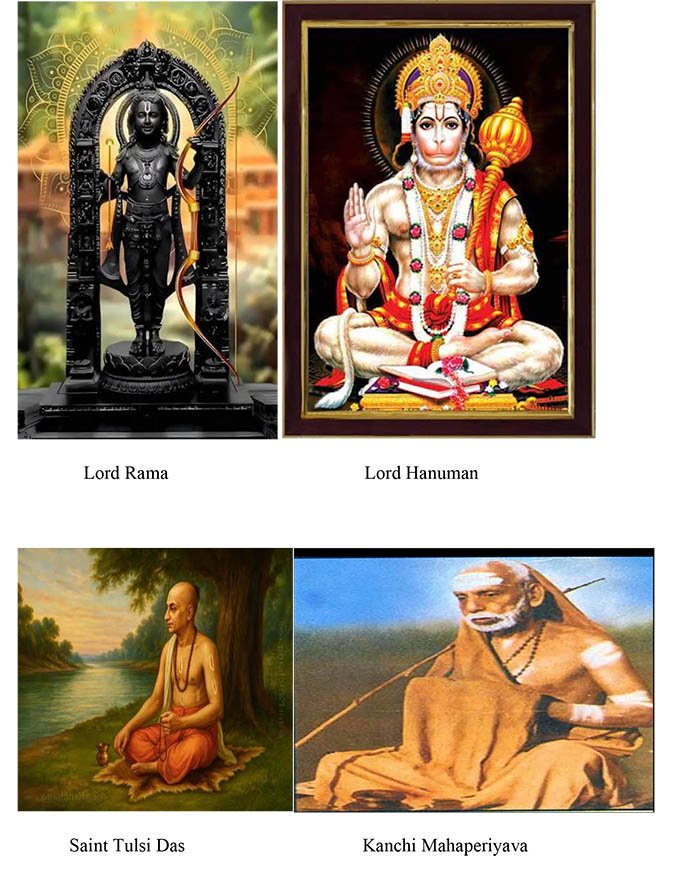
On September 30th 2026, Captain Smit Machchhar was in command of Fly Dubai Flight 1073 from Dubai to Tel Aviv carrying 172 passengers and 8 crew members. Mid-flight, while flying over Saudi Arabia air space he was attacked by a co-pilot from behind, with a cockpit crash axe. Captain Smit Machchhar was severely wounded and was fighting for his life. Meanwhile,since the aircraft could not be controlled, it plunged by about 3000 feet in just a minute. Captain Smit Machchhar started chanting “Hanuman Chalisa” (details and significance of this Prayer is given below) and gained physical and mental energy to reach the cockpit’s door release mechanism. He managed to open the door. Two dead heading pilots (those travelling as passengers) Henson Steven and Rowan Tooth rushed to the cockpit, subdued the co-pilot, took control of the aircraft and safely landed the plane in Saudi Arabia without any casualty. There is no official record saying when Hanuman Chalisa was translated in Hebrew. However recently, the Hebrew version was rendered by Israelis in Tel Aviv Beach as a tribute to our Indian pilot Captain Smit Machchhar. This is an ample proof that the power of Hanuman Chalisa has travelled beyond the boundaries of India.
Now about the origin of Hanuman Chalisa. This timeless ode to the devotion of Lord Hanuman to Lord Ram, was authored by Saint Tulsidas, the author of Tulsi Ramayana (called as Ramcharitamanas) and was composed in the 16th Century originally in a language known as “Awadhi”, a dialect of Hindi. As per the biography of Saint Tulsidas, Mughal Emperor Akbar came to know of the divine powers of Tulsidas and summoned him to his court to demonstrate his powers. Saint Tulsidas declined saying that he was just a devotee of Lord Rama and he did not possess any magical powers. This angered King Akbar and he ordered that Tulsidas should be locked up in prison. While in prison, Tulsidas is said to have composed Hanuman Chalisa, containing forty verses praising Lord Hanuman. It is also believed that Tulsidas was ailing and after composing Hanuman Chalisa, he regained his health. A little later a swarm of monkeys descended on the court of Akbar and created chaos. This prompted the advisors of the king to show respect to Saint Tulsidas and release him from the prison.
Hanuman Chalisa starts with
“ Sri Gurucharan Saroj Raj, Nija Mann Sudhaari,
Baranaun Raghuvar Bimala Jasu, Jo Daayaku Phal Chaari”
Which means “ I clean the mirror of my mind with the dust of the lotus feet of the Guru (teacher). I then describe the pure, untainted glory of Lord Rama, which bestows the four fruits of life—dharma (righteousness), artha (prosperity), kama (desires), and moksha (liberation).
It is followed by the verse
“Buddhiheen Tanu Janike, Sumirau Pavan-Kumar
Bal Buddhi Vidya Dehu Mohi, Harahu Kalesh Vikar’
This shall be translated as “Knowing myself to be devoid of intelligence, I meditate upon you, O Hanuman, the son of the wind God. Grant me strength, wisdom, and knowledge, and remove my sorrows and flaws.
It goes on to describe Lord Hanuman as a great warrior and mighty like a thunderbolt, an incarnation of Lord Shiva, full of wisdom and ever eager to perform the tasks ordained by Lord Rama. This hymn praises Lord Hanuman as having brought “Sanjivini” herb to revive Lakshmana and won the praise of Lord Rama. Tulsidas says “ All happiness is attained by taking refuge in you. When you are the protector, what is there to fear? All diseases are eradicated, and all pain is relieved by the constant chanting of the name of the brave Hanuman.”
There is a verse as below:
“Aur devata Chita na dharahi
Hanumath sehi sarv sukha karahi”
This means “There is no need to focus on other deities when all happiness can be attained by worshipping Hanuman”
There is yet another verse which goes as :
“Sankat kate mite sab peera
Jo sumirai Hanumat Balbeera”
Which means “All troubles and pains are removed for those who remember the mighty and brave Hanuman.”
Reciting the Hanuman Chalisa is believed to offer numerous spiritual and emotional benefits. Here are some reasons why this hymn holds such a special place in the hearts of millions:
1. Protection and Courage: Lord Hanuman is revered as the symbol of strength and fearlessness. Chanting the Hanuman Chalisa gives a sense of protection and courage to face life’s challenges head-on. The hymn acts as a shield, warding off negative energies and fears.
2. Mental Peace and Focus: The rhythmic recitation of the Hanuman Chalisa has a calming effect on the mind. It helps devotees center their thoughts, focus on their goals, and attain mental clarity. In the fast-paced world we live in, this hymn offers a moment of pause, helping us reconnect with our inner selves.
3. Overcoming Obstacles: It is also believed that regularly reciting the Hanuman Chalisa can help overcome personal and professional obstacles. Hanuman, who is often depicted as the remover of difficulties, is thought to help devotees navigate through tough times, offering solutions and guidance.
Kanchi Paramacharya (Maha Periyava) during India-Pakistan war made arrangements for lakhs of copies of Hanuman Chalisa to be printed and distributed to the Indian Jawans on the battle filed. The Paramacharya conveyed a specific instruction to the jawans: "Recite this hymn regularly; it will instill a completely new, Divine strength in you. Those who do not know how to recite it or cannot read it, simply keep this book in your shirt pocket with the firm faith that Hanuman is standing right next to you. In the battlefield, nothing but total victory will happen to you." Devotees and historical accounts note that this practice significantly boosted the morale of the soldiers. The massive distribution of the Hanuman Chalisa was repeated during the subsequent 1971 Bangladesh Liberation War, where many Indian soldiers carried the text as a protective shield and source of courage on the frontlines.
Lord Hanuman is known for his physical might. He is known as Mahavira and Mahabala. He, being the son of Wind God Vayu, has the powers to leap across oceans and change his size from as small as an insect to taller than a mountain. Lord Hanuman possesses mastery over Ashta Siddhis, making Him the giver of spiritual strength. He was Blessed by multiple Gods like Lord Vishnu, Lord Shiva, Lord Vayu and Lord Indra, granting Him immortality (Chiranjeevi) and invincibility. Ultimately the inspiring attitude of Lord Hanuman is His unquestionable devotion, selfless service and total surrender to Lord Rama in all humility.
Melody Queen Smt M.S.Subbulakshmi has chanted Hanuman Chalisa in a very mellifluous way and this is available on You Tube. I have listened to this and learnt the same. I have also recommended chanting of this Sloka in Nungambakkam Seva Samajam, Chennai, where I go regularly and Pooja is conducted for Lord Hanuman every month on His Star “Moolam.”
Let us all pray to the Mighty Lord Hanuman and get His Blessings to overcome our challenges with lots of courage and faith.
JAI HANUMAN
I am T.V.Krishnakumar, aged about 66 years. I am a C.A who was in employment in a U.S company in Chennai doing U.S accounting and U.S tax work for clients in the U.S.A. I was also employed in a logistics firm and later went for freelancing. I am now retired and post retirement I am in the Board of Nungambakkam Saswatha Dhanarakshaka Nidhi Ltd which is 144 years old and into the business of granting gold loans and mortgage loans to the lower strata of society.
MY FIRST LOVE
Sreechandra Banerjee

It was early November of 2001. Had landed in Milan in the morning and had to report to office right then as was on an official assignment.
From airport went to the apartment complex where I just had time to dump my luggage before setting off for office.
And after office, I decided to have dinner somewhere before going back to my apartment.
It was a Friday that I landed there and had planned to do arrangements for cooking over the weekend.
So, had dinner at a nearby restaurant as recommended by my Italian colleague, “Just go to the right and turn left, and you will find a good restaurant.”
And then…
… came out from the restaurant after devouring a small Pizza!
But which way to go?
Couldn’t locate the way to my apartment complex. Colleagues at office told me that it was near. But then, which way do I go?
Tired that I was after traveling, started feeling scared too. In 2001, I didn’t have a cellphone and relied only on phone-booths.
Tried to locate a sign board nearby to know exactly where I was!
Found none nearby. Besides, it was pretty cold. It had rained a lot.
In fact, that night BBC News reported that Milan recorded its heaviest rainfall for that day in recent years. As it is, climatically, November is the wettest month of the year for Milan.
Though the night was apparently too young, only 8 pm, I was an ‘étrangère’ or stranger in a foreign land.
Thought of asking someone, but would it be prudent for a ‘straniera’ or a foreigner to reveal that I had lost my way!
Then saw a handsome young man walking towards the restaurant that I came out from.
Thought of asking him, “which place is this?”
“Signora, this is Piazzale Loreto”, he answered.
Better not ask him anything more. So, I turned around. Then on the other side I found a small signpost which I had missed earlier.
Went to read it. But wait a minute, what was the name of the road of my apartment complex?
And then, was he following me? The man, whom I asked about the name of this place! Oh My God, I thought he was trustworthy.
What to do? Better to look confident now. It won’t be prudent to take out the paper where the address of the apartment complex was written.
The signpost showed Corso Buenos Aires, Viale Monza, Via Padova, Viale Abruzzi, Viale Brianza and so on.
What to do?
Better go near Loreto Metro Station and see the signpost there.
Looked around, was the man still following me?
This time I couldn’t see him. So went near the metro station. There was another signpost which showed Via Giuseppe Pecchio, Via Nicola Antonio Porpora, Via Andrea Maria Ampère, Via Venini.
My God, what to do!! So confusing.
And then I saw him,
…un café selling caffè (Italian). It had cappuccino and espresso written on the sign board. Somehow, felt so relieved.
Went to the shop and decided to taste cappuccino for the first time.
Heard about cappuccino but had never tasted it before. A café classic with rich espresso and steamed milk. It is usually served with milk foam.
It is said that the name Cappuccino came from the name of an order of Catholic monks, Capuchin Friars, founded in 1520s. When milk or cream was added to coffee, the resulting colour resembled the colour of robes of these monks.
The origin can be traced back to 18th-Century Vienna, where coffee houses served Kapuziner, a brewed coffee drink mixed with a small amount of cream or milk, sometimes spices and chocolates.
When I took the first sip I started remembering the street name , and also the way back to the apartment complex.
Oh, My First Love! Oh! My Cappuccino!
Couldn’t wait any longer to return to my apartment.
Now, now don’t blame me for taking you “for a ride” through the streets of Milan.
I had to, as first I lost my way and then I lost my heart,
…in narrating this story!
Photo from The Internet only to which I have no right (Disclaimer).
Copyright Sreechandra Banerjee. All rights reserved except as noted. A lot is imagination only. No part of this story can be reproduced by anyone.

Sreechandra Banerjee is a Chemical Engineer who has worked for many years on prestigious projects. She is also a writer and musician and has published a book titled “Tapestry of Stories” (Publisher “Writers’ Workshop). Many of her short stories, articles, travelogues, poems, etc. have been published by various newspapers and journals like Northern India Patrika (Allahabad), Times of India, etc. Sulekha.com has published one of her short stories (one of the awardees for the month of November 2007 of Sulekha-Penguin Blogprint Alliance Award) in the book: ‘Unwind: A Whirlwind of Writings’.
There are also technical publications (national and international) to her credit, some of which have fetched awards and were included in collector’s editions.
CHAPTER 1 THE WEIGHT OF THE KINA
Syamala Haridas
The dewdrops clung to the leaves. That night, the windows of my mind opened and memories poured in like a feast of twigs.
The sky grew dim, and even the stars closed their eyes in fear. The black shadows of sorrow rushed into Reshma's heart like the unceasing flow of a stream. In that silence, she wandered around the yard, cherishing her lost dreams.
She wandered around like a prisoner chained to her memories. On that sleepless night, she fell onto her bed, carrying the weight of a thousand pounds.
The soft light of the twinkling stars that streamed through the window panes shone like a light in her chest.
In some deep moment of the night, sleep gently caressed her eyelids.
It was past eight o'clock. The morning sun, casting golden rays on the treetops, streamed into the room. Reshma slowly got up, picked up a broom, and began sweeping the yard.
Every now and then, those eyes glanced towards the edge of the stream.
Vivek's house is across the stream. It's a small house with seven younger sisters, him, and his mother. His father died early. His mother, Daksha, works as a wage laborer to raise and educate the children.
The seven younger sisters are all beautiful like their mother. Last of all, Nitya is the one. The sadness of not having a boy remained in the house.
Three or four of the sisters are past marriageable age. What's the point of saying they're beautiful? All those who come want dowry and gifts. They stay at home because they can't afford to pay for it. Reshma could see the age in their eyes, the fading in their smiles.
Meanwhile, the elder sister Hima goes to a nearby garden to cut kappa.
Ramu, the one-armed man there, sees Hima and falls in love with her. Even though he has one arm, he is loving.
Yes. He also has impeccable finances. Although he has no hands, his heart is full of love.
One day, under a shady tree in the garden, Ramu tells Hima his wish.
"Hime... May I marry you? I don't have much. But I have you on my mind."
The poor girl stood in shock. A one-armed man, and that too with a beauty that surpasses even the Apsaras? Her brow furrowed. A sad expression darkened her eyes.
She stood there for a while. She thought. Who would marry someone who didn't have a penny? There were still six of them under her. If only one of them could escape, wouldn't it? If she left, she would open a way for her younger sisters. What good was her beauty? It wouldn't fill her stomach.
Finally, with tears in her eyes but a firm voice, she expressed her consent to Ramu.
"Ramuvetta... I agree. But you have to love me. That's enough."
On the hill beyond, the red lilies, like yellow flowers of hope, smiled warmly.
That same evening, Ramu approached his father, who was sitting in an armchair at the door reading the newspaper, and stayed for a while. Then he told his father the wish in his heart.
The father didn't say anything. He folded the newspaper. He looked at his son's face. The son, who had no arm, had come to take over a woman's life. The father's eyes filled with tears.
So they arrived at Hima's house and explained the purpose of their visit.
Hima's mother Daksha and Ramu's father talked and decided things. No dowry, no wedding, no luxuries. Just the assurance of two minds.
At that moment, Hima's memories flooded back to her like a silver screen. The benches among the shady trees, the moments spent there, the sweet private conversations... everything flashed before her eyes like in a movie.
But she knew. This marriage is not a movie. This is a sacrifice. A sacrifice she is making for her younger sisters, for her mother.
Reshma, standing in the yard, saw it. Her eyes were wandering towards the edge of the stream. She also saw the happiness happening in Vivek's house. But only one question remained in her mind.
"When will my life begin?"
Syamala Haridas is an active presence on prominent online publishing platforms. She regularly writes poems, short stories, reviews, retellings of mythological tales, and articles for many online outlets including USA Malayali Manass, Manorama Online magazine, and an Australian online magazine. Her work has received several awards, including the Kerala Thanima Puraskaram, Sargga Kairali Puraskaram, Mayookham Sahitya Vedi Puraskaram, USA Malayali Manass Puraskaram, and the S. K. Publication Puraskaram. Her first novel, Manassinnullile Paruddeess (Heaven in the Mind), has already been published.
TASHKENT: A HISTORIC LANDMARK OF PEACE AND INDIA’S ENDURING FRIENDSHIP WITH UZBEKISTAN
Mr Nitish Nivedan Barik
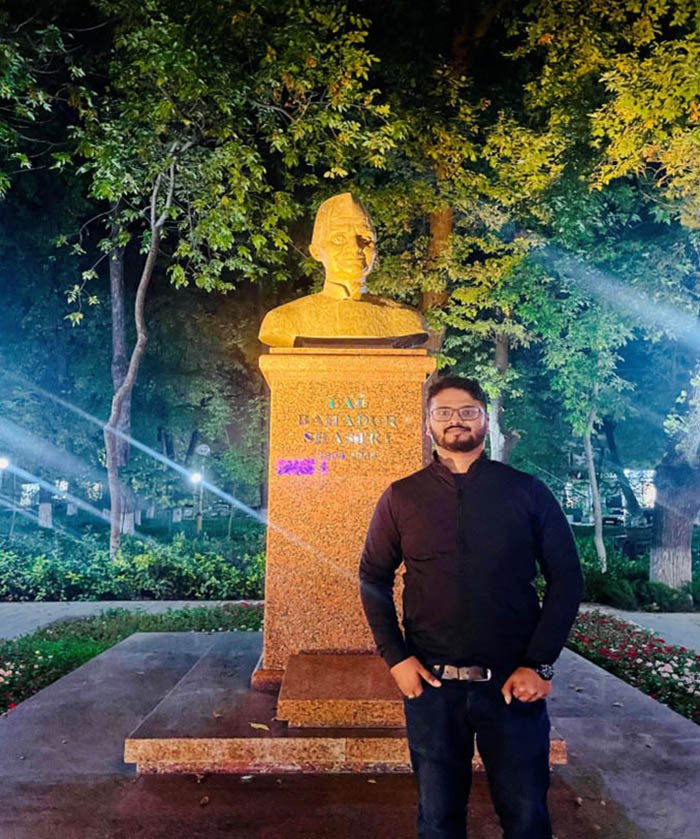
Tashkent occupies a special place in the political and diplomatic history of India, particularly because of its association with the Tashkent Declaration of 10 January 1966, signed by India's then Prime Minister, Lal Bahadur Shastri, and Pakistan's President, General Ayub Khan. The declaration was the outcome of a historic diplomatic initiative undertaken in the aftermath of the Indo-Pakistan War of 1965. The war had caused considerable loss of life and resources on both sides, further deepening hostility between the two neighbouring countries. Indian forces had advanced towards Lahore, reaching its outskirts and bringing the conflict dangerously close to one of Pakistan's major cities. This military confrontation underscored the urgent need for a diplomatic settlement from Pakistan side which had mistakenly started the war thinking of quick victory in its favour. Against this background, the Soviet Union, under the leadership of its Prime Minister, Alexei Kosygin, took the initiative to bring the two leaders to the negotiating table at Tashkent.
The negotiations, held from 4 to 10 January 1966, were aimed at restoring peace and normalising relations between India and Pakistan. The agreement provided for the withdrawal of armed forces to their respective positions as they existed before 5 August 1965, the restoration of diplomatic relations, repatriation of prisoners of war, resumption of economic and trade relations, and a commitment to resolve differences through peaceful means rather than the use of force. Although the declaration did not resolve the fundamental dispute over Jammu and Kashmir, it represented an important diplomatic effort to prevent further military confrontation and create an atmosphere conducive to dialogue. Its significance lay in the recognition that lasting peace in the subcontinent could not be achieved through military confrontation alone.
Unfortunately, the historic occasion was overshadowed by an extraordinary national tragedy. On 11 January 1966, barely a few hours after signing the declaration, Lal Bahadur Shastri died in Tashkent, reportedly following a heart attack. His sudden demise plunged India into profound grief and left behind several unanswered questions in the public imagination. Shastri, remembered for his simplicity, integrity, courage and leadership during the 1965 war, had become a symbol of national unity through his inspiring slogan, Jai Jawan, Jai Kisan. His death in a foreign land, immediately after undertaking an important diplomatic mission for peace, added a deeply emotional dimension to the historical significance of Tashkent. The city thus became not merely the venue of an international agreement but also a place of enduring national remembrance for the people of India.
It is equally interesting to recall that Tashkent, which was then part of the erstwhile Soviet Union, is today the capital of the independent Republic of Uzbekistan, which emerged as a sovereign nation following the disintegration of the Soviet Union in 1991. India's relationship with Uzbekistan has since developed into an important partnership based on historical connections, cultural affinities, economic interests and shared geopolitical concerns. The ancient links between India and Central Asia, facilitated by trade routes, Buddhism, cultural exchanges and the movement of people and ideas, provide a strong historical foundation for this relationship.
A significant new chapter in these ties was written during Prime Minister Narendra Modi's state visit to Tashkent on 29–30 August 2026, when he held extensive discussions with Uzbekistan's President, Shavkat Mirziyoyev. The visit resulted in the elevation of bilateral relations to a Comprehensive Strategic Partnership, accompanied by agreements covering trade and investment, education, scientific research, digital technology, defence, mining, healthcare, traditional medicine, tourism and environmental cooperation. The two countries also expressed their ambition to increase bilateral trade to five billion US dollars by 2030. Particularly noteworthy were India's initiatives to support the restoration of ancient Buddhist heritage sites in Uzbekistan and its announcement of a grant of one million US dollars for afforestation in the Aral Sea region. The announcement of 100 Lal Bahadur Shastri Scholarships for Uzbek students studying Hindi was especially symbolic, coming in the year marking the sixtieth anniversary of the former Prime Minister's passing in Tashkent. It was a fitting tribute to a statesman whose final days were associated with the pursuit of peace and friendship in this very city.
Thus, Tashkent offers a remarkable historical continuity: in 1966, it witnessed an Indian Prime Minister's earnest efforts to establish peace between two hostile neighbours; six decades later, it became the setting for another Indian Prime Minister's efforts to strengthen friendship, cooperation and strategic partnership with an independent Central Asian nation. The historical memory of Shastri and the contemporary diplomatic engagement of Modi together underline the enduring importance of Tashkent in India's foreign policy and its relationship with Central Asia.
Having discussed the historical and diplomatic significance of Tashkent, I would now like to share a few impressions of Uzbekistan, a beautiful blend of heritage, hospitality and modernity, based on my visit to the country in October 2026. Uzbekistan is undoubtedly one of the most fascinating countries I have visited, not just for its stunning architecture and scenic landscapes but also for the warmth and friendliness of its people. What made my experience particularly memorable was the country's rich cultural heritage, impressive infrastructure and the genuine hospitality extended towards visitors, especially Indians.
The warmth and hospitality of the Uzbek people are truly exemplary. During my visit, I found the locals to be extremely courteous, welcoming and helpful. On several occasions, families approached us and expressed an interest in taking photographs with us, perhaps because they did not frequently encounter foreign tourists in their neighbourhoods. English is not widely understood by many locals, which can sometimes make communication challenging. However, technology came to our rescue. We frequently relied on Google Translate to communicate, and interestingly, even the locals were equally comfortable using it.
One particular incident perfectly captures the hospitality of the Uzbek people. On the day I was visiting the Tashkent TV Tower, I accidentally entered an incorrect drop-off location in my cab booking application. Just as I was about to reach the destination, I realised the mistake and showed the driver a photograph of the actual location. He immediately understood what had gone wrong and took me to the correct destination without asking for any additional payment. It was a small gesture, but one that left a lasting impression. Such experiences make you realise that the true beauty of a country lies not only in its monuments and landscapes but also in the kindness and character of its people.
During my trip, I explored two of Uzbekistan's most iconic Silk Road cities — Samarkand and Bukhara. Both cities are remarkable repositories of history, culture and architectural brilliance. The territory of present-day Uzbekistan occupied a strategic position along the ancient Silk Road, the historic trade network that connected China with Central Asia, the Middle East and Europe. This geographical advantage made the region an important centre for commerce, scholarship, cultural exchange and architectural development.
Walking through these historic cities feels like travelling back in time. The magnificent Islamic architecture, intricately designed facades, majestic minarets and beautiful blue-tiled mausoleums create an unforgettable visual experience. The use of blue and turquoise tiles, in particular, gives many of the monuments their distinctive character. The architectural grandeur of these cities bears testimony to Uzbekistan's glorious past and its historical significance as a centre of civilisation and trade.
Beyond its historical attractions, Uzbekistan also impressed me with its modern infrastructure and urban development. The roads are exceptionally well designed and maintained, with wide lanes and smooth surfaces that make travelling comfortable. The overall infrastructure, particularly in the cities I visited, gives them a distinctly modern appearance, comparable in some respects to that of developed Western countries. The country also has stylish shopping malls, contemporary commercial spaces and well-developed public areas. The people themselves are fashion-conscious, with many sporting modern and stylish outfits. This interesting combination of traditional cultural values and contemporary urban lifestyles adds another dimension to the country's appeal.
One of my most memorable dining experiences was at Bolo Hauz Restaurant in Bukhara. It is an aesthetically pleasing, open-air restaurant with a fountain nearby, situated close to some of the city's historic landmarks. During our visit, the waiter asked us where we were from. When we replied that we were from India, he mentioned that he knew about Mahatma Gandhi. It was a simple yet meaningful interaction that highlighted the cultural awareness and goodwill towards India among the Uzbek people. Such little conversations often become some of the most memorable moments of travelling abroad.
Uzbekistan's present-day development becomes even more interesting when viewed against the backdrop of its political and economic history. Following the dissolution of the Soviet Union in 1991, Uzbekistan emerged as an independent nation. Islam Karimov, who had led the Uzbek Soviet Socialist Republic from 1989, became the country's first president and remained in power until his death in 2016.
His rule was characterised by an authoritarian political system and a tightly state-controlled economy. During this period, Uzbekistan remained heavily dependent on exports of cotton, natural gas and gold. These resources played a significant role in sustaining the country's economy. The country has since entered a new phase of economic and social transformation, making its development journey particularly interesting.
Uzbekistan has increasingly emerged as an attractive destination for international tourists, drawing visitors in growing numbers from different parts of the world. Its popularity is reflected in the official tourism statistics: the country welcomed approximately 11.7 million foreign visitors in 2025, registering an impressive increase of 46.8 per cent over the previous year. Uzbekistan offers much more than beautiful photographs and historical monuments. It is a country where centuries-old heritage coexists with modern infrastructure, where the magnificent architecture of Samarkand, Bukhara and Khiva brings alive the stories of a glorious past, and where the warmth and hospitality of ordinary people leave a lasting impression on visitors. My own visit reinforced this impression. Uzbekistan is certainly a destination I would happily recommend to anyone interested in history, architecture, culture and meaningful travel experiences.
(Mr Nitish Nivedan Barik hails from Cuttack,Odisha and is a young IT professional working as an Associate Manager with Accenture at Bangalore.)
I PITY MY NATION
Dr. Rajamouly Katta
A famous nation was under foreign rule for many years. It felt bondage and slavery rather than freedom and self-government. The people in the nation were deprived of craved freedom. They felt they were birds in cages. Dharma Raju, who was in patriotic fervor, felt like a slave. He was in unseen manacles and untold problems. He dreamed of freedom from the shackles of foreign rulers.
Dharma Raju praised his nation very highly for he was a great patriot. Many great people were born in the nation and so it was called ‘Ratna Garbha’. At the same time, it was rich with natural resources, mines, and with all treasures to be unrivalled.
What made Dharma Raju unhappy? His unhappiness was ascribed to his nation’s pathetic plight under the foreign rule. He fought for its freedom. He went to jail like great leaders. He dreamed of the white pigeon’s flight in it in every sphere and corner of the nation and in the world,
“My nation is very famous for its history, culture and heritage. It is known for its resources, mines, and all a rich nation is to own. I have been aware of the unwelcome changes for a long time. Now the position of my nation is pitiable and so it draws the attention of the people, especially patriots and democrats.”
All the leaders were unhappy with the foreign rule as progress was unseen in the nation. They waged the movement for freedom for ‘Swarajya is my birth right’ for many years. After the movement, the foreign rulers declared independence for the nation. They felt free from shackles and manacles, slavery and bondage. They celebrated the occasion in a jubilant manner.
When the nation was free, it thought of high aims and five-year plans in the development of the nation. The leaders elected were committed to the welfare of the nation. Many projects came up when the government was to undertake the welfare programs in the interest of the nation. The leaders were happy with their good reforms. The country was flourishing and its fame was illuminating across the world. Self-government encouraged leaders in the nation to undertake many projects and plans. They looked forward to seeing the nation at its heights of image, glory and glitz.
Like that, the nation was progressing in self-government in a free nation. The nation felt happiness for its progress. In the meantime, the leaders have grown selfish. They became corrupt for self-development in self-government. They welcome corruption as the best means for their development in the self-government in the nation.
The corrupt leaders were happy with their own progress and development. They minted money, grabbed government lands and owned powers, leaving the nation poor. They became richer in treasures and stronger in powers sans limits. As a result, poverty prevailed everywhere as a new problem confronting society. It became an ample chance for the leaders to take up poverty as a slogan for the leaders to use in every forthcoming election. It was, is, and will be ‘Gareebi Hatao’(‘Eradication of poverty’), used by the leaders forever as a winning factor in every election to come.
Some leaders tried to pollute the minds of leaders including Gopala Krishna, the son of great patriot Dharma Raju. They hoped to provoke him to be corrupt like them. They tried their best to change him to loot the nation for self-progress.
“Gopala Krishna, you too fought for the freedom of our nation…You can be corrupt and become a multimillionaire like us. Chances are ample and full at your doorstep…your family. Your son and grandsons in the generations will be magnates excelling others,” said the leaders.
“As leaders, what do we undertake in the welfare of the people of the nation. It is self-government but not selfish government for self-development and self-progress beyond limits…It is not model and advisable. It is the worst crime for the leaders in democracy. We are to lead the nation towards progress but not towards downfall. When we were under foreign rule, we criticized foreigners for their selfish and cunning rule… Let us be different from them and get good name in the world,” said Gopala Krishna.
“Opportunities come rarely to become rich overnight…When there are ample opportunities, we are to grab them without waiting for a single second…a mini fraction of time. See how we were at the past and how we are now…We are one of the richest leaders in the nation,” said the leaders.
“Then your plans, my dear friends, are antisocial and antinational. You make your nation poor, weak and crippled…You say in your speeches that you are the shepherd to look after your innocent sheep… But as a shepherd you have become strong and fat and your sheep have turned weak…Is it the shepherd’s principle? You have grown rich and the people poor against the principles of democracy. Democracy is ‘for the people, of the people and by the people’. You are going against democracy to be of the leaders, for the leaders and by the leaders… We are people’s representatives…leaders to march towards the progress of the people in the nation. For us people’s progress is first and your progress is last…,” said Gopala Krishna to the corrupt leaders.
The leaders laughed loudly. They mocked Gopala Krishna in various ways. He did not feel in any way as he did not aim at swerving from the path of rectitude.
Gopala Krishna was a leader of patriotic principles as he followed in the footsteps of his father, Dharma Raju, a committed leader in his family from his childhood. However, he never deviated from his principle of democracy under any circumstances. He said to them openly and convincingly,
“I am a leader of commitment and sincerity… My father is also like that… I am like my father Dharma Raju. Many corrupt leaders provoked me to be corrupt. Once they tried to murder me but failed. I am a fair leader for the people. We, my father and I, wish that my son would be principled like my father Dharama Raju and me, Gopala Krishna, as committed leaders. That is why I named my son, Jana Pran. I wished him to be the life of the people…for the people’s life; the name connotes so. For him, people are his life and his life is people.”
“You are a wrong man in leader’s paradise…When you do not want to tread the path of hoarding, God will not help you,” said the leaders and left Gopala Krishna alone.
Jana Pran, coming forward from the family of leaders of commitment, is ready to serve the people. He observed all these evils and wrong practices and felt extremely sorry. He did not want to let these all continue in the nation. He jumped into the arena of politics on an auspicious occasion.
On the fine day, Jana Prem met his grandfather Dharma Raju who was in his decrepit old age. He sought blessings from his elderly grandfather.
“Our nation needs a good leader like you, my dear grandson. I pity my nation as it is in trouble. My nation should not face any problem but progress unrivalled,” said Dharma Raju, blessing his grandson heartily.
Then Jana Pran went to his father, Gopala Krishna and sought his blessings. Gopal Krishna as a committed leader was happy for the readiness of his son Jana Pran to enter the politics’ arena. Jana Pran sought his blessings.
“Dear son, my nation is in trouble…I pity my nation for that…My nation needs a powerful leader. You can shine as a leader par excellence…I wish you all the best,” said Gopala Krishna with love and affection.
Dharma Raju and Gopala Krishna were aware of the nation and its unexpected problems. It was very risky for the fair leaders. Anything might happen to anybody. Even then, they were ready to send Jana Sena to the field in the welfare of the people.
Jana Pran wanted to serve the people and so he addressed the gatherings in public meetings. All heard his words, “I pity my nation” and were happy with the feeling that a true leader had come for them after all these days, years and decades of suffering.
All cheered in utmost joy and gave Jana Pran big rounds of applause… They thought that good days were ahead for them under his dynamic leadership. They witnessed bright future and good hopes in the future. Many new leaders were impressed by his principles and those of his family. They extended their unstinted support to him all the time. They expected development and progress under the leadership of the young dynamic leader, Jan Pran.
In a little span, Jana Pran became a public character in the nation. Wherever he went, he was accorded warm welcome. He was in his youth but his performances in speeches were like those of a mature leader. The people of the nation enshrined him in their hearts. So, they looked after him for his safety in the nation of violence.
Jana Pran held meetings with the supporters nationwide. He trained them to be leaders in his line. There was positive response from his followers.
One day Jana Pran addressed at length giving a clear picture of what was going on against the people in the nation. While speaking in the marathon meeting, he became emotional. He spoke at length:
“The leaders, who were corrupt and developed themselves, are against my charisma as a new leader. They were unable to digest my popularity as a good leader. They plotted to see that I was killed but they failed in the attempt. My security was uncertain. I was advised to have a dupe for my protection despite the measures for my security by the police department. I followed their advice given in my welfare…
“My nation was under the rule of foreigners. Under their rule, it lost its treasures. Many invaders entered my nation and destroyed all its valuables and sculptures. Still, my nation is very rich, but it is made poor day by day. It has been deceived on the throughfare. National property is owned by private managements and political leaders…
“The nation became victim to corruption, deception and exploitation. Everywhere funds are swallowed. Roads are to be laid properly but not. In summer, they lay roads and in rainy season, they are swept away by rain. Buildings are built with wrong bricks. Projects show cracks unimaginably…
“The leaders who were like men in the street became rich to live in big mansions. They bought helicopters for their flight in the blue sky and landed and are leading on to the places they want to travel. This is the progress of the leaders on one side…
“There is a clear-cut downfall on the other side. There are incidents of violence reported everywhere. They are murders, rapes and rapes-cum-murders. There are lusty people to rape even babies of tender age. They kill babies after raping them. There are theft cases and cyber criminals. There are chain snatchers. They are kidnaps for ransom kidnaps-cum-murders to reach selfish goals. The newspapers reflect the facts through their headlines. The dailies appear to print all news of crimes in bloodshed. Courts are open for criminals to argue in their favor and earn billions. Criminals are arrested for one day and set free the second day. Are they guests to the courts and governments...?
“Bribing is going on. Bribe makes the file move from one table to the other easily Officers use two hands—one to receive the files to attend and the other to take bribe simultaneously. It is the most unwelcome process prevalent in office in the nation…
“Apart from pollution, adulteration, duplication and all malpractices for the people who dream of riches are living in society. They cause various types of diseases. Hospitals are the business centers to earn sans limits. They gave treatment to dead bodies if needed. There were many pills and heavy bills for the patients. The patients are in utter state of confusion…Doctors are living deities, but they are not committed to their prime and primary duties…
“Students forget the standards of education. Many institutions are everywhere to offer certificates to them on the payment of fees. Malpractice is their regular practice in examinations, and colleges are to understand it. There is no discipline, no decency and no devotion. They do not have chances for recruitment. They are at the crossroads sans employment…
“People are fond of freebies. They do not know whether they deserve to get freebies or not. They think that the leader is compassionate towards them and so he gives freebies. Does he give the freebies from his pocket? Nobody thinks of the scheme of freebies on these lines. When Government is ready for freebies, they celebrate the occasion. They never think that they are becoming slaves when they take freebies...
“Even then the Government is going on its own successfully. Leaders say that there is progress in all fields in the nation...
“Nothing is pure and original, no transaction is genuine, no business is fair and all do not find all in order and proper. They are unable to know what will happen to them in the future. There were wars going on elsewhere to worsen the situation…
“I cannot keep quiet witnessing all these evils…With your support, I put an end to all these…Thank you very much for your patient hearing of speech, my dear people.”
The people heard Jana Pran’s speech in emotions like that. They were happy and clapped long in utmost impression. They expressed their heart-felt feelings.
“We wish the welfare and long life of our beloved leader, Jana Pran… The sun with its powerful shine, the moon with its cool beams and stars with their bright twinkles should rescue our beloved leader, Jana Pran, from all risks of the corrupt leaders in the nation. He came out to sacrifice his life for the sake of our nation.”
Jana Pran grew up to learn the situation in the nation. He was not a novice but a mature politician by virtue of his patriotic fervor. He was the leader of the third generation in the family of unrivalled political history.
Against the wishes of his nation, my grandfather, Dharma Raju witnessed all these incidents with his own eyes. He felt sorry for what had happened in the nation. He told his son Gopala Krishna how his nation was in the past and how it is in the present. He as a committed leader wanted to inculcate all patriotic feelings in the mind of his son Jana Pran in his boyhood days and youth.
“I pity my nation… How my nation was rich with its rich history, culture and heritage in the past. Great kings and emperors ruled the nation treating their people as gods and goddesses in the interest of the nation. Now the situation has turned topsy-turvy. Why has it happened and why is it happening so?” Jana Pran questioned himself.
Jan Pran fell into deep thoughts to find a solution to the problem confronting society. He was serious about the solution:
“We became free from the clutches of the foreigners after a long struggle. Since then, our nation as a democratic nation has been in self-government for more than seven decades under native leaders. At the beginning, after getting freedom, many projects came up since our leaders were committed to the development of our nation. Why don’t the leaders today follow in their footsteps? They have their own steps to come up overnight and make the people poor.”
“Now the time has come for you to fight for a new sunrise… Let us win the election and prove our mettle to reach our goal and fulfil our beloved leader’s wish. Let us fight together in the election battle… This is our oath… Jana Pran… Zindabad…Jana Pran Zindabad…,” said the people and their voice echoed in the sky.
As part of the election campaign, Jana Pran addressed a series of meetings. There was very good response from the people, but the corrupt leaders were unhappy.
Jana Pran addressed a big gathering of the people. The people were happy. They listened to his speech attentively, nodding their heads. Meanwhile, there a thunderous sound arose. It was that of a bomb explosion despite tight security. It aimed at shooting Jana Pran dead. The corrupt leaders plotted against the growing and upcoming leader. They were successful in their mission. Jana Pran was shot dead.
Immediately there was a meeting by the corrupt leaders…They were rejoicing the occasion. They thought they were free from any debacle in any election in the future. The future is for their grand success in the election.
The people fell into the sea of tears. They felt the loss of the leader was irreparable and irreplaceable. They were sad, shedding tears.
The corrupt leaders heard that it was the dupe of Jana Pran who was shot dead while they were celebrating the death of Jana Pran. They were shocked to hear the news, but the people were happy for their beloved leader is alive for their welfare.
Jana Pran expressed his feelings on the killing of his dupe, “The killer aimed at killing me. My dupe was killed instead me. I am sorry…This was the last killing. As a leader I hereafter wish I had no dupe…A true leader is one who does not have a bodyguard.”
Election date stood before the people for their enfranchise. They voted for Jana Pran and his supporters. Jana Pran as the leader-in-chief got landslide victory in the elections of the nation. Jana Pran came to power and made innumerable plans to be successful as a leader. He proved his efficiency as a leader and people were happy ever in his rule. He won applause from all corners as a leader unopposed and unrivalled.
Justice won success. Injustice failed. Jana Pran successfully ruled the nation for decades together and the people were happy. He let no evil and malpractice enter the nation. They celebrated his governance in a befitting manner. They all applauded him ‘Jayaho Jana Pran…Jayaho Jana Pran’, wishing him ‘Long Live Jana Pran’

Dr. Rajamouly Katta, M.A., M. Phil., Ph. D., Professor of English by profession and poet, short story writer, novelist, writer, critic and translator by predilection, has to his credit 64 books of all genres and 344 poems, short stories, articles and translations published in journals and anthologies of high repute. He has so far written 3456 poems collected in 18 anthologies, 200 short stories in 9 anthologies, nine novels 18 skits. Creative Craft of Dr. Rajamouly Katta: Sensibilities and Realities is a collection of articles on his works. As a poet, he has won THIRD Place FIVE times in Poetry Contest in India conducted by Metverse Muse rajamoulykatta@gmail.co
THE PROCESSION
Dr. Mrutyunjay Sarangi
Sushant paused and looked back at the house. One last look, he told himself. One last look at the house which was not only a home, but the whole universe to him. A month's absence had made him miss it as much as he missed his dead wife. Both were parts of his life so integral that their separation would open up the raw soul - smouldering, throbbing, festering.
Yet he had lost her one and half months back and he was going to lose the house today. He had wondered for one full hour whether he acted in haste, if life deserved another chance.
And then he had told himself there was no point in regretting. He had reached a point where time went beyond temporality, it was not to be measured by the long and short of it, but by the intensity of his feeling - just asking one simple question and answering it in his mind - should he or should he not? Should he quit or trudge along on a path which had become so rough that a mere step scalded his feet, the skin peeling off like an unwanted appendage of the body. Just like he himself had become an unwanted appendage to his sons and their families.
He looked away, tears filling his eyes. Hopefully no changes would be made in the house. No one would chip away parts of the house, no hammer would hit the parapet, no one would drill holes in the walls. Would the trustees of the orphanage, to which he had donated the house in a Will Deed a few hours back, ever know how much he had sweated standing under the hot sun on the day the foundation was laid? And the drizzle which drenched him, and gave him a fever on the day concrete was poured to make the roof?
Would they touch and feel the corner of the room where Nishant, the elder son lay in a cradle as a baby, crying in the nights? How Tapaswini would run to him and bring him to the small bed being shared by them, how he would get up and leave for the living room and sleep on the floor?
And that small space between the terrace and the skylight? Sushant could hear the cooing noise of the pigeons as if they were still living there, shamelessly making love and breeding baby pigeons. Despite all the mess they made, the poop and the feathers, they were never driven away till about a year back. Some relatives kept on insisting that their poop and feathers were causing the illnesses for Sushant and Tapaswini, and one day he dismantled the nest. The pigeons must have found some other place nearby to build their nest, because Sushant saw them once in a while sitting on the window sills and cooing to each other.
Ah, there, the small stainless steel plate, how is it still lying there under the branches of the hibiscus tree? How has it withstood the heat and the rains? Sushant clearly remembered the white cat which used to eat rice and the occasional fish curry from the plate. When the finances dwindled and there was just enough to feed Jim, the dog, the cat returned without her share of food for a whole week. After that she had disappeared. Sushant had never seen her again.
Mercifully it was a very small plot, so no big house could be constructed there. It would certainly not be sold to a builder because there was just not enough land to build multi storeyed apartments. Just one bed room with a small living room. A room was added later on the first floor, to enable Nishant and Vikrant, the younger one, to study and sleep, prepare for the exams. This was all that Sushant could afford from his meagre income as a stamp vendor at the local magistrate's court.
Jim, the dog barked a painful, whining cry. He didn't want to be tied up in his small shed. The last one month he had lived away from his own little house, protesting, howling his heart out. And today he didn't want to be left alone.
Sushant didn't want to leave him alone. After Tapaswini died a painful, lingering death, partly out of malnutrition and partly out of cancer, the dog was his faithful companion. Vikrant had brought Jeena, his mother, when he was in college. His class mate had gifted her to him. She lived for fourteen years. Jim, her son, was already twelve, his emaciated body concealed his age.
The two boys had moved on. They were good students. Nishant had become an engineer working in the State Electricity Board in the state capital. Vikrant went into the legal profession and worked as a lawyer in a nearby town, just thirty kilometres away. Maybe, seeing his father selling stamp papers in the premises of the Magistrate's Court had inspired him. Both had married into rich families, their wives smart spendthrifts who wanted money all the time, never satisfied with what they had.
Three years back Sushant had to quit his job. Two spells of long fever had pulled him down. And then tuberculosis sapped his energy. He was not able to even ride the bicycle to work. Nishant and Vikrant spent a few thousand rupees on him, but it was getting clear that their wives were reluctant to spare the money. Sushant's savings were getting depleted, food became scarce, Jim, the dog had to give up his non vegetarian meal, but after the first two days of surprised reluctance, he understood and adjusted with a plate of simple rice with salt.
By the time Sushant recovered from tuberculosis, Tapaswini had been diagnosed with pancreatic cancer. Her thin, emaciated body degenerated with frequent bouts of dysentery, she died a silent death, in her husband's arms, smiling as always, at a loving, dutiful companion.
Sushant was devastated. Tapaswini had never left him alone, not even to go to her parents' place for the customary festival holidays. His each and every need was taken care by her. The day after her death, he spent an hour in the bathroom crying. For as long as he remembered, it was a daily routine for him to call her, "Tapu, please get the towel". She would come running, shouting in mock anger, "Can't you get your towel before going to the bath room? Who will give it to you when I am no more?" He would shout back, "Don't worry, you will live for fifteen years after me!"
Ah, how life plays these cruel jokes! She left him within three months of the detection of cancer. The sons came for the funeral and left immediately after the rituals were over. No one talked with him, the grand children had come only for a day, and left with their mothers because the exams were on. The sons were busy with their mobile phones, no one had time for him. Their wives came back for the tenth day ceremony and stayed back till the fourteenth day. That's when he overheard the conversation among the sons and their wives one late evening in the living room when they thought he was asleep in the bedroom.
"Vicky, you should take Baba with you. He looks so thin now and without Mama he will not be able to manage".
Shalini, Vikrant's wife pounced on her brother in law,
"Why Bhaiya, you are the elder one, the responsibility comes to you first. And your income is much higher, look at Didi buying all those ornaments, they are certainly not coming from your salary!"
Nishant got shocked by the unexpected direction the discussion took,
"Oh, come on Shalu, you have a such a large house in a big town, and only one son. We have two of them, our expenses are certainly higher than yours!"
Shalini nudged Vikrant to say something, who said haltingly,
"Bhaiya, it's not a question of our household expenses being less. Baba was not doing a government job, he has no pension. The entire burden will come upon me!"
Nishant, the practical Engineer tried to put some reason into the mind of his younger brother, "But think of this plot of land and the house, it will fetch at least eighty lakhs or so when we sell it".
Shalini was off from her chair in a jiffy,
"Will you let us keep the sale proceeds if we let the old man stay with us? Then we will consider keeping him".
It was the turn of Sunita, the elder daughter in law to interject,
"How can that be? Both the sons should have equal claim to the father's property".
Vikrant found a compromise,
"Then the responsibility should be equally shared. Tell you what Bhaiya and Bhabhi, let us keep him for fifteen days each. First fifteen days of the month he will stay with you, I will keep him for the next fifteen days. We will put this house on rent and share it half-half. That way the burden will be divided by half and Baba will have a change of place every fifteen days".
Nishant was not averse to the idea. The rent will be at least twenty thousand rupees, this place being so close to the central market.
Listening to this from his bedroom Sushant was aghast, by the idea of this division of burden. A burden? With a paltry income he and Tapaswini never considered the children a burden! They led a frugal life so that the children would have good food and education. And today the sons were talking of the father as a burden to be shared fifty-fifty!
But Sushant had no choice. His back was broken, with all the medical expenses for himself and Tapaswini, who had to be treated in a private hospital. These days who goes to a government hospital with all its crowd, filth and the stench? Next morning he agreed to move with Nishant on the first of August, after spending the remaining eleven days of July in his house, reliving a few precious moments in the memory of his beloved Tapaswini. A 'To Let' notice was put up giving the contact numbers of the two sons. Sushant folded his hands and made his sons agree that he should be allowed to take Jim, the dog with him.
The first two days of Sushant's stay with the son's family were spent in peace, but then the restrictions set in. No playing with the kids, lest it affect their studies, no more than two cups of tea per day, go slow on sugar and oily food, no hot water for bath, no meal for the dog, he had to roam around the street searching for food. After all, the old man contributed nothing to household expenses. What kind of job had he chosen to do which had no pension? Even a peon gets a pension! The renting of the house could not be finalised, a couple of prospects, rejected it for the small size of the rooms, and the electricity connections were considered treacherous. Some one offered only ten thousand rupees. And the 'old man' got lectures from his sons for his lack of foresight in not making the rooms big, not renovating the electricity and plumbing systems with whatever little savings he had. Sushant's life became a long catalogue of regrets and frustrations. He felt suffocated in the homes of his two sons.
And on the morning of thirtieth August Shalini called Sunita to inform her that the same evening the 'old man' will reach his elder son's place. The quota of fifteen days was over for Vikrant and Shalini. Sunita shouted from the other end, No, she can take the old man on first of the next month only. From first of the month to fifteenth, not a day more, not a day less. Shalini raised her voice. What joke is this? Sixteenth to thirtieth is fifteen days, Sunita can calculate if she wants to. Vicky and Shalu were not prepared to keep the old man even for one extra day. And the dog! One look at his emaciated body, she feels like puking!
They were shouting at each other over phone when Sushant left. He had somehow managed to keep enough money with him to pay for the taxi fare for thirty kilometres to his old home. That night he and Jim had a good sleep in their own home, Jim's excitement, joyous barks made up for all the pains of the last one month. The next day, Sushant left home at nine thirty to his old work place, bought a stamp paper, made a Will Deed for his house to go to the local orphanage after his death. He got the signature of two friends on the Will Deed and came home, spent a few hours going from room to room, touching every corner, the bed, the table, the old TV set, reliving bits and pieces of memory. He took out the sarees of Tapaswini, lovingly touched them one last time, copious tears flowing from his eyes in unending streams.
And then he came out, tethered Jim to his usual post, hoping against hope by tomorrow he would be rescued by a neighbour. He had one last look at the house and resolved, he would not look back at it again.
Sushant started walking on and on, he didn't know where to go, he just took the road that goes out of the town towards some little-known villages. Once he reached the open road, away from the crowd, he looked back at his old, beloved town where he had spent sixty six years of his life with all his hopes and dreams, sorrows and despair. Did he ever know the journey would end like this? Was this the dream he had dreamt with Tapaswini, when the sons were small, holding the fingers of their parents, struggling to walk the path of life?
And then he saw Jim, blood oozing out of a fresh cut in his neck, he must have snapped the chain and followed his master's scent, catching him finally and jumping with joy, pawing him, scratching him and crying his heart out. The cat which had disappeared two years back followed the dog. And the two pigeons, the shameless love birds who bred like there was no tomorrow, were hovering over his head, their cooing music echoing in the stillness of the fading day. They all stopped. The old man looked up. The clouds appeared to have stopped moving. The sky was silent, frozen in the bowl of the earth. The wind was still. He knew with his next step forward the spell would break, the sky would open up, clouds would burst , winds would blow and his solemn procession with the dog, the cat and the pigeons would march towards the horizon where the sky hugs the earth in a tight embrace. He knew with the next step forward it would be a final journey from where there would be no return.
He felt a tug at his pant and looked down. Jim was sitting, hunched, wagging his tail, it was the cat which had pulled at his pant. The town he had left behind was taking a pinkish hue welcoming the setting sun. Sushant knew, in this small town somewhere there lived a buyer who would buy his house for eighty lakh rupees. And from the interest earned out of that money he could find a small place to live in, with his Jim, his cat and the two shameless pigeons. He threw away the two strips of sleeping pills he had bought from the chemist's shop with his last twenty rupees note. He and his companions turned back and started walking towards home in a solemn procession, awaiting a starry night which was looming over the horizon.
Dr. Mrutyunjay Sarangi is a retired civil servant and a former Judge in a Tribunal. Currently his time is divided between writing poems, short stories and editing the eMagazine LiteraryVibes . Four collections of his short stories in English have been published under the title The Jasmine Girl at Haji Ali, A Train to Kolkata, Anjie, Pat and India's Poor, The Fourth Monkey. He has also to his credit ten books of short stories in Odiya. He has won a couple of awards, notably the Fakir Mohan Senapati Award for Short Stories from the Utkal Sahitya Samaj. He lives in Bhubaneswar.
Viewers Comments