
Literary Vibes - Edition CLVIII (31-Oct-2025) - SHORT STORIES
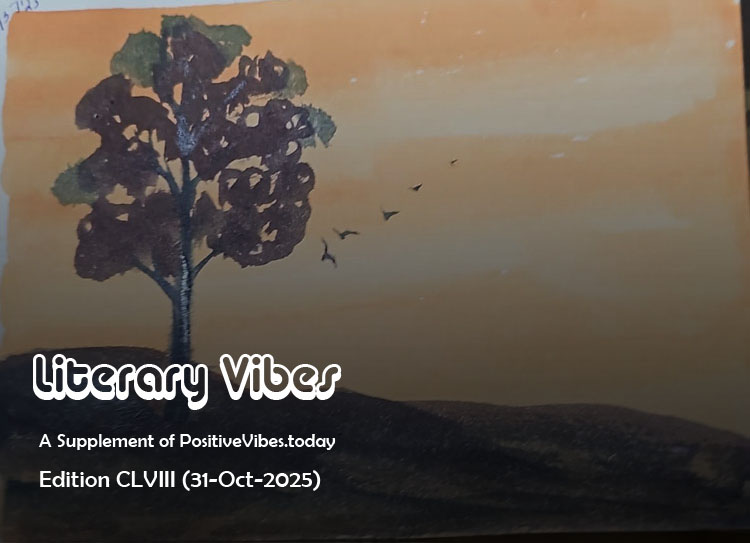
Title : The Lone Tree (Watercolour by Ms. Latha Prem Sakya)
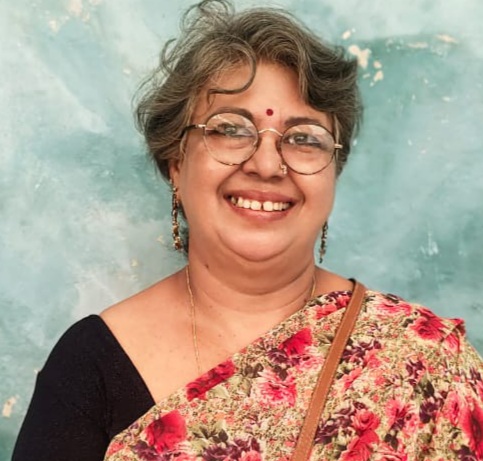
An acclaimed Painter, a published poet, a self-styled green woman passionately planting fruit trees, a published translator, and a former Professor, Lathaprem Sakhya, was born to Tamil parents settled in Kerala. Widely anthologized, she is a regular contributor of poems, short stories and paintings to several e-magazines and print books. Recently published anthologies in which her stories have come out are Ether Ore, Cocoon Stories, and He She It: The Grammar of Marriage. She is a member of the executive board of Aksharasthree the Literary Woman and editor of the e - magazines - Aksharasthree and Science Shore. She is also a vibrant participant in 5 Poetry groups. Aksharasthree - The Literary Woman, Literary Vibes, India Poetry Circle and New Voices and Poetry Chain. Her poetry books are Memory Rain, 2008, Nature At My Doorstep, 2011 and Vernal Strokes, 2015. She has done two translations of novels from Malayalam to English, Kunjathol 2022, (A translation of Shanthini Tom's Kunjathol) and Rabboni 2023 ( a Translation of Rosy Thampy's Malayalam novel Rabboni) and currently she is busy with two more projects.
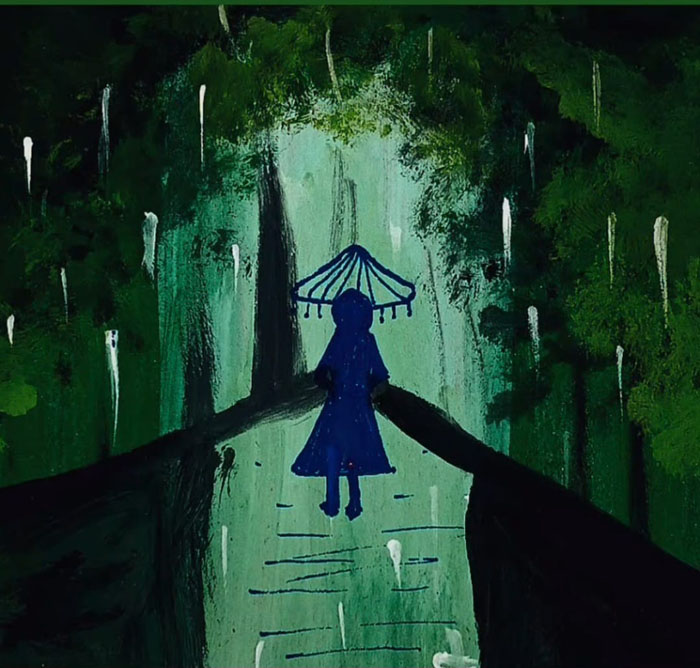
Title : Emerald Veil (Colour Painting by Swatishree Parija)

Swatishree Parija is a second year B.Ed..student from Jajpur, Odisha. She is passionate about literature, painting and photography from her school days. She writes excellent poetry. Her paintings and photographic creations are equally outstanding. She has won many awards in essay writing, painting, and debate at the block, district, and state level.
Table of Contents :: Short Story
01) Prabhanjan K. Mishra
A GIFT: IRREDEEMABLE
02) Dilip Mohapatra
BE A MOUSE AGAIN
03) Sreekumar K
CRUSH’D
04) Snehaprava Das
A PORTRAIT OF THE RUINS
05) Satish Pashine
THE JOURNEY OF CHANGE
06) Triloki Nath Pandey
MY JOURNEY TO THE WEST: LONDON AND CHICAGO
07) Deepika Sahu
MEET AROONA BHAT, INDIA’S FUNKY BINDI QUEEN
08) Annapurna Pandey
MY HOME MY IDENTITY
09) Ashok Kumar Mishra
BILWAMANGALA AND CHINTAMANI
10) Bidhu K Mohanti
PATIENT STORIES CAN TRANSFORM THE HEALTH SYSTEM APPROACH TO PALLIATIVE CARE
11) Dr. S. Padmapriya
THE AUTOBIOGRAPHY OF A NEEM TREE
12) T. V. Sreekumar
MOVE MAN
13) Seethaa Sethuraman
CONVERSATIONS WITH AMMA – PART 1 (B)
14) Sibaprasad Mishra
WRITING FROM MY FIRSTHAND EXPERIENCE
15) Sheena Rath
VACATION TIME
16) Molly Joseph
MERGING TERRAINS
17) Dr. Rajamouly Katta
‘POET SAMRAT’, HIS PEN NAME: TRUE LOVE
18) Mr Nitish Nivedan Barik
LEAF FROM HISTORY : “A LIFE THAT BRIDGED THE SOIL OF ODISHA WITH THE SOUL OF INDIA.”
19) Dr. Mrutyunjay Sarangi
BABA`S FILTER COFFEE
Prabhanjan K. Mishra
I was impressed by Rambha's empathy for the poor railway’s Junior Engineer (JE). She turned repeatedly and responded with a wave of her manicured palm to the JE’s moving rough and tough right hand waving good bye. It was a touching sight. Wife of the DRM, the Divisional Railway Manager, head of one of the divisions of the Western Railway Zone, melting her heart for a railway employee at the bottom of the engineering hierarchical rung.
It could not be a show-casing as there was, if I was not mistaken, a drop of tear at the corner of her eye that was turned away from me with an effort to hide emotional embarrassment. I presumed she was feeling bad for the poor working environment of the Junior Engineer.
I was however wondering what a weird name that JE had, ‘Hayavadan’! I had read the myth of Hayavadan (horse-faced) after watching Girish Karnad’s play of the same name - how a human baby born to a princess had a horse face. The princess was in love with a horse who sired Hayavadan, a hybrid creation. Hayavadan, the hybrid man, had lived hankering after completeness as human. He all along suffered from an identity crisis, torn between a horse and human persona.
At the very instant as if, my wife of twenty springs, Rambha, heard my thought through telepathy, and mused aloud, "But I like that name, Hayavadan, having associations with vulnerability and alienation, that could lead to an interesting split personality. A musical and meaningful name like yours, ‘Ranchhod’ with two distinct and different nuances – ‘coward’ and ‘strategist’, like heaven and earth. I liked the name from the very start, the day he had walked into our house.”
She went silent and then continued, “How smart he sounded, when bending forward imperceptibly towards me, with a semi-smile lighting his impressive face, he extended his right open palm and said, ‘I am Hayavadan, Madam. May I have the pleasure of knowing yours?’ It was a foregone fact, in his case, before visiting us with parents as a suitor, he must be knowing my name as I knew his, still he spoke aloud his own and wanted to hear mine from my lips. His social etiquette and a respectful approach towards a woman impressed me.”
I was a bit flustered, “You mean, Rambha, you knew him well from your earlier days? You said he came as a suitor. But you two didn’t move a muscle to show your earlier familiarity. Strange!" I saw Rambha getting flustered. She had perhaps bitten too much to chew and swallow.
Gathering her wits, Rambha shyly divulged, "Yes Ranchhod, I came to know him, as he visited us with parents on his heels as my eleventh suitor, asking for my hand. Such impromptu visits, as you know, were in vogue in our society. A sort of inhouse Swayamvar. It was common for parents like mine who had a pretty unmarried girl to be visited by the parents of unmarried boys.”
After a pause, Rambha went on, “In my parents’ case, as they were rich, educated, well-heeled, principled, liberal, and Gandhian, they allowed their girl, that was me, to meet and see the suiter-boy’s suitability personally. When mine and Hayavadan’s parents were sitting in the drawing room, I was sent with Hayavadan to the garden behind our big house to show him our roses. I knew he was brilliant, and was in the final year of mechanical engineering.”
Rambha was not over, “I was clean bowling when Hayavadan opened with an off-spin googly, ‘Madam, I like you much, if given a chance I may fall in love outright. Besides your beauty, my information about your friendly disposition with one and all tilts the balance in your favour as a bride. But, Madam, the name Rambha is out of tune with you, meaning a celestial nautch entertainer. Another thing, like your family, my family don’t believe in dowry, the Devil. We are Gandhian.”
Rambha added, “I liked his frankness about my name. Many had already said, including you Ranchhod, that it did not suit my personality. Rambha stood for a celestial dancer-cum-entertainer, and I as a woman had nothing to do with such a profession. I decided to be equally frank, ‘But I like your name, Hayavadan, that associates vulnerability, and I love vulnerability being a harbinger for kind feelings. I am impressed by your personality, for that any would-be-bride would be. But I am sorry. I am in love with a man already.”
She continued, “I told Hayavadan about you elaborately, about your UPSC’s Indian Railway Personnel Services (IRPS) examination after doing post-graduation in English literature, about by all possibility you hitting the nail. I said, ‘So, I am afraid you would return empty handed.’ It was Hayavadan’s turn to hit the ball that I had put in his court.”
He hit my ball with an exemplary and graceful sixer. He smiled expansively with so kind words that I found him as a rare specimen among my suitors, ‘It is absolutely OK, Madam. My blessings for your love and your suitable boy. I wish him success and wish the love between you two might flourish until death part you. Best of luck. Yes, your roses are beautiful but not as beautiful as you. Take care.’ With that he turned and started walking back into the house.”
Rambha had not finished yet, “To Hayavadan’s surprise, I stopped him firmly with a restraining hand. He flinched. He looked at me with surprise. I smiled and said with appeal in my voice, ‘Haya, I have a personal request. Will you mind treating me as your friend, so that I can bare my secrets before you?’ He choked, ‘Yes please. Be frank. Only, please take my full name, not ‘Haya’, that means a ‘horse’. And I detest it.’ I saw his identity crisis. Also, his split personality, keeping with his name, getting charged like a horse from his gentle disposition.”
Rambha continued, “I felt embarrassed to open up, but Hayavadan urged me, ‘Please go ahead, Madam, you may speak freely to your friend, Hayavadan.’ Now I was choking. But, after gathering courage, I asked him if he could oblige me by rejecting me as his would be bride, so, I had not to reject him causing embarrassment to his parents.”
Rambha went ahead, “I begged, ‘Dear me Hayavadan, I saw a light of appreciation in my father’s eyes for you. He appears to like you immensely. See, you have such a loving personality. You are my eleventh suitor in my father’s in-house Swayamvar for me, but I saw father melt at the first sight of you, the first time ever. It sounded a warning signal to me. What of my love story? I will die without him. So, Hayavadan, don’t delay in rejecting me outright if you are asked for an opinion.’ He nodded, boxed my ear with childish affection, and left. we went back to sit with our parents, and join the bonhomie tea-snacks session.”
Rambha continued, “As usual, my father begged for a few days’ time from Hayavadan’s parents to let them know our decision, ‘You know, we need to discuss your proposal with our extended family.’ His father sportively replied, ‘Of course, Sir.’ And with that, he got up to beg leave like a real gentleman.”
Rambha was not finished, “After they departed, my father started speaking to my mother, ‘I like the boy. He is personable and well behaved. Gentle and polite. Liking for our Rambha was writ large on his face. Though the family looked poor but they never showed any self-pity for their material poverty, or poverty-related nervous behaviour.’ I appreciated my father’s view but with a pinch of salt, as it was against my default selection, you, Ranchhod, my first and last love. So, I panicked.”
Rambha went on, “My panic continued. My only hope was Hayavadan’s firm refusal to his parents about me, that needed backbone and courage. It was one thing to nod his head before me and quite another thing to shake a firm head before his parents. So, my iron in your fire, dear Ranchhod, was getting hot, hotter, and white hot.”
Rambha sighed in relief as if remembering something good that happened, “And Hayavadan proved he had backbone. After two days, my father came home looking crest fallen and to my mother’s probing questions, he said reluctantly, ‘I was just going to confirm my consent for Hayavadan as the suitable boy for our Rambha, but his father’s telephone preceded mine. He said Hayavadan had other plans about his marriage. He was sorry and apologized for it. His early refusal saved me at least an embarrassment of my consent being turned down.’ I heaved a sigh of relief.”
Rambha appeared finished. She was gasping a little, also perspiring a bit. Must be out of double exertion, walking and talking non-stop. I felt a twinge. So, that's why the Hayavadan fellow was referring to her while saying “Come again, Madam” repeatedly. He never said, not even once, “Come again, Sir.”
But I had no clue how so apparently a brilliant boy like Hayavadan landed in such a stingy place for his Junior Engineer’s job, and never got his timely promotions in roughly twenty years of his service.
The things might have been different half an hour ago, I thought, had Hayavadan known that I was his big boss, the Divisional Railway Manager (GRM) of his Division under the Zone of Western Railway. How would Hayavadan, a Junior-Engineer guess that I, the new DRM, was touring incognito to know the staff’s state of affair, comfort, and wellbeing.
My intention immediately after taking the charge was to tour without the knowledge of the subordinate staff and to look at various field formations, especially to see how the railway department had been taking care of the wellbeing of its staff. I was inspired by Lord Ram, who after ascending throne, was taking intermittent tours in remote areas of his kingdom in the guise of an ordinary mendicant to know the problems of his subjects.
We were walking to our car, parked across a small bridge almost a mile away behind a walled road of railway. I drove the car in that lofty mission of mine. But, at times, Rambha also took the steering from my hand to give my hands rest. She was equally enthusiastic like me about the welfare of the staff. Keeping the car away and not using the driver was a strategy I was following from Ramayan also.
The strategy to remain incognito had been successful so far. That day my second twinge came when Rambha had no complaints for the long walk along the rough terrain of the railway yard to reach the car, and she behaved as if she had grown the wings of Pegasus.
I asked, “Aren’t your legs aching from this long walk, Rambha?” She replied, “I was thinking of Hayavadan. He must be in his job as long as you, almost twenty years, but the brilliant man was still a Junior Engineer, a post he might have joined after passing engineering. His misfortune for whatever reason diverted me and I forgot my personal exhaustion from long walking.” Was I jealous to hear my wife’s concern for one of her previous suitors?
Noooo …I reconfirmed to myself that I could not be jealous like any Tom, Dick, or Harry, as I was no spring chicken, rather a senior IRPS officer of twenty years’ experience and now headed the Division of the Western Railway Zone.
Rambla asked, "Hey, you look upset. Your face is red. You have the hint of a scowl on your face. You must be feeling angry on yourself for the poor condition of Hayavadan, one of your staff." I wondered, was I so noble as Rambha was presuming? Did I deserve the compliment? Again, a noooo .... rose silently but strongly from deep down me, and it was a more honest a ‘noooo…’ than the earlier one.
I knew I did not deserve Rambha’s compliment. How would my beloved, college sweetheart, Rambha, feel if she knew after a love marriage of twenty years, her husband, was suffering from a jealousy-based sulk and insecurity? Was my love for her so fragile?
Then the weather changed from stormy to fare... as I heard Rambha musing aloud, “I recall when during my ragging days, you as a two-year senior in my college asked me in a college corridor, 'Tell me Rambha, what is your name?’ When the onlookers laughed remembering the famous dialogue from movie ‘Sholay’, I wilted feeling humiliated.”
Her loud musing continued, “So, you teased me further, but I felt simultaneously that you were giving me a link to tease you, ‘OK Rambha, that question was rather hard for you. I, therefore, change the question. Tell me the meaning of my name Ranchhod.' I laughed out loud (LOL).’ The atmosphere eased with your cameo and my LOL. You also gaffawed.”
I recalled those days when I had ragged my pretty Rambha. After her LOL, my classmates who had gathered to see the fun, knew by instinct that the fun was over, and left. Her laughing out loud, an impromptu action, though an indiscretion, pleased me. After the onlookers cleared the corridor, I faced Rambha on equal terms, not as a senior or a ragger, rather a collegemate to speak heart to heart. She had impressed me a lot and I knew ‘the coin had dropped’, as it was said, when she had laughed out loud.
That laugh had broken the ice and made a spring breeze blow. After that laugh, when she was cringing out of fear that she had committed an indiscretion, an obvious tease at my name, indicating, 'What a name? Or what a joke of the name!' I had, laughed out loud, to make her comfortable.
I clearly recalled what I had told her then, “Rambha, isn’t that your name, dear junior? Isn’t it a bit funny to carry the name of a celestial nautch girl? Rambha is also considered by many mythology experts as a celestial entertainer, show-stealer, and tawaif-equivalent of the then time.”
I had continued, “Of course, equally odd and funny is my name. ‘Ranchhod’ which is assumed to mean by the ignoramus as one who runs away from the battle field without giving a fight, a kayar or coward. But Mahabharat interprets it as a strategist, who retreats from the battle field as a part of war-craft to strike back in opportune moment. It was the other name of Lord Krishna, the king of Dwarka. My mother loved the name so much, she made it a part of her household by naming me ‘Ranchhod’. The action ‘ranchhod’ was equivalent to ‘gambit’ in the game of chess.”
Rambha had quoted Shakespeare. ‘What’s in a name’?” But I had replied, “Much, my dear, association of those loving moments when our parents, or grandparents chose those names.” My honesty had impressed Rambha.
Speaking of strategy, we started making our own separate strategies to meet each other, that would look like accidental meetings, though in fact, the meetings were much planned ones from both sides. Though a mystery, how all separately planned meetings were so successfully accomplished, each one. After a few months the cat was out of the back.
Then, once my secret was leaked to Rambha by my co-planner Raghu who during those planning processes had repeatedly met by some or other pretences with Jyoti, the co-planner of Rambha to know the plan of the other party. Those repeated meetings between Raghu and Jyoti drove them into each other’s fondness leading to a second love story. Another day, Jyoti also leaked Ramba’s secrets to me.
It was then known that behind our backs our co-planners, Raghu and Jyoti, had planned those moves so accurately. The mystery was demystified. We four had a good laugh, rather we had LOLs. After the LOL we started courting each other openly, each of both pairs, planners and co-planners. Our strategy became popular in the campus and was followed like an App as were computer apps.
Rambha said her hands on steering, “Now, I recall a joke of yours when we were wrapped in love’s ointment, ‘Our wedding card would produce a thunderous effect if printed as, ‘Rambha Patel weds Ranchhod Prajapati, you are requested to grace the occasion by partaking of a feast of our Gujarati delicacies – Fafda, Handvo, Thepla, Khaman, Dhokla, and other delicacies.’ I had agreed, with you “Yes Ranchhod, the guests would run away thinking bombs would drop all over during our wedding.”
Rambha recalled some more memories aloud, “So, we decided in our marriage to skip the card, gusts, feast and the priest; and replace them with garlands, signatures of our witnesses, Raghu and Jyoti, and the registrar of marriage solemnising the sacred bond. Of course, that was to my parents’ great consternation.”
She went on, “Your name was funny but dear to you, as it was your mother’s stamp on your being, so I started respecting it and forced myself never to show that I was supressing a laugh. Gradually, I started to love it, the name ‘Ranchhod’.”
Suddenly I had a brain wave. I wanted to test Hayavadan. I wanted to go a step ahead of my icon, the King Ram, in the matter. I requested Rambha to U-turn the car, and go to Hayavadan’s railway yard office.
She obeyed but with dismay, “Why, …why my dear Ranchhod?” I replied with a serious frown, “Your eleventh suitor, Hayavadan, a brilliant mechanical engineer, appears to be languishing at a very low level of maintenance section. Doesn’t it appear a bit odd? So let us go back and check his secret.”
When our car stopped in front of his office, Hayavadan did not come out. We disembarked from the car, and walked into the office. It lay empty except Hayavadan at his desk inventorying parts and accessories of train engines, might be a newly received batch that lay scattered around his sitting area. He stood up and greeted Rambha, ignoring me like the earlier time, as if I was invisible or a ‘nobody’.
With a big smile Hayavadan asked Rambha, “Did you forget something here, Madam?” I, however, took control of the situation with my authority of a DRM, and asked, “Mr. Hayavadan, where are your colleagues?” I looked at the clock on the wall, “It is 12.00 noon and all chairs except yours are empty, how so?”
He smiled, “I don’t know with what authority you ask. But as a taxpayer, I think, you have a right to know. It is a remote area. My colleagues come and go at their sweet will. The senior engineer in charge himself is lax for his timings, so, all others take advantage of his irregularity. But Sir, you are killing my time. I am to finish inventorying these newly supplied parts.”
Hayavadan folded his palms and returned to his machine parts and inventory register. I liked the way, the busy bee indicated, ‘Get out’, politely.
I handed over my departmental ID card showing my name and designation, ‘Ranchhod Prajapati, IRPS, DRM’. He read the card, and stood up, “Sorry Sir, I never met you earlier. I could not associate you with your photograph in the local news daily published last week with the news of your taking charge. Please take a seat. Now I recall, Madam Rambha marrying her college sweetheart, Ranchhod Prajapati, an IRPS officer. How can I serve you Sir?”
I didn’t know why I felt belittled before Hayavadan, so many rungs down me in hierarchy of railway administration. I gathered my wits, “My first visit an hour earlier here was an incognito affair. I wanted to see, after taking the charge as DRM, how my officers are treated by railway department and vice versa. But this second visit is not so. Please tell me Hayavadan ji, in your twenty years of service, why are you languishing at the junior most level, as a Junior Railway Engineer? Why did you miss your regular promotions?”
He hesitated, shifted his weight from foot to the foot, then blurted out, “I don’t know, Sir. Perhaps, I lack great qualities that oil our railway machinery. I am too proud to be promoted. Even railway engines may grind to halt without lubrication, if I was promoted.”
I liked the way, he used the metaphors, to call the railway department crawling with sycophants. I accepted a cup of tea he made for me in the little pantry. As Rambha drank only coffee, and he had no coffee in stock, he apologized, “I know Madam, you drink only coffee, but I never knew about your coming …. There is no coffee in the pantry.” Rambha waved a hand as if to rub off his embarrassment.
I shared the cup of tea half-and-half, two-cutting-chai, I had learnt from my Mumbai days. Hayavadan was bowled clean by the cutting chai. We shook hands as equals, two suitors in Rambha’s Swayamvar roughly twenty years’ ago.
Ram, my icon, in Ramayan broke the Shiv Dhanush (the mythical bow of Lord Shiv) to win Sita’s hand. I, Ranchhod, won Rambha by eloping after I landed my IRPS job. I was accepted by Rambha’s parents in spite of my dicreion, as Hayavadan, with a great gesture of sacrifice without her parents’ knowledge, had left the ring without taking part in the contest, giving me the walkover. Hayavadan’s refusal had deeply wounded Rambha’s father, and permitting me to marry her was his balm for the wound.
I returned to my office, called all of Hayavadan’s Annual Performance Reports (APRs), nineteen in number and reviewed them with a special power given to the DRM. They all read either ‘poor’, or ‘good’, not even a single one was ‘very good’. So, I realised what caused him languish at his starting level. I knew I had all along underestimated the power of sycophancy. I reviewed them and upgraded each to ‘excellent’ level adding superlative words of praise as reasoning.
I thought, I had survived that evil ‘sycophancy’ myself because I was the son-in-law of a leading industrialist who had a great ballast in power corridors of politics. That invisible hand protected me. Again, I felt belittled before Hayavadan. His honest, hardworking, unprotected post of a Junior Railway Engineer raised a much larger image in my mind than my own, image of a sheltered DRM.
I informed so to Rambha. I also informed Rambha about my orders already issued to raise him three posts higher by promoting him to the level that he would have achieved in normal course, had he not been overlooked for bad entries in annual performance reports because he would not do sycophancy.
But Rambha had a doubt, “I suspect, Hayavadan would understand your justice. In the circumstances he is most likely to take it as your out of the way ‘grace’, and he is too proud…”
Exactly that happened. Hayavadan politely turned down the promotion on health grounds. He messaged me in WhatsApp, “Respected DRM Sir, I cannot accept your personal gift guised as official. Thank you, Sir, for your kind thoughts. Don’t give me so much, I would not be able to give you back anything in return.”
In a lighter vein I messaged him back, “But Hayavadan, you have already gifted Rambha to me on a platter twenty springs ago. I am only trying to redeem the injustice done to you.” He simply replied, “Sir, some gifts are irredeemable.” (END)
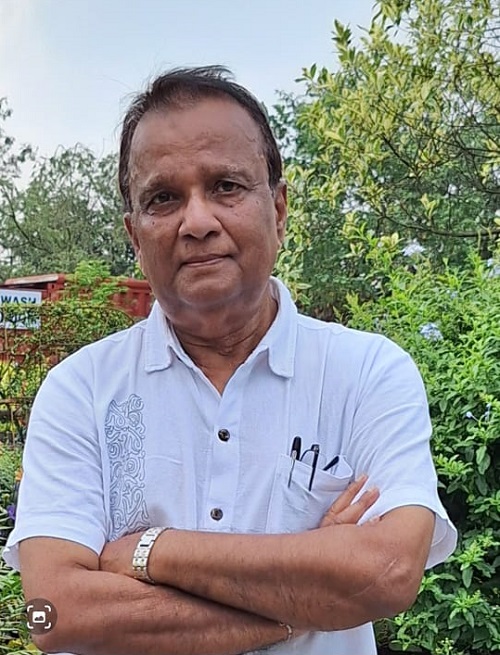
Prabhanjan K. Mishra is an award-winning Indian poet from India, besides being a story writer, translator, editor, and critic; a former president of Poetry Circle, Bombay (Mumbai), an association of Indo-English poets. He edited POIESIS, the literary magazine of this poets’ association for eight years. His poems have been widely published, his own works and translation from the works of other poets. He has published three books of his poems and his poems have appeared in twenty anthologies in India and abroad.
Dilip Mohapatra
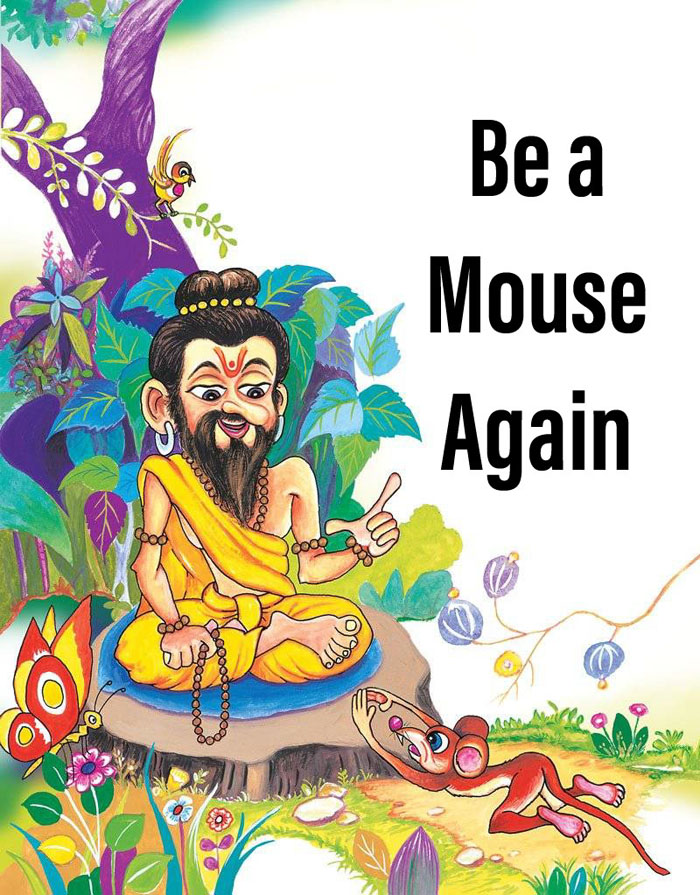
Present Day
Arvind Mehra sat alone in his office, the glow from the city skyline bleeding through the half-closed blinds. The building was almost empty, save for the low hum of the air conditioner and the restless ticking of the wall clock.
It was late enough that the cleaners had finished their rounds and left; the faint smell of floor polish still lingered in the air. Arvind’s reflection in the darkened window seemed older than the man he thought himself to be — deep creases at the temples, hair more silver than black. He had travelled a long, arduous road in the corporate world, earning name and fame as a role model for many. And now, almost at the end of his career, he headed a thriving company in the solar energy sector.
On his desk lay a slim folder — a compilation of emails, whispers, and quiet confirmations from people he trusted. All of it pointed to the same man: Rohan Suri.
Rohan. The young recruit Arvind had once hand-picked, mentored, and shielded from the wolves of the corporate jungle. The one who had risen faster than anyone expected — sharper, smoother, and lately… far more dangerous.
Arvind leaned back in his chair, letting the leather creak under his weight, and closed his eyes. The city’s neon pulse blinked against the glass, but in his mind’s eye he saw something else — a quiet evening from long ago, the warm lamplight of his mother’s room, and her voice telling him the story of the hermit and the little mouse—
Long ago, in the quiet shade of a sage’s hermitage, a hermit found a trembling mouse, dropped from an eagle’s talons.
The hermit’s heart softened. He cupped the tiny creature in his palms, fed it grain, sheltered it from the wind.
But the world is full of hungers.
One day, a cat prowled near. To save the mouse, the hermit turned it into a cat.
Soon, the cat feared dogs — so the hermit made it a dog.
The dog, in turn, feared tigers — and so the hermit made it a tiger.
Now the little mouse wore stripes and a roar.
The forest bowed to its presence. Yet the hermit still saw only the mouse within. And the people, too, whispered, “It was the hermit who made him.”
The tiger’s pride festered.
As long as this man lives, it thought, I will be a mouse in their eyes.
One night, it resolved to kill the hermit.
But the hermit, reading its heart, chanted a sacred hymn and spoke only five words:
“Be a mouse again.”
And that was that.
Arvind opened his eyes. The city lights glinted on his glasses as he murmured, almost to himself,
“Time to remind the fake tiger who he really is.”
Last Seven Years
Mouse to Cat
The first time Arvind saw Rohan Suri, he was standing just inside the reception lobby, straightening his tie for the third time in as many minutes.
There was a nervous energy about him — not the kind born of fear, but of an eagerness barely contained. His eyes darted from the receptionist to the glass-walled conference rooms beyond, like a boy catching his first glimpse of a stadium he’d only heard about.
Arvind was on his way to a client meeting when the HR manager called out,
“Sir, excuse me — this is Rohan. The new analyst joining the Marketing division.”
Rohan stepped forward quickly, almost too quickly, and extended his hand.
“Sir, I’ve followed your work for years,” he said, words tumbling over each other. “It’s an honour to—”
“Welcome aboard,” Arvind interrupted with a polite smile, shaking his hand firmly but briefly. “I’m off to a meeting. We’ll talk later in the afternoon.”
He remembered having read Rohan’s résumé: strong academic credentials, glowing recommendations from his previous employer. The potential was clear; the commitment, less so. Yet something in that clear, sharp gaze made him pause for a half-second longer than usual.
By the end of that week, Arvind had noticed the young man’s questions in meetings — pointed, curious, incisive, sometimes naïve, but never lazy. He took to stopping by Rohan’s desk in the evenings, offering pointers on presentations, correcting the way he phrased certain client responses.
One Friday night, as they left together, Arvind remarked casually,
“In this place, you’ll need sharp claws — but also the wisdom to know when to sheath them.”
Rohan grinned. “I’ll learn, sir.”
And for a long time, it seemed he did.
Rohan adapted quickly. Within a month, he had mastered the reporting systems, learned the company jargon, and memorised the nuances of each senior executive’s temperament as well as client expectations. He could predict competitors’ strategic moves and suggest counter-moves in advance. He began to anticipate client concerns, sometimes preparing solutions before the meetings even took place.
Arvind watched this with quiet satisfaction.
“You’re quick on the uptake,” he remarked one evening.
Rohan’s grin was modest but his eyes shone. “I just try to stay ahead, sir.”
It was the sort of answer that sounded humble, yet hinted at a deeper hunger.
That hunger revealed itself in a defining moment just two months in, when a major client threatened to pull out of a solar farm project over cost escalations. The team was floundering in a Friday review meeting when Rohan, almost hesitantly, proposed a workaround — renegotiating the supply contract in exchange for a small equity share.
The room went quiet. Arvind leaned forward, weighing the risk. It was bold, unconventional, and had every chance to backfire. Yet something in Rohan’s delivery — calm, precise, confident — made him give the nod to go ahead.
The deal closed the next week. The client stayed.
The board sent congratulatory emails, some addressed directly to Rohan. When Arvind forwarded the mail with a short, “Well done,” Rohan replied, “Couldn’t have done it without your blessings and guidance, sir. You just give me the free hand and I’ll give you the results.”
The tone was right. The words were right. And yet, in a corner of Arvind’s mind, the mouse in the fable had already taken its first step toward becoming a cat.
Cat to Dog
Over the next year, Rohan became Arvind’s shadow. They travelled to conferences together, dined with clients, and often stayed late at the office working on pitches. Arvind enjoyed the role — not just as boss, but as mentor, grooming the young man into a seasoned professional.
He taught Rohan how to pace a presentation, when to let silence work for you, how to turn an objection into an opportunity — stumbling blocks into stepping stones.
“Remember,” he would say, “a deal is never about the product. It’s about the trust you build before you even talk numbers. Understanding, building and nurturing relationships matter in a big way.”
Rohan listened, absorbed, applied. He also began to cultivate relationships beyond Arvind’s immediate circle — a habit Arvind noticed but did not discourage. Networking was part of growth. Or so he told himself.
One day, Rohan invited Arvind to his home for dinner. It was modest, a two-bedroom apartment in a gated complex. Over home-cooked food, Rohan’s wife spoke warmly of Arvind’s influence on her husband’s career.
“We’ve never seen him so driven,” she said, refilling Arvind’s plate. “He talks about you as if you were… well, not just a mentor, but a compass.”
Arvind smiled politely, but something in the phrasing lodged in his mind. A compass points north — it does not walk the path for you.
Year two brought the first signs of strain. In a quarterly meeting, Rohan presented a strategy paper without consulting Arvind. It was solid work, based on earlier discussions between them, and the board’s praise was generous and immediate. Rohan’s back was patted; Arvind’s role went unmentioned.
After the meeting, Arvind said lightly, “Good job. But next time, don’t give me surprises — loop me in before it goes upstairs.”
Rohan’s apology was swift. “Of course, sir. I was just caught up in the deadline.”
It was the right answer again — but this time, the eyes didn’t quite match the words.
Dog to Tiger
By year four, Rohan’s network had grown. He had allies in procurement, finance, even among a few board members. He still came to Arvind for advice, but increasingly on his own terms — quick calls instead of long discussions, bullet-point updates instead of collaborative planning.
At an industry summit in Singapore, Arvind overheard a junior executive whisper,
“That’s Rohan Suri. The guy who closed the SunVantage deal. Brilliant operator.”
No mention of the man who had brought him into the company, groomed him for that very role.
That night, alone in his hotel room, Arvind remembered the fable’s tiger — its stripes bold under the moonlight, its eyes glowing in the dark.
In year six, the solar energy market tightened. A critical tender came up — a contract that could define the company’s next decade. Rohan led the bid team. Arvind, though technically his superior, found himself being updated rather than consulted.
The bid succeeded spectacularly. Media outlets ran stories featuring Rohan’s photograph, calling him the “face of the company’s new era.”
The congratulatory call from the chairman came not to Arvind, but to Rohan directly. And for the first time, Rohan did not mention Arvind’s role at all.
Sitting in his office that evening, Arvind realised that somewhere along the way, the mouse had not only become a tiger — it had started to believe it had always been one.
Present Day
The rain had eased into a thin drizzle, leaving the streets slick and shining under the sodium lamps. Arvind stepped into his car, the door closing with a deliberate click. Through the fogged glass, the city looked distant, almost blurred — a place humming with its own intrigues while he sat cocooned in a quiet bubble.
His mind wasn’t on the official dinner he had just attended with functional heads and a few board members, nor the polite small talk that had filled the evening. It was on a few casual remarks he had overheard — snippets about SunVantage’s expansion, procurement anomalies, and unusually “flexible” vendor terms. Names had been mentioned in low tones, but Rohan’s had floated up twice, almost too casually, as if those speaking assumed everyone already knew.
Arvind had kept his expression neutral, but a small ember of suspicion had been lit. By the time the driver pulled up to his apartment, it had grown warmer — something to be revisited with precision and without haste.
Days later, the city skyline bled pale orange light through the half-closed blinds of his office. The building was hushed; only the low hum of the air conditioning and the occasional groan of old ductwork disturbed the stillness.
On his desk sat the folder — email trails, procurement records, payment vouchers from the SunVantage expansion project. Not all bore Rohan’s signature, but the patterns were telling: vendor invoices inflated just below approval thresholds; repeated contracts to the same “new” supplier whose address was a shabby two-room office; the same courier service handling both company and “private” parcels for a certain executive.
It wasn’t proof — not yet — but it was enough. And Arvind had built an entire career on seeing patterns before others did.
He leaned back, fingertips pressed together. This wasn’t just about numbers. This was about teaching a young man who had grown too comfortable — too cocky — exactly where he stood.
The Audit
The internal audit was his first move, announced not as a witch-hunt but as a “routine financial health check” before the next expansion cycle. The auditors worked quietly but methodically, pulling files, matching invoices, cross-verifying supplier registrations.
Rohan remained outwardly calm but began making more frequent visits to his assistant’s desk, asking about “old” files, sometimes even requesting to “double-check” ledgers himself.
Within a week, the anomalies had teeth: duplicate billing, subcontracting without disclosure, a service provider sharing a bank account with a known Rohan associate. Each revelation was another stitch in the net closing around him.
The Confrontation
Arvind called Rohan into his office on a Thursday evening, when most staff had left. The folder lay between them on the desk.
“Sit,” Arvind said, his tone measured.
Rohan sat. His smile was polite but tight.
Arvind flipped the folder open and turned it toward him. “You’ve been busy.”
Rohan’s eyes flicked over the documents. “Operational decisions. Standard vendor terms—”
“Save it,” Arvind cut in, voice flat but controlled. “You’ve played fast and loose. I could take this upstairs, let the board decide how deep they want to dig. Or…” He let the pause stretch like the moment before a guillotine drops. “…you could remember your place. From now on, every contract you sign, every negotiation you enter, gets cleared by me. No exceptions.”
Rohan’s jaw tightened. “You make it sound like—”
“I’m making it what it is,” Arvind said. “A reminder. You work under me, not alongside me. And certainly not above me.”
The Realisation
When Rohan left the office that night, the city’s humid air seemed heavier. The streets were alive with traffic, but every sound felt muted under the drumbeat of his own thoughts. He had imagined himself untouchable — clever enough to skirt rules, confident enough to take liberties.
Now he knew better.
Arvind hadn’t needed to shout, threaten, or fire him. The message had been sharper, cleaner, and far more permanent.
As he walked into the night, the image of the tiger from the fable flickered in his mind. The stripes had shifted — and they weren’t his.
Dilip Mohapatra, a decorated Navy Veteran is a well acclaimed poet in contemporary English and his poems appear in many literary journals of repute and anthologies worldwide. He has nine poetry collections, two short story collections and two professional books to his credit. He is a regular contributor to Literary Vibes. He the recipient of multiple awards for his literary activities, which include the prestigious Honour Award for complete work under Naji Naaman Literary Awards for 2020. He holds the honorary title of ‘Member of Maison Naaman pour la Culture’. He lives in Pune and his email id is dilipmohapatra@gmail.com
Sreekumar K
There was a woman who sold fruits by the roadside, right in front of my house. In those early days of her trade, she would call out to me whenever I passed. “Buy some fruits, sir,” she’d say in her thick Tamil accent.
I had barely enough to afford my meals then, and her persistence irritated me. Each time, I’d walk faster, pretending not to hear.
One day, out of guilt, or maybe pity, I bought a papaya from her. I didn’t realize I’d left my umbrella behind until much later. She must have noticed it after I left, because the next day, she came running down the road to return it. She had kept it safe in her stall all night.
That evening, when I made tea, I poured an extra cup and took it to her. It was a small gesture, but that’s how our friendship began. She spoke only Tamil; I knew just enough to respond. Our broken exchanges became a kind of lesson, my Tamil improved, her smile grew easier.
I was sixty then—retired, living alone in a house that had grown too large for a single life. My days passed quietly: a morning walk, a few chores, an afternoon nap, and some idle reading. She was forty-five, perhaps. Her hair was streaked with sweat and dust from the road, but her voice carried a simple warmth that began to fill the hollow air of my days.
After that first cup of tea, she began dropping by now and then—sometimes to ask if I wanted mangoes, sometimes just to talk. One evening, when she noticed the weeds in my front yard, she said, “Anna, garden not good. I clean, no?” Before I could protest, she tied her saree up at the knee and began pulling the weeds out with practiced hands. I watched her from the veranda, the evening light glinting off her bangles as she worked.
The next morning, she brought a broom and a small brass vessel. “House also need cleaning,” she said, with a teasing smile. I tried to argue, told her I could manage. “Anna old, no?” she said, laughing. “I do fast-fast.” And she did. By the time I returned from my walk, the floor was mopped, and the air smelled faintly of jasmine and lemon.
She began cooking for me, too, quietly, without being asked. A small pot of rasam, a few boiled vegetables, rice. “Only little salt, little chili,” she said, “because Anna stomach weak.” She had noticed things about me that I myself ignored.
Once, when I caught a fever, she came uninvited, carrying a flask of kanji. She stayed the whole afternoon, sponging my forehead, scolding me softly for not keeping warm. “Why no blanket, Anna? Old body need cover.” Her voice, half tender, half chiding, reminded me of something I had lost long ago, someone who cared without asking for anything in return.
After that, she began coming almost daily. My neighbours whispered, but I didn’t care. She brought life into the stillness of my house: the sound of vessels clanging, the smell of spices, the chatter in her rough Tamil. Sometimes she would hum old film songs as she worked. I found myself listening for her footsteps in the mornings.
Then, one afternoon, she came to say she was leaving for her village. “Festival in my place,” she said. “Big temple fair. I go few days, come soon.” She handed me a bundle of fruits wrapped in newspaper. “You take. When I come, all this no good.” She refused money, waving it away with a laugh.
Later, I came to know she had been saving for weeks—skipping meals, working extra hours, all to make this trip to her hometown near a great temple in Tamil Nadu.
Two days after she left, the news broke: a stampede at a temple fair. Dozens dead.
I sat before the television, frozen. They flashed images of bodies covered in cloth, slippers scattered in the mud. My mind searched each blurred frame for her face. I hadn’t even thought to ask her phone number.
For days I couldn’t rest. The meals she had left behind went untouched. Each time I closed my eyes, I heard her voice again, that lilting rhythm: “Anna… tea ready, Anna… garden clean, Anna…”
A strange sweetness began to rot in the kitchen air. I ignored it at first. The tray of fruits she had given me lay untouched in the storeroom. I told myself they had ripened, that I’d throw them away later. But I couldn’t open that door. It felt like desecration.
When the smell turned rancid, I forced myself to look.
The moment I opened the storeroom door, a heavy stench enveloped me. The fruits lay collapsed on the tray, their skins split, their flesh oozing. They looked as though someone had stepped on them, crushed them underfoot.
I stood there a long time, the silence pressing down.
Everything she touched, every sign of her presence—gone.
Crushed. All of it.
Sreekumar K, known more as SK, writes in English and Malayalam. He also translates into both languages and works as a facilitator at L' ecole Chempaka International, a school in Trivandrum, Kerala.
Snehaprava Das
I looked out the window.
Outside, a skimpily dressed girl held out a packet of some brand of tea and laughed from a brilliantly lit hoarding board.
My room was in darkness except for the light of the street lamps that sneaked in to room. There was a power failure in our colony. It was a routine matter, the power failure. And it always filled me with frustration.But not tonight. It did not make me brood over the oddly poised shadow of my dream in the dark center of a luminous circle.
I turned my gaze to the tall trophy standing on the table by the wall. In that feeble light the trophy cast a.slanted, irregular shadow on the table.
I smiled to myself. Even the most coveted thing in our lives have shadows!
My painting titled 'Ruins' was selected as the best in a regional level painting contest and had fetched me the trophy.
The shadows that once had filled me with fear danced merrily inside me. I smiled again, dropped into an easy chair and closed my eyes.
***
'They are your friends. They will be with you when you are in the light. They are very fond of light and the sun and would not come out when there is no sun. Or no light! They are timid. You are brave. Why should you fear them?'
Father said solacing me.
I was scared of shadows when I was a kid. I could not understand them. The black faceless figures that imitated my movenents in a funny,obscure way confused me. Father said my shadow was my friend but I could not touch it, feel it, nor communicate with it. Father said it loved light and would never come out in darkness.
But I would not accept that without proof. So I wanted to test it. I kept awake one night till mother switched off the light of the room and lay down by my side. I sat up on the bed when I heard her gentle snoring. Then I got down and inspected the walls and the floor meticulously. My dark, faceless friend was nowhere. I began to feel really brave. My funny, faceless friend was really scared of the dark! I lay awake for a long time thinking of the poor shadow, feeling sorry for it.
And I believed my father.
'Poor creatures! How lost they are without light!!' I felt sorry for the shadows.
Had it been within my power I would have given them a face and a voice!!
Then I began to sketch them, first as dark, slanting or straight lines for the body and a black O on their top for the face.
I wanted to make them assert their presence. So every thing I drew, a tree, a mountain, a house, ahuman being....everything made their presence on my drawing sheet with their shadows puddlling starkly at their feet.
And they became indispensable for my painting. Because I wanted the shadows, I wanted the sun, the light. In the beginning I made them black, but later I put colours in them. Why should shadows be always black? Why couldn't they hold all colurs like the sun does?
I had no idea how did I conceptualize the 'Ruins'. I just made a sketch of a dilapitated fort and added a sprawling shadow to each structure, the half collapsed pillars, the broken walls, the crumbling statues and all every thing. I painted the shadows in milder shades of the colour I used for the substances they were the impressions of. I gave them a light tinge of grey at the out lines to stress their inevitable presence.
...
Shadows are like the days of the past, I reflected, never lost in oblivion.Though not clear, and are shy, indistinct patches, shadows always assert their presence and their inexorability like the unforgettable days left behind.
So, I had added a sub-title to the 'Ruins', 'Days in Faded Colours' and I tried the past to come alive, like breathing shadows!
**
Once again I looked at the trophy. Standing elegantly poised by its faint shadow, like the sculptural marvels standing in the shadow of time, and getting more conspicuious in the contrast.
**
I could hear the door open with a gentle creak. It was followed by a soft rustle and a smell that was familiar, a smell of a time in my childhood. I could feel a presence close by me, a comforting, assuring presence. A cool touch on my forehead. My eyes were heavy with sleep.... sleep and exhaution. But I opened them. He stood there, wrapped in a shawl of luminous white, smiling at me, his.hand on my head.
My father!!
'Didn't I tell you that shadows are our friends? Look what they fetched you. Success and fame. '
In the dim light that streaked into the room easing the darkness partially, father looked like a lit-up shadow. But it was not a faceless shadow. It spoke to me! Touched me!
'I love shadows' I muttered. Father laughed.
A light breeze wafted in and the skirt of my frock fluttered. The floral patterns on it waved and danced merrily. I felt happy to be with father. I nudged closer to him. My head hit something hard and I sat up abruphly, nursing my head.
There was no one in the room. The skimpily dressed girl still flashed her inviting smile from the hording board across the road. I squinted into the screen of the mobile phone. It was about three in the morning.
The trophy, standing over its transparent shadow gleamed in the dimly lit room. I climbed up to my bed, breathed out sigh of satisfaction and closed my eyes.
Dr.Snehaprava Das, former Associate Professor of English, is an acclaimed translator of Odisha. She has translated a number of Odia texts, both classic and contemporary into English. Among the early writings she had rendered in English, worth mentioning are FakirMohan Senapati's novel Prayaschitta (The Penance) and his long poem Utkala Bhramanam, which is believed to be a.poetic journey through Odisha's cultural space(A Tour through Odisha). As a translator Dr.Das is inclined to explore the different possibilities the act of translating involves, while rendering texts of Odia in to English.Besides being a translator Dr.Das is also a poet and a story teller and has five anthologies of English poems to her credit. Her recently published title Night of the Snake (a collection of English stories) where she has shifted her focus from the broader spectrum of social realities to the inner conscious of the protagonist, has been well received by the readers. Her poems display her effort to transport the individual suffering to a heightened plane of the universal.
Dr. Snehaprava Das has received the Prabashi Bhasha Sahitya Sammana award The Intellect (New Delhi), The Jivanananda Das Translation award (The Antonym, Kolkata), and The FakirMohan Sahitya parishad award(Odisha) for her translation.
Satish Pashine
Ishani – A City Left Behind
Ishani had always been a city girl. Rajarhat, Kolkata, wasn’t just an address; it was a rhythm she had danced to since childhood. She knew every corner like the back of her hand—the rickshaw pullers’ constant ringing of bells, the sudden summer rain that left the streets glistening and smelling of wet earth, and the aroma of phuchka rising from roadside stalls. Neighbors felt like family, shopkeepers greeted you by name, and even the chaos was familiar, like a beloved song slightly out of tune but still dear.
This city was noisy, messy, and imperfect—but it was hers. Warm, chaotic, and rooted.
Her mother, Anjali, had always been the practical one.
“Beta, emotions don’t pay bills,” she would often say while balancing the household accounts. For her, Kolkata was charming, yes, but stagnant. A life of slow climbs and modest increments.
“Here, nothing really changes. Same job, same salary… no scope for real growth,” she told Rajiv one evening over tea. “But Mumbai? Mumbai is opportunity.”
Rajiv, who had silently carried the weight of being underpaid and overlooked for years, listened without argument. He had never voiced his frustration, but Ishani could read it in his tired smiles and heavy sighs after long nights finishing reports. When the Mumbai job offer came, it felt like the door they had been waiting for finally opened. Anjali saw it as a ticket to a better life—a new chapter with higher salaries, bigger roles, and dreams that had been shelved for years.
Within weeks, everything changed. Rajiv landed a role that paid more than he had ever earned. Anjali too found a position—20% higher salary, a company that valued her presence. Suddenly, their dinner conversations sparkled with plans—foreign trips, a new car (not second-hand this time), and long-postponed aspirations finally within reach. The home felt lighter, filled with laughter and a sense of triumph. It seemed like the perfect decision.
But for Ishani, it was an earthquake.
Everything she knew—the slow mornings in Rajarhat, the Dood Wala’s familiar call, the soft Bengali lilt echoing in every lane—was gone. Her parents had embraced a new rhythm, but she stumbled over its pace, tripping on its urgency.
Mumbai didn’t welcome her gently. It hit like a tidal wave.
On her first day, she clung to Rajiv’s arm at the station, wide-eyed at the flood of people. Local trains screamed past, their compartments packed like moving anthills. Roads honked in unending choruses. Billboards loomed like giants, flashing ads of lives far shinier than hers. Everyone seemed to be in a race, sprinting toward invisible finish lines. No one stopped. No one looked.
From their apartment balcony, she saw buildings stretching endlessly toward the sky, slicing it into fragments. In Kolkata, she had space to breathe—open lanes, green canopies shading narrow paths, air that didn’t feel heavy with ambition. Here, the horizon was swallowed by concrete. The air buzzed with urgency. Her parents, swept into the excitement of their new jobs, barely noticed her silent struggle. They were moving ahead at lightning speed, and she was standing still, watching them disappear into the blur.
Her first day at the new school was an ordeal. The classrooms were sleek, fitted with smart boards and glossy furniture. But the warmth of familiarity was missing. Kids were grouped in tight circles, their laughter ringing like passwords she didn’t know. Every conversation zipped past in rapid Hindi laced with Marathi and a sprinkle of showy English. Her own words, soft with a Bengali accent, felt like stamps of otherness.
She introduced herself in a trembling voice, “Hi, I’m Ishani… from Kolkata.”
The response was polite but cool, their eyes sliding past her as if she were a commercial break in their ongoing show.
At lunch, she sat alone, picking at her food, listening to the overlapping chatter that sounded like static. By evening, her head ached with the weight of unspoken words. When she returned home, she wanted to pour it all out—how the corridors felt like mazes, how the voices sounded sharp and unfamiliar, how loneliness pressed on her chest like a stone. But when the door opened and her mother walked in, shoulders drooping, eyes clouded with exhaustion, Ishani swallowed the words. She smiled instead.
“Kaisa tha first day?” Anjali asked, trying to sound cheerful.
“Good,” Ishani lied, forcing brightness into her voice.
At night, she sat by the window, watching Mumbai race on. Lights blinked in towers, cars crawled like fireflies on distant highways, and somewhere in the opposite building, a family laughed together at dinner. Ishani rested her chin on her knees and whispered to herself, “I feel like a ghost in my own house… present, but unseen.”
Anjali – A Bitter Reality
Anjali had imagined Mumbai differently. She pictured herself walking into an office where her skills mattered more than office politics, where respect wasn’t rationed out like charity. She wanted a fresh start, free from the shadows of her old life.
But reality… reality was colder.
The office looked modern on the outside—glass walls, open spaces, motivational posters screaming Teamwork! Innovation! Excellence! But beneath the gloss, it was a jungle. Every smile carried a hidden edge, every compliment hid a calculation.
Her manager was a woman with impeccable taste and razor-sharp words. She could strip a person of confidence without ever raising her voice. Her praise was measured, never generous—each kind word just bait for another hour of work. Her real weapon was division. She nurtured competition like a gardener tending weeds—turning teammates against each other, rewarding loyalty over merit, and making sure no one felt secure enough to question her.
At first, Anjali played along. She kept her head down, focused on her work, and told herself things would improve. But the undercurrent was relentless.
“Ideas are welcome,” the manager would say in meetings—only to later present Anjali’s ideas as someone else’s brilliance. The first time it happened, Anjali brushed it off. The second time, she stayed silent. By the fifth time, silence tasted like blood in her mouth.
The team learned fast. “Don’t speak up unless you know which side to pick.” That was the unspoken rule. Side chats excluded her. Emails mysteriously skipped her. Decisions happened in whispers she wasn’t part of. Slowly, a wall rose around her—transparent but solid.
One evening, as she stirred sugar into her tea in the empty pantry, she called Rajiv.
“Sab mujhe bypass kar rahe hain,” she said, her voice low. “
They leave me out of meetings, Rajiv. They make decisions behind my back. And the worst part? I can’t even fight it because it’s all so… subtle. Like they’re erasing me one inch at a time.”
Rajiv sighed on the other end. “Hang in there, Anju. Don’t let them get to you. Tum bohot strong ho.”
She smiled bitterly. Strong. The word felt hollow. Every day, a little piece of her confidence chipped away, falling soundlessly into the void.
By the time she got home, it was late. Ishani was asleep most nights. Dinner was cold. And silence filled the apartment like water rising slowly in a sinking ship. She would glance at Rajiv, who sat hunched over his laptop, his face pale under the glow of the screen. They exchanged mechanical words—
“Khaana fridge mein hai.”
“Kal ka schedule tight hai.”
“ID card mat bhoolna.”
Even love became functional—compressed into brief hugs and perfunctory kisses at the door.
And yet, she kept going. Because quitting wasn’t an option. Or so she thought.
Rajiv – The Weight of Walls
When Rajiv joined his new company, he carried hope like a fresh notebook—blank, full of possibilities. He had envisioned a workplace buzzing with ideas, a team ready to conquer new heights together.
Instead, he walked into a swamp.
The office wasn’t hostile; it was worse—it was indifferent. People sat like clockwork toys, moving only as much as necessary. Meetings were lifeless, brainstorming sessions felt like funerals. Every time Rajiv suggested a new idea, he met the same refrains—
“Sir, that’s never been done before.”
“Customers are happy as it is.”
“Time nahi hai, sir.”
He pushed harder. Tried motivation, persuasion, logic. He shared success stories, painted visions of growth. For a while, he fooled himself into thinking change was possible. But the more he pushed, the more resistance solidified. People were welded to their comfort zones, and his enthusiasm only made their inertia heavier.
Some evenings, he sat alone in his cabin, staring out at the city’s glittering skyline. His reflection in the glass looked tired, older.
“Kya yahi sapna tha?” he wondered. “Did I come here to fight a losing battle every day?”
The frustration seeped into his bones, trailing him home like an unshakable shadow. He wanted to leave it at the door, but by the time he walked in, his face carried the imprint of disappointment. Anjali noticed, but she was too weary to ask. And even if she had, what could he say? That he felt like he was running a race alone while everyone else stood still.
One night, as he loosened his tie and dropped into a chair, he whispered to himself,
“This city promised speed, but all I feel is stuck.”
The Silent Drift
Life in Mumbai moved like an express train—too fast for anyone to notice who was left behind. For the Mukherjee family, it meant schedules that never aligned.
Rajiv’s company worked six days a week; only Sundays were off. Anjali’s weekly off was Thursday. At first, they told themselves it was a minor inconvenience, just an adjustment. “Bas thoda sa samay lagta hai,” Anjali said with a tired smile. “Things will settle down.”
But the reality was harsh. There were no lazy Sunday mornings when the three of them sat at the breakfast table together. No cozy evenings spent watching TV, no shared walks in the park. Their lives became parallel lines—close but never meeting.
Most nights, Rajiv returned home around 9 p.m., shoulders heavy with defeat. Anjali came even later, often near midnight, her ID card hanging lopsided, her lipstick faded, her silence thicker than the Mumbai smog. By then, Ishani had eaten alone, cleared the table, and vanished into her room. The apartment felt full, yet hollow—like three separate islands floating in the same ocean, close enough to see each other, but too far to reach.
Conversations shrank to functional exchanges:
“Khaana kha liya?”
“Kal school kaisa tha?”
“ID card mat bhoolna.”
Even affection turned mechanical—a rushed hug, a distracted kiss. Words that once carried warmth now felt like receipts—proof of interaction, nothing more.
For Ishani, the loneliness was sharp and silent. She wasn’t just alone; she felt invisible. She wanted to tell them—about the labyrinth of her new school, the cold stares, the laughter that never made room for her, the weight of eating lunch alone every day. She wanted to cry into her mother’s lap and hear her father say, “I’m proud of you, beta.”
But when her mother stumbled in after a twelve-hour shift, eyes glazed with exhaustion, or when her father sat staring blankly at his plate after yet another soul-crushing meeting, she swallowed her words. She buried them deep, like stones pressing against her chest.
“Unke dukh ke pahaad par main apni chhoti chhoti chattan kaise rakh doon?” she thought. So, she chose silence.
The Breaking Point
It happened on an ordinary evening. Rajiv was at the dining table, reheating last night’s dal-chawal, scrolling absently through work emails. The apartment buzzed with the hum of the fridge and the distant honk of traffic. That’s when Anjali walked in.
Her voice was calm. Too calm.
“Bahut ho chuka, Rajiv.”
Rajiv looked up, startled. Her tone was steady, but the exhaustion in it was undeniable—a weight so heavy it pulled the air down. She was still in her office clothes, her ID card dangling from her neck, hair frizzed from the day’s battles.
“I’ve decided to resign,” she said simply. “I can’t do this anymore. I can’t keep going to a place where I’m erased every single day.”
Rajiv froze, his spoon hanging midair. For a moment, the only sounds were the clink of cutlery and the hum of the city beyond the window. He knew what that job had meant to her—the pride, the hope, the sacrifices. He remembered the spark in her eyes when she had received the offer letter, the dreams they had spun together. To hear her say this now… it felt like a collapse.
After a long silence, Rajiv set the spoon down and looked at her. Her eyes were tired, yes, but there was something else in them too—a quiet defiance, like a flame refusing to die.
“I’ll support you, Anju,” he said softly. “You’ve fought long enough. Ab khud ko choose karne ka waqt hai.”
Anjali exhaled, a long, shaky breath, as if releasing months of suffocation. She pulled out a chair and sat opposite him—not just at the table, but in the moment.
“I kept telling myself that if I worked harder, if I proved myself, things would change,” she whispered. “But it’s not me, Rajiv. It’s them. That place is broken. And I refuse to break with it.”
Rajiv reached across the table and held her hand. “You’re stronger than this job. And you don’t need their validation to know your worth.”
For the first time in months, their eyes met without walls between them. The fog didn’t vanish completely, but it thinned enough for them to breathe.
In the next room, Ishani stood by the half-open door. She couldn’t catch every word, but the tone told her everything. Her mother wasn’t giving up—she was choosing herself. And in that moment, a fragile spark lit inside Ishani:
Maybe… maybe we can find our way back to each other.
Not overnight.
But maybe.
A New Beginning
The decision to return to Kolkata wasn’t sudden, but when it came, it felt inevitable. Mumbai had given them a lot—money, titles, a taste of ambition. But somewhere along the way, it had stolen what mattered most: peace, connection, the simple joy of belonging.
“Are we running away?” Rajiv asked one night as they sat on the balcony, watching the city lights flicker like restless fireflies.
“No,” Anjali said, her voice firm. “We’re going home.”
When they told Ishani, her eyes lit up in a way they hadn’t for months. For the first time since leaving Kolkata, her smile reached her eyes. It wasn’t just about the city—it was about getting her parents back, about having mornings filled with laughter instead of silence.
Back to Roots
Kolkata welcomed them like a warm embrace. The air was thick with humidity and familiarity. The chatter of street vendors, the honking rickshaws, the smell of frying telebhaja—everything whispered, Welcome back.
Rajiv’s old firm reinstated him without hesitation. Here, the work moved slower, but that was exactly what he needed. No constant firefighting, no hollow race to prove himself. He could finally lead without pushing people uphill. He could breathe.
For Ishani, it was like stepping out of a storm into sunlight. Her old school took her back. Friends rushed to her side with stories and laughter. The loneliness that had carved hollows inside her slowly filled with music, with giggles, with the comfort of belonging.
And Anjali? She did something bold. Something she had always dreamed of but never dared. She started her own venture—as a real estate channel partner. No boss hovering over her, no games, no erasure. Just her skills, her choices, her terms.
“It’s scary,” she admitted to Rajiv one evening as they sipped tea on the balcony. “But for the first time, it feels like my life.”
Rajiv smiled. “And you’re going to own it.”
The Toast
One Sunday evening, as the golden light spilled across their dining table, Rajiv raised his glass. His voice was soft, but steady with gratitude.
“To new beginnings,” he said. “To happiness, and to a life we’ve chosen for ourselves.”
Ishani clinked her glass against his, her laughter ringing like music.
“To happiness,” she echoed. “And to being together.”
Anjali joined in, her eyes glowing with quiet triumph.
“To change,” she added. “To peace. And to everything that makes us feel alive again.”
The three glasses touched, and for the first time in a long time, it felt like the world was whole again—not because it was perfect, but because they had found their way back to each other.
Outside, the city of Kolkata hummed its timeless song. And inside that modest apartment, a family finally exhaled—and began to live.
Shri Satish Pashine is a Metallurgical Engineer. Founder and Principal Consultant, Q-Tech Consultancy, he lives in Bhubaneswar and loves to dabble in literature.
MY JOURNEY TO THE WEST: LONDON AND CHICAGO
Triloki Nath Pandey
After my exams were over, I was required to vacate my room at N.D. Hall.
I decided to move to Moti Mahal on the bank of the Gomati River across the University campus. Moti Mahal is one of the most beautiful buildings in Lucknow, run by a trust and named in honor of Motilal Nehru, the patriarch of the Nehru family. Two senior research scholars from the department of sociology – C. Lachhumana and V.P. Singh were also in Moti Mahal. Prominent Congress leaders such as Kailash Prakash, the Minister of Education, and C.B. Gupta, the Ex-Chief Minister of Uttar Pradesh, often came there. Kailash Prakash decided to move there permanently. While I was there, Prime Minister Nehru came for a visit and briefly chatted with us.
After the academic year ended, my friend, Will Wilcox, had to vacate his room. Before returning to Michigan he wanted to spend some time in a village. I invited him to come with me to my village, Srinagar, Ballia. Will and I took the overnight train which goes to Samastipur in Bihar. It passes through Chhapra, President Rajendra Prasad’s home district, about 20 miles from my village. That region of Bihar is notorious for petty crimes. One of my boxes, containing family photographs, school and college pictures, some books, and certificates, was stolen. Will lost his briefcase. We reached my village by taking another train and a taxi.
Will became very popular in the village. He was the first American to visit Srinagar. We walked together to every part of the village and were greeted warmly. People started to call him “Ujarka (white) Pandit ji.” He was moved by the warm reception he was getting. My Bhaiya Ji’s business partner, Paras Agarwal, whom I mentioned earlier, joined us. We took a taxi to go to Varanasi, visited Sarnath, and various touristy sites in the city. I still remember our boat ride on the sacred river and the different ghats I had never seen before. Wilcox left for Delhi, and Paras Bhai and I returned to Ballia.
I went to see my Nani, my maternal grandmother in Dube Chhap, and my sister, Surya Kumari, who after her marriage to Rabindra Nath Tewary in 1962, had moved to Hazipur, Bihar where her husband was posted as the Fisheries Inspector. On my return home my father, uncles, my Bhaiya ji, and all other members of the family kept telling me that I should not go abroad. No one wanted me to leave India. My father kept telling me that, “you should get a job after getting a Master's degree and now your mother would like to have a Bahu, daughter-in-law.” But nobody was adamant in stopping me from going abroad for higher education. Finally, my Bhaiya ji said that he will give me three thousand rupees for buying woolen clothes, my father gave me five hundred for other expenses.
I returned to Lucknow towards the end of June. I applied to the U.P. government for a travel grant. My friend’s uncle, Keshbhan Rai from Gorakhpur, was the Deputy Minister of Education, and he supported my application. I became busy writing letters in longhand to Sir Edmund Leach in Cambridge, Lévi-Strauss in Paris, and A.K. Ramanujan in Chicago, seeking their advice. They all wrote back handwritten letters – Leach telling me that Chicago has a “vigorous” department, Lévi-Strauss advising me to work in Brazil or Venezuela and study one of their "tribes”, and Ramanujan informing me that Chicago has a very supportive group of scholars working on India. The admission office at the University of Chicago wrote to me that I have been nominated to participate in a month-long program called “Experiment in International Living,” run by the Institute of International Education.
In Lucknow, my friend - Ram Advani, the Bookseller, who used to lend me books I cannot afford to buy, Surma Das Gupta in Philosophy, Sevaram Sharma and S.P. Nagendra in Sociology, Professor A.R. Roy in Statistics, who had a Ph.D. from Stanford, Dr. Naresh Chandra, in English, who had spent a year at M.I.T, was very supportive of my decision to go to Chicago. The only person who did not want me to go was Dr.K.S. Mathur, who kept telling me in Hindi, “Are Kaha Jawoge. Yahi Raho. Tumhara Tharu par Accha Kam hHai. MERE SATH Apna Ph.D Kar lo. Tumne Mujhe Kuch Kaha Nahi. External Examiner ne tumhe social structure me 88% marks diya hai Aur Mujhe Likha hai Ki Usme Itani clarity Kabhi M.A. Ke student me Dekha Nahi (Where will you go? Stay here. Your work on the Tharu is good. Work on your Ph.D with me. You never told me how well you have done in social structure paper. The External Examiner gave you 88% marks and wrote to me that he had never seen such clarity in an M.A. student”). He continued in Hindi, “Dekho, Bhandari Delhi Gaya, Sarana Chandhigarh, Our Madan Lotta Kar Nahi Ayenge. Tum Yaha social structure Paddhawo (Look, Bhandari went to Delhi, Sarana Chandigarh. Madan is not coming back. You teach social structure here”). I thanked him and told him that since I have gotten this opportunity, I will go to Chicago.
I wrote to Professor L.P. Vidyarthi in Ranchi. He earned his M.A. from Lucknow in 1953 and, after teaching for a couple of years, went to Chicago to pursue his Ph.D. He wrote me back, briefing me about various professors – Eggan, Mac Quown, Marriott, Redfield, Singer, and Tax - he had studied with them and told me that Robert Redfield died in 1959, while he was there.
Gradually, Dr Mathur warmed up to me. He asked me to write a review of Sir Edward Evans-Pritchard’s book, “Anthropology and History,” for the Eastern Anthropologist, which he was editing. I wrote the review and pointed out some inconsistencies I noticed in the two parts of the book. In the first part, he presented anthropology as a natural science, and in the second part, he considered it a form of history, closely related to the arts and philosophy. There were several letters from famous anthropologists published in Man- the journal of the Royal Anthropological Institute, mentioning similar criticism. When I received the offprints of my review, I had the audacity to send a copy to Evans-Pritchard, requesting a meeting with him at Oxford. I never heard from him.
When the University of Lucknow began the new academic year in July, Dr Mathur asked me to give three to four lectures on social structure for M.A. Part II students. He attended one of the lectures and asked me if I liked any of the women in the class. He told me, “you will miss Lucknow in Chicago. It is better to get married here before going there.” I told him that my father gave me the same advice.
I heard through some sources that I was awarded a travel grant from the U.P. government, but never got any official letter. I was getting concerned about my air ticket. I went to see Gupta ji for help. He said, “they will be sending you the letter after you leave so that the clerks will pocket the money. All you need is your air ticket. Look, someone gave me this Pashmina wool. You take it and get yourself a jacket tailored.” When I told him that I have already gotten some woolen clothes, his response was,”you are a Brahman, but you are not greedy. I like that.” He asked his P.A. to call the airline manager to come to Moti Mahal right away. When he arrived in his car and entered Gupta ji’s office, he told him, “ Meet my friend Triloki Pandey. He has been awarded a travel grant to go to America for higher education. Get him an Air India ticket and collect the money from the government.”
The Manager Saheb gave me a ride to his office. We worked out my schedule to take the flight from Delhi on August 13th, and after a week of stopover in London, proceed to Chicago. He booked me a room, one pound per day, with breakfast, in a lodge in Green Park. He handed over the ticket to me and wished me good luck.
Now it was definite that I was leaving India for my higher education in the West.I got busy collecting some foreign currency for my trip. Those days there was a scarcity of foreign exchange. One was allowed to get the equivalent of 40 rupees in dollars or pounds. Since I was going to London, the State Bank gave me a five-pound note. If I were going straight to the United States of America, I would have gotten eight dollars. My friend, Ram Advani, got five pounds from someone whose son was working in England. He asked me to send him the money.
The only person I knew in London was my friend, Anjali, who was a year behind me at Lucknow. She had gone to London a couple of months earlier to join her family. Her father had joined the Indian High Commission as a senior advisor. I wrote to her about my travel plans. I also wrote letters to my father, my Bhaiya ji, and my brother-in-law. Bhaiya ji wrote back, informing me that Paras and he will be taking the Dehradun Express in Varanasi on August 12th to join me in Lucknow and then travel to Delhi. The day had finally arrived! I took a taxi to go to the Railway Station. The train had already arrived. Some three dozen friends and well-wishers were waiting at the platform for my arrival. Dr Mathur was also there to see me off. I was overwhelmed by the farewell I got.
On the 13th morning, the train finally reached Delhi. We took a taxi to go to the residence of Chandrashekhar ji in South Extension. A hearty breakfast of Purhi and Aloo Bhaji was waiting for us. We all rested for a while before going to the airport to catch my Air India flight to London . Chandrashekhar ji arranged a car to take us to the airport. I was in a pensive mood because the world I had created for myself was ending and the world I was on the verge of entering was completely unknown to me. I gave a hug to my Bhaiya ji, for the first time in my life, and to his business partner and said my final goodbyes. I boarded the Air India flight and took my seat. This was a new experience for me because I had never flown before.
During the early 1960’s Air India flew only a couple of days a week and stopped frequently at different airports to pick up new passengers. The first stop of my flight was at Mumbai airport, and then Cairo, Egypt. At every stop, passengers were allowed to disembark, and I remember many airport staff greeting me warmly in Arabic. After reboarding, I must have fallen asleep because I remember waking up in Frankfurt, West Germany. We must have stopped for a longer period at the airport because I remember visiting various shops. In one of the shops, I remember seeing a beautiful briefcase of crocodile skin. I asked the price and was told 200 US dollars. I made a promise to myself that when I get a job, the first thing I will purchase is going to be a crocodile-skin briefcase. The other memory I have is seeing an escalator for the first time. That reminded me of an amusing conversation I had with Professor P.C. Biswas, the physical anthropologist of Delhi University. “Oh, escalator! Baba, escalator up, Biswas down.” This happened when he was in Berlin for his post graduate studies in physical anthropology during the mid 1930s.
Finally, my flight landed at the Heathrow airport in London. It was about 10:30 am and the sun was not visible; the temperature was in the 50s. When I had left Delhi, it was 85°F. I was shivering in my Nehru Jacket. I opened my suitcase and got out my woolen gown, which I had gotten custom-made before going on the field trip to the Tharu land. I must have looked like a clown. My eyes were moving in every direction, looking for my friend, Anjali, the only person I knew in London. I had written to her after getting my air ticket and also sent a cable. I asked taxi drivers how much it will cost to take me to the Green Park lodge. The answer I got was three pounds. All I had was ten and I will have to pay seven for my room. An hour passed by and no sign of Anjali. Suddenly, I saw a cream colored Mercedes with the flag of India. My mood changed and I approached the car. My eyes fell on the driver who informed me that the car was there to receive P.C. Mahalanobis, who was here for the Independence day celebration. I asked him whether he could give me a ride. He said he cannot but ask the professor when he arrives. I knew that Mahalanobis was a Cambridge-educated statistician who had collaborated with my Professor Majumdar. The moment I spotted him, I rushed to introduce myself and tell him my predicament. He cut me short, “Hop in, I don’t have time to hear about your problem.” I thanked him and put my luggage in the car and heard him say, “sit in the passenger seat, next to the driver.” After dropping him at India House, the driver took me to my lodge in the Green Park.
I was greeted by the porter, who gave me my room key and informed me of the rules I had to follow. He took me to my room and showed me how to operate the light and the heating system. Even though I had a jetlag and was hungry, I sat down and wrote a letter to Professor Evans-Pritchard, telling him my financial situation and my wish to come and visit with him. The next day's afternoon mail brought me a handwritten letter along with a two pound note, informing me, “ I will be at the Institute for Social Anthropology at 51 Banbury Road between 11 am to 2pm. Please come to see me.” I still have that letter from one of the greatest anthropologists of the 20th century.
I asked the porter how to go to Paddington Street to catch the train to Oxford. I bought a round-trip day ticket and, in an hour, arrived at Oxford Railway Station. I walked to the Institute and saw the great man in his office. He was very gracious and welcoming. He had my offprint on the desk and said, “I read your review. I should have clarified. The booklet is my inaugural lecture. My predecessor, Radcliffe-Brown, asked me to include his lecture with mine since his own lecture Oxford refused to publish. His ‘natural science of society’ didn’t go well here with the humanists.” As I wrote about Fred Eggan in the centennial volume,” Remembering the University of Chicago,” (edited by Edward Shils 1991, the University of Chicago Press) Evans- Pritchard told me. “How lucky you are to be going to Chicago, which has a vigorous department under Fred Eggan.” He also said that he respected only two American anthropologists- Kroebev and Eggan” (Pandey 1991:98).
On my return, I saw a note written by Anjali who mentioned that it was only that day when the High Commission opened after the independence day, that she saw my cable and letter. Next day her brother picked me up to have dinner with their parents. The visit did not go well. Their anglicized father was not impressed by a vegetarian and teetotaler guest going to study and live in the West. Anjali told me that she was going to SOAS to continue her studies. I told her why not go to Oxford or Cambridge. The High Commission will help you get there. Later, I learned that she decided to move up to Oxford.
Now it seems so long ago, but after reading Gandhi’s account of his student days in London during 1888-91, it does seem normal that, like him, I had to walk a lot as well to get a vegetarian meal. Usually, I walk to the India House to eat my lunch or supper there. Once, I noticed a board advertising Lucknow Restaurant. Excitedly, I walked in and saw the menu. There were very few vegetarian dishes. I learned that the Muslim owner from Lahore likes to call it by that name because his mother came from Lucknow.
It was time for me to leave for Chicago. I learned that from Victoria Station, I can take the airport bus to Heathrow. I showed them my air ticket and gave them the 35 pence fare they asked for. That was the last of the British currency I had. I boarded my flight for Chicago without a pence or a penny in my pocket.
My flight landed at O’Hare airport just a few minutes before noon. Unlike Heathrow, Chicago was much warmer. I was met by my host family, Ada and Fred Bonakar, and my friend, Dr. Shyam Manohar Pandey, who was informed of my itinerary by my Bhaiya ji. The Bonakars offered to drop Dr. Pandey in Hyde Park before going to Harvey, about 20 miles south of Chicago.
My month-long stay with the Bonakars was a good introduction to life in the United States. Like my parents, they had four children – two girls and two boys. The eldest daughter was working in West Germany after graduating from the University of Illinois, Urbana-Champaign, the younger daughter also went there, and after graduating was working in town, and stayed home. I learned that she was paying rent to her parents. The older son was going to Trinity College in Hartford, Connecticut, and the younger one was a junior in a local High school. Mr. Bonakar had retired from his day job but was quite active in the Church and community affairs. Ada Bonakar was a homemaker. She asked me about my meals. I told her not to worry much about that. I will eat salad and whatever vegetables she cooks. It took me some time to get adjusted to the odor of cooking meat inside the house, though.
The family owned a red brick home and there were two cars in the garage. The younger daughter, who was working, had her own wheels, and the youngest son drove the family car. The college going son owned a car, he drove it to Hartford. The double story house had 5 bedrooms – two on the ground and three on the second floor. I was using the room which was the eldest daughter’s on the second floor. With their own home and automobiles for every member this was clearly a middle class or what sociologists call a ‘middle middle class’ family. Being with them every day and watching their day to day living made me realize the shape of what the economist John Kenneth Galbraith called an “Affluent society”, so different from a society of “scarcity,” which the political theorist, Myron Weiner, called Nethru’s India.
The Banakars were Church going Christians. Every Sunday morning, they will drive to the Church. I loved the music and was amused by the sermons, centered on hard work and salvation. Once I heard Mr. Bonakar tell someone on the telephone, “My guest does not come from the bush; he is quite knowledgeable about religion. No chance to make him Christian." He never made any effort to do that.
Once I was asked whether I could cook an Indian meal for them, I told them that I had never cooked before, but I had seen my mother, grandmother, and sister-in-law cook, and I could certainly try. I called Dr.Pandey on the telephone and told him my plan. He told me that he had never cooked either, but agreed to come and we can try together. We decided to cook rice, lentil dal, allo-gobhi, and cucumber salad.
He took the train and came to Harvey. We picked him up and went to Safeway for our own shopping. We also bought curry powder. The meal turned out to be okay, but far too much salt. Mr Bonakar asked, “Do Indians eat such salty food?” I admitted it was my fault. Inadvertently, we both had put salt along with other spices.
September was ending, and October was coming fast . Like the U.S. Supreme Court, the University of Chicago opens on the first Monday of October. My time with the Bonakars was up, and I began packing up my belongings. The day I was leaving, the mailman brought a letter from West Germany. It was from their elder daughter working there. Ada Banakar read from the letter, “Mom, I broke up with my German boyfriend. You know, Mom, men are like rats. You cannot live with them, but one has to adjust to life with them.” Everyone laughed to hear that.
Ada and Fred Bonakar drove me to Hyde Park and dropped me off at the International House, which John D. Rockefeller built. This was the beginning of a new life for me. I will have a lot more to say about it in the coming parts of this memoir.

Triloki Nath Pandey is a well known anthropologist, educated at University of Lucknow (B.A., M.A.), University of Cambridge (M.A.) and the University of Chicago (Ph.D.). He has taught anthropology at various Western Universities—Chicago, Pittsburgh, N.Y.U., Columbia, and Cambridge, and since 1973, at the University of California, Santa Cruz. He often visits India for lectures, and on teaching and research assignments. He is a well respected scholar of indigeneity.
Triloki Nath Pandey
Professor Emeritus of Anthropology
University of California, Santa Cruz
California, 95064, USA
MEET AROONA BHAT, INDIA’S FUNKY BINDI QUEEN
Deepika Sahu

A single dot on your forehead can tell a thousand stories. And if the world calls you by the name ‘The Funky Bindi Queen’, then there are more layers to the stories.
That little dot can even earn you a mention in the Limca Book of Records. Ahmedabad-based celebrity image consultant and filmmaker Aroona Bhat loves pushing her imagination when it comes to the bindi on her forehead.
Growing up in Mangalore, Aroona had a different tryst with the bindi. Her working professional parents upheld all their traditional values, chiefly among them the importance of that little black dot in the centre of the forehead of their daughters.The little dot was always there on her forehead, even as she went to school or on holidays. When Bhat and her sister decided not to wear the little black dot, they were subjected to questioning and scrutiny. Their mother was told that she had not brought up her daughters with proper values.
Being the younger of the siblings, Bhat had a streak of defiance. So, in 1993–94, she started to experiment with lines and forms of her bindi. Taking a retro look at her journey, Bhat says, “When I look back, I feel extremely different. My forehead is my canvas. My way of wearing bindi is pushing my creative boundaries. It’s all about being comfortable in my skin. I can safely say that I chose to look beyond the tiny little dot and learnt to experiment with my creativity.”
In 1997, when Bhat moved to Bombay from Mangalore, the girl with the dot on her forehead felt a sense of freedom and lightness. Her forehead became her canvas to experiment.
She says, “The dot gained a vast expanse of space and covered my forehead.” Her bindis also became more colourful because she discovered a box of colour. That was also the time when Bhat started experimenting with other things like the vibhuti (holy ash), which was available in different temples in Mumbai. She also started using lipstick and eyeliners.
Talking about her Mumbai days, she says, “My imagination went wild on some occasions. Once I used the sticky part of a band-aid and stuck that on my forehead and drew lines around it. Bombay was a breath of fresh air and nobody really seemed to mind the designs I had on my forehead or what I drew on my forehead.
“Sometimes I walked around with a wine glass I chose to draw on the forehead, which started to climb towards the sky and cover the expanse of my forehead, and sometimes there would be a little bit of pattern on the sari and make that into a bindi. Sometimes, a pendant became my muse and I had drawn a bit of the pendant on the forehead. It was all about giving wings to my imagination.”
But when she returned to Mangalore, to her disappointment she found things were exactly the same where she had left them. She still remembers the unsavoury comments and the rude things that people would say to her about her bindi.
She says, “I remember one particular incident very, very clearly. I had drawn a horizontal eye on my forehead and I had put tiny little red flowers on the inside to make it look quite pretty, and a friend’s uncle actually walked up to me and said, ‘Have you drawn your vagina on your forehead?’ I felt humiliated and I was extremely shocked by that reaction.
“It’s only because my sister and my cousin were with me that day and they were the ones who actually got me out of there without saying a word. I thought about the whole incident when I went back home. I thought about it and I realised I was brave enough to be me and there was something clearly different about me. The horizontal eye design remains one of my favourite basic designs.”
Ask her about her bindi design inspiration as she never repeats a design. She says, “I dig deep within. You can call me a forehead artist. It is all about spontaneity. While doing my bindi, I am totally immersed in the process. I am totally in sync with my inner consciousness. Those 60–80 seconds are very precious to me. Mindfulness is what makes me who I am and that’s reflected in my bindi designs.”
Thanks to social media, now many youngsters have taken an interest in Bhat’s unique way of wearing a bindi. She says with a laugh, “Many times, youngsters walk up to me and say, ‘Oh, we have seen your pics on Instagram.’ Sometimes, my bindi also inspires people to do their artwork. All these interactions give me happiness.”
Bhat feels that the bindi is still gender-centric and 90 percent of the male population have distanced themselves from the bindi. Some people in India think that she is “brutalising the bindi.” However, her bindi evokes interest among many foreigners whenever she goes abroad.
So, how did she manage to find a mention in the Limca Book of Records? She says it is all due to a chance encounter with the editor of the Limca Book of Records. “I never imagined that I would find a mention there. The editor walked up to me and asked, ‘What’s that on your forehead?’ I said, ‘It’s my expression of a bindi,’ and she asked, ‘How long would it take you to do it?’ I replied, ‘Within a minute.’ She double-checked and she said, ‘You draw it yourself?’ I said, ‘Yes, I do.’ She said, ‘You realise you can qualify in the record books?’ and then it happened.”
Bhat debunks all the stereotypes associated with the bindi, like one shouldn’t wear it while wearing denim or a skirt. Bhat laughs and says, “I wear a bindi even while wearing a bikini on the beach.”
For her, being called the Funky Bindi Queen is all about “expressing herself.” She says, “The moment you stop becoming self-conscious and embrace yourself fully, you win the battle. Stereotypes are meant to be fought against. Life is all about being comfortable in your own skin. And that’s what I have been doing all my life.”
And she has a lot to draw from her own life experiences while drawing a design on her forehead.
Deepika Sahu is an Ahmedabad-based senior journalist with a career spanning since 1995. During her career, she has worked with India's premier media organisations, including the Press Trust of India (PTI) in New Delhi, Deccan Herald in Bengaluru, and The Times of India in Ahmedabad. Currently, she is contributing India-centric features to Melbourne-based The Indian Sun, a cutting edge media platform. In addition to her journalism career, Deepika is involved in teaching English and Communication Skills to learners from different parts of India through Manzil, a Delhi-based NGO. Beyond her professional endeavors, Deepika is passionate about India's rich diversity, literature, blogging, quiet hours at a cafe and enjoying a cup of tea.
Annapurna Pandey
I remember the ink-blue borders of my father’s off-white, mercerized cotton dhoti brushing against his ankles, the soft rustle of his blue half-shirt, and the distinct slap of his Bata chappals fading as he stepped out of our home each morning to teach. My father was a teacher revered for his rare mastery of both mathematics and English at the Secondary Board High School in Cuttack. I was just a child when we moved to this historic town. After a brief period of renting houses, my parents purchased a small plot near the high school and took out loans to build a modest, three-room, tiled-roof house. I was barely three years old at the time. This house has become my identity, my solace, and my haven.
Built in 1961, this house still stands— shaped by decades of life and a few renovations. I spent thirty years of my life there, and although I left thirty-seven years ago, it remains my identity. Within its walls, the daily prayers of my devout kind mother, the combined discipline and love of my father, and the blessings of my grandparents and elders consecrated the space. It became a witness to the feasts and festivals celebrated every rhythm of life—thread ceremonies, weddings, as well as funerals, joys, and sorrows. Home is a sanctified space, constantly renewed through the precious moments we carry within us. It is where life, love, memory, and belonging continue to dwell, even long after we’ve stepped away.
My home has shaped me into the person I am today.
Foundation
In the 1930s, my father’s journey began far from Cuttack. He had to walk five kilometers from his village to go to primary school. His interest in his studies was so intense that he had to move away from his mother's care to live with a relative's family hundreds of kilometers away in Khurda. Despite many odds, he performed well in his high school exams and went on to pursue undergraduate studies at the college in Cuttack. He became the first graduate from his family and the village, and was eager to pursue his master's degree in Mathematics in Allahabad. However, his father, a vernacular school teacher, was reluctant to invest the money in his higher education. My father, who had no money, began teaching at a high school in his 20s. I was born in Sarankul, famous for the Ladubaba, a very popular Shiva temple. When I turned one, my father was offered a teaching position at the newly established Secondary Board High School. So we moved to Cuttack. The house he helped create with my mother was more than a shelter—it was a monument to perseverance, learning, and aspiration. Its walls held the hopes of our family and extended kin, a foundation for the life that would unfold within. I spent my childhood, adolescence, and college years in our Cuttack home and take pride in being a Cuttackia.
Tulasi Plant In the Courtyard
When my parents first moved into this modest house, my mother carried with her a small khatuli—a wooden altar that held her most precious possessions: the bronze idols of Lakshmi, Vishnu, and Ganesh. It was not furniture, nor utensils, nor valuables that she claimed first for the new home, but her gods. To her, the sanctity of a place depended not on walls or roofs but on the rituals that consecrated it.
The courtyard was her temple. At its heart stood the Tulasi plant, a slender stalk wrapped in a red cloth, on a brick altar that would become the axis of her daily devotion. Each morning, after her bath, she would appear in her damp sari, hair still dripping at the ends, to offer obeisance to Tulasi before turning to Vishnu and the other gods. “Tulasi is Vishnu’s consort,” she would tell me, “and no offering reaches him without passing through her.” The plant was the goddess, a guardian, and a witness.
In the evenings, just before dusk, my mother would light an oil lamp at the Tulasi altar. That small flame, lighting the gathering dark, carried both intimacy and grandeur. I remember crouching near her, transfixed by the glow. One evening, restless and curious, I wondered what would happen if the cloth wrapping my injured thumb touched the flame. It seared my skin instantly. The pain was sharp, and the scar it left remains after more than sixty years. The Tulasi plant taught me a valuable lesson in being both curious and cautious, a lesson I have not forgotten.
In this home, my mother performed the Lakshmi puja every day, reciting the story of the goddess who stood by her Dalit devotees and chastised her arrogant spouse, Jagannath. She named our cow Lakshmibanti (the holder of Lakshmi) and her daughter Aliali (the dear one). For me, these became life examples of kindness and justice.
The Home That Held Us All
Our house in Cuttack was a hub for all the relatives from my parents' villages. My Mother stayed home and raised us. I was the third child, the only daughter, with two older brothers and two younger. I had never seen my mother idle. She was always in motion—cooking, cleaning, feeding her five children, her cows, a stray dog, and stray cats. The constant hustle and bustle of people - my grandparents, uncles, aunts, and cousins - dropping in during the hot Summer days, unannounced. My mother welcomed them as she scrambled to make a meal - leftover rice in water (pakhala) and drumstick greens (sajana saag) from our backyard, along with boiled potatoes and leftover curry, to feed them. Some of them would stay with us for months.
As the only daughter among five siblings, I occupied a curious place in this household. My older brother teased me for being the parents’ favorite, often leaving me in tears. My younger ones were adorable. Between their rough jests and my parents’ quiet protection, I learned to adapt and adjust to living with different beings. Our house, with its spacious veranda, witnessed the sibling dramas unfold daily. Arguments echoed against the walls, but so did laughter, games, and the intimate sounds of growing up together. In this home, we all learned how to live with one another.
Festivals Celebrated at Home
This home holds memories of the festivals that have shaped me.
Our home in Cuttack was the venue for many celebrations. For me, it meant my favorite food. I remember the familiar sound of my mother pounding soaked rice in a mortar and pestle; she would steam the rice powder and lentil paste mix to prepare aromatic cakes filled with homemade cheese and molasses. The batches of these cakes will fill the whole house with a fragrant aroma, and I will ask my Mother if I can try a cake even before it is offered to the divine. She would say, "Of course”. Children are gods first." Here, I learned to cherish my girlhood; my parents taught me to be “me”, free from comparison with my four brothers. The year moved to their rhythm—Besides Ganesh Puja and Saraswati Puja, Raja festival in June, Khudurukuni Puja in September, Durga Puja and Kumar Purnima in October, and Kartik Purnima in November. Each was tied to special dishes, rituals, and family and kin gatherings.
During Raja, the swings and homemade cakes marked the celebration. My brothers would tie ropes to the ever-obliging neem tree in the courtyard, securing a wooden plank as the seat. I would rush to claim the first turn, hair neatly combed with ribbon flowers floating on the ground. The air smelled of wet earth and mango leaves, and laughter filled the air from kin and extended family gathered together. Raja, a festival of swings—a celebration of girlhood — profoundly impacted my growing up.
Khudurukuni Sundays arrived with a different mood. My friends from the neighborhood and cousins from the village, along with me, would sit in a circle in the courtyard, carefully arranging puffed rice, local fruits, sugarcane, and flowers on brass plates. My mother guided us as we worshipped Maa Mangala, protector of unmarried girls. We sang together, our voices, even though out of tune, calling on the goddess for strength and blessings, teaching us the importance of feminine courage. Our home thus became a living space, imparting lessons of resistance and empathy.
Kartik Purnima, celebrated at home, was a special and transformative experience for me. Every year, on the day of the full moon in the month of Kartik, my Mother would whisper, 'Wake up,' in my ears well before dawn. This morning was special. I would resist; why did I get up so early on a winter day? She would say we had to beat the crowd to win the early morning race. The night before, she would collect the banana stems from our backyard, peeling out the layers of the stem, cutting them each one-foot long, decorating with rice dipped in turmeric, a betel leaf, a betel nut, and red and yellow hibiscus, crepe Jasmine, yellow oleander, and get the tiny oil lamps ready to put in the center of the banana stem boat. To beat the crow, I would take a quick dip in cold water and wear my newly tailored blue and pink frock. My Mother would comb my hair and paint my eyes with fresh homemade kajal. She would pack all of us, the five children, into a cycle rickshaw, filling every centimeter of the seat to the brim, and halfway to the Mahanadi River in the swelling crowd, the rickshaw puller would hackle, "Ma, I cannot go any further." We would walk single-file to the River Mahanadi, about half a kilometer away, joining the streams of people: mothers in their colorful saris, young girls and boys marching along, holding onto their boats of many shapes, forms, and materials. I would envy their flapping chappals while my newly bought sandals would squish my toes, making my eyes teary.
On the banks of the river, she would place me in knee-deep water to sail my boat with the flickering oil lamp in the center. My eyes would follow my slowly floating boat, joining hundreds of them, until the lamp became dim, and I would lose track of which one was mine. Back home, the smell of jaggery and sesame filled the kitchen as my mother worked tirelessly to prepare the sweets that marked the day.
Kartik is the eighth lunar month in the Hindu calendar and the holiest month in the Hindu worldview. It coincides with October or November in the Gregorian calendar. The fifteenth lunar day, or Purnima of the Kartik month, is known as Kartik Purnima and is celebrated by Hindus, Sikhs, and Jains as a cultural festival. Dipping in holy rivers before sunrise remains a popular tradition on this auspicious day. Several decades later, when she was lying flat on her back, I reminded her of Kartik Purnima, and she burst out singing in her frail, cracking voice:
Aa Ka Ma Boi ( Aswina, Kartika, and Margashira, three months of winter)
Pana Gua Thoi ( Betel leaf and betel nut offering)
Pana Gua Tora ( Betel leaf and betel nut belong to you, the water divine)
Barsha Ka Jaka Punya Mora (the good deeds of the whole year are mine).
Kartik Purnima coincides with the celebration of Odisha's rich maritime heritage and pays tribute to its seafarers. It is performed to appease the water divine to keep the seafarers safe and return them in good health and spirits.
Festivals stretched the walls of our home until they dissolved. Relatives poured in, neighbors dropped by, and children raced through the rooms. Rituals without rigidity brought joy everywhere—into the courtyard, onto the swings, across the little pond. The home became a porous structure, not just sheltering the family but holding a community together.
Even now, when I recall my memories, I see the compassion of nature - neem tree swaying under the weight of a swing, girls’ voices singing to a goddess, the glow of banana-leaf boats drifting on water. The space of our house did not confine us during festivals—they expanded into the world, carrying with them the fragrance of devotion and the sound of laughter, holding a rhythm that still echoes in me.
Lessons of the Moringa Tree
The home garden featured a diverse array of trees and plants. On a rainy day, my mother will collect greens sprouting around the yard, known as “anabana saag,” to saute a delicious green. The moringa tree in the courtyard was my favorite, as I enjoyed the moringa greens and the moringa sticks as vegetables. In winter, the trunk would swarm with black, bristly caterpillars. I would watch them with a mixture of fear and fascination, their spines stinging my fingers if I dared to touch. Each sting burned, but my mother’s castor oil soothed the pain, and I learned that caution and curiosity could coexist.
The caterpillars also taught me patience. I observed them slowly consuming the leaves, moving inch by inch, utterly determined, until one day they transformed into butterflies, their wings streaked with yellow and black. That metamorphosis struck me deeply—pain, struggle, and patience could lead to something beautiful. The lesson of the moringa tree and the caterpillars became a metaphor for my own growth: endurance, transformation, and the quiet unfolding of life.
Even now, whenever I encounter butterflies or the scent of fresh earth after rain, I am transported back to that courtyard, to the moringa tree, and to the lessons learned in the home that shaped me. The trees in our garden - berries, mangoes, coconuts, and bananas became a vast classroom, and their teachings remain etched into who I have become.
The House in Mourning
Our home experienced several losses, along with other life cycle rituals, such as sacred thread ceremonies and weddings. When I was eleven, my youngest brother, only seven, fell ill and passed away. My mother lost her mooring and her mind. In the quiet aftermath, I became aware of the house in a new way. Every corner, every floorboard, every window bore witness to sorrow as it had to joy. I remember sitting by the courtyard, staring at the moringa tree, watching the black, bristly caterpillars that once fascinated and stung me. They, too, seemed to slow their movement in sympathy, and I saw in them a lesson I had not known before: suffering can coexist with life, and grief can transform into understanding.
My 64-year-old father’s loss in 1993, when my mother was barely 58 years old, followed by my younger brother, who passed away in 1999, made the place so different. Our house, in mourning, taught me that grief is not an absence but a presence; it leaves marks, just like the scar on my thumb, that guide and shape us. The ancestral walls, my father’s dhotis and shirts neatly folded in the Godrej almirah bought with the first paycheck of my lecturer’s salary, absorbed sorrow as deeply as joy. From them, I learned that endurance, quiet strength, and memory are as vital as love and celebration.
Scars and Wings
Looking back, I see the child who touched fire in the Tulasi in our courtyard and the woman who learned to fly beyond the walls of the ancestral home. Every ritual, every festival, every scar, and every quiet moment of observation—the divinity of Tulasi plant, layers of banana-leaf boats, the sway of the neem-tree swings, the stings of caterpillars—has been woven into the fabric of who I am.
The house still stands in Cuttack; its tiled roof has been replaced with concrete, and my mother spent the last 10 years of her life here, feeling secure and protected. She did not want to move anywhere else and found her bearings here. I, as the daughter, was privileged to perform the last rites after she passed away in August 2025. The house has been a haven, and its presence remains as alive as ever in memory. It is more than bricks and beams; it is a witness, a teacher, and a guide. The courtyard that witnessed so many rituals has now become the resting place of my mother’s remains; the banana, mango, berry, and coconut trees are the witnesses. The kitchen where my mother’s parathas still make my friends nostalgic, and the garden where metamorphosis played out—all of it continues to teach lessons of resilience, love, devotion, and transformation.
I carry the home within me. Its echoes are in my life, in my capacity for care, in the rhythms I follow, and in the wings I have learned to grow. Life has been shaped by chance, curiosity, love, and necessity, yet that sacred place has always remained its foundation. I was the child who touched fire, and I am the woman who flies. And through it all, the ancestral home lives on, not only in the streets of Cuttack but in the very marrow of who I have become.

Annapurna Pandey is a cultural anthropologist at the University of California, Santa Cruz. Originally from Cuttack, Odisha, she moved to Santa Cruz, California in 1989. She is a travel enthusiast and loves to write travelogues highlighting her exotic experiences in different parts of the world.
Ashok Kumar Mishra
Sudipta could not quite understand why Tanaya, as they met on the college lawn that evening, suddenly asked him, “How much do you love me?”
It struck him as an odd question—especially after a year of deep companionship and affection. They had been inseparable since the beginning of their postgraduate studies—she in Applied Economics, he in Public Policy. Their evenings were sacred: after his gym and sauna routine, and her endless rehearsals and meetings as the Cultural Secretary, they would meet under the old almond tree near the canteen, talking for hours until dinner time.
Tanaya, with her flair for drama and music, often organized programs in association with INTACH, inviting classical artists for evening performances. Sudipta, on the other hand, was the Sports Secretary—disciplined, focused, and deeply involved in shaping the college’s athletic team for inter-university meets. Together, they balanced passion and purpose, intellect and emotion.
That evening, though, Tanaya seemed distracted.
“Tell me, Sudipta,” she pressed on, “do you love me as much as Bilwamangala loved Chintamani?”
He blinked in surprise. “Bilwamangala? Who’s that?”
“You don’t know?” she smiled. “Then you must listen to their story.”
Sudipta only vaguely remembered her mentioning that the college drama group had chosen Bilwamangala for the annual play, and that she was playing Chintamani. But beyond that, he knew little.
Later that night, curiosity got the better of him. A quick search told him that Bilwamangala was a tenth-century devotee of Lord Krishna who spent years in Vrindavan composing hymns of divine love. The connection to a courtesan named Chintamani intrigued him—but the details were hazy.
The next evening, Tanaya narrated the story under the same almond tree. The sun had dipped behind the hostels, and the lawn was wrapped in the soft orange of twilight.
The Tale of Bilwamangala
“In his previous birth,” began Tanaya, “Bilwamangala was a pious monk who devoted all his wealth to feeding devotees and organizing spiritual gatherings. When his resources ran dry, he desperately sought new means to continue his good work. One day, he saw a royal funeral procession. The deceased was a young princess, adorned with jewels and gold. When the mourners left, the monk, tempted by the sight of the ornaments, began to collect them for what he thought was a noble cause.
But as he reached out, the voice of the dead princess echoed from the pyre, forbidding him. Shocked, he explained his intentions. The princess pitied him and told him of a treasure hidden under her bed that her father, the king, could give him for his spiritual service. The monk obeyed, received the wealth, and again spent it all on religious work. But greed soon returned, and he revisited the cremation ground—only to be cursed by the princess’s spirit:
‘For your impurity of heart, you shall not find God in this birth. You will be born again and learn what true love means.’
In his next life, the monk was reborn as Bilwamangala—a man consumed by passion for worldly pleasures. The princess was reborn as Chintamani, a courtesan. He was deeply infatuated with her—so much so that on the day of his father’s funeral rites, he hurried through the ceremony to rush to her house, despite a violent storm raging outside.
The river was flooded, the boatmen gone. Yet, driven by desire, Bilwamangala swam across the swirling waters. Reaching her house, he mistook a snake for a rope and climbed it to reach her balcony. Chintamani, astonished, received him drenched and shivering.
‘If you had loved Lord Krishna with the same intensity with which you love me,’ she said gently, ‘you would have seen God by now.’
Her words struck him like lightning. That very moment, Bilwamangala’s heart turned. He left her house and began his journey to Vrindavan in search of the divine.
On the way, his old weakness resurfaced when he saw a beautiful woman. He followed her to her home. When confronted by her husband, Bilwamangala confessed, ashamed but honest: ‘I was drawn by her beauty.’ Instead of anger, the husband bowed to him and said, ‘If my wife’s beauty can serve a holy man’s desire, it is an honour for us.’
The man’s humility pierced Bilwamangala’s soul. Realizing how blinded he was by lust, he asked for a hairpin from the lady and drove it into his eyes. ‘These eyes have deceived me,’ he said, ‘let them see darkness, not illusion.’
Now blind, he continued his journey to Vrindavan. There, he lived in penance, meditating on Lord Krishna. Moved by his devotion, Krishna appeared before him in the form of a young boy who brought him milk every day and played the flute beside him. Bilwamangala spent the rest of his life composing verses in the Lord’s praise, his love transformed from human passion to divine surrender.”
When Tanaya finished, silence fell between them. The evening lights flickered on around the lawn.
“What a story,” Sudipta murmured. “A man’s journey from desire to devotion… and from blindness to inner vision.”
Tanaya smiled softly. “That’s why I asked you about love. Bilwamangala’s love began in desire, but it ended in realization. True love isn’t about possession—it’s about transformation.”
Sudipta looked at her—her eyes shining under the faint light, her words echoing something deeper than the story itself. He took her hand gently and said,
“Then perhaps, Tanaya, love—whether human or divine—can’t be measured at all. It can only be lived, until it purifies the heart.”
They sat in silence for a while, as the night breeze whispered through the almond leaves, and somewhere in the distance, the faint notes of a flute seemed to drift through the air.
That evening, long after Tanaya had left, Sudipta searched again for Bilwamangala’s verses. He read one line that stayed with him forever:
“Where love begins with the body, it ends in tears.
Where love begins with the soul, it ends in God.”
And he finally understood what Tanaya had truly asked him that evening.
(The End)
Completed his MA and M Phil in Political studies from JNU and served as Deputy General Manager in NABARD. He made pioneering contribution in building up Self Help Group movement in Odisha and popularized Amrapally mango plantation in the state. He has authored several books and written several articles on micro credit movement. Four tele films were made on his book titled “A Small Step forward”. He served as Director of a bank for over six Years.
An acclaimed Short story writer in Odia and English. His stories are rooted in the soil and have sublime human touch. Many of his short stories in Odia have been published in reputed magazines. His short story collection “Michha jharanara pani” was released recently.
(9491213015)(m)
PATIENT STORIES CAN TRANSFORM THE HEALTH SYSTEM APPROACH TO PALLIATIVE CARE
Bidhu K Mohanti
Inside a chaotic corridor leading to the out-patient clinic room, a young duo stood almost blocking the path, “Can you give us a couple of minutes?” Then inside the room, as we settled down, the two were fidgety. On an earlier consultation, I had guided them to take their father with an advanced stomach cancer to the adjacent palliative care centre. Now, I was inquisitive, “how is your father?” The young man looked blank and his accompanying sister blurted out, “Palliative Care Centre does not have an intensive care unit. We took him to another hospital. He was in ICU for a week and died there.” Brother and sister had come to unburden their repentance in grief and loss. That it was not a good death for their father shuttered away with tubes, catheter, and beeping monitor. After they left, I expressed my gratitude in silence as rain-soaked sunlight filtered through the clinic window. When there is a society’s realization about ‘what is not a good death’, that the death inside an ICU would haunt the bereaved family, rays of light filter through our clouds of healthcare.
Every year the second Saturday marks the World Hospice and Palliative Care Day (WHPCD), this year it was observed on October 11th.
Lancet commission in its 2025 published paper has stated, “Lack of access to palliative care is an opprobrium of global health.” Worldwide health care delivery is beset with several challenges and hurdles, namely vaccine reluctance, blood transfusion refusal, and medical abortion denial. Amid all these, the same Lancet paper lamented, “palliative care continues to be one of the most neglected and inequitable facets of health systems, despite stark evidence of enormous, preventable global suffering and disparity.” During the last 30 years, estimates are available about serious health-related suffering (SHS) which currently record 74 million persons facing the adverse suffering in physical, mental, social and spiritual dimensions of daily living. And out of those, nearly 47 million would die through SHS in 2025.
During the difficult Covid-19 pandemic, Carol Kerrigan Moore, a retired public heath nurse in Delaware, USA wrote evocatively about her own cancer journey, “This crisis(pandemic) comes on the heels of my two-year tumble into Cancerland. But a cancer diagnosis offers its own adventures into confronting one’s mortality, and that, for me at least, paved the way for a different perspective when faced with another (albeit worldwide) crisis. I am not living in fear. I am living in hope.” Patient stories give us the real-world understanding. Narrative medicine (NM) is a new discipline in healthcare that helps the patients and physicians to tell and listen to the accounts of disease, illness, and suffering.
In our world of several disparities between the global North-South, in terms of hunger, financial distress and gender inequality, the hurdles to reduce SHS can become pronounced when someone dies because of our lack of understanding toward palliative care within the health system. When there is a road traffic accident the victim would be referred to a trauma or emergency facility, yet on the face serious illness and imminent death the person is not reaching a palliative care centre. Patients and their family members are mostly unaware about the excellent benefits which palliative care physicians, nurses, counsellors, and trained support staff can offer. “I had not slept for seven days. In the last 3 days, after reaching the hospice, my pain, vomiting and breathing problems are gone. Nurses and counsellors make me smile after so many months.” It was so humbling to watch him through his meal of khichdi and dahi.
Palliative Medicine has emerged as a clinical discipline similar to trauma and critical care. Meticulous patient assessment, careful treatment decisions, and quality research have gone into the practices of palliative care since 1960s when Dame Cicely Saunders founded the first modern hospice, St Christopher’s Hospice in London, now a globally famous institution. She would scrupulously observe patients through their serious life-threatening illness, trying to understand the process of relieving pain, physical and mental distress, and provided those dying a dignified end. Dame Saunders and her team of doctors, nurses, pharmacist, counsellor, chaplain brought a new paradigm shift into the biomedical concepts of death, conversation, and essential medical care to improve a person’s quality of life. A good death for those living with serious diseases, away from futile, expensive and aggressive clinical management, was established as a cardinal principle of palliative care.
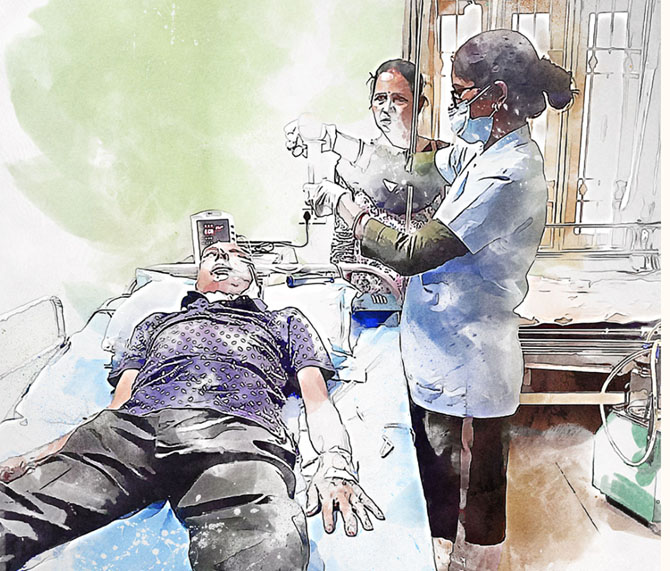
After 60 years of progress in palliative care, the infrastructure and manpower needed to set up the Palliative Care facility would cost a fraction of the costs for the cardiac or dialysis unit. The average daily medical expense for each patient, in a hospital or homecare, would cost around 2000-2500 Indian rupees. Essential medicines including opioids for pain relief are among the cheap drugs within a pharmacopoeia in any country.
World Health Assembly (WHA 67.19) in 2014 made the resolution for the global health, “Strengthening of palliative care as a component of comprehensive care throughout the life course.” Ten years gone. Political leaders, health policy makers, health economists and medical communities will need to listen to patient stories. Palliative Care is person-centred and includes the family caregivers to relieve the SHS trajectory. Our biomedical world will attain higher grounds when we hear voices of suffering and reach out to alleviate. It would remain a loss for humanity when the society is not aware about the beautiful compassion called Palliative Medicine.
“Although the world is full of suffering, it is also full of the overcoming of it.” -Helen Keller

Dr. Bidhu K Mohanti, is an oncologist, former Professor at A.I.I.M.S., Delhi and is presently the Director-Academic, Bagchi Sri Shankara Cancer Centre & Research Institute, Bhubaneswar 752054, India. He occasionally writes non-medical pieces in popular medium. Email: drbkmohanti@gmail.com
THE AUTOBIOGRAPHY OF A NEEM TREE
Dr. S. Padmapriya
I am a Neem tree. My scientific name is Azadiracta indica. I was born in a dilapidated compound in the Egmore area of Madras in 1985. I am an Indian. My ancestors were all born in India. We don't survive in cold climates. The hot and humid Indian climate is our favourite climate. This is our home.
The beauty of India is a sensory delight to us. We love the myriad colours of India. The fragrant rosewood and sandalwood trees are my close friends.
We love to contribute to everyone's health. We have been used by generations of Indians to kill bacteria and fungi. Farmers love us. Our leaves are the most potent insecticides and fungicides. The bark of Neem is used in a wide variety of medicinal preparations. Our flowers are used in Indian cooking. Our wood can be used as firewood, too.
We are used widely. My whole community serves the variegated interests of man. Yet, human beings scarcely recognise our need for water. It is summer time and we feel thirsty (just like you!) all the time. We don't blame people. All are busy - studying or pursuing their careers! We hear that lessons on science, maths, history and geography are taught in schools! Do they teach students about selflessness and generosity? Maybe, they do! Anyway, we wish everyone well. We don't hold grudges!
We trees????????are usually, a happy lot! I have little white flowers all over me, every April and May! We neither go to schools nor visit doctors. We are always happy and healthy!????
I am happiest when little birds make their nests on me. I enjoy the mild evening breeze, while listening to the songs ???? of the pretty birds. We enjoy listening to all kinds of music! Life is quite interesting. Everything is quite all right, today. I hope everything remains like this, always!????
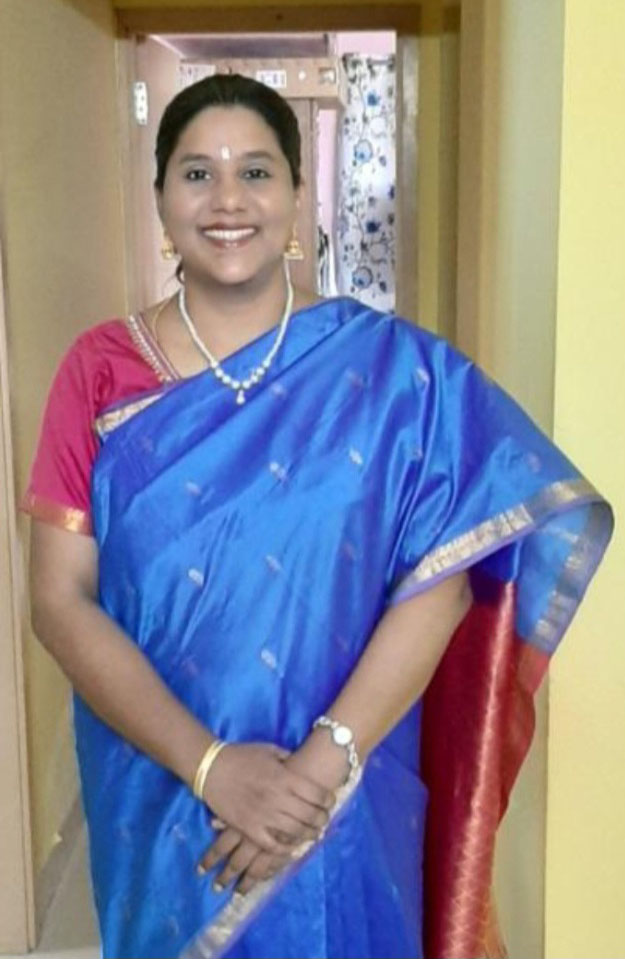
Dr.S.Padmapriya is a well-known poet and author from India. She began writing poems in English at the tender age of seven. Her poems, short stories, essays, book reviews, forewords, articles( general, critical, and research), and other literary works have been published far and wide.
She is the author of four poetry collections – ‘Great Heights’, ‘The Glittering Galaxy’, ‘Galaxy’ and ‘New Poems’, one novel, ‘The Fiery Women’ and two collections of short stories – ‘Fragments’ and ‘Surreal Stories’.
In addition, multiple non-fiction articles on diverse topics have also been published on various platforms, including in 'New18.com' and 'Organiser'.
T. V. Sreekumar
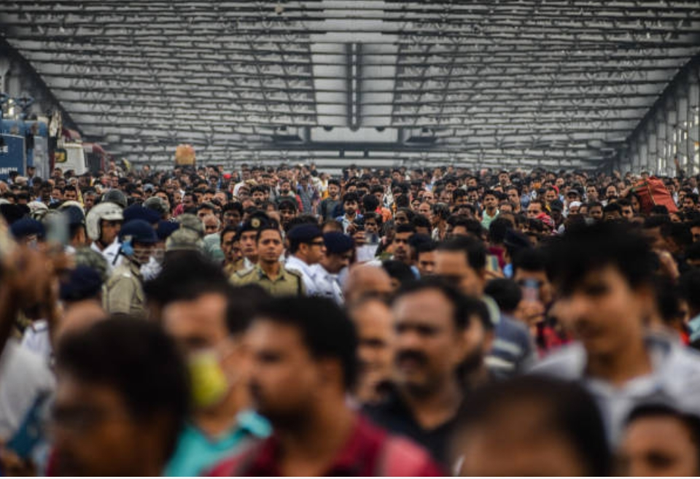
I was born with this habit of getting into problems uninvited but believe me with good intentions and facing the consequences all alone. Advices to refrain from all sides went in vain and a headload of problems followed me all through. My upcoming marriage almost collapsed due to some unwanted statements from my side but fortunately the girl understood that my intentions were in good faith and stuck to her commitment. The first day itself she told me,
“Please, for God’s sake don’t get involved in others’ problems and as far as possible keep your mouth shut”
She read my nature right. I told her lengthy stories of my getting into the wrong books for unwanted reasons.
“That’s the reason I am telling you and from now it is for our good”
I promised her not to intervene in unwanted issues and kept my word for a long time till this happened.
I was travelling to my office that day and half way down, in the middle of the city, I noticed a large crowd. The latent force in me rose and I stopped my vehicle and walked towards the crowd to find out what the issue was. I asked the young guy nearby what was happening and he gave me a tough look.
Did I do anything to provoke him?
I pushed and squeezed myself into a position where I could see ahead of me. No, nothing happening except the crowd pushing and pulling for space.
Not one to give up, I too pushed into the available gap when someone just screamed at me,
“Move man” with some unprintable expletives added.
Move for what, as I was still in dark about the happenings there. In between this struggle I was unknowingly going forward pushed by the sea of people behind me. No way of turning back as there was no space behind even for a pin. I had fallen into the pool and now the only way was to keep myself afloat by some means. With the available energy I pushed myself forward with others shouting and screaming at me. No, I am not going to give up until I know what was happening. I see a counter ahead and push myself forward. With the theory might is right I push all others and occupy the first place at the counter.
As I stand there with a victory smile not knowing what my purpose was, a well-dressed gentleman with all smiles walks in and opens the counter.
“Welcome sir, welcome to Apple i Phone17 Pro Max”
I looked at him in surprise when he says
“Sir, 0ne three four nine double zero”
“What”
“Cash or card”? he was asking me
“What is happening here”?
“Sir, you are the lucky one to get the first new i Phone from here and the press people are waiting there to take your picture”
Now I knew what was happening. I had read about the new phone launch in the paper and here I am poking my nose into an unwanted matter. I was inadvertently pushed to buy something which I never wanted and was not interested With a few hundred rupees in my pocket and instead of driving to my office I stood there like a fool in front of a fancy phone I never wanted.
Under the pretext that I forgot to take my card I rushed out through the available space to life and freedom.
Are these people mad to even come here and sleep overnight to get a phone and willingly pay through the nose?
This information I overheard while in the crowd. A huge amount appeared peanuts to this crowd. “Crazy” was my thought.
Standing outside, the advice my wife had given long back rang in my mind. Why did I poke my nose into something with which I was not concerned? The reply I invented satisfied me to some extent.
“The first man in history to refuse an i Phone at the launch.”
Standing outside with a sigh of relief I lifted my head and saw a whole lot surging forward to the phone shop and almost pushing me to the floor. I heard one of them loud and clear:
“MOVE MAN”
T. V. Sreekumar is a retired Engineer stationed at Pondicherry with a passion for writing. He was a blogger with Sulekha for over fifteen years and a regular contributor writing under the name SuchisreeSreekumar.
Some of his stories were published in Women's Era. “THE HINDU” had also published some of his writings on its Open Page..
CONVERSATIONS WITH AMMA – PART 1 (B)
Seethaa Sethuraman
The next part(b) of Part 1 series.
Trigger 3 – Small dosa: Needless to say, idlis-dosas are among the key food preparations in Tamilian households and ours was no different. Unlike current times where you conveniently pick up a packet of dosa-idli batter off the counters of a carefully cultivated local store dealing in Tamil items (online ordering is only in extremely super tight situations for reasons that will become apparent as this article pans out); it was different in the past. Then, even the dosa-idli batter would be made at home in a wet grinder that occupied prominent space in our kitchens.
The consistency and the texture of the batter had to be just right which only the seasoned hands of home makers like Amma would be able to fathom. And Dosa and Idli batters were different, mind you. As I’m typing this piece, I’m digging deep into the recesses of my mind/memory to correctly remember the differences and the kind of specific, curated efforts Amma would take to get the proper dosa batter and idli batter in place.
How I wish I could just call up Amma in the heavens and let her soft voice weave the magic!
I’m imagining her smiling softly and saying “Ah taking shortcuts, is it, seethaa (or maybe, she will address me as radha…like Appa used to)?......by seeking my help even when I’m in this other world and navigating new experiences? You know very well that nothing comes easy, try to at least remember by a little more effort what I used to do several times over the years…by spending countless hours in the kitchen.”
But running through this thought again in my mind….. Amma was so kind and giving always…she would have just given me the details which was on her auto pilot mode and not said anything else. She wouldn’t want to hurt anybody even when in the other world…maybe, she would have just smiled at me…and at my helplessness with the kitchen details.
Among all the concerns that AI is spewing up and is likely to do more of in times of come; I’m have been fantasizing from time to time, if those times aren’t far off in the future; when we could possibly reach out to our parents in the other world and continue with our conversations – from earth to heaven. Wouldn’t that be the real magic of AI?
Coming back to the dosa-idli batter on hand.
If I remember the sequence right and let me honestly confess here, I’m slightly tense that I would mess it up in my mind….. “hey mind devata…don’t play any tricks on me…at this crucial juncture…I need to get this right for Amma’s sake if not mine. And I’m putting these down in an article, remember!...”
So,
# She would first wet grind the soaked udad dal first with little water at relatively slower speed, get the super fluffy and soft udad dal batter out into a vessel with her delicate palm (at this point one is forced to wonder what was softer - the urad dal batter, her gentle palm or her immensely caring heart….no need for any guesses here, right?) ;
# the soaked pulungal arisi (parboiled rice integral to South Indian cuisine) would go in next with required amount of water (much more than what would be used for the udad dal) and the grinder speed would be set at a higher one for this ;
# once it attained the required texture and consistency by intermittently checking and adding more amount of little water from time to time; she would take out some amount of the rice batter required to be added to a stipulated carved out quantity of the earlier ground udad dal batter (kept in another vessel) towards the “idli batter” (as is obvious, the measure of rice batter to be used in idlis is relatively quite lesser and that of urad batter is relatively quite greater than that in dosas) ;
# the rest of the urad dal batter would go back into the wet grinder containing the rest of the rice batter and some gentle rounds of wet grinder later, the “dosa batter” would be in ready as well in parallel.
Imagine what all goes into that packet of dosa-idli batter that you lift off the store these days! But yeah, they come with a difference - the Non-South Indian stores offer just one variant that go for both idlis-dosas….so, if the idlis steam up rock solid, you now know the reason for that. On the other hand, the South Indian stores offer you both variants…but, in urgencies, you could pick up the fluffier-thicker idli batter and add some water to also circle out crispy dosas on pans, besides cup out mouthwatering idlis in idli cookers or direct steaming methods with suitable utensils.
Moving to the trigger of small dosa that has help fan out this literally “delectable” write-up.
Amma would always start with 1-2 small dosas – to prime the tawa, to test waters…whether the pan was heated up optimally, whether the batter was proper or if any small adjustments were required?...a little more water, some rice flour, some rawa only as last resort, etc etc. So, there was room for improvement even in that juncture, even after the elaborate process of wet grinding the dosa-idli batter delineated above.
I’m forced to delve into the minds and hearts of these Indian mothers, who will go to any lengths…to get their kitchen activities right. After all, it is their work of art or should we say, work of their heart?
Seethaa Sethuraman has had a creative orientation right from her school days – dabbling in writing,drawing and painting as well as learning Indian dance forms and Carnatic music. Thereafter, the usual suspect in professional education and corporate pursuits assumed centre stage (B.Pharm, MBA by education and a Health market researcher by profession); till the pandemic strongly nudged her to delve back into her creative side; alongside her continuing corporate endeavours. While formally learning Bharatanatyam had already begun since mid-2018; writing poems and drawing-painting turned somewhat prolific since the last 2 years.
As per seethaa, she writes/ draws-paints when the calling within her turns so strong at that moment; that it just cannot be brushed aside till it has been acted upon. So far, she has been doing them for her own self without giving much thought about publishing them. Coming across the Literary vibes platform has, however, enthused her to share this creative happiness with the outer world. Through this process, she also looks forward to receiving feedback/ comments that will encourage her to keep creative expressing; always.
WRITING FROM MY FIRSTHAND EXPERIENCE
Sibaprasad Mishra

Nepal is renowned for its majestic Himalayas, including the iconic Mount Everest and the stunning Annapurna range. The country is rich in Buddhist and Hindu culture, with sacred sites such as Lumbini—the birthplace of Buddha—and revered temples like Lord Pashupatinath, ChanguNarayan, and the Boudhanath Stupa. These landmarks, adorned with intricate stone and wooden carvings, are truly spectacular.
Adventure tourism thrives here, drawing visitors from around the world for trekking, mountaineering, white-water rafting, cycling, and paragliding. Nepal’s natural beauty and rugged terrain make it a paradise for thrill-seekers and nature lovers alike.
The country also offers unique local products, including handcrafted garments, luxurious pashmina shawls, traditional khukuri knives, woolen hats, and beautifully carved wooden items.

Nepali cuisine is hearty and flavorful. Staples like rice and dal are complemented by popular dishes such as momos (dumplings), thukpa (noodle soup), Nepali-style pizza, and a variety of rice cakes. Cities and towns like Kathmandu, Pokhara, and Sarangkot are dotted with Indian, Nepali, Chinese, and Thai restaurants, offering a diverse culinary experience.
Tourism is a vital source of income for Nepal, alongside agriculture and forest products. It revolves around the country’s rich architectural heritage, spiritual landmarks, and adventure sports. Cultural hubs like Kathmandu, Bhaktapur, and Patan showcase centuries-old temples and carvings, while nearby parks and lakes add to the scenic charm.

Following recent disturbances, the situation has stabilized, and foreign tourists are once again seen thronging the streets of Kathmandu, Pokhara, Sarangkot, and beyond.
Pokhara, in particular, stands out for its breathtaking natural beauty. Scenic lakes like Phewa Lake, panoramic views of the Annapurna range, vibrant markets, serene parks, and cascading waterfalls make it a must-visit destination. Activities like cycling, trekking, and paragliding add to its allure.

On the whole, my journey through Nepal was a truly memorable experience—one that left me inspired and deeply connected to its spirit.

After doing post graduation i was engaged in research and teaching profession.
There after I joined civil service and was an administrator,
having both field and office experience.
I often write poems . Going around different places and meeting with various people to know many things is my hobby.
I write travel experience covering almost all aspects.
My children are well settled in different places.
Sheena Rath

Woofh woofh!!
what happened Hushkoo,why such bad behaviour.
Enough is enough Mommy,it's high time that I go on a pawcation.
I see that everyone, even the helpers go on leave, but what about me?I'm always on a 24/7 duty time.
I don't complain as I love my family i.e....you, Rahul bhaiya and the man of the house,but sometimes I just need to be outdoors, having the open spaces to just run around, now that's my "Me time",if you haven't understood it till now.
It's monsoon time, i need to run after the kittens, frogs,snails,birds,butterflies, i can smell them all the time.
But for me my duty is first towards all of you,hence I overlook it at times.
I heard Ruby too has gone to her village to meet her family members and friends.I left my family back in Siberia and my brother in mumbai, he probably must be with another family now.
I don't miss them coz I made you my own, and it's the best thing that could have ever happened to me.
I couldn't have got a better family for the rest of my life.
I love to get wet in the waterfalls, or an overflowing water tank,or a roadside river,it's fun.
Ok!!...."but first you good ???? doggy,and think pawsitive."
We will definitely plan something when it's the right time.
Oh!!.....that's pawsome mommy!! ???? ????
No need to look so sad,I'm a bit tired of your furr- ever complaints these days.I have been giving you your choco cookies and turmeric sticks on time.
It's high time you learn some patience from Rahul Bhaiya....The "Best DJ in town."
You always been such a pawful doggy.
I guess it's the Incessant rains that's making you grumpy,can't blame you much,I'm just longing for some sunshine too,flowers have stopped blooming as they are covered by a blanket of darkness .
Hushkoo let me know if you would like to visit the kaas plateau near satara i believe during this season the hills are covered with colourful flowers that grow naturally and are not planted. Tiny flowers of different colours bloom from August to October.
renowned for its seasonal bloom of diverse wildflowers that transform the plateau into a vibrant "valley of flowers.
I'm just looking out for open spaces mommy where i could just keep running and not hit onto a table or sofa....that's my freedom..off duty for sometime..and my "Me time ",just the way you long for yours.
Tomorrow is Durga Puja hope Ma fulfills all your dreams of a pawfect pawcation, why don't you just do a dhunuchi dance to please her.
Oh mommy!!.....for me you are my supreme power and I'm your constant spiritual vahan. ???? ????
"Ya Devi sarwabhuteshu shakti rupena sansitha namastasye namastasye namoh namah."!!
Sheena Rath is a post graduate in Spanish Language from Jawaharlal Nehru University Delhi, later on a Scholarship went for higher studies to the University of Valladolid Spain. A mother of an Autistic boy, ran a Special School by the name La Casa for 11 years for Autistic and underprivileged children. La Casa now is an outreach centre for social causes(special children, underprivileged children and families, women's health and hygiene, cancer patients, save environment) and charity work.
Sheena has received 2 Awards for her work with Autistic children on Teachers Day. An Artist, a writer, a social worker, a linguist and a singer (not by profession)
Molly Joseph
Life stretches out on the immediate, the present, that straddles between memories of the past and the pulsations of the unpredictable future.. Your being is like a float swept away by forces beyond your control. Caught up in the flux conscience shreds out the layered contours
….. ….. ……… ,………..
In the confines of her little room, Ammachy lay on her faded bed and favourite cot, under the all seeing eyes of the framed Christ. Her eyes were firmly shut: She was adamant in her refusal not to see, not to open them out. Seeing is a kind of naming, ordering. She had given that up for years, or rather was forced to give that up.
That was a world, all fostered by her..the one acre land, the house, three sons, a daughter, the tall looking Tamarind tree , the very well numbered spoons,the faded wall hangings,the smoky kitchen crowded with utensils. There were days she reigned supreme shadowing her less worldly Gandhian husband. For securing anything she had to fight it out, against his passivity, his bland, blind faith that left everything to Providence.
…… ……….. ……..
It was the dim hour of the early dawn. Something kept Malu awake , a strange sense of something amiss.The phone was ringing in the hall. With trepidation she took it up. Cold came the message slicing off the morning waves of anxiety.
“ Ammachy gone at 3.30 p.m “
A voice that had gravitated into itself.
Suddenly the phone went dead.
Silence on both sides.
…… …….. ……
The train chucked in, out, passengers…people eager to get into, people anxious to get out
People, people, people…
There was a grave looking self absorbed middle aged man opposite the seat of the self indulgent couple giggling out frivolity and the philosopher like overgrown student in the adjacent berths, Confined to the corner of her berth Malu looked through the window. The evening darkening into the night, the glimmer of distant lights and lamps..households brightening up with human presence. People fatigued with a day’s work returning to rest, recuperation.
…….. ……….. ……… …….
Far out in the east in her allotted corner, under the dim light of the lamp, Ammachy was reciting her rosary. For her daughter, only daughter travelling alone.
The next morning would be the much awaited bright day. A glimpse of her daughter, her sweet voice calling out ‘Ammachy,’ …that would do.
Here where I am denied my place, treated as a nuisance, an old disgusting stuff..how rude were they, especially the one I lived with.
Malu was somebody to listen to her aching self..to care for, to understand..
Yes, clinging on to her
hand, tomorrow I would move around to my sons and daughters in law, to show how important and proud am I with my daughter who values me.
It is their insult and injury that shatters.. worst, their attempts to smother my communication with my daughter O ,Malu , come and take me away from here to somewhere else, so that we can talk and talk, sharing my sorrows.. Other wise, one day I will fall unconscious and dead , unwanted, uncared for.
Malu , I need you...
My heart pounds fast..I feel giddy… …. …….. ,,…….. ……..
A dry wind blew through the palm and banana leaves.It swept through the one acre land., the smoky kitchen and created ripples in the old looking wall hangings.It reached the coffin and whispered something into the ears of Ammachy who lay with closed eyes.
The crowd thronged the hall, verandha and the yard crushing the jasmine that was reaching out to the canopy to peep at Ammachy her profile, her broad forehead, neatly cut, long nose, and well curved lips that graced her visage.
Elbowing each other, her children stood with her grandchildren, uncles and aunts vying with each other in their blacks putting on a grieving look, fake or real! It matters much when the crowd is watching you.
Now that Ammachy needed no help there were a number of people to appropriate her, do things for her. .Standing in a corner next to the coffin, Malu wondered how much this person mattered to her, how much she mattered to that person.
Yes when you leave, you leave behind a sapling of your own stem cell, to imbibe what you were, what you felt.
In a flash Malu’s eyes were in search of Ammu, her little daughter. Where was she ? Too young to realize the gravity of the situation, she might be playing somewhere around,or getting lost in the crowd or holding on to her Dad. A biological urge to hug her close and press her cheeks to say,” Ammu, I need you.”
Holding Ammu’s hand, Malu inched along with the funeral procession. It went past the one acre land,the familiar rural walkways shaded by coconut trees reaching up to the road, and made its way into the church and cemetery. Ammachy returning to Mother Earth, the safe abode of peace and rest after her weary life’s journey

Dr. Molly Joseph is a Professor, Poet from Kerala, who writes Travelogues, Short stories and Story books for children. She has published twelve books,10 Books of poems, a novel and a Story book for Children. She has won several accolades which include India Women Achiever’s Award 2020. She believes in the power of the word and writes boldly on matters that deal with the contemporary. She can be reached at E mail- mynamolly @gmail.com ; You tube- https://www.youtube.com/user/mynamolly
‘POET SAMRAT’, HIS PEN NAME: TRUE LOVE
Dr. Rajamouly Katta
The function hall Kalakshetra was packed with the people to the capacity for the felicitation of a poet par excellence. He was very famous for his poetry as per the newspaper statement on a day that week: ‘It is good news for all the people of our region’. All were in good impression to attend the felicitation function at the hall, famous for literary and cultural programs. All were happy to learn the news that week and listen to the poetry of the poet on the day. They all gathered in the hall to see the felicitation accorded to him on the occasion and listen to talks on his poetry. Meanwhile soft music was going on until the commencement of the function welcoming guests. Meanwhile, the poet along with a group of five people was found entering the hall. The hall started to echo with the slogans welcoming him,
“Poet Samrat… Hearty Welcome”
“Poet Samrat… Hearty Welcome”
All the people seated in the hall Kalakshetra stood in honor of Poet Samrat. He and his five people with the replenished trademark on their foreheads were coming in their style. Then they were seated in the front row. Some people in the hall started to comment on the five people who came with Poet Samrat. They were strong-built and stout-shaped. They thought that the five people were, for sure, the bodyguards of Poet Samrat. They stopped their comments on the five bodyguards with the arrival of Bhupesh, the leader of the region who was to be the chief guest of the felicitation function.
The function started in a formal way. The luminaries sitting on the dais were invited amid the claps of the people. The Secretary of the organizing committee invited its President to preside over the function. Later Bhupesh, the leader of the region, was called with due honor to be the chief guest of the function. It all seemed that the leader was interested in the poet to be honored on the occasion. Later Poet Samrat was invited to the dais. He was seated on the dais. Immediately the five people who seemed to be his bodyguards stood behind Poet Samrat on the dais. Two speakers who were to speak on Poet Samrat’s masterpiece entitled Ocean of Pearls were called to the dais. Later all the invitees, who were seated on the dais, were honored with the offer of bouquets to them. They duly lit the lamp in adoration to Goddess Vani.
The poets to speak on Poet Samrat’s masterpiece, Ocean of Pearls came to the podium and spoke one after the other. They highly extolled the merits of the book, taking some poems as per their choice. They considered the collection of poems entitled Ocean of Pearls the gem of gems. The book of poems is like the deep ocean, and the poems are the pearls shining like the pearls at the bottom.
It was time for the organizers to felicitate Poet Samrat and so they called him amid the widespread claps for his felicitation in the most befitting manner. Soon, the five people came and stood behind him. All thought that they were surely his bodyguards. The bodyguards praised the poet loudly, “Jayaho Kavi Samrat,” “Jayaho Kavi Samrat”. The appearance of the five people with the replenished trademark on their foreheads behind the poet on the dais was the most surprising scene of the day. The felicitation was about to begin and go on in a successful manner.
Meanwhile a new man in simple clothes entered the function hall with tear-welled eyes. The felicitation program started in a befitting manner. The new man said shedding tears,
“My dear people! Poetry lovers! Kindly pay attention to what I tell you… I’m Dhanush, Poet Samrat, my Pen Name… I wrote Ocean of Pearls. It’s my masterpiece…I wrote its every word, its every line… every poem…my musings… all mine… They all gushed from my pen… Dear people! Listen to me. All organizers! The man who is being felicitated is not the poet you think… He is not Dhanush… not Poet Samrat… He is Deenesh… not Dhanush. He says that he is Dhanush… but he is not Dhanush. He is not Poet Samrat…He is not at all a poet,” said crying, looking at the felicitation function with all feelings.
The five people who were like the bodyguards rushed to the new man. They were almost attacking him by commenting loudly. All listened to their comments silently. All were silent spectators, watching all silently. The five people sprang abuses at the new man, protesting his claims,
“Fool! Don’t pose to be a poet here. Who believes that you have written Ocean of Pearls…? Do you believe that you’re Dhanush. Shut up and get out of the hall,” said the first of the five angrily.
“Are you educated? Do you know how to read and write? It’s a wonder to say that you’ve written poetry,” said the second of the five chuckling.
“Our boss is the poet… He’s Dhanush, Poet Samrat. He’s written Ocean of Pearls. You’re after all a man in the street… You don’t know how you appear. You’re more like a beggar than a street hawker… What you are to shut up and get out or I will hurl you out,” said the third of the five with angry looks.
“You’re a Shudra, downtrodden. Do you have a trademark--vertical or horizontal on your forehead…? Are you a devotee of Lord Shiva or Lord Vishnu? You aren’t… How do you expect yourself to be a poet and write Ocean of Peals? Have you ever seen your face in the mirror? All present here hate you vehemently… You can escape without waiting for a minute before all start hating you, “said the fourth of the five.
“Get lost… I don’t let you stay here… You’re an uneducated man. You’re looking like a watchman. All here think that you are not a poet… The sooner you leave the hall, the better and safer for you now than before,” said the fifth of the five.
“Have you forgotten that you belong to the clan of Shudras? Have you heard of anyone in your family writing poetry? Does any member in the family have a library of his own…? You should be ashamed of claiming that you’ve written the book entitled Ocean of Pearls,” said the first of the five, shouting at the new man angrily.
“You’re unfit to be here in the felicitation function…What you claim here is bogus… A Shudra can never write poetry… Take it for granted you’re not a poet. You’re not Dhanush… My boss who is felicitated on the dais is the poet Dhanush. My boss is Dhanush, Poet Samrat, the composer of Ocean of Pearls,” said the third of the five with force, raising his hand.
“Without speaking a single word and trying to express your feelings through gestures or postures, get out and let our boss, the poet Dhanush, Poet Samrat be felicitated duly… He deserves felicitations as a well-acclaimed poet,” said the first of the five shouting at the new man at a high pitch. The attention of most of the people was diverted to their shouts.
A Samaritan sitting in the first row observed all the things happening before him. He felt sympathy with the new man who was attacked with comments. He stood and was ready to offer his seat in the first row to him, but things were adversely going on in his presence.
The felicitation program went on though humiliation meted out to the new man claiming that he was the poet to be felicitated. All the five did not give him any chance to speak. They attacked one after the other. The man only said, “Time will prove the reality…Who I’m…What my name is. Whose title ‘Poet Samrat’ has been transformed into my pen name, Poet Samrat. You learn who the real poet is. You can’t hide the rays of the truth with your arms.”
Then all the five shunted the man out of the hall forcibly. All were watching the scene silently. Some were keenly observing what was happening before them. Some thought that something went wrong. They doubted the man to be the real poet and felicitated on the dais.
The bodyguards were outside scaring the new man whom they shunted out, saying to him loudly,
“With your own eyes, you’ve seen none supporting you in the function hall… In the future also nobody will come to your rescue… It’s better for you in all respects to keep away from the felicitation functions of my boss. This is the first and last warning to you… We hope you’ve listened to what we said. Mind it…”
“If you come to any felicitation of our boss, the real poet, we teach you a bitter lesson that you’ll never forget it…You are one… You are single. We’re five strong and energetic… We kick you and so you’ll fly like a balloon and burst to fall into the Bay of Bengal… We have swords in our pockets. If necessary, they come out for their immediate action… Their action will be severe…If you repent for it, it is of no use… You don’t know that nothing happens to us… Don’t you know the noted fact that we have the full support of our leader, Bhupesh sitting on the dais? You’re a fool to know about our power. Remember the swords in our pockets,” said all the five bodyguards very loudly, raising their hands.
The new man was on his way saying, “You say your swords are powerful…The days are ahead to say that my pen is mightier than your swords.”
“You’ll see the swords and their power…Now you don’t guess their power…You’re one and we are five with the support of the leader Bhupesh,” said the five bodyguards.
Within a short while the new man was out of the function hall. He went on his way, looking at all with many pitiable looks though he had confidence that he was right. The Samaritan in the function hall felt sorry for the humiliation meted out to the new man who was shunted out. He said with all deep feelings, “God is hurled out from heaven by Satan.”
The five bodyguards reentered the function hall and stood behind their boss posing as if they were very successful in shunting the new man out. They were in the confidence that the new man would not be present in felicitations in the future. The bitter lesson he learnt was enough for him like a powerful dose.
Those who were clearly watching the incident of shunting the man out from the function hall felt stunned at the turn of events. They felt agitated as they thought that something had gone wrong. After some time, all that disturbance subsided.
The poet was felicitated in a befitting manner by the President and the Chief Guest. The surprising thing was that the Chief Guest, Bhupesh, was very happy and so he was all in smiles. The poet said loudly,
“I’m Dhanush… I’m Poet Samrat… I wrote Ocean of Pearls… Fools talk nonsense… I don’t want to listen… I don’t care.”
“Jayaho Dhanush, Poet Samrat,” “Jayaho Dhanush, Poet Samrat” said the five bodyguards loudly and their loud noise resounded in the hall.
The Chief Guest came to the podium and congratulated the poet felicitated. He said a few words appreciating the poet, “I’m happy that a literary gem, Dhanush was accorded due honor for his contributions to creative writing in my region. I’m proud of him and bound to congratulate him on this happy occasion.”
Finally, the President of the Poets’ Association came to the dais for the presidential remarks, “We, on behalf the Poets’ organization, are happy for the literary programs we’re undertaking. We’re proud of felicitating poets par excellence.”
The people, especially the press personnel present in the function hall, were in a state of confusion, knowing who the real poet was. They never tried to listen to the words spoken by the Chief Guest and those of the President at the podium as they could decide who the real poet was and who the dummy poet was. They were not happy with the turn of events that had taken place in the function hall that day.
The press personnel expressed their views in newspapers the following day. Most of the newspapers doubted the poet with five people who acted as bodyguards and supported him as their boss and the poet to be honored.
… … … … …
The new man who claimed to be the real poet Dhanush, Poet Samrat, recalled his past by going back to the years when he was first known as a poet par excellence. He had already written two books of poetry. His first collection of poems entitled Lovers’ Traverse catapulted him to fame as a poet of merits. The next year he wrote Rising Rays that enriched his glory as a poet. The two books of poetry won the hearts of the readers and research scholars by their poetic merits. He was to be felicitated in a befitting manner with the title ‘Poet Samrat’. There was someone else who felicitated him under the auspices of a political leader’s recommendation. The poet who was to be felicitated was not seen on the dais to receive his due honor. He said that he was Dhanush, the writer of the two collections of poems, Lovers’ Traverse and Rising Rays.
The new man who claimed to be the real poet as usual entered the library. It was not just a library with books dust laden, but a rich library named Sri Vani library visited by many readers. It was famous for all kinds of books helping the library goers. There were students, especially research scholars, reading the books of their choice. He too sat there to read books. There were a few copies of his poetry collections entitled Lovers’ Traverse and Rising Rays available. That day he noticed the poetry collections Lovers’ Traverse and Rising Rays with multiple copies in the racks of the library available. He found the collections of poems in the hands of research scholars and students. He, however, was happy with the collections of poems available in the famous library. It was a happy sign for him indeed.
The poet took a book and sat to read it in the library. He wanted to pay attention to what he read but it was not possible for him to do so. He fell into an unhappy mood. Time was passing slowly. Meanwhile he listened to the conversation of some women students nearby. They talked about Lovers’ Traverse and Rising Rays and the poet who wrote them.
“The books are invaluable treasures indeed. The poems in both collections are very interesting,” said the first of the women students happily.
“Yes, they are precious treasures, no doubt,” said the second.
“I’m happy to find the collections of poems in the library… I feel thankful to the librarian for keeping the collections available to readers,” said the third.
“The poet composed all poems excellently… He is fortunate to have written the collections… He is a poet par excellence… My words are not enough to present the kaleidoscopic picture of his poetry,” said the fourth.
“I love to read all the poems since they are drawing my attention to the poetic scene the poet delineates… I love to read them,” said the fifth.
“Dear friends, I would like to do research on the poet with his poetry collections… I feel thrilled to do research on the poet. Analyzing every poem is indeed pleasant. I can visualize the poet and his sweet disposition and lovable character in the poems. I feel like seeing and honoring him from my heart,” said the sixth with all smiles.
The new man heard their conversation and was happy. He was happy that someone would like to pursue research on his poetic works, Lovers’ Traverse and Rising Rays.
Meanwhile the librarian came to the new man and wished him, “Good Evening”.
“Very Good Evening,” said the new man humbly.
“Sir, as the poet to be felicitated, you must be in the function hall to receive your felicitations… By now it has already started,” said the Librarian.
“I read about the news in the dailies yesterday, but I have not gone to participate in it as I have some urgent work at home,” said the poet casually.
“Poets are heard and read but not seen and regarded, researched and rewarded. People are indifferent to poets… The poets go unnoticed like hidden pearls,” said the librarian with all feelings.
“Poets are to be read and researched and then their poetry is known to them and all. They needn’t be known to the people personally,” said the poet.
“You’re great… you want to remain unknown even after writing excellent poetry,” said the librarian.
“Yes,” said the poet.
“I would like to see you in the library tomorrow morning…Thank you for speaking to me, Sir,” said the librarian and went to his seat.
The women, who were reading Lovers’ Traverse and Rising Rays, were continuing their conversation even though silence was solicited in the library. The poet listened to it. Meanwhile the library was to be closed as per the library timings. All left the library.
The next morning the student who would like to pursue research on the collections of poetry came. She was none, but Miss Ragini. She came to the library, greeting the Librarian “Good Morning”.
The librarian said to her happily, “I’m going to introduce a very important person to you today… Now, I see him coming to the library. O! What a wonderful coincidence! He is stepping in. Hello poet, “Good Morning”.
“This is Miss Ragini. She would like to pursue research on your poetry,” said the librarian to the poet humbly.
“Very glad to see you, Miss Ragini… I hope you were in the library yesterday saying that you would like to pursue on the books, Lovers’ Traverse and Rising Rays,” said the poet.
“Yes, sir…I’m seeing my favorite poet with my own eyes…What a surprise…! The most welcome gesture,” said Ragini with all smiles.
“I welcome your feelings,” said the poet.
“Sir, let us sit in the garden on the premises of Sri Vani Library and discuss your poetry, classics of our age…” said Ragini with all smiles.
They decided to sit beneath a beautiful tree to offer them its coolness on the premises of the library. The people said that all great poets sat under the tree and wrote poems.
“Sir, let us be guests to the tree to offer its coolness as the selfless host,” said Ragini.
“It is most comfortable for us to sit,” said the poet.
They sat under the tree on the premises of the library. She wanted to ventilate her thoughts and feelings about his poetry. She felt the place beneath the tree very comfortable for the poet.
“I’m happy that you would like to do research on my poetry… Most welcome to your thoughts and feelings on my poetry!”, said the poet.
“Meeting my favorite poet… wonderful… most wonderful…! Is it a dream in which I’m seeing you or is it I’m seeing you in reality?” said Ragini.
“You are seeing me in reality…not in a dream,” said the poet.
“The librarian introduced you to me and the library introduced your poetry to me… I am happy to say that I am very much impressed by your poetry, your concepts in rich variety… Really, I’m enjoying your poetry,” said Ragini while her hearty smile was lingering over her lips.
“I’m happy that you are interested in my poetry…,” said the poet.
“Poetry is very fascinating… Your poetry is more fascinating… What impressed you to write poetry?” said Ragini.
Meanwhile, a cuckoo started singing on the tree pleasantly. It was Spring, the queen of seasons… the most welcome season for the cuckoo to outpour its melodies… There was another cuckoo to join it singing. It was coincidence in listening to the heart of poetry in the coos of the cuckoos.
“The melodies you and I are listening are to inspire us to write poetry. Sensuous sonorities we find around us touch our hearts for nature has the beauty in plenty to inspire us. Man with a poetic bent of mind is sure to be impressed deeply by the sonorities to write poetry,” said the poet.
“Yes, I too feel inspired by the melodies of the cuckoo,” said Ragini.
“The cuckoo for Wordsworth, the nightingale for Keats, the lark for Shelley, prime sources for inspiration for them to write poetry,” said the poet.
“Wonderful examples for the source of inspiration!” said Ragini.
“This is one angle for the inspiration of poets…There is another angle for inspiration to write poetry. A tragic incident or pathetic plight moves the heart of a poet to write poetry. Wars on the borders, tears of women, fears of men and shrieks of the people rushing for rescue to be away from risks, surely move their hearts,” said the poet.
“Wonderful information for a budding poet like me,” said Ragini.
“You have read my poems…Have they not come from my heart?” said the poet.
“Yes, they are the outpours of your heart,” said Ragini.
“A sensitive heart cannot hide his heart, so is the poet,” said the poet.
“I’m trying to write poetry, but I am not able to write like you,” said Ragini.
“For anything, there is definitely a beginning…One cannot be perfect in the beginning itself,” said the poet.
“May I know about your personal background. I feel that it also plays an important role in shaping one’s character and career. I would like to express my feelings as a budding poet, a novice in the field of writing poetry,” said Ragini.
“Yes, I was born in a hut… It means that I was born in a poverty-stricken family… facing hurdles and hazards in life… Moreover, I was born at a small village away from cities,” said the poet.
“Great…Sweet are the uses of adversity. My case is different… I was born rich to have lavish comforts and luxuries knowing no problems. I don’t feel any credit for I was born at a high mansion in riches at the heart of a city,” said Ragini openly.
Ragini opened her heart without minding any sense of pride and prejudice for her riches. Her frankness was appealing to the poet. She liked him very much for his openheartedness. The doors of their hearts were open for the expression of their feelings for each other. Their gestures reflect the fact that they liked each other. They felt that they were birds of a feather to flock together despite their different backgrounds. That day passed happily; they left the premises to meet again the following day. They left the place with sweet memories in their hearts.
The next morning, they met and sat beneath the tree enjoying the songs of cuckoos on it. There blew the breeze to enrich the beauty of the place. They sat beneath the tree with their hearts open.
“I would like to know how to present our feelings in poetry,” said Ragini.
“Our musings born in mind are raw and rubbish. They should be shaped into bright thoughts to be poetic and majestic. A process is there in mind for all poets including me. Rough ideas are shaped into bright expressions to appeal to the readers. In nature we find the butterfly… It is pretty and beautiful. Do you know where it comes from? It comes from the rugged caterpillar. It transforms into a beautiful butterfly. The same transformation takes place as rough ideas are transformed into beautiful poems,” said the poet.
“Wonderful! Excellent comparison…Lovely explanation…I love it from the bottom of my heart,” said Ragini in excessive joy.
“Your zeal for learning is amazing… Definitely you would be a poet par excellence,” said the poet with the expression of confidence.
“I thank you profusely for your kind wishes…I’m indebted to you at the same time,” said Ragini.
The poet is a teacher or preacher of virtues and values and so he taught her many things essential for poetry making. She listened to him with rapt attention and learnt all the things. He also learnt many things from her. They travelled together widely. They were on their trips, hiking, pilgrimages, expeditions and excursions. They held extensive discussions. They visited mounts, hills, forests, valleys, orchards and so on. They played sports and games. They had discussions and debates. They spoke to rivers, trees, mounts and so on. They too responded to them positively as they were the parts of nature. They were together talking and walking.
On a fine morning, they met and opened their hearts. They felt at ease expressing their feelings to each other. They were eagerly waiting for each other for the happy moment. They were amid the flowering plants and trees. Songbirds were singing songs in the trees. They were in their jubilant mood. They glimpsed a pair of doves courting.
“Dear poet, see the doves…We are like the doves on the stem. They were born for each other like us,” said Ragini and her dimpled cheeks glowed brightly in her happiness.
“Dear Ragini, I too feel so. We are more than doves on the stem…We were born for each other,” said the poet with all smiles.
“Love ultimately culminates in marriage… I want to be wedded to you,” said Ragini.
“I feel a clash between you and me as you were born in a rich family, and I was born in a poor family… For me marriage is not adjustment…It is a boon showered on the lovers…Lovers feel no clash,” said the poet.
“No, lovers are not to feel any clash… Love knows no discriminations and disparities…It teaches equalities, keeping aside disparities,” said Ragini.
“I feel the clash as the current society teaches me hard realities and harsh facts,” said the poet with feelings.
“Then I remain unmarried loving you ever…,” said Ragini.
“I love you ever even without marrying you…,” said the poet.
Their love parley went on like that but there was no trace of unhappiness on their faces though they were not ready for their marriage. Their joy glowed in their dimpled cheeks. They had confidence that no wind of ill feeling would disrupt their love born from hearts as true lovers.
The poet completed his masterpiece, Ocean of Pearls, and published it. It was in the market. It was in every library. Ragini undertook her research on his poetry with a special reference to the collection of poems, Ocean of Pearls.
The poet recalled his love with Ragini relaxing under a tree amid the beautiful environs of verdant growth. A river was gently flowing at its pace nearby.
… … … … …
The poet’s recall of the happy past was disturbed by the appearance of the five bodyguards with replenished trademarks on their foreheads. They looked at him angrily passing comments on the poet as they did in the past.
“How do you escape from us?” said the first of five bodyguards.
“There is no necessity for me to escape from you. You want me not to come and share the felicitations. You may stop me coming to the stage but not from writing poetry. It is the flow of a river…It is a living river… it flows ever. It is light… a living glow… it glows ever,” said the poet.
“Again, you are saying that you are a poet… How do you say so when you are a Shudra… Forget that you are a poet… So far, we have excused you…But now it is impossible for us to excuse you… Don’t you know that we have come here to kill you and throw your body into the flowing river,” said the second of five bodyguards.
“You have already killed me with your series of humiliations…You need no weapons to kill me, the man who has already been killed,” said poet.
“Despite our warnings, you are ready to attend felicitation functions. Now you are one…you are single…You are alone here… We are five… See how we are…We five together kick you,” said the third of the bodyguards but all raised their hands and feet as if they were ready beat him.
“There is no need for you to come together and tell me what you want. I don’t want to be there to receive any felicitations when your boss is with you, the bodyguards on the stage… This is my promise…my solemn promise,” said the poet.
“Will you keep the word?” said the fourth of the bodyguards.
“Yes, cent percent…,” said the poet.
“You should keep the word forever…Promises are to be kept…Or we don’t want to tell you…You see it in our act of no kindness,” said the fifth of the bodyguards.
When the bodyguards quit the spot leaving him alone under the tree near the river, he recalled what happened to him as Ragini traversed with him all the time. As she did not go to their parents, they learnt the fact that their daughter was in love with someone. They wanted to disturb her love with him like the storm to disrupt the pleasant weather. Gangs were diffused everywhere on that mission.
A gang came in search of the poet, they noticed him staying amid the beauties of nature, they rushed to him, saying,
“We’re from Ragini’s father…Don’t you know that he is the richest man in the region…He has political support… He can go to any extent to separate his daughter Ragini from you…,” said the gang.
“See, Ragini is not here with me,” said the poet.
“But she is in love with you…You are in love with her…Her absence in the house led her father to know all about her as she loves poetry… She is a poetry lover… She was born with the blessings of Goddess Vani,” said the gang.
“All poetry lovers love poetry…Ragini is one of them,” said the poet.
“You should not love her. You are unfit to love her as she is from a family of high status and splendor. If you know their family splendors, you will be at a distance,” said the gang.
“I’m at a distance…,” said the poet.
“You’ve won her heart…You have trapped her by your gimmicks… You should forget her. If you don’t forget her, you’ll learn a bitter lesson. We are going to teach you,” said the gang and went back in their way.
All gangs went back to their master, Ragini’s father and lodged a complaint that the lover was ready to be killed. He said that Ragini was not with him. They told her father that it was waste to kill him. They also expressed sorry for their failure in their mission.
Ragini was with her father. He tried his best to brainwash her to forget her love. He brought a match who was very rich. The match stood before her as per his plan. He said to his only daughter,
“This magnate is the most suitable match for you. Don’t miss it.”
Ragini did not respond to her father’s command. She did not care about her father’s proposal, saying,
“I fell in love with the match of my choice… My love has already born from my heart… It is not going to die…It is in the direction of my love sojourn. The direction is right…there is no other direction. It has one and only one… the sole direction.”
“He is a Shudra… He is moreover poverty stricken… He is not suitable to love you… to light your heart with his bliss of love,” said her father.
“My love has transcended all kinds of barriers created by man like you, I am just a beloved worshipping my lover in the heart of my heart… All your efforts to change the direction of my love will prove futile,” said Ragini openly.
“I bring a boy… He had a boon of touching all to turn them into gold at will. He would be the richest man in the world. What more do you want from your would-be partner,” said her father forcing her to marry him.
“My love knows no highs and lows…no riches and crises. It is at that level that you can’t understand and assess it,” said Ragini.
“If you continue to tread that wrong path, I banish you from my mansion… my region… my nation,” said her father angrily.
“My love has no borders…It has transcended all borders. I’m everywhere as a beloved with my lover, adored forever … He is here, there and everywhere with me in love,” said Ragini.
“As my daughter, you are to follow my advice…It is my command…You can’t say ‘no’ to my command,” said her father.
“I’m not your daughter now… Right now, I am playing my role as a beloved. I am the beloved of my lover…in our love sojourn,” said Ragini confidently.
The thought in him that Ragini was the only daughter, born with the blessings of Goddess Saraswati, led him to inaction. He was tense on one side and silent on the other.
… … … …
In the other place, the poet expressed his feelings towards the society he lived in. He did not know what to do. He did not like evils confronting society. He was a free bird. He wanted to be a free bird and others to be free birds. He didn’t like prejudices. He described all the prejudices in his poetry to hold mirror to society.
“People talk of liberty, equality and fraternity as the principles of a democratic nation, but they are heard but they are not practiced. I don’t like hypocrisy. This society has never changed. How many years does it take to change as per my wishes…,” he said to himself.
He stood up and went on pacing to a place to sit near a tree-worn hill, for nature gave him fresh breath and a lease of life. It was the chief source for his rejuvenation. His contact with nature gave him new strength and new enthusiasm. Suddenly another gang stood before him saying that there were many gangs after him to mend him or to see his end.
“Hello, we are a special gang from Ragini’s father… We know how to separate you from Ragini… We are sure of our strategies to be successful,” said the members of the gang.
“Is Ragini with me giving a chance to you to separate her from me,” said the poet.
“She is in your heart…You have gimmicks to arrest her heart in your heart… She lives at the heart of your heart. You are bound to forget her, letting her stay with her parents to go according to their wishes,” said the gang.
“How do you confirm that I have forgotten her?” said the poet.
“She must be ready to be wedded to a match of her and her father’s choice…She is not ready for that. She rejects all matches,” said the gang.
“She is not in my presence … I am not forcing her to marry me… She should like the match of her choice as per her freedom. For that, she has right to do according to her choice…Her father should bring the match of her choice,” said the poet.
“We instead bring a match for you… First, you should marry the match we bring… Your marriage with the match of our choice solves the problem… Members of our gang bring a beautiful woman for you…,” said the gang, asking their people to bring her.
They brought the woman. She was very beautiful. She was at the poet’s disposal with the gestures that she was ready to marry him. She sprang her amorous looks at him, but they went futile like waste arrows. They came with garlands. She was ready with a garland in her hands. They were ready to give the other garland to him.
“Take the garland and deck it in the neck of the woman,” said the gang to the poet.
“This is not marriage…,” said the poet.
“We give you the dowry in the marriage…How much do you want?” said the gang.
“Money in the form of dowry won’t impress me in a marriage…These are false means man created. I don’t agree with the false customs… Don’t try futile attempts. Marriages are not made by man or by the gang like yours.
“You are adamant…You are not influenced by powerful means…,” said the gang.
The poet looked at the woman with pitiable looks and said to her very convincingly, “You, woman, don’t be guided by fools and become a fool of yourself. Your would-be life-partner should like you and you should like him…Then it is marriage… Marriage is not the force… Hearts should marry but not bodies…Mind it.”
Then the woman ran away from the gang. They ran after her as they did not want to lose her as they bought her, giving her billions of rupees. She threw stones at them and so they were hurt. They failed to find her as she hid somewhere.
One day another gang came to him. They came with weapons. The poet was not afraid of them and their weapons. They said raising their hands with knives,
“Forget Ragini or we kill you…”
“You can kill me but not my love,” said the poet.
“We kill you and your love,” said the gang.
“You can never kill my love… It abides in my heart… I cherish it ever…It goes on flourishing in my heart,” said the poet.
“We come on a better mission… We teach a bitter lesson… Our plot will be successful…We kill you as per our plan,” said the gang going in the way they had come.
From a distance, they said that they would come with the powerful five bodyguards with replenished trademarks on their foreheads. The poet knew that the bodyguards had come and gone back in their way. With the scene, the poet stopped recollecting the past.
… … … … …
Days passed to witness another felicitation function at the Kalakshetra with the research scholars to speak on the poet’s life and his works on one of Sundays after some time. This time the program would be different as there were talks by eminent scholars.
The program was conducted for poetry lovers to listen to the works of Poet Samrat on Sunday as scheduled. The people were more curious than before. They were fond of listening to the speakers to speak on the poet’s works. The press personnel were very serious this time. The Samaritan was very much present with feelings on his face. He was very curious to see the man in the function hall who previously claimed to be the real poet but was humiliated. He was ultimately shunted out of the hall mercilessly.
The program was for the lovers of poetry and the speakers in a good number to speak on the poet, Poet Samrat. There were not all the same people attending the function, but their number was less than that of the previous function. There were newcomers like research scholars to speak on the poet’s works. This time there was Ragini, a special guest and research scholar to speak on the poet and his works as per the newspaper statement. The program marked a special significance on the occasion.
As usual, the organizers called the President of the Poets’ organization to preside over the function and Mr. Bhupesh, the leader of the region to be the Chief Guest of the function. They occupied seats on the dais. Then the poet to be felicitated formally was also called to occupy a seat on the dais. Then the five bodyguards came and stood behind the poet. The luminaries were offered bouquets as a mark of respect. They lit the lamp in deep adoration to the idol of Goddess Vani.
A few research scholars were invited to speak on the poet and his works. They attempted to speak about the poet and his works, touching important poems and the poetic merits in them. Finally, Miss. Ragini, a research scholar, was invited to speak on the poet and his works. She came to the podium. All the people were very curious to listen to her talk on the poet and his works. Her appearance marked significance. She started to speak authentically about the poet and his works, especially Ocean and Pearls.
All in the hall expected a lot from Miss Ragini regarding the poet and his works. They started to listen to her as she spoke excellently so that all listened to her talk with rapt attention. She started her talk on the poet and his works, especially Ocean of Pearls. It went on mellifluously,
“Respected President and the Chief Guest of the function, the poet to be honored and the organizers and my dear poetry lovers… I’m very much happy to see the august gathering… Good evening… Ladies and gentlemen. At the outset I profusely thank all the organizers for felicitating the poet par excellence in the famous hall Kalakshetra… I feel honored to speak on the works of the prominent poet and his works, especially Ocean of Pearls.
As part of my research, I, Miss. Ragini, studied the gem of gems, Ocean of Pearls. I feel that it is my boon to have studied it as part of my research as I was much impressed by its unsurpassed poetic merits and creative talents. The poet portrays several characters taking from the social scenario today in such a manner that they come alive, becoming an integral part of his poetic scenes. He presents snapshot details inviting readers to participate in the scene he portrays. Poetry lovers find beauty in every poem for their gaiety. To tell the truth, the poet touched on all concepts, particularly the concept of love. Hence, his poetry is very interesting and heart-touching.
The poet delineates mainly the beloved he adores in the heart of his heart. He describes her physical features and charming manners, amiable disposition and adorable culture, all her guiding force as the beacon light. He and his beloved were in deep love, and all the readers foresee their marriage soon. They were born for each other to be made for each other. They sit together amid enchanting nature, full of sights and sounds, fascinating them. They swing in the swing of love swaying and conversing closely like the love birds sitting on a stem together. He, as the lover, and she, as the beloved were lovers with their hearts open for their parley. As a poetic lover, Dhanush expresses his feelings to his beloved. As a lover he is true. He firmly believes that love is pure to gladden life like the fragrance of the flower to sweeten the atmosphere. Their lovely conversations are delightful for the poetic audience.
“Our union is lovers’ union. Our love is quintessential,” said the lover.
“Exactly the same words I wanted to speak to you to express my love,” said the beloved.
“Wow! Wonderful…,” said the lover.
“Nothing wonderful… Our love is natural, born like the rays at dawn to light the world,” said the beloved with all smiles.
“My heart voices the same… You can listen to it expressed by its throbs,” said the lover while smile was lingering over his lips.
“Our hearts are busy like love birds to express their love to each other in spring to enrich nature with beauty to be plenty,” said the beloved happily.
“You’re the compass to lead me in my love journey. There is no doubt about its success,” said the lover to his beloved in some of the poems.
“We are at a distance, but the distance is transcended by the power of our love. We are like the sun and the lily, and the moon and the lotus. We are close to each other though we are at a seeming distance,” said the lover to his beloved in some of his poems.
“We are lovers without a feeling that we are at a distance…,’ admitted the beloved to her lover in the poems.
“You’re the compass in the ship of my life journey…the guiding force of my life adventure,” said the poet as a lover to his beloved in some of the poems.
In some poems, the poet, Dhanush himself, talks of her, excelling all others in all fields. She is a model to all women. He profoundly loves her. He says that a lover to his beloved in a poem that he can’t spend a second without seeing her but immediately he says that he visualizes her in his presence.
In one of the poems, the lover remains unmarried, for he finds her far superior to him in all respects. He thinks that he is not on par with her in any respect. He loves her all his life in the sojourn of his life as it is unblemished love.
I’m impressed by a poem in which he delineates his beloved as Goddess to be adored in the shrine of his heart. He portrays the concept of love, elevating it to a divine level, and says referring to his beloved:
“You are not just a woman but Goddess to be adored in the shrine of my heart.”
In one of the poems, his beloved remains unmarried for her lover. She adores him like Radha who adores Lord Krishna.
The poet says in his love poem that he lives for her… in the hermitage of her love. He is not ready to marry her to treat her as a homemaker or housewife. He elevates her position to that of a goddess.
If his beloved puts some untoward conditions, he’ll remain a bachelor loving her and adoring her as Goddess in the shrine of his heart as she has become a model to him in all respects. He wants to remain a bachelor, worshipping her in the heart of his heart. He says that he loves to treat her as Goddess to be adored forever by him. He expresses his deep love for a lover in my favorite poem,
“I surely say that the lover is God to be adored in the shrine of the beloved’s heart.”
The poet portrays the role of woman, giving her utmost significance and reverence. He delineates her roles as a daughter, as a wife, as a woman, as mother, as a daughter-in-law, as a mother-in-law and so on. He incomparably respects woman. He says that injustice is done to woman. Man is unfair to woman. She becomes a victim to the prevailing evils in current society. For him, woman excels man in all respects. He compares her to the earth, symbolic of tolerance. In some poems, he compares woman to the moon with her charming beams of charms lighting the night, excelling twinkling stars. His profusive use of imagery is wonderful. He extensively uses similes for the description of woman and nature scenes like the Sanskrit poet Kalidasa. His pictorial quality excels all other poets living today.
In some poems, the poet promotes the image of woman for adventures, achievements and service by comparing her to great women like Queen Rudrama, Jhansi Lakshmi Bai, Mother Teresa and so on. He says that she brings up her children fondly. She at the same time reforms the society she lives in to bring about harmony to it.
Woman thus plays numerous roles with a lot of patience excelling man in numerous aspects. He says that woman is man’s mate. Behind man’s success there is a woman.
As a love poet, he describes its kaleidoscopic aspects to make his love poetry very interesting. The concept of love in his poetry is appealing to me.
There are many more interesting poems in the collection of poems entitled Ocean of Pearls. It takes much more time to present his thematic variety for beauty. I feel it is right to say that the collection of poems is like the deep ocean, and his poems are like the pearls at its bottom. I delve deep down into the ocean to enjoy the pearls for my plenteous pleasures on the cosmic premises.
Now, I would like to challenge the poet, whom the organizers are going to felicitate on this occasion. I welcome him, Dhanush, Poet Samrat, to speak on the collection of poems. It is an open challenge to Dhanush…
The poet sitting on that dais should not be silent… I appeal to him to speak on Ocean of Pearls.
At least the poet can answer my questions… innumerable questions. Come on… questions on the collection of poems entitled Ocean of Pearls.
There was silence… no response from Dhanush.
I challenge that you are not Dhanush…You are a dummy poet naming yourself Dhanush, Poet Samrat. You are Deenesh I know. You are Deenesh sitting on the dais to be felicitated instead of the real poet Dhanush, Poet Samrat.
I welcome you as the poet who claims that he is the real poet to answer questions or at least he can analyze a poem of his choice, or he should admit that he is a dummy poet to have been felicitated in many functions.
Come forward…Rise from your seat on the dais… Rise to deliver your valuable talk enlightening the audience here…
There is silence… No response… Still, there is no response…Why?
Rise from your seat…Come on Dhanush named Deenesh… If you have guts…you can speak on the poet or answer a few of my questions on the poetry of Dhanush. When Ocean of Pearls is yours…written by you, why don’t you speak on it? You are a cheat… a notorious cheat.
If you speak on the merits of the book par excellence, I bow my head before you…or you are to accept your plot of deceiving the real poet Dhanush, Poet Samrat… You’re bound to accept your plot in the presence of all people here…”
There was pin-drop silence in the hall. The dummy poet felt heartbroken. He was unable to sit further in the seat on the dais facing the people present in the hall.
Then Deenesh, the dummy poet who claimed to be the poet of Ocean of Pearls, stood silently and left the hall crestfallen. Then his five bodyguards followed him like sheep to follow a sheep.
The Samaritan was overwhelmed with joy and said in his words: “Now, time has come for the reality to come out…Yes, now Satan is shunted out by God.”
The whole hall was arrested in silence for a while as all in the function hall were stunned. It was calm after the storm. All realized that the truth can never be hidden for a long time and clapped happily and heartily for a long while. The Leader Bhupesh controlled his emotions at the turn of events and kept tightlipped.
Miss Ragini raised her voice again and broke silence and continued her speech,
“Dear poetry lovers, now you have understood who the real poet of not only Lovers’ Traverse and Rising Rays but also Ocean of Pearls, his latest contribution to English literature. He is none but Dhanush who is the real poet, Poet Samrat of Ocean of Pearls, an excellent book of poems. It is the ocean of pearls, and I love the poetic work from my heart. For a long time, he had been kept in the dark, to be shattered.
The comments made by the bodyguards of the dummy poet against the real poet Dhanush, Poet Samrat were baseless, false and shocking. They insulted him in the presence of all the people here earlier. I read their comments in the newspaper on the following day of the function.
I oppose their comments: One need not be from an educated family to write poetry. A man from any family can write poetry from a remote rural background. He need not have a trademark—vertical or horizontal on the forehead to write poetry. They should know that appearances are often deceptive. Appearances can never help them write poetry.
I congratulate only the Samaritan on his reaction to the turn of events against Dhanush. Thank you for your positive, prompt response, sir.
I hope Dhanush is very much present here among all the members sitting in the function hall because his poetry surely calls him here… Somewhere he is sitting unknown to the people. Now, he is happy, for the rays of reality have risen to shatter the darkness of falsehood and pretense. He is the sun unclouded now…ever to shine. I welcome him with folded hands,
“Hearty welcome to Poet Samrat”
“Hearty welcome to Poet Samrat”
Ragini kept silent and attentively watched from all angles for Dhanush to come forward. She watched all the events happen. Everything happened as per her cherished wish.
Dhanush, who had sat in the corner seat of the last row, rose for his clear appearance to the people. All looked at him with high respect. The luminaries on the dais, organizers and all the people stood to receive him with open arms. Cheers resounded in the hall. They were curious to meet him as they heard the merits of his poetry. They received him with folded hands. When he came near them, they were eager to shake hands with him. He slowly came to the dais with folded hands. All were impressed by his humble stature and sweet disposition.
The organizers wanted to celebrate his presence in a grand manner, but he gently refused, requesting them not to celebrate his presence. Dhanush paced towards the dais amid a big round of applause in the hall. They appealed to him to accept their felicitation for their satisfaction.
Deenesh, the dummy poet, and his five bodyguards listened to the long claps of the people from a distance. They felt insulted deeply because of their plot in hiding Dhanush’s greatness as a poet by the clouds of their false tactics and gimmicks, but they failed miserably in the execution of their plot for the poet to shine bright in success.
Dhanush at last granted the request of the organizers in accepting their felicitations. They felicitated him in a befitting manner. He humbly received it. Ragini’s happiness knew no bounds. Organizers appealed to Dhanush, Poet Samrat to speak a few words on the happy occasion. He came to the podium accordingly and started to speak in a dignified way,
“First, I profusely thank the organizers holding the program enabling the people to listen to the merits of my poetry collection Ocean of Pearls. Mainly I thank Miss Ragini from the bottom of my heart for analyzing my poems impressively. She presented a clear picture of my poetry. Poets may write books but there is no use when poetry lovers are not there to read, appreciate and enjoy poetry. Their role is prominent here… I thank the poetry lovers present here and poetry readers everywhere …
All the people were eager to ask a million-dollar question, appealing to him to reveal the Goddess he adores in the shrine of his heart. He says openly,
“She is my beloved I adore in the shrine of my heart.”
“Who is she? We want to know her,” said the people.
“As I told you she is my beloved… nobody else,” said the poet.
“She is none but me, Ragini here in the function hall. She is adored in the shrine of his heart. As the sculptor, he chiseled me into a scintillating sculpture,” said Ragini, coming forward to speak openly.
The faces of all in the function hall gleamed in utmost happiness for the sight of true lovers. They in fact did not know who they were. They had the sight of true lovers, side by side on the stage.
“Yes, love bloomed in us so naturally like flowers…Every tree, every leaf, every flower, every cool shade, flowing rivers, wandering clouds and all know our love,” said Dhanush.
“We were born for each other to be made for each other, “said Ragini.
“I was born in a poor hut… She was born in a rich mansion… I felt the difference as a barrier for our marriage… not for our love as it was born from our hearts to shine ever… So, I adore her in the heart of my heart,&rd
Dr. Rajamouly Katta, M.A., M. Phil., Ph. D., Professor of English by profession and poet, short story writer, novelist, writer, critic and translator by predilection, has to his credit 64 books of all genres and 344 poems, short stories, articles and translations published in journals and anthologies of high repute. He has so far written 3456 poems collected in 18 anthologies, 200 short stories in 9 anthologies, nine novels 18 skits. Creative Craft of Dr. Rajamouly Katta: Sensibilities and Realities is a collection of articles on his works. As a poet, he has won THIRD Place FIVE times in Poetry Contest in India conducted by Metverse Muse rajamoulykatta@gmail.com
LEAF FROM HISTORY : “A LIFE THAT BRIDGED THE SOIL OF ODISHA WITH THE SOUL OF INDIA.”
Mr Nitish Nivedan Barik
As India commemorates the 125th birth anniversary of Dr. Harekrushna Mahatab, it is time to revisit the life and legacy of a statesman. Popularly known as Utkal Keshari, Mahatab was not only a visionary leader of Odisha but also a key figure in shaping post-independence India.
Born on 21 November 1899 in Agarpada village of Bhadrak district, Odisha, Dr. Mahatab was a towering figure in India’s political, social, and literary history. As the first Chief Minister of Odisha, a freedom fighter, social reformer, literary luminary, and true Gandhian, he played a pivotal role in shaping modern Odisha and integrating the princely states into the Indian Union. His life was marked by courage, foresight, and an unwavering commitment to the ideals of freedom and social justice.
Deeply inspired by Mahatma Gandhi, Mahatab joined the Indian freedom struggle through the Non-Cooperation Movement. During his early years, he served as Secretary of the Balasore District Congress Committee, leading efforts to boycott foreign clothes and goods ,one of the defining features of the movement. He actively participated in the Salt Satyagraha led by Gandhi and was imprisoned for his involvement. By this time, he had become a key member of the Indian National Congress in Odisha, holding several important positions and working tirelessly for India’s independence.
A firm believer in social equality, Mahatab also took bold steps to fight social evils like untouchability. In 1934, he made a landmark move by opening the doors of his ancestral temple to people of all castes, setting a precedent for social reform in the state. Recognizing his dedication, the then Congress President, Subhash Chandra Bose, nominated him to the Congress Working Committee in 1938, where he continued to serve until 1950.
Mahatab’s most critical contribution came during the years of India’s transition to independence, when he took on the challenging task of merging the 26 Oriya-speaking princely states with the Indian Union. Elected Chief Minister of Odisha on 23 April 1946, he initiated this process by issuing notifications to all princely states, urging them to cooperate in forming a unified administration. At a meeting with the rulers on 16 October 1946, he remarked, “So far as Orissa is concerned, considering its geographical, linguistic and ethnological affinity with the states, it is desirable that there should be one administration for both the states and the province; otherwise both the province and the states can have no efficient planning, in the absence of which each part will be weak in comparison with the other states of India.”
However, the princely rulers were not pleased with the idea of merger and formed the Eastern States Federation under the Maharaja of Patna. The federation soon faced internal dissent, especially in the princely state of Nilgiri, where the people demanded accession to Odisha. When the local ruler responded with violence, Mahatab sought military assistance from the interim Indian government. With the support of Sardar Vallabhbhai Patel, the Nilgiri merger was completed on 14 November 1947 with minimal bloodshed. This success strengthened Mahatab’s resolve to complete the unification of Odisha. In discussions with V.P. Menon and Patel, he firmly opposed granting administrative powers to the princes—a stance Patel supported. Mahatab also played a crucial role in bringing Patel to meet the rulers personally, persuading them to accede to the Indian Union.
As Chief Minister, Mahatab focused on building the foundation of a modern Odisha. His vision and leadership were instrumental in establishing key institutions such as the Rourkela Steel Plant, Utkal University in Bhubaneswar, the Odisha High Court, and the Cuttack Wireless Station. In 1962, he was elected to the Lok Sabha from Angul and later became Vice President of the Indian National Congress in 1966. However, political shifts following the death of Lal Bahadur Shastri and the party’s move toward the political left under Indira Gandhi led Mahatab to leave the Congress the same year.
During the Emergency in 1975, Mahatab once again demonstrated his commitment to democracy by opposing the authoritarian regime and was imprisoned for his dissent. After the Emergency, his political outfit, the Orissa Jana Congress, merged with the Janata Party in 1977.
Beyond politics, Harekrushna Mahatab was also a gifted writer and intellectual. His literary contributions earned him the Sahitya Akademi Award in 1983 for his celebrated three-volume Odia work Gaon Majlis. His writings captured the pulse of rural life, the essence of Indian society, and the struggles of a changing nation.
After retiring from active politics following the Emergency, Mahatab continued to influence public thought through his writings and ideas. He passed away on 2 January 1987, leaving behind a legacy of courage, reform, and visionary leadership.
Harekrushna Mahatab’s life was a testament to selfless service and unwavering dedication to the ideals of unity and progress. As a freedom fighter, reformer, administrator, and literary figure, he not only shaped Odisha’s destiny but also contributed immensely to the building of modern India. His ideals of integrity, inclusiveness, and social justice continue to inspire generations, making him one of the most revered sons of Odisha and of the nation.
Mr Nitish Nivedan Barik hails from Cuttack,Odisha and is a young IT professional working as a Team Lead with Accenture at Bangalore.
Dr. Mrutyunjay Sarangi
Siddharth looked at his father over the cup of coffee. Baba was looking haggard. It was quite unlike him. The face was dark with a few days' stubble crowding the cheeks and his eyes had lost a bit of their trademark lustre. Siddharth had always been captivated by the way Baba's entire face lighted up when he broke into a smile. Especially, the eyes would twinkle as if they were about to let out some secret hidden inside them. But today, the eyes were lustreless, the face sad and worried.
"Baba, why are you looking so haggard? What has happened to you? Is anything wrong? Is your health alright?"
Baba smiled, a faint shadow of his usual broad glow of a smile, which was always like a streak of lightning that has made up its mind to stay.
"Nothing, Beta, just a sudden loss of interest in everything. I feel as if I don't have any desire for anything anymore. Want to sit down somewhere and wait for the unknown to come with stealthy steps and envelop me like a dense fog," he said.
Siddharth was shocked,
"Why Baba, are you missing Mama?"
Baba shook his head; no, not particularly, not more than the way he has missed her since she suddenly passed away after a brief struggle with pneumonia three years back. He sat up, and gazed intently at his son,
"A strange inertia has gripped me. I have lost interest in everything. I switch on the TV to watch a movie, keep looking at it, but nothing registers in my mind. I try to listen to my favourite old songs, but switch off the CD player in a few minutes. Sometimes I feel like cooking my favourite dish of noodles, but after chopping a couple of vegetables, I give up. It's like I commence short journeys, but abandon them. I try to return but I don't know where I should return to. I wonder if my home would be the same when I return to it, I am not sure."
Baba paused for a moment; his eyes had a dreamy look, like he was visiting a land far away.
"When you were just a new-born, a few days old, I never wanted to leave you for a minute, I thought you were the one who was ticking in my heart beats. So I would leave for the office in the morning. Half way to the office, my mind would become restless, I would feel like returning home to again play with you, to grab your small fingers, hold you close to my heart and make you smile."
Baba's face brightened at the memory, he looked at his son, trying to rediscover the tiny toddler in him. Siddharth felt shy, Baba got back a bit of his verve for a moment. It lasted a few seconds. The morose look was back in no time,
"These days, it's almost the same feeling, I start on different roads, a movie here on TV, a song there, a Murakami novel in hand, but I break the journey and return, though I am not sure where I am returning. The mind gets restless."
Siddharth felt bad for Baba, his heart ached for him. He wished he could ask him to come home, but he knew, it was not possible. Baba continued,
"Tell me, do you think of me as normal, or like many others you also think I am a useless talker, giving advice all the time to everyone, till no one comes near me anymore."
Siddharth squirmed in his seat,
"No Baba, I never think of you as a useless talker. You are my Baba, every word you say is like a command from God for me."
Baba straightened up and chuckled, it looked pathetic on his worry-worn face,
"See, this is what I was telling you. You are my son, so I am dear to you. Does anyone else ever remember me? Does...."
xxxxxxxxxx
Siddharth put his hand over Baba's to signal him to stop. He knew what Baba was about to say. It was one of the darkest chapters of Siddharth's life. Three years back when his mother died, he knew Baba would feel lonely. He had no office to go to, having retired five years before. And he would miss Mama badly. So Siddharth arranged a transfer to Bhubaneswar from Mumbai. His wife, Reema, was against it. When you live in Mumbai for five years it grows upon you and embraces you like an old, dear friend. But Siddharth insisted upon it. Any way he was due for a transfer. In his banking job five years' stay at Mumbai was an exception. Baba locked up his apartment and settled down to a happy life with his son, daughter-in- law and grandson. But Reema got increasingly suffocated. In Baba's regime everything had to happen with clock-like precision. Meals must be taken exactly at the same hour everyday. A five minutes' deviation would invite caustic comments. Tea must be served at a certain temperature, all lights must be switched off at ten, a little noise would disturb his sleep, drawing a yell from him. Lights and fans must be switched off when leaving a room. Pintu, the grandson must play for one hour in the evening and then recite his evening prayers without fail.
Reema started taking out her anger on Siddharth the moment he returned from office. She was upset about something or the other; the frustration kept mounting. Baba could sense the palpable tension at home. One evening he told his son and daughter in law,
"Sunu, it looks like my stay here is disturbing your peace at home. Let me go back to my apartment. I will manage, you don't have to worry. I want you and Bahu to be happy".
Siddharth would have nothing of it,
"Baba, I took a transfer from Mumbai only to be with you . How can you think of going away from us?"
Reema pounced on the idea,
"If Baba thinks he will be more comfortable in an apartment, let him go. He must be facing some problem here. It's not possible that everything can be done with a clock like regularity. You are not able to sense it because you are away at office the whole day."
Siddharth glared at her. Before he could say anything more, Baba left for his room.
That night Siddharth had a big fight with Reema,
"How heartless can you be, Reema? You want my seventy year old Baba to go and stay alone in an apartment? Would you have done it if it were your father? What kind of sanskar has your family given you?"
Each of these words was like a sword driven into Reema's heart. She lost her cool and hissed,
"How dare you! How dare you compare my father with your Baba? My father is a balanced person, not a mental case like Baba. My father never criticises anyone, nor does he enforce rules like a Hitler. Even when he admonishes some one, there is a smile on his face. And your Baba? Only a machine can live with him, not a human being. Lunch at eleven, tea at three, dinner at seven, not a minute early, not a minute late! And sanskar? You are you talking of sanskar? What sanskar is it to pull up your daughter in law at every step? If you know what is good for us, go and drop him at his apartment. And since you have insulted my father, take it from me, I won't forgive you if you even go and visit Baba. If you ever enter into his apartment and I come to know of it, you will see my dead body hanging from the fan! I am swearing it on my son's head"
Siddharth could not believe his ears! He was stunned. Why was Reema so insistent? And the harsh condition? Why had she laid a condition on him? That too swearing on their son's head! O my God! Had she gone crazy? He left for the drawing room and spent the night there.
Next Sunday Baba shifted to his apartment. The maid and cook who used to work there earlier resumed their duty. Siddharth took a look at everything before he left. He knew he wouldn't be entering the apartment again. Instead he made arrangements with Baba to meet every Friday evening at Cafe Coffee Day just about a hundred metres from his apartment. He would order Baba's favourite filter coffee for both. And they would chat for a couple of hours. He would hand over to Baba packets of chowmein and momos he would have bought from Baba's favourite Chinese restaurant on the way from office..
xxxxxxxxxxx
Siddharth returned to the present. Baba was in a pensive mood, he asked,
"Does Reema remember me? Does she ever ask you about me?"
Siddharth looked at Baba, his vision blurred by tears. He shook his head and looked outside. The busy town had got busier with the evening traffic returning home. Was there a magician somewhere among them who could restore his Baba to him and his family? Baba looked even sadder,
"How about Pintu? Does he ever ask about his Grandpa? Does he remember me?"
"Yes, he loves you and misses you, Baba, despite all the discipline you had imposed on him. He is waiting for your stories, gets animated when he speaks about you. I have been telling him that I would bring you home one day, but I know it is not possible with Reema watching all of us like a hawk. She gives a hard stare to Pintu and the poor boy runs away."
Baba sighed like a wounded dove,
"I know, I have become an alien for almost everyone, an unwanted person impinging on their peaceful, placid existence. Do you know how people snub me these days? There are at least a hundred people I must have helped when I was in service, gave a job to some, sanctioned grants for their children's education, cleared medical bills without asking a question, but today no one has time for me, nobody calls to ask how I am doing. The most ungrateful are the big officers. There are so many of them I recommended for high positions or gave out of turn promotions to. Today when I try to speak to them over phone, their P.A.s always say they are in a meeting and cannot be disturbed. And none of them returns my call."
Siddharth was pained to see the sad smile and the vacant look on his Baba's face. He knew Baba was lonely, yet he couldn't do anything about it.
They fell silent, each immersed in his own thoughts.
Suddenly Baba smiled,
"But Sunu, I have my dreams also. Some of them are happy ones and keep my spirit up for a long time. I don't know if you remember when you were ten years or so we had gone on a long trip to Balasore - you, Mama and I. I was driving the car. We stopped at Bhadrak at a road side stall to have some snacks and tea. There was a boy serving us, he was probably your age, but looked famished and emaciated. There were a few other customers. The owner of the stall was shouting at the boy all the time, using abusive words and threatening to give him a slap or two. A deep feeling of sadness was buried in the eyes of the small boy, although he kept flashing small smiles at the customers. Even those smiles looked so intensely tragic, like the smile of a ghost defeated in the struggle of life. Your Mama wiped a tear or two just looking at him. Do you remember?"
Siddharth nodded, the memory made him feel sad,
"Yes, I remember. After we finished you paid and told the owner of the stall to pack some snacks and sweets. You asked him to send the boy to deliver the packet at the car. When he came you gave away the packet to him and some money also. I don't remember how much."
"Hundred rupees. That used to be a big sum those days. The boy burst into tears and touched my feet and kept on saying, 'My mother will bless you for many years, Babu. You are a God to us.' You know Sunu, I don't know what the boy looks like now, but I have had this dream at least three times in the past one week and heard the boy say, 'My mother will bless you for many years, Babu. You are a God to us.' Every time I have that dream I wake up with a warm feeling."
"That's good Baba. You should feel happy about it"
Baba nodded,
"There is another one which comes frequently to me. You know, a couple of years before my retirement, once I had gone to Delhi on some official work. In the morning I was out on my morning walk when I saw an old lady sitting under a bus shelter with a big gunny bag full of vegetables. A city bus came and stopped for a few seconds. She was the only passenger waiting to get in. She tried her best to lift the bag but failed. The bus started moving. I shouted at the driver to stop, crossed the road and put the gunny bag inside. The old lady in a tattered sari smiled. Her face broke into a soft glow and before climbing onto the bus she put her hand on my head and said 'Ishwar tera bhala karey Beta!' My son, that blessing overwhelmed me. Many times during the day I felt as if she was somewhere close by and saying 'Ishwar tera bhala karey Beta!' And these days she often comes in my dream, smiles at me and blesses me like she did on that autumn morning in Delhi."
Siddharth felt good for his Baba, but the haggard look troubled him.
"Baba, all this should make you happy. But why are you looking so glum?
Baba kept mum. He looked outside through the glass panes, something was weighing on his mind.
"Five days back I had another dream. Want to hear about it?"
"Of course Baba, why are you asking this so seriously?"
"That dream has not left me even for a minute ever since I saw it. It's about you and me. You are a small child of five or six years and we have gone to a park. It has many big trees and lush green lawns. You are running and I am chasing you. After a while I get close to you and manage to catch you. When you turn, I get a shock. It's not you but your son Pintu. He looks at me and say, 'Daddy, you finally caught me! Let's play again.' I stand still. Why is Pintu calling me Daddy, he should address me as Jeje, the way he normally does. Then I realise that I am not me, but you. I desperately look around, searching for me. I find a person looking like me hiding behind a big tree and looking longingly at you and Pintu. I run to him and touch him. What I find sends shivers through me. The man standing there is cold like ice, his eyes are frozen like a dead fish's eyes. When I touch him, he tumbles over and sprawls on the muddy ground. I woke up with a scream. O my God! What kind of dream is this? Is it a portender of my death? Do I want to die so early? Am I done with all my desire to live? Sunu, this conflict has been eating away my soul for the past five days. I feel restless, utterly devoid of a direction in life. I don't know what to do, I have lost interest in everything. It's a strange feeling, as if I want to do everything that will take me away from all the mundane existence of life, yet I want to cling to life with the greed of a shark."
Baba fell silent. Siddharth sat there stunned, words failed him. He understood why Baba was looking so haggard, so dejected, as if in the big gamble of life he had put everything as a stake and by a cruel quirk of fate lost everything.
Their reverie was broken by the young waitress asking them if they would like to have some more coffee. Siddharth ordered one more round of filter coffee. They silently sipped it.
Suddenly Siddharth caught hold of Baba's hand. Ah, so loving, so reassuring were Baba's hands, he told himself,
"Baba, don't be so upset by a dream. Dreams are just that - strange shadows of nonexistent substance. Will you do something I suggest? First promise me, then I will tell you."
Baba nodded, his gaze fixed on this handsome son of his. What is he going to suggest? Baba was curious.
"Look Baba, right since my childhood I have heard so much about your good deeds, your philanthropy, the way you have inspired so many people. All those experiences are essentially your signatures in life, no one else can do it the way you did it. Someone may do something better, nobler or grander, but what you have done is yours and yours alone. I remember your telling me in my childhood how you had gone to Daringibadi and found a tiny tribal girl crying and pleading with her mother to let her go to school. You not only put her in school but bore all her expenses till she passed her nursing course. What was her name Baba?"
Baba smiled, a genuine, million dollar smile that spread over his face and brought a glow all over,
"Gowri. Your Mama and I attended her wedding also."
"And Baba, the man, Narahari, who used to work as your driver, when he died in service, everyone washed their hands off, you fought your way with the head of the office to get a job for his son. You also arranged for them to retain the same government quarters where they used to live earlier. I remember Narahari's wife touching your feet and breaking into sobs sobbing out of sheer gratitude. But the struggle you had to go through to get this concession was stupendous. I don't think anybody else would have done so much for another person."
Baba nodded in memory of Narahari and his desperate family,
"I only did my duty."
"No Baba, you always went beyond the call of duty. Remember the old man who fell down from his bicycle on a street in Berhampur when you had gone there on a tour and taking a morning walk? You lifted him, took him to the hospital in an autorickshaw, and stayed with him for three hours till his family was located and they came to take charge of the old man."
Siddharth was happy to see a bright smile lighting up Baba's face.
"Yes, so many good memories, a few bad ones also. My life has been eventful."
Siddharth chuckled,
"I know. I remember the boss who was jealous of you because you wrote better English than him in the files. He insisted that you should go and stand at the gate of his daughter's wedding reception party and receive the guests. You refused to do it and the next week he shouted at you in the office. There was an open fight. The association took up your cause and got you transferred to another office. I was so proud of you at the time for standing up to fight for your dignity."
Baba grimaced at the memory of the mean boss. And he had met a few bad specimens like that in his career. The most rotten among them was a middle aged debauch who kept calling a young girl from Baba's section to his room and kept her sitting there pretending to explain some work. He would keep ogling at her, drooling from the mouth. The girl used to feel as if he were a python waiting to pounce on her and gobble her up. Baba sensed her discomfort and went to the chamber of the boss and threatened to get the girl to file a case of harassment at work place. Baba promised that he would be the prime witness and make sure the officer's career was finished.
He had not told this story to Siddharth, as also many other stories which he had shared only with his wife.
Siddharth kept looking at his Baba, enjoying the way he was turning the pages of his memory and smiling to himself.
"Baba, let me suggest something to you. There are so many experiences which have made your life worth celebrating. Unless you share them with others, those stories will die with you in a few years. No one will know about them. What you do is, tonight you start writing down those memories. Your English is so good, I am sure you can make brilliant stories out of these, small nuggets which will fill the readers' mind with joy. Next Friday when we meet here over coffee you can read out those stories to me. Once we have a few dozen stories I will publish a book. O, I have just coined a title for your book, won't you like to hear it?"
Baba's face broke into a wide grin, the first time in the evening Siddharth felt Baba was returning to his cheerful self,
"Achha, tell me what name you have given to my non-existent book?"
"See Baba, the stories will all be brewed from your experiences and filtered from your memory. They will have the aroma and flavour of good, splendid coffee. So we will name your book "Baba's Filter Coffee",
Baba let out a wild, loud laugh, making others turn their head.
Siddharth knew Baba was getting into the mood of a good raconteur. He paid the bill and they came out. The evening was at its brightest, merriest and liveliest form.
Siddharth opened the door of the car and asked his Baba to get in,
"Come Baba, I will drop you at your apartment."
Baba waved him away, he preferred to walk. Inspired by his one in a million son he started walking to a new world, waiting with a great promise - the promise of an absolutely incredible aroma of filter coffee.
Dr. Mrutyunjay Sarangi is a retired civil servant and a former Judge in a Tribunal. Currently his time is divided between writing poems, short stories and editing the eMagazine LiteraryVibes . Four collections of his short stories in English have been published under the title The Jasmine Girl at Haji Ali, A Train to Kolkata, Anjie, Pat and India's Poor, The Fourth Monkey. He has also to his credit nine books of short stories in Odiya. He has won a couple of awards, notably the Fakir Mohan Senapati Award for Short Stories from the Utkal Sahitya Samaj. He lives in Bhubaneswar.
Viewers Comments